
A complete issue · 36 pages · 1922
Life — July 27, 1922
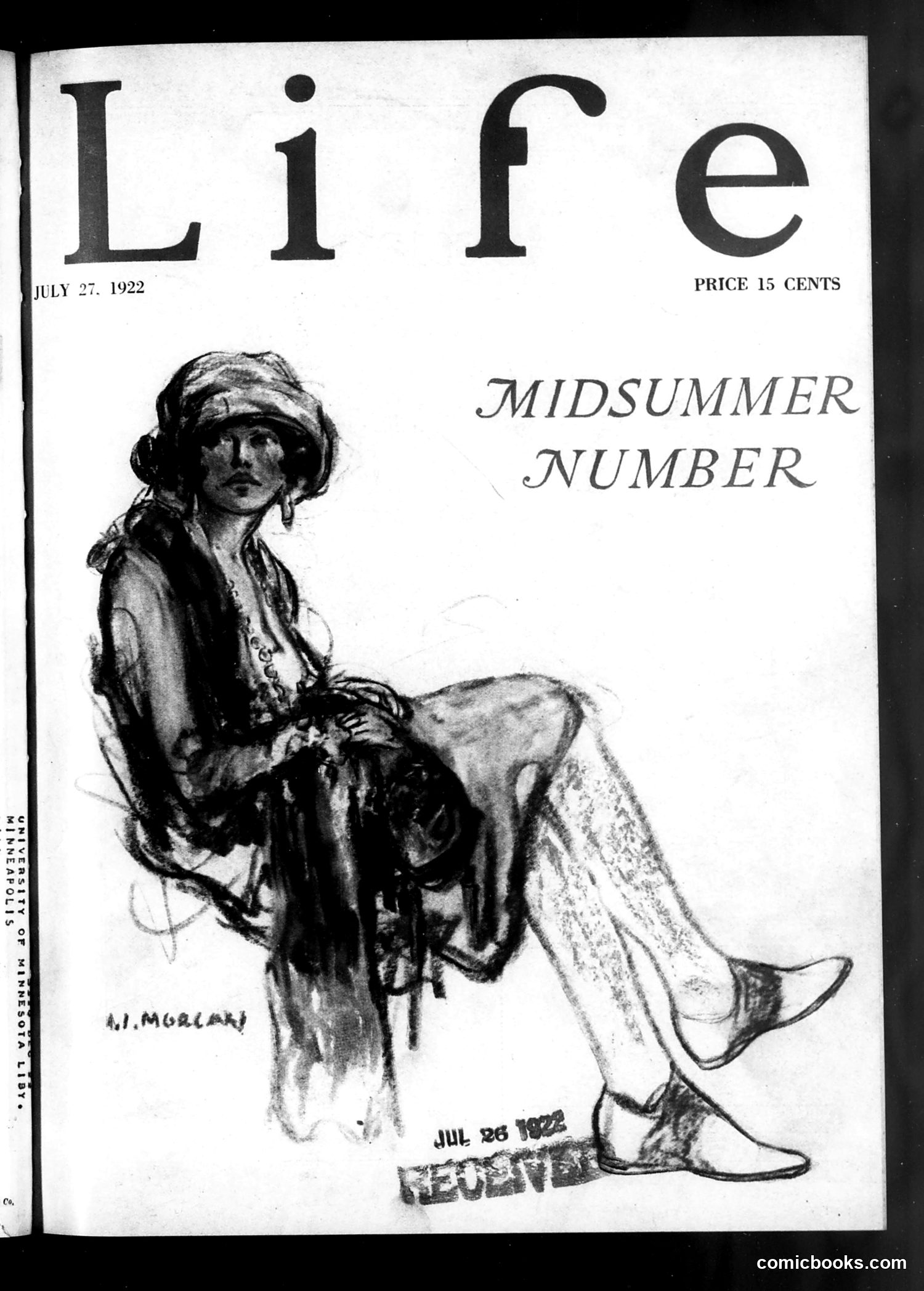
This is the cover of Life's "Midsummer Number," priced at 15 cents. The illustration, signed by artist W. McGlacken, depicts a woman in 1920s attire—cloche hat, loose-fitting dress with draped fabric, and pointed shoes—in a relaxed, reclining pose. The image likely represents the "modern woman" or "flapper" of the Jazz Age era, a figure that dominated 1920s popular culture and satire. The carefree, languid posture and fashionable styling suggest commentary on evolving social attitudes toward women's freedom and changing gender roles during this period. The "Midsummer Number" designation indicates this was a special summer issue, typical for magazines of the era.
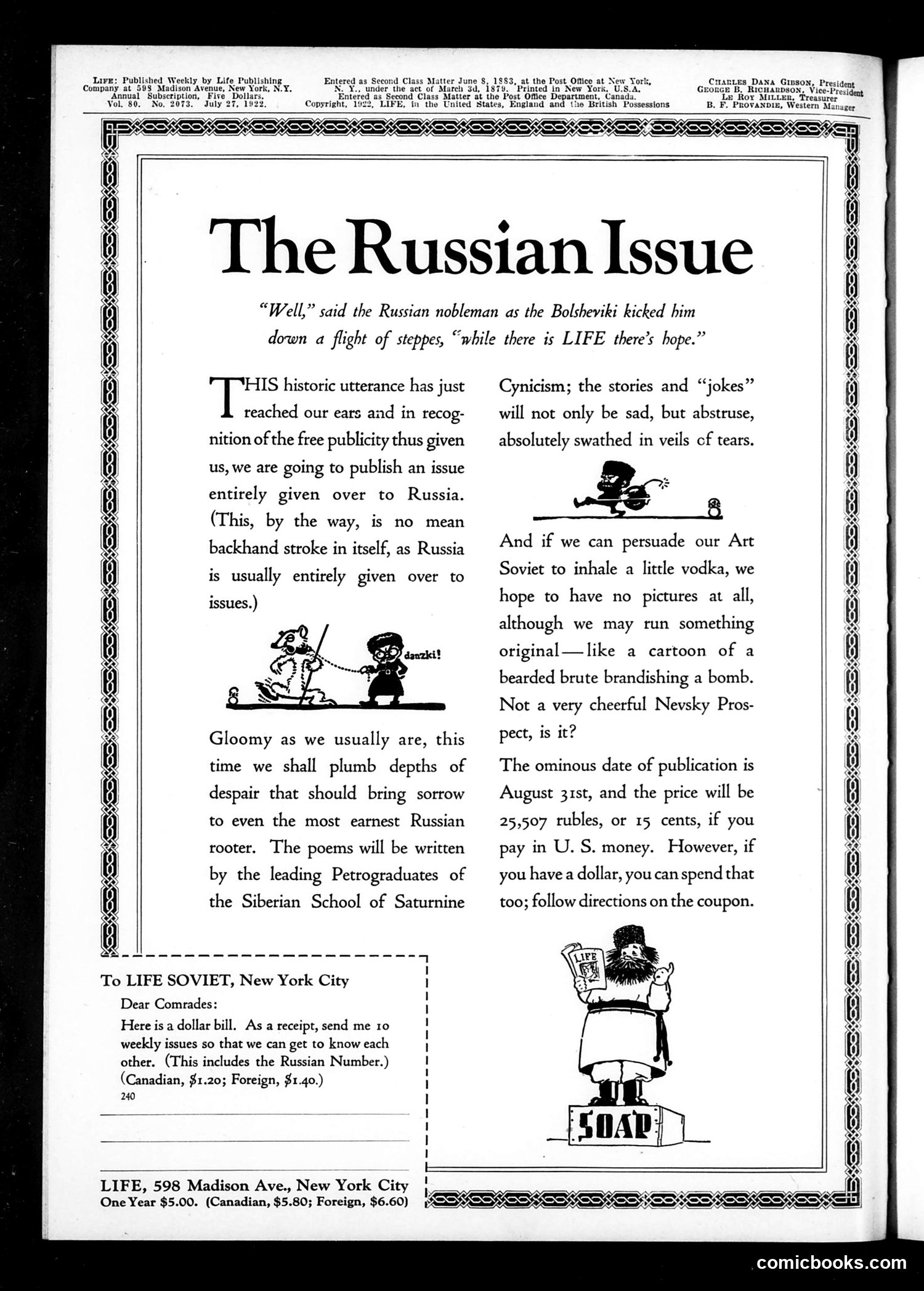
This 1932 *Life* magazine page satirizes the Soviet Union through dark humor. The opening quote—"while there is LIFE there's hope"—jokes that even as Bolsheviks kick a Russian nobleman down stairs, optimism persists. The cartoons depict stereotypical Russian violence: one shows a figure being struck, another a bearded revolutionary with a bomb. The text mocks Soviet brutality while maintaining *Life*'s ironic tone, promising gloomy poetry from "Petrograduates of the Siberian School of Saturnine" cynicism. The subscription coupon offers 10 weekly issues for $1, positioning this as an anti-Soviet political statement packaged as entertainment. The imagery and messaging reflect American Cold War-era stereotypes of Soviet barbarism and communist terrorism—themes that would dominate U.S. political discourse for decades.
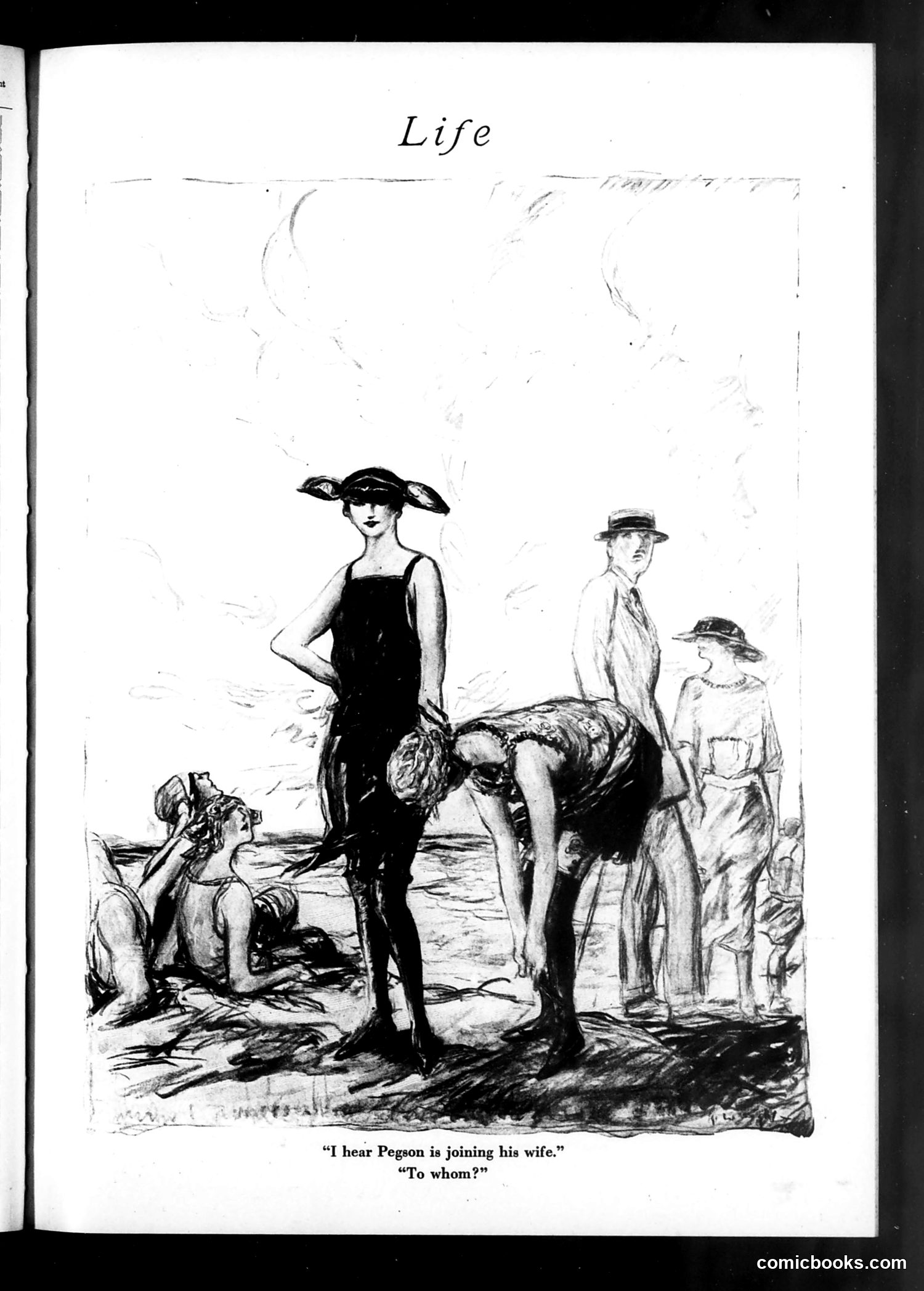
This cartoon from *Life* magazine shows a beach scene with several figures in early 20th-century bathing attire. The caption reads: "I hear Pegon is joining his wife." "To whom?" The joke appears to be a marital infidelity gag—someone named Pegon is "joining" (or reuniting with) his wife, but the questioner humorously asks "to whom?" implying the wife is already with another man. This suggests the wife is unfaithful or that Pegon's marriage is troubled. The specific identity of "Pegon" is unclear from context alone, though the casual reference suggests he was likely a recognizable public or social figure of the era. The humor relies on contemporary gossip about marital scandals among the upper classes who frequented beaches.
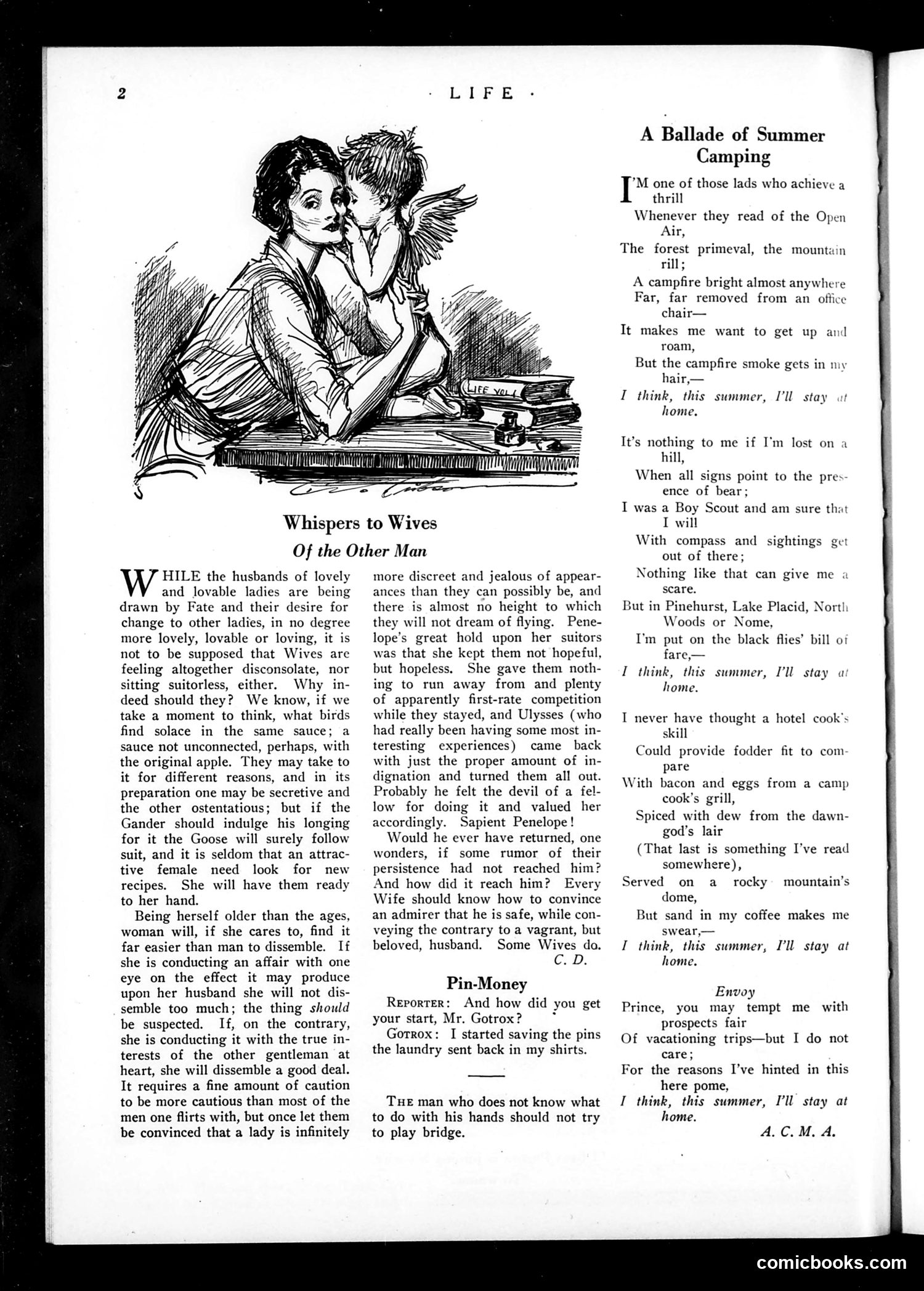
This page contains three separate pieces of satirical prose and humor rather than political cartoons: 1. **"Whispers to Wives of the Other Man"** - A cynical commentary on infidelity, advising wives how to handle affairs with calculated indifference rather than confrontation. 2. **"A Ballade of Summer Camping"** - A humorous poem mocking the romanticization of outdoor camping, where the narrator insists he'll stay home despite camping's supposed appeals (bears, lack of hygiene, discomfort). 3. **"Pin-Money"** - A brief joke about a man starting a money-saving scheme by collecting laundry pins from his shirts. The illustrated vignette shows a woman and cherub, likely accompanying the infidelity piece. These pieces reflect early 20th-century Life magazine's focus on domestic satire and middle-class social commentary rather than political cartooning.
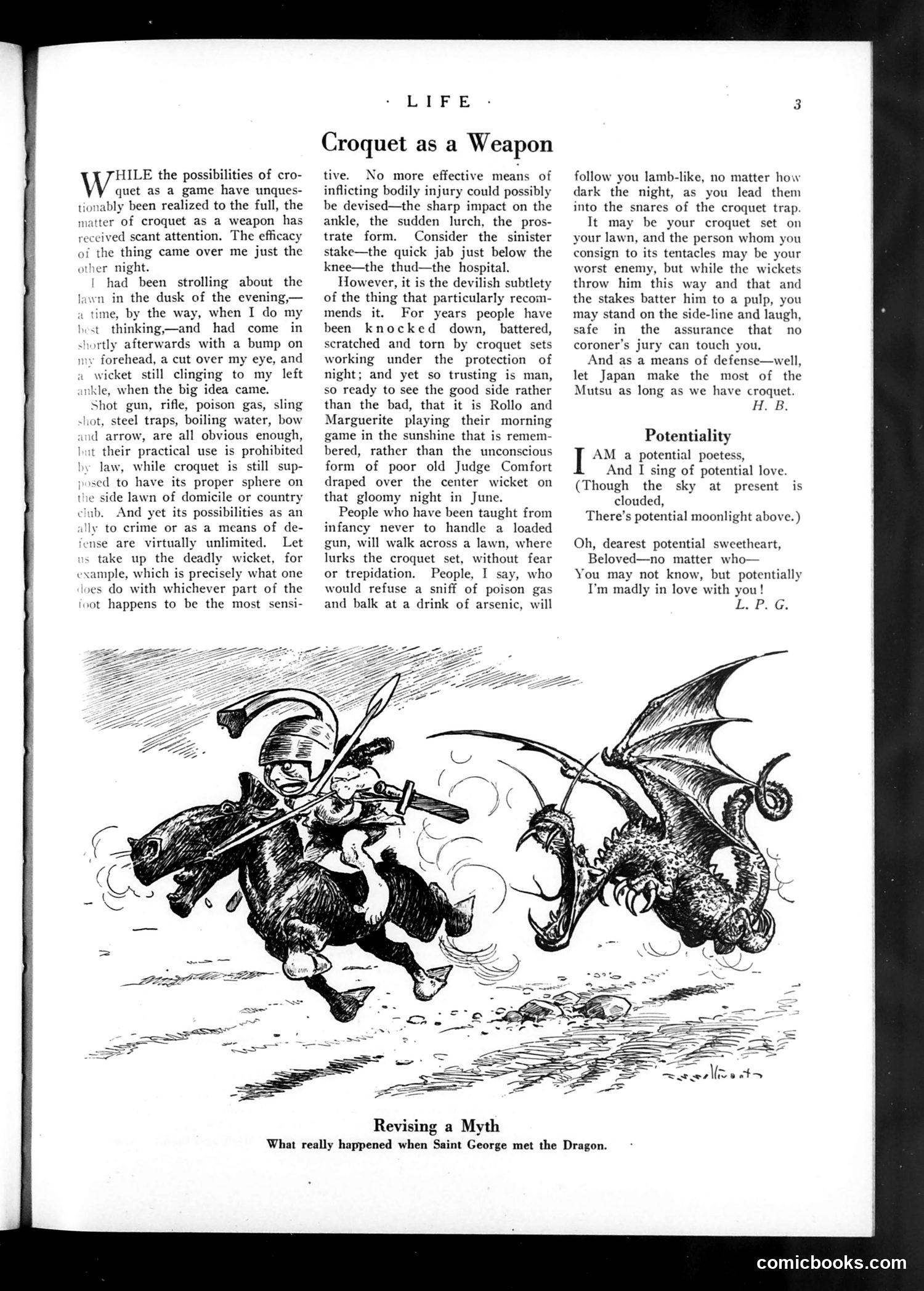
This page contains two distinct pieces: **"Croquet as a Weapon"** (left column): A humorous essay arguing that croquet, typically viewed as a genteel parlor game, is actually an effective means of inflicting bodily harm. The author catalogs croquet's dangerous potential—the sharp impact on ankles, sudden lurches, and trap mechanisms—suggesting it rivals actual weapons in lethality. The tone is satirical, mocking both the game's deceptive civility and society's willingness to overlook violence when dressed in respectable form. **"Revising a Myth"** (bottom): An illustration captioned "What really happened when Saint George met the Dragon" depicts Saint George wielding a croquet mallet against a dragon. This visual joke reinforces the preceding essay's satire by reimagining a legendary heroic narrative through croquet's lens, treating the implement as genuinely formidable weaponry. Both pieces use absurdist humor to comment on hidden violence in "civilized" pastimes.
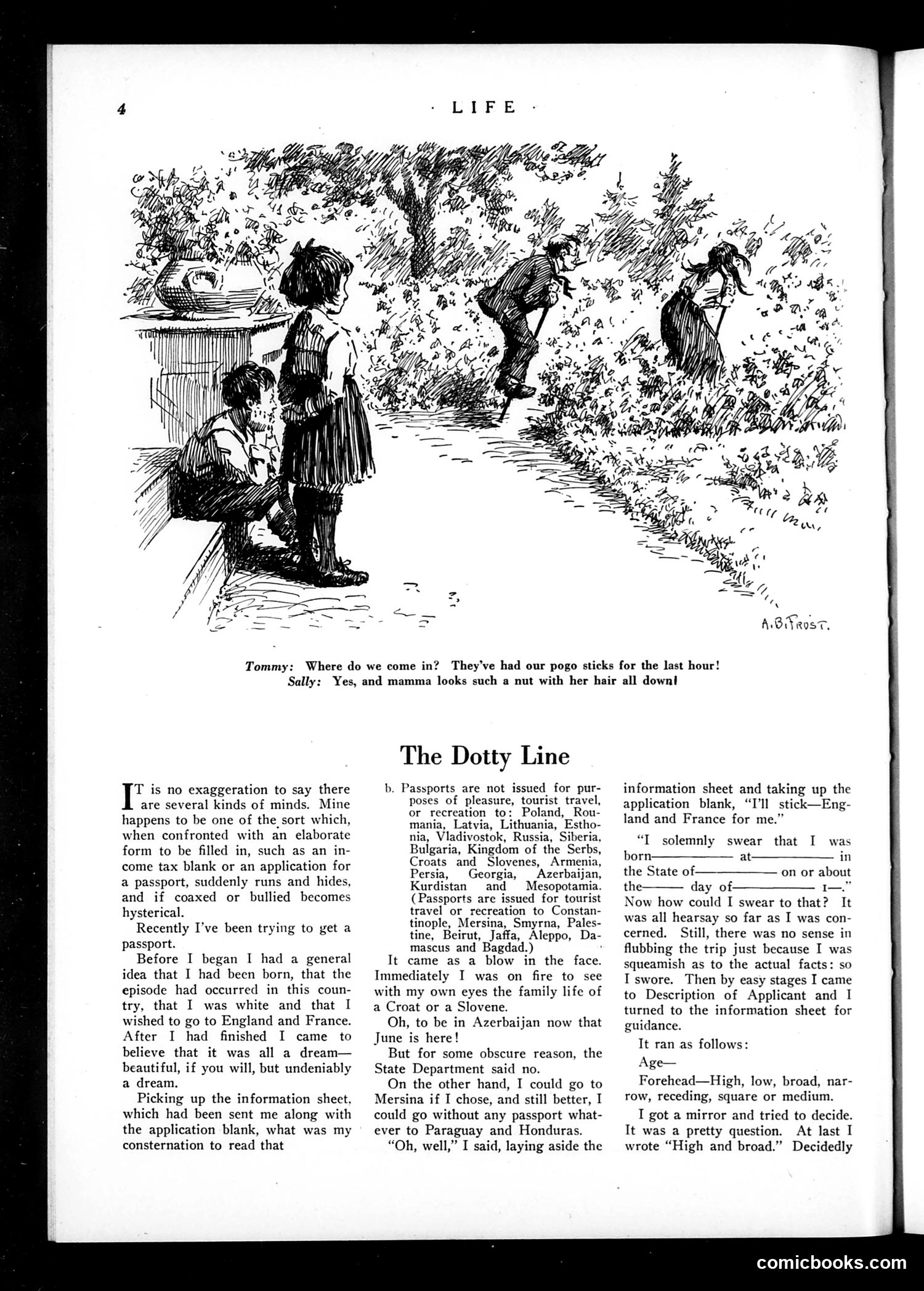
The cartoon depicts children at a garden gate watching adults behave strangely. The accompanying article discusses the absurdity of passport application requirements. The satire targets bureaucratic inconsistency: the author notes that while some countries issue passports freely for pleasure travel (Poland, Romania, etc.), the U.S. State Department inexplicably denied his passport application despite being "white" and wishing to visit England and France. The cartoon illustrates this bureaucratic madness—the adults appear disheveled and irrational ("mamma looks such a nut with her hair all down"), suggesting that passport officials behave illogically and arbitrarily. The piece satirizes government inefficiency and discriminatory application standards, with the children's confused observations mirroring readers' bewilderment at such policies.
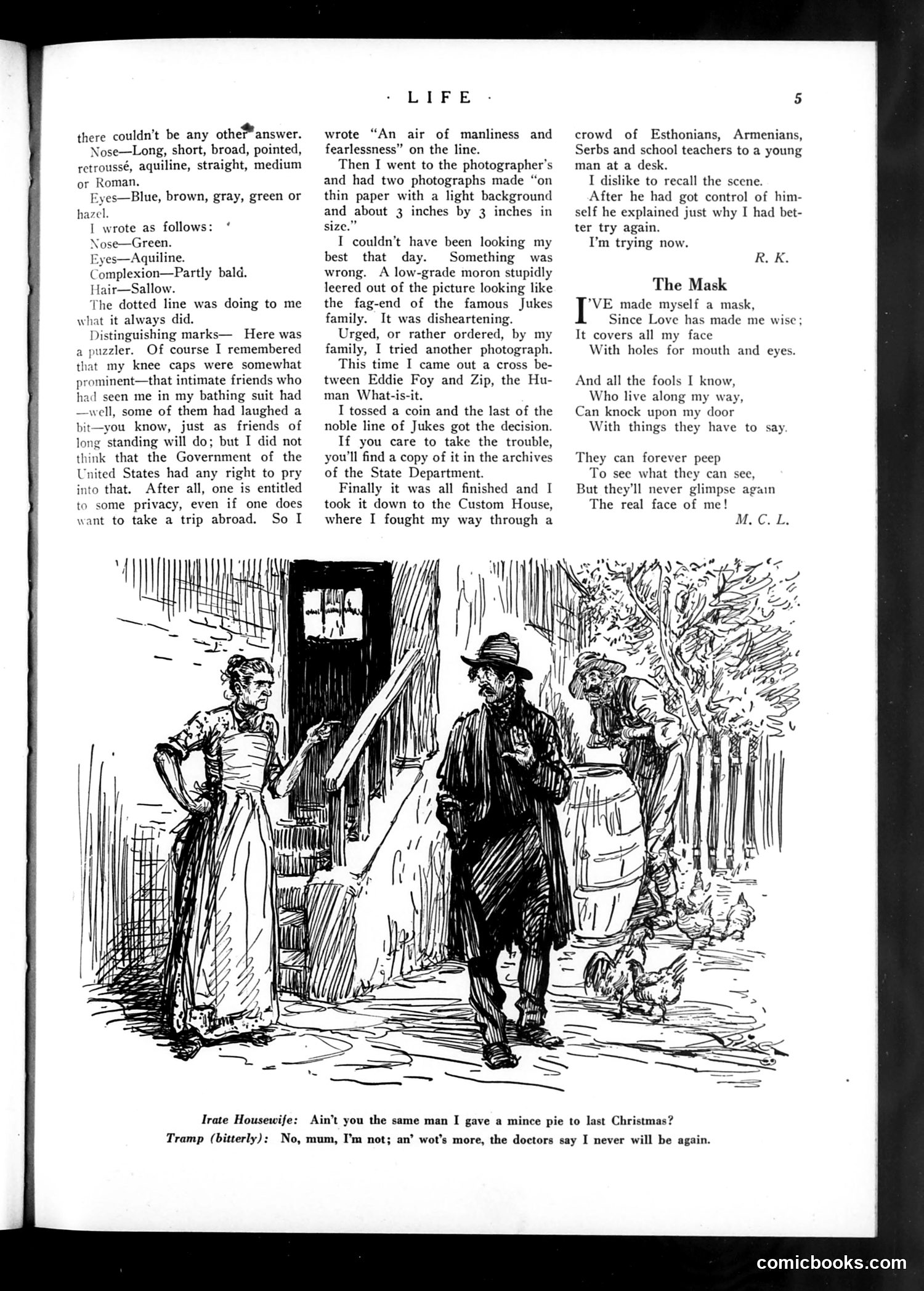
This page contains a sketch-based cartoon depicting what appears to be a social encounter on a street. An "Irate Housewife" confronts a "Tramp," accusing him of being the same man she gave a mince pie to at Christmas. The tramp replies bitterly that he's not the same man because doctors say he'll never recover—implying serious illness or injury from his circumstances. The satire targets early 20th-century attitudes toward poverty and homelessness. It mocks both the housewife's patronizing charity (a single pie) and society's indifference to the tramp's deteriorating condition. The dark humor suggests that minimal charity cannot address systemic poverty, and that the vagrant's fate is essentially sealed by his circumstances and lack of medical care.
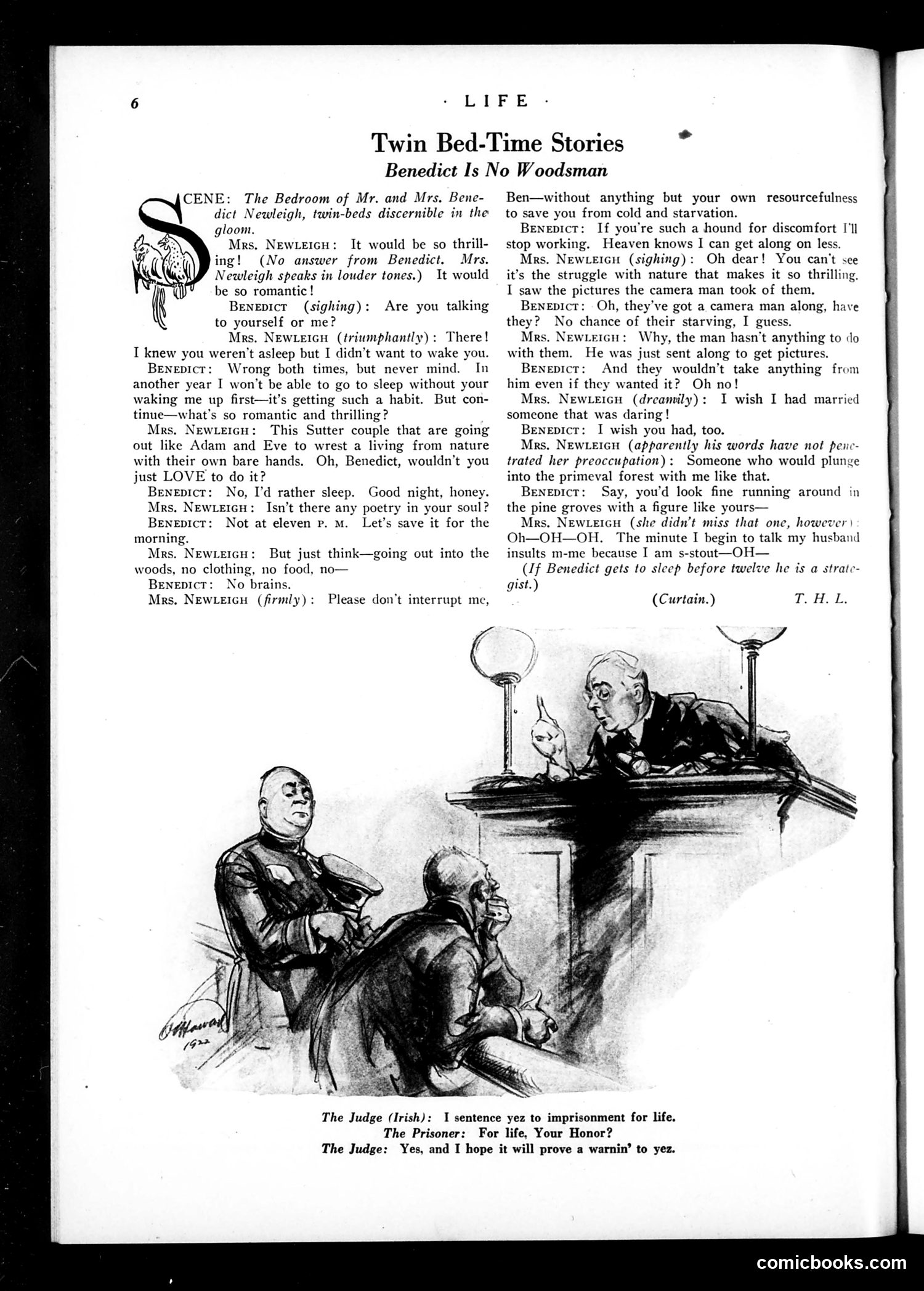
This page contains two distinct pieces: **Top: "Benedict Is No Woodsman"** — A bedroom dialogue between Mr. and Mrs. Benedict and Mrs. Newleigh. The humor relies on marital tension: Mrs. Benedict wants romantic adventure (sleeping outdoors), while Mr. Benedict refuses, preferring comfort. Mrs. Newleigh's interjections mock both the couple's pretensions and contemporary "back-to-nature" idealism. The joke satirizes romanticized notions of primitive living versus practical domestic reality. **Bottom: A courtroom cartoon** featuring an Irish judge sentencing a prisoner to life imprisonment, with the judge's closing remark ("I hope it will prove a warnin' to yez") being darkly ironic—a life sentence cannot logically warn anyone. This appears to satirize either harsh judicial sentencing or Irish judicial practices, likely representing stereotypical Irish brogue through dialect. Both pieces reflect early 20th-century American middle-class anxieties and ethnic humor.
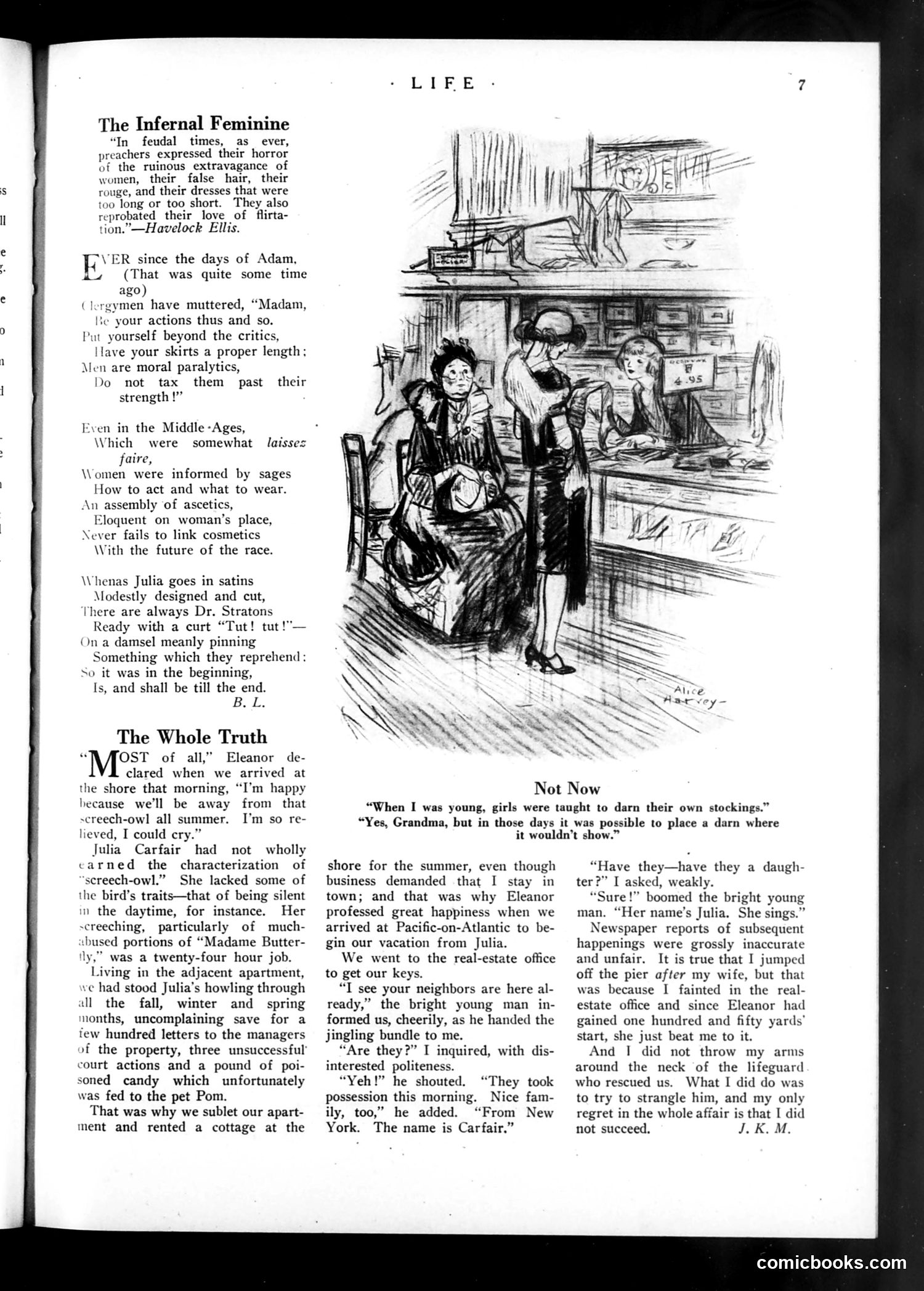
This page satirizes women's fashion and behavior through two articles with accompanying sketch. **"The Infernal Feminine"** mocks medieval and contemporary criticism of women—their clothing choices, cosmetics, and flirtatiousness. It quotes historical disapproval of women's dress length and hairstyles, then uses the character Julia to illustrate ongoing male anxiety about female vanity. **"The Whole Truth"** and **"Not Now"** (with the sketch) depict a grandmother-granddaughter conversation about darning stockings. The grandmother recalls when girls could hide darning imperfections, while the modern young woman must show her legs—implying changing social standards and women's increased visibility/scrutiny. The sketch shows this generational tension about female propriety and fashion exposure during what appears to be the 1920s flapper era.
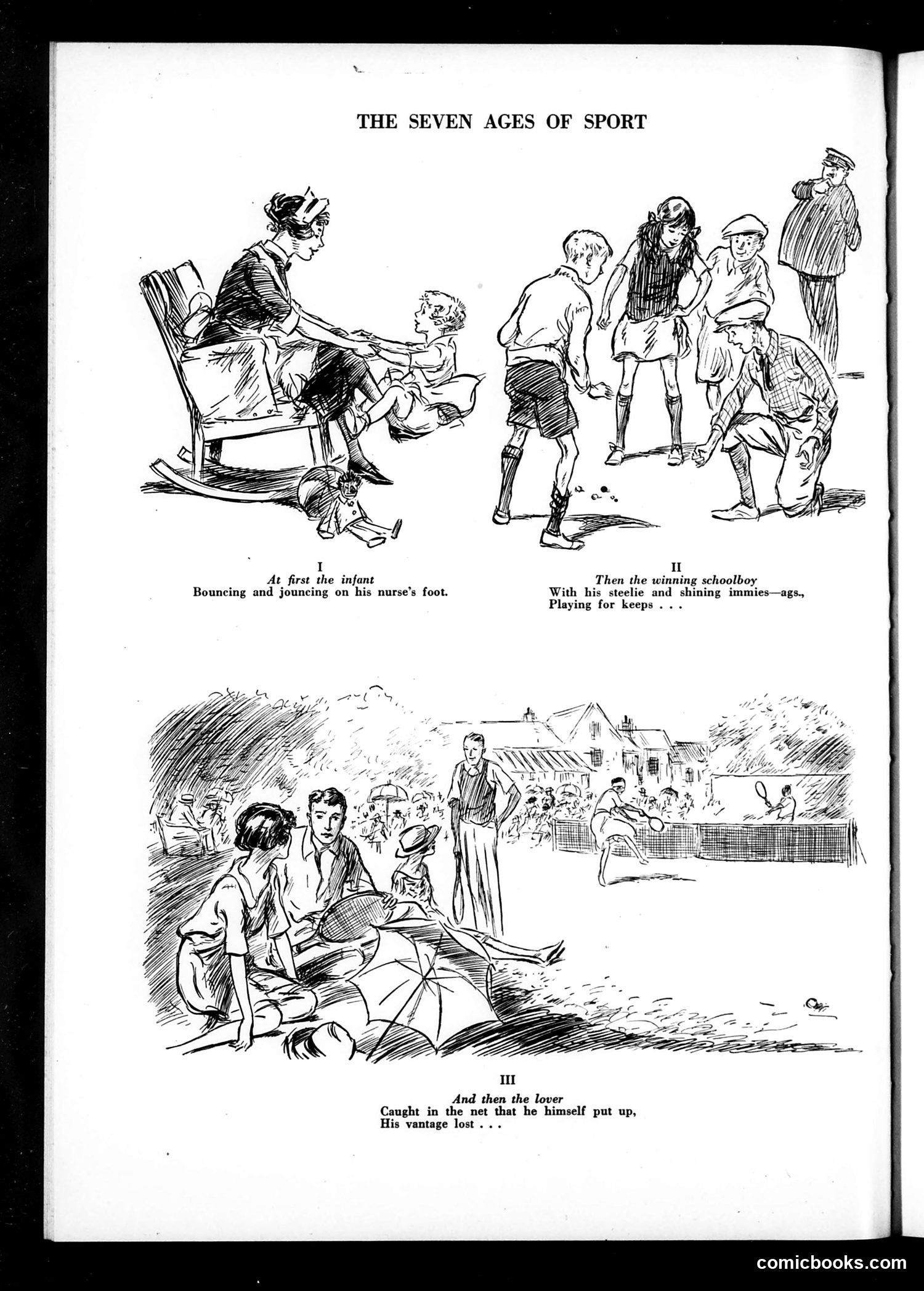
This illustrated sequence humorously depicts sport across different life stages: **Stage I**: An infant bouncing on a nurse's lap—sport as physical play begins in infancy. **Stage II**: School-age boys playing with "steelie and shining jimmies" (marbles), competing for "keeps"—the competitive schoolboy phase. **Stage III**: A young man playing tennis, "caught in the net that he himself put up, / His vantage lost"—likely satirizing romantic entanglement interfering with athletic pursuits. The domestic scene (woman with umbrella nearby, country house setting) suggests courtship has sidelined his sporting ambitions. The cartoon's progression suggests how life circumstances—particularly romance and marriage—progressively diminish a man's athletic engagement, moving from innocent childhood play toward adult social complications.
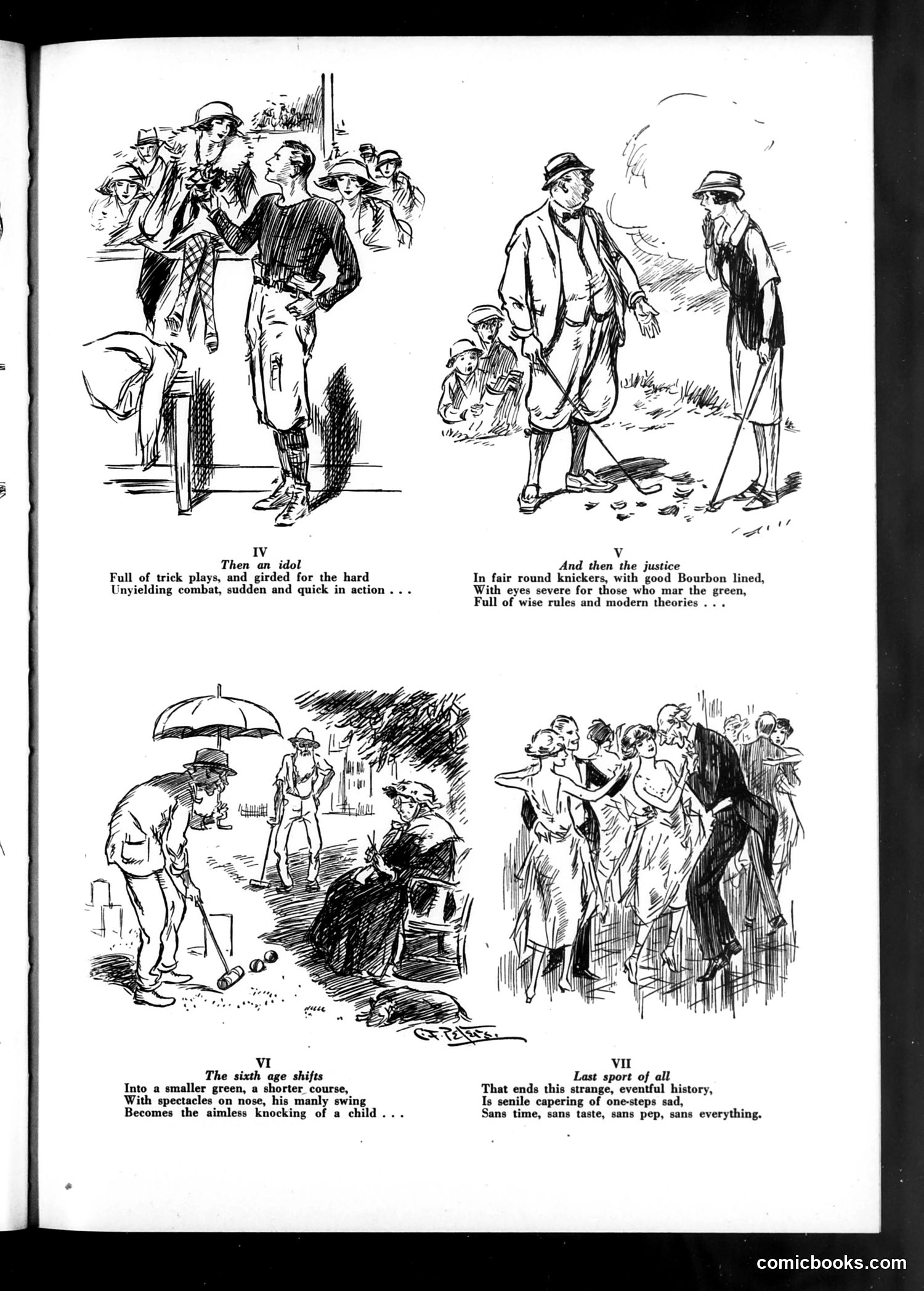
This page satirizes the evolution of golf from an aristocratic pursuit to a mass-market sport. The seven panels trace golf's progression: **IV-V**: An "idol" golfer (well-dressed, surrounded by admirers) contrasts with a "justice" figure enforcing rules strictly. **VI**: Golf becomes accessible to ordinary people, shown by a man with spectacles playing on a smaller, public course—"the aimless knocking of a child." **VII**: The final stage depicts golf's popularization as chaotic and undignified—"sans time, sans taste, sans pep, sans everything." The satire mocks how golf transitioned from an exclusive gentleman's game to a democratized leisure activity, with the implication that mass participation degraded the sport's prestige and quality. The verses emphasize this decline throughout.
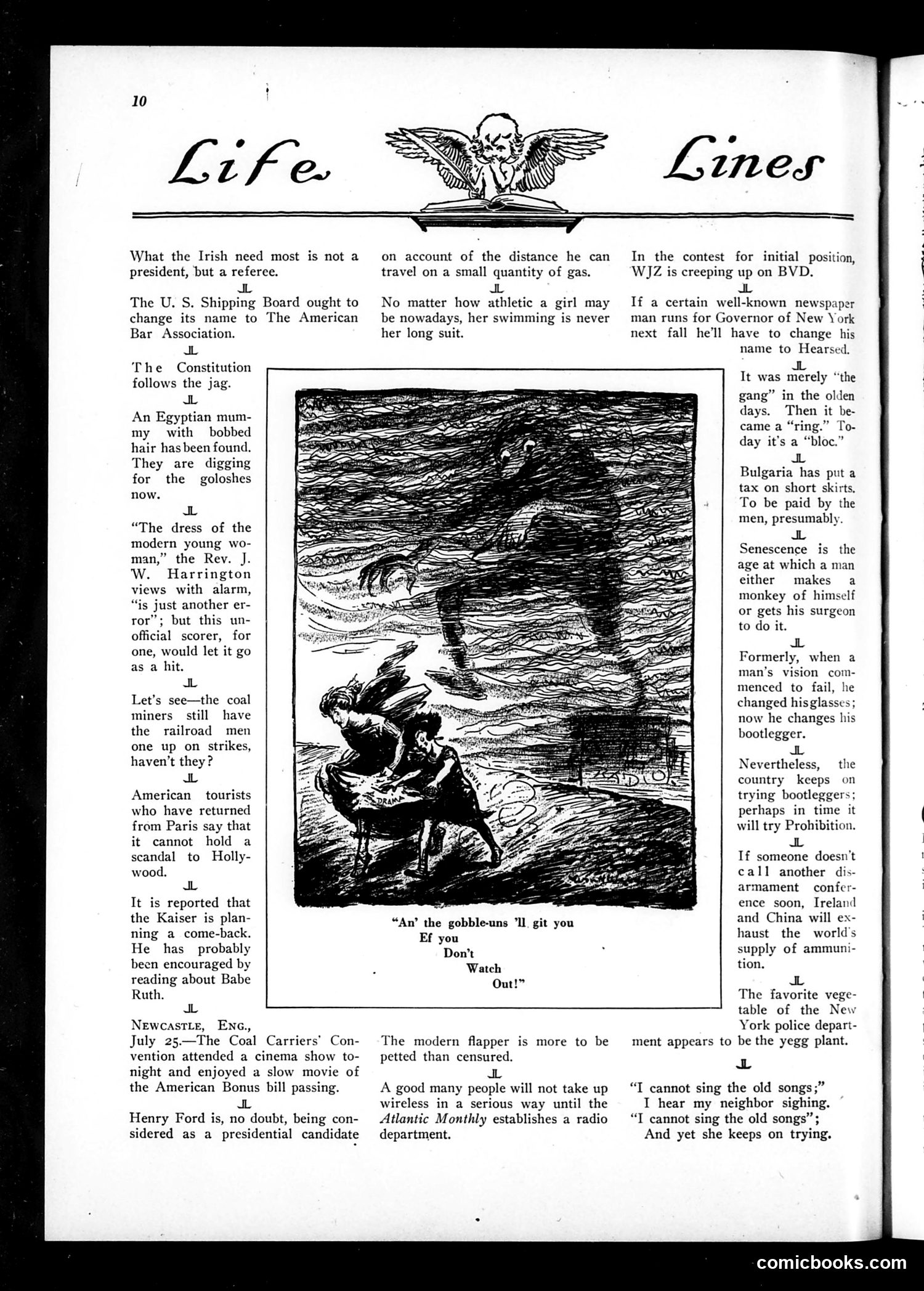
This satirical page contains a central cartoon titled "An' the gobble-uns 'll git you Ef you Don't Watch Out!" The image depicts goblin-like creatures threatening a human figure—likely referencing James Whitcomb Riley's famous children's poem "Little Orphant Annie" (1885), which used the "gobble-uns" threat to frighten children into obedience. The surrounding text consists of brief satirical quips about contemporary issues: Irish politics, shipping regulations, Egyptian archaeology, women's fashion, and coal miners' strikes. The cartoon appears to humorously apply Riley's cautionary tale framework to warn about modern social anxieties, though the specific contemporary threat being referenced remains somewhat unclear from the visible text alone.
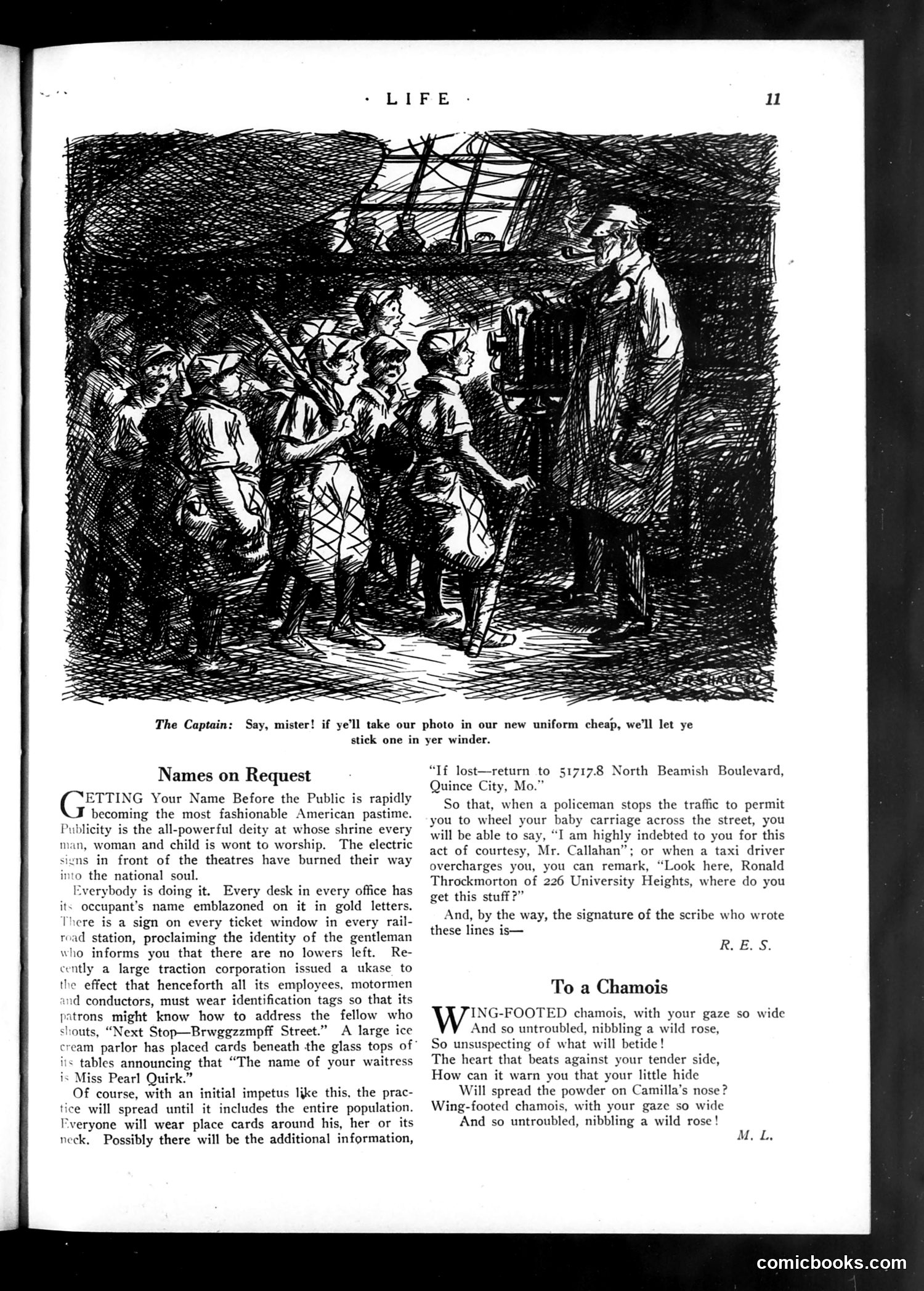
The page contains two distinct items: **Top Cartoon:** Shows soldiers in military uniforms speaking with a captain about having their photograph taken. The caption indicates they're negotiating to pose in "new uniform cheap" in exchange for letting the captain "stick one in yer winlder" (display it in his window). This satirizes soldiers as commodities in a commercial transaction and mocks both military vanity and the commercial exploitation of uniformed personnel for publicity. **Bottom Section:** "Names on Request" discusses the American trend of public name-display (on desks, tickets, storefronts). It satirizes how business increasingly uses employees' names as marketing tools, treating identification as a form of worship. The poem "To a Chamois" appears unrelated to the satirical content above.
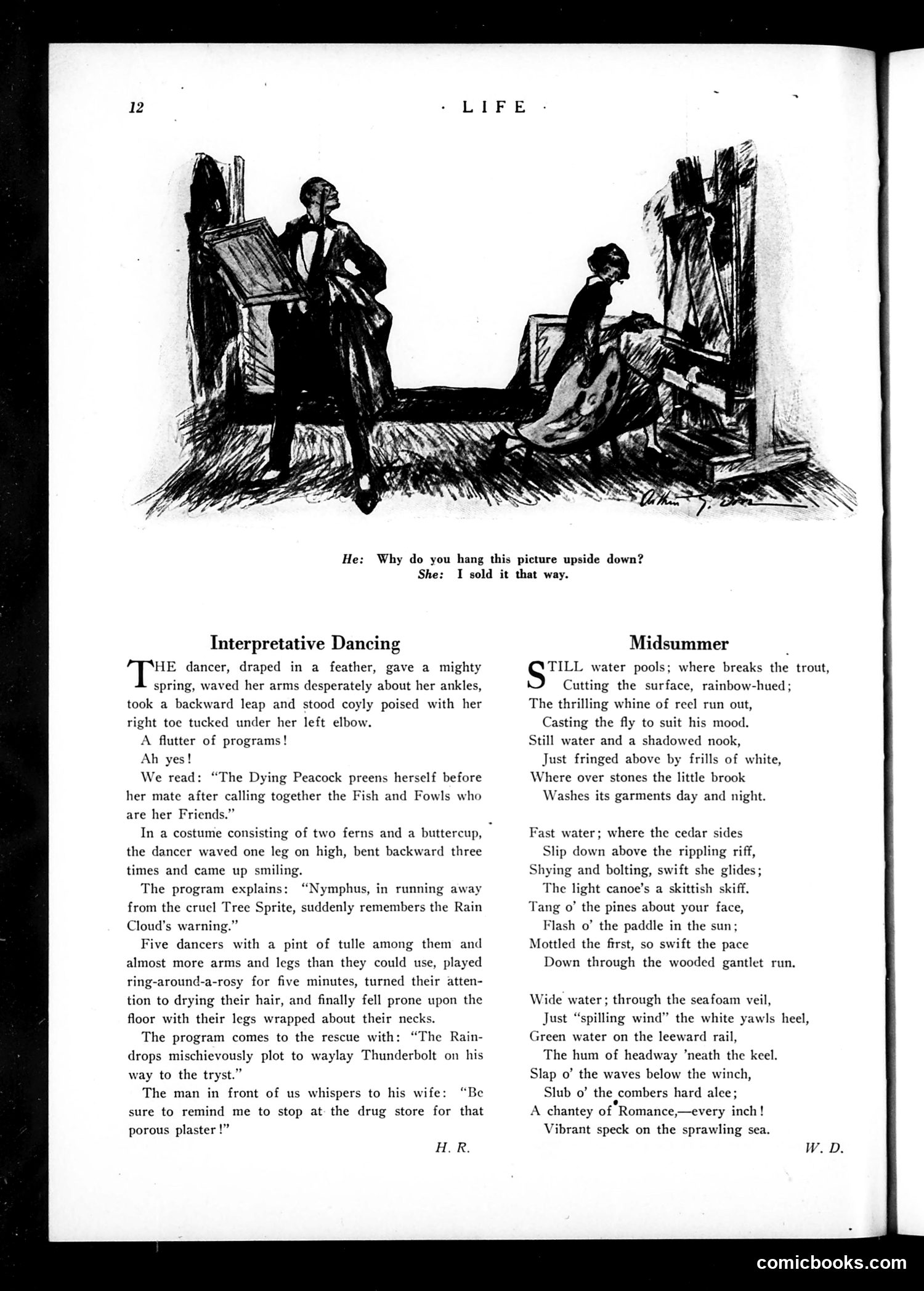
This page contains a single-panel cartoon and two separate literary pieces, not political satire. **The Cartoon:** Shows a man asking a woman why she's hanging a picture upside down; she replies "I sold it that way." The joke satirizes pretentious modern art and gullible collectors—suggesting that abstract or experimental art is so incomprehensible that its orientation doesn't matter, and that people buy it without understanding it. **The Literary Content:** Two poems follow—"Interpretive Dancing" by H.R. (mocking avant-garde dance performance) and "Midsummer" by W.D. (celebrating nature). The dancing poem's detailed parody of an experimental performance reinforces the cartoon's theme: early 20th-century modernism is presented as absurd and incomprehensible to ordinary people.
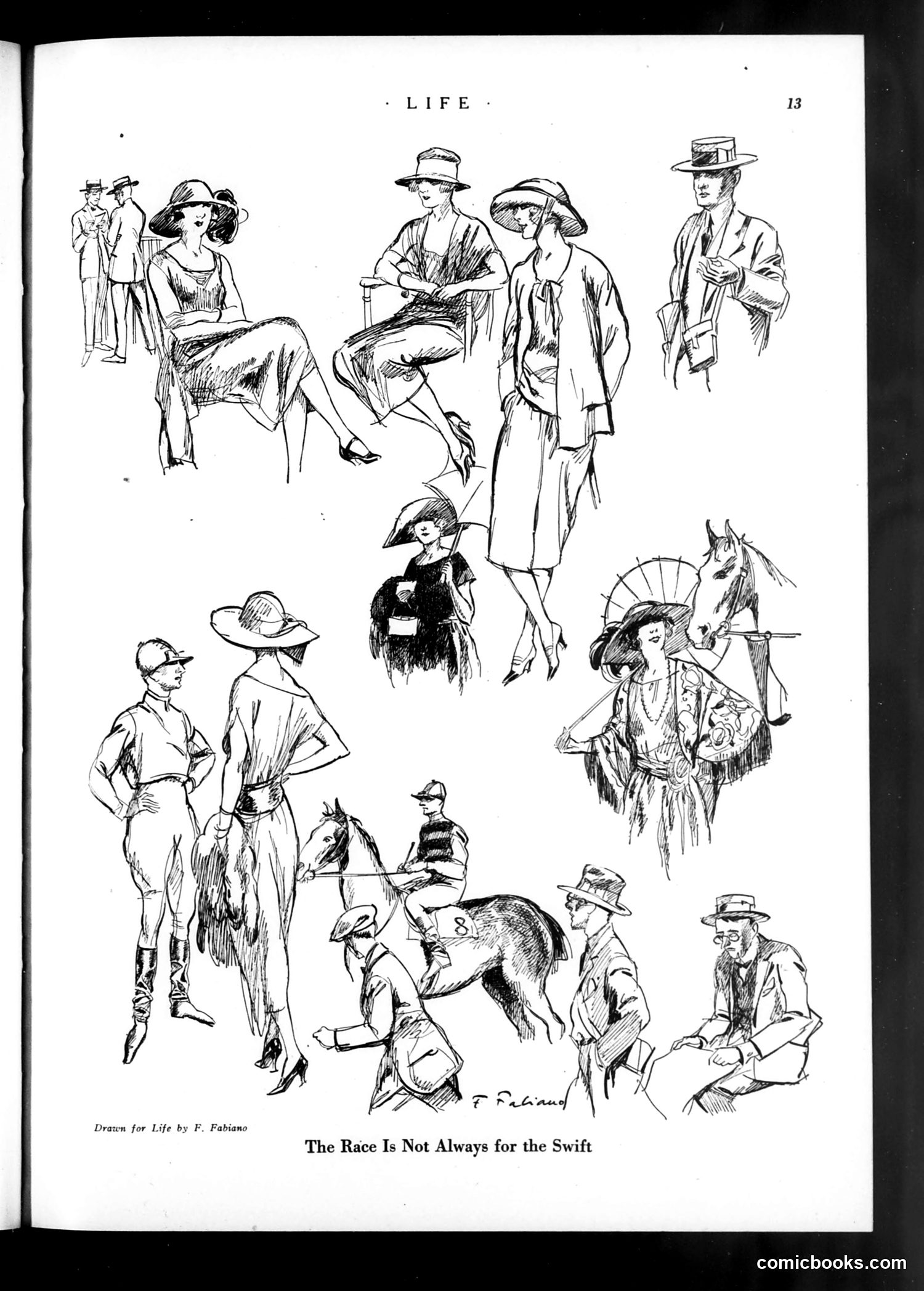
This satirical drawing by F. Fabiano depicts various scenes of horse racing and equestrian sports, referencing the proverb that victory doesn't always go to the fastest competitor. The illustration shows wealthy spectators in fashionable dress observing racing activities—including women in elaborate hats and coats typical of early 20th-century high society, men in suits, and jockeys with horses. The satire likely critiques the racing world's unpredictability and the folly of betting on "sure things." The title ironically suggests that despite common assumptions about who will win, outcomes remain uncertain. The mixed scenes of observation, riding, and horseback activities emphasize the sport's social prominence among the wealthy class during this period.
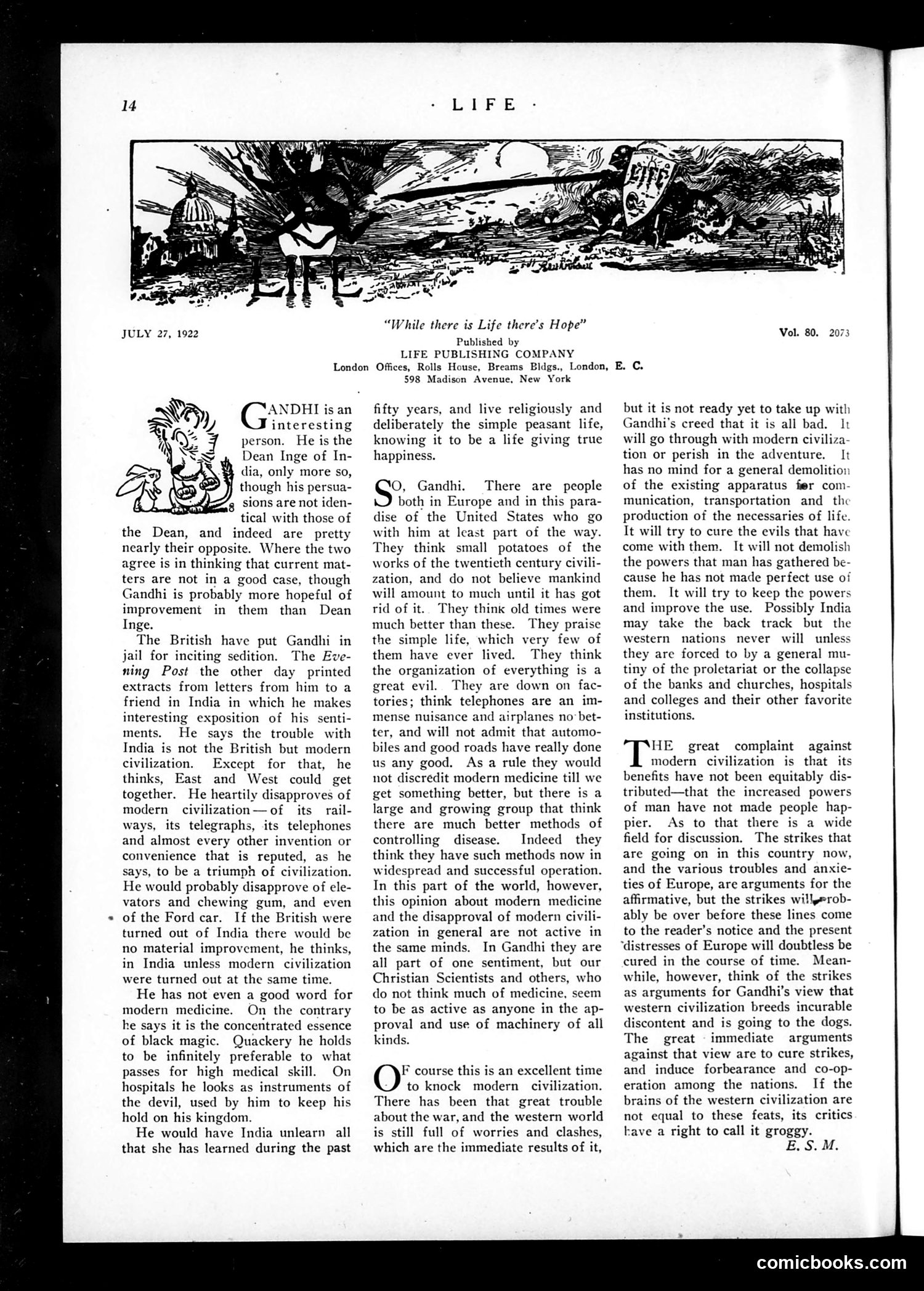
The page features a satirical article about **Mohandas Gandhi**, identified as "an interesting person" and "Dean of India." The cartoon at top depicts Gandhi as a skeletal, demonic figure riding what appears to be a flying vehicle labeled "LIFE," with chaotic scenes below. The article critiques Western attitudes toward Gandhi, noting that some Westerners dismiss him as promoting outdated ideas hostile to modern civilization—rejecting railways, telegraphs, and medicine. However, the author (E.S.M.) argues Gandhi's critique of industrial civilization has merit, particularly regarding post-WWI European turmoil. The piece suggests Western intellectuals shouldn't dismiss Gandhi's philosophy entirely, though his methods remain debatable. The dark cartoon suggests contemporary skepticism about Gandhi's radical vision.
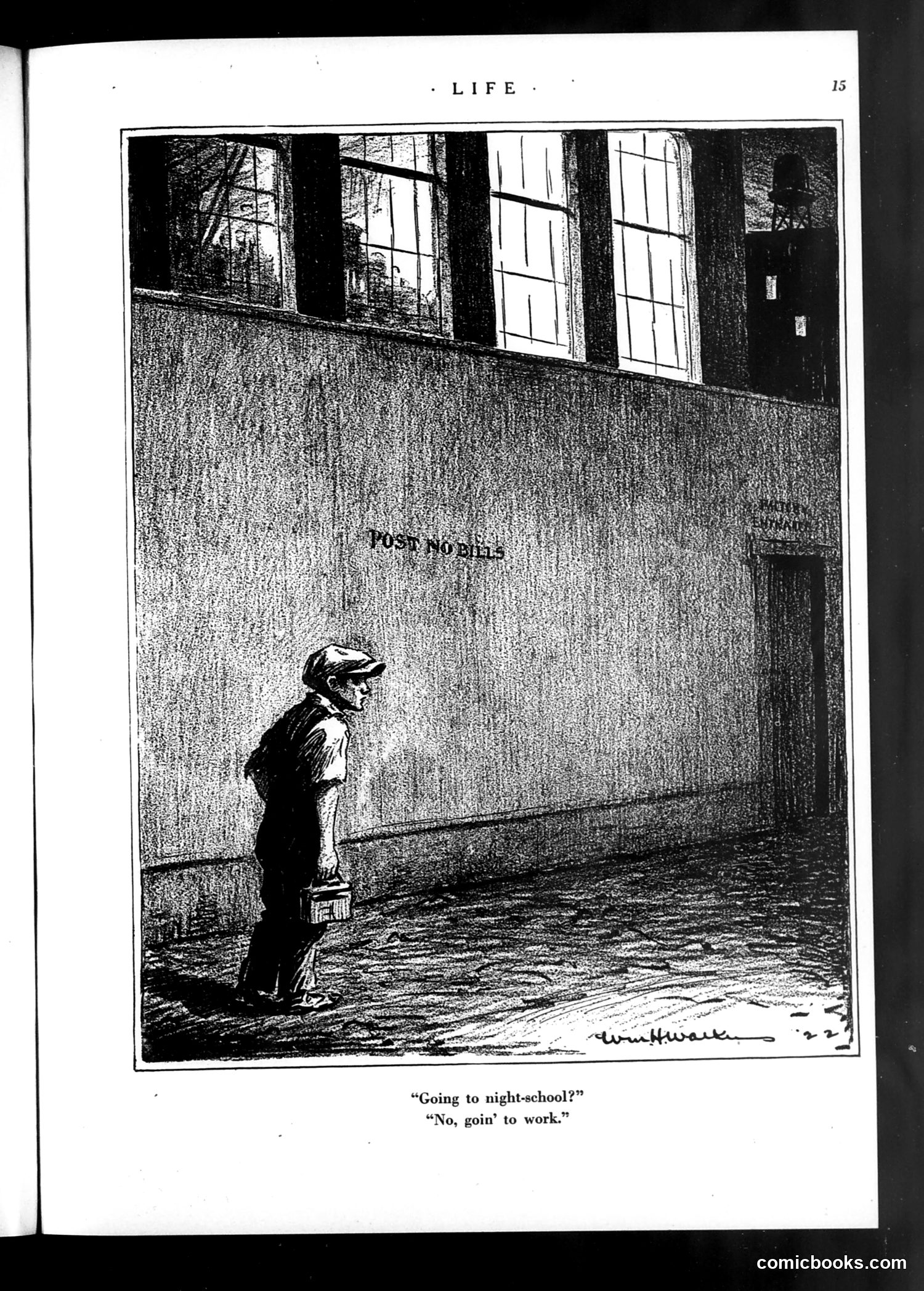
This is a single-panel cartoon depicting a working-class boy carrying what appears to be a lunch pail or work gear, standing against an industrial building marked "POST NOHELL" (likely "Post No Bills"). The joke critiques child labor and lack of educational opportunity during the industrial era. When asked if he's going to night school—an avenue for working children to gain education—the boy responds "No, goin' to work." The cartoon satirizes the economic desperation that forces children into factory work rather than education, even evening instruction. This reflects Progressive Era concerns about child labor practices in American industry and the barriers poor children faced in accessing schooling.
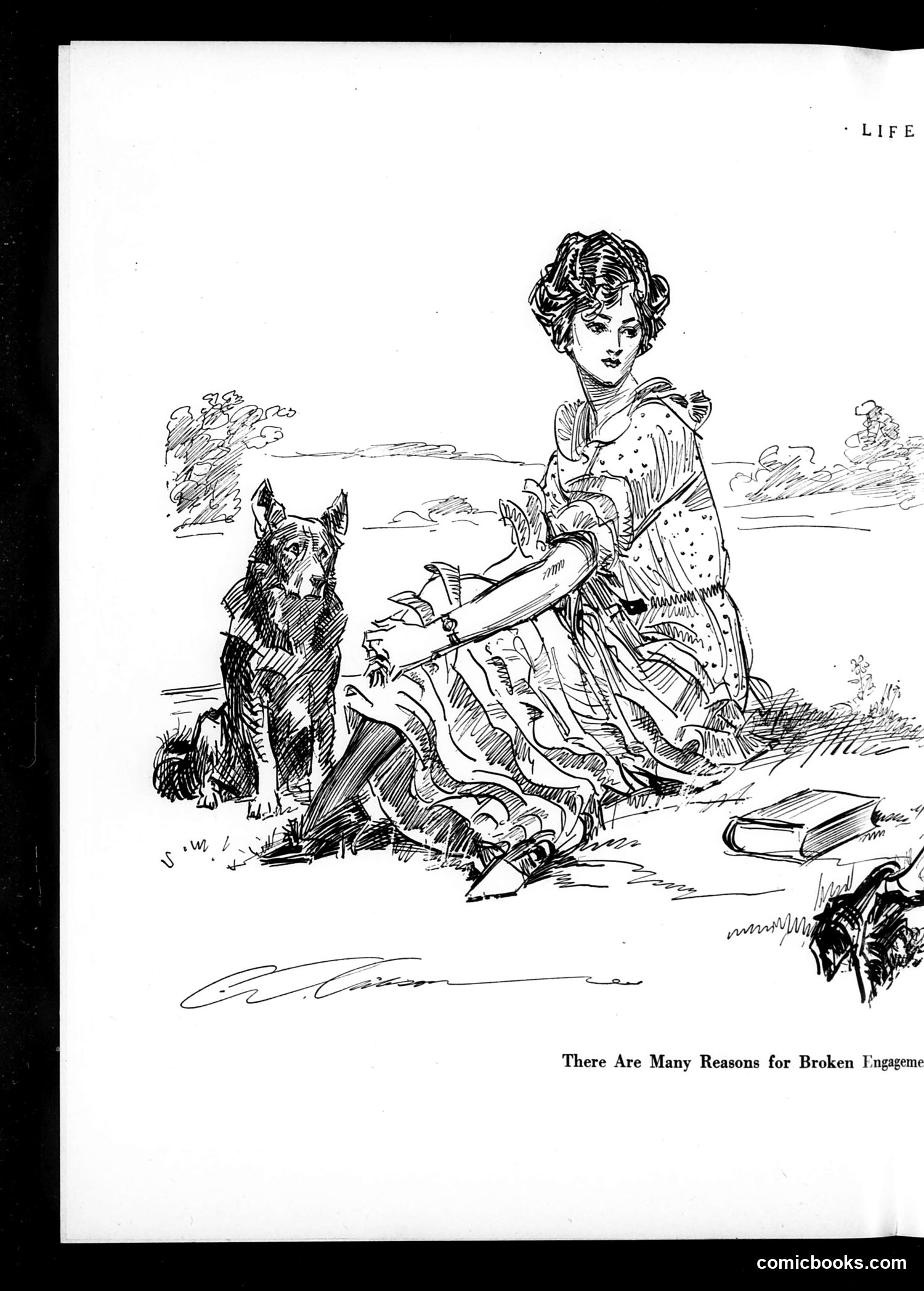
This appears to be an illustration from *Life* magazine showing a young woman in an elegant dress sitting outdoors with a dog, reading what appears to be a letter or document. A book lies nearby on the ground. The caption reads: "There Are Many Reasons for Broken Engagements" (text cuts off). The image depicts a romantic or sentimental scene—likely illustrating one of those reasons humorously. The woman's contemplative pose and the formal setting suggest she may have received bad news regarding her engagement. Without seeing the complete caption or additional context, the specific satire isn't entirely clear, but the illustration appears to comment on the various circumstances that could lead to broken engagements in early 20th-century society—a topic *Life* frequently addressed with wit and social commentary.
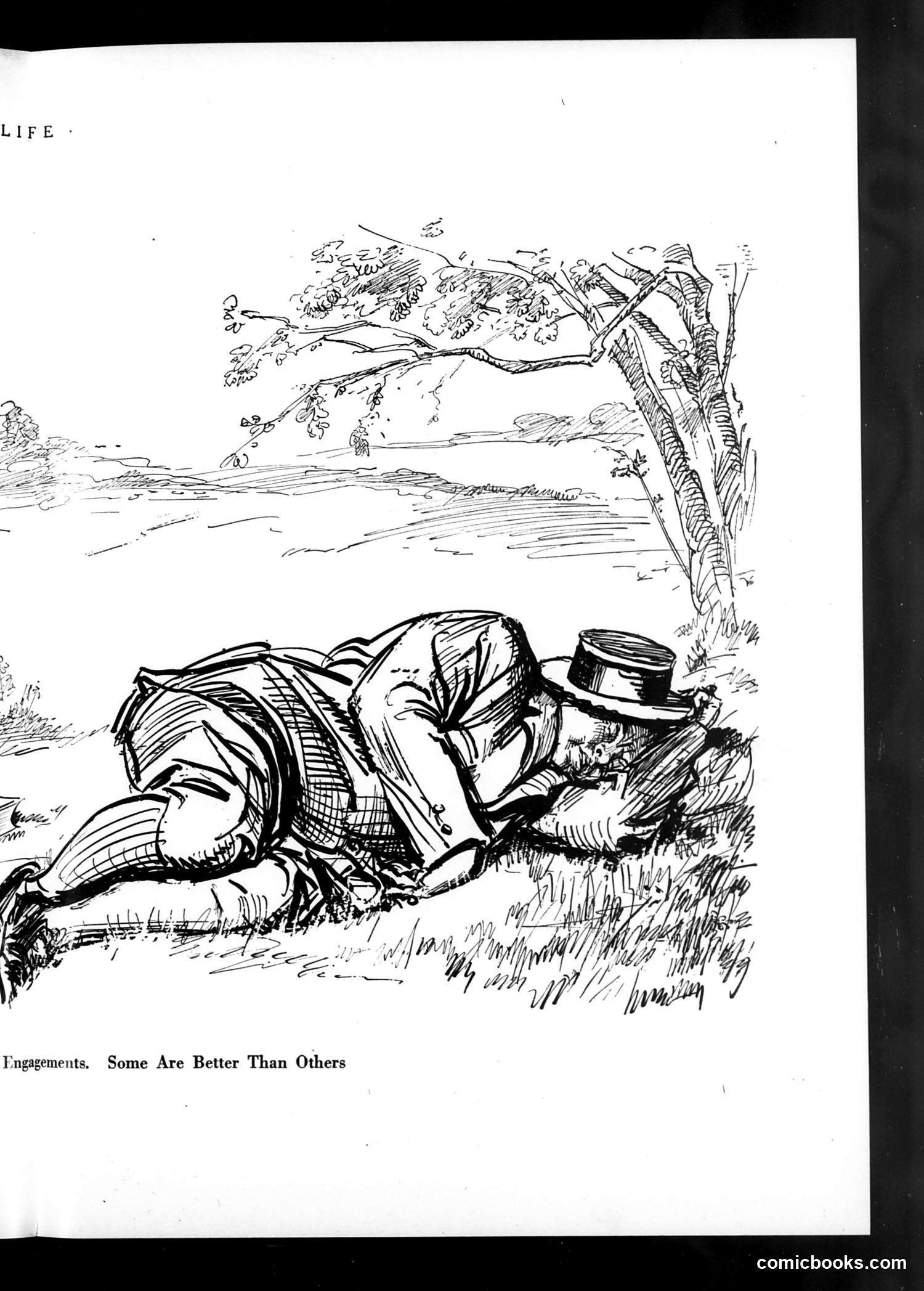
This cartoon from *Life* magazine satirizes romantic engagements through the figure of a man lying prone on the ground beneath a tree, appearing exhausted or defeated. The caption "Engagements. Some Are Better Than Others" suggests commentary on courtship or marriage proposals. The man's posture—collapsed in the grass wearing formal attire (suit and hat)—implies he's been worn out by romantic pursuit or engagement-related obligations. The wind-blown tree above may symbolize turbulent romantic circumstances. Without additional context about the specific historical period or any identifying details of the figure, the exact political or social reference remains unclear. However, the cartoon appears to mock the arduous nature of courtship expectations, presenting engagement as physically and emotionally draining rather than joyful.
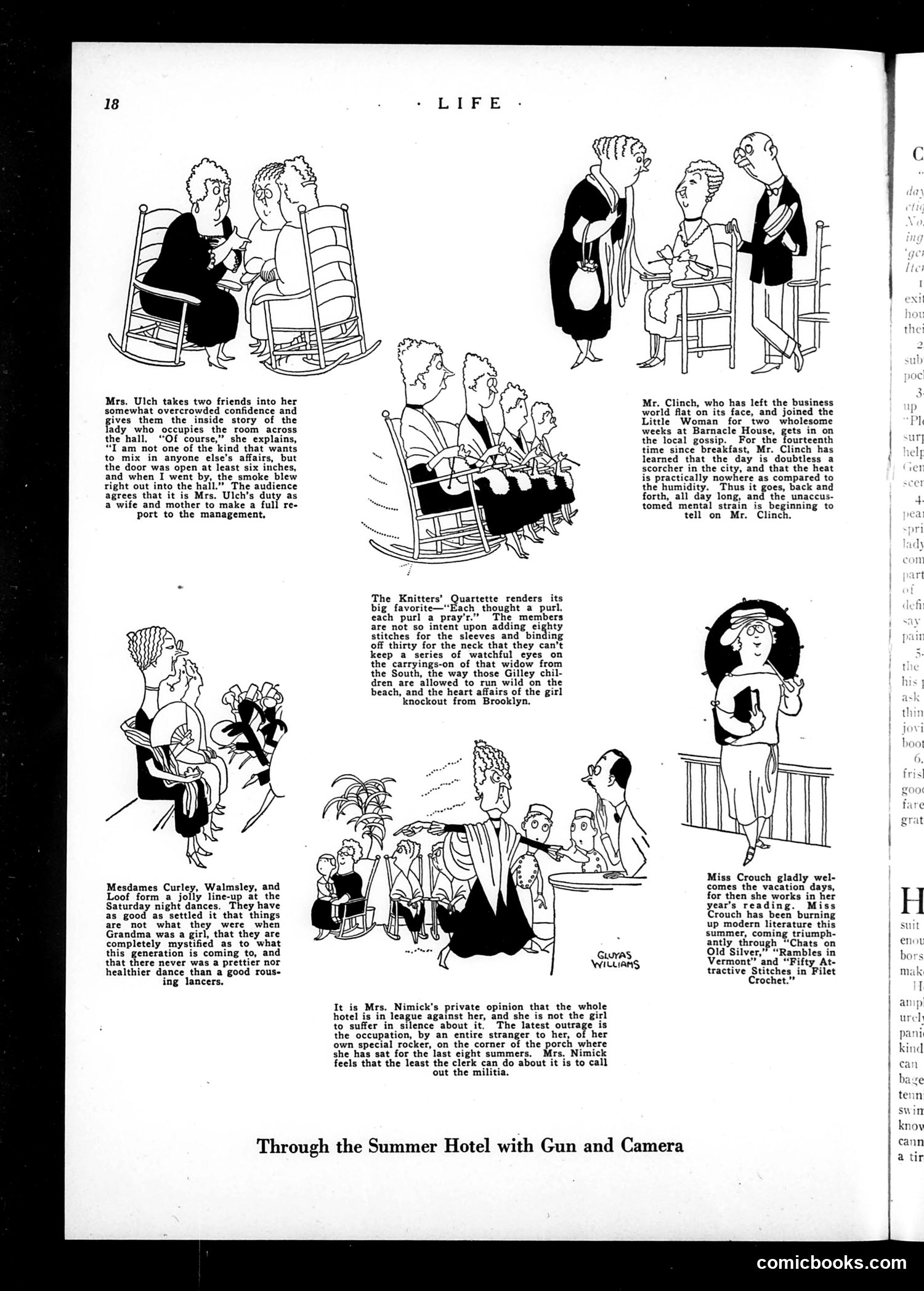
This page satirizes summer hotel social dynamics and gossip culture. The cartoons depict various hotel guests during their vacation: **Mrs. Ulch** exemplifies invasive gossip—she admits she's not one to pry while clearly doing exactly that, having peered through a partially open door to report on a neighbor's smoking habits to hotel management. **Mr. Clinch** endures repetitive small talk about the heat, hearing the same observations fourteen times before breakfast. **The Knitters' Quartette** pretends devotion to their needlework while actively surveilling other guests' behavior—the "widow from the South," children on the beach, and "the girl knockout from Brooklyn." **Mrs. Nimick** represents petty entitlement, outraged that a stranger has taken her customary rocking chair after eight summers, demanding the hotel "call out the militia." The overall satire mocks the pettiness, busybodying, and territorial behavior of leisure-class hotel guests—people with little to occupy them except monitoring neighbors and complaining.
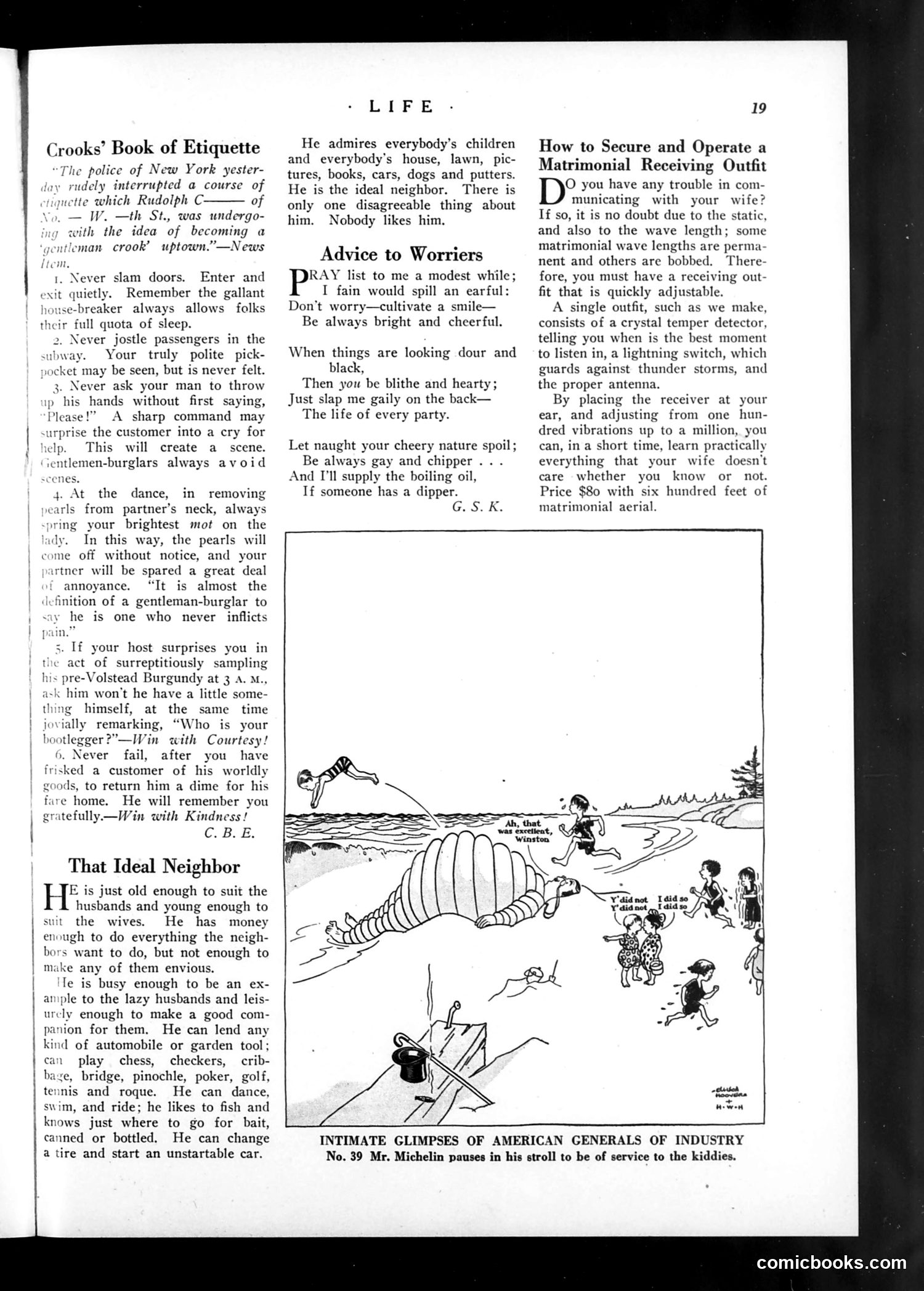
This page contains several satirical pieces targeting 1920s American society: **"Crooks' Book of Etiquette"** parodies etiquette guides by humorously applying genteel manners to burglary—advising thieves to avoid slamming doors, not jostle victims, and return a dime after robbing someone. The satire likely comments on Prohibition-era criminals operating with impunity, treating crime as almost respectable. **"That Ideal Neighbor"** describes a man perfectly suited to everyone—capable at every activity, generous with possessions—yet concludes "Nobody likes him." This paradoxical joke satirizes either impossible social expectations or the emptiness of performative perfection. **"Matrimonial Receiving Outfit"** uses radio technology metaphors to mock marriage communication problems, suggesting wives are incomprehensible static that require mechanical "adjustment"—a sexist joke about spousal discord. The **cartoon** shows Mr. Michelin (the tire company mascot, a rotund figure) surrounded by children playing with an oversized tire—corporate advertising disguised as editorial content. All pieces reflect 1920s concerns: Prohibition, consumerism, gender relations, and corporate influence.
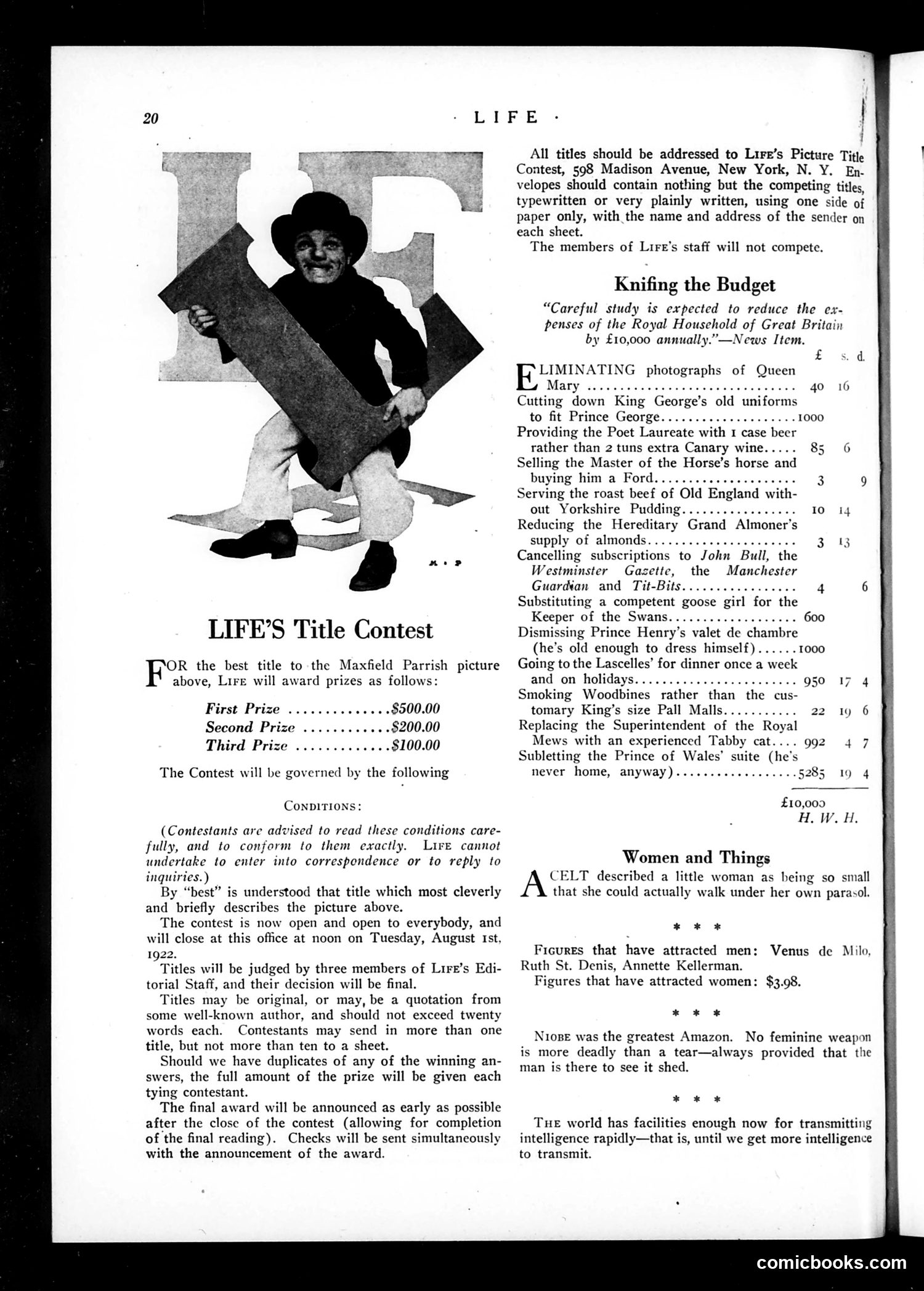
This page features a **title contest** for a Maxfield Parrish illustration (the large stylized figure in the upper left). Readers submitted witty captions for the artwork, competing for $500-$100 prizes—a common interactive feature in satirical magazines of this era. Below that, **"Knifing the Budget"** is a satirical list mocking British royal household cost-cutting efforts. It proposes absurd economies: replacing the Swan Keeper with a "competent goose girl," buying the King a Ford instead of maintaining horses, serving cheaper wine to the Poet Laureate, and substituting a cat for the Superintendent of the Royal Mews. The humor lies in the contrast between the monarchy's traditional dignity and these undignified penny-pinching measures—implying that post-WWI Britain's fiscal constraints force ridiculous indignities on the crown. The page concludes with brief, unrelated social commentary in "Women and Things," offering quips about femininity and human nature typical of 1920s magazine fillers.
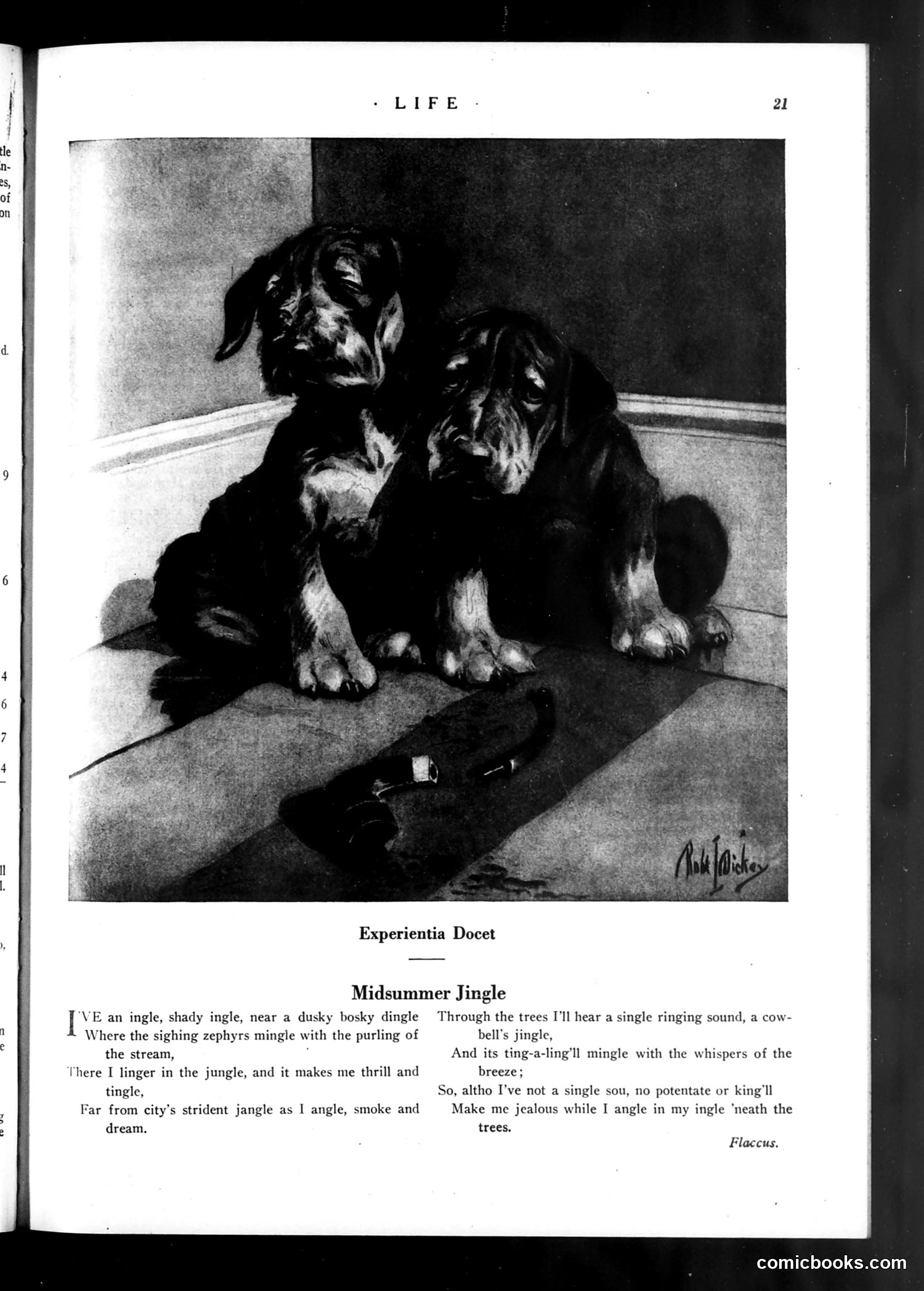
This page combines a photograph with light verse rather than a political cartoon. **The Image:** Two dachshund dogs sit together indoors, appearing to gaze upward. The Latin caption "Experientia Docet" means "experience teaches." **The Text:** "Midsummer Jingle" is a whimsical poem by Flaccus (a Life magazine humorist) celebrating solitary fishing in nature. The speaker describes escaping the city's noise to angle (fish) in a quiet forest stream, contentedly lacking wealth ("not a single sou") while surrounded by natural sounds—cow bells, breezes, and water. **The Connection:** The photograph likely illustrates the poem's theme ironically. The two dogs together contrast with the speaker's solo retreat into nature, or the dogs' wistful upward gaze suggests longing for freedom—mirroring the poem's escape from urban constraints. The joke appears gentler than typical satire: a humorous pairing of image and nostalgic verse about simple pleasures.
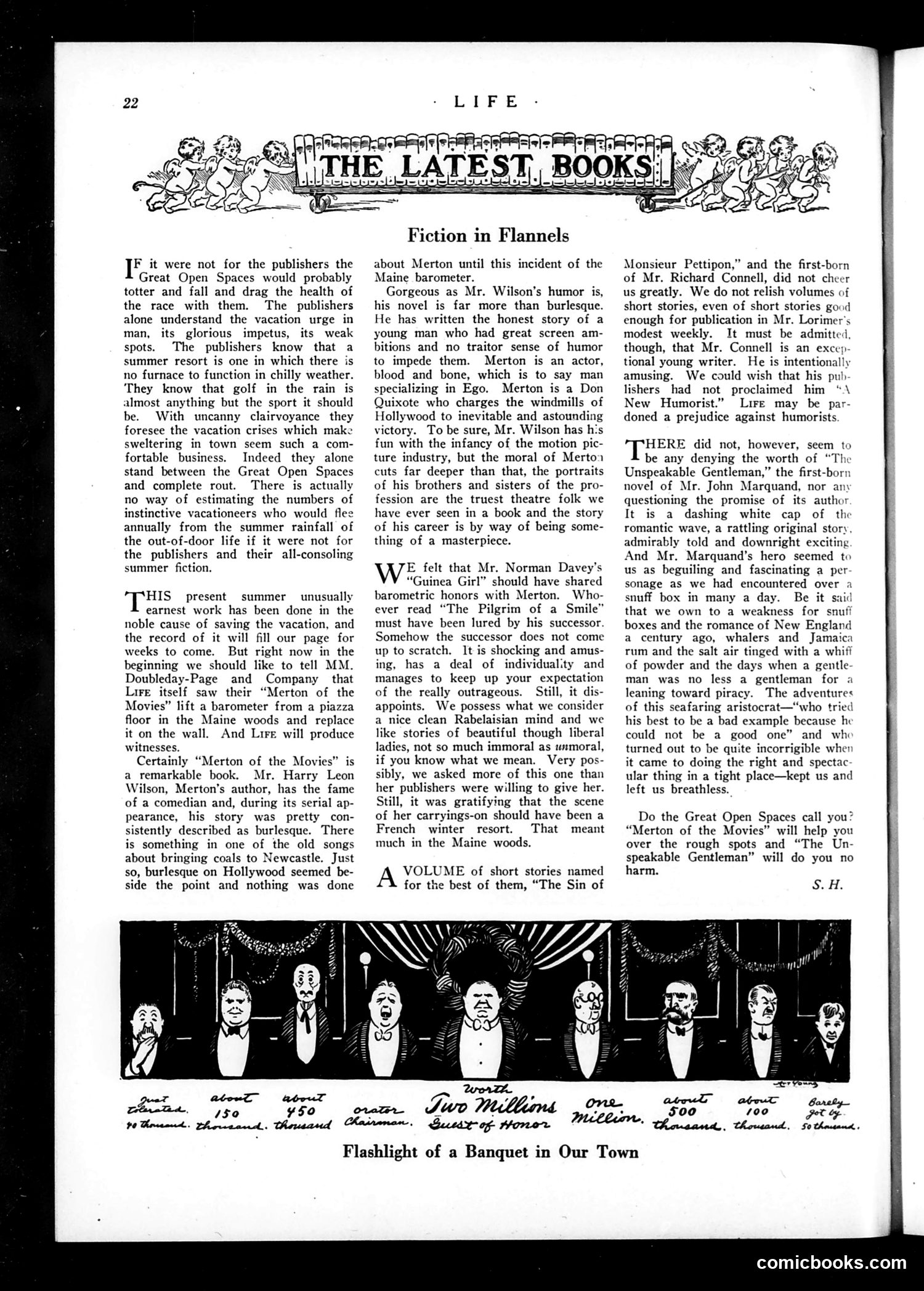
This page satirizes summer vacation reading and publishers' marketing strategies. The main article praises Harry Leon Wilson's novel "Merton of the Movies"—about an earnest but humorless actor pursuing Hollywood success—as genuine literature rather than mere burlesque, despite its comedic elements. The piece gently mocks publishers (specifically Doubleday-Page) for understanding that vacationing Americans need engaging fiction to escape poor weather and outdoor disappointments. It reviews other contemporary summer reads, including Norman Davey's "Guinea Girl" and a Richard Connell short-story collection, with mixed enthusiasm. The bottom cartoon shows wealthy men at a formal banquet, labeled with their net worths (ranging from "about 10 thousand" to "sixty-five thousand"), captioned "Flashlight of a Banquet in Our Town." This satirizes small-town social hierarchies and the obsession with displaying wealth. Together, the content reflects early 20th-century *Life* magazine's satirical focus on American consumer culture and social pretension.
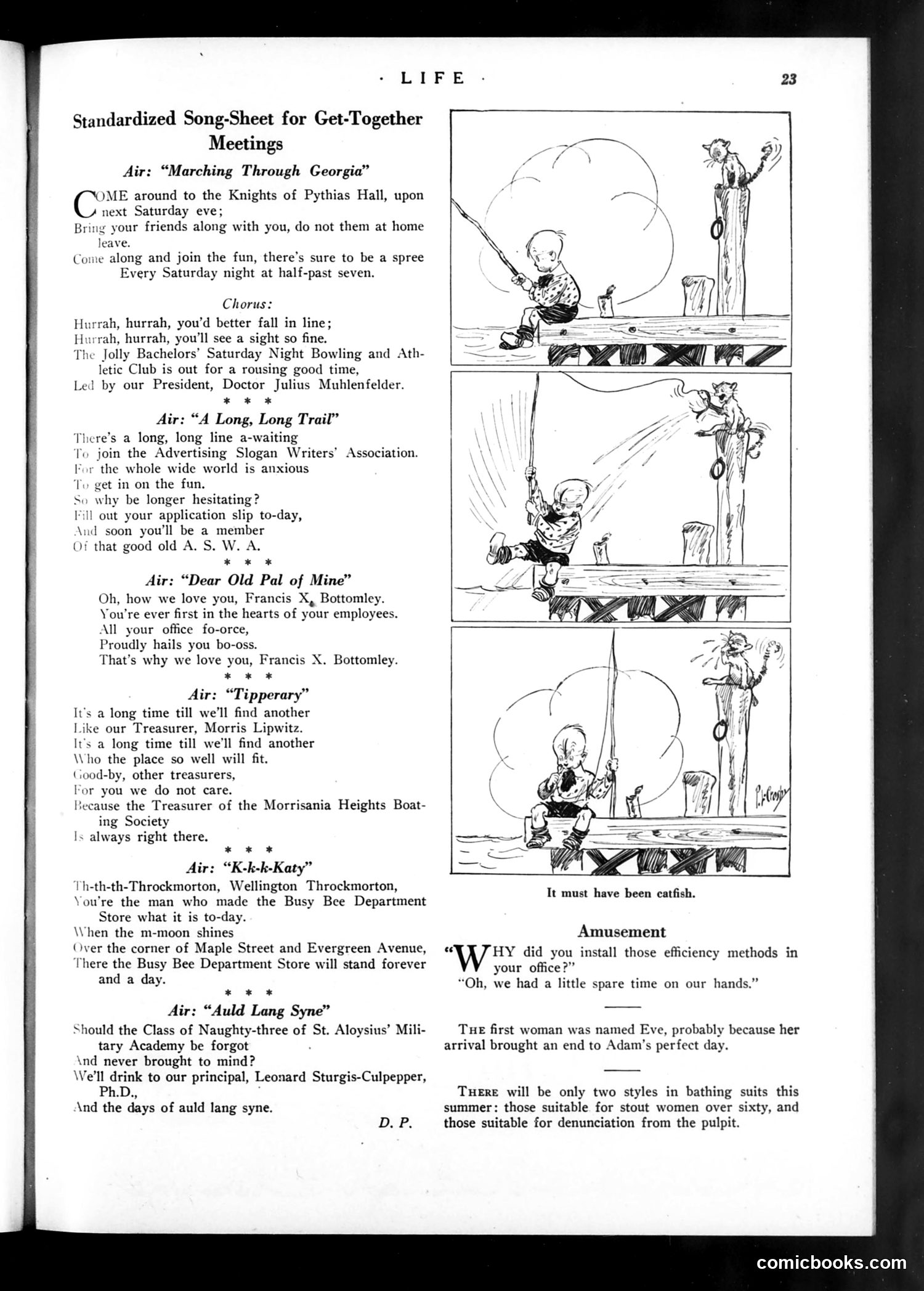
This page satirizes the proliferation of organizational "get-together" meetings and corporate/civic clubs popular in early 20th-century America. The left side parodies standardized song sheets used at such gatherings—set to familiar melodies like "Marching Through Georgia" and "Tipperary"—where groups celebrate their leaders with saccharine praise. Each verse ridicules a different organization: the Jolly Bachelors' bowling club, the Advertising Slogan Writers' Association, and various company departments and societies. The humor lies in the overwrought sentimentality and the generic, interchangeable nature of these tributes to figures like "Francis X. Bottomley" and "Morris Lipwitz." The right side contains three separate jokes mocking social conventions: one about efficiency methods, one about women's names, and one about bathing suit fashion and religious prudishness. The cartoon illustrations show a child on a swing, underscoring the implied childishness of adults' organizational enthusiasm.
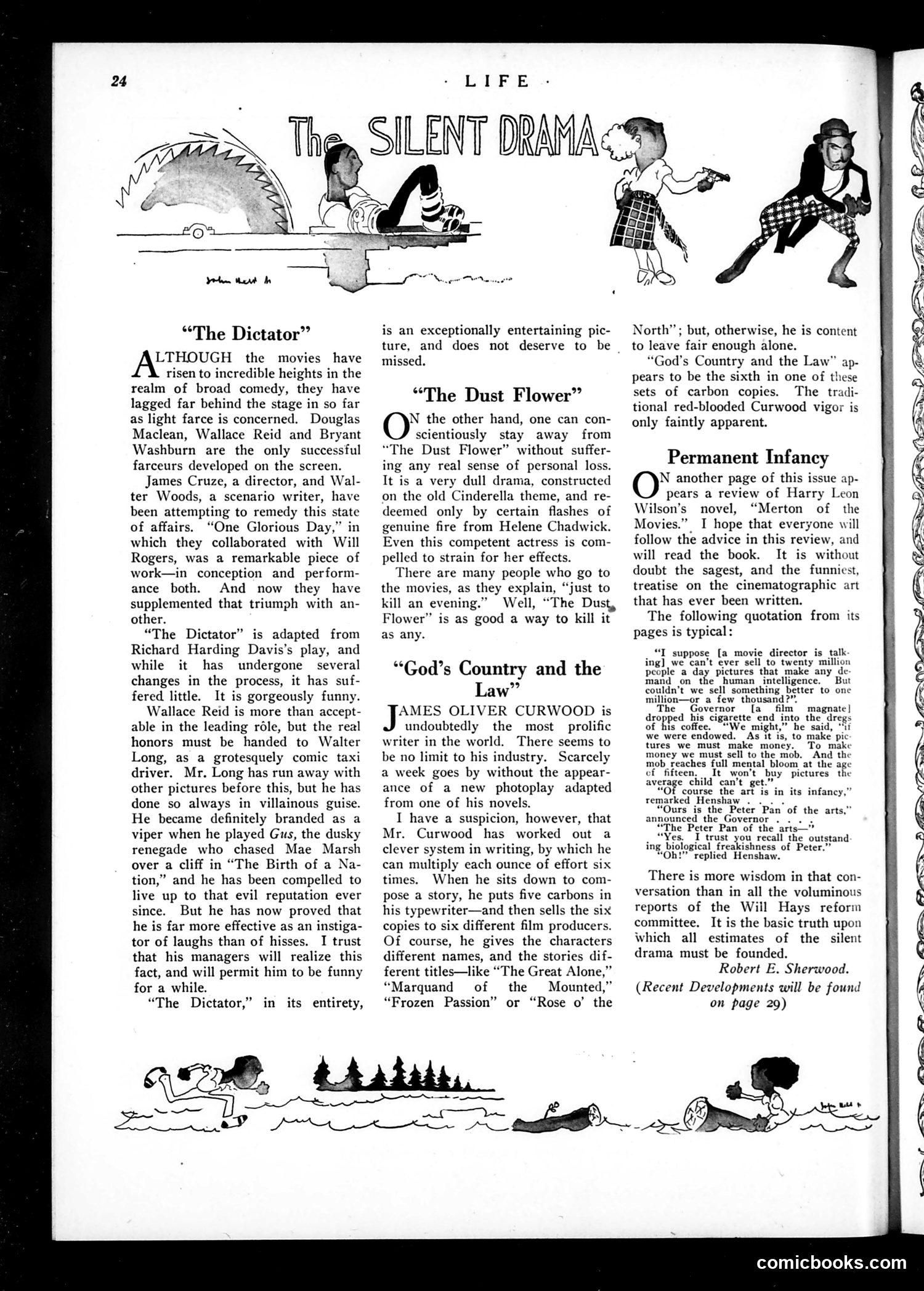
This page contains three film reviews from an era (likely 1920s based on references to silent films and early cinema stars). **"The Dictator"** praises the film starring Wallace Reid and Walter Long, adapted from Richard Harding Davis's play. The reviewer notes Long's successful transition from villainous roles (notably as "Gus, the dusky renegade" in *Birth of a Nation*) to comedy, arguing he's proven himself capable of generating laughs rather than just menace. **"The Dust Flower"** is dismissed as a dull Cinderella retelling where even capable actress Helene Chadwick struggles to generate genuine drama. **"God's Country and the Law"** satirizes author James Oliver Curwood's prolific output, humorously suggesting he uses a carbon-copy system—writing one story with five carbons, selling six nearly identical versions to different studios under different titles. The reviewer notes this particular adaptation lacks Curwood's typical vigor, implying it's merely another tired variation. The cartoons above illustrate slapstick silent comedy scenarios.
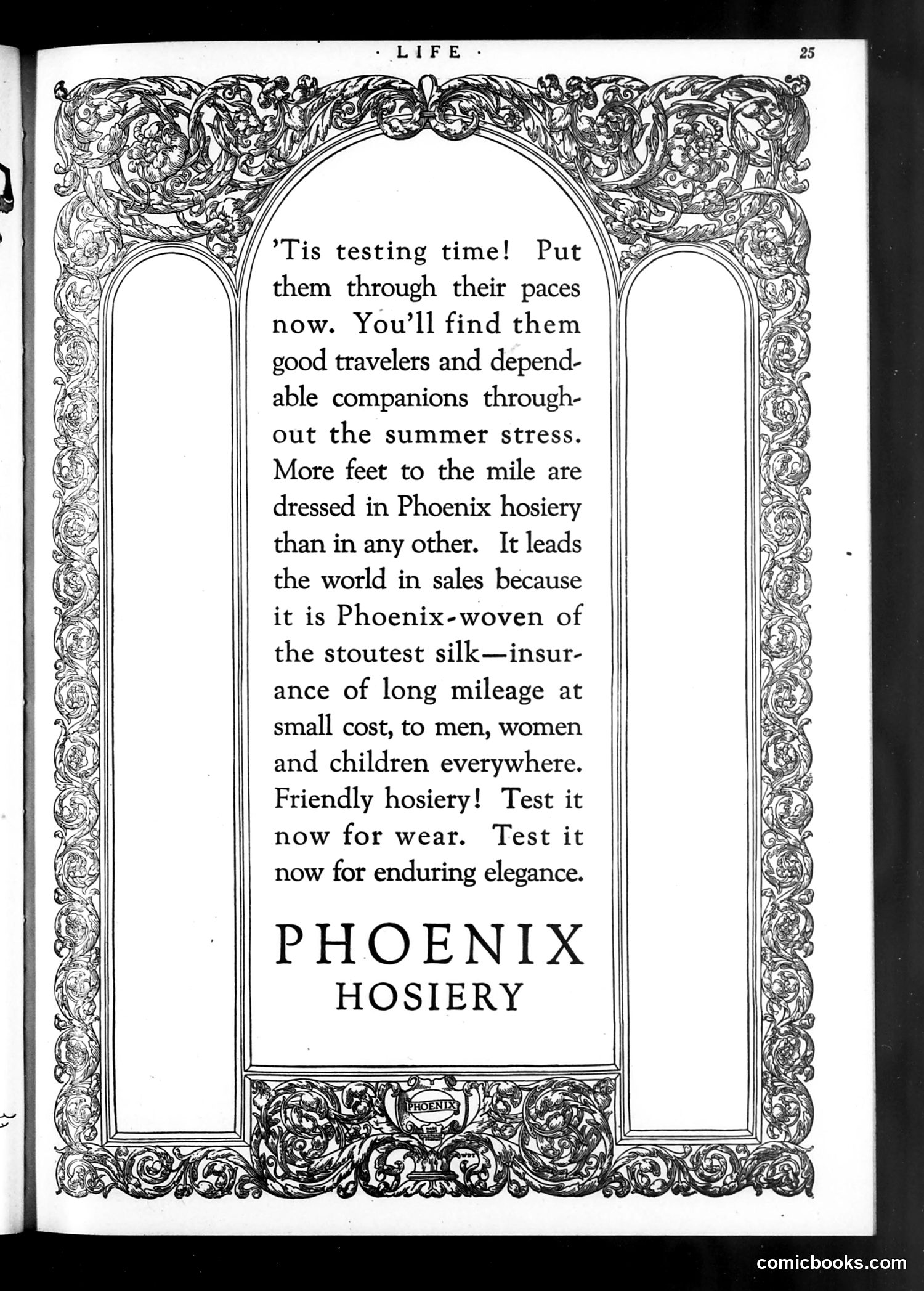
This is a **product advertisement**, not political satire. It's a full-page ad for Phoenix Hosiery that uses the metaphor of "testing time" to pitch socks and stockings as reliable travel companions for summer journeys. The ad employs period marketing language common to early 20th-century advertising: claims of superiority ("leads the world in sales"), quality assuredness ("stoutest silk"), and inclusive appeal ("men, women and children everywhere"). The decorative Art Nouveau border frames the text in the style typical of Life magazine's design. There is no cartoon, no caricature, and no political reference—just commercial copywriting dressed in ornate typography. The "testing" conceit is merely a sales pitch: prospective buyers should "test" the hosiery for durability and elegance before purchasing.
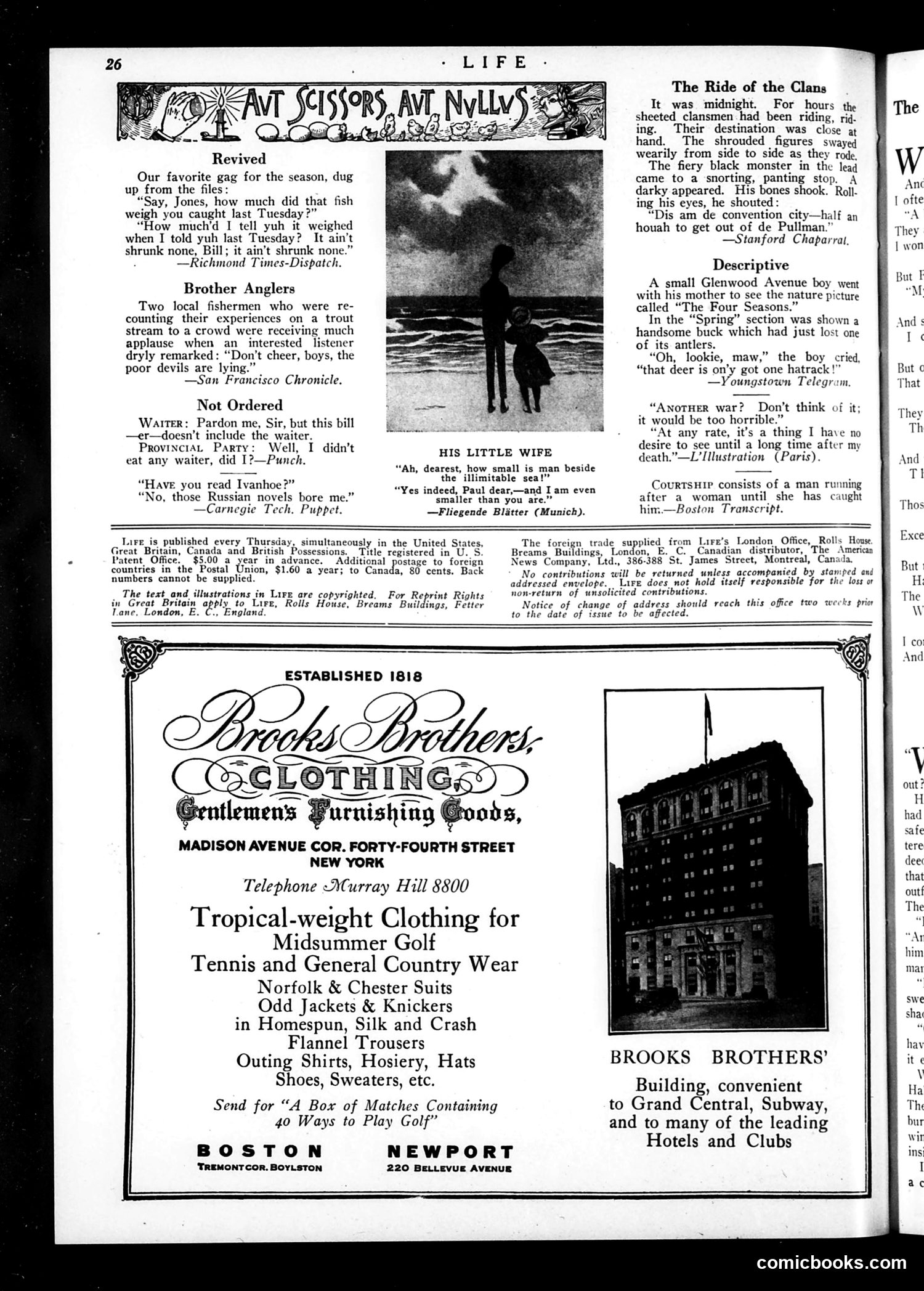
This page from *Life* magazine contains humorous short jokes and a satirical cartoon, primarily targeting fishing exaggeration and racial stereotypes common to the era. **The Jokes:** Multiple brief comedic pieces mock fishermen's notorious habit of exaggerating catch sizes ("it ain't shrunk none"), relationship dynamics, and literary pretension. The humor is gentle, domestic satire. **"The Ride of the Clans":** The illustration and accompanying text depict a KKK night ride—"sheeted clansmen" in robes—arriving at a train station. The satire's point: a Black porter's announcement that they're at "the convention city" deflates the Klan's sinister mystique by revealing mundane reality. The joke mocks the KKK as ridiculous rather than fearsome, though it treats racial terror as punchline material rather than serious threat. The remainder consists of advertising for Brooks Brothers clothing.
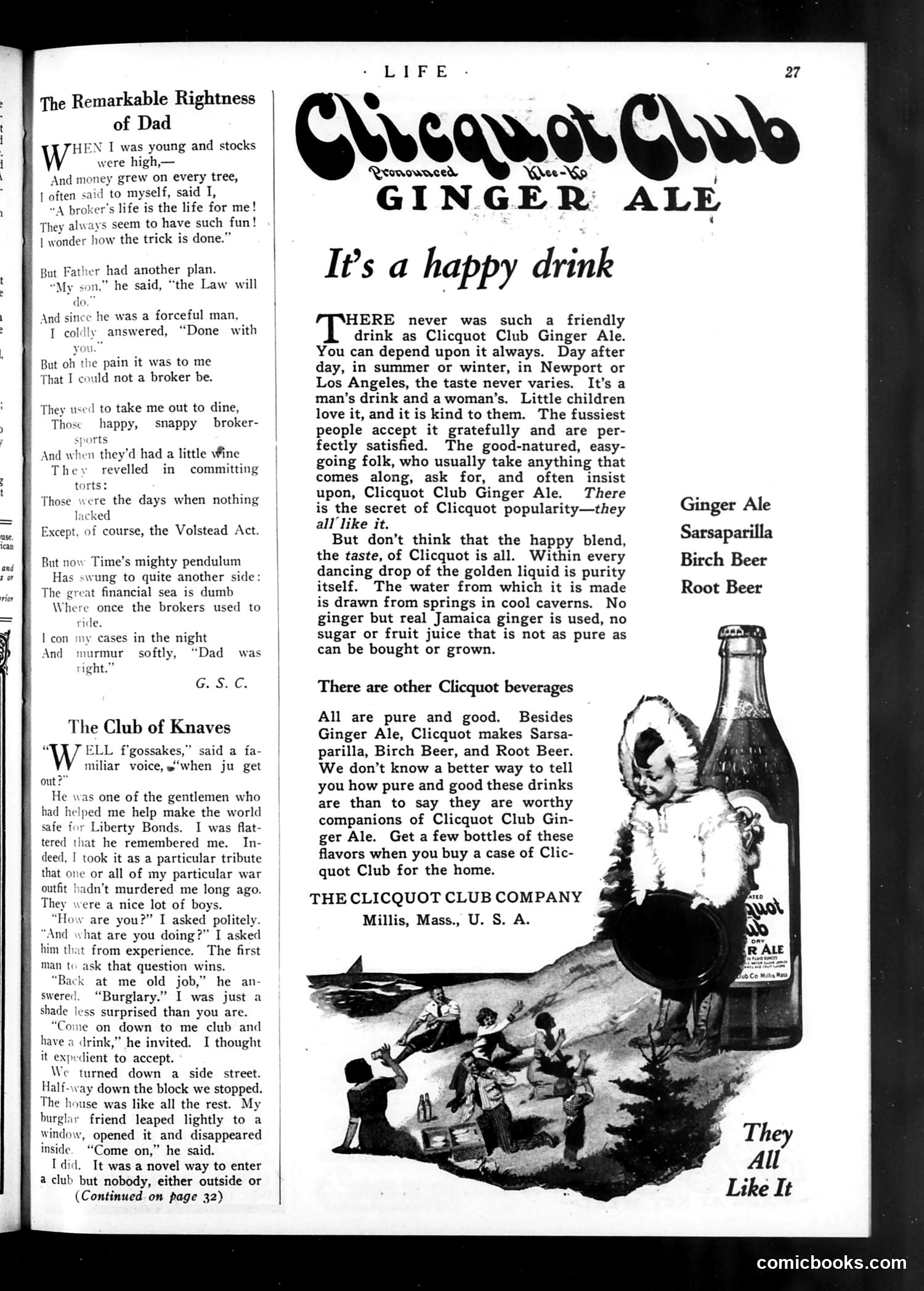
This page contains two literary pieces and a major advertisement. **Left side:** Two short stories—"The Remarkable Rightness of Dad" and "The Club of Knaves"—both satirizing post-Prohibition economic collapse. The first contrasts a young man's envy of 1920s brokers (who flouted the Volstead Act) with his current regret, now that the financial market has crashed. The second depicts a war buddy who's turned to burglary, entering his "club" through a window—dark satire on economic desperation. **Right side:** A full-page advertisement for Clicquot Club soft drinks (Ginger Ale, Sarsaparilla, Birch Beer, Root Beer), featuring a cherubic child figure. The ad emphasizes purity and universal appeal across classes and ages, produced in Millis, Massachusetts. The juxtaposition is striking: stories about financial ruin and crime appear alongside cheerful advertising for wholesome beverages—reflecting Life's dual role as satirical commentary and advertising vehicle during the early Depression era.
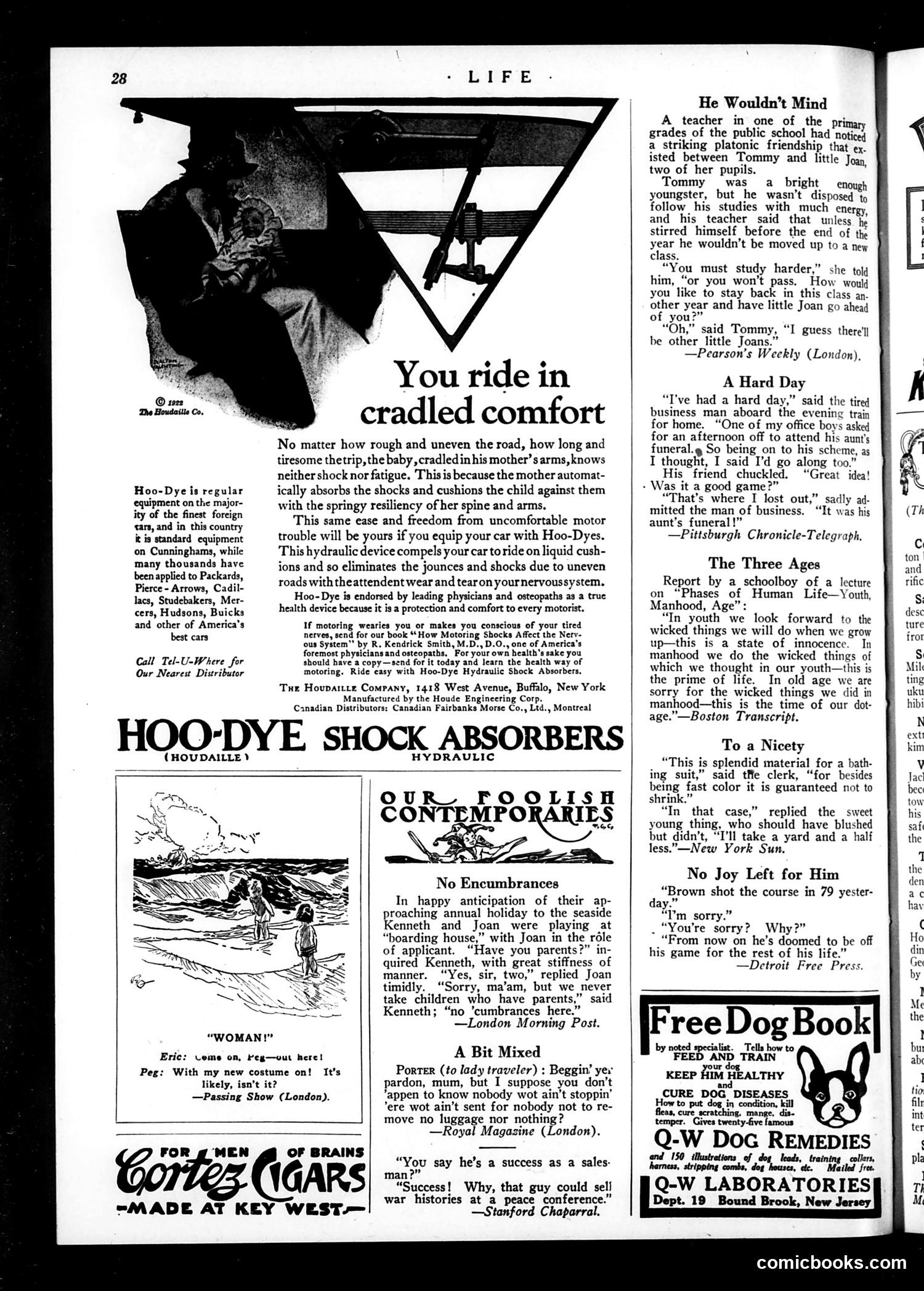
This page is primarily **advertising and filler content** rather than political satire. The dominant feature is a large advertisement for **Hoo-Dye Hydraulic Shock Absorbers** for automobiles, emphasizing comfort and health benefits by comparing a car's suspension to a mother cradling a baby. It claims endorsement by physicians and osteopaths. The page also contains several brief humorous anecdotes labeled "Our Foolish Contemporaries"—short jokes from various publications poking fun at everyday social situations: children without parents being "encumbrances" at a boarding house, a confused porter's tangled grammar, and a salesman's dubious success. These are gentle, non-political humor pieces typical of period magazines. Additional advertisements for cigars and dog remedies fill remaining space. There is **no significant political cartoon or satire** on this page—it represents typical 1920s magazine content mixing advertising with light domestic humor.
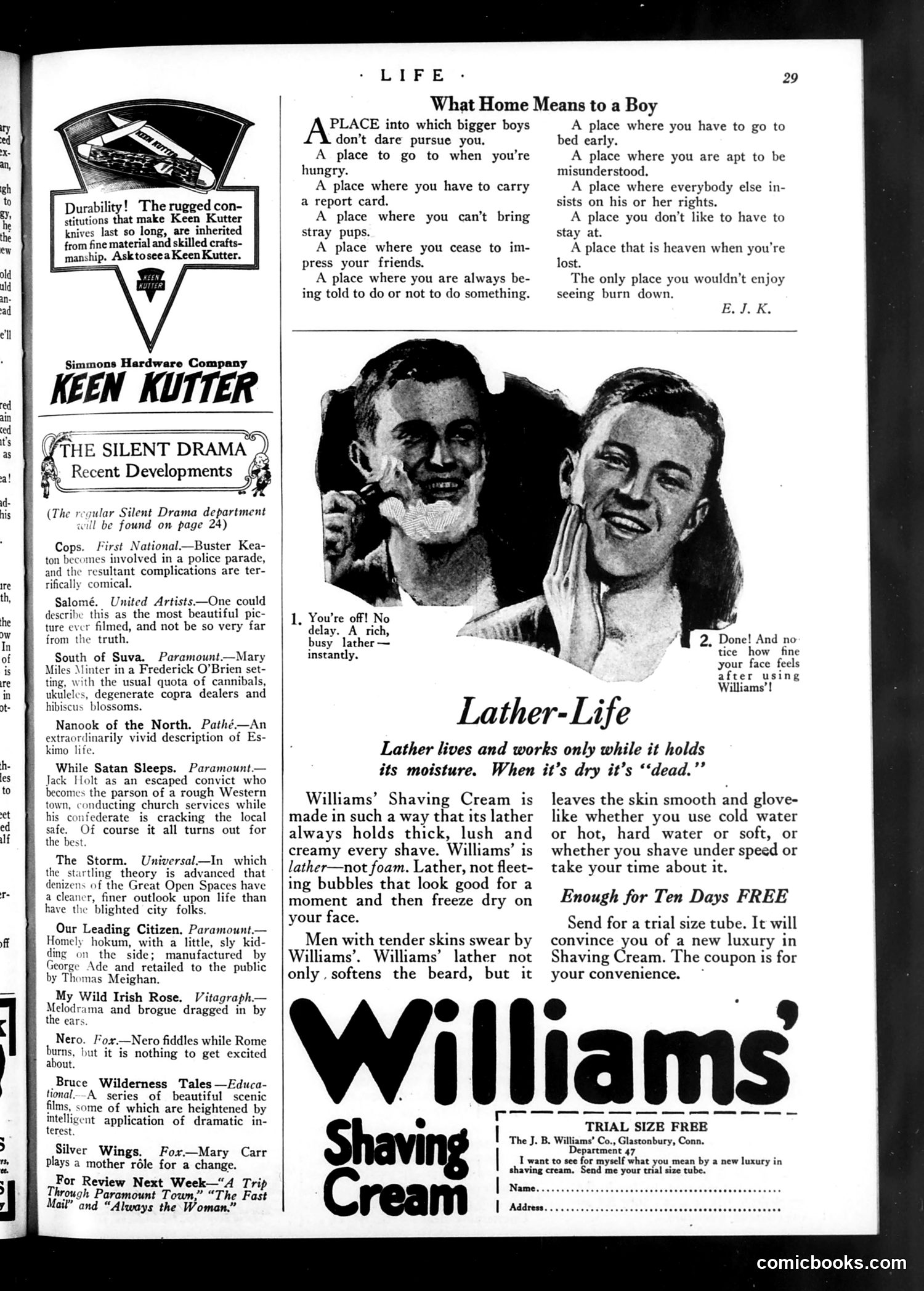
This page combines humorous social commentary with period advertising. The main content is a satirical list titled "What Home Means to a Boy," authored by E.J.K., presenting childhood domestic life from a boy's cynical perspective. Rather than idealizing home, it depicts it as a place of rules, restrictions, and misunderstanding—where you're forced to bed early, can't keep stray dogs, must carry report cards, and where parents insist on their rights over yours. The humor lies in this inversion of sentimentality; the final lines acknowledge home's true value only through absence ("heaven when you're lost"). The remainder is advertising: a Keen Kutter knife ad emphasizing durability, and a substantial Williams' Shaving Cream advertisement featuring two men demonstrating the product's lather quality. The "Lather-Life" tagline plays on the product's moisturizing properties. The page also lists recent silent films (this appears to be from the early 1920s), reflecting cinema's prominence in period entertainment.
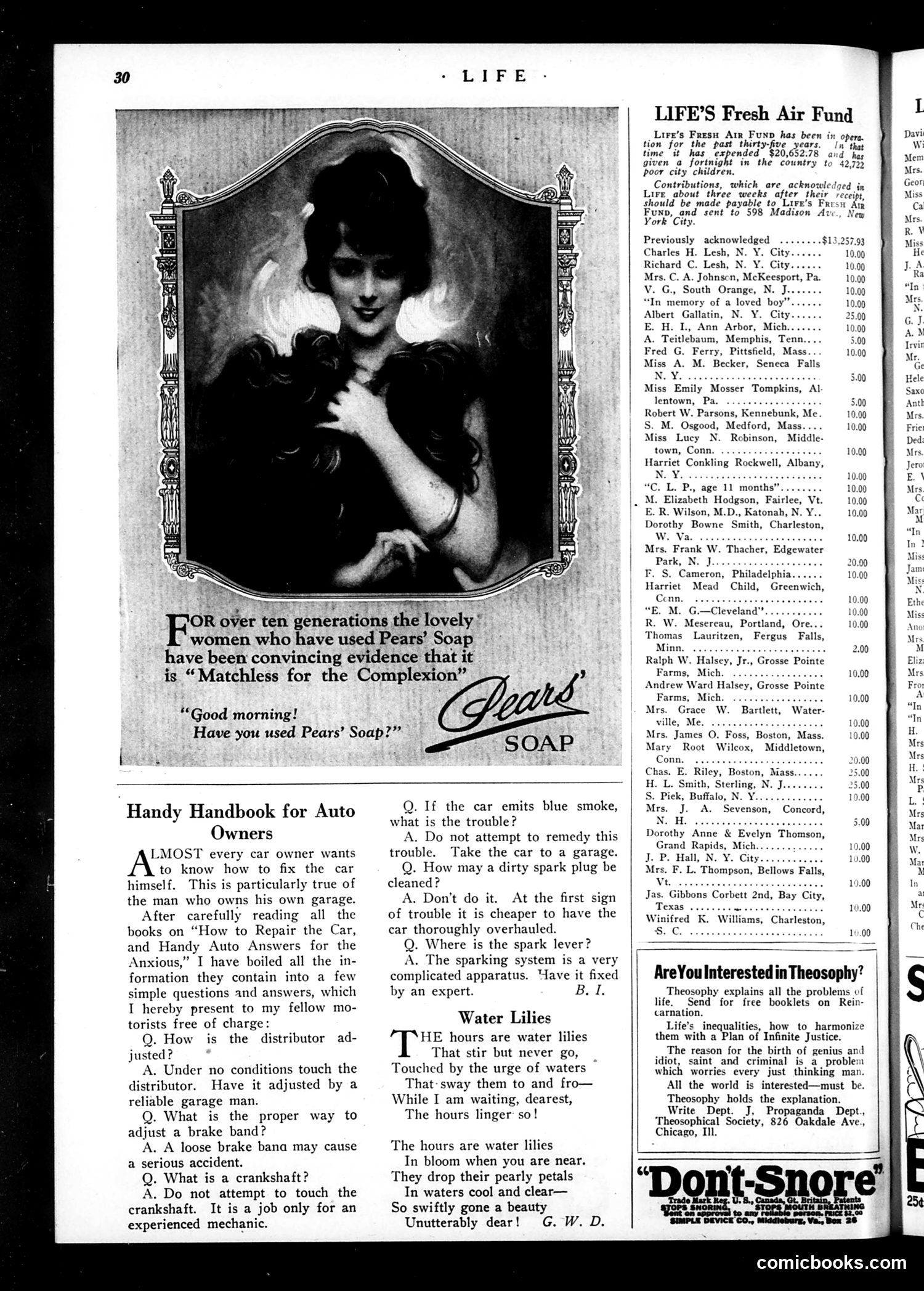
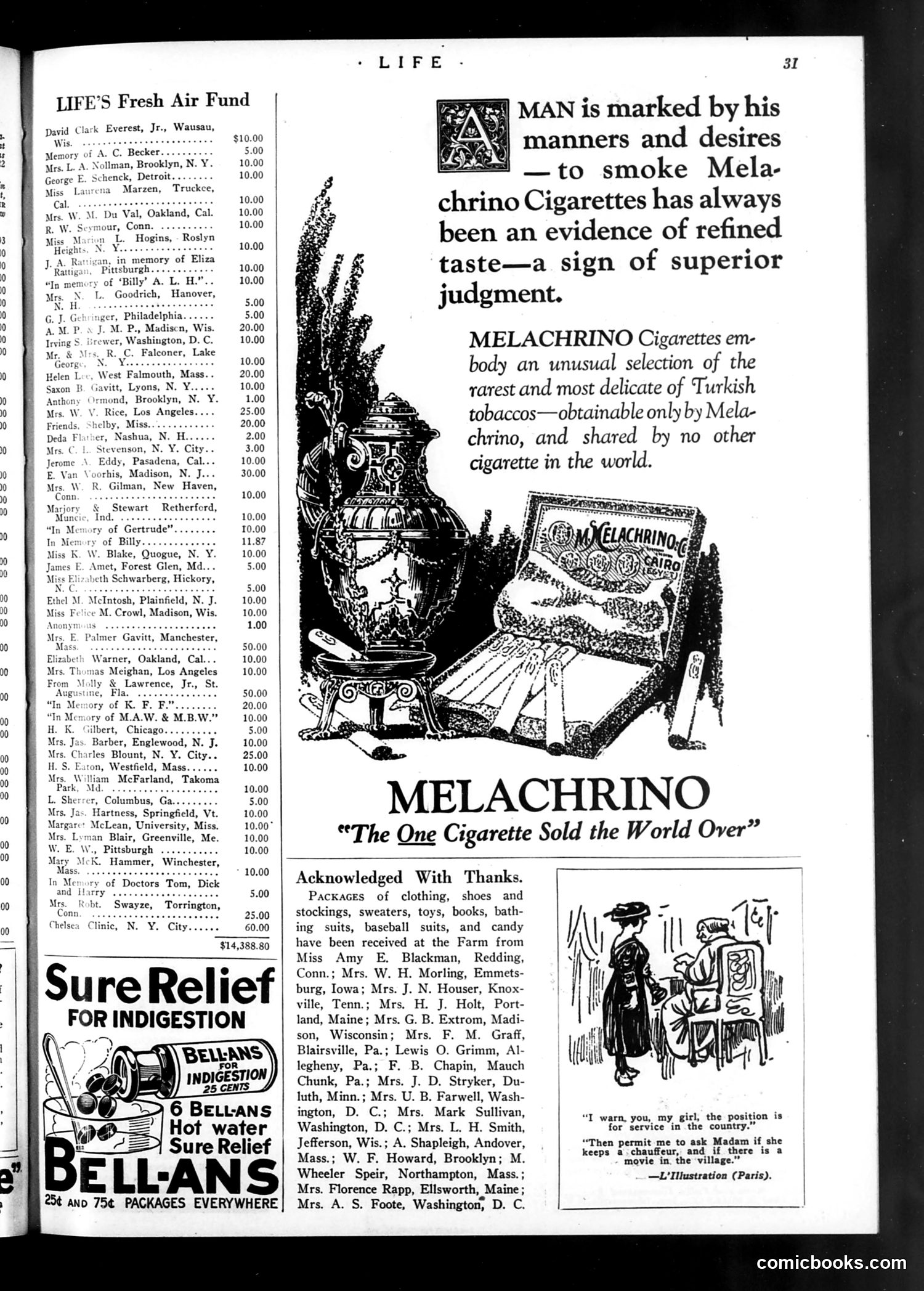
This page contains primarily **advertisements and charitable notices** rather than political satire or comics. The main content includes: 1. **Pears' Soap Advertisement**: A full-page ad featuring a woman's portrait in an ornate frame, promoting the soap as "Matchless for the Complexion"—a genuine historical product claim from the era. 2. **"Handy Handbook for Auto Owners"**: A humorous Q&A piece satirizing automobile repair manuals by offering absurdly unhelpful advice (e.g., "Do not attempt to touch the crankshaft"). The joke mocks both overly cautious instruction manuals and car owners' actual mechanical ignorance. 3. **"Water Lilies"**: A sentimental poem about time and longing. 4. **Life's Fresh Air Fund**: A charitable notice listing donors who contributed to sending poor city children to the countryside—a genuine philanthropic initiative Life magazine sponsored. The page reflects early 20th-century American consumer culture, automotive anxiety, and progressive-era charitable work rather than political commentary.
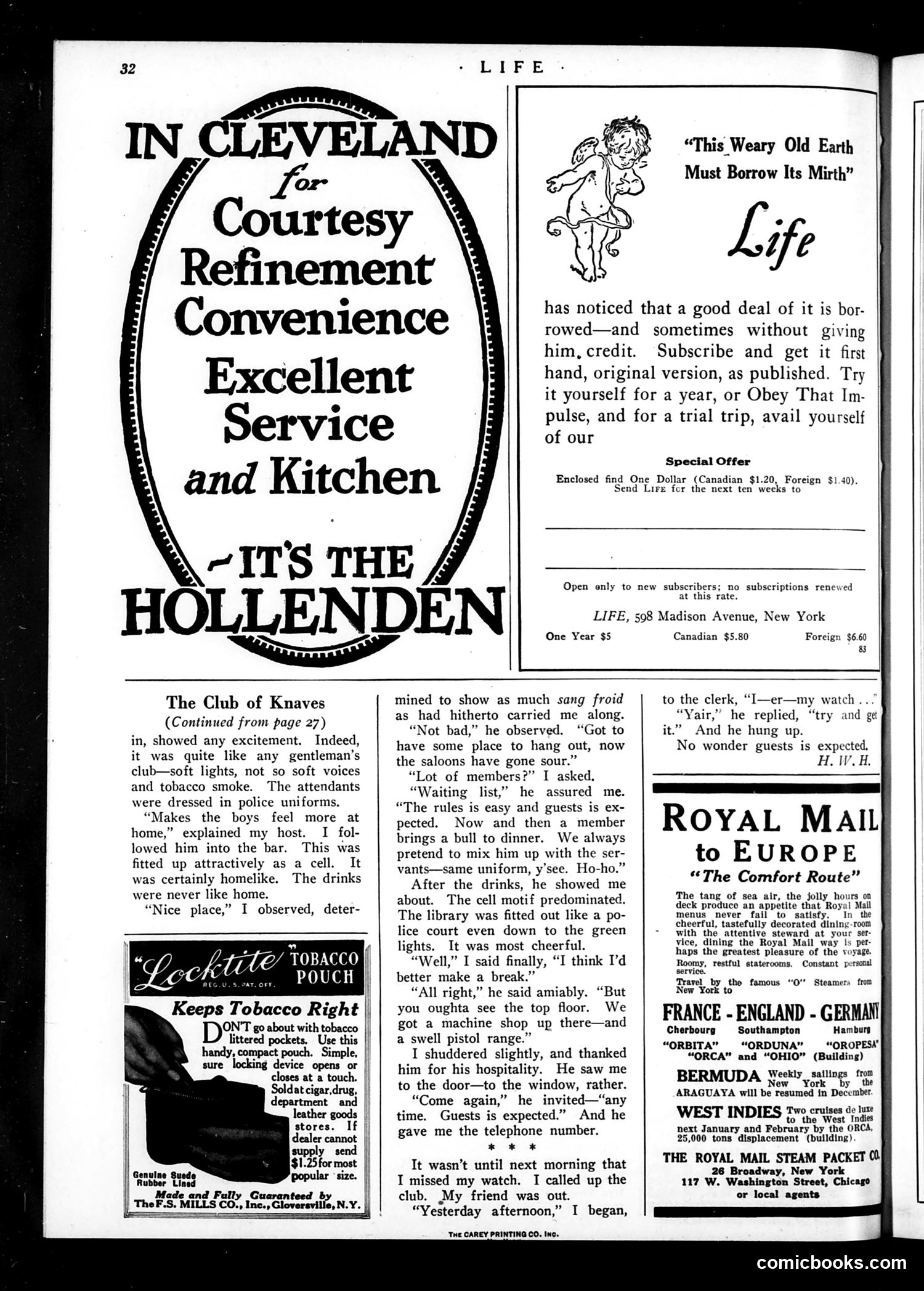
This page continues a serialized story mocking Prohibition's unintended consequences. The "Club of Knaves" is a speakeasy disguised as a gentlemen's club, complete with police-uniform-wearing staff and a "cell" motif bar—satirizing the absurd lengths people went to circumvent alcohol bans. The joke's climax: the protagonist's watch goes missing, and when he calls to report it, the staff unhelpfully hangs up. The final caption ("No wonder guests is expected") suggests the club operates as a front for petty crime and theft, not just illegal drinking. The satire criticizes Prohibition itself—by closing legitimate saloons ("the saloons have gone sour"), the law drove patrons into criminal establishments far worse than regulated bars. The casual criminality and lawlessness depicted represent the era's widespread social disorder caused by the alcohol ban. This reflects broader contemporary criticism of Prohibition as counterproductive and corruption-enabling.
This is not a cartoon but an **advertisement for advertising itself**—a meta-promotional piece by *Life* magazine's advertising department. The piece argues that reading advertisements constitutes genuine "economy" (frugal spending), not just saving money. It makes several claims: that advertised products are trustworthy (manufacturers wouldn't risk their reputation), that ads function as "news from the business world," and that they help consumers make smarter purchases and live better. For a modern reader, this reveals **early 20th-century advertising philosophy**—a time when the advertising industry was still justifying its own existence and legitimacy to the public. Today's readers would likely find the argument circular and naive: the piece essentially says "trust ads because companies wouldn't advertise bad products," without acknowledging that persuasion itself is the advertiser's goal, separate from product quality. The signature "Gee. Bee. Are." (pronounced "G.B.R.") adds a whimsical touch, while the contact information positions this as official *Life* magazine messaging.
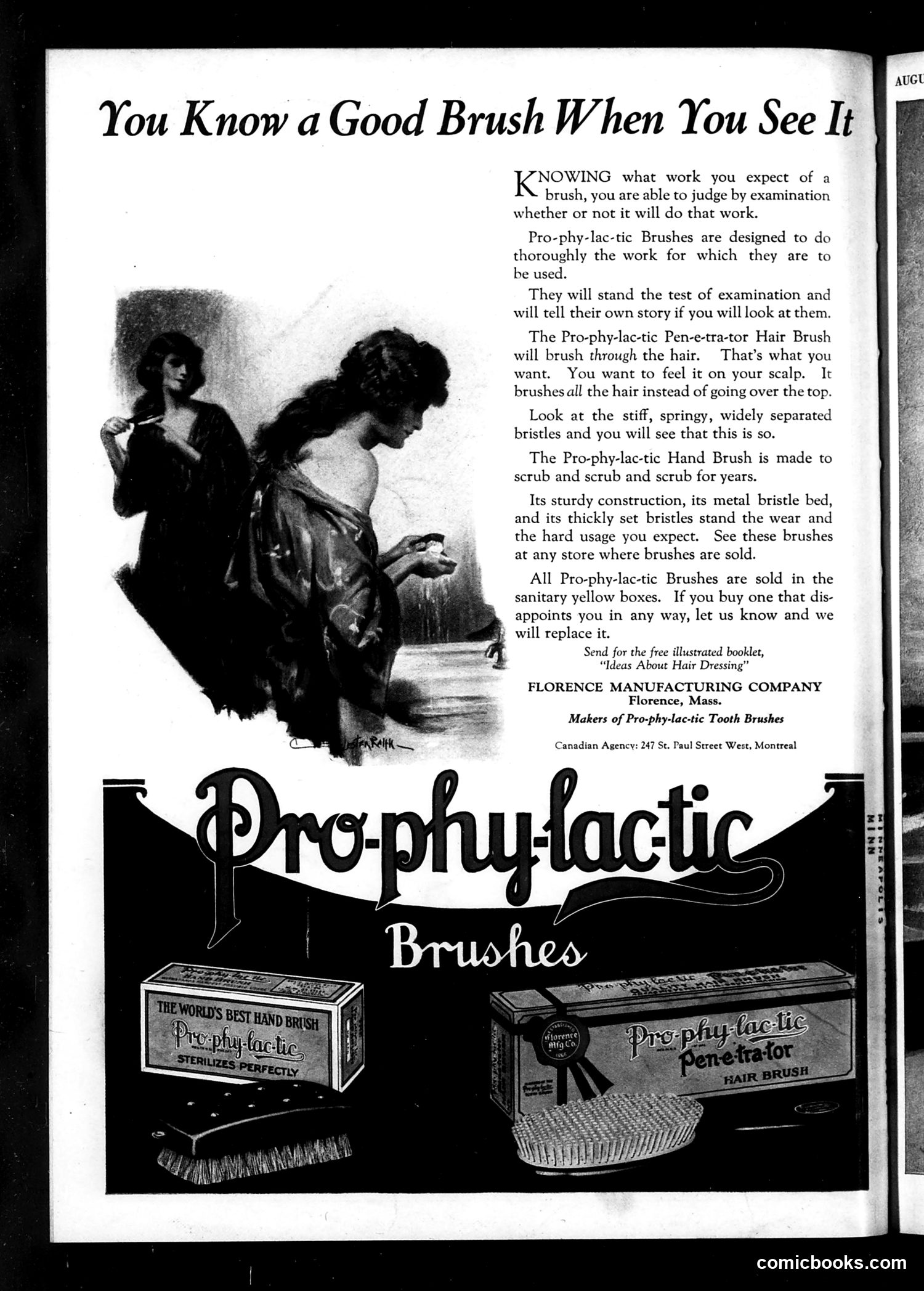
This is **not a political cartoon but a straightforward product advertisement** from Life magazine's advertising section. It promotes Pro-phy-lactic brand brushes—specifically hair brushes and hand brushes—manufactured by Florence Manufacturing Company in Massachusetts. The page features an illustration of two women (one brushing the other's hair) to demonstrate the product in use. The advertisement emphasizes durability and effectiveness: the "Pen-e-tra-tor Hair Brush" brushes *through* hair rather than just over it, while the hand brush is designed for years of scrubbing. The text appeals to consumer judgment by encouraging buyers to examine brushes before purchase. A notable detail is the promise to replace any disappointing purchase, suggesting quality assurance was a selling point. The distinctive "sanitary yellow boxes" served as brand recognition. This represents typical early-20th-century product advertising strategy: testimonial-style copy, practical benefits, and visual demonstration.