
Life, 1922-07-27 · page 26 of 36
Life — July 27, 1922 — page 26: what you’re looking at
What you’re looking at
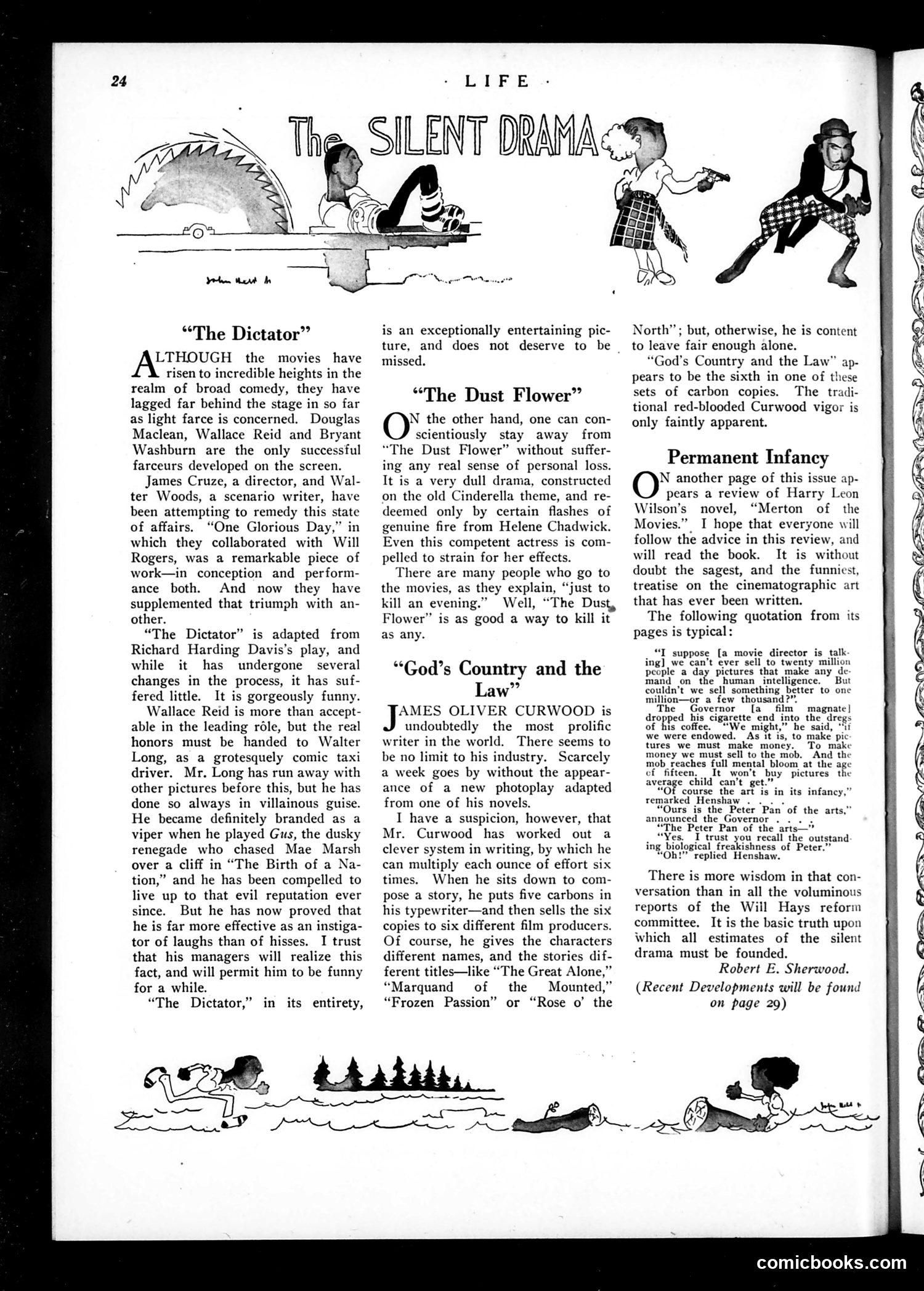
This page contains three film reviews from an era (likely 1920s based on references to silent films and early cinema stars). **"The Dictator"** praises the film starring Wallace Reid and Walter Long, adapted from Richard Harding Davis's play. The reviewer notes Long's successful transition from villainous roles (notably as "Gus, the dusky renegade" in *Birth of a Nation*) to comedy, arguing he's proven himself capable of generating laughs rather than just menace. **"The Dust Flower"** is dismissed as a dull Cinderella retelling where even capable actress Helene Chadwick struggles to generate genuine drama. **"God's Country and the Law"** satirizes author James Oliver Curwood's prolific output, humorously suggesting he uses a carbon-copy system—writing one story with five carbons, selling six nearly identical versions to different studios under different titles. The reviewer notes this particular adaptation lacks Curwood's typical vigor, implying it's merely another tired variation. The cartoons above illustrate slapstick silent comedy scenarios.
📄 Transcribed text from this page (OCR, searchable)
Machine-transcribed from the original scan — historical spelling and the odd misread are preserved.
“The Dictator” LTHOUGH the movies have risen to incredible heights in the realm of broad comedy, they have lagged far behind the stage in so far as light farce is concerned. Douglas Maclean, Wallace Reid and Bryant Washburn are the only successful farceurs developed on the screen. James Cruze, a director, and Wal- ter Woods, a scenario writer, have been attempting to remedy this state of affairs. “One Glorious Day,” in which they collaborated with Will Rogers, was a remarkable piece of work—in conception and perform- ance both. And now they have supplemented that triumph with an- other. “The Dictator” is adapted from Richard Harding Davis’s play, and while it has undergone several changes in the process, it has suf- fered little. It is gorgeously funny. Wallace Reid is more than accept- able in the leading réle, but the real honors must be handed to Walter Long, as a grotesquely comic taxi driver. Mr. Long has run away with other pictures before this, but he has done so always in villainous guise. He became definitely branded as a viper when he played Gus, the dusky renegade who chased Mae Marsh over a cliff in “The Birth of a Na- tion,” and he has been compelled to live up to that evil reputation ever since. But he has now proved that he is far more effective as an instiga- tor of laughs than of hisses. I trust that his managers will realize this fact, and will permit him to be funny for a while. “The Dictator,” in its entirety, is an exceptionally entertaining pic- ture, and does not deserve to be missed, “The Dust Flower” N the other hand, one can con- scientiously stay away from “The Dust Flower” without suffer- ing any real sense of personal loss. It is a very dull drama, constructed on the old Cinderella theme, and re- deemed only by certain flashes of genuine fire from Helene Chadwic! Even this competent actress is com- pelled to strain for her effects. There are many people who go to the movies, as they explain, “just to kill an evening.” Well, “The Dust, Flower” is as good a way to kill it as any. “God’s Country and the Law” AMES OLIVER CURWOOD is undoubtedly the most prolific writer in the world. There seems to be no limit to his industry. Scarcely a week goes by without the appear- ance of a new photoplay adapted from one of his novels. I have a suspicion, however, that Mr. Curwood has worked out a clever system in writing, by which he can multiply each ounce of effort six times. When he sits down to com- pose a story, he puts five carbons in his typewriter—and then sells the six copies to six different film producers. Of course, he gives the characters different names, and the stories dif- ferent titles—like “The Great Alone,” “Marquand of the Mounted,” “Frozen Passion” or “Rose o’ the North”; but, otherwise, he is content to leave fair enough alone. “God's Country and the Law” pears to be the sixth in one of sets of carbon copies. The tradi- tional red-blooded Curwood vigor is only faintly apparent. Permanent Infancy N another page of this issue ap- pears a review of Harry Leon Wilson’s novel, “Merton of the Movies.” I hope that everyone will follow the advice in this review, and will read the book. It is without doubt the sagest, and the funniest, treatise on the cinematographic art that has ever been written. The following quotation from its pages is typical: “I suppose [a movie director is talk. ing] we can’t ever sell to twenty million people a day pictures that make any de hand on the human intelligence. But couldn’t we sell something better to one million—or a few thousand?”. The Governor [a film’ magnate] dropped his cigarette end into the. dregs is coffee. “We might,” he said, we were endowed. As it is, to make pic tures we must make money. To make money we must sell to the mob. And the mob reaches full mental bloom at the age of fifteen, Tt won't buy pictures. the average child can’t get.” course the art is in its infancy,” remarked Henshaw . “Ours is the Peter Pan’ of the arts, announced the Governor . . “The Peter Pan of the arts i Egat aU, Tecall the outstand ing biological freakishness of Peter.” “Oh!” replied Henshaw. There is more wisdom in that con- versation than in all the voluminous reports of the Will Hays reform committee. It is the basic truth upon which all estimates of the silent drama must be founded. Robert E. Sherwood. (Recent Developments will be found on page 29) comicbooks.com