
Life, 1922-07-27 · page 16 of 36
Life — July 27, 1922 — page 16: what you’re looking at
What you’re looking at
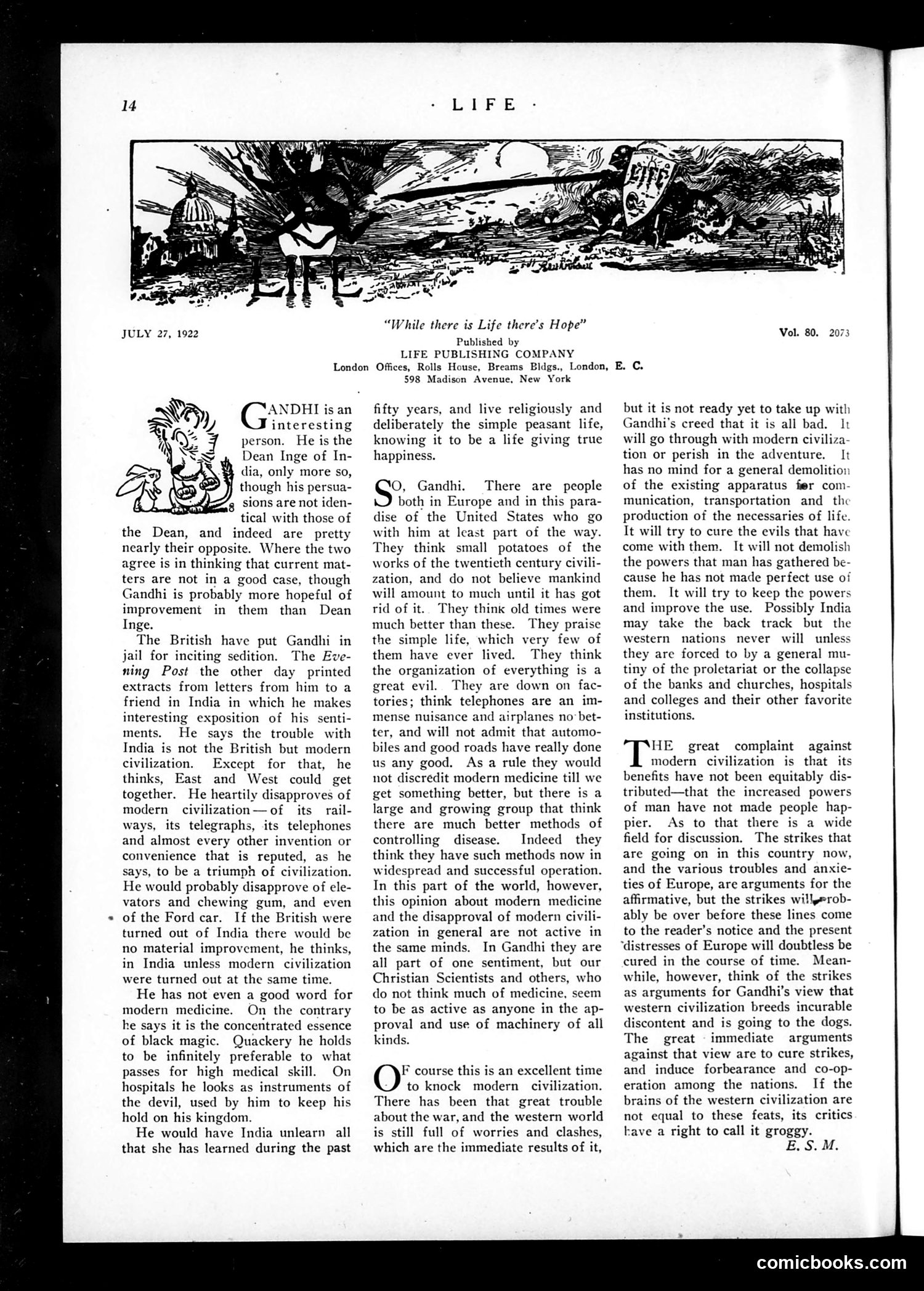
The page features a satirical article about **Mohandas Gandhi**, identified as "an interesting person" and "Dean of India." The cartoon at top depicts Gandhi as a skeletal, demonic figure riding what appears to be a flying vehicle labeled "LIFE," with chaotic scenes below. The article critiques Western attitudes toward Gandhi, noting that some Westerners dismiss him as promoting outdated ideas hostile to modern civilization—rejecting railways, telegraphs, and medicine. However, the author (E.S.M.) argues Gandhi's critique of industrial civilization has merit, particularly regarding post-WWI European turmoil. The piece suggests Western intellectuals shouldn't dismiss Gandhi's philosophy entirely, though his methods remain debatable. The dark cartoon suggests contemporary skepticism about Gandhi's radical vision.
📄 Transcribed text from this page (OCR, searchable)
Machine-transcribed from the original scan — historical spelling and the odd misread are preserved.
JULY 27, 1922 “While there is Life there’s Hope” Published by LIFE PUBLISHING COMPANY 2073 London Offices, Rolls House, Breams Bldgs., London, E. C. NDHI is an interesting person. He is the Dean Inge of In- dia, only more so, though his persua- g sions are not iden- tical with those of the Dean, and indeed are pretty nearly their opposite. Where the two agree is in thinking that current mat- ters are not in a good case, though Gandhi is probably more hopeful of improvement in them than Dean Inge. The British have put Gandhi in The Eve- jail for inciting sedition. ning Post the other day printed extracts from letters from him to a friend in India in which he makes interesting exposition of his senti- ments. He says the trouble with India is not the British but modern civilization. Except for that, he thinks, East and West could get together. He heartily disapproves of modern civilization—of its rail- ways, its telegraphs, its telephones and almost every other invention or convenience that is reputed, as he says, to be a triumph of civilization. He would probably disapprove of ele- vators and chewing gum, and even + of the Ford car. If the British were turned out of India there would be no material improvement, he thinks, in India unless modern civilization were turned out at the same time. He has not even a good word for modern medicine. On the contrary he says it is the concentrated essence of black magic. Quackery he holds to be infinitely preferable to what passes for high medical skill. On hospitals he looks as instruments of the devil, used by him to keep his hold on his kingdom. He would have India unlearn all that she has learned during the past 598 Madison Avenue, New York fifty years, and live religiously and deliberately the simple peasant life, knowing it to be a life giving true happiness. 'O, Gandhi. There are people both in Europe and in this para- dise of the United States who go with him at least part of the way. They think small potatoes of the works of the twentieth century civili- zation, and do not believe mankind will amount to much until it has got rid of it. They think old times were much better than these. They praise the simple life, which very few of them have ever lived. They think the organization of everything is a great evil. They are down on fac- tories; think telephones are an im- mense nuisance and airplanes no bet- ter, and will not admit that automo- biles and good roads have really done us any good. As a rule they would not discredit modern medicine till we get something better, but there is a large and growing group that think there are much better methods of controlling disease. Indeed they think they have such methods now in widespread and successful operation. In this part of the world, however, this opinion about modern medicine and the disapproval of modern civili- zation in general are not active in the same minds. In Gandhi they are all part of one sentiment, but our Christian Scientists and others, who do not think much of medicine, seem to be as active as anyone in the ap- proval and use of machinery of all kinds. * course this is an excellent time to knock modern civilization. There has been that great trouble about the war, and the western world is still full of worries and clashes, which are the immediate results of it, but it is not ready yet to take up with Gandhi's creed that it is all bad. lt will go through with modern civiliza- tion or perish in the adventure. It has no mind for a general demolitio: of the existing apparatus fer com- munication, transportation and_ the production of the necessaries of life. It will try to cure the evils that havc come with them. It will not demolish the powers that man has gathered be- cause he has not made perfect use of them. It will try to keep the powers and improve the use. Possibly India may take the back track but the western nations never will unless they are forced to by a general mu- tiny of the proletariat or the collapse of the banks and churches, hospitals and colleges and their other favorite institutions. HE great complaint against modern civilization is that its benefits have not been equitably dis- tributed—that the increased powers of man have not made people hap- pier. As to that there is a wide field for discussion. The strikes that are going on in this country now, and the various troubles and anxie- ties of Europe, are arguments for the affirmative, but the strikes will»rob- ably be over before these lines come to the reader’s notice and the present ‘distresses of Europe will doubtless be cured in the course of time. Mean- while, however, think of the strikes as arguments for Gandhi’s view that western civilization breeds incurable discontent and is going to the dogs. The great immediate arguments against that view are to cure strikes, and induce forbearance and co-op- eration among the nations. If the brains of the western civilization are not equal to these feats, its critics tave a right to call it groggy. E.S.M. comicbooks.com