
A complete issue · 33 pages · 1921
Life — October 6, 1921
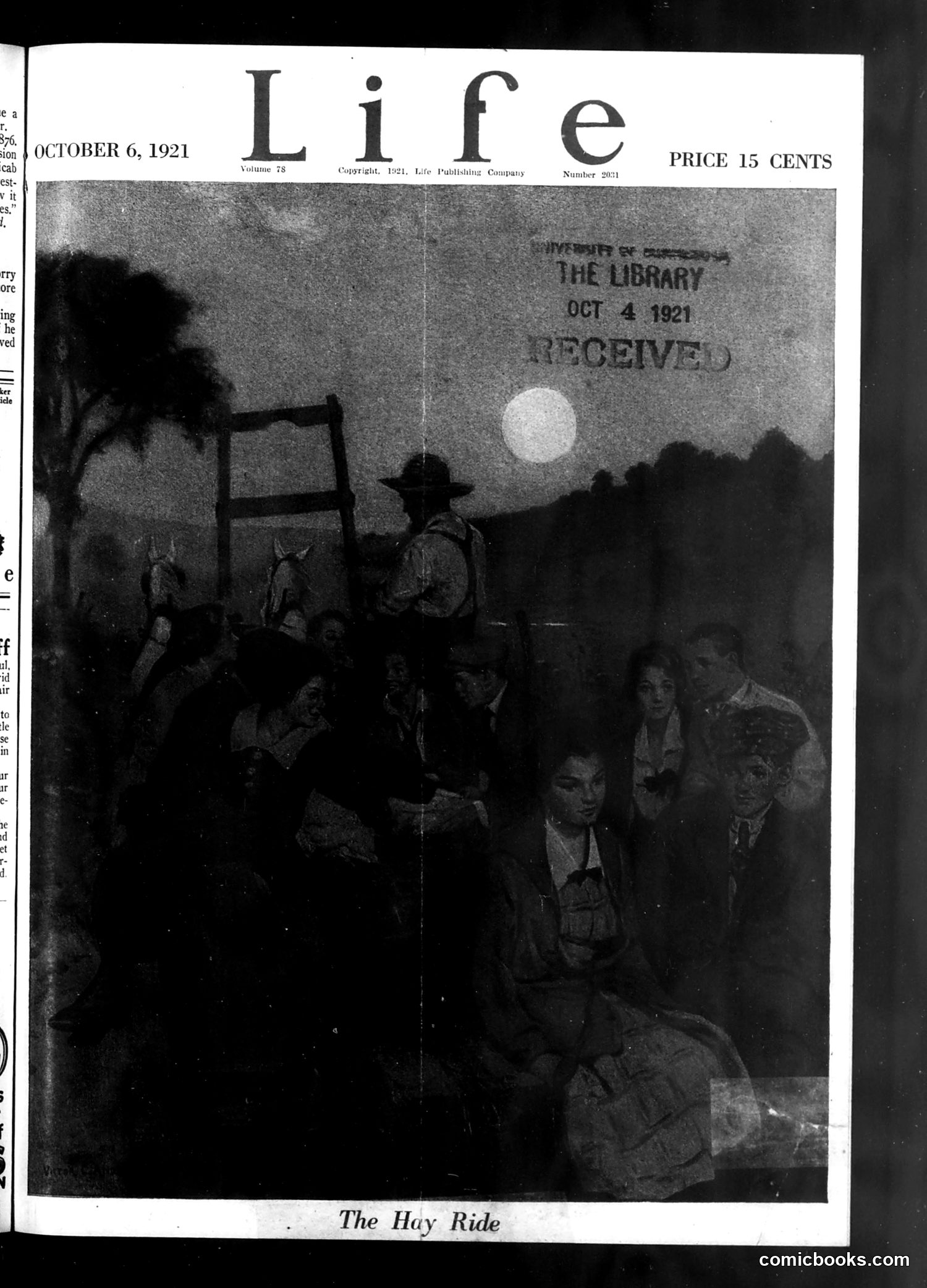
This Life magazine cover from October 6, 1921 depicts a nighttime hay ride—a popular social activity where groups rode together on wagons filled with hay, typically for entertainment or courting purposes. The image shows silhouetted figures on a wagon under a full moon, with trees in the background. The scene captures the romantic or social nature of this pastime, which was common in rural and small-town America during the early 20th century. The title "The Hay Ride" suggests the cover illustrates this wholesome American tradition. Without additional context or caption text visible, the specific satirical point—if any—remains unclear, though the moonlit setting and composition emphasize the nostalgic, leisure aspects of the activity.
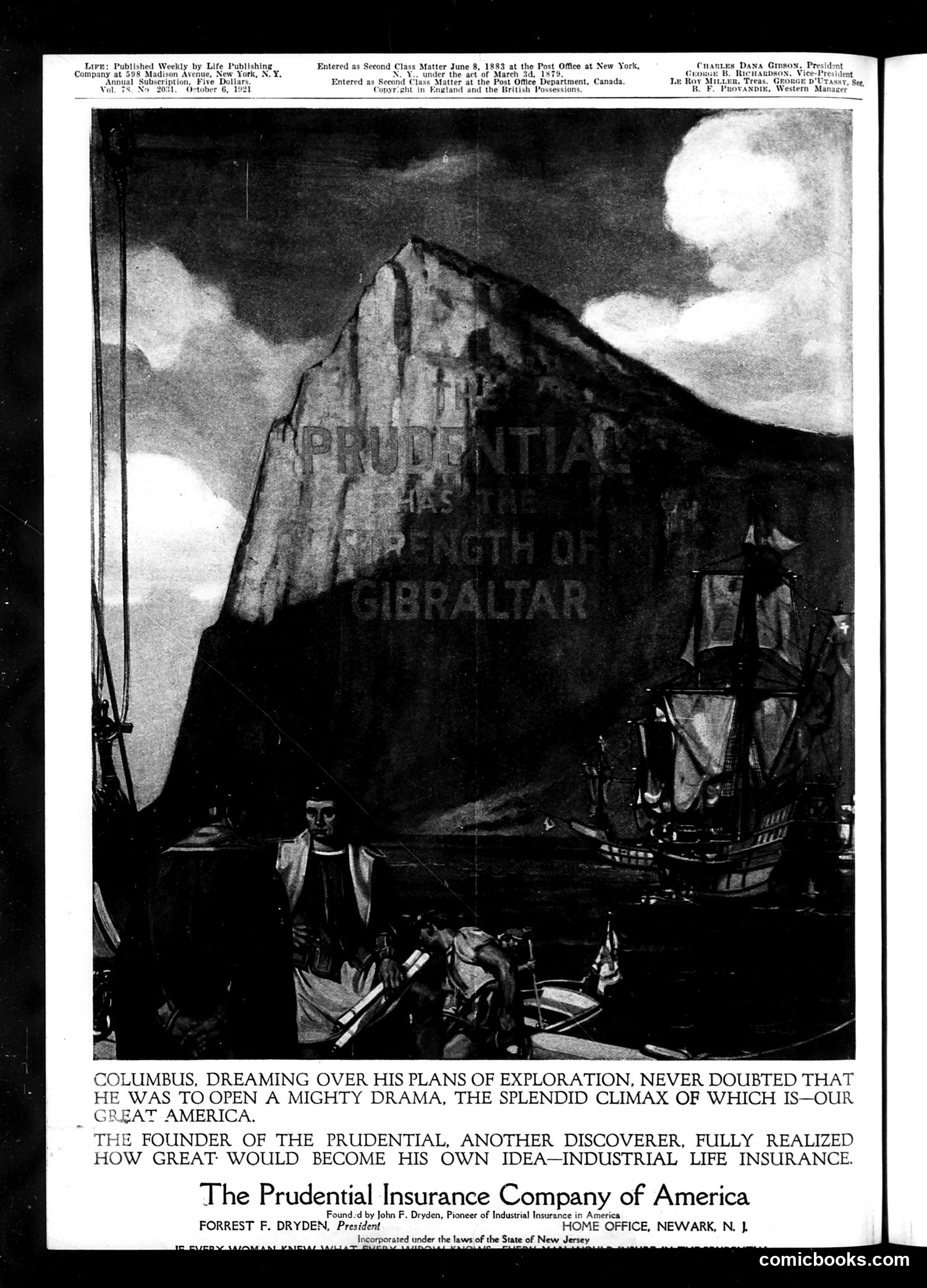
This is primarily a **full-page advertisement** for the Prudential Insurance Company of America, not satirical content. The ad uses Christopher Columbus as a historical figure to draw a parallel with industrial insurance. The image depicts Columbus gazing at plans for exploration, with sailing ships in the background. The text suggests that just as Columbus opened "a mighty drama" in discovering America, the founder of Prudential (John F. Dryden) realized how "great would become his own idea—industrial life insurance." The advertisement conflates colonial exploration with modern insurance innovation, positioning Prudential as similarly pioneering and nation-building. This rhetorical strategy—equating insurance with heroic discovery—was common early 20th-century marketing. The date is October 6, 1921.
This is a **motor car advertisement**, not political satire. The Templar Motors Company uses an extended metaphor comparing automobile engineering to athletic training. The ad argues that removing "unnecessary weight" from cars—like athletes shedding excess pounds—improves performance: speed, endurance, and handling. It contrasts this with competitors' cars that remain "heavy" because manufacturers mistakenly believed weight provided stability ("easy riding"). The piece emphasizes Templar's innovation: their lightweight construction makes cars faster, more nimble, and more fuel-efficient. The ad positions Templar as the "winning" choice, achieving "the pink of perfection" through superior engineering rather than outdated design philosophy. The Templar Motors Company was located in Cleveland, Ohio.
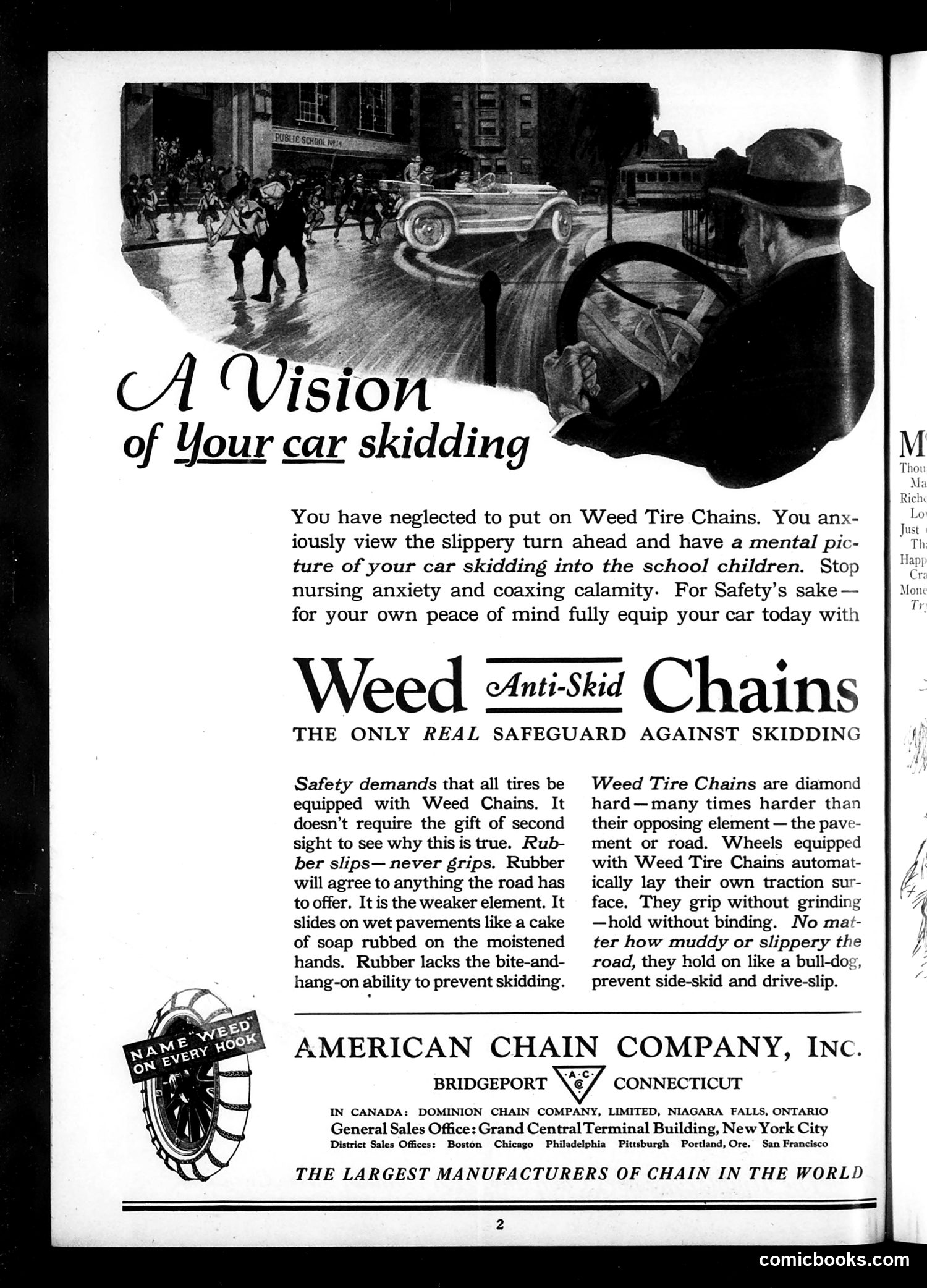
This is a **1920s-era advertisement**, not satire or political commentary. The page promotes tire chains for winter driving safety. The "vision" depicted shows a fearful driver imagining his car skidding dangerously near schoolchildren—a persuasive safety appeal targeting parental anxieties. The ad argues that rubber tires alone lack sufficient traction on wet, icy roads, making chains essential. The copy uses vivid language ("mental picture of your car skidding into the school children") to create urgency. It positions Weed chains as superior because they're "diamond hard" and grip without binding, unlike rubber alone. This reflects early-20th-century automobile culture when winter driving was genuinely hazardous and tire chains were standard equipment, not optional accessories.
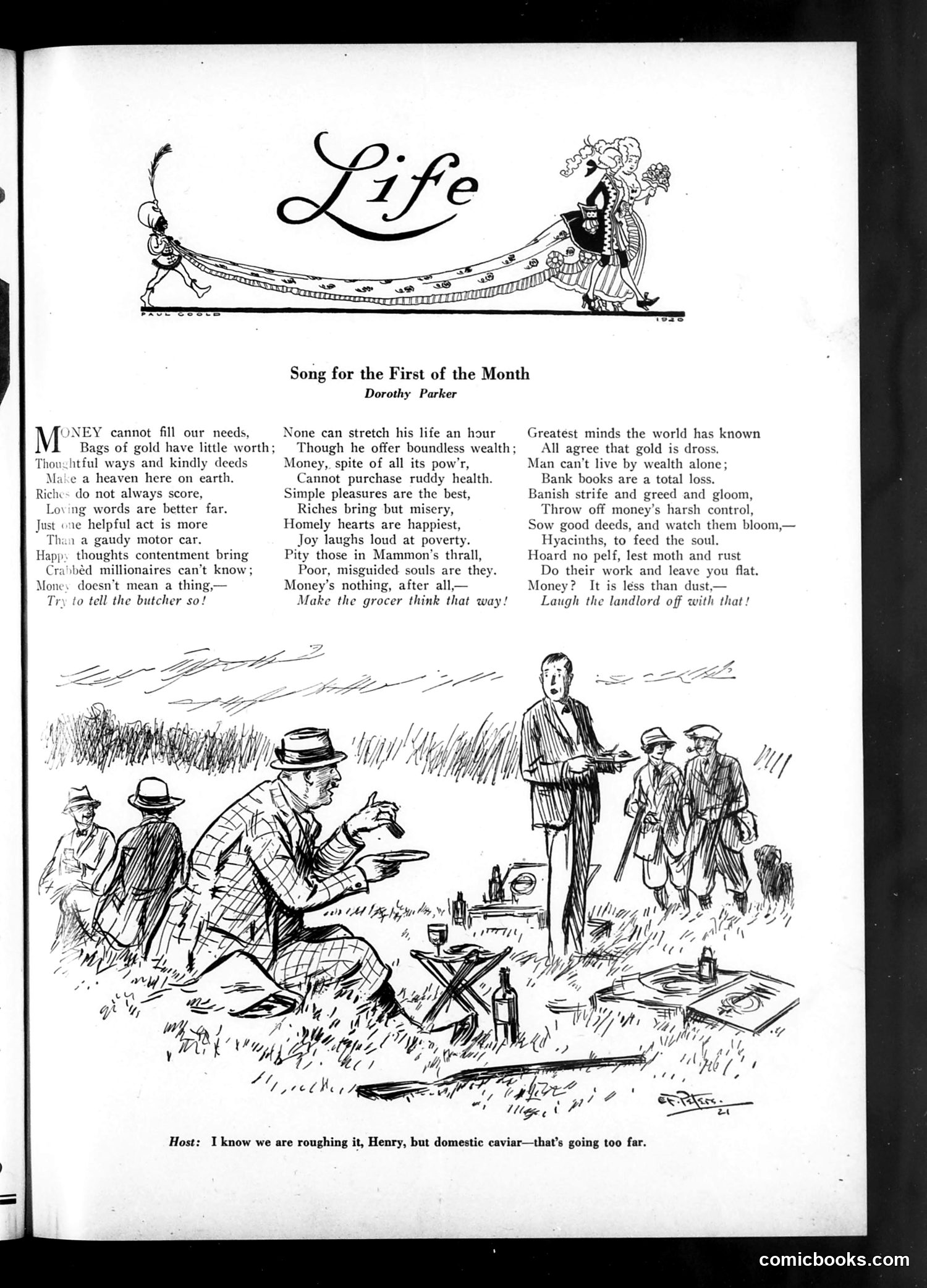
This page combines a poem by Dorothy Parker with a satirical cartoon about poverty and class struggle. Parker's poem mocks the wealthy's assumption that money solves all problems—"Money cannot fill our needs" and "Make the grocer think that way!" The verses argue that contentment and simple pleasures matter more than wealth. The illustration below depicts working-class men on an outing, apparently roughing it outdoors. The caption reveals the satire: "Host: I know we are roughing it, Henry, but domestic caviar—that's going too far." This mocks wealthy people's attempts to seem relatable by "slumming" while maintaining their luxuries, contrasting sharply with Parker's message about money's actual limitations.
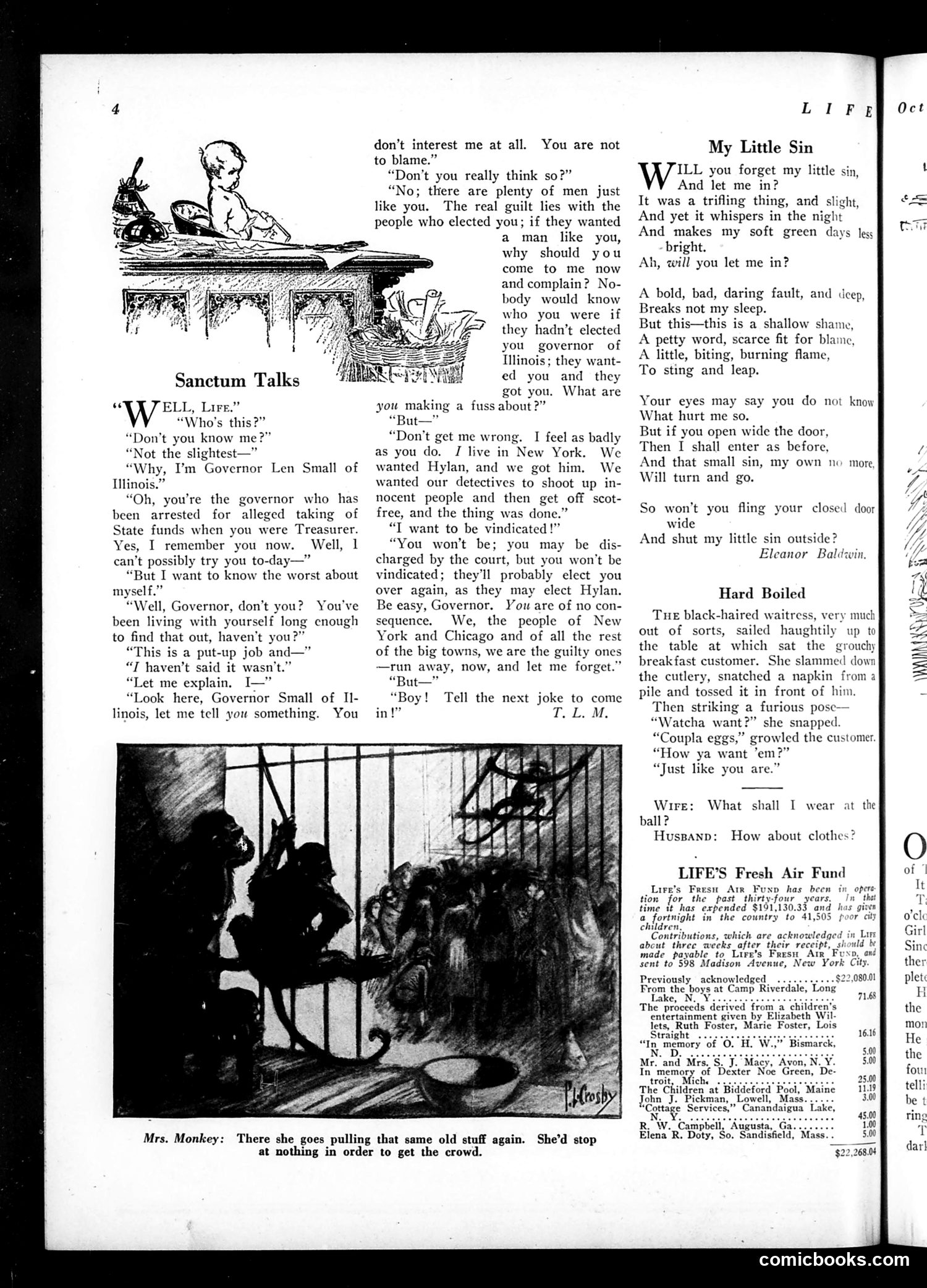
The main cartoon, "Sanctum Talks," depicts a conversation between two men—apparently Governor Len Small of Illinois and Life magazine editor ("LIFE"). Small was arrested for allegedly misappropriating State funds during his tenure as Treasurer. The satire mocks Small's defensive posture: he claims innocence while acknowledging the public's guilt in electing him, deflecting blame onto voters and other corrupt politicians like Hylan. The cartoon criticizes both Small's shamelessness and the electorate's complicity in choosing corrupt officials. The lower illustration, captioned "Mrs. Monkey," appears to be unrelated social satire about crowd manipulation or attention-seeking behavior. The page also includes several poems and the "Hard Boiled" humor section—typical Life magazine content mixing political satire with lighter fare.
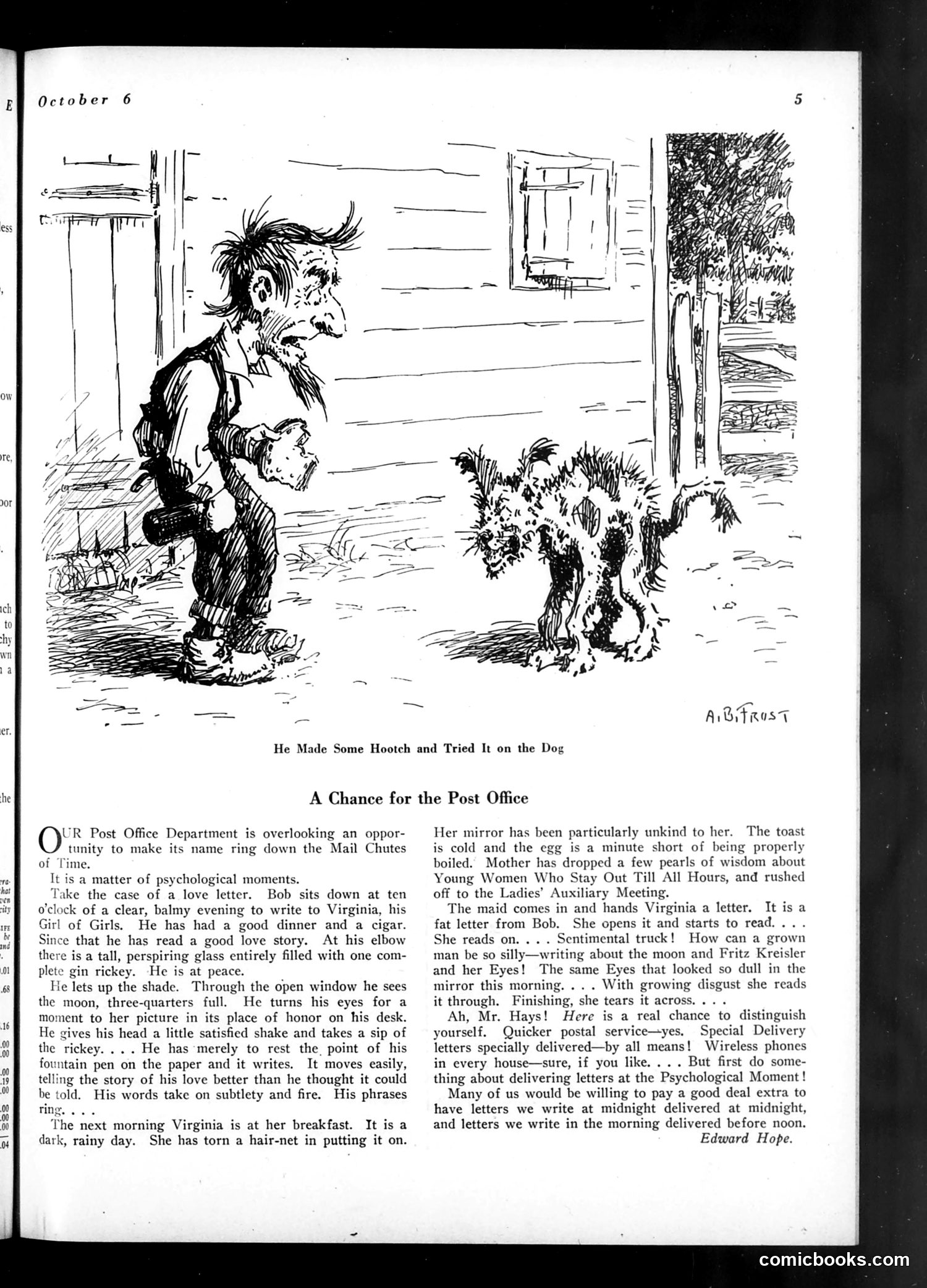
**The Cartoon:** The illustration by A.B. Frost shows a poorly-dressed man offering what appears to be a "hootch" (homemade alcohol) to a small dog. This visual accompanies a satirical article criticizing the Post Office Department. **The Satire:** The article argues that the U.S. Post Office is missing an opportunity to improve service by not implementing psychological principles for mail delivery. The author uses sardonic examples—a woman receiving a cold toast and undercooked egg, letters arriving late—to mock postal inefficiency. **The Central Joke:** The connection between the cartoon and text appears to critique poor judgment: just as the man foolishly gives alcohol to a dog, the Post Office foolishly ignores obvious solutions (like special delivery and wireless phones) to operational problems. The piece advocates for modernizing postal service methods.
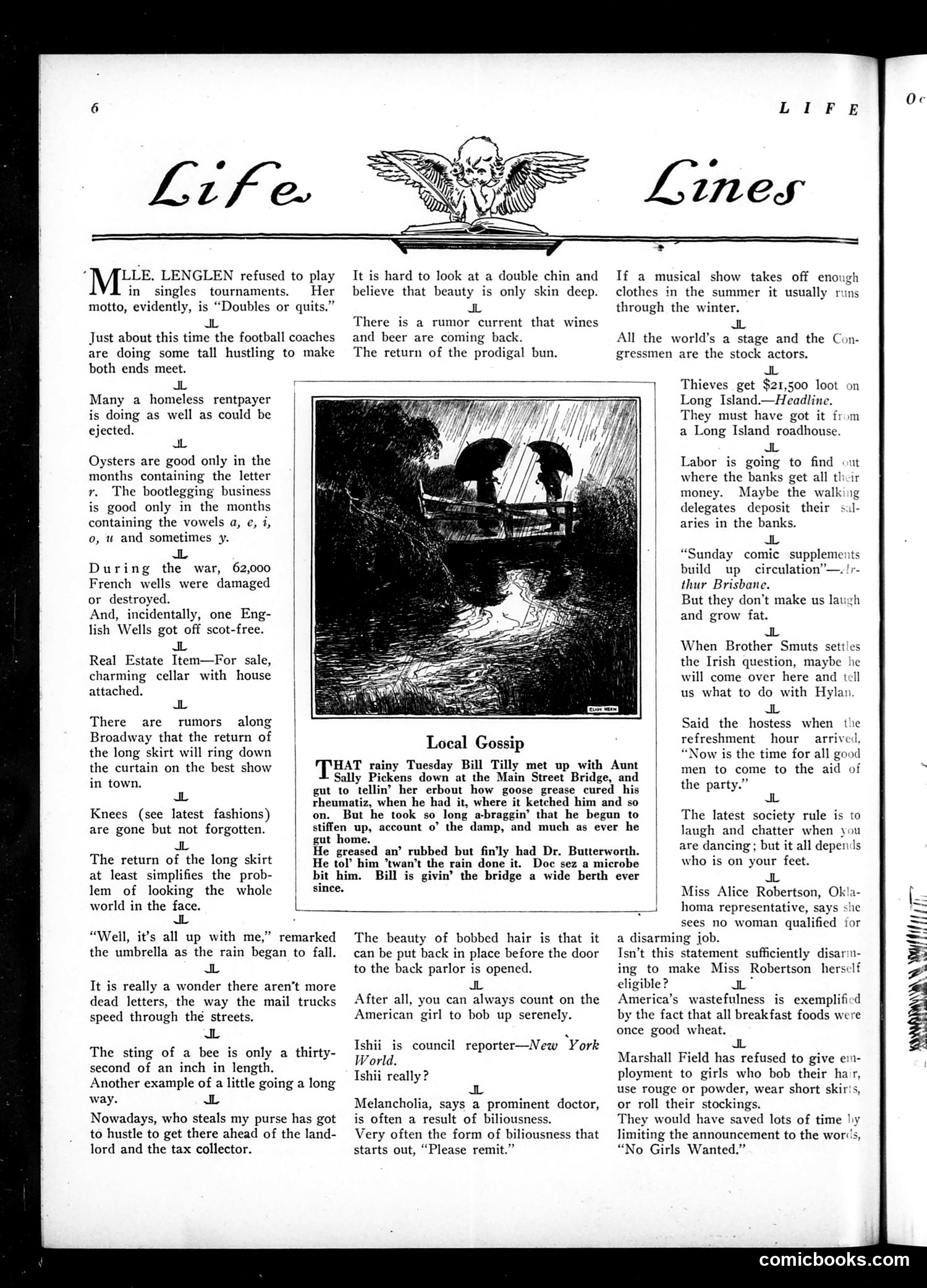
This appears to be a humor and gossip column page from Life magazine. The central image shows two figures with umbrellas in heavy rain, captioned "Local Gossip." The text consists of brief satirical observations about contemporary social issues: women's fashion (the return of long skirts and bobbed hair), wartime damage to English wells, real estate, Broadway rumors, and social etiquette. Notable items mock women bobbing their hair, criticize an employment manager (Marshall Field) who refuses to hire women with bobbed hair or short skirts, and reference "Brother Smuts" settling an "Irish question." The humor relies on wordplay and observational comedy about 1920s social changes—particularly women's fashion choices and their employment consequences—rather than partisan politics.
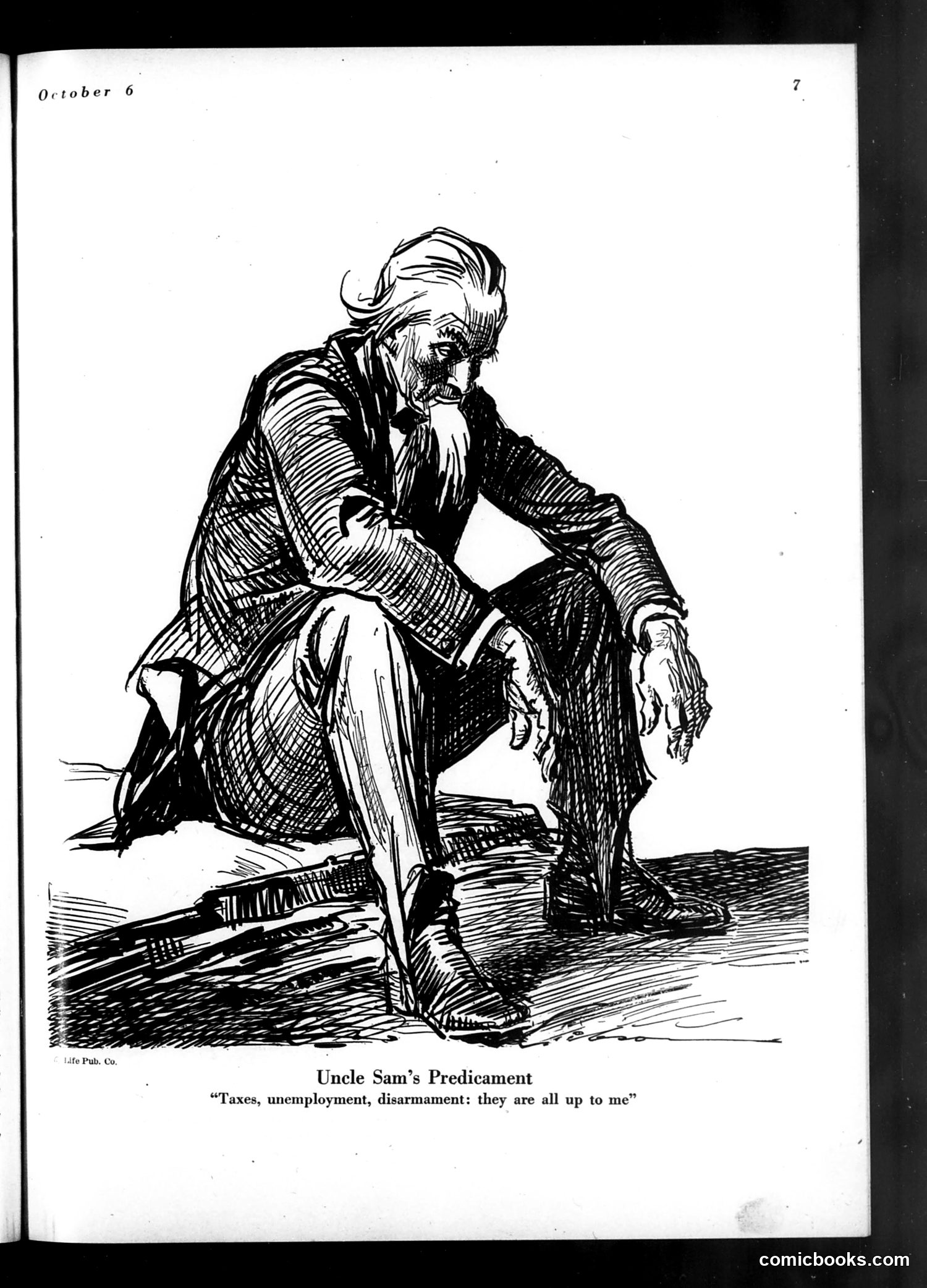
This political cartoon depicts Uncle Sam (the personified United States, identifiable by his characteristic top hat and goatee) in a crouched, worried posture. The caption states: "Taxes, unemployment, disarmament: they are all up to me." The satire criticizes Uncle Sam for bearing responsibility for three major national problems during what appears to be the interwar period. The figure's body language—hunched and troubled—conveys the weight of these burdens. The cartoon suggests that the government (Uncle Sam) is responsible for managing taxes, joblessness, and military disarmament, while also implying the seeming impossibility or difficulty of addressing all three simultaneously. This reflects public anxiety about economic and military policy during an economically turbulent era.
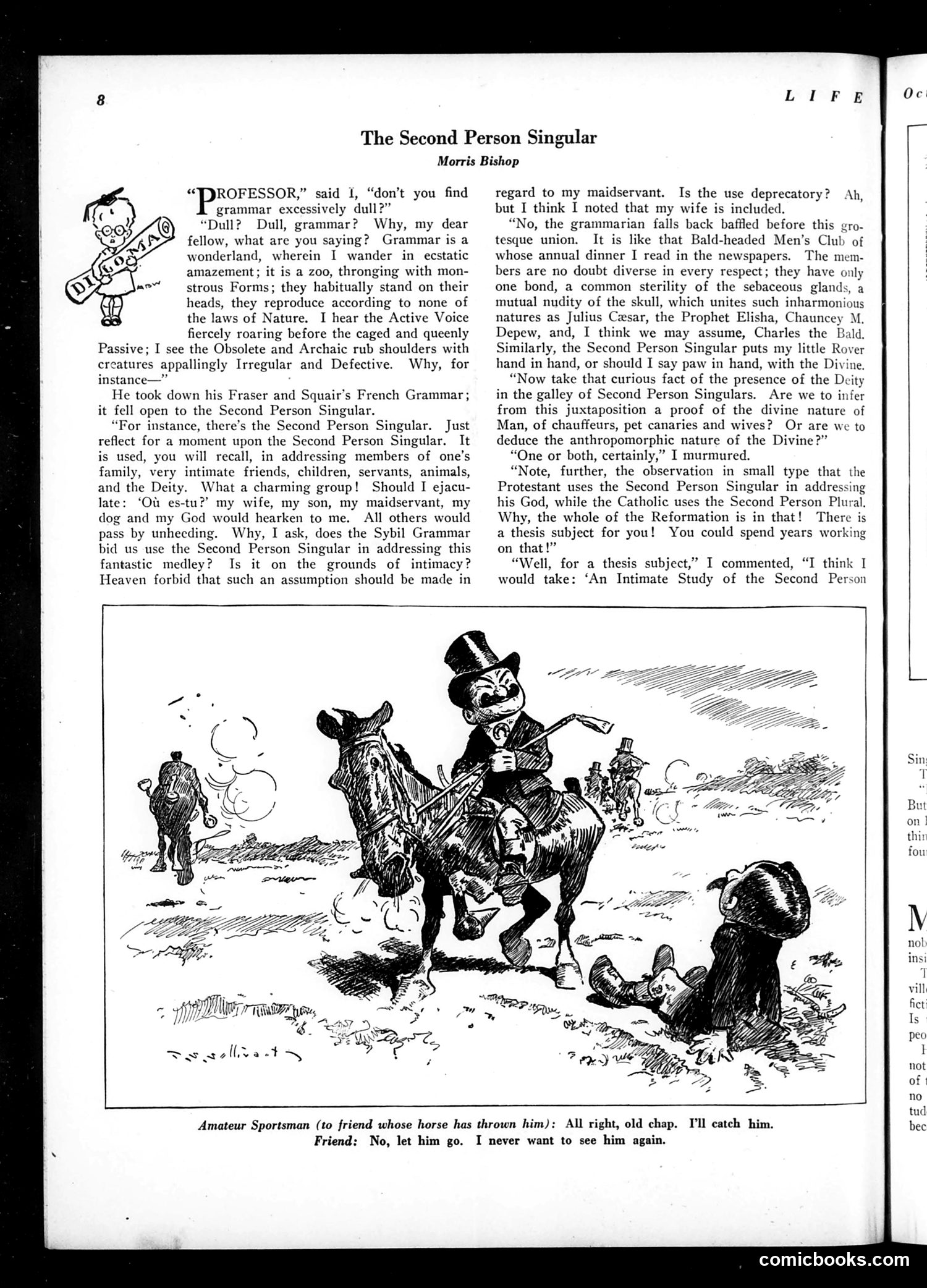
This page combines a humorous essay about English grammar with a cartoon satirizing amateur sportsmen. **The Essay:** Bishop playfully discusses why English lacks a distinct second-person singular form (like French "tu"). He notes the grammatical absurdity that "you" addresses everyone equally—family, servants, God, animals—making social hierarchy linguistically invisible, unlike Catholic and Protestant theological distinctions. **The Cartoon:** Shows an amateur horseman who's been thrown, telling his friend "All right, old chap. I'll catch him," while his friend replies "No, let him go. I never want to see him again." The humor targets incompetent upper-class sportsmen pretending at riding and fox-hunting—a common target of satire mocking the idle wealthy.
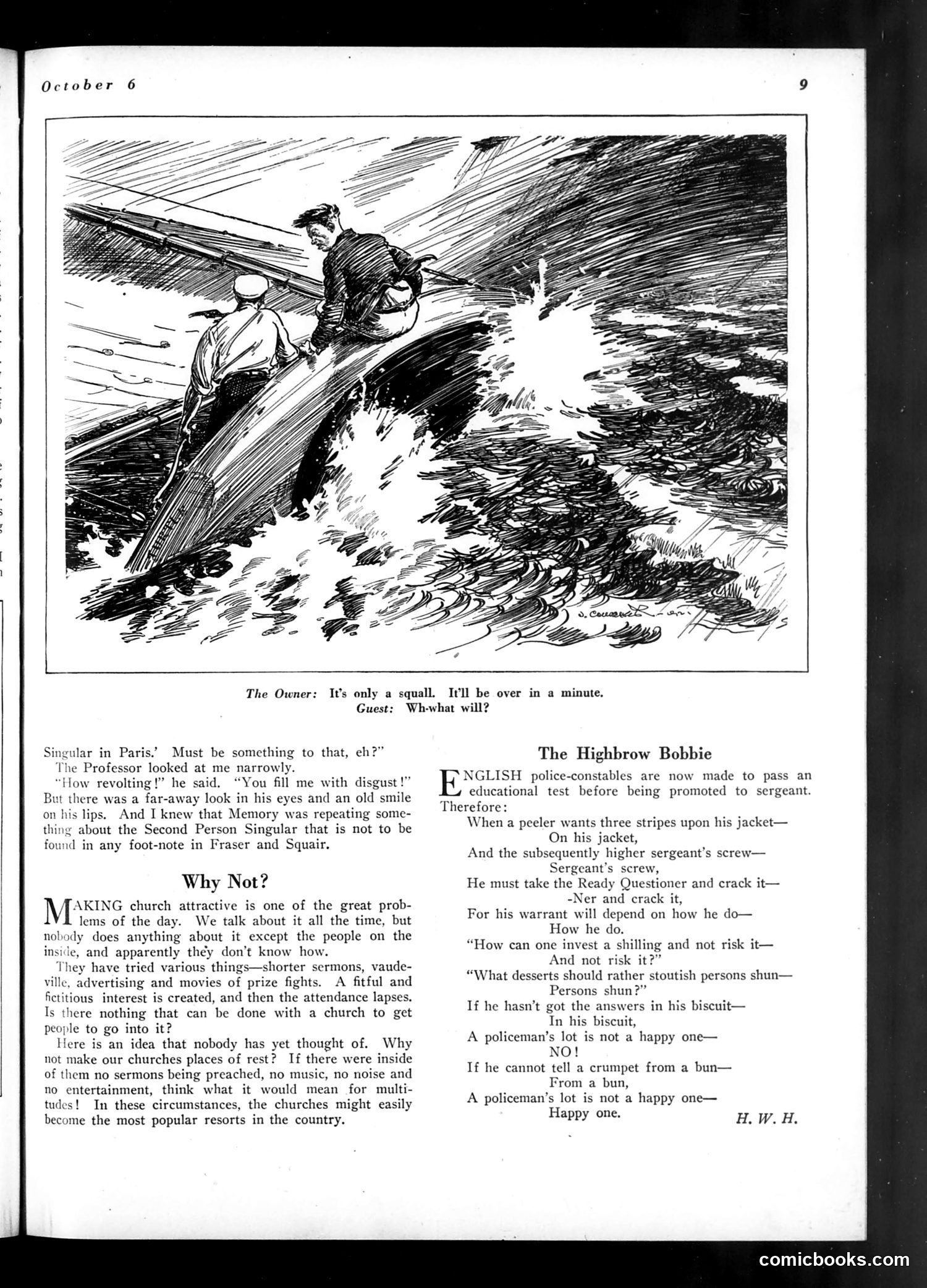
**The Cartoon:** The illustration depicts two men in a small boat during rough seas. One says "It's only a squall. It'll be over in a minute," while the other asks "Wh-what will?" The joke appears to be a dark humor exchange about their survival prospects during dangerous water conditions—the first man's reassurance is undermined by the second's anxious (and grammatically incomplete) question, implying skepticism about whether they'll survive. **The Articles:** "Why Not?" proposes making churches into secular venues with sermons removed, suggesting they become "popular resorts" instead—satirizing both churchgoing habits and secular entertainment venues. "The Highbrow Bobbie" is a humorous poem about English police promotion requirements, mocking the bureaucratic absurdity of testing officers on obscure knowledge (crumpets, desserts, buns) irrelevant to policing.
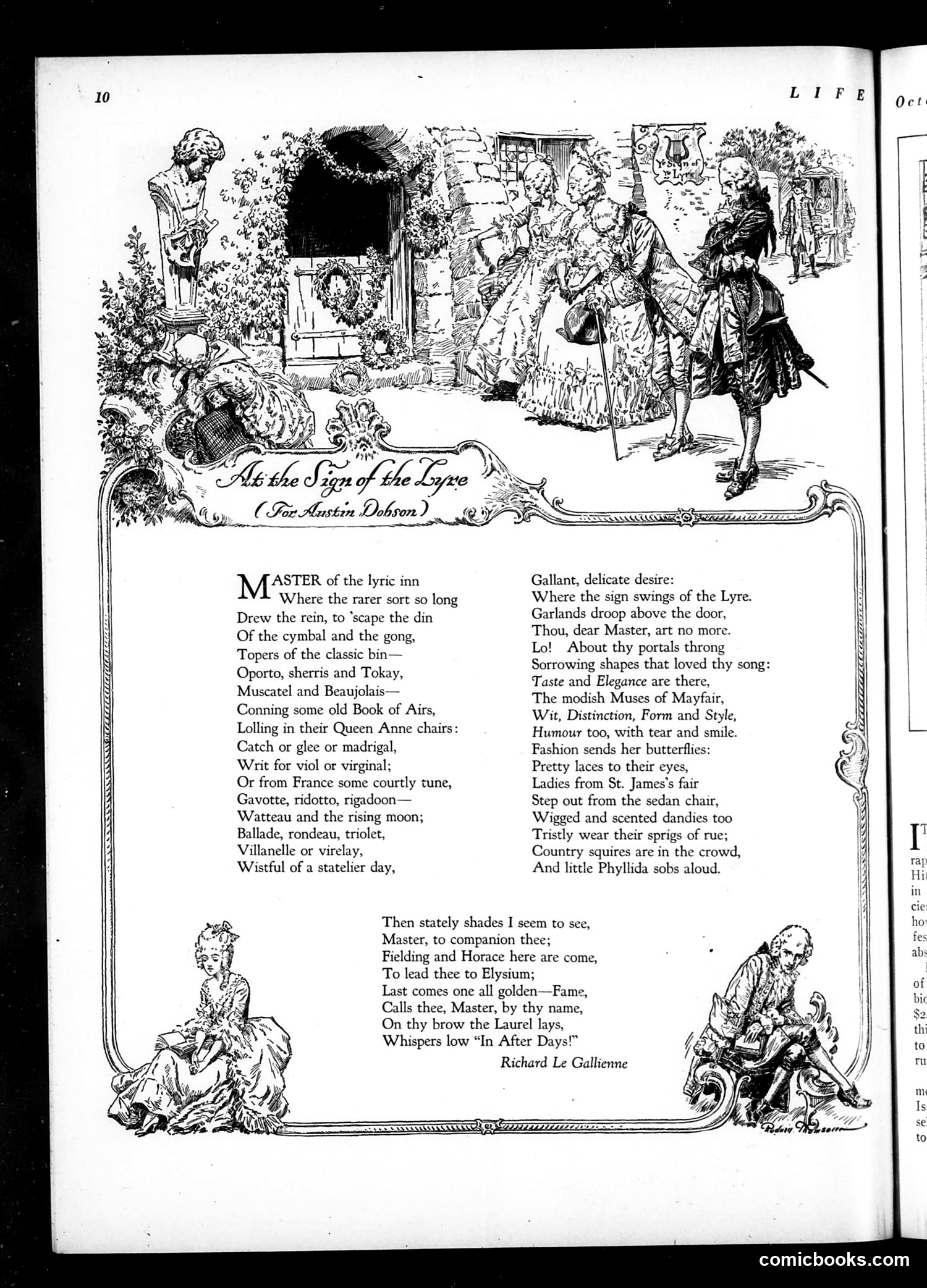
This is a literary illustration accompanying a poem by Richard Le Gallienne, not a political cartoon. The decorative page features an 18th-century-style scene of fashionable society gathering at an inn called "The Lyre." The poem celebrates the cultural refinement of this establishment—a place where educated patrons discuss classical literature, music, and wit. References to "Porto, sherris and Tokay," French courtly music, and allusions to figures like Fielding and Horace suggest an idealized literary salon. The illustration's ornate frame and period costumes evoke nostalgia for an earlier era of aesthetic sophistication. This appears to be satirizing contemporary concerns about declining cultural taste, positioning the "Lyre" as a refuge for genuine artistic sensibility amid modish superficiality.
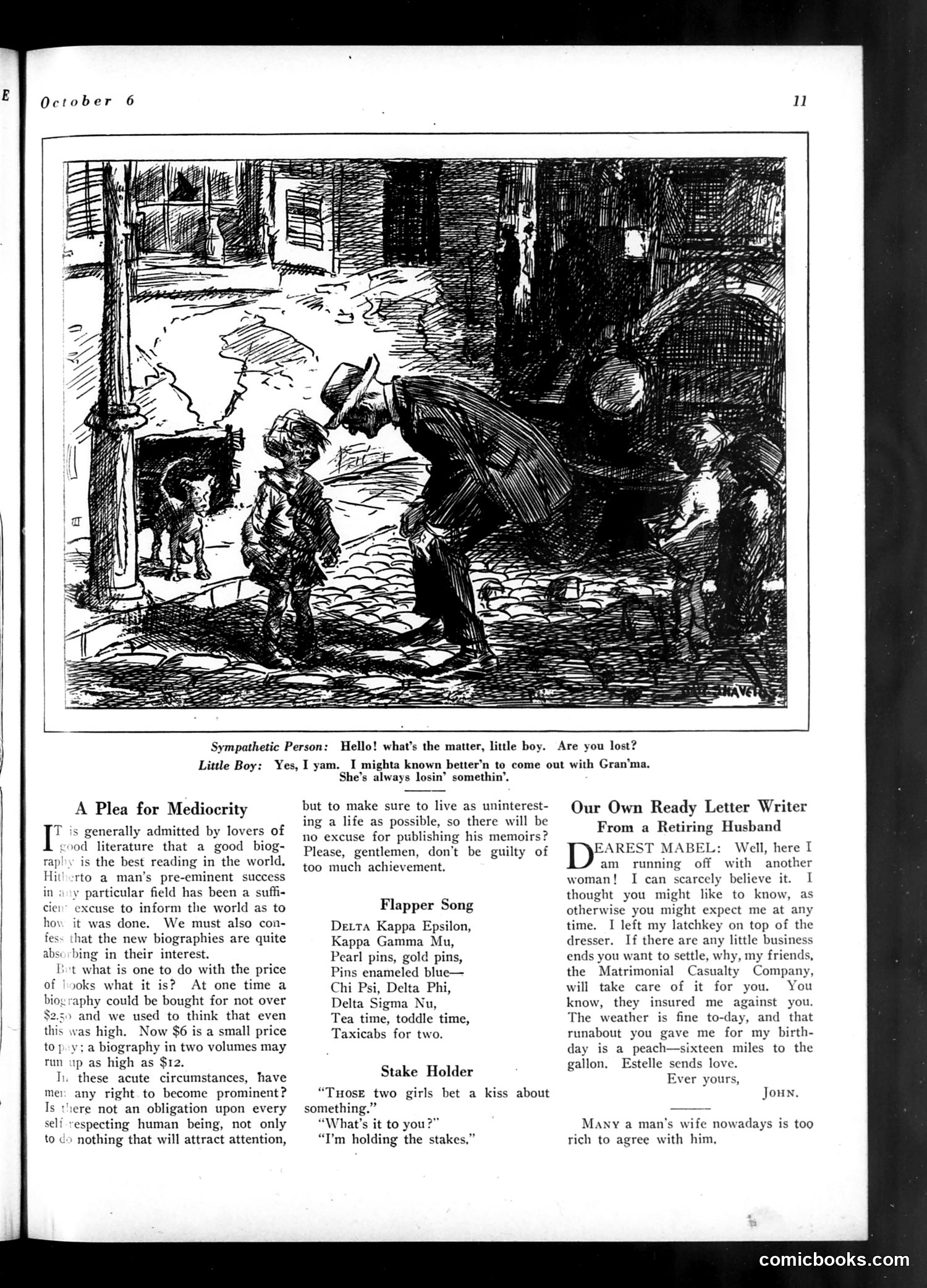
The main illustration depicts a street scene where a sympathetic adult encounters a lost young boy. The dialogue reveals social commentary: the child says he "might'a known better'n to come out with Gran'ma. She's always losin' somethin'." This is gentle satire about elderly women's absent-mindedness or forgetfulness—a common stereotype of the era. The joke's humor depends on the reversal: the grandmother brought the child out but is herself so scatterbrained that she loses track of him, then blames him for being lost. The rest of the page contains unrelated items: "A Plea for Mediocrity" (article), "Flapper Song" (humorous verse about sorority life), and a brief joke about betting. These represent typical *Life* magazine content mixing humor, social commentary, and light satire.
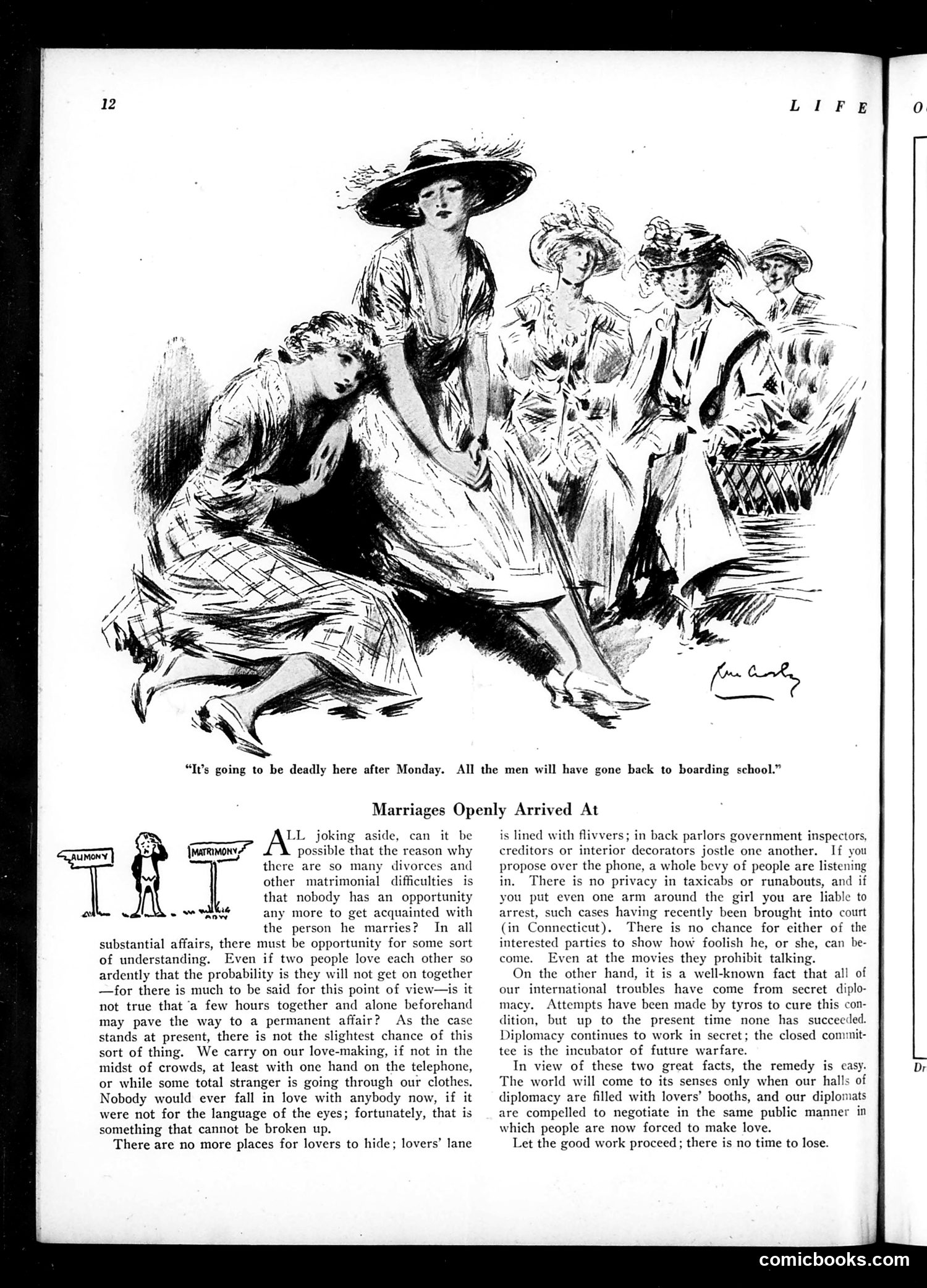
This cartoon illustrates the article's thesis about public courtship. The sketch shows a woman in a large hat surrounded by other women and men, with one man kneeling—a theatrical marriage proposal happening openly in public view, with an audience watching. The accompanying text argues that modern marriages lack privacy because society constantly monitors romantic relationships. The author suggests this public scrutiny—via telephone gossip, servants, decorators, and government inspectors—makes genuine courtship impossible. The satire critiques early 20th-century social conditions where no private space exists for couples. The article proposes that only open diplomacy (rather than secret negotiations) can remedy this surveillance culture, since "there are no more places for lovers to hide."
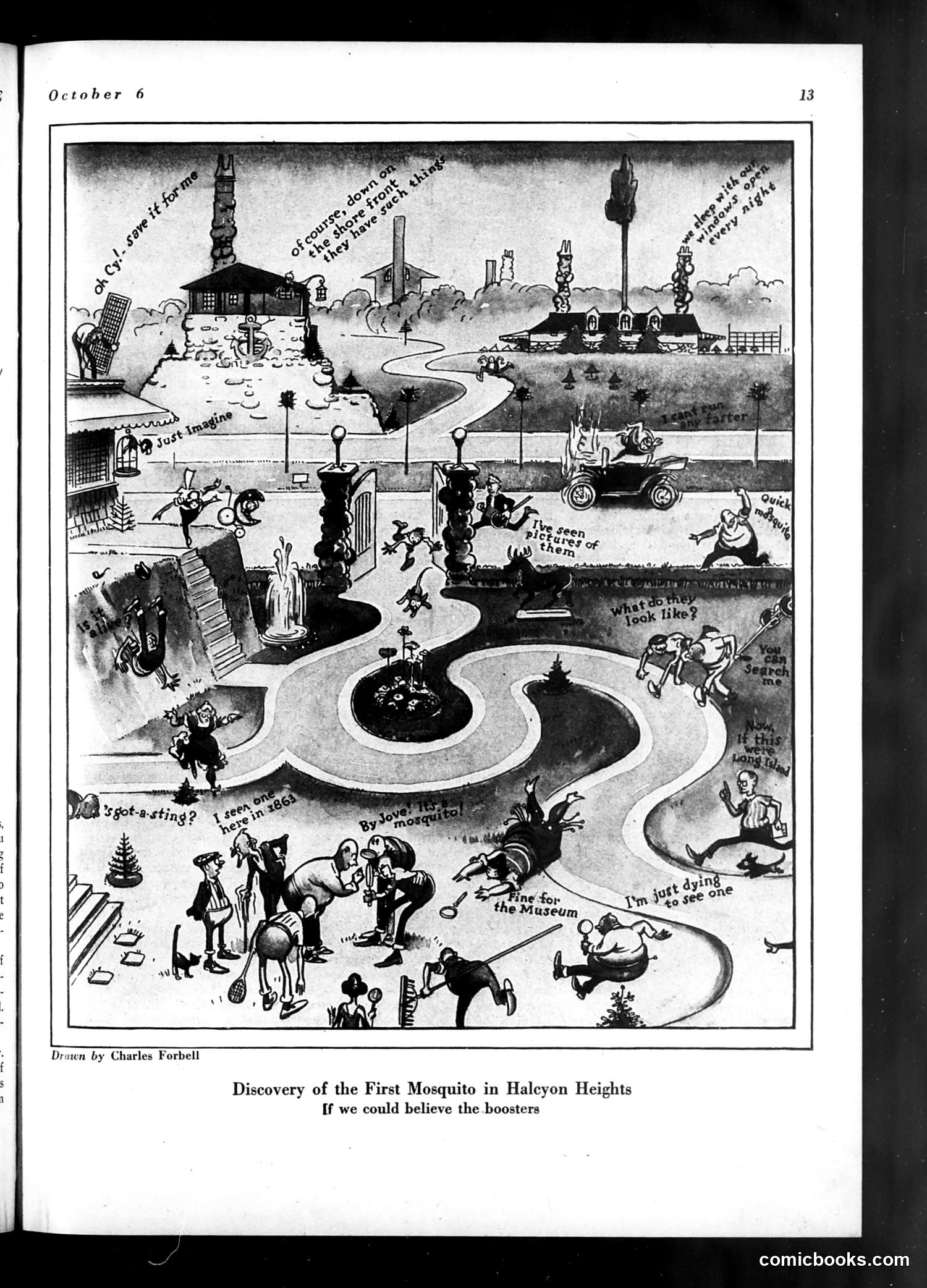
This satirical cartoon by Charles Forbell depicts the discovery of a mosquito in what appears to be an upscale residential area ("Haleyon Heights"). The humor derives from the exaggerated panic and chaos this causes among residents—people are shown running, fleeing in cars, and generally in distress. The subtitle "If we could believe the boosters" suggests the satire targets local promotional claims. Real estate "boosters" advertised Haleyon Heights as an ideal community, but this cartoon mocks that marketing by showing how a single mosquito discovery would shatter the image of perfection they promoted. The cartoon ridicules both the boosters' over-promising and residents' overreaction to a minor pest problem.
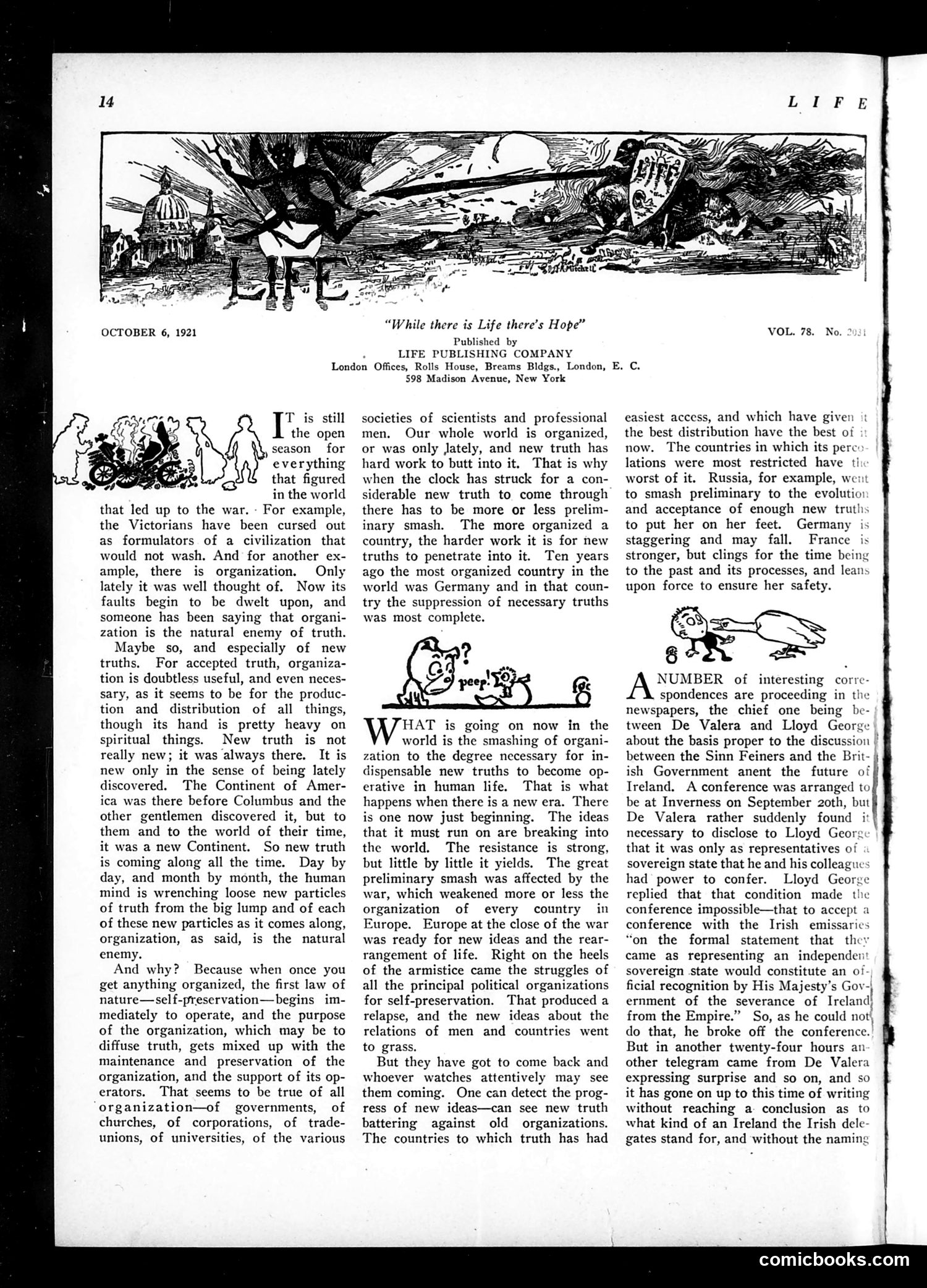
This page is primarily text-based editorial content rather than political cartoons. The article discusses the post-WWI reorganization of societies and governments, arguing that organization itself—while necessary—naturally corrupts truth and becomes self-serving. The small decorative cartoons are generic illustrations rather than specific political satire: one shows a figure with question marks (representing confusion about new ideas), another depicts a small character near fallen objects (likely symbolizing disruption from organizational collapse). The text references De Valera and Lloyd George's September 1921 conference regarding Irish independence—a major contemporary issue. The author suggests new political ideas are emerging but face resistance from established organizations clinging to power, reflecting post-war ideological tensions in Europe and Ireland.
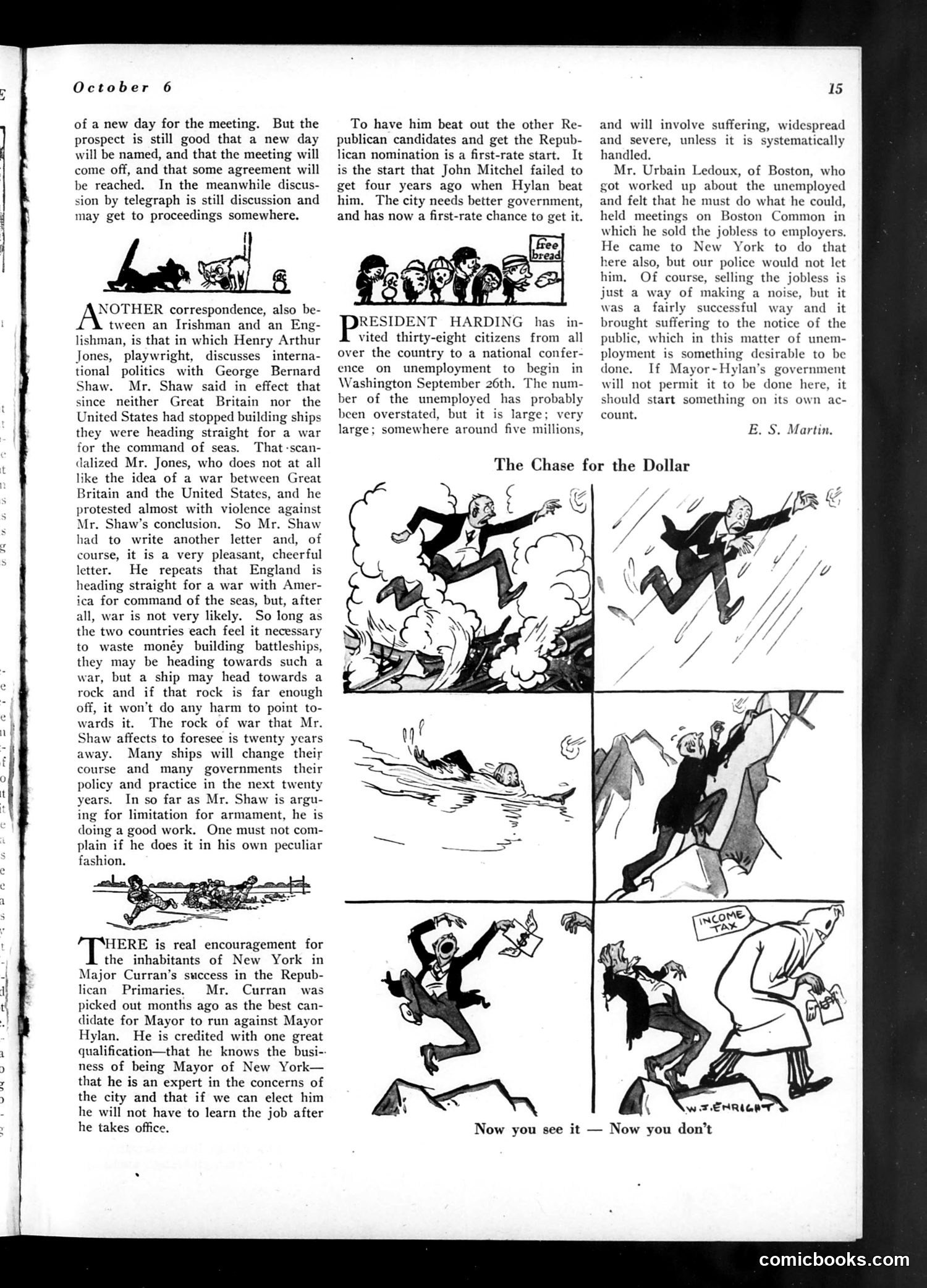
This page from *Life* magazine (October 6, likely 1921) contains a multi-panel cartoon satirizing wealth and financial instability during the post-WWI economic period. The cartoon depicts figures literally chasing after a dollar bill across various scenarios—climbing mountains, falling into water, struggling uphill—illustrating the desperate pursuit of money and the precariousness of economic fortune. The title "Now you see it — Now you don't" emphasizes how wealth is fleeting and elusive. The accompanying text discusses unemployment (estimated at five million), President Harding's unemployment conference, and New York mayoral politics. The cartoon thus comments on widespread economic anxiety and the public's frantic struggle for financial security during a period of economic uncertainty and transition following World War I.
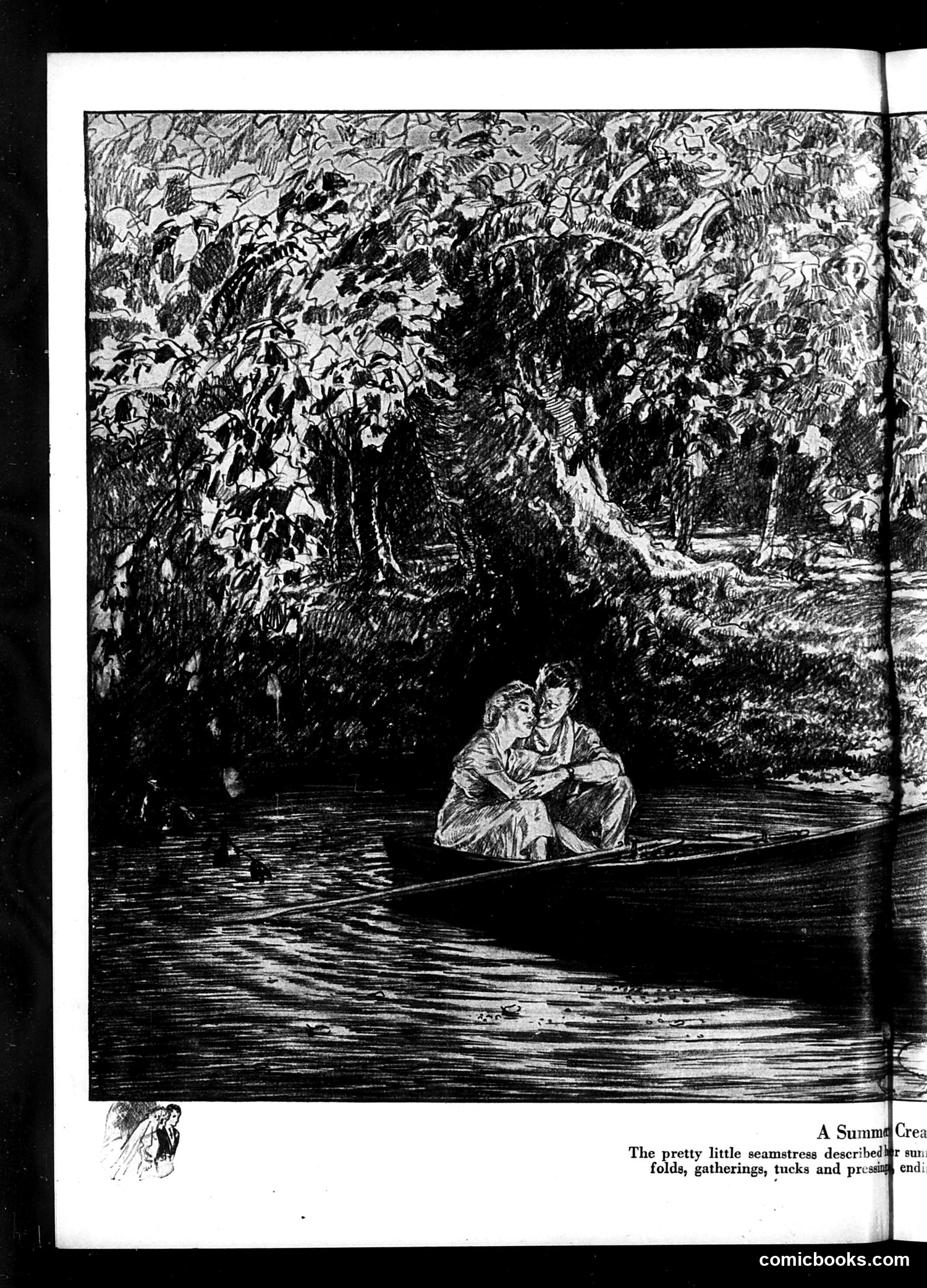
This appears to be an illustration from *Life* magazine showing two figures in a small boat on a stream or creek, surrounded by dense foliage. The OCR'd text is fragmented and difficult to parse fully, but references "the pretty little seamstress" and mentions "sun," "folds, gatherings, tucks and pressing"—language associated with sewing and garment construction. The illustration likely satirizes or comments on romantic or domestic themes, possibly contrasting refined sewing work with a pastoral scene. However, without clearer text or additional context about the specific issue of *Life*, the precise satirical point remains unclear. The caption appears incomplete or corrupted in the OCR process, making definitive interpretation difficult.
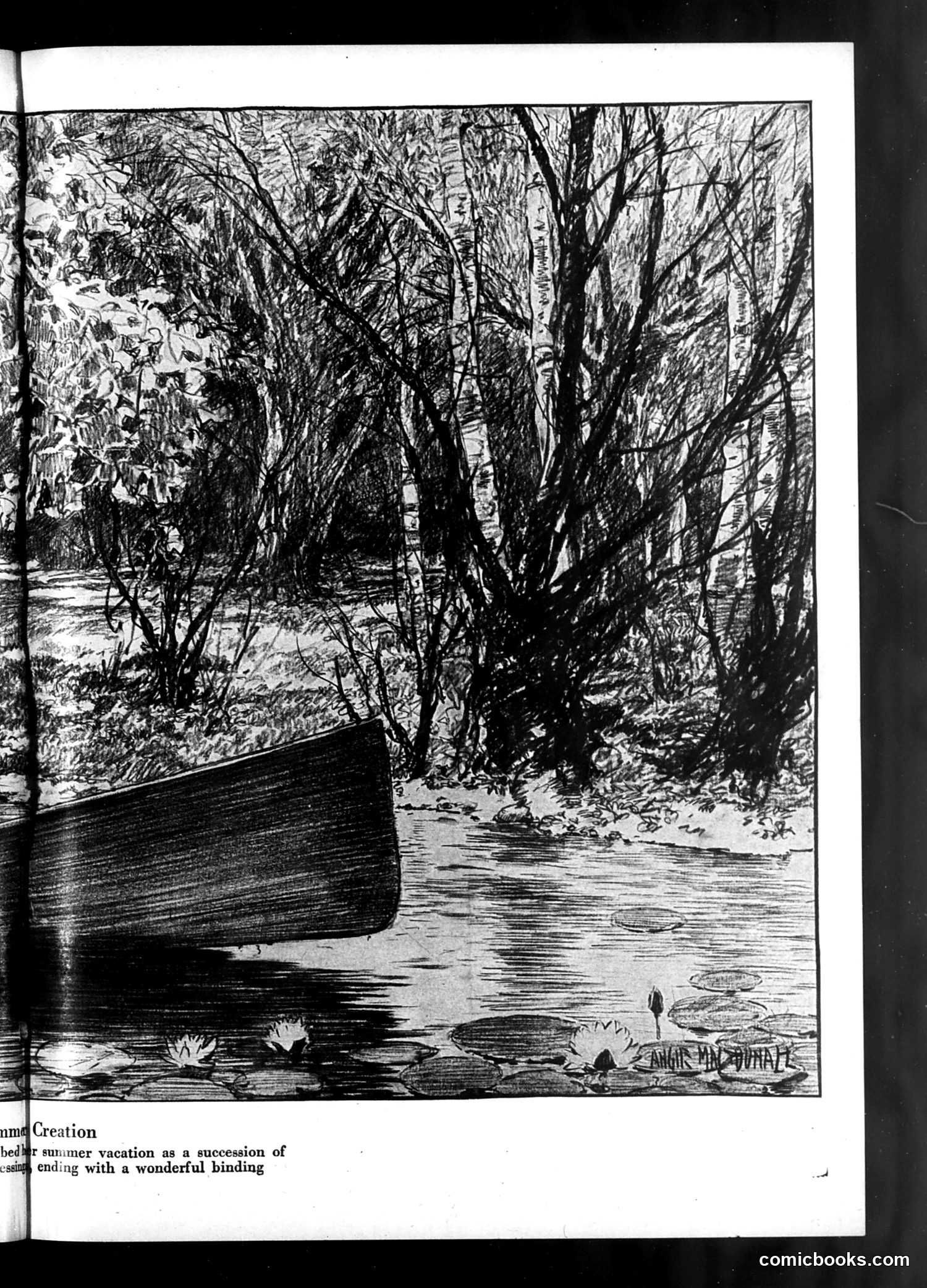
This is a pen-and-ink illustration titled "Creation" depicting a peaceful riverside or lakeside scene with a beached rowboat, willow trees, water lilies, and natural vegetation. The visible text fragment references "summer vacation as a succession of" and mentions "ending with a wonderful binding," though the complete context is unclear from this page excerpt. The illustration appears to be a romantic or idyllic nature scene rather than political satire. Without the full article text or page context, the specific satirical intent—if any—is unclear. The image itself is rendered in detailed crosshatching typical of early 20th-century magazine illustration. The signature appears to read "Aman-Tadema" or similar, though this is difficult to verify with certainty from the image quality.
This page reviews three theatrical productions from the early 20th century. **"Blood and Sand"** adapts a novel by Spanish author Blasco Ibáñez about bullfighting in Madrid. The reviewer criticizes it as melodramatic ("red plush plot") despite featuring respected actor Otis Skinner. The play allegedly contains mildly risqué moments—a woman calls the male lead "My beast"—designed to titillate audiences, though the reviewer finds them awkwardly executed. **"Bluebeard's Eighth Wife"** is a French farce starring Ina Claire. The reviewer notes American audiences find such European comedies acceptable precisely because they're foreign. The plot involves a woman undressing a man to check his shirt-maker—the reviewer finds this harmless, but criticizes the play overall as unoriginal and insufficiently bold. **"The White-Headed Boy"** receives praise as a well-written, modestly entertaining piece from Dublin's Abbey Theatre with excellent ensemble acting. The small decorative illustrations are ornamental flourishes typical of the era's magazine design.
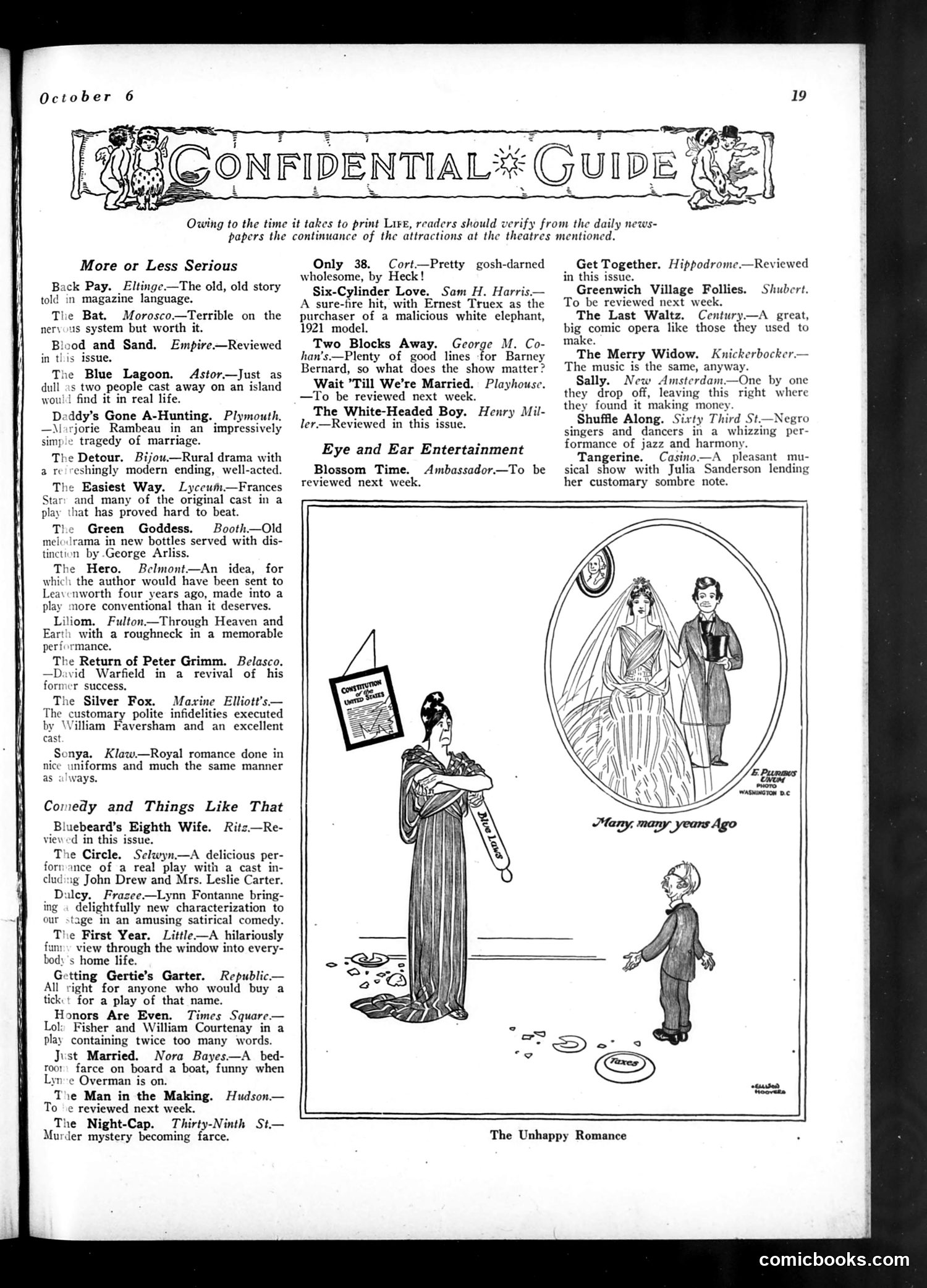
This illustration satirizes romantic disappointment, likely referencing a popular theatrical production or cultural narrative of the era. The cartoon depicts three panels: a woman in classical/mythological dress holding a scroll labeled "Confidential Guide" (mirroring the magazine's header), a cherub or cupid figure scattering coins or tokens below, and a small figure walking away dejected. The joke appears to target the gap between romantic idealization and reality—the grandiose, draped figure represents love or romance as imagined, while the scattered coins and departing figure suggest the messy, disappointing, or mercenary reality. The title "The Unhappy Romance" reinforces this ironic contrast. Without additional context about specific 1921 theatrical productions, the exact target remains unclear, but the satire mocks the mismatch between romantic fantasy and actual experience—a timeless Life magazine theme.
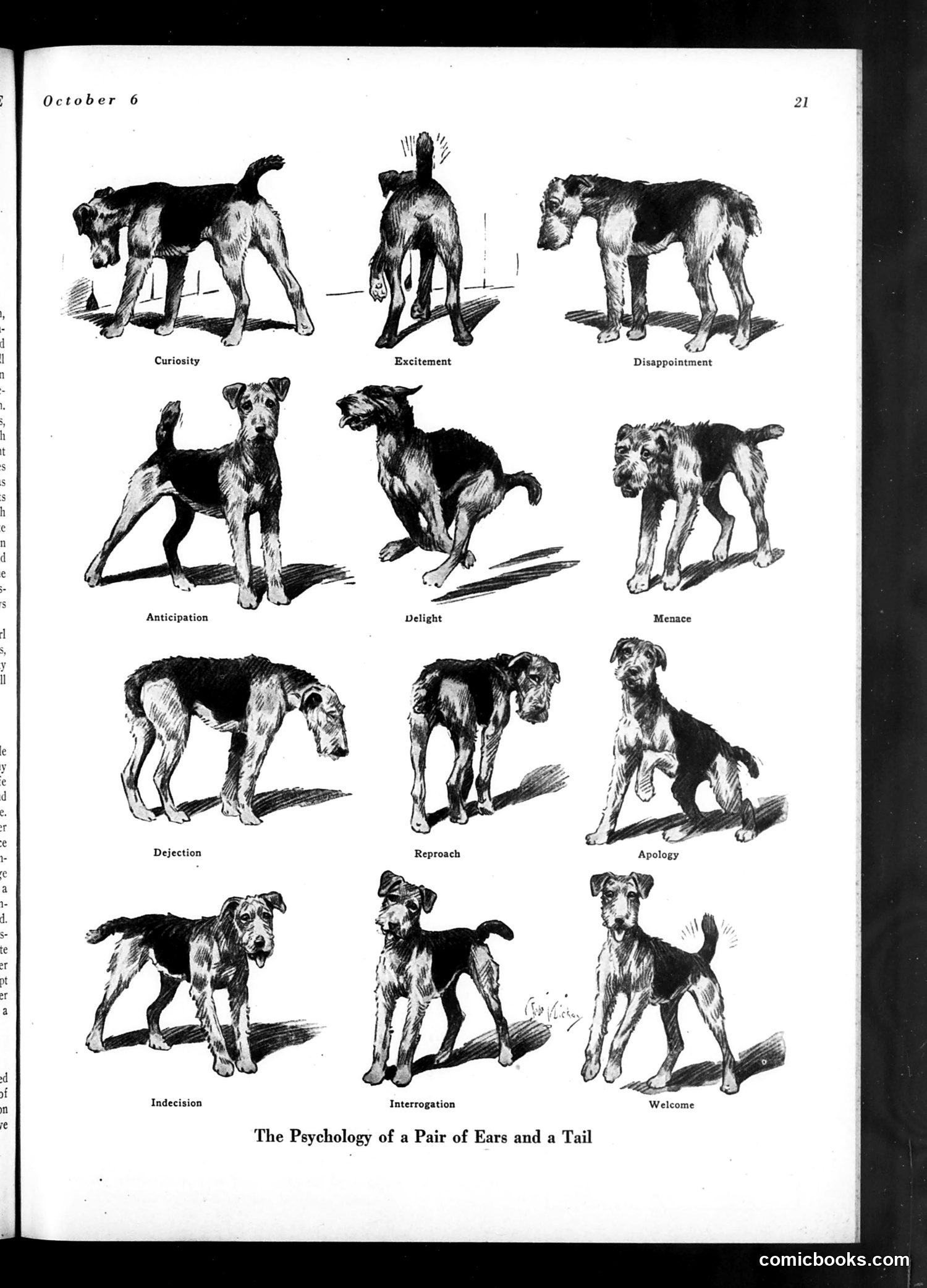
This page presents twelve dog sketches illustrating different emotional states through body language—specifically ear and tail positions. Each illustration is labeled with a human emotion: Curiosity, Excitement, Disappointment, Anticipation, Delight, Menace, Dejection, Reproach, Apology, Indecision, Interrogation, and Welcome. The satire likely compares dog behavior to human emotional expression, suggesting that dogs communicate feelings as clearly as people do—sometimes more honestly. By anthropomorphizing canine body language, the cartoonist humorously implies that dogs possess recognizable psychology parallel to humans. This was a common early-20th-century satirical device: using animal behavior to comment obliquely on human nature and society. The piece appears to be straightforward visual humor rather than political commentary.
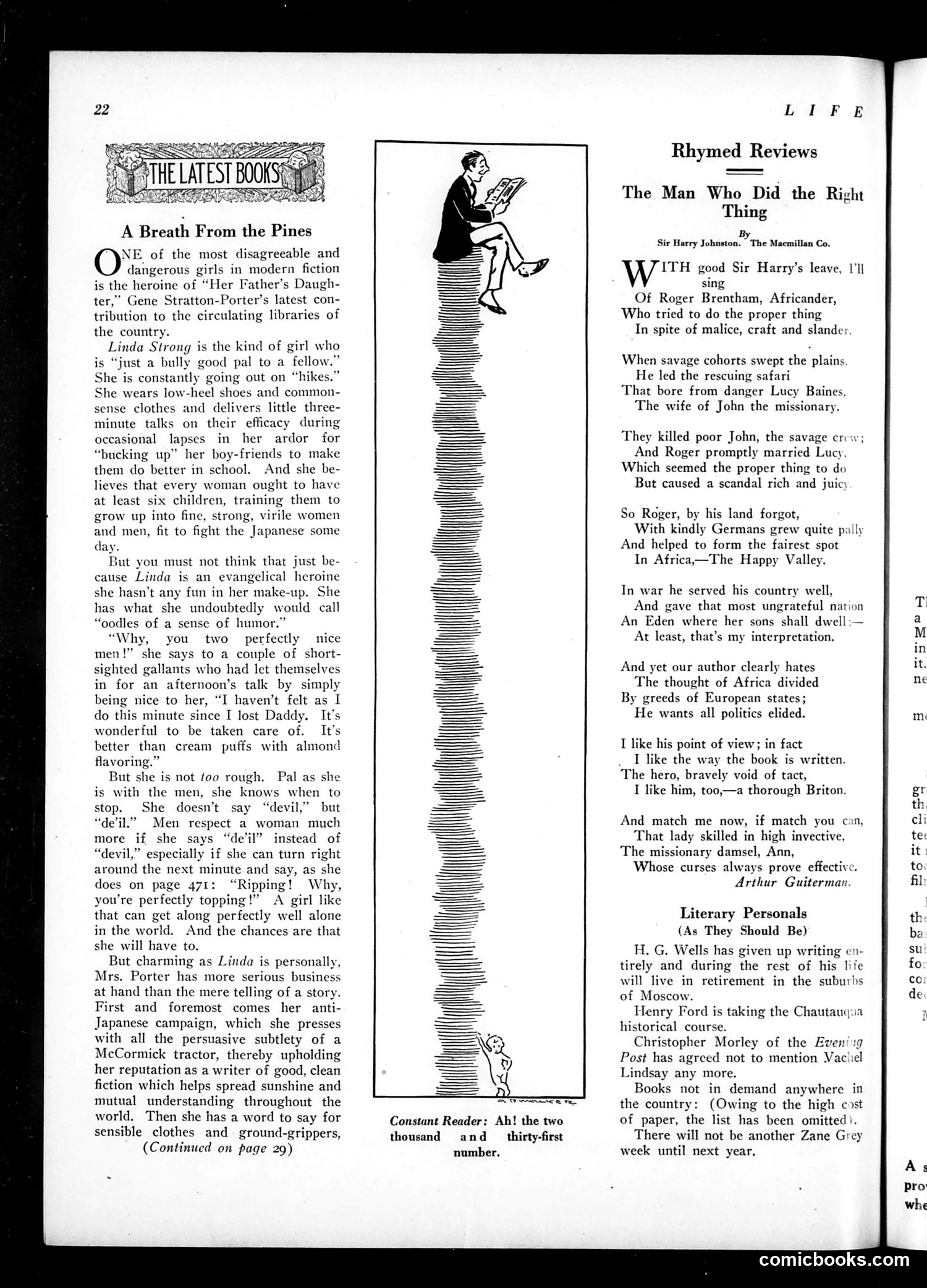
This *Life* magazine page satirizes popular fiction and literary trends of its era through two main pieces: **"A Breath From the Pines"** mocks Gene Stratton-Porter's novel heroine Linda Strong as an insufferable "modern girl"—aggressively wholesome, evangelical about motherhood and military preparedness (anti-Japanese sentiment), and annoyingly cheerful. The satirist deplores her fake practicality (sensible shoes, "ground-grippers"), her patronizing advice to men, and her linguistic affectation of softening curses ("de'il" instead of "devil") while remaining priggish. The joke: such relentlessly virtuous heroines are intolerable company, and Linda will end up alone despite her forced cheerfulness. **"The Man Who Did the Right Thing"** reviews Sir Harry Johnston's novel in verse, praising its African setting and hero Roger Brentham's pragmatism, while gently mocking the author's political naïveté about colonialism and his missionary characters' moral absolutism. Both pieces critique early 20th-century popular fiction's didactic moralizing and sentimental heroines.
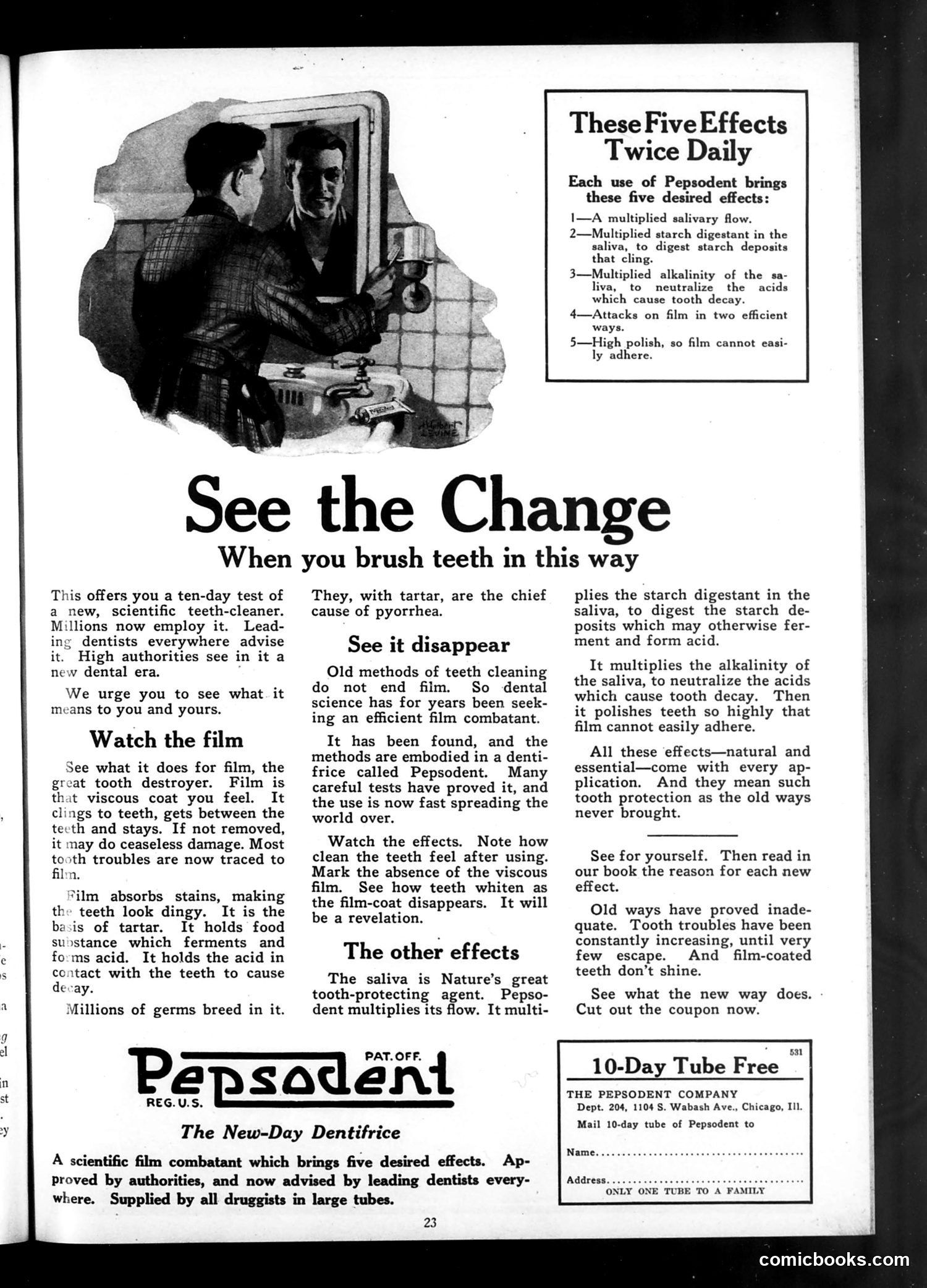
This is **not satire or a political cartoon**, but a straightforward early 20th-century toothpaste advertisement. The illustration shows a man examining his teeth in a mirror—a simple visual demonstrating the product's promised results. The ad promotes Pepsodent as a scientifically revolutionary "film combatant" (targeting plaque/tartar buildup). It claims five benefits: increased saliva flow, starch digestion, alkalinity to prevent decay, film removal, and polish. The marketing emphasizes that "millions now employ it" and that "leading dentists" endorse it—appeals to authority and popularity common in vintage advertising. The coupon offers a free 10-day trial, a direct-mail marketing tactic. The language uses pseudo-scientific explanations (discussing germs, acid, fermentation) to position Pepsodent as modern and evidence-based compared to "old ways" of tooth cleaning. This reflects early 1900s advertising's shift toward scientific claims and consumer testing to build trust in commercial products.
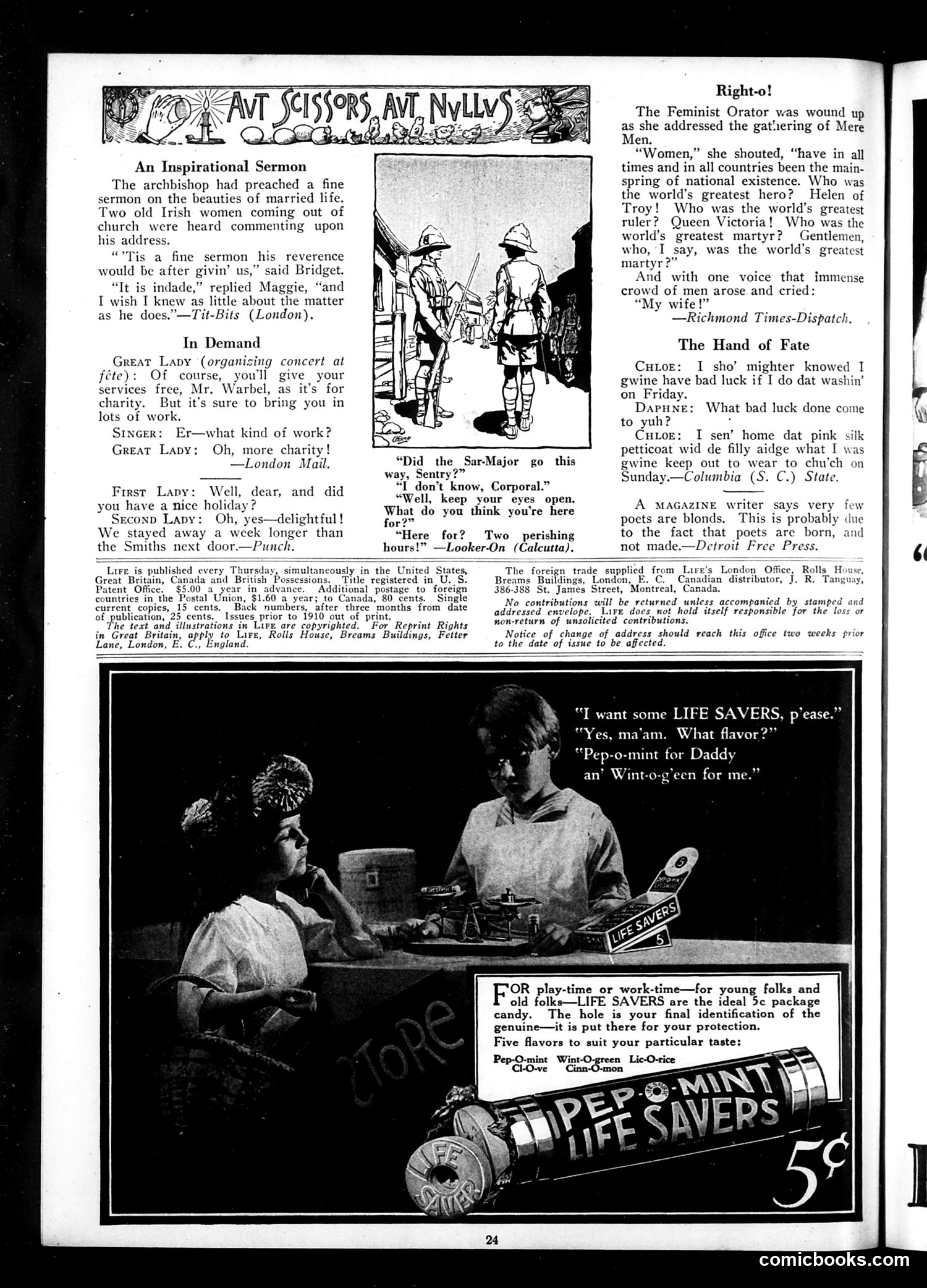
This page contains several satirical cartoons and an advertisement from an early 20th-century American humor magazine. The cartoons mock social conventions: 1. **"An Inspirational Sermon"**: An Irish joke where two women leaving church ironically praise the archbishop's sermon on marriage—one wishing she knew as little about the subject as he does, implying his celibacy makes him unqualified. 2. **"Right-o!"**: A feminist orator delivers passionate speeches about women's historical achievements (Helen of Troy, Queen Victoria) to a crowd of men. When she asks "who was the world's greatest martyr?" the men cry out "My wife!"—a dig at both feminist rhetoric and husbands' marital complaints. 3. **"The Hand of Fate"**: A brief dialect piece about superstition regarding laundry on Friday. The page is dominated by a **Life Savers candy advertisement** featuring a mother and child discussing flavors, with product imagery emphasizing the candy's distinctive hole as an authenticity marker. The ad represents typical early 1900s marketing. The overall tone is light domestic and gender-based humor typical of the era.
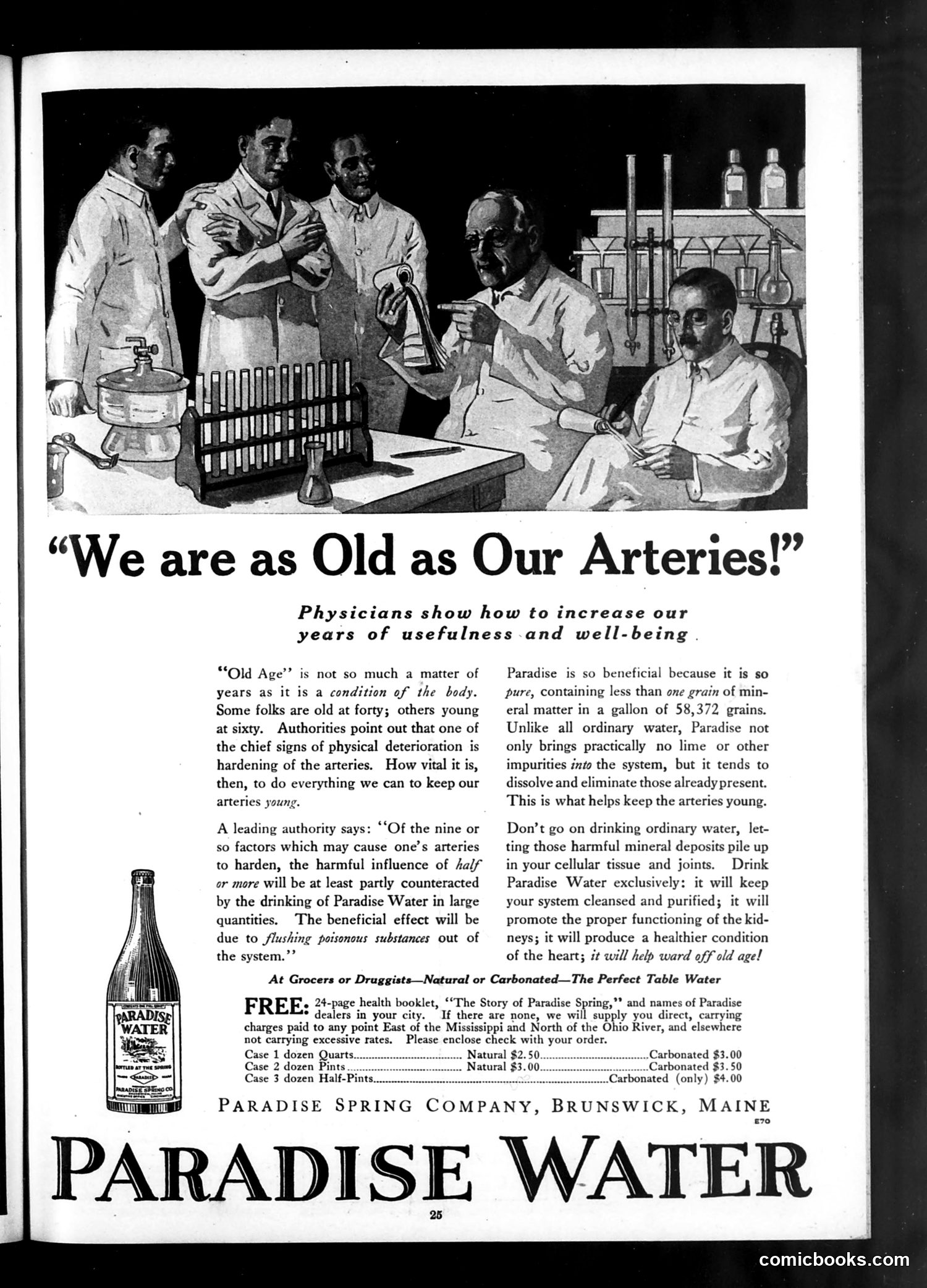
This is primarily a **product advertisement**, not satire, though it employs pseudo-scientific claims typical of early 20th-century patent medicine marketing. The image shows physicians in a laboratory demonstrating that arterial hardening causes aging. The advertisement claims Paradise Water—a spring water from Brunswick, Maine—can reverse this by being exceptionally pure and flushing "poisonous substances" from the body. The pitch exploits genuine health anxieties about aging and mineral deposits while making unsubstantiated medical claims. The "free health booklet" offer and physician endorsements were standard persuasion tactics of the era, before FDA regulation of health claims. Modern readers should recognize this as snake oil marketing: the vague promise that a simple product prevents aging through pseudo-medical mechanisms—a sales pitch that persists today in "detox" and "wellness" products.
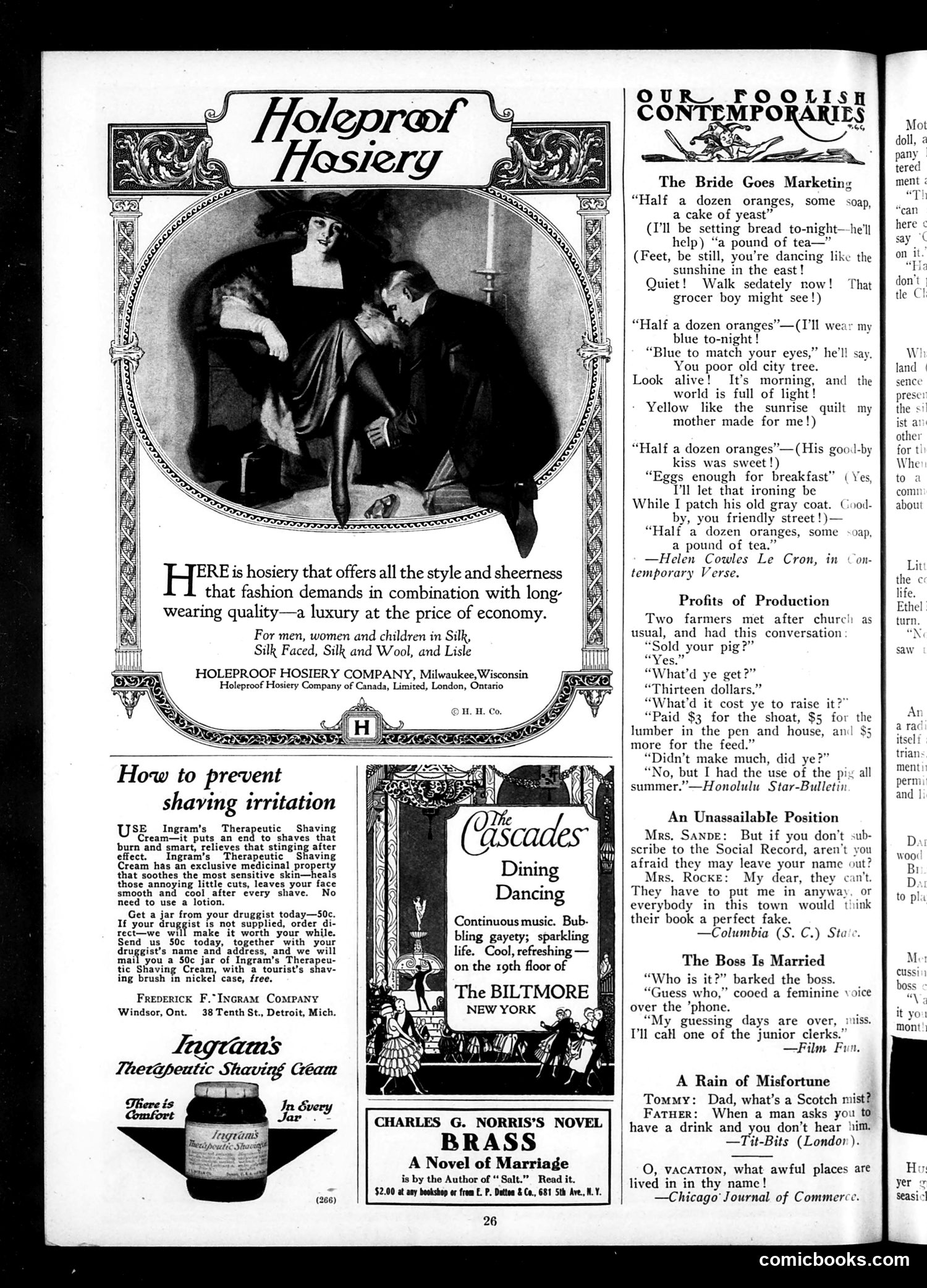
This page is primarily **advertising and humor columns**, typical of Life magazine's format. The main content includes: **"The Bride Goes Marketing"** — A sentimental poem about a newlywed woman shopping, her excitement barely contained as she daydreams about her husband while maintaining proper public decorum ("Walk sedately now!"). The satire gently mocks the emotional intensity women were expected to hide in public. **"Profits of Production"** and other brief humor items are rural/domestic jokes exploiting class or gender stereotypes common to the era—farmers discussing farm economics, a woman concerned with social status, a "Scotch mist" (not hearing someone). **Advertisements** dominate: Holeproof Hosiery (emphasizing durability and affordability), Ingram's Shaving Cream, The Cascades nightclub, and a Charles G. Norris novel. The page reflects **early 20th-century concerns**: consumerism, gender propriety, rural versus urban life, and domestic economics—but lacks politically charged satire. It's primarily entertainment and commercial content.
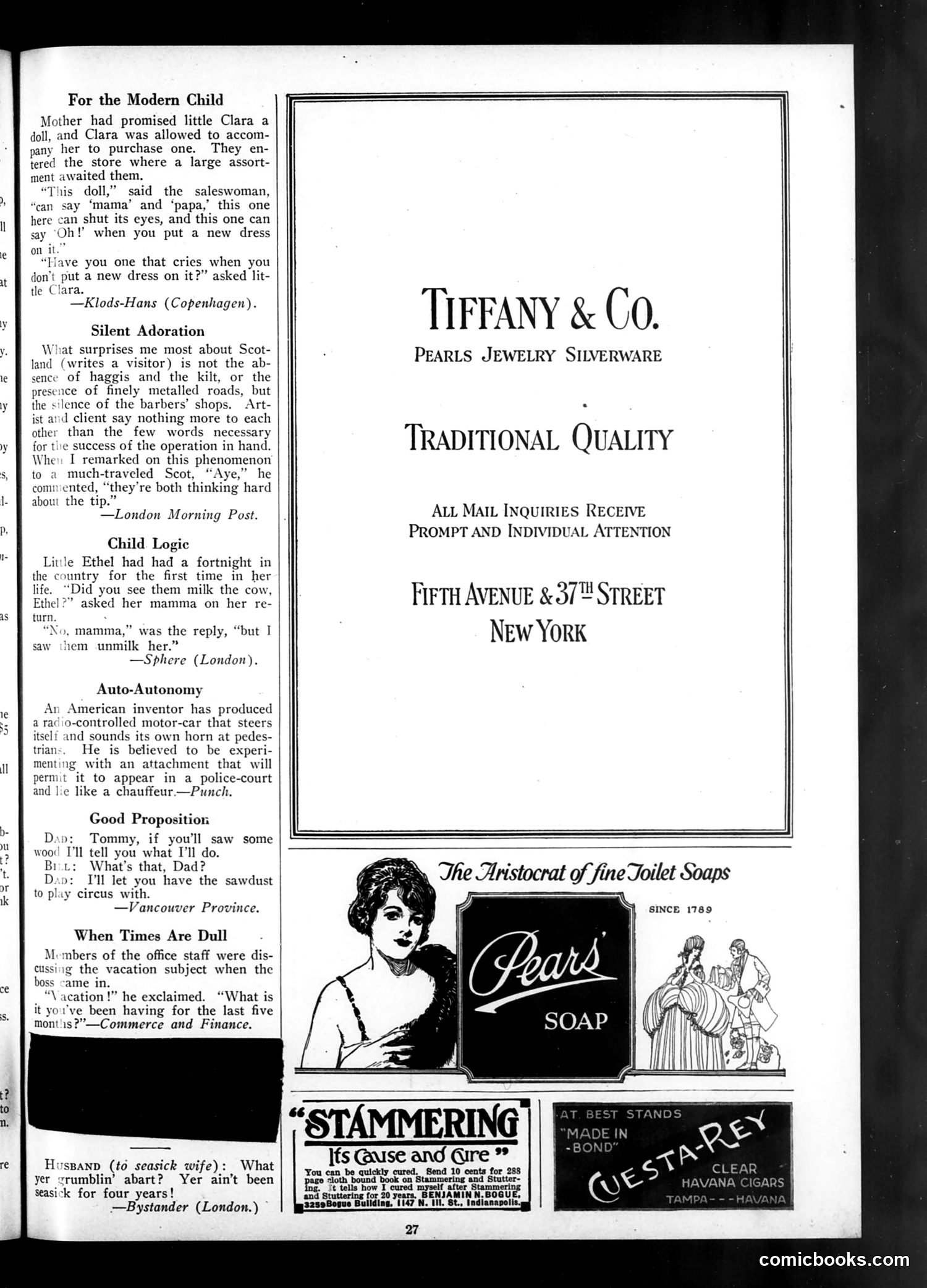
This page combines short humorous anecdotes with advertising. The left column features satirical jokes about modern life, children, and social behavior—typical of Life magazine's satirical format. **The humor targets:** - Consumer culture ("For the Modern Child"): A girl asks for a doll that cries when *not* dressed up, satirizing materialistic children and fashion obsession. - Scottish stereotypes: Barbers work silently, thinking about tips. - Child logic: A girl says cows are "unmilked," mocking innocent misunderstandings. - Technology: A radio-controlled car that "lies like a chauffeur"—joking about automobiles and dishonest drivers. - Work culture: Bosses claiming employees have had five months of vacation. **The advertisements** (right side and bottom) feature Tiffany & Co., Pears Soap, and Questar cigars—luxury goods targeting affluent readers. The page is primarily **humorous commentary** on early-20th-century consumer society, gender roles, and technological change, wrapped in brief jokes attributed to international publications.
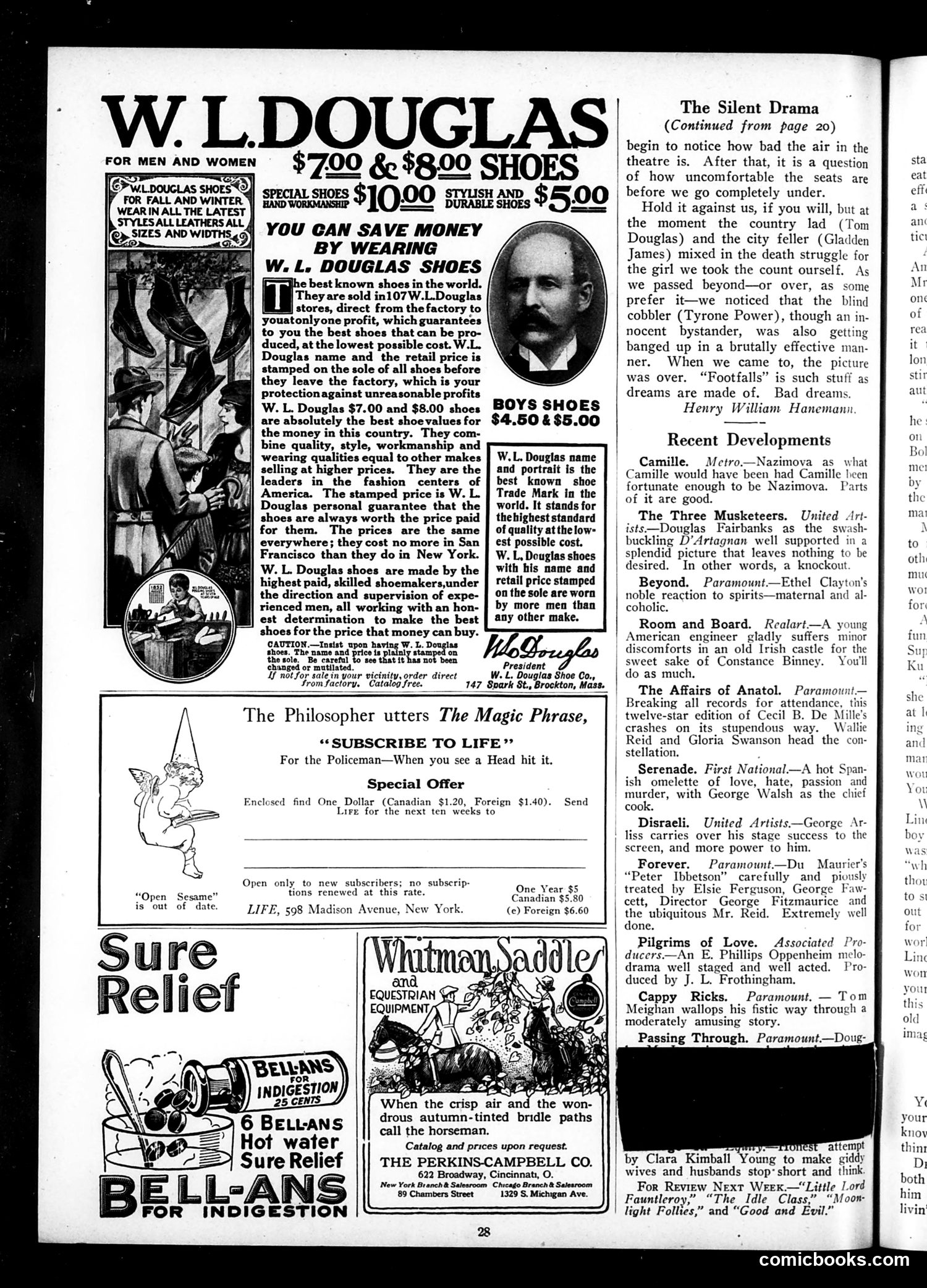
This is primarily an **advertising page** rather than satirical content. The dominant feature is a large W.L. Douglas shoe advertisement aimed at budget-conscious consumers—emphasizing that shoes are "stamped on the sole" with the price and maker's name as a guarantee against "unreasonable profits." The small section titled "The Philosopher utters The Magic Phrase" contains mild satirical humor: the joke "For the Policeman—When you see a Head hit it" is a pun on subscribing to *Life* magazine (suggesting hitting a police officer's head when you see one). It's lighthearted wordplay rather than serious satire. The "Recent Developments" section reviews current films (Nazimova, Douglas Fairbanks, Cecil B. DeMille productions), offering brief critical commentary on movies then in theaters. There are also period advertisements for Bellans indigestion remedy and a Whitman Saddles catalog. The page reflects 1920s consumer culture and entertainment.
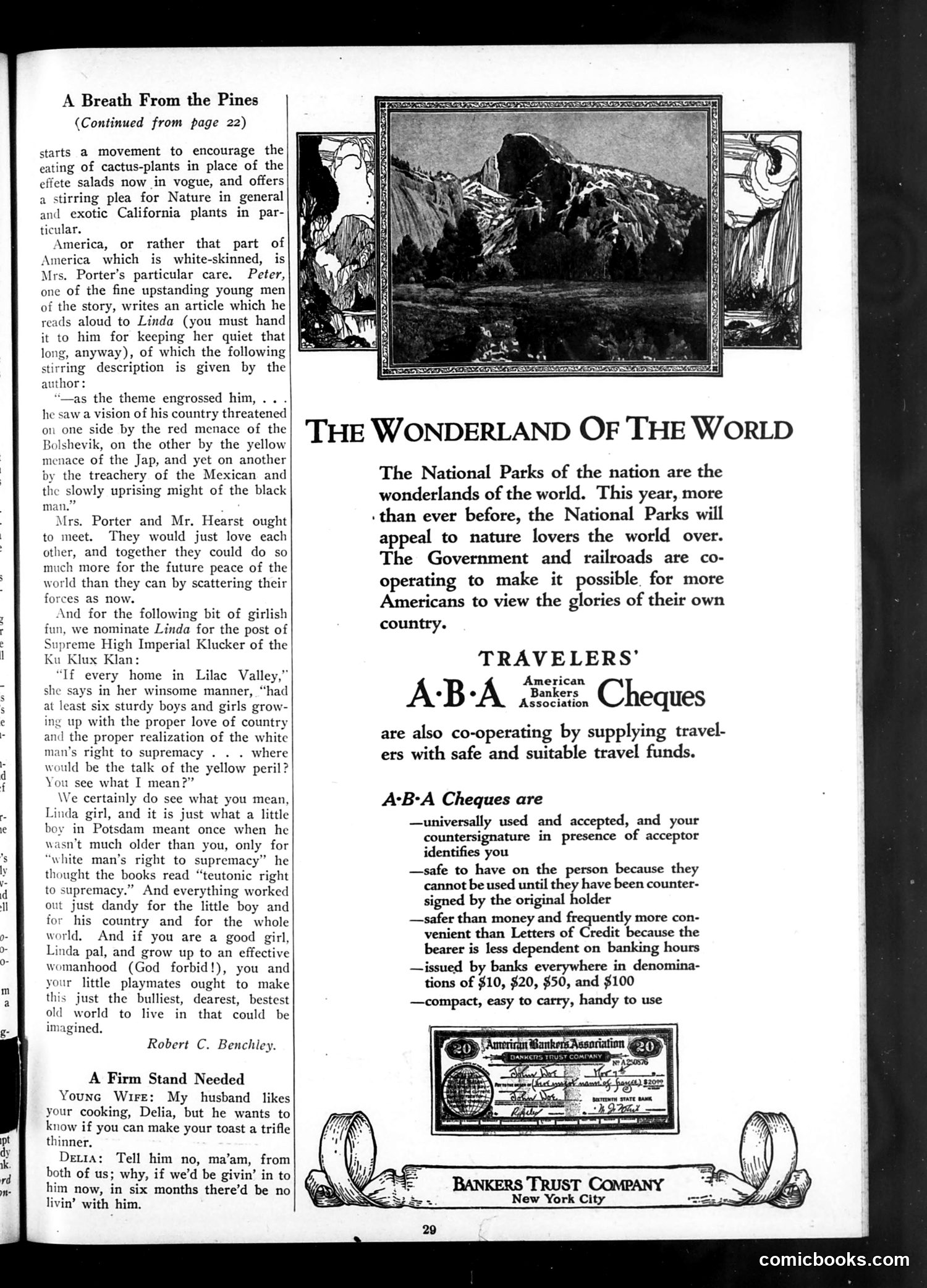
This page critiques a novel by Mrs. Porter (likely Katherine Anne Porter) that promotes white American supremacy. The satire, by Robert C. Benchley, highlights a character named Linda who advocates for large white families to counter perceived threats from "the red menace of the Bolshevik," "the yellow menace of the Jap," Black Americans, and Mexicans. Benchley's key satirical move: he compares Linda's white-supremacist rhetoric to Kaiser Wilhelm II's "Teutonic right to supremacy" ideology, which led to World War I. The implication is biting—Linda's American nativism mirrors the dangerous nationalism that devastated Europe, and promoting it will produce similarly catastrophic results. The satire suggests that Porter and media figures like William Randolph Hearst were spreading racialized fear-mongering dressed as patriotism, a common rhetorical strategy during the 1920s Red Scare and anti-immigration period.
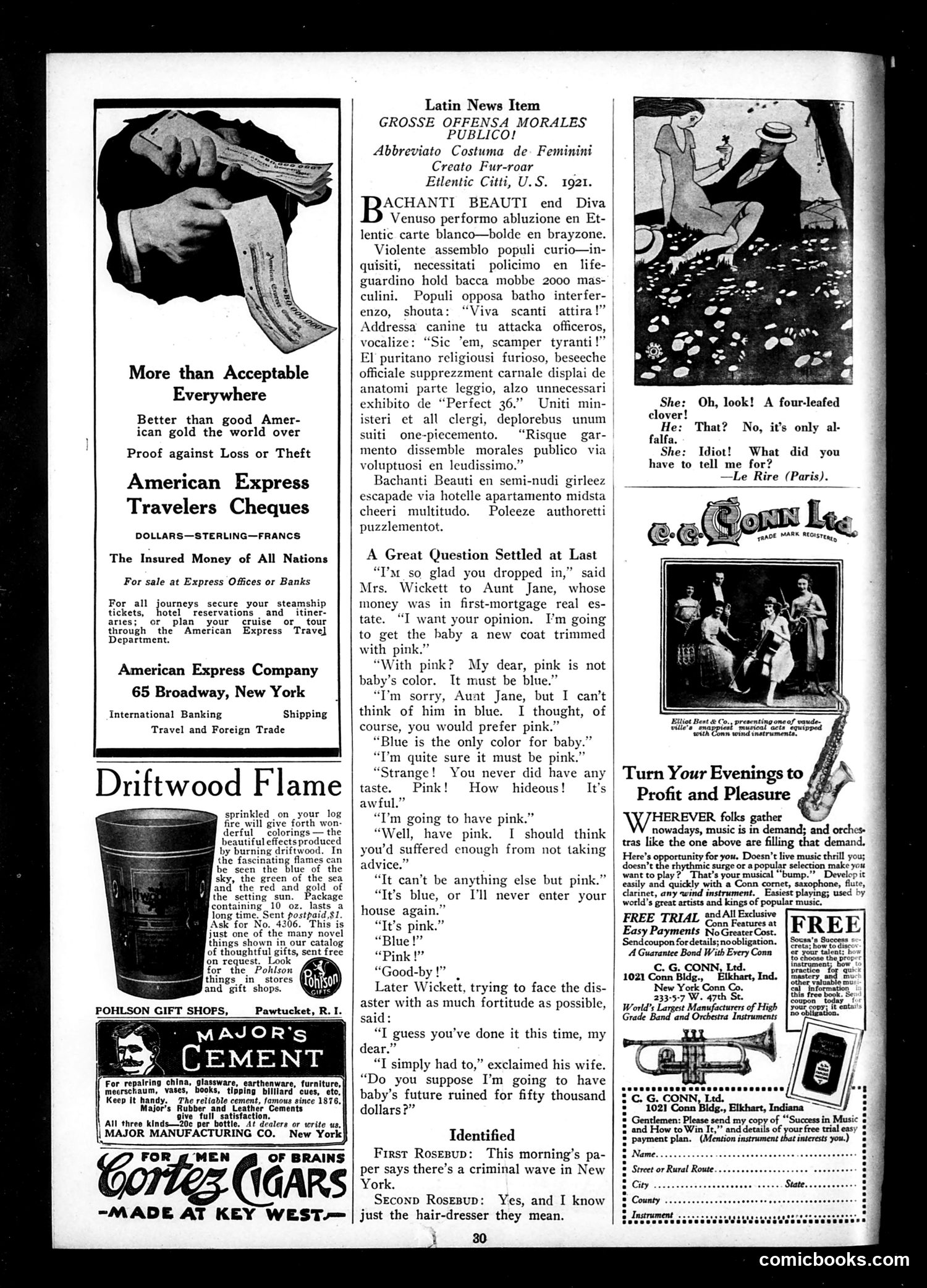
This page consists primarily of **advertisements** for American products (American Express Travelers Cheques, Driftwood Flame, Major's Cement, Cortes Cigars) interspersed with humor content. The main satirical piece is **"A Great Question Settled at Last,"** a domestic comedy sketch about Mrs. Wickett and her aunt arguing over whether a baby's coat should be trimmed with pink or blue. The joke satirizes rigid gender conventions: blue was considered the "only proper" baby color, while pink was viewed as frivolous or unsuitable. The satire mocks the aunt's stubborn, joyless moralism—she threatens never to visit again over the color choice—and Wickett's capitulation out of fear of financial consequences. The humor lies in the absurd escalation of a trivial decision into a moral crisis. The "**Latin News Item**" is mock-serious Latin nonsense about a public bathing incident, parodying overwrought journalistic outrage. The brief joke "**Identified**" references organized crime ("criminal wave") and makes a pun about hairdressers, likely referencing contemporary gangster activity in 1920s New York.

I can see this is a very dark, low-contrast black and white page from Life magazine that appears to be mostly blank or illegible in the image provided. The only clearly visible text is the "comicbooks.com" watermark at the bottom right corner. Without being able to discern the actual cartoon content, text, or illustrations on the page itself, I cannot identify specific figures, political references, or explain the satirical intent. The image quality and contrast make it impossible to read any OCR'd text that may have been present or to analyze any visual content meaningfully. To provide accurate historical analysis as requested, I would need a clearer, higher-contrast version of this page.