
Life, 1921-10-06 · page 22 of 33
Life — October 6, 1921 — page 22: what you’re looking at
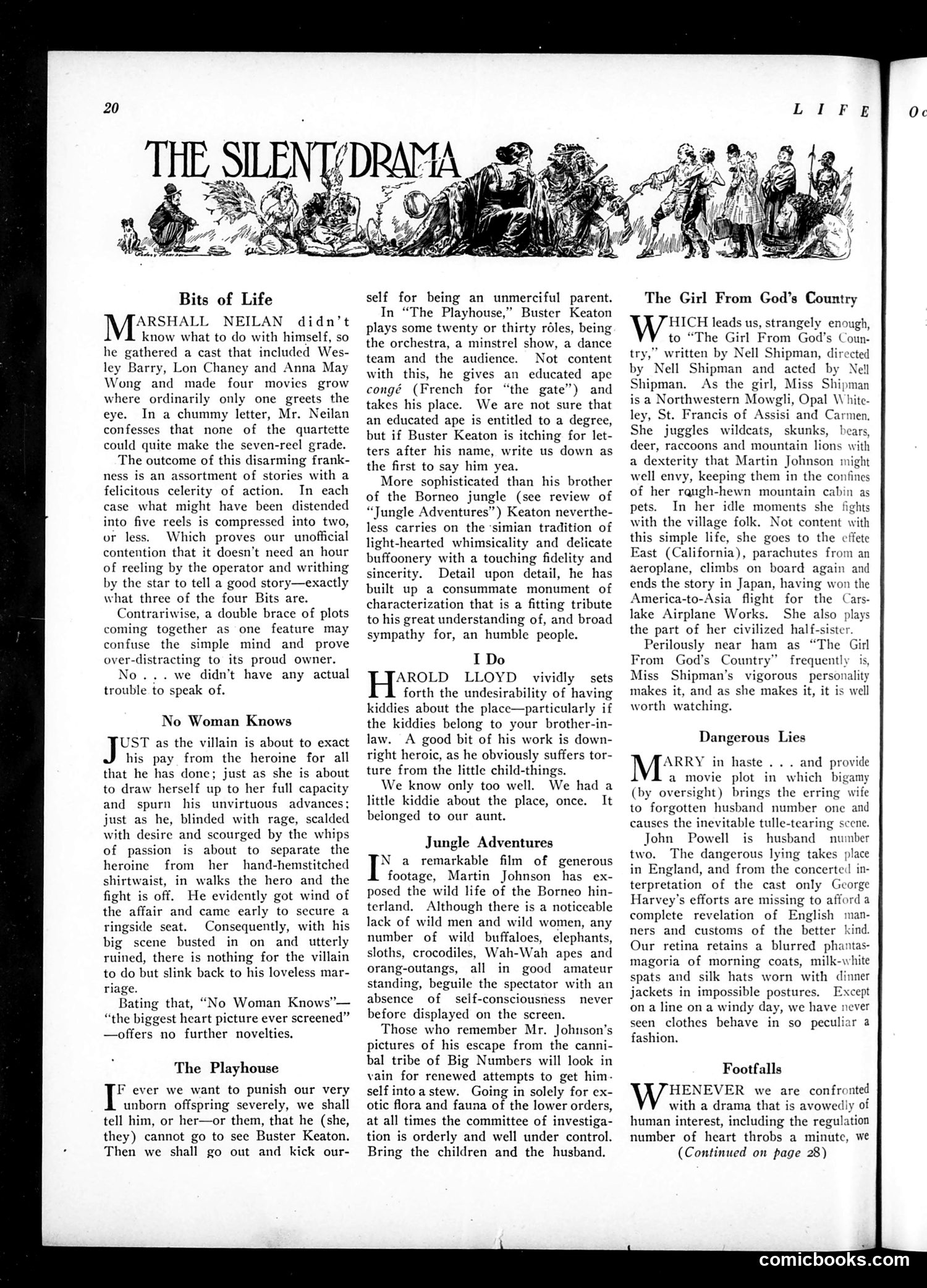
A restored page from Life, 1921-10-06. Page through the whole issue in the reader above.
📄 Transcribed text from this page (OCR, searchable)
Machine-transcribed from the original scan — historical spelling and the odd misread are preserved.
THE ery 7h Bits of Life ARSHALL NEILAN didn’t know what to do with himself, so he gathered a cast that included Wes- ley Barry, Lon Chaney and Anna May Wong and made four movies grow where ordinarily only one greets the eye. In a chummy letter, Mr. Neilan confesses that none of the quartette could quite make the seven-reel grade. The outcome of this disarming frank- ness is an assortment of stories with a felicitous celerity of action. In each case what might have been distended into five reels is compressed into two, or less. Which proves our unofficial contention that it doesn’t need an hour of reeling by the operator and writhing by the star to tell a good story—exactly what three of the four Bits are. Contrariwise, a double brace of plots coming together as one feature may confuse the simple mind and prove over-distracting to its proud owner. No... we didn’t have any actual trouble to speak of. No Woman Knows JST as the villain is about to exact his pay from the heroine for all that he has done; just as she is about to draw herself up to her full capacity and spurn his unvirtuous advances; just as he, blinded with rage, scalded with desire and scourged by the whips of passion is about to separate the heroine from her hand-hemstitched shirtwaist, in walks the hero and the fight is off. He evidently got wind of the affair and came early to secure a ringside seat. Consequently, with his big scene busted in on and utterly ruined, there is nothing for the villain to do but slink back to his loveless mar- riage. Bating that, “No Woman Knows’— “the bigg: est heart picture ever screened” —offers no further novelties, The Playhouse F ever we want to punish our very unborn offspring severely, we shall tell him, or her—or them, that he (she, they) cannot go to see Buster Keaton. Then we shall go out and kick our- self for being an unmerciful parent. In “The Playhouse,” Buster Keaton plays some twenty or thirty roles, being the orchestra, a minstrel show, a dance team and the audience. Not content with this, he gives an educated ape congé (French for “the gate”) and takes his place. We are not sure that an educated ape is entitled to a degree, but if Buster Keaton is itching for let- ters after his name, write us down as the first to say him yea. More sophisticated than his brother of the Borneo jungle (see review of “Jungle Adventures”) Keaton neverthe- less carries on the ‘simian tradition of light-hearted whimsicality and delicate buffoonery with a touching fidelity and sincerity. Detail upon detail, he has built up a consummate monument of characterization that is a fitting tribute to his great understanding of, and broad sympathy for, an humble people. I Do Hyer LLOYD vividly sets forth the undesirability of having kiddies about the place—particularly if the kiddies belong to your brother-in- law. A good bit of his work is down- right heroic, as he obviously suffers tor- ture from the little child-things. We know only too well. We had a little kiddie about the place, once. It beionged to our aunt. Jungle Adventures a remarkable film of generous footage, Martin Johnson has ex- posed the wild life of the Borneo hin- terland. Although there is a noticeable lack of wild men and wild women, any number of wild buffaloes, elephants, sloths, crocodiles, Wah-Wah apes and orang-outangs, all in good amateur standing, beguile the spectator with an absence of seif-consciousness never before displayed on the screen. Those who remember Mr. Johnson's pictures of his escape from the canni- bal tribe of Big Numbers will look in vain for renewed attempts to get him- self intoa stew. Going in solely for ex- otic flora and fauna of the lower orders, at all times the committee of investiga- tion is orderly and well under control. Bring the children and the husband. The Girl From God’s Country HICH leads us, strangely enough, to “The Girl From God’s Coun- try,” written by Nell Shipman, directed by Nell Shipman and acted by Nell Shipman. As the girl, Miss Shipman is a Northwestern Mowgli, Opal White- ley, St. Francis of Assisi and Carmen, She juggles wildcats, skunks, bears, deer, raccoons and mountain lions with a dexterity that Martin Johnson might well envy, keeping them in the confines of her rqugh-hewn mountain cabin as pets. In her idle moments she fights with the village folk. Not content with this simple life, she goes to the effete East (California), parachutes from an aeroplane, climbs on board again and ends the story in Japan, having won the America-to-Asia flight for the Cars- lake Airplane Works. She also plays the part of her civilized half-sister. Perilously near ham as “The Girl From God’s Country’ frequently is, Miss Shipman’s vigorous personality makes it, and as she makes it, it is well worth watching. Dangerous Lies ARRY in haste . . . and provide a movie plot in which bigamy (by oversight) brings the erring wife to forgotten husband number one and causes the inevitable tulle-tearing scene. John Powell is husband number two. The dangerous lying takes place in England, and from the concerted in- terpretation of the cast only George Harvey’s efforts are missing to afforda complete revelation of English man- ners and customs of the better kind. Our retina retains a blurred phantas- magoria of morning coats, milk-white spats and silk hats worn with dinner jackets in impossible postures. Except on a line on a windy day, we have seen clothes behave in so pecul fashion. Footfalls HENEVER we are confronted with a drama that is avowedly of human interest, including the regulation number of heart throbs a minute, we (Continued on page 28) comicbooks.com