
Life, 1921-10-06 · page 10 of 33
Life — October 6, 1921 — page 10: what you’re looking at
What you’re looking at
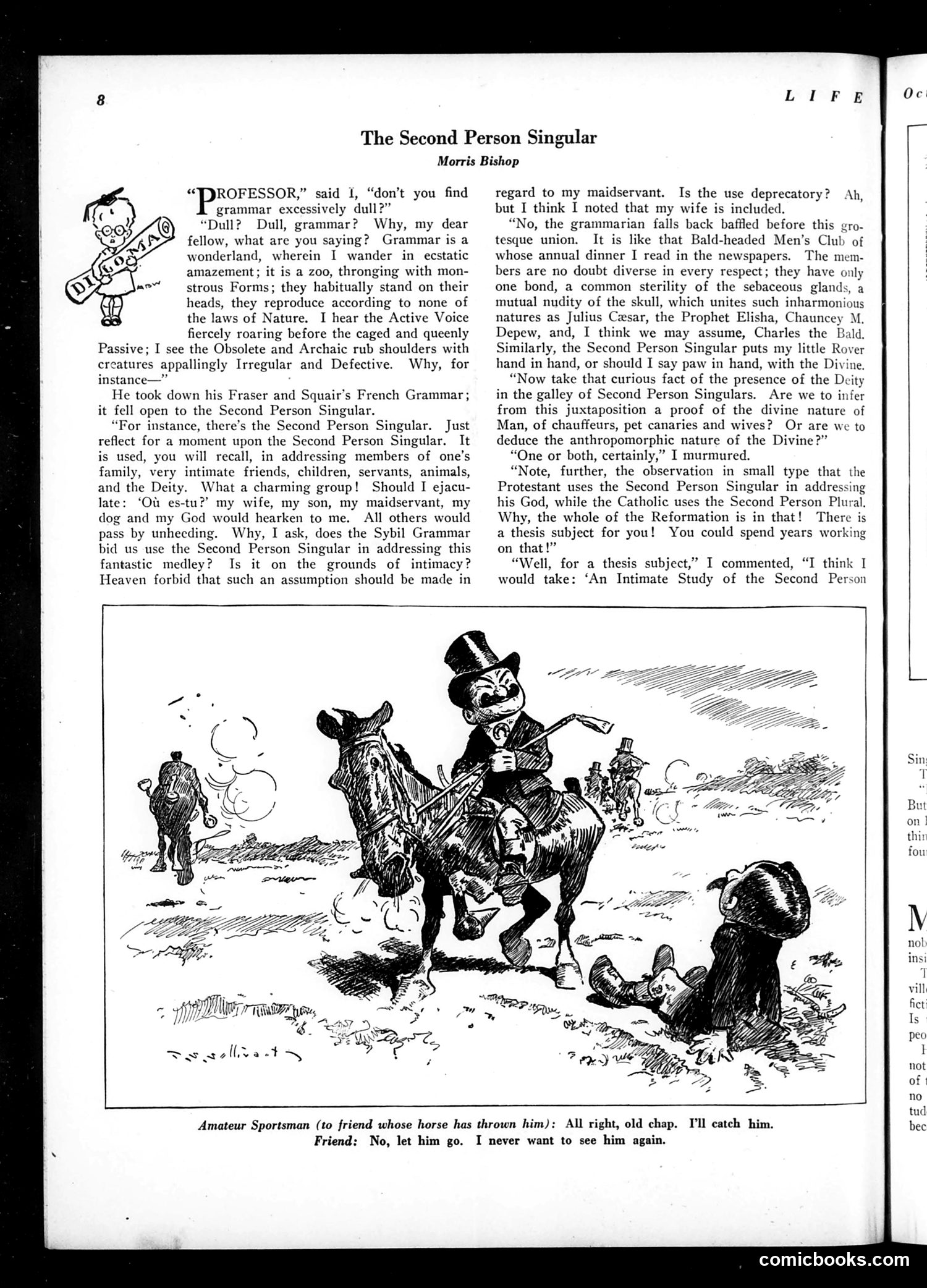
This page combines a humorous essay about English grammar with a cartoon satirizing amateur sportsmen. **The Essay:** Bishop playfully discusses why English lacks a distinct second-person singular form (like French "tu"). He notes the grammatical absurdity that "you" addresses everyone equally—family, servants, God, animals—making social hierarchy linguistically invisible, unlike Catholic and Protestant theological distinctions. **The Cartoon:** Shows an amateur horseman who's been thrown, telling his friend "All right, old chap. I'll catch him," while his friend replies "No, let him go. I never want to see him again." The humor targets incompetent upper-class sportsmen pretending at riding and fox-hunting—a common target of satire mocking the idle wealthy.
📄 Transcribed text from this page (OCR, searchable)
Machine-transcribed from the original scan — historical spelling and the odd misread are preserved.
The Second Person Singular Morris Bishop ““DEROFESSOR,” said 1, “don’t you find grammar excessively dull?” “Dull? Dull, grammar? Why, my dear fellow, what are you saying? Grammar is a wonderland, wherein I wander in ecstatic amazement; it is a zoo, thronging with mon- strous Forms; they habitually stand on their heads, they reproduce according to none of the laws of Nature. I hear the Active Voice fiercely roaring before the caged and queenly Passive; I see the Obsolete and Archaic rub shoulders with creatures appallingly Irregular and Defective. Why, for instance—” He took down his Fraser and Squair’s French Grammar; it fell open to the Second Person Singular. “For instance, there’s the Second Person Singular. Just reflect for a moment upon the Second Person Singular. It is used, you will recall, in addressing members of one’s family, very intimate friends, children, servants, animals, and the Deity. What a charming group! Should I ejacu- late: ‘Ou es-tu?’? my wife, my son, my maidservant, my dog and my God would hearken to me. All others would pass by unhecding. Why, I ask, does the Sybil Grammar bid us use the Second Person Singular in addressing this fantastic medley? Is it on the grounds of intimacy? Heaven forbid that such an assumption should be made in = regard to my maidservant. Is the use deprecatory? Ah, but I think I noted that my wife is included. “No, the grammarian falls back baffled before this gro- tesque union. It is like that Bald-headed Men’s Club of whose annual dinner I read in the newspapers. The mem- bers are no doubt diverse in every respect; they have only one bond, a common sterility of the sebaceous glands, a mutual nudity of the skull, which unites such inharmonious natures as Julius Cesar, the Prophet Elisha, Chauncey M. Depew, and, I think we may assume, Charles the Bald. Similarly, the Second Person Singular puts my little Rover hand in hand, or should I say paw in hand, with the Divine, “Now take that curious fact of the presence of the Deity in the galley of Second Person Singulars. Are we to infer from this juxtaposition a proof of the divine nature of Man, of chauffeurs, pet canaries and wives? Or are we to deduce the anthropomorphic nature of the Divine?” “One or both, certainly,” I murmured. “Note, further, the observation in small type that the Protestant uses the Second Person Singular in addressing his God, while the Catholic uses the Second Person Plural, Why, the whole of the Reformation is in that! There is a thesis subject for you! You could spend years working on that!” “Well, for a thesis subject,” I commented, “I think I would take: ‘An Intimate Study of the Second Person Mer r rere pe, ye @. tes wellacty Amateur Sportsman (to friend whose horse has thrown him): All right, old chap. I'll catch him. Friend: No, let him go. I never want to see him again. Sin; But on | thir fou nol insi vill fict Is peo not of | no tud bec comicbooks.com