
Life, 1921-10-06 · page 24 of 33
Life — October 6, 1921 — page 24: what you’re looking at
What you’re looking at
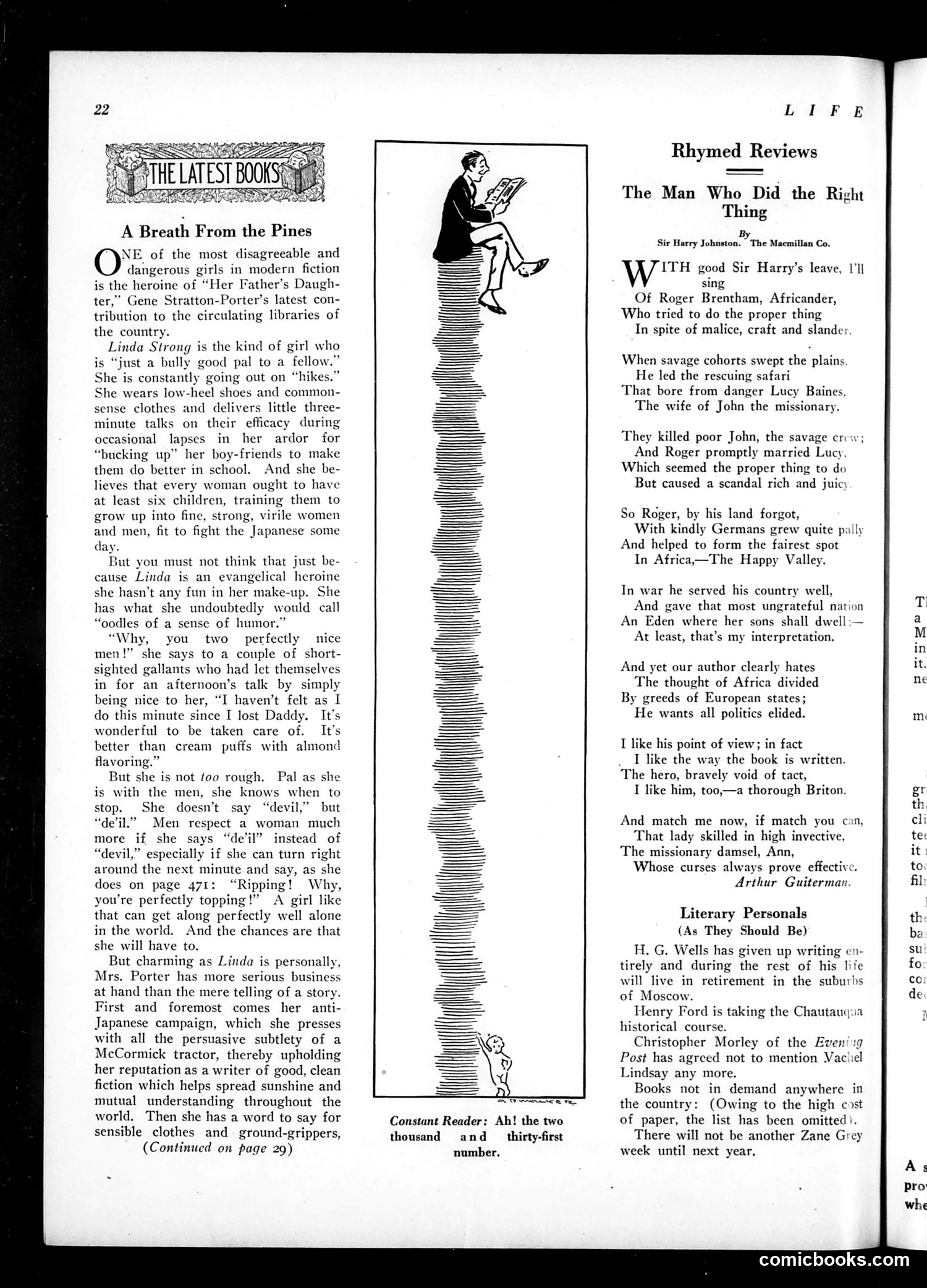
This *Life* magazine page satirizes popular fiction and literary trends of its era through two main pieces: **"A Breath From the Pines"** mocks Gene Stratton-Porter's novel heroine Linda Strong as an insufferable "modern girl"—aggressively wholesome, evangelical about motherhood and military preparedness (anti-Japanese sentiment), and annoyingly cheerful. The satirist deplores her fake practicality (sensible shoes, "ground-grippers"), her patronizing advice to men, and her linguistic affectation of softening curses ("de'il" instead of "devil") while remaining priggish. The joke: such relentlessly virtuous heroines are intolerable company, and Linda will end up alone despite her forced cheerfulness. **"The Man Who Did the Right Thing"** reviews Sir Harry Johnston's novel in verse, praising its African setting and hero Roger Brentham's pragmatism, while gently mocking the author's political naïveté about colonialism and his missionary characters' moral absolutism. Both pieces critique early 20th-century popular fiction's didactic moralizing and sentimental heroines.
📄 Transcribed text from this page (OCR, searchable)
Machine-transcribed from the original scan — historical spelling and the odd misread are preserved.
A Breath From the Pines NE of the most disagreeable and dangerous girls in modern fiction is the heroine of “Her Father’s Daugh- ter,’ Gene Stratton-Porter’s latest con- tribution to the circulating libraries of the country. Linda Strong is the kind of girl who is “just a bully good pal to a fellow.” She is constantly going out on “hikes.” She wears low-heel shoes and common- sense clothes and delivers little three- minute talks on their efficacy during occasional lapses in her ardor for “bucking up” her boy-friends to make them do better in school. And she be- lieves that every woman ought to have at least six children, training them to grow up into fine, strong, virile women and men, fit to fight the Japanese some day. But you must not think that just be- cause Linda is an evangelical heroine she hasn't any fun in her make-up. She has what she undoubtedly would call “oodles of a sense of humor.” “Why, you two perfectly nice men!” she says to a couple of short- sighted gallants who had let themselves in for an afternoon’s talk by simply being nice to her, “I haven’t felt as I do this minute since I lost Daddy. It’s wonderful to be taken care of. It’s better than cream puffs with almond flavoring.” But she is not too rough. Pal as she is with the men, she knows when to stop. She doesn’t say “devil,” but “de’il.” Men respect a woman much more if she says “de’il” instead of “devil,” especially if she can turn right around the next minute and say, as she does on page 471: “Ripping! Why, you're perfectly topping!” A girl like that can get along perfectly well alone in the world. And the chances are that she will have to. But charming as Linda is personally, Mrs. Porter has more serious business at hand than the mere telling of a story. First and foremost comes her anti- Japanese campaign, which she presses with all the persuasive subtlety of a McCormick tractor, thereby upholding her reputation as a writer of good, clean fiction which helps spread sunshine and mutual understanding throughout the world, Then she has a word to say for sensible clothes and ground-grippers, (Continued on page 29) Ny i | yt I Constant Reader: Ah! the two thousand and number. thirty-first LIFE Rhymed Reviews The Man Who Did the Right Thing By, Sir Harry Johnston. The Macmillan Co. wi good Sir Harry’s leave, I'll sing Of Roger Brentham, Africander, Who tried to do the proper thing In spite of malice, craft and slander. When savage cohorts swept the plains He led the rescuing safari That bore from danger Lucy Baines, The wife of John the missionary. They killed poor John, the savage crew; And Roger promptly married Lucy, Which seemed the proper thing to do But caused a scandal rich and juicy So Roger, by his land forgot, With kindly Germans grew quite pally And helped to form the fairest spot In Africa,—The Happy Valley. In war he served his country well, And gave that most ungrateful nation An Eden where her sons shall dwell :— At least, that’s my interpretation. And yet our author clearly hates The thought of Africa divided By greeds of European states; He wants all politics elided. 1 like his point of view; in fact I like the way the book is written. The hero, bravely void of tact, I like him, too,—a thorough Briton. And match me now, if match you cin, That lady skilled in high invective, The missionary damsel, Ann, Whose curses always prove effective. Arthur Guiterman Literary Personals (As They Should Be) H. G. Wells has given up writing en- tirely and during the rest of his life will live in retirement in the suburbs of Moscow. Henry Ford is taking the Chautauq:ia historical course. Christopher Morley of the Evening Post has agreed not to mention Vaciiel Lindsay any more. Books not in demand anywhere in the country: (Owing to the high cost of paper, the list has been omitted). There will not be another Zane Grey week until next year, comicbooks.com