
Life, 1921-10-06 · page 17 of 33
Life — October 6, 1921 — page 17: what you’re looking at
What you’re looking at
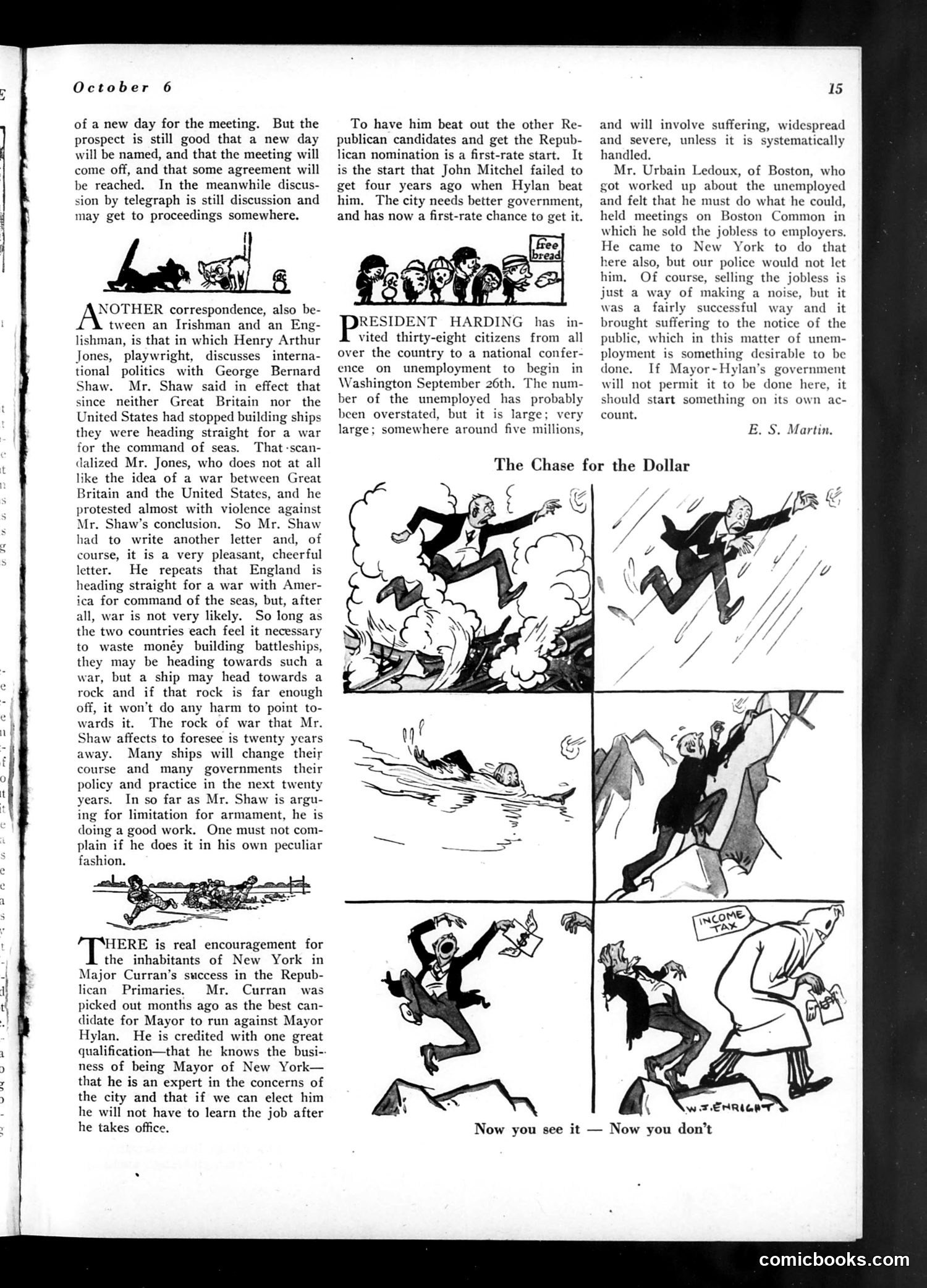
This page from *Life* magazine (October 6, likely 1921) contains a multi-panel cartoon satirizing wealth and financial instability during the post-WWI economic period. The cartoon depicts figures literally chasing after a dollar bill across various scenarios—climbing mountains, falling into water, struggling uphill—illustrating the desperate pursuit of money and the precariousness of economic fortune. The title "Now you see it — Now you don't" emphasizes how wealth is fleeting and elusive. The accompanying text discusses unemployment (estimated at five million), President Harding's unemployment conference, and New York mayoral politics. The cartoon thus comments on widespread economic anxiety and the public's frantic struggle for financial security during a period of economic uncertainty and transition following World War I.
📄 Transcribed text from this page (OCR, searchable)
Machine-transcribed from the original scan — historical spelling and the odd misread are preserved.
October 6 of a new day for the meeting. But the prospect is still good that a new day will be named, and that the meeting will come off, and that some agreement will be reached. In the meanwhile discus- sion by telegraph is still discussion and may get to proceedings somewhere. NOTHER correspondence, also be- tween an Irishman and an Eng- lishman, is that in which Henry Arthur Jones, playwright, discusses interna- tional politics with George Bernard Shaw. Mr. Shaw said in effect that since neither Great Britain nor the United States had stopped building ships they were heading straight for a war for the command of seas. That-scan- dalized Mr. Jones, who does not at all like the idea of a war between Great Britain and the United States, and he protested almost with violence against Mr. Shaw’s conclusion. So Mr. Shaw had to write another letter and, of course, it is a very pleasant, cheerful letter. He repeats that England is heading straight for a war with Amer- ica for command of the seas, but, after all, war is not very likely. So long as the two countries each feel it necessary to waste monéy building battleships, they may be heading towards such a war, but a ship may head towards a rock and if that rock is far enough off, it won’t do any harm to point to- wards it. The rock of war that Mr. Shaw affects to foresee is twenty years away. Many ships will change their course and many governments their policy and practice in the next twenty years. In so far as Mr. Shaw is argu- ing for limitation for armament, he is doing a good work. One must not com- plain if he does it in his own peculiar fashion. ‘HERE is real encouragement for the inhabitants of New York in Major Curran’s success in the Repub- lican Primaries. Mr. Curran was picked out months ago as the best can- didate for Mayor to run against Mayor Hylan. He is credited with one great qualification—that he knows the busi-: ness of being Mayor of New York— that he is an expert in the concerns of the city and that if we can elect him he will not have to learn the job after he takes office. To have him beat out the other Re- publican candidates and get the Repub- lican nomination is a first-rate start. It is the start that John Mitchel failed to get four years ago when Hylan beat him, The city needs better government, and has now a first-rate chance to get it. RESIDENT HARDING has in- ited thirty-eight citizens from all over the country to a national confer- ence on unemployment to begin in Washington September 26th. The num- ber of the unemployed has probably been overstated, but it is large; very large; somewhere around five millions, 15 and will involve suffering, widespread and severe, unless it is systematically handled. Mr. Urbain Ledoux, of Boston, who got worked up about the unemployed and felt that he must do what he could, held meetings on Boston Common in which he sold the jobless to employers. He came to New York to do that here also, but our police would not let him. Of course, selling the jobless is just a way of making a noise, but it was a fairly successful way and it brought suffering to the notice of the public, which in this matter of unem- ployment is something desirable to be done. If Mayor~Hylan’s government will not permit it to be done here, i should start something on its own ac- count. E, S. Martin. The Chase for the Dollar Now you see it — Now you don’t comicbooks.com