
Life, 1921-10-06 · page 20 of 33
Life — October 6, 1921 — page 20: what you’re looking at
What you’re looking at
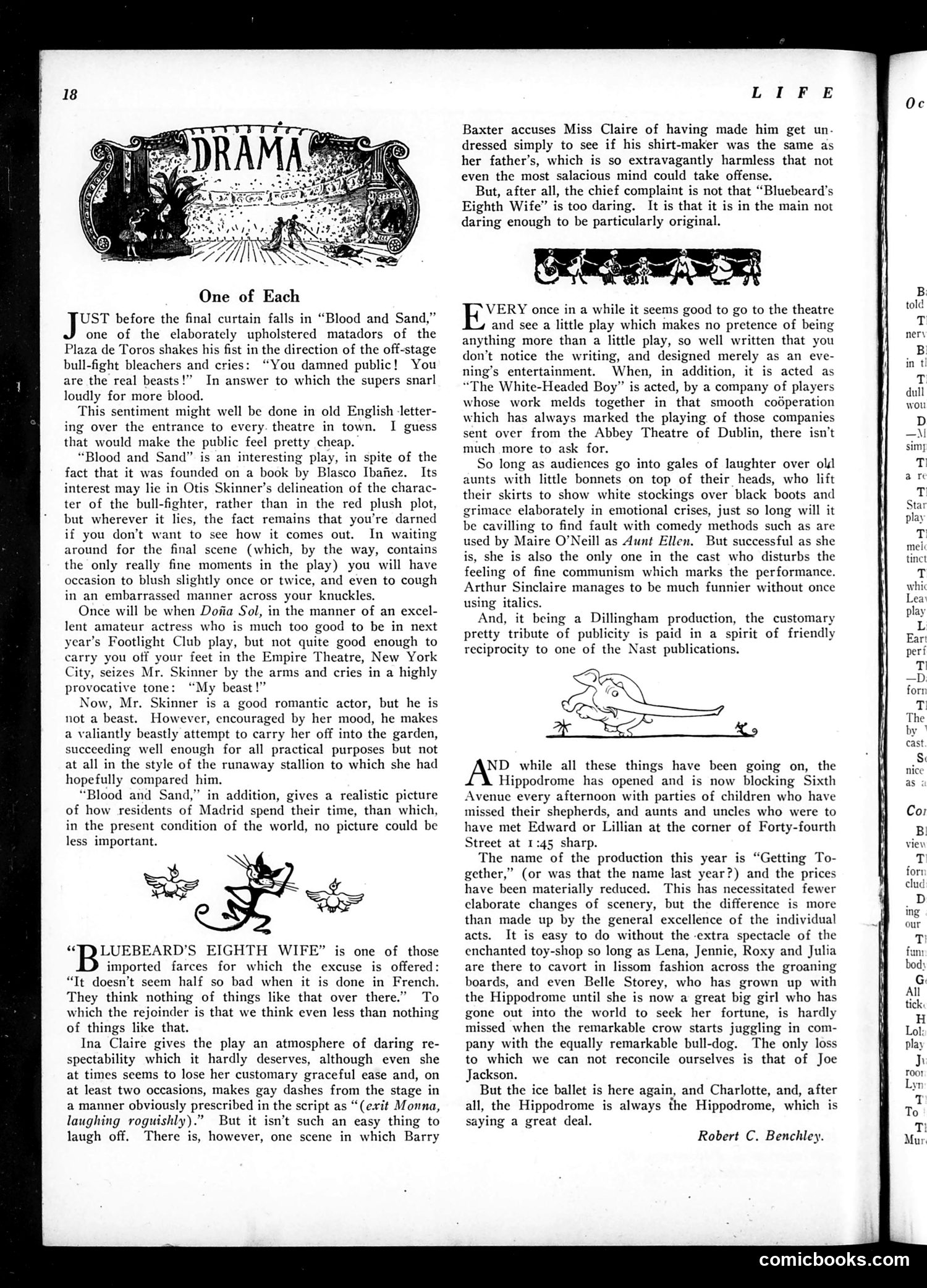
This page reviews three theatrical productions from the early 20th century. **"Blood and Sand"** adapts a novel by Spanish author Blasco Ibáñez about bullfighting in Madrid. The reviewer criticizes it as melodramatic ("red plush plot") despite featuring respected actor Otis Skinner. The play allegedly contains mildly risqué moments—a woman calls the male lead "My beast"—designed to titillate audiences, though the reviewer finds them awkwardly executed. **"Bluebeard's Eighth Wife"** is a French farce starring Ina Claire. The reviewer notes American audiences find such European comedies acceptable precisely because they're foreign. The plot involves a woman undressing a man to check his shirt-maker—the reviewer finds this harmless, but criticizes the play overall as unoriginal and insufficiently bold. **"The White-Headed Boy"** receives praise as a well-written, modestly entertaining piece from Dublin's Abbey Theatre with excellent ensemble acting. The small decorative illustrations are ornamental flourishes typical of the era's magazine design.
📄 Transcribed text from this page (OCR, searchable)
Machine-transcribed from the original scan — historical spelling and the odd misread are preserved.
One of Each UST before the final curtain falls in “Blood and Sand,” one of the elaborately upholstered matadors of the Plaza de Toros shakes his fist in the direction of the off-stage bull-fight bleachers and cries: “You damned public! You are the real beasts!” In answer to which the supers snarl loudly for more blood. This sentiment might well be done in old English -letter- ing over the entrance to every. theatre in town. I guess that would make the public feel pretty cheap. “Blood and Sand” is an interesting play, in spite of the fact that it was founded on a book by Blasco Ibafiez. Its interest may lie in Otis Skinner’s delineation of the charac- ter of the bull-fighter, rather than in the red plush plot, but wherever it lies, the fact remains that you're darned if you don’t want to see how it comes out. In waiting around for the final scene (which, by the way, contains the only really fine moments in the play) you will have occasion to blush slightly once or twice, and even to cough in an embarrassed manner across your knuckles. Once will be when Dojia Sol, in the manner of an excel- lent amateur actress who is much too good to be in next year’s Footlight Club play, but not quite good enough to carry you off your feet in the Empire Theatre, New York City, seizes Mr. Skinner by the arms and cries in a highly provocative tone: “My beast!” Now, Mr. Skinner is a good romantic actor, but he is not a beast. However, encouraged by her mood, he makes a valiantly beastly attempt to carry her off into the garden, succeeding well enough for all practical purposes but not at all in the style of the runaway stallion to which she had hopefully compared him. “Blood and Sand,” in addition, gives a realistic picture of how residents of Madrid spend their time, than which, in the present condition of the world, no picture could be less important. “TQ LUEBEARD’S EIGHTH WIFE” is one of those imported farces for which the excuse is offered: “It doesn’t seem half so bad when it is done in French. They think nothing of things like that over there.” To which the rejoinder is that we think even less than nothing of things like that. Ina Claire gives the play an atmosphere of daring re- spectability which it hardly deserves, although even she at times seems to lose her customary graceful ease and, on at least two occasions, makes gay dashes from the stage in a manner obviously prescribed in the script as “(exit Monna, laughing roguishly).” But it isn’t such an easy thing to laugh off. There is, however, one scene in which Barry LIFE Baxter accuses Miss Claire of having made him get un- dressed simply to see if his shirt-maker was the same as her father’s, which is so extravagantly harmless that not even the most salacious mind could take offense. But, after all, the chief complaint is not that “Bluebeard’s Eighth Wife” is too daring. It is that it is in the main not daring enough to be particularly original. VERY once in a while it seems good to go to the theatre and see a little play which makes no pretence of being anything more than a little play, so well written that you don’t notice the writing, and designed merely as an eve- ning’s entertainment. When, in addition, it is acted as “The White-Headed Boy” is acted, by a company of players whose work melds together in that smooth codperation which has always marked the playing of those companies sent over from the Abbey Theatre of Dublin, there isn’t much more to ask for. So long as audiences go into gales of laughter over old aunts with little bonnets on top of their heads, who lift their skirts to show white stockings over black boots and grimace elaborately in emotional crises, just so long will it be cavilling to find fault with comedy methods such as are used by Maire O'Neill as Aunt Ellen, But successful as she is, she is also the only one in the cast who disturbs the feeling of fine communism which marks the performance. Arthur Sinclaire manages to be much funnier without once using italics. And, it being a Dillingham production, the customary pretty tribute of publicity is paid in a spirit of friendly reciprocity to one of the Nast publications. N YD while all these things have been going on, the Hippodrome has opened and is now blocking Sixth Avenue every afternoon with parties of children who have missed their shepherds, and aunts and uncles who were to have met Edward or Lillian at the corner of Forty-fourth Street at 1:45 sharp. The name of the production this year is “Getting To- gether,” (or was that the name last year?) and the prices have been materially reduced. This has necessitated fewer elaborate changes of scenery, but the difference is more than made up by the general excellence of the individual acts. It is easy to do without the extra spectacle of the enchanted toy-shop so long as Lena, Jennie, Roxy and Julia are there to cavort in lissom fashion across the groaning boards, and even Belle Storey, who has grown up with the Hippodrome until she is now a great big girl who has gone out into the world to seek her fortune, is hardly missed when the remarkable crow starts juggling in com- pany with the equally remarkable bull-dog. The only loss to which we can not reconcile ourselves is that of Joe Jackson. But the ice ballet is here again, and Charlotte, and, after all, the Hippodrome is always the Hippodrome, which is saying a great deal. Robert C. Benchley. B: told 34 nery B in t T dull wou D —M simy T a re T play T mei tinct T whic Lea’ play L Ear comicbooks.com