
A complete issue · 36 pages · 1921
Life — April 28, 1921
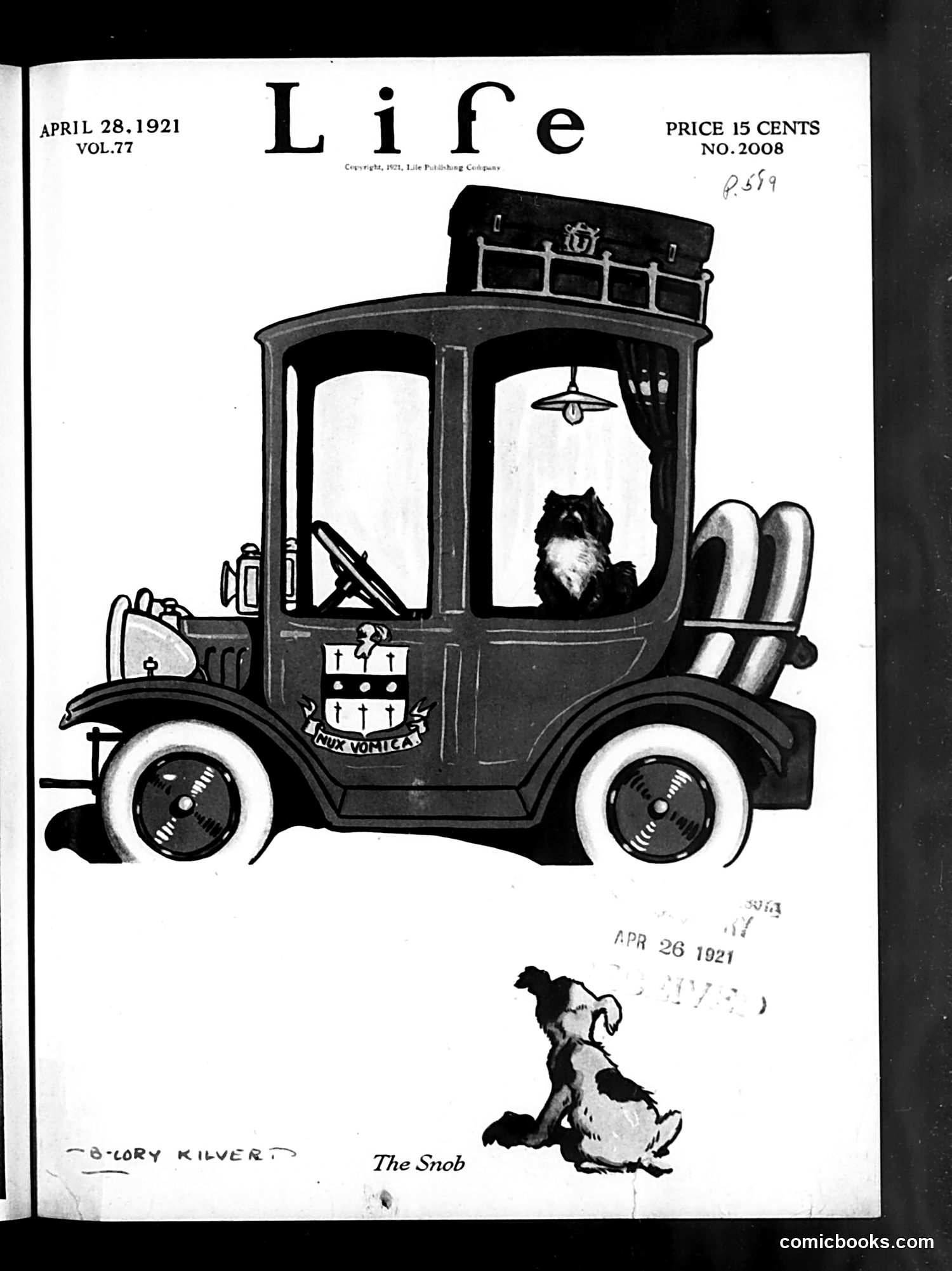
The main illustration, credited to Cory Kilver, depicts "The Snob"—a caricatured figure with a prominent beard driving an elaborate, pretentious automobile. The vehicle features ornate details including a coat of arms on the door and an oversized rear exhaust pipe, suggesting ostentatious wealth and social pretension. The satire targets nouveau riche affectation: the "snob" displays exaggerated markers of status (heraldic symbols, elaborate engineering) that reveal insecurity rather than genuine aristocratic standing. The absurdly large exhaust system particularly mocks the owner's need for visible, wasteful displays of affluence. This reflects post-WWI American anxieties about emerging wealthy industrialists and their perceived lack of refined taste, a common theme in 1920s satirical humor.
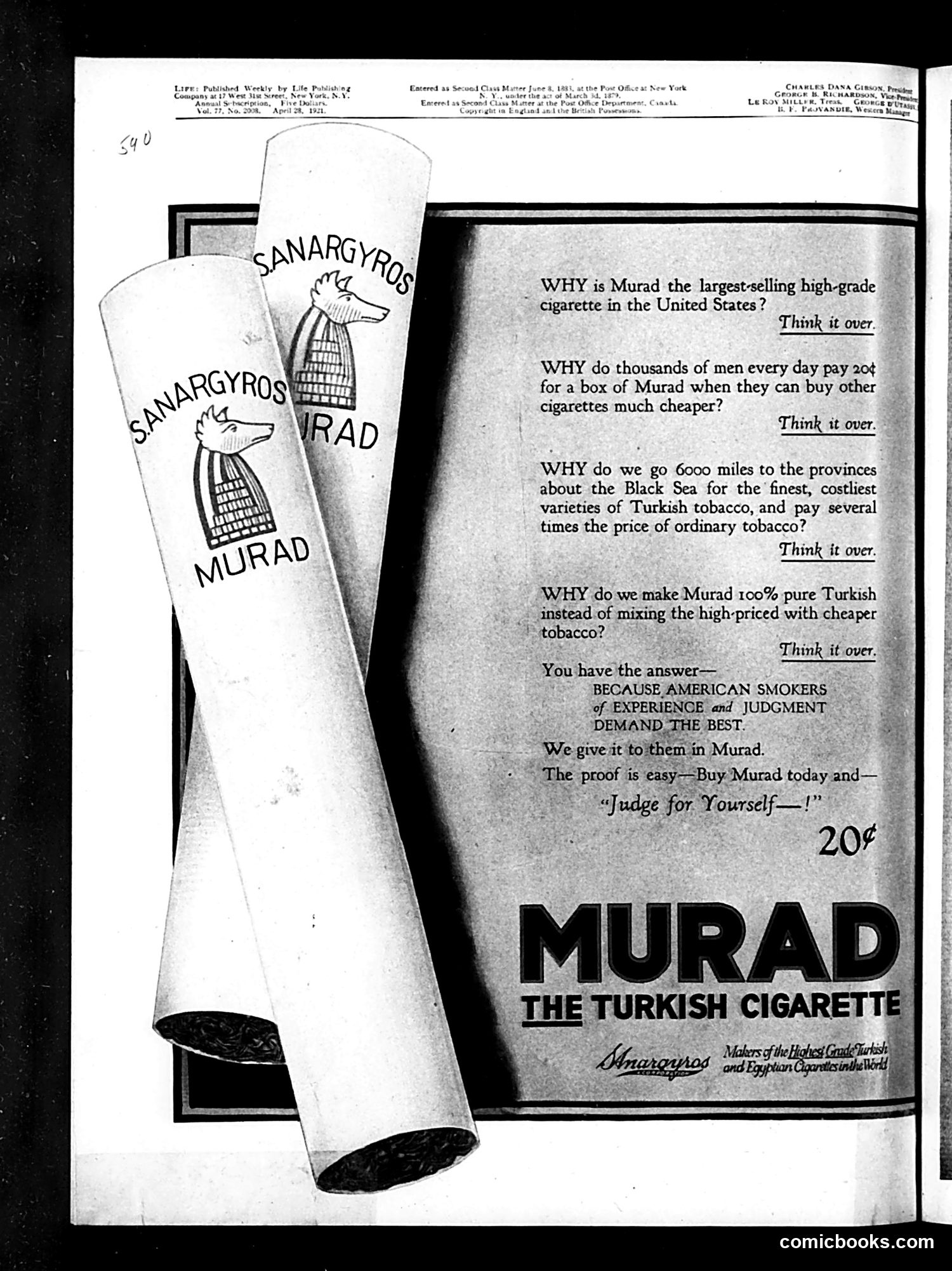
This is a **commercial advertisement**, not political satire. Murad advertises Turkish cigarettes at 20¢ per box by posing rhetorical questions to consumers: Why is Murad the best-selling premium cigarette? Why do people pay more for it when cheaper alternatives exist? Why source expensive Turkish tobacco from the Black Sea region? The ad's answer: American smokers of "experience and judgment demand the best." The imagery shows two cigarette packages branded with "Sanargyros" (the distributor) and a figure in Turkish dress, emphasizing the product's foreign, premium origin. This reflects early 20th-century marketing that equated imported luxury goods with quality and sophistication.
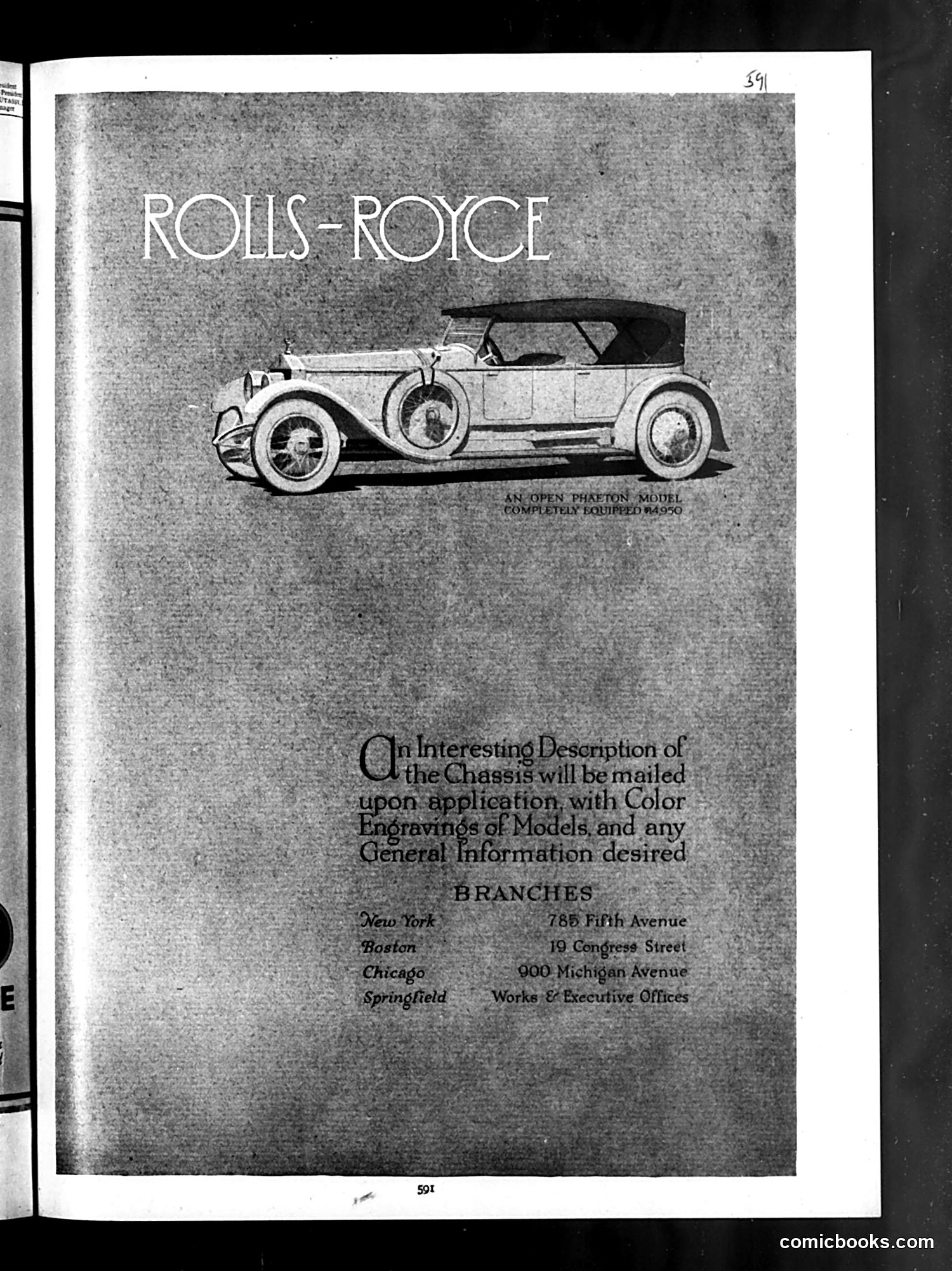
This page is a **straightforward luxury automobile advertisement**, not satire or political commentary. It features an illustration of a Rolls-Royce open phaeton model priced at $4,950—positioned as a high-end vehicle for wealthy buyers. The ad emphasizes the brand's prestige and offers to send interested parties detailed chassis descriptions and color engravings of available models. The advertisement lists four company branches: New York, Boston, Chicago, and Springfield, with their respective addresses. This reflects early 20th-century American expansion of the prestigious British automotive brand into the U.S. market. There is no cartoon or satirical content; this is purely commercial advertising targeted at Life magazine's affluent readership.
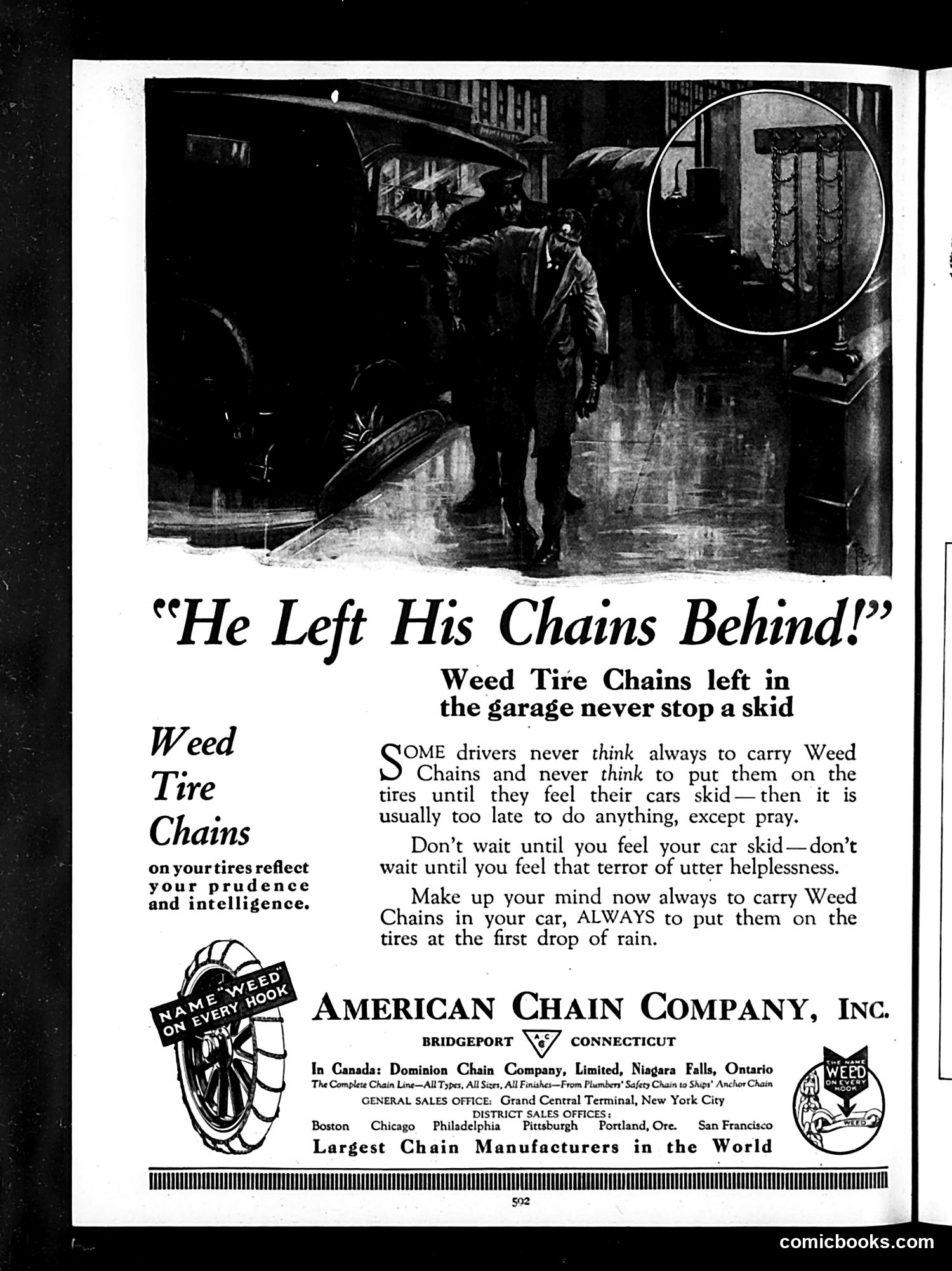
This is primarily **advertising, not satire or political commentary**. The American Chain Company is promoting Weed Tire Chains—devices attached to vehicle tires for traction in snow and ice. The ad's rhetorical strategy uses a cautionary narrative: "He Left His Chains Behind!" The circled inset shows an empty garage, dramatizing the consequence of forgetfulness. The copy warns drivers not to wait until they feel their car skid before installing chains; instead, drivers should proactively carry and install Weed Chains "at the first drop of rain." The tagline "Weed Tire Chains on your tires reflect your prudence and intelligence" appeals to drivers' sense of responsibility and safety-consciousness. This appears to be vintage (pre-modern winter tire technology), likely early-to-mid 20th century.
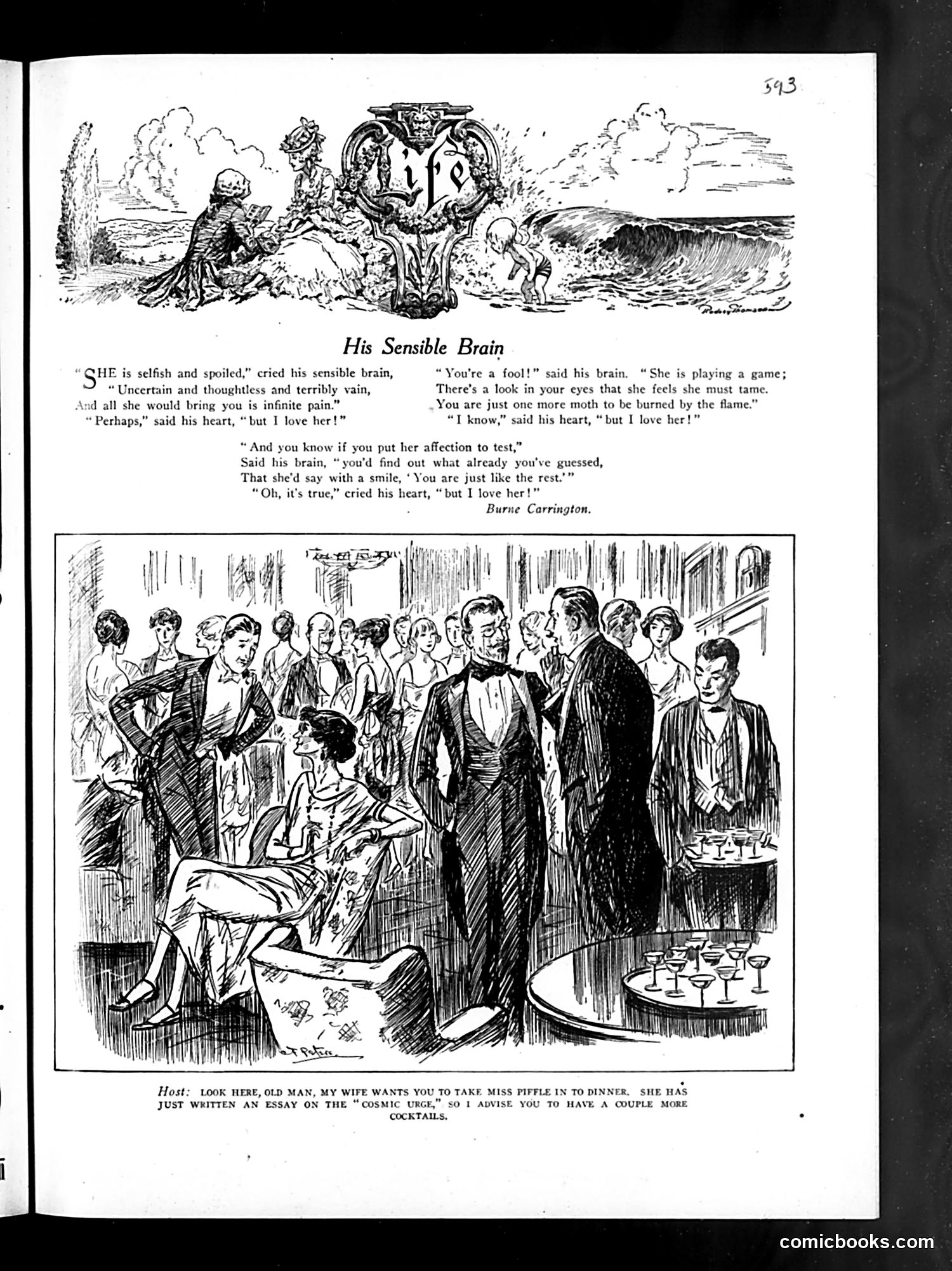
This page contains two separate pieces of satirical content: **Top Section:** A poem by Burne Carrington titled "His Sensible Brain" presents an internal dialogue where a man's rational mind (brain) argues against his emotional heart. The brain warns that a woman is manipulative and selfish, attempting to "tame" him through games, while his heart insists on loving her anyway. The satire mocks the common romantic predicament where logic and emotion conflict—a timeless theme about male vulnerability to female charm. **Bottom Section:** A social cartoon depicting a formal dinner party. A host addresses an elderly guest, referencing his wife's recent essay on "cosmic urge" and inviting the man to dinner to discuss cocktails. The satire appears to mock contemporary pseudo-intellectual trends and pretentious social gatherings dressed up in fashionable philosophical language. Both pieces satirize romantic and social foolishness through wit rather than political commentary.
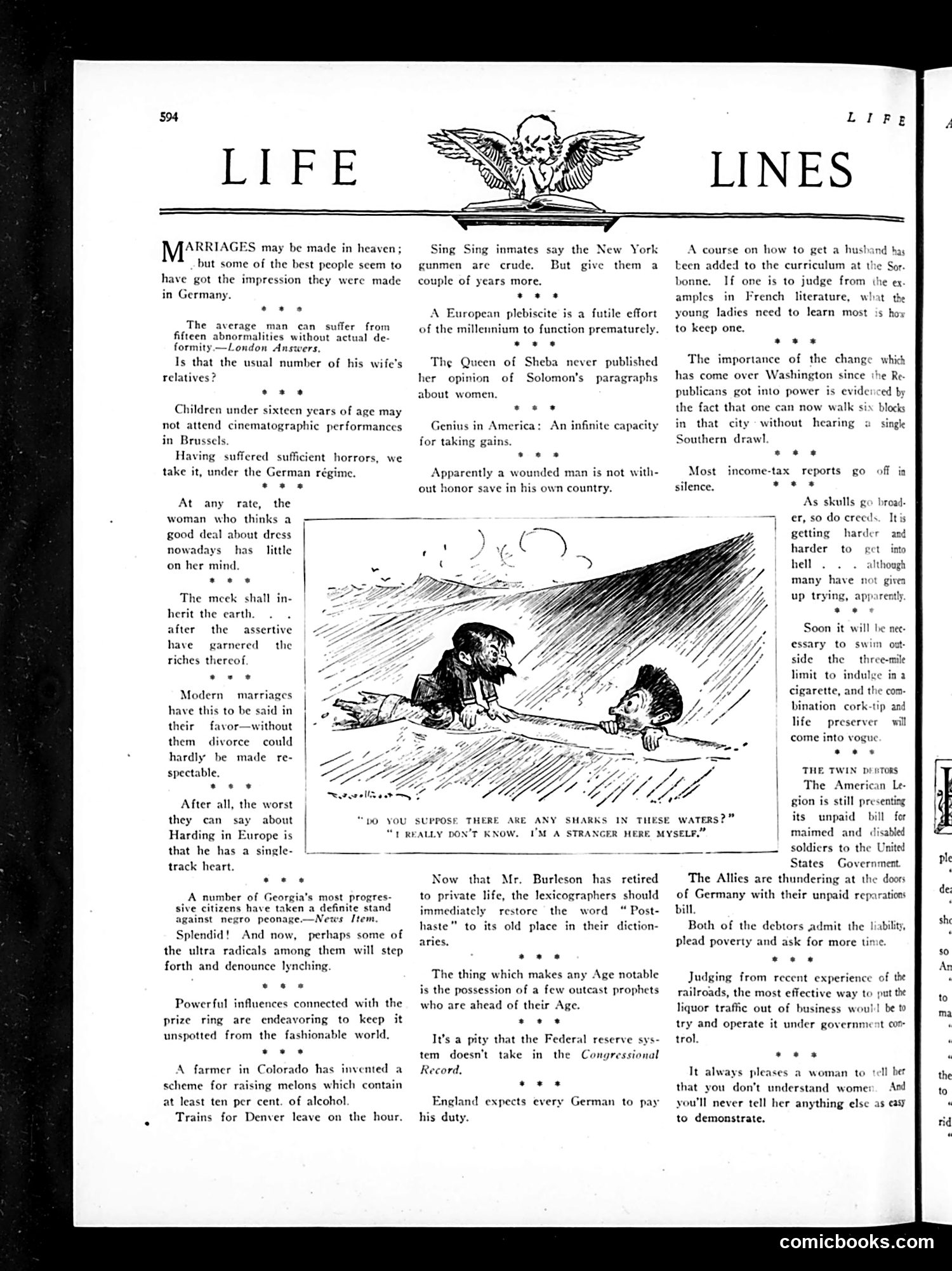
The main cartoon depicts two figures in water with one asking: "Do you suppose there are any sharks in these waters?" The second replies: "I really don't know. I'm a stranger here myself." This appears to be a humorous commentary on uncertainty and displacement, likely referencing post-WWI displacement or immigration themes common in 1920s satire. The cartoon's joke relies on both characters being equally ignorant despite one appearing more established. The surrounding "Life Lines" column contains topical commentary typical of Life magazine's satirical format—brief observations on contemporary social issues, politics, and cultural matters. The specific references to Washington, railroads, and international relations suggest this is from the early-to-mid 1920s period.
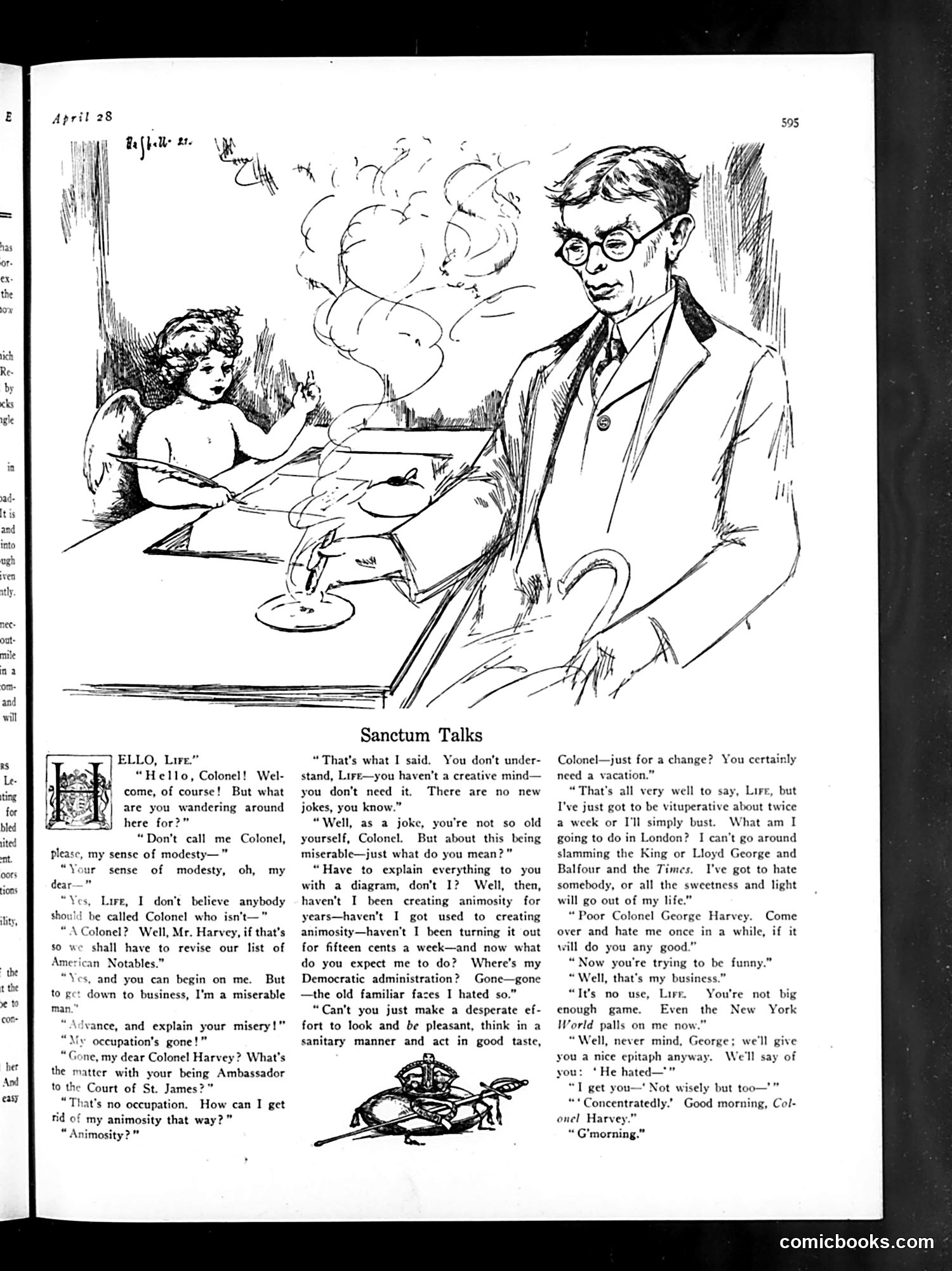
This page presents a dialogue between "Colonel" Harvey (the bespectacled man) and "Life" (represented as a cherub/cupid figure), a common satirical device in Life magazine where abstract concepts personified as characters offered commentary. The satire mocks someone—likely a public figure or diplomat—for becoming an Ambassador to the Court of St. James (Britain) and complaining about losing his anonymity. The joke centers on the tension between seeking prestigious appointments and then resenting the public scrutiny that accompanies them. References to "Democratic administration," "George Harvey," and complaints about press attention ("Balfour and the Times") suggest this lampoons a political appointee's hypocrisy about wanting both status and privacy.
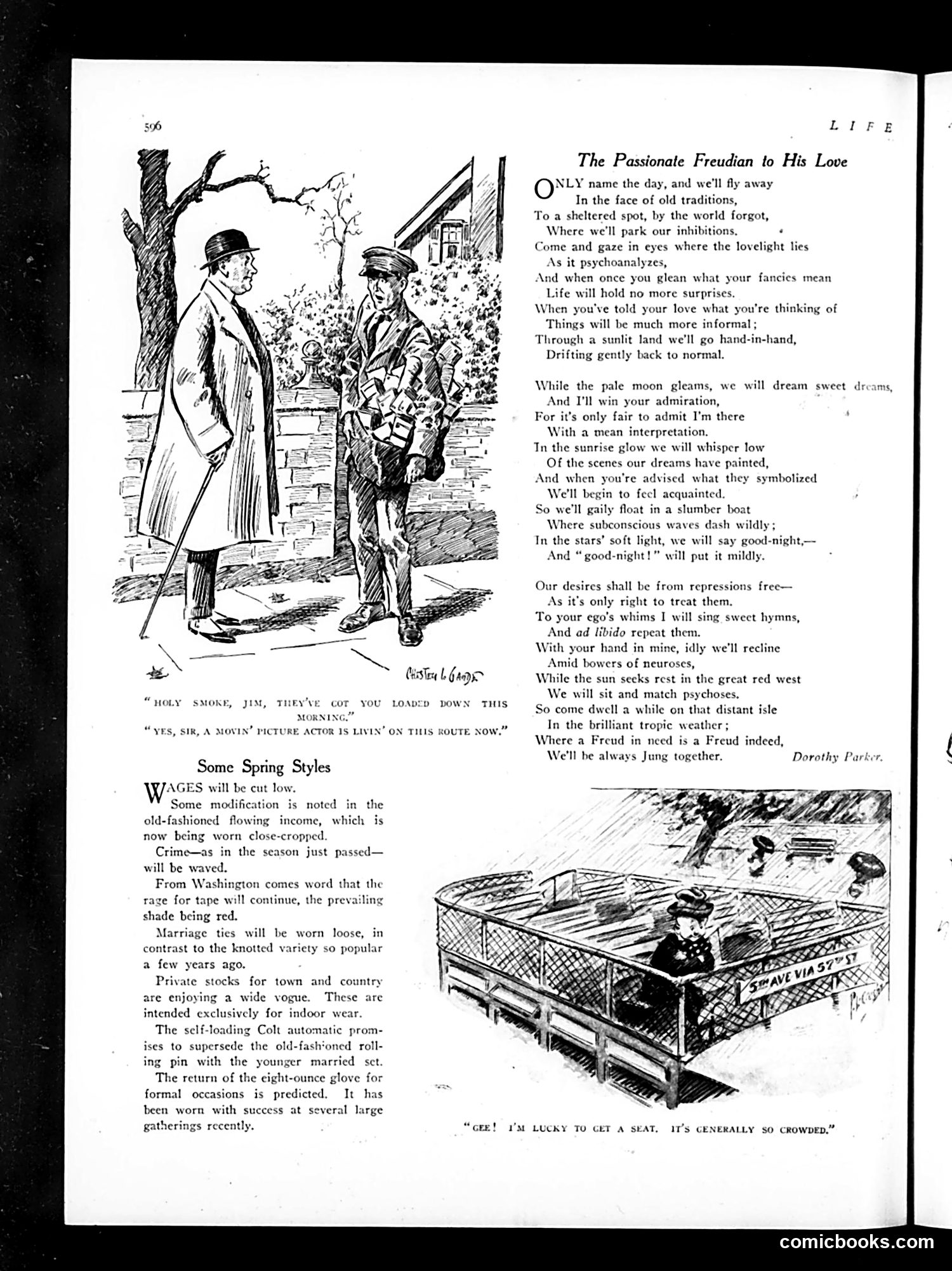
This page contains two distinct sections: **Top illustration**: A sketch showing two men in conversation on a street, with the caption "Holy smoke, Jim, they've got you loaned down this morning" / "Yes, sir, a moving picture actor is living on this route now." This appears to be social satire about the presence of film actors in residential neighborhoods—treating their arrival as a notable, somewhat amusing local event. **"Some Spring Styles" section**: Fashion commentary predicting trends for the upcoming season, including shortened hemlines, changes to wedding ties worn "loose," and the return of eight-ounce gloves for formal occasions. This is straightforward fashion reporting rather than political satire. **Bottom illustration**: Unrelated scene of people in what appears to be a boat or viewing platform, with the caption "Gee! I'm lucky to get a seat. It's generally so crowded."
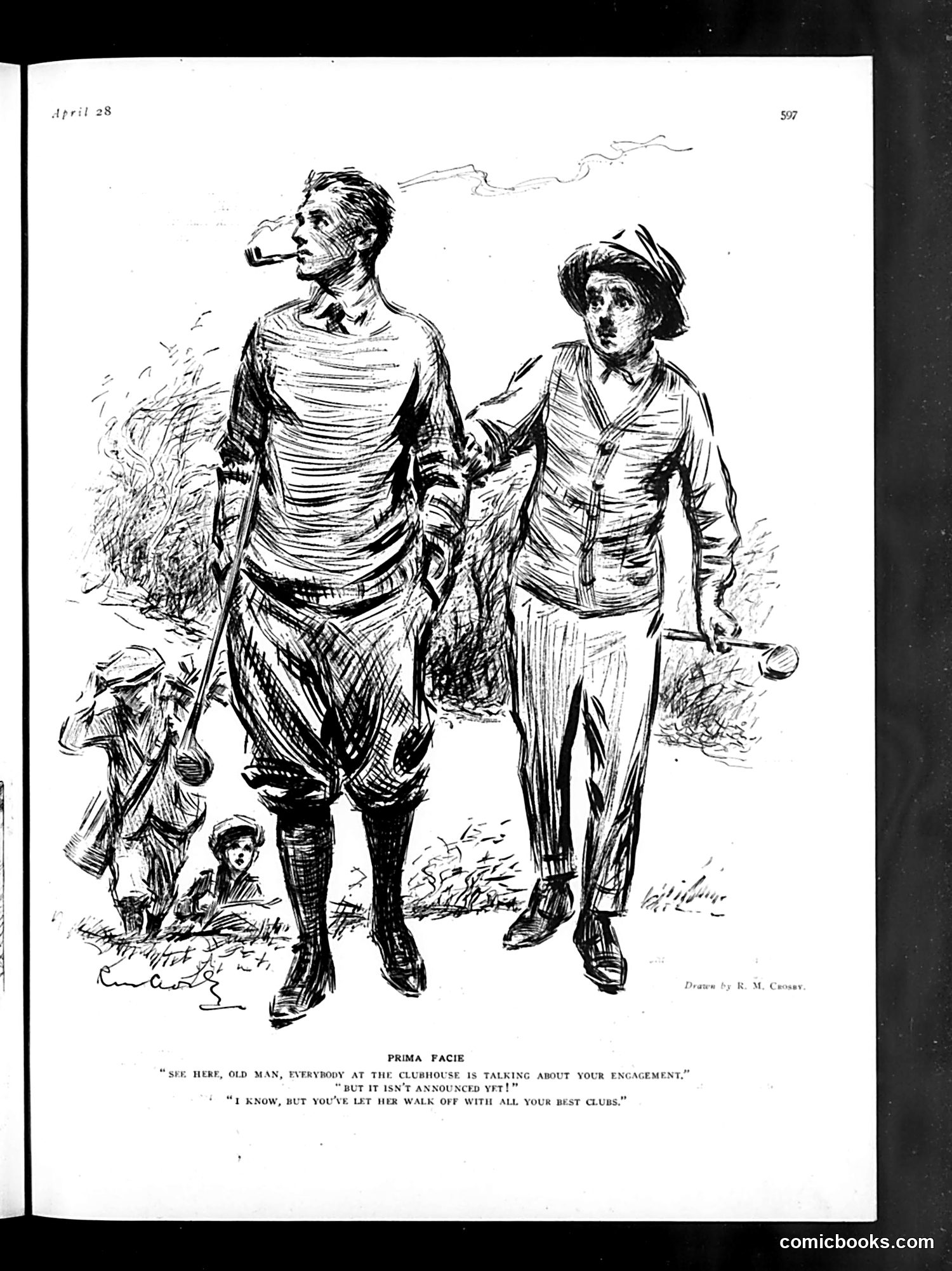
This is a golf-themed social satire drawn by K.M. Conway. The cartoon shows an older man with a cigar speaking to a younger man, with small figures in the background. The caption indicates gossip at a clubhouse about an engagement—the older man tells the younger one that everyone's talking about his engagement, but it hasn't been announced yet. The punchline suggests the younger man has "let her walk off with all your best clubs." The humor plays on two meanings: the social embarrassment of a leaked engagement announcement, combined with the literal loss of golf clubs—implying the woman has either left him or taken his possessions. It satirizes both masculine vanity about social status and the material consequences of romantic entanglements among the country-club set.
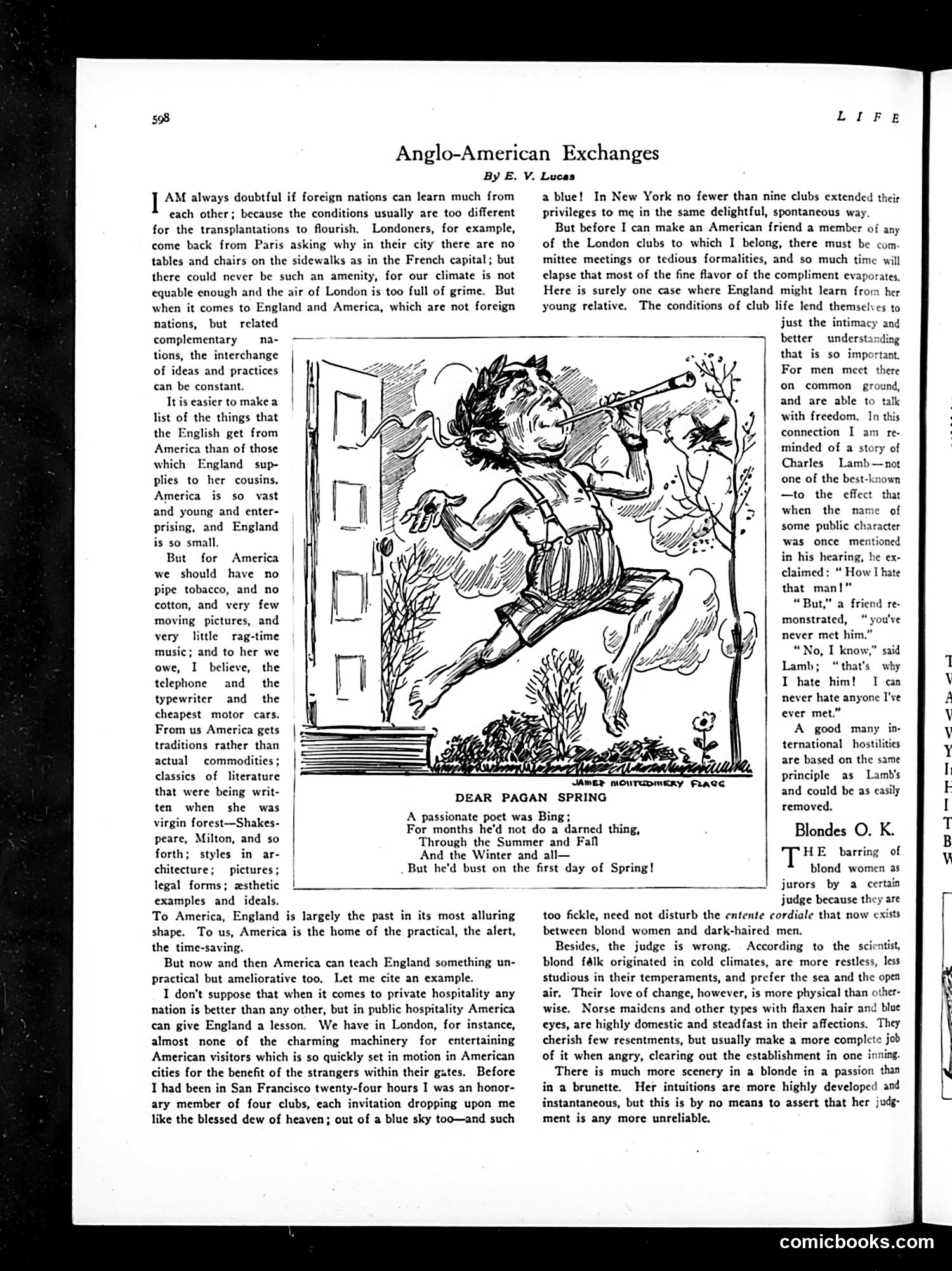
This cartoon illustrates a poem about springtime by showing a wild, energetic figure (likely representing Spring personified as a pagan or nature spirit) bursting through doors with exuberant abandon. The figure plays pipes and carries flowers, embodying the chaotic, untamed energy of the season. The poem's message is humorous: despite spring's romantic associations with renewal, the poet Bing couldn't resist noting that spring "bust on the first day of Spring"—a playful complaint that spring arrived with overwhelming chaos rather than gentle grace. The crude, frenzied illustration style matches this tone of irreverent humor, poking fun at romanticized notions of seasonal change. This represents *Life* magazine's satirical approach to contemporary culture and attitudes.
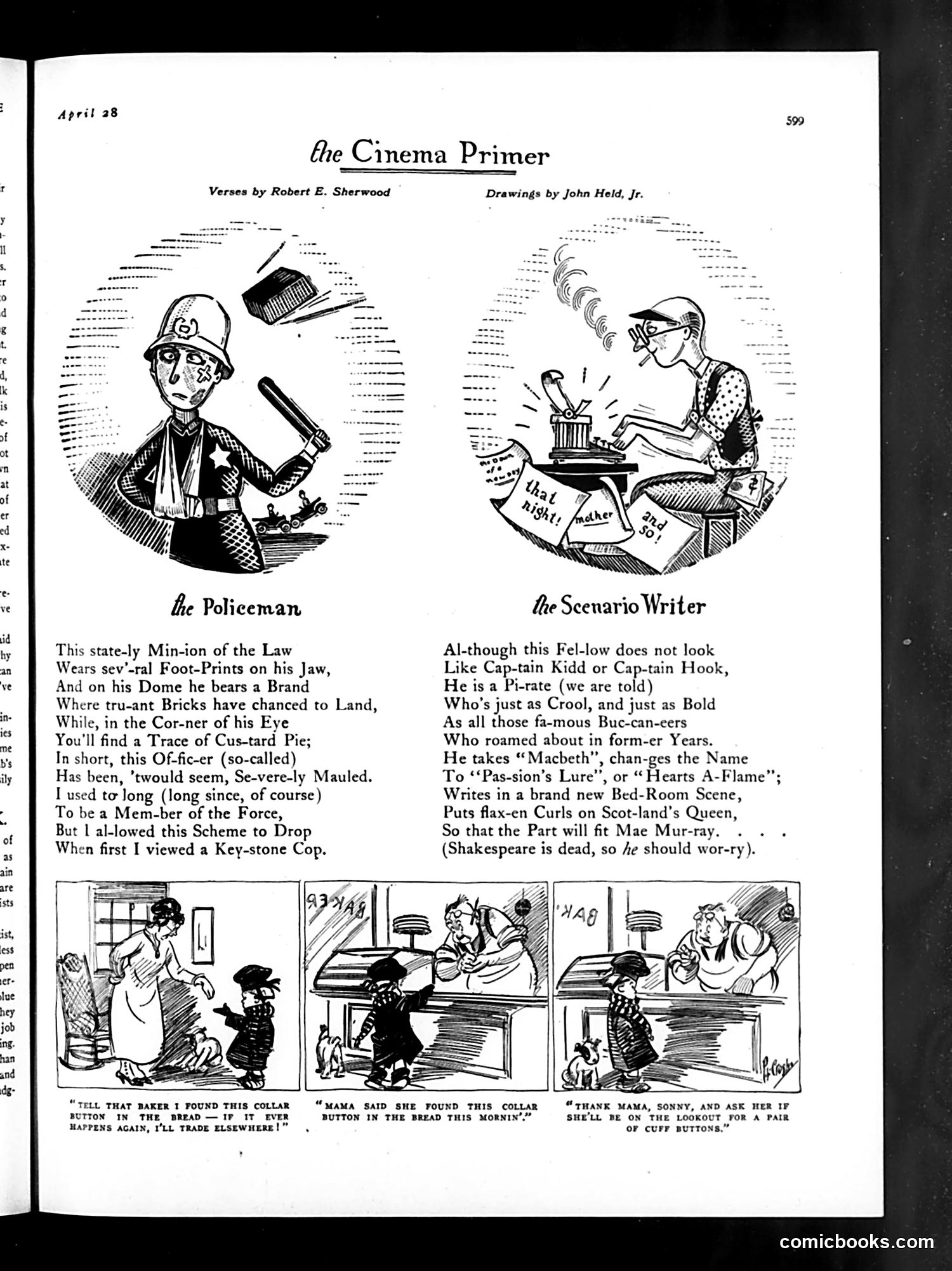
This satirical page mocks early cinema archetypes through caricatured characters and their descriptions. "The Policeman" depicts a stereotypical film cop—brutish, incompetent, and corrupt ("Trace of Cus-tard Pie"). The satire suggests cinema police are laughably inept compared to real law enforcement. "The Scenario Writer" caricatures screenwriters as pretentious hacks who plagiarize Shakespeare ("Shakespeare is dead, so *he* should worry") and substitute sensationalism for substance—creating melodramatic "Bed-Room Scenes" with cheap tricks like "flax-en Curls on Scotland's Queen" to replace genuine storytelling. The bottom comic strip shows domestic chaos: lost collar buttons, bread mishaps, and missing cuff buttons—mundane household troubles presented as cinema fodder. The satire critiques how early films elevated trivial domestic irritations into overwrought drama.
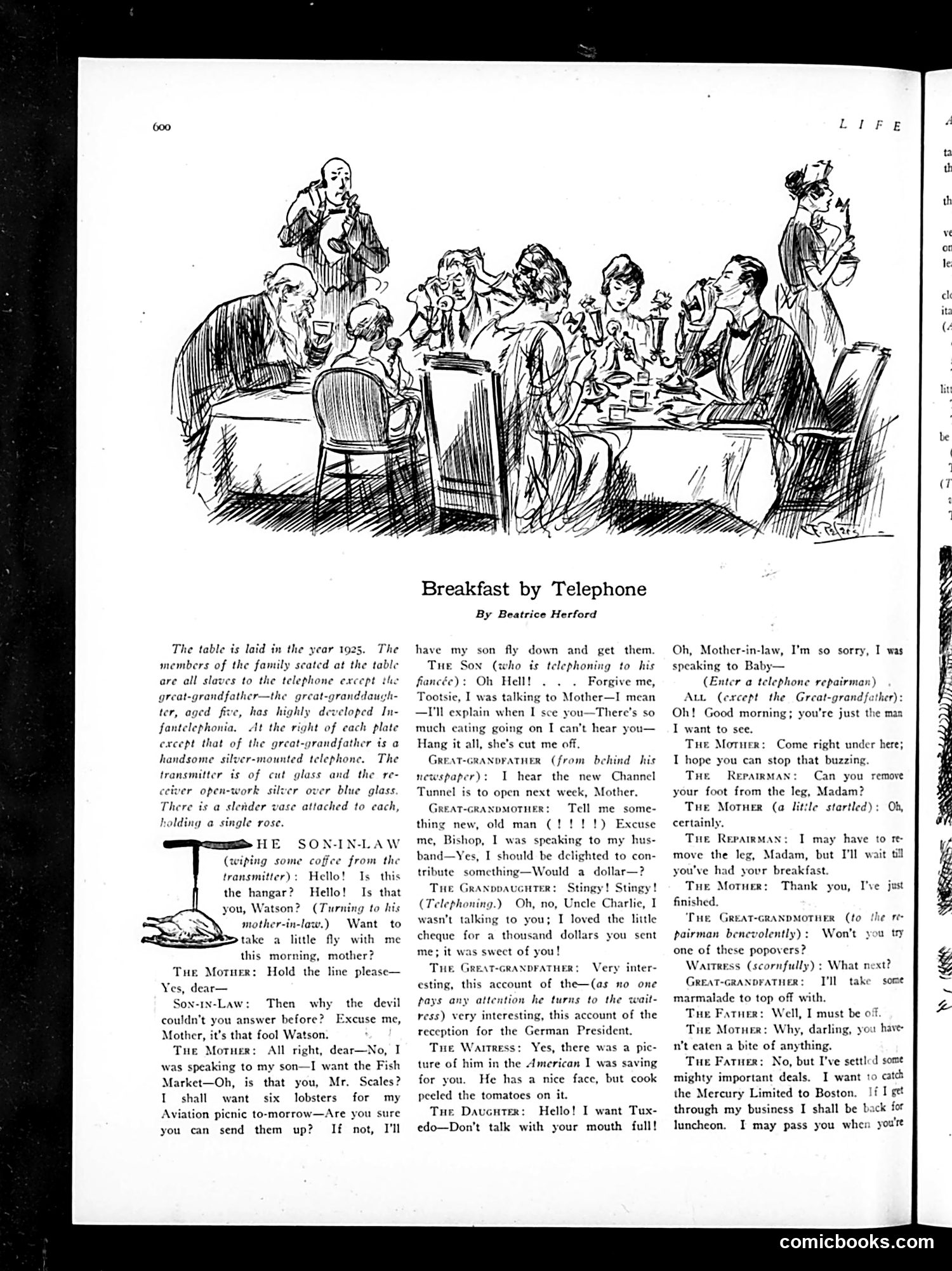
This satirical piece by Beatrice Herford depicts a family dinner where multiple relatives conduct conversations simultaneously via telephone—a then-novel technology. The humor targets the chaotic intrusion of telephones into domestic life and family gatherings. The sketch shows a crowded table where the son-in-law speaks to his mother-in-law, the daughter negotiates with a taxi service, the grandfather discusses a new "Channel Tunnel," and others manage various calls—all while supposedly eating together. The satire mocks how this modern convenience fragments family attention and transforms a shared meal into a cacophony of separate transactions. The piece implicitly critiques technology's disruption of traditional social rituals and domestic intimacy, a concern that resonated in the 1920s as telephones became increasingly common household fixtures.
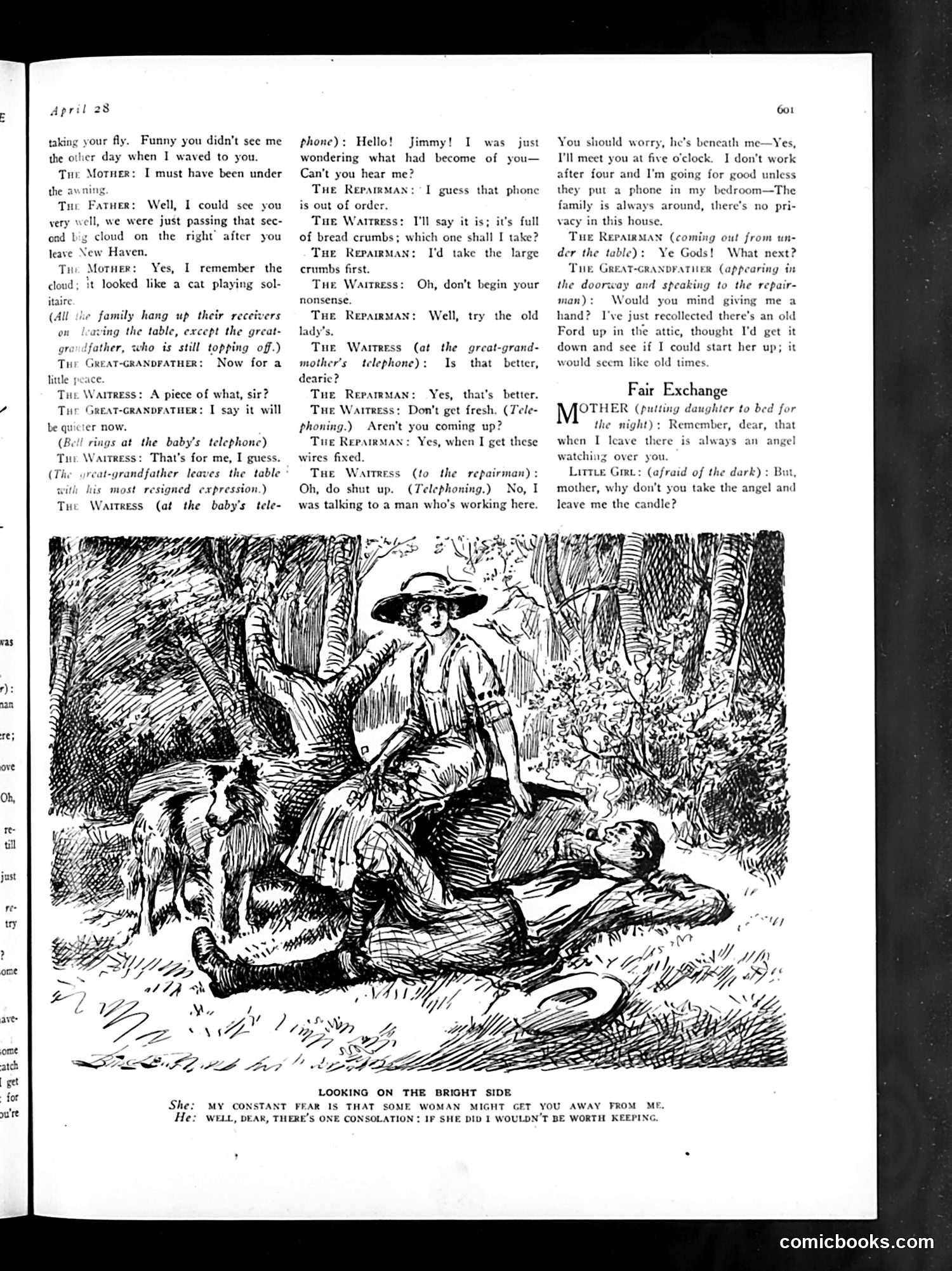
This page contains a domestic comedy sketch and accompanying illustration titled "Looking on the Bright Side." The dialogue involves a Mother, Father, Waitress, Great-grandfather, and Repairman dealing with a malfunctioning telephone and a broken-down Ford automobile in the attic. The humor centers on early 20th-century domestic frustrations: unreliable technology (phones going out of order), aging family members inhabiting the home, and the complications of maintaining newfangled machinery like automobiles. The illustration shows a couple relaxing outdoors while a woman stands watch, humorously illustrating the final joke about marital anxieties. The satire gently mocks middle-class household chaos and the intrusions of modern technology into domestic life.
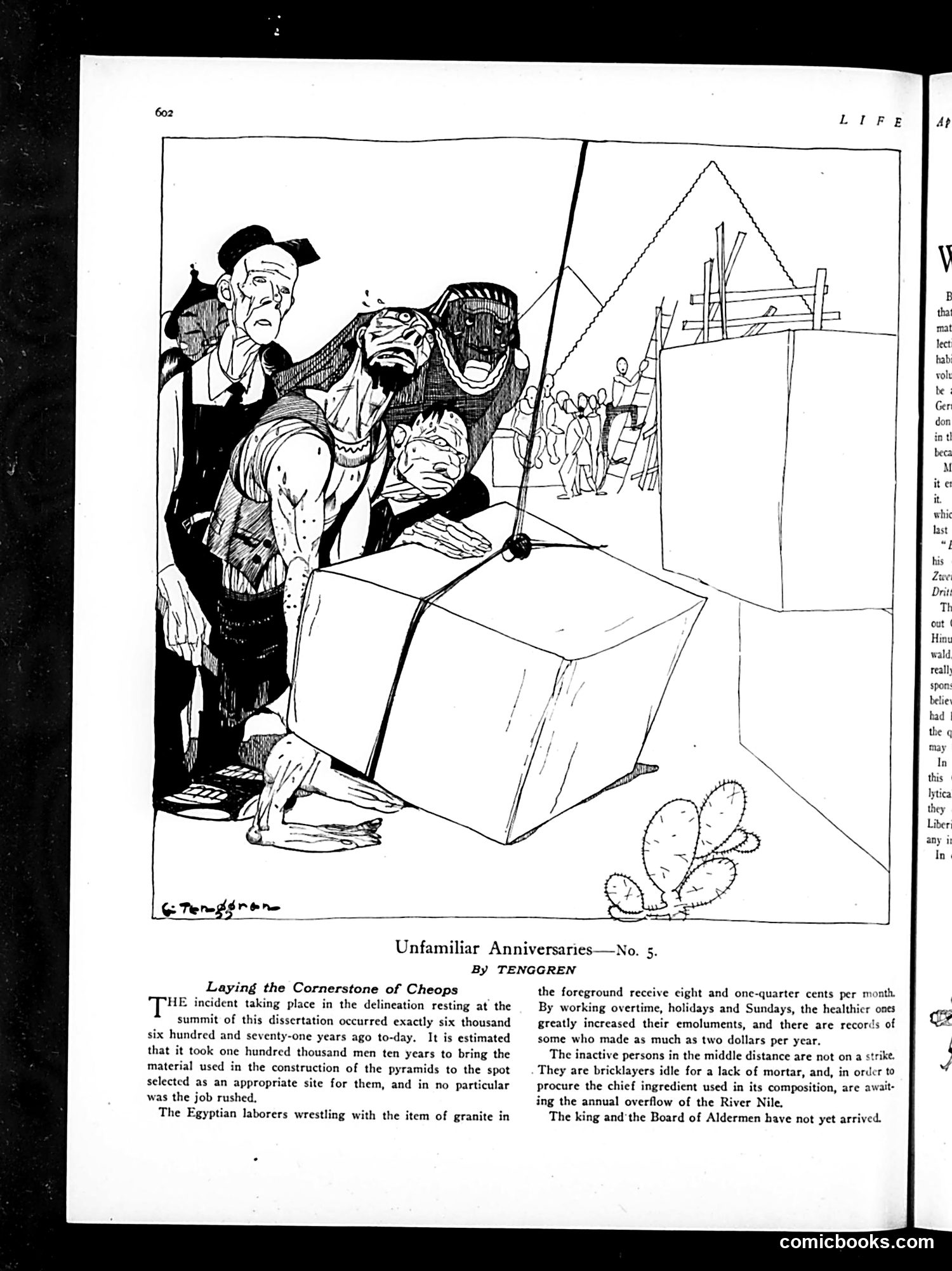
This satirical cartoon by Tenggren depicts the laying of the cornerstone for the Cheops pyramid, occurring 671 years ago. The joke centers on labor conditions: Egyptian workers, depicted with exaggerated features, struggle with massive granite blocks while appearing exhausted and miserable. The satire compares ancient Egyptian slave labor to contemporary working conditions. The text notes workers received minimal pay (8.25 cents monthly) and had to work overtime and holidays to earn slightly more—some made only two dollars yearly. The "inactive persons" (strikebreakers) and delayed arrival of "the king and the Board of Aldermen" suggest corruption and indifference to workers' plight. The cartoon critiques how little labor conditions have improved across millennia.
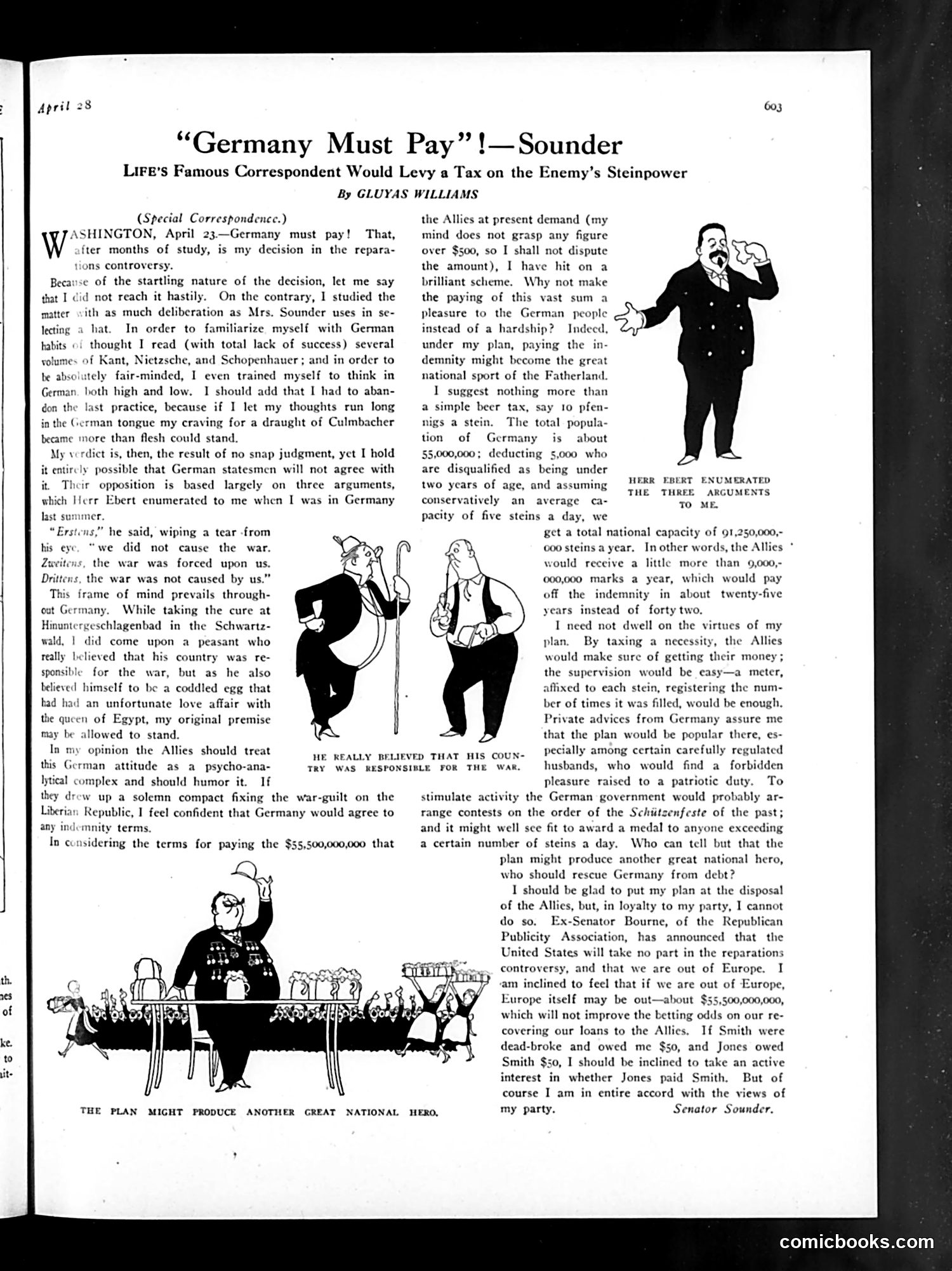
This 1921 *Life* magazine page satirizes Senator Gluyas Williams's proposal to tax German beer steins as reparations for World War I. The article's headline announces "Germany Must Pay!"—a reference to the massive indemnity imposed on Germany after the war. The cartoons mock Williams's scheme as absurd: one shows a German official caught between blame ("he really believed that his country was responsible for the war"), while another depicts a military figure presiding over beer-stein production, captioned "The plan might produce another great national hero." The satire targets both German war-guilt arguments and American politicians proposing creative (and ridiculous) payment schemes. The beer-stein tax exemplifies the period's heavy-handed approach to post-war punishment and financial recovery from defeated nations.
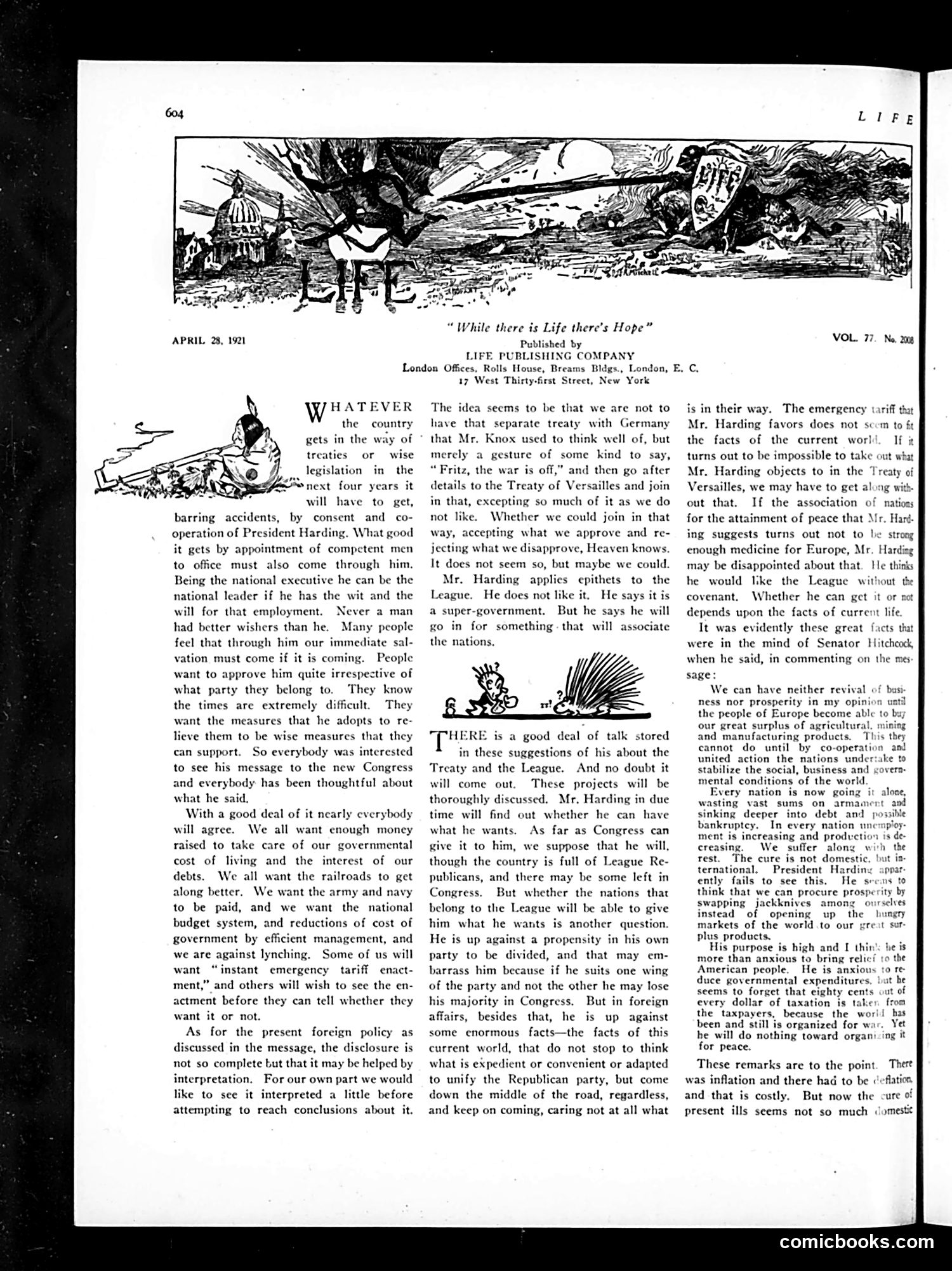
This April 28, 1921 *Life* page critiques President Harding's approach to post-war international relations. The article "Whatever" argues against separate treaties with Germany, advocating instead for unified League of Nations involvement. The political cartoons (two small illustrations) appear to use animal figures—likely representing nations or political positions—in satirical poses, though the specific identities are unclear from the image alone. The main text expresses concerns that Harding's proposed foreign policy will fragment Republican support and fail to achieve peace. The author warns that without international cooperation, economic revival across Europe remains impossible, and that nationalist divisions threaten lasting stability. The piece reflects broader 1921 debates over American isolationism versus League of Nations participation.
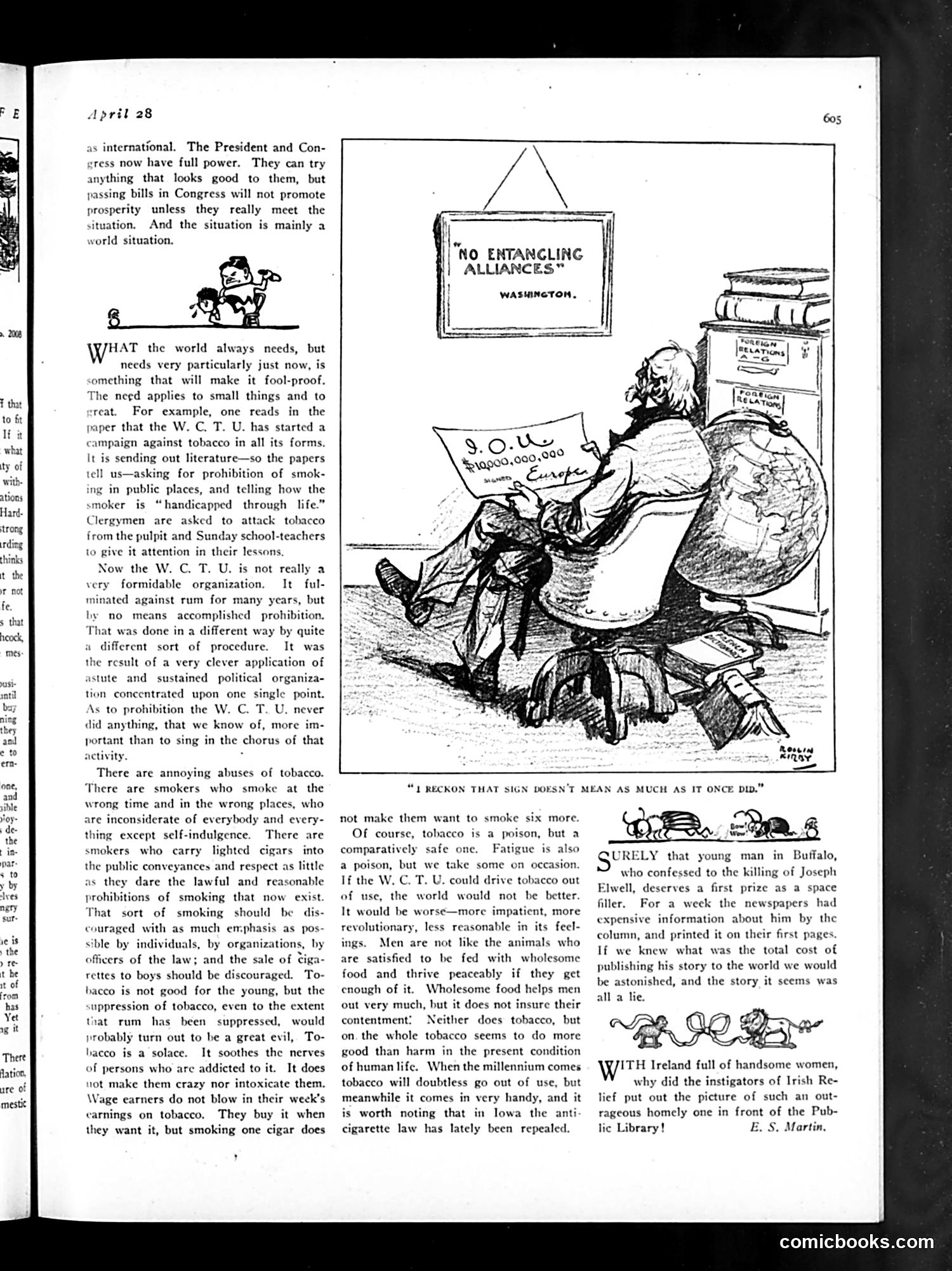
This page from *Life* magazine (April 28, likely 1920s based on references) contains political and social commentary on Prohibition and related reform movements. **The Main Cartoon:** Shows Uncle Sam sitting atop a globe labeled "$500,000,000" debt, reading a "No Entangling Alliances" sign from Washington. The caption reads "I reckon that sign doesn't mean as much as it once did." This satirizes America's shift from isolationism to international financial/political involvement despite official policy claiming otherwise. **The Text Commentary:** Critiques the W.C.T.U. (Women's Christian Temperance Union)—a real anti-alcohol/anti-tobacco advocacy group—for their ineffectual moralistic campaigns. The author argues their crusades against tobacco accomplish little compared to actual political organization (like that which achieved Prohibition). He defends moderate tobacco use as harmless compared to alcohol, suggesting the real problem is inconsiderate smokers, not the substance itself. The piece mocks reform organizations that rely on rhetoric and moral persuasion rather than practical political power.
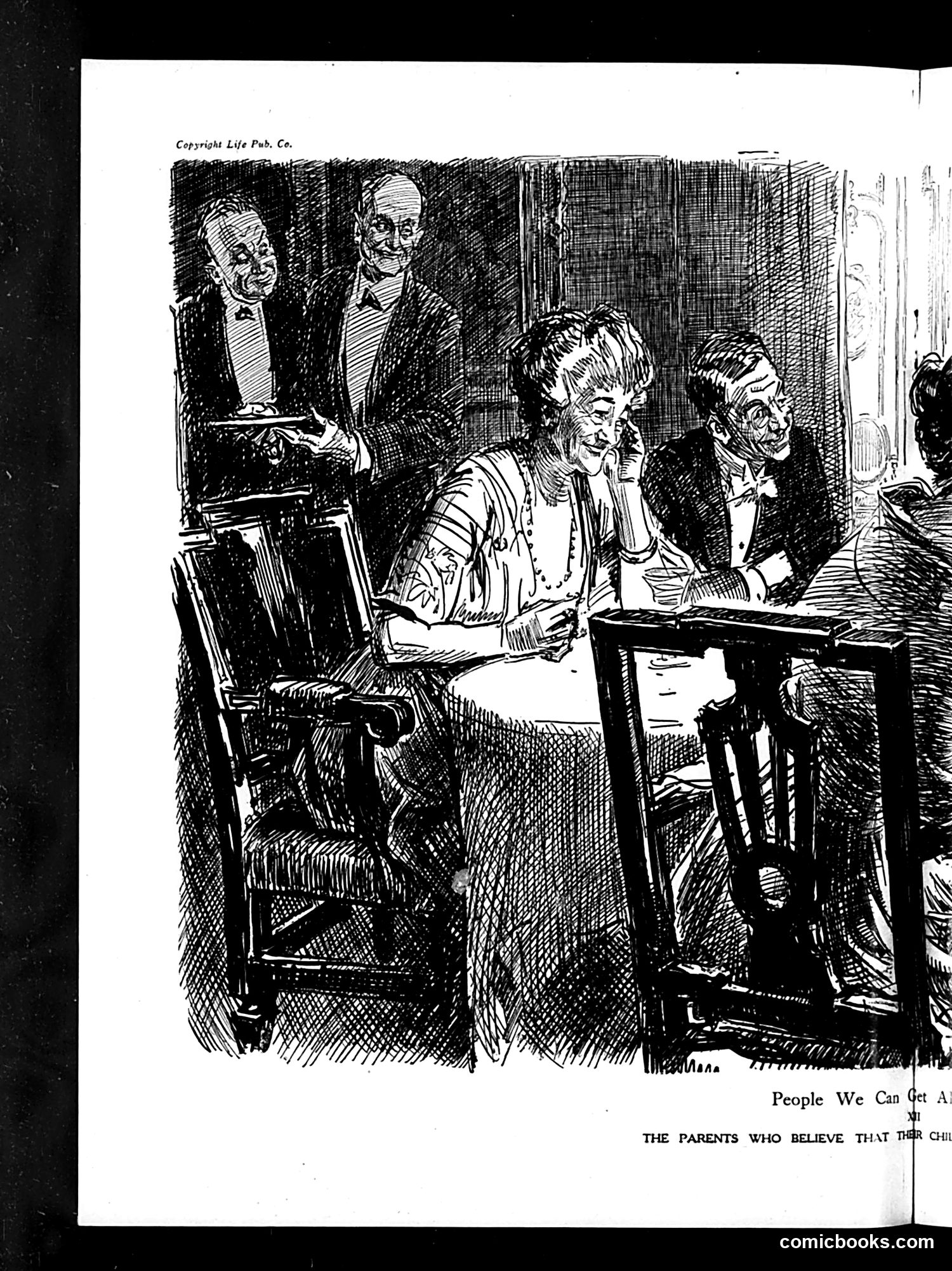
This ink sketch depicts a social commentary on parenting attitudes, likely from the early-to-mid 20th century. The cartoon shows a woman seated at what appears to be a dining or social setting, surrounded by men in formal attire who are observing or judging her. The partially visible caption references "THE PARENTS WHO BELIEVE THAT THEIR CHI[LDREN]..." suggesting commentary on parental beliefs or practices. The satire appears to critique parents who hold particular views about child-rearing, though the complete text is cut off. The woman's prominent positioning and the surrounding male figures' scrutiny suggest the cartoon examines how parenting choices—particularly by mothers—were subject to public judgment or social pressure. The formal setting implies this reflects middle-class social norms and expectations of the era.
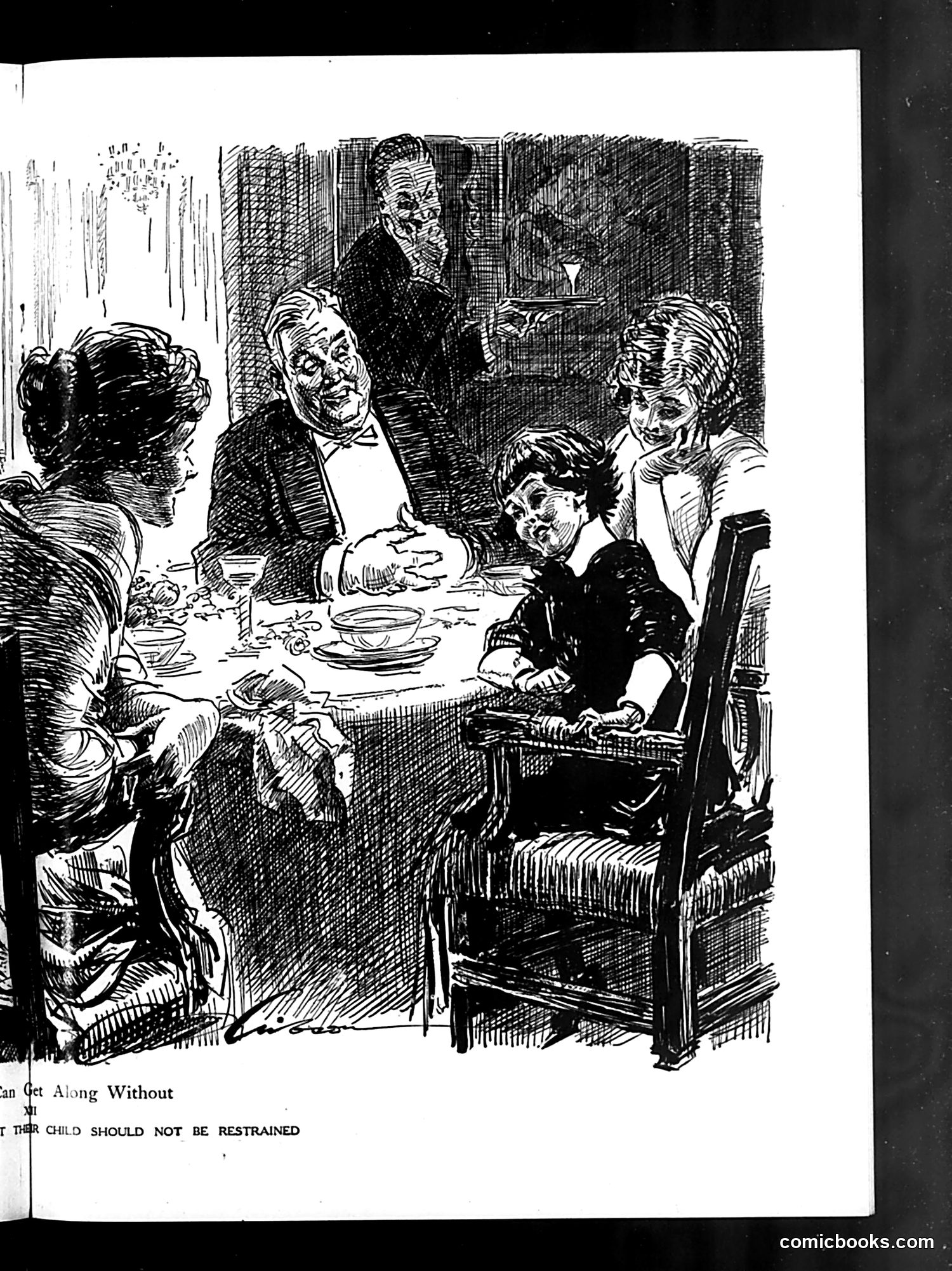
This is a sketch-style cartoon depicting a formal family dinner scene. The visible text fragment reads "...et Along Without" and "...r tHeir CHILD SHOULD NOT BE RESTRAINED," suggesting a parenting advice or social commentary piece. The cartoon appears to satirize upper-class family dynamics, showing well-dressed adults seated around a dining table with a young child. The exaggerated facial expressions and caricatured style are typical of Life magazine's satirical approach. However, the OCR text is heavily corrupted and incomplete, making it impossible to identify the specific social issue, historical figures, or satirical target with confidence. Without the full caption or article text, I cannot reliably explain what parenting philosophy or social norm this cartoon critiques. The incomplete state of the source material prevents accurate interpretation.
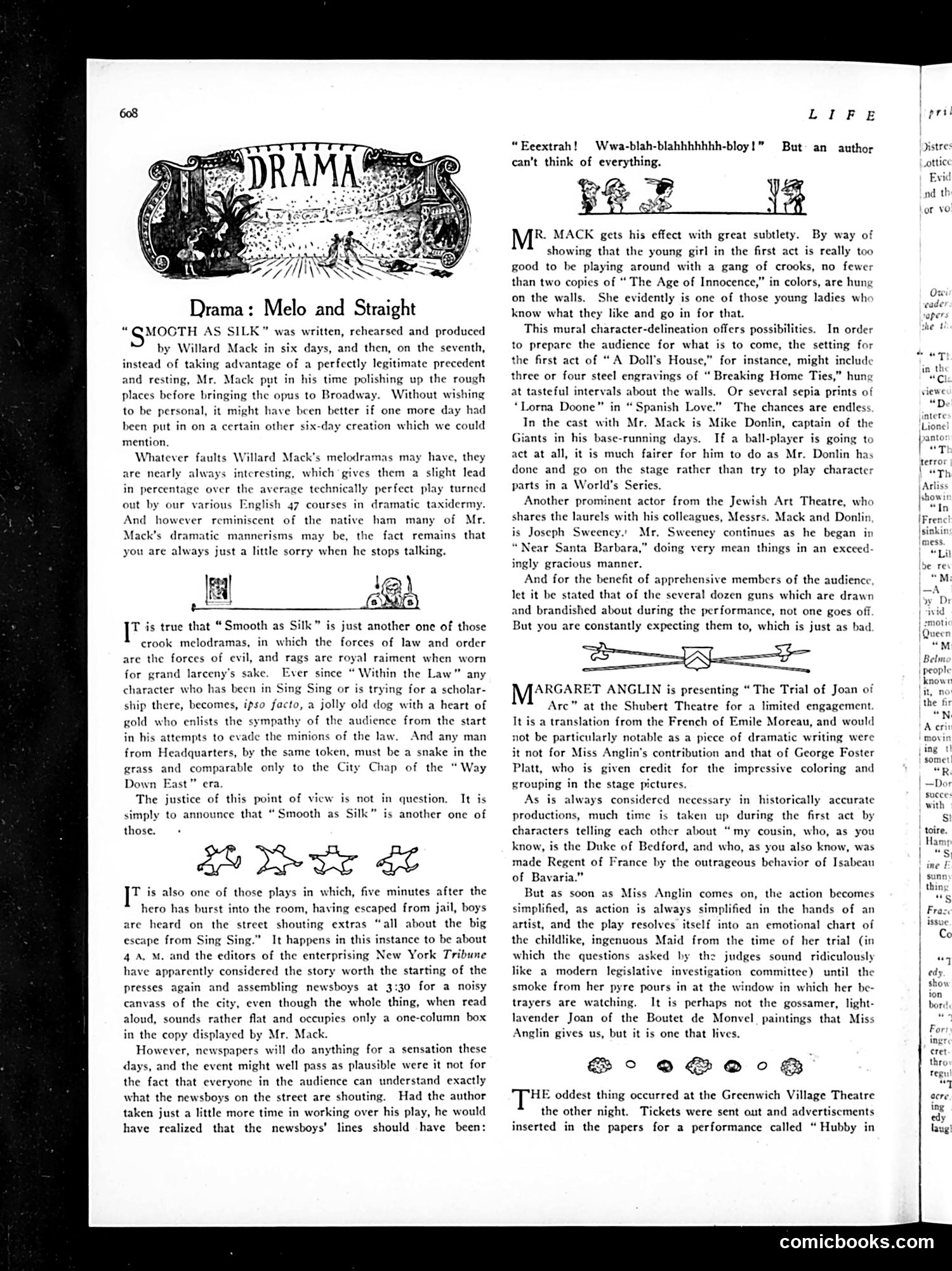
This page reviews **"Smooth as Silk,"** a melodrama by Willard Mack. The small cartoon at top shows newsboys shouting incomprehensibly ("Eeextrah! Wwa-blah-blahhhhhhh-bloy!"), satirizing a plot absurdity: in the play, a jail escape reportedly makes the 4 a.m. papers, yet audiences can supposedly understand the newsboys' shouts—implausible in reality. The critic mocks the play's lazy theatricality: using two copies of *The Age of Innocence* as wall decoration to signal a character's virtue is reductive "character-delineation." The review suggests this could extend absurdly to other plays—hanging *Breaking Home Ties* engravings to establish morality. The writer also notes the casting of Mike Donlin, a baseball player, suggesting Broadway's reliance on celebrities over trained actors. Overall, this is **satirical theater criticism** targeting both melodrama conventions and the entertainment industry's shortcuts.
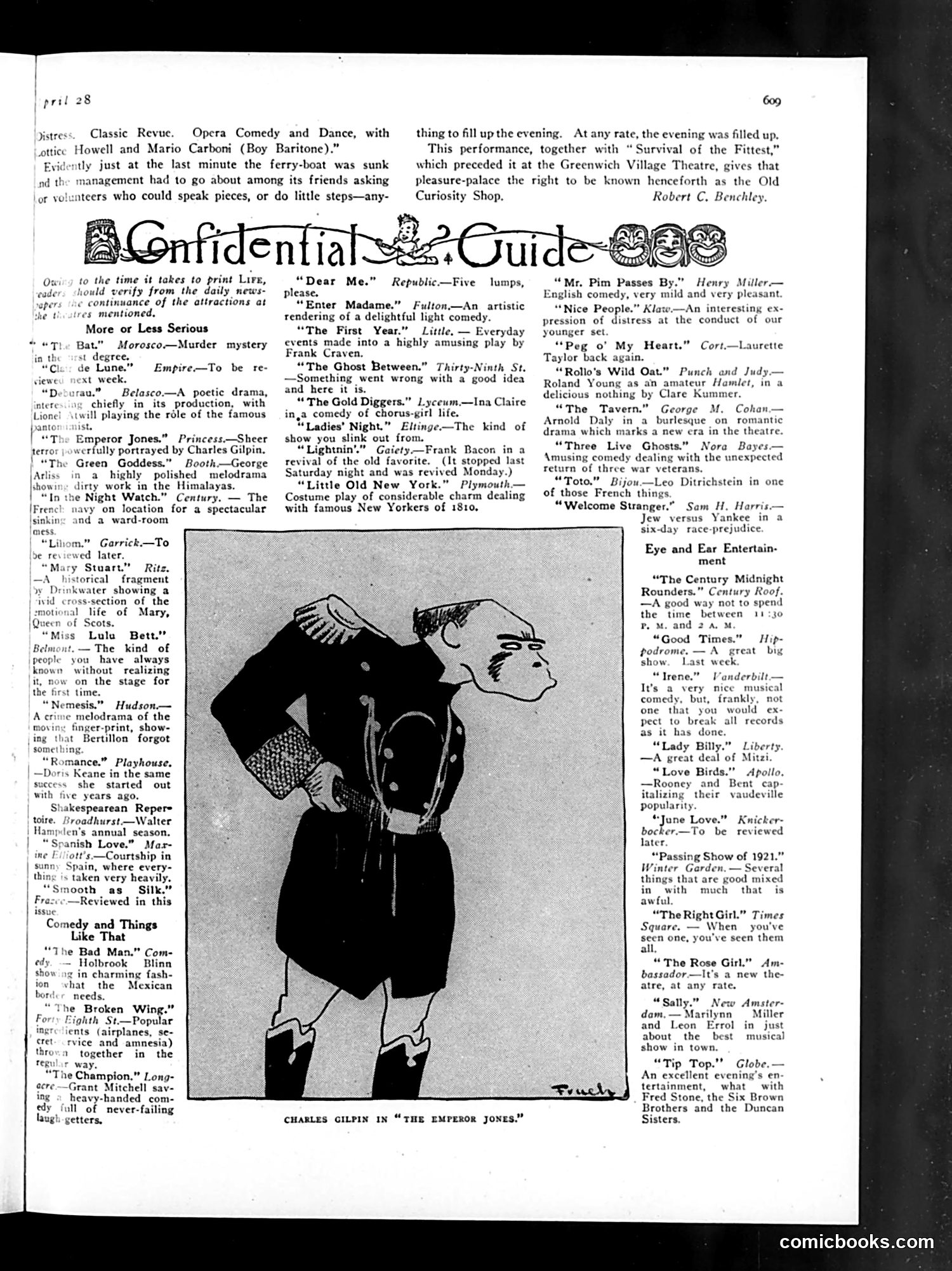
This page from *Life* magazine is primarily a theater review section called "Confidential Guide," featuring reviews of Broadway productions and entertainments. The central cartoon depicts **Charles Gilpin in "The Emperor Jones,"** as labeled. Gilpin was a groundbreaking African American actor; this 1921 play by Eugene O'Neill was a landmark work featuring a Black protagonist. The caricature's exaggerated features reflect the racist artistic conventions of the era, though the review itself appears straightforward. The surrounding text lists theater reviews with the magazine's characteristic satirical commentary. Critic Robert C. Benchley humorously notes that one production was so hastily assembled that management "had to go about among its friends asking for volunteers who could speak pieces, or do little steps—anything to fill up the evening." The reviews mock various shows' quality and artistic choices with dry wit typical of *Life*'s cultural criticism, ranging from serious drama to light comedies and musicals popular with 1920s audiences.
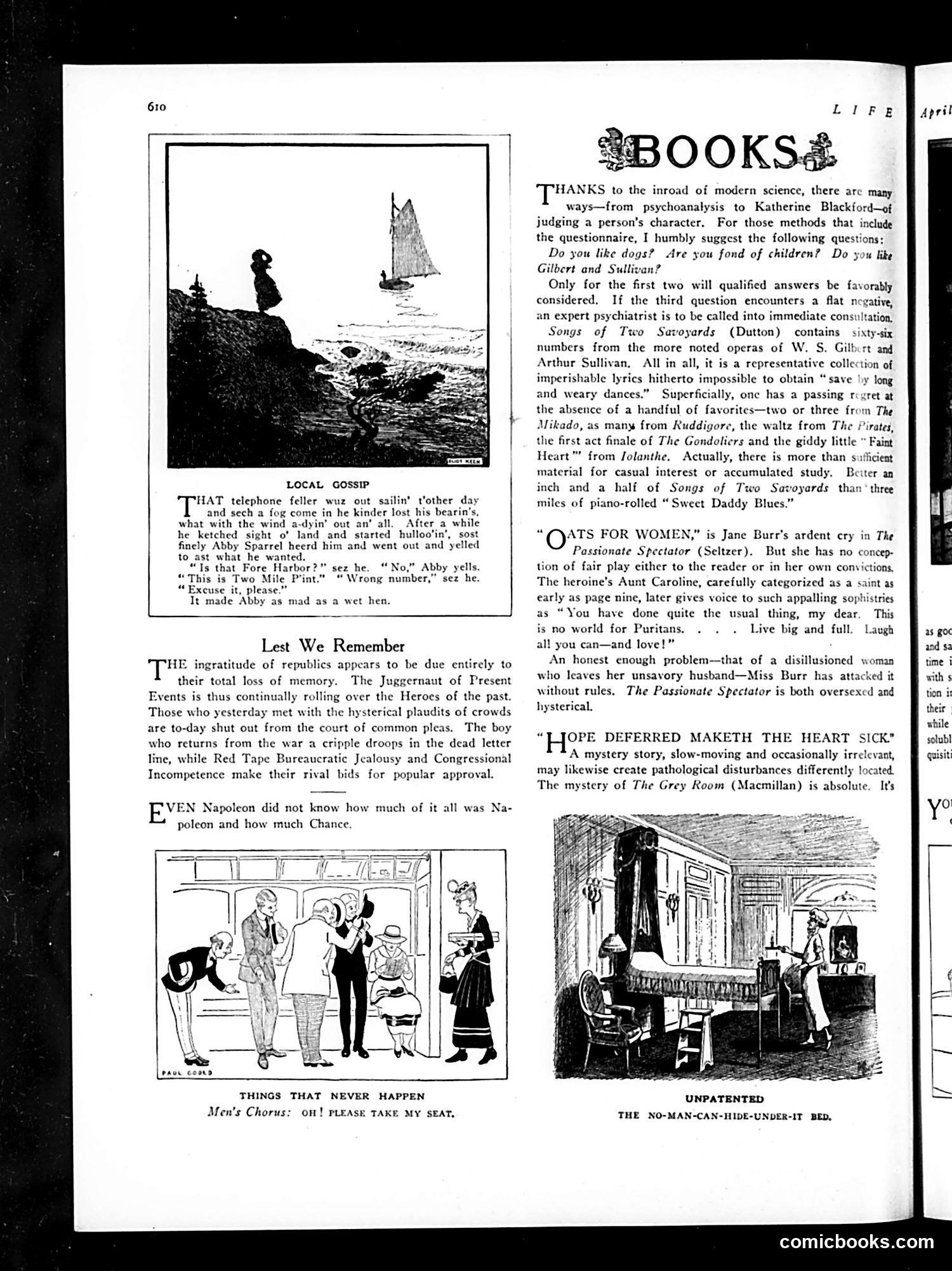
The **"Local Gossip"** cartoon depicts a humorous rural anecdote: a telephone operator lost in fog at sea hails someone on shore asking if it's "Fore Harbor," only to learn he's reached "Two Mile Point" — a wrong number. The joke plays on early telephone technology's novelty and the confusion it could cause. **"Things That Never Happen"** is a satirical cartoon showing men offering their seats to a woman, captioned as something that "never happens" — mocking the actual behavior of men who *don't* offer seats. This reflects early 20th-century debates over civility and gender etiquette. **"Lest We Remember"** is a brief social commentary criticizing how republics forget their war heroes. It suggests returning soldiers and wounded veterans are abandoned by bureaucracy and political indifference, a pointed criticism of post-WWI veteran treatment in America.
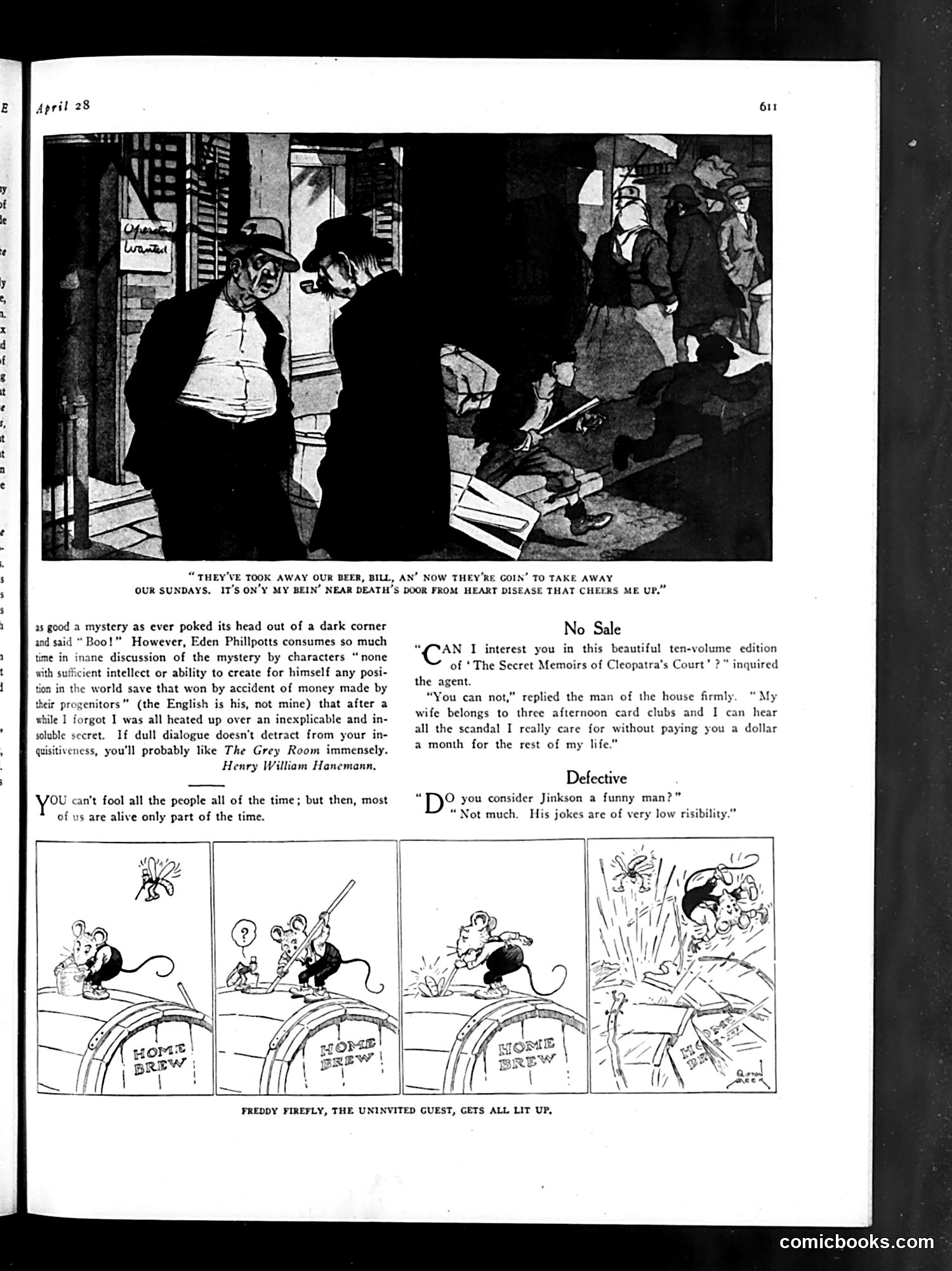
**Top Photograph:** A Prohibition-era scene showing men discussing beer and Sunday leisure. The caption quotes a working-class man lamenting that alcohol has been banned ("they've took away our beer") and now "they're goin' to take away our Sundays"—likely referencing attempts to restrict Sunday entertainments or activities. He notes only his poor health keeps him cheerful. This reflects working-class resentment of Prohibition (1920-1933) and moral reform movements that restricted leisure activities. **"No Sale" Joke:** A book agent tries selling a multi-volume set of scandalous memoirs. The husband refuses, explaining his wife already gets plenty of gossip from three afternoon card clubs—so he won't pay for more scandal. The humor targets both women's social gatherings and door-to-door sales tactics. **"Detective" Joke:** A brief quip suggesting someone named Jinkson tells unfunny jokes with "very low risibility" (laughability). **"Freddy Firefly" Comic Strip:** Four panels showing a mouse or similar creature getting increasingly intoxicated from "Home Brew," culminating in explosive chaos—satirizing homemade alcohol production during Prohibition.
This page reviews three German Expressionist films for American audiences. The main critique concerns **"The Cabinet of Dr. Caligari,"** a German import praised for its artistic boldness. The reviewer ironically notes that despite conventional warnings about "Bolshevism and Anarchy," this radically experimental film—with its distorted, nightmarish set design representing "post-impressionism"—deserves praise for daring to be different from conventional American cinema. The review criticizes the American adaptation's editing and suggests no native American producer (except possibly Maurice Tourneur) could match the original's ambition. The accompanying illustration shows stylized animals, reflecting the film's expressionist aesthetic. The page also previews upcoming film reviews and discusses "The Passion Flower" and "The Little Clown," establishing this as a regular cinema criticism column. The tone suggests 1920s debates about European artistic modernism versus American commercial filmmaking conventions.
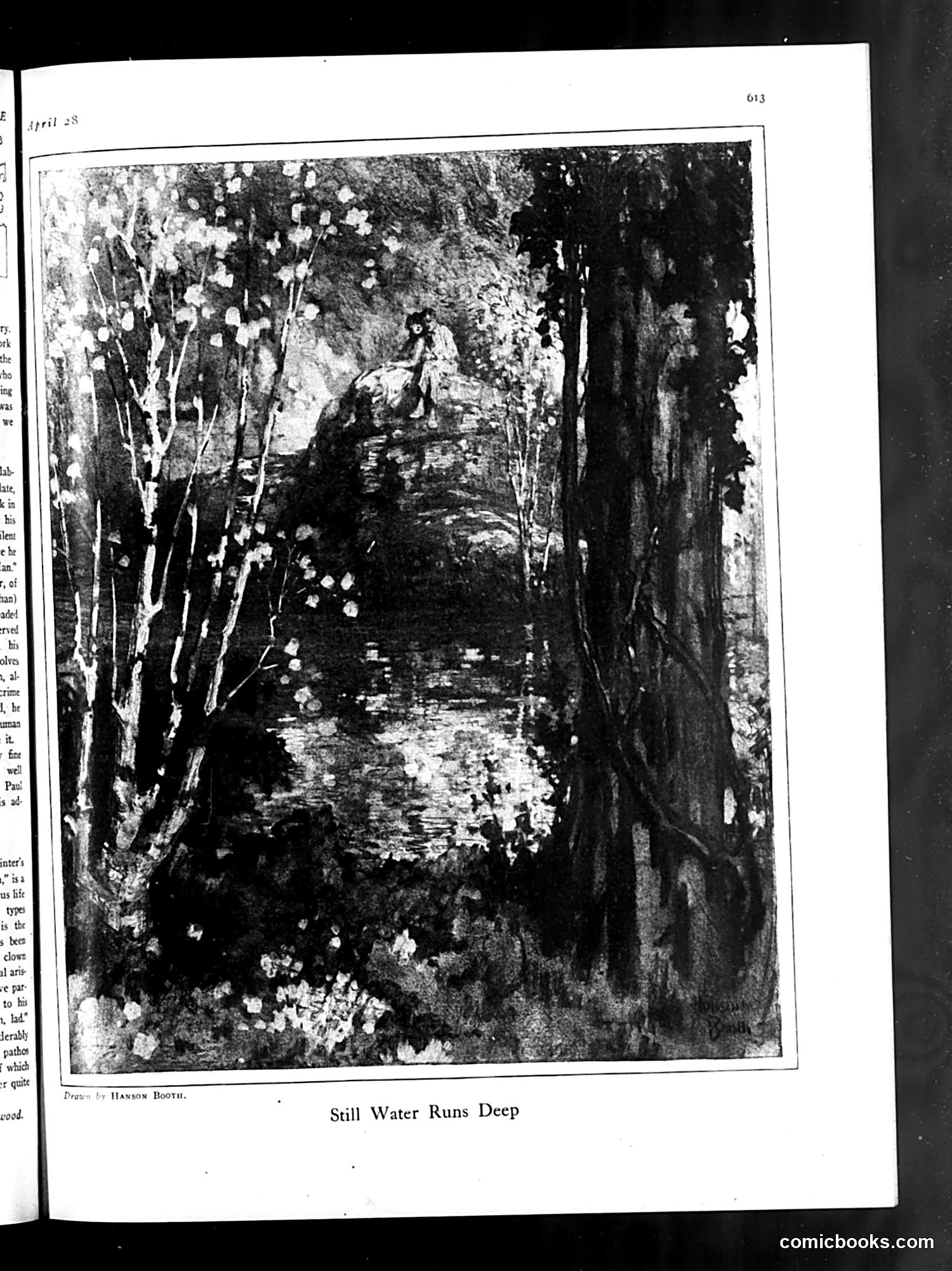
This page features a drawing by Hanson Booth titled "Still Water Runs Deep." The image depicts a serene natural scene: a stream or creek flowing through a woodland setting, flanked by tall dark trees on both sides and flowering plants (appearing white in the black-and-white reproduction) blooming along the banks. The title "Still Water Runs Deep" is a common proverb suggesting that calm, quiet exteriors can conceal significant depth, complexity, or hidden currents beneath. Without additional context from the magazine issue, the specific satirical or political meaning remains unclear—it may be purely illustrative landscape art, or the title could carry metaphorical commentary on contemporary events or social conditions. The proverb itself implies hidden depths worth considering.
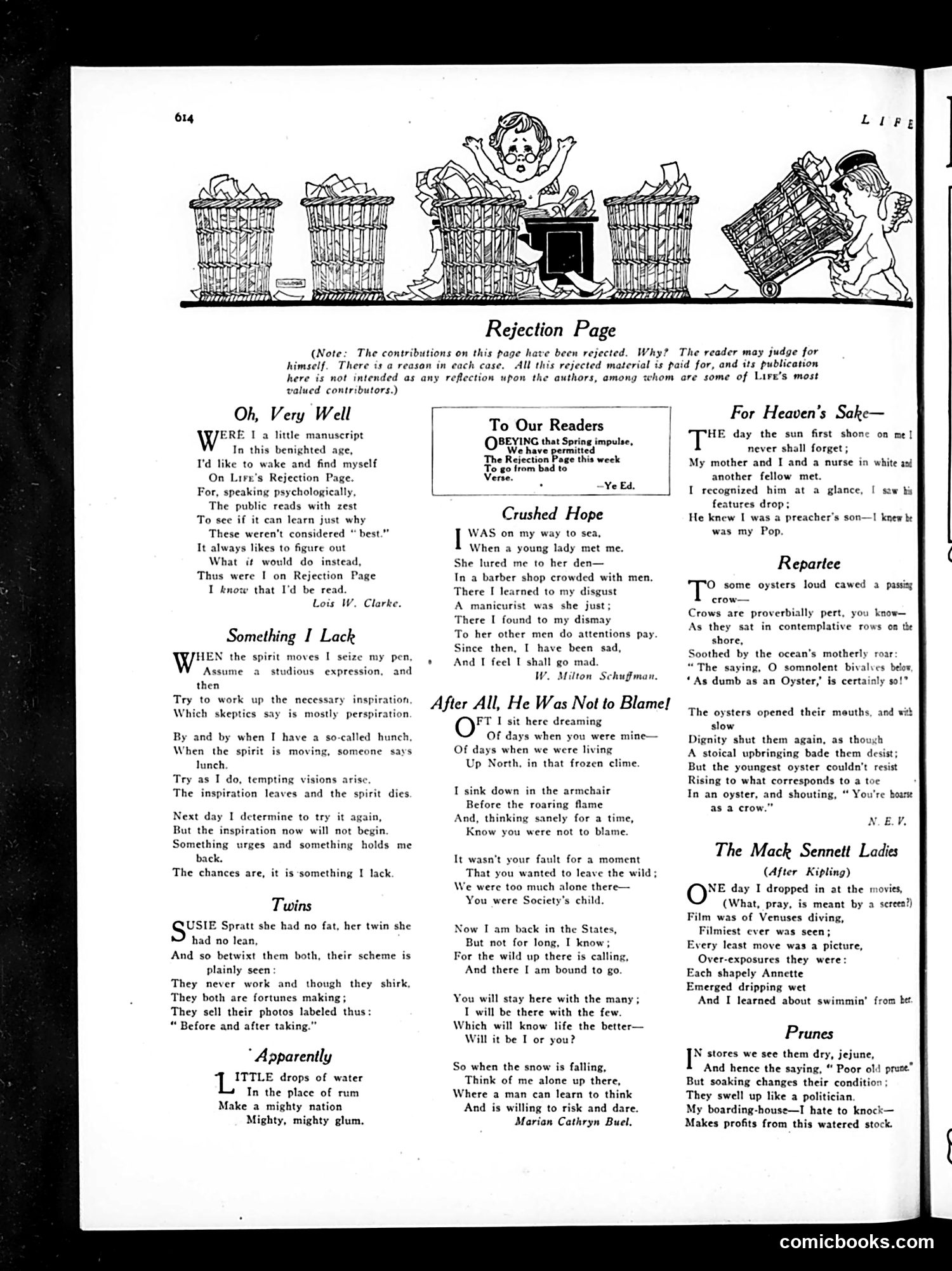
This is a **meta-editorial feature** where *Life* magazine publishes rejected reader submissions, inviting readers to judge why each piece was rejected. The editor notes these are paid contributions from valued writers—the rejections aren't insulting, but educational entertainment. The cartoon header shows overflowing trash baskets of rejected material, with a child emerging from one—visualizing the volume of submissions *Life* receives. The actual rejected poems and humorous pieces satirize contemporary themes: aspiring writers lacking inspiration ("Something I Lack"), con artists exploiting vanity ("Twins" selling fake before/and-after photos), prohibition-era temperance sentiment ("Apparently"), and romantic disappointments. The feature's appeal is psychological—readers enjoy "figuring out" editorial judgment while authors gain exposure despite rejection. It's a clever way to fill pages while poking fun at both amateur writers and reader psychology.
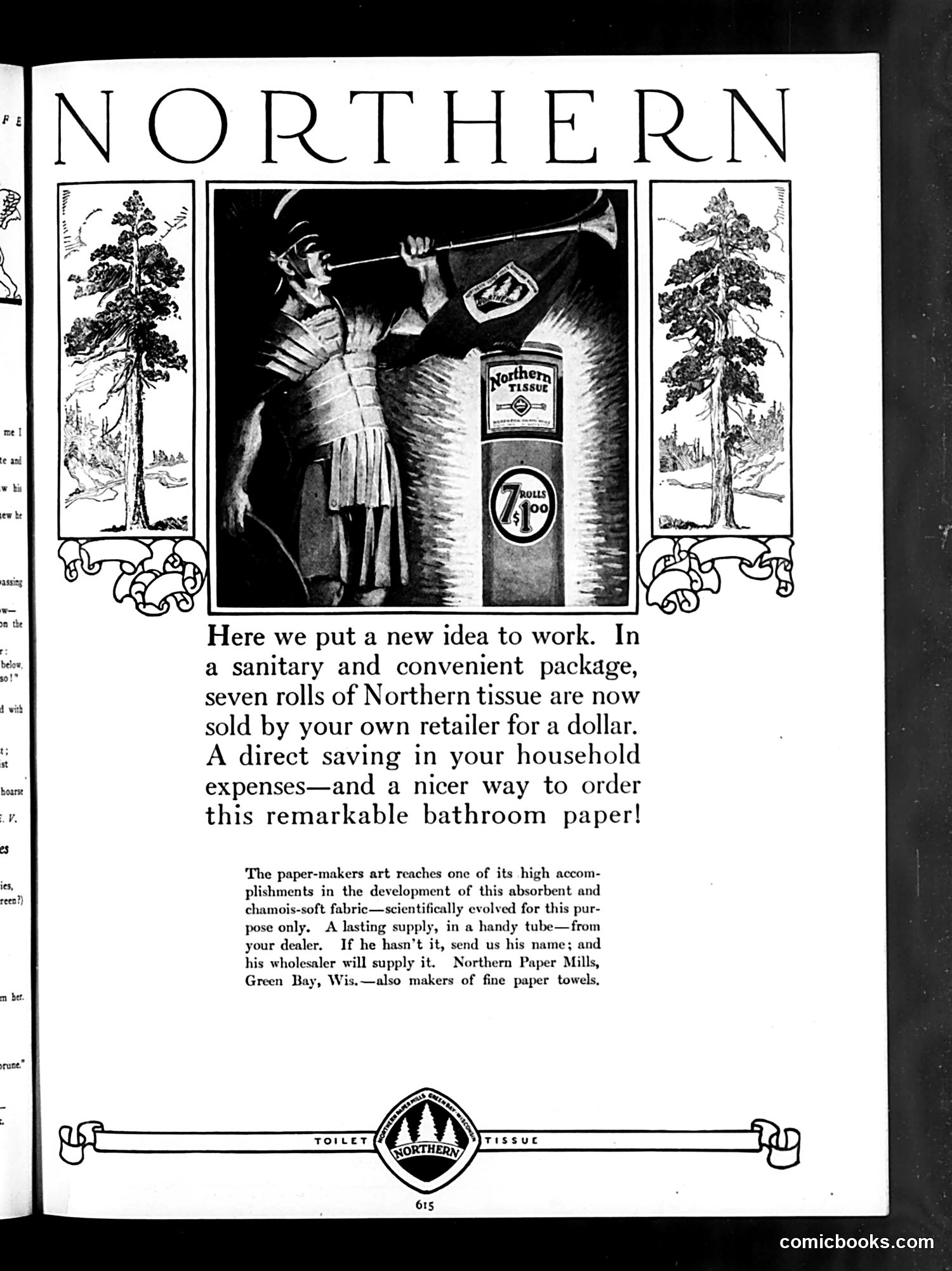
This is a **product advertisement**, not political satire. It promotes Northern brand toilet tissue, marketed as a novel packaging innovation: seven rolls sold together for one dollar through retail stores. The central image depicts a classical female figure (likely representing quality or progress) blowing a trumpet while holding a shield, flanked by tall pine trees. This imagery suggests Northern Paper Mills' connection to Wisconsin forestry and emphasizes the product's natural origins and superiority. The ad's appeal is economic ("direct saving") and practical—positioning bulk purchasing and convenient packaging as modern conveniences. The language emphasizes the product's scientific development and softness ("chamois-soft fabric"), standard marketing claims for the era. There is no political commentary or satire present. This represents straightforward early-to-mid 20th-century consumer advertising targeting household budget-consciousness.
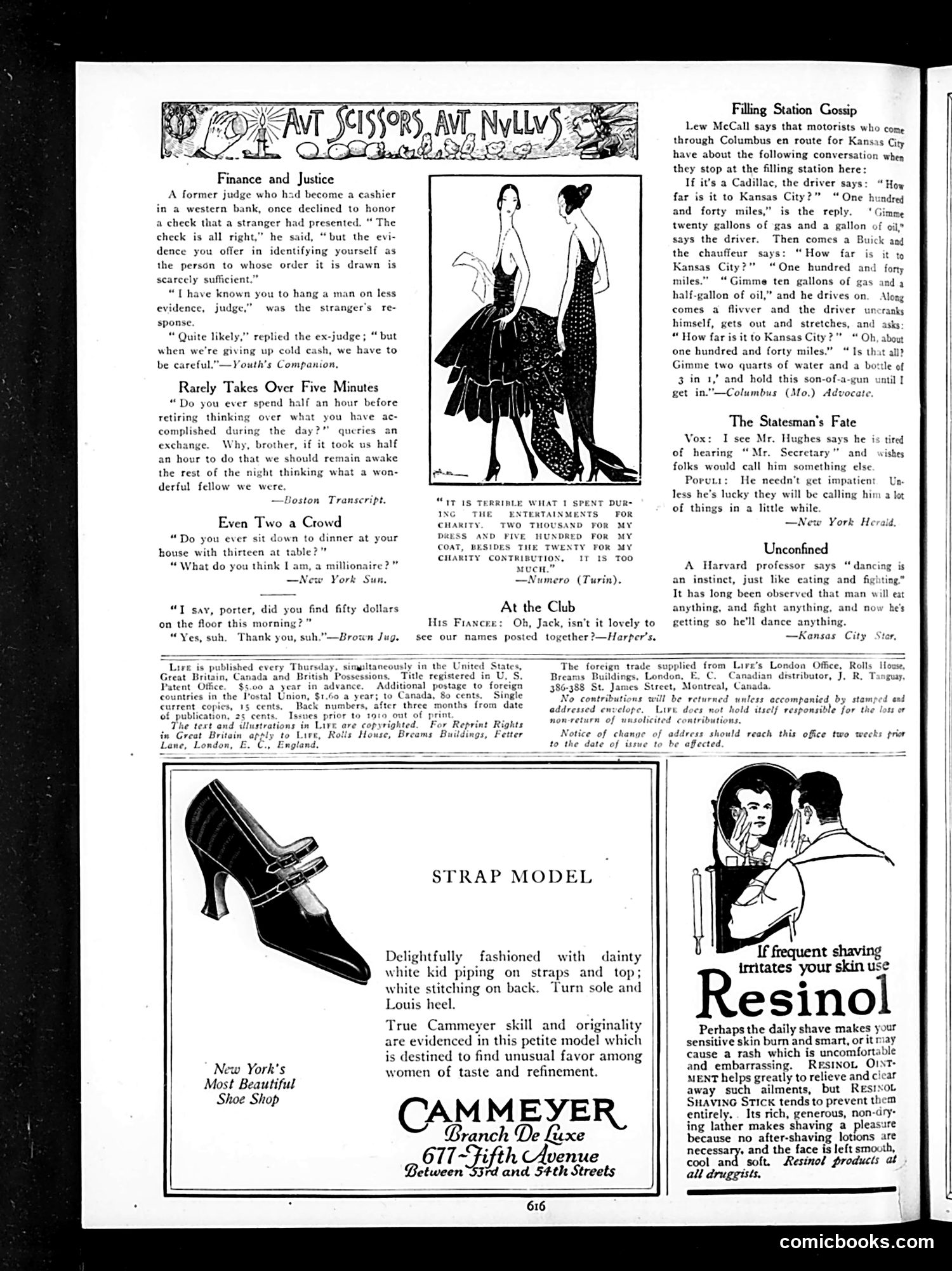
This page from *Life* magazine contains mostly brief satirical anecdotes and advertisements rather than political cartoons. The humor relies on class commentary and social observation. "Finance and Justice" contrasts a former judge's leniency with criminals versus his caution with bank money—satirizing priorities. "Filling Station Gossip" mocks the inverse relationship between car expense and fuel consumption: wealthy Cadillac owners buy more gas than economical "flivver" (cheap car) drivers who need only water. "The Statesman's Fate" appears to reference Charles Evans Hughes (Secretary of State), joking that if he tires of the title, he'll soon face harsher names—likely alluding to political criticism or electoral defeat. The remaining items are light observational humor about human nature and vanity. The page includes period advertisements for shoes and shaving cream, typical of *Life's* mixed content format.
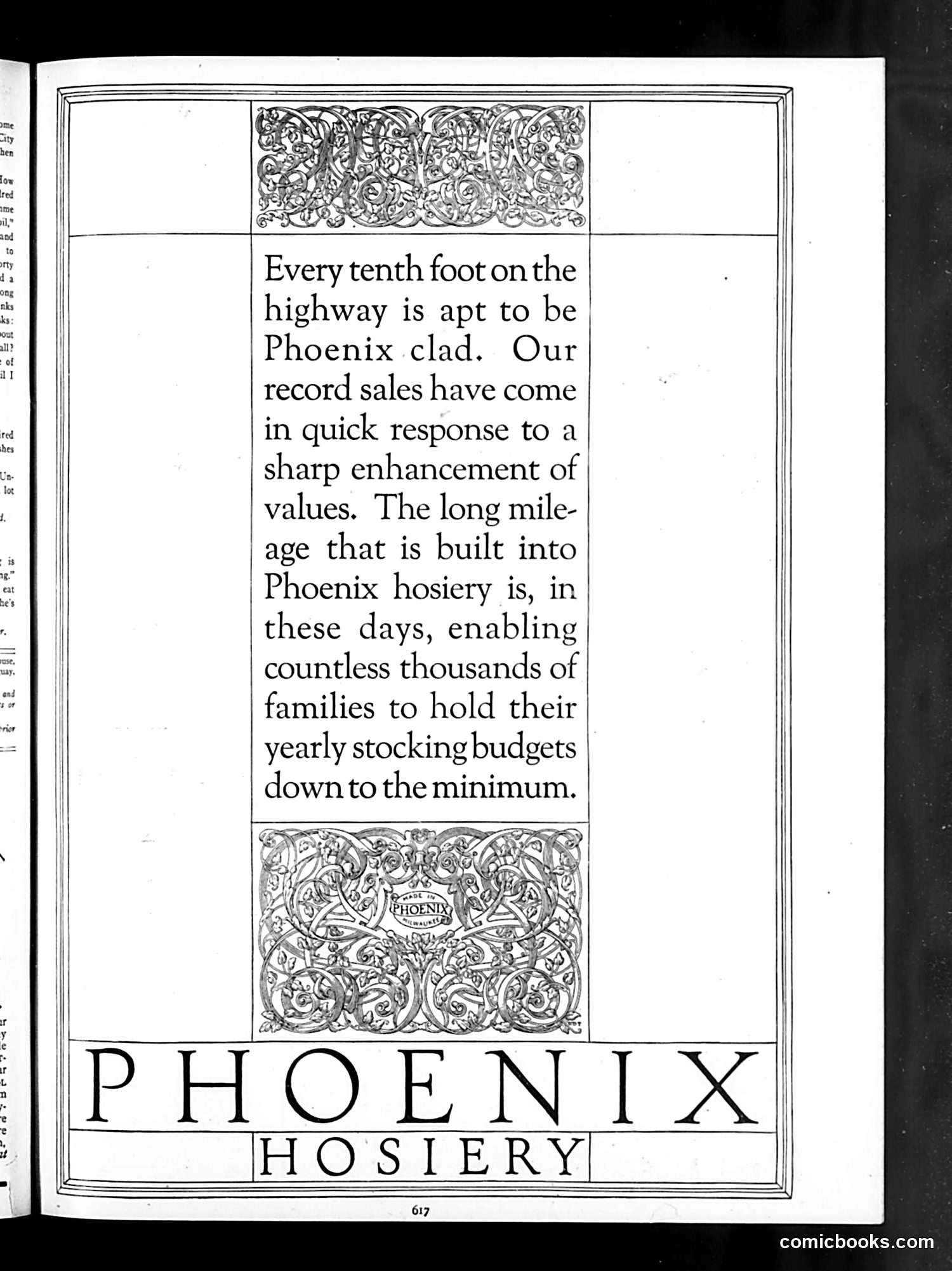
This is a **Phoenix Hosiery advertisement**, not a political cartoon. The page promotes Phoenix brand stockings/hosiery to a 1920s audience. The ad's appeal targets Depression-era or post-WWI economic concerns: it emphasizes that Phoenix hosiery's durability and longevity allow families to minimize their clothing budgets. The phrase "every tenth foot on the highway is apt to be Phoenix clad" is a boastful claim about market saturation and popularity. The ornamental borders and formal typography are typical of early 20th-century magazine advertising design. There is no satire or political commentary—this is straightforward commercial messaging using economic frugality as its selling point. The decorative flourishes lend the product an air of quality and respectability to justify its cost to cost-conscious consumers.
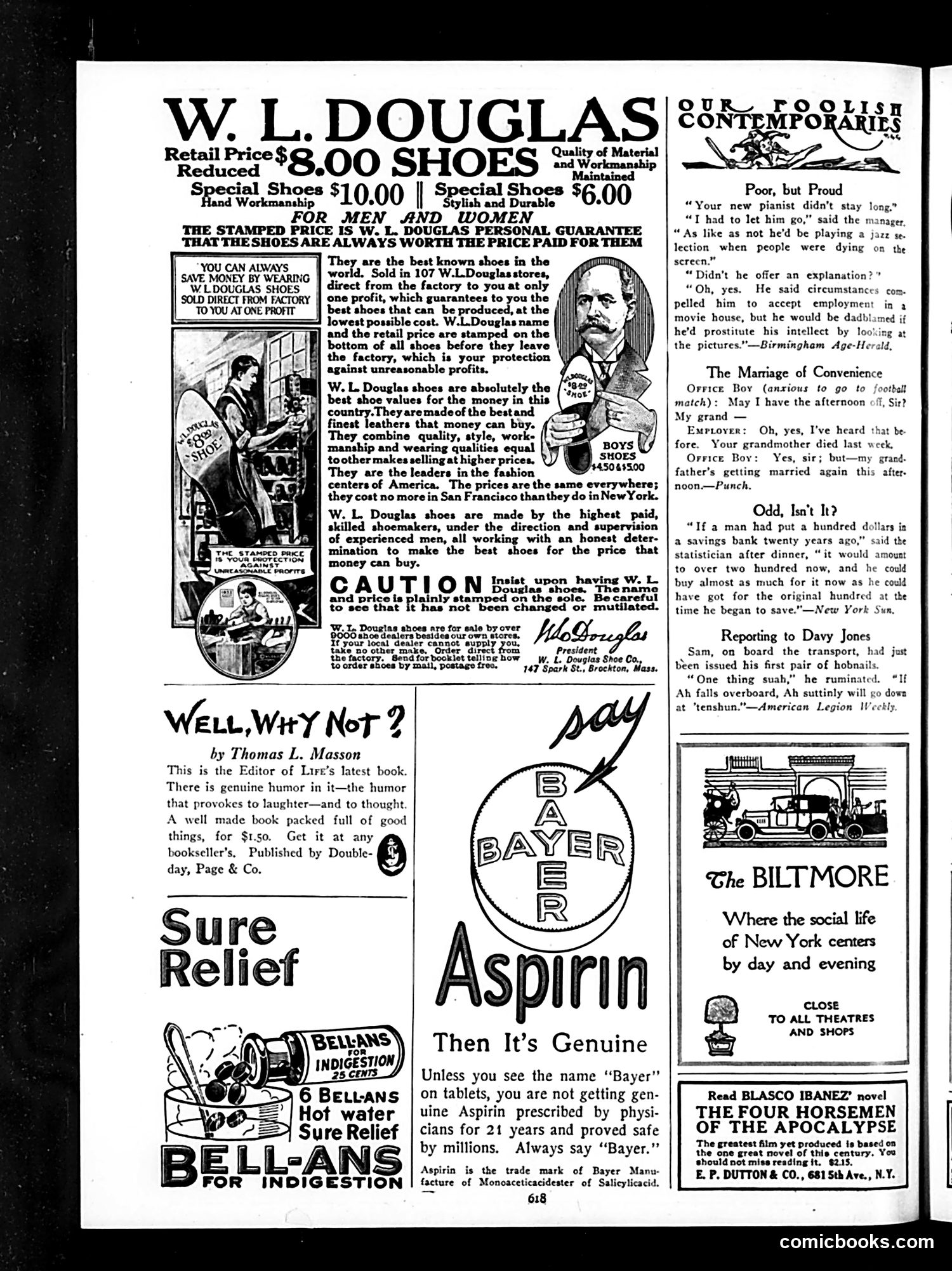
This page is primarily **advertising and humor**, not political cartooning. The dominant content features a **W.L. Douglas shoe advertisement** with testimonial text and images of factory workers, emphasizing direct factory-to-consumer sales and value. Douglas (shown in portrait) was a real shoe manufacturer. The page includes several short **humorous anecdotes**: - "Poor, but Proud" jokes about a pianist fired for playing jazz during a death scene - "The Marriage of Convenience" features workplace banter about a grandfather's wedding - "Odd, Isn't It?" presents a mathematical paradox about savings - "Reporting to Davy Jones" offers military humor about a soldier's first boots Additional ads include **Bayer Aspirin** ("Then It's Genuine"), **Bell-Ans** antacid, **The Biltmore** hotel, and a book promotion. The satirical content is gentle—social comedy rather than political critique. No specific figures are caricatured. This reflects Life's early 20th-century identity as a humor and lifestyle magazine before becoming primarily a photojournalism publication.
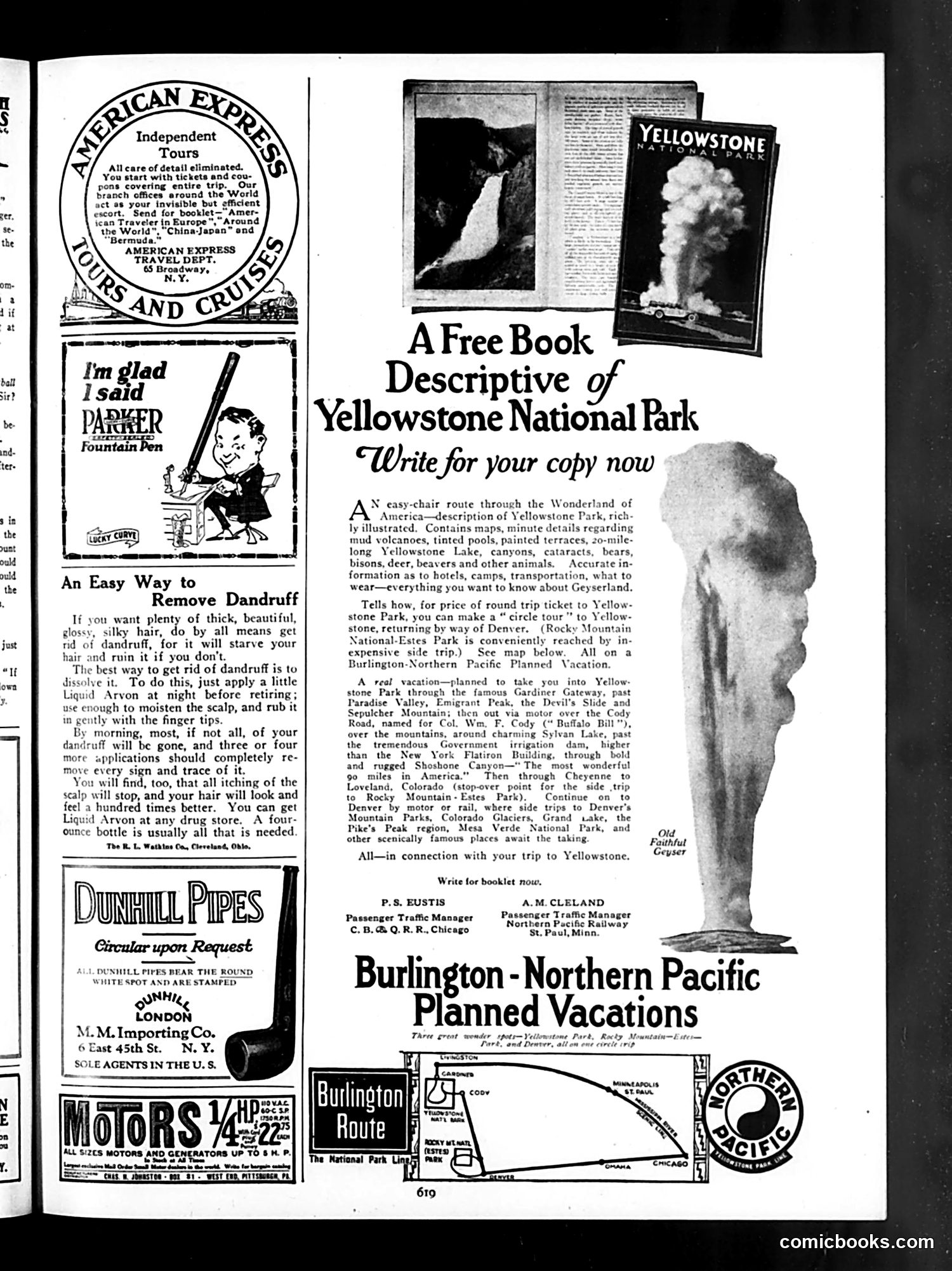
This is primarily an **advertising page** from Life magazine, not a political cartoon page. It contains multiple product and travel advertisements typical of early 20th-century periodicals. The main content is a **Burlington-Northern Pacific Railway advertisement** promoting organized vacation tours to Yellowstone National Park. The ad emphasizes convenience ("easy-chair route," pre-planned itineraries with tickets and coupons) and details scenic attractions like geysers, canyons, and wildlife. Supporting advertisements include: - **American Express travel services** offering guided international tours - **Parker fountain pens** (with a cartoon mascot saying "I'm glad I said Parker") - **Hair/dandruff treatment** (Liquid Arvon) - **Dunhill pipes** from London - **Motors** advertisement The Parker pen cartoon is the only satirical element—a mild joke about the pen's quality. The page otherwise reflects early 1900s consumer culture marketing leisure travel and luxury goods to affluent readers.
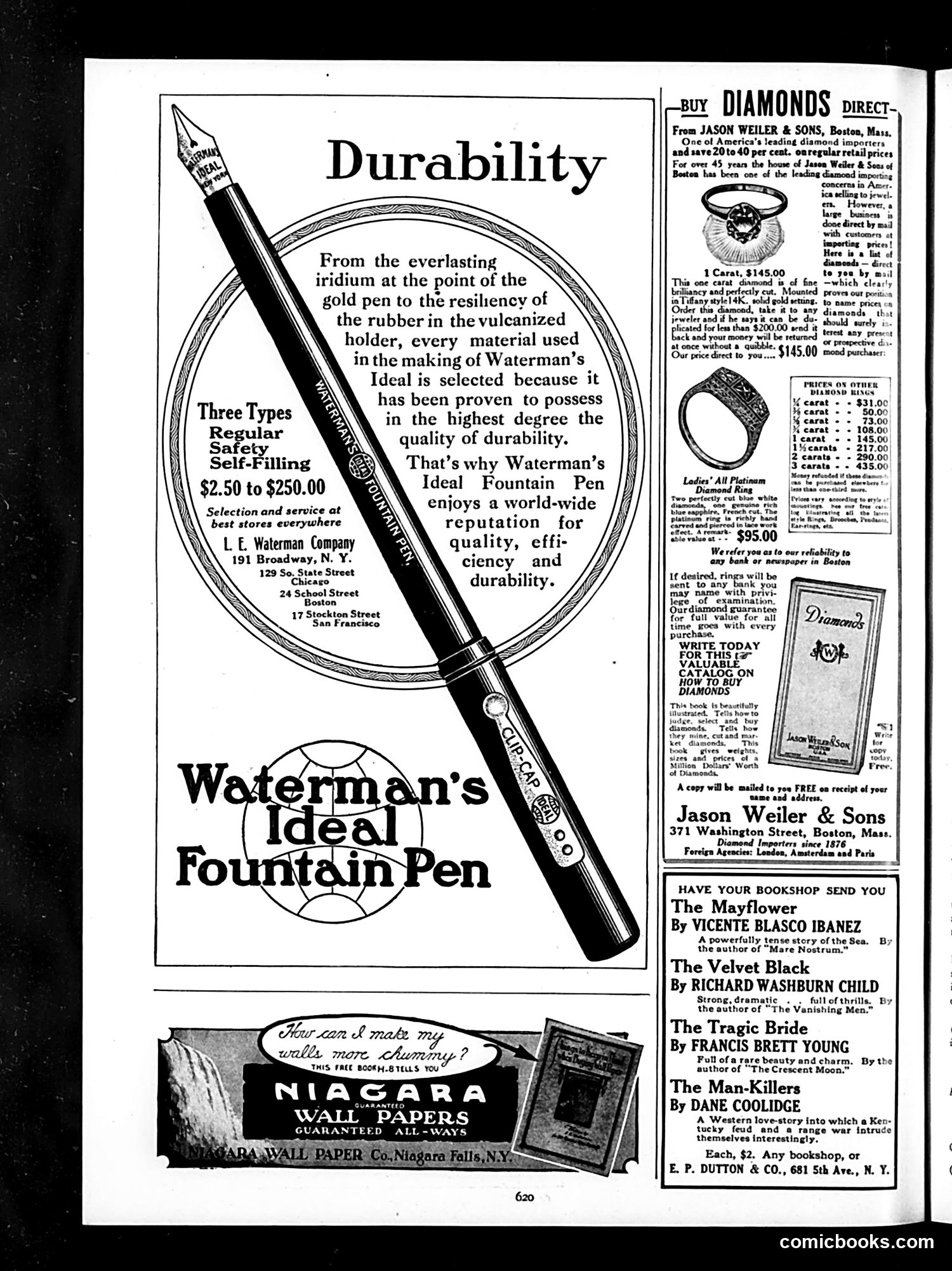
This page is primarily **advertising**, not editorial satire. The dominant content features two major ads: 1. **Waterman's Ideal Fountain Pen** (left): Emphasizes the pen's durability through materials like iridium and vulcanized rubber. The ad targets the mass market with prices from $2.50-$250, listing multiple retail locations. This reflects early 20th-century consumer marketing—the pen's reliability is its selling point in an era before ballpoint alternatives. 2. **Jason Weiler & Sons Diamonds** (right): A jewelry importer advertising direct-mail diamond sales with claimed savings of 20-40% off retail prices. The accompanying diamond ring imagery and price list ($145-$435 per carat) target affluent buyers. The page also includes **book advertisements** for novels by contemporary authors (Vicente Blasco Ibáñez, Richard Washburn Child, Francis Brett Young, Dane Coolidge). **No political satire or caricature appears here**—this is a straightforward commercial page typical of *Life* magazine's revenue model during the 1920s era.
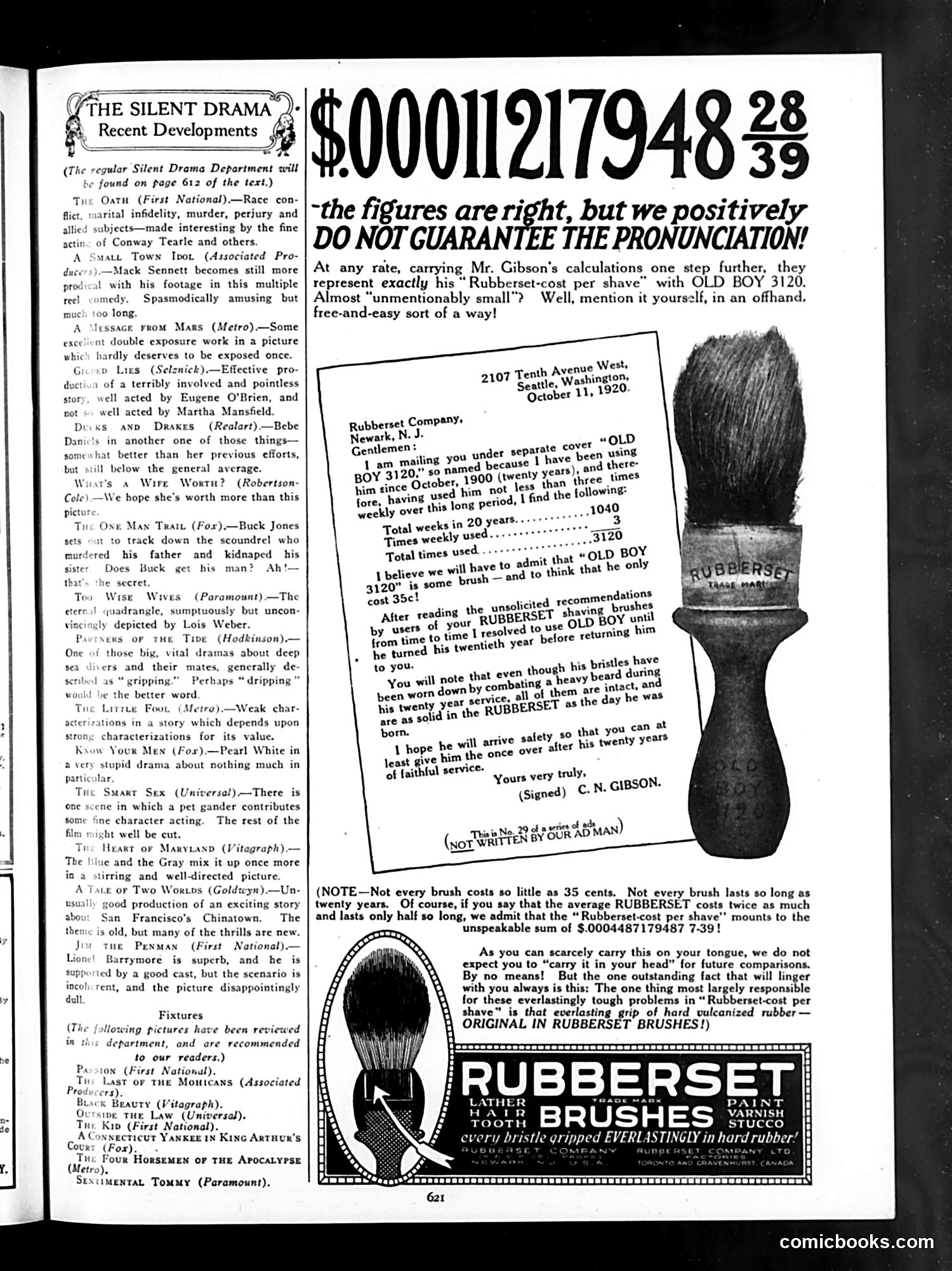
This page is primarily a **film review section** ("The Silent Drama") critiquing recent movies, not political cartoons. The reviews are brief, snarky assessments of silent films from studios like First National, Metro, and Paramount. However, the page is dominated by a **Rubberset Brushes advertisement** disguised as editorial content. A letter from "C.N. Gibson" in Seattle claims to have used the same "OLD BOY 3120" brush for twenty years, calculating its cost-per-shave at an absurdly small fraction of a penny. The ad satirically presents this as "unmentionably small" while mentioning it repeatedly. The joke: the advertisement ironically claims the figures are correct but "we positively DO NOT GUARANTEE THE PRONUNCIATION"—mocking both inflated advertising claims and the absurdity of the calculation itself. Large brush illustrations emphasize the product's durability. This represents early 20th-century **advertorial tactics**: blending advertising with editorial to seem more credible and entertaining than straightforward promotion.
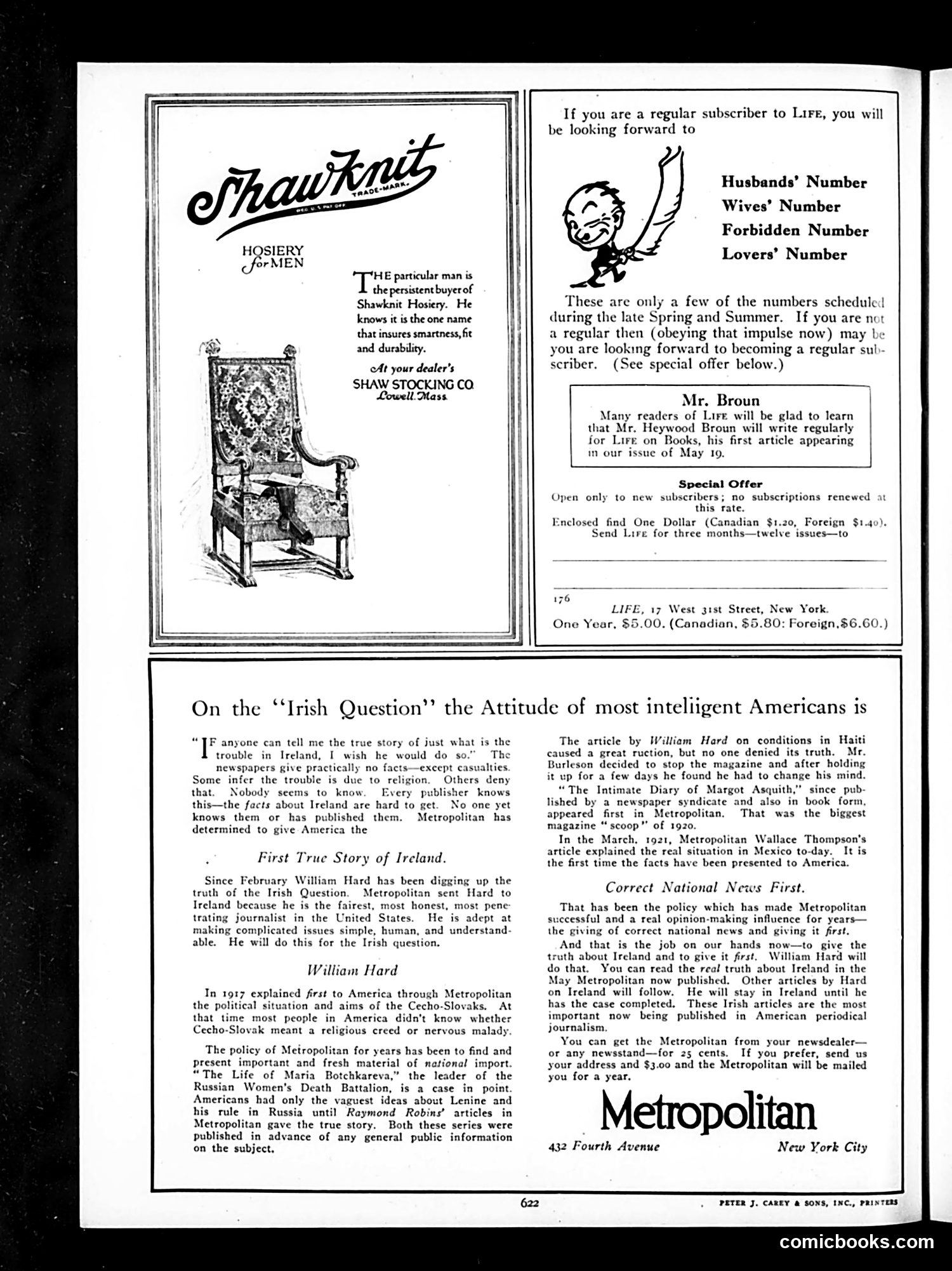
This page combines advertisements with editorial promotion of *Metropolitan* magazine's upcoming Ireland coverage. **The Shawknit Hosiery Ad** (left) uses a genteel illustration of a well-dressed man in an armchair—representing the "particular man" who knowingly purchases quality hosiery. It's straightforward product advertising emphasizing smartness and durability. **Life's Subscription Promotion** (top right) humorously teases upcoming themed issues: "Husbands' Number," "Wives' Number," "Forbidden Number," and "Lovers' Number"—playing on presumed reader interests to boost subscriptions. **The Main Content** (bottom) has *Metropolitan* magazine touting its competitive advantage: investigative journalist William Hard will provide "the first true story of Ireland" to American readers confused by sparse newspaper coverage. *Metropolitan* boasts previous scoops (Czechoslovakia, Haiti, Margot Asquith's diary, Mexico) to establish credibility as a serious news source committed to "correct national news first." This reflects early-1920s magazine competition and American public hunger for reliable information on international crises.
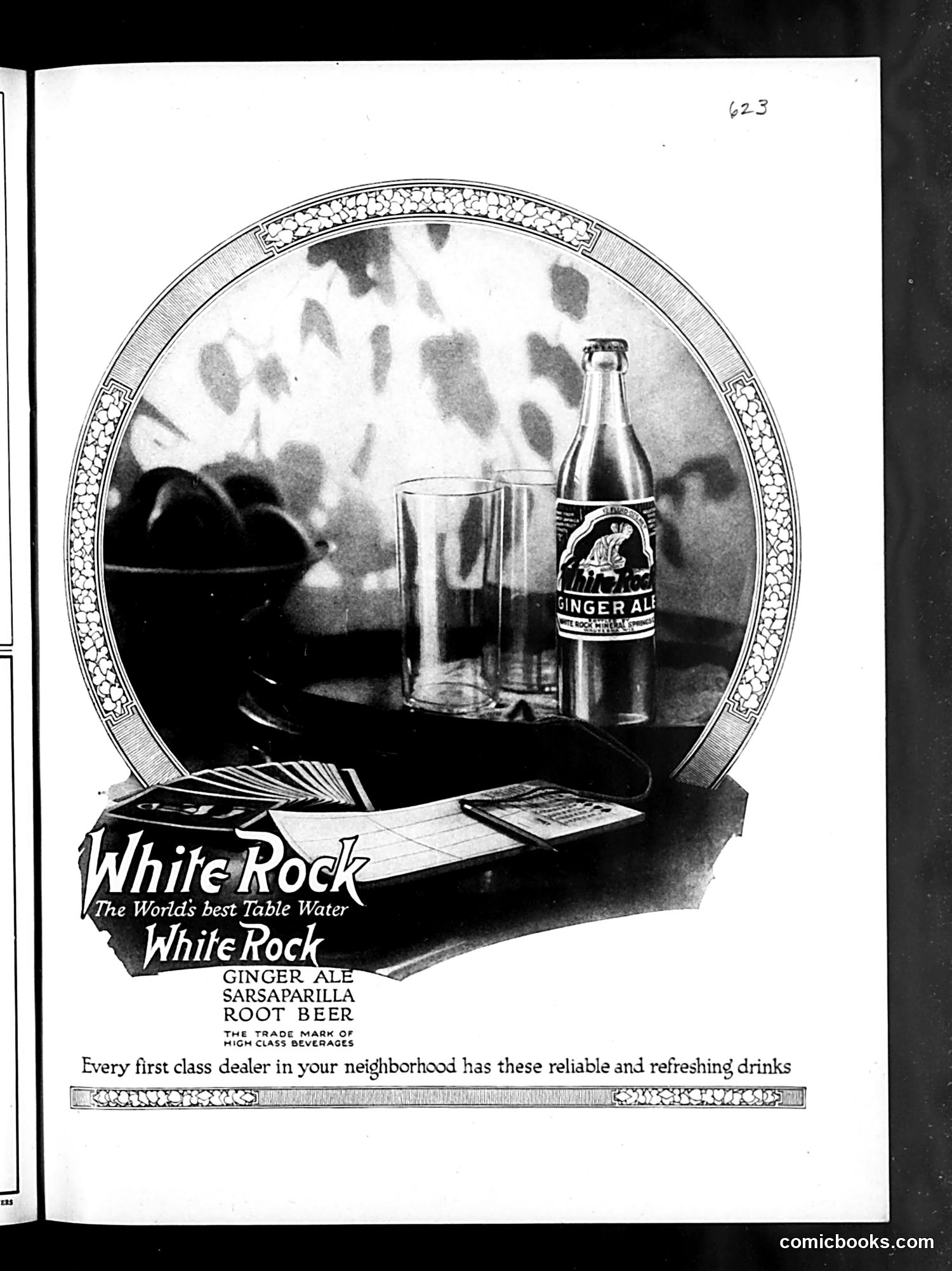
This is a **vintage advertisement**, not satire or political commentary. It promotes White Rock brand beverages—specifically ginger ale, sarsaparilla, root beer, and other "high class beverages." The ad features a decorative oval frame showing a bottle and glass, with appetizing shadows suggesting food or produce in the background. The text emphasizes that "every first class dealer in your neighborhood" stocks these drinks, suggesting they were premium products distributed through quality retailers. The styling and typography indicate this is from the early-to-mid 20th century. There's no cartoon or satirical content—it's straightforward product marketing using period advertising conventions: ornate framing, claims of quality/reliability, and appeals to consumers' desires for respectable, "high class" refreshments.
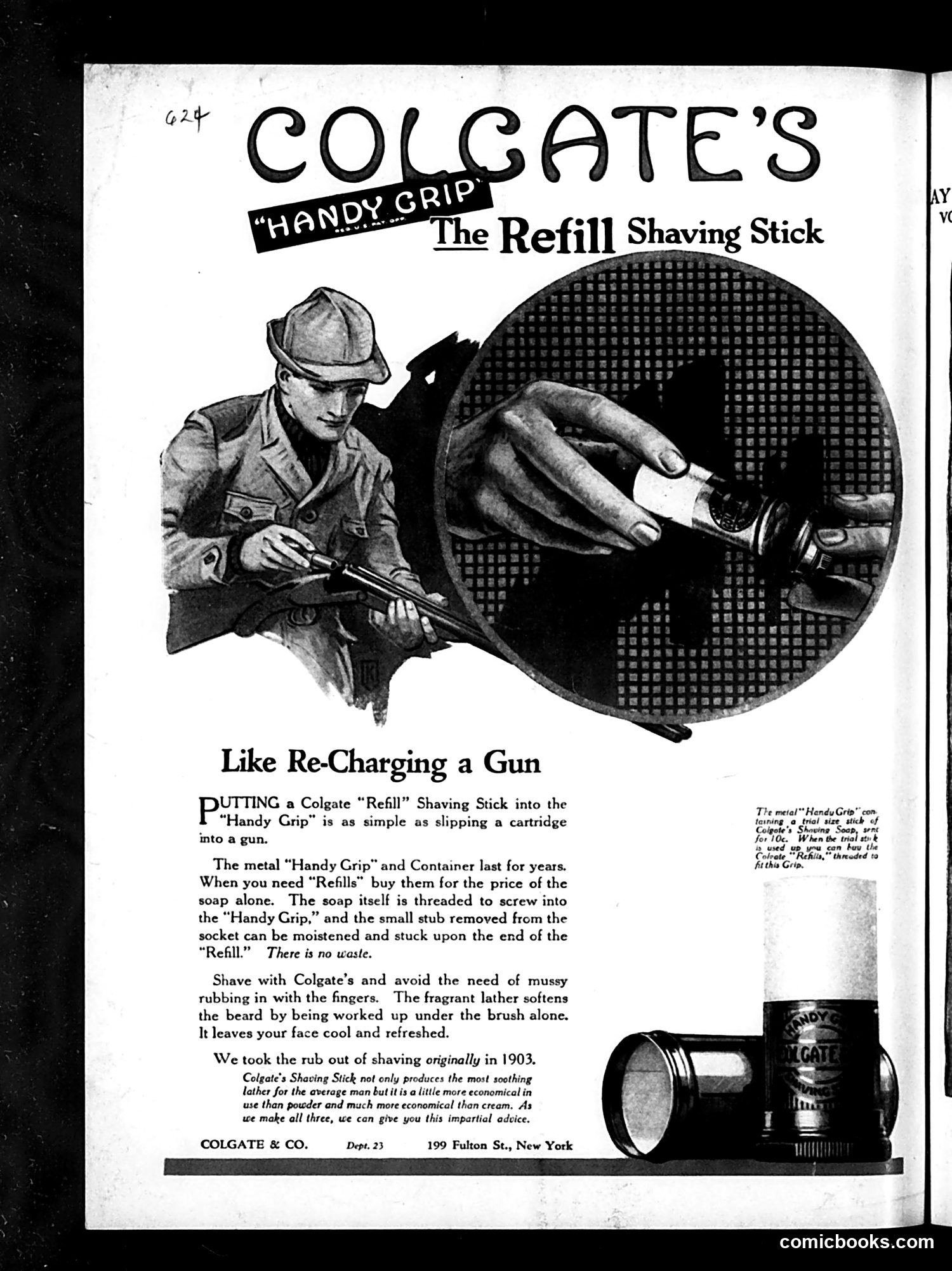
This is a **product advertisement**, not political satire. Colgate & Co. marketed their refillable shaving stick by comparing the replacement mechanism to reloading a firearm—a vivid analogy for early 1900s readers familiar with guns. The ad highlights the product's economy: customers buy the metal grip once, then purchase only cheap refill soap cartridges rather than full containers. The military comparison suggests efficiency and practicality to appeal to masculine consumers. The soldier illustration reinforces this masculine angle. The text emphasizes convenience (no messy finger-rubbing) and fragrance. Notably, the company claims to have "took the rub out of shaving originally in 1903," establishing market leadership. This reflects pre-WWI advertising conventions: associating consumer products with military preparedness and masculine virtue was common persuasive strategy.