
Life, 1921-04-28 · page 7 of 36
Life — April 28, 1921 — page 7: what you’re looking at
What you’re looking at
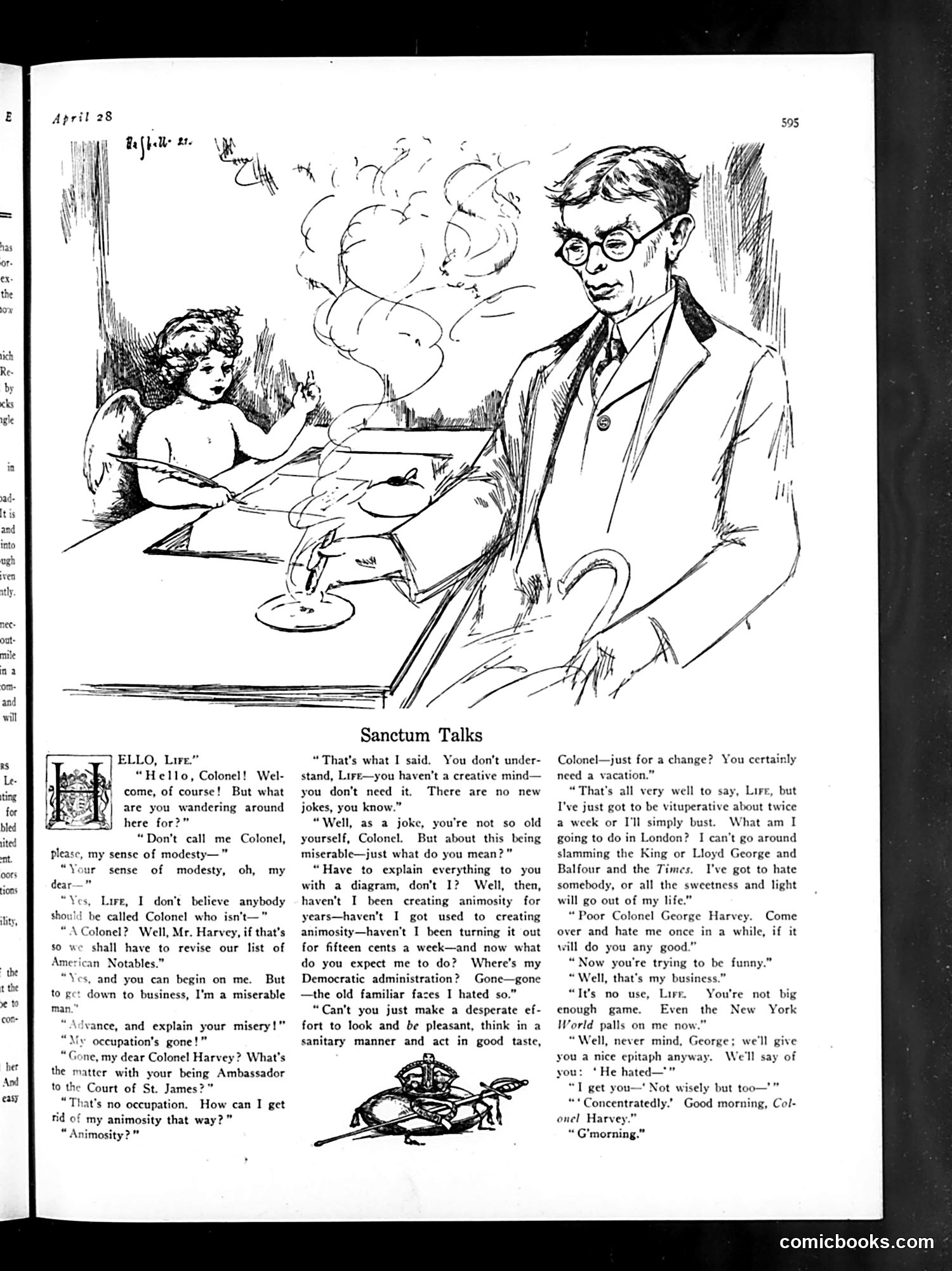
This page presents a dialogue between "Colonel" Harvey (the bespectacled man) and "Life" (represented as a cherub/cupid figure), a common satirical device in Life magazine where abstract concepts personified as characters offered commentary. The satire mocks someone—likely a public figure or diplomat—for becoming an Ambassador to the Court of St. James (Britain) and complaining about losing his anonymity. The joke centers on the tension between seeking prestigious appointments and then resenting the public scrutiny that accompanies them. References to "Democratic administration," "George Harvey," and complaints about press attention ("Balfour and the Times") suggest this lampoons a political appointee's hypocrisy about wanting both status and privacy.
📄 Transcribed text from this page (OCR, searchable)
Machine-transcribed from the original scan — historical spelling and the odd misread are preserved.
April 28 ELLO, Lire.” “Hello, Colonel! Wel- come, of course! But what are you wandering around here for?” “Don't call me Colonel, Please, my sense of modesty—” “Your sense of modesty, dear—" oh, my Lire, I don’t believe anybody should be called Colonel who isn't—” “A Colonel? Well, Mr. Harvey, if that’s so we shall have to revise our list of American Notables.” “Yes, and you can begin on me. But to gct down to business, I'm a miserable man.” “Advance, and explain your misery!" “My oceupation’s gone!” “Gone, my dear Colonel Harvey? What's the matter with your being Ambassador to the Court of St. James?” “That's no occupation. How can I get fid of my animosity that way?” “ Animosity?" Sanctum Talks “That's what I said. You don’t under- stand, Lire—you haven't a creative mind— you don’t need it. jokes, you know.” “Well, as a joke, you're not so old yourself, Colonel. But about this being miserable—just what do you mean?” “Have to explain everything to you with a diagram, don’t 1? Well, then, haven't I been creating animosity for years—haven’t I got used to creating animosity—haven't I been turning it out for fifteen cents a week—and now what do you expect me to do? Where's my Democratic administration? Gone—gone —the old familiar faces I hated so.” “Can't you just make a desperate ef- fort to look and be pleasant, think in a sanitary manner and act in good taste, There are no new Colonel—just for a change? You certainly need a vacation.” “That's all very well to say, Lire, but I've just got to be vituperative about twice a week or I'll simply bust. What am I going to do in London? I can’t go around slamming the King or Lloyd George and Balfour and the Times. I've got to hate somebody, or all the sweetness and light will go out of my life.” “Poor Colonel George Harvey. Come over and hate me once in a while, if it will do you any good.” “Now you're trying to be funny.” “Well, that’s my business.” “It's no use, Lire. You're not big enough game. Even the New York World palls on me now.” “Well, never mind, George; we'll give you a nice epitaph anyway. We'll say of you: ‘He hated—” “T get you— Not wisely but too—’ “*Concentratedly.” Good morning, Col- onel Harvey.” “ G'morning.” comicbooks.com