
Life, 1921-04-28 · page 24 of 36
Life — April 28, 1921 — page 24: what you’re looking at
What you’re looking at
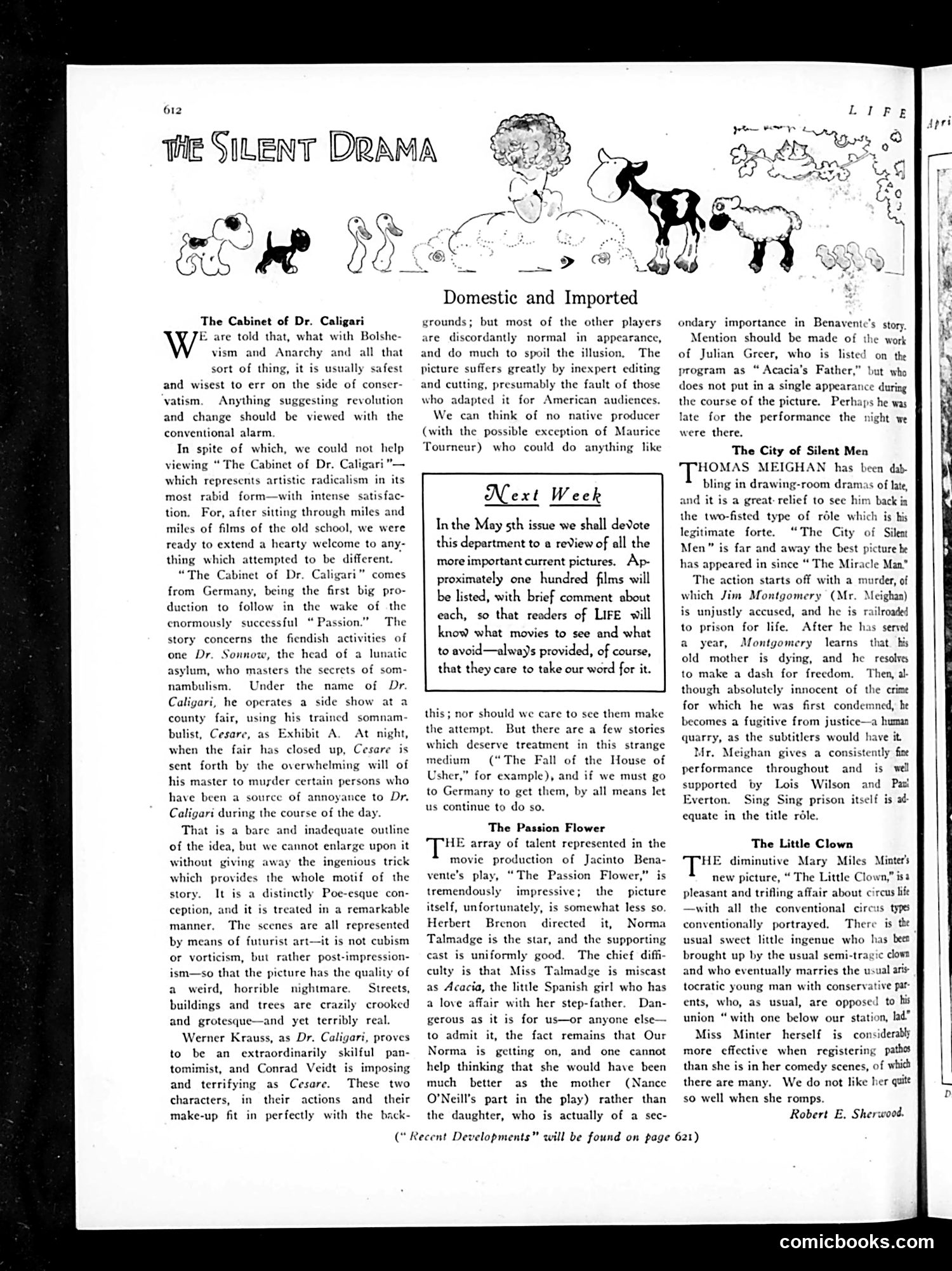
This page reviews three German Expressionist films for American audiences. The main critique concerns **"The Cabinet of Dr. Caligari,"** a German import praised for its artistic boldness. The reviewer ironically notes that despite conventional warnings about "Bolshevism and Anarchy," this radically experimental film—with its distorted, nightmarish set design representing "post-impressionism"—deserves praise for daring to be different from conventional American cinema. The review criticizes the American adaptation's editing and suggests no native American producer (except possibly Maurice Tourneur) could match the original's ambition. The accompanying illustration shows stylized animals, reflecting the film's expressionist aesthetic. The page also previews upcoming film reviews and discusses "The Passion Flower" and "The Little Clown," establishing this as a regular cinema criticism column. The tone suggests 1920s debates about European artistic modernism versus American commercial filmmaking conventions.
📄 Transcribed text from this page (OCR, searchable)
Machine-transcribed from the original scan — historical spelling and the odd misread are preserved.
612 tie SILENT DRAMA The Cabinet of Dr. Caligari E are told that, what with Bolshe- vism and Anarchy and all that sort of thing, it is usually safest and wisest to err on the side of conser- vatism. Anything suggesting revolution and change should be viewed with the conventional alarm. In spite of which, we could not help viewing “The Cabinet of Dr. Caligari”"— which represents artistic radicalism in its most rabid form—with intense satisfac- tion. For, after sitting through miles and miles of films of the old school, we were ready to extend a hearty welcome to any- thing which attempted to be different. “The Cabinet of Dr. Caligari” comes from Germany, being the first big pro- to follow in the the enormously successful “ Passion.” The story concerns the fiendish activities of one Dr. Sonnow, the head of a lunatic duction wake of asylum, who masters the secrets of som- nambulism. Dr. Caligari, he operates a side show at a Under the name of county fair, using his trained somnam- bulist, Cesare, as Exhibit A. At night, when the fair has closed up, Cesare is sent forth by the overwhelming will of his master to muyder certain persons who have been a source of annoyance to Dr, Caligari during the course of the day. That is a bare and inadequate outline of the idea, but we cannot enlarge upon it without giving away the ingenious trick which provides the whole motif of the story. It is a distinctly Poe-esque con- ception, and it is treated in a remarkable manner, The scenes are all represented by means of futurist art—it is not cubism or vorticism, but rather post-impression- ism—so that the picture has the quality of horrible Streets, buildings and trees are crazily crooked a_ weird, nightmare. and grotesque—and yet terribly real. Werner Krauss, as Dr. Caligari, proves to be an extraordinarily skilful pan- tomimist, and Conrad Veidt is imposing and terrifying as Cesare. These two characters, in their actions and_ their make-up fit in perfectly with the back- Domestic and Imported grounds; but most of the other players are discordantly normal in appearance, and do much to spoil the illusion, The picture suffers greatly by inexpert editing and cutting, presumably the fault of those who adapted it for American audiences. We can think of no native producer (with the possible exception of Maurice Tourneur) who could do anything like Next Week Inthe May sth issue we shall devote this department to a review of all the more important current pictures. Ap- proximately one hundred films will be listed, with brief comment about each, so that readers of LIFE will know what movies to see and what to avoid—always provided, of course, that they care to take our word for it. this; nor should we care to see them make the attempt. But there are a few stories which deserve treatment in this strange medium (“The Fall of the House of Usher,” for example), and if we must go to Germany to get them, by all means let us continue to do so. The Passion Flower HE array of talent represented in the movie production of Jacinto Bena- vente’s play, “The Passion Flower,” i tremendously impressive; the picture itself, unfortunately, is somewhat less so. Herbert directed it, Norma Talmadge is the star, and the supporting cast is uniformly good. The chief diffi- culty is that Miss Talmadge is miscast as Acacia, the little Spanish girl who has a love affair with her step-father. Dan- gerous as it is for us—or anyone else— to admit it, the fact remains that Our Norma is getting on, and one cannot help thinking that she would have been much better as the mother (Nance O'Neill's part in the play) rather than the daughter, who is actually of a sec- Brenon VOov_ ‘ ondary importance in Benavente’s story. Mention should be made of the work of Julian Greer, who is listed on the program as “ Acacia’s Father,” but who does not put in a single appearance during the course of the picture. Perhaps he was late for the performance the night we were there. The City of Silent Men HOMAS MEIGHAN has been dab- bling in drawing-room dramas of late, back ia the two-fisted type of réle which is his “The City of Silent Men” is far and away the best picture be has appeared in since “ The Miracle Man” The action starts off with a murder, of which Jim Montgomery (Mr. Meighan) is unjustly accused, and he is railroaded to prison for life. After he has served a year, that. his old mother is dying, and he resolves to make a dash for freedom. Then, al- though absolutely innocent of the crime for which he was first condemned, he becomes a fugitive from justice—a human quarry, as the subtitlers would have it Mr. Meighan gives a consistently fine performance and is well supported by Lois Wilson Pari Everton. Sing Sing prison itself is ad- and it is a great: relief to see him legitimate forte. Montgomery learns throughout and equate in the title rdle. The Little Clown HE diminutive Mary Miles Minter’s new picture, “ The Little Clown,” is pleasant and trifling affair about circus life —with all the conventional circus types conventionally portrayed. There is the usual swect little ingenue who has bee brought up by the usual semi-tragic cows and who eventually marries the usual aris tocratic young man with conservative pat ents, who, as usual, are opposed to his union “with one below our station, had” Miss Minter herself is considerably more effective when registering pathos than she is in her comedy scenes, of which there are many. We do not like her quite so well when she romps. Robert E, Sherwood. (* Recent Developments” will be found on page 621) comicbooks.com