
A complete issue · 36 pages · 1919
Life — November 27, 1919
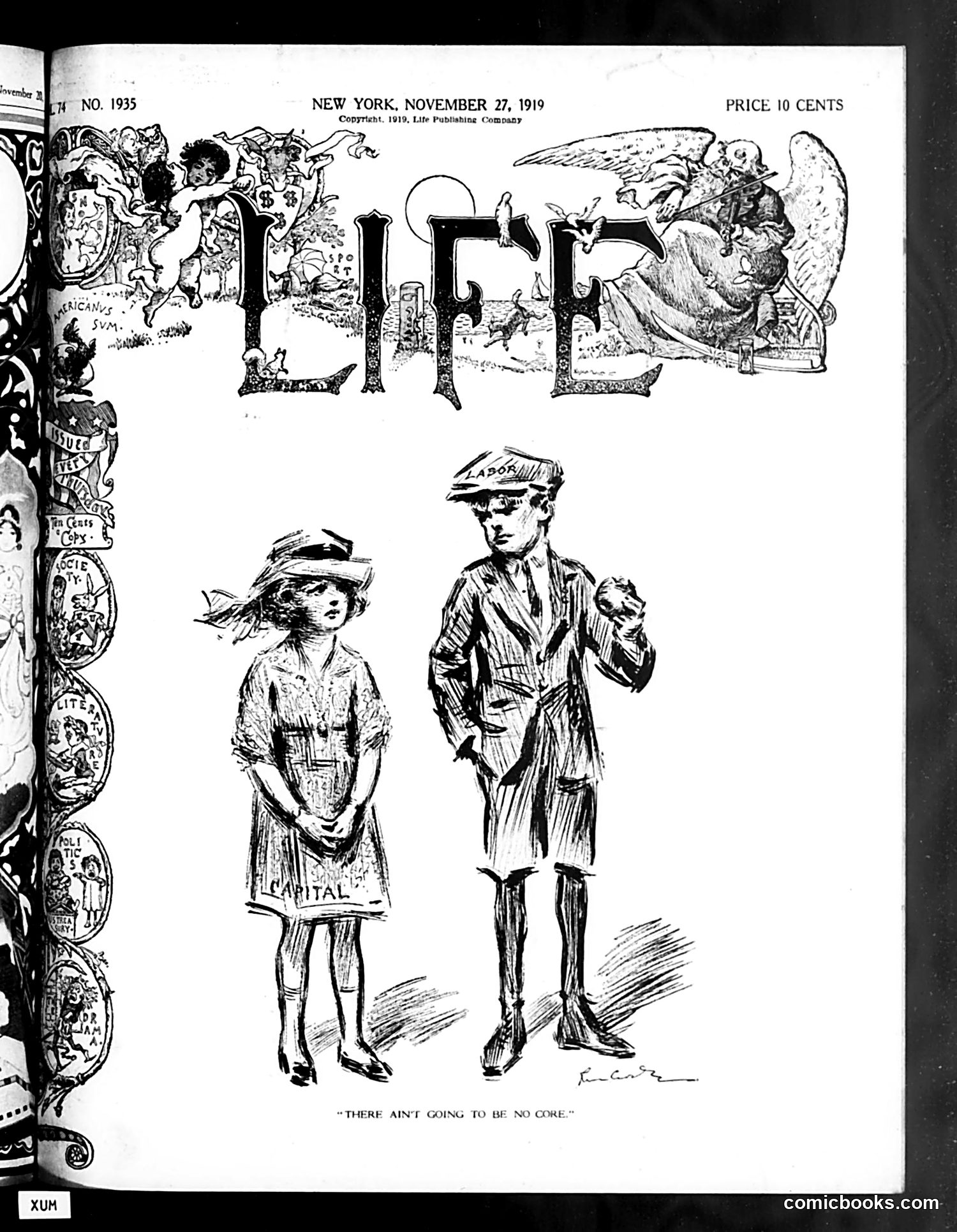
This cartoon references the **Prohibition movement** and the imminent enactment of the 18th Amendment (ratified in 1919, effective January 1920). The caption—"There ain't going to be no coke"—appears to be wordplay on "Coca-Cola," suggesting the beverage industry faced uncertainty under Prohibition's restrictions on alcohol production. The two figures represent a young woman and man, likely symbolizing ordinary Americans confronting the reality of Prohibition. The woman appears labeled "CAPITAL," suggesting the economic concerns of business interests worried about lost profits from alcohol sales. The ornate decorative border left suggests this is a cover or feature spread. The satire mocks both Prohibition's inevitability and the public's anxiety about the dramatic lifestyle changes it would impose.
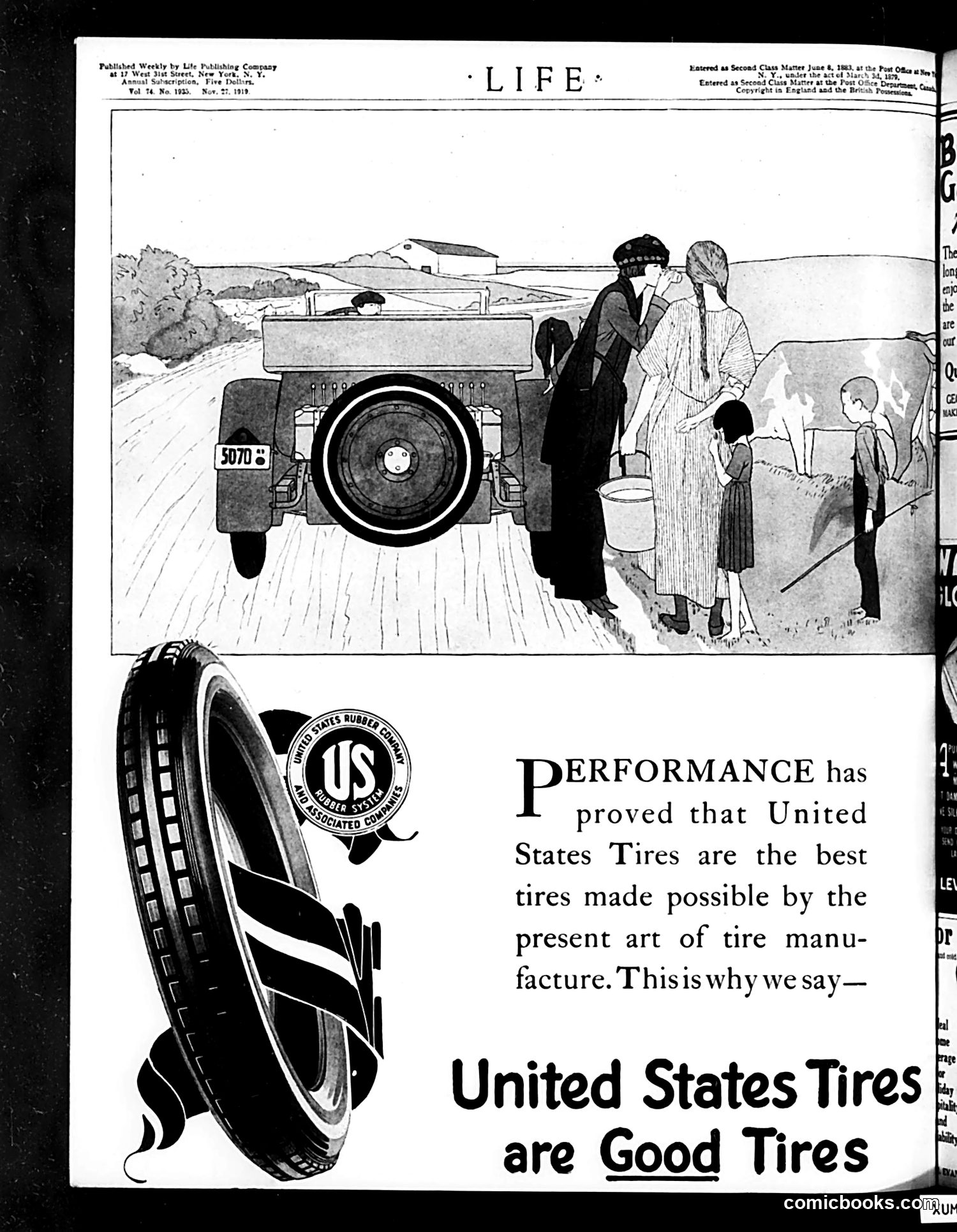
This is primarily a **United States Tires advertisement**, not a satirical cartoon. The image depicts a rural family stopping by their car (license plate 5070) while traveling, with what appears to be a mother, children, and another adult examining or discussing the vehicle on a country road. The advertisement's claim—"PERFORMANCE has proved that United States Tires are the best tires made possible by the present art of tire manufacture"—uses the family roadtrip scenario to suggest reliability and trustworthiness for everyday Americans. The large tire illustration and "US" company logo below emphasize the product. This reflects early 20th-century advertising that associated automobiles and tires with modern family leisure and travel opportunities.
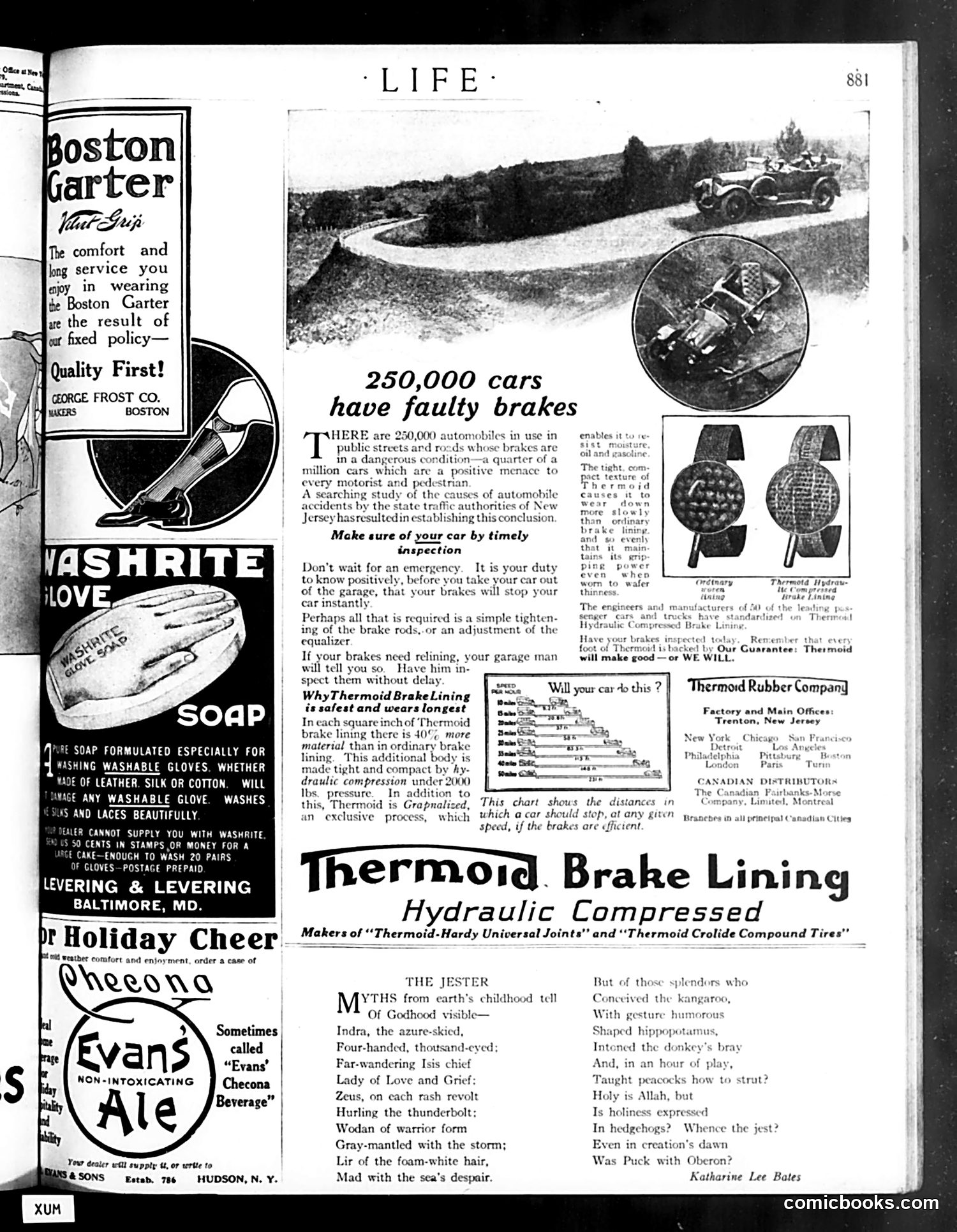
This page is primarily **advertising and product promotion** rather than satirical editorial content. The dominant feature is a large advertisement for **Thermoid Brake Lining**, promoting hydraulic compressed brakes for automobiles. The ad references a contemporary safety concern: "250,000 cars have faulty brakes," citing a New Jersey traffic authority study. It emphasizes the importance of brake inspection and maintenance. The page includes several smaller advertisements for unrelated products: **Boston Garter** (men's hosiery), **Washrite Glove Soap**, **Evans Ale**, and **Checoana** beverage. At the bottom, there's a short poem titled **"The Jester"** by Katharine Lee Bates, referencing mythological figures (Zeus, Isis, Wodan). This appears to be editorial filler rather than satire.
This page is primarily an **advertisement for Life magazine's Christmas issue**, not political satire. The ornate border features decorative cherub/putti illustrations (common in period design), but these are purely ornamental—not satirical caricatures. The text announces Life's upcoming Christmas double issue at 25 cents and promotes gift subscriptions at $5/year for U.S. readers. A "Special Offer" section includes subscription details and pricing for Canadian and foreign readers. The small note at bottom mentions a Christmas card will arrive with subscriptions to announce the gift. This is essentially a house advertisement using festive framing to encourage holiday subscriptions—typical marketing copy for the era, with no discernible political or social satire present.
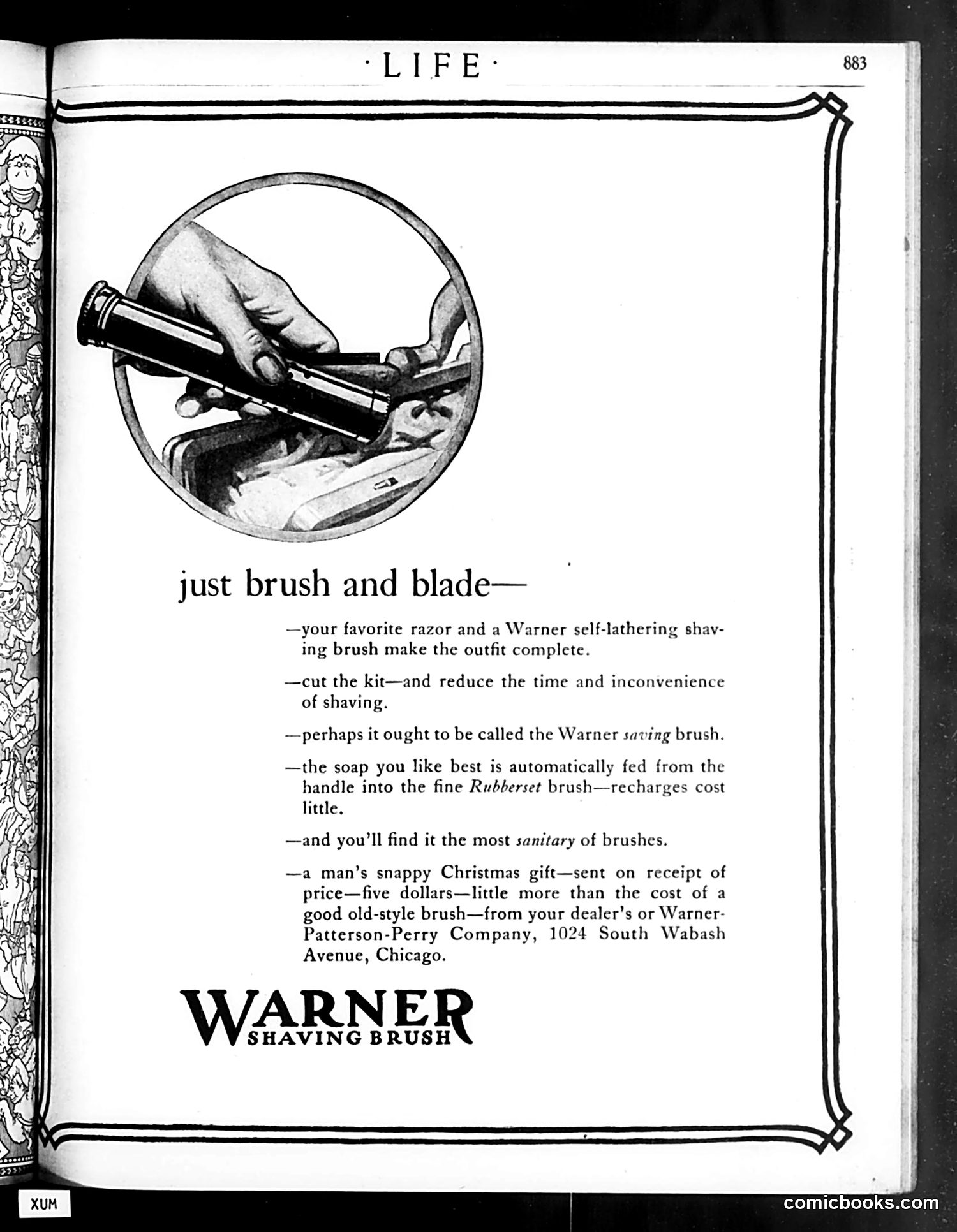
This is a **straightforward product advertisement**, not satire or political commentary. The page promotes the Warner self-lathering shaving brush, manufactured by Warner-Patterson-Perry Company in Chicago. The advertisement emphasizes practical benefits: the brush automatically dispenses soap from its handle, reduces shaving time and inconvenience, and costs about five dollars—slightly more than a traditional brush. The circular photograph demonstrates the brush in use. The ad markets it as a "snappy Christmas gift" and highlights sanitation as a selling point, reflecting early 20th-century concerns about hygiene. There is no cartoon, caricature, or political reference here—simply period advertising copy promoting a grooming product to male readers of *Life* magazine.
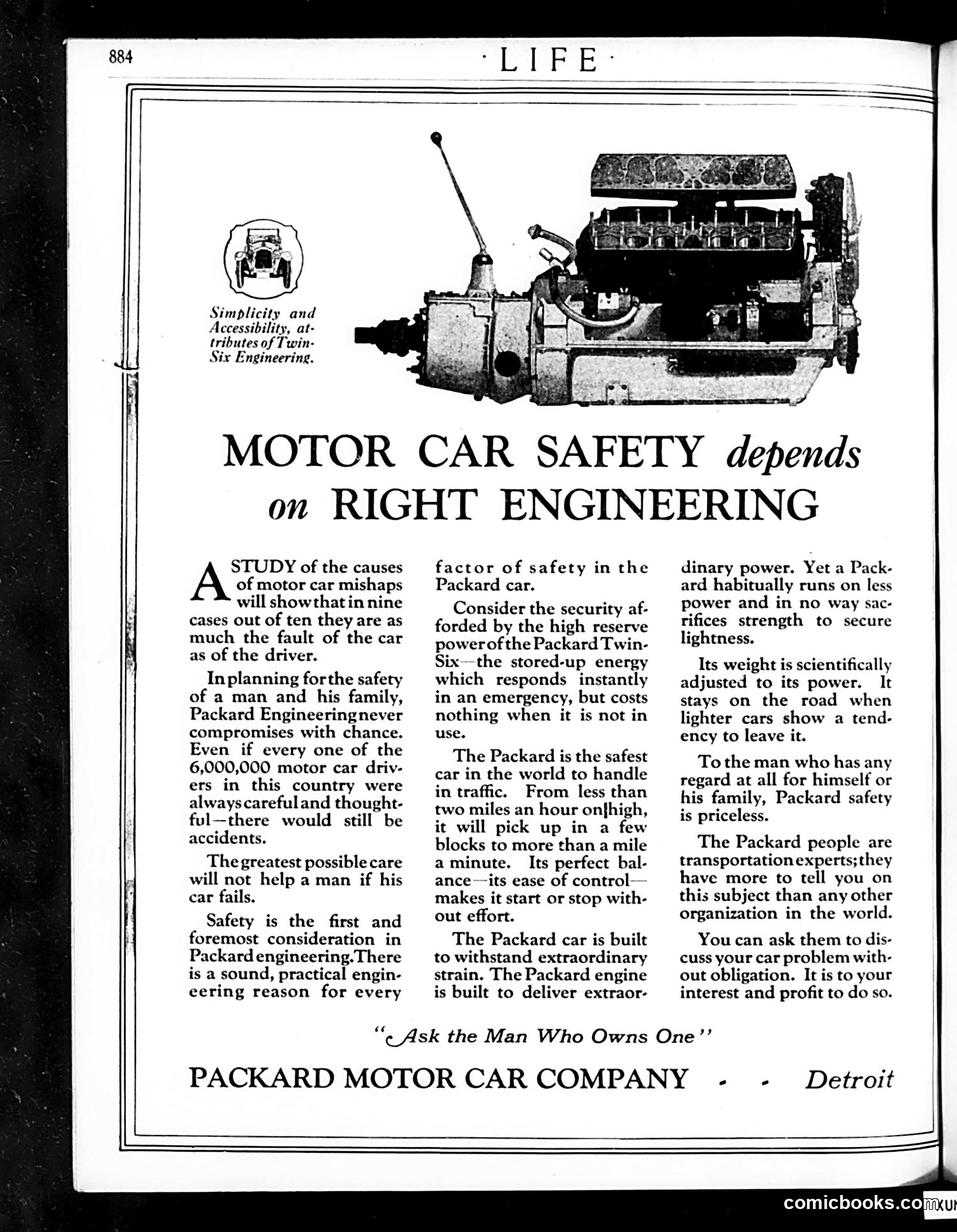
This page is primarily an **advertisement, not satire or political commentary**. It's a Packard Motor Car Company ad from *Life* magazine promoting automobile safety. The ad argues that motor car safety depends on "right engineering" rather than driver skill alone. It emphasizes the Packard Twin-Six engine's reliability and power reserve as safety features—claiming the car can handle emergencies instantly and maintain control on roads. The small illustration in the upper left shows "Simplicity and Accessibility" as Vein-Six engineering traits. The ad's tagline, "Ask the Man Who Owns One," was Packard's actual slogan, positioning the company as a premium, trustworthy manufacturer. This is straightforward product marketing highlighting engineering as a competitive advantage, not political or social satire.
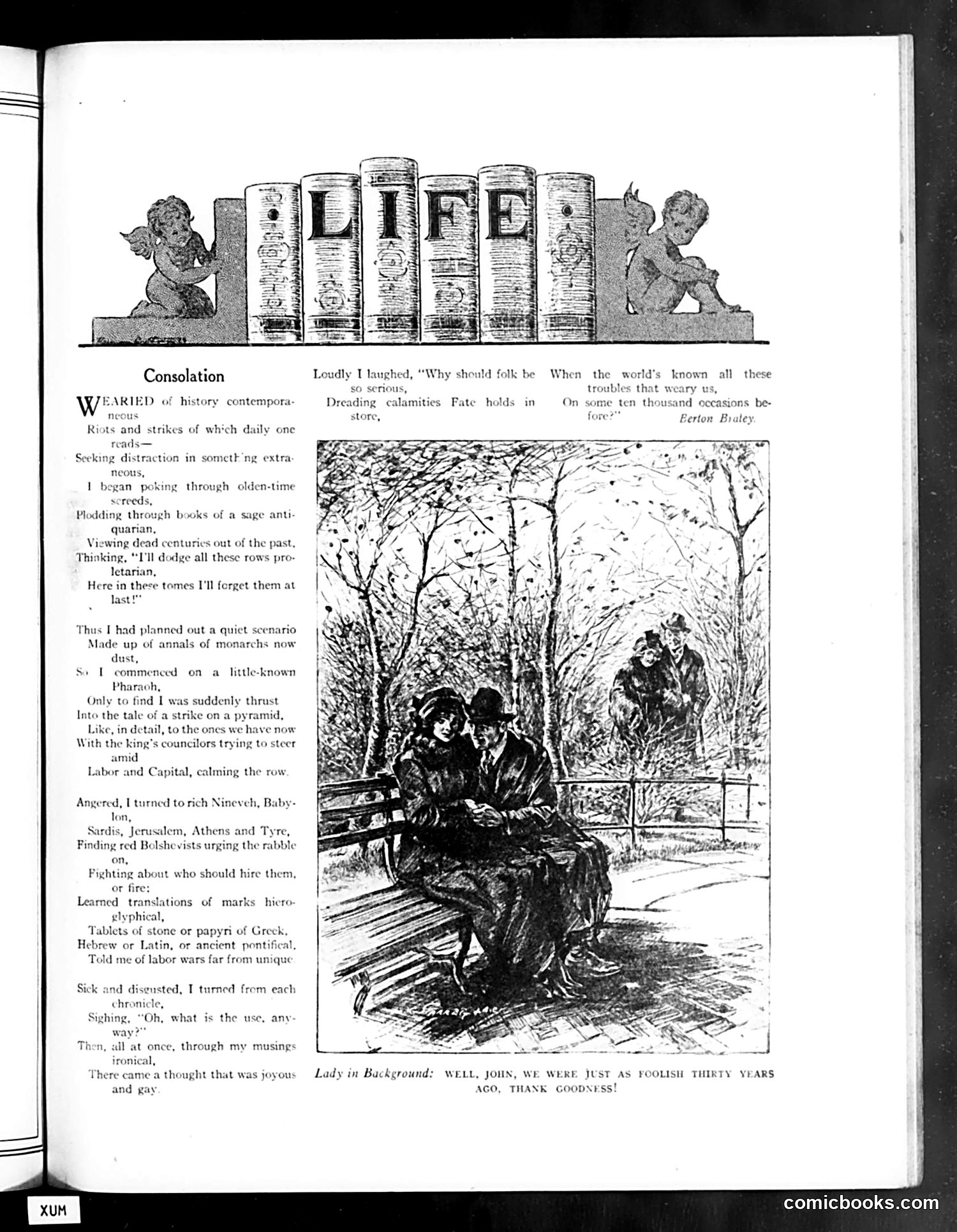
This page features a poem titled "Consolation" alongside an illustration. The poem describes someone overwhelmed by contemporary history—"Riots and strikes of which daily one reads"—seeking escape in old books. The speaker ironically plans to study obscure historical subjects (ancient Pharaohs, Greek manuscripts, stone tablets) to avoid current events. The illustration shows two figures on a park bench beneath bare trees, with the caption: "LADY IN BACKGROUND: WELL, JOHN, WE WERE JUST AS FOOLISH THIRTY YEARS AGO, THANK GOODNESS!" The satire targets those who retreat into historical study to escape present anxieties. The punchline suggests human folly is timeless—today's troubles mirror yesterday's, so historical escapism offers no real comfort. This reflects early 20th-century anxieties about social unrest and labor conflicts.
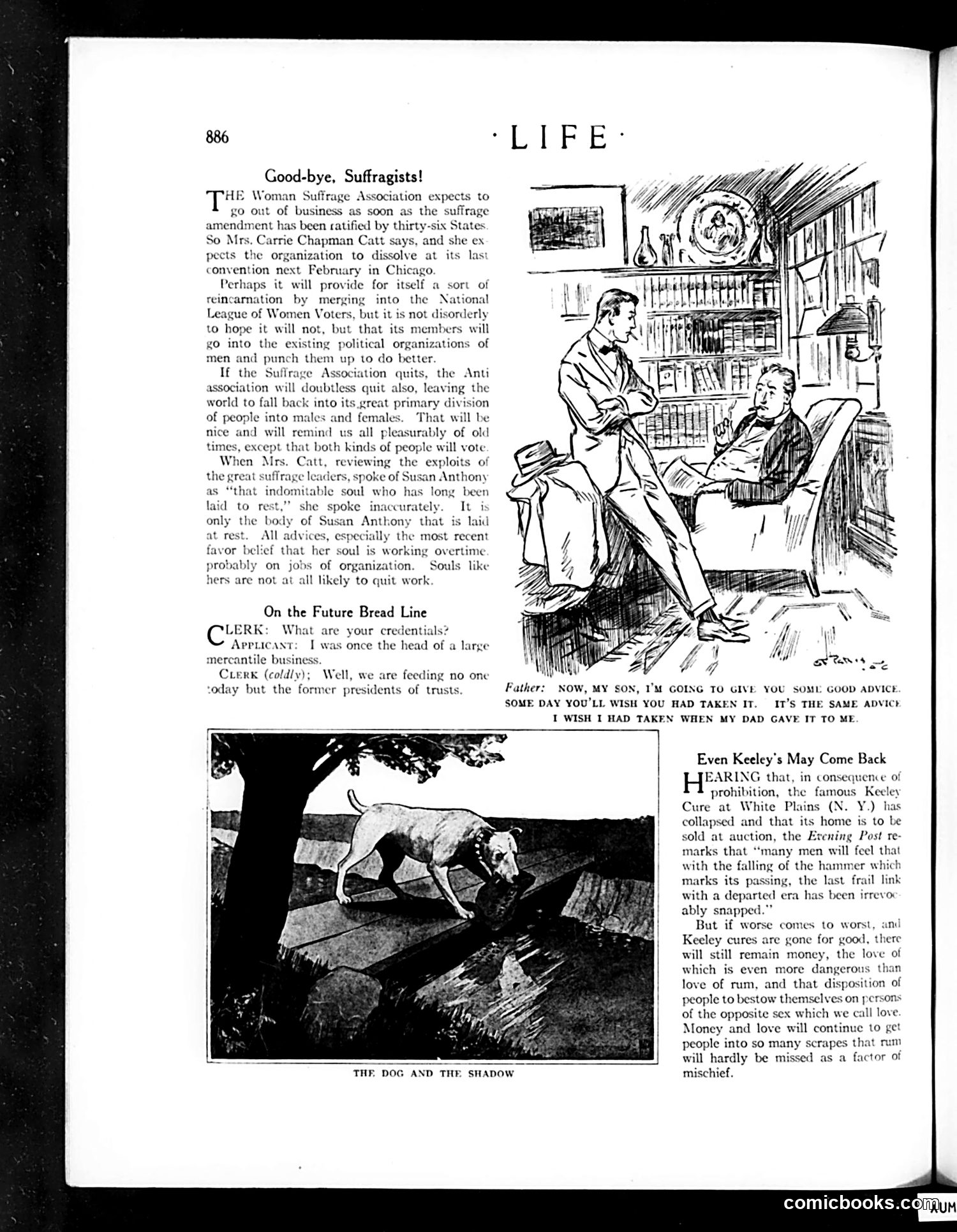
This page contains three distinct pieces of satire: 1. **"Good-bye, Suffragists!"** — Mocks the Woman Suffrage Association's expected dissolution after the suffrage amendment was ratified by thirty-six states. The author sarcastically suggests women will simply merge into existing male-dominated political organizations, and ironically notes that even Susan Anthony's soul won't find rest since women will finally vote. 2. **"On the Future Bread Line"** — A cartoon dialogue between a clerk and applicant, with a father advising his son that bad business decisions lead to hardship—a cautionary tale about trusts and failed business leadership. 3. **"Even Keeley's May Come Back"** and **"The Dog and the Shadow"** — References to the Keeley Cure (alcohol treatment facility) closing, warning that money and vice will persist despite prohibition.
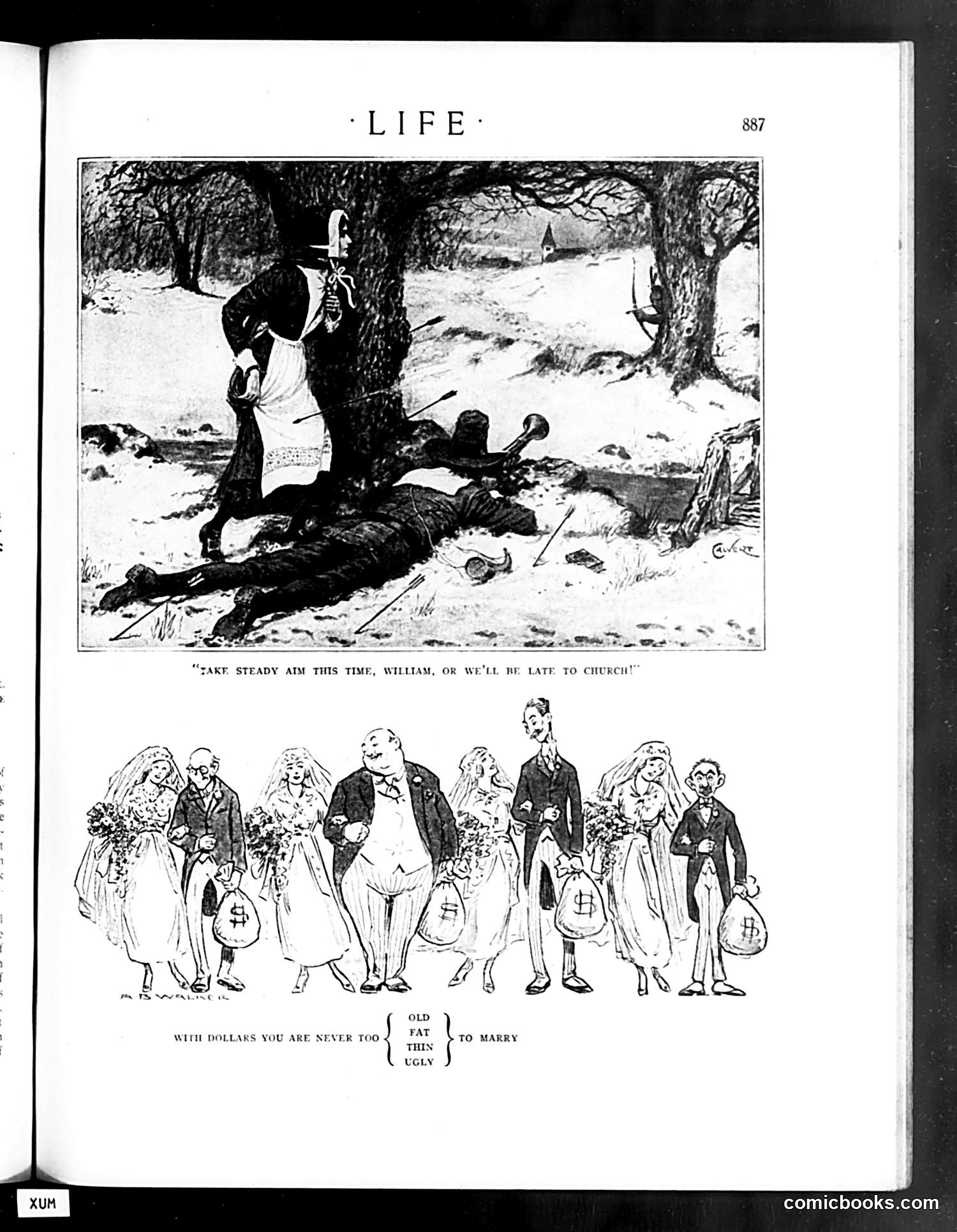
**Top Cartoon:** A couple rushes to get a man to church on time. The woman says, "Take steady aim this time, William, or we'll be late to church!"—suggesting William has a poor track record with punctuality or aim (possibly hunting-related). **Bottom Cartoon:** A satirical commentary on marriage markets. An older, rotund man (labeled "old fat") stands surrounded by young women in wedding dresses holding money bags marked with dollar signs. The caption reads: "With dollars you are never too [old/fat/this ugly] to marry." This is a cynical joke about mercenary marriages—wealthy older men purchasing brides regardless of their appearance or age. The satire critiques both the transactional nature of marriage and the desperation of women who would accept such arrangements for financial security.
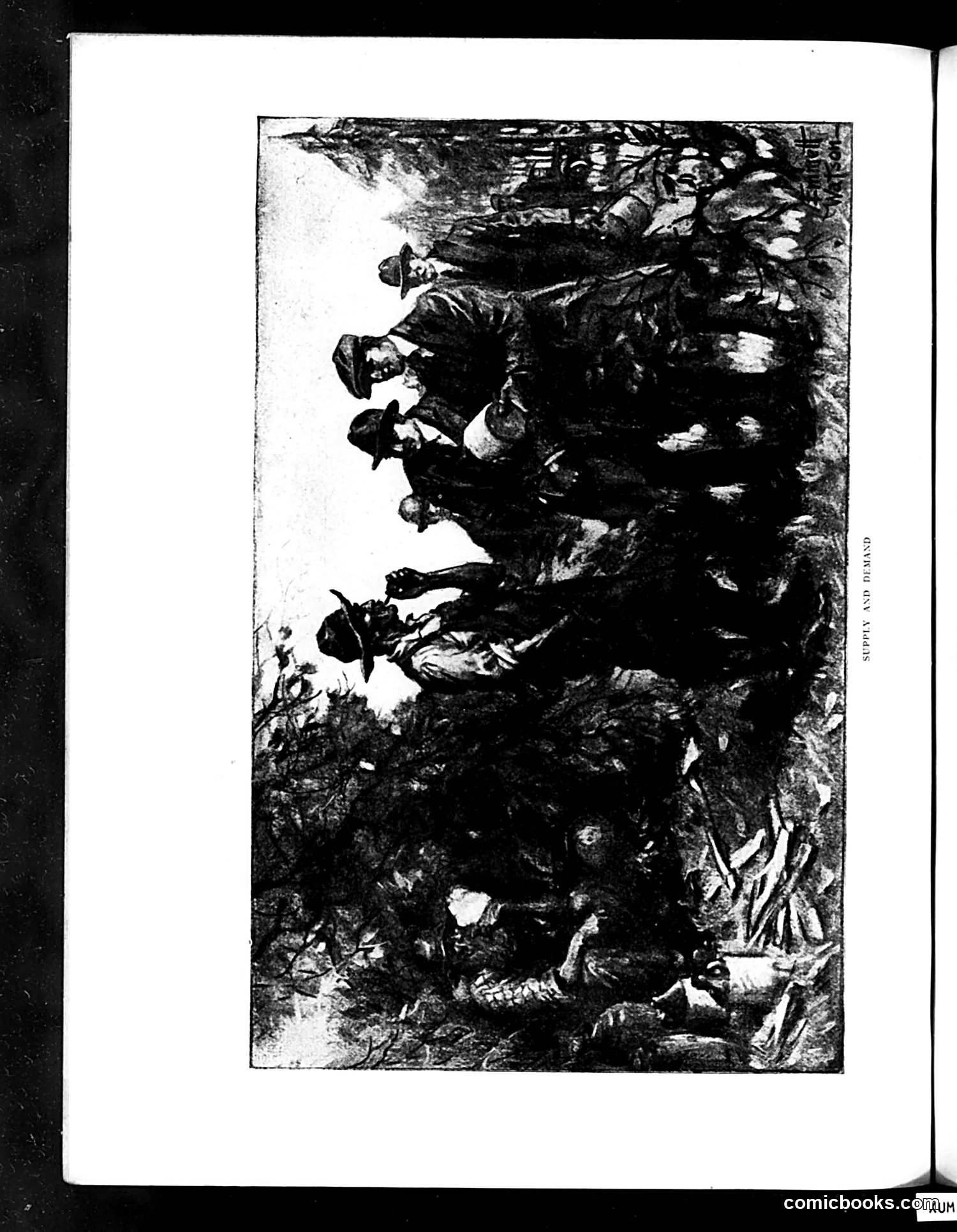
This appears to be a historical illustration (rotated 90 degrees) showing a group of figures in what looks like a wooded or garden setting. The caption reads "SUPPLY AND DEMAND" along the right margin. The image quality and composition suggest this is satirical commentary, likely depicting an economic or social concept through visual metaphor. The figures appear to be engaged in some form of transaction or interaction among vegetation and natural elements. However, without clearer legibility of facial features, clothing details, or additional context from surrounding text on the page, I cannot confidently identify specific historical figures or pinpoint the exact political/social reference being satirized. The "Supply and Demand" caption suggests economic commentary, but the specific target and meaning remain unclear from this image alone.
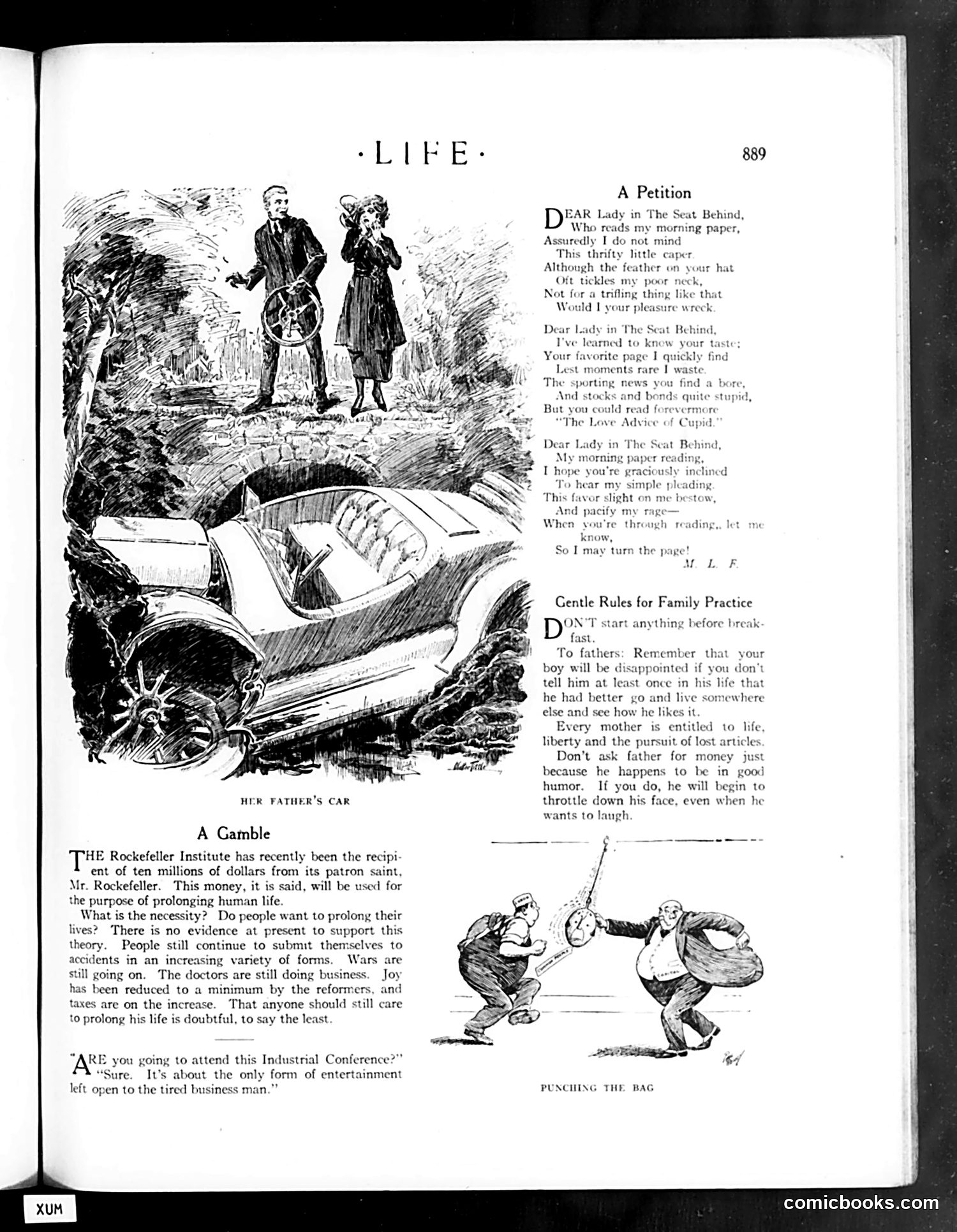
The top illustration shows a couple examining an overturned automobile, captioned "HER FATHER'S CAR." This appears to be satirical commentary on young people's reckless behavior with parental property—a common theme in early 20th-century Life magazine. The damaged vehicle suggests either careless driving or an accident caused by youthful irresponsibility. Below that, "A Gamble" discusses the Rockefeller Institute's receipt of ten million dollars intended to prolong human life. The satire questions whether this is worthwhile, noting that people still experience accidents, war, and suffering. The page also includes "A Petition" (a humorous poem about a newspaper reader's complaints) and "Gentle Rules for Family Practice" offering satirical domestic advice. The bottom illustration, "Punching the Bag," shows boxing practice—likely recreational humor rather than political commentary.
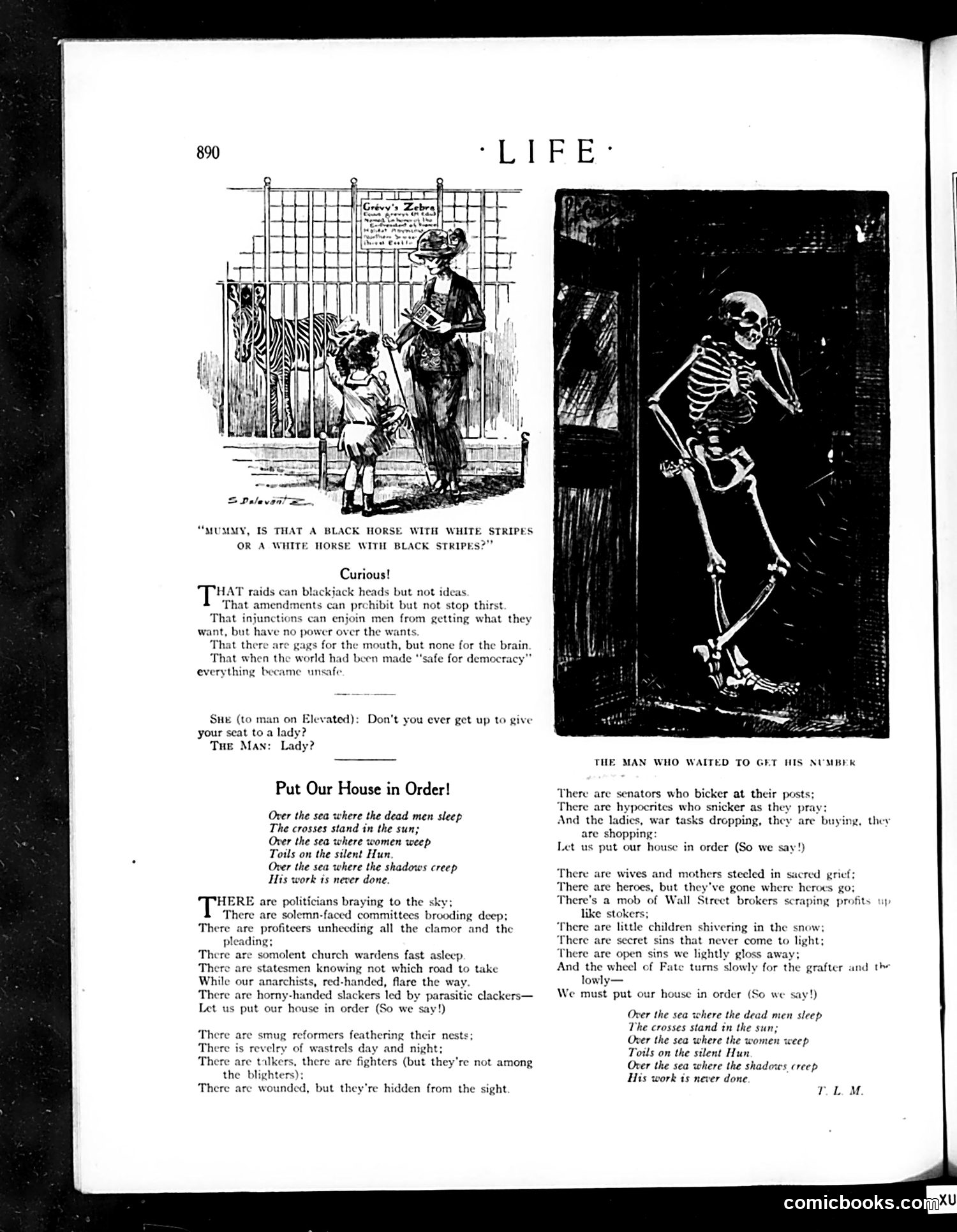
This page contains satirical commentary on post-WWI American politics and society. The top cartoon jokes about animal identification, likely mocking public confusion or political rhetoric. The main piece, "Put Our House in Order!" critiques widespread social problems: corruption among politicians and profiteers, church hypocrisy, labor unrest, poverty, and profiteering on Wall Street. The skeleton figure titled "The Man Who Waited to Get His Number" appears to reference death or fate, suggesting these problems persist unaddressed. The poem catalogs societal ills—from "smug reformers" to "hypocrites," wounded veterans hidden from sight, and financial exploitation—while repeatedly insisting "we must put our house in order." The satire suggests American institutions have failed to address fundamental social injustices despite wartime sacrifice.
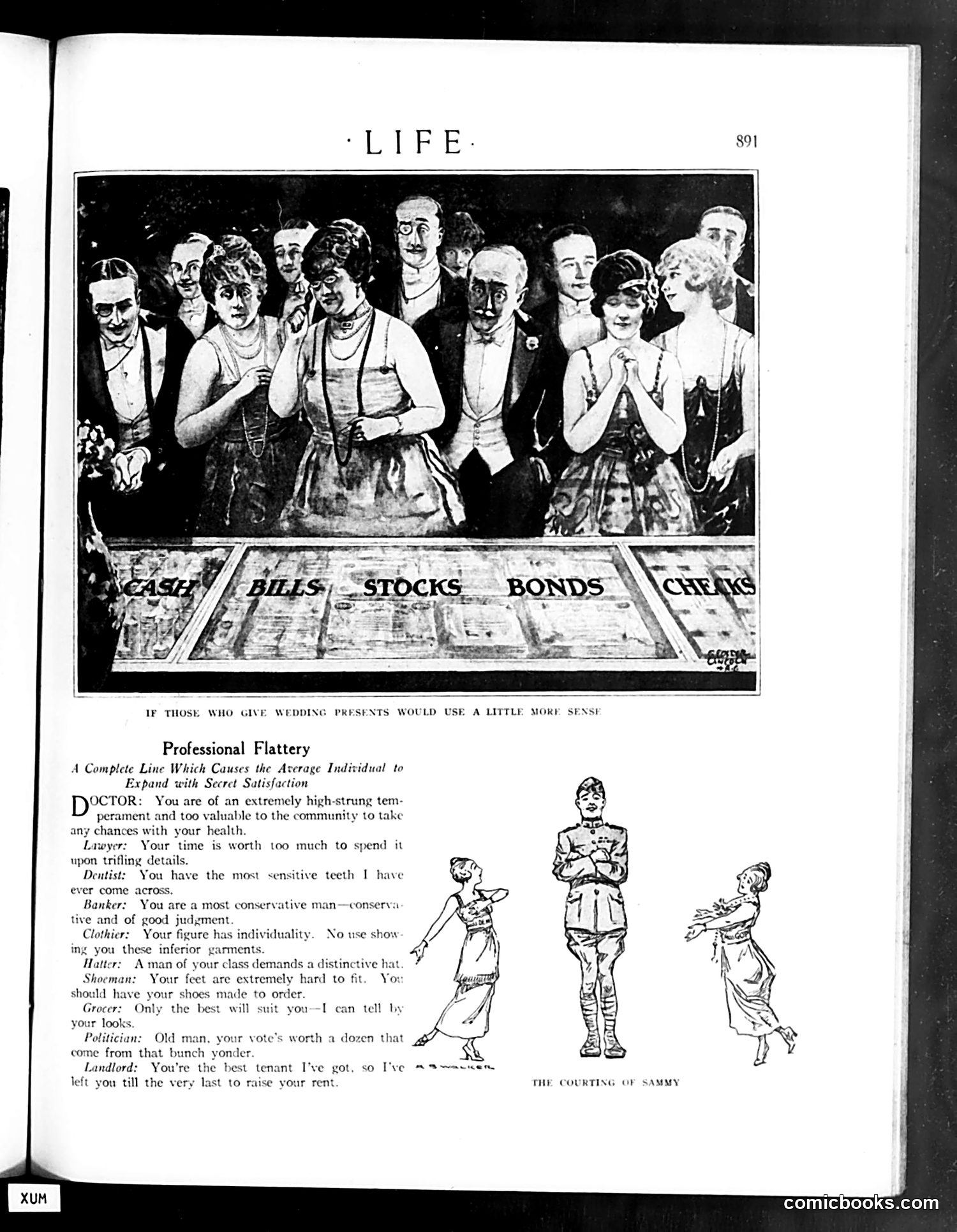
**Top Cartoon:** "If Those Who Give Wedding Presents Would Use a Little More Sense" This satirical cartoon depicts a couple at what appears to be a financial counter displaying "CASH, BILLS, STOCKS, BONDS, CHECKS." The humor mocks wedding gift-giving customs—suggesting guests give impractical or frivolous presents when practical financial gifts would be more sensible for newlyweds establishing a household. **Bottom Section:** "Professional Flattery" This section humorously catalogs insincere compliments various professionals supposedly give clients (doctors, lawyers, dentists, bankers, clothiers, etc.). Each profession's flattery is tailored to make clients feel special while implying the professionals are simply employing practiced manipulation to keep customers satisfied and spending money. Both pieces satirize commercial relationships and consumer culture.
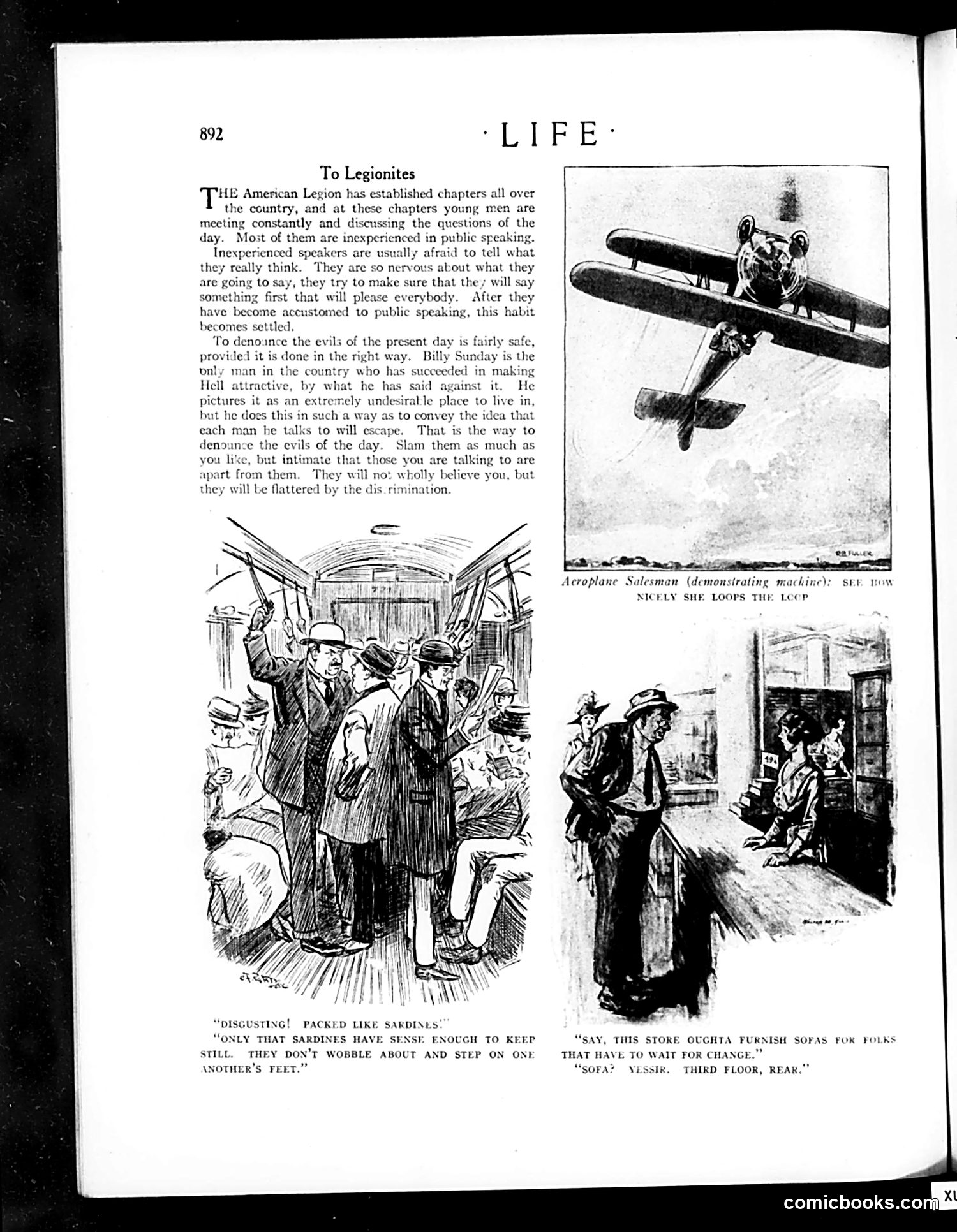
This page addresses young American Legion members through an editorial titled "To Legionites." The text advocates for public speaking as a tool to combat social evils of the era, citing Billy Sunday (a famous evangelist) as an example of effective moral persuasion. Three cartoon illustrations depict social scenarios: crowded public transit (sardine-packed conditions), a furniture store scene, and what appears to be an urban street interaction. The cartoons satirize everyday frustrations—overcrowding, consumer goods shortages or delays ("wait for change"), and general post-war social friction. They humorously illustrate the "evils of the present day" referenced in the editorial, suggesting that frank discussion and moral suasion (not legislation) should address these common complaints.
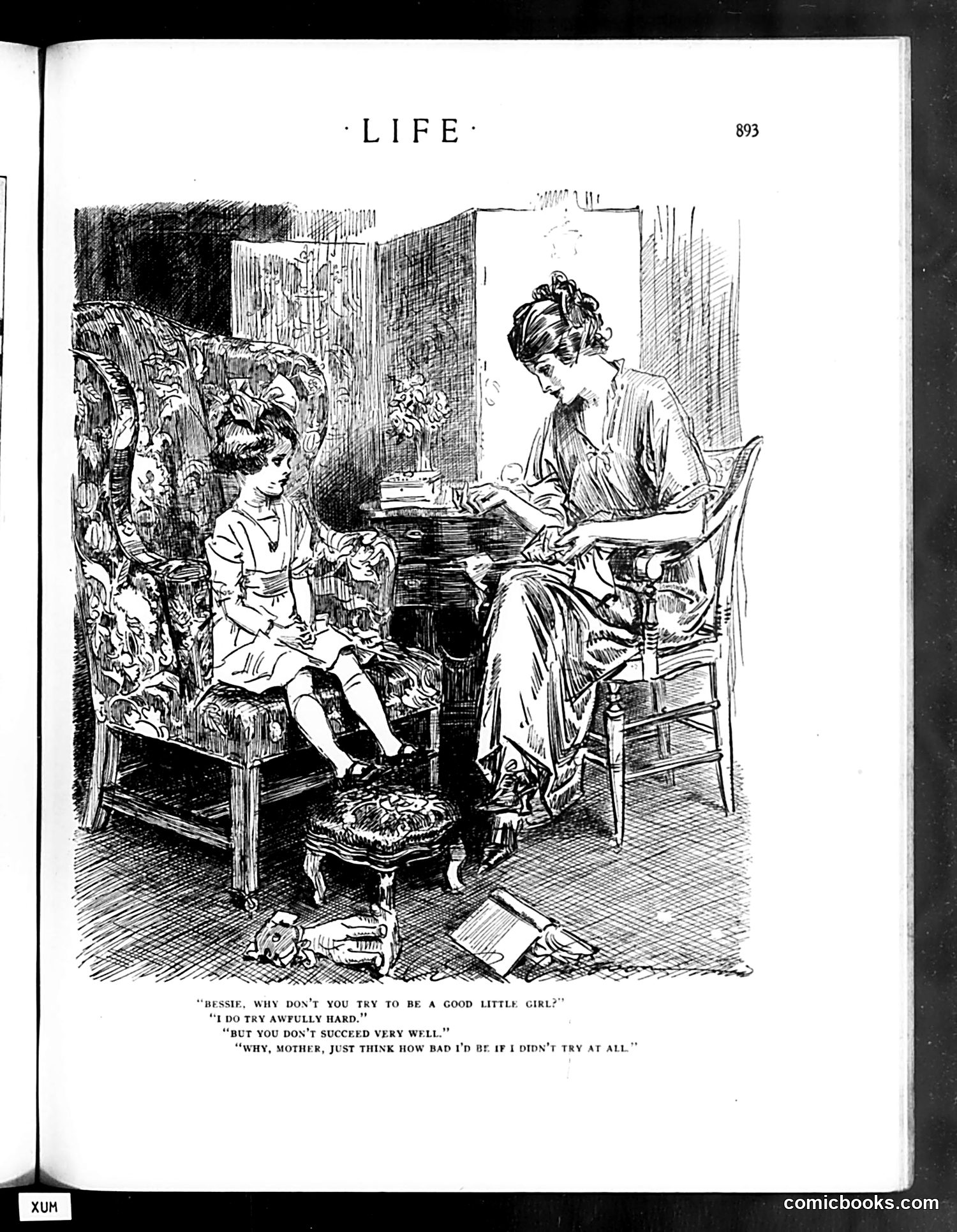
This is a domestic humor cartoon depicting a mother and daughter in conversation. The child, named Bessie, is being scolded for misbehavior. When told to "be a good little girl," Bessie responds that she tries awfully hard. The mother counters that Bessie doesn't succeed very well, to which the child replies: "Why, mother, just think how bad I'd be if I didn't try at all." The joke is a child's logical defense against criticism—by arguing that her attempts at goodness, however unsuccessful they appear, are preventing her from being even worse. It's gentle domestic satire targeting parental discipline and childhood logic, relying on the ironic twist of the child's reasoning rather than political or social commentary.
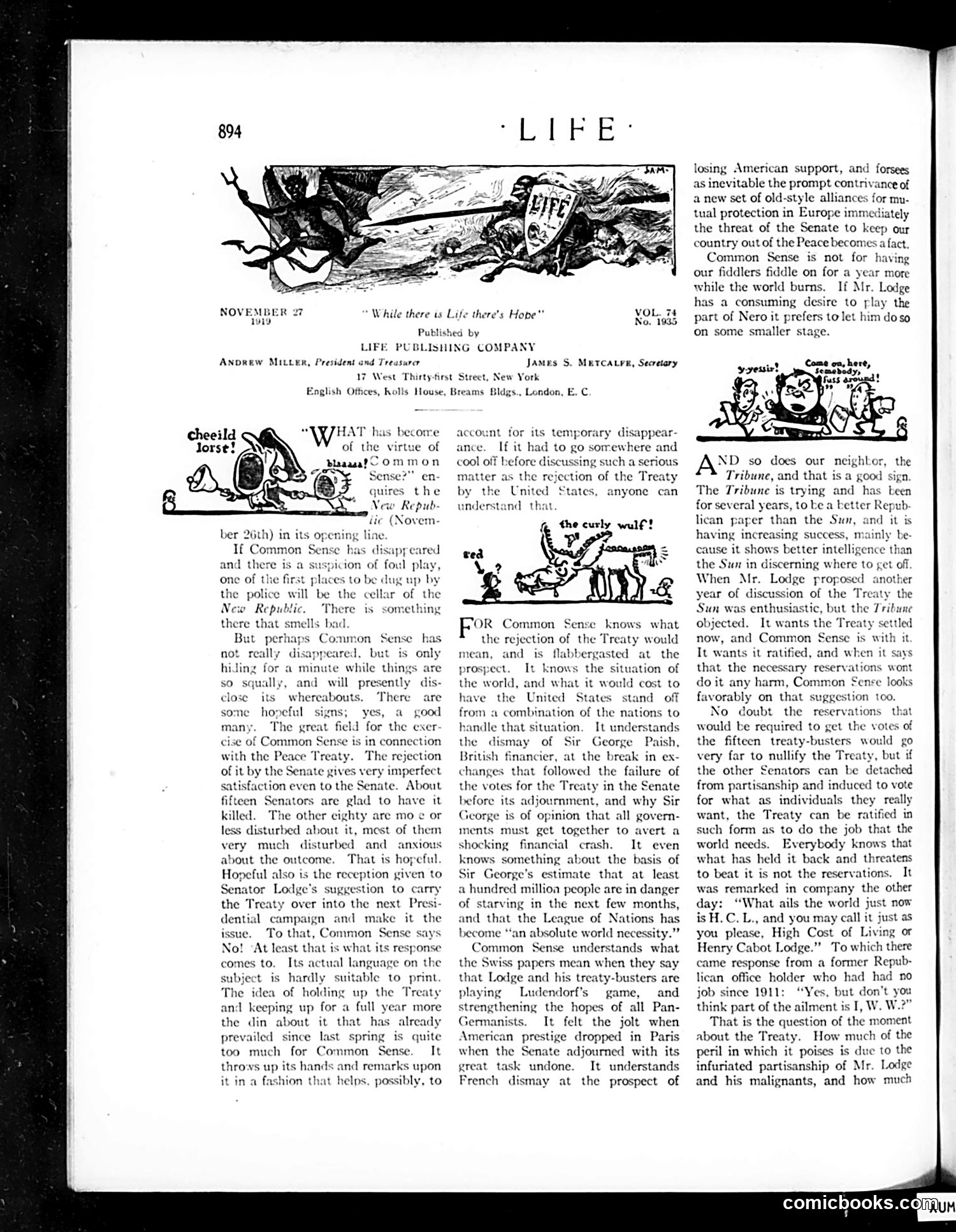
This 1919 *Life* magazine editorial attacks Senator Henry Lodge and opponents of the League of Nations Treaty, which the Senate had just rejected. **The cartoon's targets:** Lodge and "treaty-busters" who delayed ratification; the editorial mocks their obstruction as playing "Ludendorf's game" (helping German interests). **The satire's point:** Common Sense has "disappeared"—vanished from American politics. The editorial argues Lodge's proposal to defer the Treaty to the next presidential election is absurd during a global crisis. It catalogs real consequences: financial collapse, potential starvation of millions, loss of American prestige in Europe, and the breakdown of post-war stability. **The dig:** Lodge is compared to Nero (fiddling while Rome burned), suggesting narcissistic recklessness. The editorial praises the *Tribune* newspaper for better judgment than the *Sun*. This reflects the bitter 1919-1920 debate over American isolationism versus internationalism that ultimately kept the U.S. out of the League of Nations.
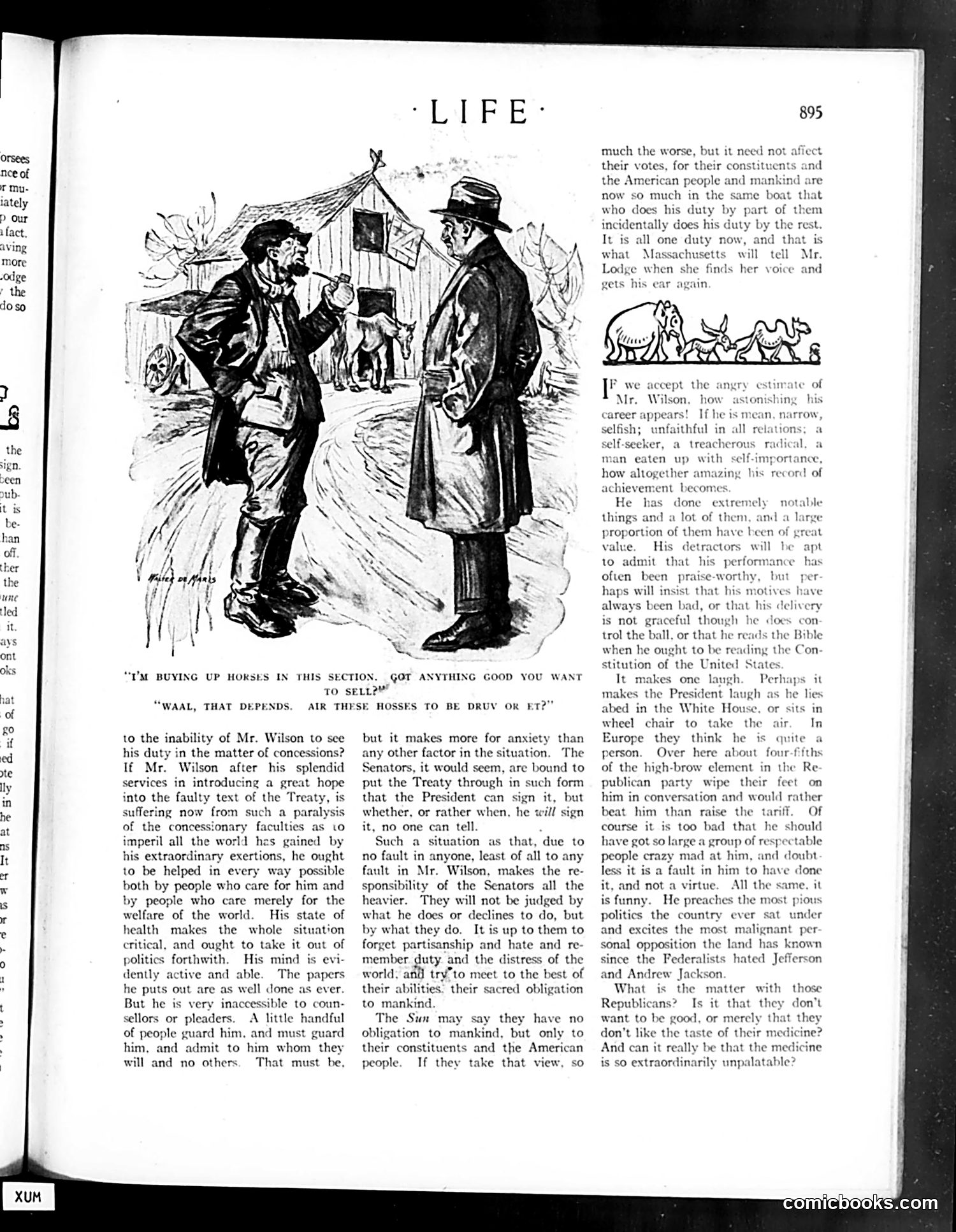
This cartoon satirizes **President Woodrow Wilson** and concerns over the **Treaty of Nations** (likely the League of Nations treaty after World War I). The sketch depicts two men negotiating over horses—a metaphor for Wilson's treaty negotiations. One figure asks whether the horses are "to be druv or et?" (driven or eaten), questioning the treaty's intended use and value. The accompanying text criticizes Wilson's apparent paralysis in securing Senate ratification. It argues that while Wilson has done "extremely notable things," his isolation and inaccessibility to counsel have created a crisis. The piece blames Republican senators—particularly Lodge—for partisan obstruction rather than Wilson himself, accusing them of prioritizing political gain over duty to mankind. The satire targets both Wilson's stubbornness and Republican opposition to the treaty, reflecting the bitter 1919-1920 ratification battle that ultimately defeated American League membership.
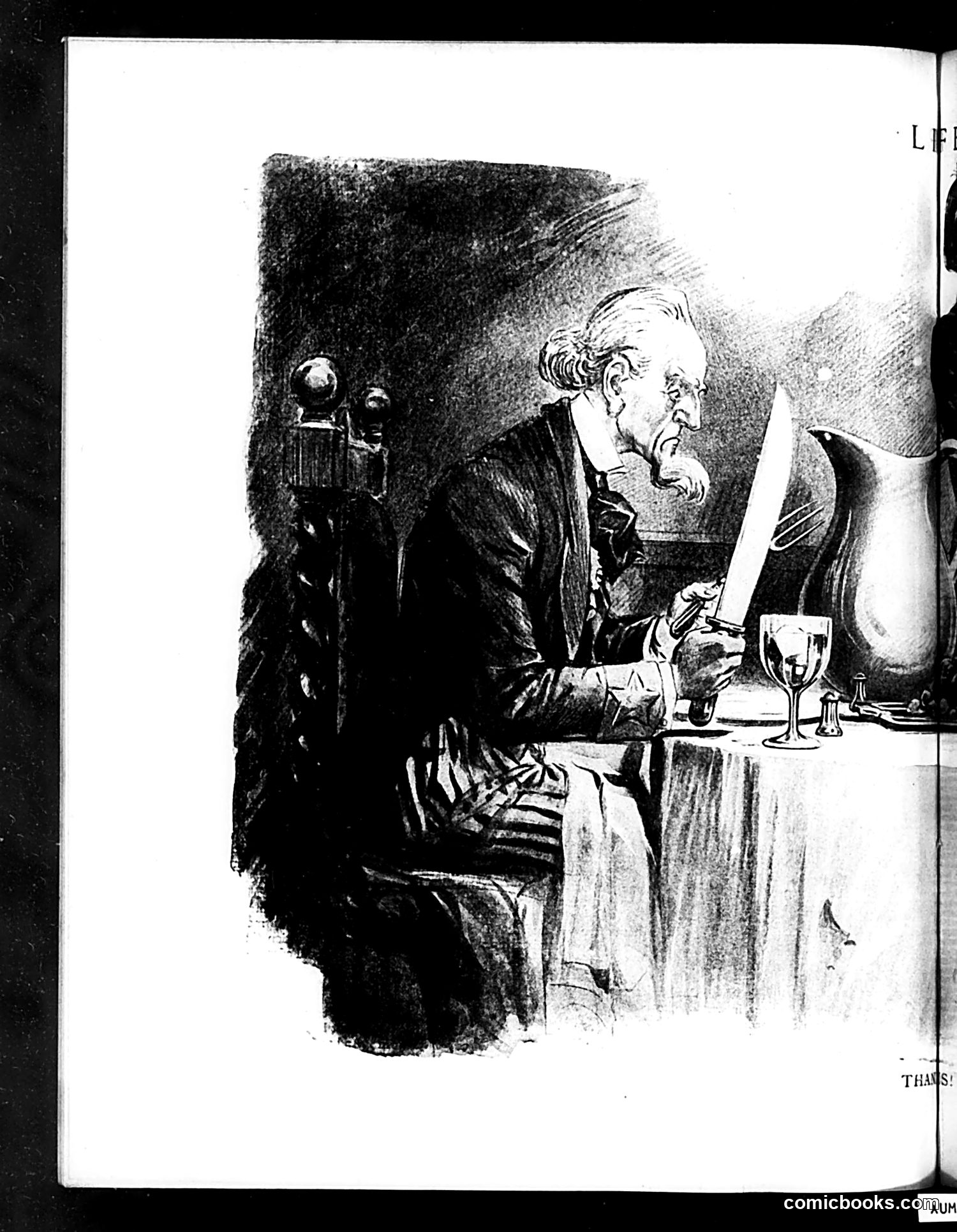
The OCR text is largely unreadable, so I must rely on the image alone. This appears to be a single satirical illustration from *Life* magazine showing an elderly, thin-faced man seated at a dining table. He's depicted in caricatured style with exaggerated facial features—a prominent nose and gaunt expression. Before him sits a place setting with a glass and pitcher. In the shadowy background, two figures are visible, though their identities aren't clear from the image. Without readable text identifying the subject or context, I cannot definitively determine what political or social commentary this cartoon makes. The style suggests late 19th or early 20th century. The emphasis on the man's physical appearance and the dining setting might suggest commentary on wealth, appetite, or social status, but **I cannot specify the intended target or message with certainty**.
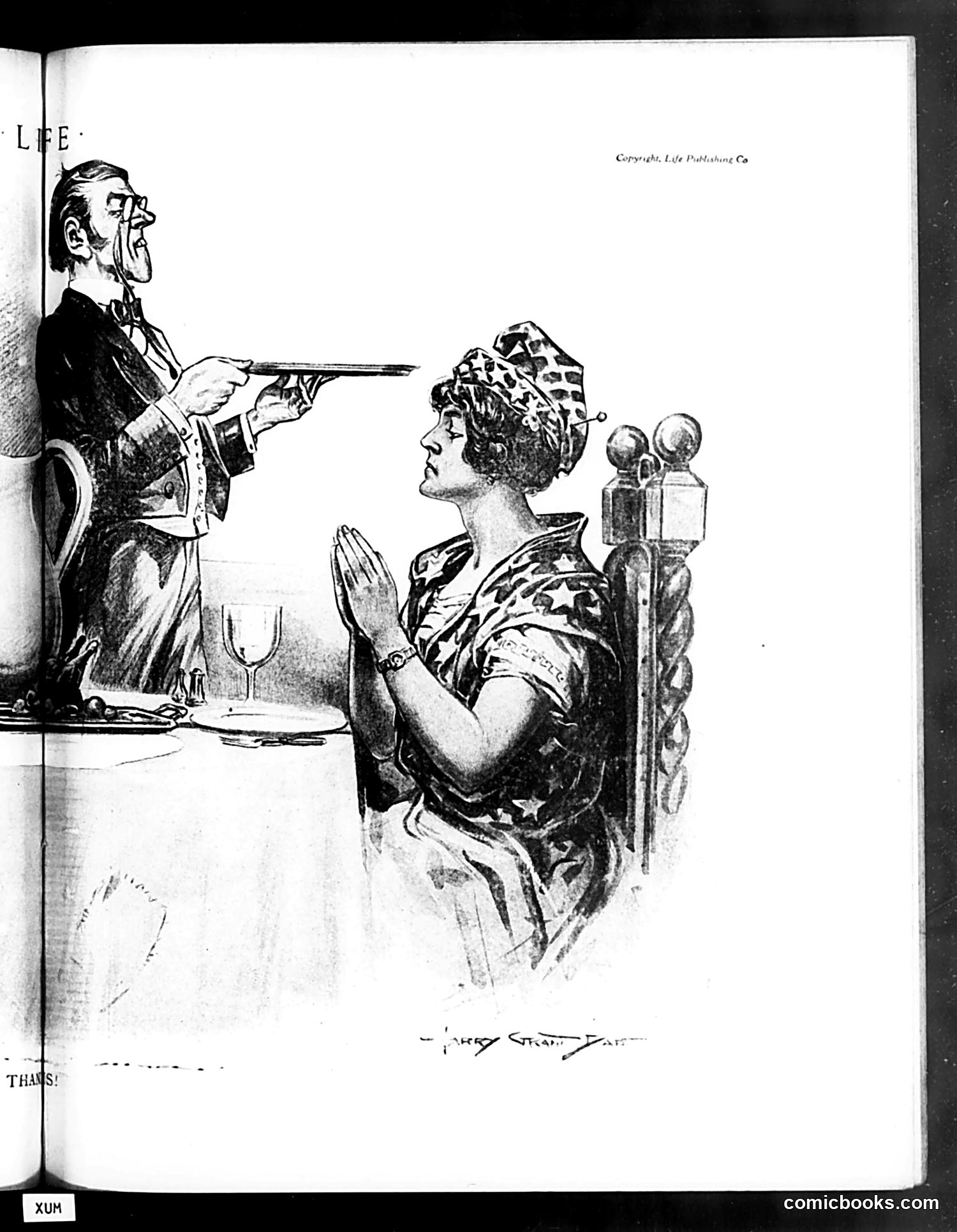
This Life magazine cartoon depicts a director or showman (left, in formal attire, pointing a rifle-like object) aiming at a woman dressed as Lady Liberty or America (center, wearing a starred costume and patriotic garb, with her hand raised in a defensive gesture). Behind her stands what appears to be a movie camera or projection equipment. The satire likely critiques **Hollywood's influence on American patriotism or values**—suggesting that entertainment industry figures are "shooting at" or undermining authentic American ideals. The woman's defensive posture and patriotic costume underscore the cartoon's message that national values are under attack from commercial entertainment interests. The exact historical context remains unclear without the article text.
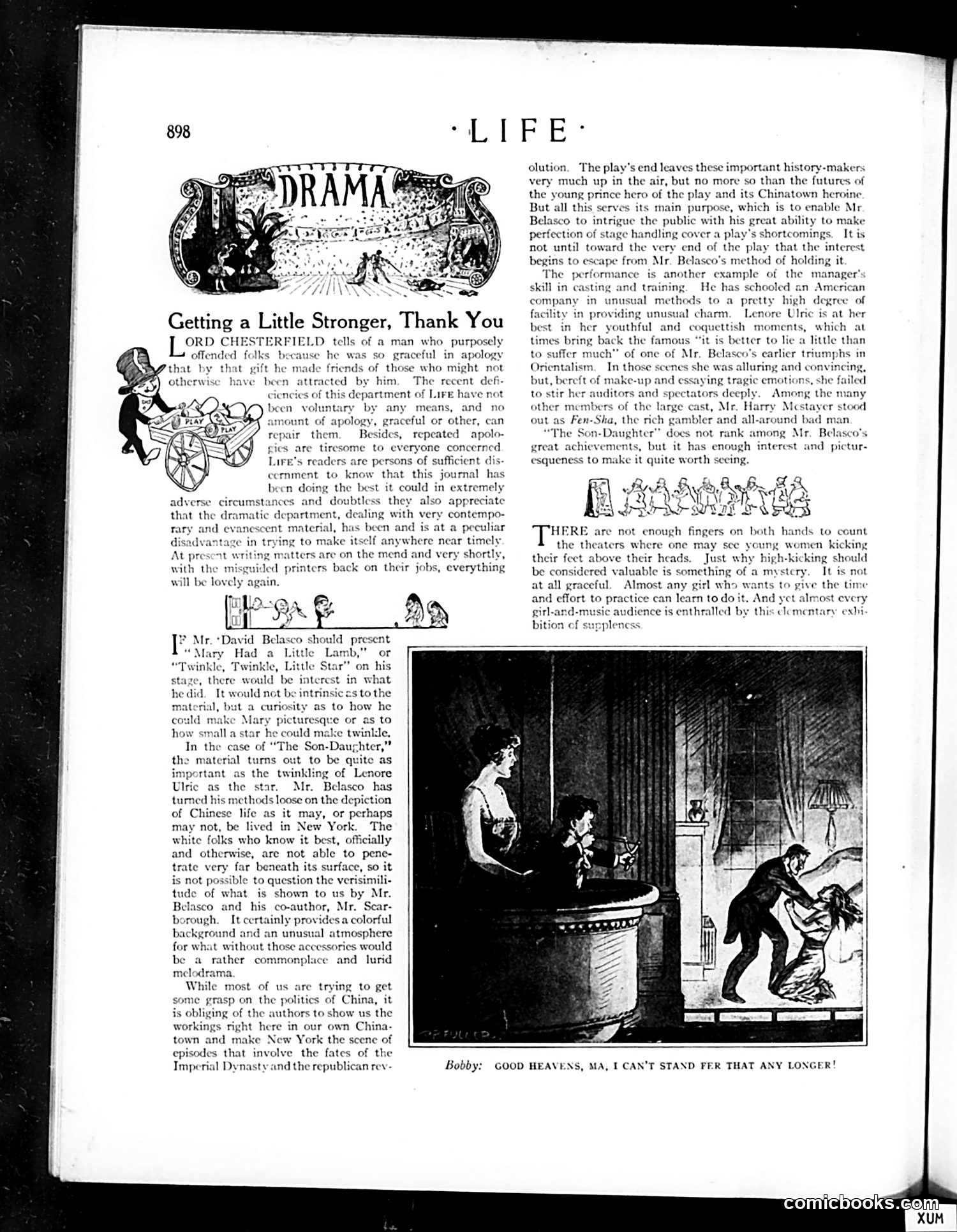
This page reviews David Belasco's theatrical production "The Son-Daughter," a melodrama set in New York's Chinatown. The critic praises Belasco's directorial skill in staging and his ability to train actors, particularly actress Lenore Ulric, who performs both seductive and tragic scenes. The accompanying photograph shows a scene from the play featuring what appears to be Ulric in character interacting with another performer in a Chinatown setting. The editorial opening addresses Life's recent production delays, apologizing for inconsistent output while defending the magazine's efforts during difficult circumstances—likely wartime-related printing challenges. The critic notes that while "The Son-Daughter" lacks profound artistic merit, it succeeds as entertaining spectacle with sufficient interest and visual appeal to warrant viewing. The sidebar commentary critiques the popularity of high-kicking dance numbers in theaters, dismissing them as neither graceful nor difficult to learn, yet acknowledging their audience appeal.
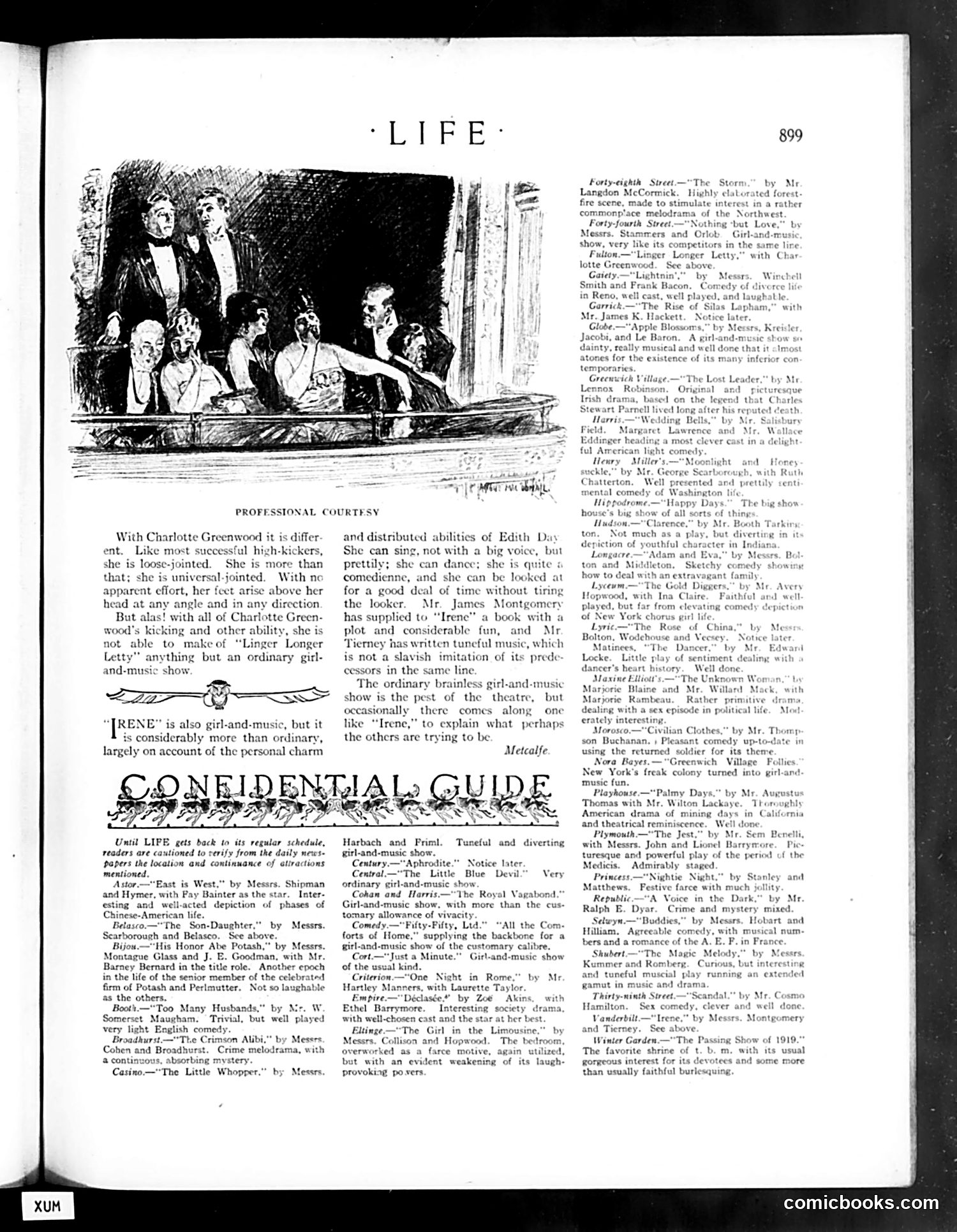
This is a theater review section from *Life* magazine, not primarily a political cartoon. The page features a single sketch titled "PROFESSIONAL COURTESY" showing what appears to be a theatrical scene with multiple figures on a stage or balcony. The sketch illustrates a review of Broadway productions, with the accompanying text discussing performer Charlotte Greenwood and her abilities in the musical "Irene." The satire is theatrical rather than political: Greenwood is praised for her physical flexibility and "universal-jointed" body, yet the reviewer notes she cannot elevate the "ordinary girl-and-music show" format beyond its limitations. The page primarily catalogues current New York theater offerings—mostly girl-and-music comedies of the era—reviewing plots, casts, and entertainment value. References include productions like "The Storm," "Aphrodite," and "Palmy Days." The tone is lighthearted critique of popular entertainment rather than social or political commentary.
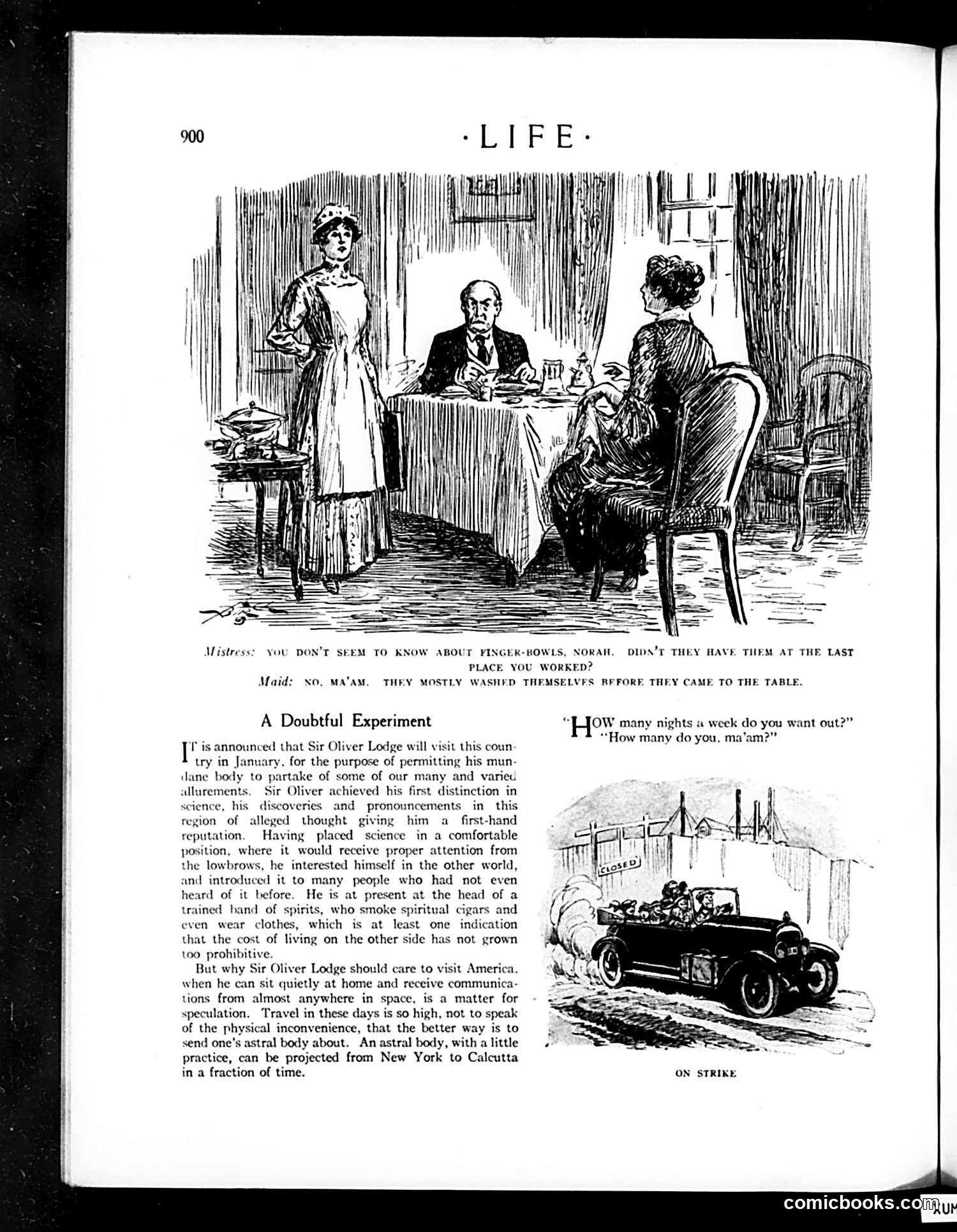
**Top Cartoon:** A domestic humor sketch mocking class pretension. A mistress questions her new maid (Norah) about finger-bowls—an etiquette item signaling upper-class dining. The maid's response—that servants at her previous employer's house washed their hands before eating rather than using formal finger-bowls—is the joke: it suggests the mistress's obsession with genteel refinement masks lower-class origins or that the "refinement" is unnecessarily fussy. **Bottom Article & Cartoon:** Satirizes Sir Oliver Lodge, a real spiritualist who claimed to communicate with the dead through séances. The text mocks him sardonically: spirits supposedly smoke cigars and wear clothes (suggesting spiritualism is absurd), and questions why he'd travel to America when he could project his "astral body" instead. The accompanying auto cartoon labeled "ON STRIKE" likely jokes about labor unrest or modern inconveniences—possibly contrasting with Lodge's otherworldly concerns.
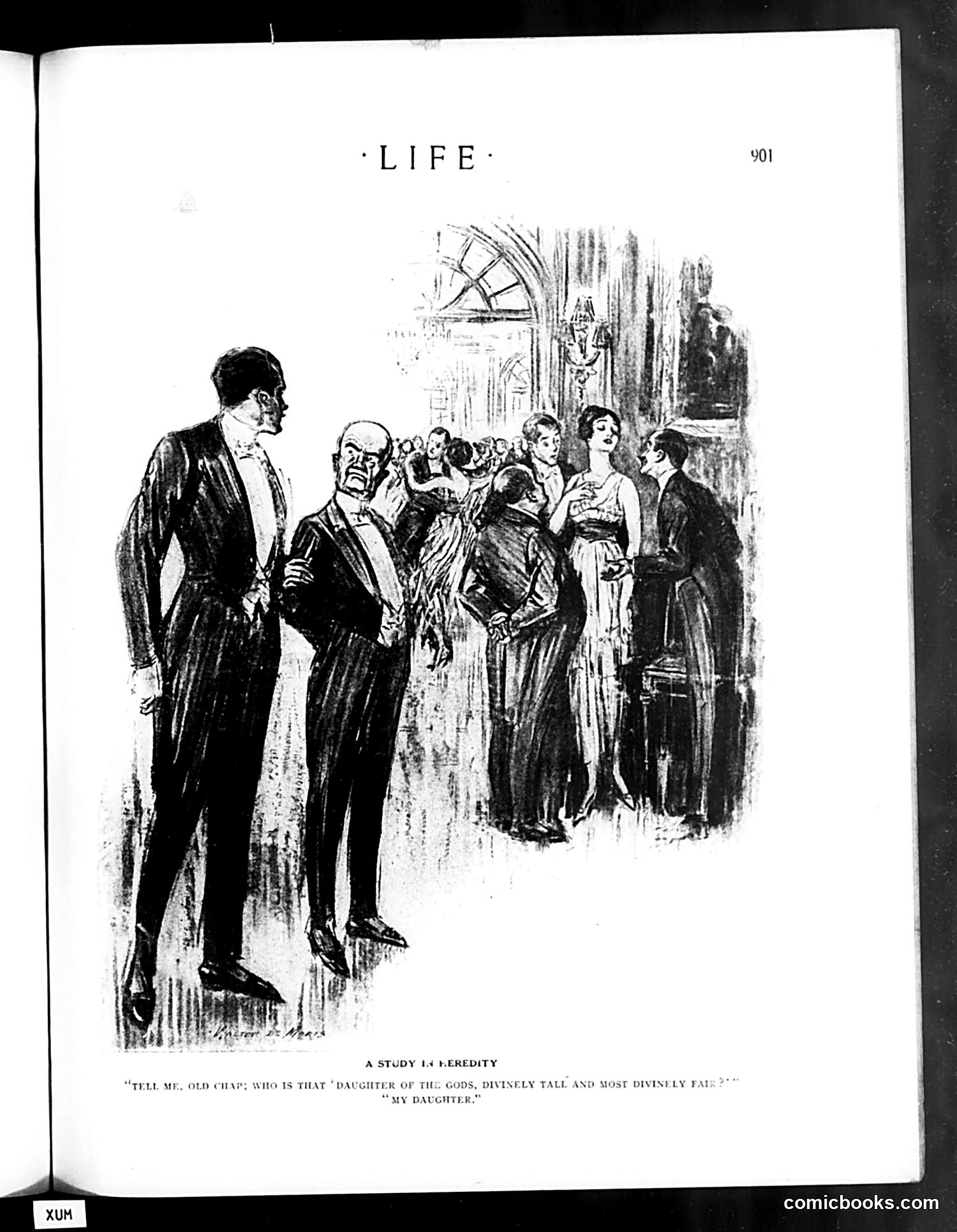
This satirical cartoon mocks the pretensions of wealthy or aristocratic fathers. Two men in formal evening wear converse at what appears to be a social gathering. One asks about a tall, beautiful woman, quoting flowery poetic language ("Daughter of the Gods, divinely tall and most divinely fair"). The other man simply replies, "My daughter." The joke targets paternal vanity: the questioner expects some elaborate explanation for the woman's exceptional beauty, but the answer deflates this—she's simply the speaker's daughter, suggesting he's taking unwarranted credit for her appearance through heredity alone. The cartoon satirizes how fathers of that era might boast about their daughters' beauty as a reflection of their own superiority or status, treating their children as social assets rather than individuals.
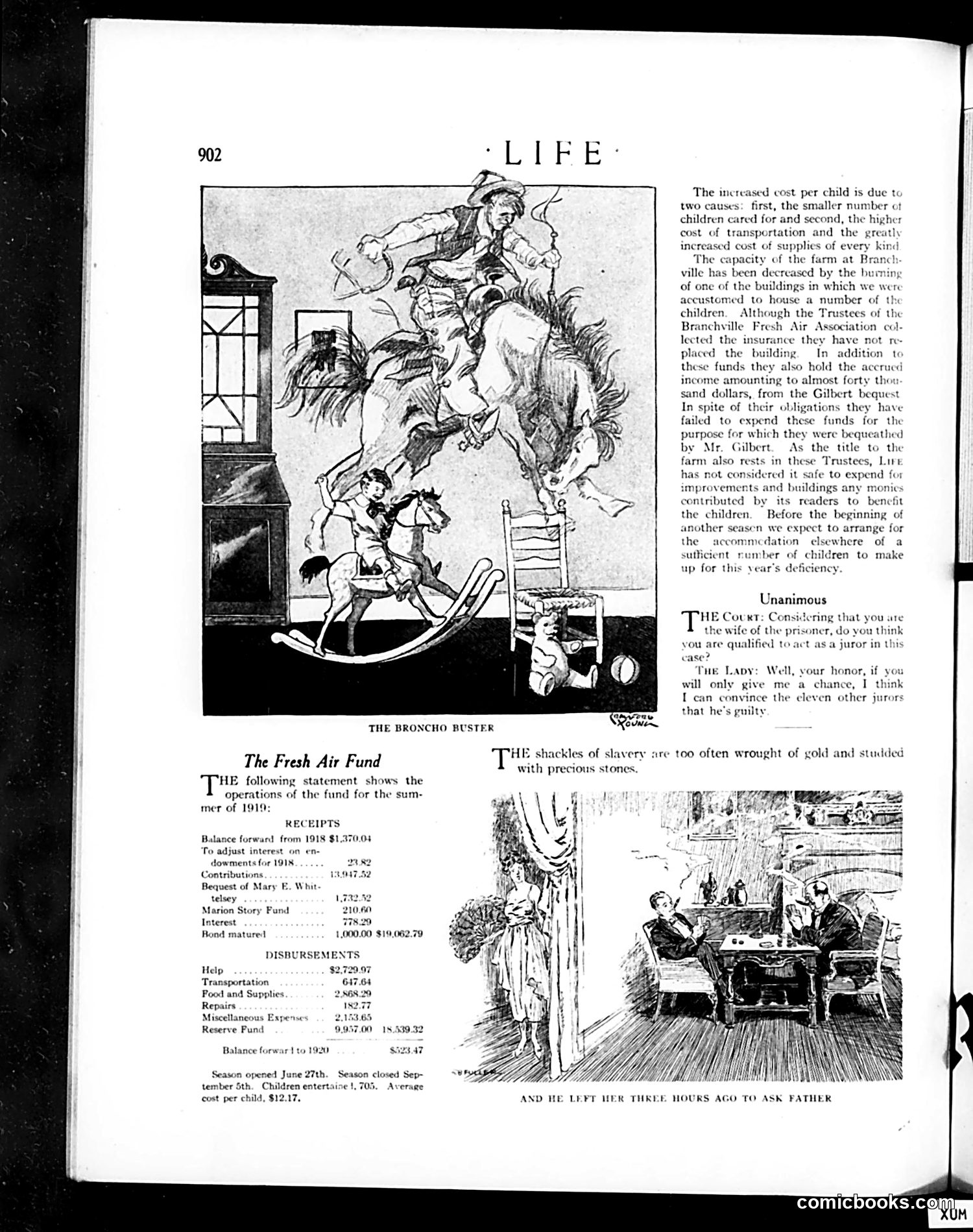
**"The Broncho Buster"** (top): A Western-themed illustration showing a cowboy on a bucking horse with children below. This appears to be a humorous editorial cartoon, likely satirizing reckless behavior or instability—the "broncho buster" metaphor suggesting someone uncontrollable or wild. **"Unanimous"** (middle right): A courtroom dialogue where a woman, asked if she's qualified to serve as a juror, responds she can "convince the eleven other jurors that he's guilty." This satirizes gender assumptions about women's impartiality and objectivity in the justice system—implying women are biased or prejudicial, a common sexist trope of the 1919-1920 era. **"The Fresh Air Fund"** (lower section): A financial report documenting a charitable organization providing summer farm care for urban children. The accompanying text discusses funding shortfalls and building damage, framed as administrative transparency rather than satire. The page mixes editorial humor with serious charitable reporting, typical of *Life* magazine's format during this period.
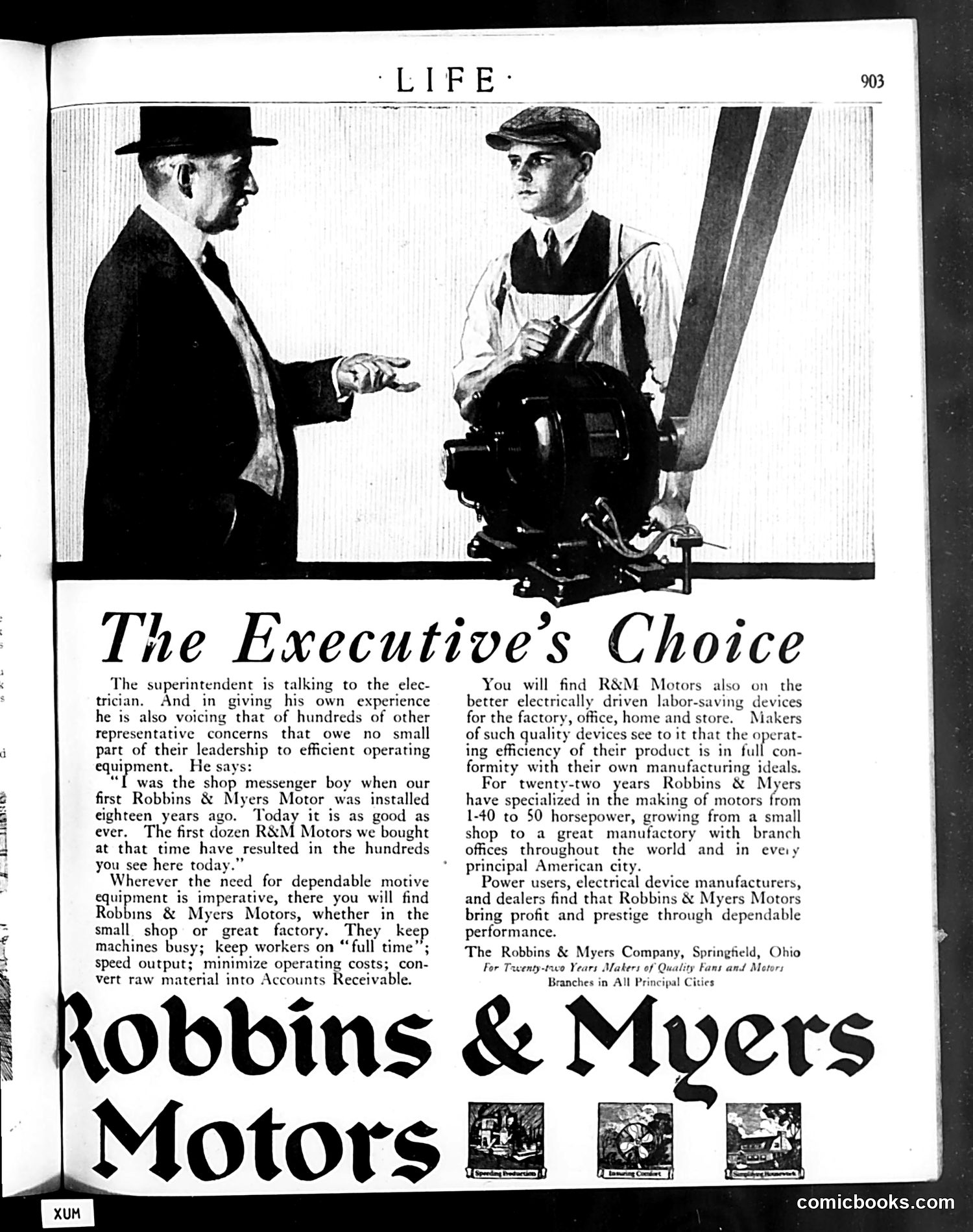
This is primarily a **product advertisement**, not satire. The image shows a superintendent (in bowler hat) speaking with an electrician about Robbins & Myers electric motors. The "joke" or appeal is business-oriented rather than political. The advertisement uses a testimonial format: the superintendent claims he installed R&M Motors eighteen years ago as a shop messenger boy, and they've proven so reliable that the company now uses hundreds of them. The pitch emphasizes **dependability, efficiency, and long-term cost savings**—converting "raw material into Accounts Receivable." For modern readers: this represents early 20th-century industrial advertising that appealed to factory managers and business owners by showcasing testimonials from "working men who've seen results." The modest dress and humble backstory of the superintendent character was meant to convey authenticity and trustworthiness to potential buyers—the motors are endorsed by someone who started at the bottom and knows quality through experience.
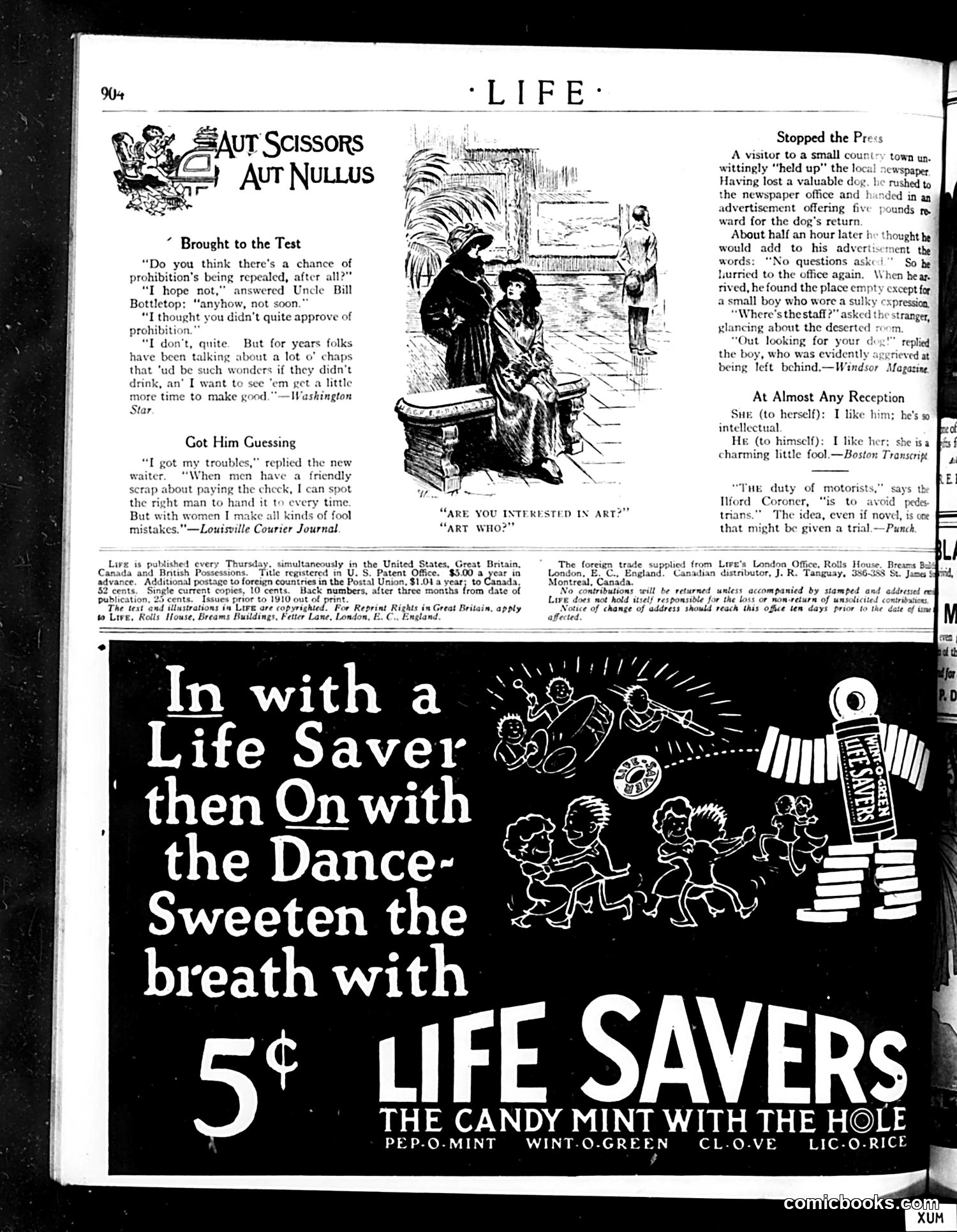
This page contains several short humorous sketches typical of Life's satirical humor, plus advertising. **"Brought to the Test"** mocks Prohibition era debates. Uncle Bill admits he dislikes Prohibition but supports keeping it because people claiming they'd improve without alcohol haven't yet proven themselves—so let them stay sober longer to demonstrate actual reform. **"Got Him Guessing"** jokes that a waiter can't read women's intentions about who should pay the bill, making mistakes—a commentary on gender relations and women's unpredictability in social situations. **"Stopped the Press"** depicts a newspaper office mishap: a visitor seeking to advertise a lost dog inadvertently delays publication. When he returns, only a boy staff member remains, who complains about being abandoned—a mild joke on understaffing. **"At Almost Any Reception"** presents a brief flirtation where each person mentally categorizes the other (he: intellectual/she: fool) in ironic contradiction. The page is primarily **advertising**: a large Life Savers candy mint advertisement dominates the lower half, featuring playful imagery of children and emphasizing the product's various flavors.
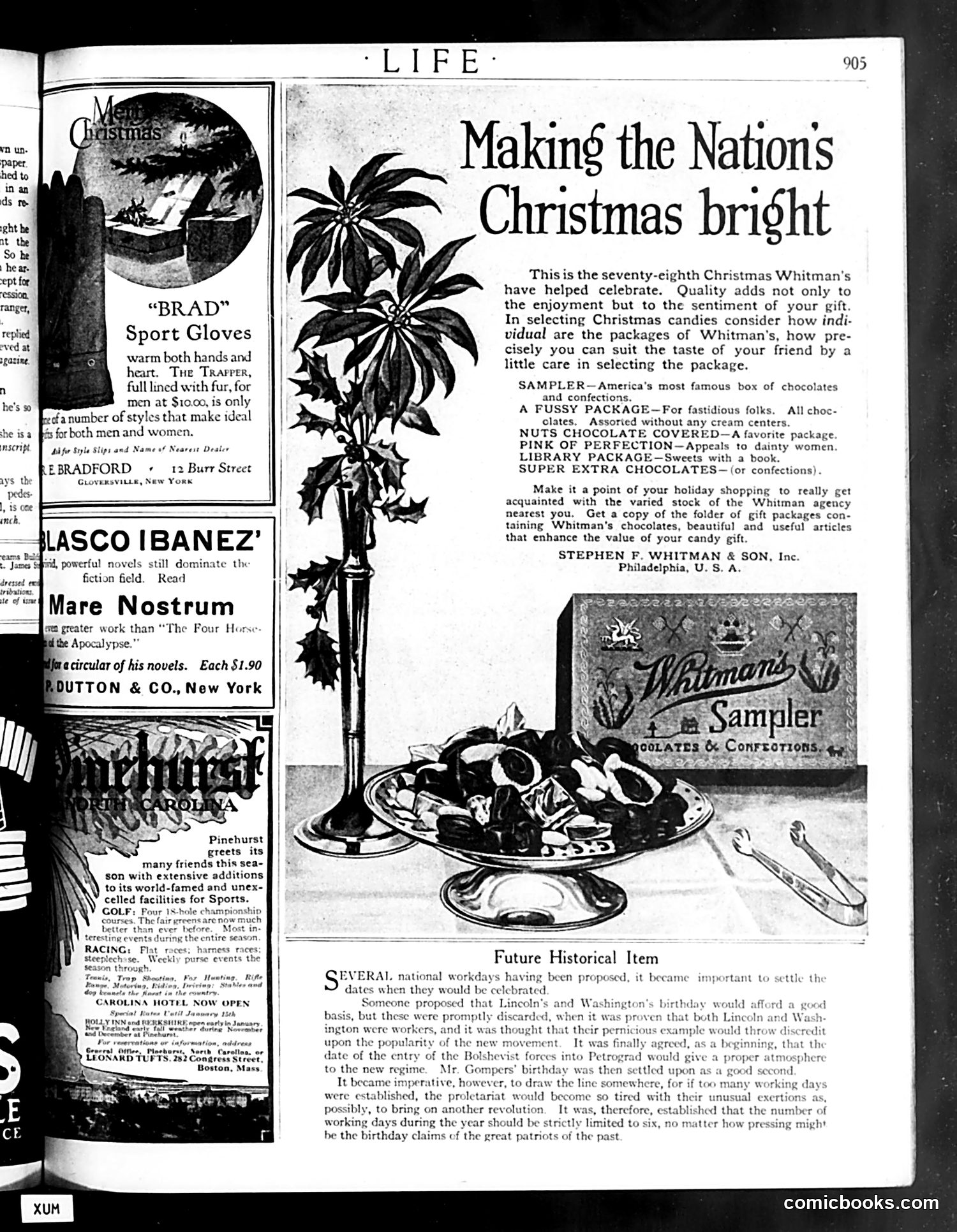
This page is primarily **advertising** rather than political satire. The main content promotes Whitman's chocolates as Christmas gifts, with subsidiary ads for "Brad" sport gloves, a novel called *Mare Nostrum*, and Pinehurst resort facilities. The one satirical piece is titled "Future Historical Item," a brief commentary on proposed national holidays. It satirizes **Soviet labor policy** (implied by references to "proletariat" and "Petrograd"), mocking the bureaucratic problem of establishing too many state holidays. The joke: if workers celebrate birthdays of national heroes constantly, they'll grow exhausted and potentially rebel again—so the regime limits working days to just six, regardless of how many "patriotic" claims exist. This appears dated to the early 1920s post-Russian Revolution era, when American magazines frequently satirized Bolshevik policies as absurdly rigid and ideologically obsessive.
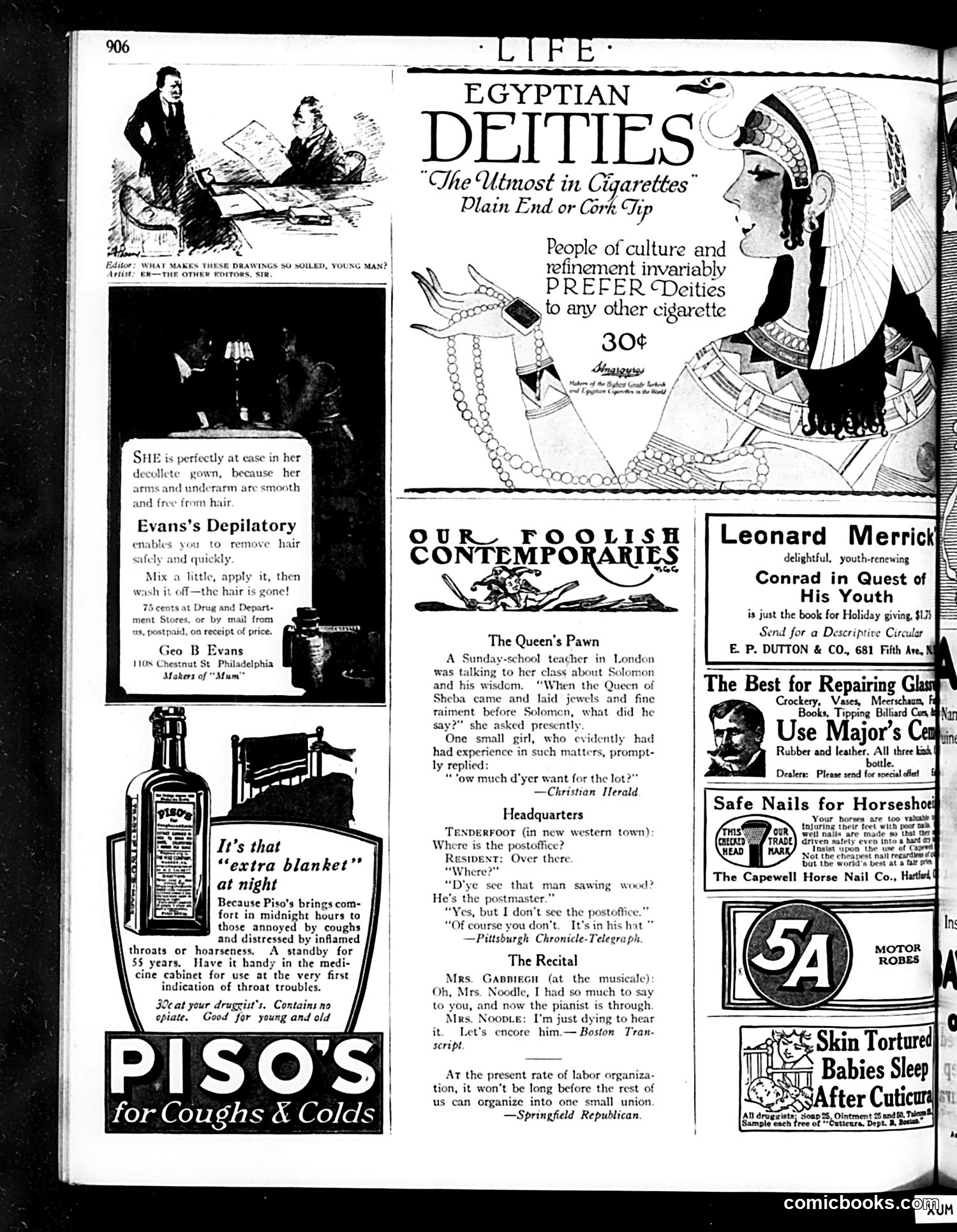
## Main Cartoon The top-left cartoon depicts two men at a desk; one asks the other "What makes these drawings so soiled, young man?" The response: "Er—the other editors, sir." This is office satire—the joke being that the drawings are literally soiled/marked up by multiple editors' revisions and criticism, a common complaint about editorial bureaucracy. ## Egyptian Deities Advertisement The large right-side advertisement uses Egyptian imagery (pharaoh headdress, hieroglyphics) to market "Deities" cigarettes at 30¢, claiming cultured people prefer them. This reflects the era's Egyptomania trend and casual use of non-Western imagery for commercial appeal—without regard for cultural meaning. ## Supporting Content The remaining page contains brief humorous anecdotes and advertisements for period products (hair removal, cough medicine, repair supplies). These were standard Life magazine filler—light humor and classifieds aimed at middle-class readers. The overall tone reflects early 20th-century American consumer culture and casual editorial humor.
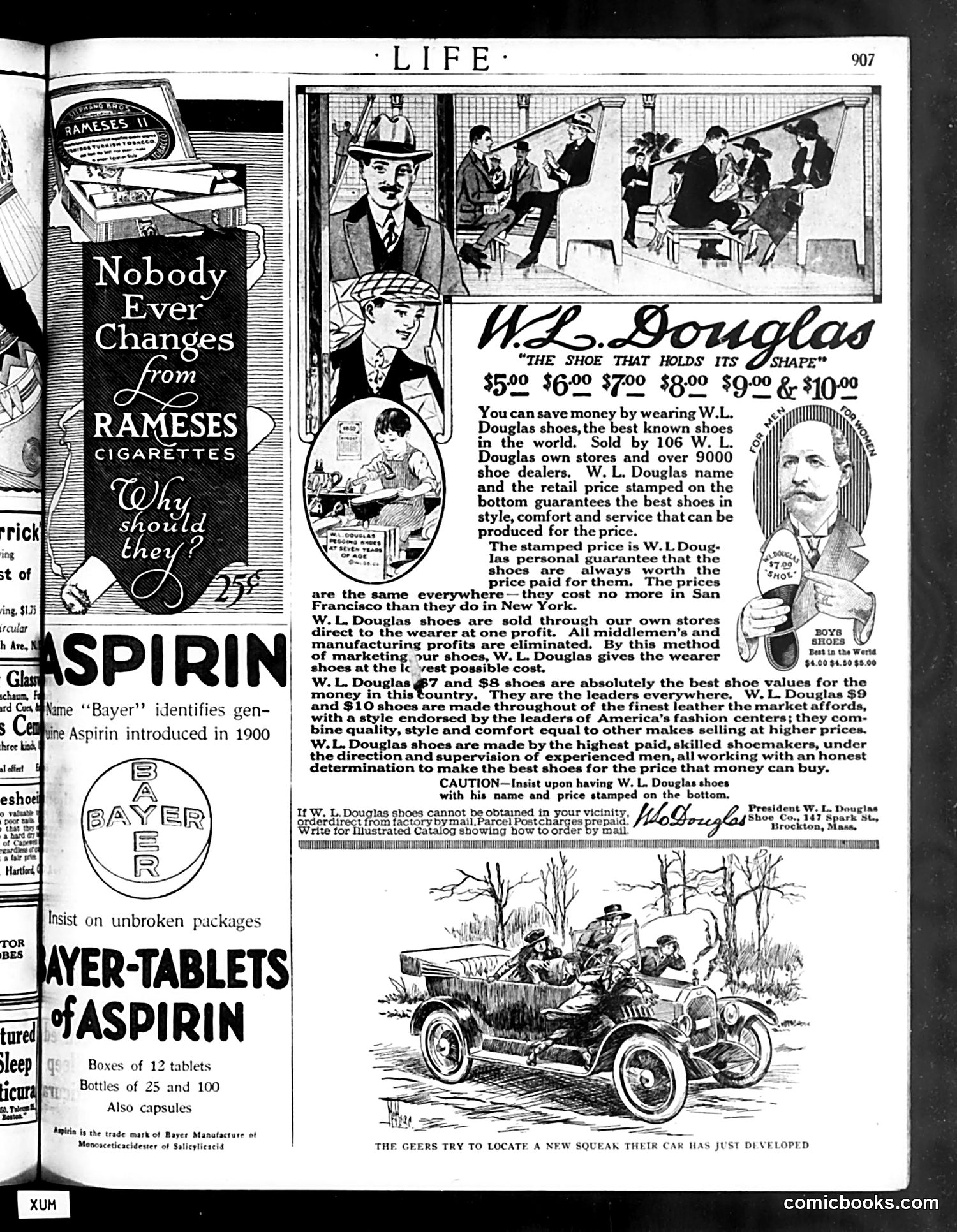
This page is primarily **advertising**, not political satire. The dominant content is a W.L. Douglas shoe advertisement promoting their direct-to-consumer sales model and fixed pricing across the country—a notable business practice for the era. Below the shoe ad are smaller advertisements for Bayer Aspirin tablets and Rameses cigarettes. At the bottom is a **cartoon** titled "The Geers Try to Locate a New Squeak Their Car Has Just Developed"—a humorous domestic scene showing a family in an early automobile trying to identify an annoying mechanical noise. This is simple visual humor about the unreliability of early cars, not political commentary. The page reflects early 20th-century consumer culture: brand-name products, mail-order purchasing, and the novelty of automobile ownership.
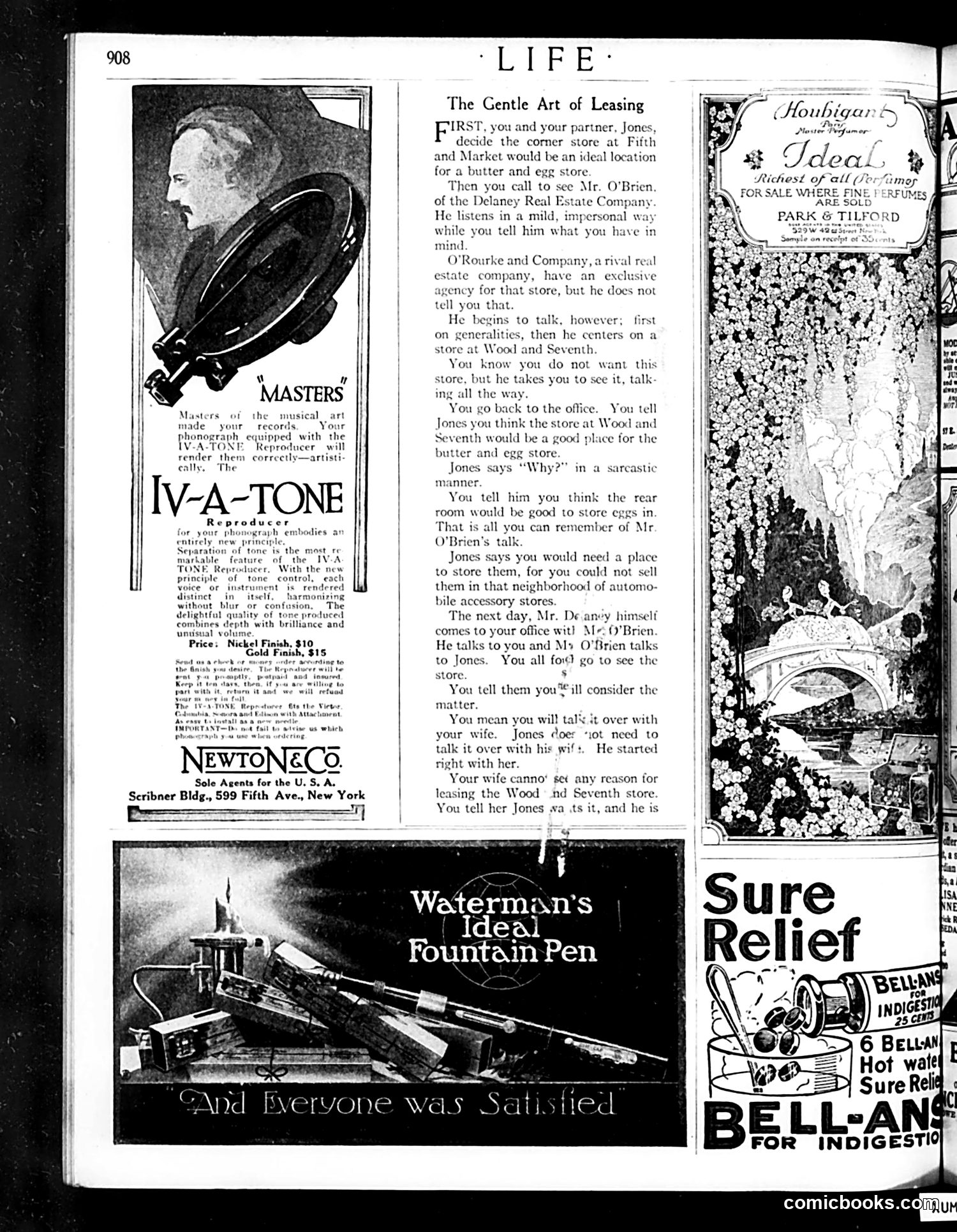
This page is primarily **advertising**, not political satire. The main content is "The Gentle Art of Leasing"—a humorous short story about commercial real estate negotiations in early 20th-century New York. The narrative satirizes the manipulative tactics of real estate agents: Mr. O'Brien uses mild-mannered persuasion and misdirection to interest a prospective tenant in a store location (Wood and Seventh), despite the tenant's original interest elsewhere. The humor lies in how the agent steers the client's thinking while appearing helpful. The social satire is gentle: it pokes fun at the persuasive games played in business deals and suggests men more readily commit to decisions than women do (Jones doesn't need to consult his wife; the protagonist does). The surrounding advertisements—IV-A-TONE phonograph reproducer, Waterman's fountain pens, Houbigant perfume, and Bell-Ans indigestion remedy—are typical of Life's era, targeting middle-class professionals conducting such business.
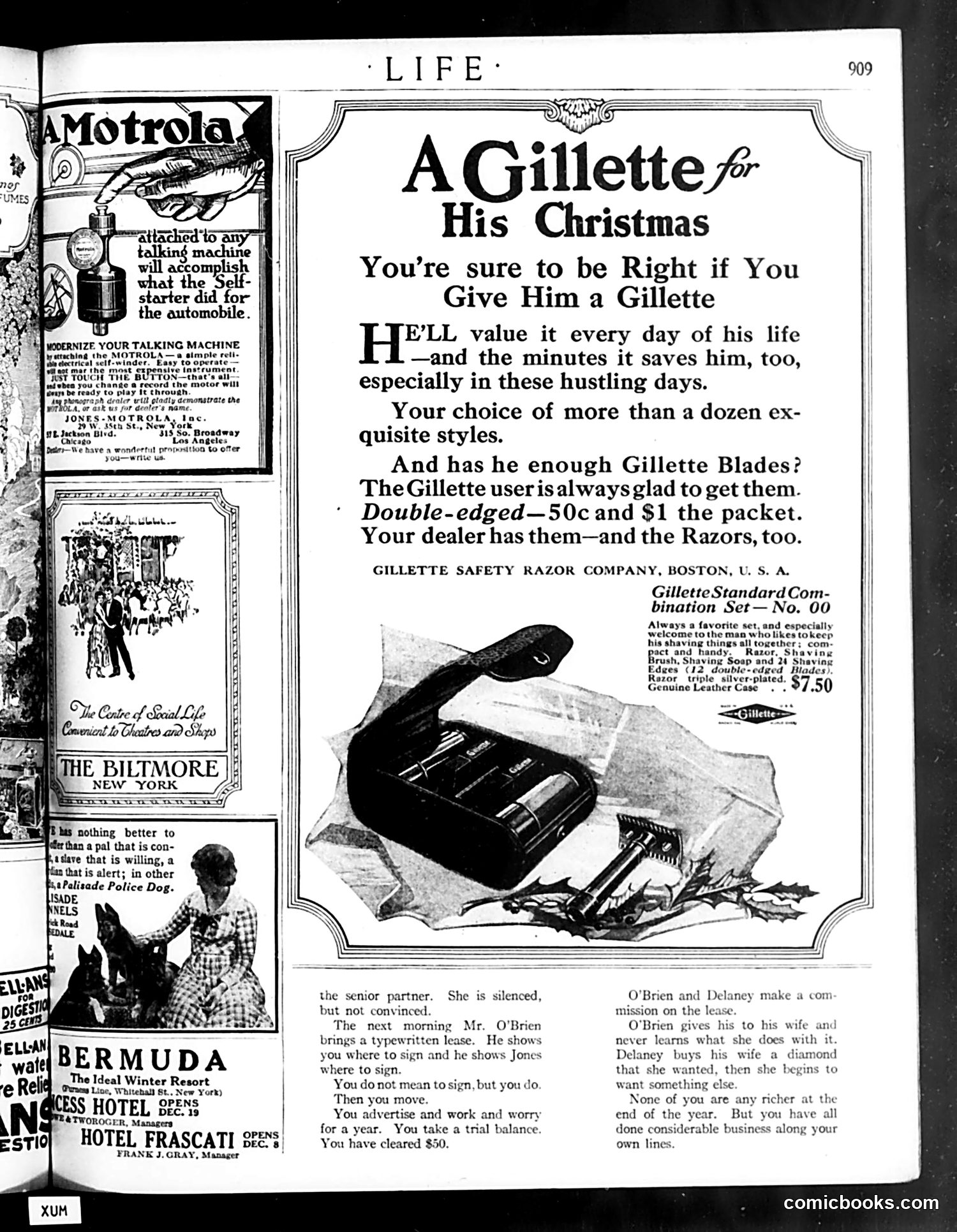
This page is primarily **advertising-focused** rather than satirical content. The main feature is a Gillette Safety Razor Company Christmas gift advertisement, occupying the right half of the page. The ad targets male readers by emphasizing that a Gillette razor is a practical, appreciated gift—one that provides daily utility during "hustling days." It showcases the "Standard Combination Set" with multiple blades and accessories, priced at $7.50. The left sidebar contains **unrelated advertisements**: a Motorola attachment for talking machines, The Biltmore hotel, a police dog endorsement, Bermuda resort promotion, and hotel listings. Below the Gillette ad runs **narrative text** describing a business scenario involving lease agreements and the distribution of commissions to wives—a modest social commentary on how business dealings affect family finances, though this appears to be continuing fiction from another page rather than original satire. The page reflects early 1920s consumer marketing: practical gift-giving advice for men and product endorsements targeting middle-class readers.
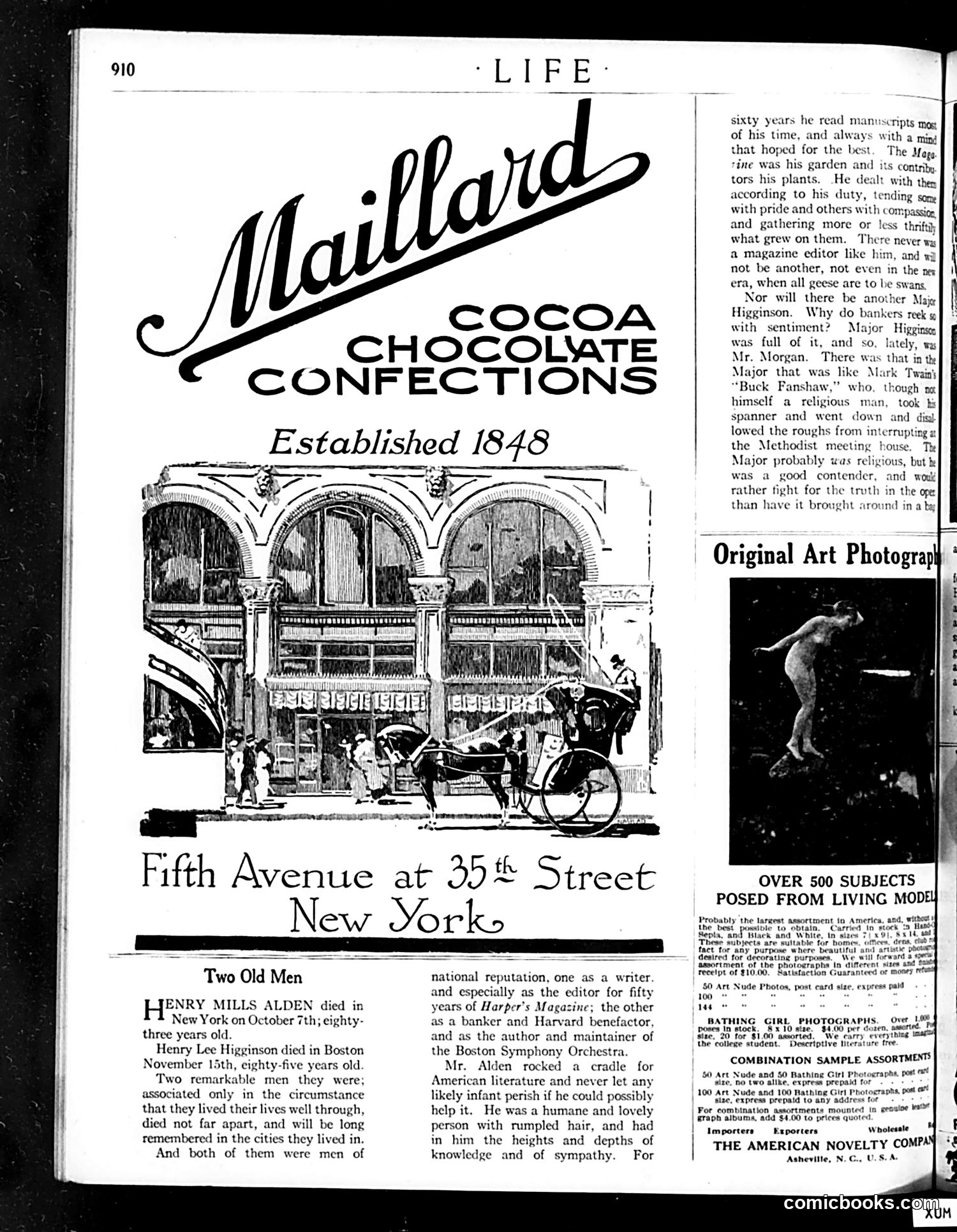
This page is primarily **advertising and obituary content**, not satire or political commentary. The dominant feature is a **Maillard Cocoa Chocolate advertisement** (established 1848) showcasing their Fifth Avenue storefront in New York with period-appropriate architectural detail. Below that are **obituaries for two prominent American figures**: Henry Mills Alden (editor of Harper's Magazine for 50 years) and Henry Lee Higginson (Boston banker, Harvard benefactor, and founder of the Boston Symphony Orchestra). The text celebrates both as men of "national reputation" who lived exemplary lives contributing to American culture and institutions. The remaining content consists of **period advertisements** for art photographs and novelty items—typical commercial filler for early 20th-century magazine pages. There is **no political cartoon or satirical content** visible. This appears to be a standard magazine page blending paid advertising with editorial tributes to notable deceased citizens.
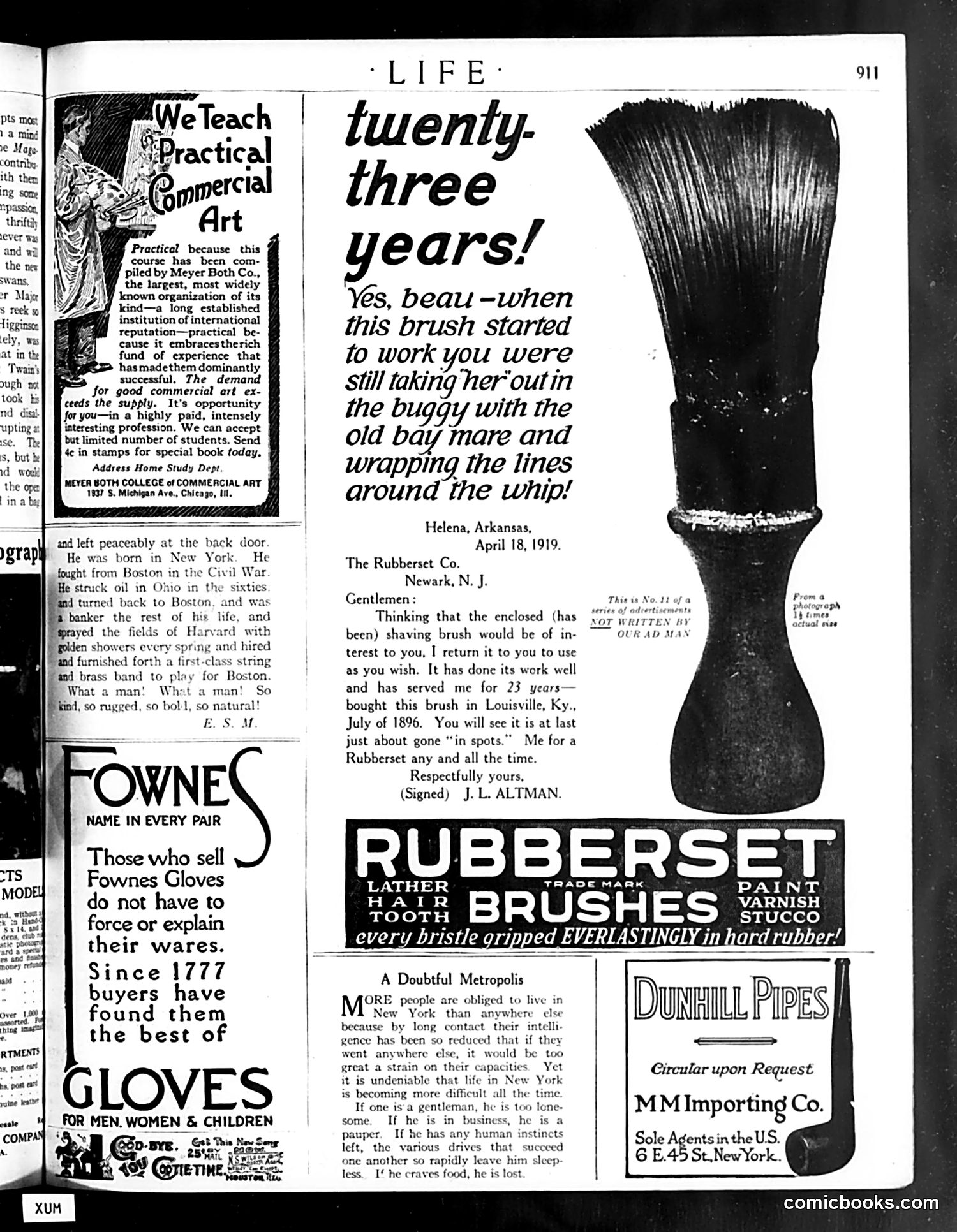
This page is primarily **advertising**, not political satire. It contains four commercial ads with one humorous testimonial letter. The main content is a **Rubberset Brushes advertisement** featuring a letter from J.L. Altman of Helena, Arkansas, dated April 18, 1919. Altman humorously returns his 23-year-old shaving brush, claiming it still works despite showing wear spots. The joke's appeal lies in the product's extreme durability—he bought it in 1896 and it's barely worn out by 1919. The humor is gentle: Altman jokingly reminisces that when the brush started working, his correspondent was still courting in a buggy with a horse. This nostalgic reference marks the rapid modernization of American life in the early 20th century. Other ads promote **Fownes Gloves** (established 1777), **Meyer Roth Commercial Art College**, and **Dunhill Pipes**. The page reflects typical 1919 magazine advertising emphasizing product longevity and tradition as selling points.
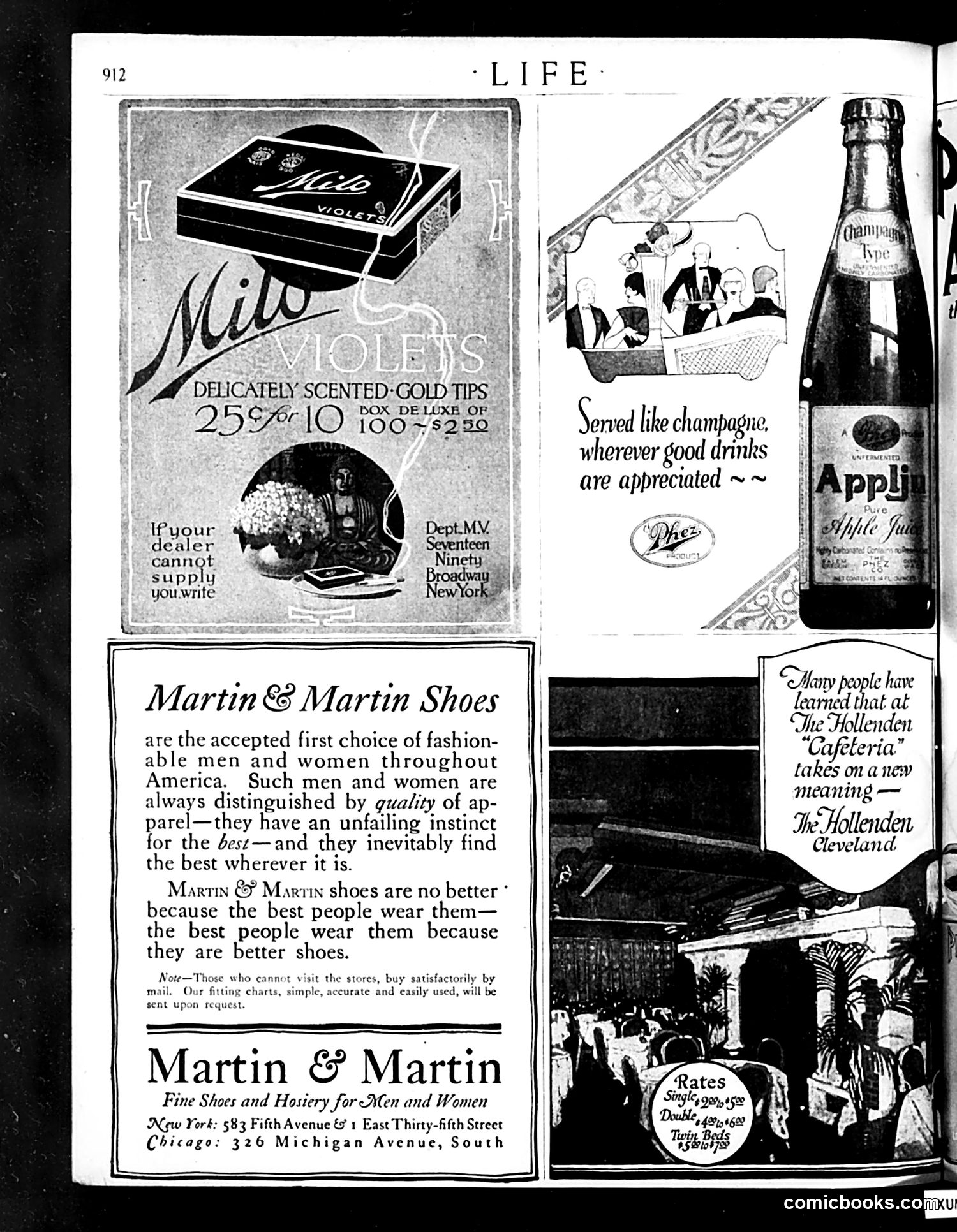
This is primarily an **advertising page**, not a satirical cartoon page. It contains four commercial advertisements typical of early 20th-century American magazines: 1. **Milo Violets** (top left): Delicately scented cigars with gold tips, priced 25¢ individually or boxes of 10/100 for $2.50. 2. **Phez Apple Juice** (top right): Positioned as a champagne alternative for social occasions, marketed to the affluent. 3. **Martin & Martin Shoes** (bottom left): A luxury shoe brand claiming to be the choice of fashionable Americans, with stores in New York and Chicago. 4. **The Hollenden Cafeteria** (bottom right): A Cleveland establishment advertising its novel "cafeteria" concept as something noteworthy. The page reflects **early 1900s marketing to upper-class consumers**, emphasizing quality, refinement, and social status. There is no political satire present—this is straightforward commercial content targeting wealthy readers of *Life* magazine.
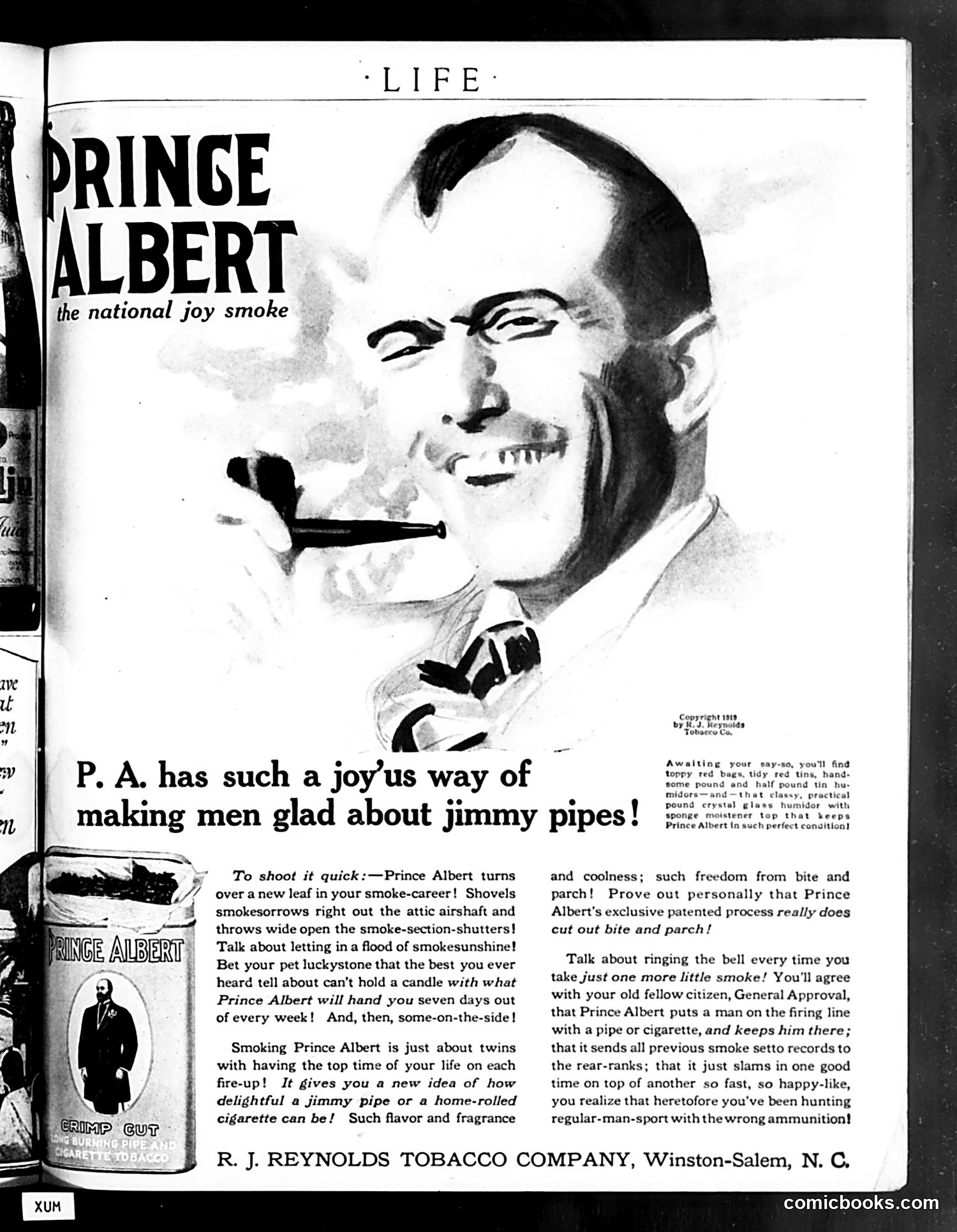
This is a **tobacco advertisement**, not political satire. It promotes Prince Albert pipe tobacco and cigarettes from R.J. Reynolds (1919). The illustration shows a man smoking contentedly—likely meant to represent an idealized consumer or possibly a celebrity endorsement (the "Prince Albert" brand name itself). The text uses exuberant, almost absurdist language typical of early 20th-century advertising: smoking will transform your life, eliminate "smoke-sorrows," and provide endless enjoyment. The phrase "General Approval" appears to personify public consensus. **For modern readers**: This reflects pre-regulation tobacco marketing, when cigarettes were advertised directly in mainstream magazines with extravagant health/happiness claims. The enthusiastic tone and promises of life-changing pleasure would now be illegal advertising. The emphasis on different package formats (tins, humidors) highlights how smoking was then a normalized, socially celebrated practice worthy of premium packaging.
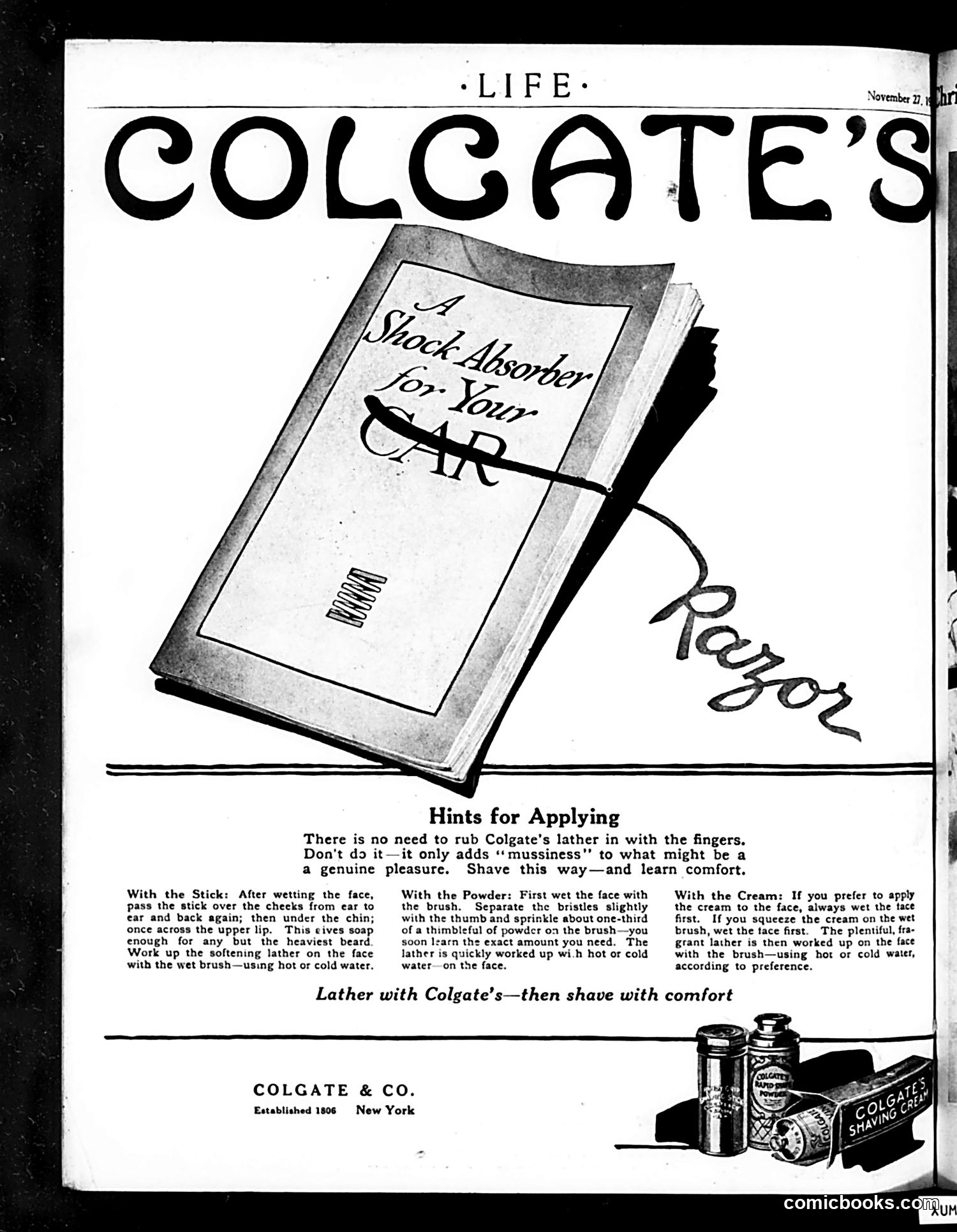
This is a **product advertisement**, not satire or political commentary. The page promotes Colgate's shaving lather products (available in stick, powder, and cream forms) to early 20th-century male consumers. The central image shows a box of Colgate's shaving cream with text crossed out reading "A Shock Absorber for Your Car" — a humorous visual joke suggesting that quality lather provides comfort comparable to automotive shock absorption, emphasizing the product's cushioning properties during shaving. The detailed "hints" section below provides practical application instructions for three different Colgate formulations, emphasizing ease of use and comfort. The tagline "Lather with Colgate's—then shave with comfort" reinforces the brand's core selling point. The advertisement targets men's grooming habits and reflects early 1900s consumer marketing that emphasized modern convenience and comfort in personal hygiene products.