
Life, 1919-11-27 · page 20 of 36
Life — November 27, 1919 — page 20: what you’re looking at
What you’re looking at
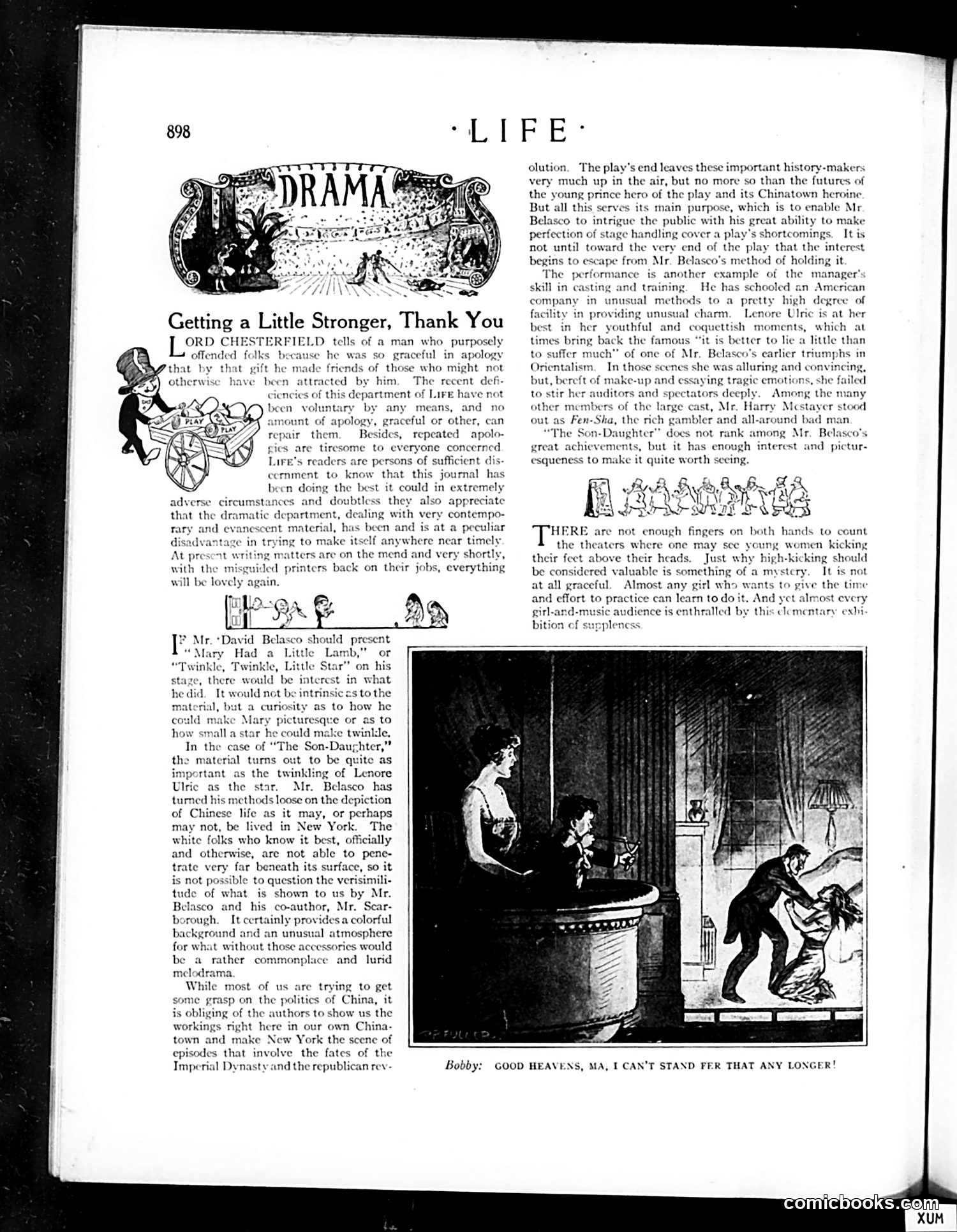
This page reviews David Belasco's theatrical production "The Son-Daughter," a melodrama set in New York's Chinatown. The critic praises Belasco's directorial skill in staging and his ability to train actors, particularly actress Lenore Ulric, who performs both seductive and tragic scenes. The accompanying photograph shows a scene from the play featuring what appears to be Ulric in character interacting with another performer in a Chinatown setting. The editorial opening addresses Life's recent production delays, apologizing for inconsistent output while defending the magazine's efforts during difficult circumstances—likely wartime-related printing challenges. The critic notes that while "The Son-Daughter" lacks profound artistic merit, it succeeds as entertaining spectacle with sufficient interest and visual appeal to warrant viewing. The sidebar commentary critiques the popularity of high-kicking dance numbers in theaters, dismissing them as neither graceful nor difficult to learn, yet acknowledging their audience appeal.
📄 Transcribed text from this page (OCR, searchable)
Machine-transcribed from the original scan — historical spelling and the odd misread are preserved.
Getting a Little Stronger, Thank You D tells of a man who purposely he was so graceful in apology friends of those who might not attracted by The recent defi- ciencies of this dep nent of Lire ha t been voluntary by any means, and no not . graceful or other, can repair repeated apolo- gies are tiresome yone concerned Lire’s readers are persons of sufficient dis- nment to know that this journal has been doing the best it could in extremely nd doubtless they also apprec tment, dealing with very contempo- terial, has been and is at a peculiar to make itself anywhere near timely, are on the mend and very shortly, d printers back on their jobs, everything m. adverse circumstances that the dramatic de rar disadva z At present w with the r will be lovel: nd leaves these important history-makers ir, but no more so than the futures of » of the play and its Chinatown heroine which is to enable Mr ue the public with his great ability to make ection of stage handling cover a play's shortcomings. It is not until toward the very end of th ) it the interest begins to escape from Mr. Belasco’s method of holding it olution, The play's very much up in the the young prince he But all this serves its main purpc The performance is another example of the manager's skill in cas 1 training. He has schooled an American unusual methods to a pretty high degree of company in facility in provi best her youthful times bring back the fa Ulric is at he unusual charm. Lenore and coquettish moments, which at jous “it is better to lie a little than to suffer n”’ of one of Mr. Belasco’s earlier triumphs in Orientali: In those scenes she was alluring and convin but, bereft of make-up and essaying tragic emotion to stir her auditors and spectators deeply. Among the many other members of the large cast, Mr. Harry Mcstayer stood out as Fen-Sha, the rich gambler and all-around bad man Son-Daughter™ docs not rank among Mr. Belasco’s great achievements, but it has enough interest and pictur- esqueness to make it quite worth seeing. zers on bot you HERE are not enough fi hands to count the theaters where one may y women kicking their fe nove their head Just why high-kicking should be considered valuable is something of a mystery. It is not at all graceful. Almost any girl who wants to give the time and effort to practice can learn to do it. And yct almost every girl-and-n c audience is enthralled by thi bition of supplencss elementary exhi Had a Twin! * on his stage, there would be interest in what ne did. It would not be intrinsiccs to the , but a curiosity as to how he i Mary picturesque or as to how smalla star he could make twinkle. In the case of “The Son-D; > mi naterial turns to be t as the twinkling of Lenore as the star. Mr. Belasco has turned his methods loose on the depiction of Chinese life as it may, or perhaps may not, be lived in New York. The white folks who know it best, officially and otherwise, are not able to pene- trate very far beneath its surface, so it is not possible to question the verisimili- tude of what is shown to us by Mr. Belasco and his co-author, Mr. Scar- borough. It certainly provides a colorful background and an unusual atmosphere for what without those accessories would be a rather commonplace and lurid melodrama. While most of us are trying to get me grasp on the politics of China, it is obliging of the authors to show us the workings right here in our own China town and make New York the scene o episodes that involve the fates of the Imperial Dynasty and the republican rev- Bobby: GOOD HEAVENS, MA, I CAN'T STAND FER THAT ANY LONGER!