
Life, 1919-11-27 · page 16 of 36
Life — November 27, 1919 — page 16: what you’re looking at
What you’re looking at
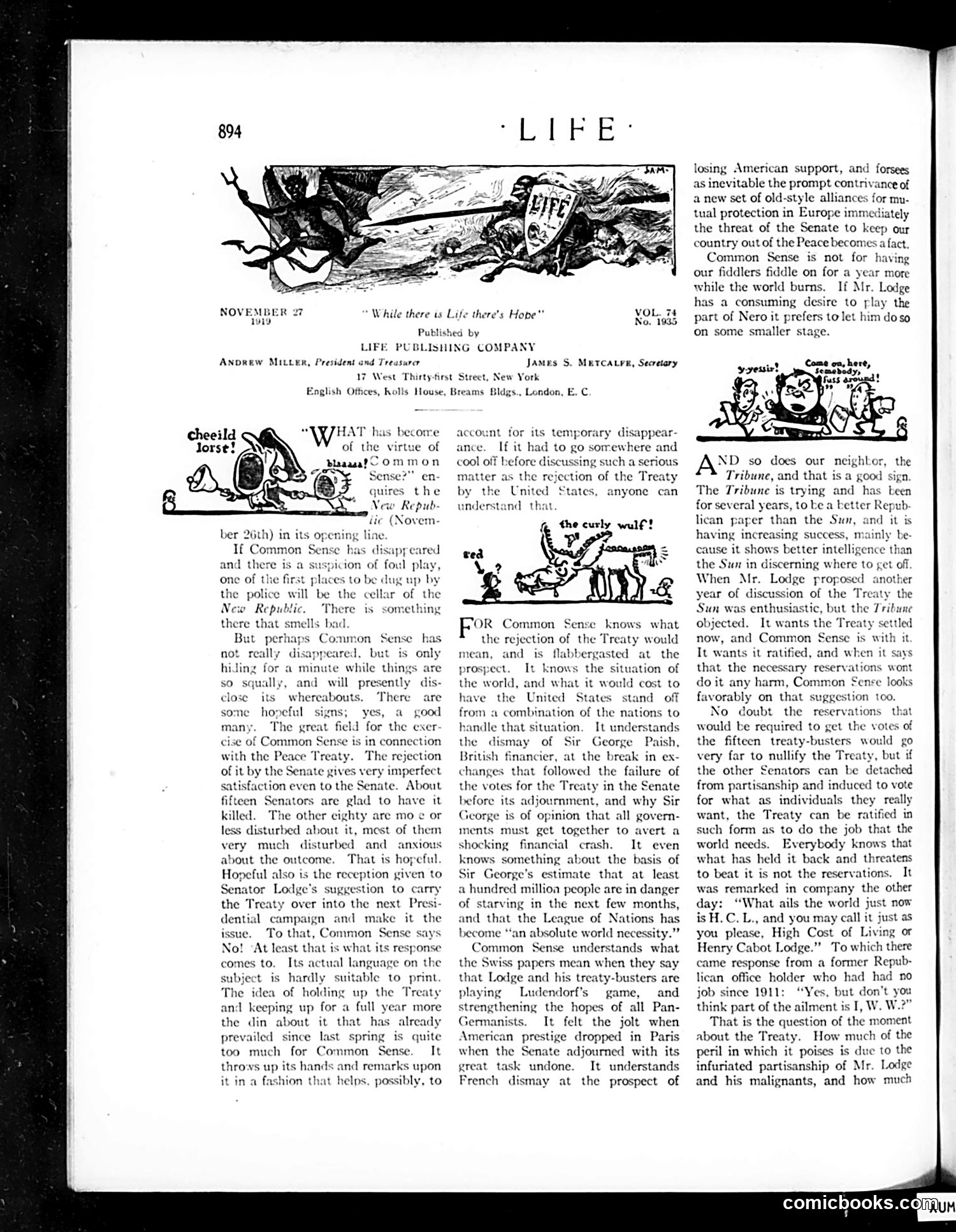
This 1919 *Life* magazine editorial attacks Senator Henry Lodge and opponents of the League of Nations Treaty, which the Senate had just rejected. **The cartoon's targets:** Lodge and "treaty-busters" who delayed ratification; the editorial mocks their obstruction as playing "Ludendorf's game" (helping German interests). **The satire's point:** Common Sense has "disappeared"—vanished from American politics. The editorial argues Lodge's proposal to defer the Treaty to the next presidential election is absurd during a global crisis. It catalogs real consequences: financial collapse, potential starvation of millions, loss of American prestige in Europe, and the breakdown of post-war stability. **The dig:** Lodge is compared to Nero (fiddling while Rome burned), suggesting narcissistic recklessness. The editorial praises the *Tribune* newspaper for better judgment than the *Sun*. This reflects the bitter 1919-1920 debate over American isolationism versus internationalism that ultimately kept the U.S. out of the League of Nations.
📄 Transcribed text from this page (OCR, searchable)
Machine-transcribed from the original scan — historical spelling and the odd misread are preserved.
NOVEMBER 27 "While vig Publish PUBLISHING COMPANY LIFE ANDREW MILLER, President and Treasurer re is Life th hed by James S. METCALPR, Secretary 17 West Thirty-tirst Street, New York House, Bre se HAT has become quires the Vew Repub- dic (Novem- ber 26th) in its opening line. mon Sense has disappeared cion of foul pla: places to be dug up by 0 Republic. there that sme But pe mon Sense h not really disappeared. but is only hiding for a minute while things are so squally, and will present! close its whereabouts. There are some hopeful signs; ye: good many. The great field for the exer cise of Common Sense is in connection with the Peace Treaty. The rejection of it by the Senate gives very imperfect satisfaction even to the Senate. About fifteen Senators are glad to have it killed. The other cigh © mo ¢ or less disturbed about it, mest of them very much disturbed and anxious about the outcome. That is hopeful Hopeful also is the reception given to Senator Lodge's suggestion to carry the Treaty over into the next Presi- dential campaign and make it the issue. To that, Common Sense says No! At least that is what its response comes to. Its actual language on the bject is hardly suitable to print The idea of holding up the Treaty and keeping up for a full year more the din about it that prevailed since last spring is quite too much for Common Sense. It throws up its hands and remarks upon it ina fashion that helps. possibly, to dis- has. ms Bldgs., London, E. C account for its temporary disappear- If it had to go somewhere and hefore discussing such a serious ction of the Tr States, anyone ance. s the rej 5 United understand t can For Common Sense knows what the rejection of the Treaty would and is flabbergasted at the prospect. It knows the situation of the world, and what it would cost to have the United States stand off from a combination of the nations to handle that situation. It understands the dismay of Sir George Paish, British financier, at the break in ex changes that followed the failure of the votes for the Treaty in the Senate before its adjournment, and why George is of opinion that all govern- ments must get together to avert a shocking financial crash. It even knows something about the ba of Sir George’s estimate that at least a hundred million people are in danger of starving in the next few month: and that the League of Nations has become ‘‘an absolute world necessity.” Common Sense understands what the Swiss papers mean when they say that Lodge and his treaty-buste: playing Ludendorf’s game, strengthening the hopes of all Pan- Germanists. It felt the jolt when American prestige dropped in Paris when the Senate adjourned with its great task undone. It understands French dismay at the prospect of mean, losing American support, and forsees as inevitable the prompt contrivance of a new set of old-style alliances for mu- tual protection in Europe immediately the threat of the Senate to keep our country out of the Peace beco: afact, Common Sense is not for having our fiddlers fiddle on for a year more while the world burns. If Mr. Lodge has a consuming desire to play the part of Nero it prefers to let him doso on some smaller stage. ND so does our neighkor, the Tribune, and that is a good sign he Tribune is trying and has been for several years, to ke a better Repub. li aper t the Sw, and it is having increasing success, mainly be- cause it shows better intelligence t the Sun in discerning where to get off When Mr. Lodge proposed another year of dis ion of the Treaty t Sun was enthusiastic, but the Tribune objected. It wants the Tre: tled now, and Common Sense is with it It wants it ratified, and when it says that the necessary reservations wont do it any harm, Common Sense looks favorably on that su ion 100. No doubt the reservations th would be required to get the votes the fifteen treaty-busters would go very far to nullify the Treaty, but if the other Senators can be detached from partisanship and induced to vote for what as individuals they really want, the Treaty can be rat i such form as to do the job that the world needs. Everybody knows that what has held it back and threatens to beat it is not the reservations. It was remarked in company the other day: “What ails the world just now is H.C. L., and you may call it just as you please, High Cost of Living or Henry Cabot Lodge.” To which there ame response from a former Repub- lican office holder who had had no job since 1911: “Yes, but don’t you think part of the ailment is I, W. W That is the question of the moment about the Treaty. How much of the peril in which it poi is due to the infuriated partisanship of Mr. Lodge and his malignants, and how much comicbooks.comm