
A complete issue · 40 pages · 1919
Life — August 28, 1919
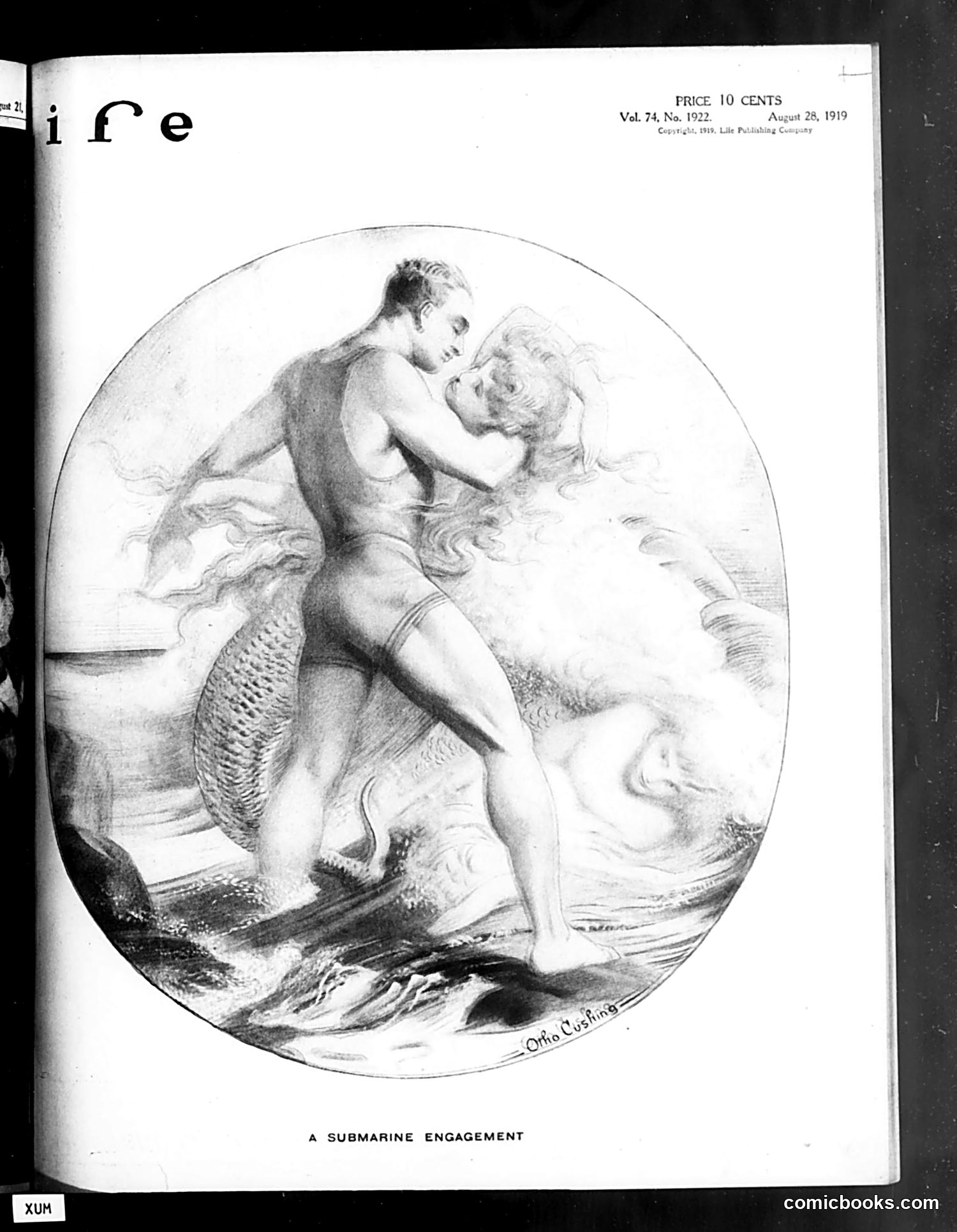
This artwork depicts a classical allegorical scene showing a cherub or cupid figure engaged with a mermaid or sea creature. The title "A Submarine Engagement" is a double entendre playing on the word "engagement" — both a romantic commitment and a military confrontation. Given the 1919 publication date, this likely references World War I's recent conclusion and the submarine warfare that devastated Allied shipping. The satire juxtaposes romantic/amorous imagery with military terminology, possibly mocking romantic notions about wartime or making crude jokes about naval combat. The classical artistic style and mythological figures were typical of Life's satirical approach to contemporary events. The artist's signature appears to read "Orlo C. Osling."
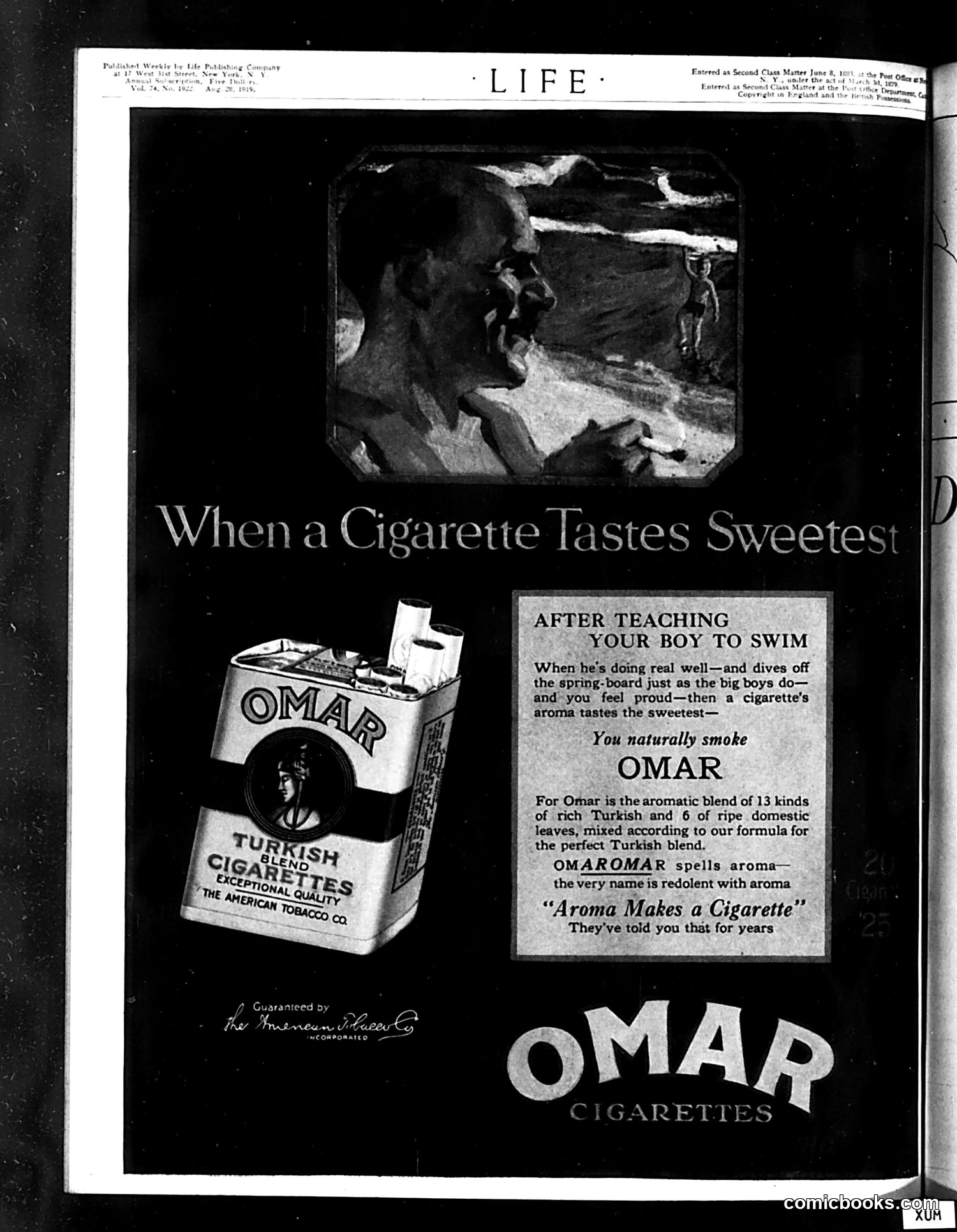
This page is **primarily a cigarette advertisement**, not political satire. It advertises Omar Turkish Cigarettes, prominently featuring the product packaging and brand name. The ad's tagline is "When a Cigarette Tastes Sweetest," accompanied by a black-and-white photograph showing a man smoking, apparently after teaching a boy to swim. The accompanying text emphasizes that after accomplishing something prideful—like coaching your son in diving—a cigarette "tastes the sweetest." The secondary text box highlights Omar's composition: a blend of Turkish and domestic tobacco leaves. The phrase "Aroma Makes a Cigarette" serves as the campaign's slogan. This represents vintage tobacco marketing, which today would be considered unethical due to its casual association of smoking with paternal pride and personal achievement.
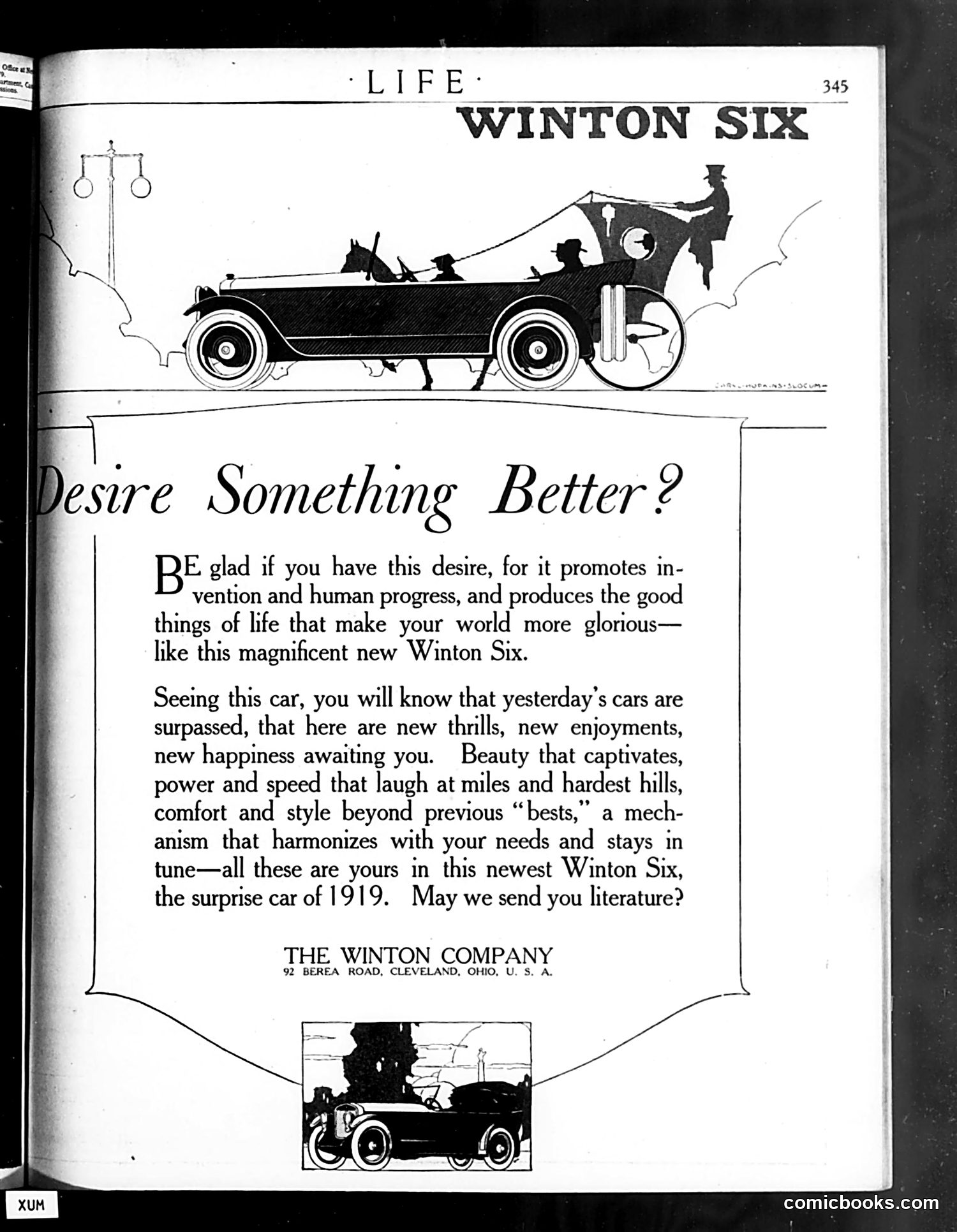
This is primarily a **Winton automobile advertisement**, not political satire. The page presents the "Winton Six" car as a 1919 innovation, using rhetoric of progress and desire to market the vehicle. The headline "Desire Something Better?" appeals to consumer aspiration, framing car ownership as evidence of ambition and good taste. The ad emphasizes modern features—"power and speed," "beauty," "comfort and style"—positioning this car as superior to predecessors. The illustration shows an elegant open-air touring car with well-dressed passengers. A small secondary image depicts the car in action on a country road. This reflects early-20th-century American advertising that conflated **material consumption with progress and personal virtue**—a common marketing strategy of the era.
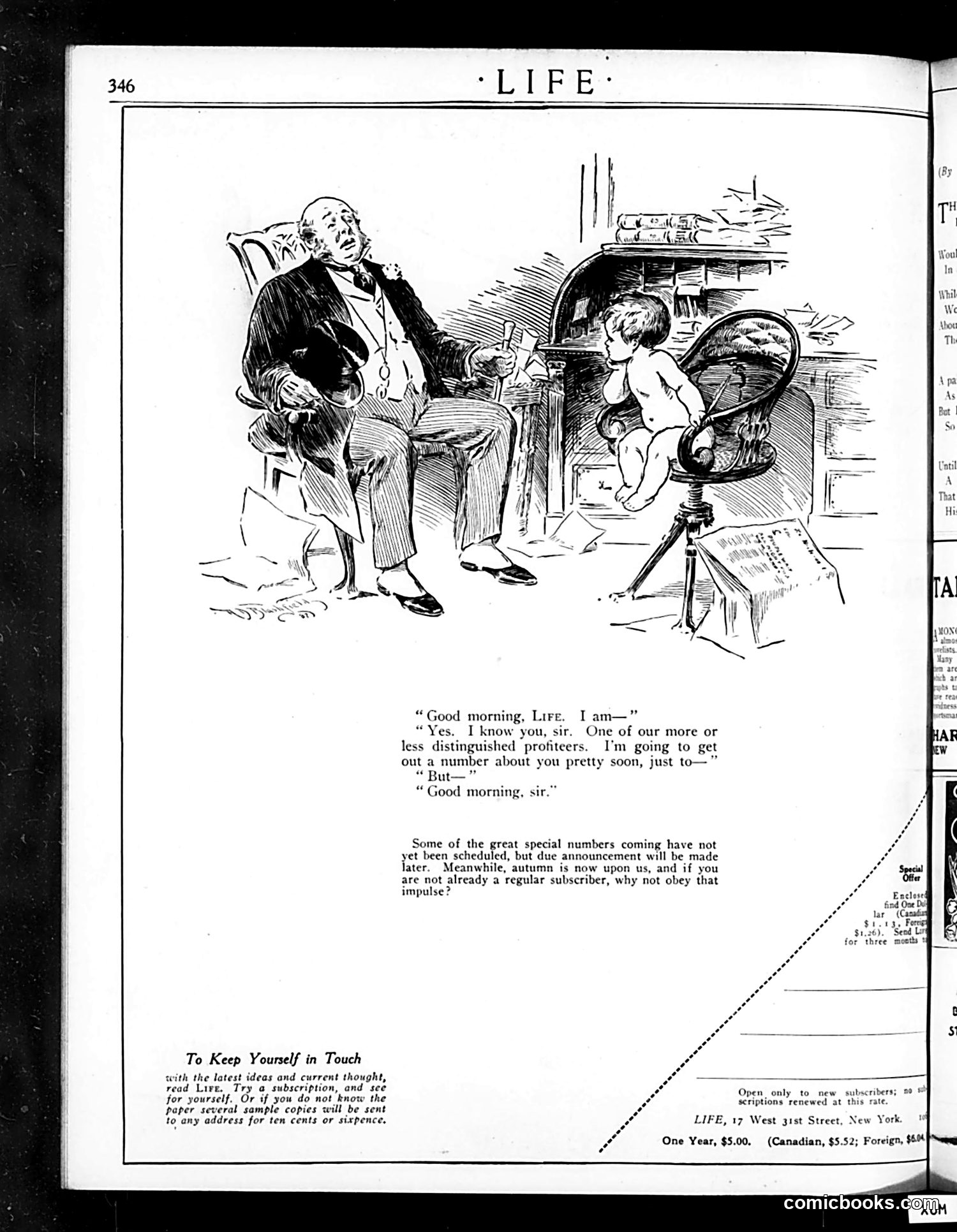
This page contains a satirical cartoon about magazine subscription practices. A well-dressed man (representing a magazine editor or publisher) sits at his desk speaking to a cherub-like figure labeled "LIFE" (the magazine's personification). The joke plays on the editor's candid admission: he recognizes LIFE as "one of our more or less distinguished profiteers" and plans to get out "a number about you pretty soon, just to—" before awkwardly stopping himself. The implication is that the magazine cynically plans to feature itself to boost subscriptions and profits, rather than for genuine editorial merit. Below, text encourages readers to subscribe, reinforcing the satirical point about LIFE's self-promotional tactics. The cartoon mocks publishing industry opportunism and the blurred line between editorial content and advertising.
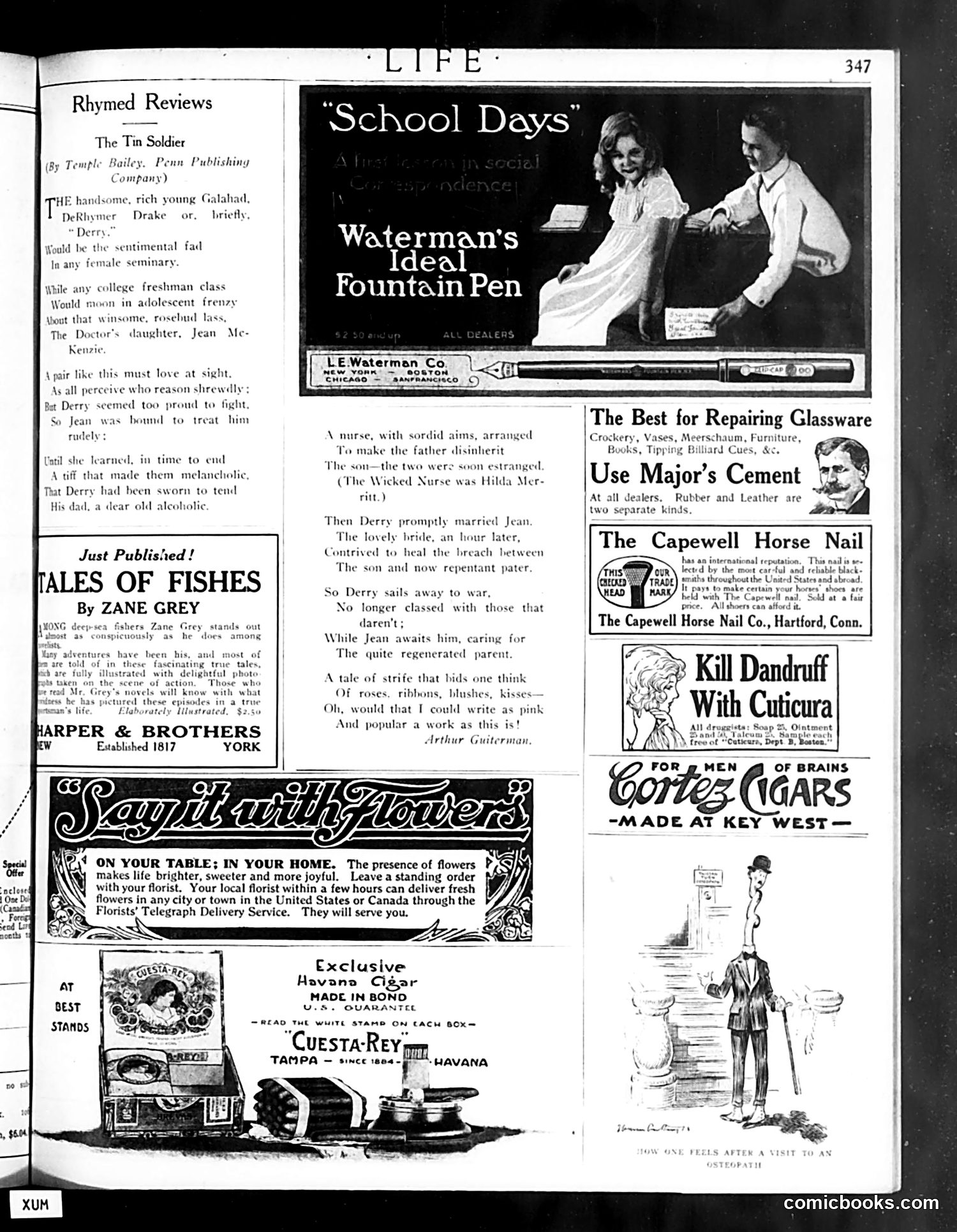
This page is **primarily advertising** with minimal editorial content. The main items are: 1. **"School Days" advertisement** for Waterman's Ideal Fountain Pen, featuring two young people in a school setting—a standard product pitch using relatable imagery. 2. **"Rhymed Reviews"** column reviewing "The Tin Soldier" by Zane Grey's publisher, using light verse about romantic entanglements. 3. **Product advertisements** for mundane items: Major's Cement, Capewell Horse Nails, Cuticura (dandruff treatment), Cortez Cigars, and Cuesta-Rey cigars. 4. **A cartoon** (bottom right) titled "How One Feels After a Visit to an Osteopath"—social satire about the physical effects of chiropractic treatment, showing a disheveled man. The page reflects early-20th-century consumer culture with minimal political content.
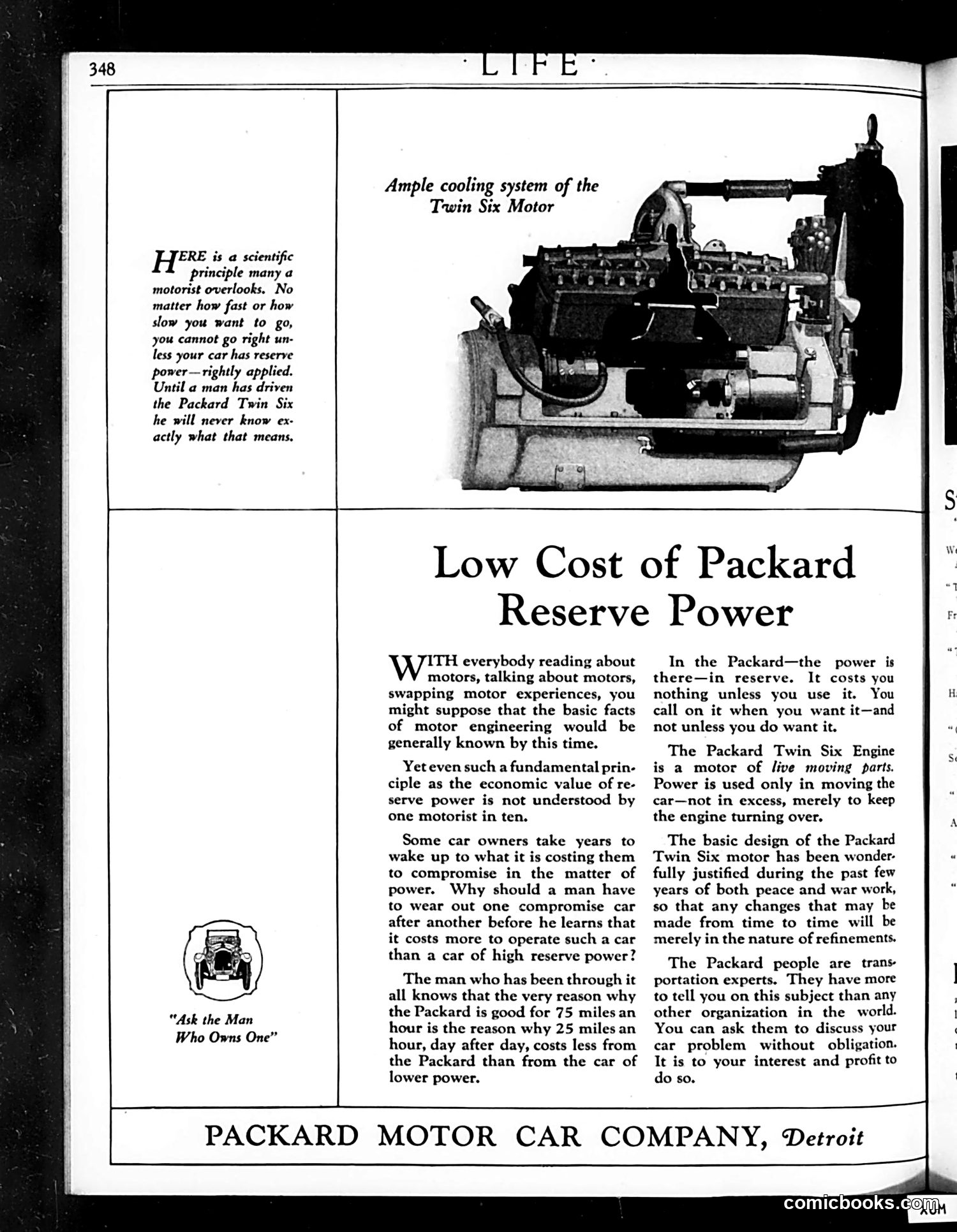
This page is **primarily an advertisement**, not satire or editorial content. It's a Packard Motor Car Company ad promoting their Twin Six engine, specifically its "reserve power" system. The ad argues that having extra engine power held in reserve—power you don't constantly use—is economical. The cooling system diagram demonstrates engineering sophistication. The text emphasizes that Packard's design uses power efficiently: "Power is used only in moving the car—not in excess, merely to keep the engine turning over." The small illustration labeled "Ask the Man Who Owns One" was apparently Packard's slogan, inviting potential buyers to consult current owners. There is **no political cartoon or satire** on this page—it's straightforward automotive marketing from Detroit.
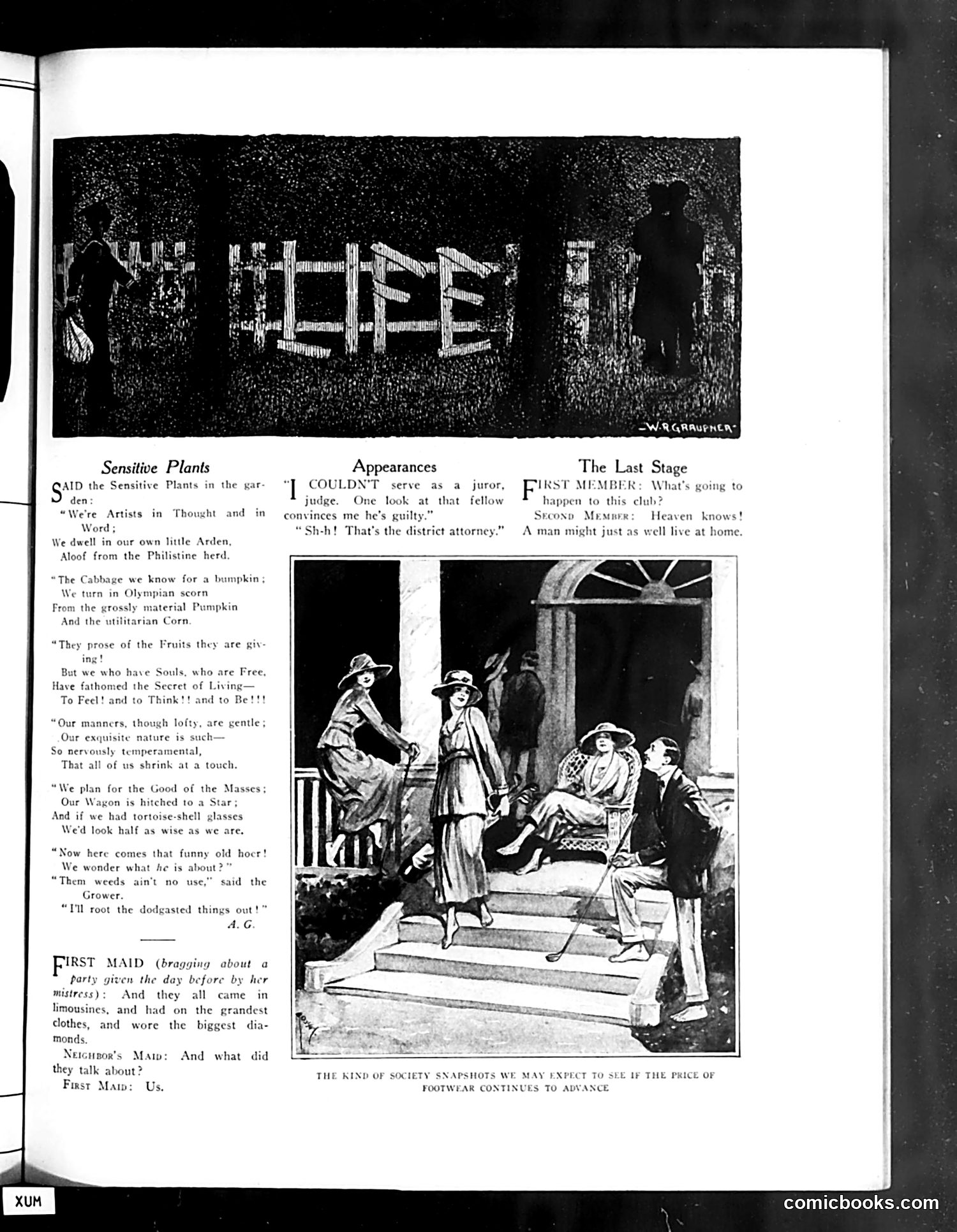
This page contains three separate satirical pieces mocking upper-class pretension and social climbing. "Sensitive Plants" ridicules wealthy people who pose as artistic intellectuals while living privileged lives removed from reality—they discuss philosophy and art while benefiting from material comforts. "First Maid" satirizes servant gossip about their employers' extravagant parties, highlighting the gap between wealthy people's self-importance and servants' indifferent observations. "The Last Stage" appears to mock theatrical or social performances, suggesting artificiality in how the wealthy present themselves. The illustration shows people in formal dress on what appears to be a porch, captioned to suggest society photographs documenting fashionable footwear trends—poking fun at how trivial upper-class concerns appear to ordinary observers.
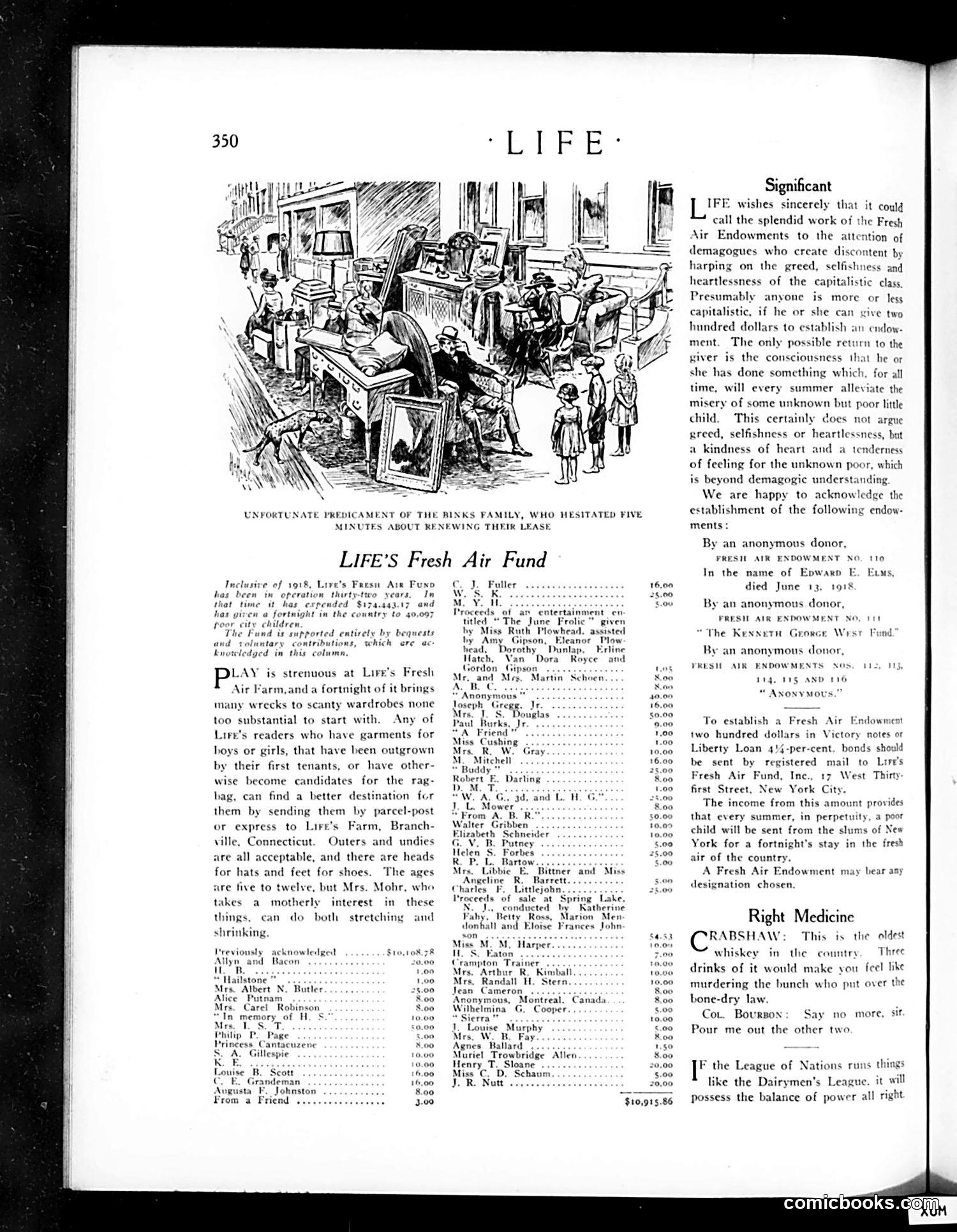
This page combines charitable fundraising with satirical commentary. The main cartoon depicts a crowded tenement scene labeled "UNFORTUNATE PREDICAMENT OF THE RISKS FAMILY, WHO HESITATED FIVE MINUTES ABOUT RENEWING THEIR LEASE." The satire targets landlords and capitalist exploitation: a working-class family faces eviction for hesitating to renew their lease, suggesting predatory rental practices. The accompanying editorial defends the "Fresh Air Fund" — a real charity providing poor children summer relief. The text ironically critiques capitalists' "greed, selfishness and heartlessness," arguing only charitable conscience can address poverty the system creates. Detailed donation lists follow, showing how readers could contribute to help poor children escape urban tenements. The satire's point: capitalism creates misery; only charity mitigates it.
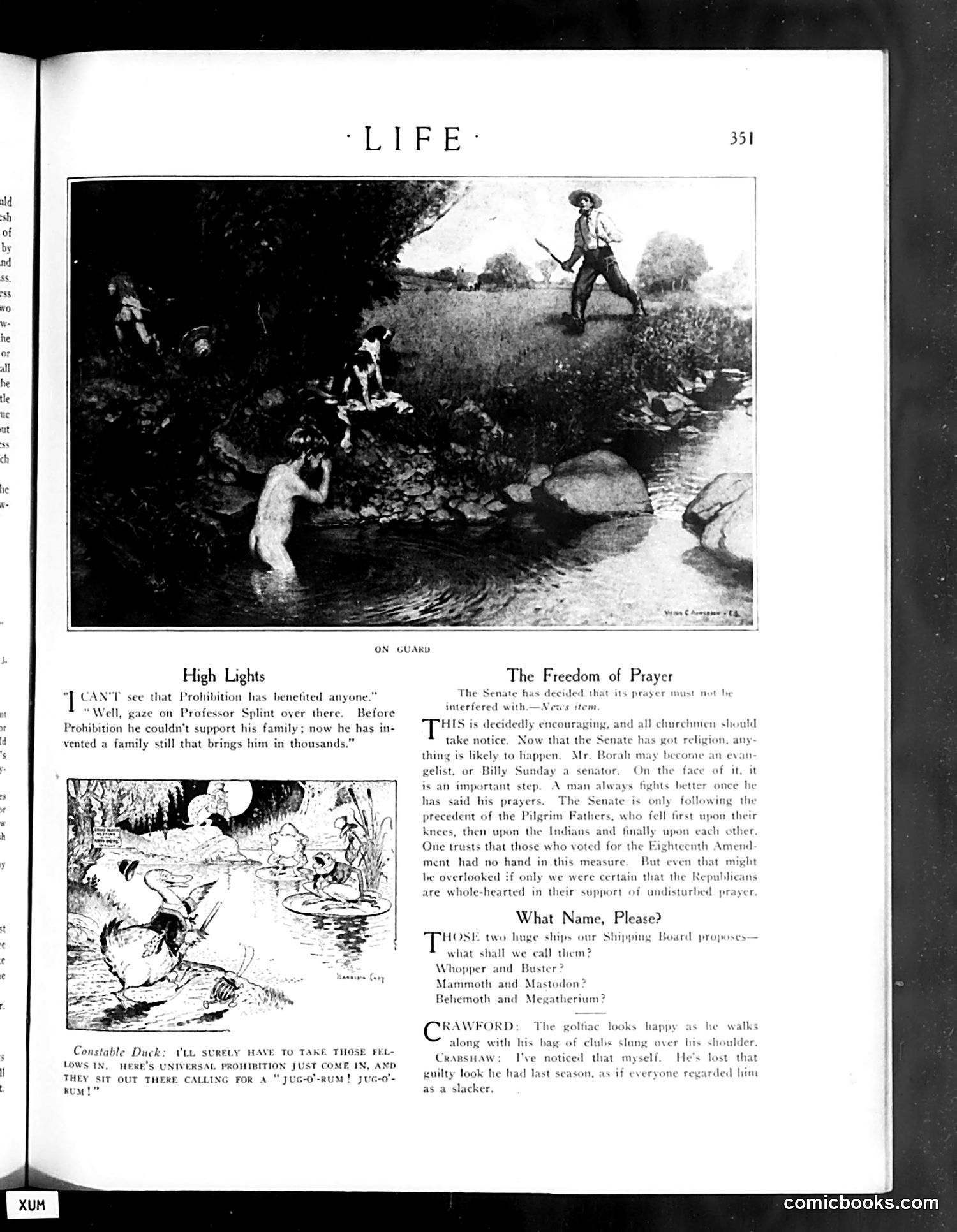
This page contains three separate satirical pieces: 1. **"On Guard" (top photograph)**: Depicts people fishing and swimming in a stream while a cowboy stands watch. The caption suggests humorous vigilance against something. 2. **"High Lights" (left column)**: A cartoon showing a duck, with a quote from "Constable Duck" mocking Prohibition enforcement. The joke appears to reference how Prohibition laws created absurd situations, with the duck's dialogue playing on the contradiction between official policy and practical reality. 3. **"The Freedom of Prayer" and "What Name, Please?" (right columns)**: These discuss Senate decisions regarding prayer and shipping board ship-naming, with gentle political commentary about Republican support for prayer and debate over naming large vessels. The overall tone is light satirical commentary on contemporary American politics and social issues of the Prohibition era.
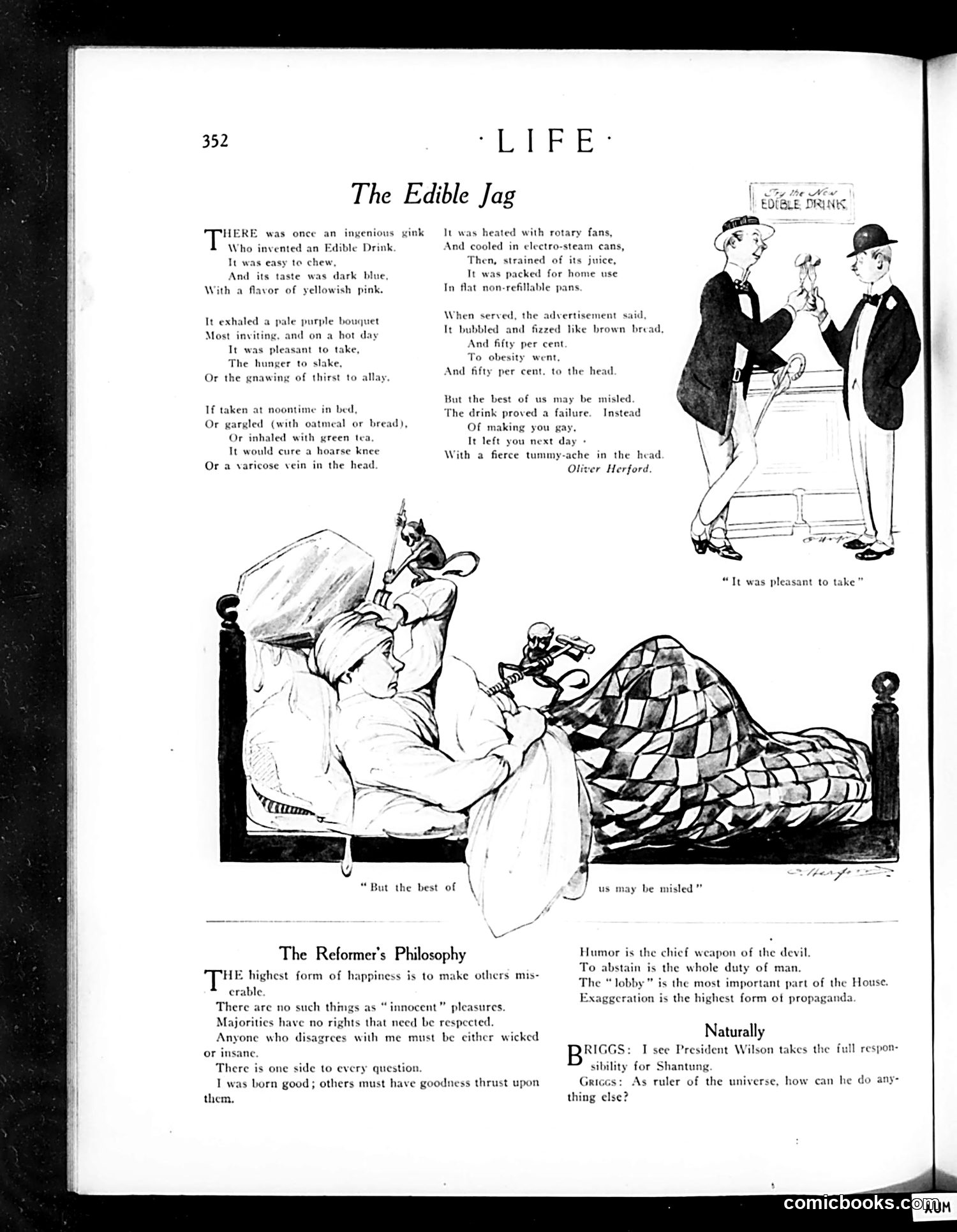
This satirical poem by Oliver Herford mocks a novelty food product marketed as an "Edible Drink" — an indigestible jelly or gelatin confection designed to be eaten rather than consumed as a liquid. The satire targets both the absurd product and false advertising claims. The poem describes the item's appearance (dark blue with yellowish-pink hue), heating method, and promised health benefits. The punchline: despite claims it aids digestion and prevents obesity, the drink actually causes severe hangovers and headaches, leaving consumers worse off than before. The accompanying illustrations show wealthy men in formal dress examining and discussing the product with skepticism. The satire critiques early-20th-century consumer culture and misleading patent medicine/food marketing practices that promised miraculous health benefits with no actual efficacy.
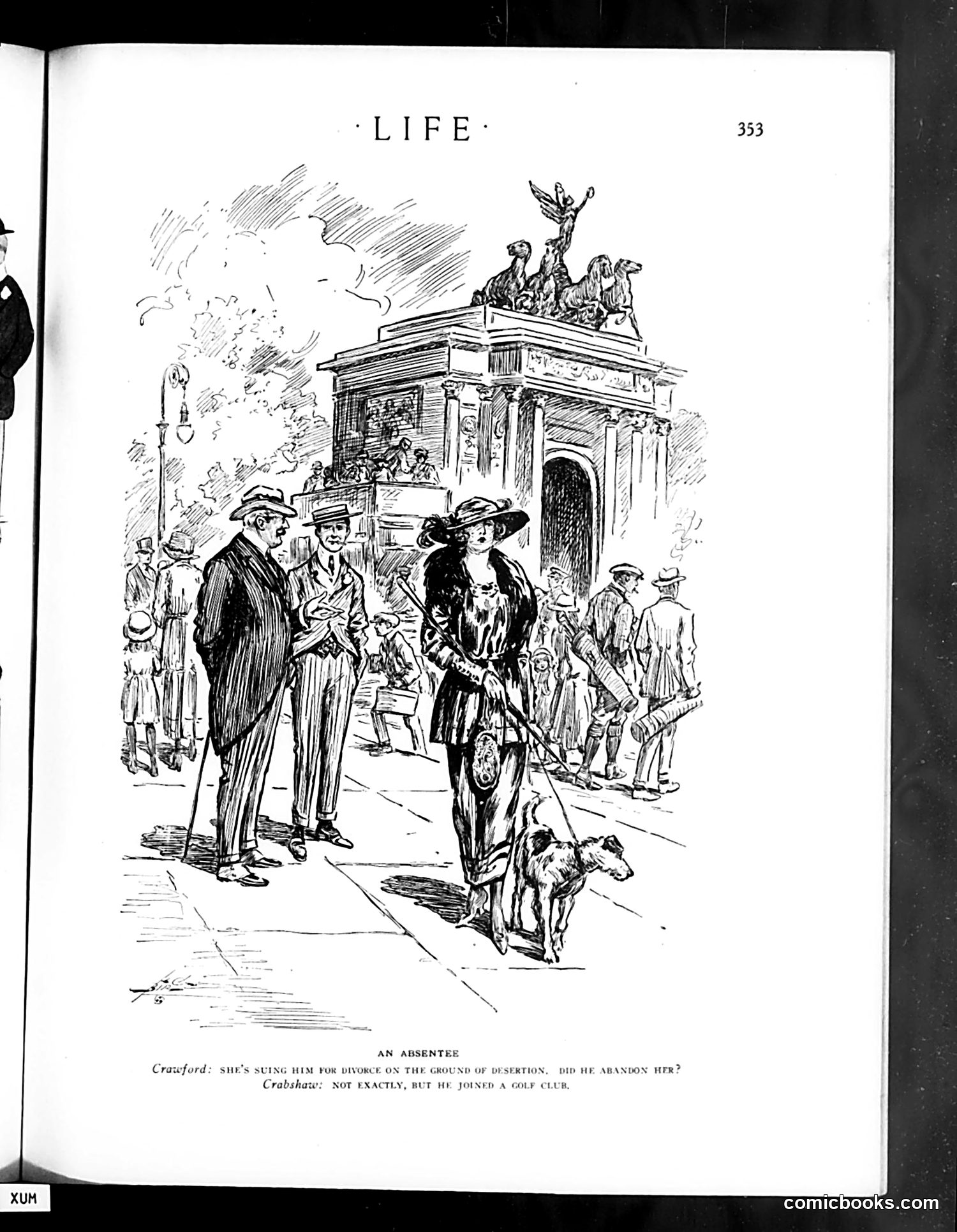
This cartoon satirizes a husband's marital desertion through humor. The caption reveals the scenario: a woman (Crassford) is suing her husband for divorce on grounds of desertion, and when asked if he abandoned her, Crashaw responds that he didn't exactly abandon her—he simply "joined a golf club." The joke mocks the priorities of wealthy leisure-class men who valued golf so highly that they effectively abandoned domestic responsibilities. The woman, dressed fashionably with a small dog, walks through a public square near a grand classical building (likely a courthouse), while the man in the left foreground appears indifferent. The satire targets both masculine neglect of marriage and the golf culture among affluent early-20th-century men.
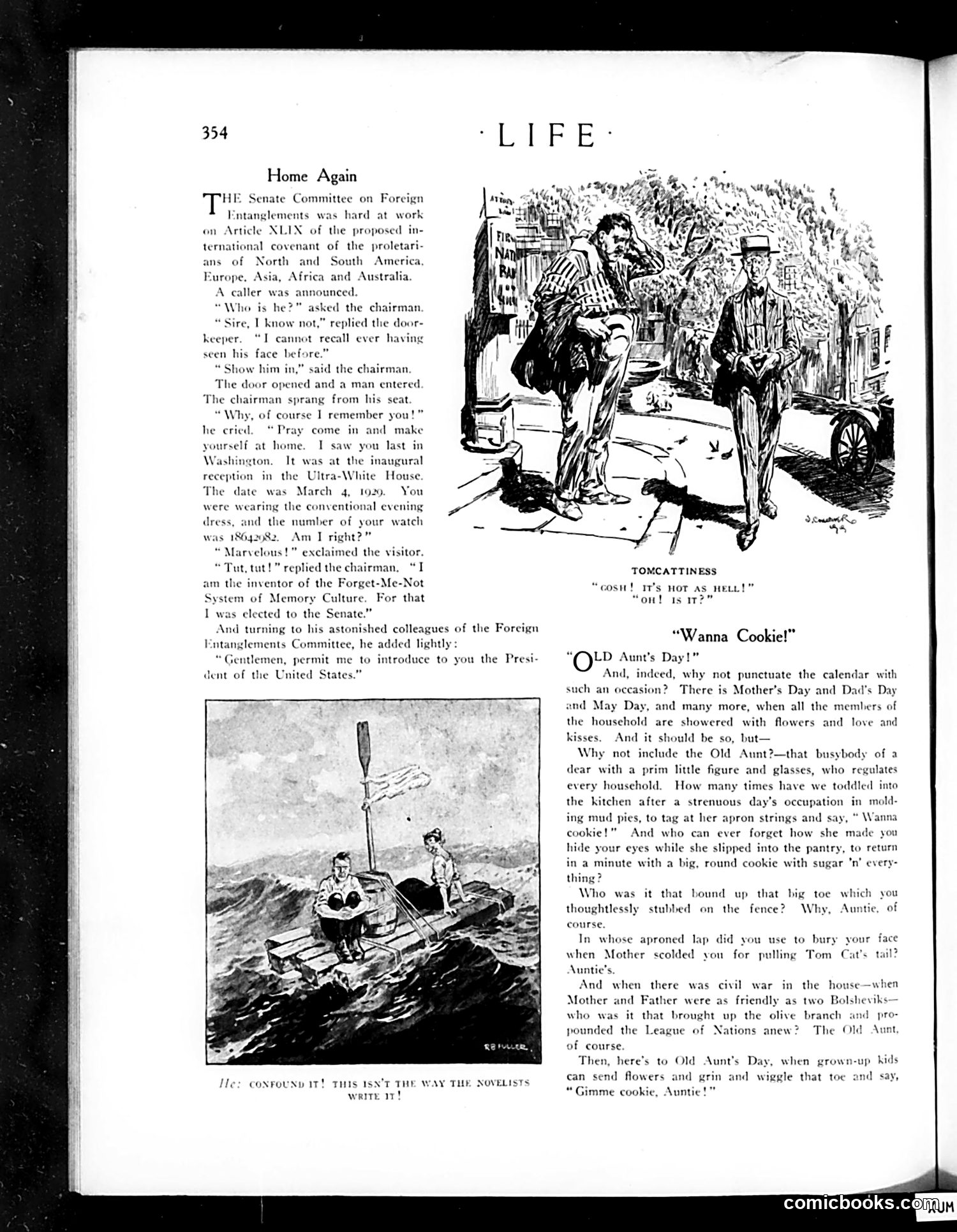
This page contains two humorous pieces about domestic life and memory. **"Home Again"**: The top cartoon depicts a Senate Foreign Relations Committee hearing where a chairman confronts a visitor who claims to be the inventor of a "Forget-Me-Not System of Memory Culture." The satire mocks both the visitor's dubious credential and the senators' gullibility—the chairman even recalls attending an inauguration in 1892 (when he was supposedly wearing a watch numbered 18042-82), suggesting either his memory is faulty or he's absurdly old. The joke targets pretentious schemes and senatorial credulity. **"Wanna Cookie!"**: This nostalgic piece celebrates "Old Aunt's Day," proposing a holiday honoring elderly aunts. It humorously catalogs the aunt's role in family life—making cookies, settling disputes, mediating conflicts—positioning her as an indispensable household fixture deserving recognition alongside Mother's Day and Father's Day.
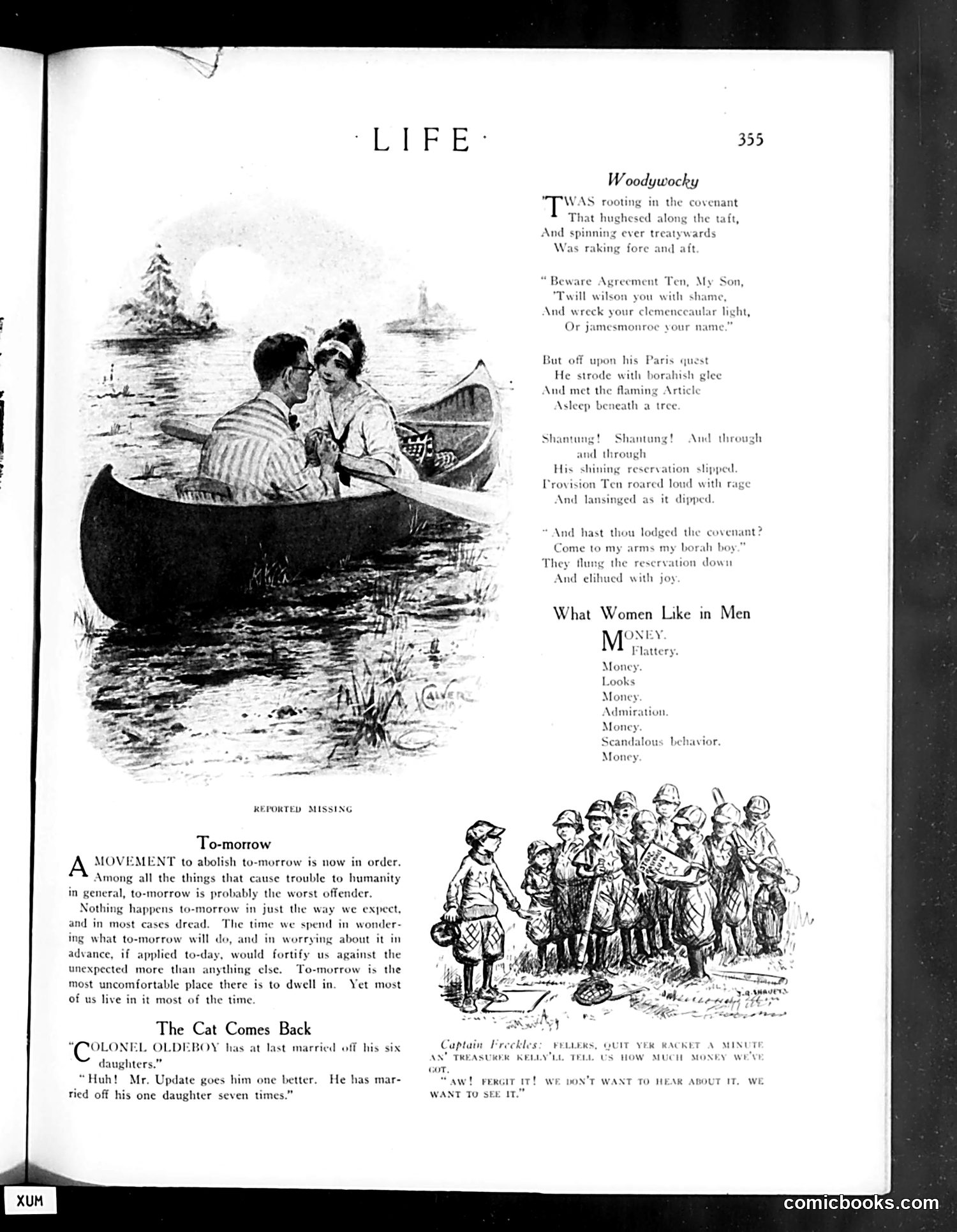
This page contains three separate humorous pieces typical of early 20th-century Life magazine satirical content: 1. **"Woodywocky"** — A poem mocking the chaos of modern life, illustrated with a couple in a boat. References "Agreement Ten" and "Provision Ten," suggesting marital or legal complications treated comedically. 2. **"What Women Like in Men"** — A sardonic list where "Money" appears multiple times, with only superficial qualities (Flattery, Looks, Home, Admiration) interspersed. The satire mocks women as mercenary. 3. **"To-morrow"** and **"The Cat Comes Back"** — Brief humorous anecdotes: one about procrastination's problems; the other a joke about Colonel Oldeboy's marriages to his daughters. The illustrations depict everyday scenes rendered in pen-and-ink style. The content reflects early 20th-century gender stereotypes and domestic humor conventions.
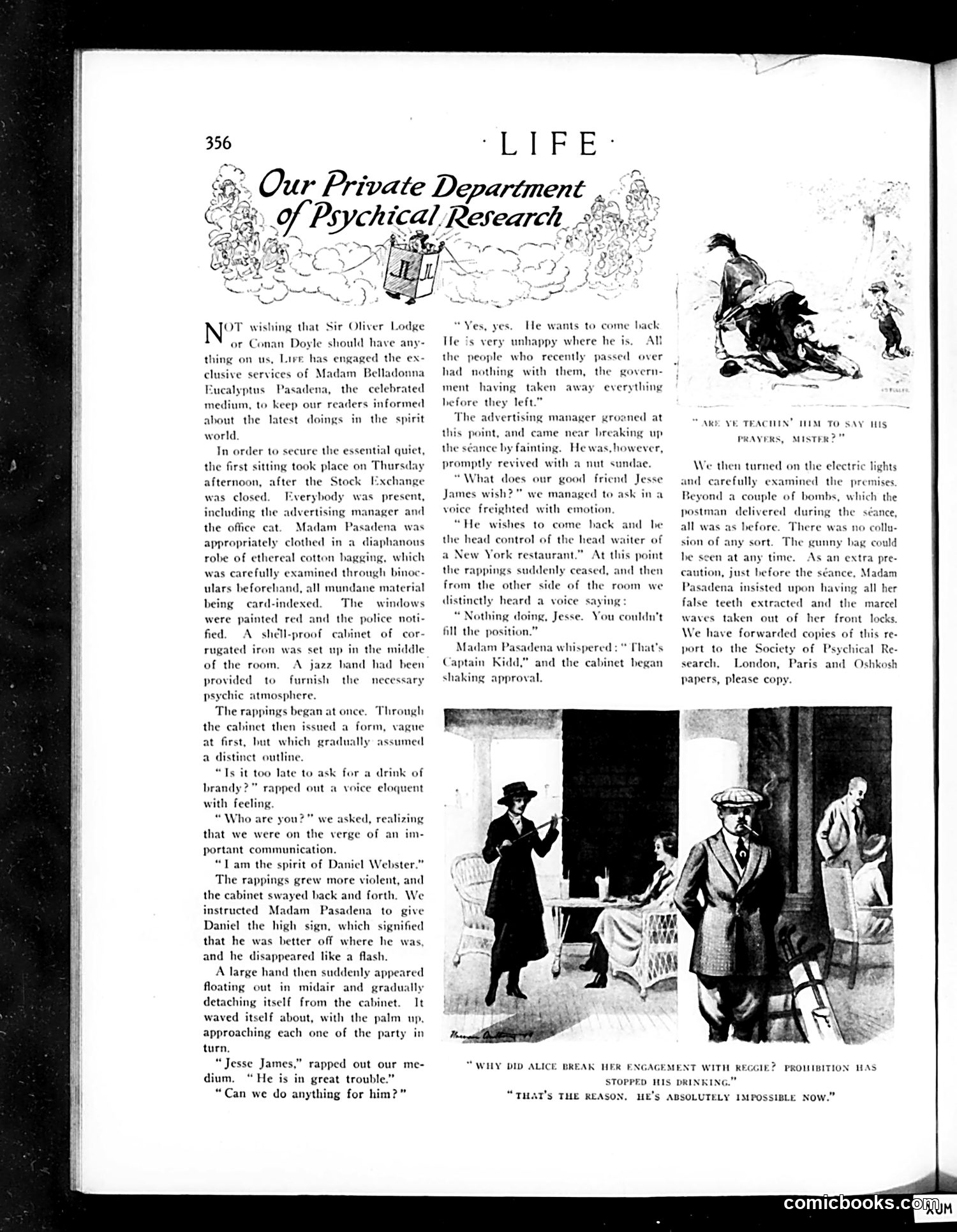
This satirical piece mocks the early 20th-century craze for spiritualism and séances. The article describes a séance conducted by "Madam Pasadena," a medium who claims to contact the dead and channel spirits through a cabinet (a common spiritualist prop). The satire targets both the credulous wealthy clients and the fraudulent mediums. References include mentions of Jesse James and "Daniel Webster," suggesting famous historical figures were supposedly contacted. The photographs show typical séance staging—people around a cabinet, dramatic gestures, and theatrical props. The humor lies in exposing spiritualism as obvious fraud, with the magazine implying the "psychical research" is merely clever showmanship designed to separate rich believers from their money. This reflects widespread skepticism toward spiritualism among educated satirists of the era.
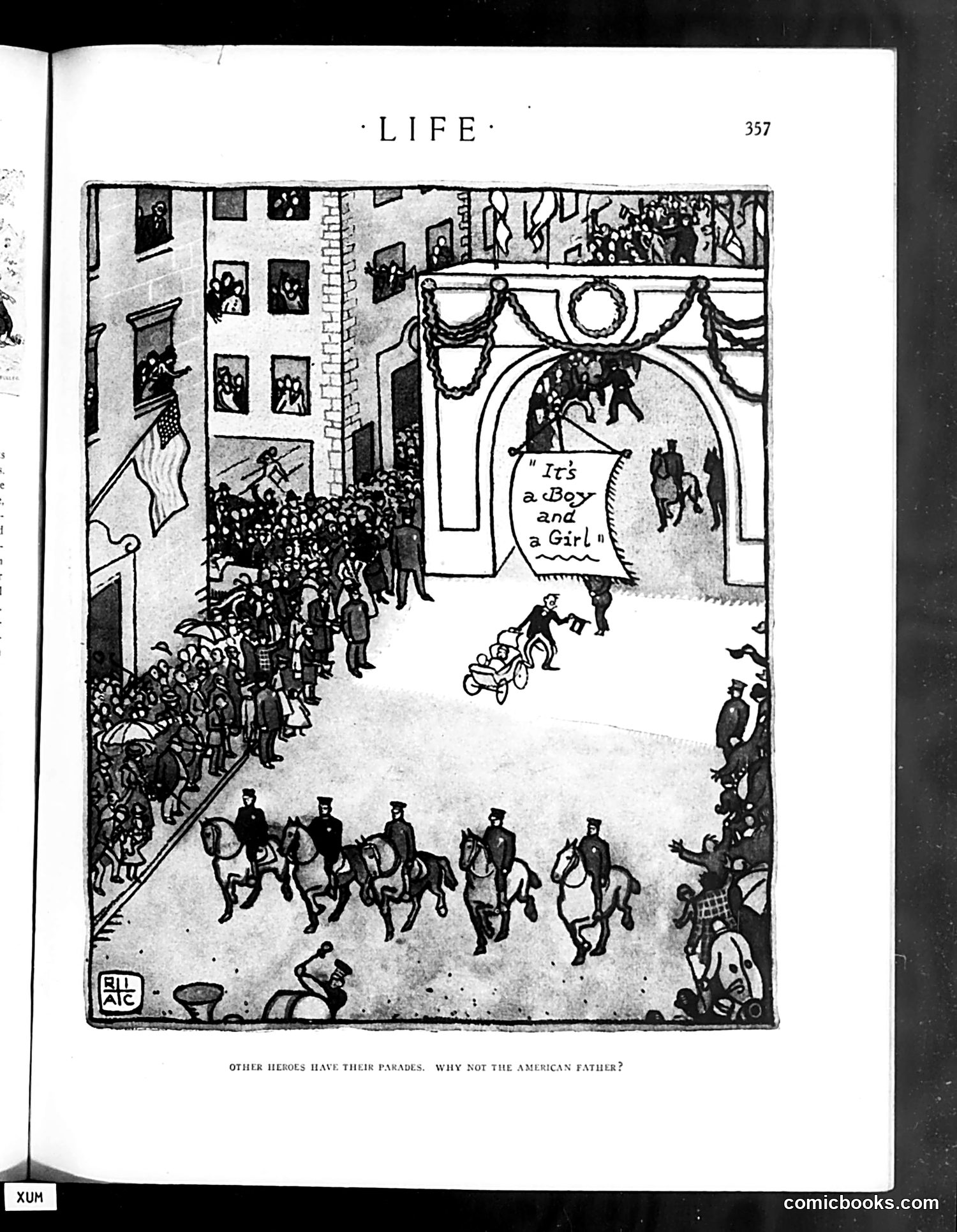
This satirical cartoon depicts a massive public parade or celebration featuring military figures on horseback, crowds of spectators, and festive decorations. A banner reads "It's a Boy and a Girl." The caption poses: "OTHER HEROES HAVE THEIR PARADES. WHY NOT THE AMERICAN FATHER?" The satire appears to celebrate fatherhood by ironically equating it with military heroism—depicting a birth announcement with the pageantry typically reserved for war heroes or military victories. The joke critiques American society's tendency to glorify warfare while overlooking the domestic role of fatherhood as equally worthy of public recognition and celebration. The cartoon advocates for elevating paternal responsibilities to heroic status in cultural consciousness.
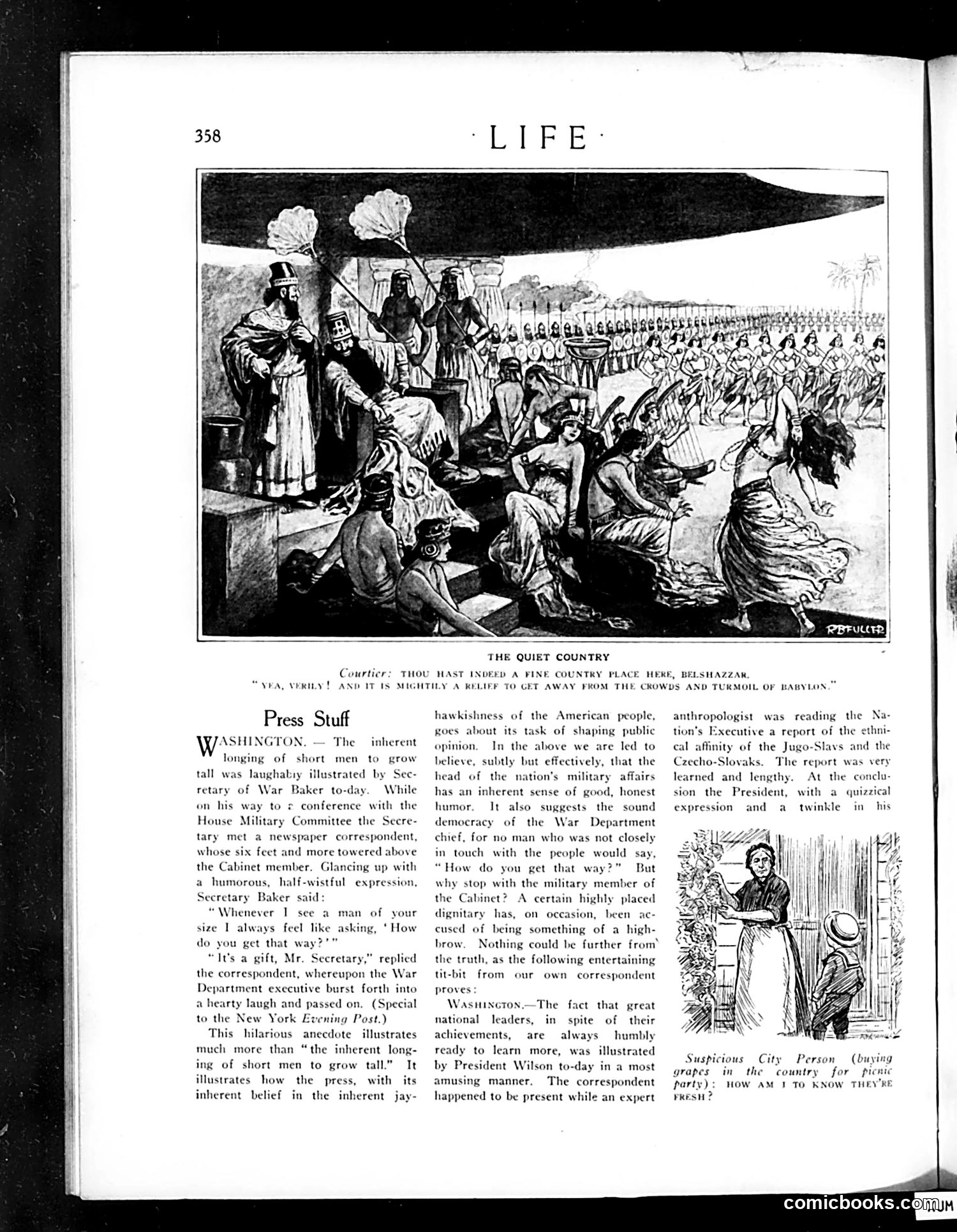
This page from *Life* magazine satirizes how the press manufactures positive public images of government officials through selective anecdotes. The main article mocks a published story about Secretary of War Baker making a self-deprecating joke to a tall newspaper correspondent. The satire's point: this "charming" anecdote was crafted propaganda designed to make Baker appear humble and relatable—when really it merely demonstrates how the press shapes public opinion by circulating flattering stories about military leaders. The piece extends this critique to President Wilson, suggesting similar favorable narratives are being constructed around him (an expert anthropologist finds Wilson "humbly ready to learn"). **The cartoon** (top) depicts an Oriental potentate surrounded by courtiers and masses—a visual metaphor for autocratic power dressed up as benevolence. **The bottom cartoon** shows a city person skeptically examining grapes, humorously illustrating urban disconnect from rural authenticity—perhaps a related jab at urban elites' disconnect from reality. The overarching message: beware how press narratives manufacture consent for authority figures.
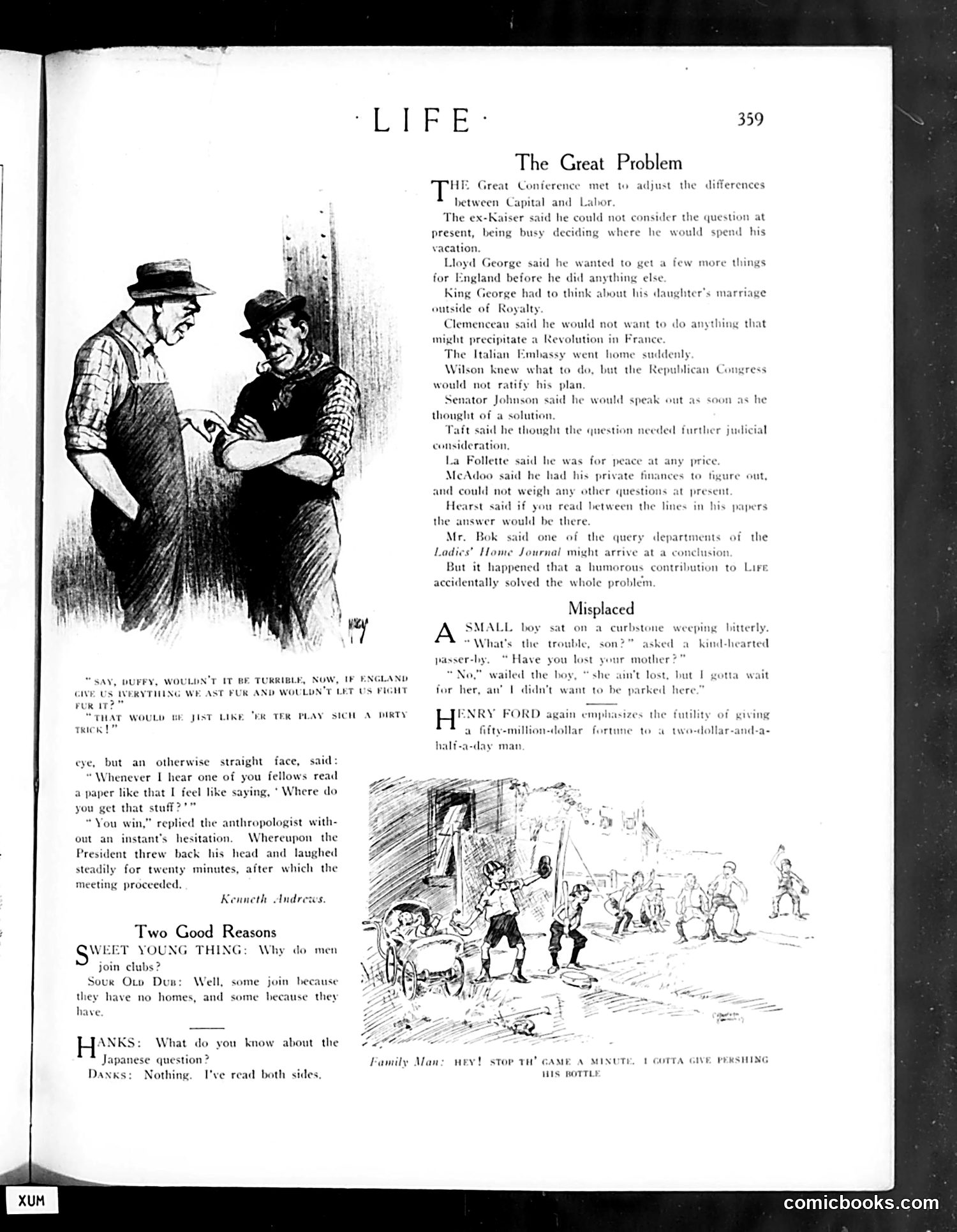
This page contains political satire about post-World War I peace negotiations. "The Great Problem" mocks world leaders at a conference trying to resolve labor-capital disputes. Each figure is presented with self-interested excuses: the ex-Kaiser worries about vacation; Lloyd George wants more for England; King George thinks of his daughter's marriage; Clemenceau fears French revolution; Wilson faces Congressional opposition; and others prioritize personal concerns over solutions. The joke culminates when a humble "humorous contribution to Life accidentally solved the whole problem"—suggesting satirical humor succeeds where serious statesmen fail. The lower cartoons are lighter fare: a boy lost from his mother (a play on words), and a Henry Ford reference emphasizing wealth inequality (giving millions to low-wage workers). The top cartoon's dialogue about England not fighting appears to reference WWI-era tensions, though context is unclear.
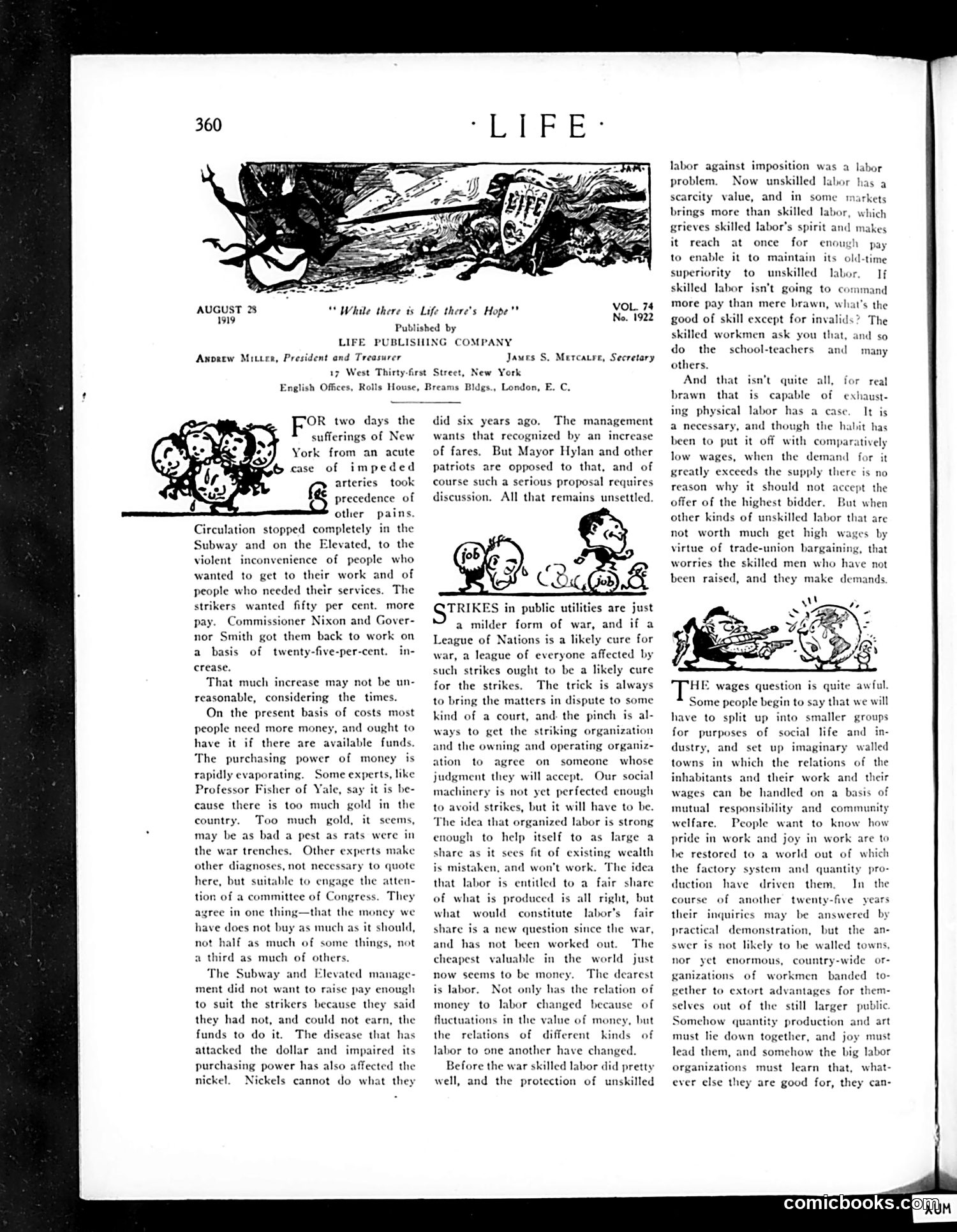
This Life editorial addresses a **New York City subway strike** that paralyzed transportation for two days. The strikers demanded a 50% wage increase; management and city officials settled on 25%. The cartoons (showing distressed figures) illustrate the public's frustration with transit disruption. The unnamed text references **Commissioner Nixon** and **Governor Smith** brokering the compromise, and **Mayor Hylan** opposing fare increases to compensate management. The core argument: inflation has devastated the dollar's purchasing power (blaming either excessive gold supply or other economic factors). Workers legitimately need higher wages, but strikes in essential public utilities are "a milder form of war." The piece advocates for neutral arbitration courts rather than labor confrontation. A secondary concern emerges: **unskilled labor now commands higher wages than skilled trades**, inverting pre-war hierarchy and threatening skilled workers' status—a post-WWI labor market shift causing resentment among craftspeople.
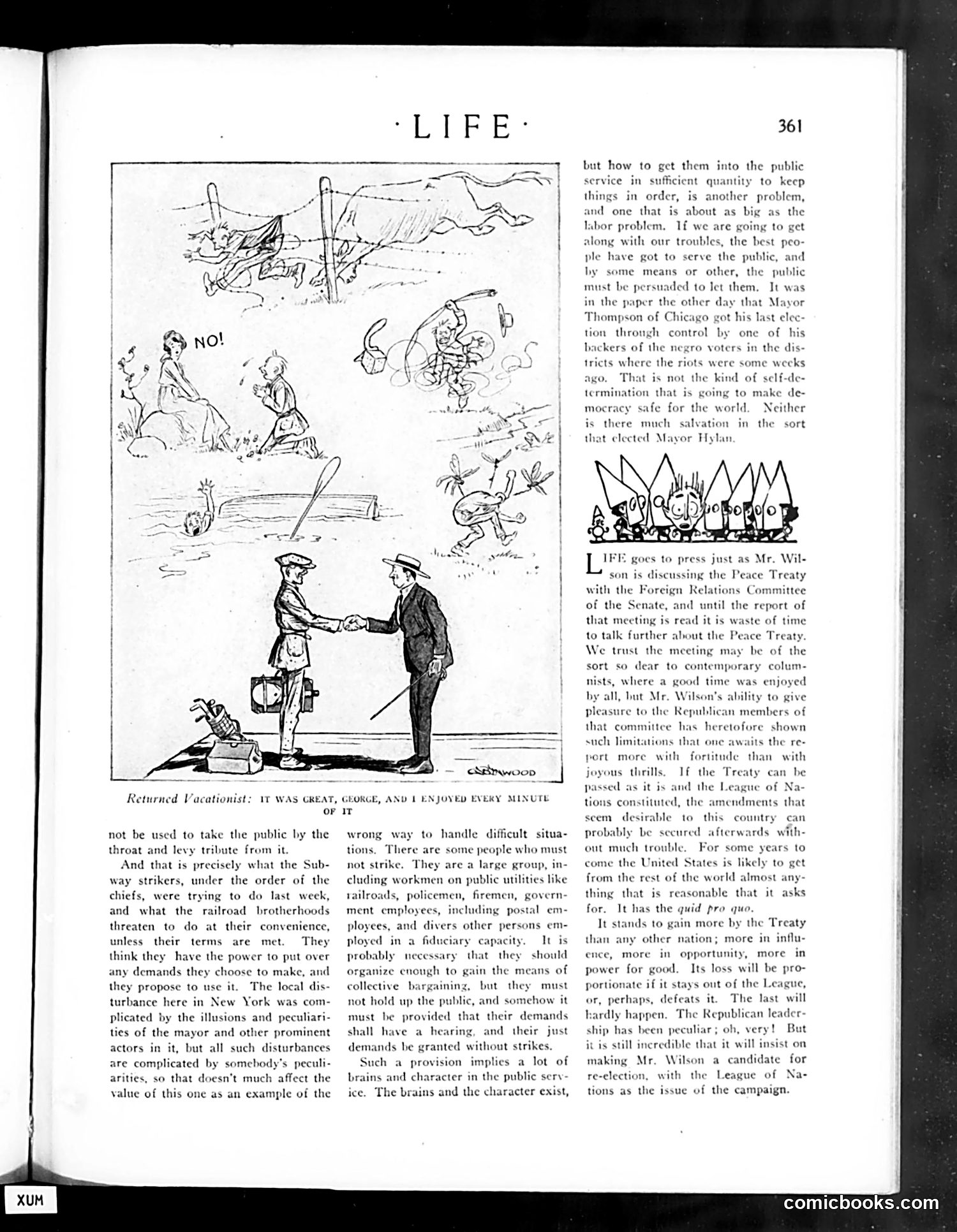
This page satirizes labor strikes and public service during the post-WWI period. The main cartoon depicts a vacationing man shaking hands with what appears to be a union official or strike leader, captioned "It was great, George, and I enjoyed every minute of it"—the joke being that while the vacationist enjoyed his break, subway strikers (referenced in the text) disrupted New York City by holding the public hostage for labor demands. The editorial argues that workers in essential services—railroads, police, firemen, government employees—shouldn't have strike power over the public. The text references Mayor Hylan of Chicago, elected through control of "negro voters" in riot-affected districts, suggesting the author views such political manipulation as undemocratic. The page also discusses the Peace Treaty debate in Congress, implying Republicans lack serious engagement with the issue. The overall tone criticizes both labor overreach and political opportunism undermining democratic governance.
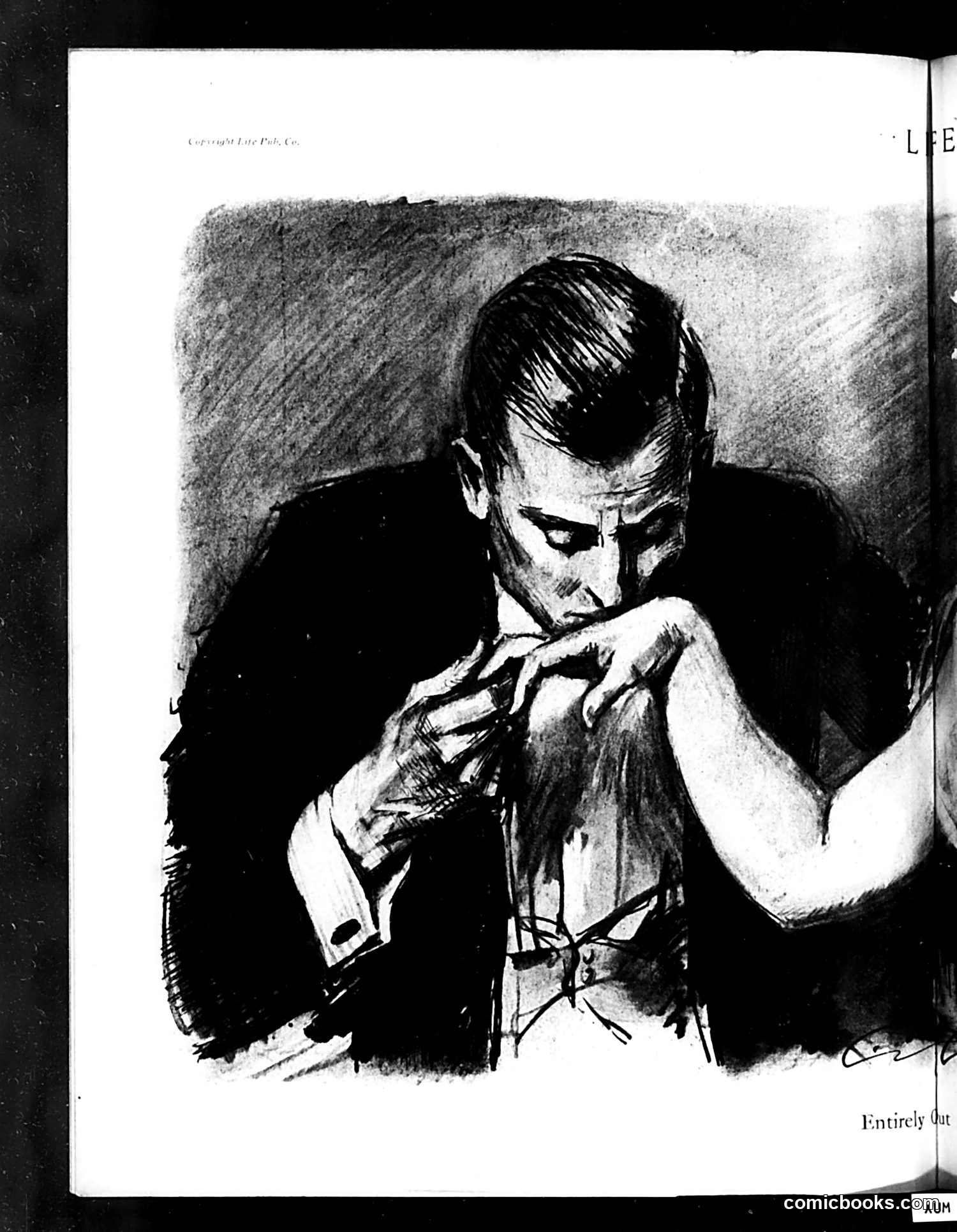
This appears to be a satirical illustration from *Life* magazine showing a man in formal attire hunched over, examining or clutching what looks like money or financial documents with intense scrutiny. The caption reads "Entirely Out." The cartoon likely satirizes financial anxiety or greed during an economic crisis—possibly related to stock market troubles or economic hardship. The figure's obsessive focus on money, combined with the withdrawn body language and the caption "Entirely Out," suggests commentary on someone who has lost their fortune or is desperately clinging to remaining finances. However, without clearer context about the specific date or accompanying article text, I cannot definitively identify the target of this satire or the precise historical event referenced. The style and printing quality suggest early-to-mid 20th century *Life* magazine humor.
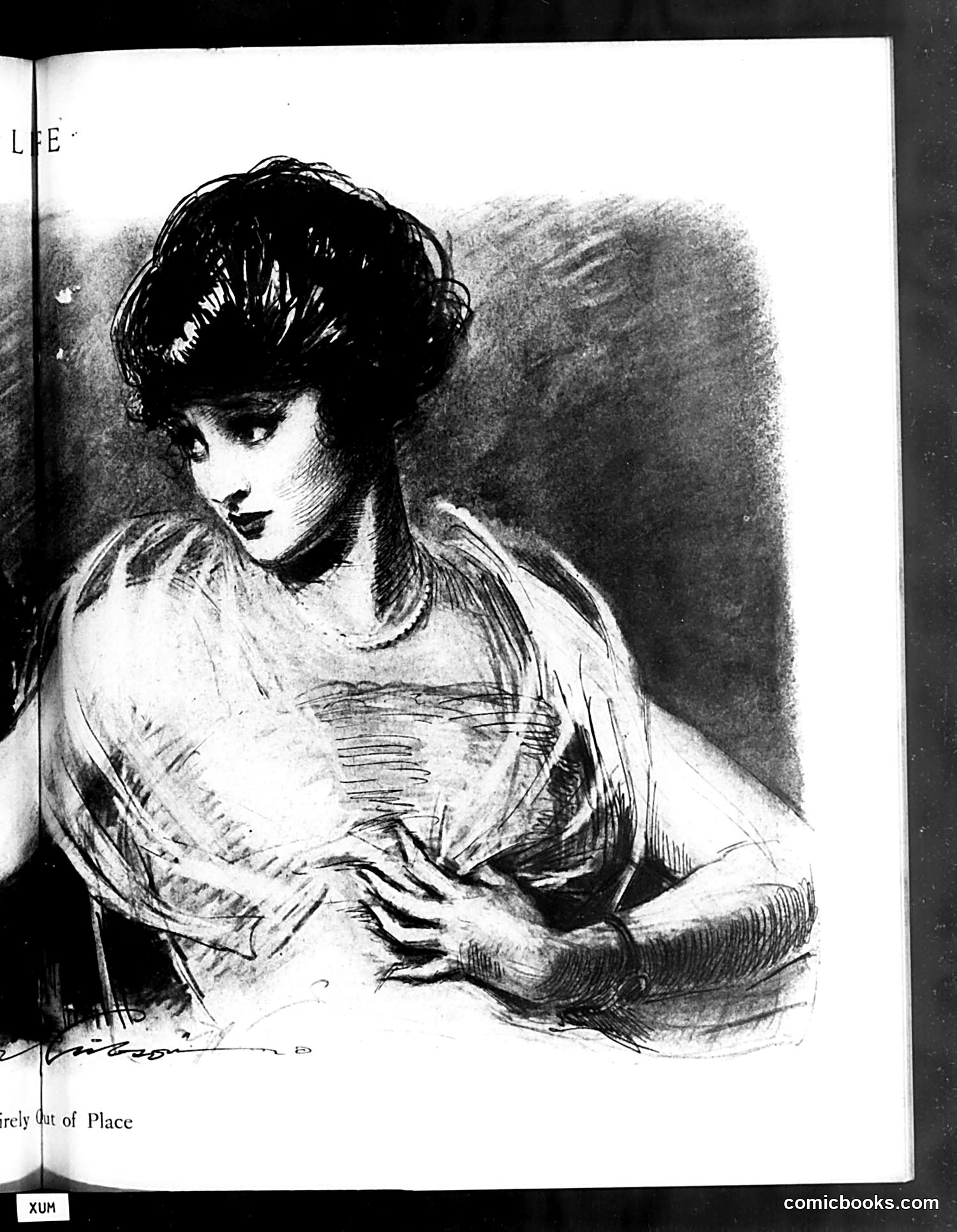
This appears to be a satirical illustration from *Life* magazine showing a woman in early 20th-century dress. The caption "Entirely Out of Place" suggests social commentary on gender roles or class propriety of the era. The drawing depicts a woman in what appears to be refined or fashionable clothing, rendered in a sketch style typical of *Life*'s satirical approach. Without clearer text or additional context, the specific satire is difficult to determine—it could comment on a woman in an inappropriate social setting, questionable fashion choices, or perhaps satirize pretension or social climbing. The "L E" marking at top left likely indicates page placement or cataloging. The illustration style and magazine context suggest early 1900s commentary on contemporary social expectations around women's proper place or behavior.
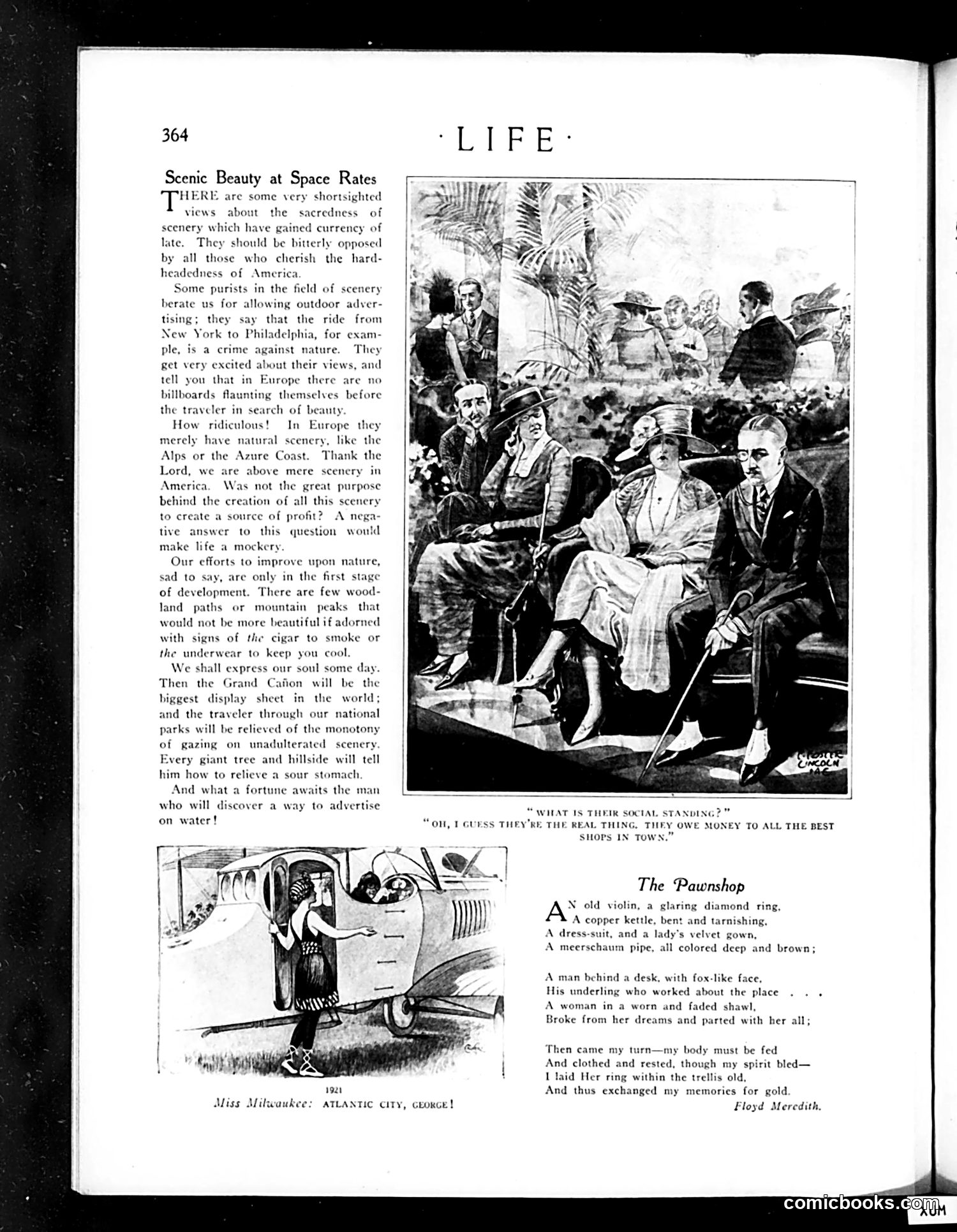
This page satirizes the commodification of American scenery and natural resources. The main article, "Scenic Beauty at Space Rates," mockingly argues that advertising billboards *improve* America's landscapes compared to Europe's "mere scenery" like the Alps. The satire is biting: the author suggests that America's true purpose is profit-making, not preservation, and fantasizes about covering the Grand Canyon and national parks with advertisements—even proposing commercials on water. The upper cartoon depicts wealthy tourists in a car, with the caption joking that their "social standing" is measured by debt to luxury shops, satirizing materialism masquerading as status. "The Pawnshop" poem below depicts economic desperation: people surrendering heirlooms and valuables to survive, exchanging "memories for gold." Together, these pieces critique both unchecked commercialism destroying nature and the economic hardship driving ordinary Americans to pawn their possessions.
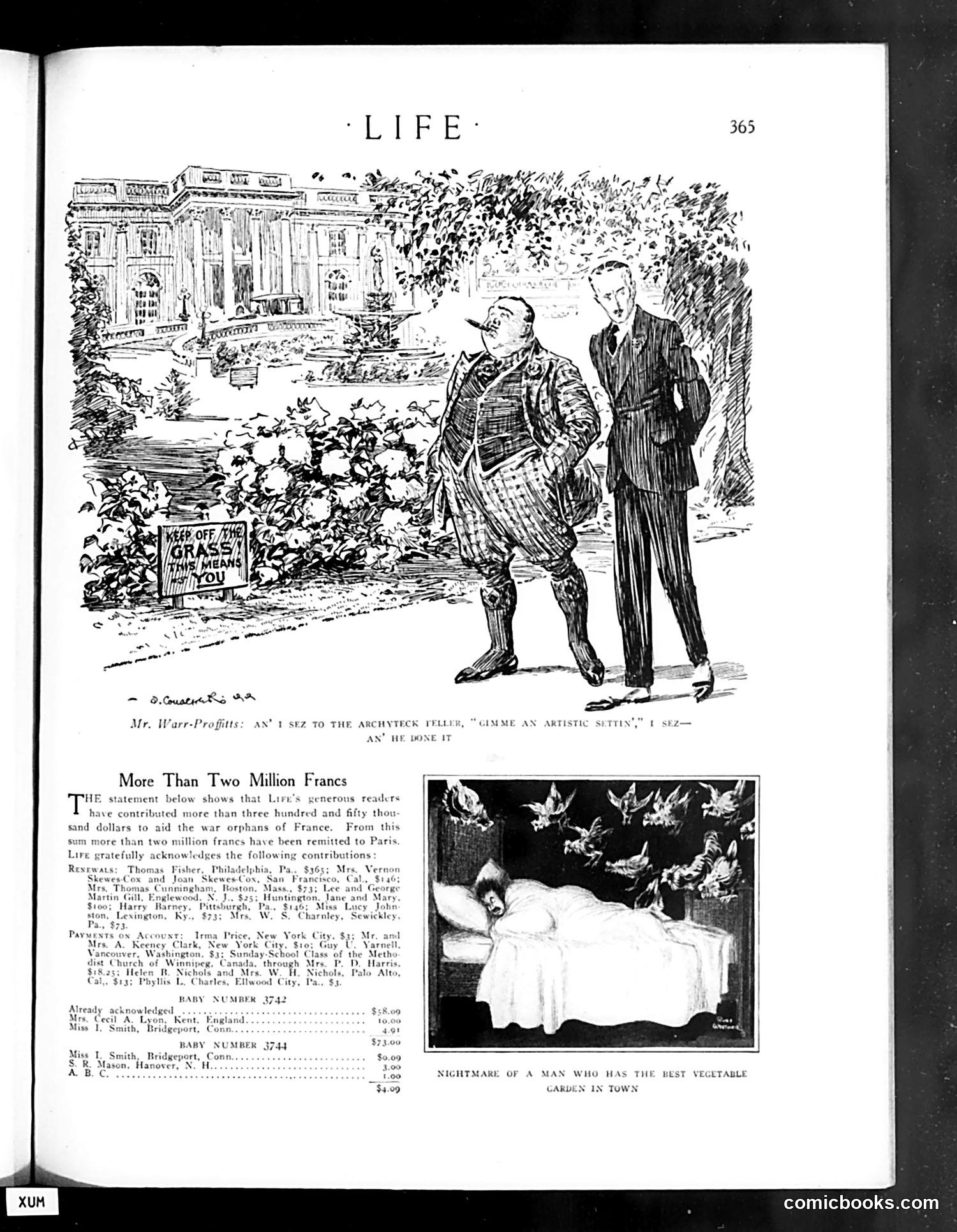
The main cartoon depicts a nouveau riche character ("Mr. Warr-Profits") showing an architect an elaborate formal garden. The joke plays on his malapropism: he requested an "artistic setting" but mispronounces it as "ARTISTIC SETTIN'"—suggesting his wealth is newly acquired and his education limited. The sign reads "KEEP OFF THE GRASS" with "THIS MEANS YOU," emphasizing the pretentiousness of his manicured estate. The second illustration, captioned "Nightmare of a Man Who Has the Best Vegetable Garden in Town," shows a man dreaming of birds attacking his prized garden—a darkly humorous commentary on the anxiety of possession and the futility of trying to protect one's achievements. Both cartoons satirize American prosperity anxiety during the WWI era, mocking both social climbing and obsessive materialism. The page also notes Life's charitable contributions to French war orphans, contextualizing the satire within wartime American consciousness.
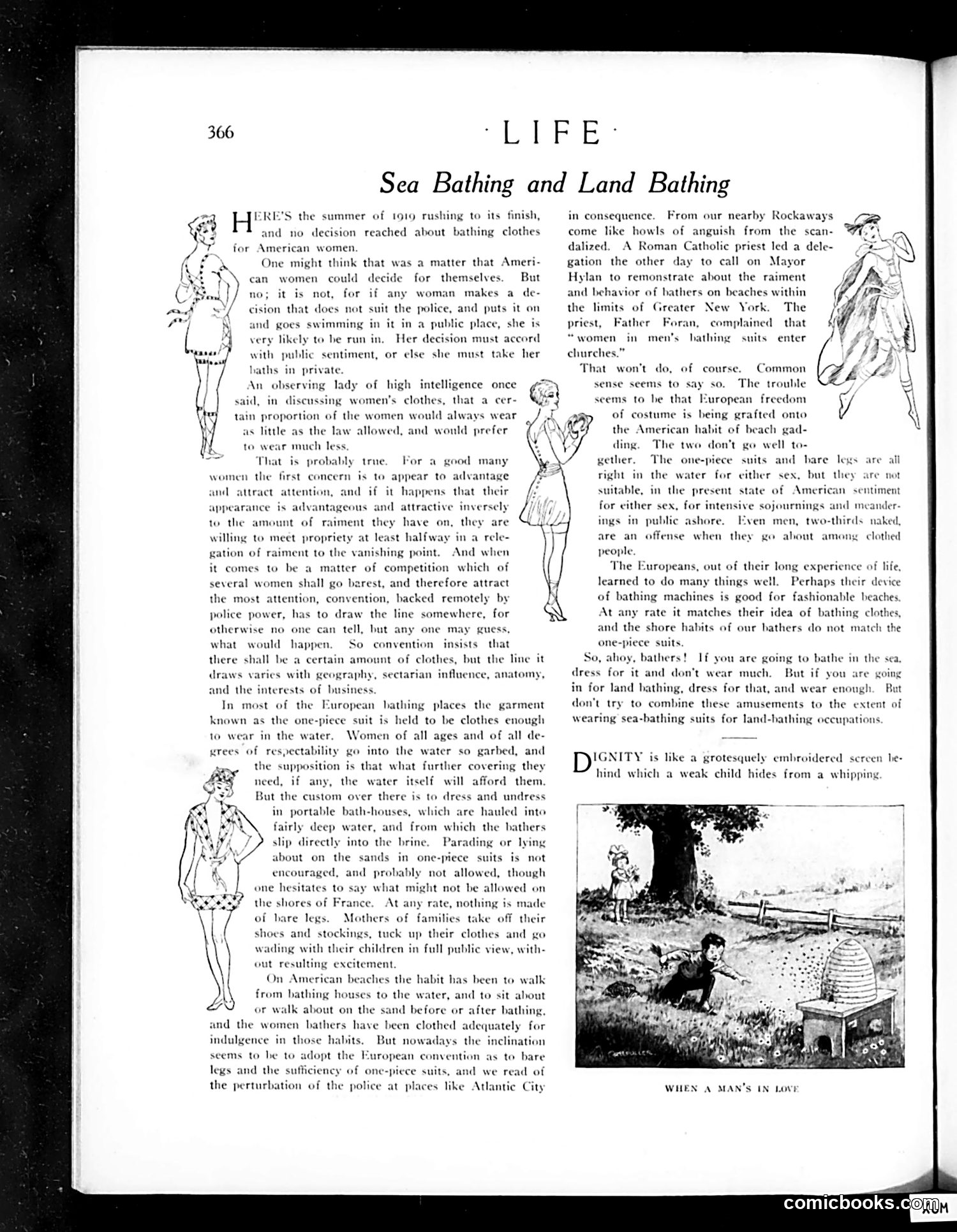
This article satirizes the cultural clash between European and American attitudes toward women's beach attire. The core issue: American women are adopting the practical European one-piece bathing suit, but continuing American customs of parading on beaches fully visible—creating moral panic. The satire targets prudish American authorities (particularly police and the Catholic Church) who police women's bodies. Notably, a priest complained to Mayor Hylan that women in bathing suits were entering churches, revealing the absurdity of the outrage. The piece mocks that convention, backed by "police power," must arbitrarily "draw the line somewhere" on female modesty while European women enjoy sensible freedom with identical clothing—the difference being European bath-houses conceal undressing. The illustrated women suggest this was partly about class anxieties: working-class women gaining beach access and wearing less restrictive clothing. The satire defends practicality and European reasonableness against American hypocrisy and prudishness policed through law enforcement.
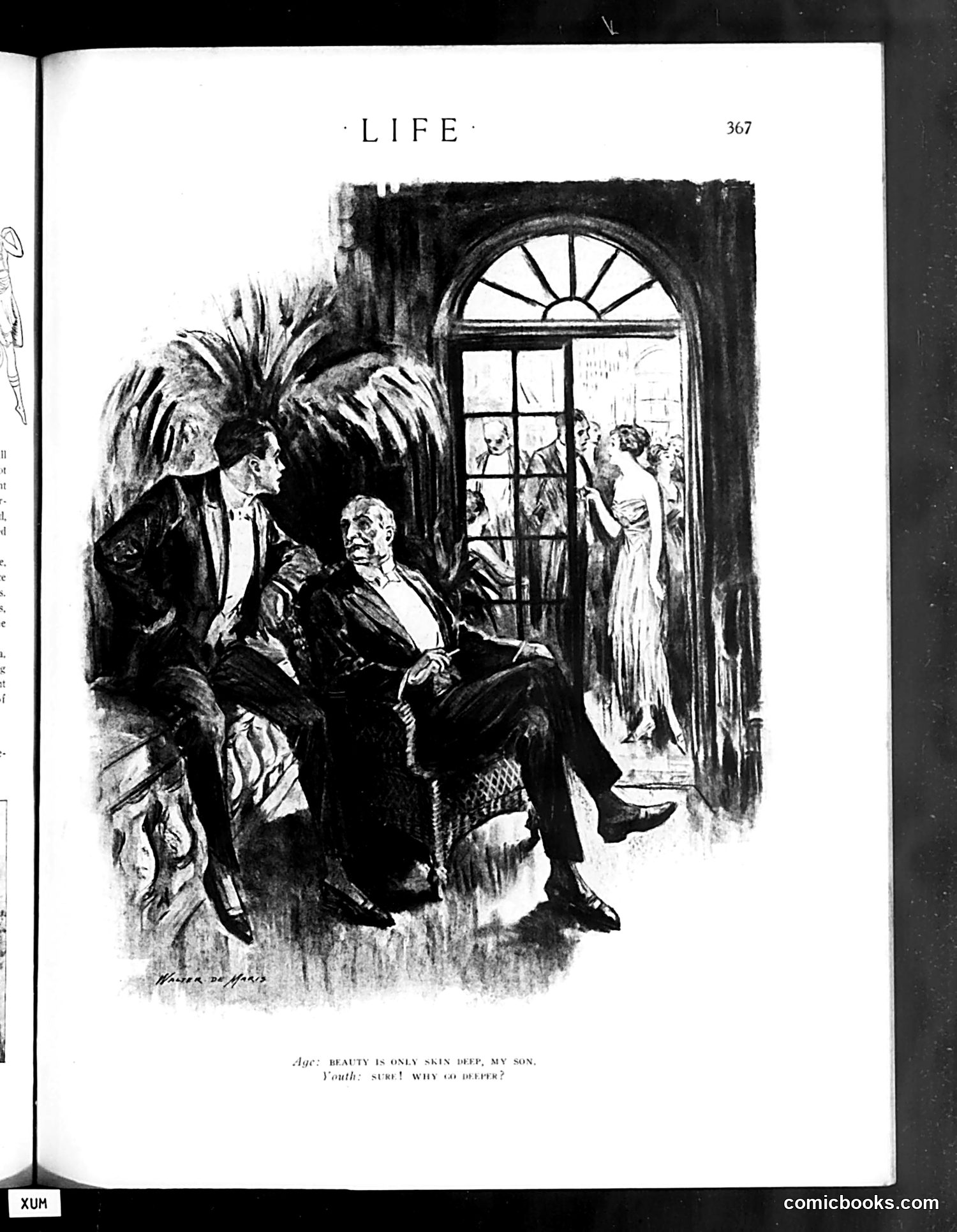
This is a single-panel cartoon from *Life* magazine (page 367) depicting a generational dialogue. An older man, seated indoors near a potted plant and elegant arched doorway, speaks to a younger man. The caption reads: "Age: BEAUTY IS ONLY SKIN DEEP, MY SON. Youth: SURE! WHY GO DEEPER?" The cartoon satirizes youthful cynicism and superficiality. The elder offers traditional wisdom about inner beauty's importance, while the youth dismissively rejects deeper meaning entirely—suggesting he cares only for surface appearances. The irony is inverted: youth claims wisdom is pointless rather than merely incomplete. The elegant interior setting contrasts sharply with this shallow exchange, emphasizing the disconnect between cultured surroundings and crude materialism. This reflects common mid-20th-century anxiety about youth rejecting established values.
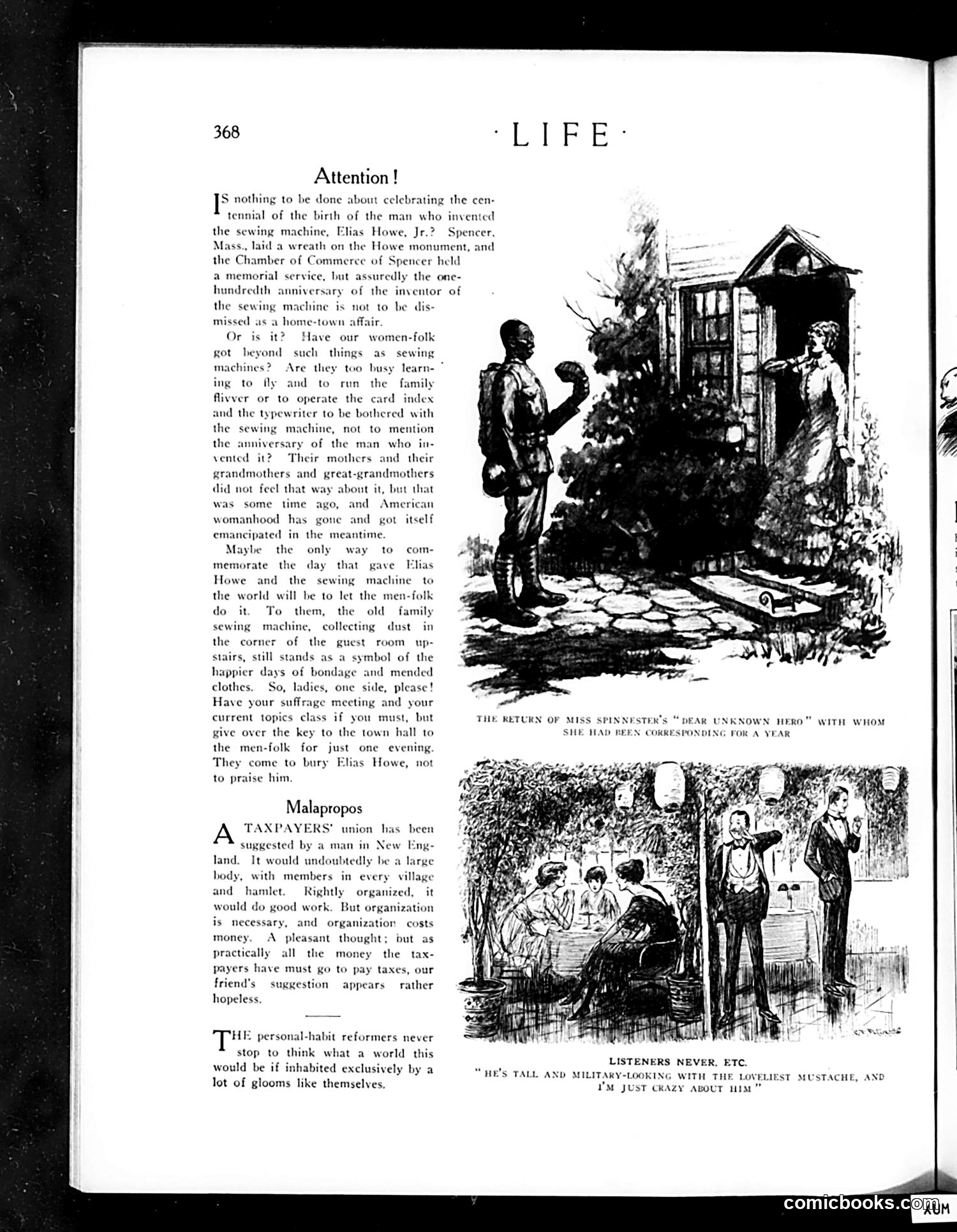
This page satirizes early 20th-century women's changing roles. The main article mocks the proposed centennial celebration of sewing machine inventor Elias Howe Jr., sarcastically suggesting modern women are too busy with suffrage meetings, driving cars ("flivvers"), and operating typewriters to care about sewing—activities their grandmothers valued. The satire implies women have gained independence but men nostalgically cling to symbols of women's "happier days of bondage." The two illustrations support this theme: the upper cartoon shows a woman corresponding with a mysterious "dear unknown hero"; the lower depicts gossiping women discussing a tall, mustached man. Both mock women's romantic preoccupations. A brief item below ridicules a proposed "Taxpayers' Union" as impractical, since citizens have no money left after paying taxes—social commentary on tax burden. The overall tone is satirical but tinged with anxiety about women's emancipation.
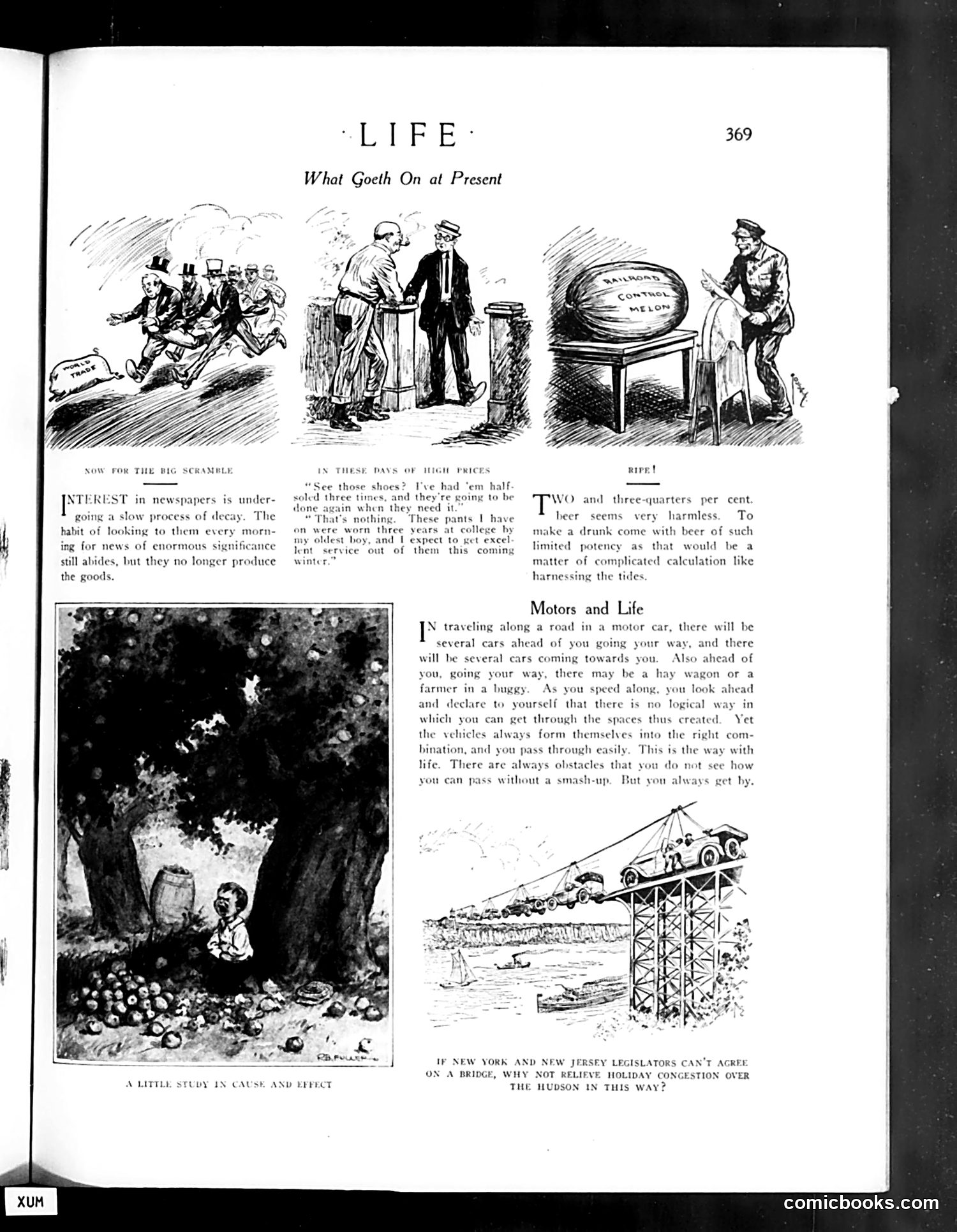
This 1920s satirical page contains three distinct commentaries on American life: **"Now for the Big Scramble"** (top left): Depicts economic hardship during high inflation. A man describes repeatedly resoling worn shoes and repurposing old pants—commentary on post-WWI cost-of-living crisis forcing working people to extend clothing life through repairs. **"In These Days of High Prices"** (top center): A conversation about necessity driving reuse, with similar themes of economic strain. **"Motors and Life"** (right): An analogy comparing traffic navigation to life's obstacles. Vehicles mysteriously arrange themselves allowing safe passage—suggesting life's apparent impossibilities somehow resolve themselves naturally. **Bottom illustration**: A humorous proposal: since New York and New Jersey legislators cannot agree on building a Hudson River bridge, why not use an absurdly steep ramp? This satirizes real bridge-construction debates of the era and governmental gridlock. The overall theme: American life in the 1920s involved economic anxiety, pragmatic survival through reuse, and frustration with bureaucratic incompetence—alongside unexpected resolutions.
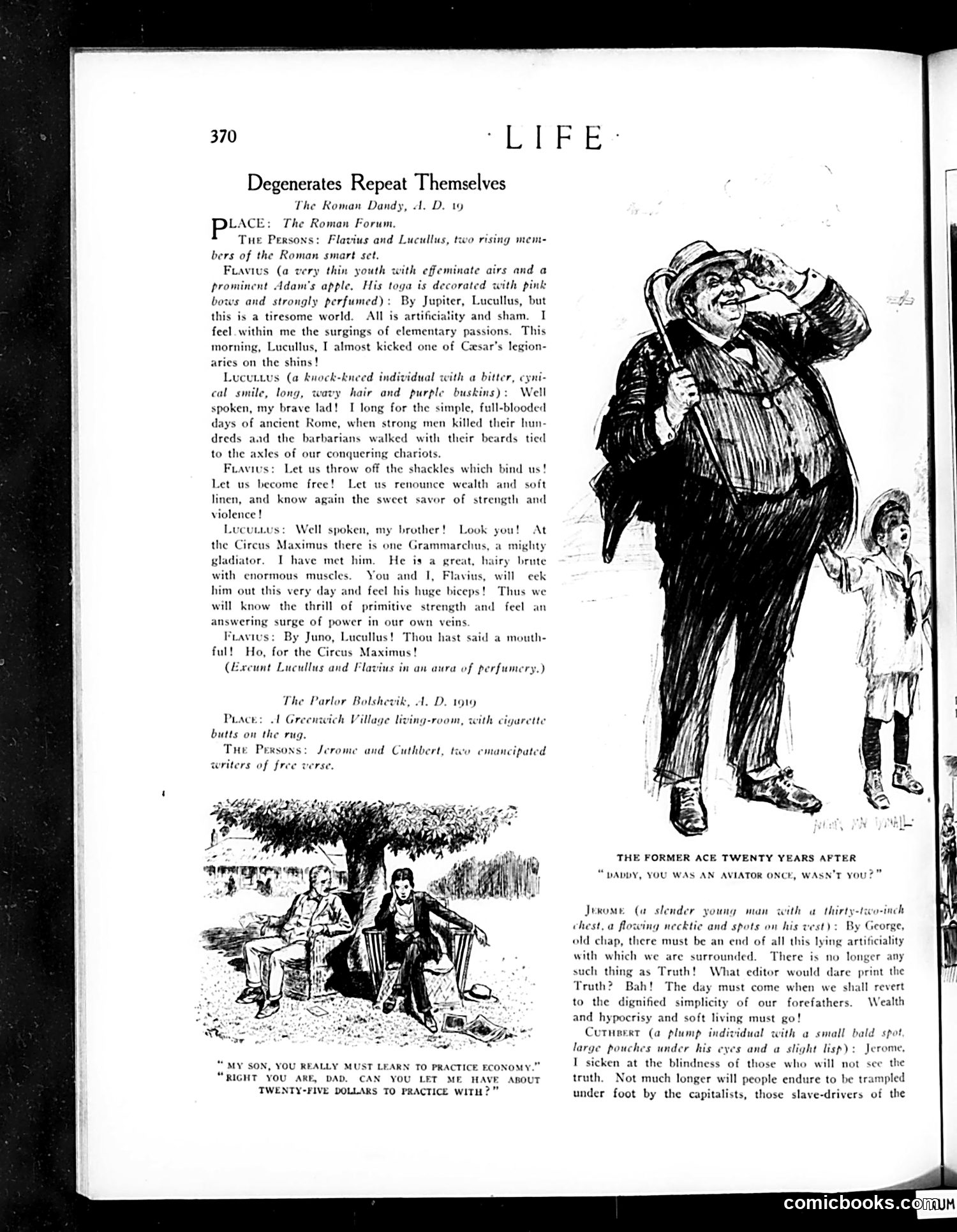
This two-part satirical piece compares decadent behavior across centuries. The first sketch mocks effeminate Roman dandies (Flavius and Lucullus)—vain, perfumed youths who romanticize primitive strength while remaining pampered and artificial. Their performative rebellion (talking of violence while decorated with pink bows) is hollow posturing. The second sketch ("The Parlor Bolshevik," set in 1919 Greenwich Village) parallels this: Jerome and Cuthbert are radical intellectuals spouting anti-capitalist, anti-establishment rhetoric while remaining comfortable and dependent (asking dad for $25). Their revolutionary talk about rejecting "artificiality" and "hypocrisy" rings equally false. The satire's point: radical posturing and pseudo-rebellious attitudes recur across history among privileged youth who lack genuine conviction. Both groups talk revolution while benefiting from the systems they claim to despise. Life magazine mocks pretentious pseudo-intellectuals and their shallow activism.
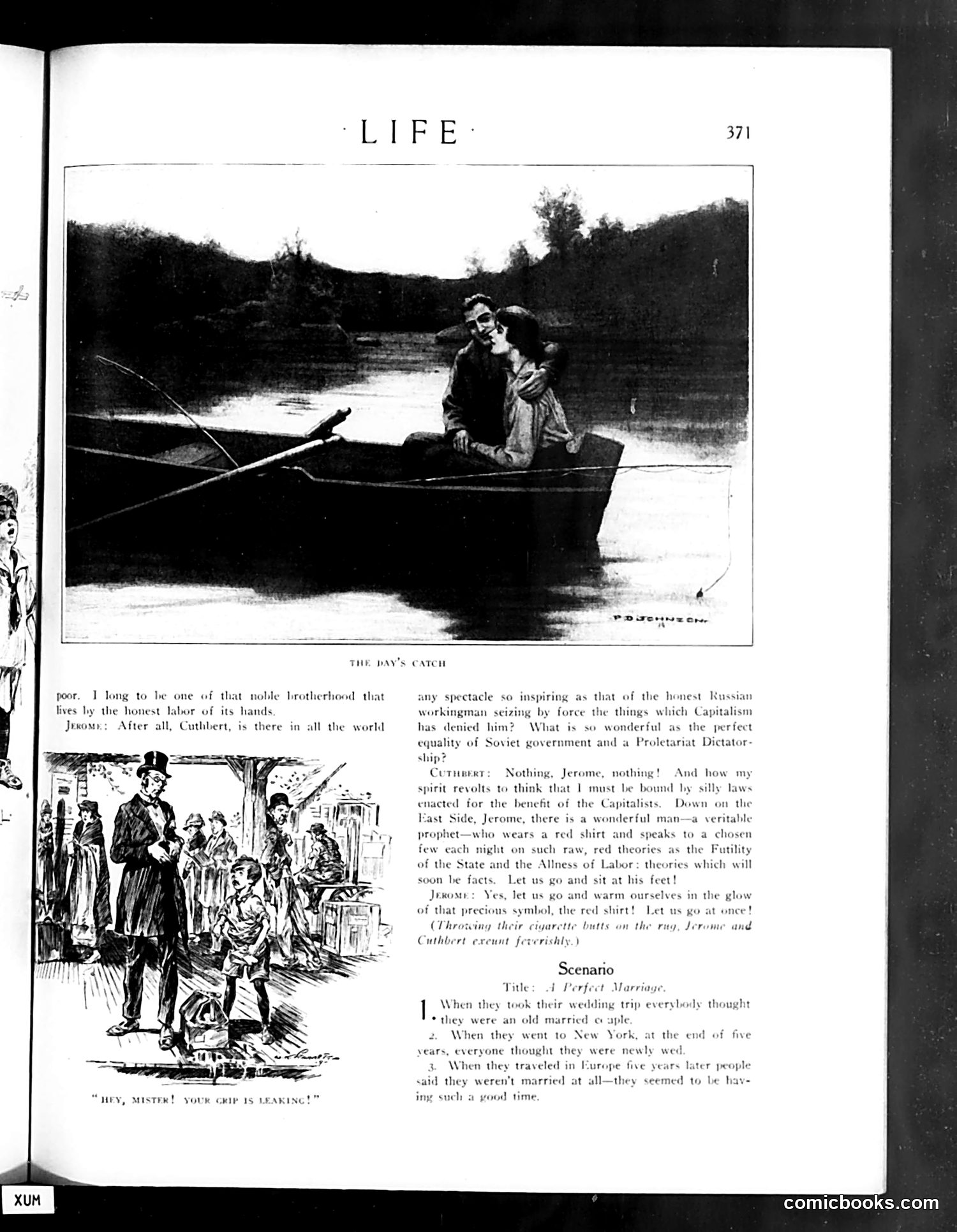
This page satirizes wealthy young socialists ("Jerome" and "Cuthbert") who romanticize Russian Bolshevism while living comfortable bourgeois lives. The dialogue mocks their hypocrisy: they eloquently praise Soviet equality and a "Proletariat Dictatorship," admire working-class struggle, and want to hear a radical prophet preach about abolishing the State—yet they casually discard cigarette butts while doing so, revealing their actual class indifference. The cartoon titled "Hey, Mister! Your Grip is Leaking!" depicts street-level working people, contrasting sharply with Jerome and Cuthbert's detached theorizing. The satire suggests that these dilettante socialists are fascinated by revolution as ideology or performance, not genuine political commitment. The "Perfect Marriage" scenario below appears unrelated or continues a separate satirical thread about appearances and social perception. **Context**: This likely dates from the 1920s Red Scare period, when American magazines mocked fashionable "parlor communists."
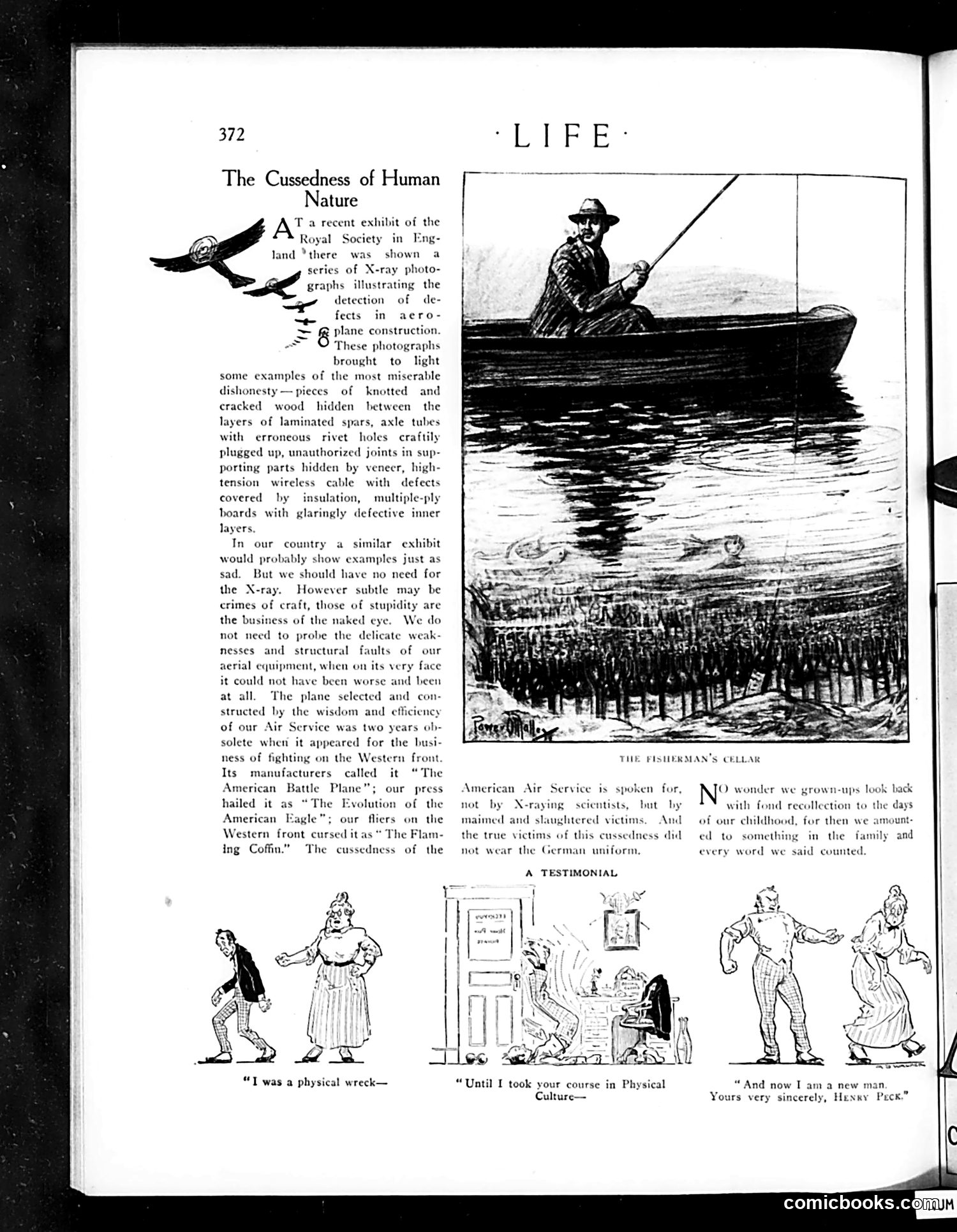
This page critiques American military incompetence during WWI. The main article attacks defective aircraft supplied to American pilots, drawing a parallel to an X-ray exhibit revealing hidden flaws in British aeroplanes. The author argues American planes were so visibly shoddy—"The Flaming Coffin"—they didn't need X-rays to expose problems. Pilots called it obsolete and deadly, yet manufacturers marketed it as "The Evolution of the American Eagle." The satirical point: American soldiers died not from enemy action but from criminal negligence and stupidity by manufacturers and military planners who failed to equip troops properly. The lower cartoon, "A Testimonial," is unrelated slapstick: it advertises a "Physical Culture" course transforming a scrawny weakling into a muscular man. The humor is the exaggerated before-and-after transformation, common in period fitness advertising.
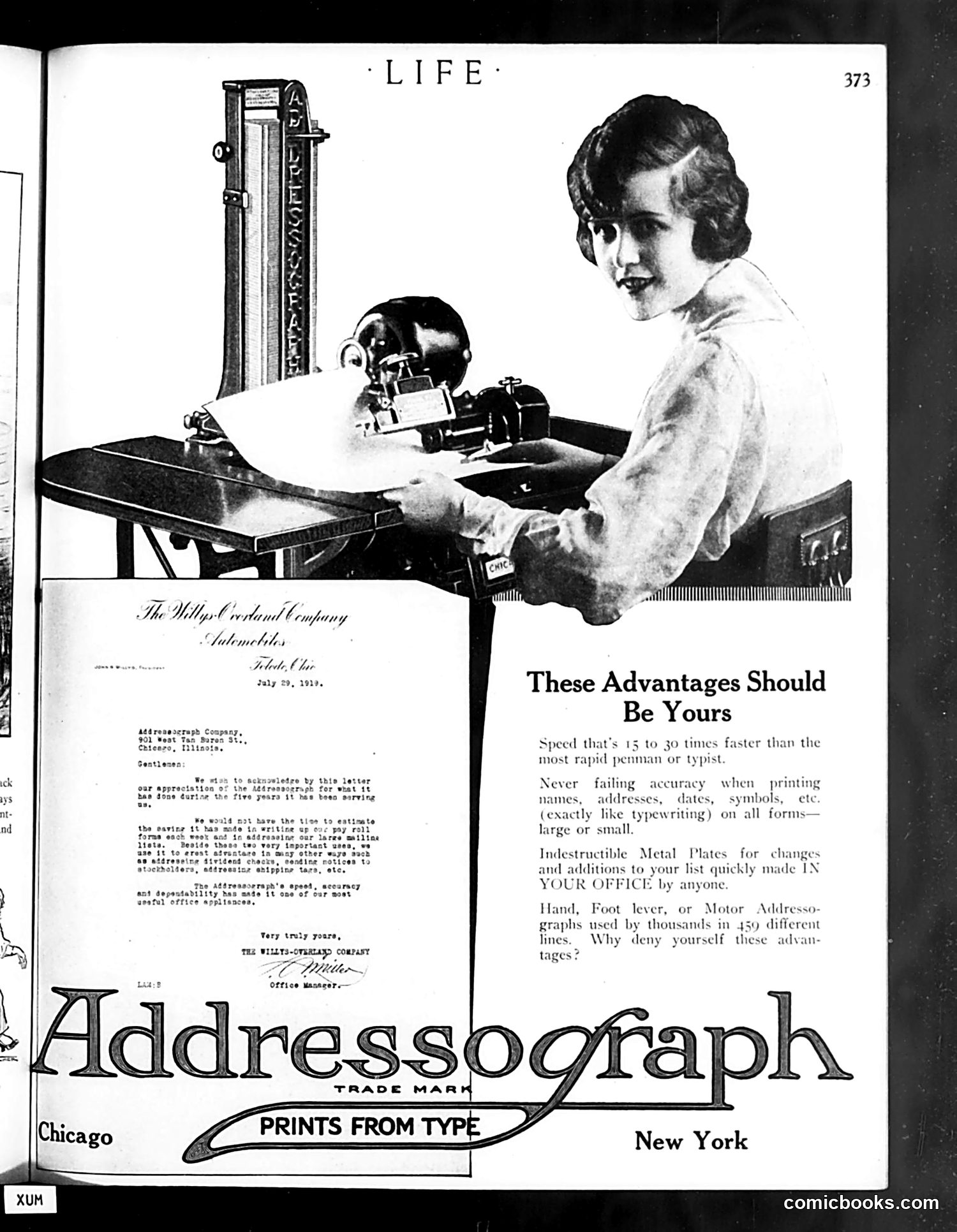
This is primarily an **advertisement**, not editorial content or satire. The page promotes the "Addressograph," a mechanical addressing machine from The Wills-Overland Company. The image shows a woman at a desk operating the device, positioned as aspirational—modern, efficient, and professional. The advertisement emphasizes speed (15-30 times faster than handwriting or typing) and accuracy for printing names, addresses, and dates on forms. The accompanying business letter (left side) appears to be a testimonial or sample correspondence, lending credibility to the product's claims. For modern readers: This reflects early 20th-century office automation. The Addressograph was a practical solution to repetitive mailing tasks before computerized databases. The gendered imagery (woman operator) was typical advertising of the era, positioning clerical work as female-coded labor while promoting technological progress as beneficial to office management.
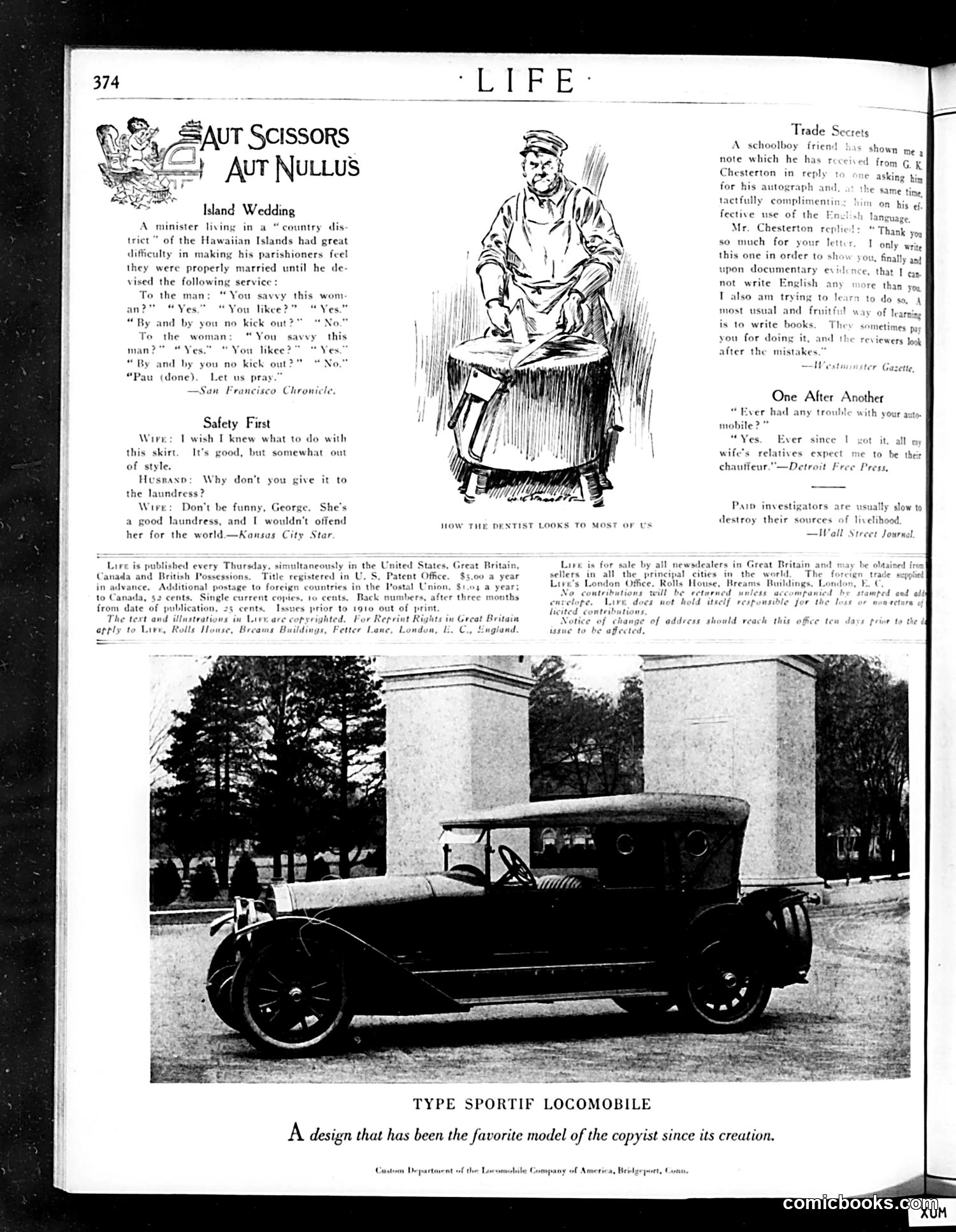
This page contains three unrelated humorous items typical of *Life* magazine's satirical format: 1. **"Island Wedding"**: A joke mocking pidgin English and Hawaiian culture. A minister simplifies marriage vows using exaggerated, broken English ("You savvy this woman?"), treating the sacrament as a commercial transaction. The satire targets both the condescension toward Hawaiian islanders and the minister's crude pragmatism. 2. **"Safety First"** and related brief quips: Domestic humor about a wife's outdated skirt and marital banter—typical early-20th-century gender comedy with no political content. 3. **"How the Dentist Looks to Most of Us"**: An illustration showing a dentist as a working-class tradesman, likely satirizing public anxiety about dental work and class perceptions. The automobile advertisement at bottom promotes a Locomobile model as a "favorite" design. The page reflects *Life*'s era: racial caricature, domestic comedy, and modernization anxiety were standard fare.
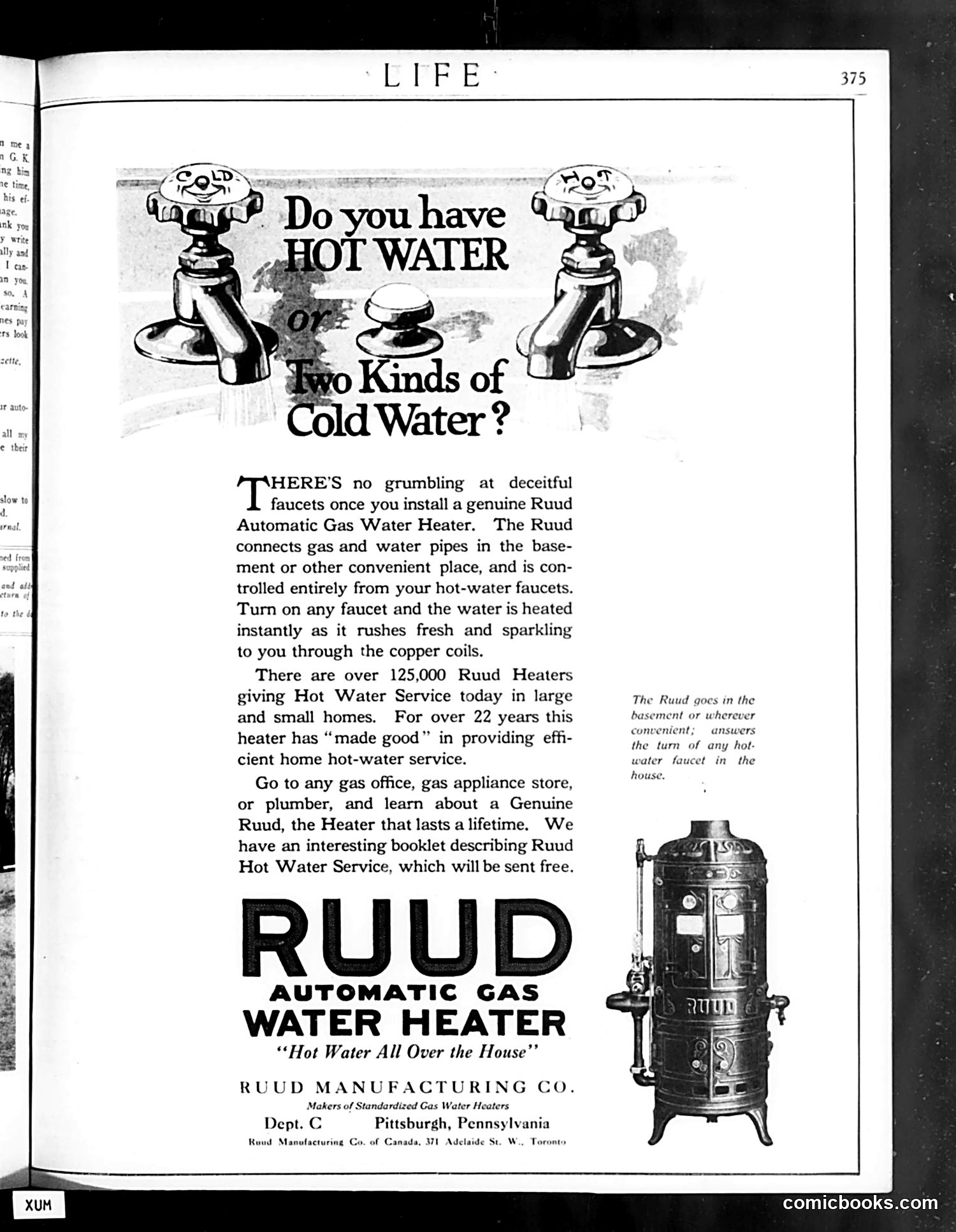
This is a **full-page advertisement**, not satire or political commentary. It promotes the Ruud Automatic Gas Water Heater to American homeowners circa early 20th century. The opening visual pun—"Do you have HOT WATER or Two Kinds of Cold Water?"—humorously references the common household frustration of inconsistent water temperature from dual faucets before centralized heating. The ad positions Ruud's system as the solution: a basement-installed gas heater delivering instant hot water throughout the house. Key claims: over 125,000 units in use, 22 years of reliability, lifetime durability. The accompanying product illustration shows the cylindrical heater unit. The text emphasizes convenience and modernity—automating hot water delivery was a significant domestic luxury selling point for this era. The manufacturer, based in Pittsburgh, positions this as standardized, trustworthy technology for both American and Canadian markets.
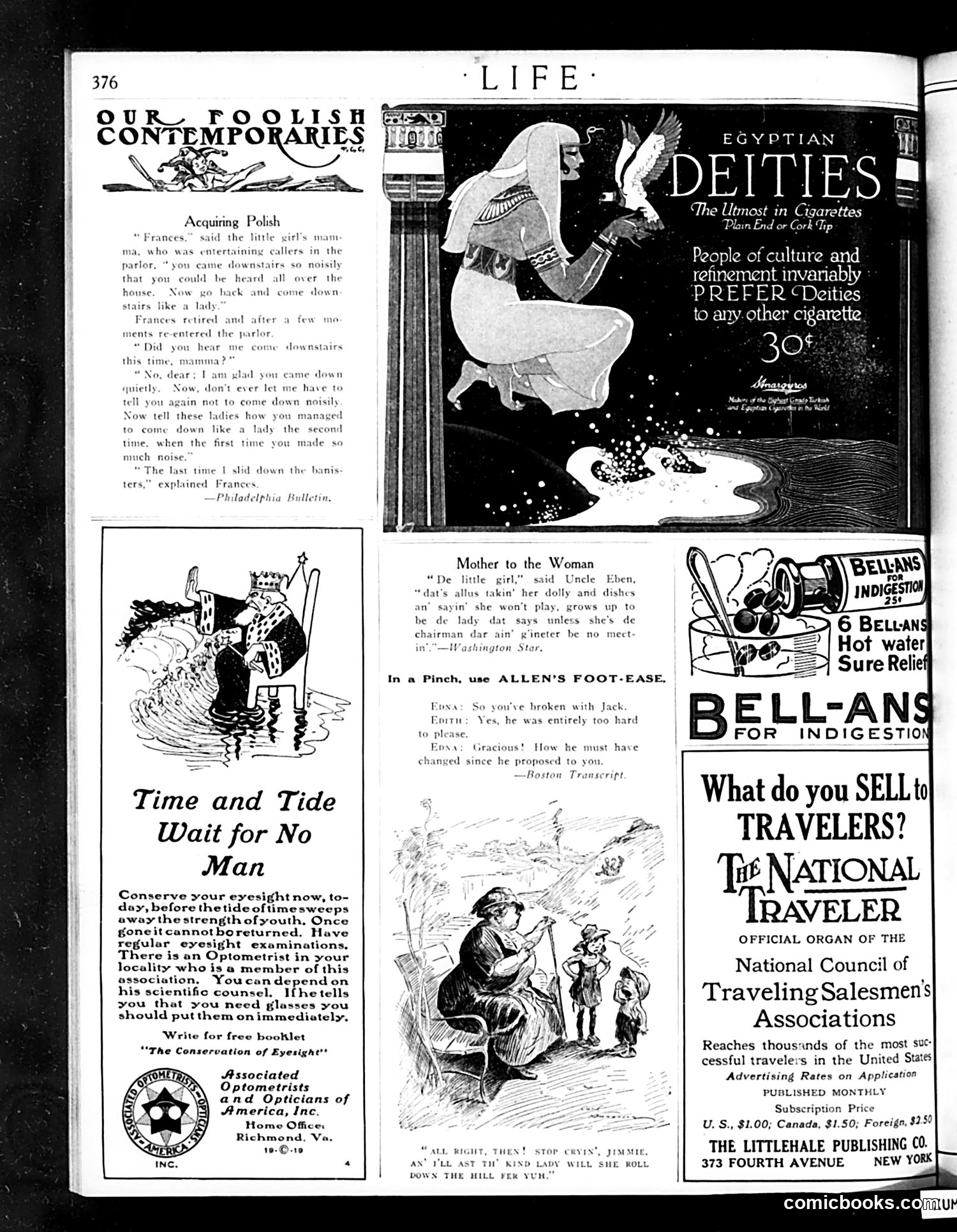
This brief comic anecdote mocks the pretensions of teaching "polish" (refinement) to working-class children. A mother instructs her daughter "Frances" to descend the stairs "like a lady" quietly rather than noisily. When Frances returns having slid down the bannister instead—producing maximum noise—she sarcastically explains she was following instructions to come down "like a lady the second time," referencing the second verse of a children's rhyme about sliding down banisters. The joke targets both the mother's ineffective gentility lessons and the child's deliberately obtuse literalism. It reflects period anxiety about social mobility and whether manners could truly be "acquired" by the working classes, or whether such refinement was inherent rather than teachable. The page itself is primarily advertisements (Egyptian Deities cigarettes, Bell-Ans indigestion remedy, optometrists' association, etc.), with this humor piece as filler content.
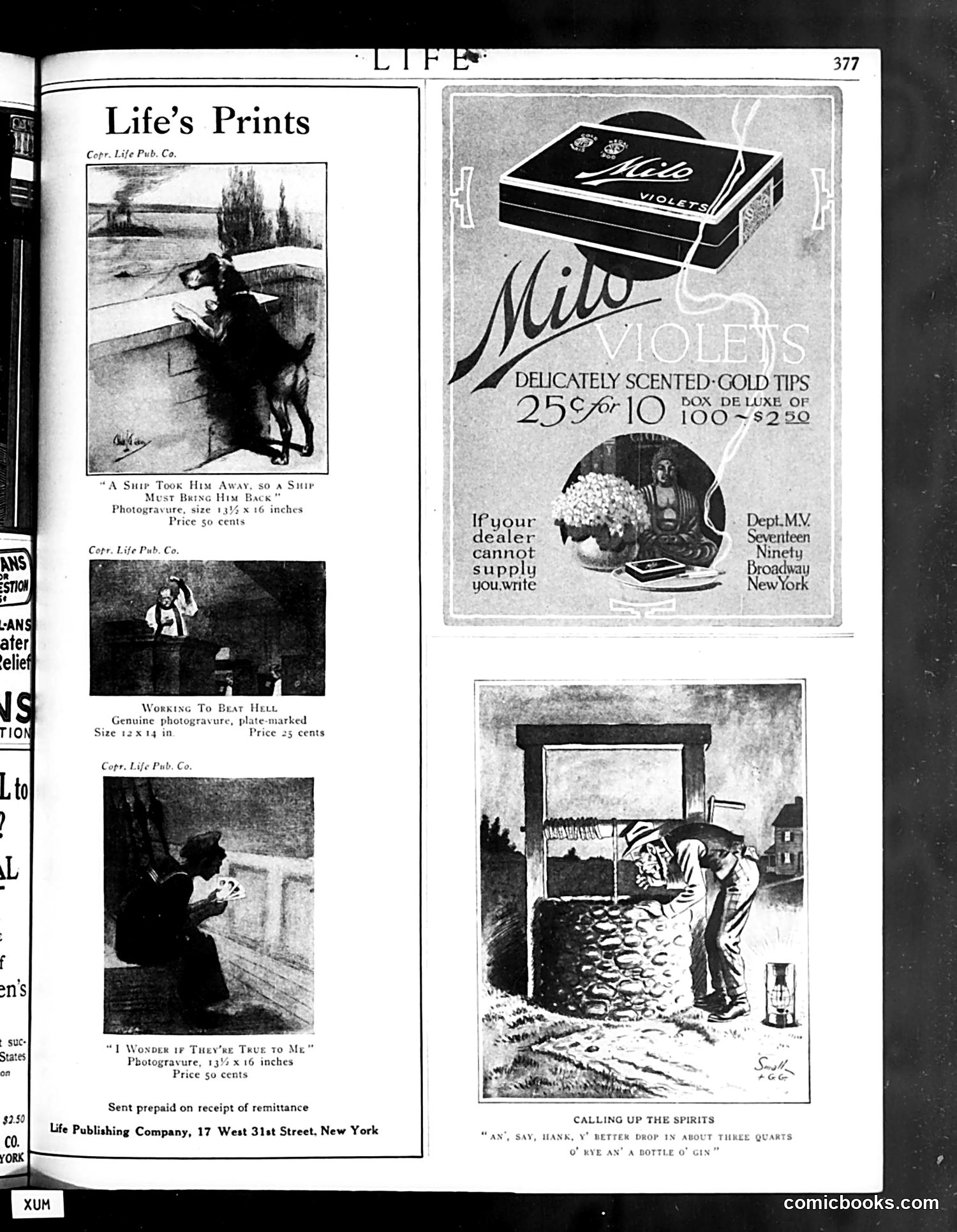
This page combines advertisements with sentimental photogravure prints for sale. The left side offers three photographs from Life Publishing Company: romantic scenes including "A Ship Took Him Away, so a Ship Must Bring Him Back" (depicting wartime separation), "Working to Beat Hell," and "I Wonder if They're True to Me"—likely referencing World War I anxieties about soldier fidelity and longing. The right side features a Milo Violets cigarette advertisement (25 cents for a deluxe box of 100) and a cartoon titled "Calling Up the Spirits," depicting two men arranging a late-night social visit involving alcohol ("three o'clock and a bottle of gin"). The cartoon likely satirizes Prohibition-era underground drinking culture, where acquiring liquor required secretive arrangements and coded language among friends.
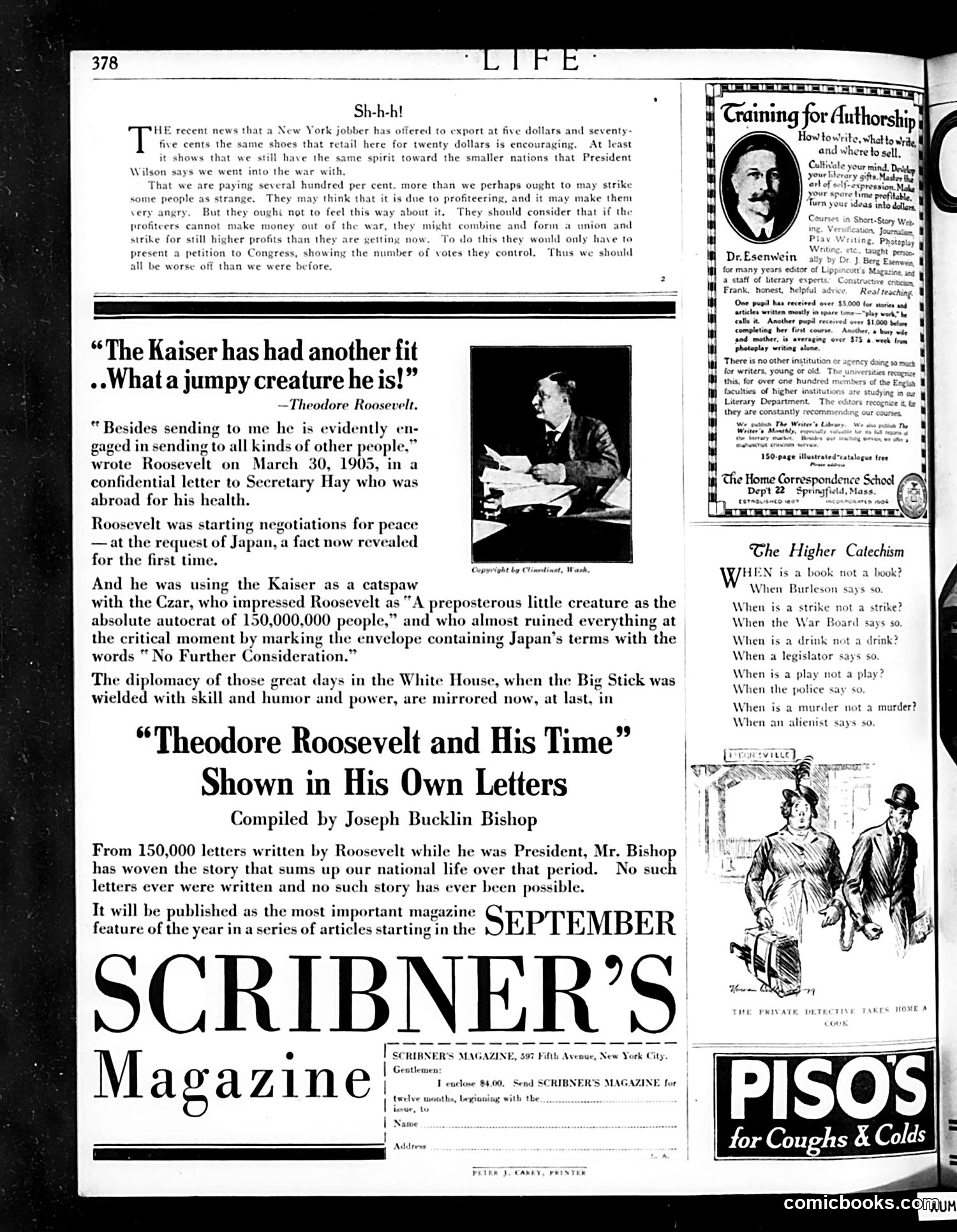
This page mixes political commentary with advertising. The main content critiques **postwar profiteering**: American shoe manufacturers export identical shoes for $5.75 that sell domestically for $20, yet the article sardonically defends this as consistent with Wilson's stated wartime principles toward smaller nations. The **Theodore Roosevelt section** advertises an upcoming Scribner's Magazine series featuring Roosevelt's letters. It references his 1905 diplomatic negotiations—brokering peace between Japan and Russia during the Russo-Japanese War, which the text claims was newly revealed. Roosevelt famously used the German Kaiser as a diplomatic tool while privately dismissing the Russian Czar as "preposterous." The quoted insult about the Kaiser being a "jumpy creature" exemplifies Roosevelt's characteristic bluntness. **"The Higher Catechism"** is satirical wordplay questioning wartime authority figures—Burleson (Postmaster General), the War Board, legislators, and alienists—each capable of declaring something is/isn't what it obviously is, mocking government overreach and censorship during or after WWI. The page reflects post-WWI American skepticism about profiteering and governmental power.
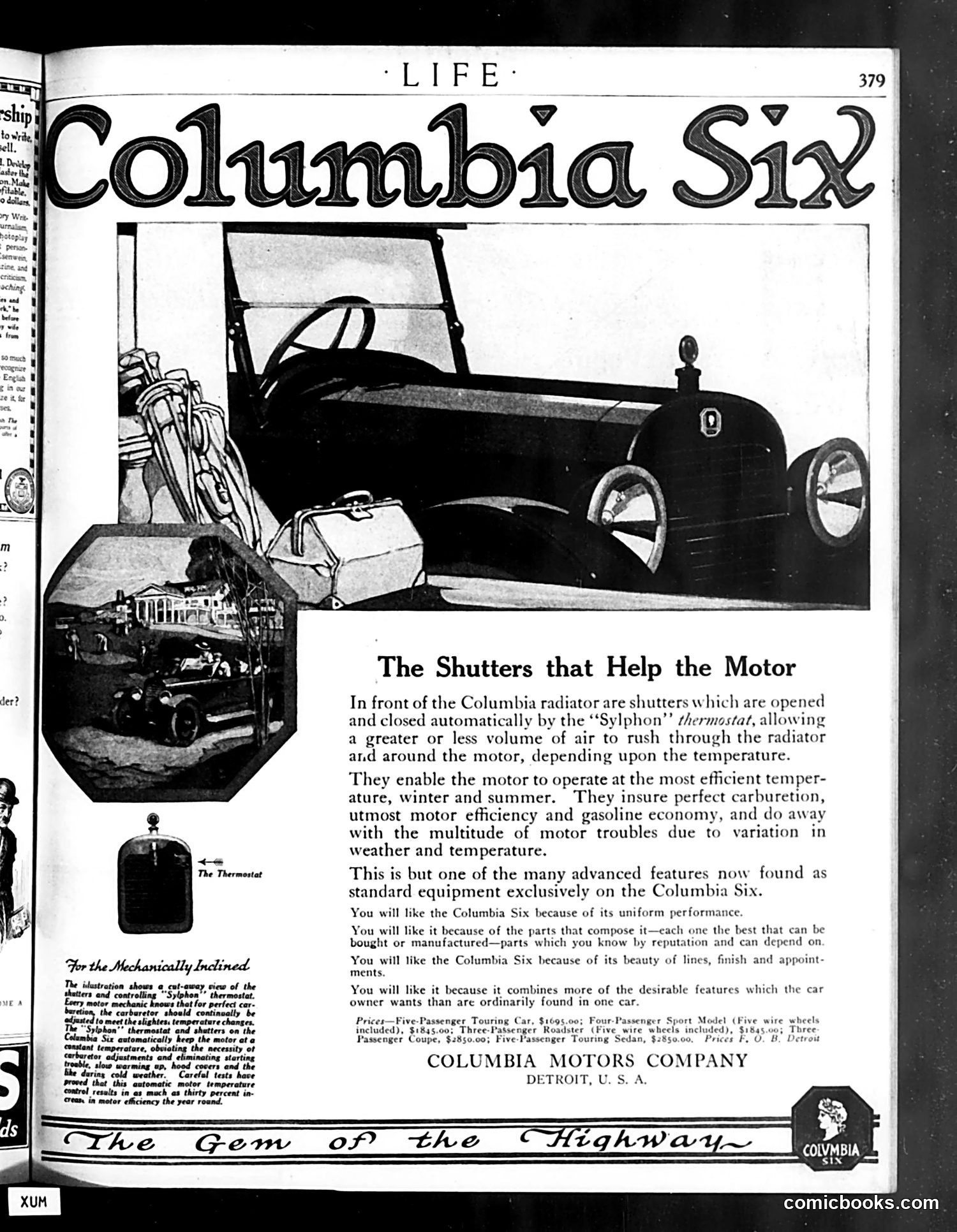
This is **not a cartoon or satire**—it's a straightforward automobile advertisement from Life magazine's early automotive era (likely 1910s-1920s). The page promotes the Columbia Six automobile, highlighting its "Sylphon" thermostat and automatic radiator shutters as advanced engineering features. The diagram shows the thermostat mechanism, explaining how it automatically adjusts airflow through the radiator based on temperature, eliminating the need for manual carburetor adjustments. The satire-like section titled "For the Mechanically Inclined" uses humorous technical language and an exaggerated "cat-away view" diagram to appeal to readers interested in automotive mechanics. However, this is marketing strategy rather than political commentary—targeting educated, mechanically-minded consumers by making complex engineering seem both impressive and understandable. The page emphasizes that these features are "exclusively" standard equipment on Columbia Six models, justifying premium pricing ($1,695-$2,850).
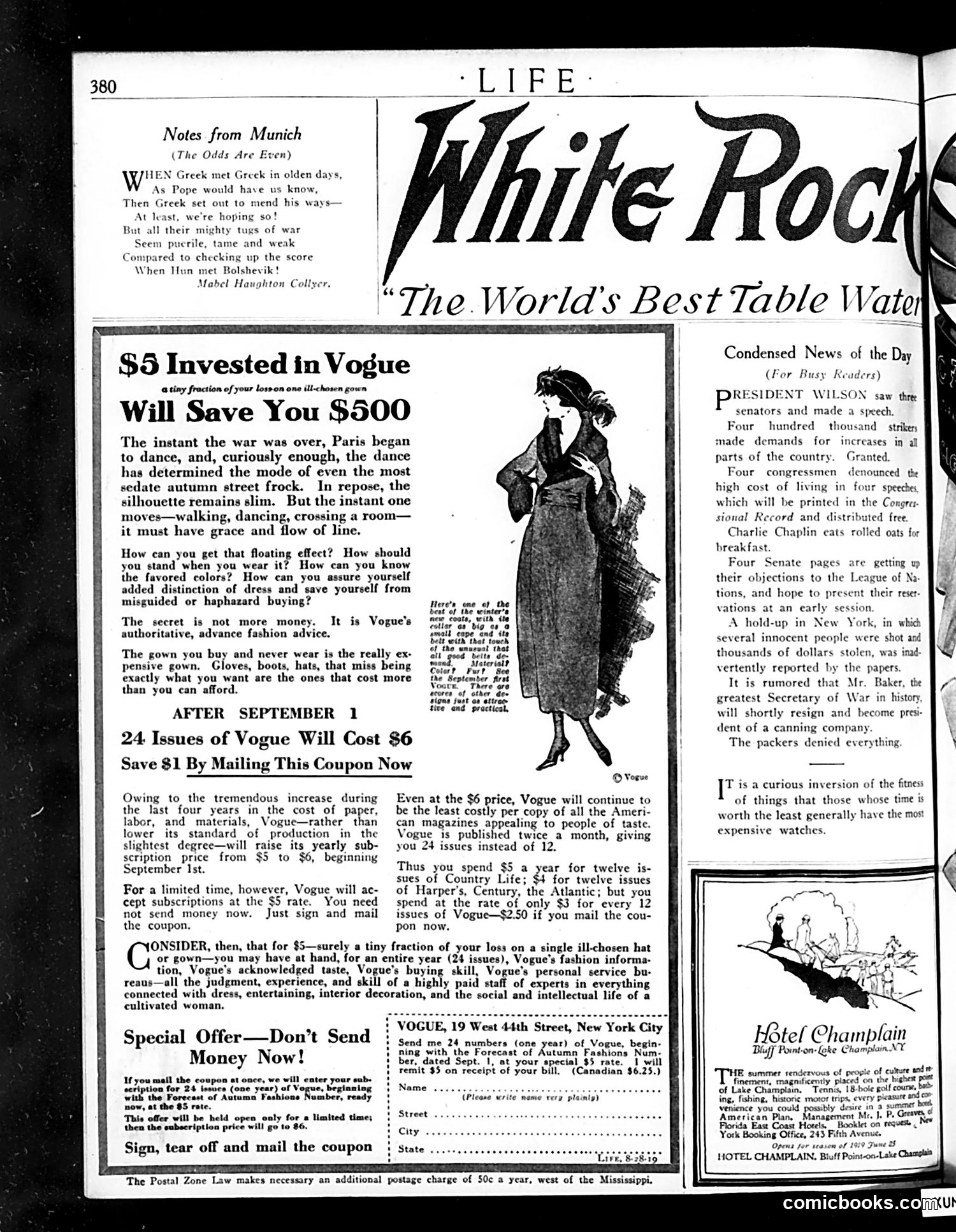
This page is primarily **advertising**, not political satire, though it opens with a brief poem mocking post-WWI tensions. The "Notes from Munich" poem compares historical Greek conflicts to contemporary geopolitical tensions—specifically the "Hun" (Germany) versus "Bolshevik" (Soviet Russia). The joke invokes the cliché that when "Greek met Greek" in antiquity, conflict resulted. The satire suggests modern power struggles are equally petty or inevitable. The "Condensed News" section uses mock-serious brevity to satirize American priorities: President Wilson's political struggles, labor strikes, war profiteering denials, and Charlie Chaplin eating breakfast—all treated with equal weight. The humor lies in juxtaposing trivial celebrity gossip with serious economic and political issues, suggesting readers' actual concerns are superficial. The bulk of the page is a **Vogue magazine subscription pitch** exploiting post-war inflation to justify price increases while claiming value—a straightforward advertisement disguised as editorial content.
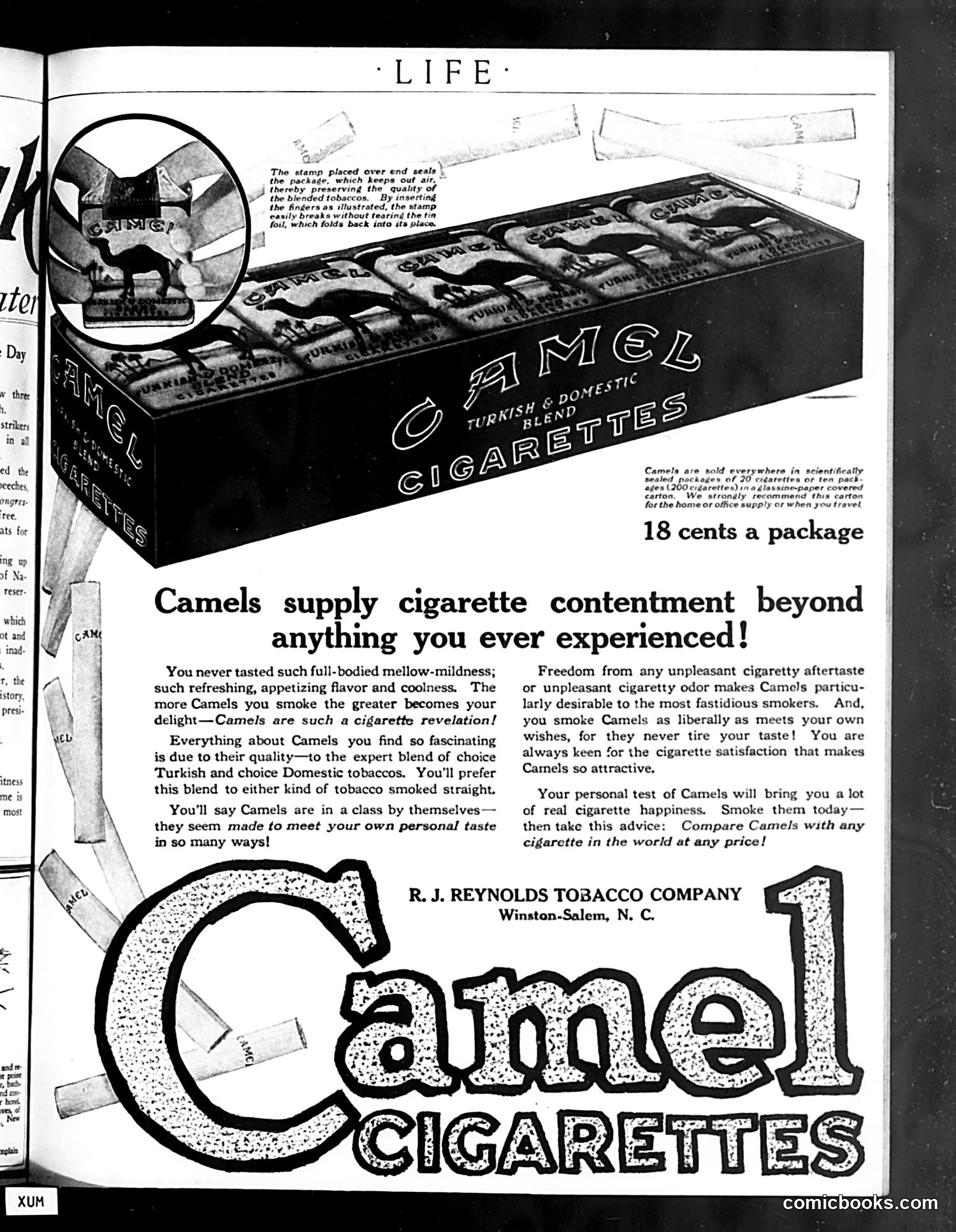
This is **not a cartoon or satire**—it's a full-page cigarette advertisement for Camel brand cigarettes by R.J. Reynolds Tobacco Company, priced at 18 cents per package. The ad features product photography showing a box of cigarettes with individual packs displayed, along with a circular inset demonstrating the package's opening mechanism. The text emphasizes marketing claims typical of early 20th-century tobacco advertising: "full-bodied mellow-mildness," "freedom from...unpleasant cigaretty aftertaste," and superior quality from a blend of "Turkish and choice Domestic tobaccos." The phrase about Camels being "made to meet your own personal taste" and never tiring your taste represents standard period advertising rhetoric, before health warnings were required. This page confirms that *Life* magazine, despite its satirical reputation, accepted tobacco advertising—a common practice before the 1960s-70s advertising restrictions on cigarettes.
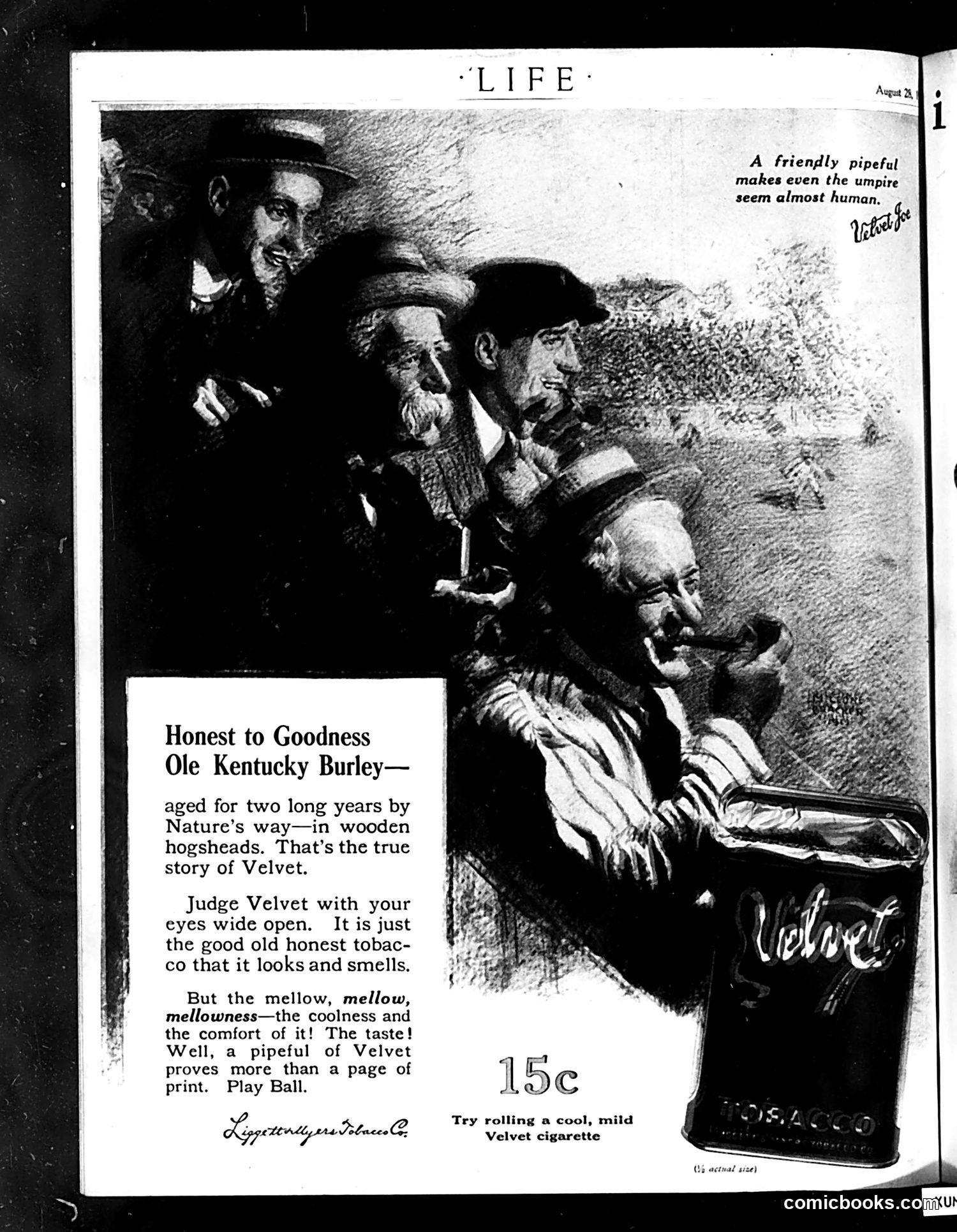
This is primarily a **cigarette/tobacco advertisement**, not political satire. The page features an illustration of four men—apparently an umpire (center, in lighter clothing) and three other figures—with the caption joking that "a friendly pipeful makes even the umpire seem almost human." The humor relies on the era's common stereotype that baseball umpires were cantankerous and inhuman in their calls. The implication is that Velvet tobacco's pleasant qualities could humanize even this notoriously disagreeable figure. The ad emphasizes the product's authenticity ("Ole Kentucky Burley aged for two long years") and its sensory appeal—mellowness, coolness, and taste. The price of 15¢ indicates this is from the early 20th century. The signature appears to be from the advertiser rather than a cartoonist commenting on social issues.