
Life, 1919-08-28 · page 26 of 40
Life — August 28, 1919 — page 26: what you’re looking at
What you’re looking at
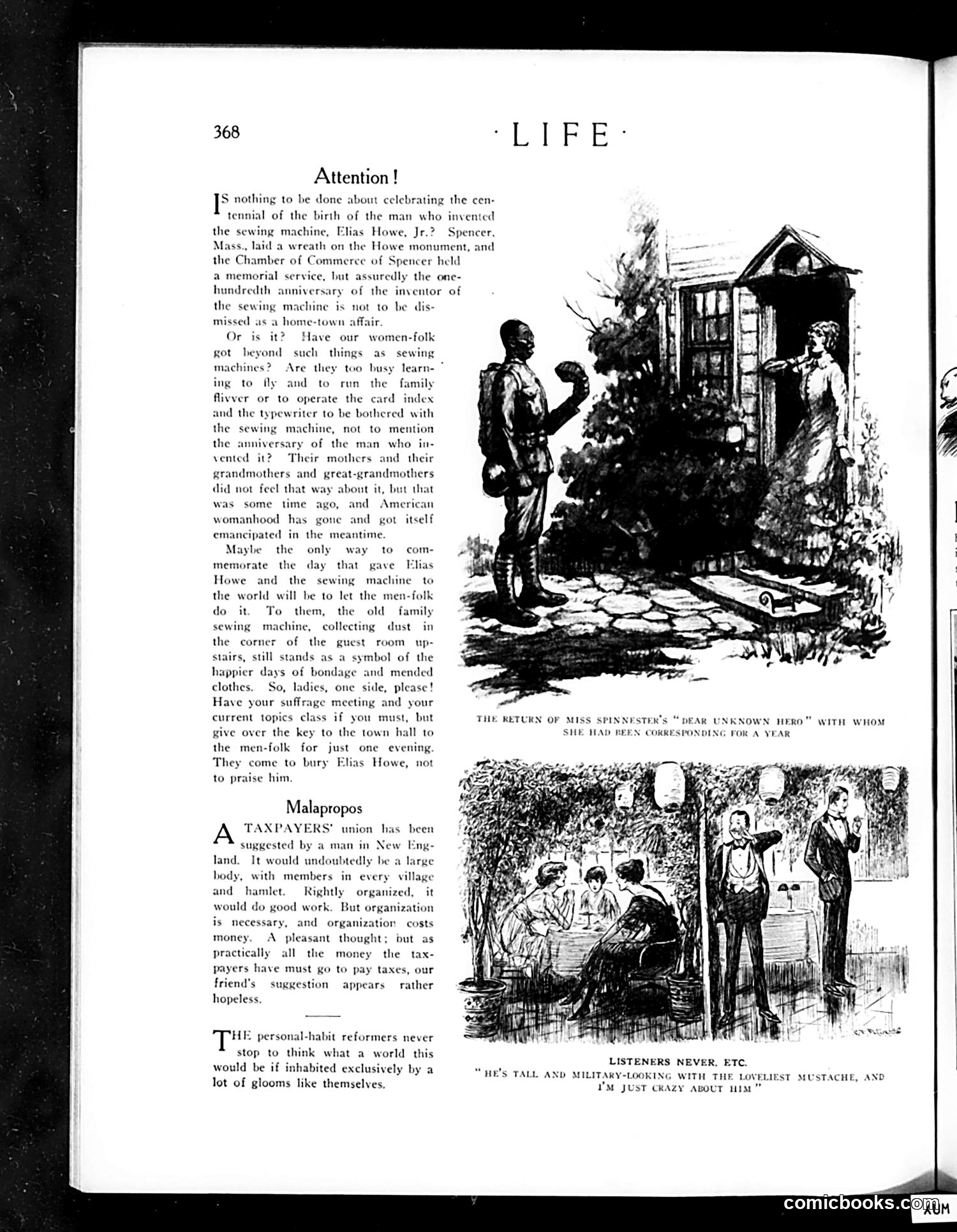
This page satirizes early 20th-century women's changing roles. The main article mocks the proposed centennial celebration of sewing machine inventor Elias Howe Jr., sarcastically suggesting modern women are too busy with suffrage meetings, driving cars ("flivvers"), and operating typewriters to care about sewing—activities their grandmothers valued. The satire implies women have gained independence but men nostalgically cling to symbols of women's "happier days of bondage." The two illustrations support this theme: the upper cartoon shows a woman corresponding with a mysterious "dear unknown hero"; the lower depicts gossiping women discussing a tall, mustached man. Both mock women's romantic preoccupations. A brief item below ridicules a proposed "Taxpayers' Union" as impractical, since citizens have no money left after paying taxes—social commentary on tax burden. The overall tone is satirical but tinged with anxiety about women's emancipation.
📄 Transcribed text from this page (OCR, searchable)
Machine-transcribed from the original scan — historical spelling and the odd misread are preserved.
Attention ! Is nothing to be done about celebrating the cen- tennial of the birth of the man who invented the sewing machine, Elias Howe, Jr.? Spencer, Mass., laid a wreath on the Howe monument, and the Chamber of Commerce of Spencer held a memorial service, but assuredly the one- hundredth anniversary of the inventor of the sewing machine is not to be dis- missed as a home-town affair Or is it? Have our women-folk got beyond such things as sewing machines? Are they too busy learn- g to fly and to run the family flivver or to operate the card index and the typewriter to be bothered with the sewing machine, not to mention the anniversary of the man who in- vented it? Their mothers and their grandmothers and great-grandmothers did not feel that way about it, but that was some time ago, and American womanhood has gone and got itself emancipated in the meantime. Maybe the only way to com- memorate the day that gave Elias Howe and the sewing machine to the world will be to let the men-folk do it. To them, the old family sewing machine, collecting dust in the corner of the guest room up- stairs, still stands as a symbol of the happier days of bondage and mended clothes. So, ladies, one side, please! Have your suffrage meeting and your current topics class if you must, but THE RETURN OF MISS SPINNESTER'S “DEAR UNKNOWN HERO” WITH WHOM give over the key to the town hall to SHE HAD REEN CORRESPONDING FOR A YEAR the men-folk for just one evening. They come to bury Elias Howe, not to praise him. Malapropos TAXPAYERS’ union has been suggested by a man in New Eng- land. It would undoubtedly be a large body, with members in every village and hamlet. Rightly organized, it would do good work. But organization is necessary, and organization costs money. A pleasant thought; but as practically all the money the tax- payers have must go to pay taxes, our friend's suggestion appears rather hopeless. THe personal-habit reformers never stop to think what a ds thi p to what a world this LISTENERS NEVER, ETC. would be if inhabited exclusively by a “HE'S TALL AND MILITARY-LOOKING WITH THE LOVELIEST MUSTACHE, AND lot of glooms like themselves, VM JUST CRAZY ABOUT MIM” comicbooks.c@n