
Life, 1919-08-28 · page 24 of 40
Life — August 28, 1919 — page 24: what you’re looking at
What you’re looking at
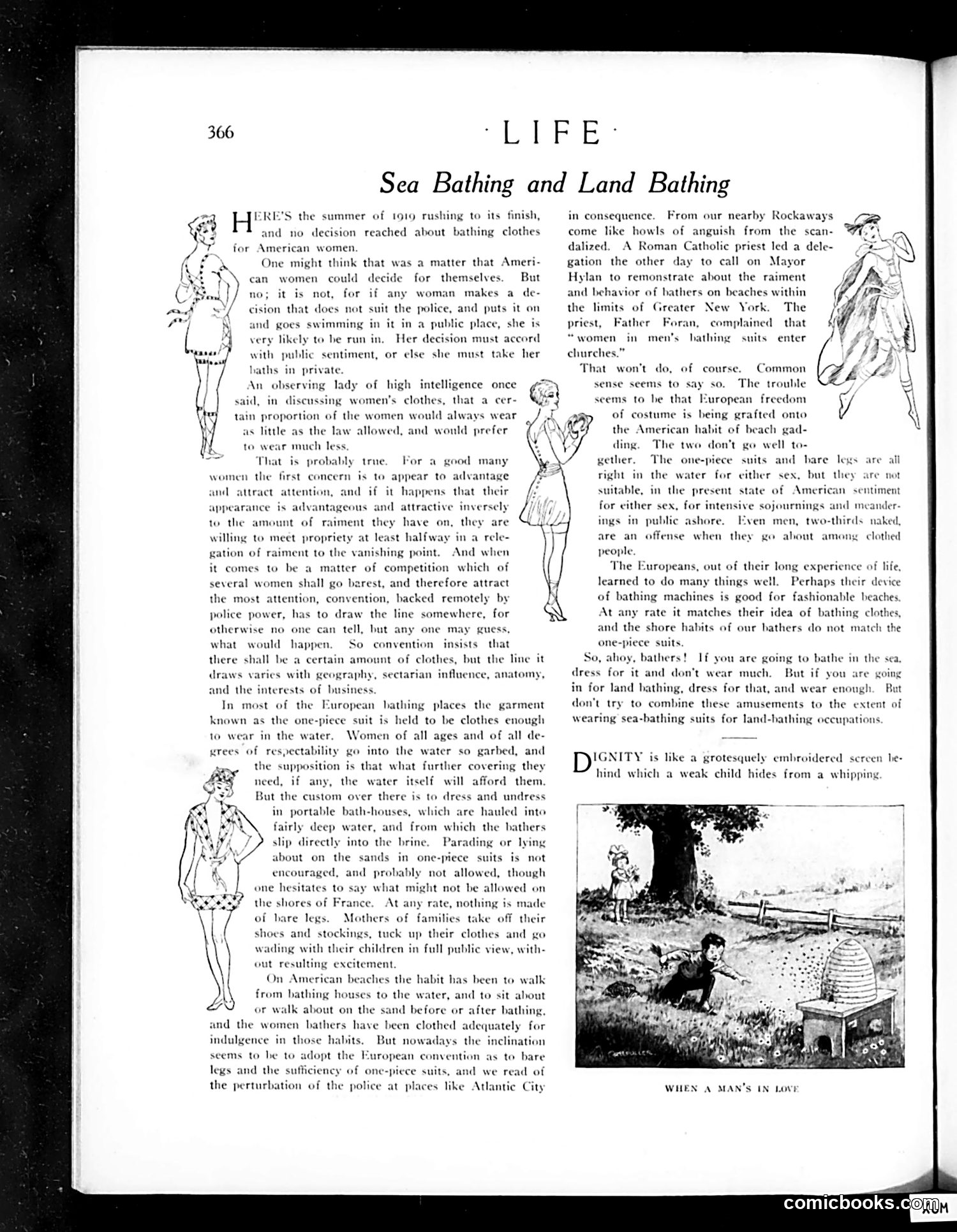
This article satirizes the cultural clash between European and American attitudes toward women's beach attire. The core issue: American women are adopting the practical European one-piece bathing suit, but continuing American customs of parading on beaches fully visible—creating moral panic. The satire targets prudish American authorities (particularly police and the Catholic Church) who police women's bodies. Notably, a priest complained to Mayor Hylan that women in bathing suits were entering churches, revealing the absurdity of the outrage. The piece mocks that convention, backed by "police power," must arbitrarily "draw the line somewhere" on female modesty while European women enjoy sensible freedom with identical clothing—the difference being European bath-houses conceal undressing. The illustrated women suggest this was partly about class anxieties: working-class women gaining beach access and wearing less restrictive clothing. The satire defends practicality and European reasonableness against American hypocrisy and prudishness policed through law enforcement.
📄 Transcribed text from this page (OCR, searchable)
Machine-transcribed from the original scan — historical spelling and the odd misread are preserved.
‘LIFE: Sea Bathing and Land Bathing ERE’S the summer of to19 rushing to its finish, and no decision reached about bathing clothes for American women. One might think that was a matter that themselves. But no; it is not, for if any woman makes a di Ameri- can women could decide for cision that does not suit the police, and puts it on and goes swimming in it in a public place, she is very likely to be run in, Her decision must ord with public sentiment, or else she must take haths in private An observing lady of high intelligence once said, in discussing women's clothes, that a cer- tain proportion of the women would always wear as little as the law allowed, and would prefer to wear much less That is probably true. For a good many women the first concern is to appear to advantage and attract attention, and if it happens that their appearance is advantageous and attractive inversely to the amount of raiment they have on, they are willing to meet propriety at least halfway in a rele- gation of raiment to the vanishing point. And when it comes to be a matter of competition which of several women shall go barest, and therefore attract the most attention, convention, backed remotely. by police power, has to draw the line somewhere, for otherwise no one can tell, but any one may guess, what there shall be a certain amount of clothes, but the line it draws varies with geogr would happen. So convention insists that why, sectarian influence, anatomy, and the interests of business. In most of the European bathing places the garment known as the one-piece suit is held to be clothes enough to wear in the water. Women of all ages and of all de grees of respectability go into the water so garbed, and the supposition is that what further covering they need, if any, the water itself will afford them. But the custom over there is to dress and undress in portable bath-houses, which are hauled into fairly deep water, and from which the bathers slip directly into the brine. Parading or lying about on the sands in one-piece suits is not encouraged, and probably not allowed, though one hesitates to say what might not be allowed on the shores of France. At any rate, nothing is made of bare legs. Mothers of milies take off their shoes and stockings, tuck up their clothes and go wading with their children in full public view, with- out resulting excitement. On American beaches the habit has been to walk from bathing houses to the water, and to sit about or walk about on the sand before or after bathing, and the women bathers have been clothe indulgence in those habits, adequately for But nowadays the inclination seems to he to adopt the European convention as to bare legs and the sufficiency of one-piece suits, and we read of the perturbation of the police at places like Atlantic City in consequence. From our nearby Rockaway ye come like howls of anguish from the scan- %7,% dalized. A Roman Catholic priest led a dele- gation the other day to call on Mayor Hylan to remonstrate about the raiment and behavior of bathers on beaches within the limits of Greater New York. The Father complained that priest, Foran, “women in men’s bathing suits enter churches.” That sense seems to say so. won't do, of course. Common The trouble seems to be that European freedom of costume is being grafted onto the American habit of beach ding. The two don't go well to- gether, The one-piece suits and hare legs or either sex, but they are not suitable, in the present state of right in the water American sentiment for either sex, for intensive sojournings and meander ings in public ashore. Even men, two-thirds naked, are an offense when they go about am clothed people The Europeans, out of their long experience of life, learned to do many things well. of bathing machines is good for fashionable beaches. At any rate it matches their idea of bathing clot and the shore habits of Perhaps their device our bathers do not match the one-piece suits So, ahoy, bathers! If you are going to bathe in the sea dress for it and don't wear much. But in for land you are going hing, dress for that, and wear enough. But don't try to combine these amusements to the extent of wearing sea-bathing suits for land-hathing occupations. IGNITY is like a grotesquely embroidered screen he- hind which a weak child hides from a whipping WHEN A MAN'S LN Love comicbooks.conmy