
Life, 1919-08-28 · page 18 of 40
Life — August 28, 1919 — page 18: what you’re looking at
What you’re looking at
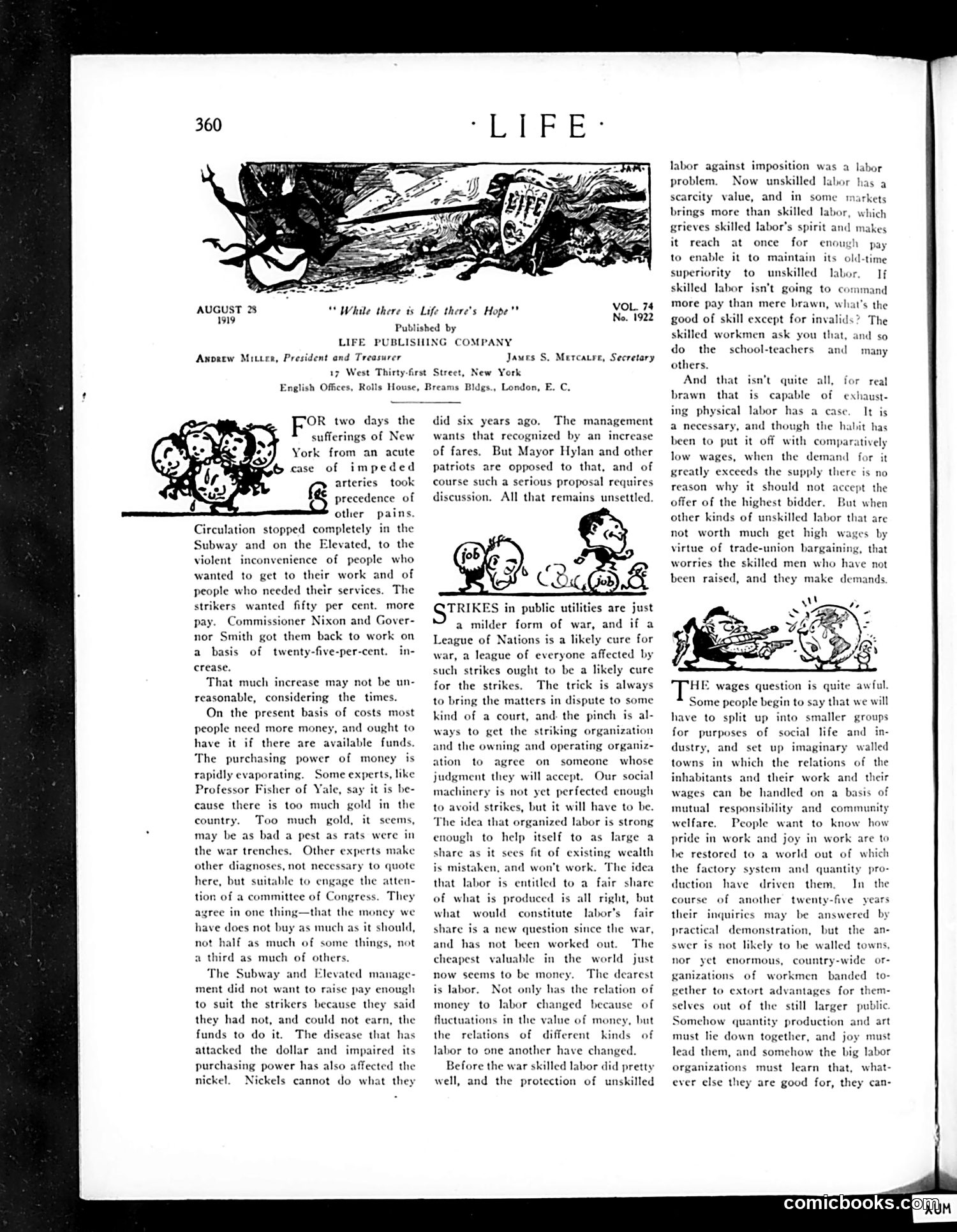
This Life editorial addresses a **New York City subway strike** that paralyzed transportation for two days. The strikers demanded a 50% wage increase; management and city officials settled on 25%. The cartoons (showing distressed figures) illustrate the public's frustration with transit disruption. The unnamed text references **Commissioner Nixon** and **Governor Smith** brokering the compromise, and **Mayor Hylan** opposing fare increases to compensate management. The core argument: inflation has devastated the dollar's purchasing power (blaming either excessive gold supply or other economic factors). Workers legitimately need higher wages, but strikes in essential public utilities are "a milder form of war." The piece advocates for neutral arbitration courts rather than labor confrontation. A secondary concern emerges: **unskilled labor now commands higher wages than skilled trades**, inverting pre-war hierarchy and threatening skilled workers' status—a post-WWI labor market shift causing resentment among craftspeople.
📄 Transcribed text from this page (OCR, searchable)
Machine-transcribed from the original scan — historical spelling and the odd misread are preserved.
Taree” 4 4 KY i AUGUST 28 1919 ‘* While there ts Life there's Hope" No. 1922 Published by LIFE Anpatw Mittre, President and Treasurer PUBLISHING COMPANY Jars S. Mercatre, Secretary 17 West Thirty-first Street, New York English Offices, OR two days the sufferings of New York from an acute case of impeded arteries took precedence of other Circulation stopped completely in the Subway and on the Elevated, to the violent inconvenience of people who wanted to get to their work and of people who needed their services. The strikers wanted fifty per cent. more pay. Commissioner Nixon and Gover- nor Smith got them back to work on a basis of twenty-five-per-cent. in- pains. crease. That much increase may not be un- reasonable, considering the times. On the present basis of costs most people need more money, and ought to have it if there are available funds. The purchasing power of money is rapidly evaporating. Some experts, like Professor Fisher of Yale, say it is be- cause there is too much gold in the country. Too may be as bad a pest as rats were in the war trenches. Other experts make other diagnoses, not necessary to quote here, but suitable to engage the atten- much gold, it scems, tion of a committee of Congress. They agree in one thing—that the money we have does not buy as much as it should, not half as much some things, not a third as much of others. The Subway and Elevated manage- ment did not want to raise pay enough to suit the strikers because they said they had not, and could not earn, the funds to do it. The dis attacked the dollar and impaired its purchasing power has also affected the nickel. Nickels cannot do what they ase that has Rolls House, Bre s Bldgs., London, E. C. did six years ago. The management wants that recognized by an increase of fares. But Mayor Hylan and other patriots are opposed to that, and of course such a serious proposal requires discussion. All that remains unsettled. TRIKES in public utilities are just a milder form of war, and if a League of Nations is a likely cure for war, a league of everyone affected by such strikes ought to be a likely cure for the strikes. The trick is always to bring the matters in dispute to some kind of a court, and. the pinch is al- ways to get the striking organization and the owning and operating organiz- ation to agree on someone judgment they will accept. machinery is not yet perfected enough to avoid strikes, but it will have to be. The idea that organized labor is strong enough to help itself to as large a wealth he idea whose Our social share as it sees fit of existing is mistaken, and won't work. that labor is entitled to a fair share of what is produced is all right, but what would constitute fair share is a new question since the war, and has not been worked out. The cheapest valuable in’ the world just now scems to be money. is labor. money to labor changed because of labor’. The dearest Not only has the relation of fluctuations in the value of money, but the relations of different kinds of labor to one another have changed. Before the war skilled labor did pretty well, and the protection of unskilled labor against imposition was a labor problem. Now unskilled labor has a scarcity value, and in some rkets brings more than skilled labor, which grieves skilled labor's spirit and makes it reach at enow pay to enable it to maintain its old-time superiority to unskilled labor, If skilled labor isn’t going to cc and more pay than mere brawn, what's the good of skill except for invalids? The skilled workmen ask you that, and so do the once for school-teachers and many others. And t isn’t real brawn that is exhaust- ing physical labor has a case. It is a necessary, and though the habit has been to put it off quite all, for capable of with comparatively low wages, when the demand for it greatly exceeds the supply there is no reason why it should not accept the offer of the highest bidder. But when other kinds of unskilled labor that are not worth much get high wages by virtue of trade-union bargaining, that worries the skilled men who have not been raised, and they make demands HE wages question is quite awful. Some people begin to say that we will have to split up into smaller groups for purposes of social life dustry, and set up ima; towns in which the relations of the inhabitants and their work and_ their wages can be handled on a basis of and in- inary walled mutual responsibility and community welfare. pride in work and joy in work are to People want to know how he restored to a world out of which the factory system and quantity pro- duction have driven them, In the course of another twenty-five years their inquiries may be answered. by practical demonstration, but the an- swer is not likely to be walled towns, nor yet enormous, country-wide or- banded to- gether to extort advantages for them- selves out of the still larger public. Somehow quantity production and art must lie down together, and joy must ganizations of workmen lead them, and somehow the big labor organizations must learn that, what- ever else they are good for, they can- comicbooks.comm