
A complete issue · 46 pages · 1919
Life — May 8, 1919
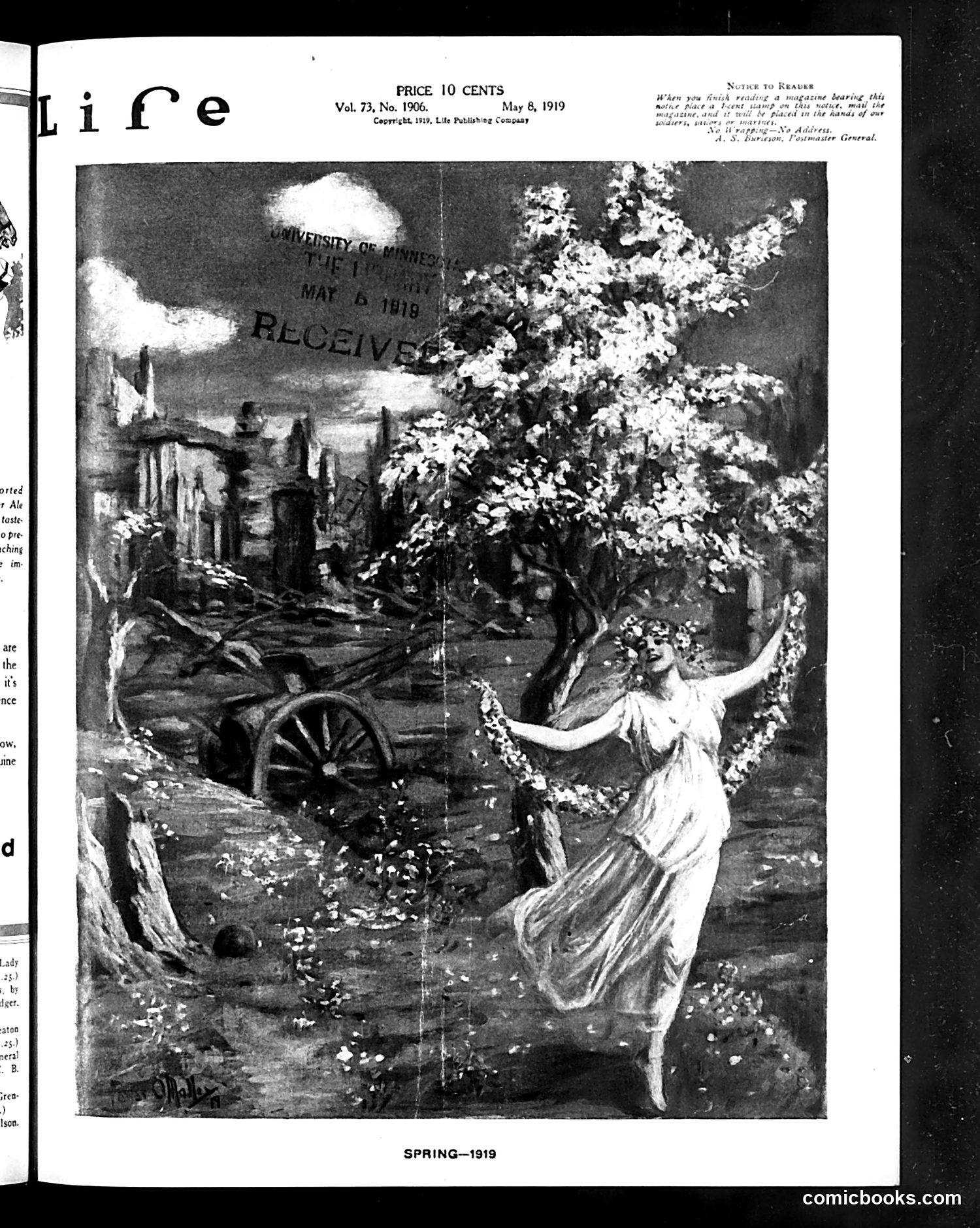
This illustration depicts classical allegory rather than political satire. A robed female figure—likely representing Spring or Nature—reaches toward flowering branches while gesturing toward a war-ravaged landscape. The destroyed buildings, abandoned cart, and barren terrain in the background contrast sharply with the blooming tree in the foreground. Published in May 1919, just months after World War I's November 1918 armistice, the image appears to symbolize hope and renewal emerging from destruction. The juxtaposition suggests spring's regenerative power offering solace or recovery following the war's devastation. Rather than mocking specific figures or policies, this is a poetic meditation on post-war recovery and nature's capacity to restore what conflict destroyed.

This is **primarily an advertisement**, not a satirical cartoon. It's a United States Tires company ad from *Life* magazine (dated May 8, 1924, based on the header). The image displays five different tire tread patterns arranged dramatically, emphasizing variety. The ad's core message is straightforward commercial persuasion: different driving conditions require different tires, and US Tires offers five distinct types ('Royal Cord', 'Nobby', 'Chain', 'Usco', and 'Plain') to match individual motorist needs. The copy positions the tire dealer as a knowledgeable advisor who can match vehicles to road conditions. There is no satire or political commentary—this is standard early-automotive-era advertising designed to establish brand authority and product diversity for the expanding American car market.
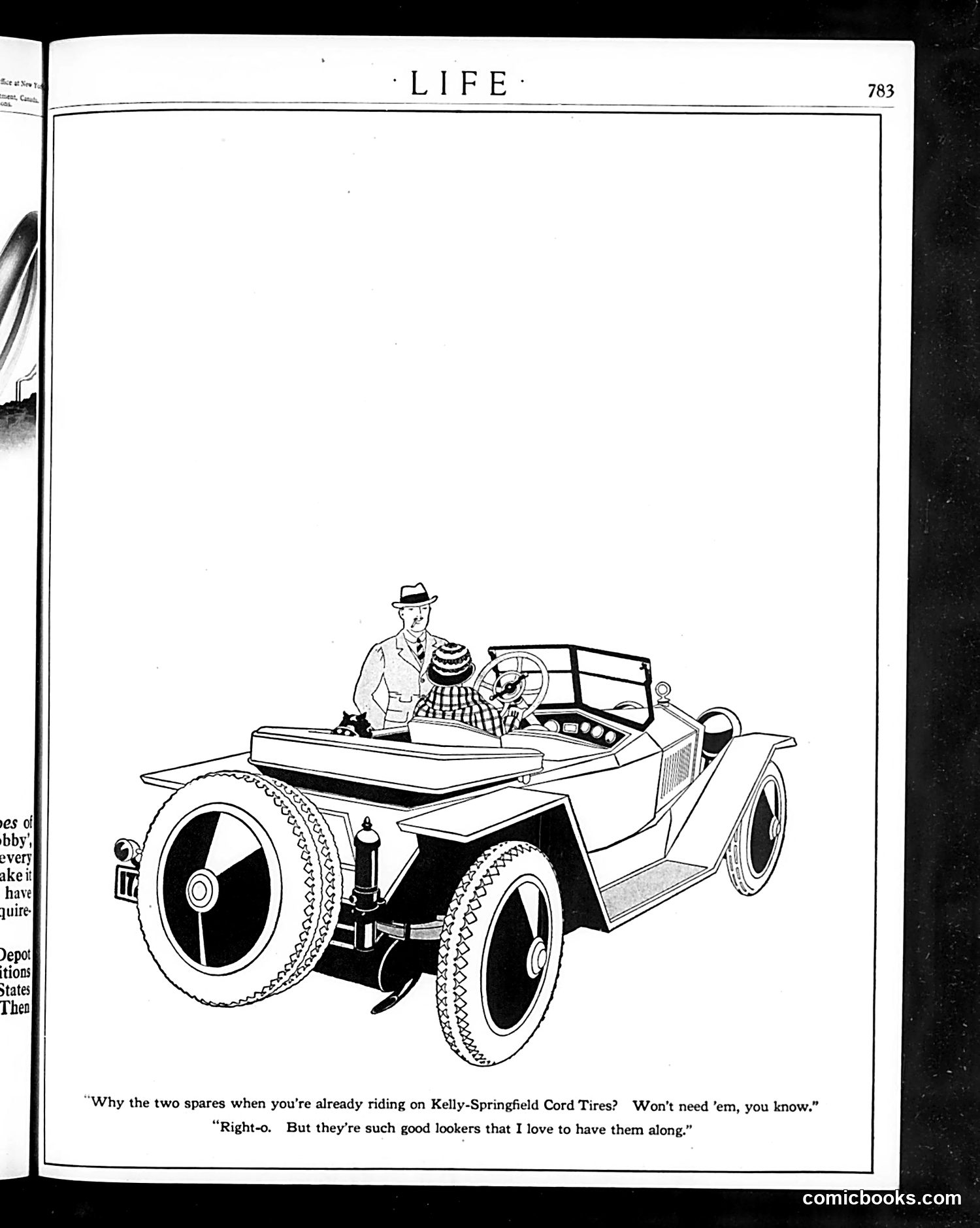
This is an advertisement for Kelly-Springfield Cord Tires disguised as a humorous cartoon. The image shows a man and woman in an open-air automobile from approximately the 1920s era, with the man driving. The joke plays on the tension between practicality and vanity. The man questions why they need two spare tires when riding on Kelly-Springfield Cord Tires (implying their reliability makes spares unnecessary). The woman responds that while spares aren't needed, she keeps them because "they're such good lookers"—valuing their aesthetic appearance. This is a common advertising technique from this period: inserting product endorsements into entertainment content while making a light joke about the product's qualities (durability and appearance). The "Cord" construction method was a notable tire technology of the era.
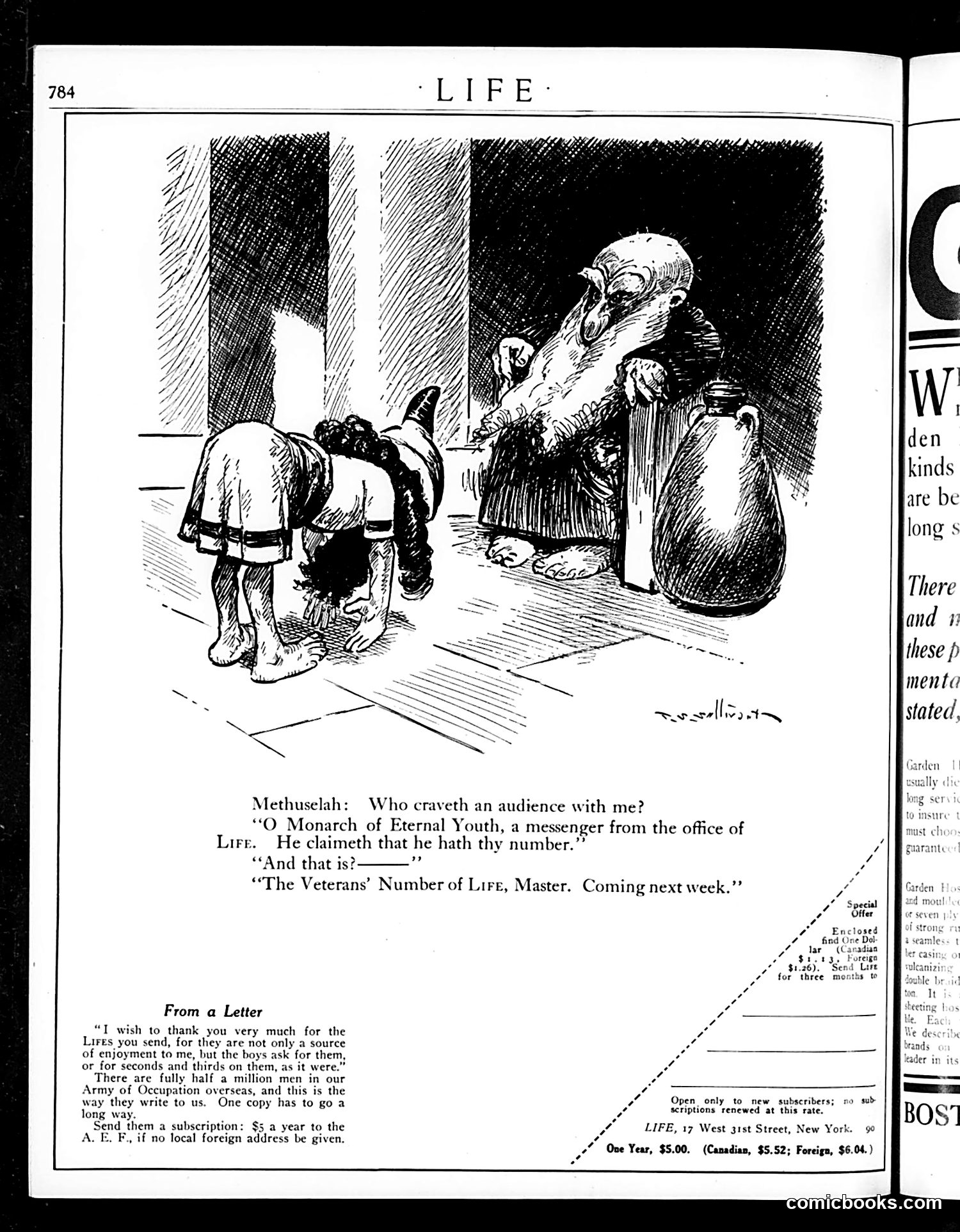
This page features a satirical cartoon titled "Methuselah: Who craveth an audience with me?" The joke plays on the biblical Methuselah, famous for extreme longevity (969 years). A character representing "Eternal Youth" visits him as a messenger from Life magazine, claiming to have Methuselah's age/number for an upcoming feature called "The Veterans' Number of Life, coming next week." The satire targets Life's editorial focus on featuring elderly figures and longevity stories. The cartoon mocks both the magazine's editorial priorities and society's fascination with extreme age. The page also includes a subscription appeal emphasizing Life's value to soldiers overseas, suggesting this is from WWI or interwar period.
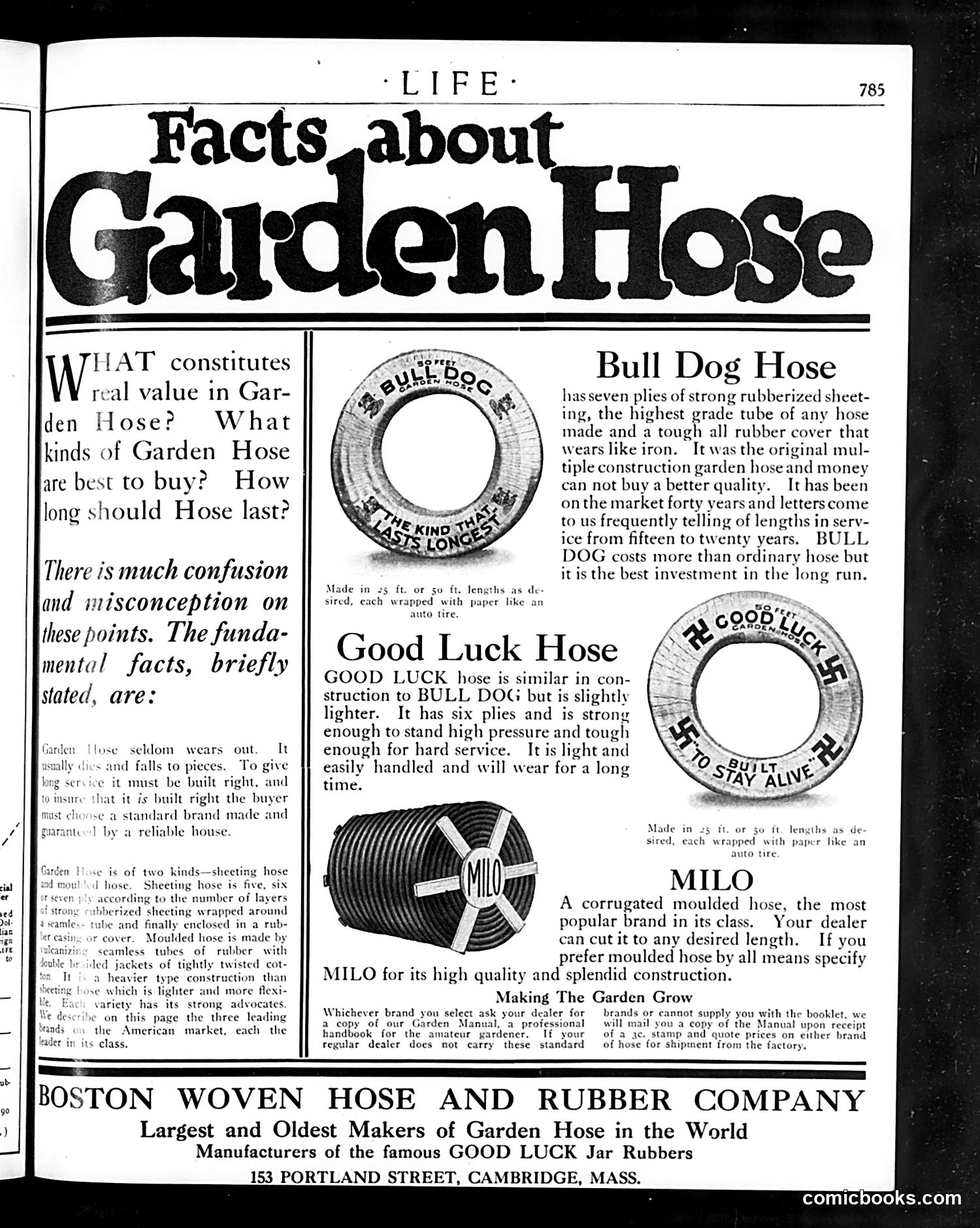
This is **not a cartoon or satire page**—it's a straightforward **advertisement and product information article** from Life magazine about garden hoses. The page explains three major garden hose brands available to consumers: Bull Dog Hose, Good Luck Hose, and Milo. It discusses practical differences in construction, durability, and value. The text acknowledges consumer confusion about which hose to buy and attempts to clarify the fundamental factors: that quality hoses rarely wear out naturally but fail from poor construction, and that buyers should choose standard brands guaranteed by reliable manufacturers. The page concludes with a full advertisement for the Boston Woven Hose and Rubber Company, the manufacturer behind these brands. There is no satire or political content here.
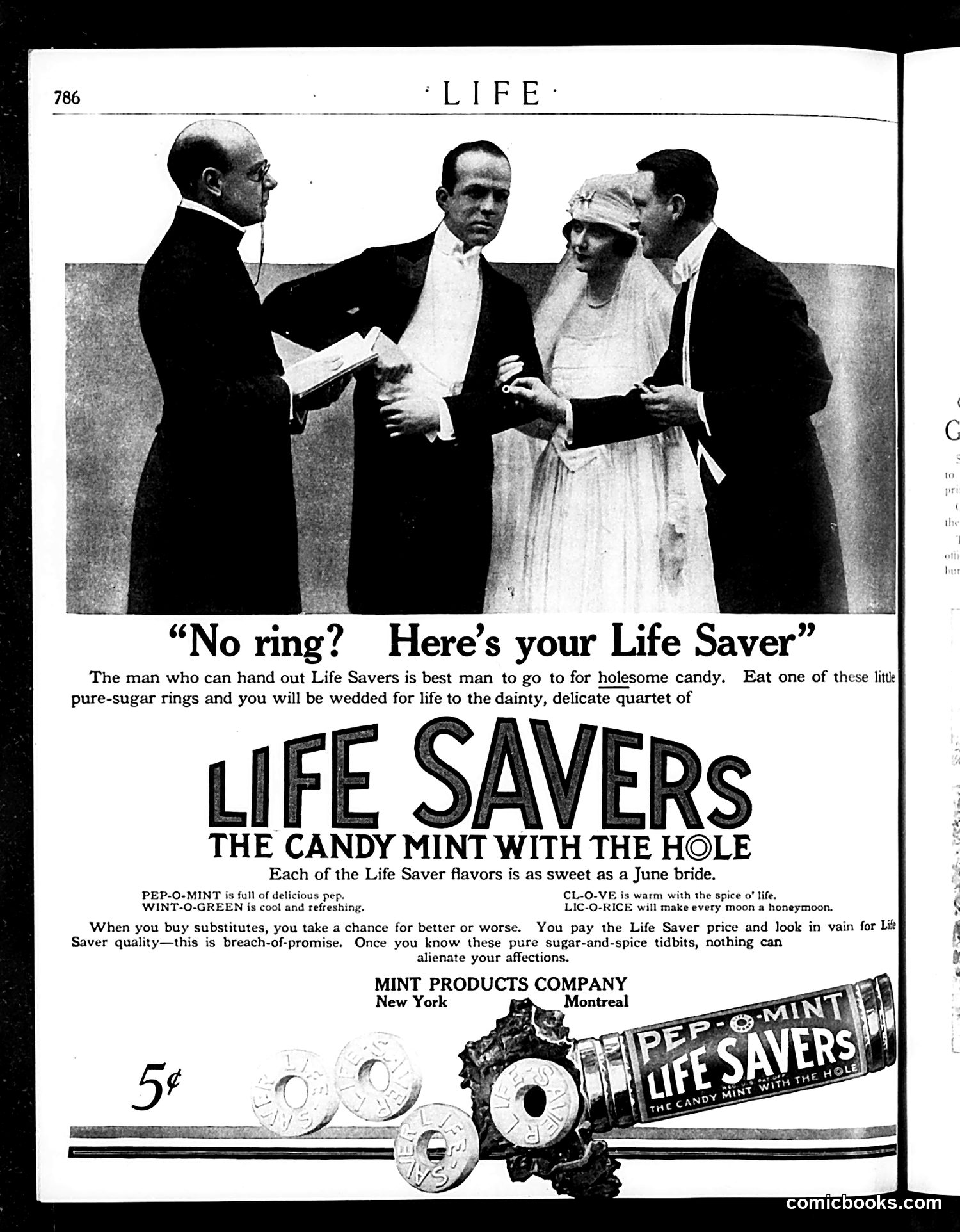
This is a **Life Savers candy advertisement**, not political satire. The image depicts a humorous wedding scene where a man presents a Life Savers mint (with its characteristic hole) as an engagement ring, with the caption "No ring? Here's your Life Saver." The advertisement plays on the candy's ring-shaped design and the slang term "Life Saver" (meaning someone helpful in a pinch). It suggests that if a man cannot afford a traditional engagement ring, he can use a Life Savers mint as a substitute—a joke about economic constraints, likely from the 1920s-1930s era. The ad emphasizes the candy's flavors (Pep-O-Mint, Wint-O-Green, Cl-O-Ve, Lic-O-Rice) and costs only 5¢, marketing it as a romantic gift despite its obvious impracticality.
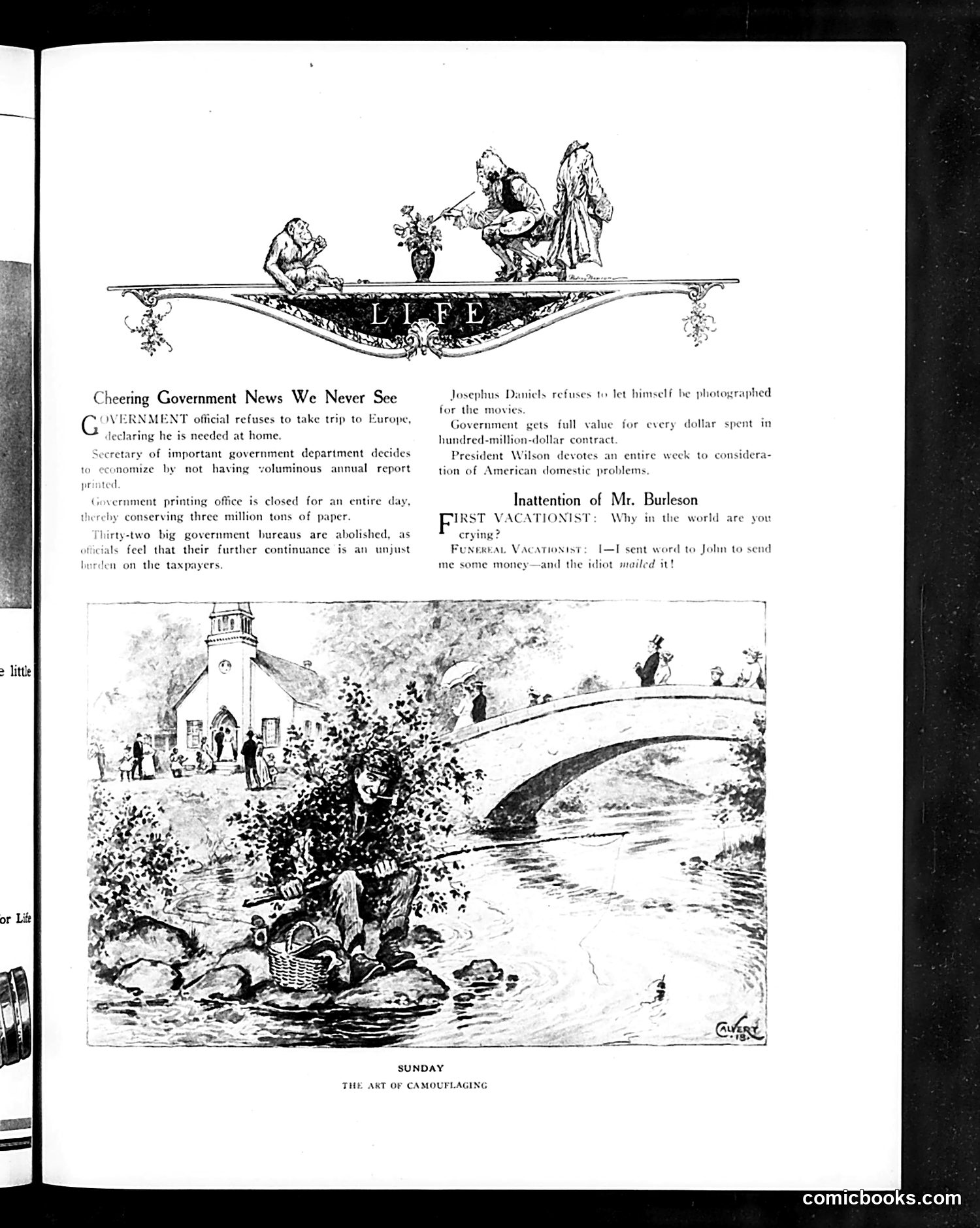
This page contains political satire from Life magazine critiquing government transparency and inefficiency. **"Cheering Government News We Never See"** mocks official secrecy, listing absurd but pointed examples: refusing European trips, closing printing offices, abolishing bureaucracies. The satire suggests the government *should* do these things but doesn't—highlighting wasteful spending and bureaucratic excess. **"Inattention of Mr. Burleson"** appears to reference a postal official (likely Postmaster General Albert Burleson) who failed to deliver money sent to "John," suggesting government mail service incompetence. The lower illustration, "The Art of Camouflaging," shows someone hiding in nature by a river and bridge—likely satirizing attempts to disguise or conceal something, possibly government misuse of funds or activities. The overall theme criticizes government waste and lack of accountability.
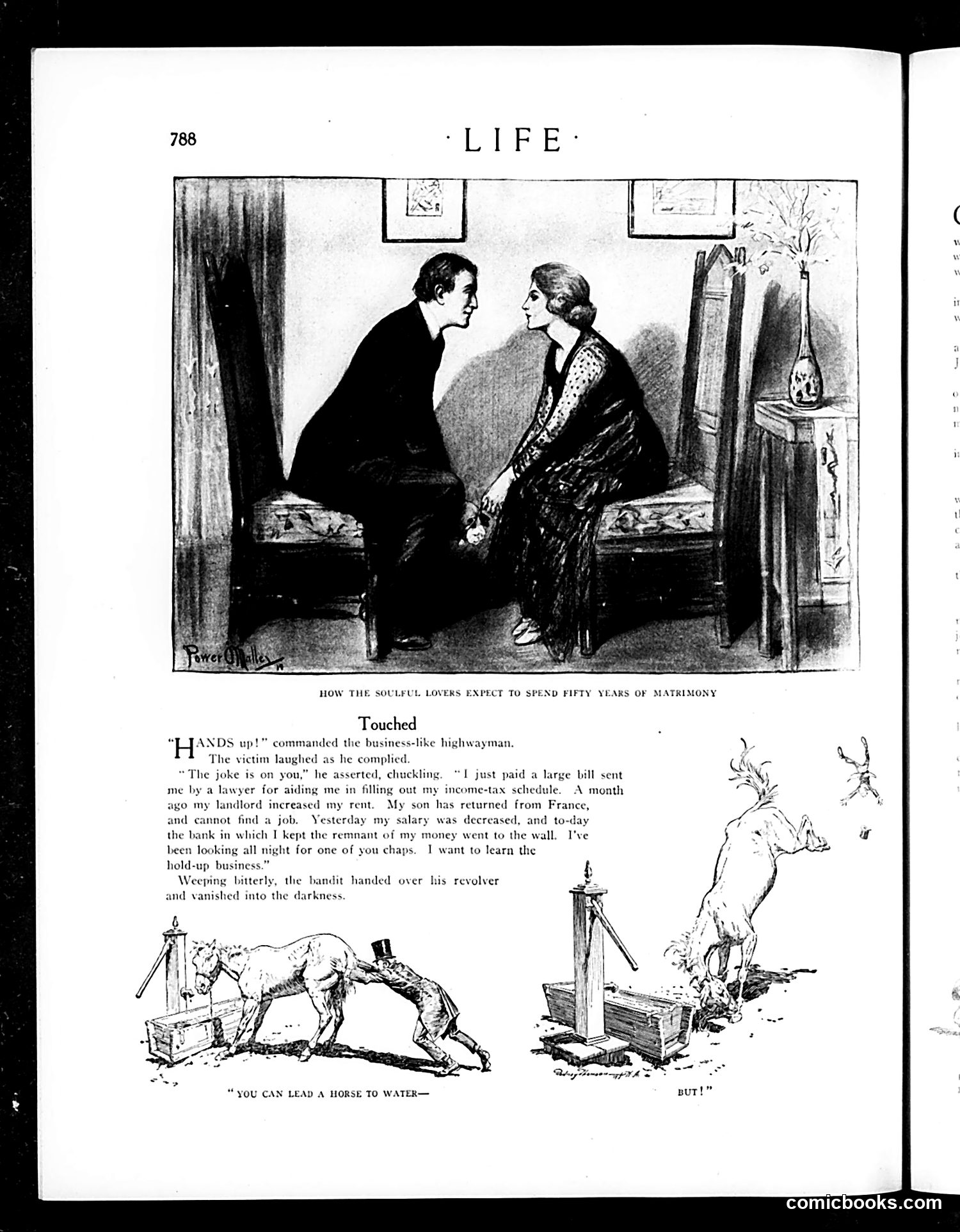
This page satirizes financial hardship and male vulnerability. The top cartoon shows a couple in intimate conversation, captioned "How the Soulful Lovers Expect to Spend Fifty Years of Matrimony"—mocking romantic ideals. The main story "Touched" depicts a businessman accosted by a highwayman demanding "Hands up!" The victim complies while recounting his financial disasters: lawyer bills, increased rent, decreased salary, and a vanished bank account. He laments being robbed repeatedly by legitimate institutions before the highway robber appears. The bottom illustrations contrast this with the old saying "You can lead a horse to water—but!" The satire's point: the victim is already so thoroughly financially "touched" (robbed) by modern life that an actual highwayman seems almost redundant.
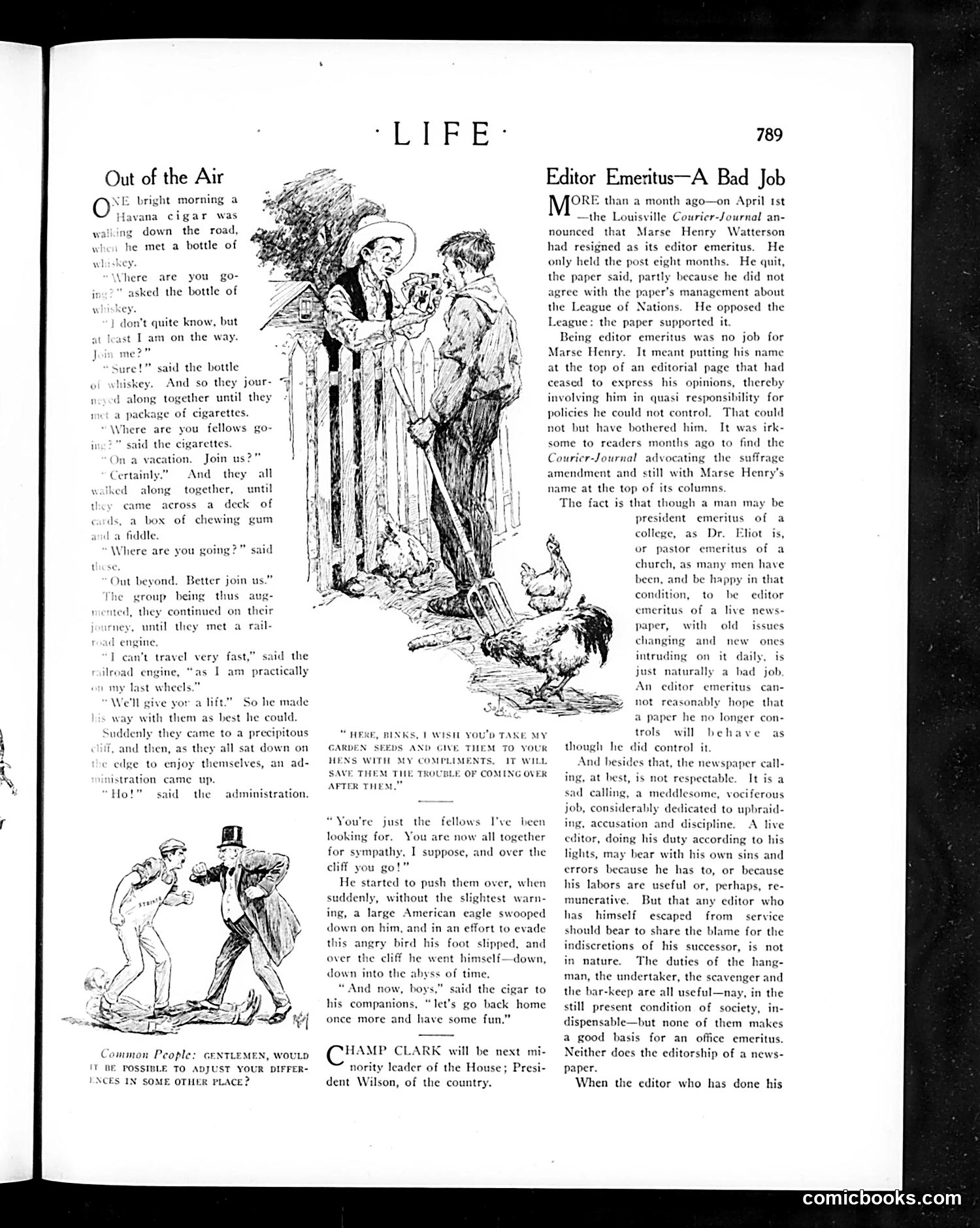
This page contains two distinct pieces: **"Out of the Air"** (left): A humorous short story illustrated with sketches. A man carrying a bottle of whiskey encounters vagrants who invite him on "vacation." They board a train together, and when they reach a cliff, the railroad engine pushes them over. The administration's response is simply "Ho!" — satire on bureaucratic indifference to vagrant deaths during the economically harsh period. **"Editor Emeritus—A Bad Job"** (right): Commentary on Morse Henry Watterson, editor of the *Louisville Courier-Journal*, who resigned after eight months due to disagreement over League of Nations coverage. The article argues that editorial emeritus positions are inherently frustrating, offering neither real authority nor escape from daily frustrations—making the role fundamentally unworkable.
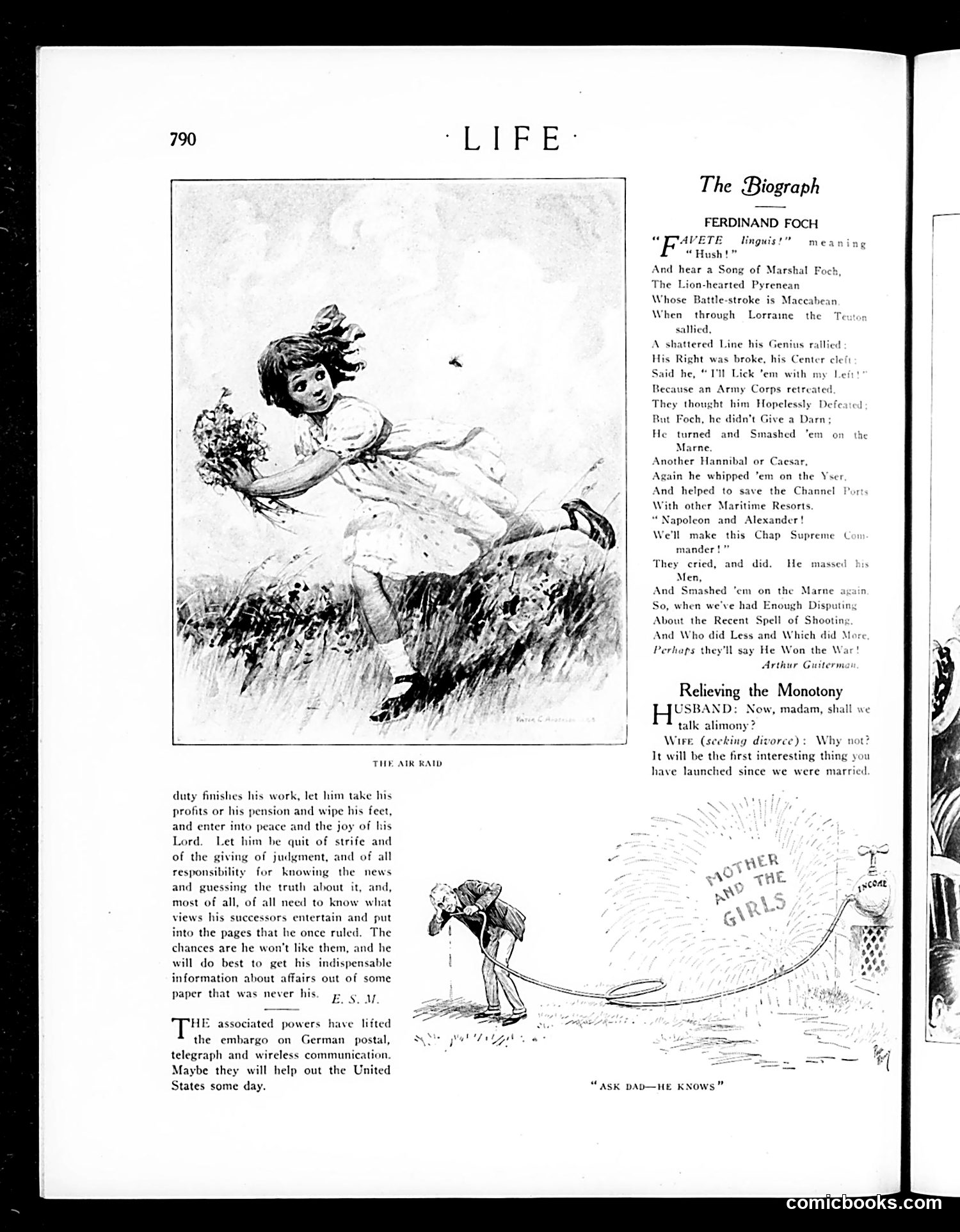
This page contains two cartoons satirizing World War I domestic life. **"The Air Raid"** (left) depicts a woman fleeing in panic from an air attack, her composure abandoned as she runs through grass. This reflects anxieties about German aerial bombardment of Britain—a new, terrifying warfare technology that threatened civilians on the home front, not just soldiers. **"Ask Dad—He Knows"** (bottom right) shows a man being pestered by women asking questions about the war, with "Father and the Girls" emerging from his head in exasperation. This jokes about husbands becoming unwilling experts on military matters, pestered endlessly by wives and daughters hungry for war news and information they cannot access themselves. Both cartoons capture wartime social disruption and gender anxieties.
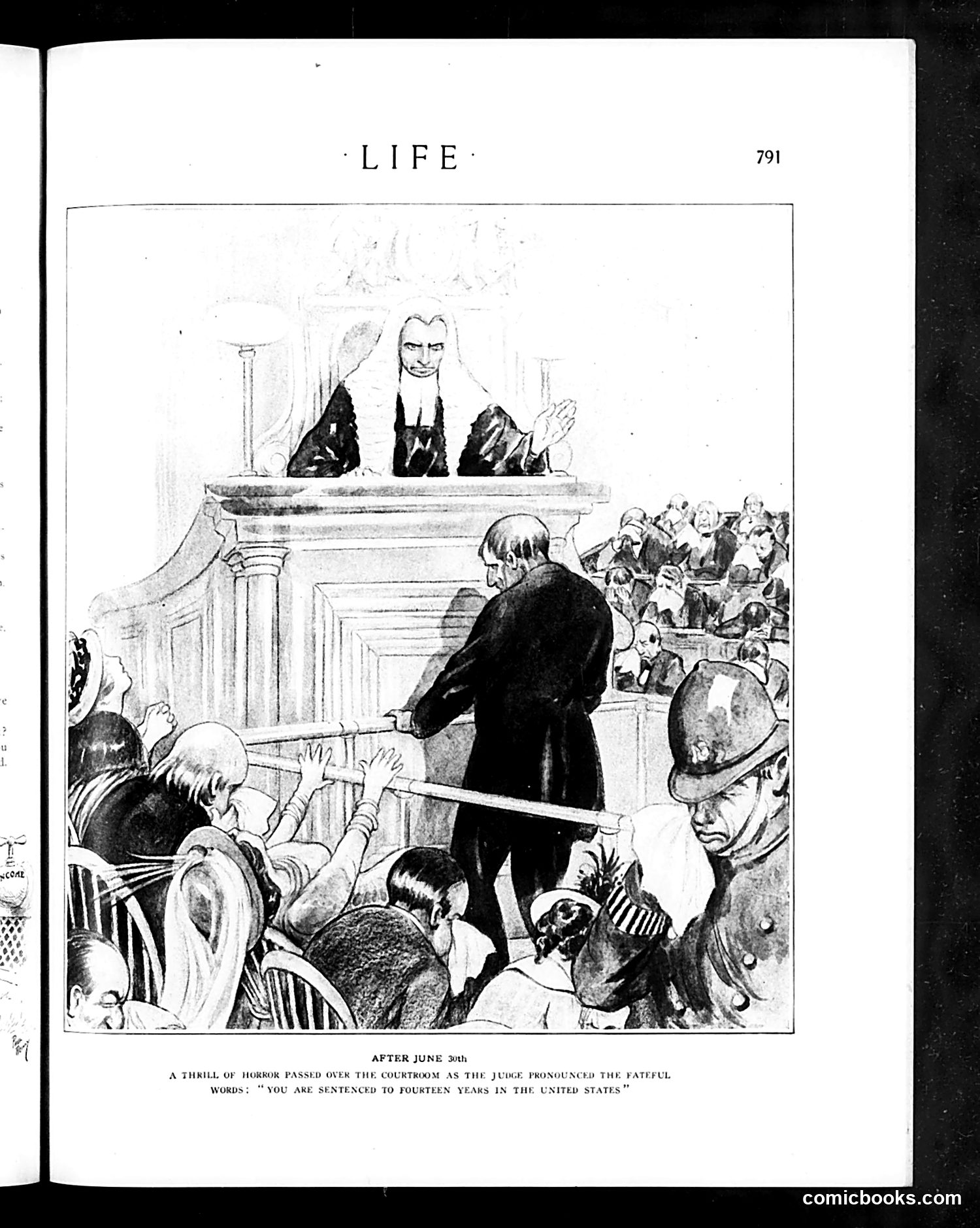
This cartoon depicts a courtroom scene captioned "After June 30th," referencing what appears to be a legal sentencing. A judge pronounces the fateful words: "You are sentenced to fourteen years in the United States." The illustration shows a crowded courtroom with spectators and armed guards present. The defendant, depicted in the foreground wearing dark clothing, faces the bench where the judge sits elevated above the proceedings. Without additional context about the specific date or historical event referenced by "June 30th," I cannot definitively identify the defendant or the case. The cartoon's satirical point—that a 14-year U.S. sentence is presented as horrifying news worthy of courtroom drama—suggests commentary on either the severity of the sentence or the defendant's likely reaction to American imprisonment, though the specific target remains unclear from the image alone.
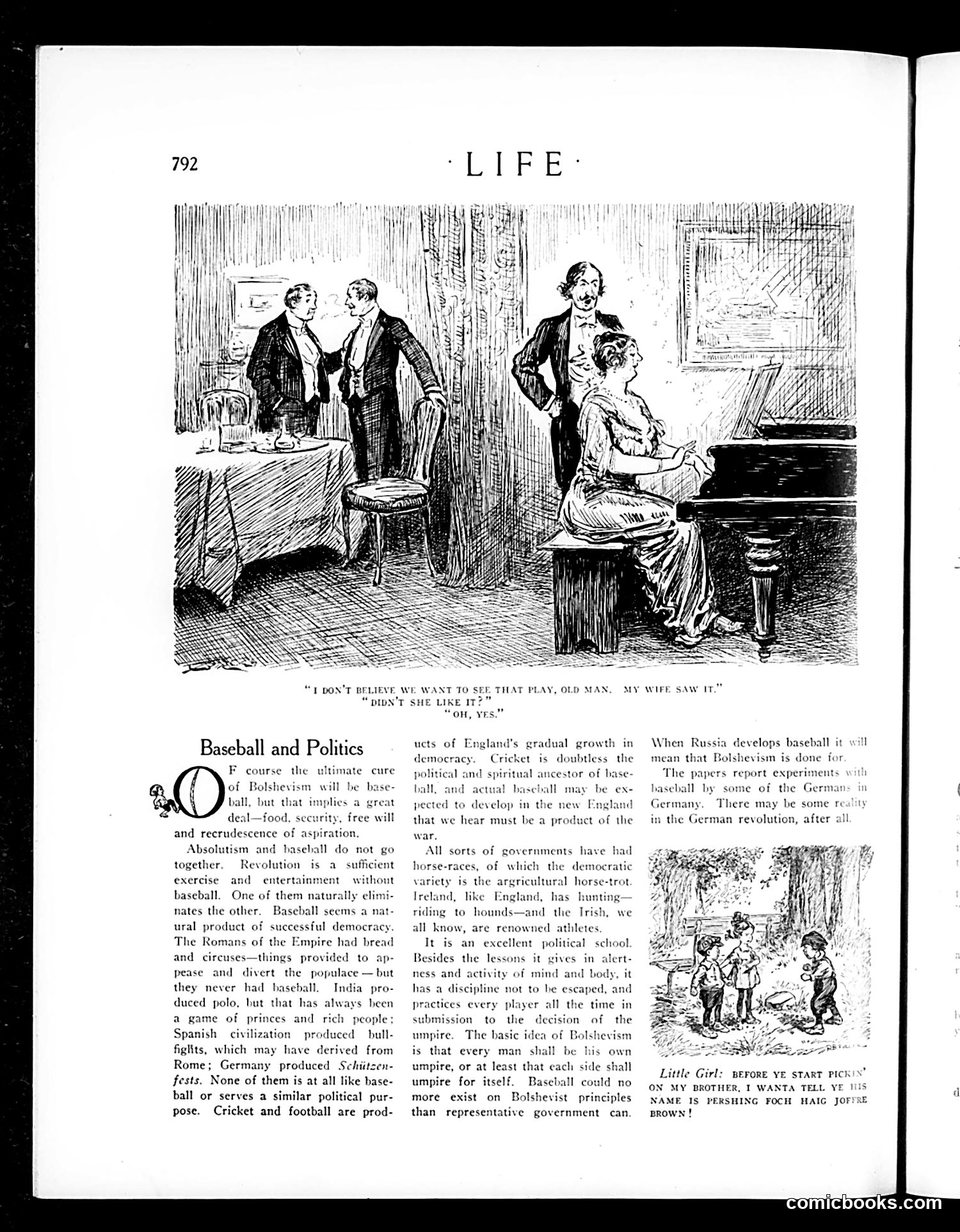
**Top Cartoon:** A domestic scene showing a man and woman at a piano with two other men present. The dialogue reads: "I don't believe we want to see that play, old man. My wife saw it." / "Didn't she like it?" / "Oh, yes." This is a joke about marital dynamics—the husband won't attend because his wife already enjoyed it, suggesting he lacks independent judgment or desires to avoid what his wife has already experienced. **"Baseball and Politics" Article:** The text argues that baseball, like cricket and football, serves a political function in democracy. It claims Bolshevism cannot coexist with baseball, as the sport requires individual decision-making and competition incompatible with communist ideology. The author suggests baseball represents democratic values and would be impossible under Bolshevik rule. **Lower Illustration:** Shows children playing, with a caption about a girl telling her brother a name—context unclear from visible text.
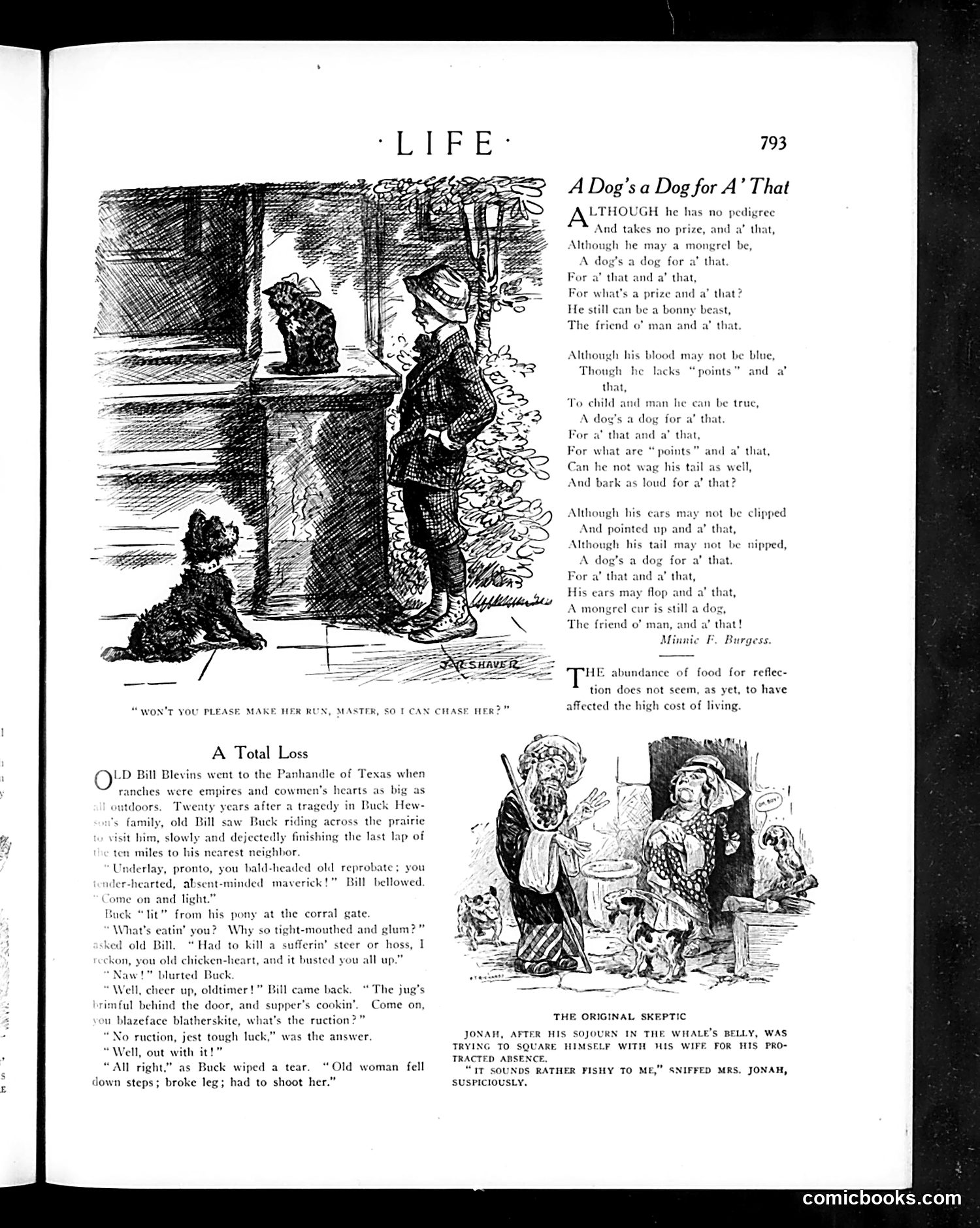
This page contains two distinct pieces: **"A Dog's a Dog for A' That"** is a poem (attributed to what appears to be Robert Burns) celebrating dogs' loyalty and worth regardless of pedigree or social status. The accompanying sketch shows two men in period dress observing a dog, with the caption "Won't you please make her run, master, so I can chase her?" It's a gentle joke about a dog's simple pleasures. **"A Total Loss"** is a short story about Old Bill Blevins, a Texan rancher visiting a poorer neighbor named Buck. The narrative describes their conversation at Buck's home, with Buck's wife Jonah appearing in the accompanying cartoon, which depicts a domestic scene. The story appears to focus on frontier hardship and economic struggle during lean times. Both pieces reflect Life magazine's mix of sentimental and humorous commentary on American life.
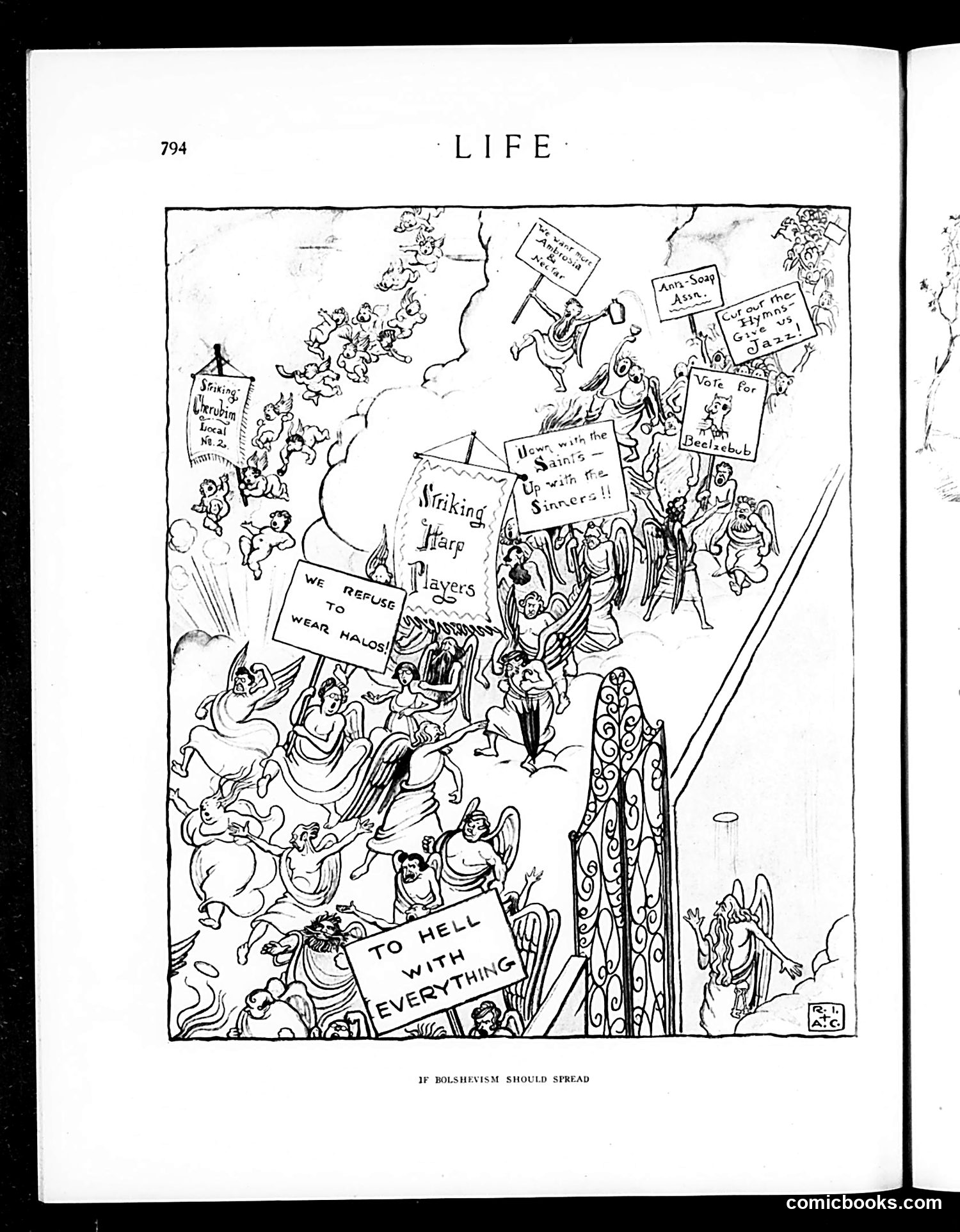
This satirical cartoon depicts a nightmarish vision of communist revolution spreading across America. The composition shows a hellish landscape filled with chaotic crowds, angels fleeing upward, and signs expressing various social anxieties: "Anti-Semitism," "Cut down the Gyms and Jazz," "Vote for Prohibition," "Striking Harp Players," "Up with the Saints—Down with the Sinners," and "We Refuse to Wear Nalos [sic]." The cartoon reflects 1920s Red Scare fears, presenting Bolshevism as a threat that would destroy American values, religious morality, entertainment, and social order. The message warns that communist ideology would replace traditional culture with authoritarian chaos and moral decay—a common anti-communist propaganda trope of the post-WWI era.
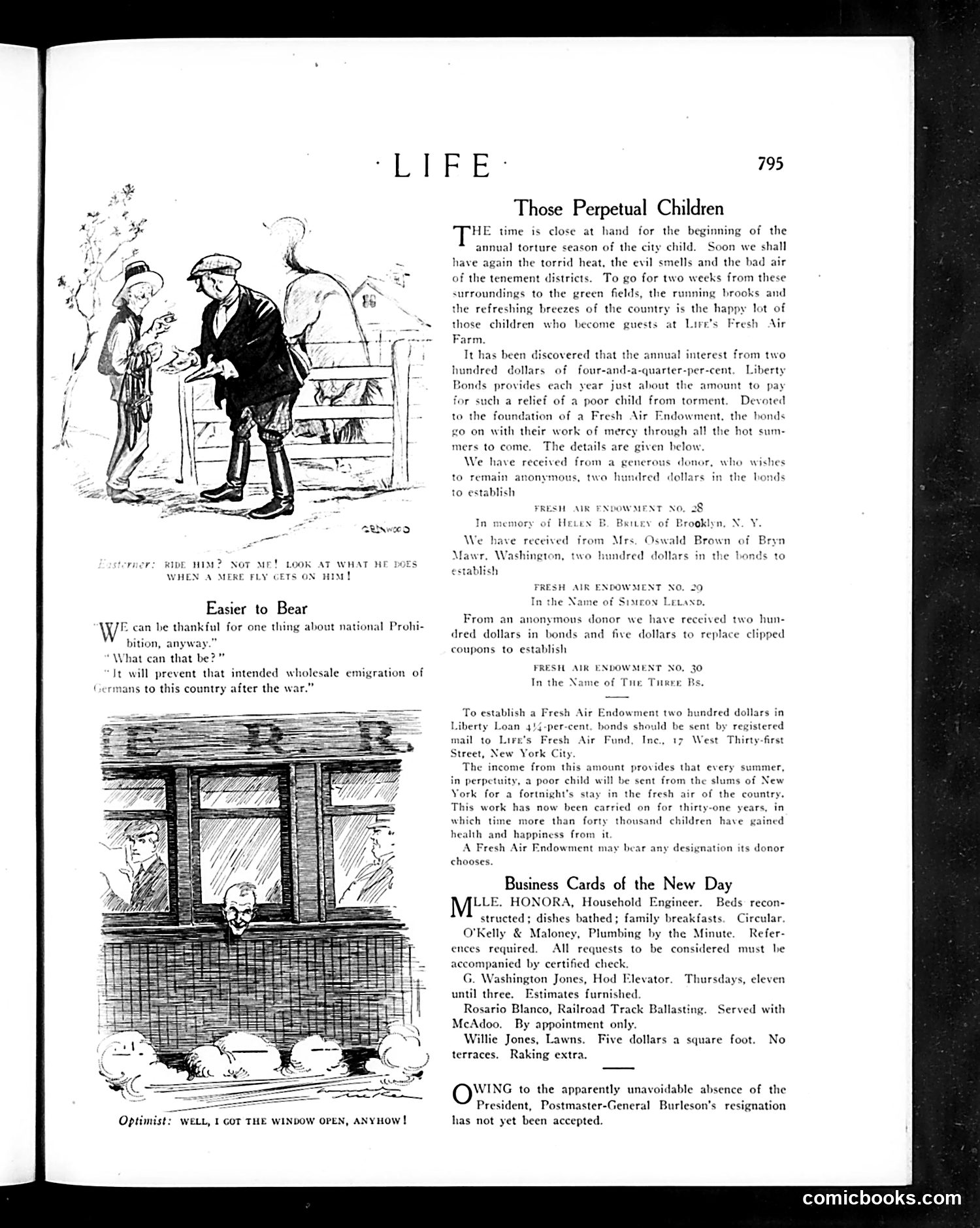
This cartoon satirizes **Prohibition** (the nationwide ban on alcohol sales, 1920-1933). The image shows a man looking out a basement window at ground level, with the caption "WELL, I GOT THE WINDOW OPEN, ANYHOW!" The joke: During Prohibition, people evaded the law by operating illegal bars and distilleries in basements. The man's comment is darkly ironic—he's celebrating a minor victory (opening a window for ventilation) while conducting clearly illegal alcohol production below ground. The cartoon mocks both the futility of trying to hide such operations and suggests Prohibition itself is so unpopular that people openly flout it, finding grim humor in their law-breaking. The piece criticizes Prohibition as impractical and unenforceable.
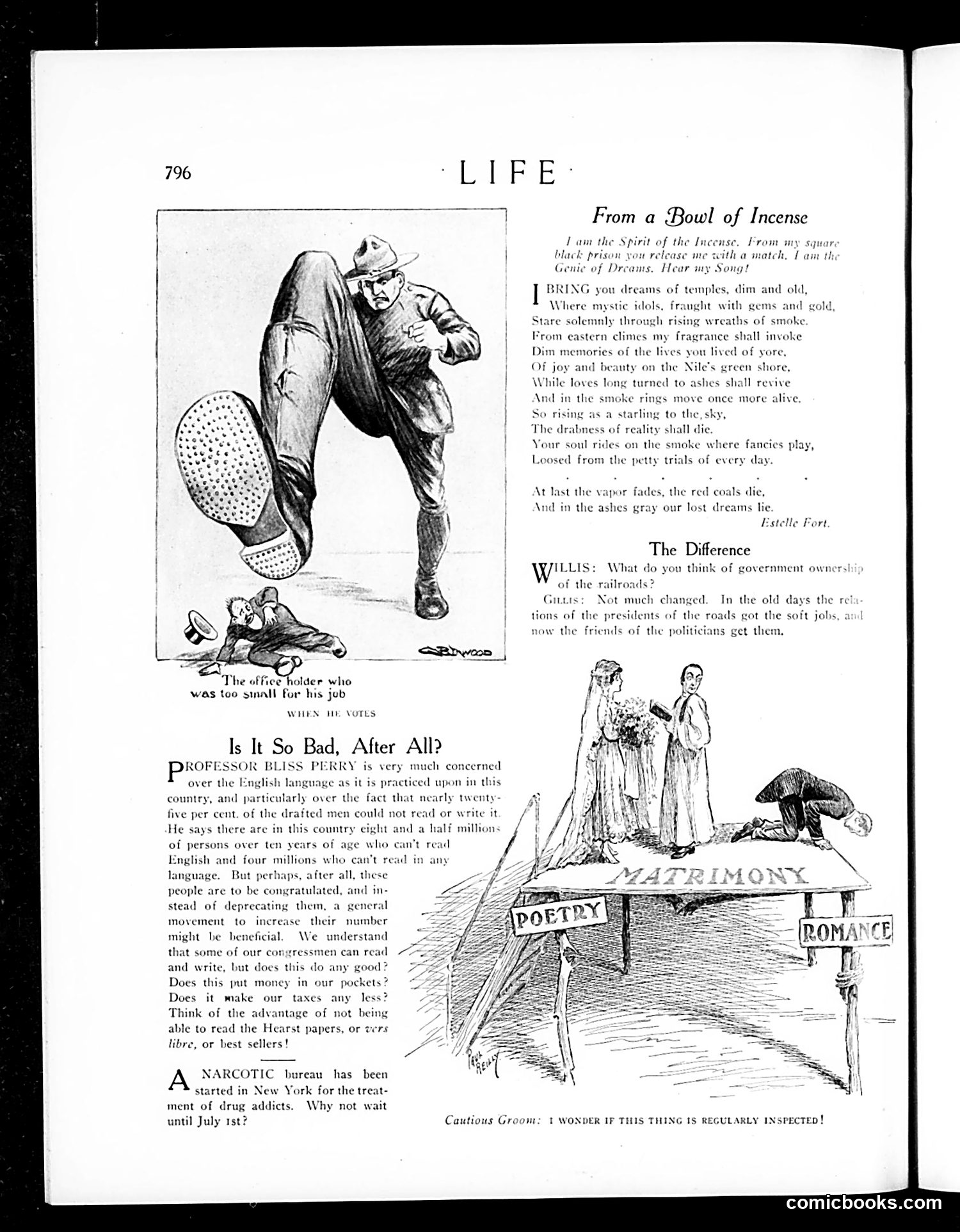
This page contains three satirical pieces typical of Life's editorial humor: **Top cartoon**: "The Office Holder Who Was Too Small for His Job" depicts a tiny bureaucrat struggling with oversized equipment—mocking incompetent political appointees. **"From a Bowl of Incense"**: A poetic piece personifying incense smoke as a "genie of dreams," offering escapist fantasy. This likely satirizes the period's interest in orientalism and the use of exotic goods as distraction from mundane reality. **"The Difference"**: A dialogue between Willis and Gillis about railroad government ownership. Gillis cynically notes that whether private or public, the corrupt patronage system remains unchanged—friends of politicians still get soft jobs instead of merit-based appointments. **"Is It So Bad, After All?"**: Sarcastically defends illiteracy by questioning whether educated congressmen actually benefit society through better policy or lower taxes, ironically suggesting ignorance might be preferable to reading sensationalist newspapers. The page overall reflects early 20th-century American cynicism about political corruption and institutional incompetence.
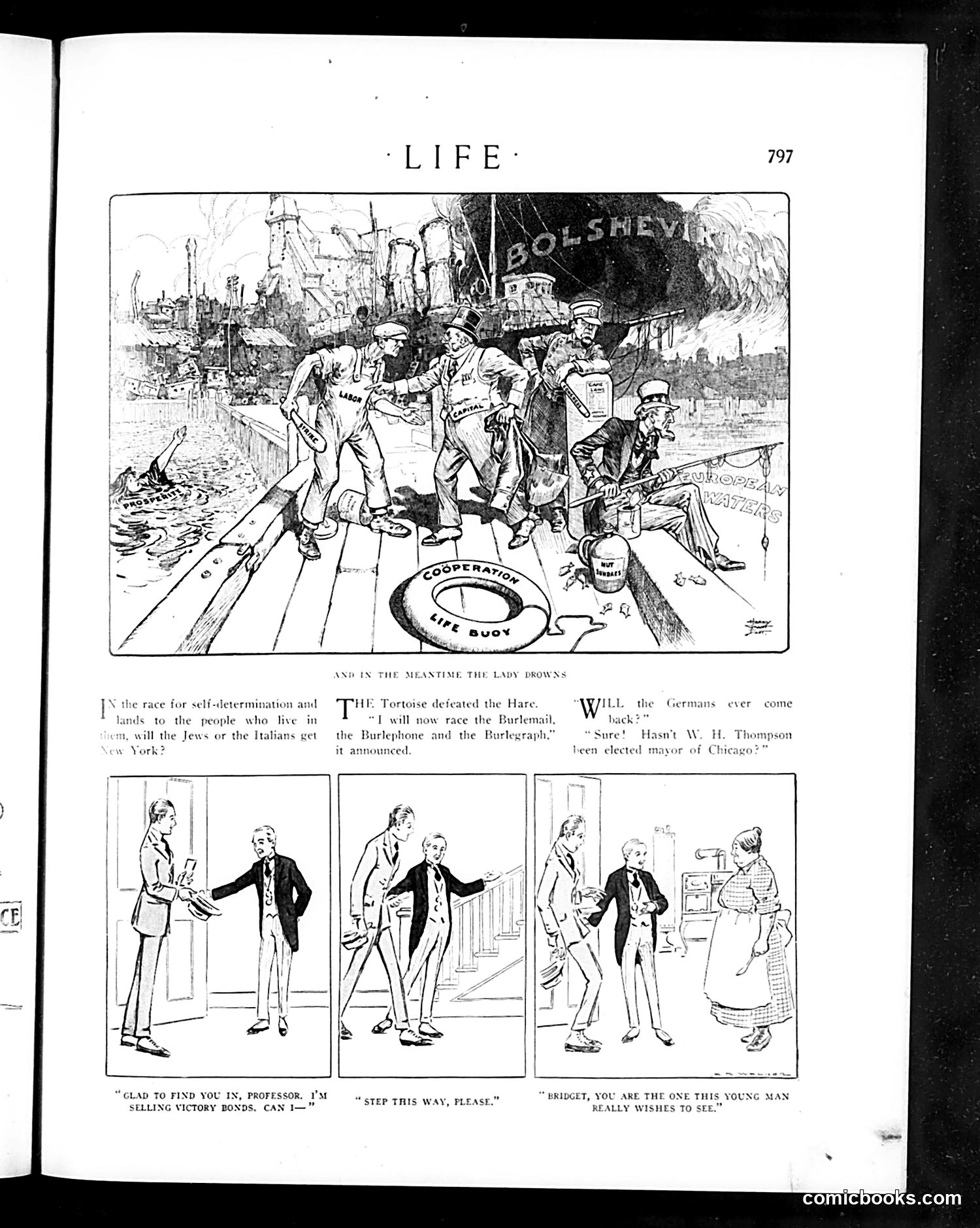
This Life magazine page uses satirical cartoons to critique post-WWI American political distraction. **Top cartoon:** "And in the Meantime the Lady Drowns" depicts workers on a ship labeled "Bolshevism" arguing while the vessel sinks. This references the "Lady" as Lady Liberty or the nation itself, suggesting Americans obsess over trivial disputes (the text mentions Jews vs. Italians competing for influence in New York) while serious threats—likely communism or economic collapse—go unaddressed. **Bottom comics:** Three sequential panels show a professor being interrupted by a "Victory Bonds" salesman. The humor satirizes how aggressive wartime fundraising efforts distract from serious intellectual work. The final panel's joke about "Bridget" (likely a maid, drawn in stereotypical Irish domestic servant style) suggests the salesman's real interest lies elsewhere than bonds. The overall message: Americans are distracted by petty concerns and commercial schemes while genuinely dangerous problems demand attention.
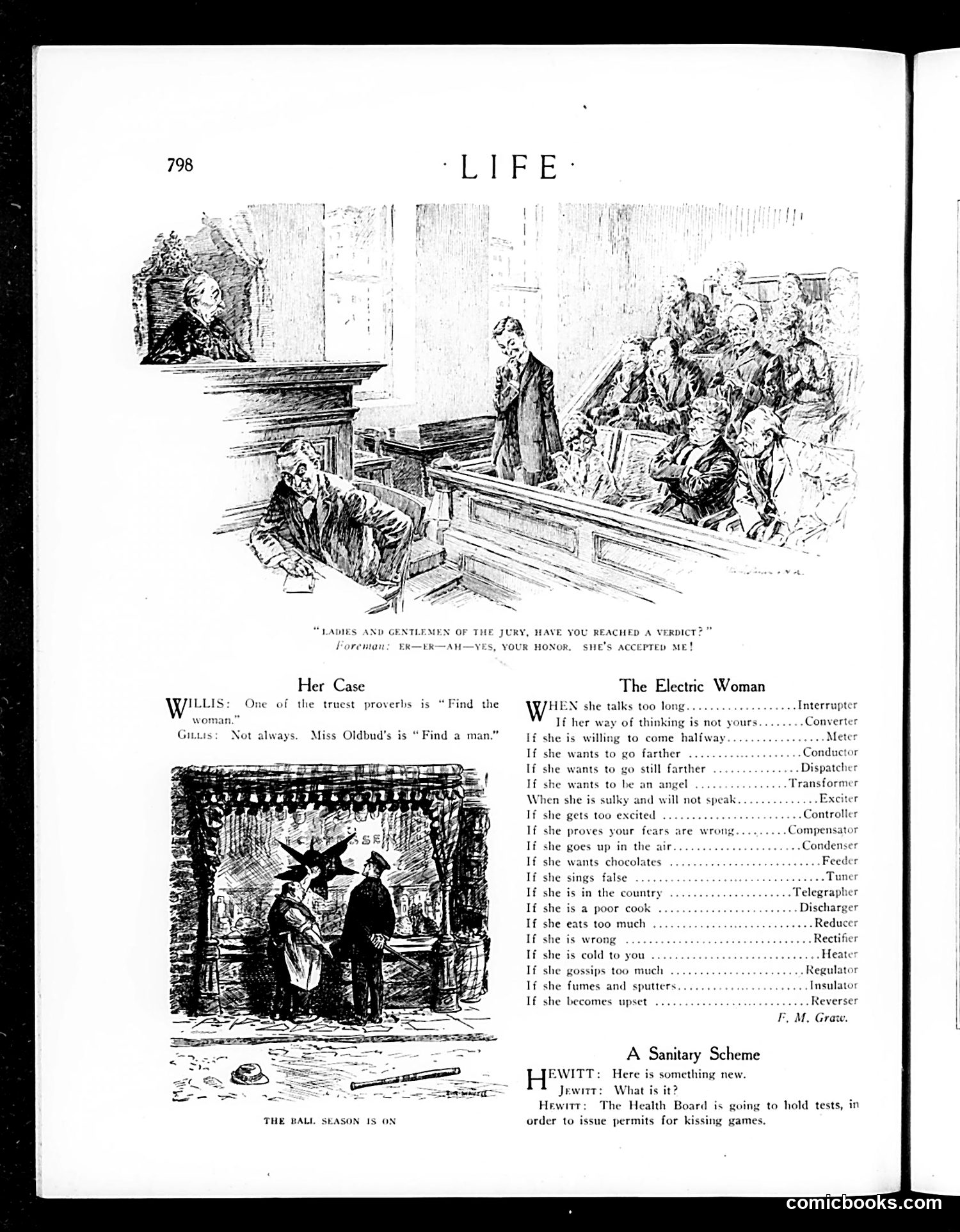
This page contains three separate satirical pieces: **"Her Case"** (top): A courtroom scene where a foreman announces a verdict—likely in a breach-of-promise or marriage suit, a common legal matter of the era. The joke plays on gender dynamics: a proverb about "finding a woman" is contrasted with Miss Oldbud's version, "find a man," suggesting women actively pursue matrimony. **"The Electric Woman"** (right): A humorous list applying electrical engineering terms to female behavior—a woman who "talks too long" is an "Interrupter," one who's "cold to you" is a "Heater," etc. This satirizes both the rise of electrical technology and contemporary stereotypes about women's emotional volatility, treating female moods as mechanical malfunctions. **"A Sanitary Scheme"** (bottom): Mock-serious commentary on the Health Board supposedly requiring "permits for kissing games"—satirizing progressive-era municipal regulation and public health obsessions by extending them to the absurd. All three pieces trade in period gender stereotypes while employing humor about marriage, courtship, and modernity.
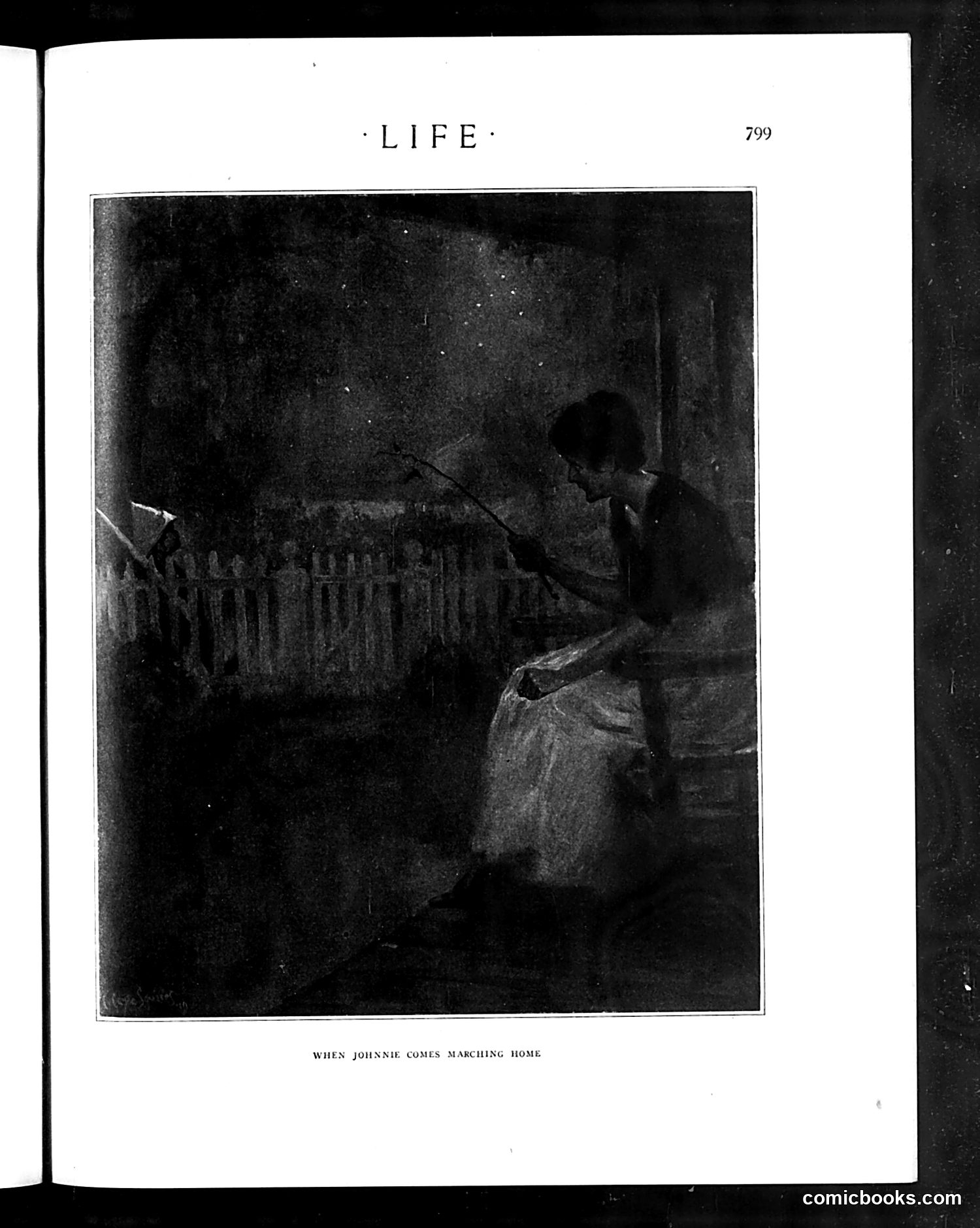
This illustration depicts a woman watching a soldier approach in the distance, marching home from war. The image references the famous Civil War-era song "When Johnny Comes Marching Home" (1863), likely appearing during or after World War I when this Life magazine issue was published. The scene captures a sentimental, domestic moment—a woman awaits her soldier's return, suggesting themes of sacrifice, separation, and reunion that resonated with American wartime experience. The moody, atmospheric quality emphasizes the emotional weight of soldiers returning from combat. The title evokes nostalgia for patriotic resolve while the intimate imagery focuses on the personal cost of war on families left behind—a common satirical and social commentary theme in Life magazine during the early 20th century.
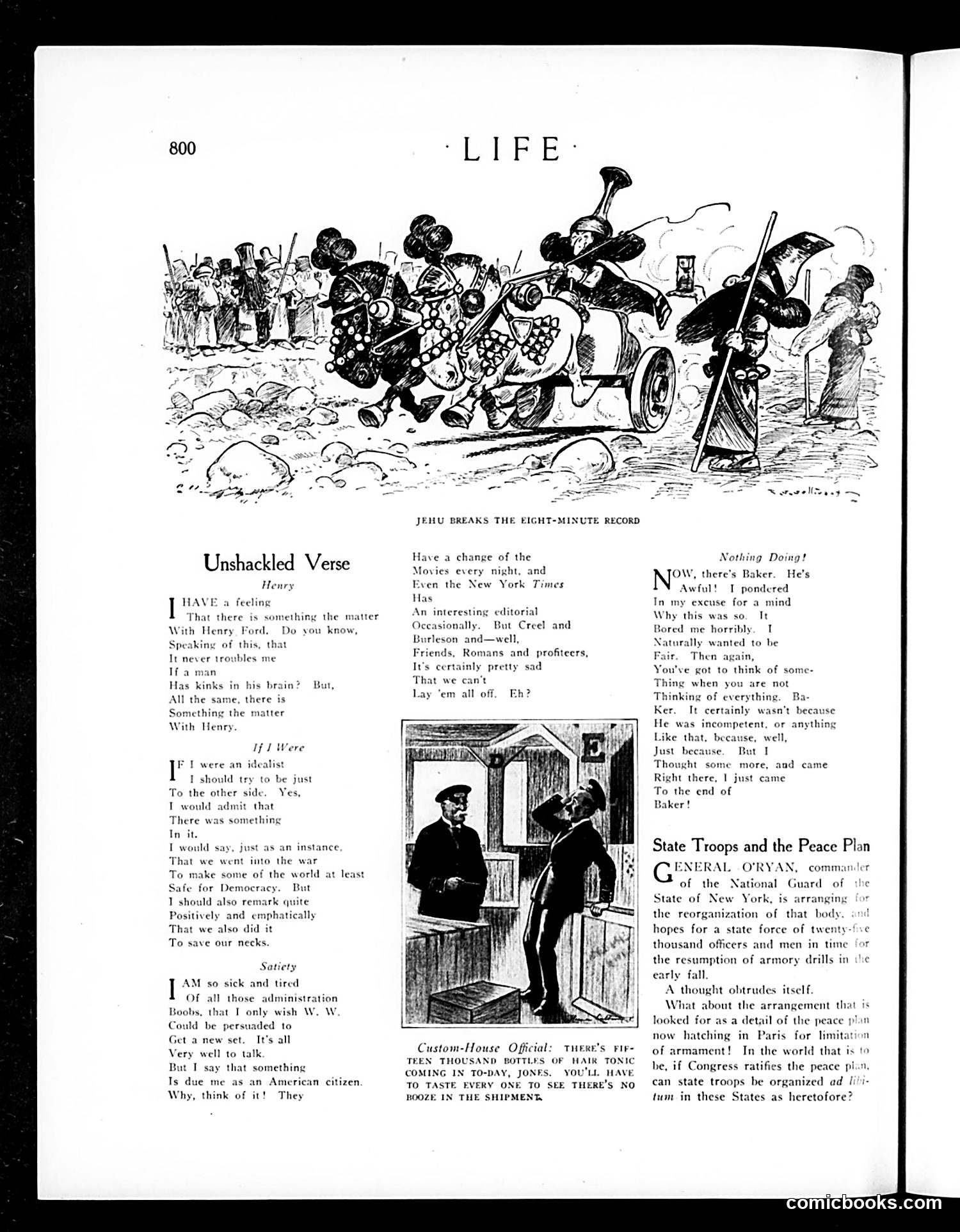
This page contains several satirical pieces critiquing American political leadership during the post-WWI period (circa 1919). **The Poetry Section** ("Unshackled Verse") attacks Henry Ford, administration officials (appearing to reference George Creel and Albert Burleson, Wilson's censorship/postal officials), and Secretary of War Newton Baker. The author expresses frustration with government incompetence and calls for replacing the entire administration. **The Cartoon** shows a customs official forced to taste thousands of bottles of hair tonic to verify no alcohol is smuggled during Prohibition—a satirical jab at the absurdity of Prohibition enforcement. **"State Troops and the Peace Plan"** questions General O'Ryan's plan to reorganize New York's National Guard while peace negotiations occur in Paris. The satire suggests confusion: if international disarmament is negotiated, why establish state military forces? The piece mocks the apparent contradiction between peace rhetoric and military buildup. Overall, the page reflects wartime and post-war American skepticism toward government competence, military organization, and enforcement policies.
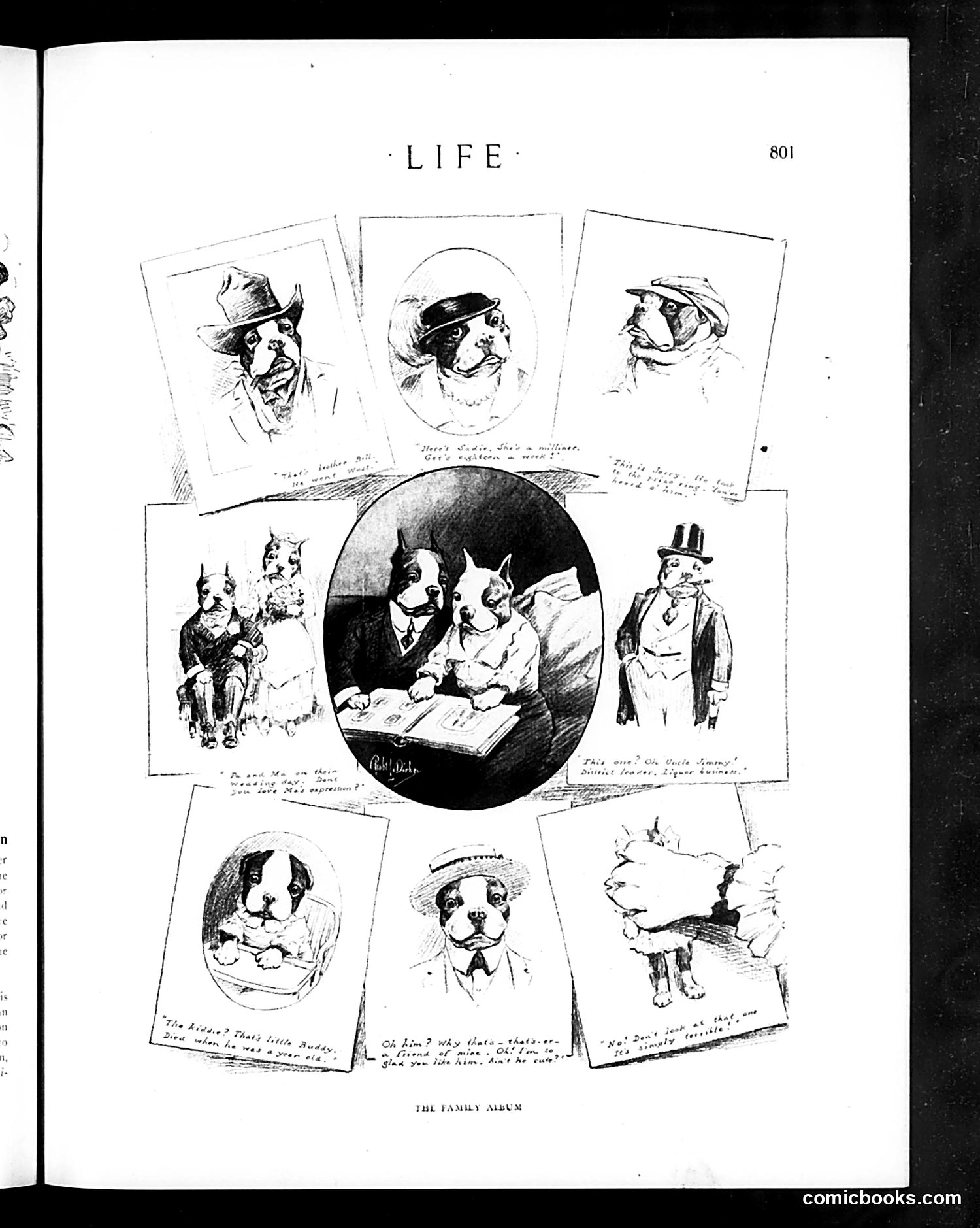
This is a humorous illustrated page featuring anthropomorphized dogs in human situations and clothing. The central oval image shows two dogs studying or reading together at a desk, surrounded by eight smaller portrait sketches of individual dogs wearing various human attire—hats, formal wear, and accessories. The layout parodies a Victorian-era family photo album, a popular domestic keepsake format. Each portrait includes handwritten captions (largely illegible in this reproduction) that appear to provide character descriptions or witty commentary on each "family member." The satire likely pokes fun at both sentimental family portraiture conventions and the anthropomorphization of pets as family members—a sentiment that was growing among the middle and upper classes in the early 20th century. The dogs' dignified poses and formal dress mock pretentious family pride.
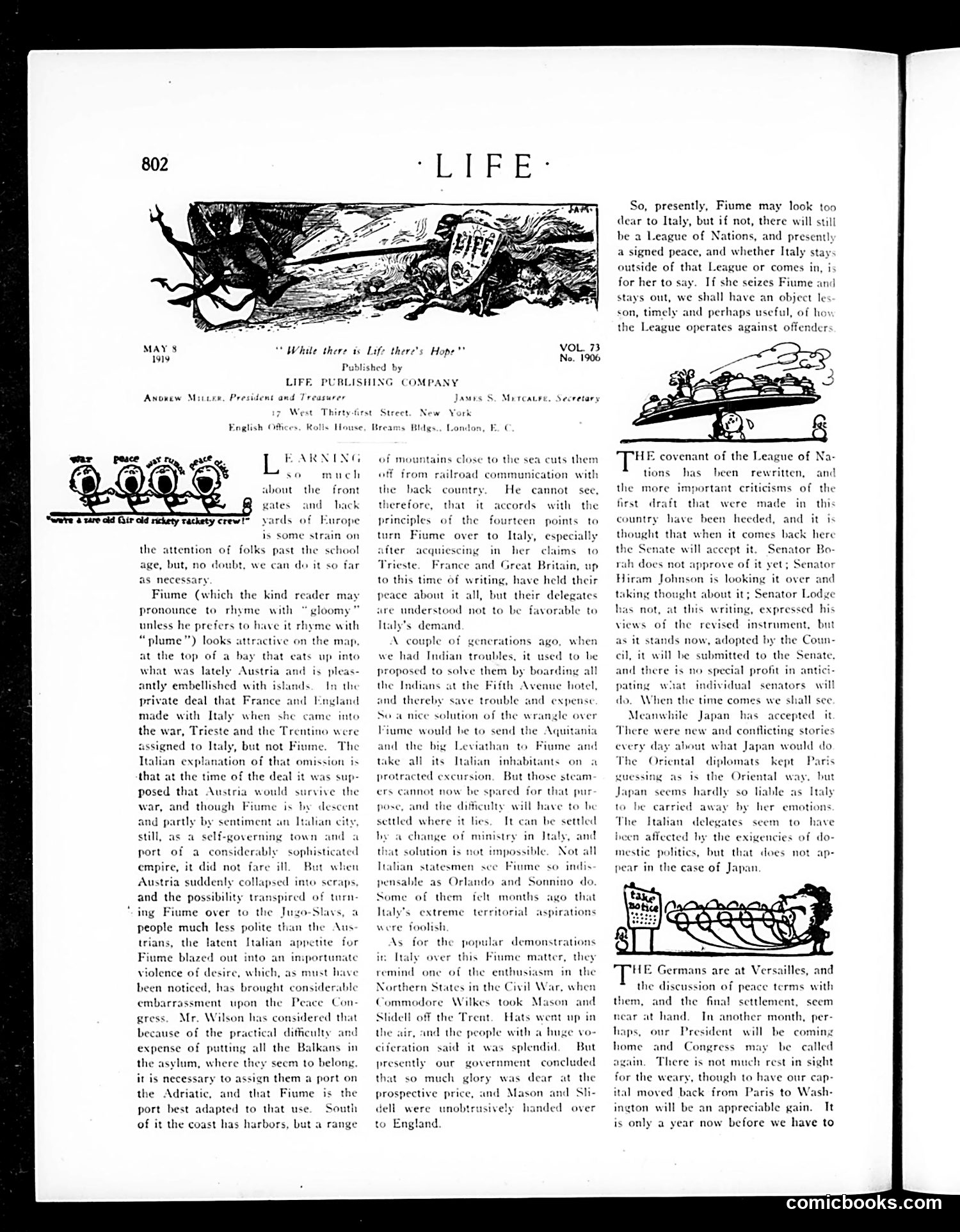
This page addresses the dispute over **Fiume** (modern-day Rijeka), a coastal city contested between Italy and the newly-formed Yugoslavia after World War I. **The Cartoon**: The top illustration depicts a skeletal, decrepit figure labeled "Fiume"—personifying the city as a worthless prize that various nations are fighting over. The caption "While there is Life there's Hope" sarcastically suggests this diseased port city still inspires desperate competition. **The Context**: Italy demanded Fiume as compensation for entering the war, though President Wilson's Fourteen Points didn't promise it. The text mocks Italian passion for the city while noting France and Britain remain noncommittal. The satire suggests Italy's obsession with Fiume—compared to Civil War-era American fervor—is disproportionate to the city's actual value. The piece implies the League of Nations will eventually force Italy to accept a compromise, making the current Italian agitation ultimately pointless. **The Joke**: Nations squabble over a worthless prize that will soon be taken from them anyway.
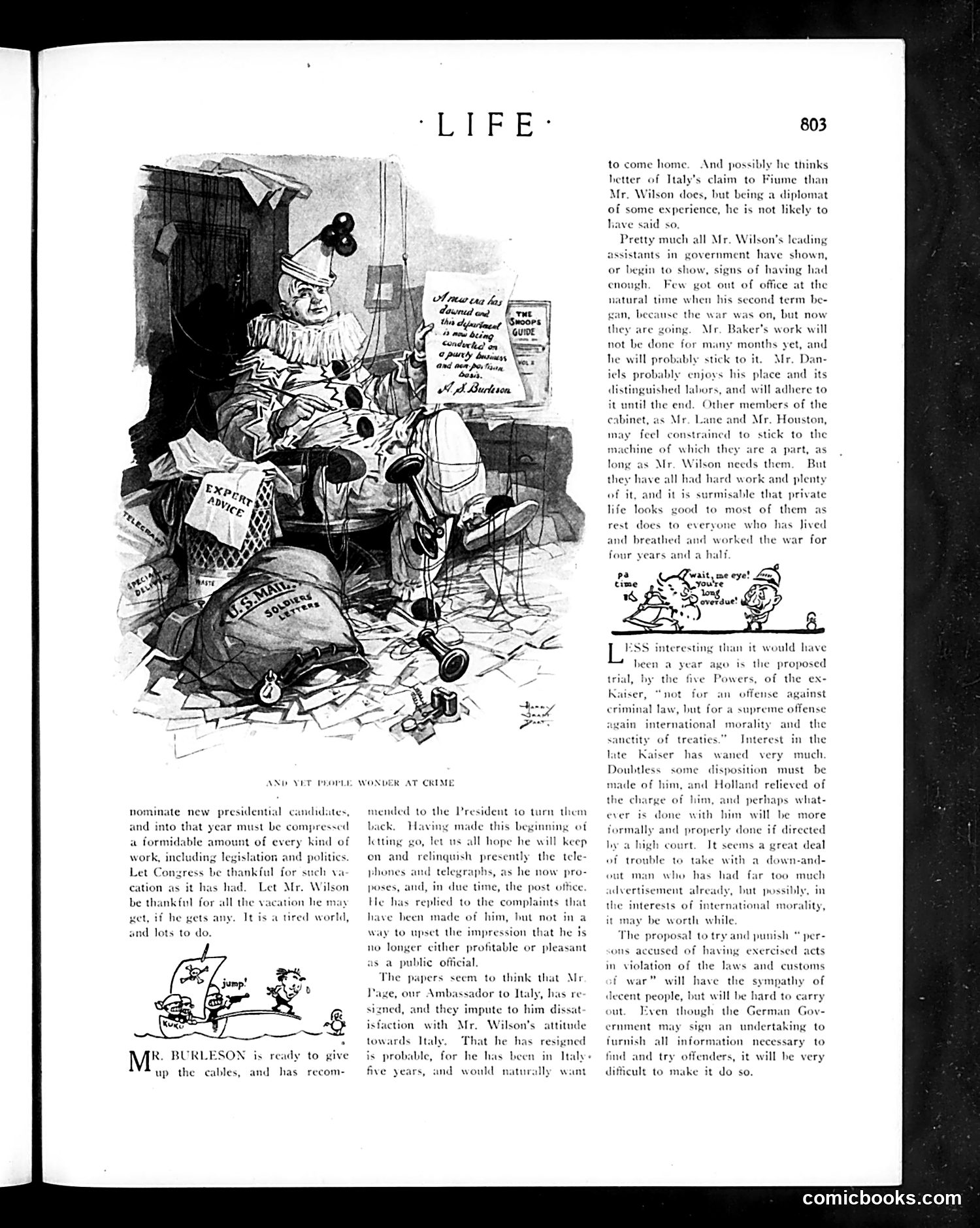
The main cartoon depicts a bloated, disheveled figure labeled "AND YET PEOPLE WONDER AT CRIME"—likely representing either bureaucratic corruption or the chaos of post-WWI government. The figure is surrounded by scattered papers, expense vouchers, and official documents, suggesting wasteful spending or administrative disorder. The accompanying text discusses President Wilson's cabinet members, particularly Ambassador Page's resignation from Italy and Secretary Baker's continuing work. The article suggests these officials are exhausted after four years of wartime service but feel obligated to remain. The satirical point: despite government incompetence and disorder (visualized in the cartoon's chaos), citizens somehow express shock at crime and corruption. The implication is that such malfeasance inevitably results from the mess of postwar governance. The cartoon mocks the public's naive surprise at misconduct arising from obvious systemic dysfunction.
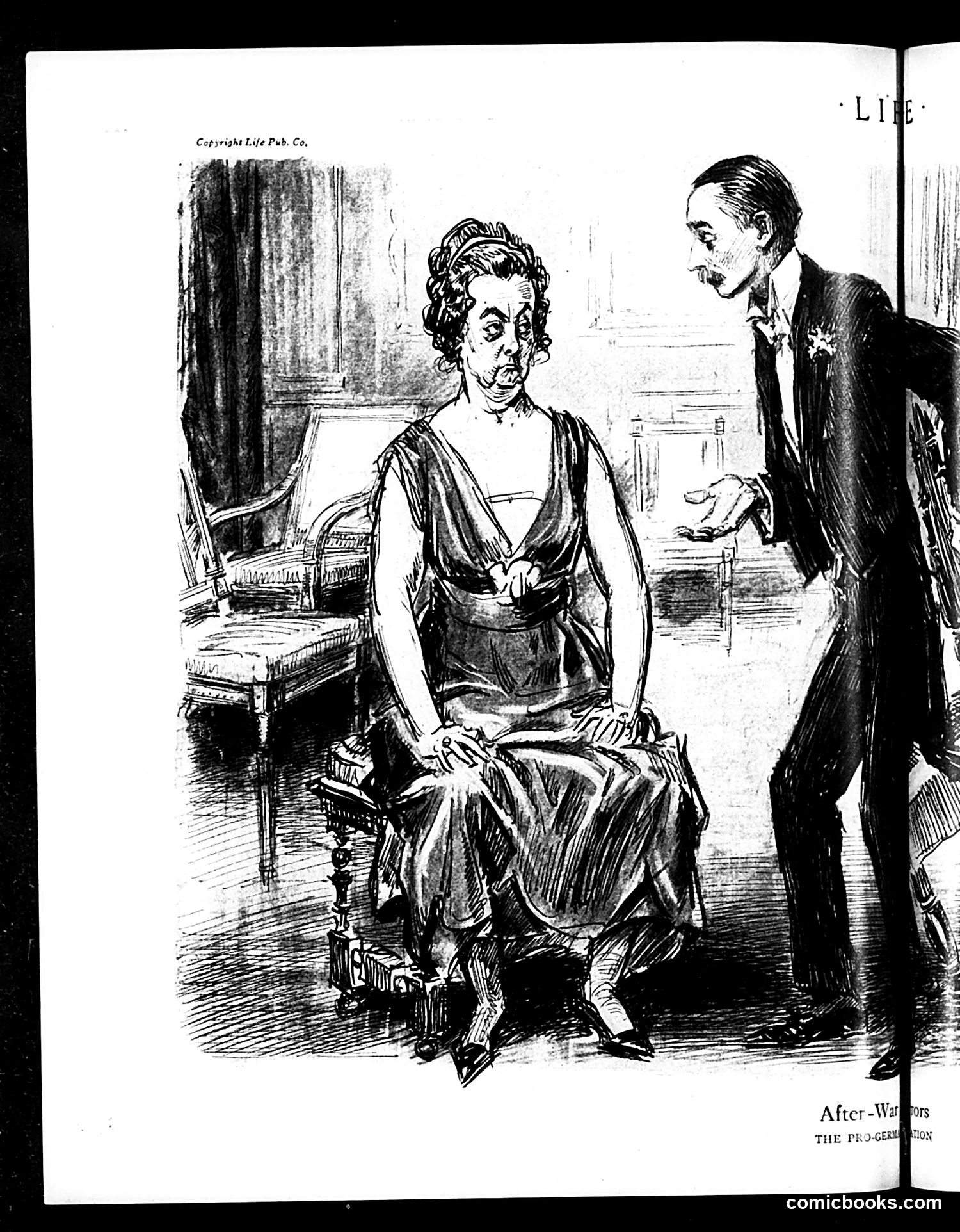
This appears to be a satirical cartoon from *Life* magazine depicting a post-World War I social scene. A well-dressed man in formal attire makes a gesture toward a seated woman in an elegant dress, appearing to present some kind of proposal or offer. The woman's stern, disapproving facial expression suggests she is rejecting his advance or proposition. The cartoon likely satirizes changing post-war social dynamics and attitudes—possibly commenting on evolving gender relations, marriage prospects, or courtship customs following WWI's disruption of traditional society. The woman's resolute rejection embodies a shift in female agency or social expectations of the era. The OCR text fragment "THE PRO-GER" is unclear but may indicate the cartoon's specific satirical target.
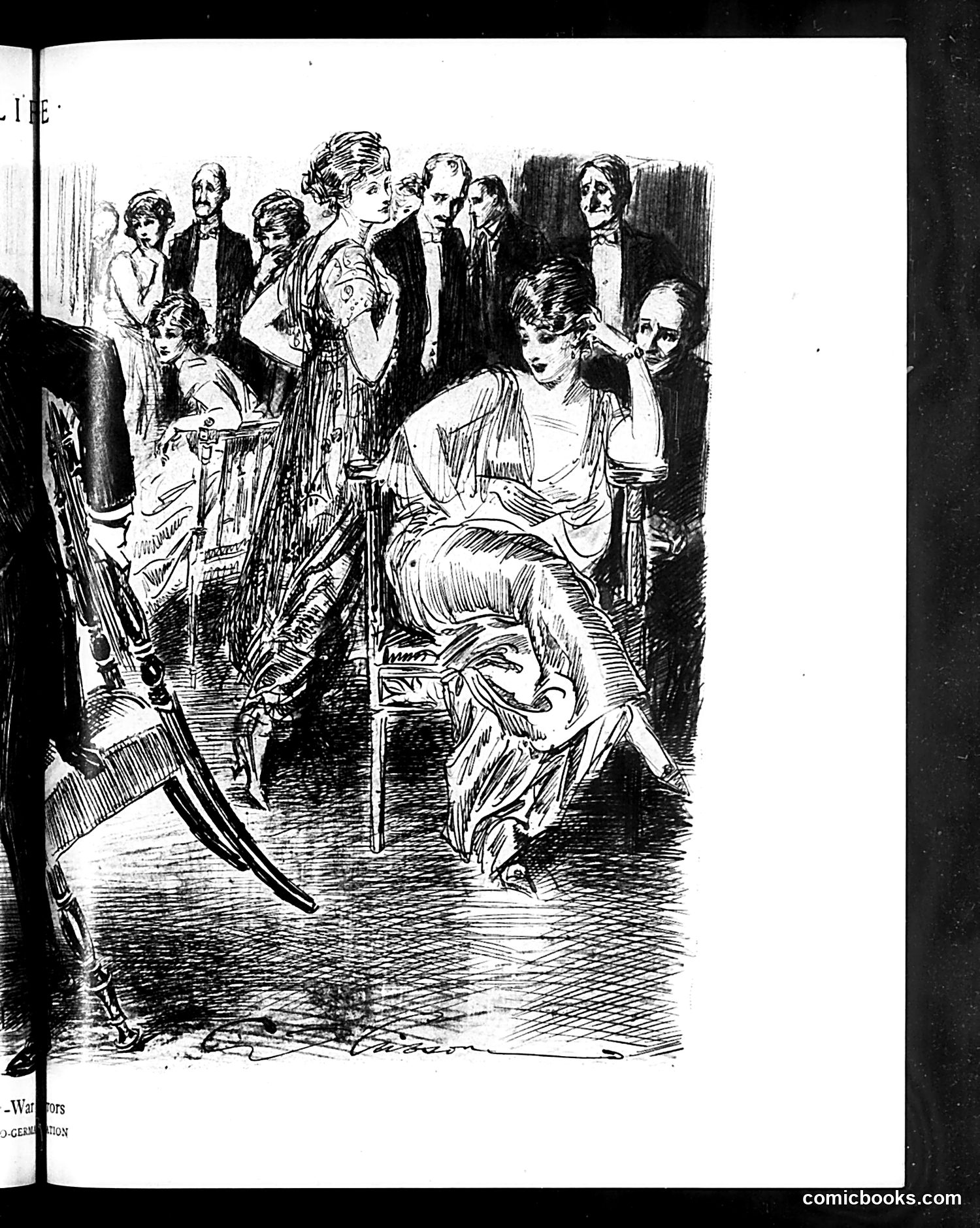
This is a satirical illustration depicting a social scene, likely from the early 20th century based on the artistic style. A woman sits prominently in the foreground while various well-dressed figures stand in the background, appearing to observe or react to her. The satire likely comments on **women's social status or behavior** during this era—possibly critiquing either female independence, fashion choices, or social ambition. The composition emphasizes the seated woman as the focal point of attention and judgment from others. However, without clearer text visible in the image or additional context from the magazine page, I cannot definitively identify the specific political/social reference, the intended targets of satire, or what particular event or trend this mocks. The exact meaning requires more legible OCR text or additional page content.
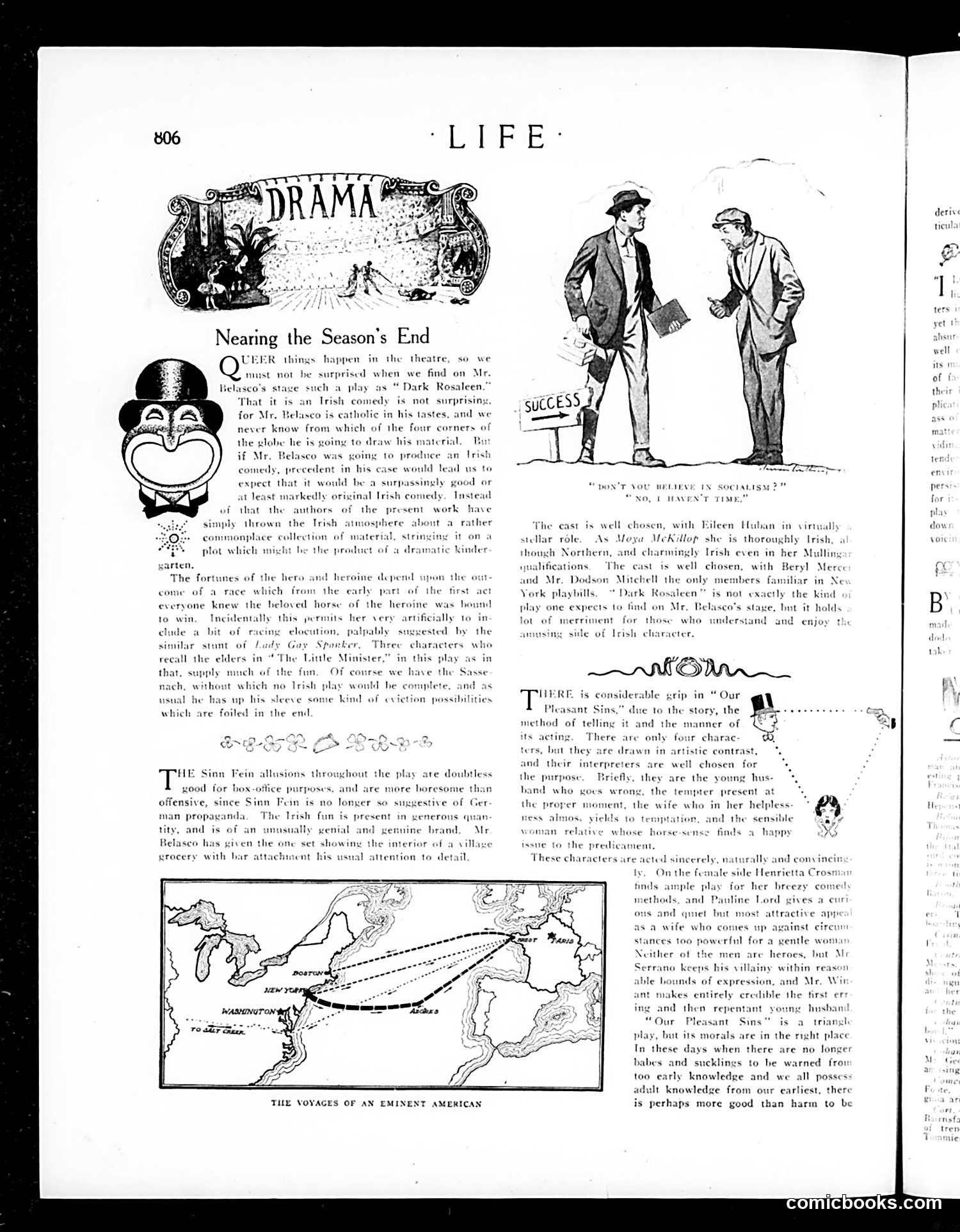
This page reviews two Broadway plays opening near season's end. The main cartoon depicts a theatrical mask, establishing the "Drama" section header. **"Dark Rosaleen"** (by producer David Belasco) is an Irish comedy. The reviewer notes Belasco's eclectic taste but finds this work derivative—merely wrapping commonplace material in Irish atmosphere. The plot hinges on whether a beloved horse wins a race, allowing artificial comedic speeches. The cast includes Eileen Huban and Beryl Mercer. The review acknowledges Sinn Féin references work for box-office appeal and appreciate the play's genuine Irish humor, though it's formulaic (featuring stock characters like the Sassanach and eviction-threat scenarios typical of Irish plays). **"Our Pleasant Sins"** receives warmer notice. With only four characters, it explores temptation and morality. The reviewer praises sincere, natural acting by Henrietta Crosman and Pauline Lord, and notes the play's moral framework remains appropriate despite modern audiences' sophistication about such themes. Both reviews are professional assessments of commercial theater, typical of *Life*'s cultural criticism for educated readers.
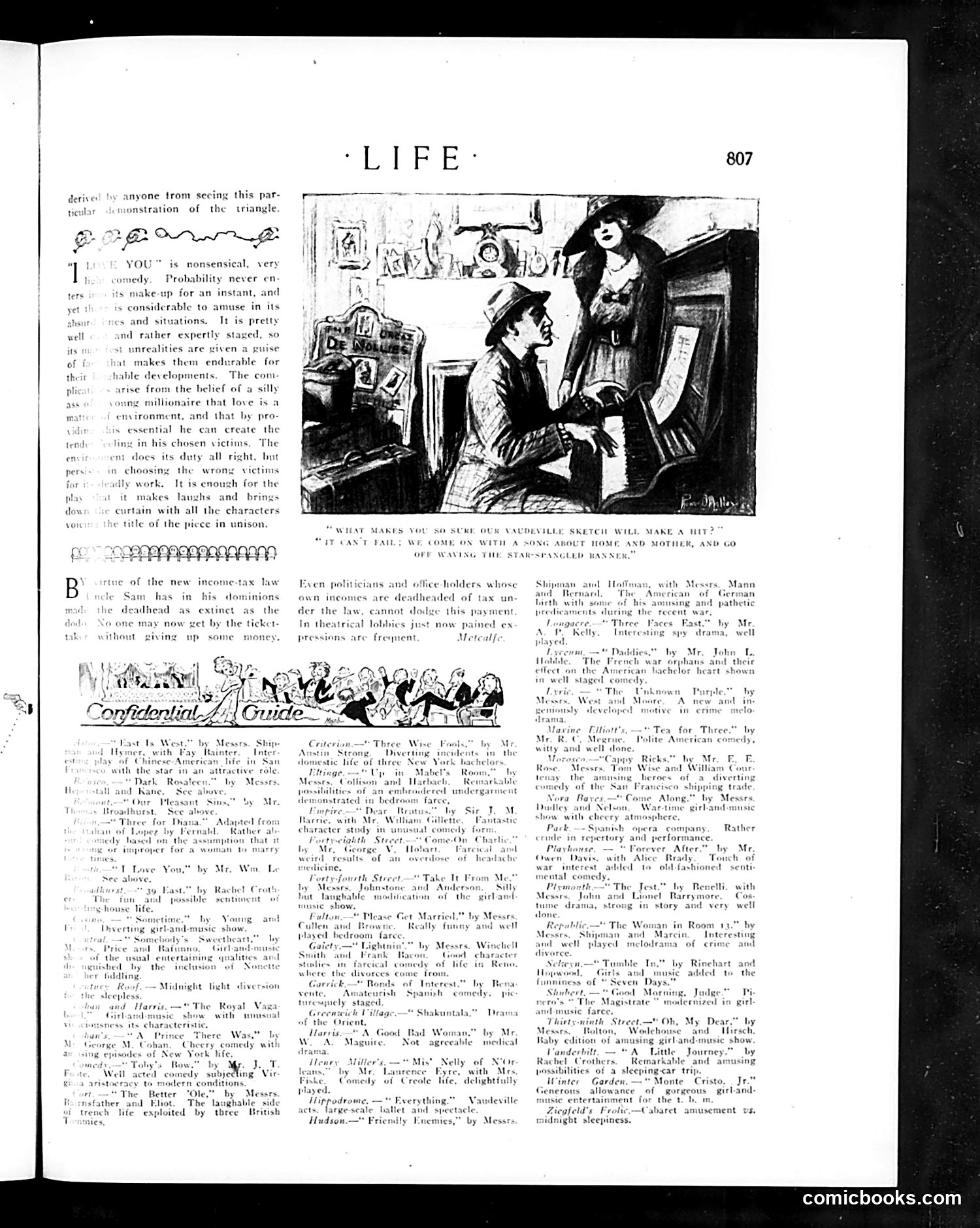
The main cartoon depicts a vaudeville performer pitching his act to a skeptical producer. The performer confidently claims their sketch "can't fail" because it features patriotic elements: "a song about home and mother" and "the star-spangled banner." The producer's skeptical response—"What makes you so sure our vaudeville sketch will make a hit?"—sarcastically undercuts this assumption. The joke targets wartime sentimentality in entertainment. During the WWI era (suggested by the text references to "war" and "French war orphans"), producers and performers relied heavily on patriotic themes and sentimental appeals to guarantee audience success. The cartoon mocks this cheap theatrical formula—the notion that merely waving the flag and invoking "home and mother" automatically creates entertainment value, regardless of actual talent or originality. The surrounding text confirms this was theater review season, listing numerous Broadway productions competing for attention.
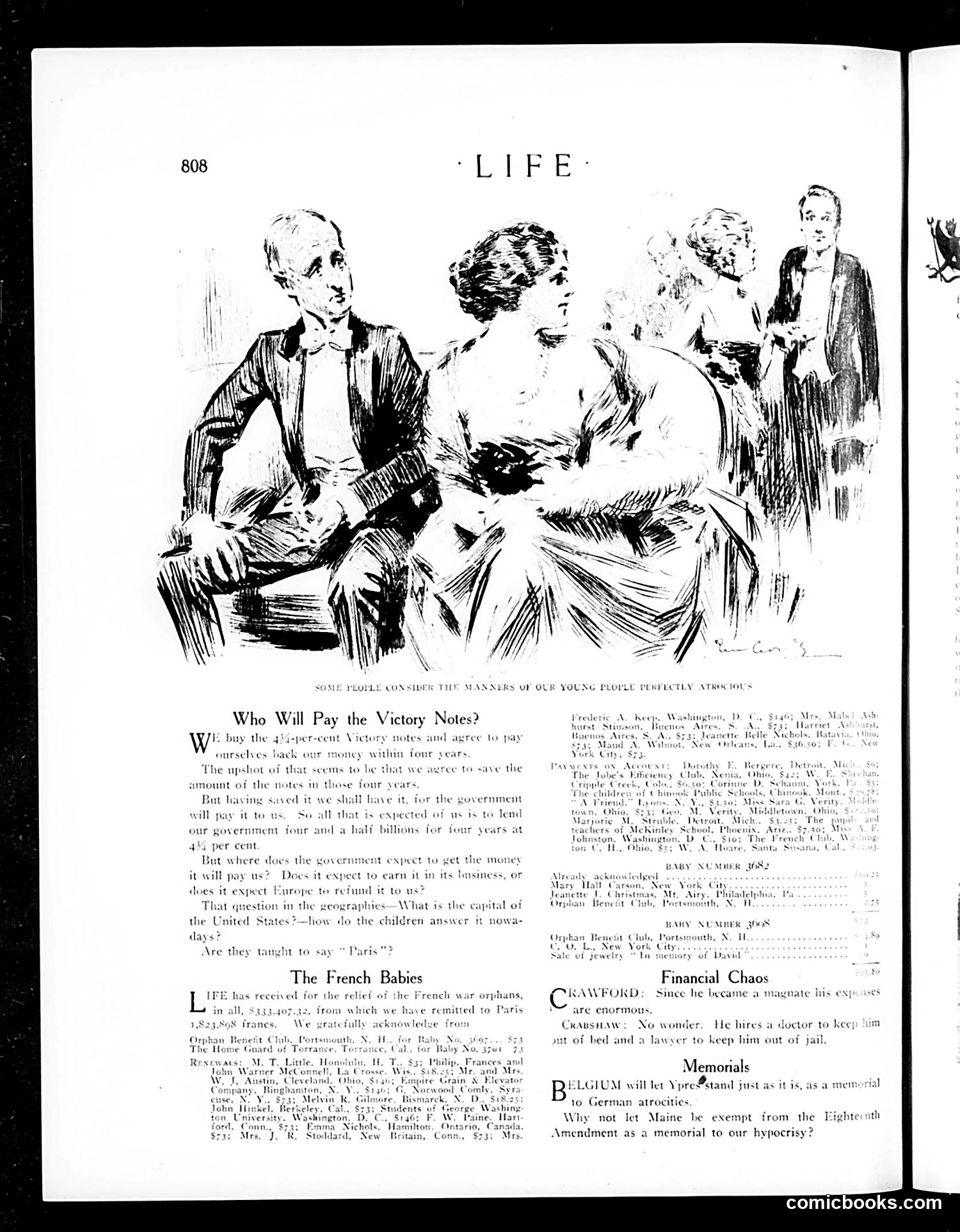
This page satirizes American war financing during World War I. The main cartoon depicts a social gathering where well-dressed figures discuss the government's sale of "Victory Notes" — bonds citizens were encouraged to buy to fund the war effort. The satire's point: The government asks citizens to lend money at 4.5% interest, supposedly repayable in four years. But the cartoon questions this logic: **where will the government get the money to repay citizens?** The text mockingly asks if the government expects to earn it through business, or if it will demand Europe repay American loans. The accompanying articles extend the critique — "Financial Chaos" suggests wealthy men hire lawyers to escape consequences, while "Memorials" sarcastically proposes leaving war-damaged sites standing as reminders of atrocities, questioning American moral authority on the war. The overall message: Americans are being asked to fund a war with uncertain financial terms and unclear purpose.
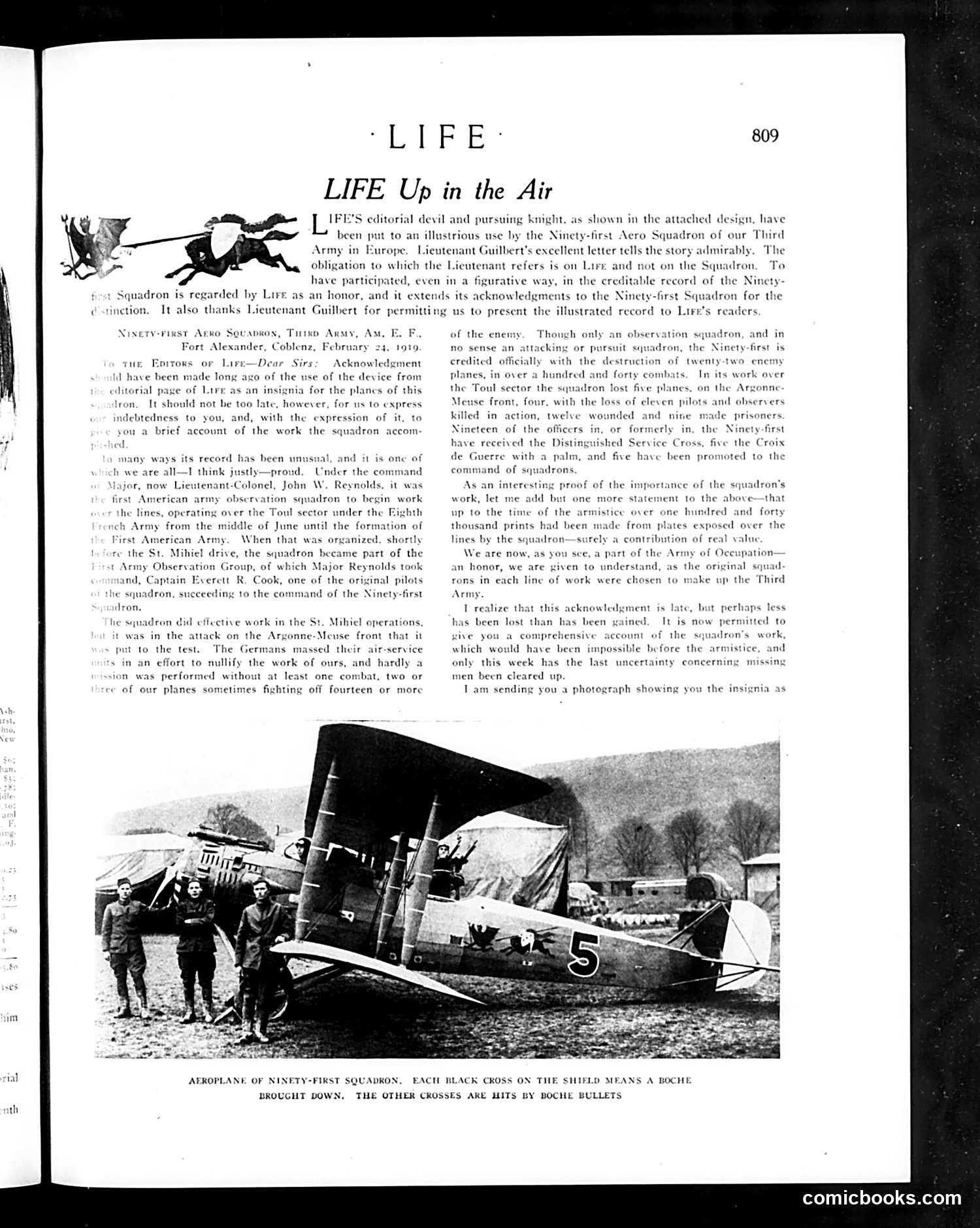
This page celebrates the **91st Aero Squadron of the U.S. Third Army** during World War I, particularly their observation and combat work over the Toul and Argonne-Meuse fronts in Europe. The content is NOT satire but rather **earnest editorial praise**. Life magazine's "editorial devil" mascot (the cartoon figures mentioned) has been adopted as the squadron's insignia on their aircraft. A letter from Lieutenant Colonel John W. Reynolds documents the squadron's record: over 140 combat engagements, 22 confirmed enemy planes destroyed, significant photographic reconnaissance (140,000 prints), with casualties of 11 pilots and observers killed. The photograph shows a damaged 91st Squadron aeroplane marked with black crosses indicating enemy aircraft destroyed and Roche bullets strikes. This is a **WWI military achievement article**, published shortly after the armistice, honoring a combat unit's service.
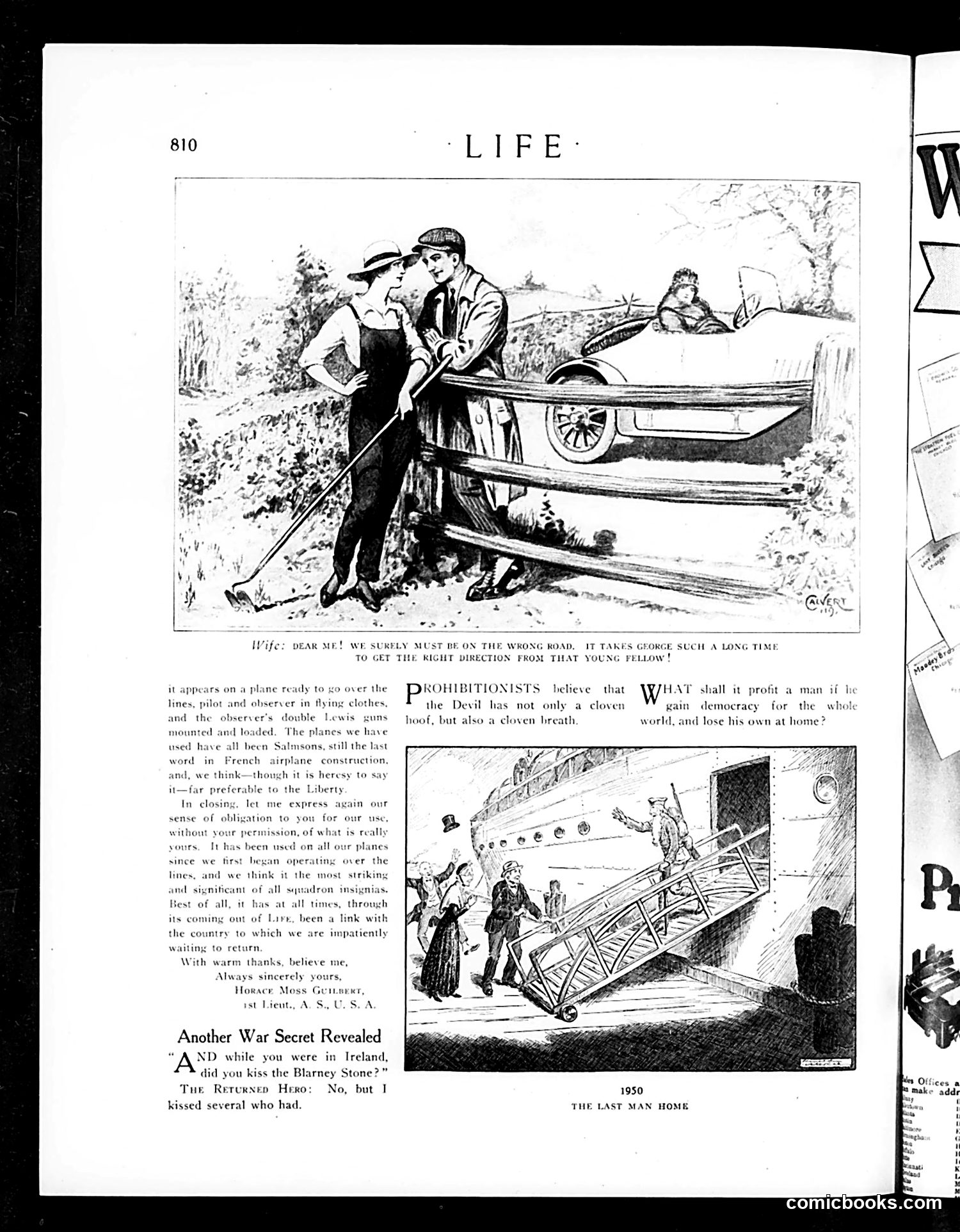
**Top Cartoon:** A wife complains to her husband "George" that they're lost because he takes too long getting directions from a young man (visible in a car ahead). This is a domestic humor joke about male pride and reluctance to ask for directions—a timeless marital stereotype. **Middle Section:** A letter from a WWI pilot (Horace Moss Guilbert) praising French Salmsons aircraft over American Liberty planes, expressing gratitude for their use in combat. This reflects real wartime debates about equipment quality. **Bottom Cartoon ("The Last Man Home"):** An illustration showing what appears to be a ship or transport vessel, likely depicting soldiers returning home after WWI. **Prohibitionist Quote:** A rhetorical jab at Prohibition advocates, sarcastically questioning whether gaining democracy domestically is worth losing personal freedom—social commentary on the controversial 18th Amendment era. The page mixes WWI military content with domestic satire and prohibition-era social criticism typical of Life's format.
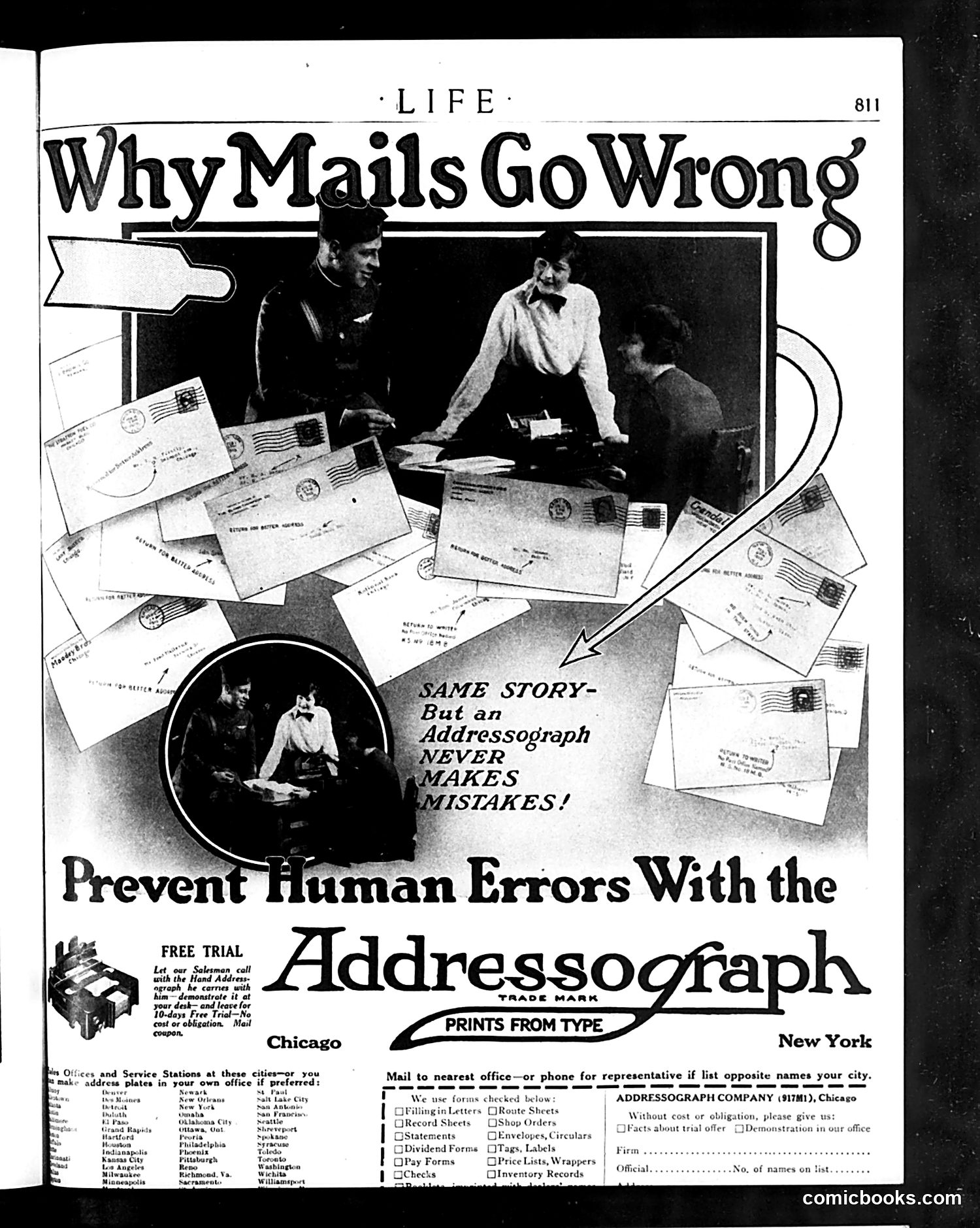
This is primarily a **product advertisement** for the Addressograph machine, disguised as editorial content in Life magazine. The "cartoon" setup shows postal workers struggling with misaddressed mail—depicting human error in manual address writing. The punchline contrasts this with the Addressograph, a mechanical addressing device that "NEVER MAKES MISTAKES." The imagery shows: - Scattered envelopes with incorrect addresses (top) - Postal workers examining problem mail - A circular inset showing the Addressograph machine in use **The point**: This is a straightforward advertising pitch leveraging relatable workplace frustration. By framing mail delivery failures as inevitable human error, the ad sells the Addressograph as the modern, reliable solution for businesses needing to address large volumes of mail accurately. There is **no political satire** here—it's a commercial advertisement using a before-and-after comparison format common in early 20th-century marketing, presented in Life's editorial style.
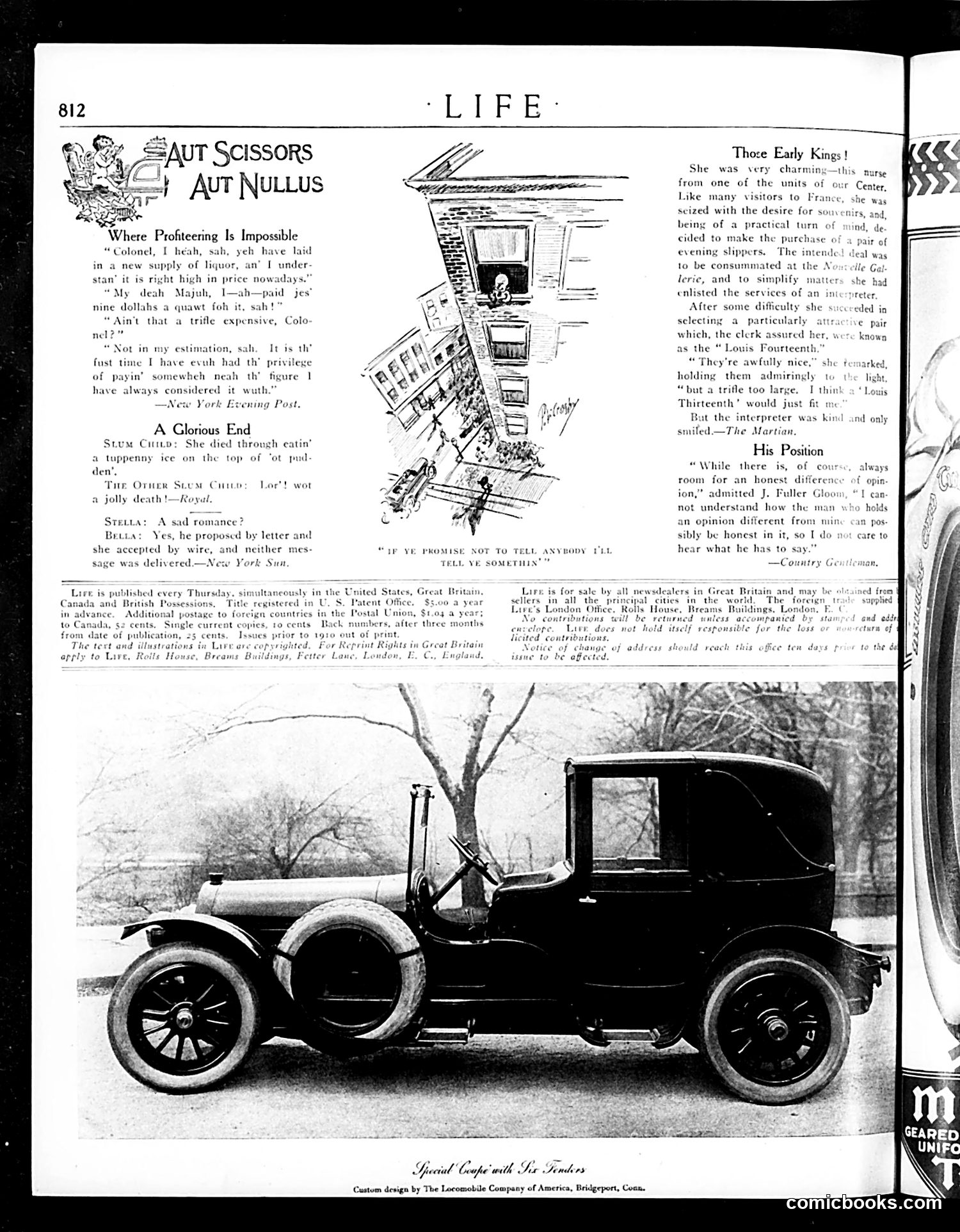
This page contains three brief satirical pieces typical of Life's humor: 1. **"Where Profiteering Is Impossible"**: A dialogue mocking wartime liquor price gouging. A Colonel charges nine dollars per quart—presented as absurdly expensive—yet a visitor acknowledges this is the first time he's paid anything close to what he considers fair value, sardonically suggesting even inflated wartime prices beat his usual costs. 2. **"A Glorious End"** and **"His Position"**: Brief joke exchanges about death and intellectual honesty, using wordplay and ironic twists typical of period humor magazines. The page's primary focus is advertising a **Locomobile automobile** (bottom), shown as a "Special Coupe with Six Tenders"—a luxury vehicle from The Locomobile Company of America. The illustration and caption present this as aspirational consumer goods alongside the satirical content, representing the magazine's mix of social commentary and advertising targeting wealthy readers.
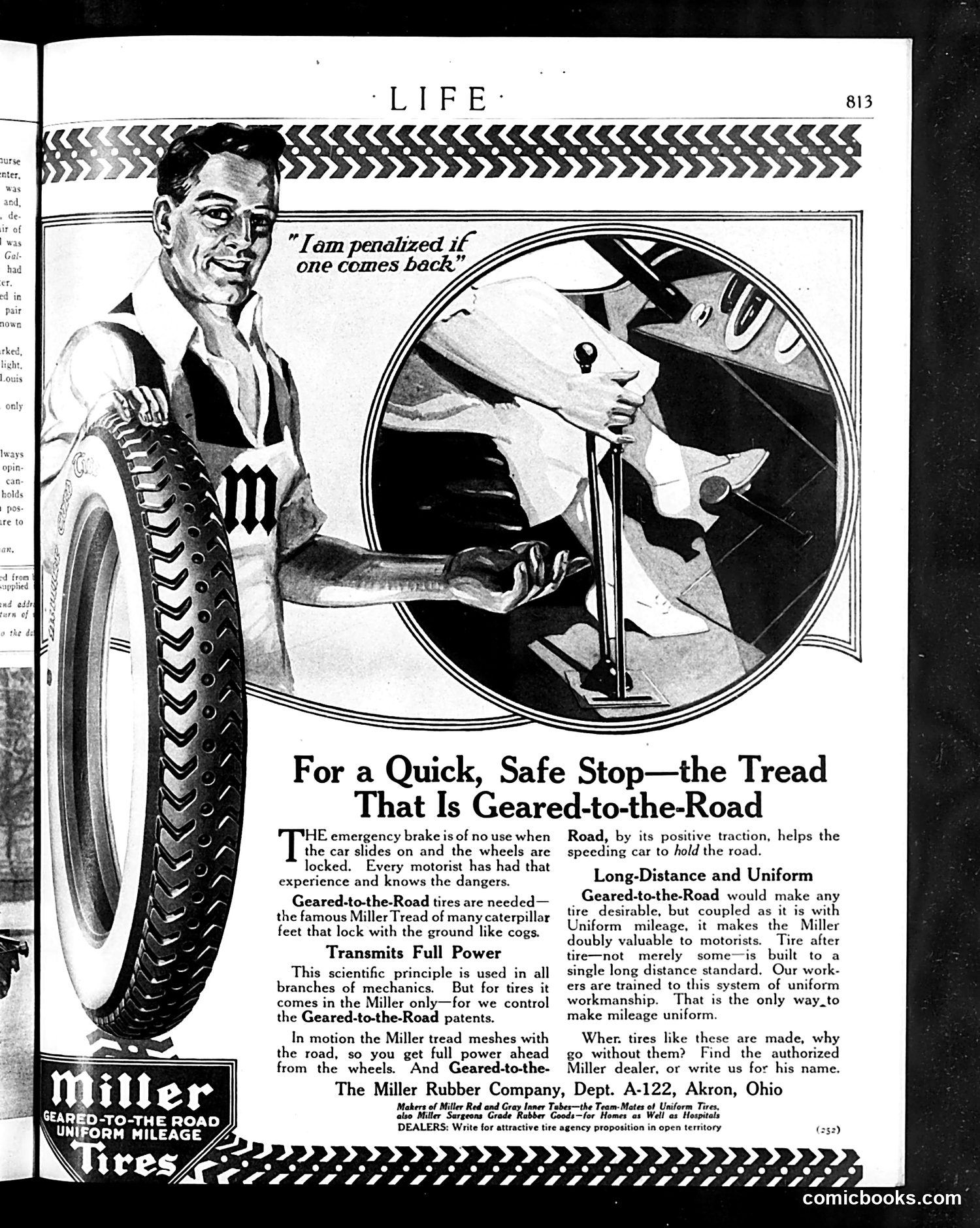
This is primarily **a tire advertisement**, not political satire. The Miller Rubber Company promotes "Geared-to-the-Road" tires through a cartoon scenario. The image shows a man with a tire beside him, and a circular inset depicting a woman at a car's steering wheel with the quote: "I am penalized if one comes back." The joke appears to be a double entendre: the woman is penalized (fined/punished) if she returns a tire—meaning it fails and must be replaced under warranty. The ad emphasizes the tire's reliability and uniform quality, implying customers won't need replacements. The technical copy explains the tire's "caterpillar tread" design for better road grip and braking, positioning it as a safety innovation. This is straightforward commercial messaging typical of 1920s-era Life magazine advertising, using humor to promote consumer products rather than offering political or social commentary.
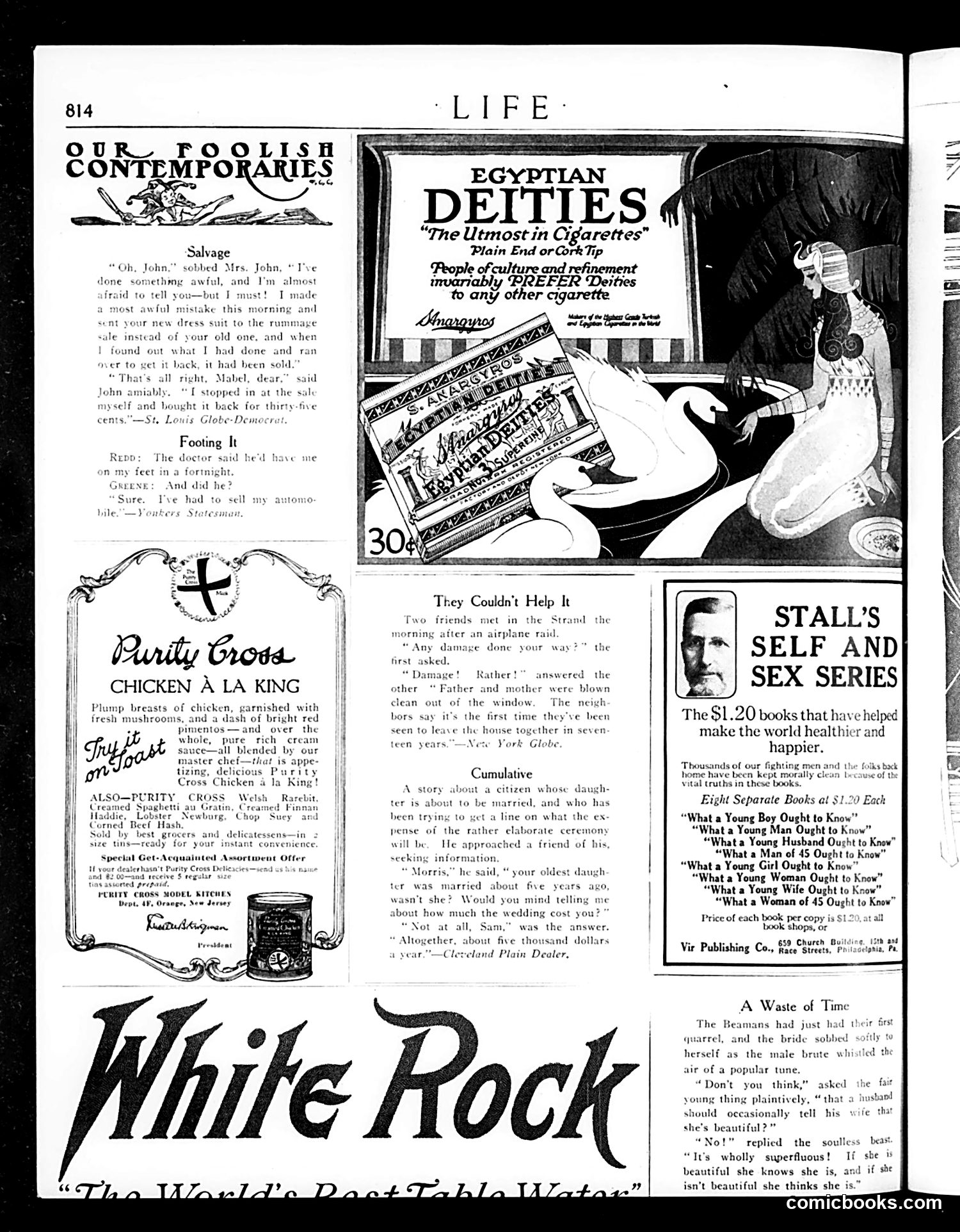
This page is primarily **advertisements and humor shorts**, not political satire. The notable content includes: **"Our Foolish Contemporaries"** section: Brief humorous anecdotes mocking everyday absurdities—a man selling his car after nearly wrecking it, doctors' questionable advice. **Egyptian Deities cigarette ad**: Features an art deco illustration promoting cigarettes with Egyptian styling, claiming superiority over competitors (30¢). **Purity Cross recipe**: A cooking advertisement for "Chicken à la King," presented as a culinary recommendation. **Stall's Self and Sex Series**: Educational book advertisements promising health guidance ($1.20 per volume). **White Rock water ad**: Large illustration at bottom promoting bottled water as "The World's Best Table Water." The page reflects early 20th-century consumer culture and advertising aesthetics rather than political commentary.
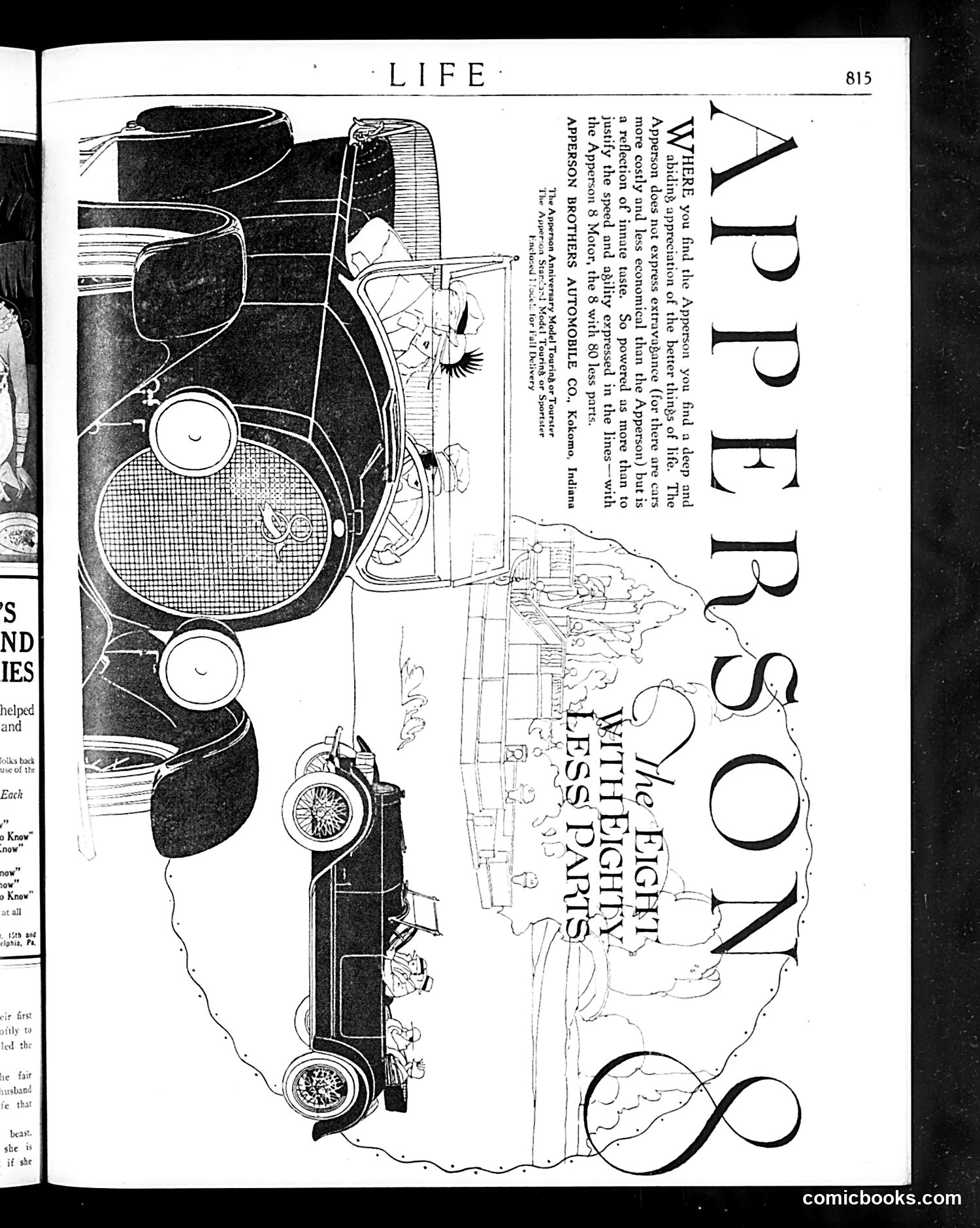
This page is primarily **automobile advertising** for the Apperson Brothers automobile, positioned as a luxury car for discerning buyers. The ad emphasizes the car's refined taste, economy despite its quality, and technical superiority (notably its "8 Motor" with "80 less parts"). The large illustration shows an elegant car from multiple angles. The decorative text reading "A Pip! For 1920" and "With Eight Eighty Less Parts" frames the vehicle as a desirable 1920 model. The satirical or humorous element appears minimal—the phrase "A Pip!" (slang for something excellent) and the tongue-in-cheek emphasis on having "80 less parts" (suggesting fewer components means better engineering) constitute the main wit. This reflects early 1920s automotive marketing, where mechanical simplicity was marketed as a virtue and luxury cars appealed to aspirational middle and upper-class consumers seeking status through refined taste rather than mere expense.
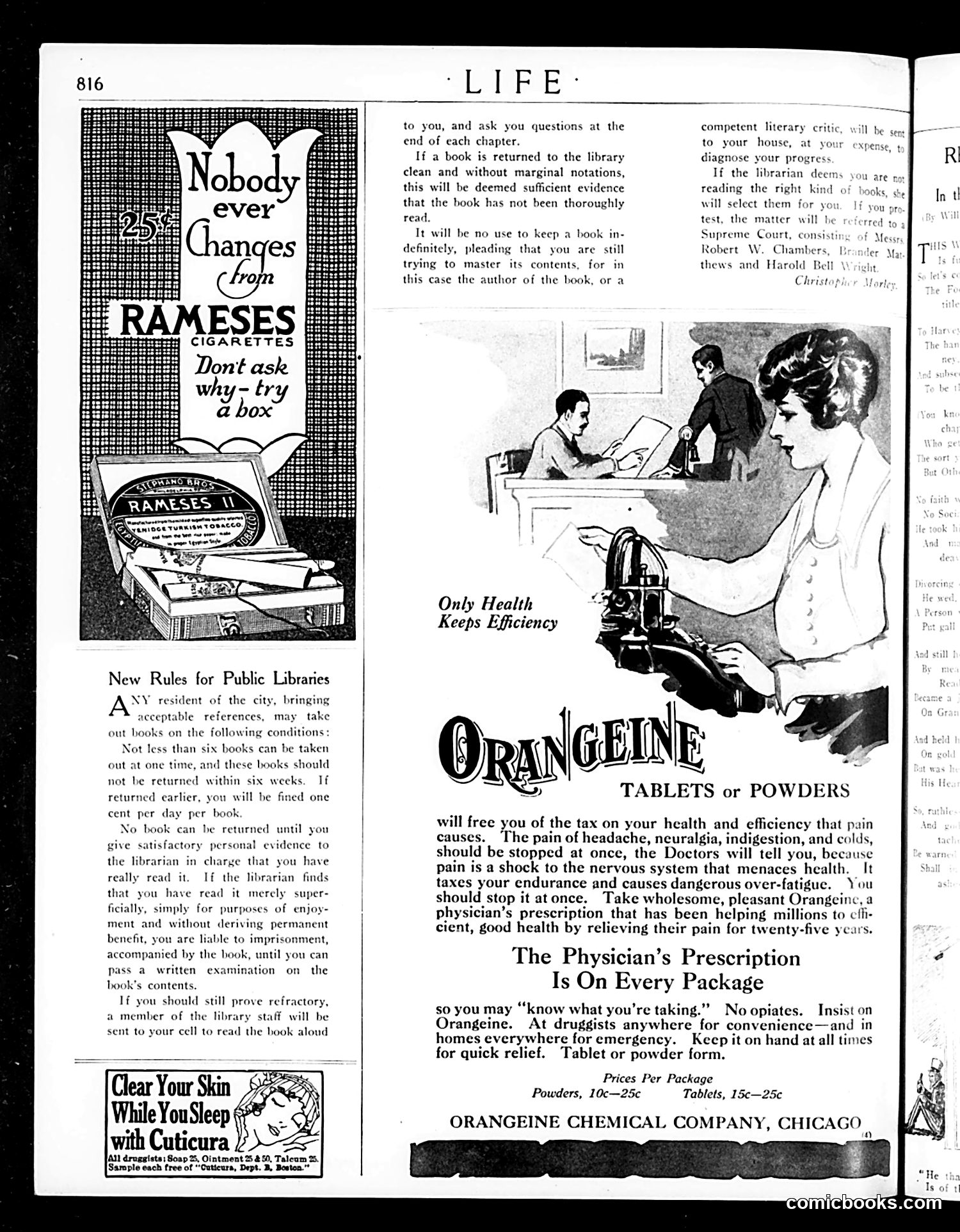
This is satirical commentary on overly strict public library policies. The humor lies in absurdly escalating rules: patrons must keep books six weeks minimum, prove they've thoroughly *read* (not just skimmed) every book, face imprisonment for superficial reading, and submit to written examinations on contents. The final absurdity—a librarian or author visiting your jail cell to quiz you chapter-by-chapter—mocks the notion that libraries should police how people consume books. The satire targets early 20th-century institutions' obsession with control and "moral improvement." Libraries weren't just lending books; they were supposedly reforming readers. The joke suggests this paternalism has become comically tyrannical, treating reading like a prison sentence with mandatory comprehension tests. The page also contains period advertisements (Rameses cigarettes, Orangeine tablets, Cuticura soap)—standard magazine filler of the era.
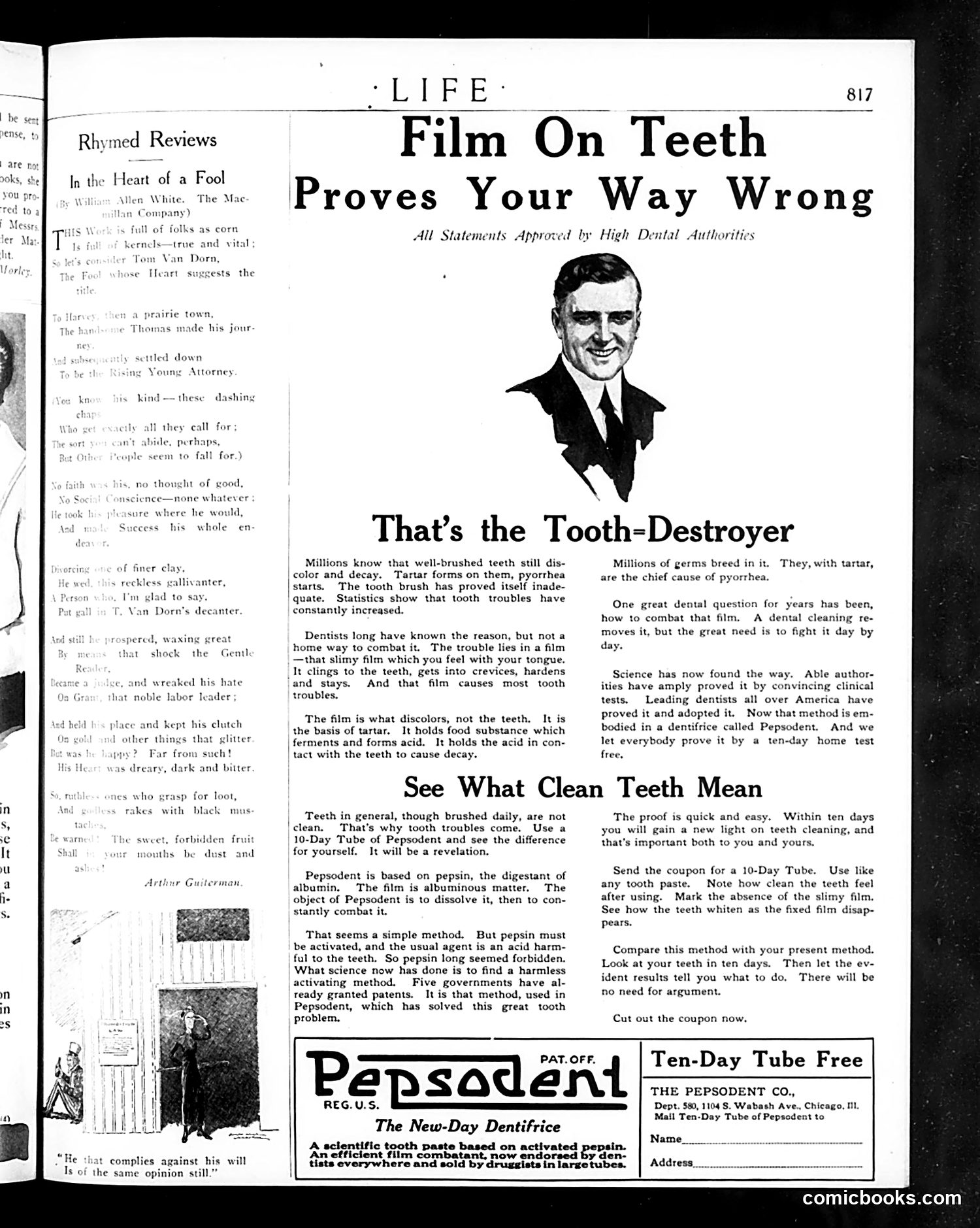
This page is primarily a **Pepsodent toothpaste advertisement**, not satire. The headline "Film On Teeth Proves Your Way Wrong" is marketing copy claiming that conventional tooth-brushing fails because of an invisible slimy film that brushing cannot remove. The "tooth-destroyer" referenced is this film—described as harboring germs, tartar, and acid that causes decay and discoloration. The advertisement promotes Pepsodent as a scientifically new solution using "activated pepsin" to dissolve this film. The left side contains unrelated **rhymed book reviews** (including "In the Heart of a Fool"), standard Life magazine content. The prominent portrait shows a smiling man, likely meant to represent a dentist endorsing the product, though the image is not identified by name. The coupon offers a free ten-day trial tube. This represents early 1900s-era **medicinal advertising**, relying on pseudo-scientific claims about newly "discovered" problems and patented solutions to sell consumer products.
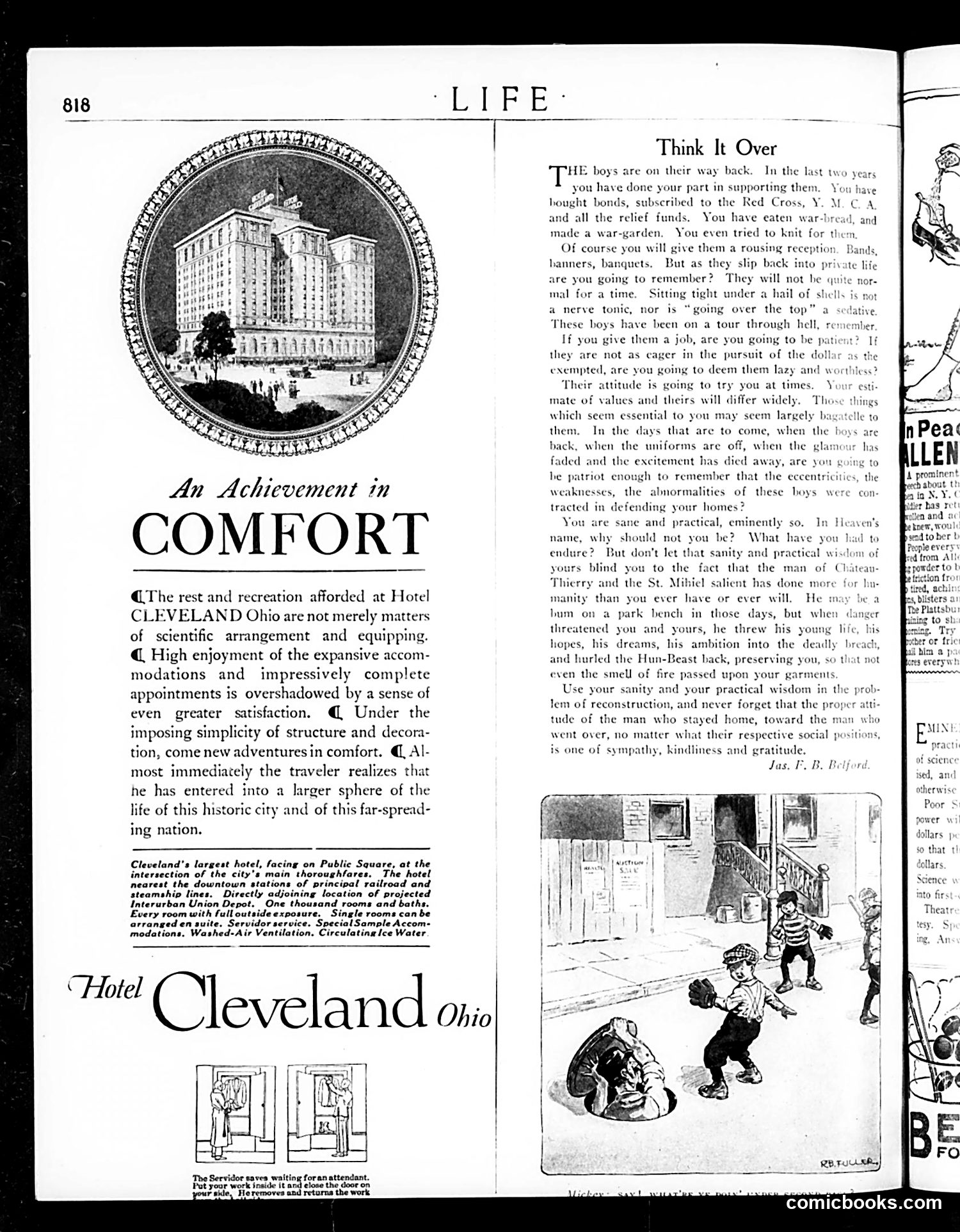
This page mixes a hotel advertisement with serious post-WWI messaging. The left side promotes Cleveland's Hotel Cleveland as offering superior comfort and refinement. The right side contains an editorial titled "Think It Over" addressing American civilians about their responsibility to returning World War I soldiers. The essay warns readers not to judge returning veterans harshly for behavioral changes or reduced ambition. It references specific WWI battles (Chateau-Thierry, St. Mihiel) and notes soldiers may appear "bums on park benches" despite their sacrifice. The piece appeals to American "sanity and practical wisdom" while urging sympathy for men traumatized by combat—even if their post-war "attitude" and "values" seem foreign to civilians who stayed home. The accompanying illustration (bottom right) shows children playing in a street, possibly contrasting innocent American life with soldiers' darker experiences abroad. The tone is patronizing but earnest propaganda encouraging social reintegration of shell-shocked veterans.
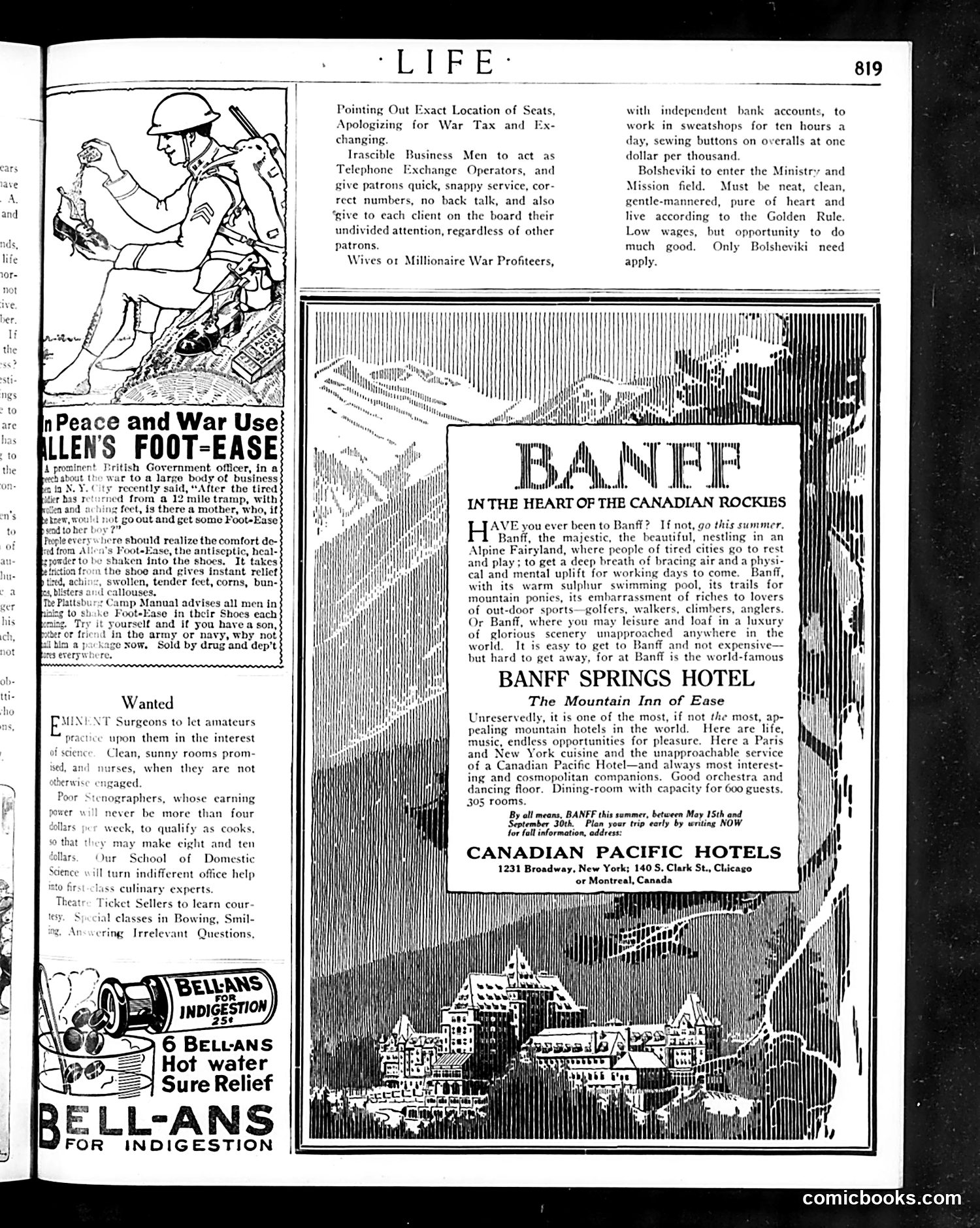
This page contains **satirical "Help Wanted" advertisements** mocking post-WWI American society during the Red Scare era. The humor targets multiple groups: - **War profiteers' wives**: Sarcastically "wanted" to work in sweatshops for pittance, mocking wealthy women who benefited from wartime business while workers suffered. - **Bolsheviki (Russian communists)**: Listed as applicants needing to be "neat, clean, gentle-mannered" and follow the "Golden Rule"—absurdist mockery equating communists with the opposite of Christian virtue, reflecting American anti-communist anxiety. - **Business men as telephone operators**: Satirizing corporate rudeness by imagining temperamental executives forced into service roles requiring patience and courtesy. The page uses exaggerated job qualifications to expose class hypocrisy and social tensions: wealthy war profiteers, labor exploitation, communist fears, and class conflicts. The remaining content comprises period advertisements (Bellans indigestion remedy, Banff Springs Hotel), typical of Life's commercial format.
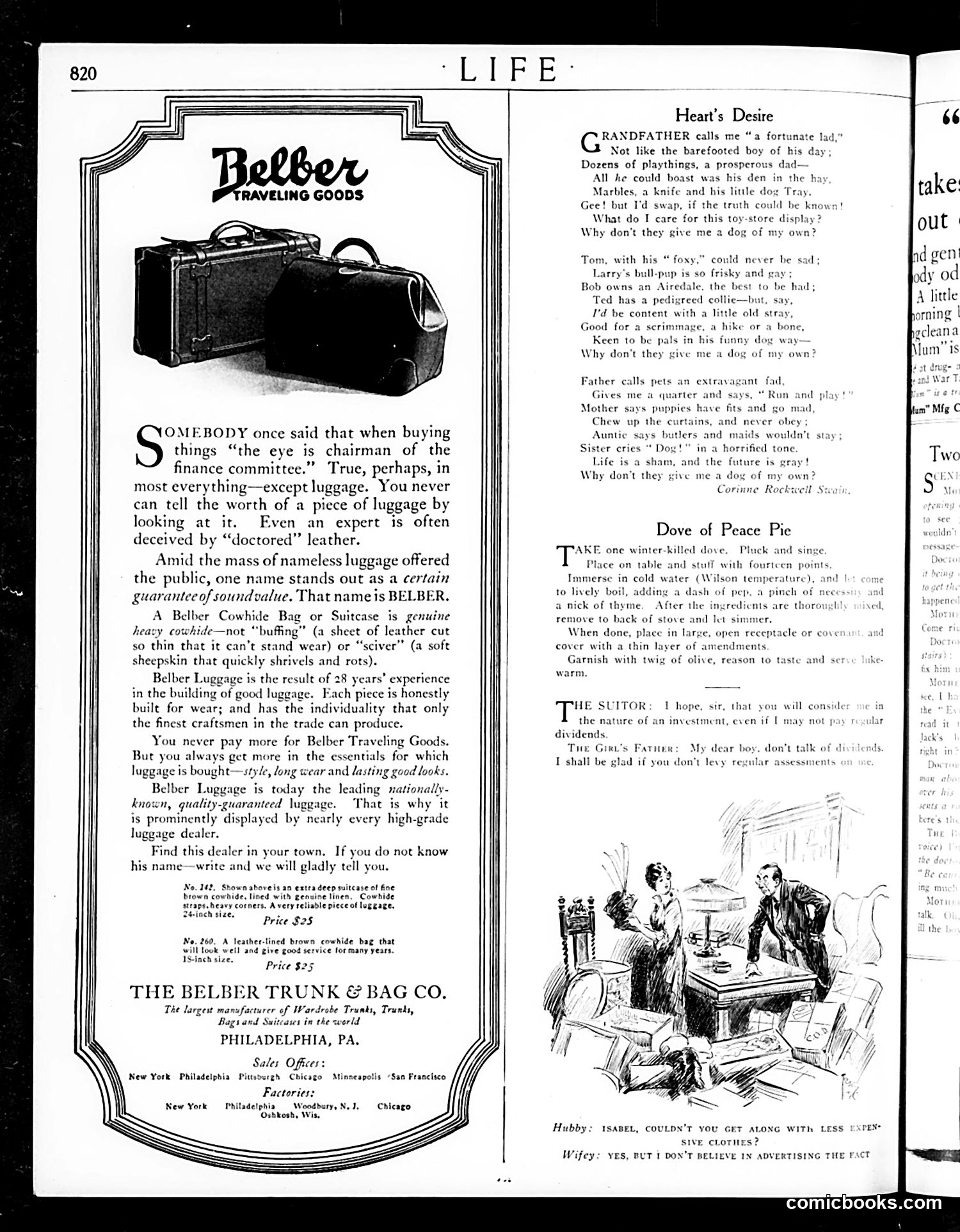
This page contains **primarily advertising** (a Belber Luggage Company advertisement occupying the left half) alongside several **humorous literary pieces and cartoons** on the right. The main content includes: 1. **"Heart's Desire"** — A poem about a child wanting a dog, contrasting his wealthy situation with his grandfather's poor childhood. The satire targets parental excuses and materialism. 2. **"Dove of Peace Pie"** — A satirical recipe mocking Woodrow Wilson's peace efforts (the reference to "Wilson temperature" and "dove of peace" indicate post-WWI context, likely 1919-1920). It suggests Wilson's peace initiatives are hollow or ineffective. 3. **A cartoon dialogue** between a suitor, a girl's father, and a husband-wife exchange about money and expenses—typical early-20th-century domestic humor about courtship, class consciousness, and marital economics. The page reflects Life's characteristic blend of **social satire, domestic humor, and advertising**, targeting educated middle-class readers concerned with consumption, propriety, and current events.
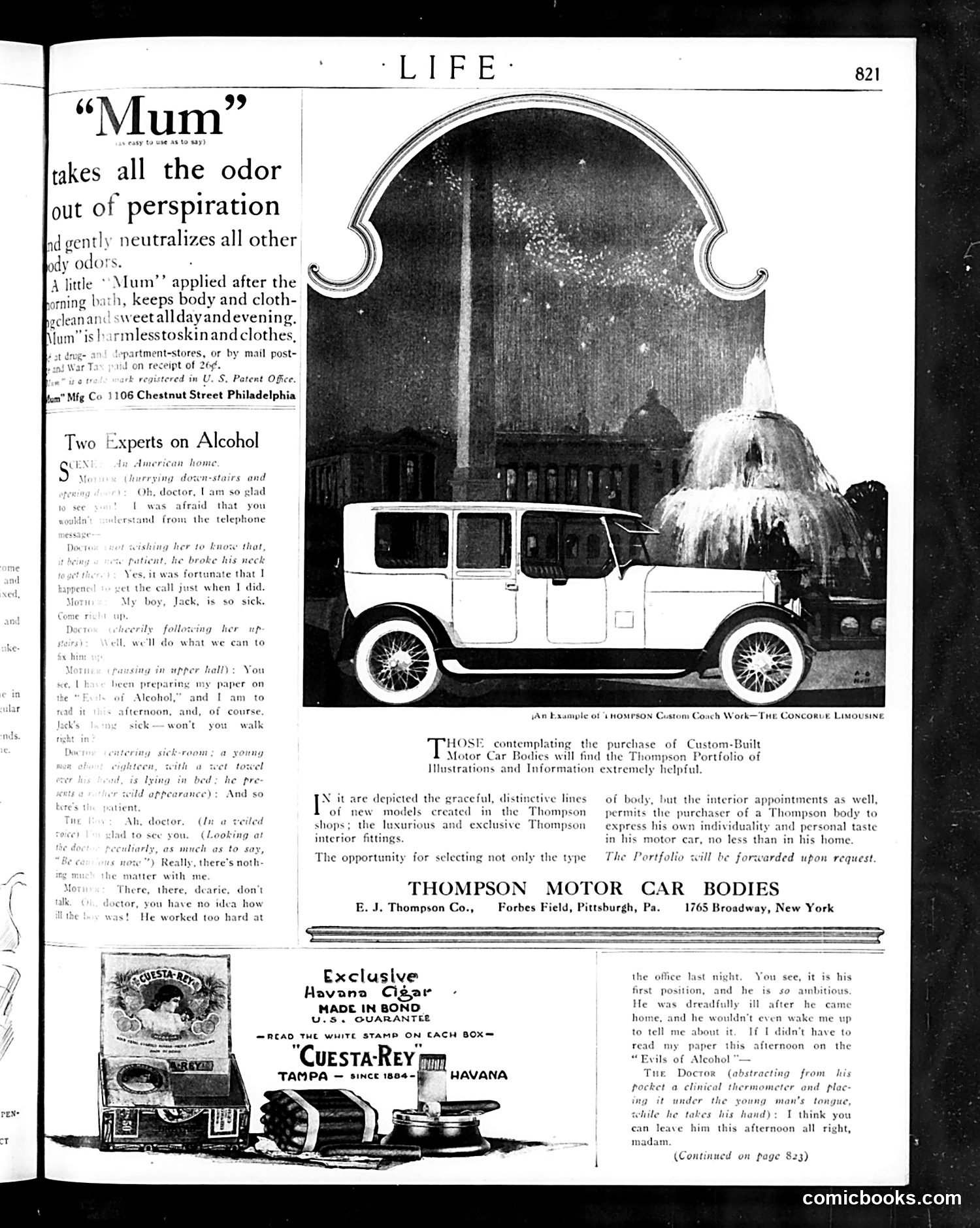
This page mixes advertisements with a comic dialogue about alcohol's dangers. The main comic, "Two Experts on Alcohol," depicts a doctor visiting a sick young man at home. The mother worriedly explains her son "Jack" overworked and won't wake up; the doctor, after examination, dismisses her concerns, saying he can leave "this afternoon all right." The satire lies in the irony: the mother mentions she's preparing a paper on "Evils of Alcohol," yet the doctor's casual reassurance about a dangerously unresponsive patient suggests either medical incompetence or—more likely—that alcohol is involved in the illness, which neither adult openly acknowledges. The "two experts" are implicitly hypocritical: one lectures about alcohol's dangers while her son may be suffering from it. The surrounding ads (Mum deodorant, Thompson motor cars, Cuesta Rey cigars) reflect 1920s consumer culture, likely during Prohibition, when discussing alcohol's dangers was socially prominent.
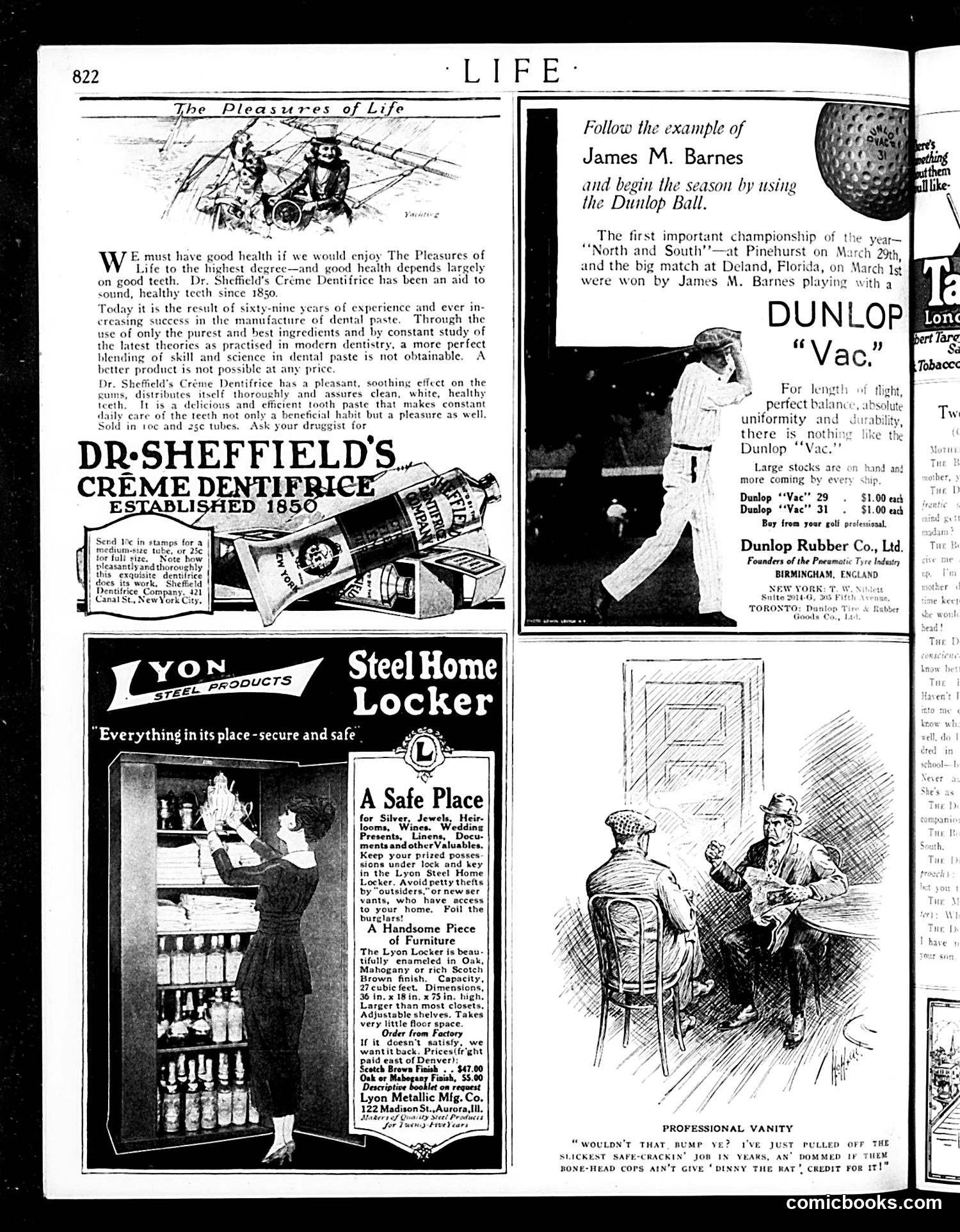
This page is primarily **advertising with one small cartoon**. The ads promote toothpaste, a steel home locker, and golf balls—typical early 20th-century consumer goods. The single cartoon at bottom ("Professional Vanity") depicts two men in what appears to be a criminal context. One brags about pulling off "the slickest safe-crackin' job in years," complaining that cops credited "the Rat" instead of him. The joke satirizes petty criminal pride—a safecracker is upset about not receiving personal credit for his theft. It's a humorous take on how even criminals have ego and seek recognition, played in vernacular working-class dialect typical of the era's comic style. The page's primary purpose is selling products to readers concerned with health (teeth), home security (the ironic placement next to a theft joke), and leisure activities (golf).
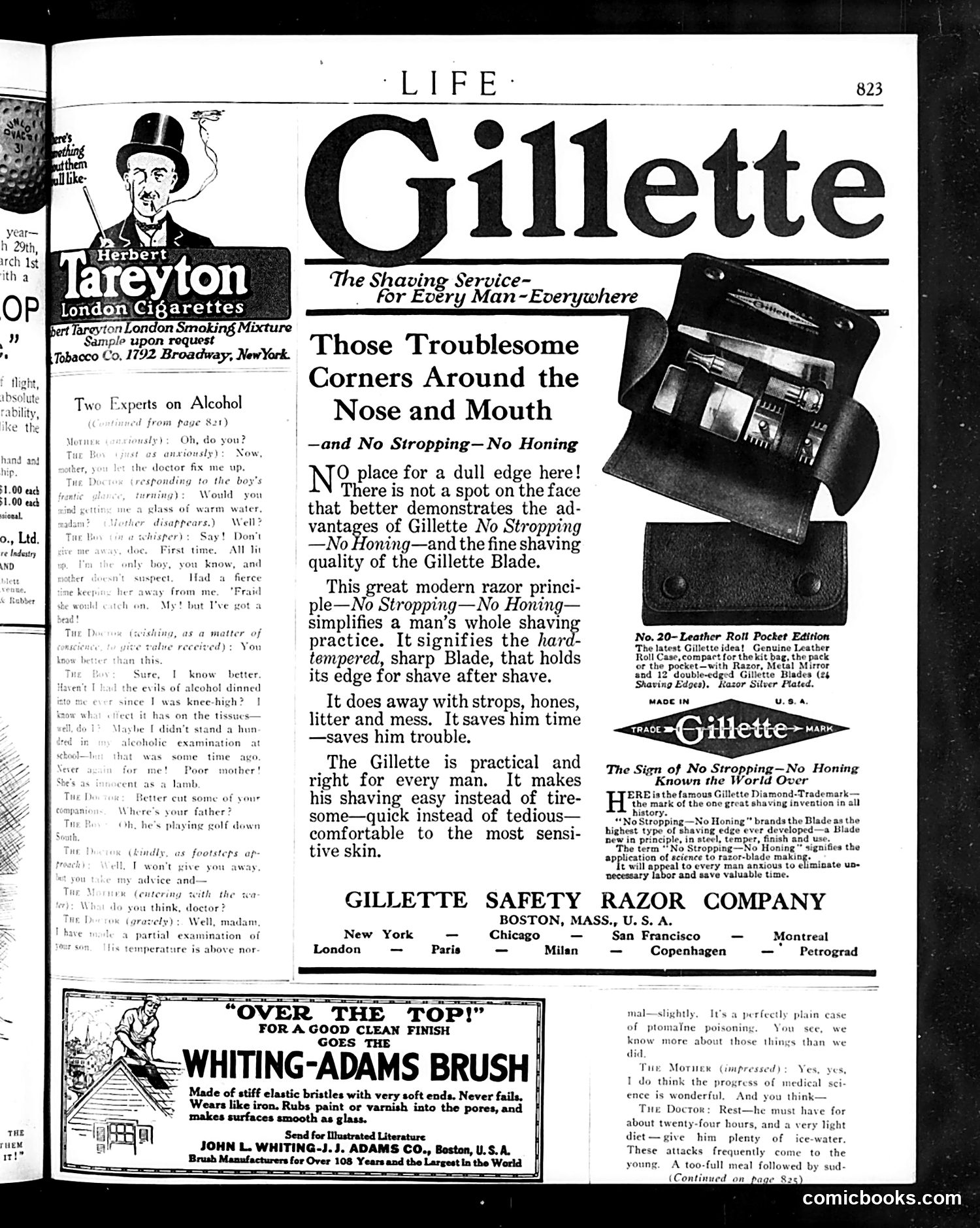
This page is **primarily advertising**, not satire or political commentary. It contains three product advertisements typical of early 20th-century magazines: 1. **Gillette Safety Razor** (dominant): Markets the "No Stropping—No Honing" feature, emphasizing convenience for shaving difficult facial areas. The ad positions this as a modern innovation simplifying men's grooming. 2. **Herbert Tareyton Cigarettes** (upper left): A simple brand advertisement. 3. **Whiting-Adams Brush** (lower left): Promotes paint/varnish brushes with claims of durability and quality. The small text dialogue labeled "Two Experts on Alcohol" (top left) appears to be a separate humor piece about medical advice regarding alcohol poisoning—not connected to the advertisements. There is **no political cartoon or satire** on this page. It represents straightforward early-1900s consumer advertising alongside light comedic content, reflecting Life magazine's mixed editorial/advertising format of that era.
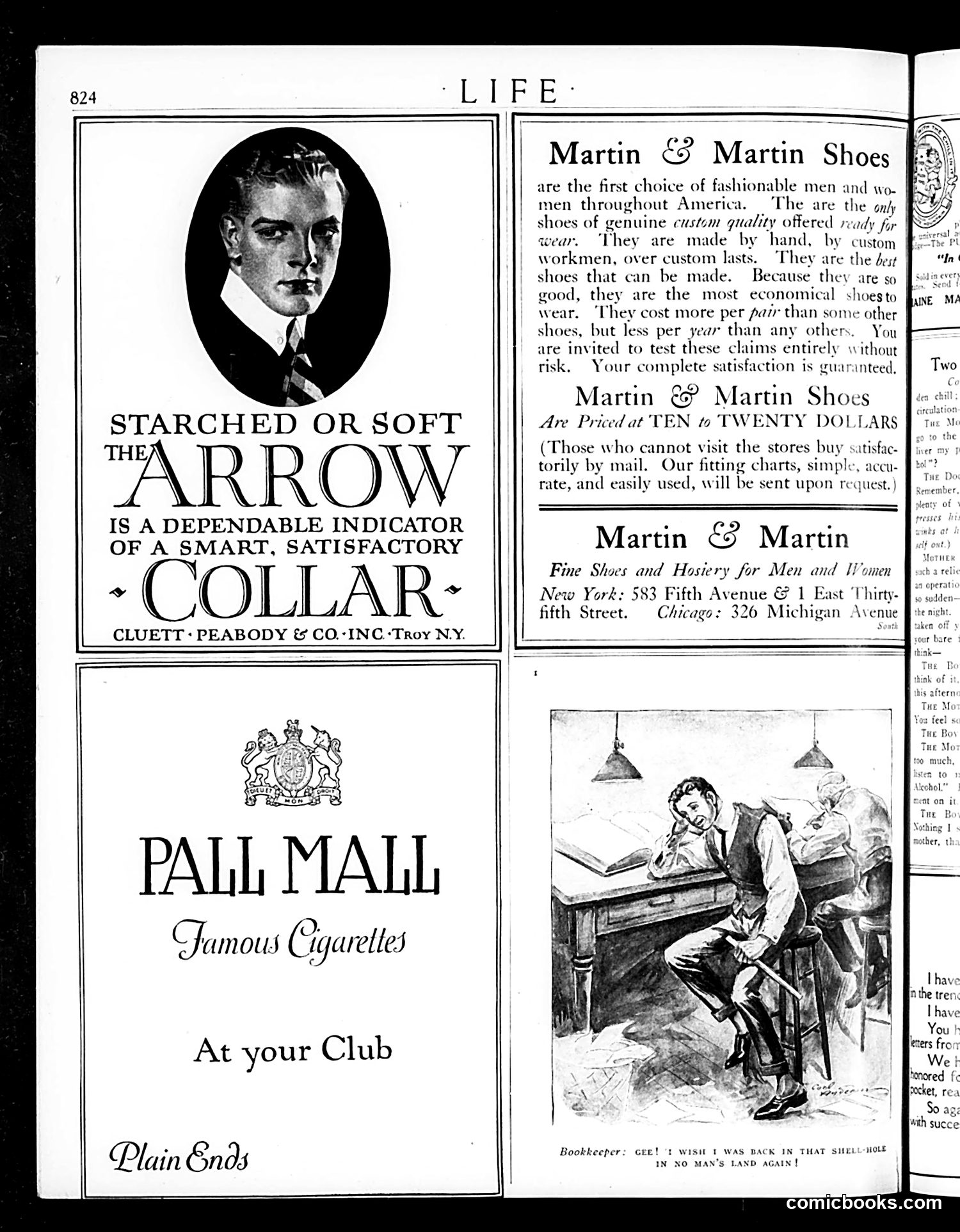
This page is primarily **advertising**, not satirical content. However, the cartoon at bottom-right provides the only editorial material: it depicts a **bookkeeper expressing despair** at his desk job, yearning to return to front-line combat ("that shell-hole in no man's land"). The joke captures a **post-WWI sentiment**: paradoxically, some veterans found civilian clerical work so tedious and soul-crushing that they romanticized the literal danger of trench warfare. It's dark humor about workplace monotony versus military service. The advertisements themselves (Arrow collars, Martin shoes, Pall Mall cigarettes) target affluent men—the magazine's primary readership—with appeals to status and quality. The Arrow collar ad's portrait suggests brand trustworthiness through an authoritative male figure, typical early-20th-century marketing.
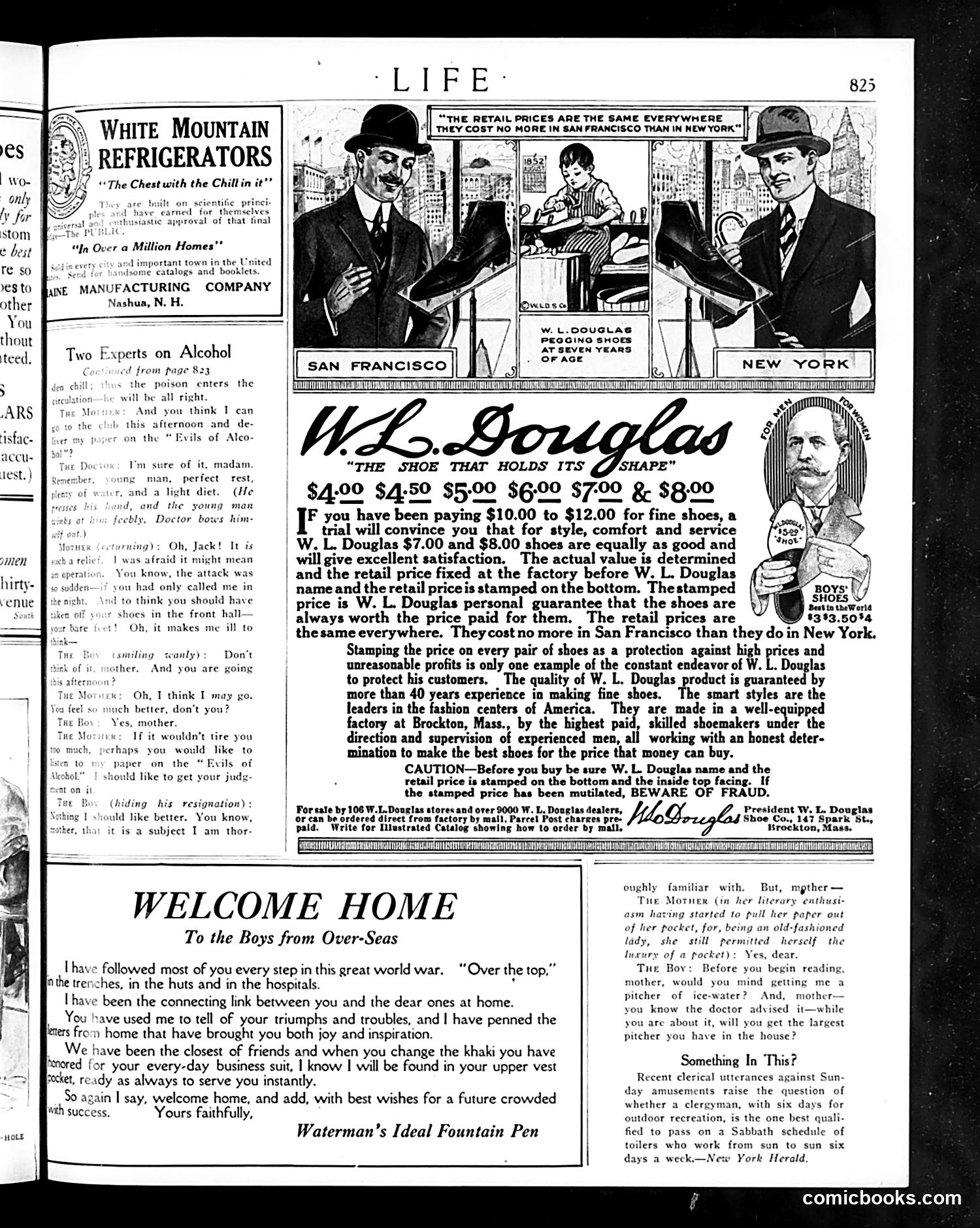
This page is primarily **advertising**, dominated by a large W.L. Douglas shoe advertisement claiming uniform retail prices nationwide—a selling point emphasized by the cartoon at top showing two men (labeled "San Francisco" and "New York") asserting "The retail prices are the same everywhere." The smaller cartoon titled "Two Experts on Alcohol" depicts a domestic scene where a doctor and young man discuss alcohol's effects on the body during what appears to be Prohibition era (likely 1920s, given the context). The dialogue suggests debate over alcohol's dangers—the doctor claiming it "poisons" the system, the young man skeptical. The page also includes a "Welcome Home" message to returning WWI soldiers and a brief item titled "Something In This?" about religious observance and Sabbath recreation. The Douglas ad's emphasis on fixed pricing reflects Progressive-era consumer concerns about price-fixing and fraud—hence the repeated "BEWARE OF FRAUD" warning about counterfeit stamped prices.
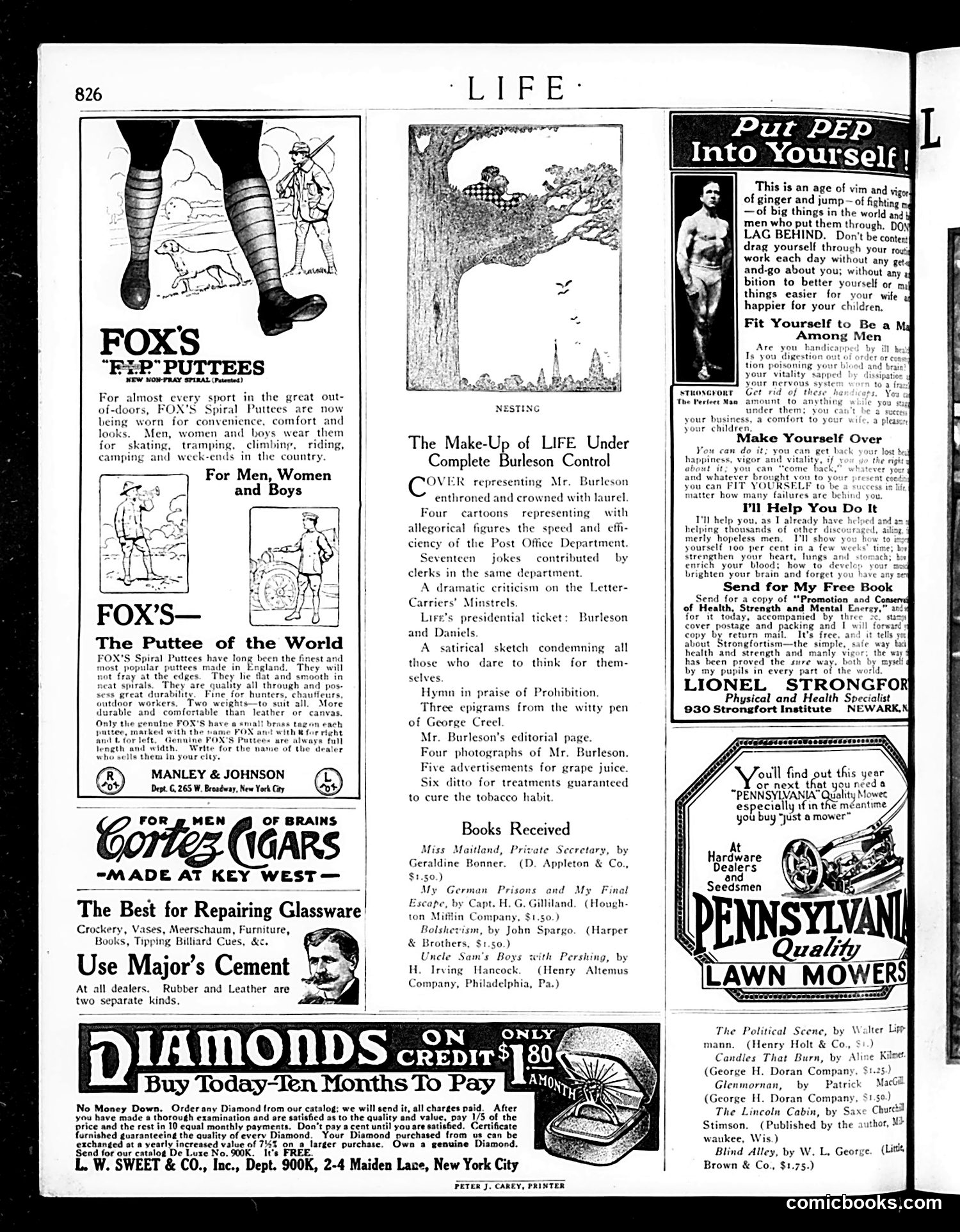
This page satirizes **Albert Burleson**, President Wilson's Postmaster General, under the headline "The Make-Up of LIFE Under Complete Burleson Control." The text lists what would supposedly comprise that issue: cartoons praising Post Office efficiency (with allegorical figures), jokes from postal clerks, editorial pages by Burleson himself, four photographs of him, and numerous advertisements for grape juice and tobacco-cure treatments—the final items parodying Prohibition-era moralism. The satire targets Burleson's power over the postal system and his reputation for censoring publications deemed seditious during WWI (the references to "those who dare to think for themselves" and mentions of George Creel's propaganda suggest wartime control). The exaggerated list—multiple photographs, hymns to Prohibition, treatments for tobacco—ridicules what the magazine sees as excessive self-promotion and moral grandstanding by a bureaucrat wielding significant government authority.