
A complete issue · 34 pages · 1919
Life — February 20, 1919
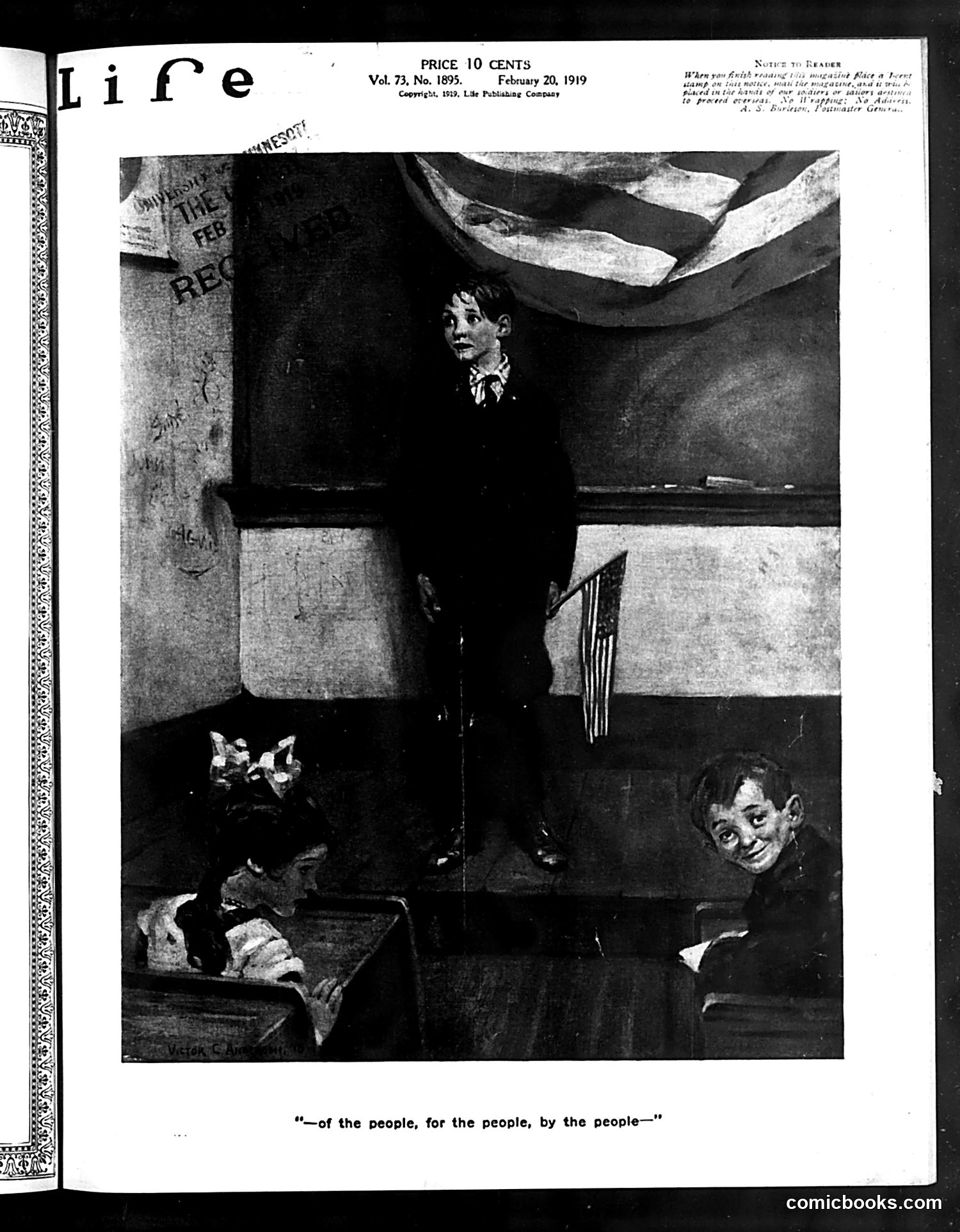
This Life magazine page from February 20, 1919 shows what appears to be a schoolroom scene with a teacher and students. The caption reads: "—of the people, for the people, by the people—" This quote references Lincoln's Gettysburg Address, suggesting the cartoon critiques democratic education or governance. The setting appears to depict a civics or history lesson, likely commenting on how American democratic ideals are transmitted to the next generation. The stark classroom environment and the children's expressions suggest the satire may mock the gap between democratic ideals and their actual implementation in education. However, without additional context or identifying captions for specific figures, the exact target of this 1919 satire remains unclear—whether it critiques educational methods, political instruction, or something else.
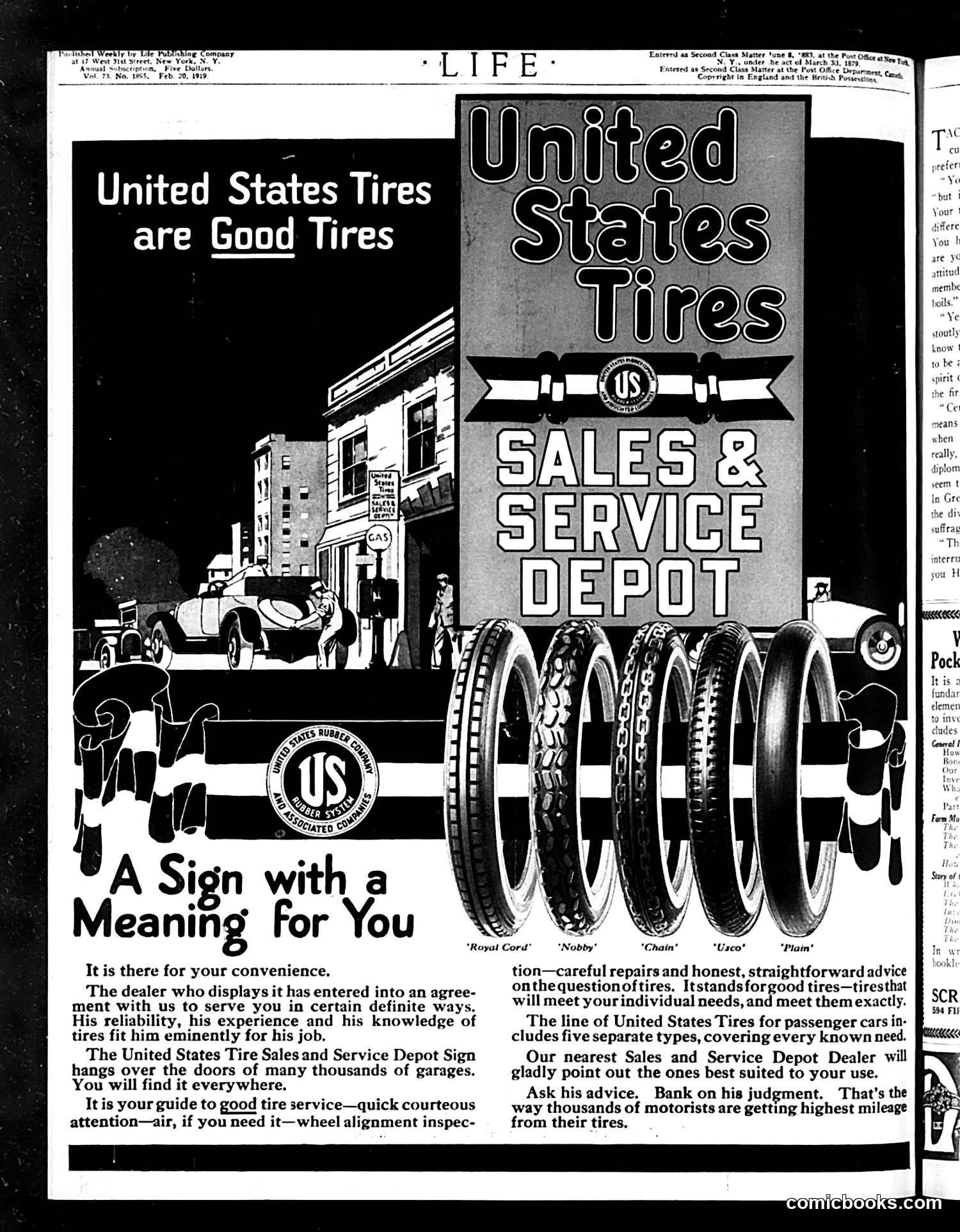
This page is primarily **advertising**, not satire or political commentary. It promotes United States Tires' Sales & Service Depot network. The ads emphasize the dealer network's reliability and convenience for motorists seeking tire service. The left panel shows a storefront with an early automobile and pedestrians, presenting the dealership as a trustworthy community fixture. The right panel displays five tire types ("Royal Cord," "Nobby," "Chafer," "Usco," "Plain"), indicating product variety for different needs. The tagline "A Sign with a Meaning for You" positions the dealership sign as a guarantee of quality service, honest advice, and fair pricing. This reflects 1920s consumer culture, when branded dealer networks represented modern convenience and reliability to automobile owners.
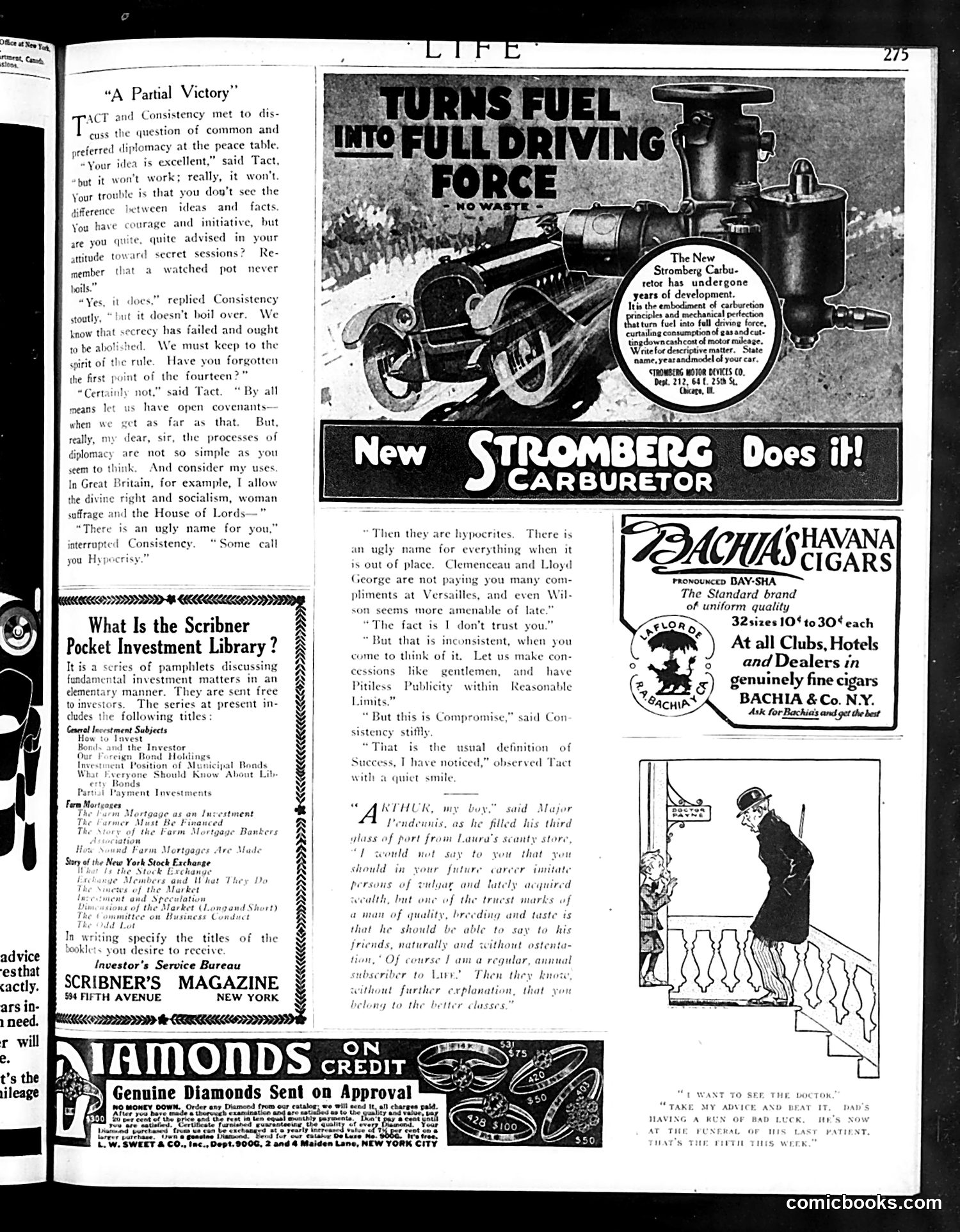
This page is primarily **advertising and fiction**, not political satire. The dominant content includes: 1. **Stromberg Carburetor ad** (top): A car advertisement claiming the carburetor "turns fuel into full driving force" with no waste. 2. **Bachia Havana Cigars ad** (right): Promoting "genuinely fine cigars" at various prices. 3. **Scribner's Pocket Investment Library ad** (left): Educational investment books for financial literacy. 4. **Diamonds on Credit ad** (bottom): Jewelry sold on installment payment. 5. **A serialized story** ("A Partial Victory") featuring dialogue between characters named Tact and Consistency, discussing diplomacy and compromise—appears to be fiction rather than satire. The page reflects early 20th-century consumer advertising and general-interest magazine content rather than political commentary.
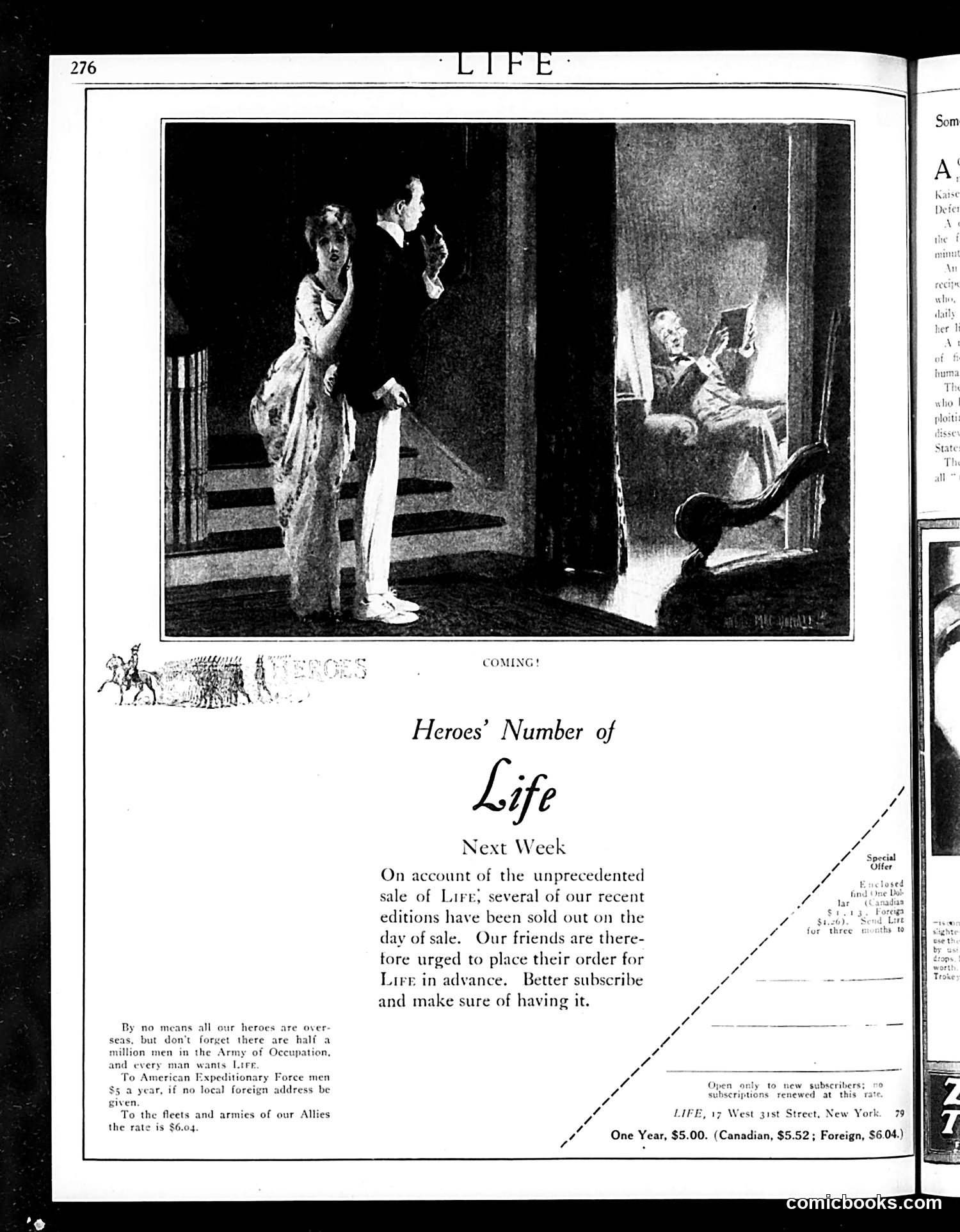
This page is primarily **advertising** for Life magazine subscriptions, not a political cartoon. The illustration shows a domestic scene: two figures in an interior space appear to be discussing something, while a third person reads nearby. The image accompanies promotional text encouraging subscriptions. The accompanying text references Life's sales success and appeals to readers to subscribe in advance, mentioning that recent editions have sold out. There's also a note about subscription rates for American Expeditionary Force personnel and Allied fleets (suggesting this is from World War I era), with pricing at $5.00 annually. **No specific political satire or caricature is evident here**—this is a straightforward subscription advertisement using an evocative domestic scene to market the magazine to potential readers.
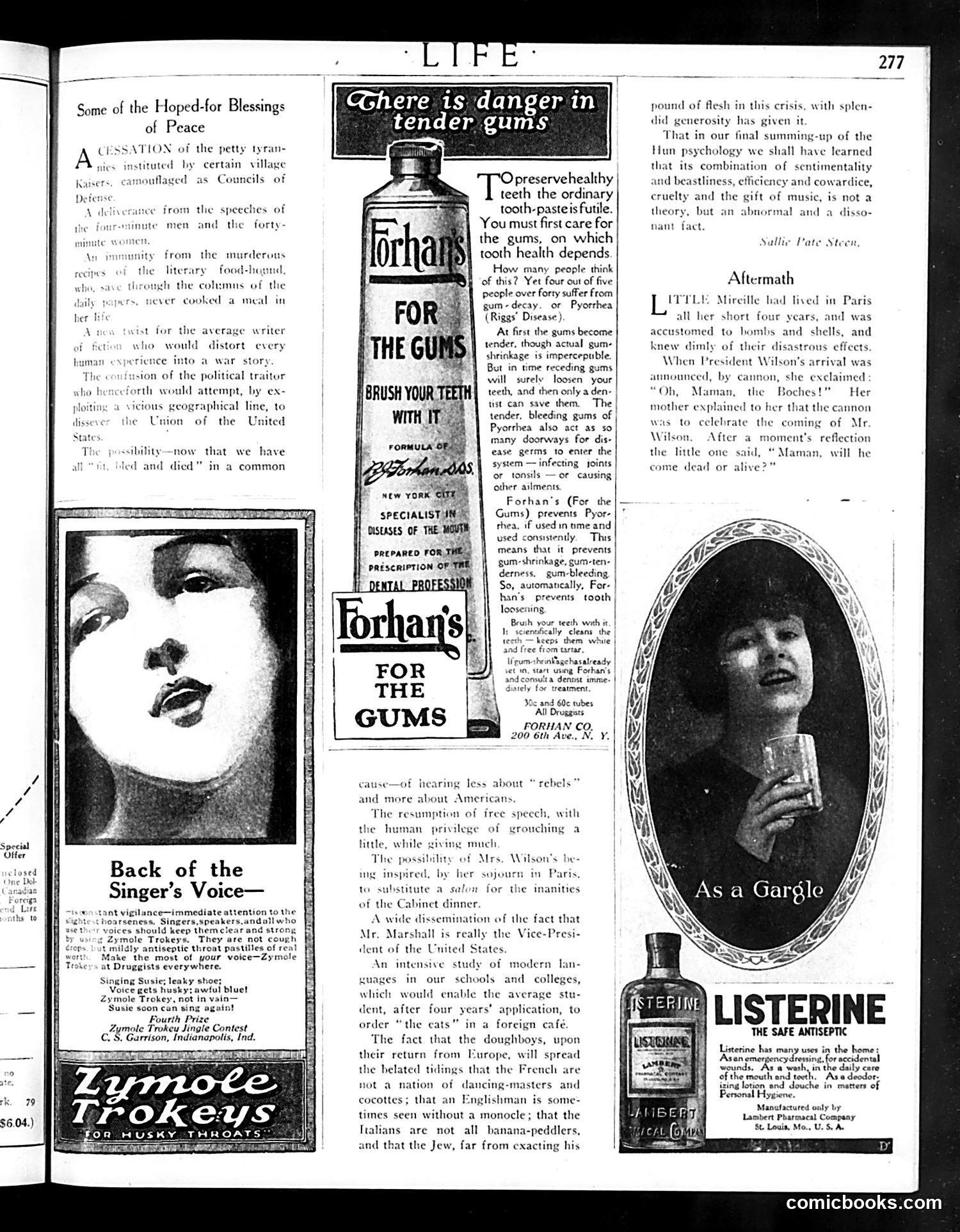
This is **not a cartoon or satire page** — it's a straightforward advertisement for the Packard Motor Car Company, published in *Life* magazine (page 278). The ad announces that Packard is resuming civilian car production after World War I, having previously devoted manufacturing to war work. The company emphasizes quality control, noting they possess six million dollars' worth of finished parts enabling smooth production restart. Key selling points include: stable pricing (no wartime inflation), superior quality (particularly their famous Twelve-Cylinder Engine), and reliability. The tagline "Ask the Man Who Owns One" was apparently Packard's actual marketing slogan. This reflects post-WWI economic conditions when manufacturers pivoted back to consumer goods.
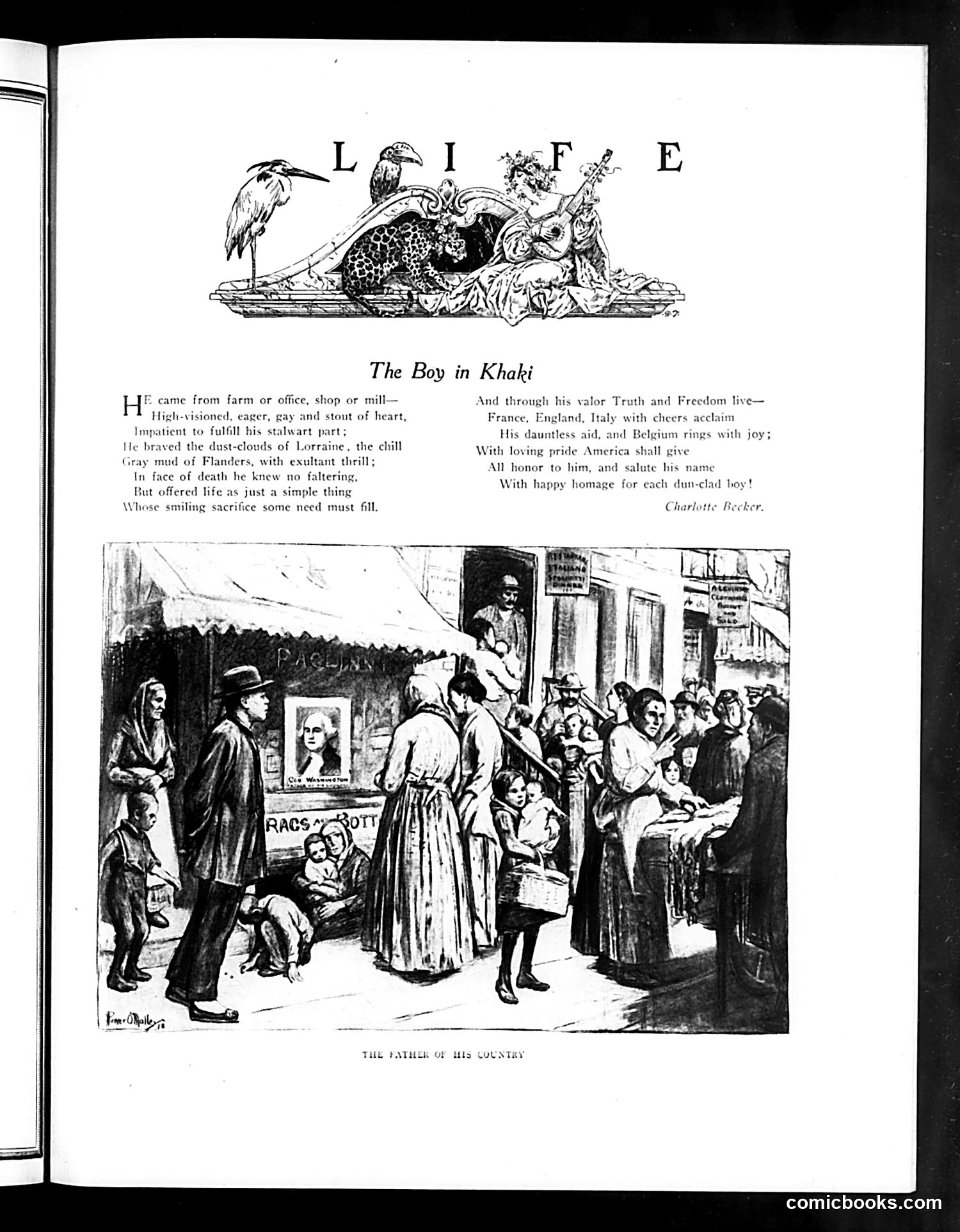
This page features a patriotic poem by Charlotte Becker honoring soldiers in World War I. The poem celebrates a boy from ordinary circumstances (farm, shop, mill) who enlisted and died in France, fighting for "Truth and Freedom." The illustration below depicts a street scene where a woman appears to be displaying or mourning a portrait—likely of a fallen soldier—while civilians gather around. The image is titled "THE FATHER OF HIS COUNTRY," suggesting the fallen soldier represents national sacrifice. The overall message is sentimental and propagandistic: glorifying the common soldier's sacrifice during WWI and positioning American involvement as morally righteous. The poem urges Americans to honor these "unchad boys" with pride and remembrance.
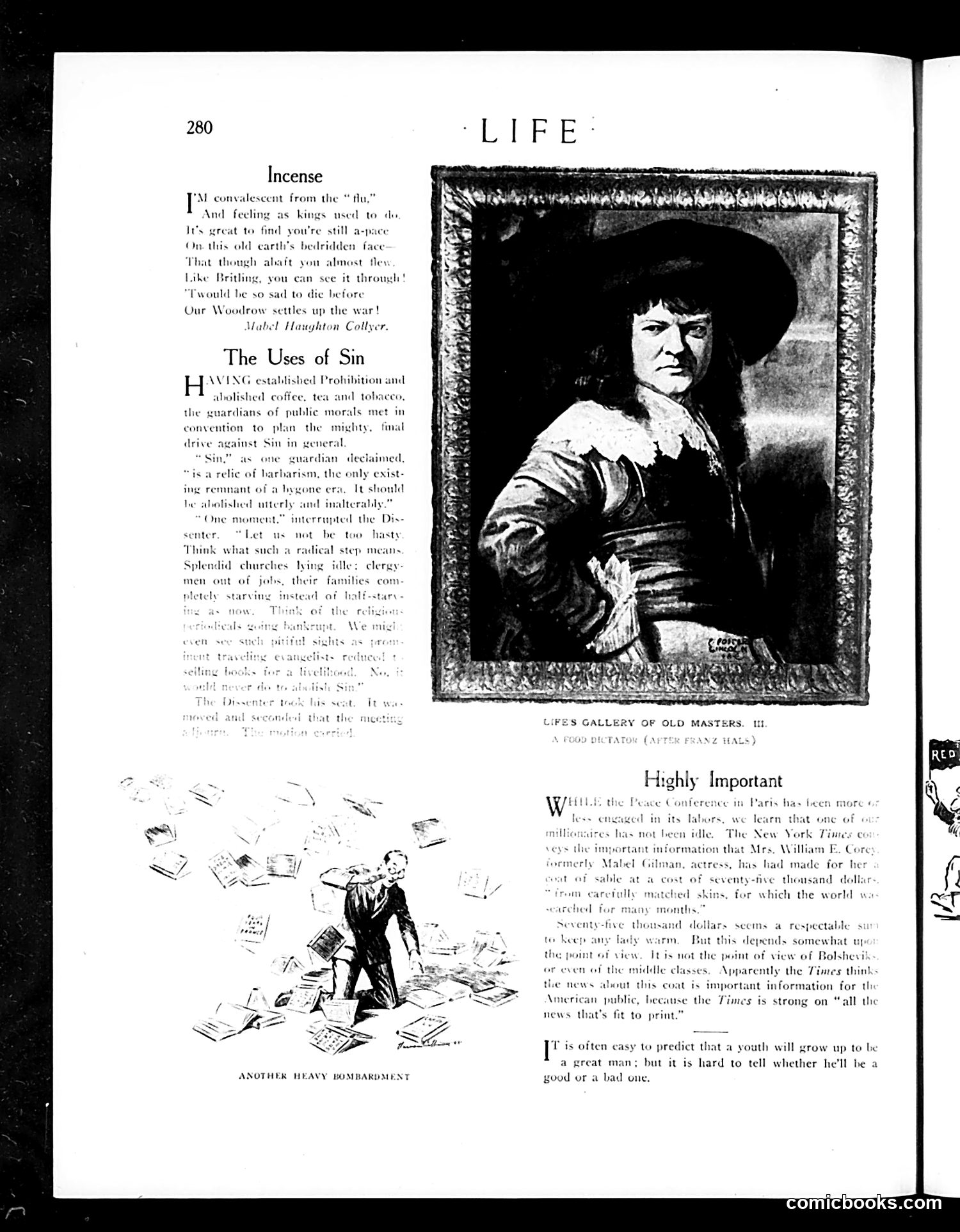
This page contains three distinct items: **"Incense"** (poem, top left): A brief verse by Mabel Haughton Colbome mocking pretentious behavior—specifically someone claiming to smell "du" (French perfume) while actually experiencing common odors. It's gentle satire of affectation. **"The Uses of Sin"** (essay, left column): A serious piece debating whether Prohibition and moral restrictions were wise policy. A dissenter argues that "Sin" is merely "a relic of barbarism" and questions whether abolishing vices (coffee, tea, tobacco) actually improves morality. **"Highly Important"** (right): Reports that a millionaire paid seventy thousand dollars for sable skins. The article notes this is newsworthy to the *Times* because it demonstrates what the wealthy can afford—satirizing both wealthy excess and newspapers' focus on such trivia. **"Another Heavy Bombardment"** (cartoon, bottom left): Shows a figure buried under papers/documents—likely satirizing bureaucratic overwhelm or excessive correspondence.
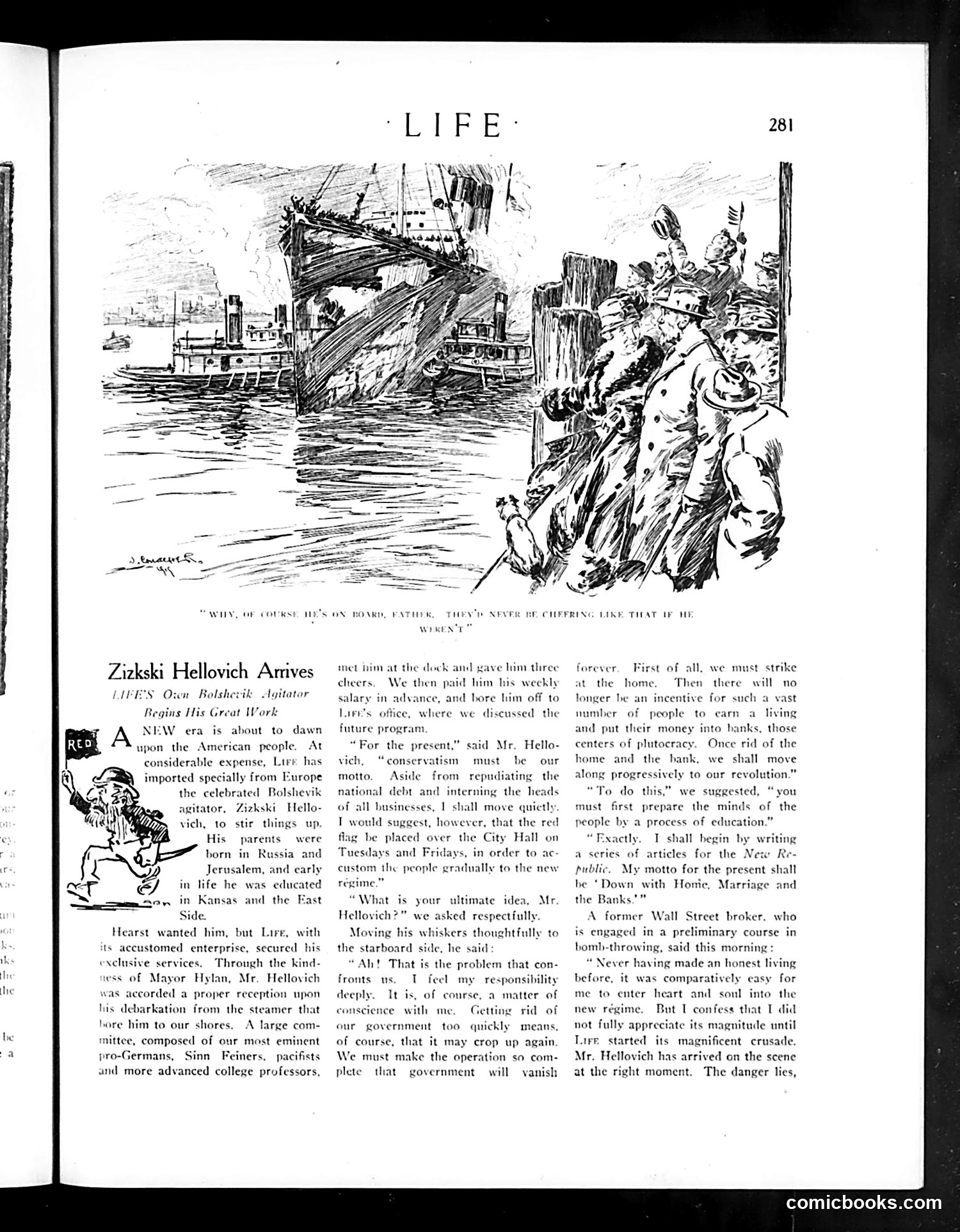
This page satirizes early 20th-century American immigration and progressive reform. The headline figure "Zizski Hellovich" appears to be a caricatured Eastern European immigrant (the name suggests Eastern European origins). The cartoon depicts dockside arrival of immigrants, while the article mocks well-intentioned but patronizing reform efforts. Prominent citizens and reformers discuss "educating" immigrants and eliminating government "waste," proposing schemes to assimilate newcomers through banking and moral instruction. The satire targets both naive progressive reformers and their condescending approach to immigrants—treating them as problems requiring "education" rather than as people with agency. The dockside scene emphasizes the immigrant's outsider status, while the reformers' grandiose plans are presented as simultaneously self-serving and ineffectual.
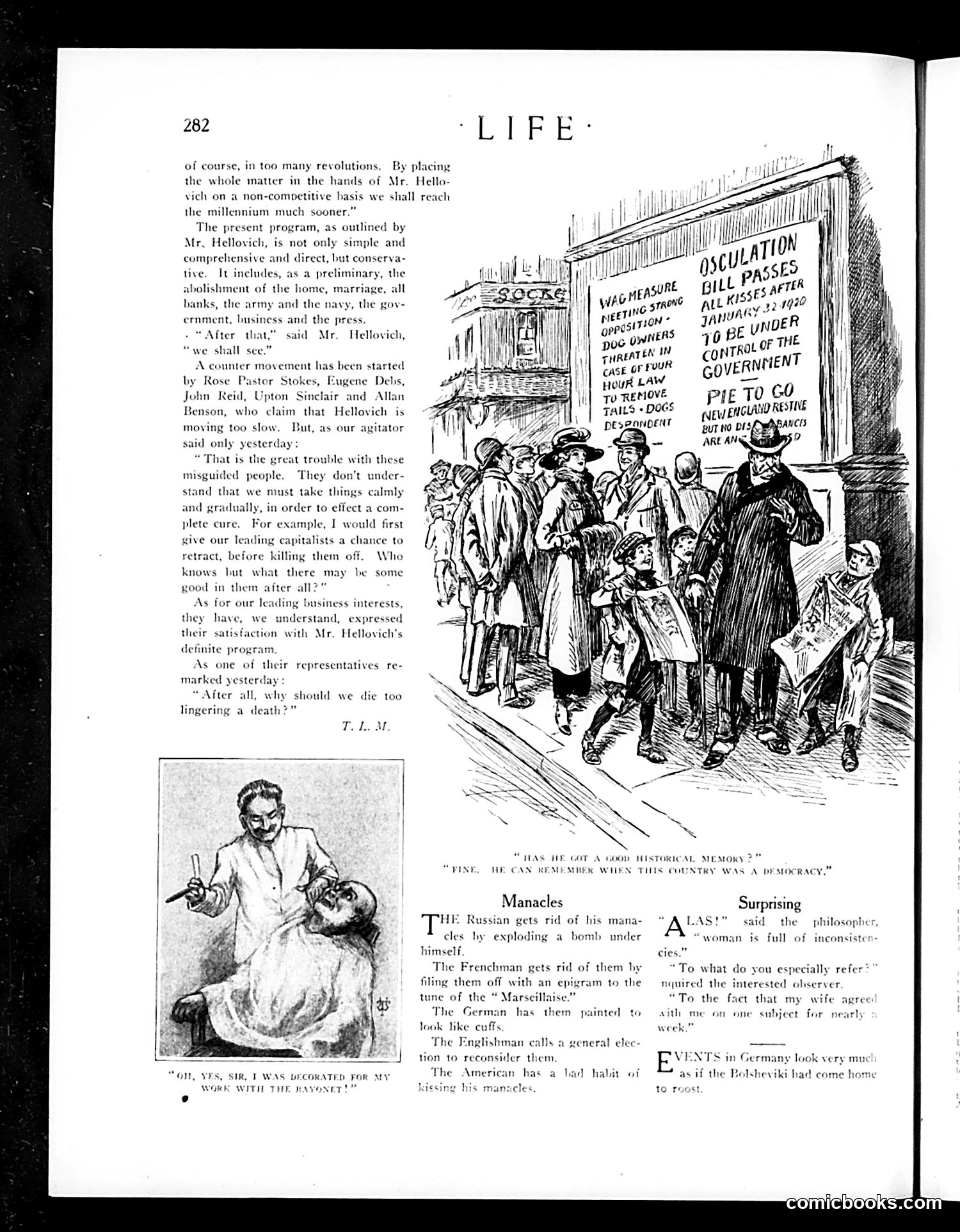
The main cartoon depicts a crowd gathered before a wall covered with socialist proclamations and bills, including references to "OSCULATION" (kissing), "BILL PASSES," and "CONTROL OF THE GOVERNMENT." The caption reads: "HAS HE GOT A GOOD HISTORICAL MEMORY? FINE, HE CAN REMEMBER WHEN THIS COUNTRY WAS A DEMOCRACY." This satirizes the Bolshevik revolution's contradictions—the new communist government promised democratic reforms but was consolidating authoritarian control. The crowd represents citizens observing the gap between revolutionary rhetoric and actual governance. The accompanying text discusses Russian and Western responses to communist "manacles"—comparing how different nations characterize Bolshevik policies—suggesting Life's critical stance toward post-1917 Soviet governance and its broken democratic promises.
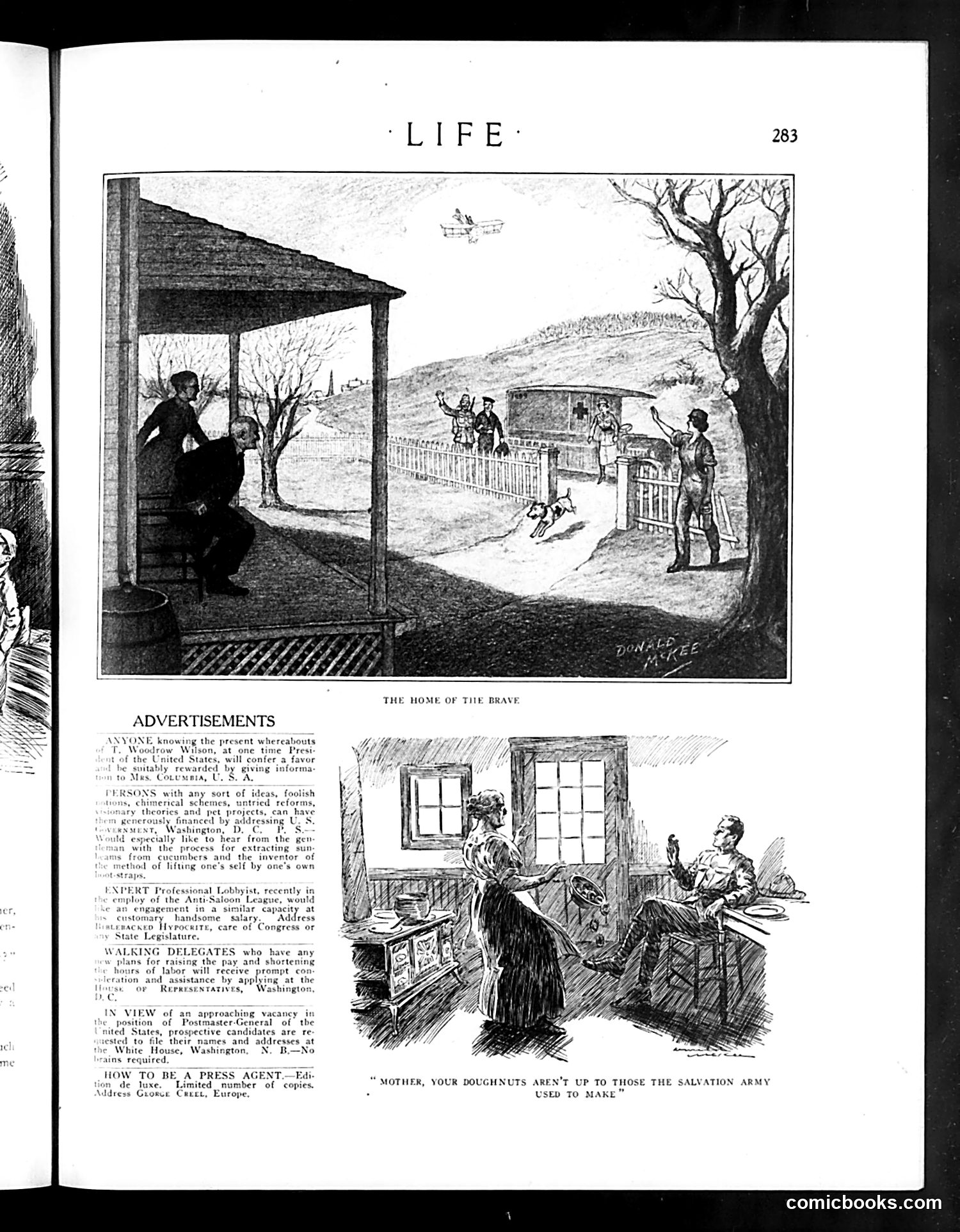
This page features two illustrations. The top image, titled "The Home of the Brave," depicts a rural American scene where a soldier or military figure stands guard at a gatehouse while civilians go about their business in the distance. The composition suggests surveillance or military presence in domestic spaces. Below are advertisements seeking various professionals (lobbyists, press agents, walking delegates) and a second cartoon showing a mother confronting her daughter, with the caption: "Mother, your doughnuts aren't up to those the Salvation Army used to make." This appears to mock the Salvation Army's charitable work or the gap between domestic and institutional care, likely reflecting early-20th-century concerns about social welfare and women's domestic roles.
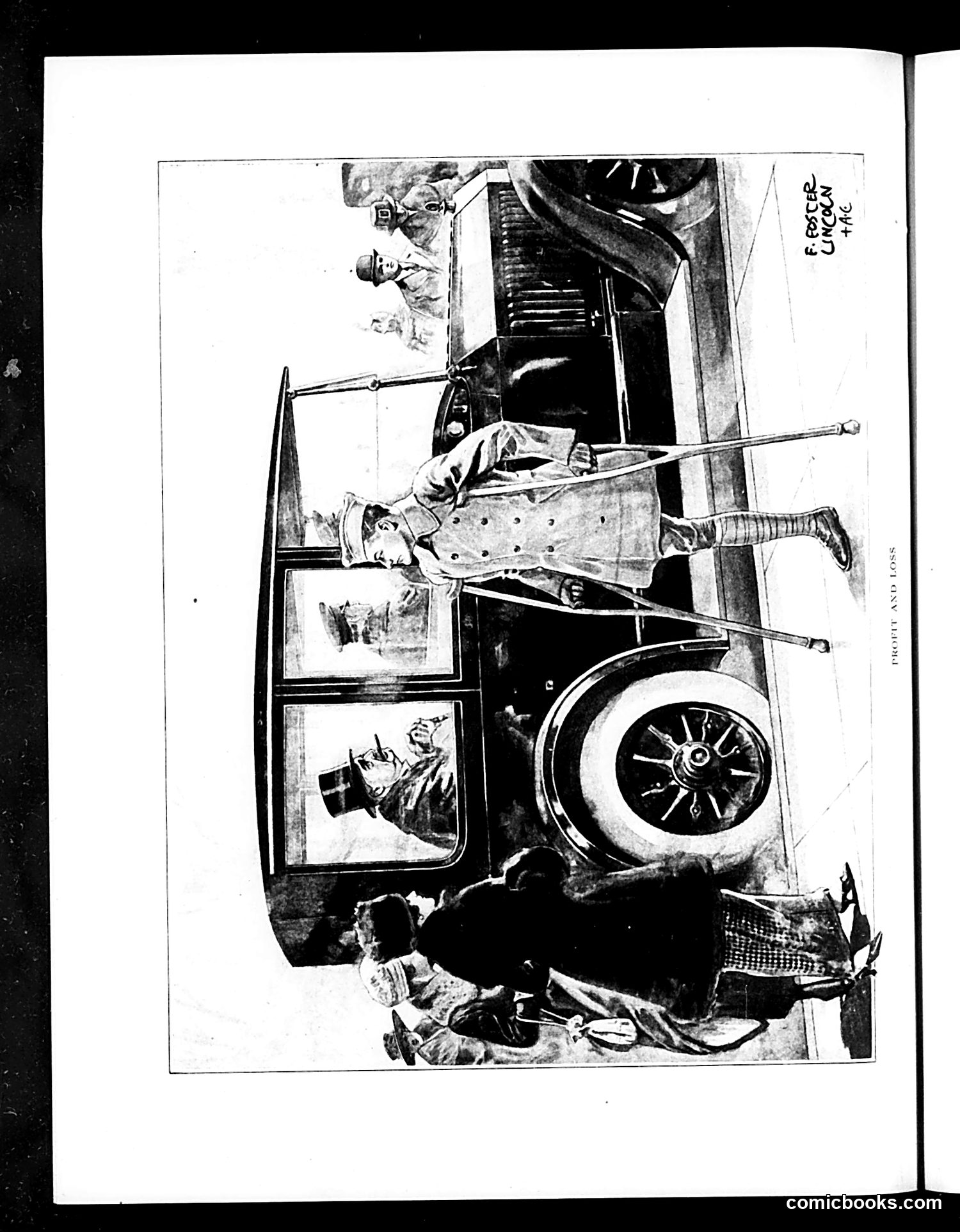
This page appears to be rotated 90 degrees, making it difficult to read clearly. The image shows what looks like a vintage automobile with several figures around it, and there are small inset illustrations in the vehicle's windows. Based on the visible elements, this appears to be satirical commentary about automobiles or transportation, likely from the early 20th century given the vehicle's style. The figures seem to be posed in exaggerated or comedic positions related to the car. However, without legible OCR text or clearer orientation, I cannot confidently identify: - The specific political or social figures being caricatured - The exact satirical point being made - References to particular events or controversies To provide accurate historical context, I would need either a properly-oriented image or readable accompanying text identifying the figures and subject matter.
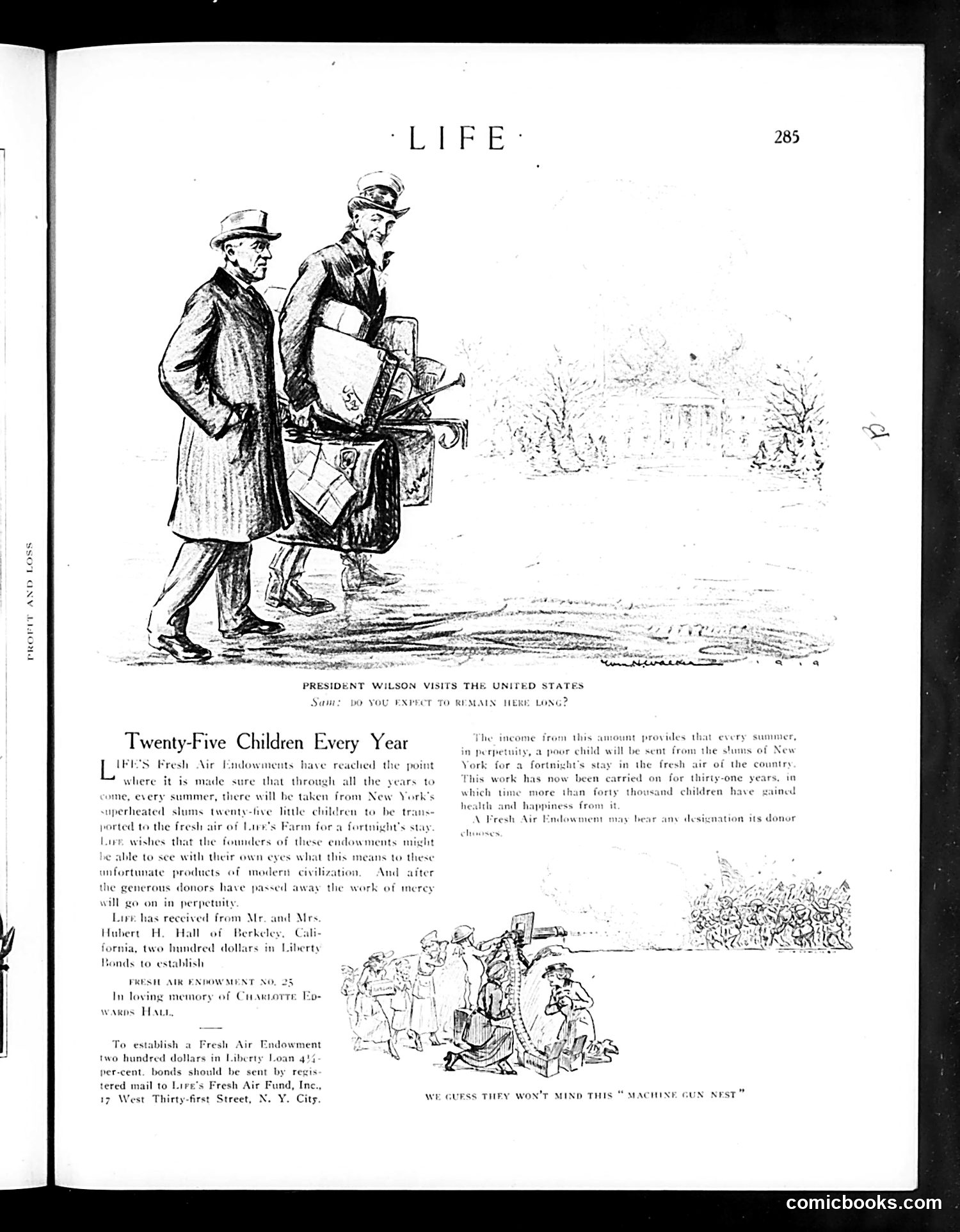
**Top Cartoon:** Shows two men in bowler hats; the caption reads "President Wilson Visits the United States" with the subtitle "Sam: Do you expect to remain here long?" This satirizes President Woodrow Wilson's extended time abroad during World War I peace negotiations, suggesting he'd become so removed from American politics he's practically a foreigner visiting his own country. **Main Article:** "Twenty-Five Children Every Year" describes LIFE's Fresh Air Endowment program, which sends poor urban children to the countryside annually. The accompanying illustrations show children at a rural camp. **Bottom Cartoon:** Depicts children with what appears to be a machine gun, captioned "We guess they won't mind this 'machine gun nest'"—apparently a humorous reference to children's games mimicking military activity.
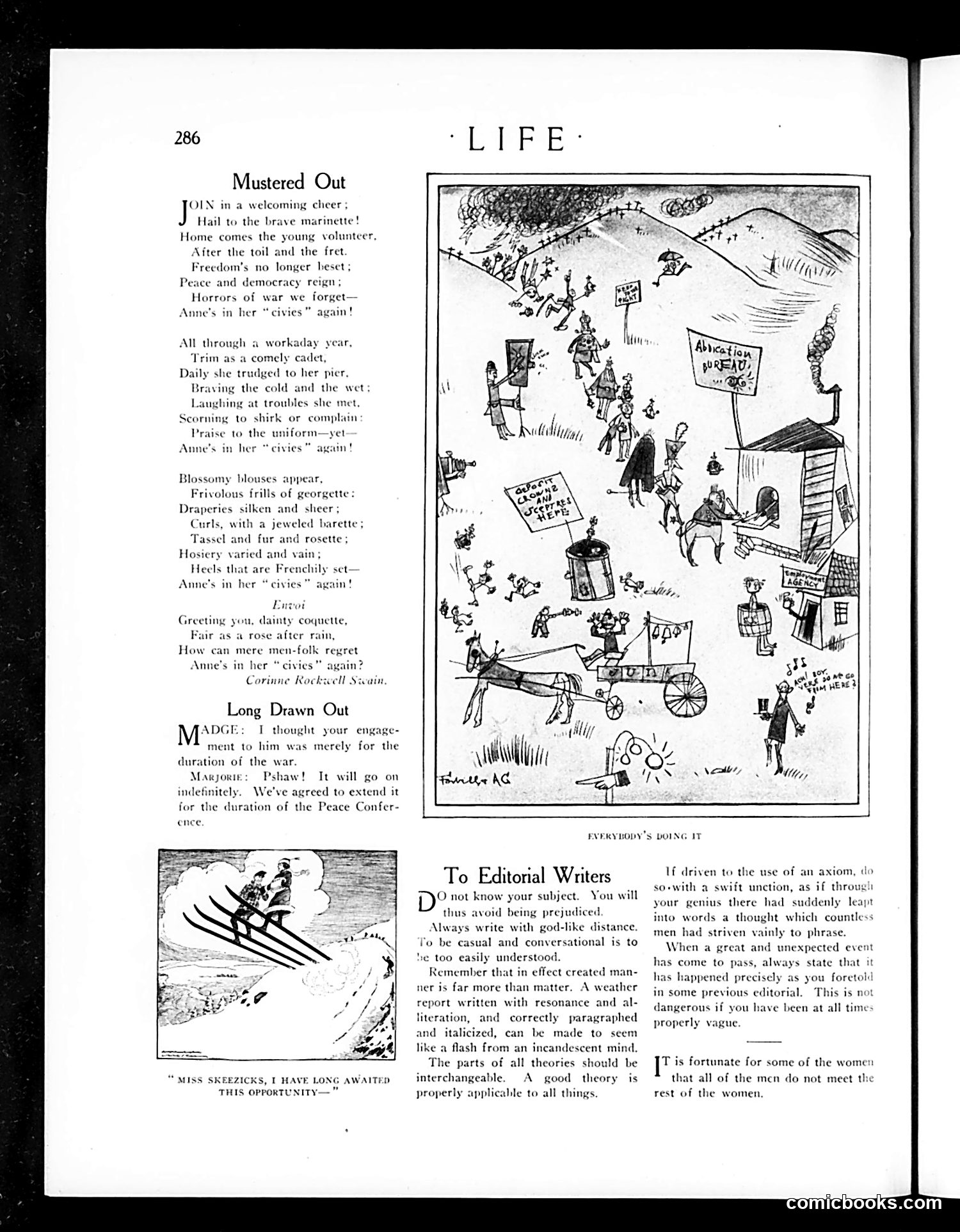
This page contains satirical poetry and illustrations commenting on post-WWI demobilization and domestic life. **"Mustered Out"** celebrates soldiers returning home after "toil and fret," with peace and democracy restored. The accompanying illustration titled "Everybody's Doing It" depicts a chaotic home-front scene with civilians engaged in various activities—suggesting the social disruption and energy of the post-war transition. **"Long Drawn Out"** is a dialogue between characters named Madge and Magnolia, apparently discussing extended engagement during wartime—a timely social concern for the period. **"To Editorial Writers"** offers professional writing advice about clarity, distance, and universal applicability of theories—standard editorial guidance unrelated to the war themes above. The cartoons satirize adjusting to peacetime normalcy after WWI.
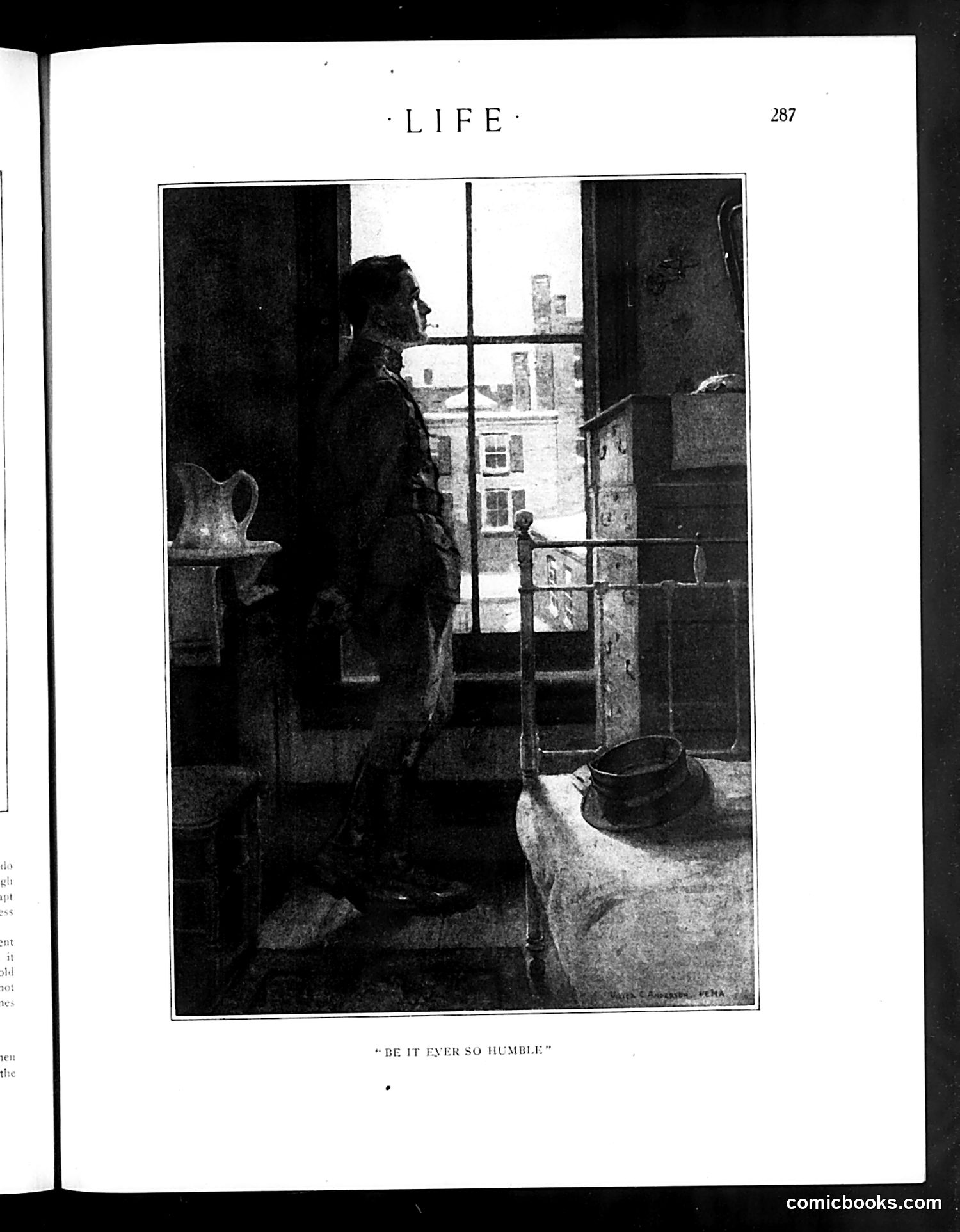
This page from *Life* magazine shows a photograph rather than a cartoon. The image depicts a woman in modest, worn clothing looking out a window from what appears to be a sparse, humble room. Outside the window, we see urban tenement buildings. A hat rests on the windowsill. The caption "Be It Ever So Humble" references the popular 1900s song "Home, Sweet Home," which romanticizes domestic life. The satire lies in the stark contrast: rather than celebrating comfortable home life, the image presents the actual living conditions of poor urban Americans—cramped tenement housing with minimal furnishings. This appears to be social commentary on poverty and the gap between sentimental ideals of American domesticity and harsh working-class reality.
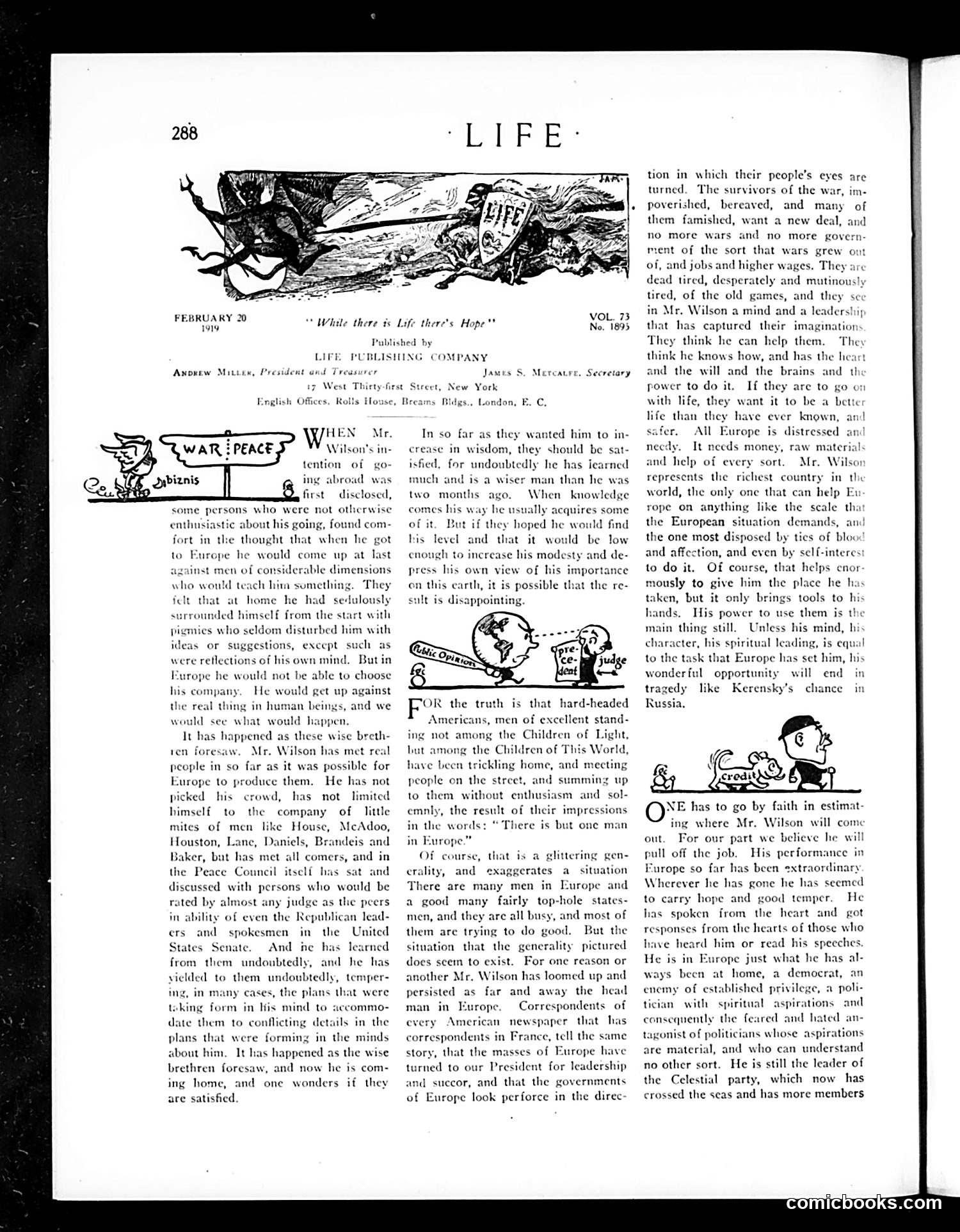
This editorial examines President Woodrow Wilson's transformation during the Paris Peace Conference. The article argues that Wilson arrived in Europe surrounded by lesser advisors (dismissively named: House, McAdoo, Houston, Lane, Daniels, Brandeis, Baker), but encountered "real people"—European statesmen of genuine ability—who educated and moderated him. The piece notes Wilson has become Europe's singular hope. War-devastated Europeans, "dead tired" of old politics, see him as their champion for "a new deal"—jobs, higher wages, and genuine change. The title's small cartoons appear to illustrate Wilson's journey and Europe's dependence on his leadership. The article's tone is cautiously optimistic but notes Wilson may not have gained the *humility* his advisors hoped for, only *wisdom*.
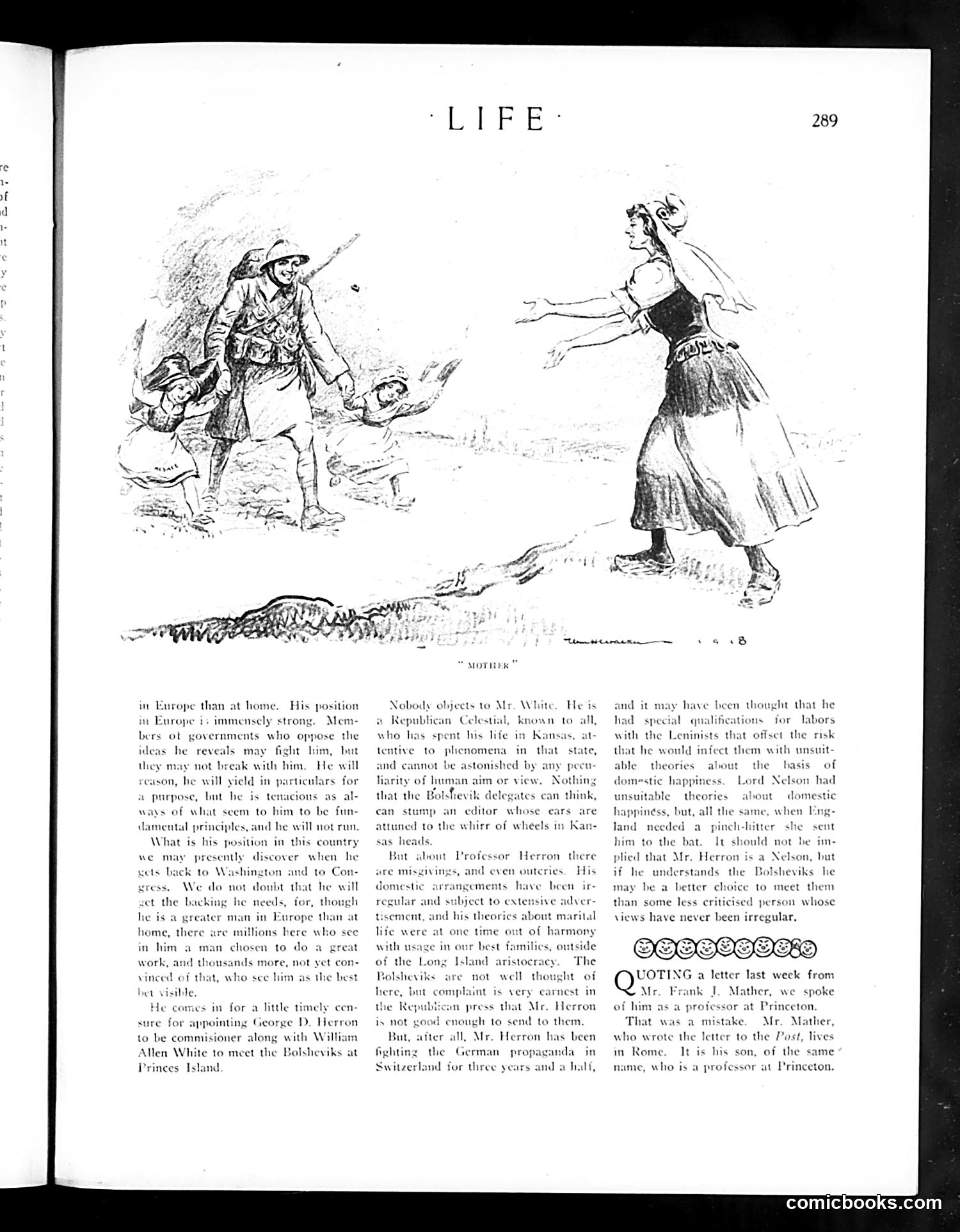
This political cartoon satirizes the appointment of Professor George D. Herron as a U.S. commissioner to negotiate with the Bolsheviks at Princes Island. The illustration depicts a soldier (representing America/government authority) presenting an undesirable choice to a woman (representing the nation or public), symbolized by the crocodile labeled "Mother"—likely referencing the Bolsheviks or communist threat. The accompanying text criticizes Republican objections to Herron, arguing he's actually well-qualified despite his unconventional past. The joke is that while Republicans reject Herron as "not good enough," he's actually more suitable than conventional diplomats—like using a pinch-hitter in baseball. A correction note clarifies that Frank Mather (the letter-writer) is a professor in Rome, not Princeton; his son holds the Princeton position.
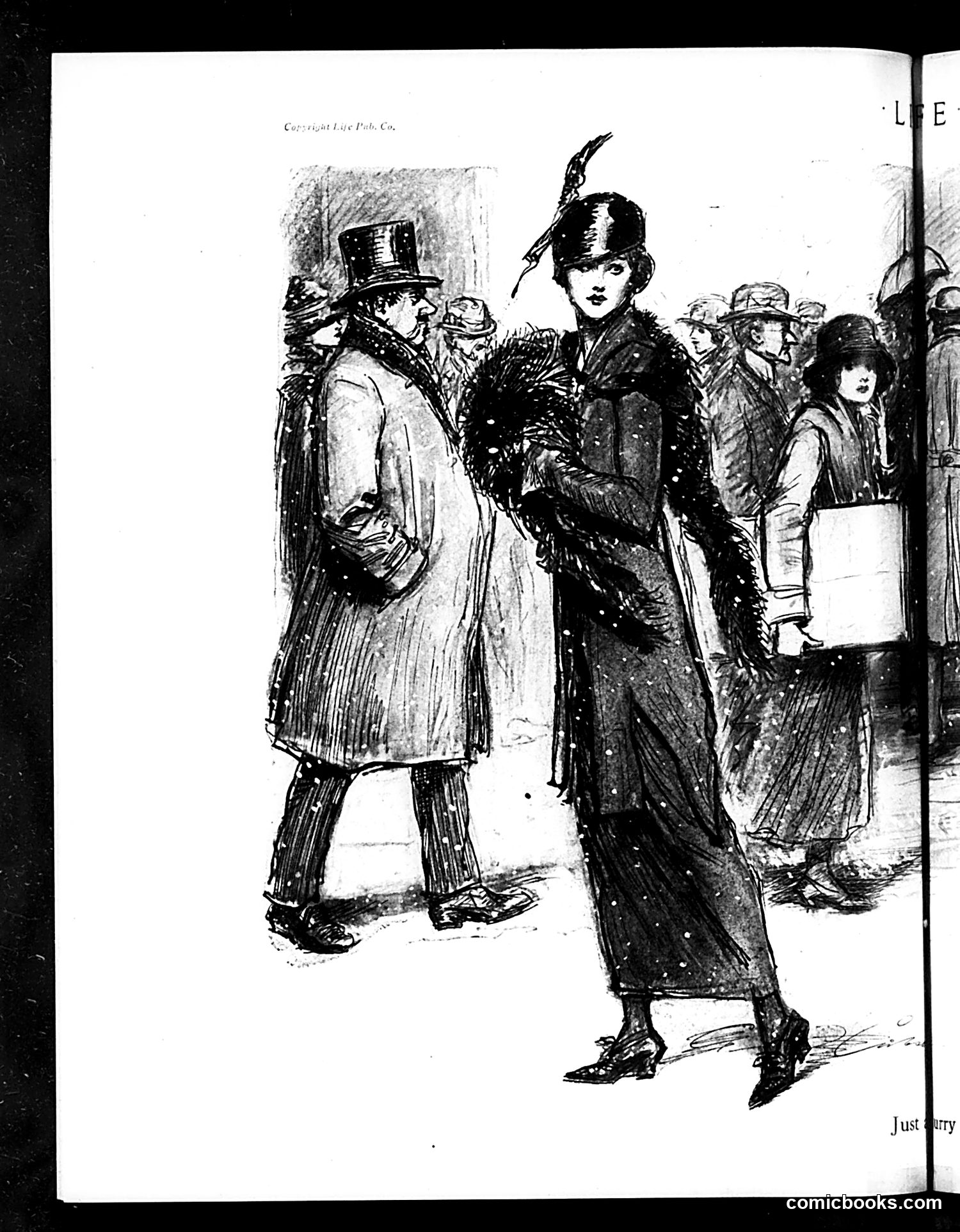
This appears to be a satirical illustration titled "Just Worry" from *Life* magazine. The image depicts a fashionably dressed woman in an elegant dark coat and feathered hat confronting or gesturing toward a formally-dressed gentleman in a top hat. They're surrounded by onlookers in what seems to be a public street scene. Without additional context or visible date information, the specific political or social commentary is unclear. However, the composition suggests satire about class differences, romantic entanglement, or social propriety—common *Life* magazine themes. The woman's confident, assertive posture toward the man implies she may be challenging established social hierarchies or conventions of the era, though the exact situation and referenced figures remain uncertain.
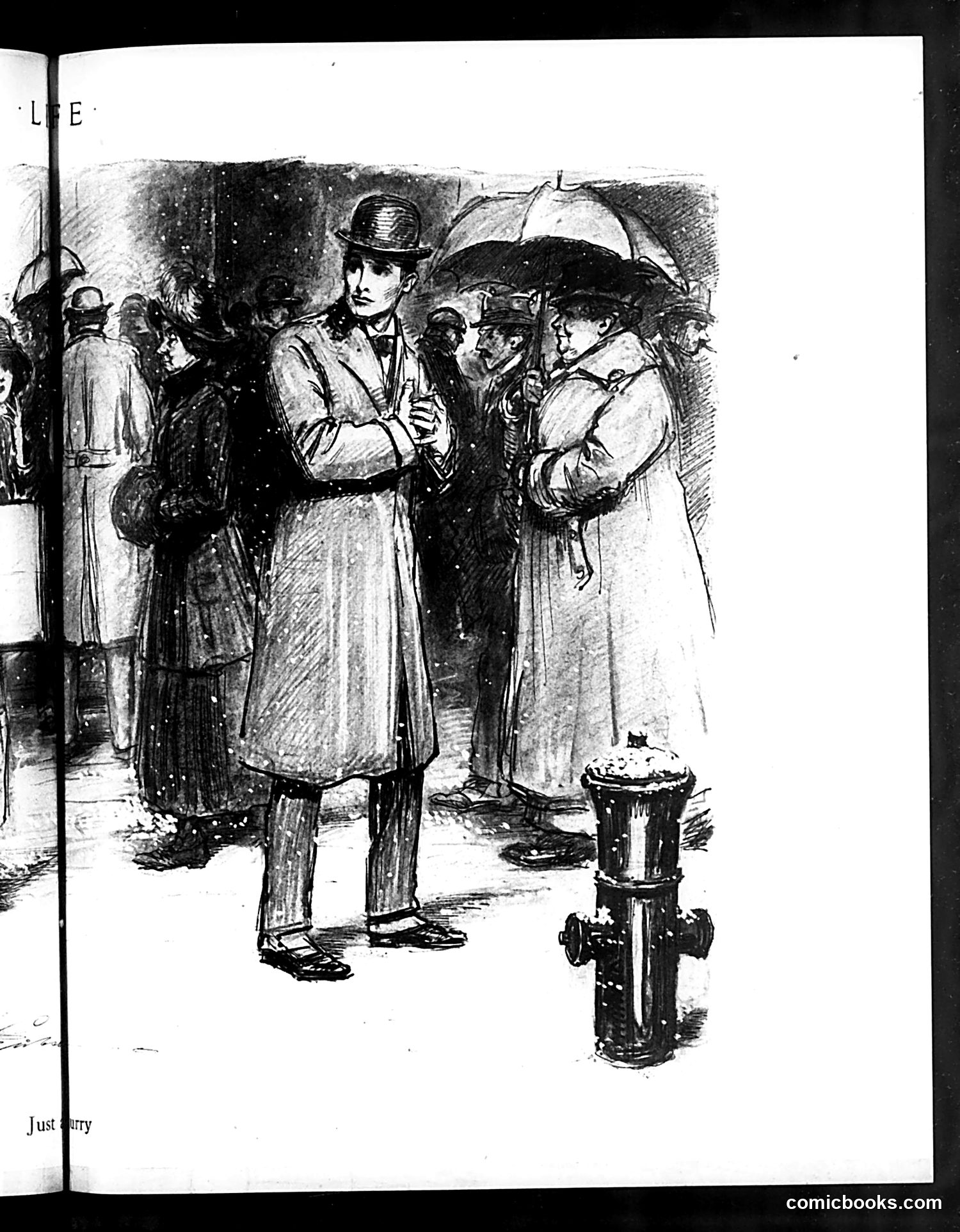
The OCR text is too corrupted to read clearly. Based on the image alone: This is a sketch signed "Just Berry" (visible lower left) depicting a street scene, likely from the early 20th century. A well-dressed man in a bowler hat stands central, appearing to speak or gesture to a group of working-class figures holding umbrellas in rainy weather. A fire hydrant is prominent in the foreground. The scene suggests social commentary—possibly satirizing a politician, official, or wealthy individual addressing the common people, or depicting some form of public interaction or appeal. Without legible text identifying the figures or occasion, the specific political or social reference remains unclear. The contrast between the central figure's formal attire and the humble workers' appearances suggests class commentary typical of *Life* magazine's satirical approach.
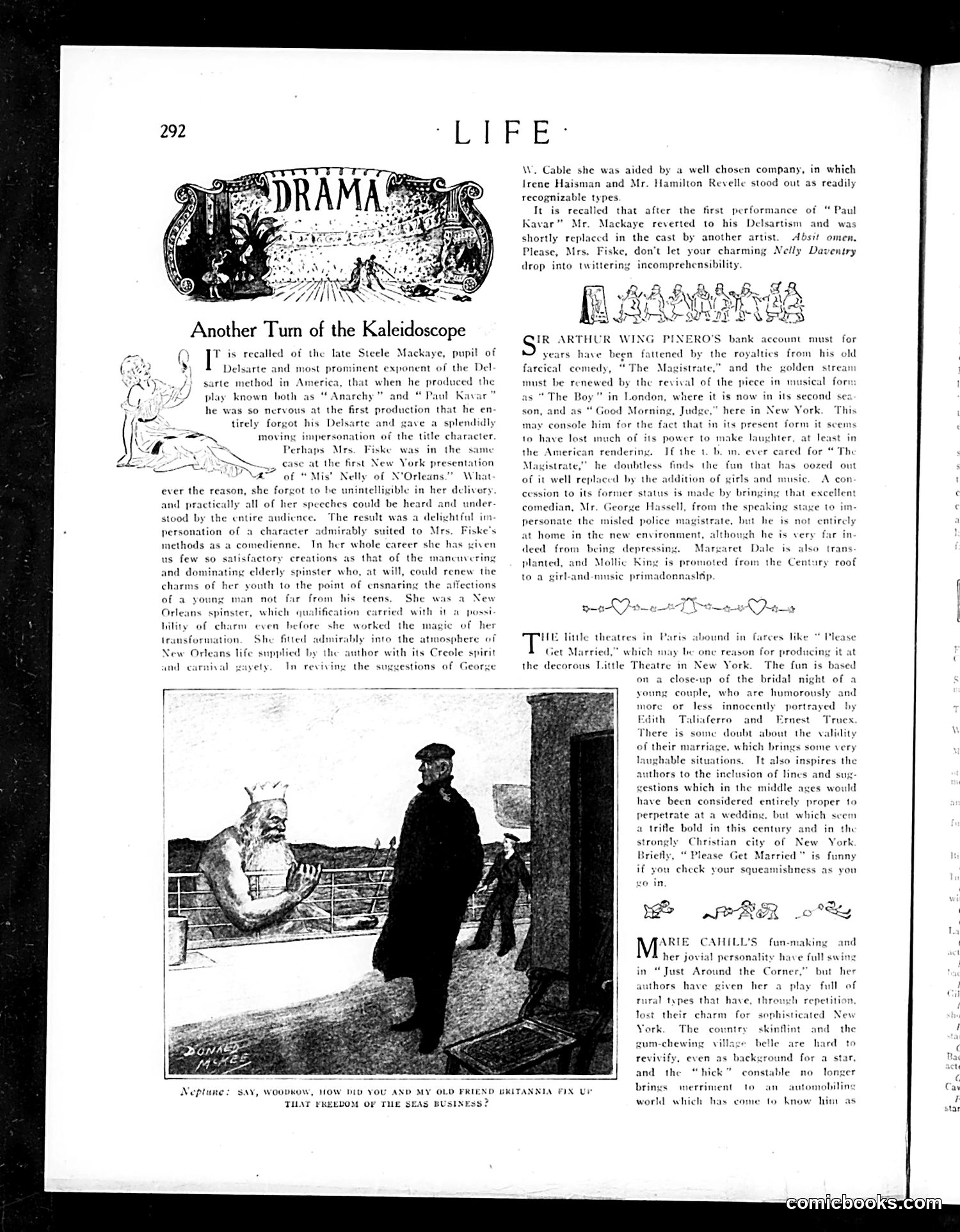
This page from Life magazine contains theater reviews rather than political cartoons. The main content discusses three Broadway productions: 1. **"Another Turn of the Kaleidoscope"** reviews a theatrical performance, discussing actress Mrs. Fiske's acclaimed portrayal of a character in a play (appears to involve New Orleans Creole themes based on W. Cable's involvement). 2. **Sir Arthur Wing Pinero's work** discusses the revival of "The Magistrate," noting its transformation into a musical comedy called "The Boy" in London and "Good Morning, Judge" in New York. The reviewer suggests the musical adaptation has diluted the original farce's humor. 3. **"Please Get Married"** at the Little Theatre is described as a French farce focusing on a wedding night, with humor the reviewer finds somewhat bold for early 20th-century New York sensibilities. The single illustration shows what appears to be a Neptune-themed scene, likely from one of the theatrical productions discussed. The page primarily serves as entertainment criticism rather than satire.
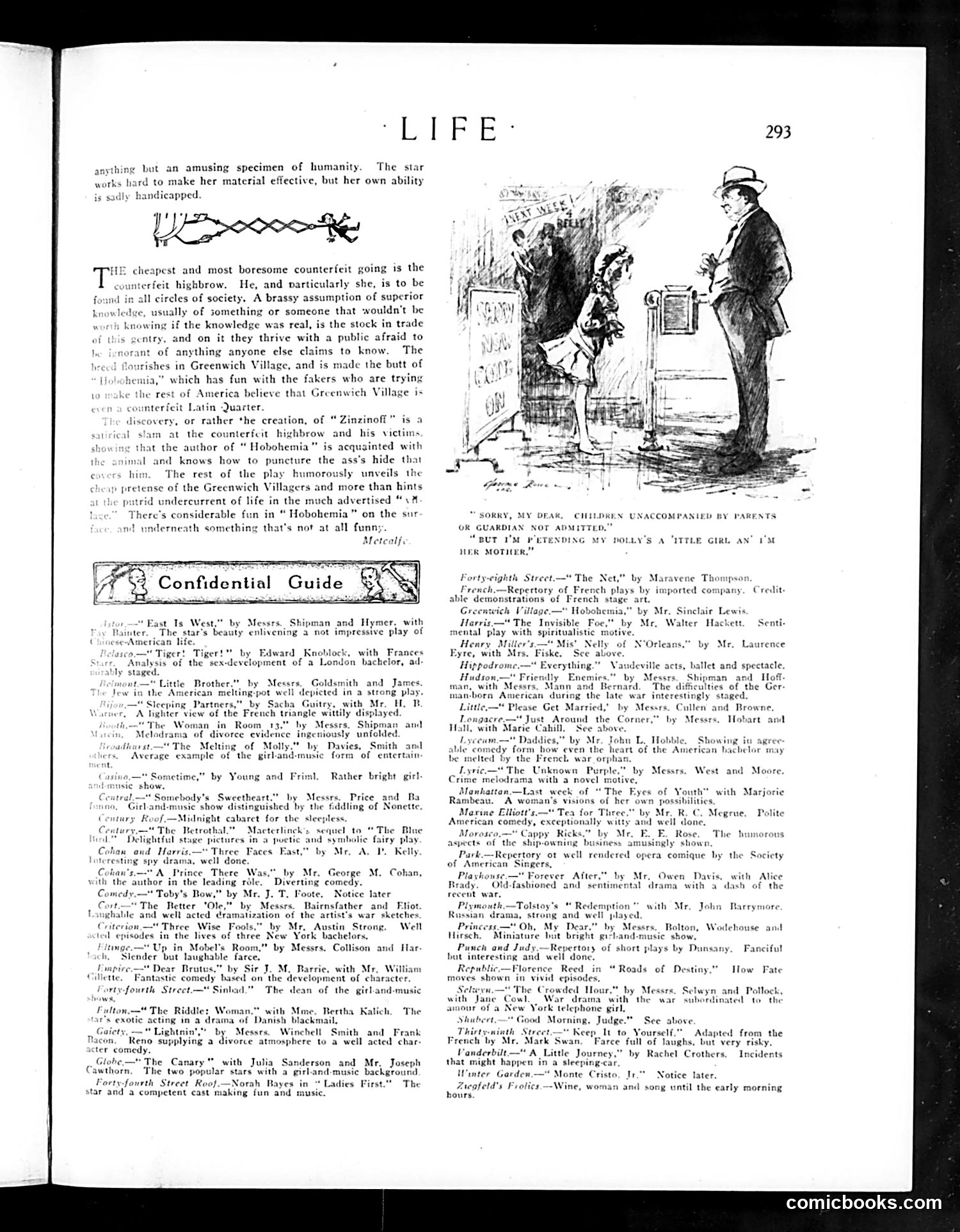
The main cartoon depicts a man attempting to sneak a child into a theater by claiming the girl is his doll—a joke about theater admission policies barring unaccompanied children. The humor lies in the obvious deception and the man's absurd excuse. The surrounding text satirizes "counterfeit highbrows," particularly those in Greenwich Village, New York. The author criticizes people (especially women) who affect superior knowledge and intellectual pretension without genuine understanding. These "fakers" trade on public intimidation—people fear admitting ignorance. The text specifically praises a play called "Hobohemia" for exposing these Greenwich Village poseurs and their pretensions. The satire targets the bohemian community's affectation of European (particularly Parisian) sophistication while living in what the author dismissively calls a "counterfeit Latin Quarter." The "Confidential Guide" section lists contemporary Broadway productions with brief reviews.
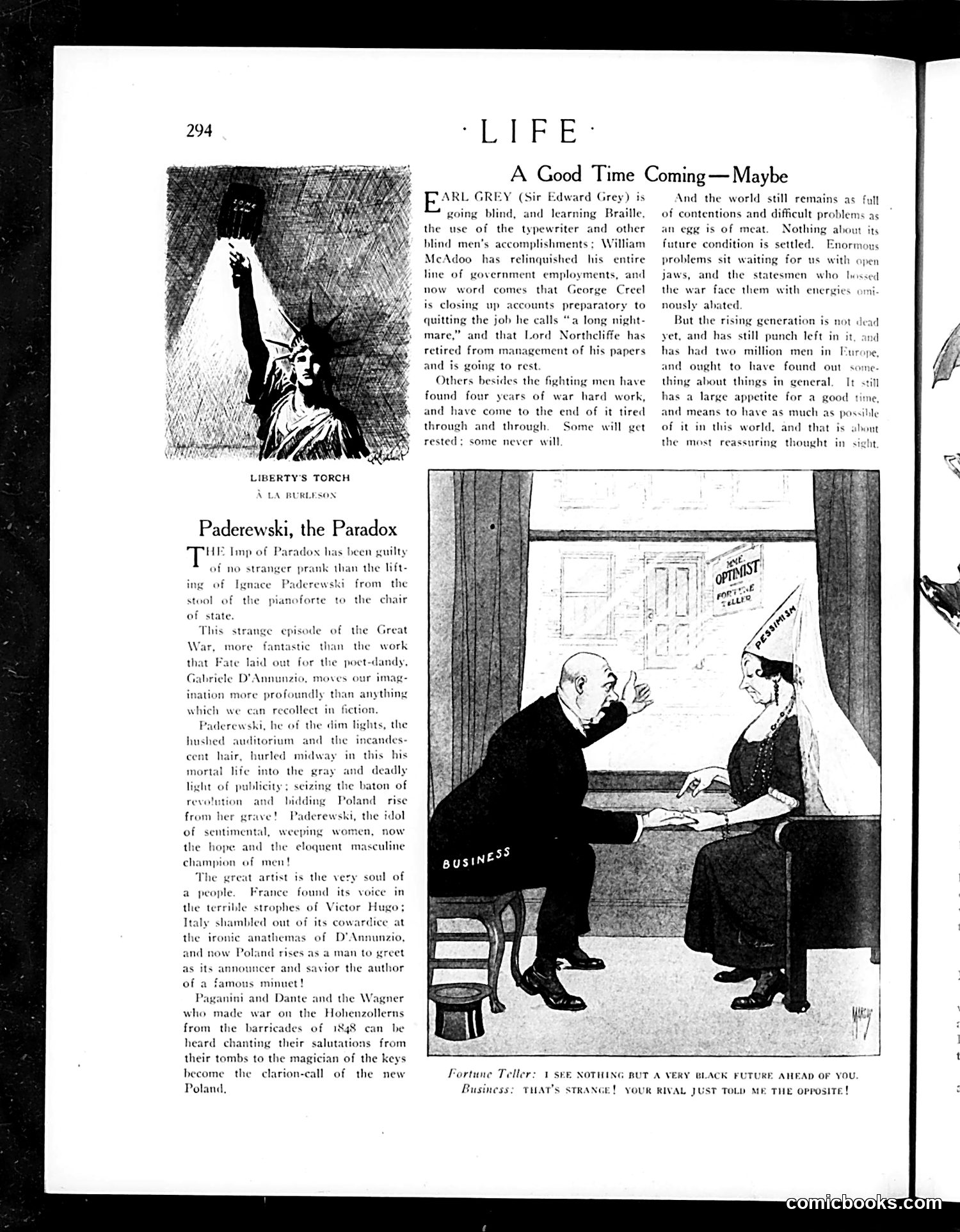
**Top Article - "A Good Time Coming — Maybe":** This discusses post-WWI conditions. It references real figures: Earl Grey (going blind), William McAdoo (relinquishing government work), George Creel (leaving his propaganda role), and Lord Northcliffe (retiring from newspaper management). The piece argues that despite war's end, problems remain unsolved, but the younger generation—having lost two million men in Europe—still desires normalcy and pleasure, which the author calls "reassuring." **Cartoon - "Paderewski, the Paradox":** The essay celebrates Polish pianist Ignace Paderewski's transformation from concert artist to statesman during WWI, comparing him to Italian poet D'Annunzio. It frames him as Poland's savior-figure, invoking France's Victor Hugo and Italy's cultural voices as precedent for artists becoming national champions. **Bottom Cartoon - "Fortune Teller":** A businessman visits a fortune teller who predicts "a very black future." His rival, she reveals, received the *opposite* prediction. The joke: both competitors received contradictory fortunes—satirizing fortune-telling's uselessness or the competitors' mutual anxiety.
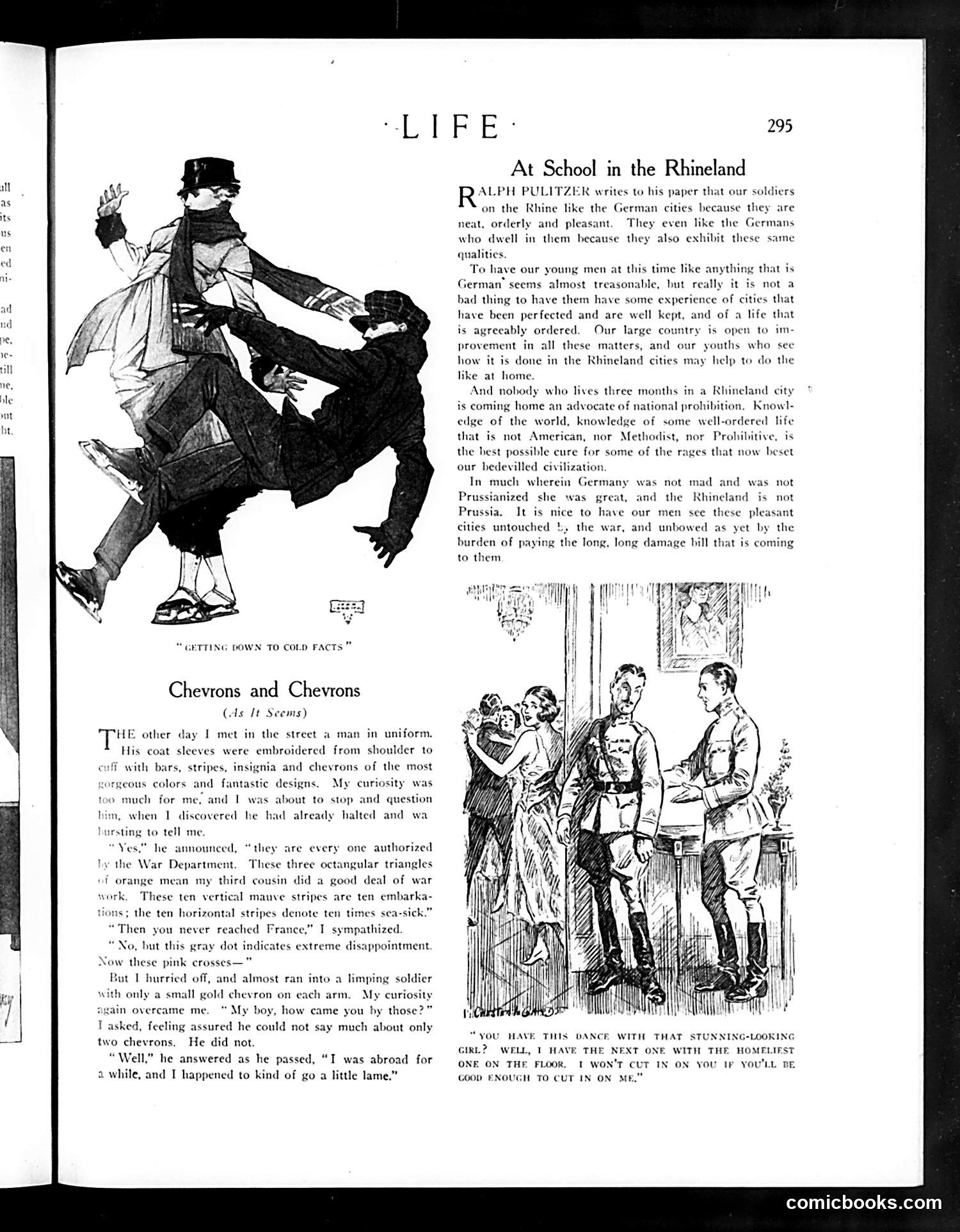
This page contains two separate satirical pieces about post-WWI American soldiers in occupied Germany. **"At School in the Rhineland"** is a editorial commentary (attributed to Ralph Pulitzer) defending soldiers' appreciation for German cities' orderliness and efficiency. The accompanying cartoon shows a soldier being "gotten down to cold facts"—likely mocking the tension between wartime anti-German sentiment and peacetime recognition of German civic accomplishments. **"Chevrons and Chevrons"** is a humorous anecdote satirizing military insignia inflation. A decorated soldier absurdly explains that his elaborate chevrons represent trivial things (a cousin's war work, seasickness episodes, disappointment) rather than actual combat achievements. The contrast with a limping soldier bearing only two chevrons—who actually saw combat—mocks how symbolic rank often fails to reflect real service or sacrifice. Both pieces reflect post-WWI American ambivalence: grudging respect for German culture alongside skepticism about inflated military credentials and the gap between appearance and genuine heroism.
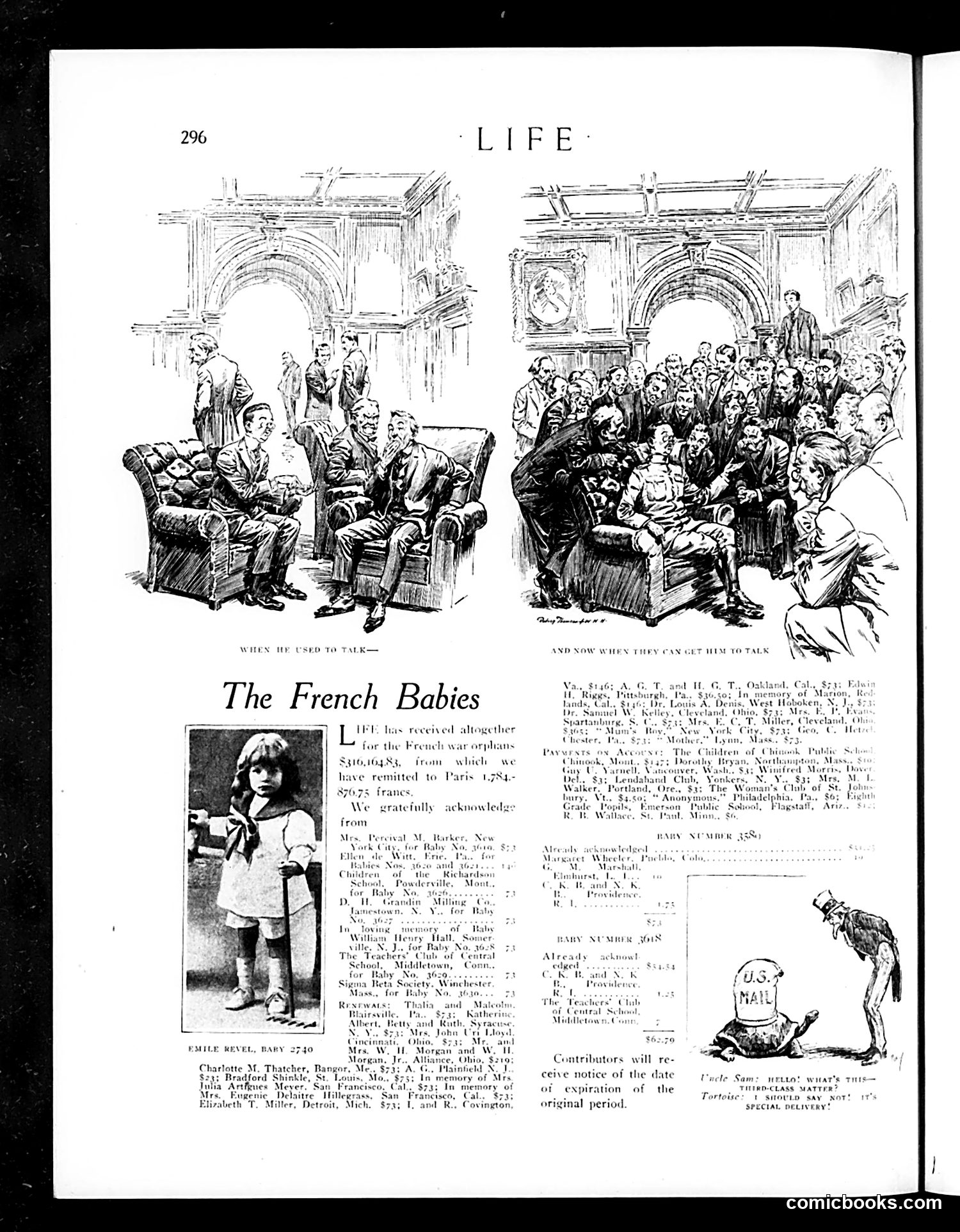
This page documents LIFE magazine's fundraising campaign for French war orphans following World War I. The two sketches contrast public attitudes: the left cartoon shows a small, quiet gathering when discussing French orphans; the right shows a crowded, enthusiastic response once donors could actually *meet* a child (identified as Emile Revel, Baby 2740, pictured center-left). The satire's point: Americans respond more generously to personal, emotional appeals than abstract humanitarian causes. Seeing a specific child's face generates donations that abstract statistics cannot. The campaign had raised $310,164.83 by this point, demonstrating the effectiveness of this strategy. The cartoons satirize human nature—we're moved by the tangible and visible rather than the conceptual.
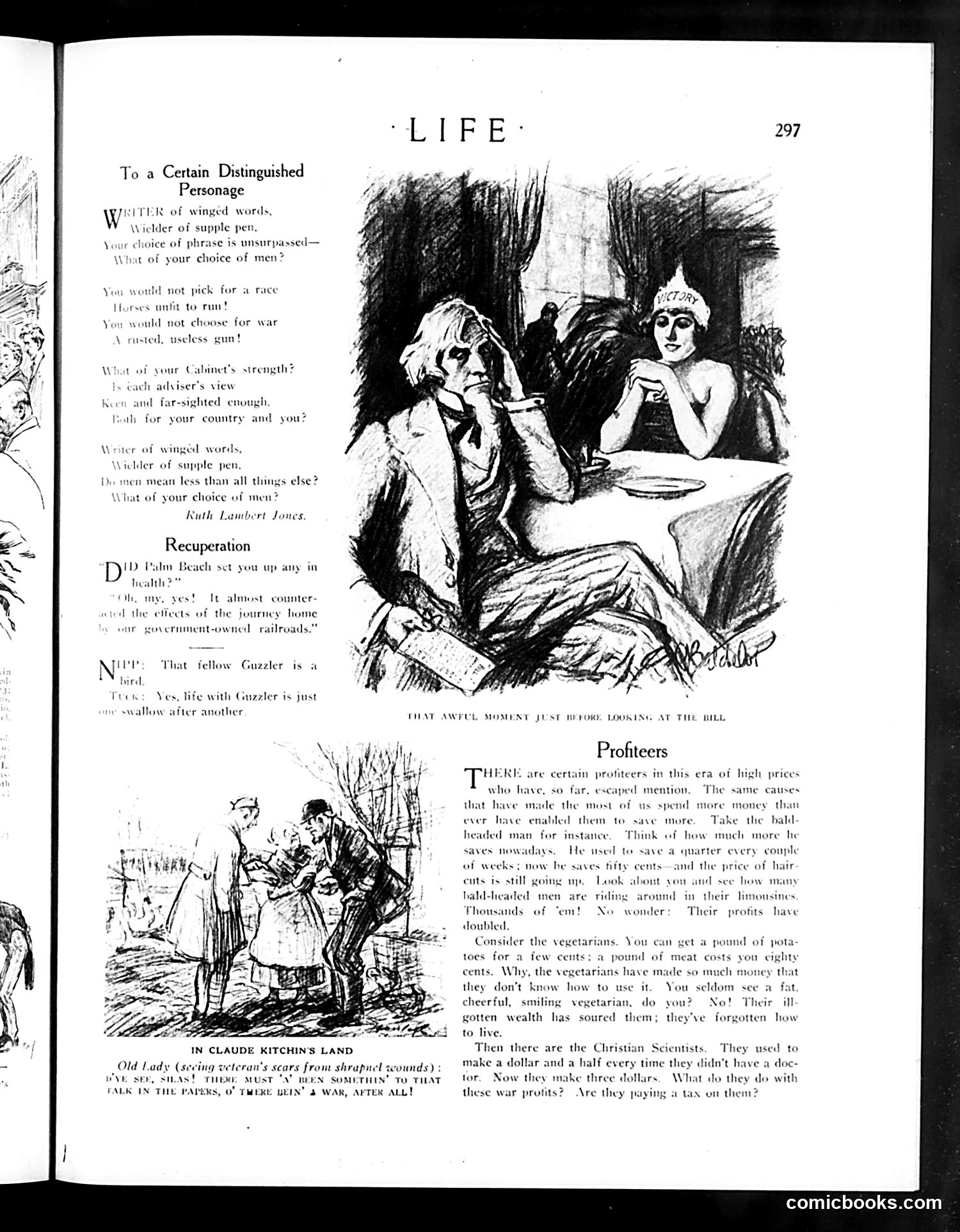
**"To a Certain Distinguished Personage"** attacks an unnamed political figure (likely a Cabinet member or president) for poor judgment in selecting advisors, despite eloquent rhetoric. The satire questions whether someone who writes so persuasively chooses incompetent men for government posts. **"Recuperation"** mocks wealthy profiteers recovering at Palm Beach while complaining about government-owned railroads—satirizing the hypocrisy of the rich. **"Profiteers"** is the page's main satire, using absurdist humor to critique war profiteers. It mockingly suggests bald men profit from expensive haircuts, vegetarians from high food prices, and Christian Scientists from charging fees (the text implies they charge $1.50 when people don't see doctors, now $3 during wartime). The underlying point: certain groups are cynically exploiting wartime inflation while claiming to hold moral or spiritual principles, yet avoid paying war taxes. **"In Claude Kitchin's Land"** references the Congressman and criticizes war profiteering affecting ordinary veterans.
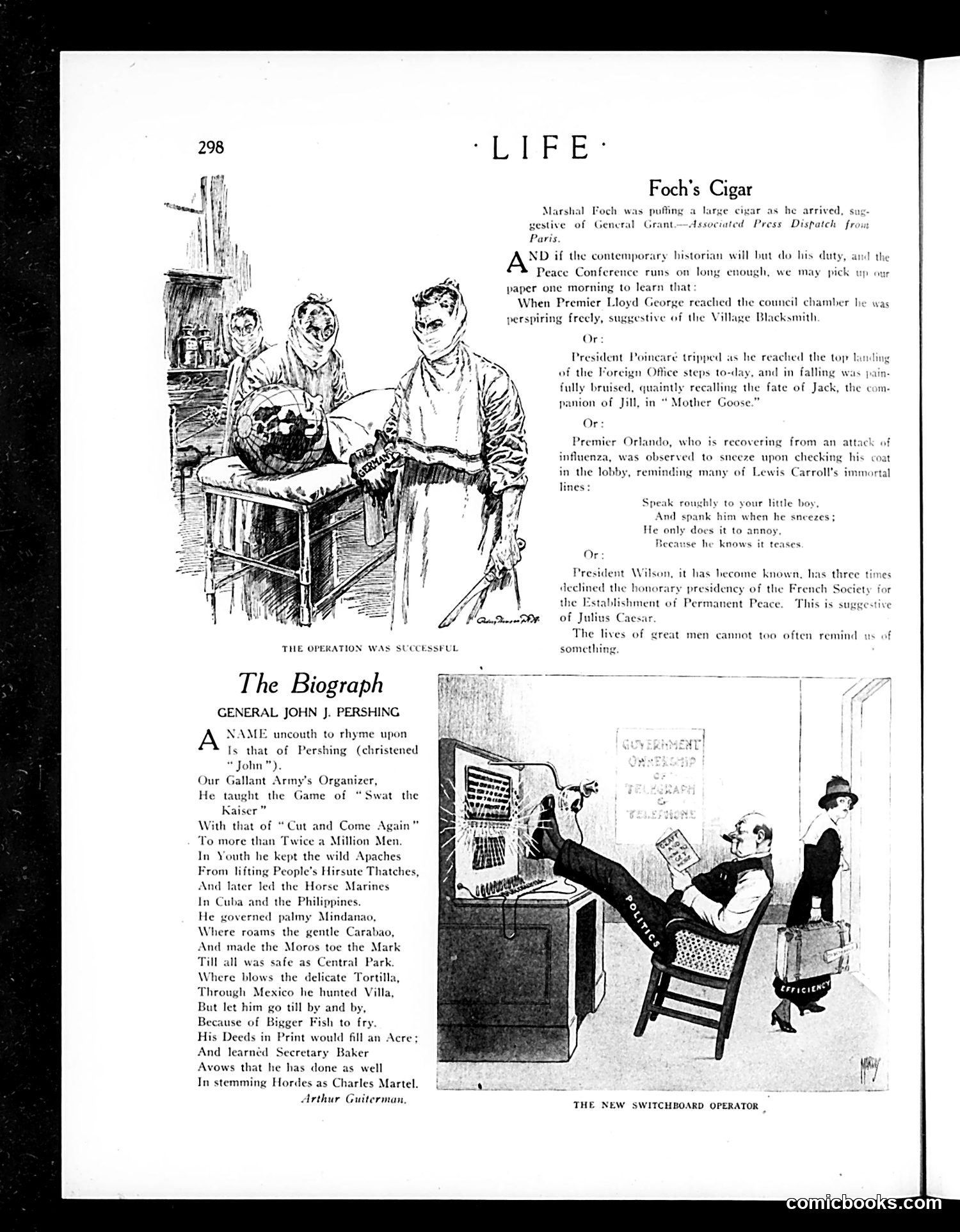
**Top Section - "Foch's Cigar":** This satirizes the Peace Conference (likely post-WWI, around 1919). The text humorously imagines future historical accounts attributing symbolic meanings to mundane actions by world leaders: Marshal Foch's cigar recalls General Grant; Lloyd George's perspiration suggests the "Village Blacksmith"; Poincaré's stumble echoes the nursery rhyme "Jack and Jill"; Orlando's sneeze recalls Lewis Carroll. The satire mocks both contemporary journalism's tendency to over-interpret leaders' actions and the Peace Conference's slow progress—if it "runs on long enough," historians will find deep meaning in trivial details. **Bottom Section - "The Biograph: General John J. Pershing":** A biographical tribute in verse to the WWI general, cataloging his military accomplishments: Apache campaigns, Philippine service, Mexican pursuit of Pancho Villa, and leading American forces in the Great War. The humorous rhyming verse (by Arthur Guiterman) celebrates Pershing as America's great military organizer. **Right Cartoon - "The New Switchboard Operator":** Appears to satirize inefficiency or incompetence in a government office (note "Switchboard" labeling).
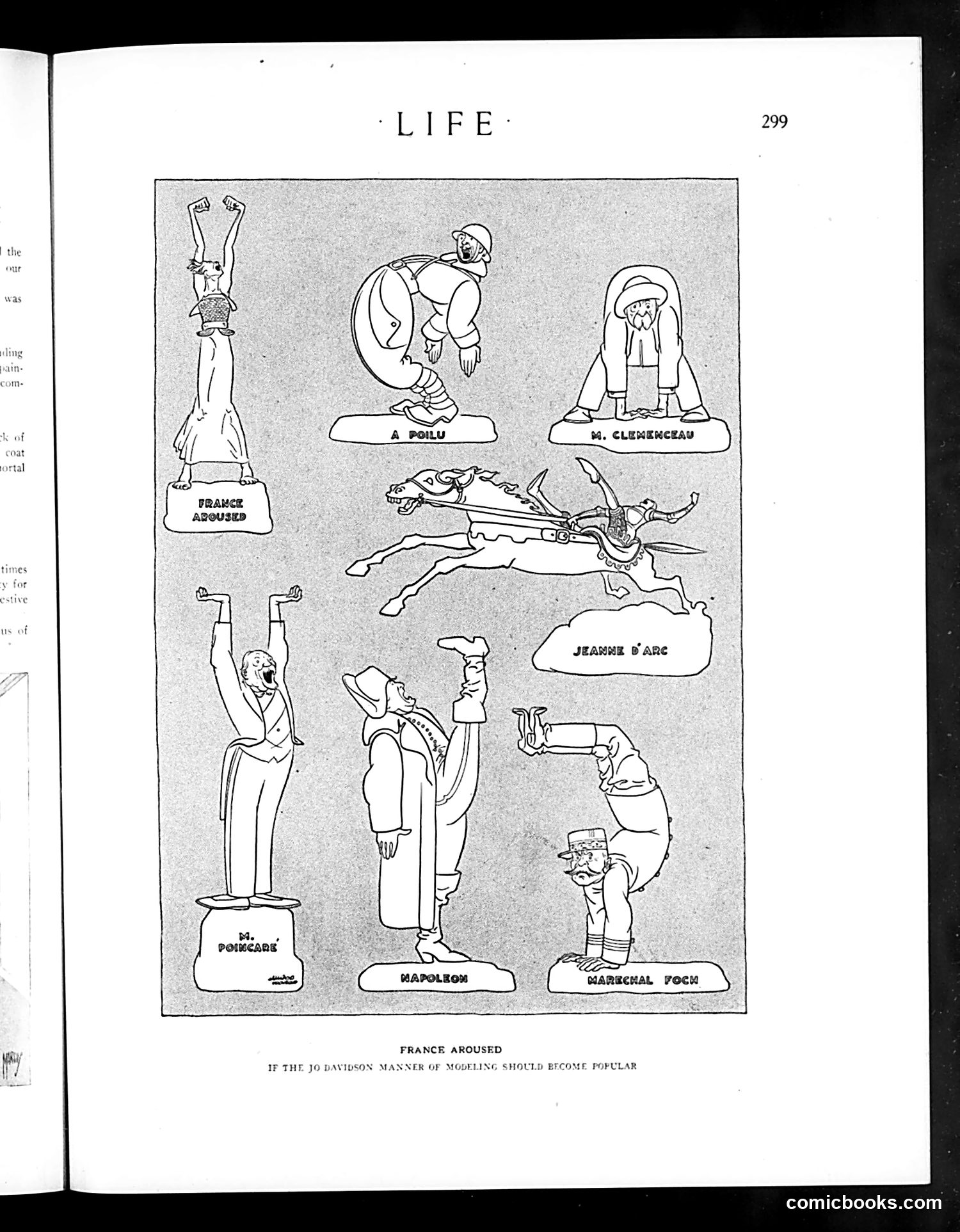
This Life magazine cartoon satirizes potential French political figures through exaggerated caricatures styled as classical statues and monuments. The labeled figures include M. Clemenceau (top right), Napoleon (center-bottom), Marshal Foch (bottom right), Jeanne d'Arc (center), and others. The caption "France Aroused" with the subtitle "If the Jo Davidson Manner of Modeling Should Become Popular" suggests this is mocking Jo Davidson, a famous American sculptor. The joke appears to mock Davidson's sculptural style by imagining historical French figures reimagined in his modernist manner—presenting them as absurdly distorted "monuments" to French national pride. The cartoon satirizes both Davidson's artistic approach and contemporary French nationalism during a period when France was reasserting its identity (likely WWI or interwar era).
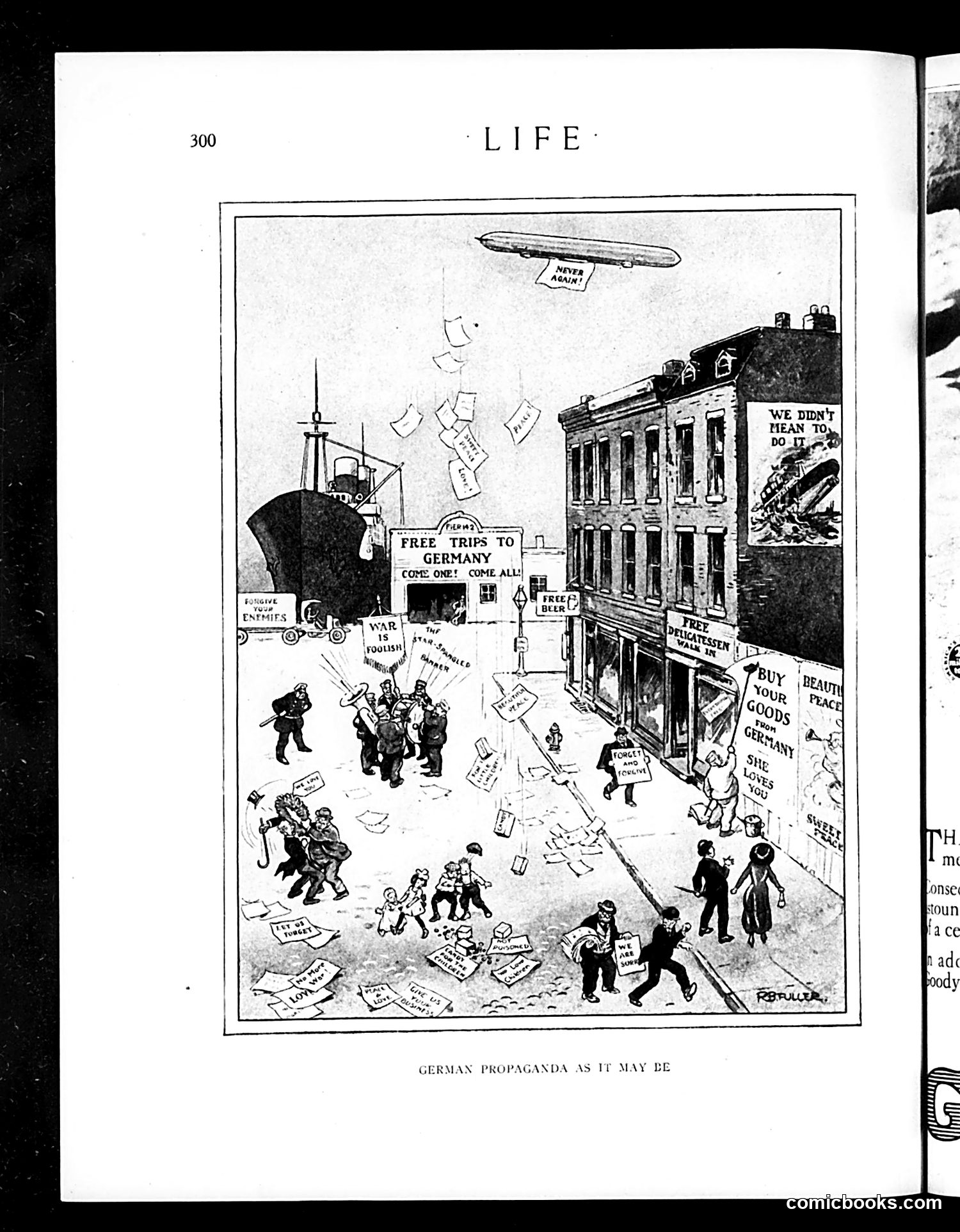
This satirical cartoon depicts German wartime propaganda tactics. A street scene shows an airship labeled "NEVER AGAIN!" dropping leaflets while various deceptive signs promise "FREE TRIPS TO GERMANY," "FREE BEER," and "BUY YOUR GOODS IN GERMANY." Civilians react with confusion and skepticism, some collecting scattered propaganda leaflets. A ship labeled "FOREIGN ENEMIES" and text reading "WAR IS FOOLISH" suggest Germany's attempt to demoralize or recruit the opposing side. The cartoon's point: German propaganda efforts are transparent, unconvincing ploys to manipulate the public through obviously false promises. The chaotic scene emphasizes the absurdity of such appeals, mocking both the propagandists and implying the public's resistance to such manipulation.
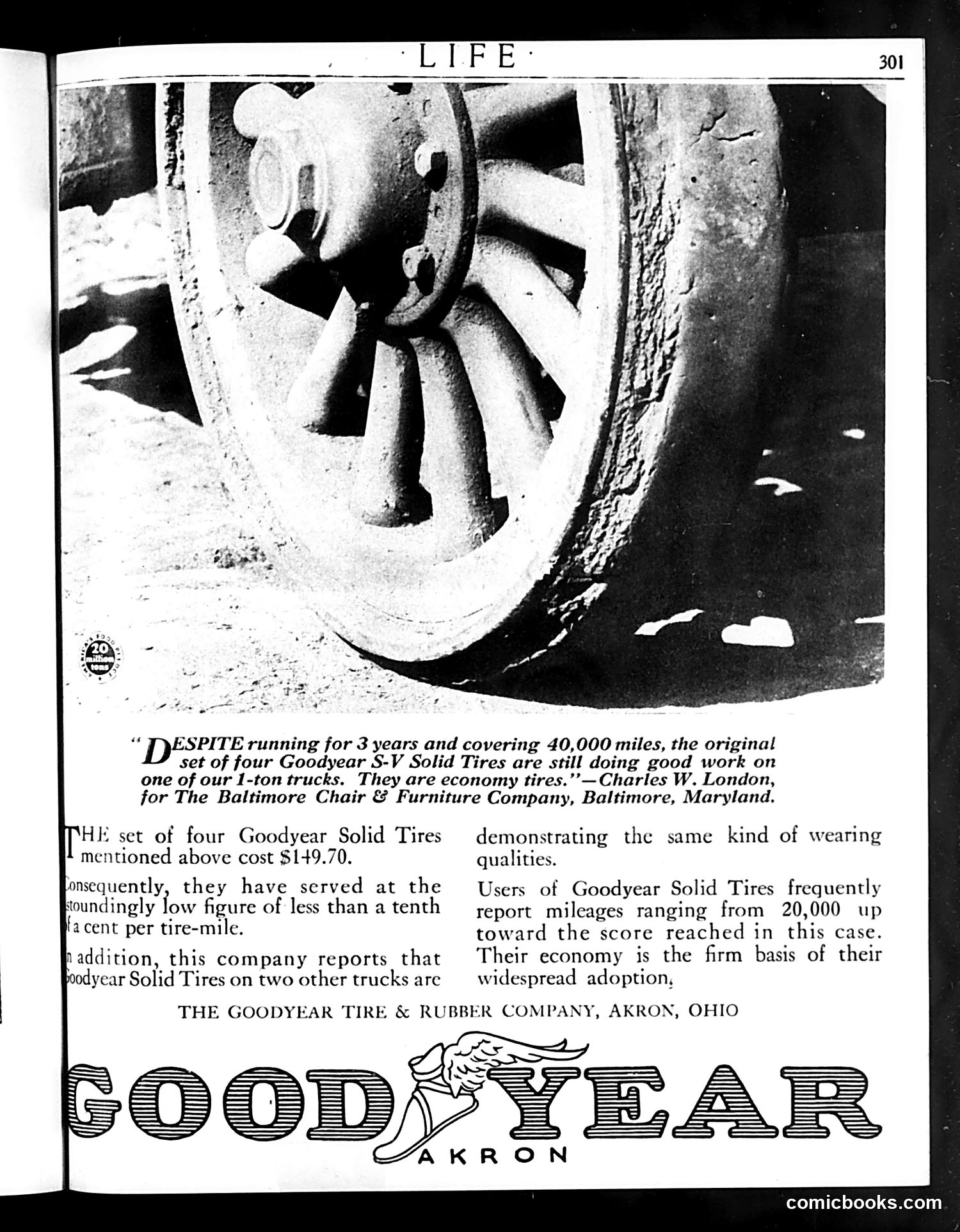
This page is primarily a **product advertisement**, not satire or political commentary. It features a photograph of a worn truck tire with an endorsement testimonial. The advertisement showcases **Goodyear S-V Solid Tires** through a real-world case study: Charles W. London of the Baltimore Chair & Furniture Company reports his original set of four tires ran for 3 years and 40,000 miles on a 1-ton truck, costing only $149.70 and averaging less than one-tenth cent per tire-mile—positioning them as economical. The pitch emphasizes durability and cost-efficiency as the basis for widespread adoption among commercial trucking companies. The worn tire photo serves as visual proof of the tires' longevity under actual working conditions, a common advertising strategy of the era. This represents standard early-20th-century commercial marketing in *Life* magazine, not editorial commentary.
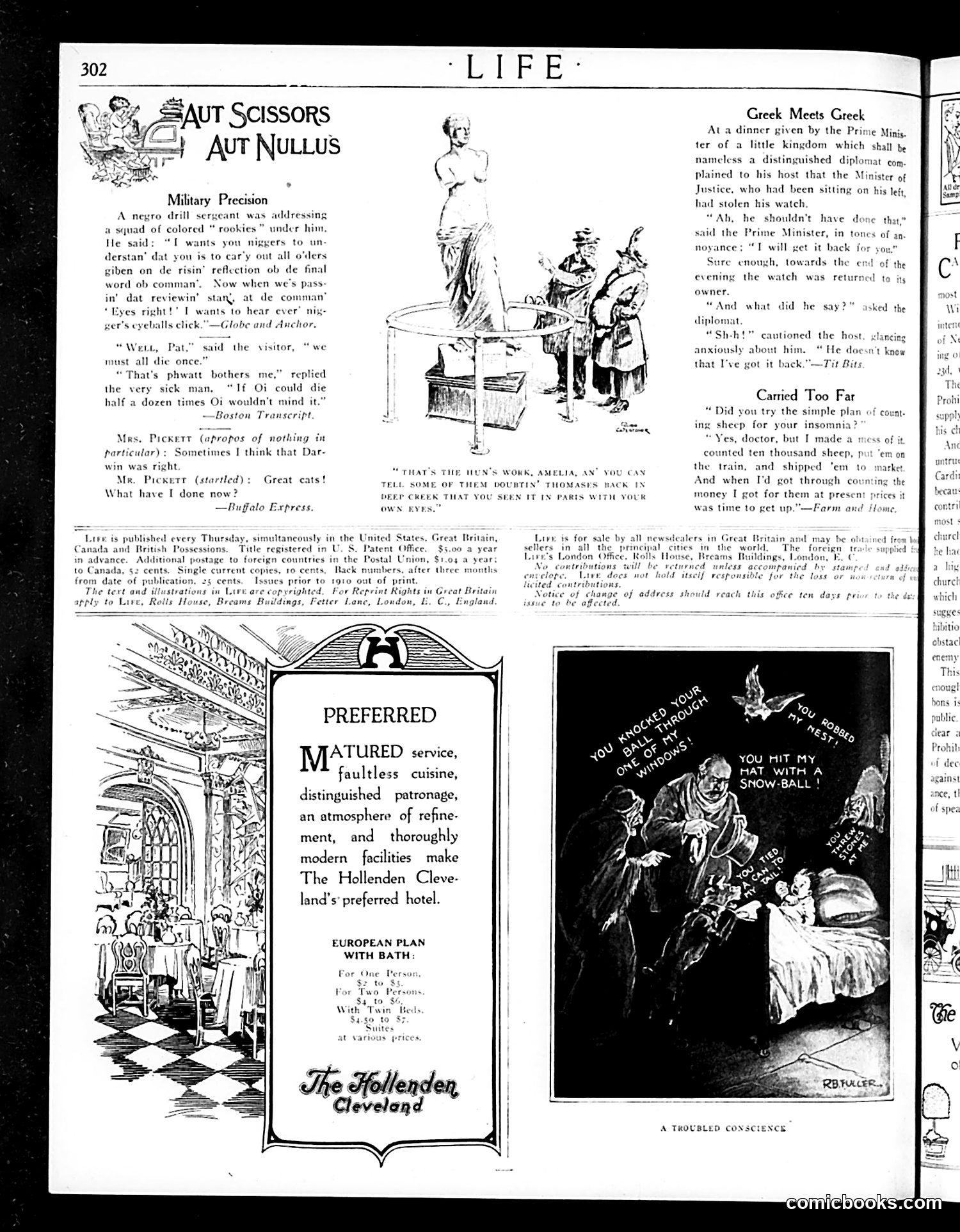
This page contains several satirical pieces typical of early 20th-century American humor magazines: **"Military Precision"** depicts a Black drill sergeant using stereotypical dialect, instructing colored soldiers. The humor relies on racist caricature common to the era—mocking Black vernacular speech patterns. **"Greek Meets Greek"** is a brief anecdote about diplomatic theft: a minister's watch is stolen by another minister at a dinner. The "joke" plays on the classical phrase "when Greek meets Greek," suggesting mutual cunning among diplomats who simply steal from each other. **"Carried Too Far"** mocks someone who took insomnia advice literally—counting sheep became so obsessive he actually bought and shipped thousands of sheep, turning a mental exercise into chaos. **"A Troubled Conscience"** (cartoon, right) shows Santa or a winter figure accosted by an angry child claiming he was hit with a snowball. The satire suggests adults using children's winter games as excuses for misbehavior. The page also includes hotel advertising. The racial caricature reflects deeply offensive but period-typical editorial standards.
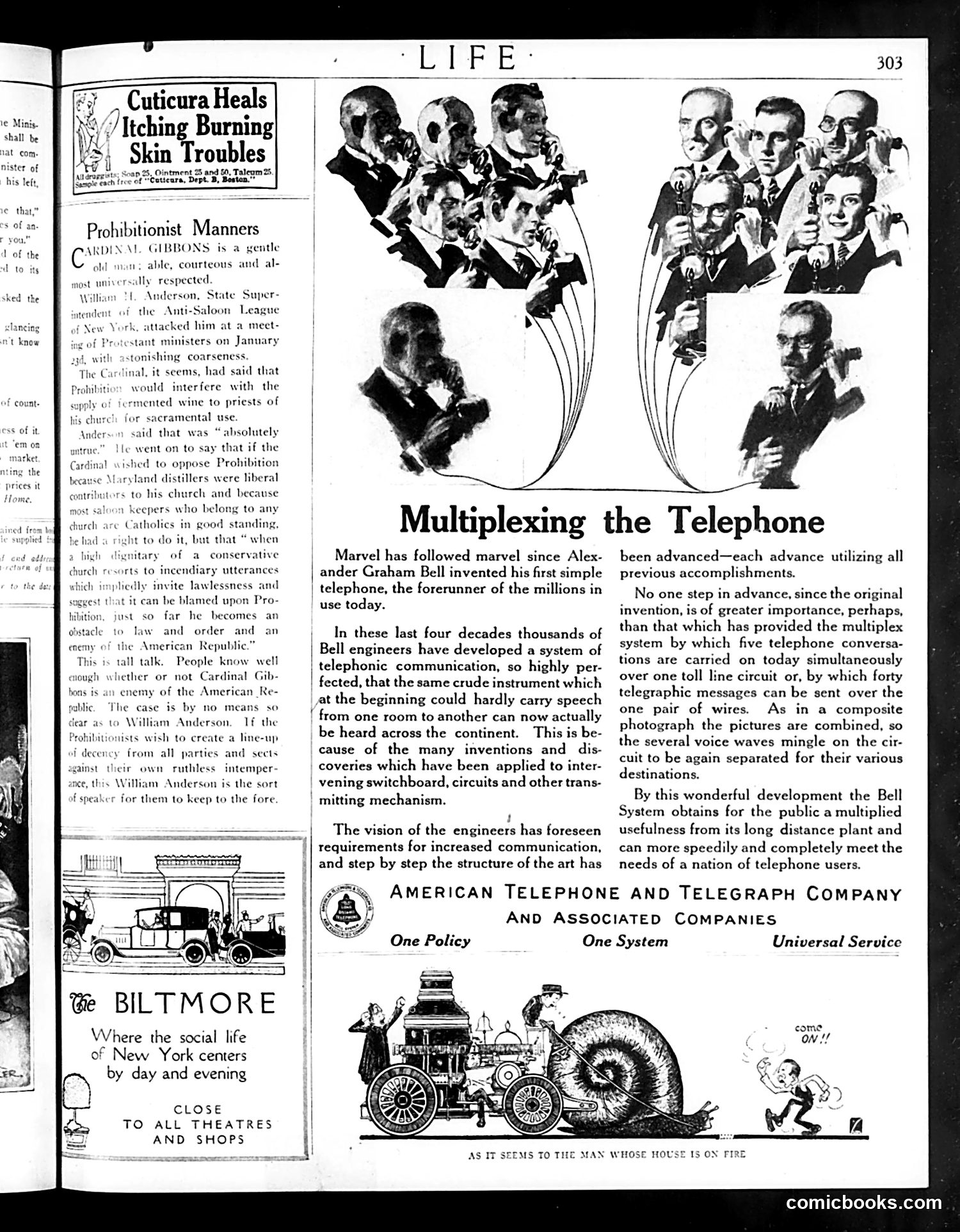
This page contains two distinct sections: **Left column: "Prohibitionist Manners"** critiques William H. Anderson, State Superintendent of the Anti-Saloon League, who publicly attacked Cardinal Gibbons (a prominent Catholic leader) over Prohibition policy. The dispute concerned whether distillers could supply sacramental wine to priests. The article sarcastically defends Gibbons's courtesy while condemning Anderson's "incendiary utterances" as counterproductive to the Prohibition movement itself. The satire suggests Anderson's aggressive tactics actually harm the cause he champions—making him a liability rather than an asset to temperance advocates. **Right section: "Multiplexing the Telephone"** is corporate advertising for AT&T, celebrating technological advances allowing multiple conversations on single telephone lines. The illustrated heads emerging from a telephone receiver showcase this innovation. The bottom cartoon shows a firefighter responding to "the man whose house is on fire," suggesting practical urgency for telephone service. The page juxtaposes Prohibition-era social conflict with celebratory corporate progress.
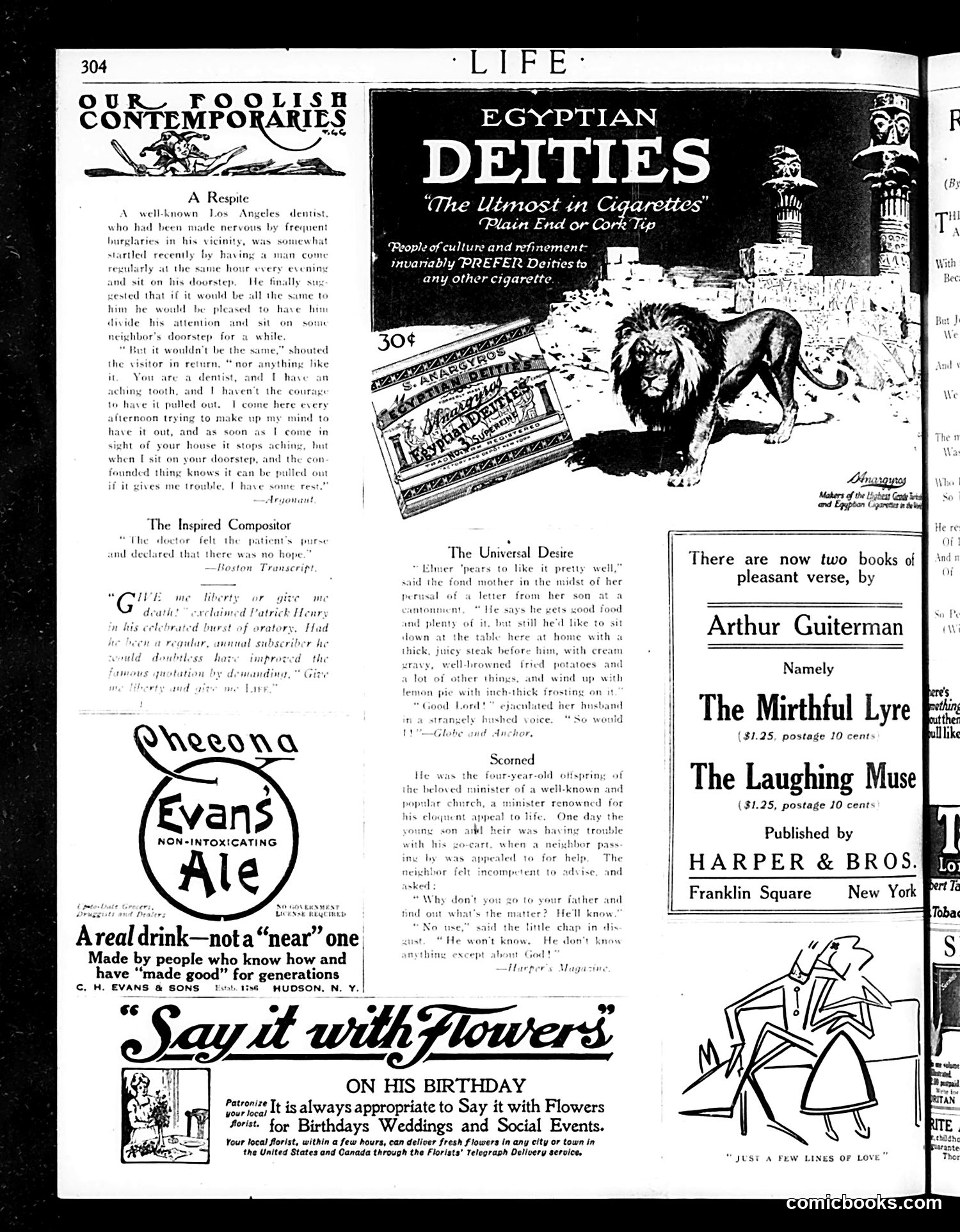
This page from *Life* magazine contains primarily **advertisements and humorous anecdotes** rather than political cartoons. The main satirical content appears in "A Respite"—a humorous story about a nervous Los Angeles dentist who hired a burglar deterrent: a man who would sit on his doorstep each evening as protection. The joke mocks both the dentist's anxiety about crime and the absurdity of this "solution." Other items include: - **Egyptian Deities cigarette ad**: Uses classical imagery to suggest sophistication ("People of culture and refinement invariably PREFER Deities") - **Phecona Evans Ale ad**: Emphasizes it's a "real drink—not a 'near' one," likely responding to Prohibition-era concerns about weak or fake alcohol - **Arthur Guiterman book advertisements**: Promoting two volumes of humorous poetry - **"Say it with Flowers" ad**: A florist service pitch The page reflects early 20th-century consumer culture and light domestic humor rather than sharp political satire.
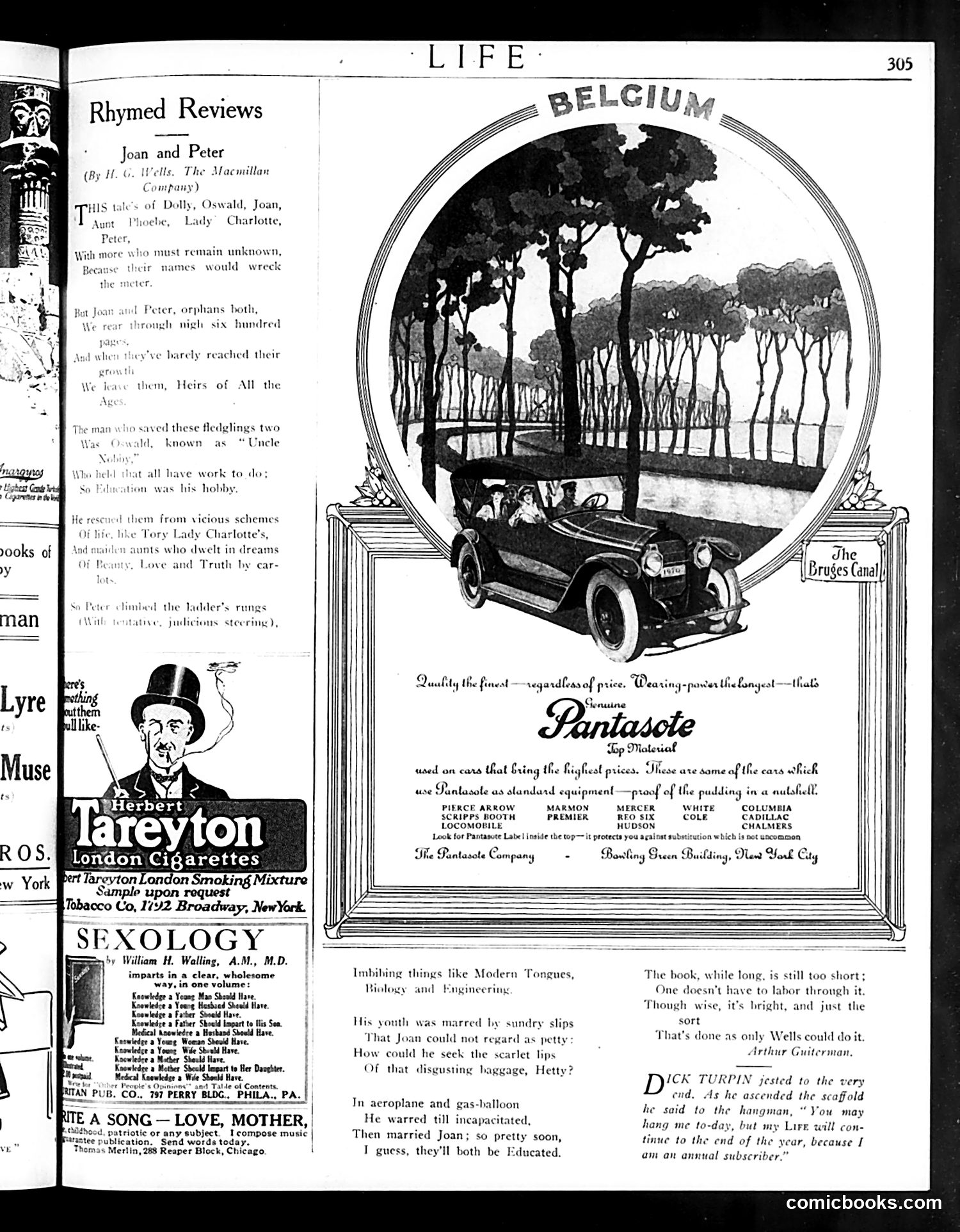
This page contains a **book review in verse** of H.G. Wells's novel *Joan and Peter*, alongside period advertisements. The rhymed review summarizes the plot: two orphans (Joan and Peter) are rescued by "Uncle Toady" from various corrupting influences—including a "Tory Lady Charlotte" and relatives obsessed with dreams of "Beauty, Love and Truth." The reviewer notes Peter must climb "the ladder's rungs / (With tentative, judicious steering)" to reach adulthood, and jokes that both orphans will eventually be "Educated." The satire here is mild—poking gentle fun at Wells's didactic storytelling and Victorian anxieties about youth morality. The page is dominated by a large **Pantasote automobile advertisement** featuring a vintage car framed by Belgium's Bruges Canal, extolling the material used in luxury vehicles. Below appears an excerpt from *Dick Turpin* (the famous highwayman legend), offering dark humor: even facing execution, Turpin declares his *Life* magazine subscription will outlast him.
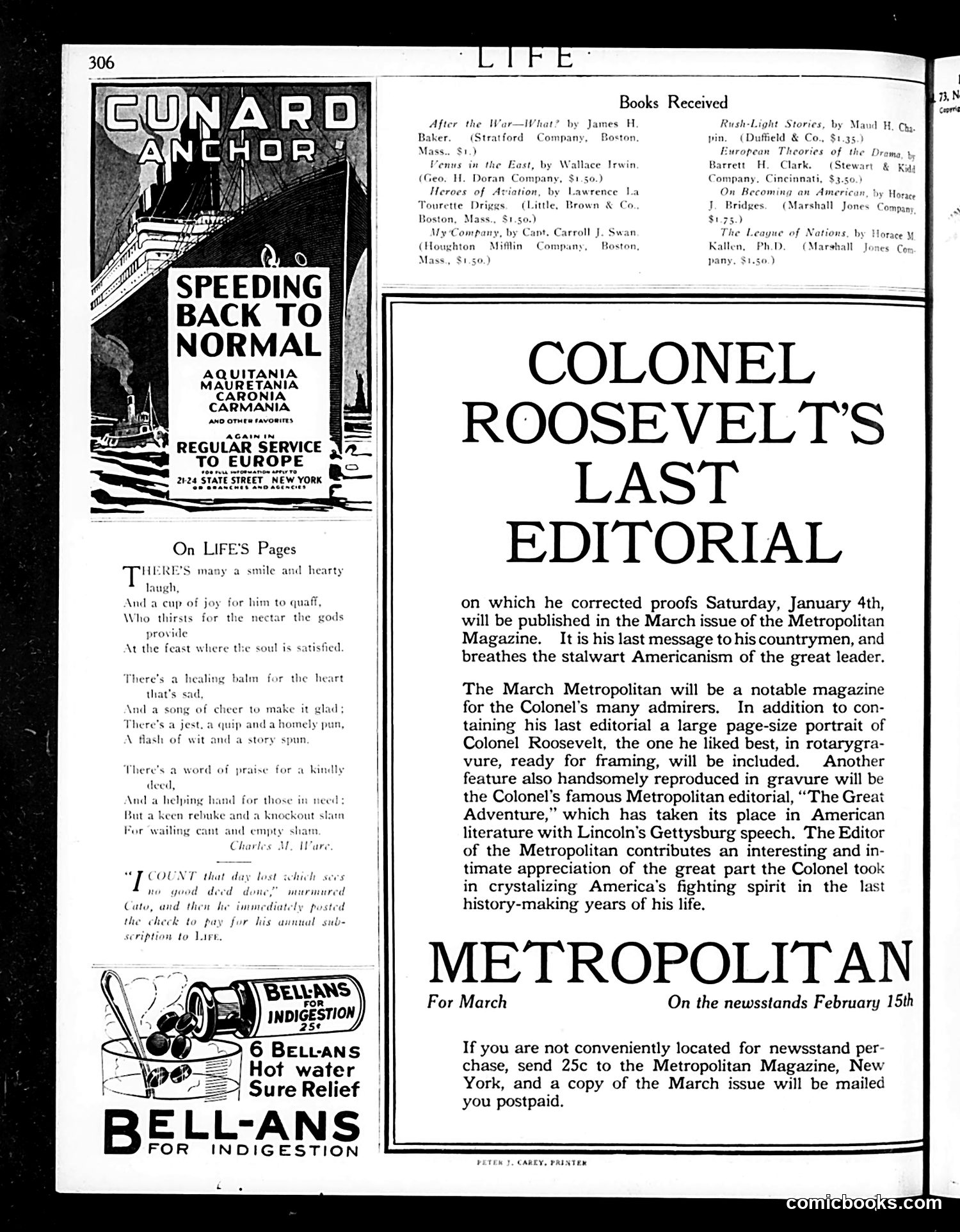
This page from *Life* magazine announces Colonel Theodore Roosevelt's death. The main article reveals that Roosevelt corrected proofs for his final editorial on January 4th, which will appear in the March *Metropolitan Magazine* issue—described as "his last message to his countrymen." The page is primarily promotional material for *Metropolitan Magazine*, emphasizing Roosevelt's legacy as a great American leader embodying patriotic "Americanism" and "fighting spirit." It advertises the March issue will include his final editorial, a portrait, and a republication of his famous earlier piece "The Great Adventure." The Cunard shipping advertisement on the left, promoting transatlantic service returning to "normal," provides historical context—suggesting this magazine likely dates to early 1919, following World War I's conclusion. The remaining page content consists of book advertisements and unrelated commercial notices (Bell-Ans indigestion remedy).