
Life, 1919-02-20 · page 22 of 34
Life — February 20, 1919 — page 22: what you’re looking at
What you’re looking at
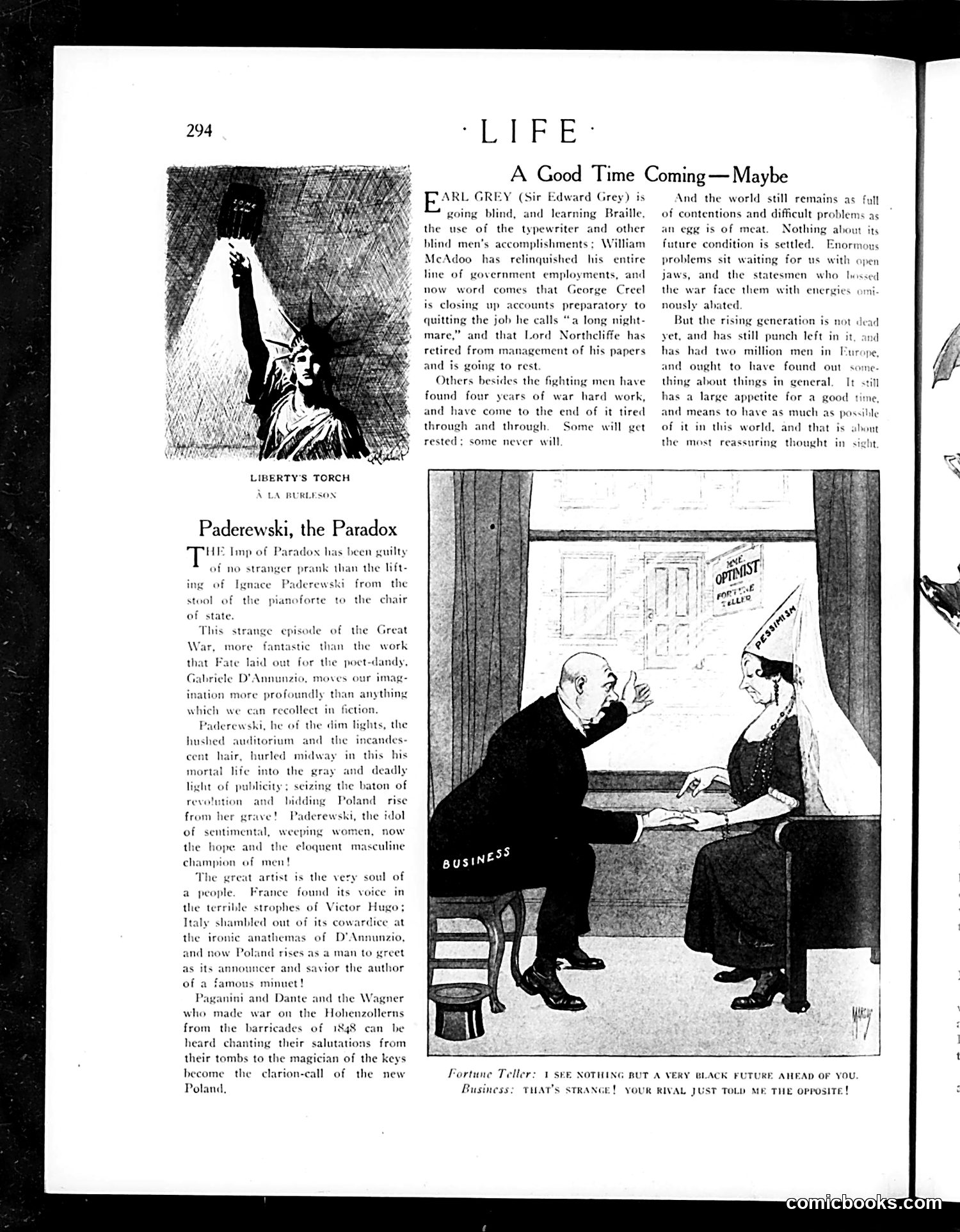
**Top Article - "A Good Time Coming — Maybe":** This discusses post-WWI conditions. It references real figures: Earl Grey (going blind), William McAdoo (relinquishing government work), George Creel (leaving his propaganda role), and Lord Northcliffe (retiring from newspaper management). The piece argues that despite war's end, problems remain unsolved, but the younger generation—having lost two million men in Europe—still desires normalcy and pleasure, which the author calls "reassuring." **Cartoon - "Paderewski, the Paradox":** The essay celebrates Polish pianist Ignace Paderewski's transformation from concert artist to statesman during WWI, comparing him to Italian poet D'Annunzio. It frames him as Poland's savior-figure, invoking France's Victor Hugo and Italy's cultural voices as precedent for artists becoming national champions. **Bottom Cartoon - "Fortune Teller":** A businessman visits a fortune teller who predicts "a very black future." His rival, she reveals, received the *opposite* prediction. The joke: both competitors received contradictory fortunes—satirizing fortune-telling's uselessness or the competitors' mutual anxiety.
📄 Transcribed text from this page (OCR, searchable)
Machine-transcribed from the original scan — historical spelling and the odd misread are preserved.
LIBERTY'S TORCH ALA BURLESON Paderewski, the Paradox HE Imp of Paradox has been guilty of no stranger prank than the lift- of Ignace Paderewski from the stool of the pianoforte to the chair of stat This strange episode of the Great War, the that Fate laid out for the poct-dandy, more fa tic than work tabriele D'Annunzio, moves our imag- ination more profoundly than anything which we can recollect in fiction, Paderewski, he of the dim lights, the hushed auditorium and the incandes- hair, hurled life into the gray and deadly cent midway in this his morts the baton of revolution Poland from her grave! Paderewski, the idol light of publicity; seizin and bidding rise of sentimental, weeping women, now the hope and the eloquent: masculine champion of men! he great artist is the very soul of a people. France the terrible strophes of Victor Huge Italy sl the iro and now Poland rises as a man to greet er and savior the author found its voice in mbled out of its cowardice at anathemas of D'Annunzio, as its annow of a famous minuet! Paganini and Dante and the Wagner who made war on the Hohenzollerns from the 18g can be heard chanting their salutations from their tombs to the magician of the keys the clarion-call_ of the barricades of become Poland, new “LIFE™ A Good Time Coming — Maybe Y (Sir Edward Grey) is ving blind, and learning Braille, the use of the typewriter and other hlind men’s accomplishments; William McAdoo line of government employments, and that Creel is closing up accounts preparatory to quitting the job he calls “a long night- mare,” and that Lord Northcliffe has retired from management of his papers and is going to rest Others besides the fighting men have found four yea and have come to the end of it tired Some will get has relinquished his entire now word comes George s of war hard work, through and through rested: some never will And the world still remains as full of contentions and difficult problems as an egg is of meat. Nothing about its future condition is settled. problems sit waiting for us with open and the the war face Enormo jaws, statesmen who bessed them with energies om nously abated. But the rising generation is not dead and has still punch left in it as had two million men in’ Europe, and ought to have found out some about things in general. It still has a large appetite for a good time, thing and means to have as much as possible of it in this world, and that is the most reassuring thought ins Fortune Teller: 1 SEE NOTHING BUT A VERY BLACK FUTURE AHEAD OF YOU. Business: THAT'S STRANGE! YOUR RIVAL JUST TOLD ME THE Opposite!