
Life, 1919-02-20 · page 20 of 34
Life — February 20, 1919 — page 20: what you’re looking at
What you’re looking at
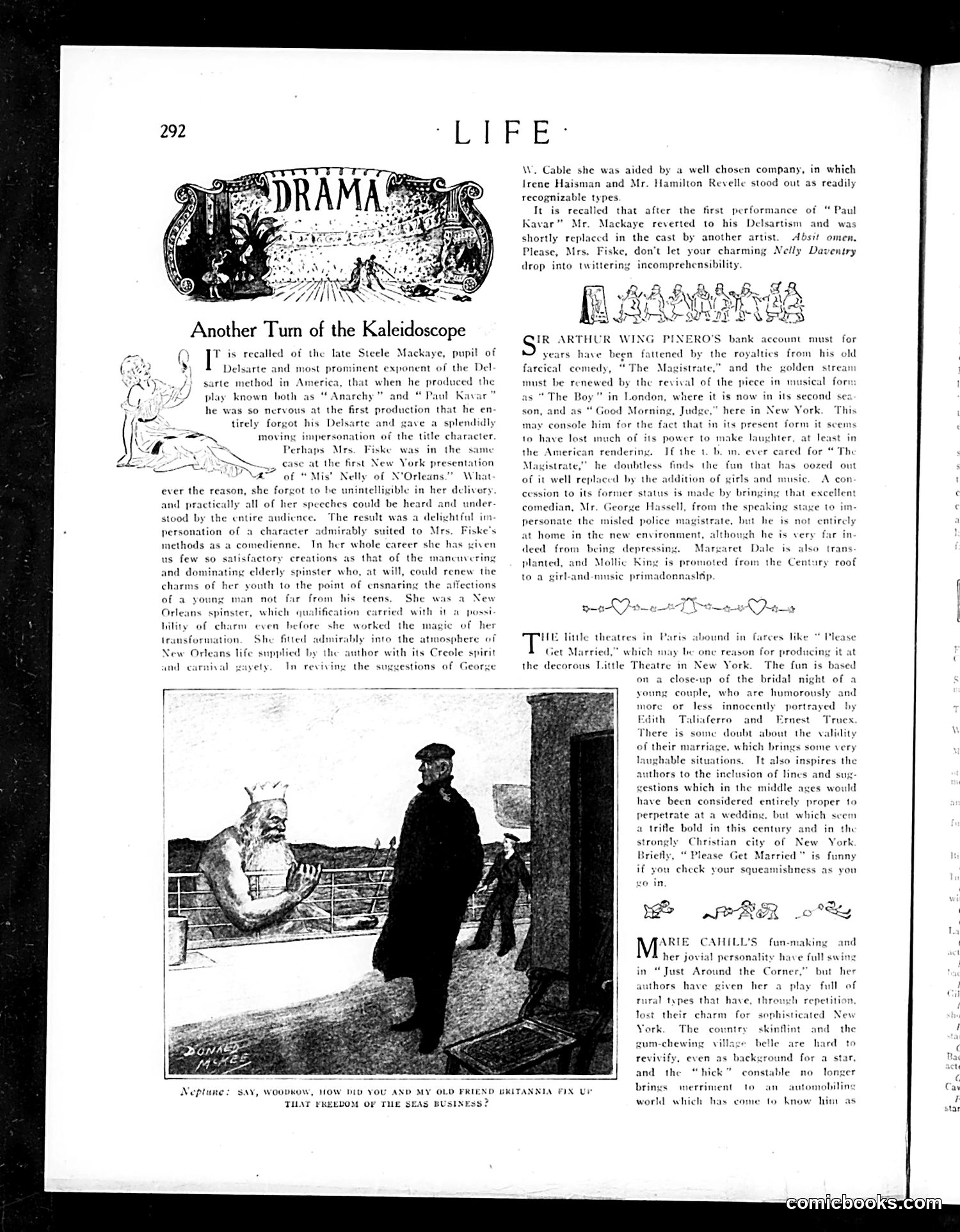
This page from Life magazine contains theater reviews rather than political cartoons. The main content discusses three Broadway productions: 1. **"Another Turn of the Kaleidoscope"** reviews a theatrical performance, discussing actress Mrs. Fiske's acclaimed portrayal of a character in a play (appears to involve New Orleans Creole themes based on W. Cable's involvement). 2. **Sir Arthur Wing Pinero's work** discusses the revival of "The Magistrate," noting its transformation into a musical comedy called "The Boy" in London and "Good Morning, Judge" in New York. The reviewer suggests the musical adaptation has diluted the original farce's humor. 3. **"Please Get Married"** at the Little Theatre is described as a French farce focusing on a wedding night, with humor the reviewer finds somewhat bold for early 20th-century New York sensibilities. The single illustration shows what appears to be a Neptune-themed scene, likely from one of the theatrical productions discussed. The page primarily serves as entertainment criticism rather than satire.
📄 Transcribed text from this page (OCR, searchable)
Machine-transcribed from the original scan — historical spelling and the odd misread are preserved.
LIFE oti S APH \ES Another Tum of the Kaleidoscope sart is recalled of th © Tate Steele Mackaye, pupil of Delsarte and most prominent exponent of the Del e method in Ame play known both ; so nervous at the first production that he en ever the reason, and practices tirely forgot his rica, that when he produced the “ Anarchy” and “Paul Kavar Delsarte and gave a splendidly moving impersonat of the title character. Perhar case at \A™ of “M ally all of her spe ood by the entire audience. personation methods as us few so of a character a comedienne, Tr satisfactory creati 3s Mrs. Fiske was in the same the first New York presentation is’ Nelly of N’Orleans.” What she forgot to be unintelligible in her delivery eches could be heard and under- The result was a delightful im. admirably suited to Mrs. Fiske’s n her whole career she has given ons as that of the maneuvering elderly spinster who, at will, could renew the her youth to the point of ensnaring the affections your ins spi hility of ch transformat New Ork and carina re Neptune man not far from his teens, She was a New inster, Which qual harm even before ion. She fitted as life supplied by Wo yayety, In rev SAY, WooDKOW, THAT & ification carried with i1 a possi she worked the cof her dmirably into the atmosphere of he author with its Creole spirit iving the wxestions of George W. Cable she was aided by a well chosen company, in which Irene Haisman and Mr. Hamilton Revelle stood out as readily recognizable types. It is recalled that after the first performance of “ Paul Kavar” Mr. Mackaye reverted to his Delsartism and was shortly replaced in the cast by another artist. Absit omen, Please, Mrs. Fiske, don’t let your charming Nelly Daventry drop into twittering incomprehensibility 7 VAT 1a SAS Nae IR ARTHUR WING PINERO’S bank account must for years have been fattened by the royalties from his old arcical comedy, “The Magistra and the golden strear must be renewed by the revival of the piece in musical fori “The Boy” in London, where it is now in its second ses son, and as “Good Morning, Judge,” here in New York. This may console him for the fact that in its present form it seems to have lost much of its power to make laughter, at least in the American rendering, If the 1. b. m. ever cared for “ The Magistra fe doubtless finds the fun that has oozed out of it well replaced by the addition of girls and music. A con cession to its former status is made by bringing that ex comedian, Mr. George Hassell, from the ny stae te personate the misled police magistrate, is not entirely at home in the new environment, although he is very far in deed from being depressing. Margaret Dale is also trans planted, and Mollic King is promoted from the Century roof to a girl-and-music primadonnaslsip BOE wy VOT 4 Ta oy OO TH little theatres in Paris abound in farces like “ Please Get Married,” which may be one reason for producing it at the decorous Little Theatre in New York. The fun is based on a close-up of the bridal night of a young couple, who are humorously and ore or less innocently portrayed by th Taliaferro and Ernest Truex There is some doubt about the validity of their marriage, which brings some very able situations. Tt also inspires the thors to the inclusion of lines and sug estions which in the middle ages would have been considered entirely proper to perpetrate at a wedding, but which seem a trifle bold in this century and in the strongly Christian city of New York Briefly, “Please Get Married” is funny ness as you Mit'® CAHILL ma a her jovial personality have full swing in “Just Around the Corner,” but her authors have given her a play full of rural types that have, through repetition Jost their charm for sophisticated New York. Th suntry oskinflint and the ym-chewing village helle are hard to revivify, even as bac! ound for a star, and the “hick” constable no HOW HID YOU AND MY OLD FRIEND BK LOM OF THE SEAS BUSINESS? RBA FIX UF brings merriment to an automobilin world which hay co: fo know hint as