
Life, 1919-02-20 · page 23 of 34
Life — February 20, 1919 — page 23: what you’re looking at
What you’re looking at
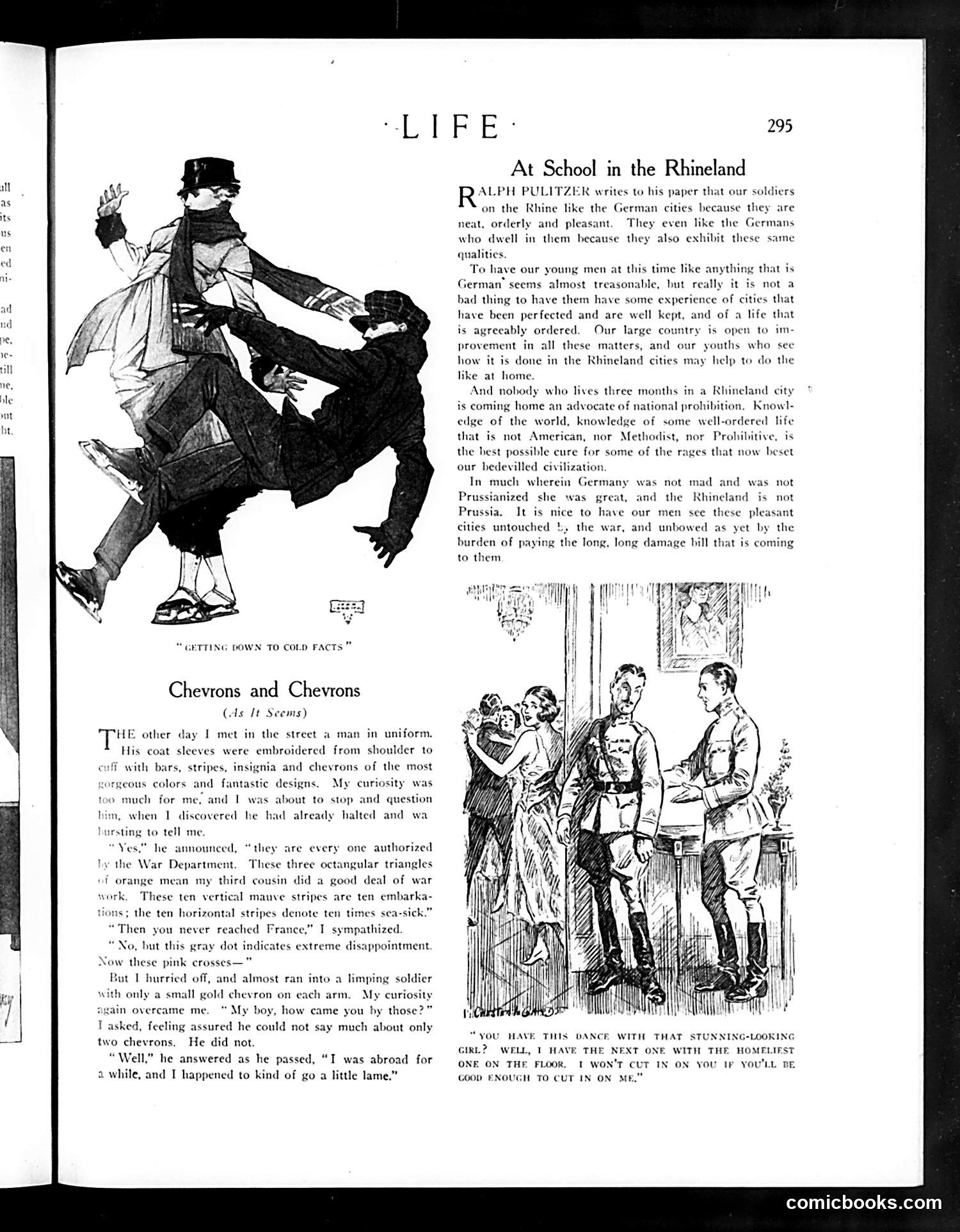
This page contains two separate satirical pieces about post-WWI American soldiers in occupied Germany. **"At School in the Rhineland"** is a editorial commentary (attributed to Ralph Pulitzer) defending soldiers' appreciation for German cities' orderliness and efficiency. The accompanying cartoon shows a soldier being "gotten down to cold facts"—likely mocking the tension between wartime anti-German sentiment and peacetime recognition of German civic accomplishments. **"Chevrons and Chevrons"** is a humorous anecdote satirizing military insignia inflation. A decorated soldier absurdly explains that his elaborate chevrons represent trivial things (a cousin's war work, seasickness episodes, disappointment) rather than actual combat achievements. The contrast with a limping soldier bearing only two chevrons—who actually saw combat—mocks how symbolic rank often fails to reflect real service or sacrifice. Both pieces reflect post-WWI American ambivalence: grudging respect for German culture alongside skepticism about inflated military credentials and the gap between appearance and genuine heroism.
📄 Transcribed text from this page (OCR, searchable)
Machine-transcribed from the original scan — historical spelling and the odd misread are preserved.
“LIFE: m5 At School in the Rhineland ALPH PULITZER writes to his paper that our soldiers on the Rhine like the German cities because they are neat, orderly and pleasant. They even like the Germans who dwell in them because they also exhibit these same qualities. To have our young men at this time like anything that is German’ seems almost treasonable, but really it is not a bad thing to have them have some experience of cities that have been perfected and are well kept, and of a life that is agreeably ordered. Our large country is open to im- provement in all these matters, and our youths who sec how it is done in the Rhineland cities may help to do the like at home. And nobody who lives three months in a Rhineland city is coming home an advocate of national prohibition. Knowl- edge of the world, knowledge of some well-ordered life that is not American, nor Methodist, nor Prohibitive, is the hest possible cure for some of the rages that now beset our bedevilled civilization. In much wherein Germany was not mad and was not Prussianized she was great, and the Rhineland is not Prussia. It is nice to have our men see these pleasant cities untouched &, the war, and unbowed a et by the burden of paying the long, long damage bill that is coming to them “GETTING DOWN TO COLD FACTS” Chevrons and Chevrons (als [t Seems) HE other day I met in the street a man in uniform. His coat sleeves were embroidered from shoulder to with bars, stripes, insignia and chevrons of the most ous colors and fantastic designs. My curiosity was too much for me, and I was about to stop and question him, when I discovered he had already halted and wa lursting to tell me. “Yes.” he announced, “they are every one authorized y the War Department. These three octangular triangles of orange mean my third cousin did a good deal of war work, These ten vertical mauve stripes are ten embarka- is; the ten horizontal stripes denote ten times sea-sick.” Then you never reached France,” I sympathized. “No, but this gray dot indicates extreme disappointment. Now these pink crosses—"” But I hurried off, and almost ran into a limping soldier ith only a small gold chevron on each arm. My curio: in overcame me. “ My boy, how came you by those?” I asked, feeling assured he could not say much about only “ two chevrons, He did not. _ “You Have THIS DANCE WITH THAT STUNNID In g GIRL? WELL, T HAVE THE NEXT ONE WITH THE HOMELIFST a while, and I happened to kind of go a little lame.” GOOD ENOUGH TO CUT IN ON ME,” comicbooks.com