
A complete issue · 34 pages · 1919
Life — January 30, 1919
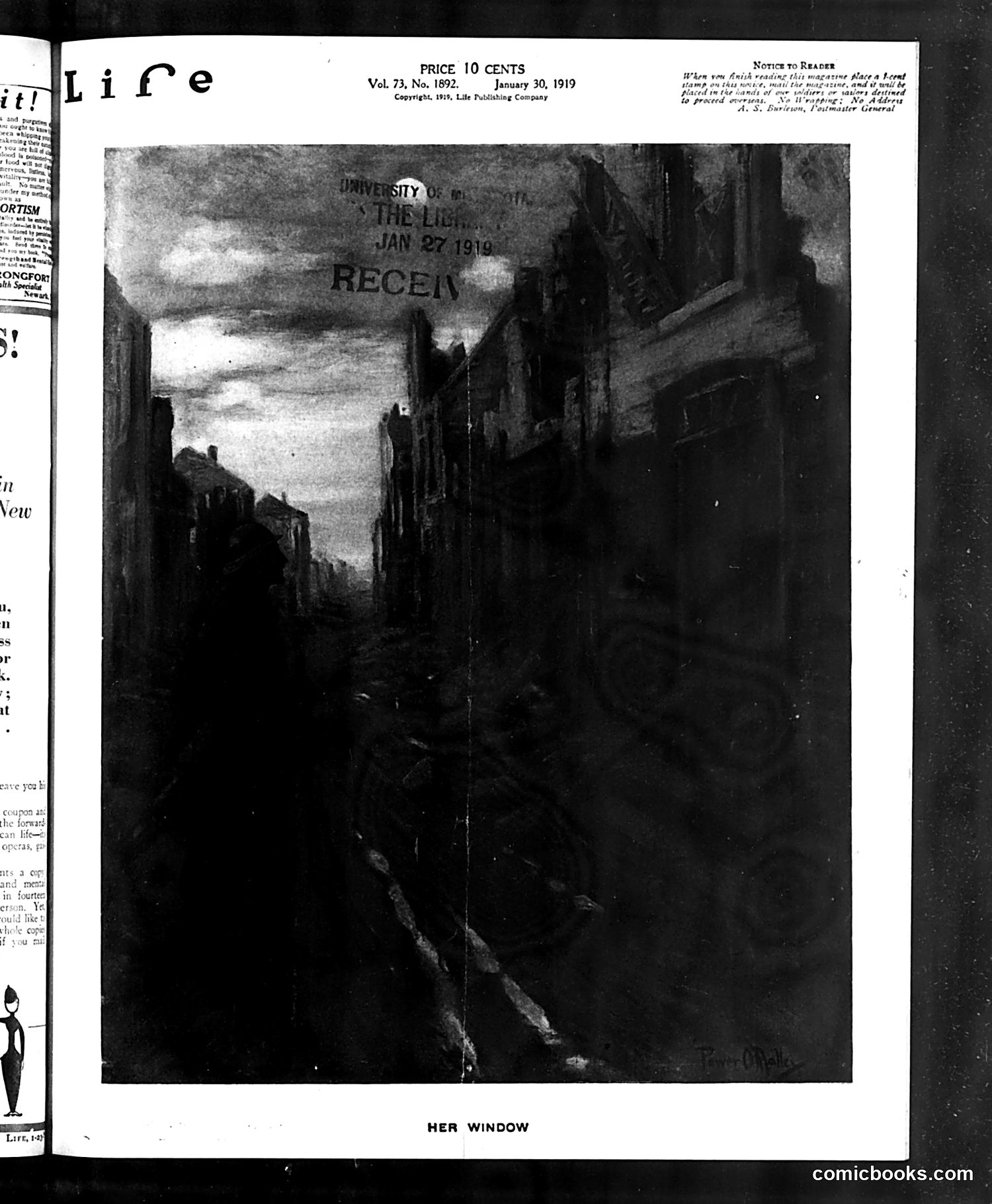
This page from *Life* magazine (January 30, 1919) features a dark, atmospheric photograph titled "Her Window." The image shows a narrow urban alley or street viewed from above, with tall buildings creating deep shadows and a moody sky. Without accompanying explanatory text visible on this page, the specific satirical intent is unclear. However, given *Life*'s tradition of social commentary, this appears to be either an artistic photograph meant to evoke urban social conditions or commentary on city life during the post-WWI period. The dramatic lighting and claustrophobic composition suggest themes of urban poverty or social constraint, common satirical subjects for the era. The actual caption or article explaining this image's satirical meaning is not legible in this reproduction.
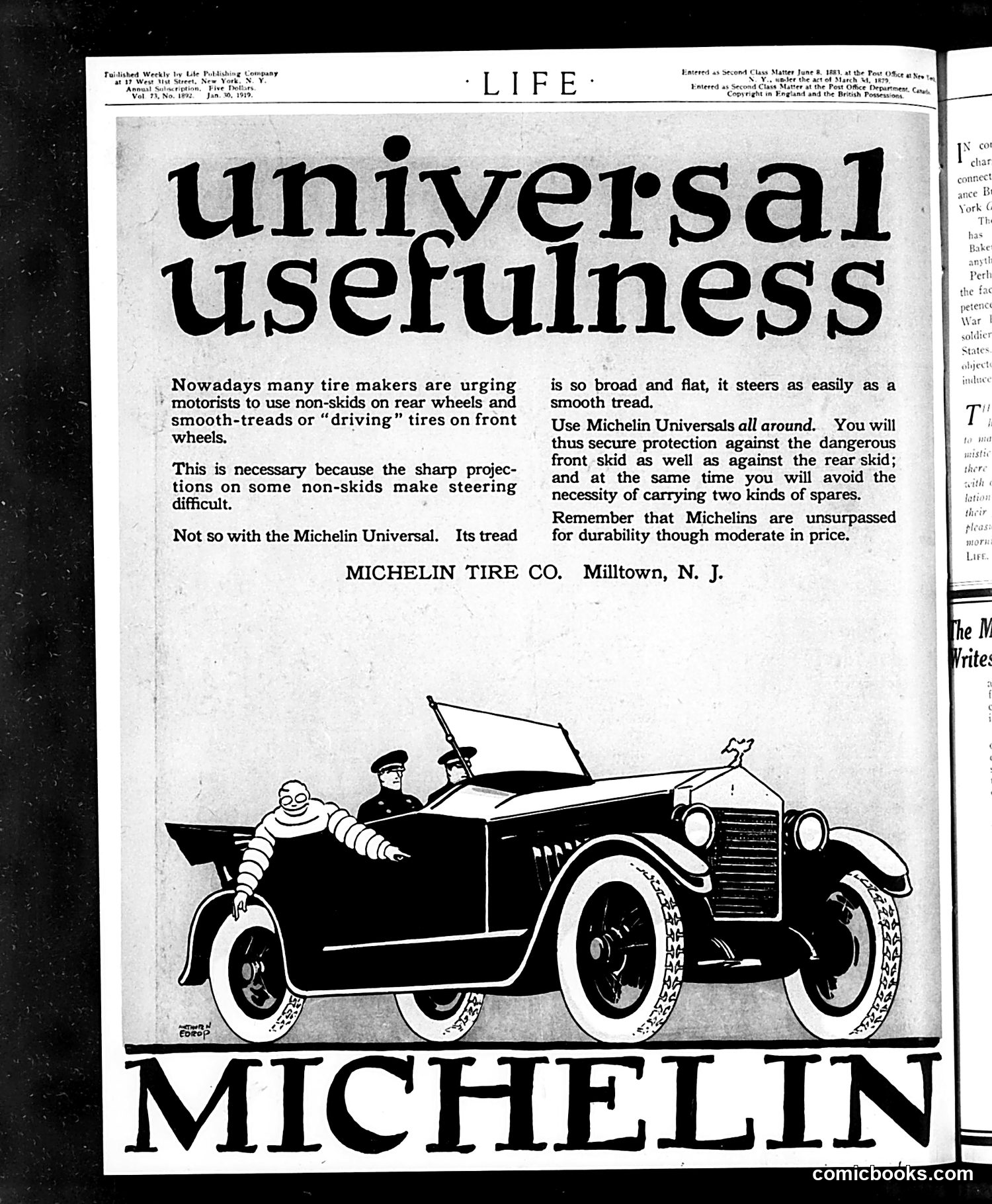
This is a **Michelin tire advertisement**, not political satire. The headline "Universal Usefulness" promotes Michelin's "Universal" tire model as superior to competitors' offerings. The ad addresses a practical automotive concern of the era: tire design. Competitors recommended different tire types for front wheels (smooth "driving" tires) versus rear wheels (non-skid treads), requiring drivers to carry multiple spare tires. Michelin's pitch: their Universal tire works equally well on all wheels due to its broad, flat tread that steers easily despite lacking sharp projections. The ad emphasizes durability and moderate pricing. The illustration shows a vintage open-air automobile with elegantly dressed passengers, typical of 1920s advertising imagery meant to convey modernity and sophistication. This reflects early automotive technology debates before tire standardization.
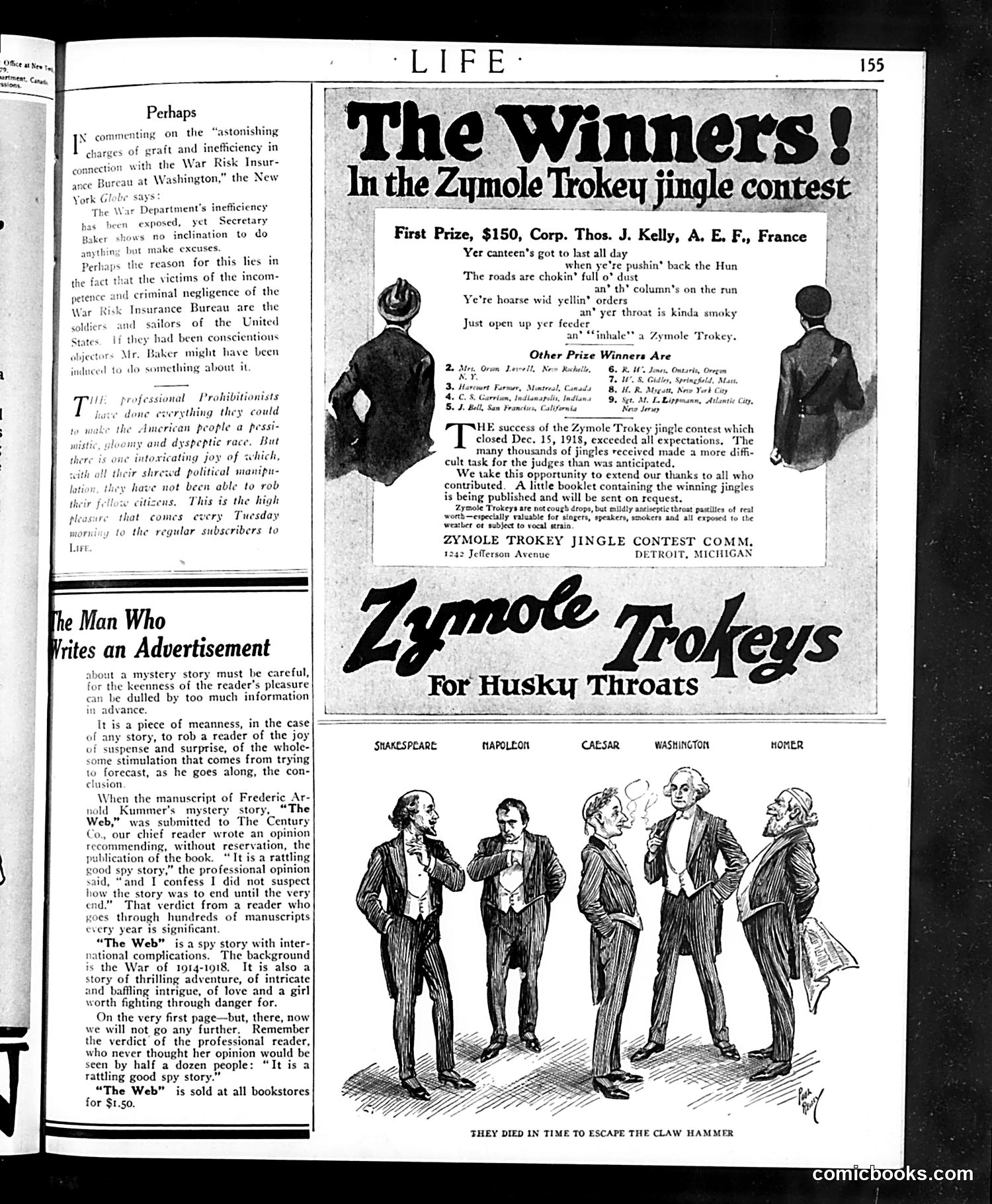
This page is primarily **advertising** for Zymole Trokey lozenges, featuring a jingle contest announcement and product promotion. The main cartoon depicts five historical figures (labeled Shakespeare, Napoleon, Caesar, Washington, and Homer) in formal dress, with the caption "THEY DIED IN TIME TO ESCAPE THE CLAW HAMMER." This appears to be a humorous advertisement suggesting that Zymole Trokey throat lozenges are so effective that famous figures from history would have benefited from them—the "claw hammer" likely refers to throat irritation or coughing. The left column contains editorial content about writing advertisements and discusses a book called "The Web." The cartoon's satire is straightforward product humor: playing on the idea that even history's greatest minds would have wanted this modern remedy.
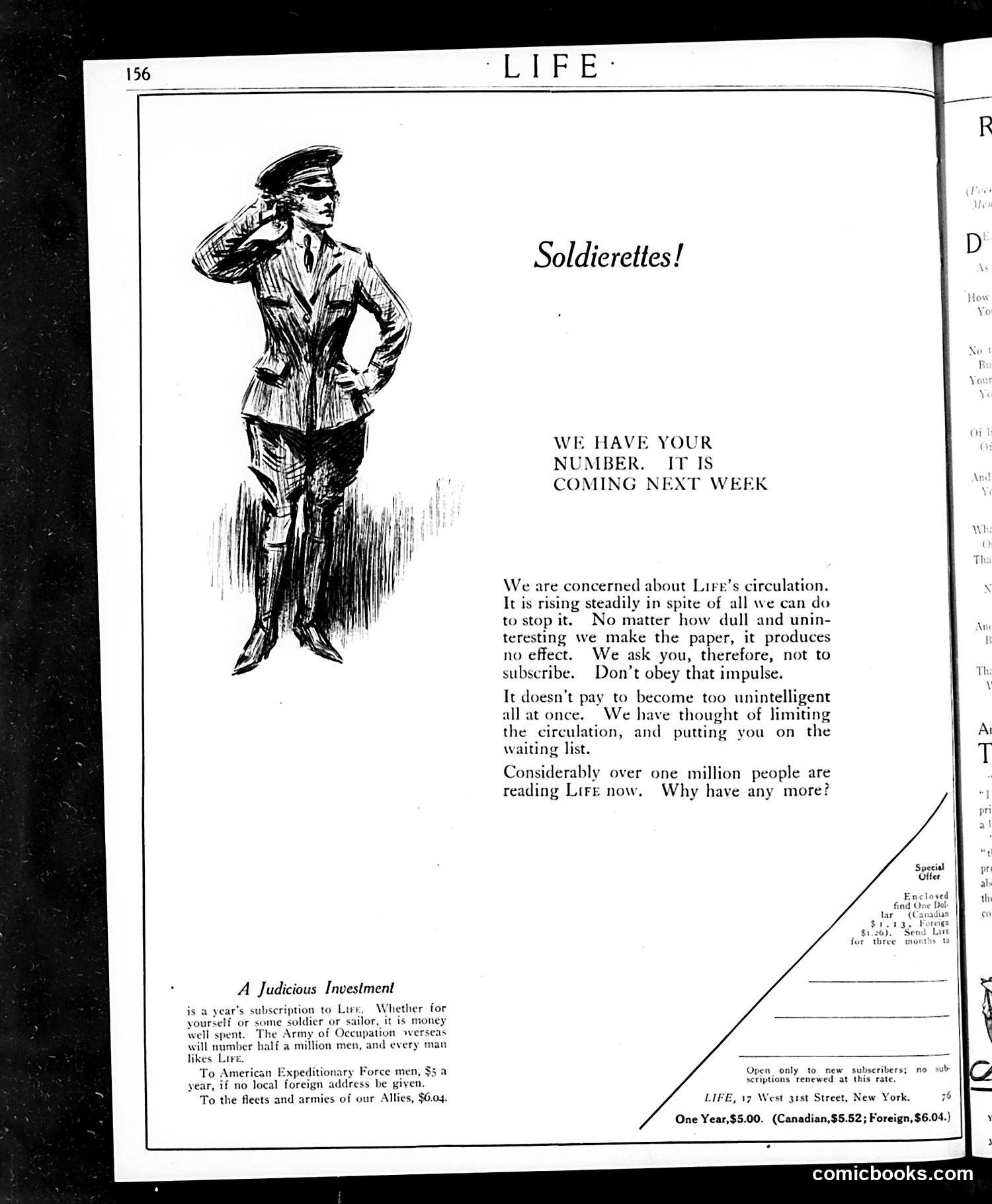
This page is primarily a **subscription solicitation** dressed as satirical commentary, likely from World War I era (references to "Army of Occupation" and Allied fleets suggest post-WWI). The illustration shows a **female soldier or "Soldierette"**—a topical figure representing women entering military service roles. The accompanying text jokingly warns readers not to subscribe to Life, claiming the magazine's circulation exceeds one million and suggesting they join a waiting list instead. This is reverse-psychology advertising: mock-discouragement designed to make the publication seem desirable. The subscription offers specific pricing for military personnel ($3 for American Expeditionary Force men, $6.04 for Allied fleets), targeting soldiers as a core audience during wartime.
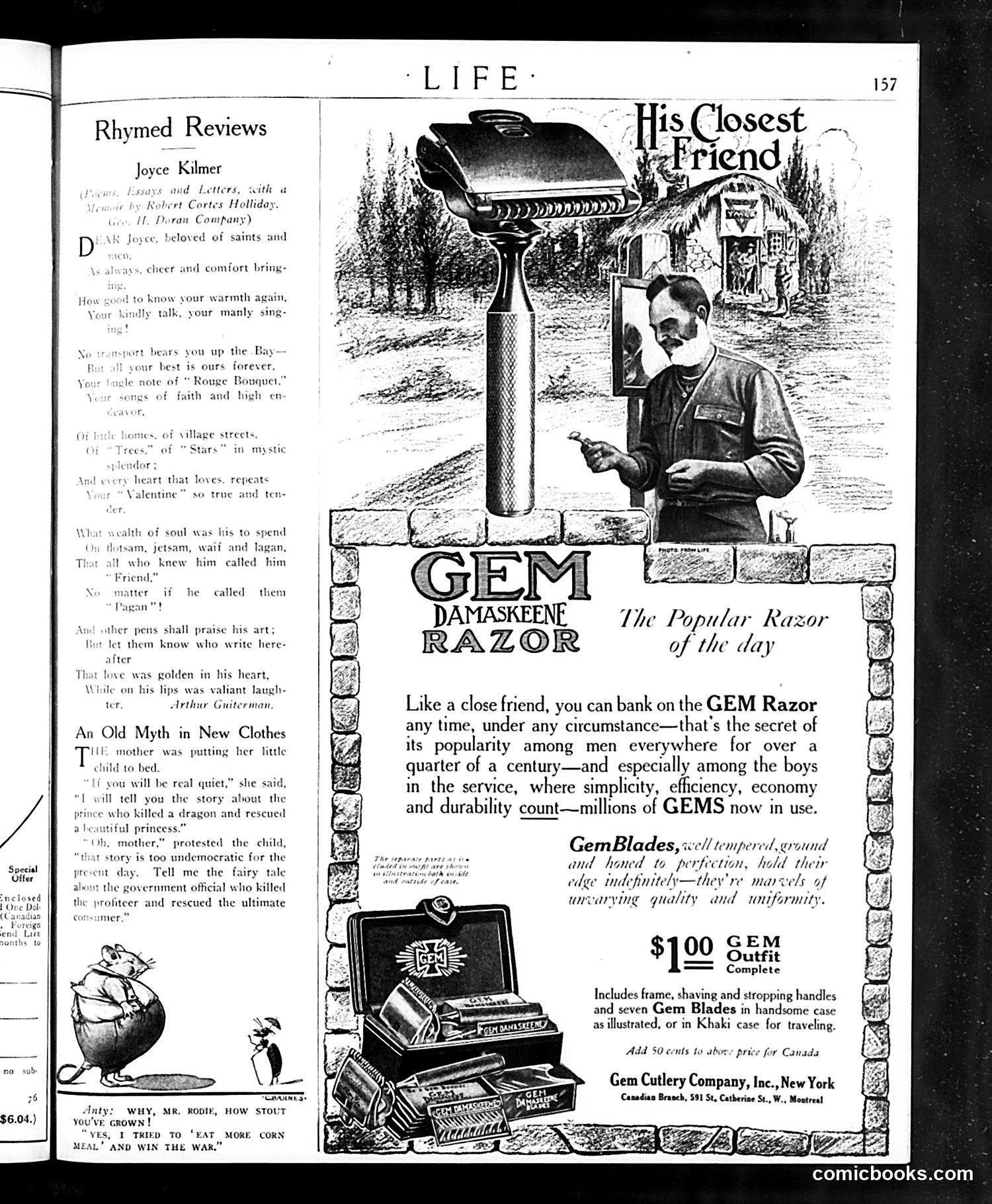
This page is **primarily advertising** rather than satire or political commentary. The dominant content is a full-page advertisement for the Gem Damascene Razor, marketed as "The Popular Razor of the day." The ad features an illustration of a man examining a razor with the headline "His Closest Friend," emphasizing the razor's reliability and dependability. The copy appeals to practicality and economy—values particularly relevant during wartime (the mention of "boys in the service" suggests World War I era). The left side contains a poem titled "Rhymed Reviews" by Joyce Kilmer, praising someone named "Dear Joyce" for their warmth and comfort—unrelated to the razor advertisement. The small cartoon at bottom-left appears to be a separate joke about food rationing or agricultural productivity, but remains unclear without additional context.
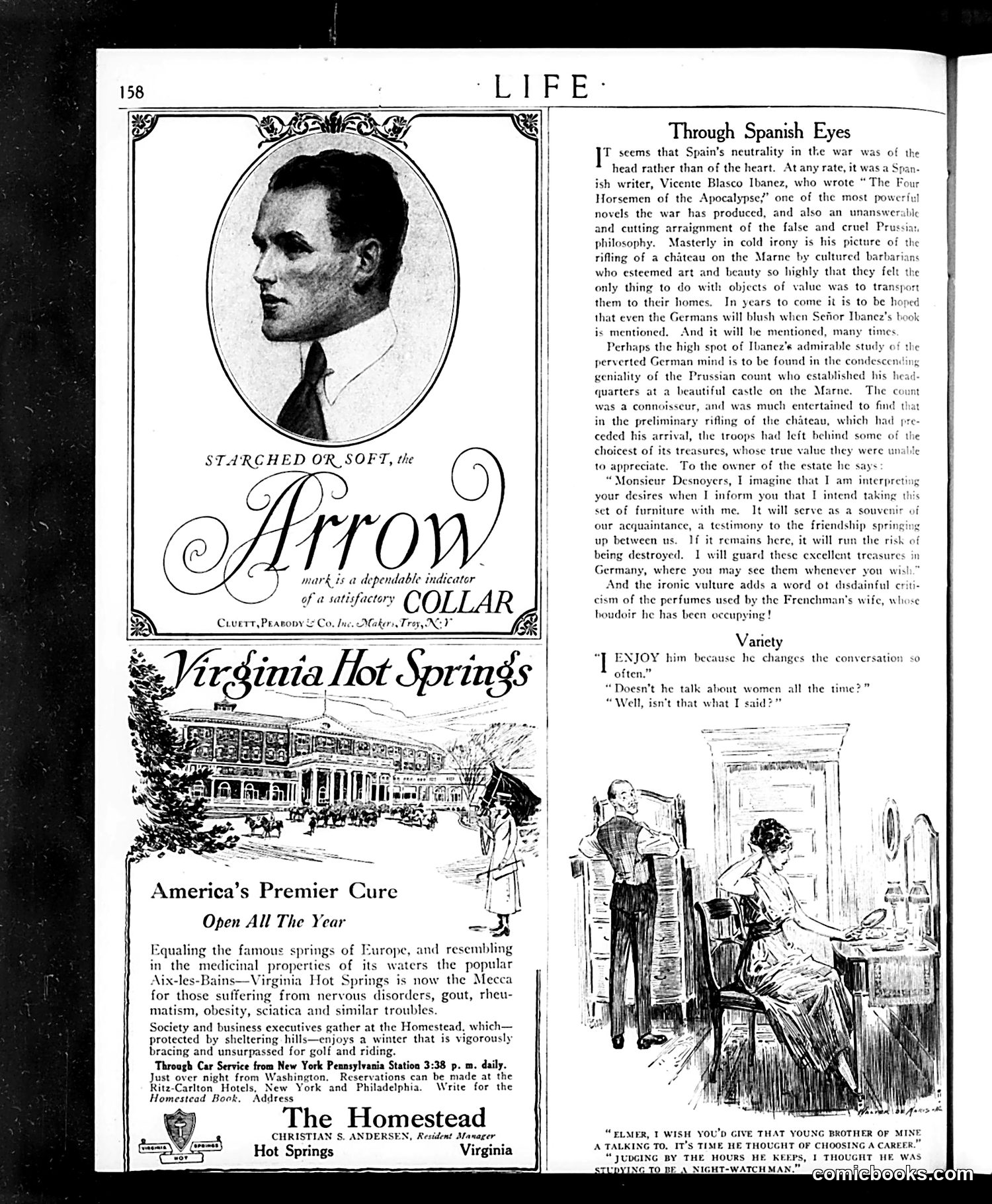
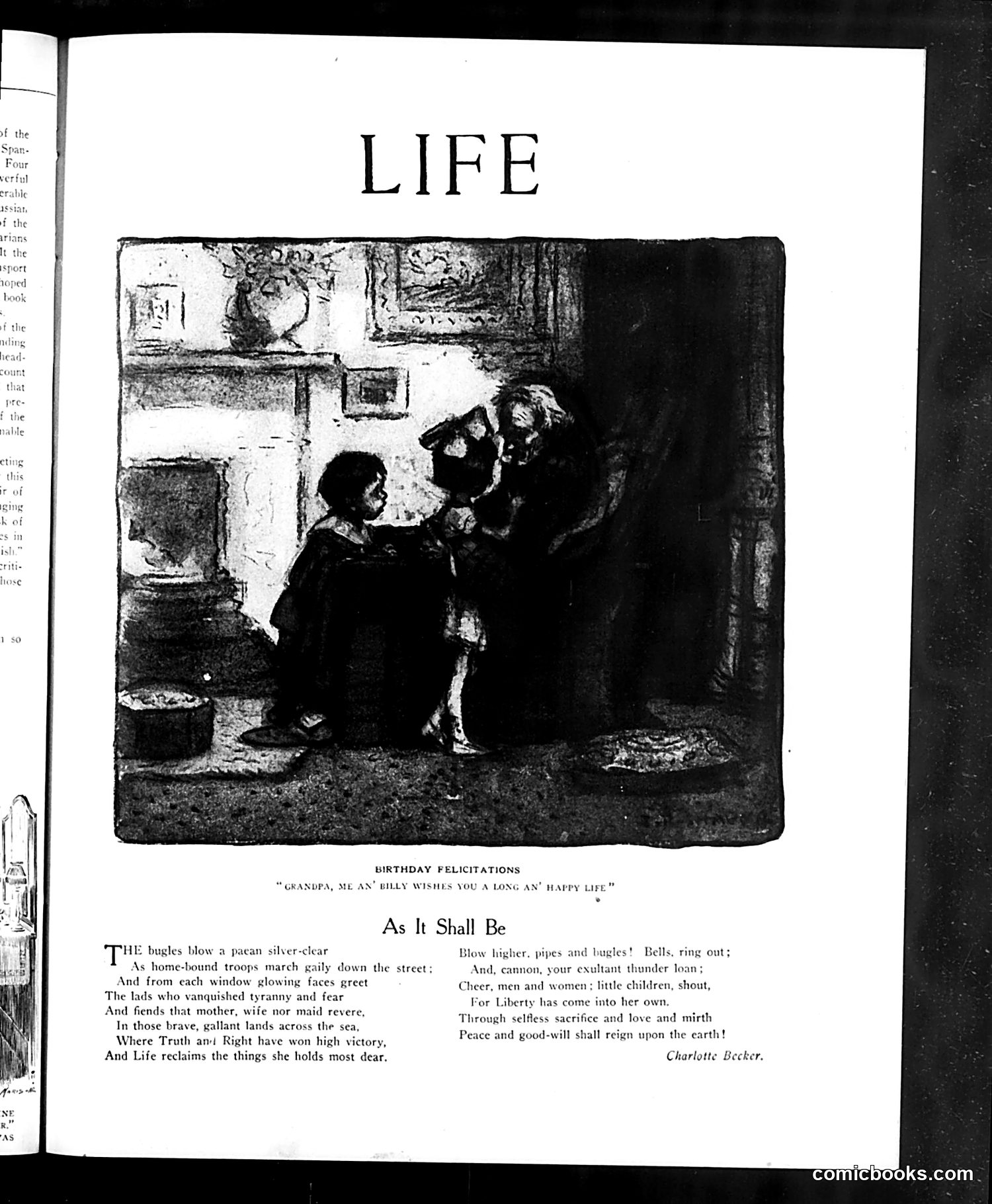
This page features an illustration titled "Birthday Felicitations" with the caption "Grandpa, Me An' Billy Wishes You a Long An' Happy Life." The image shows what appears to be an elderly woman with two children in a modest interior setting. Below is a poem titled "As It Shall Be" by Charlotte Becker, which celebrates post-war peace and prosperity. The verse references "bugles blow," "cannon's roar," and "Truth and Right" winning "high victory," suggesting this was published after World War I. The poem expresses optimistic sentiments about liberty, selfless sacrifice, and peace replacing conflict. The combination of the sentimental domestic scene with patriotic verse reflects post-WWI American hopes for restored family life and national renewal.
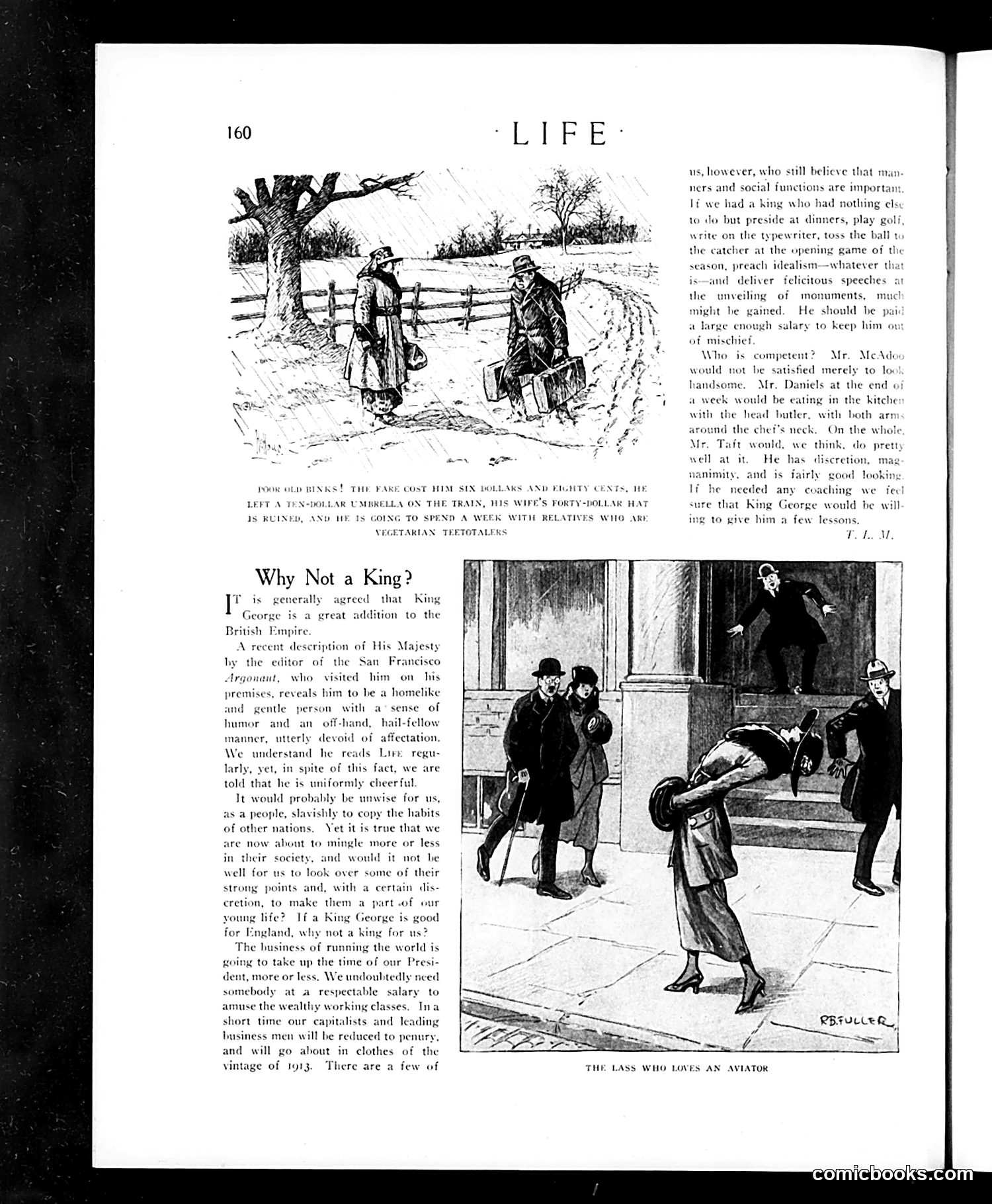
This page satirizes King George V of Britain through a tongue-in-cheek article proposing he'd make an excellent addition to American society. The upper sketch shows two figures at a fence in rural America, illustrating the article's opening anecdote about George's modest, humble demeanor. The main cartoon below, titled "The Lass Who Loves an Aviator," depicts a young woman enthusiastically greeting an aviator while onlookers react with amusement. This appears unrelated to the King George discussion—likely a separate humorous feature about the contemporary fascination with early aviation. The "Why Not a King?" article critiques American social aspirations by ironically suggesting Britain's king would suit American needs, poking fun at American attitudes toward monarchy and class.
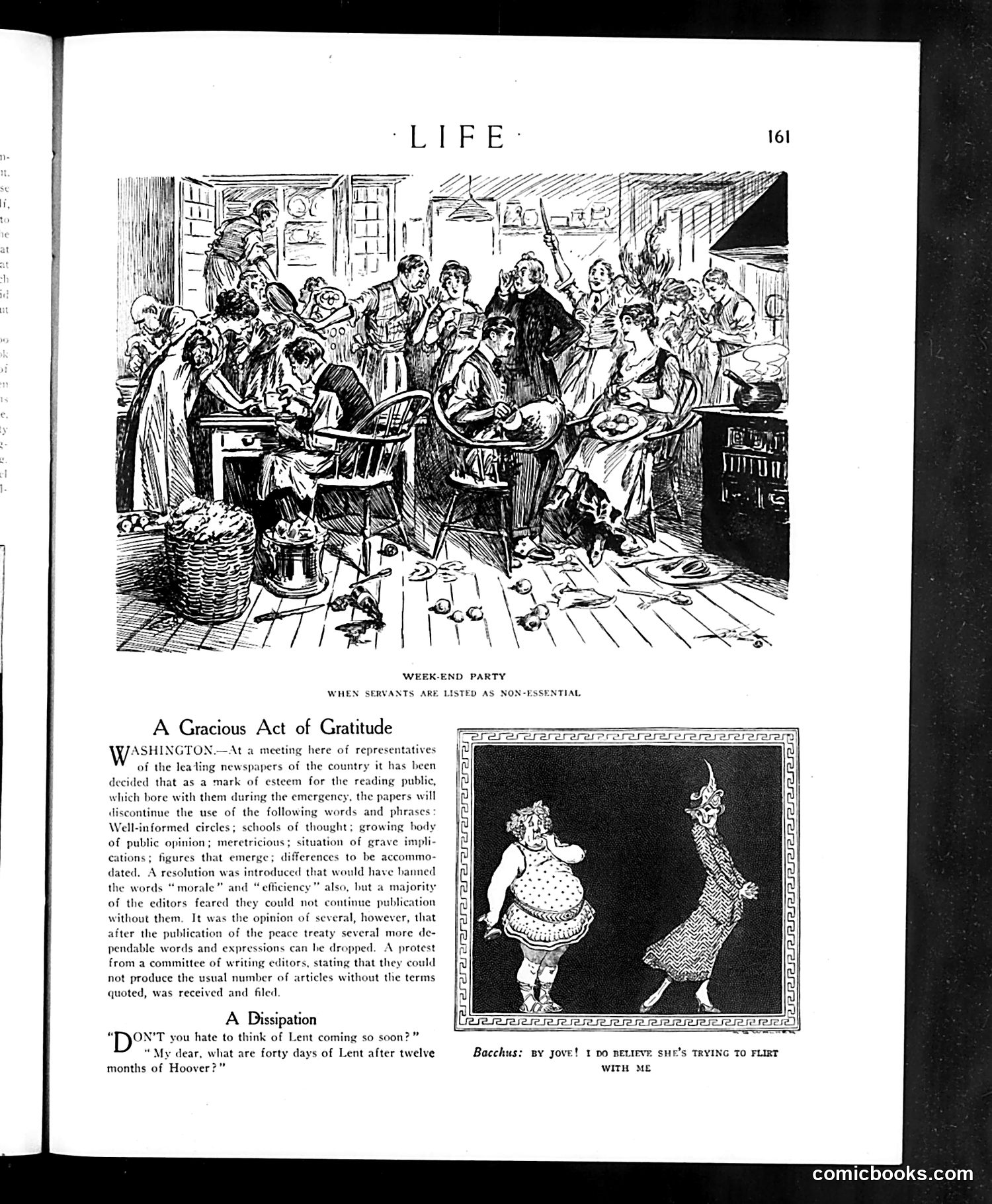
**Main Cartoon ("Weekend Party"):** Depicts a chaotic domestic scene where servants are being treated as "non-essential" — a satirical jab at post-WWI labor dynamics. The crowded, messy gathering suggests that dismissing household staff as expendable leads to household disorder. **"A Gracious Act of Gratitude":** This article mocks newspaper editors who agreed to voluntarily ban certain words and phrases ("moral," "efficiency," etc.) during peace treaty negotiations, treating it as patriotic self-censorship. The satire questions whether such restrictions actually serve the public good or merely limit press freedom. **"A Dissipation":** A brief comedic dialogue joke about Lent observance lasting forty days after twelve months of indulgence—poking fun at inconsistent religious devotion. The overall tone critiques post-war social pretensions and institutional hypocrisy.
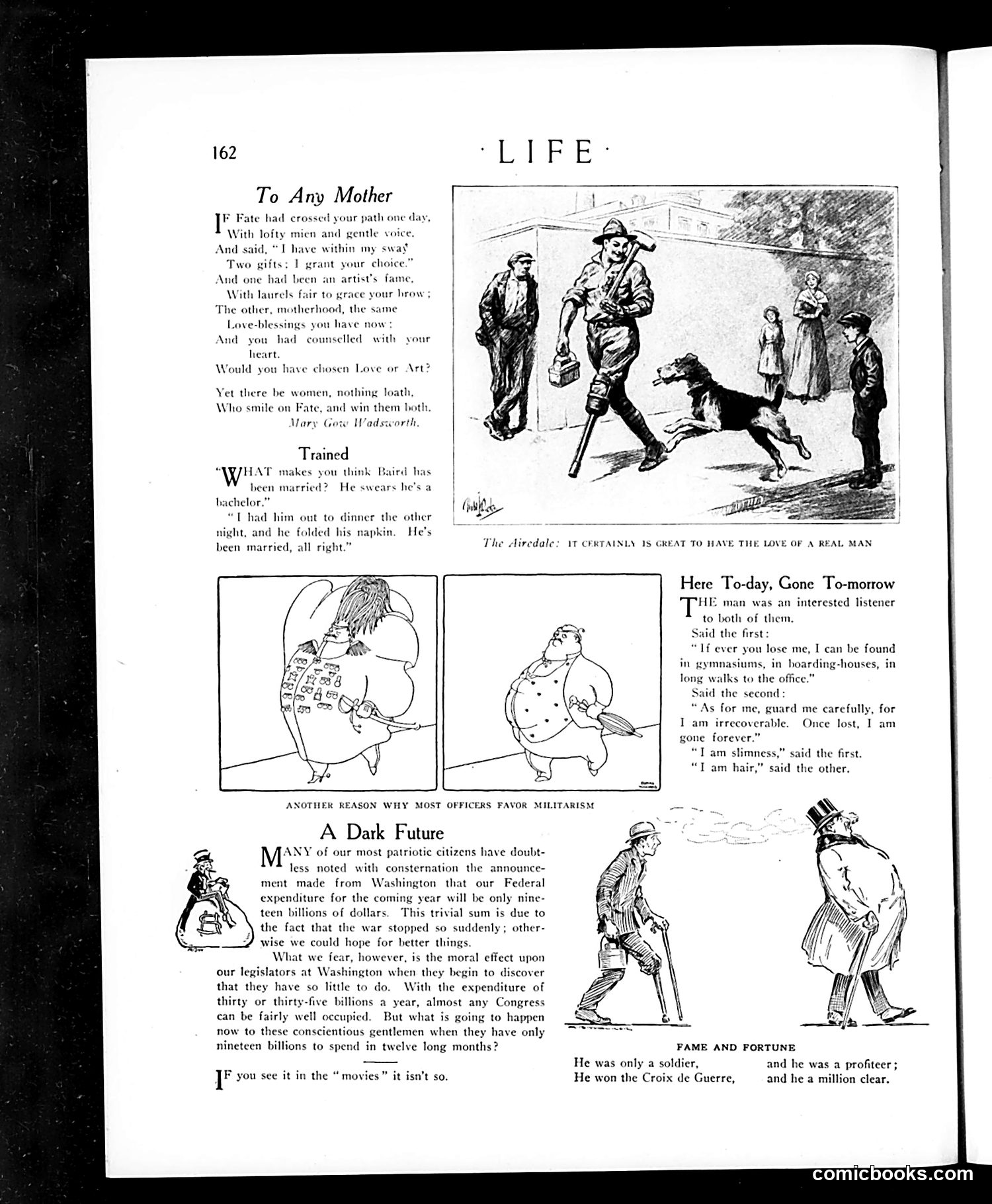
This page contains several satirical pieces from what appears to be the post-WWI era: **"To Any Mother"** is a poem by Mary Gosse Wadsworth about choosing between love and art as life paths. **"Trained"** is a brief joke about a bachelor claiming he's married while folding napkins. **"Another Reason Why Most Officers Favor Militarism"** is a cartoon showing military officers with exaggerated physiques, satirizing how military uniforms flatter larger men's appearances. **"A Dark Future"** discusses Federal spending concerns following WWI's sudden end, warning about eighteen-billion-dollar expenditures. **"Fame and Fortune"** contrasts a soldier who won the Croix de Guerre with a profiteer who became a millionaire—criticizing wartime profiteering versus military sacrifice. The overall theme critiques post-war society's values and government spending priorities.
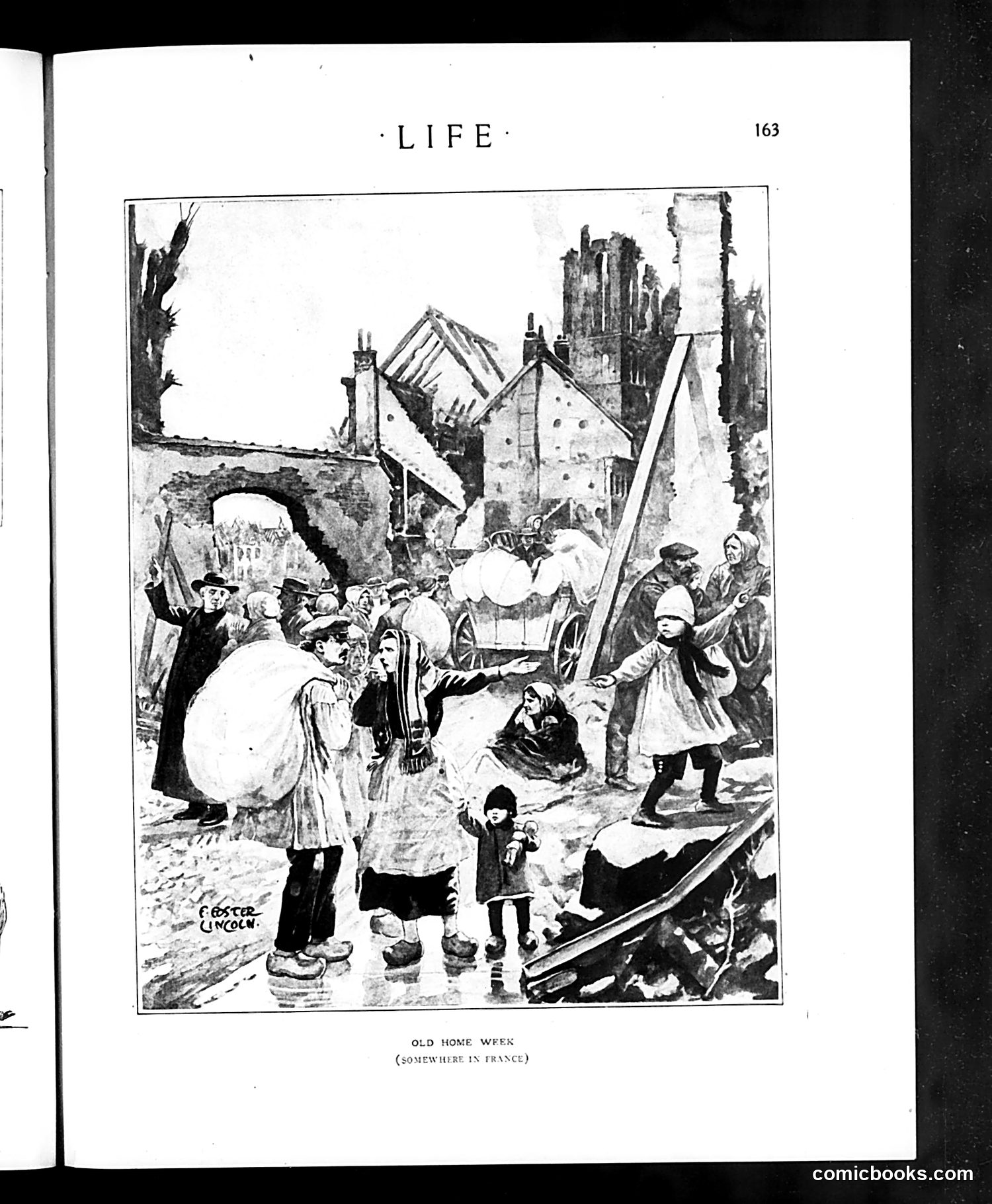
This illustration by Cesare Lincoln depicts a crowded street scene in a French town, showing civilians and soldiers mingling together. The caption "Old Home Week" suggests a nostalgic gathering or reunion. Given the reference to France and the presence of military uniforms, this likely relates to World War I, when American soldiers were stationed in France. The "Old Home Week" concept—a real American tradition of community reunions—appears to be satirizing the mixing of soldiers with French civilians, perhaps commenting on American military presence abroad or the cultural exchange/friction between American troops and French populations during WWI. The detailed architecture and period clothing support this wartime context.
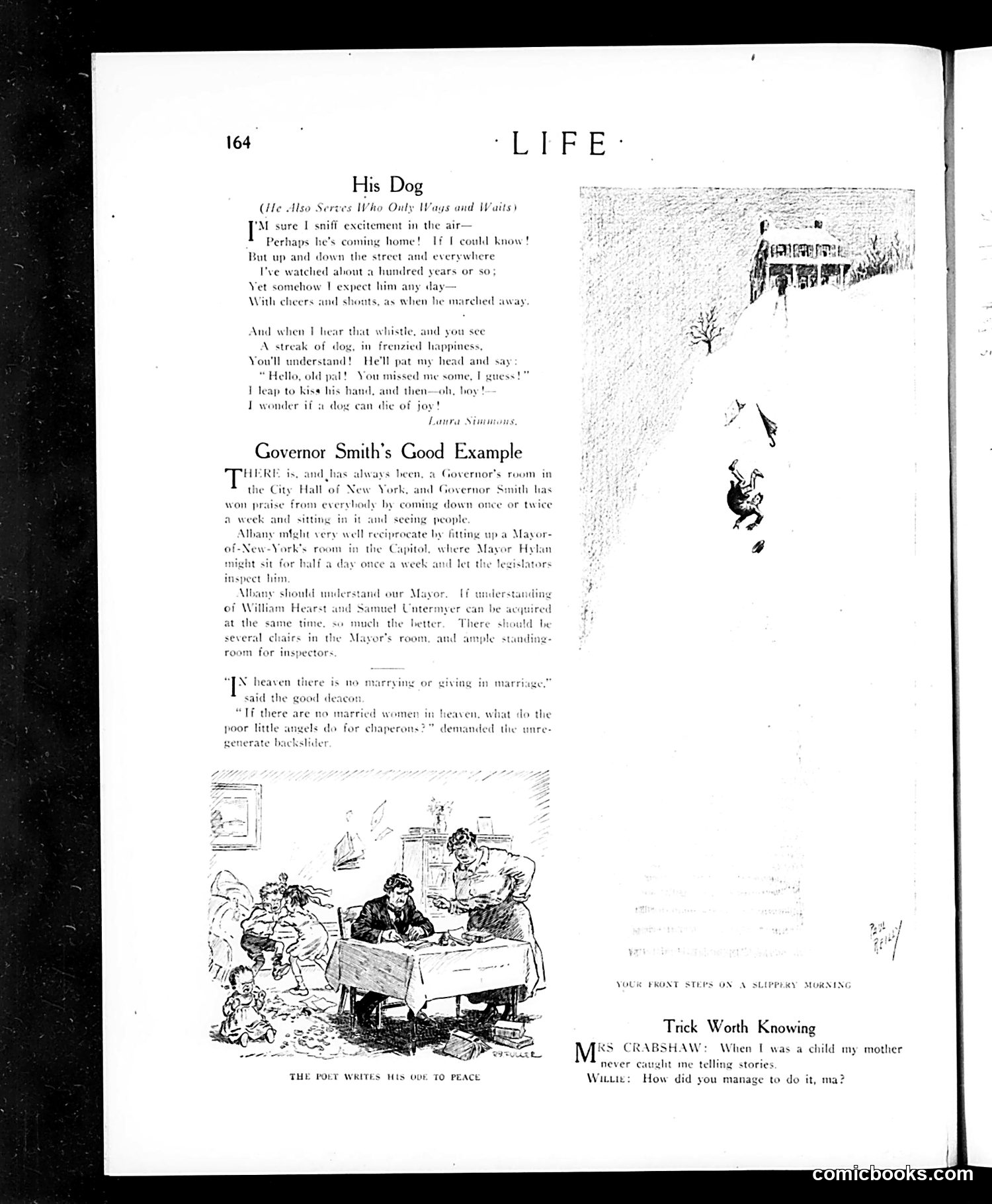
This page contains three distinct pieces: 1. **"His Dog"** — A sentimental poem by Laura Simmons celebrating a dog's joyful reunion with its owner, emphasizing unconditional loyalty. 2. **"Governor Smith's Good Example"** — A satirical article praising Governor Smith's accessibility by holding office hours in New York's City Hall, where citizens can meet him. The piece suggests other officials should adopt similar practices. It references Mayor Hylan and implies better governance through public access. 3. **"The Poet Writes His Ode to Peace"** — A cartoon (bottom) depicting a chaotic domestic scene with multiple children and household disorder, satirizing the contrast between lofty ideals of "peace" and the reality of family chaos. 4. **"Trick Worth Knowing"** — A brief humorous dialogue between Mrs. Crabshaw and Willie about storytelling. The overall theme mixes sentiment, political commentary, and domestic humor typical of early 20th-century American satirical magazines.
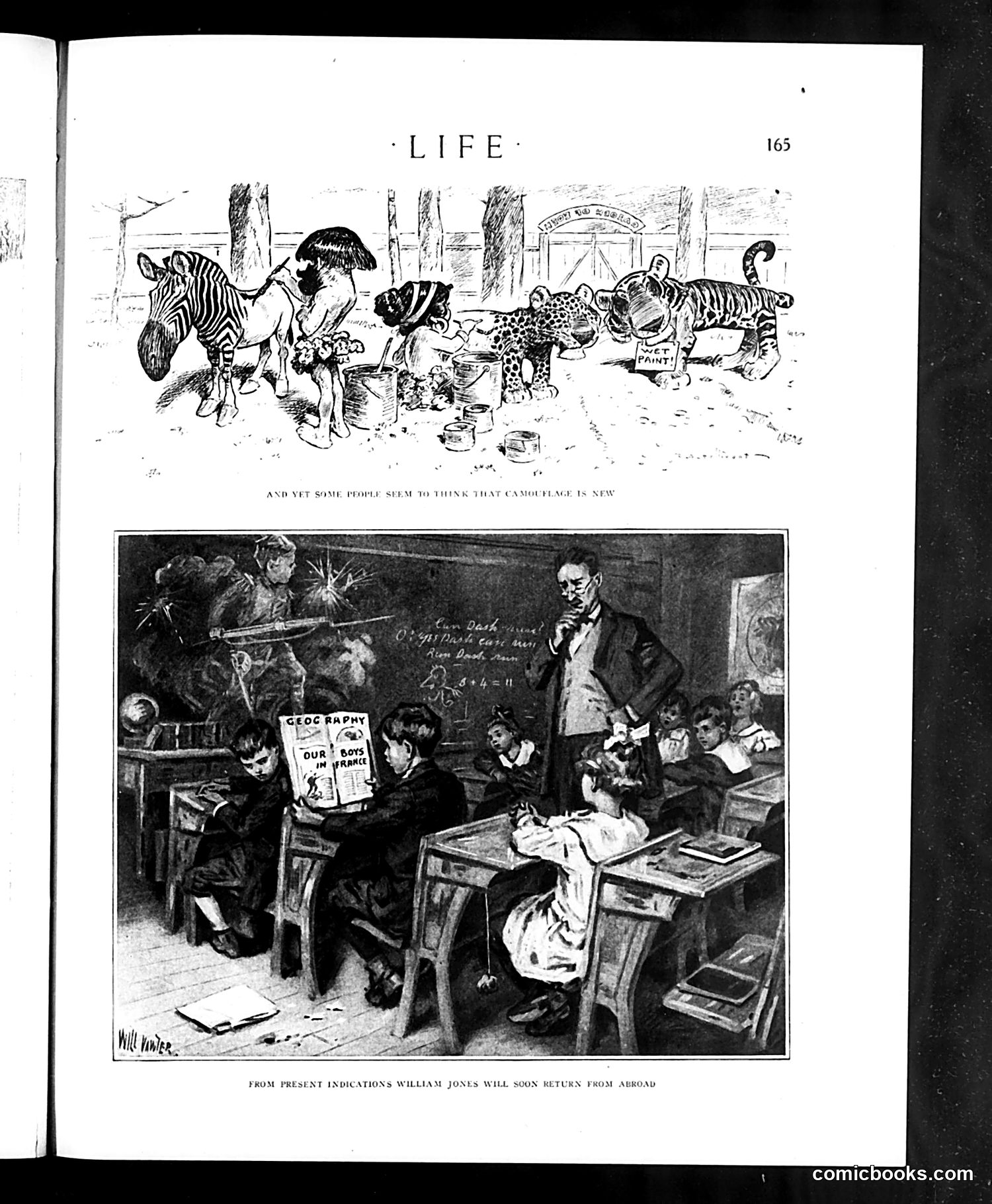
**Top Cartoon:** A satirical scene depicting various animals (zebra, leopard, tiger) and people in what appears to be a zoo or circus setting, illustrating the caption: "AND YET SOME PEOPLE SEEM TO THINK THAT CAMOUFLAGE IS NEW." This mocks the idea that camouflage is a modern invention, when animals have used natural camouflage for millennia—likely a jab at contemporary military or fashion claims of novelty. **Bottom Cartoon:** A classroom scene where a teacher presents a geography or astronomy lesson to young students. The caption references "William Jones will soon return from abroad," suggesting this is commentary on someone's anticipated homecoming. The cartoon appears to satirize educational methods or perhaps Jones's absence and impact on his position. The artist is credited as "Will Dyson."
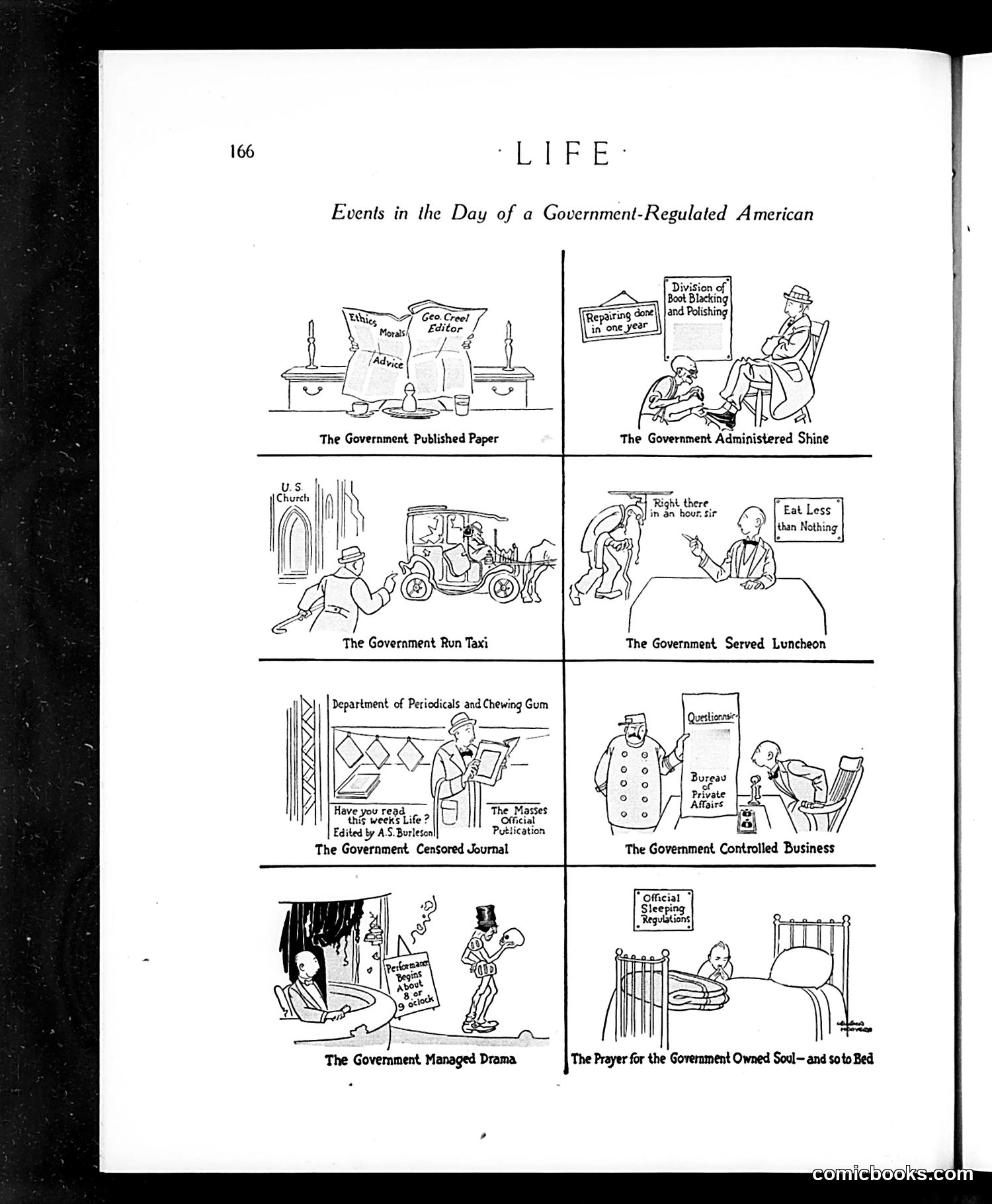
This satirical cartoon series mocks government overreach and control of daily life. Each panel shows a citizen's activities subjected to bureaucratic regulation: - **Government Published Paper**: Officials dictate what newspapers publish - **Government Administered Shine**: A "Division of Boot Blacking and Polishing" oversees shoe maintenance - **Government Run Taxi**: Transportation is state-controlled - **Government Served Lunch**: Food rationing ("Eat Less than Nothing") - **Government Censored Journal**: Publications face censorship - **Government Controlled Business**: Bureaucrats regulate private enterprise - **Government Managed Drama**: Entertainment is state-approved - **Prayer for Government Owned Soul**: The final panel sardonically suggests even spiritual life is controlled The satire critiques expansive government intervention in ordinary American activities, suggesting totalitarian control has invaded every aspect of existence—from morning to bedtime.
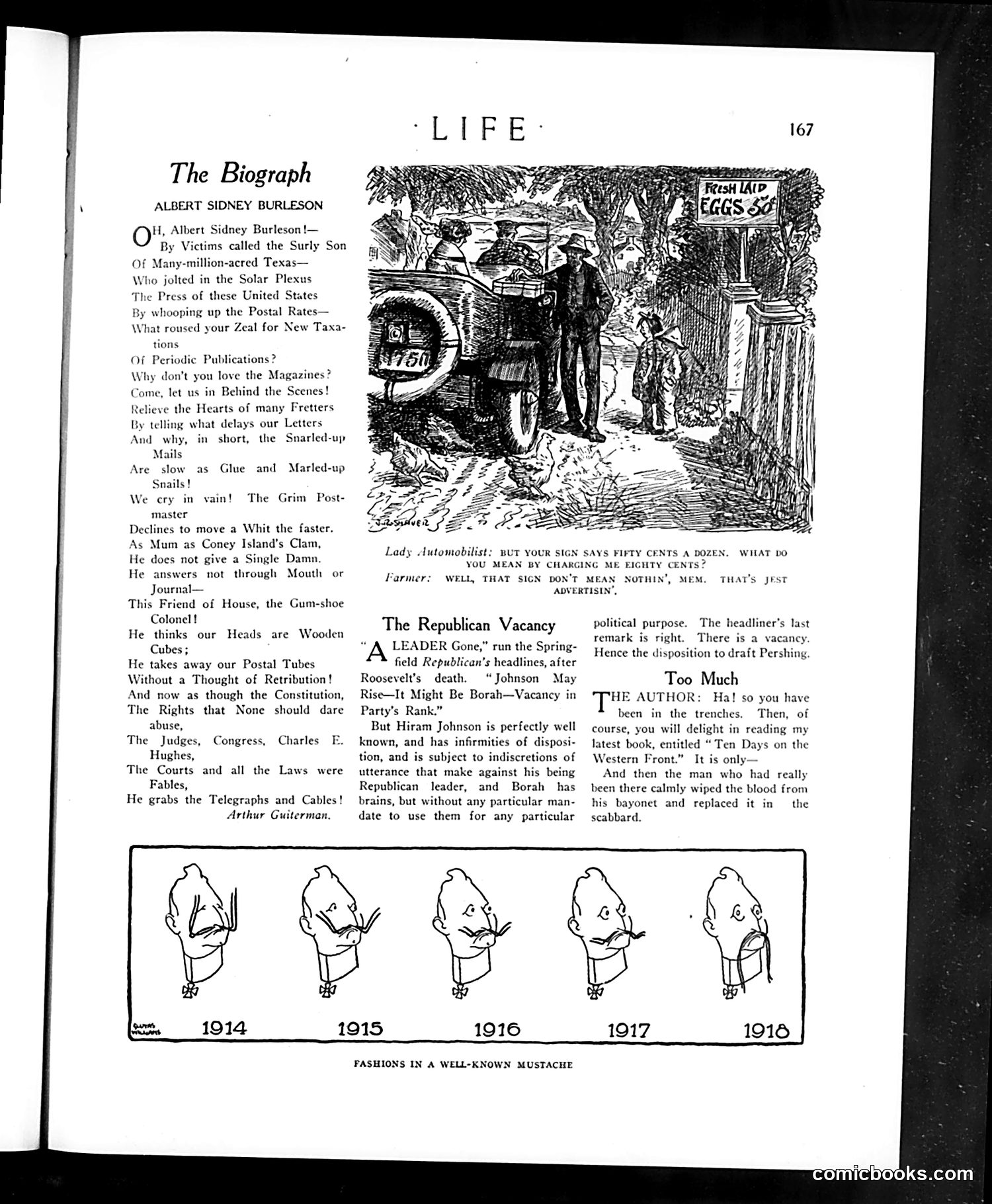
This 1918 Life magazine page contains three distinct items: **"The Biograph"** is a satirical poem by Arthur Guiterman mocking Albert Sidney Burleson, Postmaster General under President Wilson. The poem ridicules Burleson's unpopular postal policies—particularly his suppression of magazines and delays in mail delivery, which frustrated publishers and the public. **"The Republican Vacancy"** discusses the leadership void after Theodore Roosevelt's death, with Hiram Johnson positioned as a potential successor. **"Too Much"** is a brief author's quip about war books. **The bottom cartoon** titled "Fashions in a Well-Known Moustache" shows the stylistic evolution of a recognizable politician's facial hair from 1914-1918, likely satirizing vanity or changing political fortunes during this period.
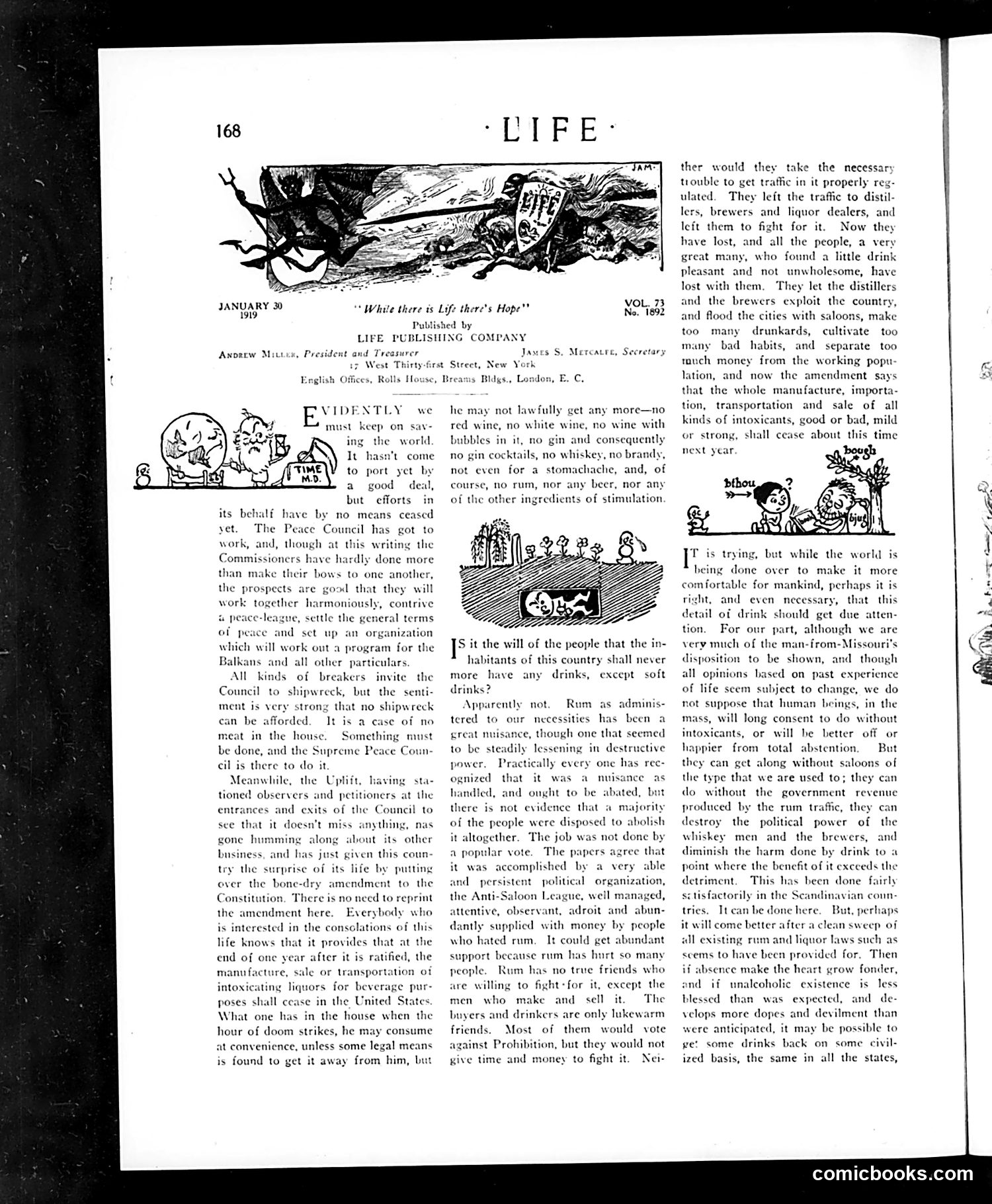
This page addresses the recent passage of Prohibition (the 18th Amendment), which took effect in 1920. The top cartoon depicts a skeletal "Death" figure labeled "PIPE" lying horizontally—likely symbolizing the death of alcohol/drinking culture. The editorial argues that Prohibition succeeded not because the majority of Americans actually wanted it, but because the **Anti-Saloon League**—a well-organized, well-funded temperance organization—outmaneuvered ordinary drinkers and liquor merchants. The piece criticizes how drinkers were passive: they wouldn't actively fight to preserve alcohol access, leaving the fight only to those profiting from the liquor trade. The satire's point: a disciplined minority with strong conviction (temperance advocates) defeated a passive, disorganized majority (casual drinkers) who merely preferred alcohol but wouldn't organize politically to defend it. This reveals how organized activism can override public opinion—a cautionary tale about democracy and special-interest movements.
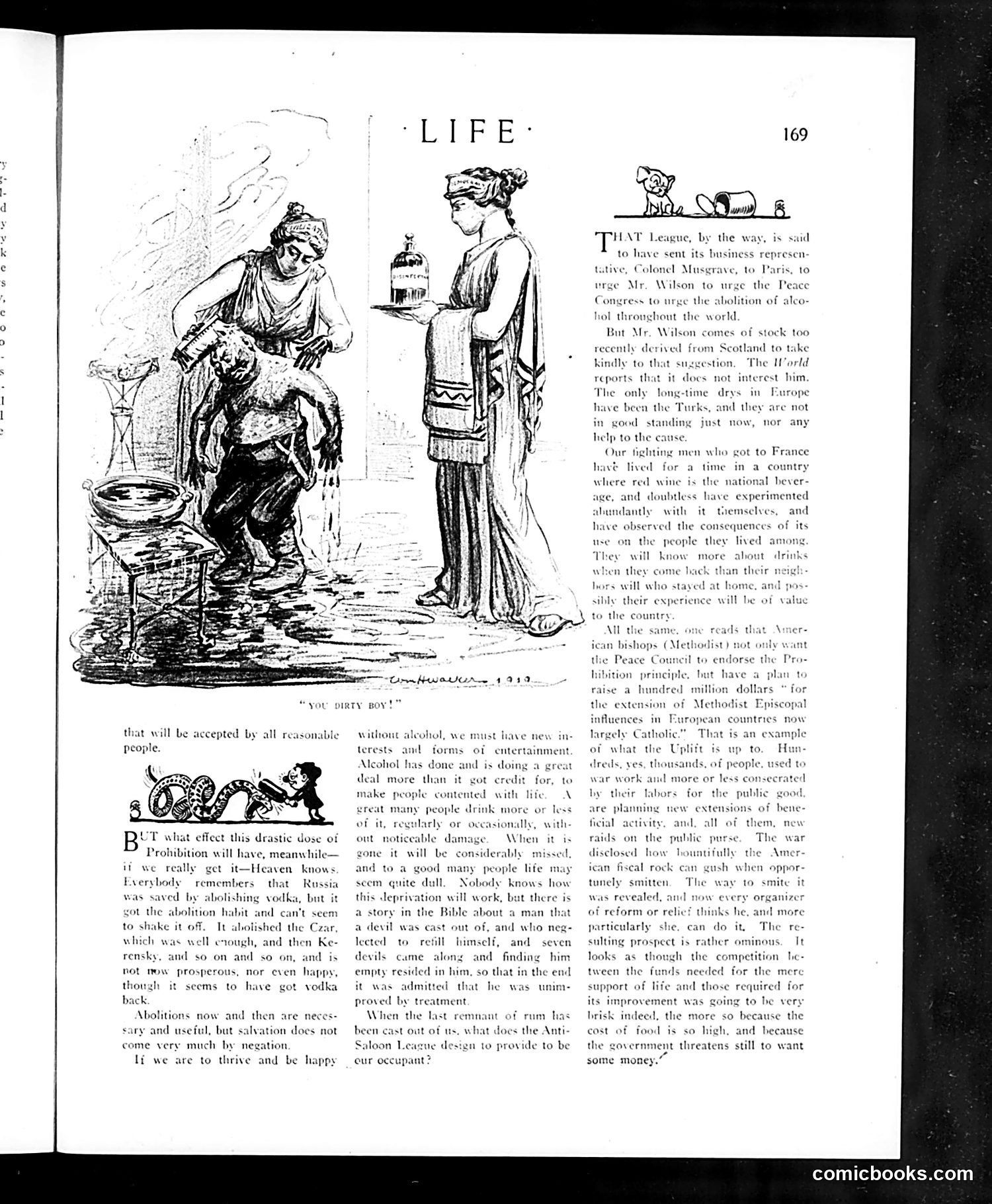
## Main Cartoon: "You Dirty Boy!" The illustration depicts a woman scolding a dirty child near bowls of liquid, likely referencing Prohibition's implementation. The caption's crude language emphasizes the cartoon's irreverent tone. ## Central Argument The article satirizes American Prohibition efforts while noting the Anti-Saloon League's attempt to influence President Wilson at the Paris Peace Conference to promote worldwide alcohol abolition. ## Key Satire Points - **The League's ambition**: Depicted as overreaching—trying to impose American moral standards globally - **Wilson's Scottish heritage**: Used humorously to suggest he'd resist such puritanical measures - **Double standard**: American soldiers in France observed wine's cultural role without harm, yet reformers push abstinence - **Unintended consequences**: Removing alcohol creates emptiness people will fill with other vices—referencing a biblical parable about demons returning sevenfold - **Economic hypocrisy**: The article notes reformers will use government funds ("fiscal rock") for their own expansion while claiming moral righteousness The piece mocks zealous reformers' naiveté about human nature and their imperialistic impulse to export American Prohibition.
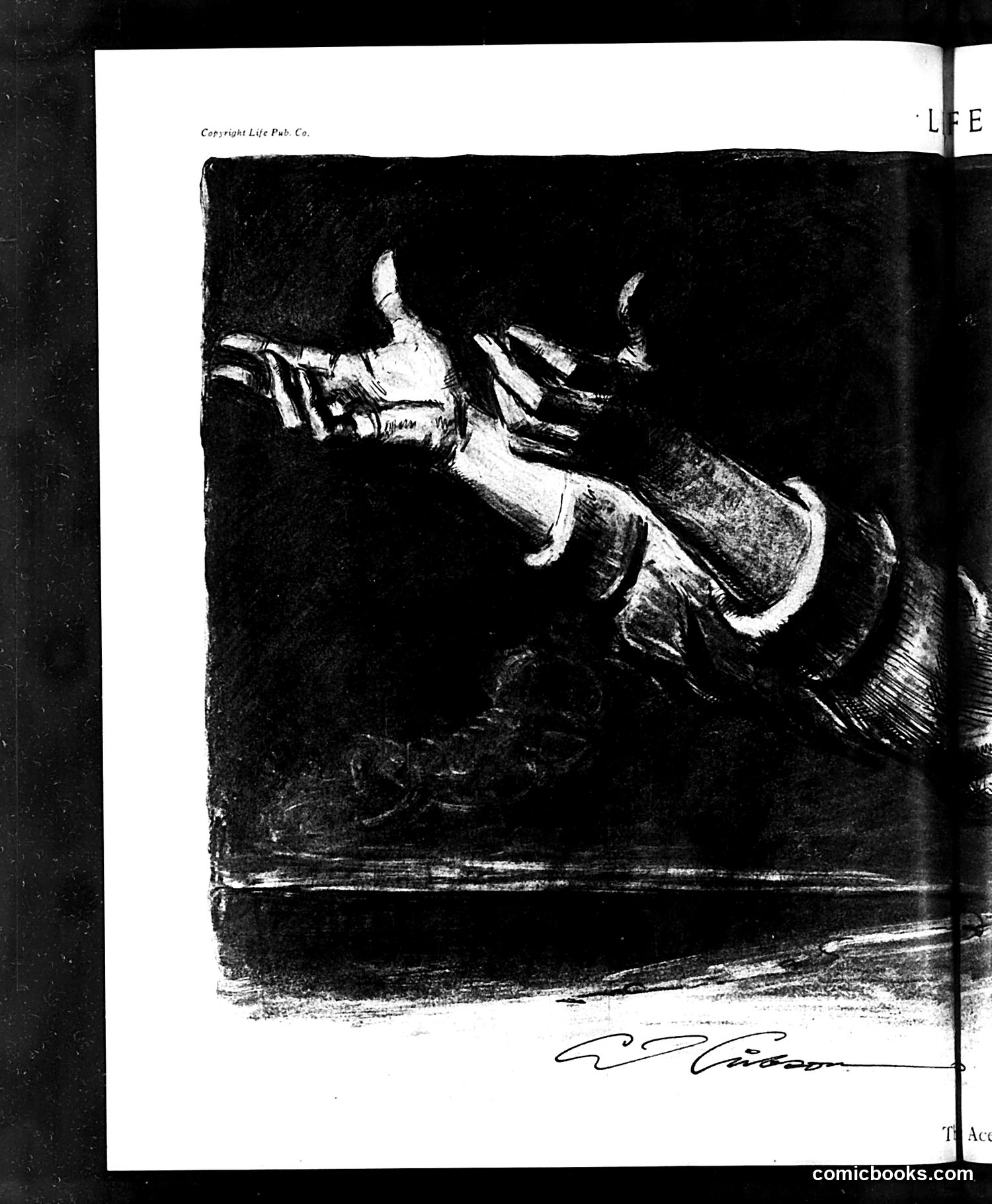
This appears to be a satirical illustration from *Life* magazine, though the OCR'd text is too corrupted to extract meaningful content. The image shows a dramatic black-and-white sketch depicting a hand gripping or wielding what appears to be a large cylindrical object (possibly a club, weapon, or industrial tool). The artistic style uses strong contrasts and expressive linework typical of early-to-mid 20th century political cartooning. Without legible accompanying text or a visible date, I cannot identify the specific historical event, political figure, or social commentary this cartoon references. The signature appears to be present but is not clearly legible in this reproduction. The dramatic, confrontational imagery suggests social conflict or criticism of power dynamics, but determining the exact target and message requires additional context not available from this page alone.
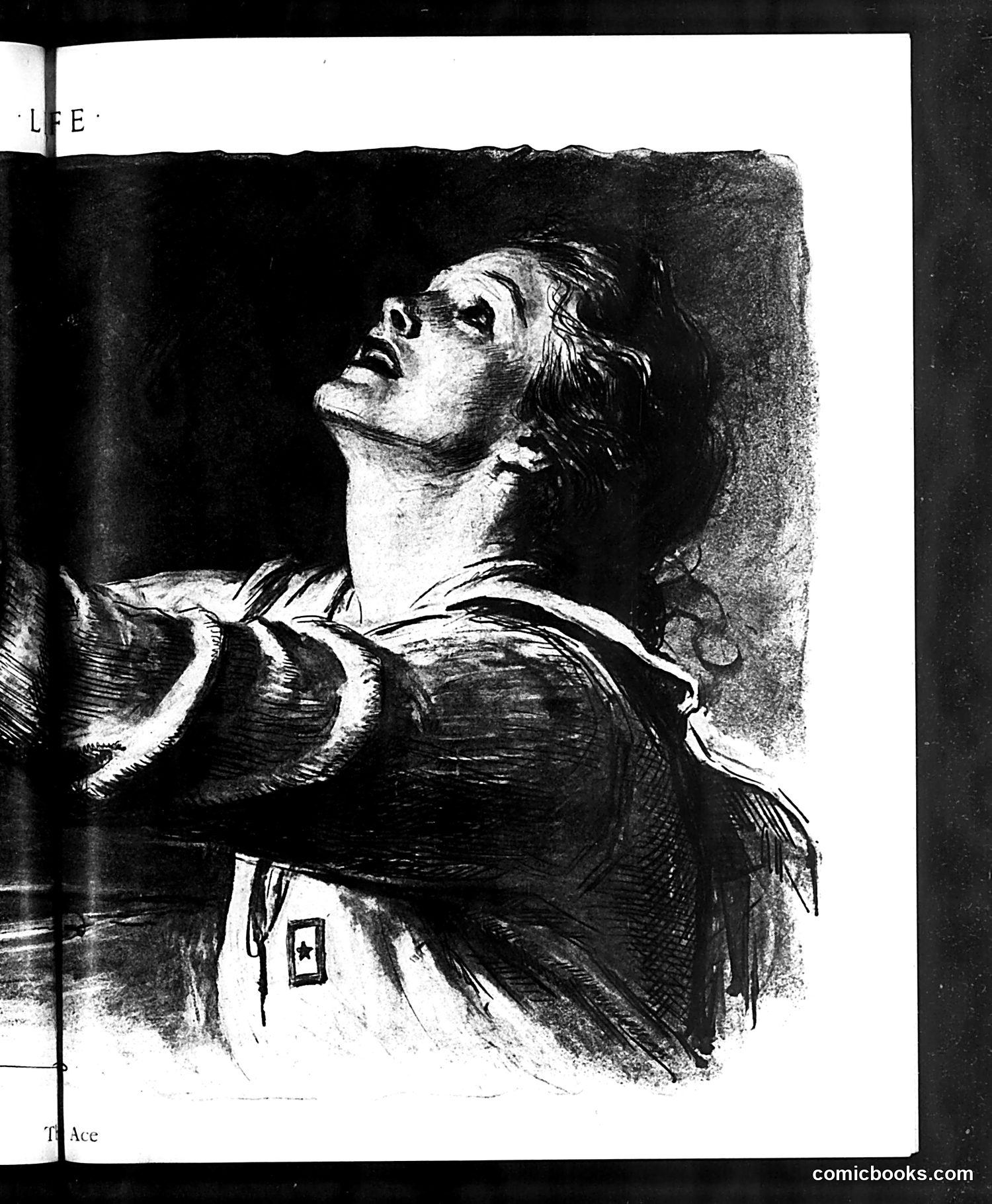
This appears to be a page from *Life* magazine featuring a dramatic sketch or etching of a man in profile, head tilted back, wearing what looks like period clothing with draped fabric across his shoulders. The figure has long, somewhat wild hair and an expression of apparent anguish or intensity. The OCR text provides only "comicbooks.com" (a modern watermark) and partial text reading "Ace" at the bottom, offering no clear identification of the subject or satirical intent. Without additional context—such as a caption, date, or accompanying text—I cannot definitively identify who this caricature represents or what political or social commentary it intended. The dramatic pose suggests emotional intensity, but the specific target and message remain unclear from the image alone.
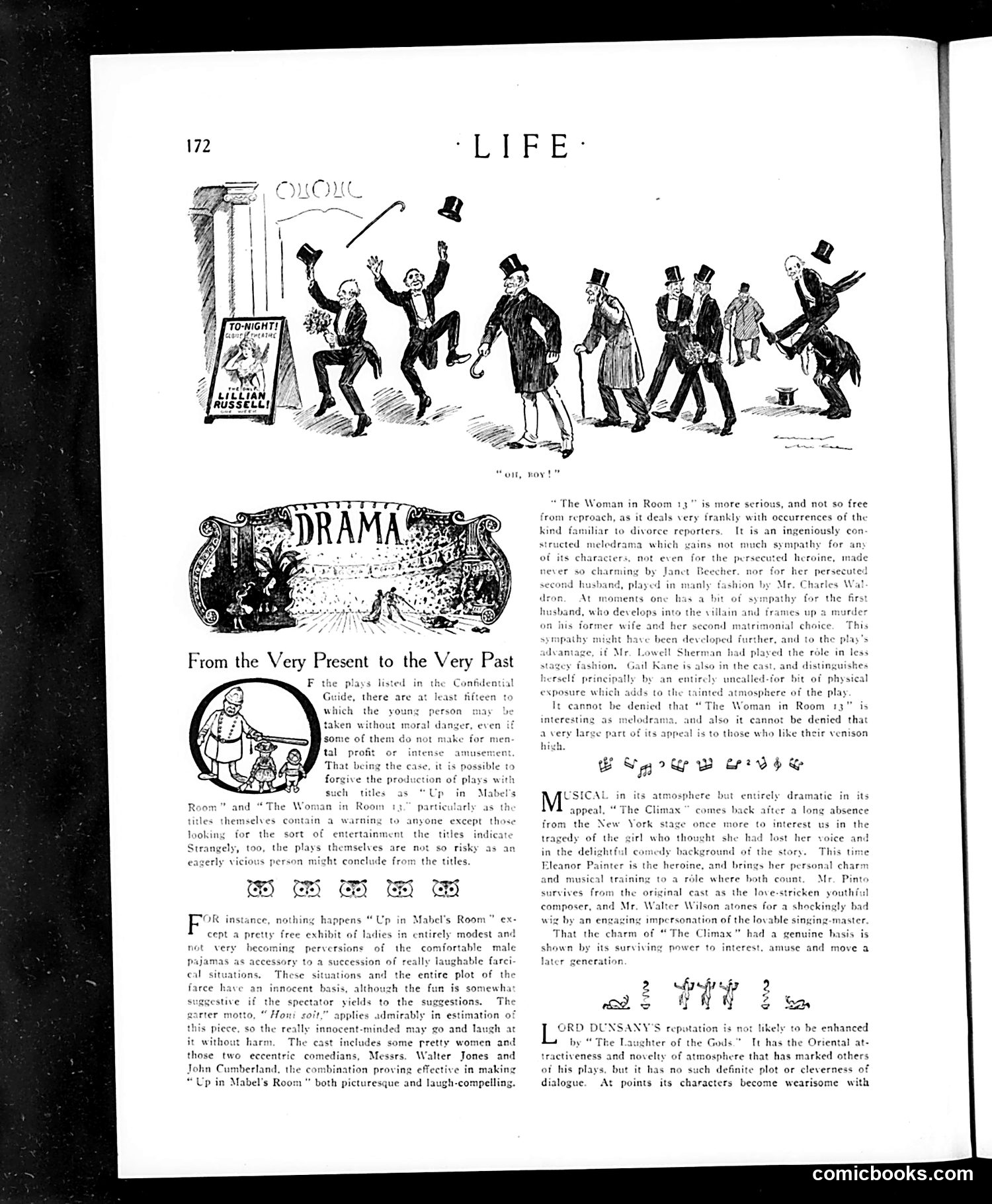
This page reviews three theatrical productions. The top cartoon satirizes the melodramatic nature of stage plays, showing audience members in exaggerated poses of excitement and distress—a commentary on how theater audiences react with outsized emotion to dramatic plots. The text reviews "The Woman in Room 13" (a play dealing frankly with divorce), "Up in Mabel's Room" (a farce featuring women in pajamas), and "The Climax" (featuring a girl who loses her singing voice). The satire mocks how these plays exploit sensational domestic situations—infidelity, near-nudity, and tragedy—to attract audiences seeking entertainment rather than art. The reviewer notes the titles themselves warn away anyone seeking serious theater, suggesting these are designed for viewers seeking "venison high" (crude entertainment). The criticism is that theatrical producers cynically construct melodrama around scandalous situations rather than meaningful drama.
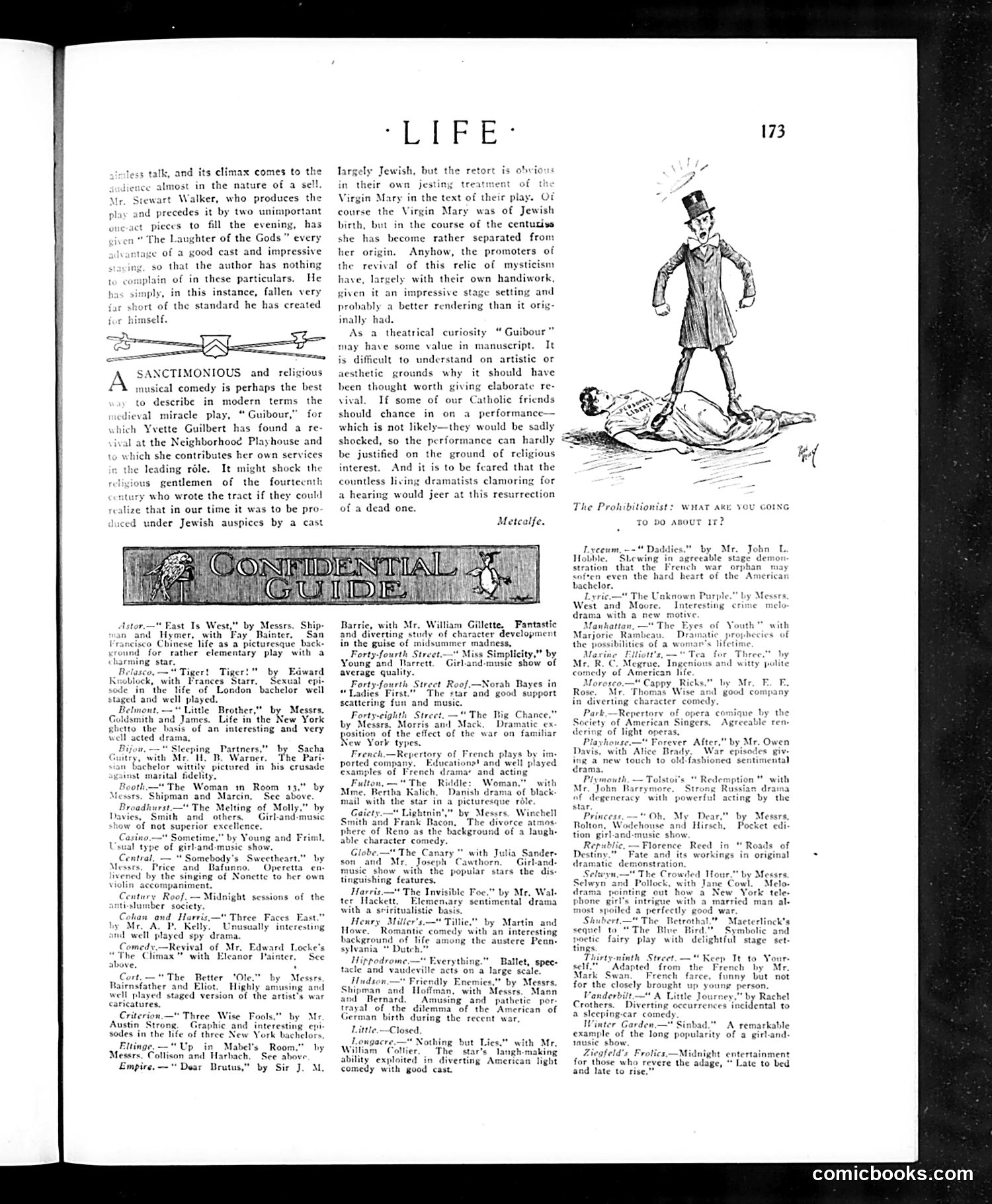
This page contains theater reviews rather than political cartoons. The single illustration shows "The Prohibitionist," a figure in formal attire standing over a prone person—likely depicting a temperance advocate's moral stance toward alcohol consumption or drunkenness. The text reviews multiple Broadway productions, including "Guibour," a medieval miracle play featuring performer Yvette Guilbert. A notable cultural observation appears: the reviewer discusses that this play—originally concerning the Virgin Mary—is being produced "under Jewish auspices by a cast largely Jewish." The critic finds this somewhat ironic given the play's Christian religious content, though notes the producers have given it "an impressive stage setting." The reviews discuss various comedies, dramas, and musical shows of the period with typical critical commentary on cast quality and entertainment value. The page reflects early 20th-century theater criticism and cultural attitudes toward religious and ethnic participation in arts production.
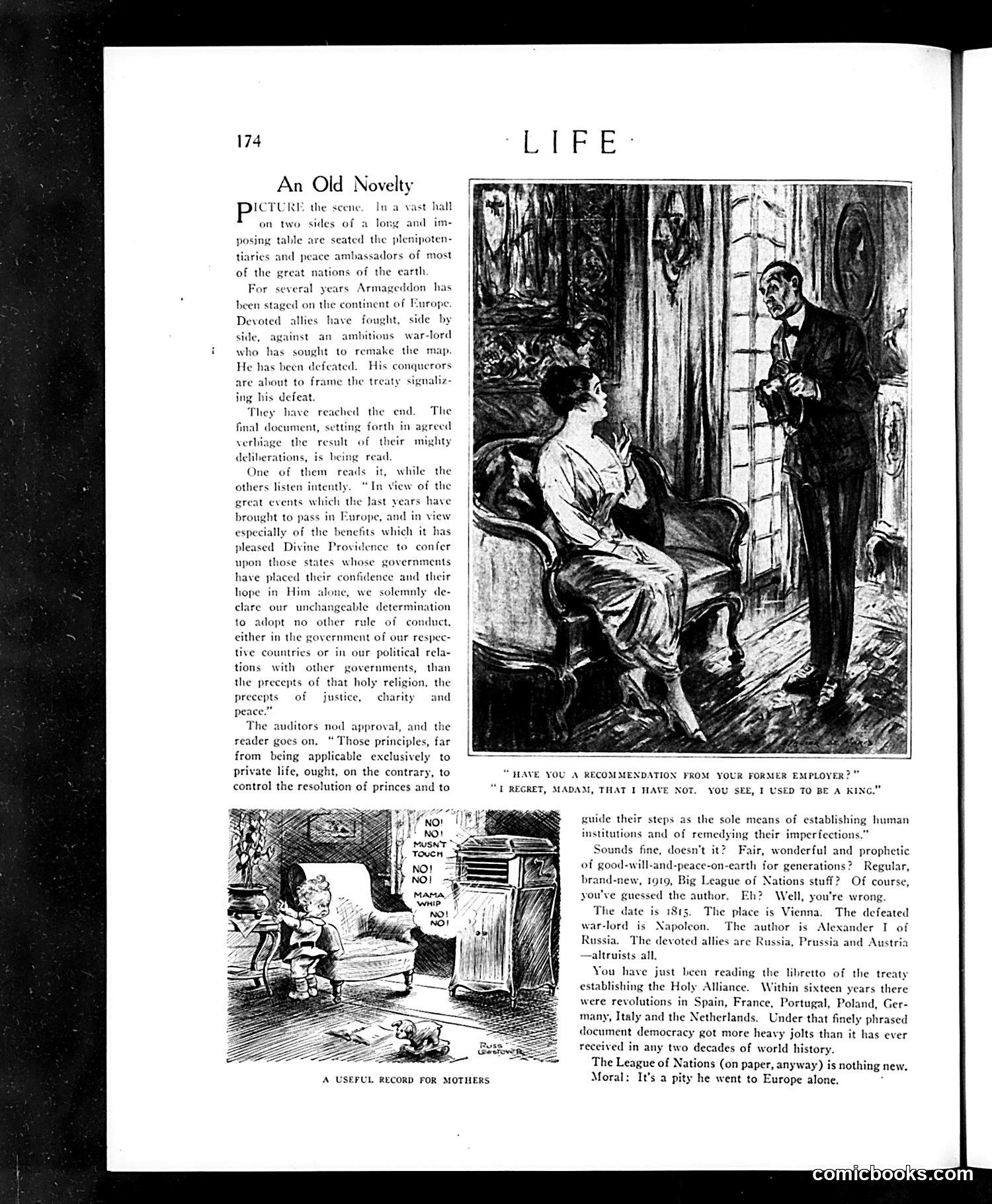
This page satirizes the 1919 League of Nations by drawing a parallel to the 1815 Holy Alliance—another idealistic peace treaty that failed spectacularly. The main illustration shows diplomats reading lofty language about justice, charity, and peace. The text reveals the joke: this noble rhetoric is actually from Alexander I of Russia's 1815 treaty, which sounded wonderful but preceded revolutions across Europe within sixteen years. The lower cartoon depicts a deposed monarch applying for a job and unable to provide a reference from his "former employer"—a visual gag about how absolute rulers lose power. The satire's point: The newly-formed League of Nations makes the same high-minded promises as the Holy Alliance did a century earlier, yet history shows such declarations mean little. The author's mordant closing—"It's a pity he went to Europe alone"—suggests the League will similarly fail without genuine commitment to its stated principles.
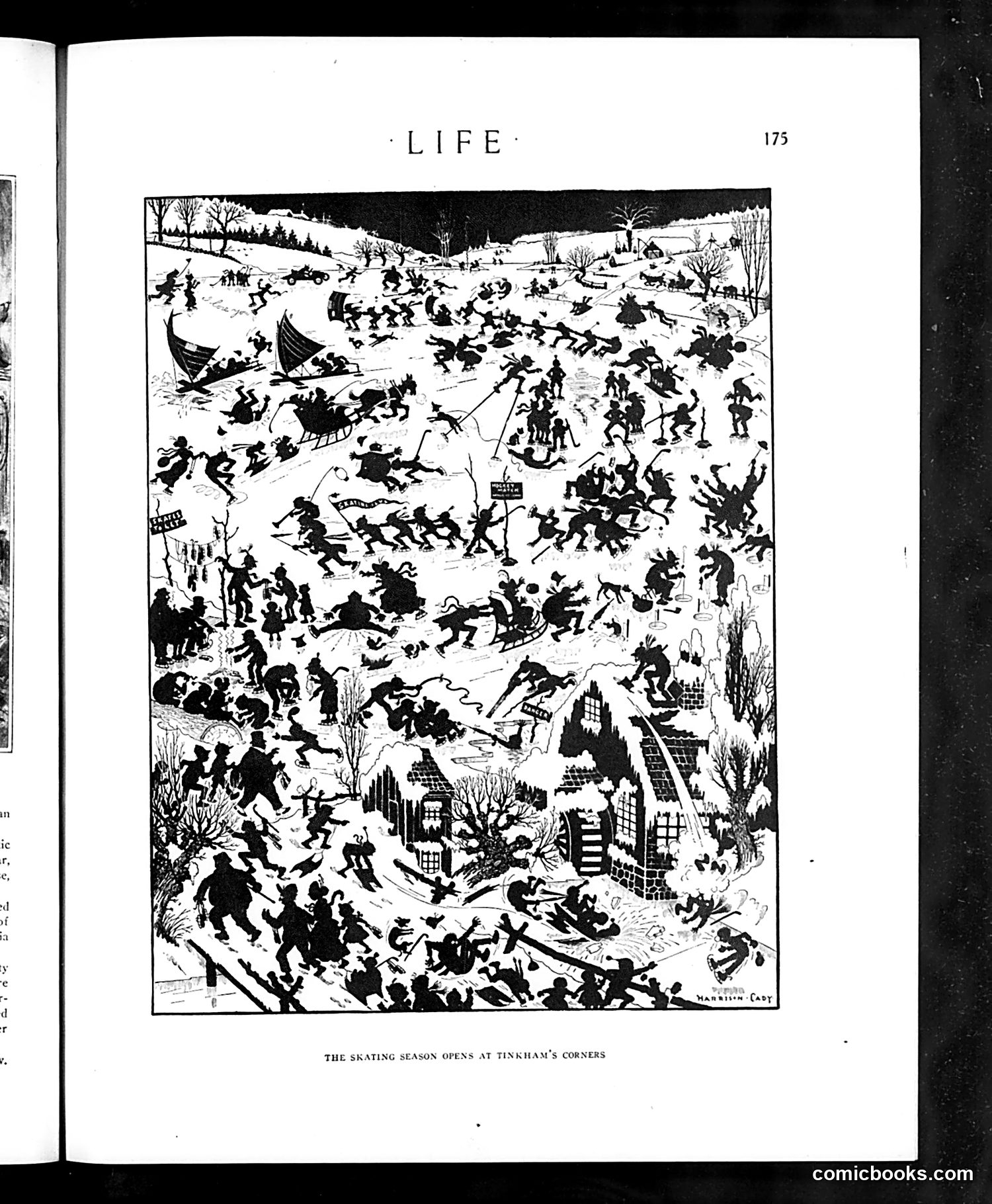
This is a crowded winter scene illustration titled "The Skating Season Opens at Tinkham's Corners." The image shows a chaotic ice-skating gathering in a small town, packed with dozens of figures engaged in various winter activities—skating, falling, socializing, and general merriment on frozen water. The scene appears to be gentle, nostalgic American small-town humor rather than political satire. It depicts the opening of the local skating season as a major social event, with the community gathering en masse. The humor derives from the busy, accident-prone chaos: people tumbling, colliding, and generally struggling on ice. This represents Life magazine's typical approach of illustrating everyday American life with warmth and gentle comedy, celebrating provincial winter traditions and community gathering places around the early-to-mid 20th century.
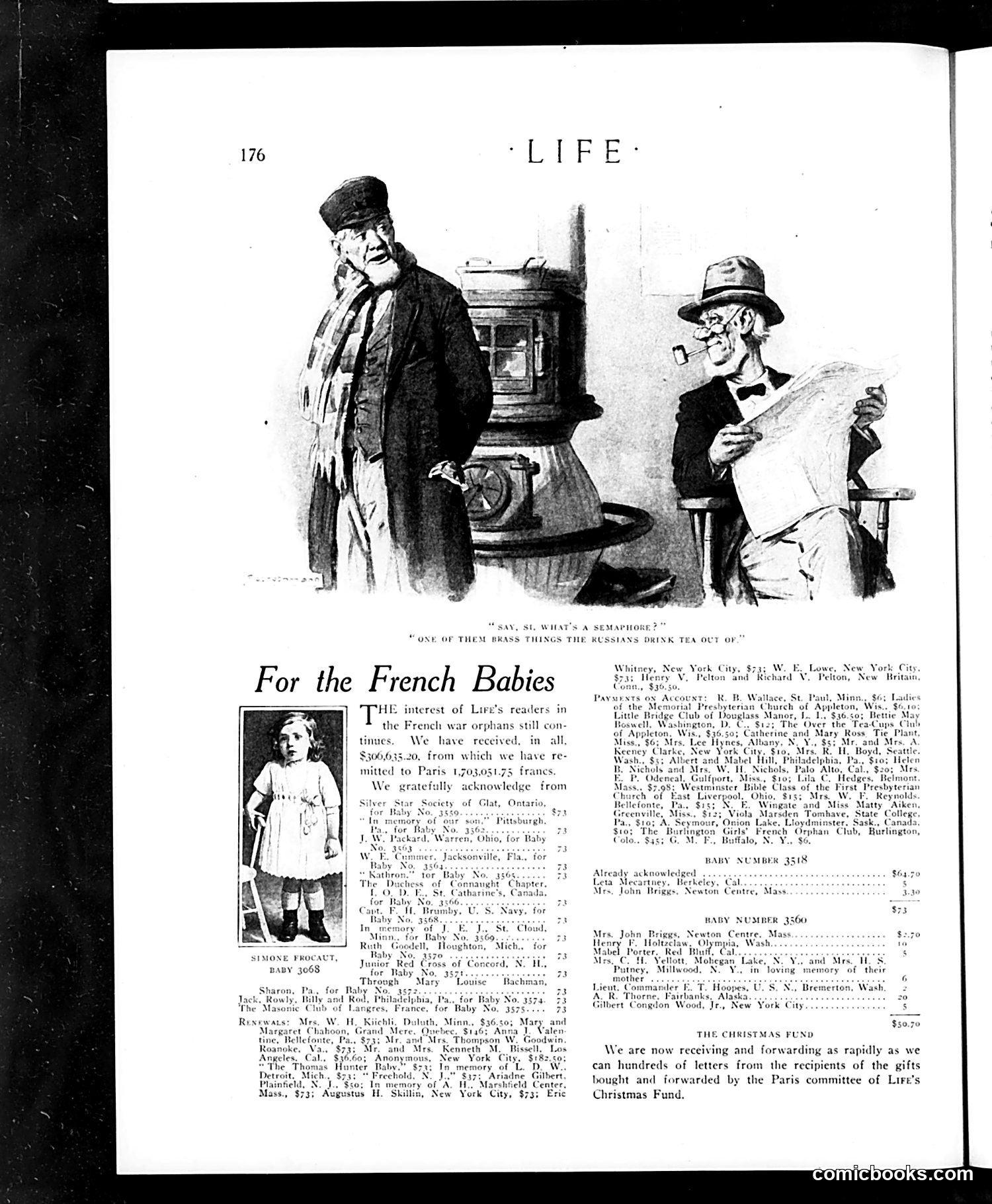
This page contains a single cartoon joke at the top and charitable fundraising content below. **The Cartoon:** Two men examine a samovar (a Russian tea urn). One asks the other what "a semaphore" is, and receives the reply: "One of them brass things the Russians drink tea out of." The joke plays on the double meaning—a semaphore is actually a signaling device using flags or arms, but the ignorant speaker mistakes it for the samovar, a distinctly Russian object. This reflects early 20th-century American cultural stereotyping of Russians and gentle mockery of working-class unfamiliarity with foreign terms. **The Remainder:** The page documents Life magazine's fundraising for French war orphans during World War I. It lists donors and amounts contributed, including the photograph of "Simone Frocaut, Baby 3068," one of the orphans being supported. The final paragraph notes the magazine is "rapidly" forwarding hundreds of letters from grateful recipients of Christmas gifts.
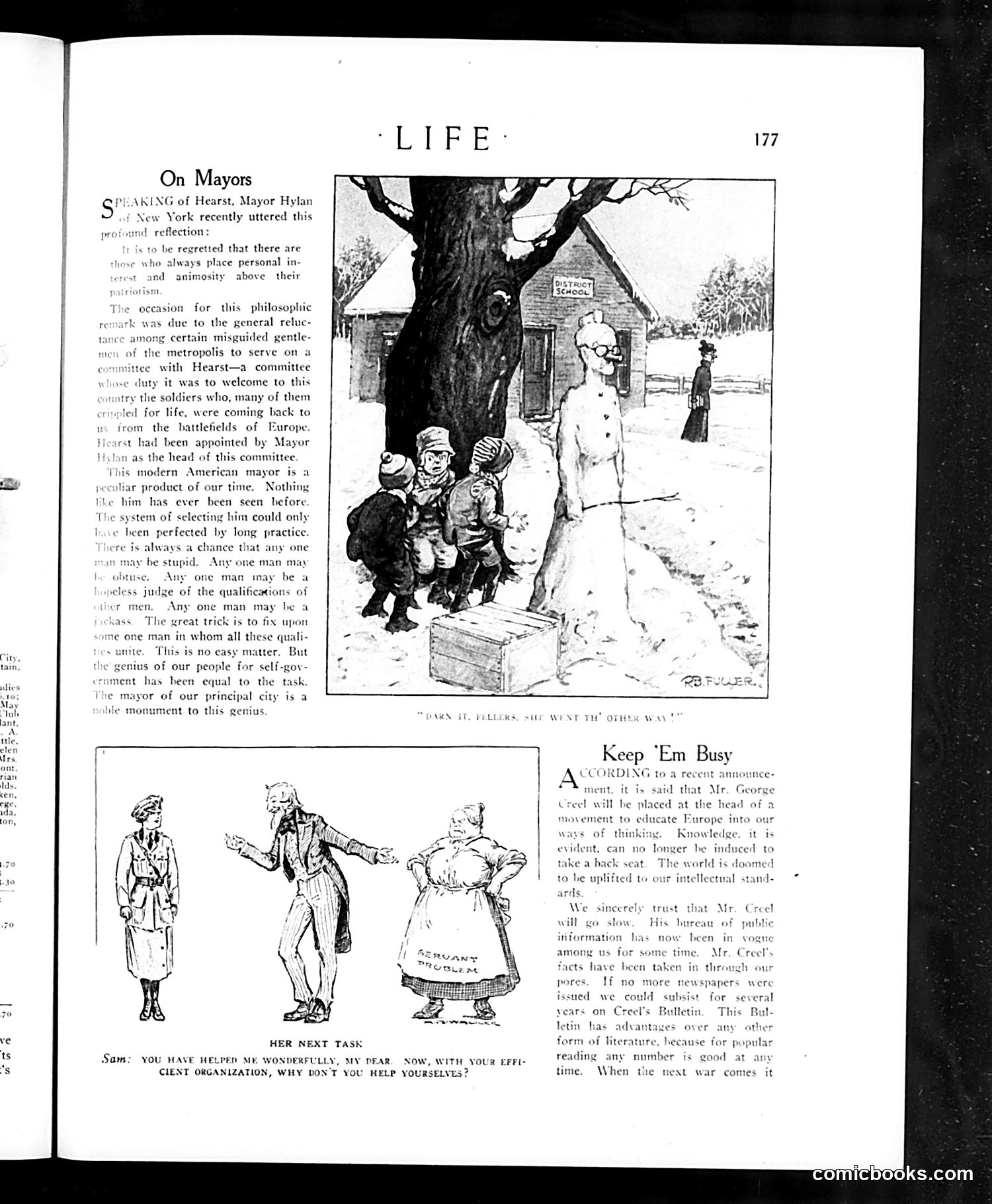
This page contains two satirical pieces about American leadership post-WWI. **"On Mayors"** attacks New York Mayor John Hylan for his self-righteous refusal to serve on a welcome committee for returning soldiers alongside newspaper magnate William Randolph Hearst. The piece mocks Hylan's claim that placing "personal interest and animosity above patriotism" is regrettable—while doing exactly that. The satire argues that even flawed democratic selection of leaders produces better results than aristocratic systems. **"Keep 'Em Busy"** criticizes George Creel, head of the wartime Committee on Public Information (the U.S. propaganda bureau). The caption suggests Creel's post-war mission to "educate Europe" into American ways is presumptuous. The cartoon below ("Her Next Task") depicts a female figure—likely "America" or "Lady Liberty"—asking Sam (Uncle Sam) why, after helping wonderfully, he won't help Americans themselves, implying Creel's organization should focus domestically rather than promoting American ideology abroad.
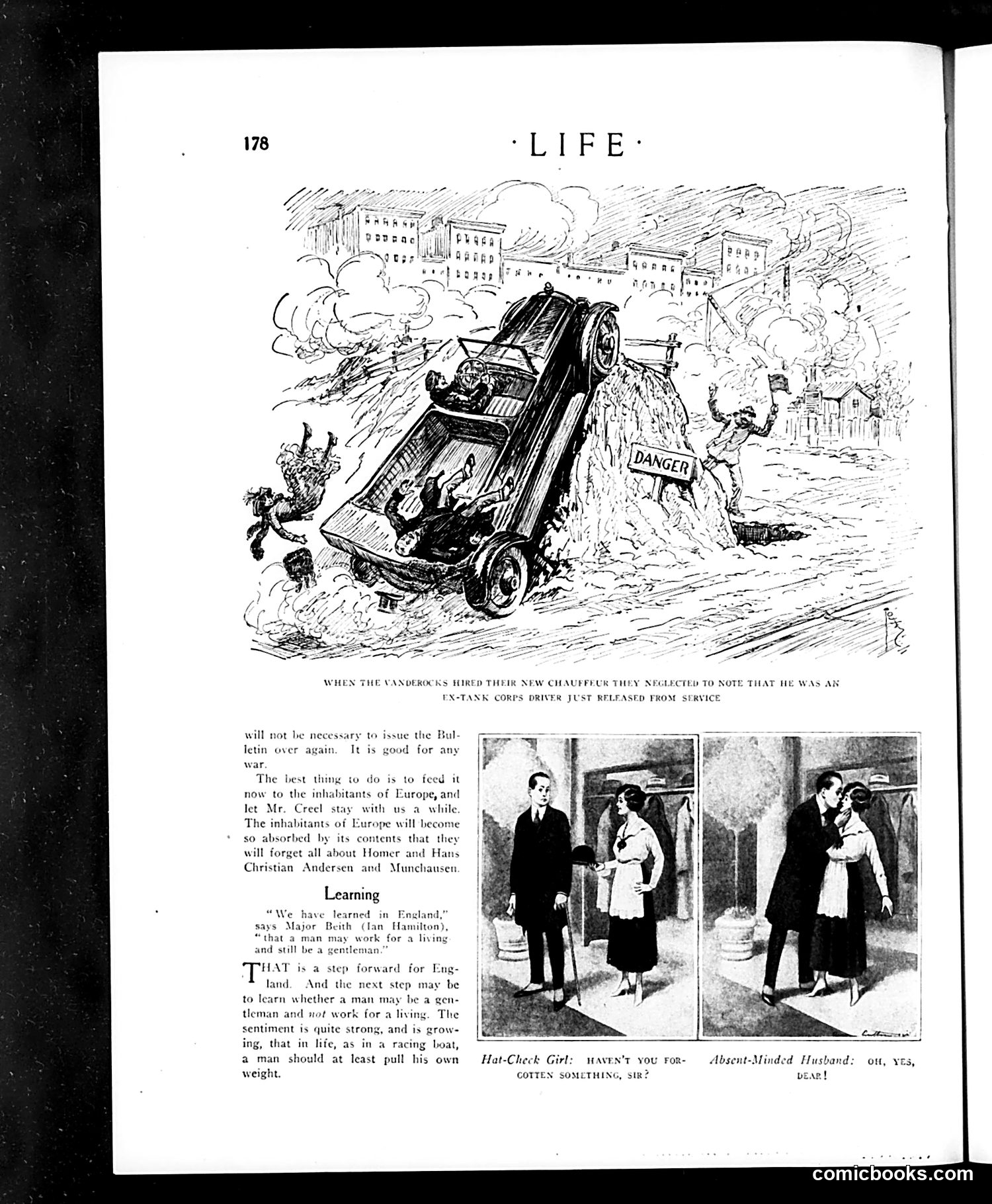
**Main Cartoon (Top):** A car driven by an ex-tank corps soldier careens dangerously down a cliff near a "Danger" sign, with wealthy passengers inside. The satire mocks newly hired chauffeurs fresh from WWI military service—suggesting they drove tanks recklessly and apply the same dangerous driving to civilian vehicles. This plays on post-war anxiety about militarized men returning to peacetime society. **Comic Strip (Bottom):** Two panels show domestic humor: a hat-check girl asks a distracted man if he's forgotten something; he replies "Oh yes, dear!"—implying he's forgotten his wife. This is standard era humor about absent-minded husbands and marital forgetfulness. **Text Section ("Learning"):** Discusses whether gentlemen should work for a living—reflecting post-WWI class debates about labor and social obligation. The page satirizes post-war readjustment and social class anxieties of the 1920s.
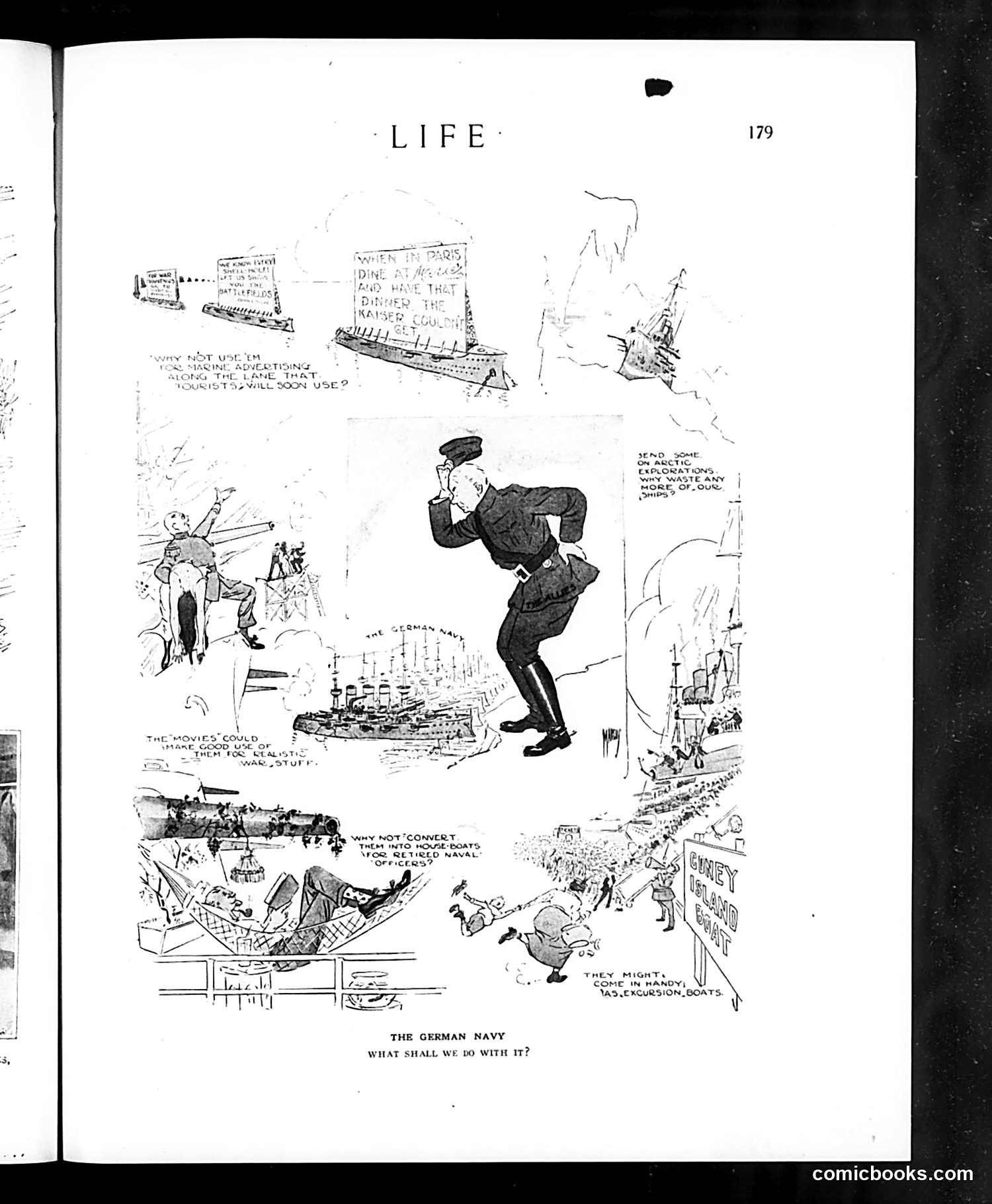
This is a satirical cartoon about post-World War I disposal of the German Navy. The central figure is a bewildered official or politician, surrounded by suggestions for repurposing German warships: converting them into houseboats, excursion boats, or using them for other civilian purposes. Various sketches show ships being transformed or dismantled. The humor targets the practical absurdity of what to do with captured enemy naval vessels after the war. The cartoonist mocks both grandiose reuse schemes (the "German Navy" caption emphasizes the irony) and the bureaucratic confusion about post-war asset management. This likely dates from the 1920s, after WWI's Treaty of Versailles, when Allied powers debated German naval reparations and vessel disposal. The satire suggests the proposals were impractical or ridiculous—converting military battleships into pleasure craft would be wasteful and economically nonsensical.
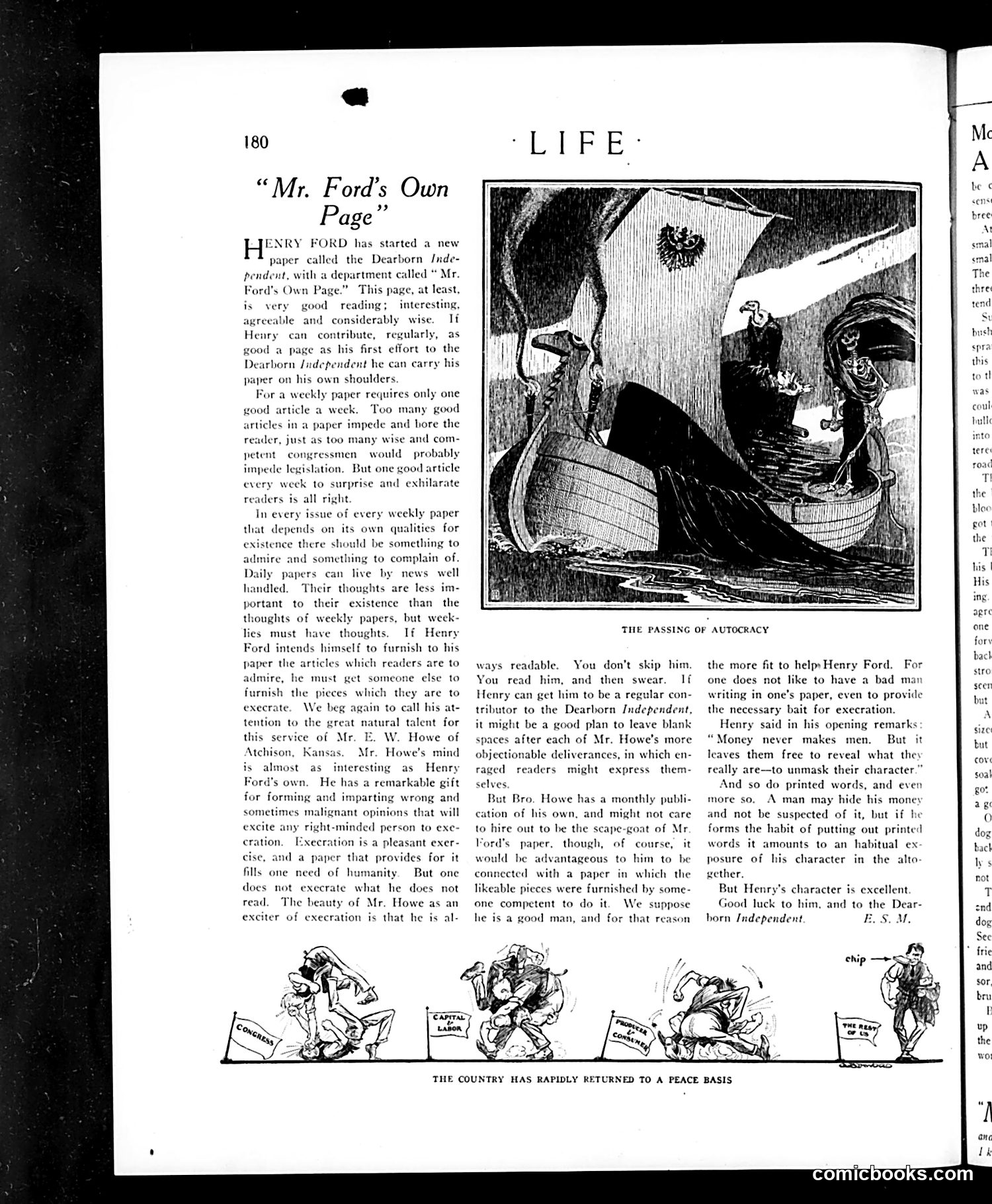
This article praises Henry Ford's new *Dearborn Independent* newspaper and its "Mr. Ford's Own Page" column. The writer argues that weekly papers need one strong article to survive, and suggests Ford contribute regularly. The piece humorously recommends E.W. Howe of Kansas as a contributor—praising his ability to provoke reader outrage through deliberately "malignant opinions." The satire is gentle: Howe is such a skilled provocateur that readers will swear at his pieces, providing the emotional engagement weekly papers require. The bottom cartoon strip titled "The Country Has Rapidly Returned to a Peace Basis" shows various figures labeled with post-WWI concerns (appearing to reference labor, capital, and other social divisions) being knocked down like bowling pins—suggesting instability despite supposed "peace." The overall tone is witty commentary on newspaper economics and American social tensions in the early 1920s.
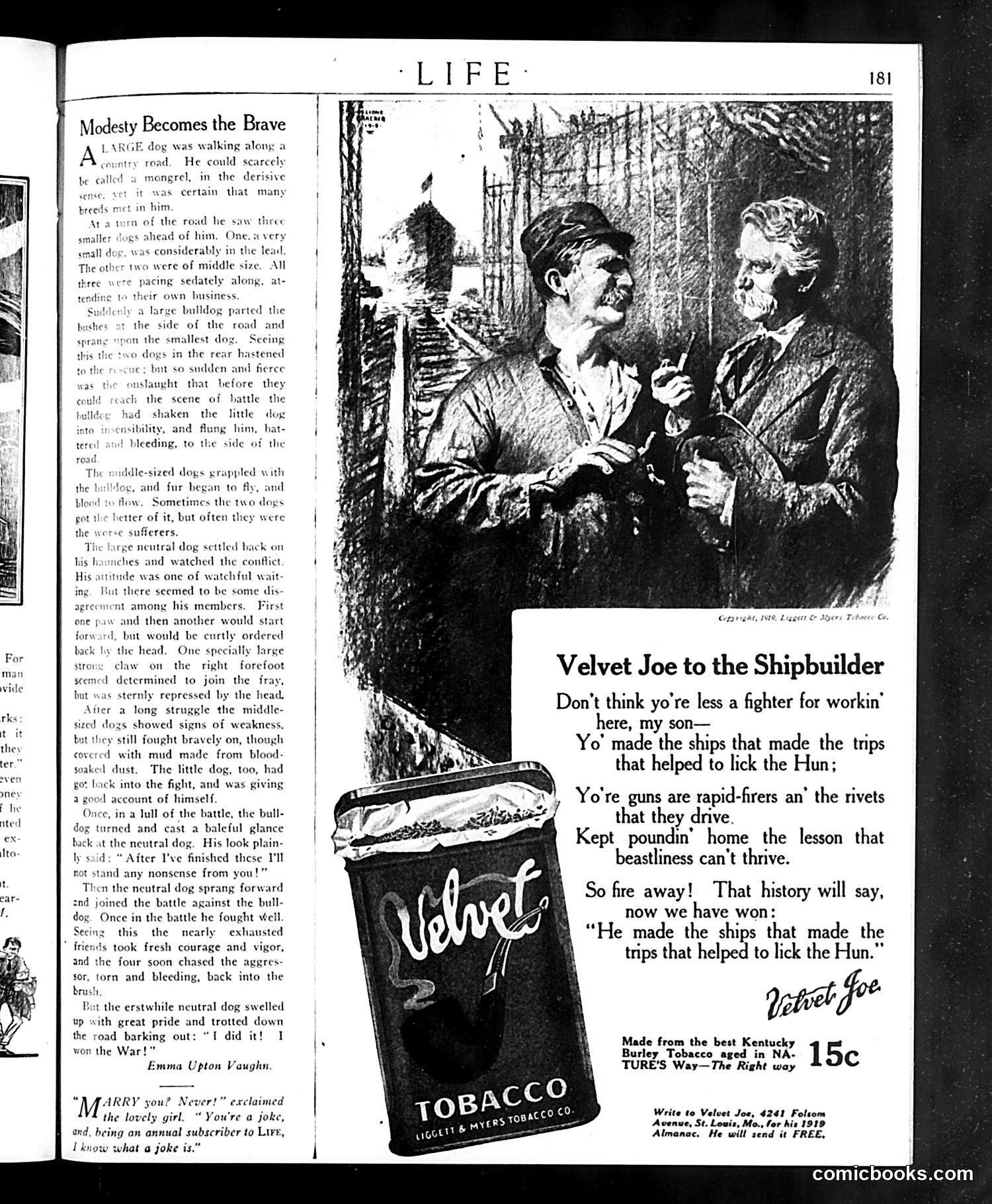
This page contains two distinct pieces of WWI-era content: **"Modesty Becomes the Brave"** (left) is a fable by Emma Upton Vaughn using dogs as allegory. A large "neutral dog" watches smaller dogs fight a bulldog without intervening—until directly threatened. He then joins the fight and takes credit for victory, declaring "I did it! I won the War!" This clearly references **America's initial neutrality during WWI and reluctance to enter the conflict**, then joining late (1917) while later claiming major credit for the Allied victory. The moral critiques both isolationism and undeserved boasting. **"Velvet Joe to the Shipbuilder"** (right) is a tobacco advertisement using patriotic verse. It reassures shipyard workers ("Velvet Joe") that manufacturing ships equals combat heroism, praising their contribution to defeating "the Hun" (Germany). This represents **WWI-era propaganda elevating industrial labor as patriotic duty**, encouraging workers' morale during wartime production efforts. Both pieces reflect American post-WWI attitudes: pride in victory, debate over America's role, and celebration of collective national effort.
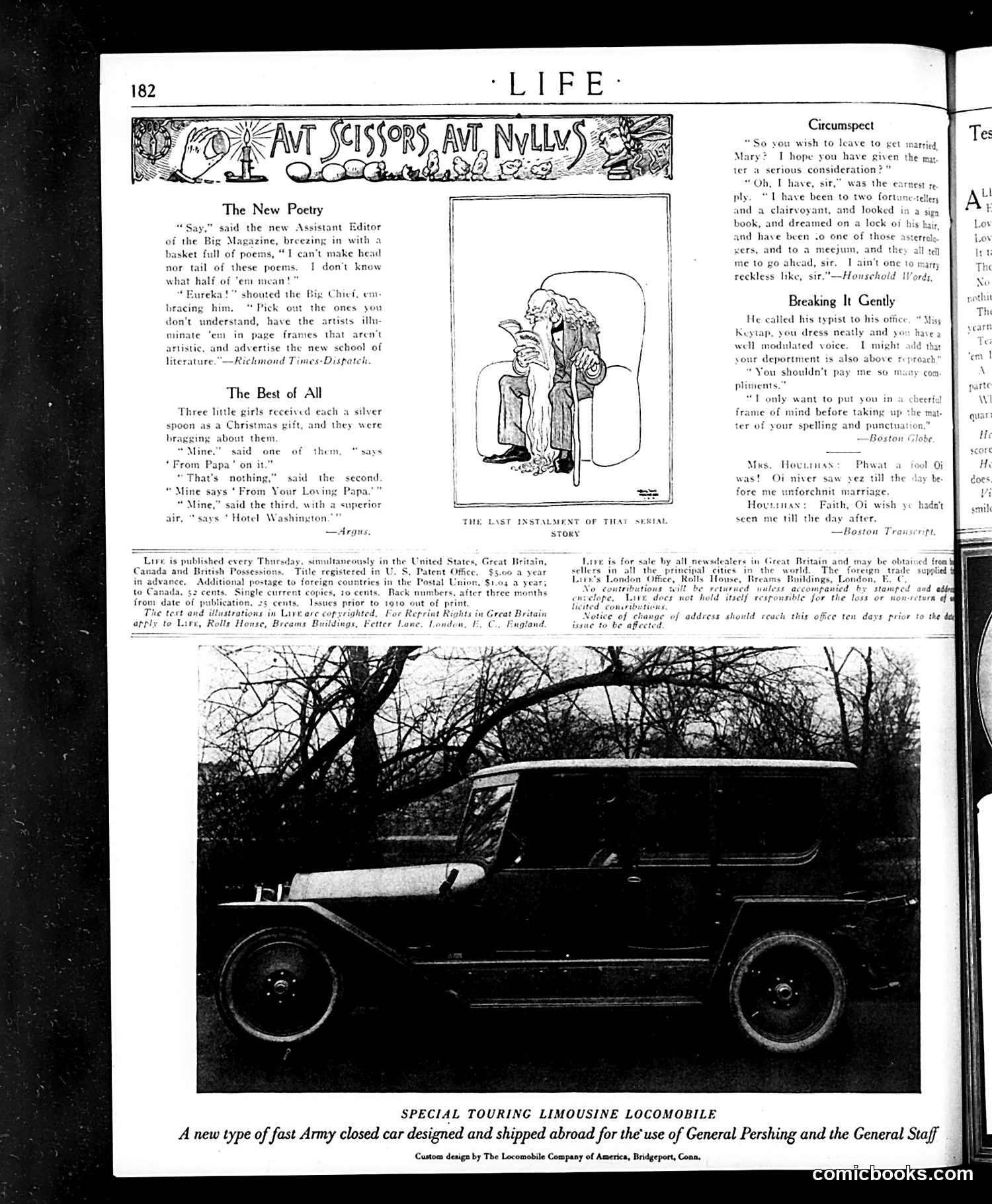
This page from *Life* magazine contains satirical short pieces and an advertisement, reflecting early 20th-century editorial humor. **The New Poetry**: Satirizes modernist poetry's obscurity. The magazine's editor receives poems he cannot understand and asks his chief to pick the comprehensible ones, suggesting "new poetry" abandons meaning in favor of artistic pretension. The joke mocks both experimental literature and magazine editors. **The Best of All**: A brief joke about three girls receiving identical silver spoons as Christmas gifts, with each claiming theirs is superior—likely satirizing materialism or snobbish bragging. **Breaking It Gently**: A typist-employer interaction where the boss compliments only the worker's cheerfulness, criticizing her spelling and punctuation. It's a workplace humor piece about delivering criticism tactfully. **The photograph**: Advertises a special limousine built for General Pershing (U.S. commander in WWI) and his staff. This appears positioned as prestigious war-related content rather than satire. The page exemplifies *Life*'s mix of sharp editorial humor targeting contemporary culture alongside patriotic advertisement.
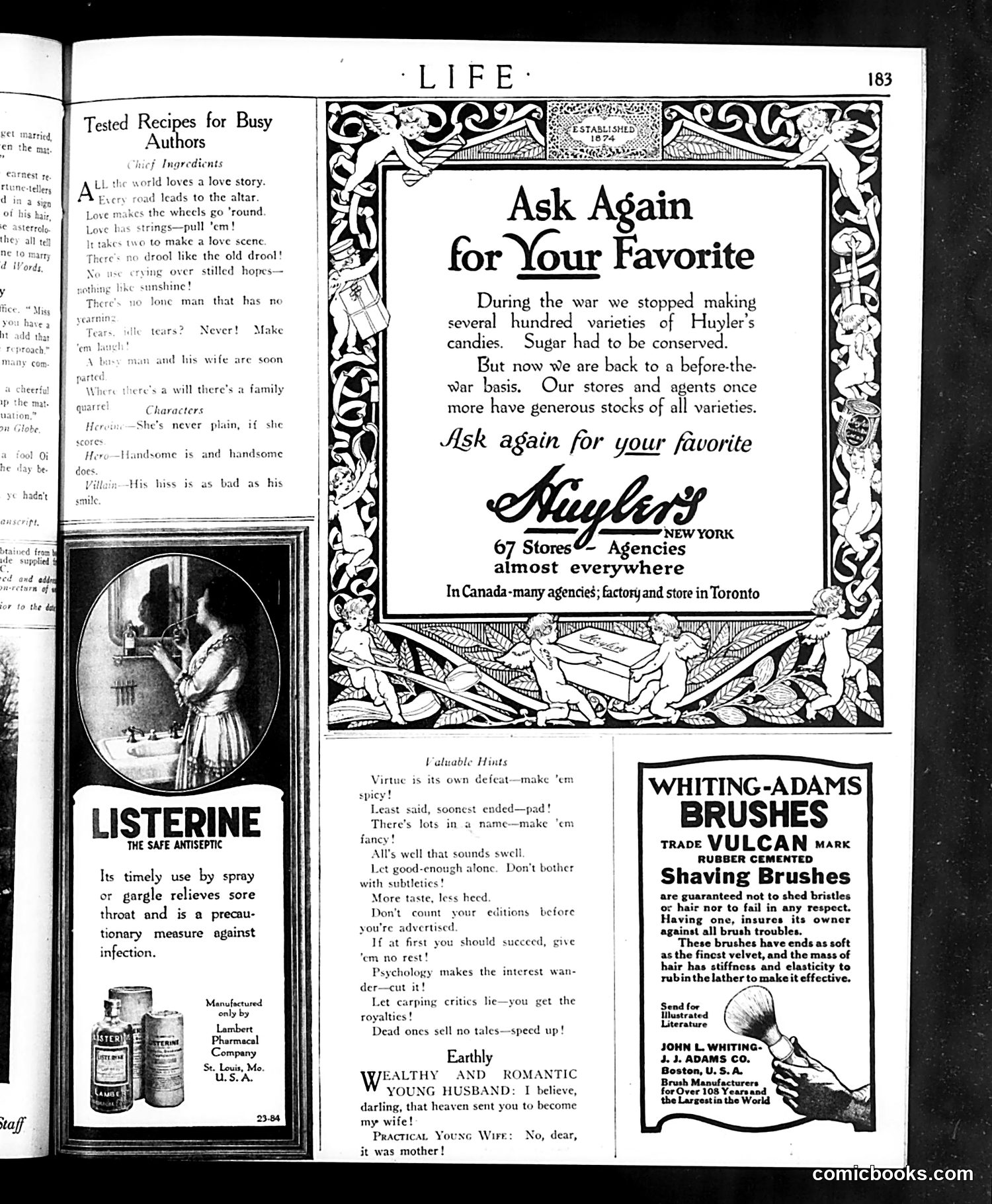
This page mixes advertising with satirical content typical of Life magazine's format. **"Tested Recipes for Busy Authors"** is a humorous column offering formulaic writing advice for love stories—stock elements like "Every road leads to the altar" and "Make 'em lunch!" It mocks how predictable and manufactured popular romance fiction had become, offering cynical shortcuts for authors to churn out sentimental plots. **The character sketches below** (Heroine, Hero, Villain) continue this satirical formula, reducing romantic fiction characters to stereotypes. **The Huyler's candy advertisement** references post-WWI rationing—during the war, sugar conservation meant limited candy varieties, but peacetime restored full production. This appeals to consumers' relief at returning normalcy. **The final joke** ("Earthly") presents a young husband's romantic declaration undercut by his wife's practical retort that his mother arranged the match—deflating sentimentality with marital reality. The page overall satirizes both commercial fiction formulas and advertising's appeal to post-war consumer desires, while advertisements for Listerine and Whiting-Adams brushes fill remaining space.
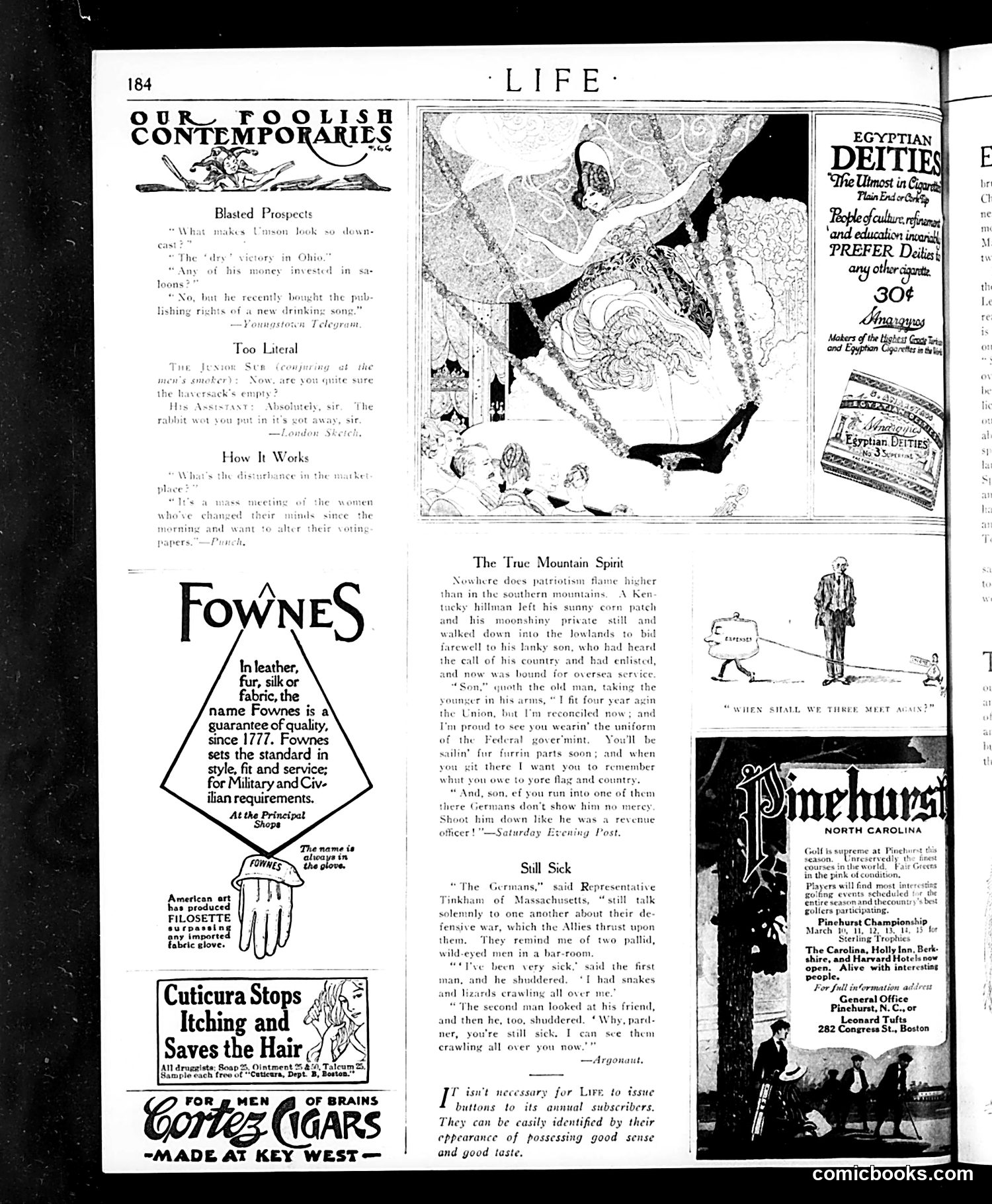
This page contains **mostly advertisements and short humorous anecdotes**, rather than political cartoons. The main satirical content includes brief joke columns under "Our Foolish Contemporaries": - **"Blasted Prospects"**: A joke about Prohibition-era alcohol restrictions (referencing "dry" victories in Ohio) - **"Too Literal"**: A wordplay joke about misunderstanding instructions - **"How It Works"**: A gag about stock market confusion The longest narrative piece, **"The True Mountain Spirit,"** depicts a sentimental Prohibition-era story: a Kentucky hillbilly's son enlists for WWI service. The father, who operates an illegal still, gives his son patriotic advice about honoring country and flag—creating ironic humor from the lawbreaker's patriotic sentiments. **"Still Sick"** uses a Representative Tinkham anecdote comparing Germans to delusional men, likely commenting on post-WWI German psychology. The remainder consists of advertisements (Fownes gloves, Cuticura, Cortes cigars, Egyptian Deities magazine, and Pinehurst golf resort).
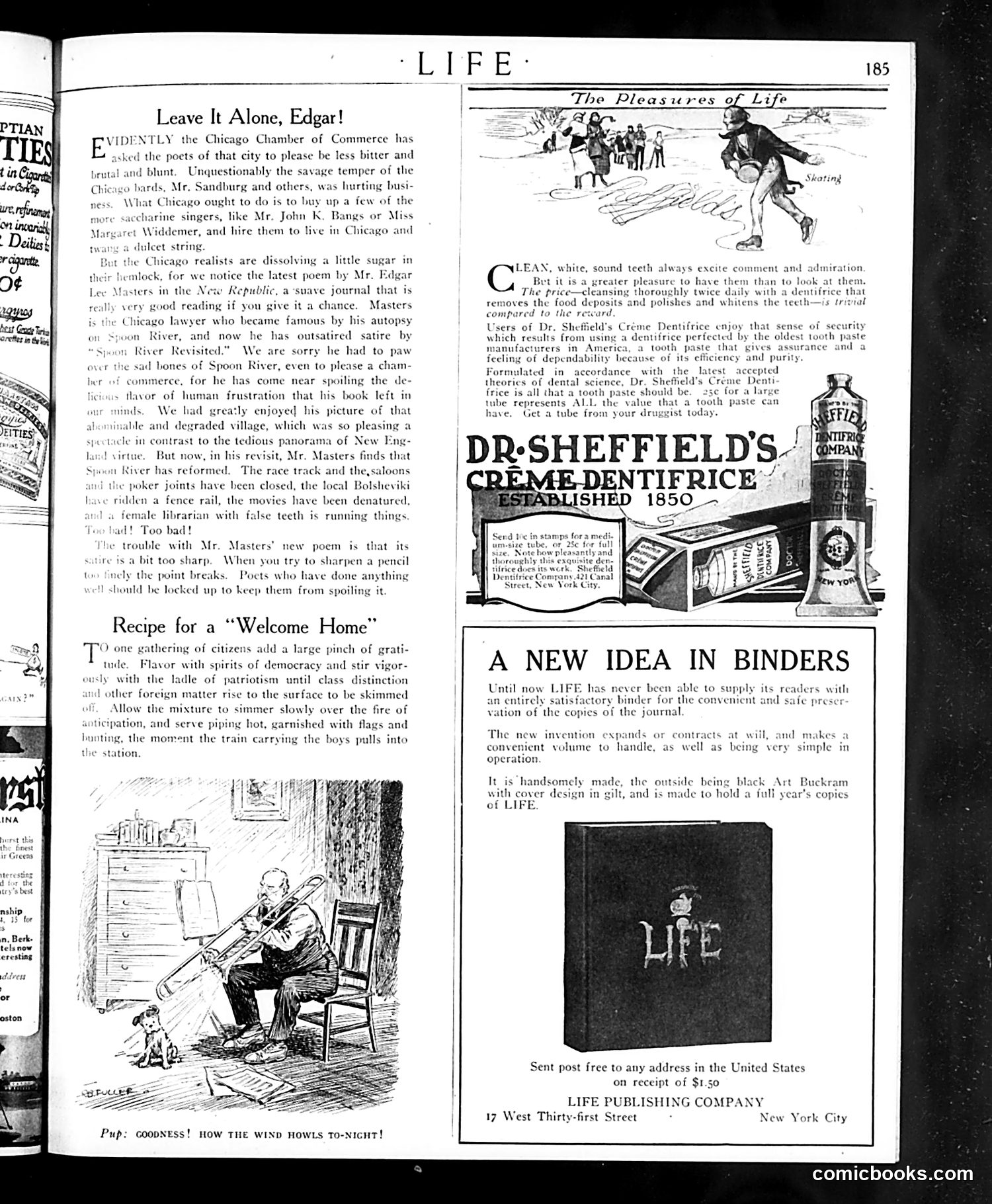
**Main Article: "Leave It Alone, Edgar!"** This satirizes poet Edgar Lee Masters and Chicago's business establishment. The Chicago Chamber of Commerce pressured local writers—particularly Carl Sandburg and Masters—to write less critically about the city, fearing damage to business interests. Masters responded by publishing "Spoon River Revisited," depicting the fictional town's "reform": closed saloons, removed race tracks, and a librarian with false teeth now running things. Life's critique is sharp: Masters' attempt to please Chicago by showing improvement actually *ruins* his original work's artistic power. The joke mocks both Masters' capitulation to commercial pressure and the absurdity of the Chamber's request—that artists self-censor for profit. **Secondary Content:** The page also includes advertisements (Dr. Sheffield's Creme Dentifrice) and a "Recipe for a Welcome Home" satirizing patriotic fervor around returning soldiers, plus a cartoon about wind and cold weather. The satire targets artistic compromise and commercialism in American culture.
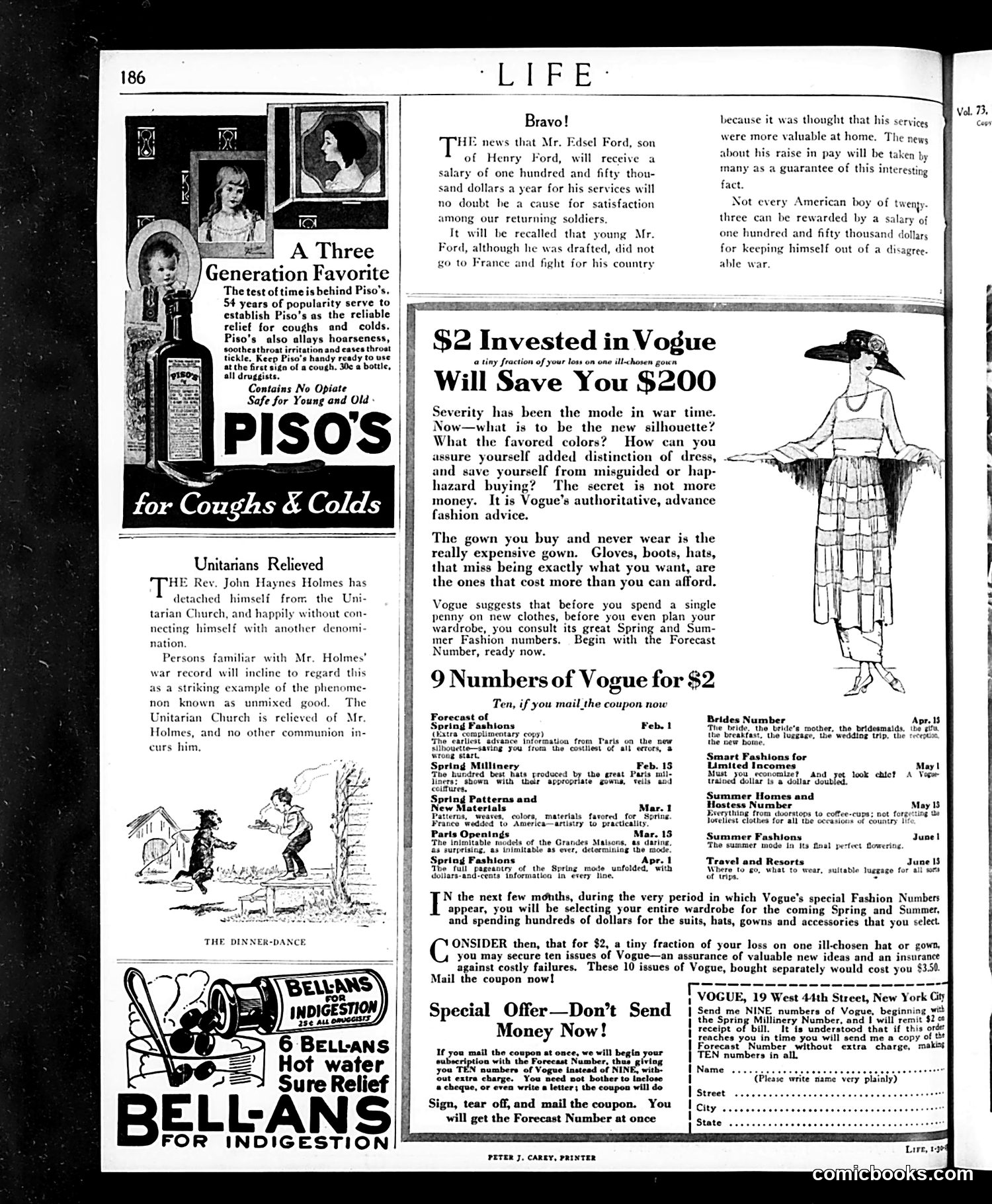
This brief article satirizes Edsel Ford (son of Henry Ford) receiving a $150,000 annual salary. The satire's point: Ford was drafted but not sent to France because his services were deemed "more valuable at home"—a euphemism for using wealth/influence to avoid combat. The author sarcastically applauds this, noting the irony that while ordinary American boys fought and died, Ford stayed home in a "disagreeable war" and now receives lavish compensation. This rewards his wartime absence. The piece mocks both Ford's draft exemption and the notion that his "valuable services" justify such wealth while soldiers return from actual combat. It's wartime class criticism—exposing how the wealthy avoided sacrifice while profiting.