
Life, 1919-01-30 · page 22 of 34
Life — January 30, 1919 — page 22: what you’re looking at
What you’re looking at
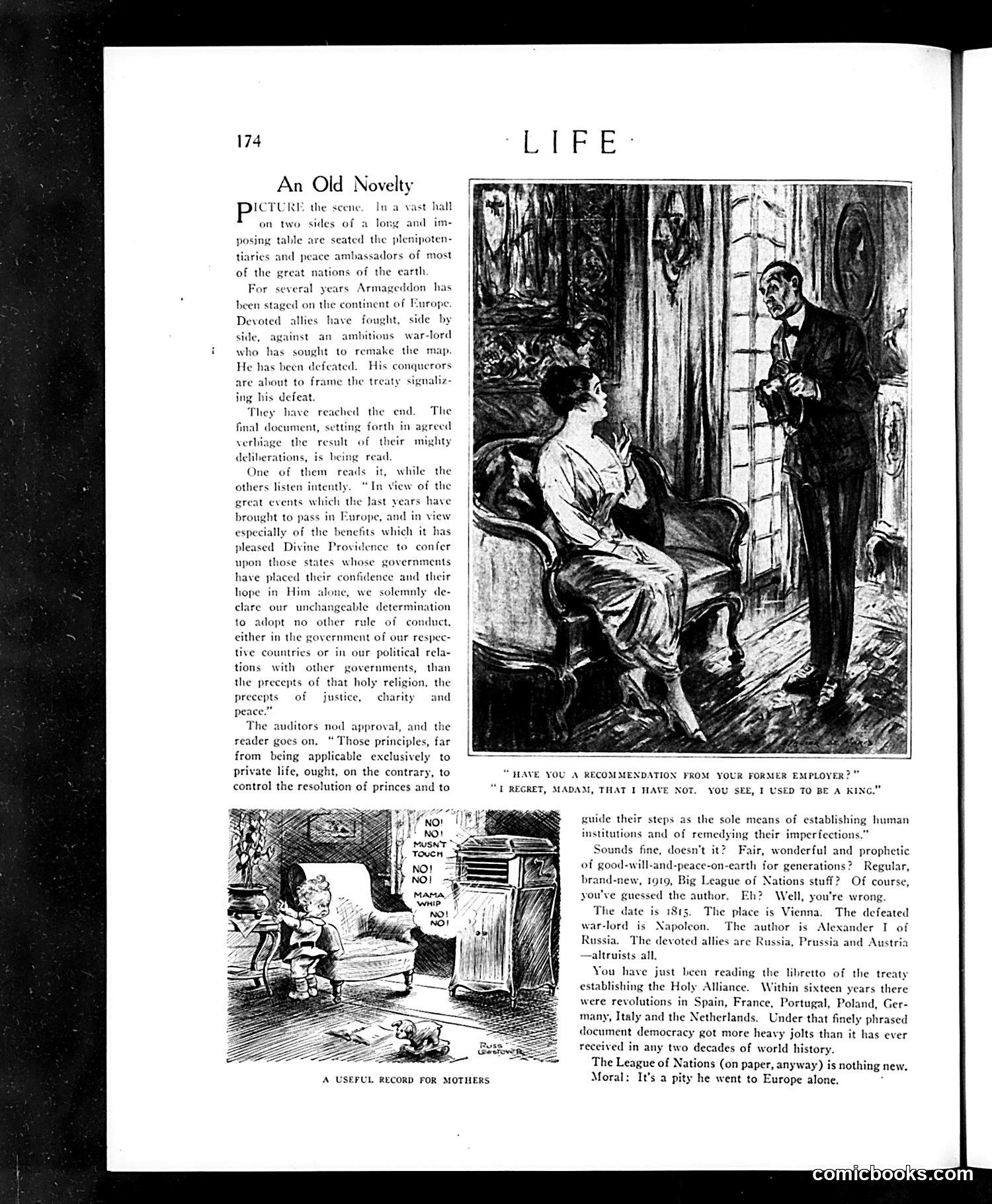
This page satirizes the 1919 League of Nations by drawing a parallel to the 1815 Holy Alliance—another idealistic peace treaty that failed spectacularly. The main illustration shows diplomats reading lofty language about justice, charity, and peace. The text reveals the joke: this noble rhetoric is actually from Alexander I of Russia's 1815 treaty, which sounded wonderful but preceded revolutions across Europe within sixteen years. The lower cartoon depicts a deposed monarch applying for a job and unable to provide a reference from his "former employer"—a visual gag about how absolute rulers lose power. The satire's point: The newly-formed League of Nations makes the same high-minded promises as the Holy Alliance did a century earlier, yet history shows such declarations mean little. The author's mordant closing—"It's a pity he went to Europe alone"—suggests the League will similarly fail without genuine commitment to its stated principles.
📄 Transcribed text from this page (OCR, searchable)
Machine-transcribed from the original scan — historical spelling and the odd misread are preserved.
An Old Novelty ICTURE the scene. Ina vast hall on two sides of a long and i posing table are seated the plenipoten- tiaries and peace ambassadors of most of the great nations of the earth For several years Armageddon has been staged on the continent of Europe: Devoted allies have fought, side by side, against an ambitious war-lord who has sought to remake the map. He has been defeated. His conquerors are about to frame the treaty signaliz- ris defeat. They have reached the end final document, setting forth in verbiage the result. of their mighty deliberations, is heing read. One of them rei while the others listen intently. great events which the Jast years have brought to pass in Europe, and in view especially of the benefits which it has pleased Divine Providence to confer upon those states whose governments have placed their confidence and their hope in Him alone, we solemnly de- clare our unchangeable determination to adopt no other rule of conduct, either in the government of our respec- tive countries or in our political rela- tions with other governments, than the precepts of that holy religion, the precepts of justice, charity and peace.” The auditors nod approval, and the reader gocs on. “ Those principles, far from being applicable exclusively to private life, ought, on the contrary, to “HAVE YOU A RECOMMENDATION FROM YOUR FORMER EMPLOYER?” control the resolution of princes and to “I REGRET, MADAM, THAT I HAVE NOT. YOU SEE, I USED TO BE A KING.” guide their steps as the sole means of establishing human institutions and of remedying their imperfections.” Sounds fine, doesn't it? Fair, wonderful and prophetic of good-will-and-peace-on-earth for generations? Regular, brand-new, 1919, Big League of Nations stuff? Of course, you've guessed the author, Eh? Well, you're wrong ie date is 1813. The place is Vienna. The defeated war-lord is Napoleon. The author is Alexander I of Russia. The devoted allies are Russia, Prussia and Austria -altruists all, You have just been reading the libretto of the treaty establishing the Holy Alliance. Within sixteen years there were revolutions in Spain, France, Portugal, Poland, Ger- many, Italy and the Netherlands. Under that finely phrased document democracy got more heavy jolts than it has ever received in any two decades of world history. The League of Nations (on paper, anyway) is nothing new. A USEFUL RECORD FOR MOTHERS Moral: It's a pity he went to Europe alone,