
A complete issue · 42 pages · 1919
Life — January 23, 1919
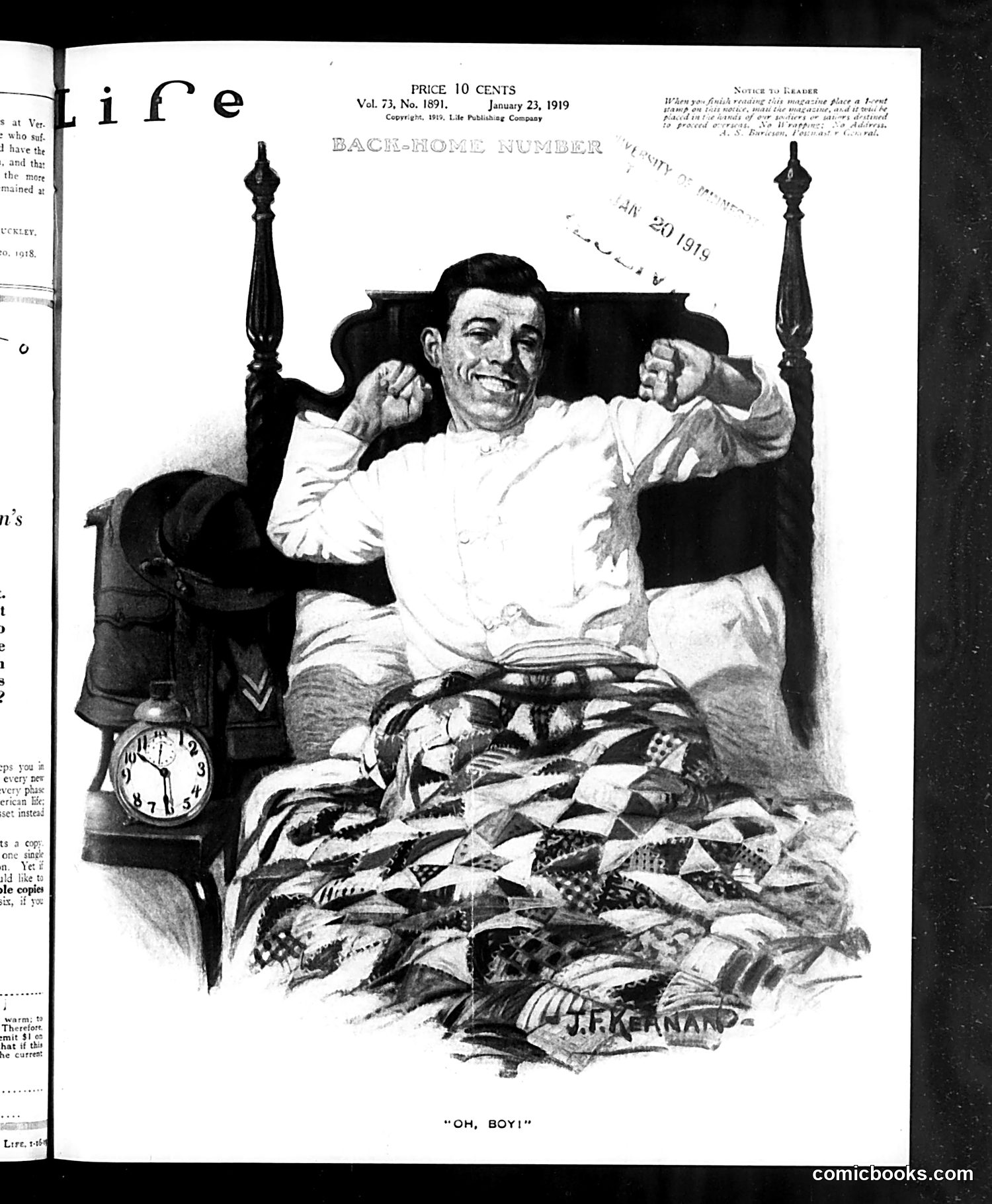
This is a "Back-Home Number" satirical illustration titled "Oh, Boy!" The cartoon depicts a soldier relaxing contentedly in bed, surrounded by piles of civilian clothing and goods. A clock on the nightstand suggests leisure time. The soldier's expression of satisfaction and comfort suggests relief at returning home after World War I. The satire likely critiques post-war materialism or consumer culture—the contrast between wartime austerity and the abundance of civilian life. The piled garments and possessions suggest excess or the overwhelming nature of civilian comfort after military service. The "Oh, Boy!" caption expresses enthusiastic joy at this transition. This reflects 1919 America's adjustment period following WWI's November 1918 armistice.
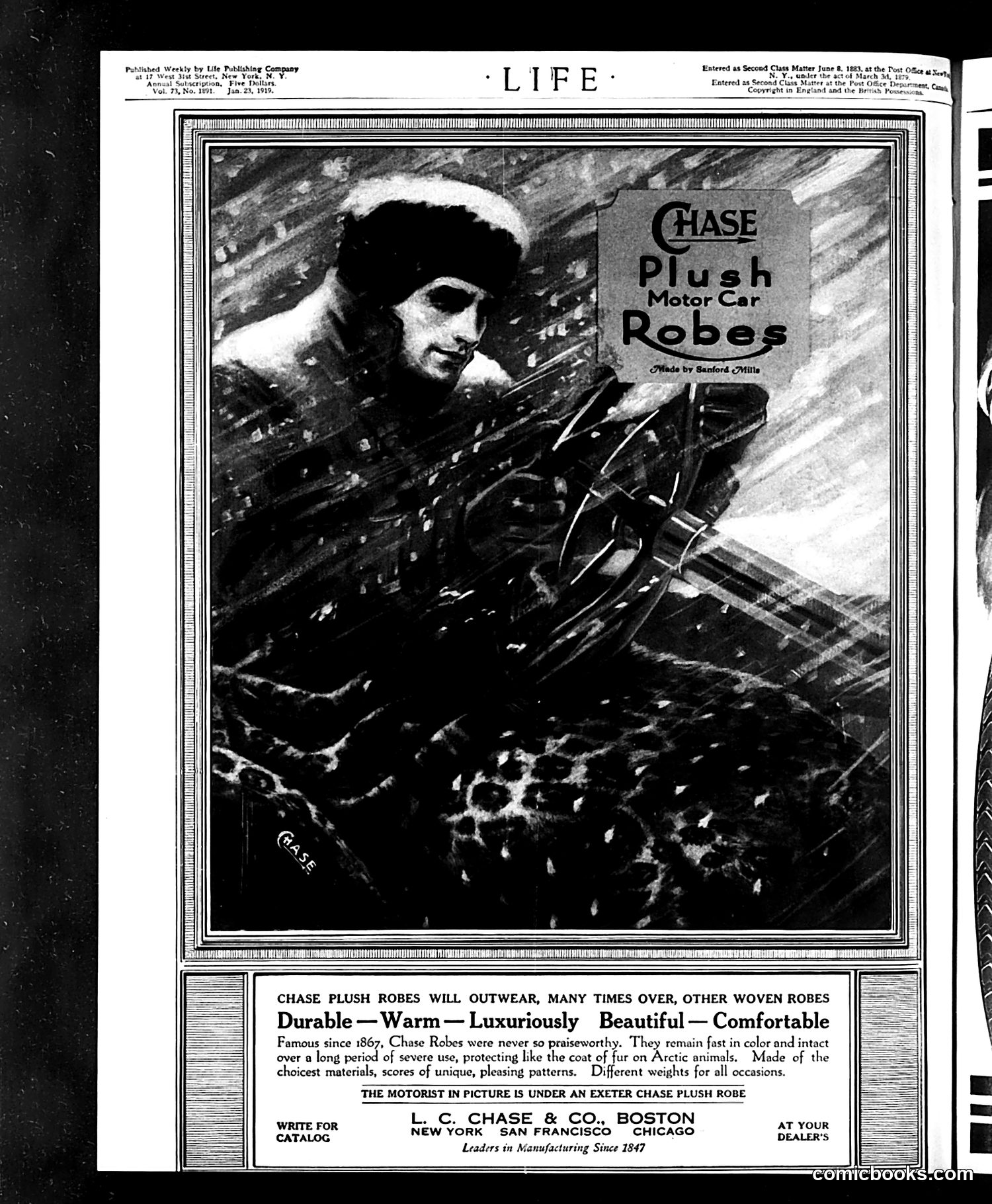
This page is primarily an **advertisement** for Chase Plush Motor Car Robes, not a political cartoon. The image shows a woman in a car wearing an elaborate fur robe and hat, presented as fashionable motoring attire. The ad emphasizes the robes' durability, warmth, and luxury—comparing their protective quality to "the coat of fur on an Arctic animal." The text highlights that Chase Robes, manufactured since 1847, were superior to other woven robes and came in various weights for different occasions. The note that "THE MOTORIST IN PICTURE IS UNDER AN EXETER CHASE PLUSH ROBE" serves as product placement. This reflects early 20th-century automotive culture when motoring was a luxury activity requiring specialized, fashionable clothing. The ad targets affluent consumers.
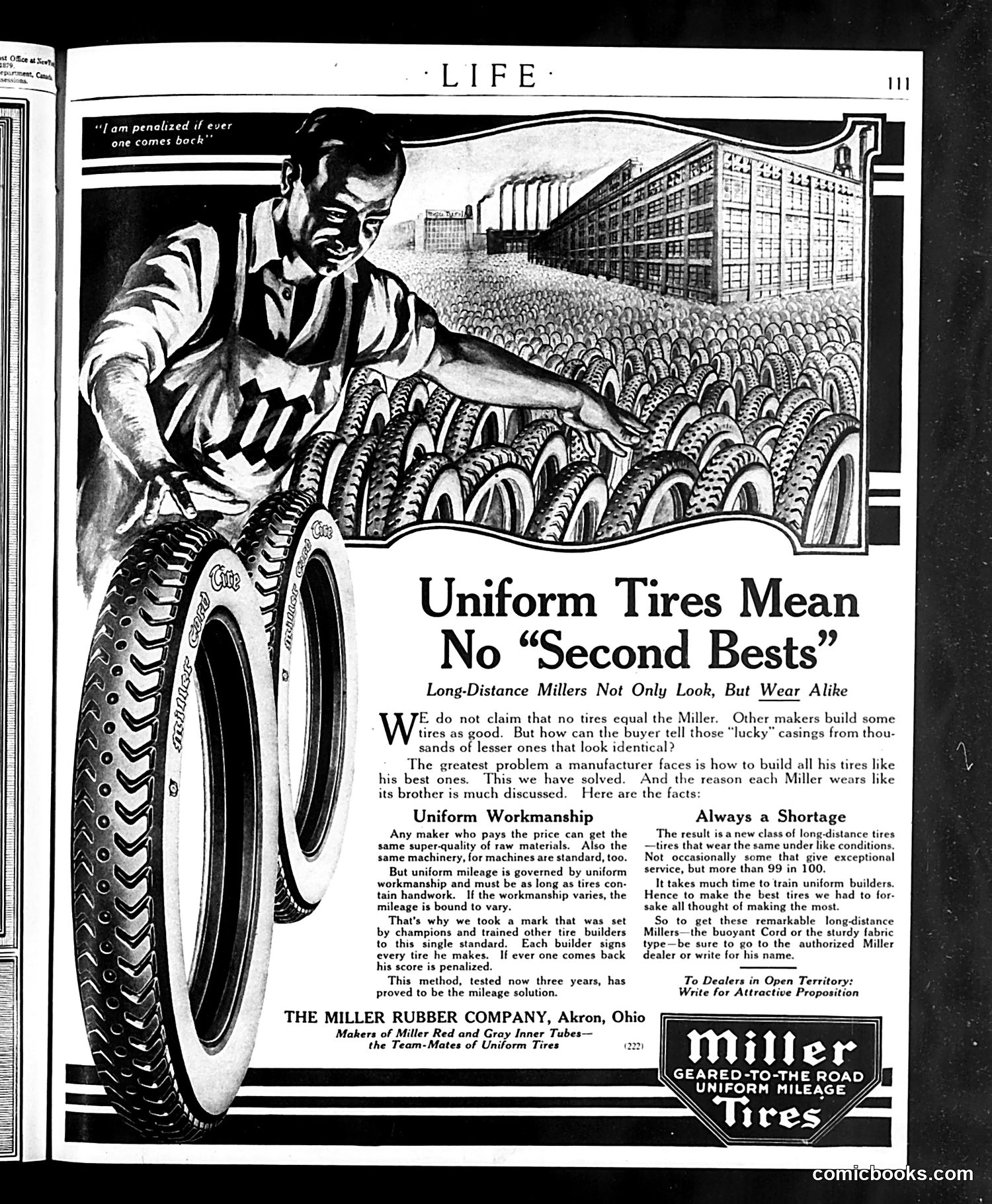
This page is **primarily an advertisement**, not satirical content. It's a Miller Rubber Company tire ad from Life magazine, promoting Miller brand tires to long-distance truck drivers and commercial users. The illustration shows a factory worker inspecting tires against an industrial backdrop with warehouses and stacked tires. The ad's main claim is that Miller tires offer "uniform" quality—each tire wears identically to others, preventing the problem of "second bests" (inferior tires mixed with quality ones). The marketing argument emphasizes consistent manufacturing standards and workmanship as Miller's competitive advantage. There is no political satire here; it's straightforward commercial advertising typical of early-to-mid 20th century trade publications, appealing to fleet managers concerned with tire reliability and uniformity.
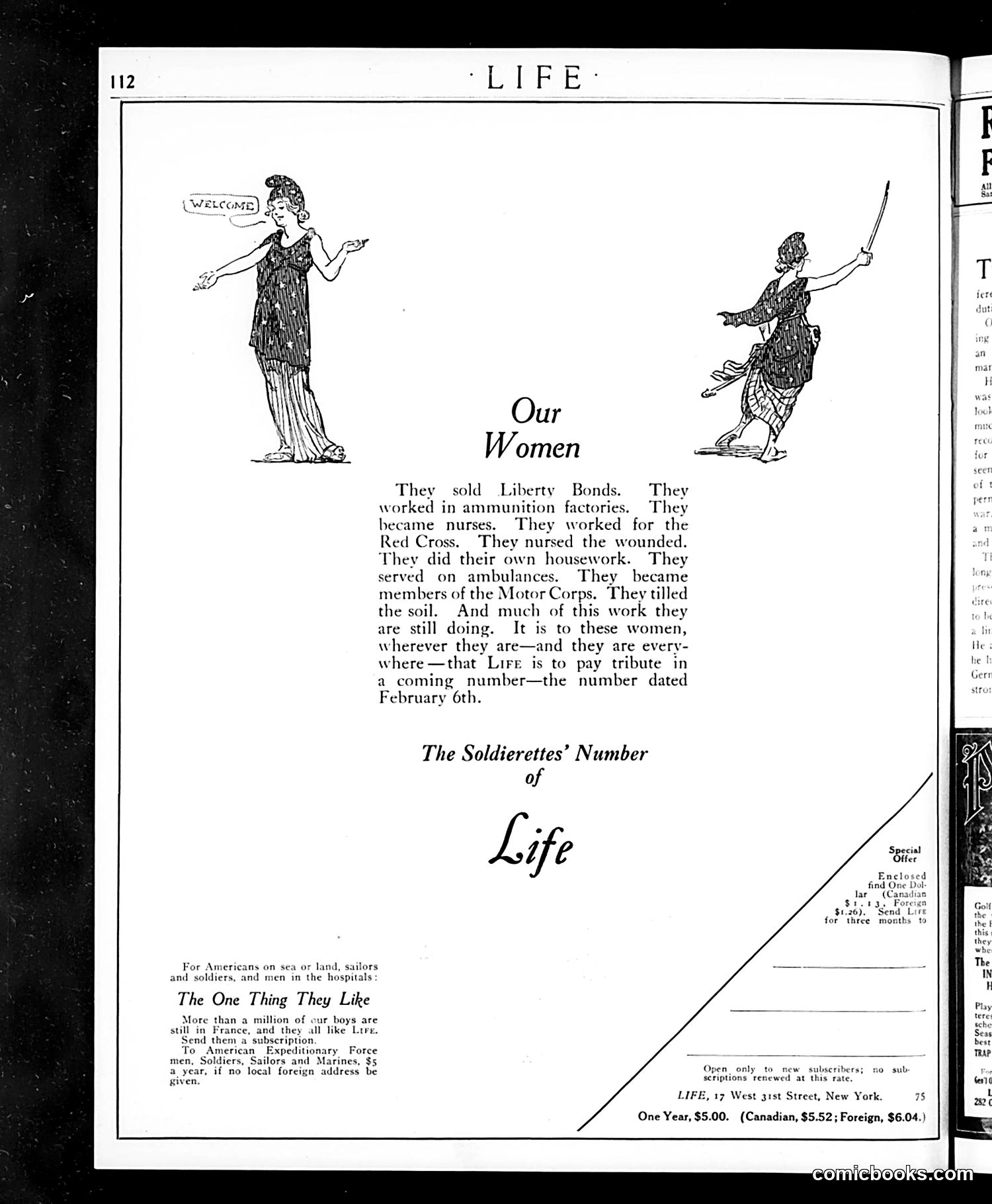
This page celebrates American women's contributions during World War I. The two illustrated figures represent women engaged in wartime work—one welcoming (labeled "Welcome"), the other actively working (wielding what appears to be a tool or implement). The text catalogs women's diverse war efforts: selling Liberty Bonds, working in ammunition factories, nursing, serving with the Red Cross, doing housework, driving ambulances, and joining the Motor Corps. The piece acknowledges this ongoing work with a tribute in an upcoming "Soldiettes' Number" of Life dated February 6th. The bottom section advertises Life magazine subscriptions specifically for American soldiers and sailors overseas, positioning the magazine as "The One Thing They Like." This reflects WWI-era recognition of the home front's essential female labor.
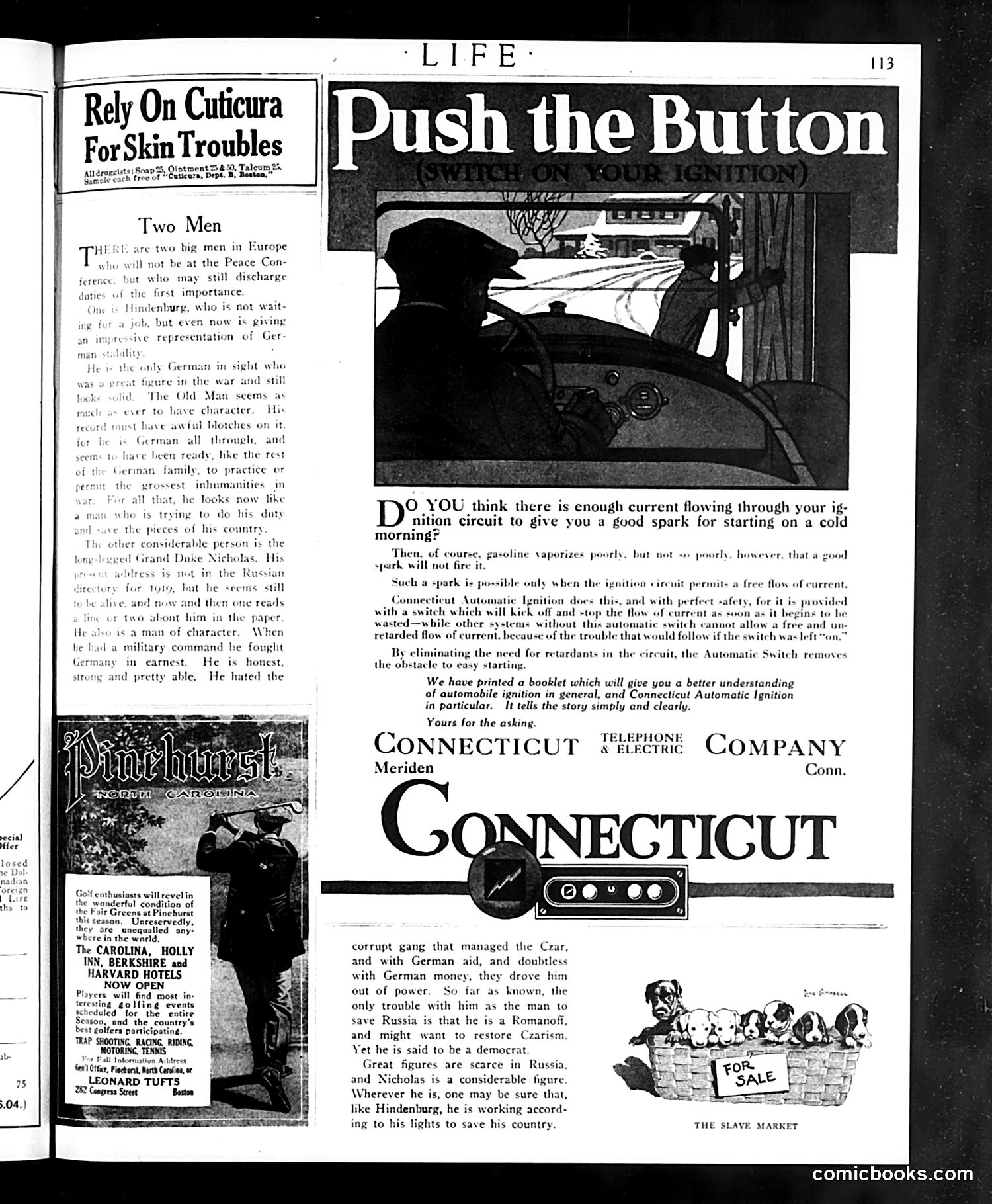
This Life magazine page is primarily **advertising**, not political satire. The main content features: 1. **"Push the Button" advertisement** for Connecticut Telephone & Electric Company's automatic ignition system for automobiles. The ad uses a car interior image to promote safer, easier engine starting without manual cranks. 2. **Left sidebar**: A Cuticura skin treatment ad and a Pinehurst, North Carolina resort advertisement. 3. **Bottom right**: "The Slave Market" illustration showing puppies for sale—a lighthearted comparison using the slavery reference as wordplay. 4. **Main text article** titled "Two Men" discusses European political figures (appears to reference Hindenburg and the Duke of Nicholas) in post-WWI context, but this is disconnected from the satirical cartoon content. The page mixes commercial advertisements with news commentary typical of early 20th-century Life magazine format.
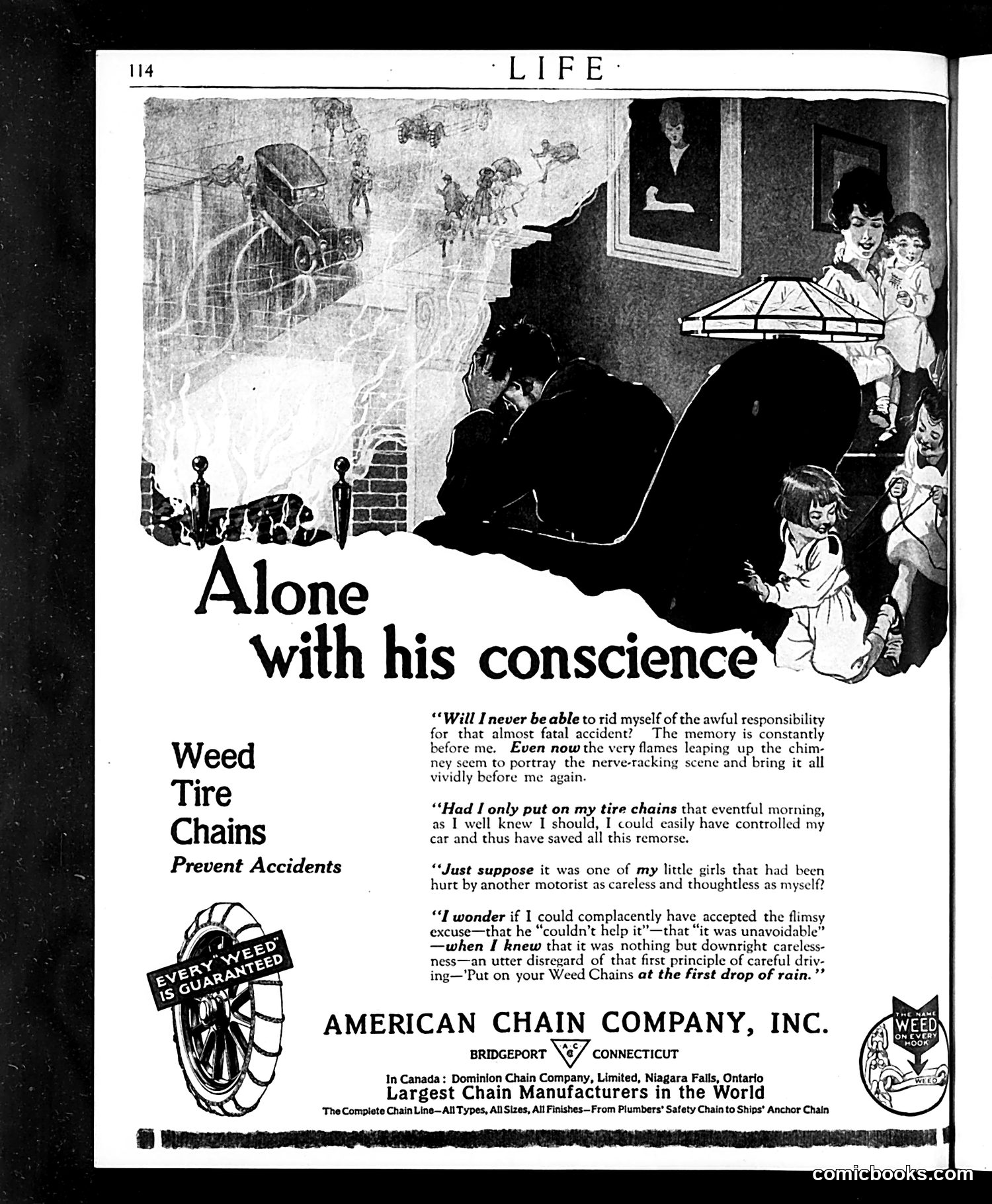
This is primarily a **Weed Tire Chains advertisement**, not political satire. The narrative depicts a motorist tormented by guilt over a near-fatal accident he caused, presumably from driving without tire chains in poor conditions. The dramatic silhouette shows him alone with his conscience—a visual metaphor for his psychological burden. The advertisement's argument is straightforward: installing Weed tire chains prevents accidents, thus sparing drivers from moral anguish. The quotes present his internal monologue rationalizing the accident as "unavoidable," which the ad contradicts—it *was* avoidable with proper equipment. This reflects early automotive safety messaging, when personal responsibility for accident prevention was emphasized to consumers. The emotional manipulation (guilt, endangered children) was typical of 1920s-era advertising.
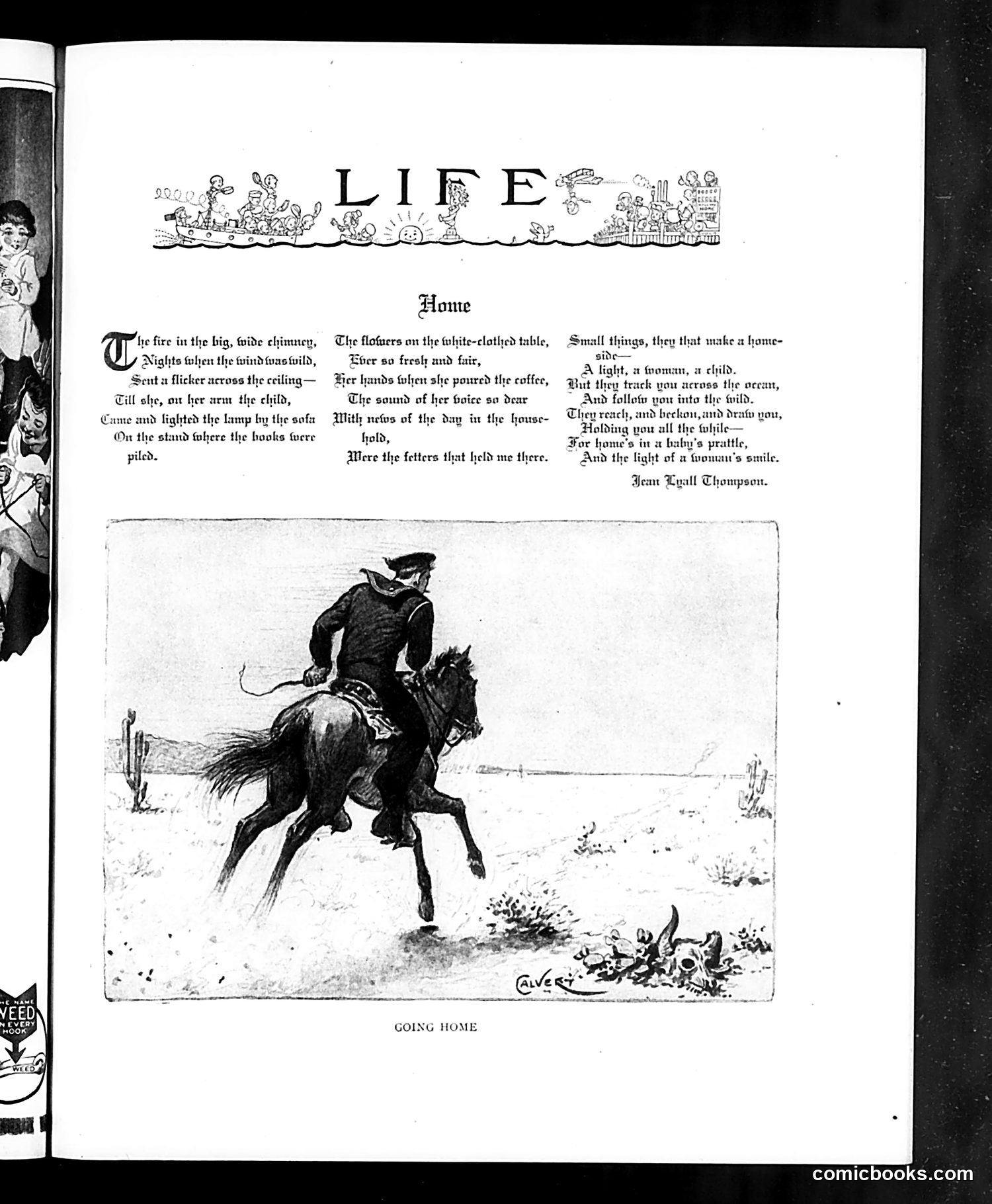
This page from *Life* magazine features a section titled "Home" with a poem by Jean Tyall Thompson about domestic life's small comforts—a fire, flowers, a child's laughter—that make a house meaningful. The accompanying illustration titled "Going Home" depicts a horseman in period clothing riding across an open landscape. The image appears to be a straightforward romantic illustration rather than political satire. It complements the poem's nostalgic, sentimental treatment of home as a place of refuge and contentment. There is no apparent political commentary or caricature on this page. Rather, it represents *Life* magazine's lighter editorial content—poetry and sentimental illustration—distinct from their satirical cartoons.
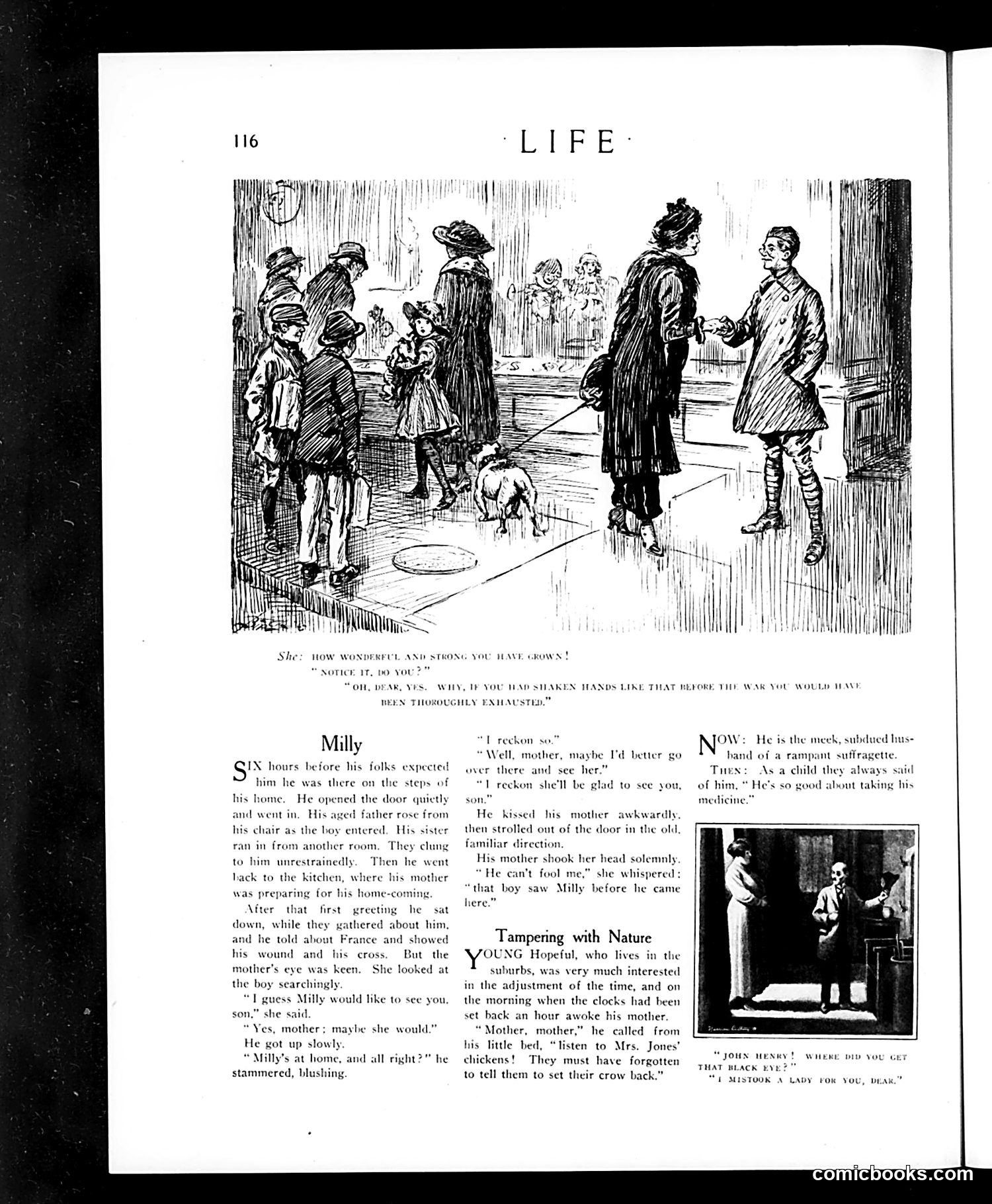
This page contains two distinct pieces: **Top illustration**: A street scene showing a woman greeting a returning soldier. The caption indicates she's praising his strength and growth, then asking why his hands aren't shakier—referencing that before the war, he would have been "thoroughly exhausted" by manual labor. This satirizes how wartime service supposedly built men's physical resilience compared to peacetime civilian life. **"Milly" story**: A domestic narrative about a soldier's homecoming. His mother expects him, he arrives tired from France, and they discuss his condition. The text notes he's now a "meek, subdued husband of a rampant suffragette," suggesting post-war anxieties about changing gender dynamics and women's increasing social power (likely referencing the suffrage movement). Both pieces reflect WWI-era social concerns about masculinity, war's effects, and women's roles.
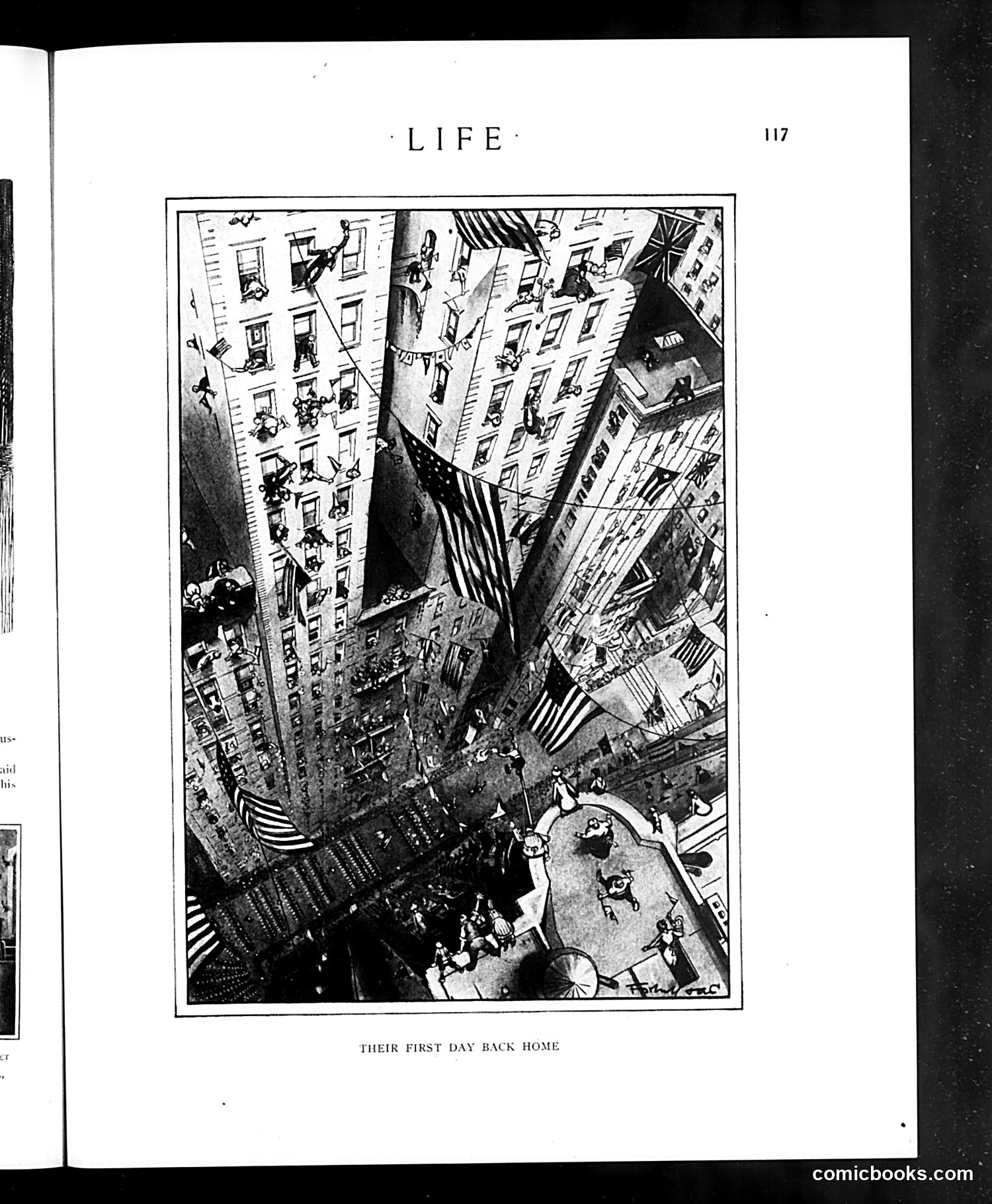
This page from *Life* magazine (page 117) features an aerial photograph captioned "THEIR FIRST DAY BACK HOME." The image shows a densely packed urban street canyon viewed from above, with tall apartment buildings flanking both sides, American flags visible, and crowds of people gathered below on the street and sidewalks. The caption suggests this depicts soldiers or servicemen returning home after military deployment, likely from World War I or II based on the photographic style. The aerial perspective emphasizes the crowded, enthusiastic welcome—throngs of citizens gathering in city streets to greet returning troops. The multiple American flags reinforce the patriotic homecoming theme. The satire appears to celebrate (rather than mock) the joyous civilian reception of veterans returning from war.
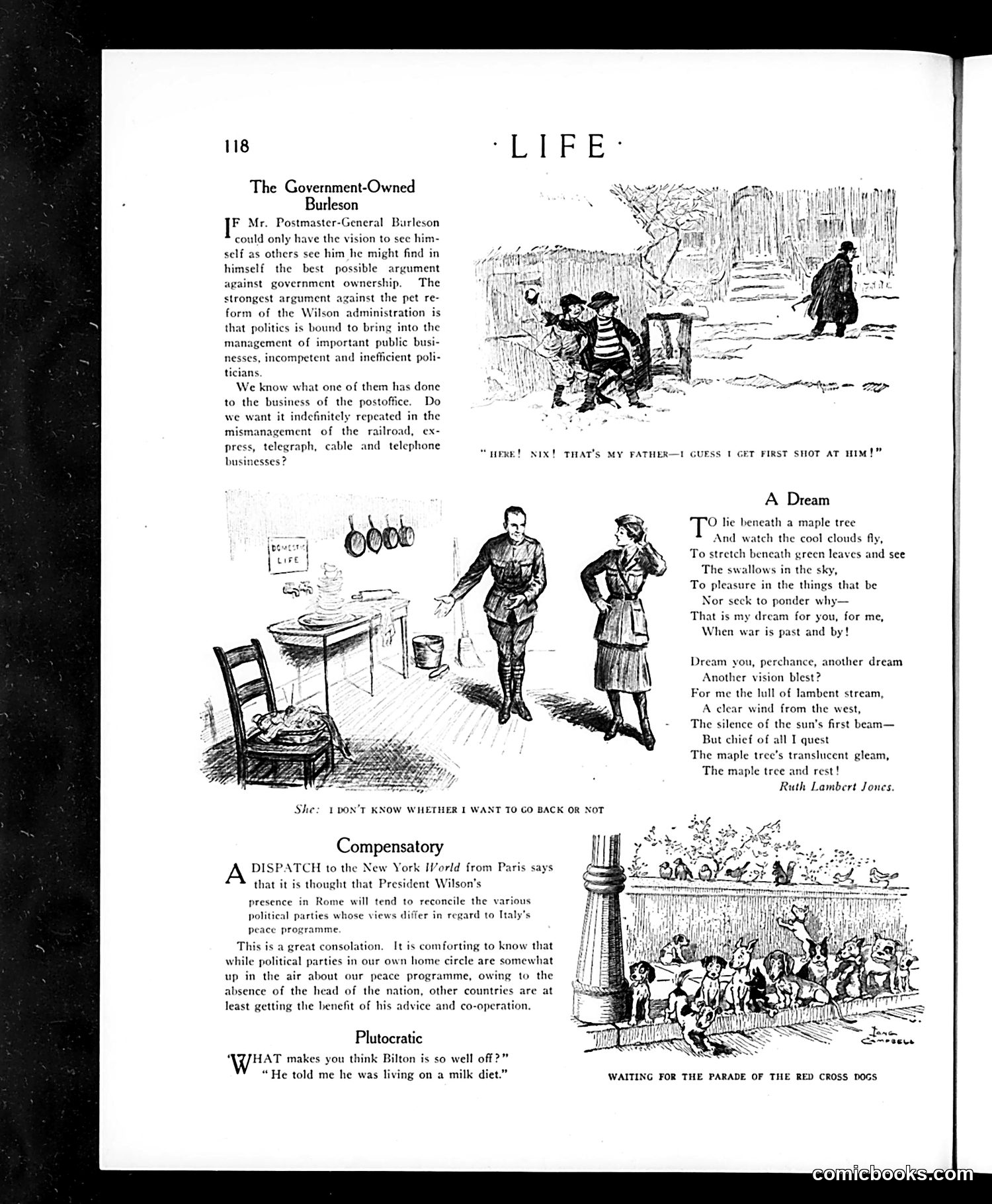
This page contains political and social commentary from the Wilson administration era. "The Government-Owned Burleson" criticizes Postmaster-General Burleson's management, arguing that the Wilson administration's policy of government control over public businesses has led to mismanagement of the postoffice, railroad, telegraph, cable and telephone services. The middle cartoon shows a domestic scene captioned "She: I don't know whether I want to go back or not"—likely commentary on postwar uncertainty about returning to peacetime normalcy. "A Dream" is a poem about pastoral peace, while "Compensatory" discusses President Wilson's diplomatic efforts in Rome regarding Italy's peace program. The bottom cartoon depicts crowds awaiting a Red Cross dogs parade, a lighthearted social scene amid serious postwar reconstruction discussions.
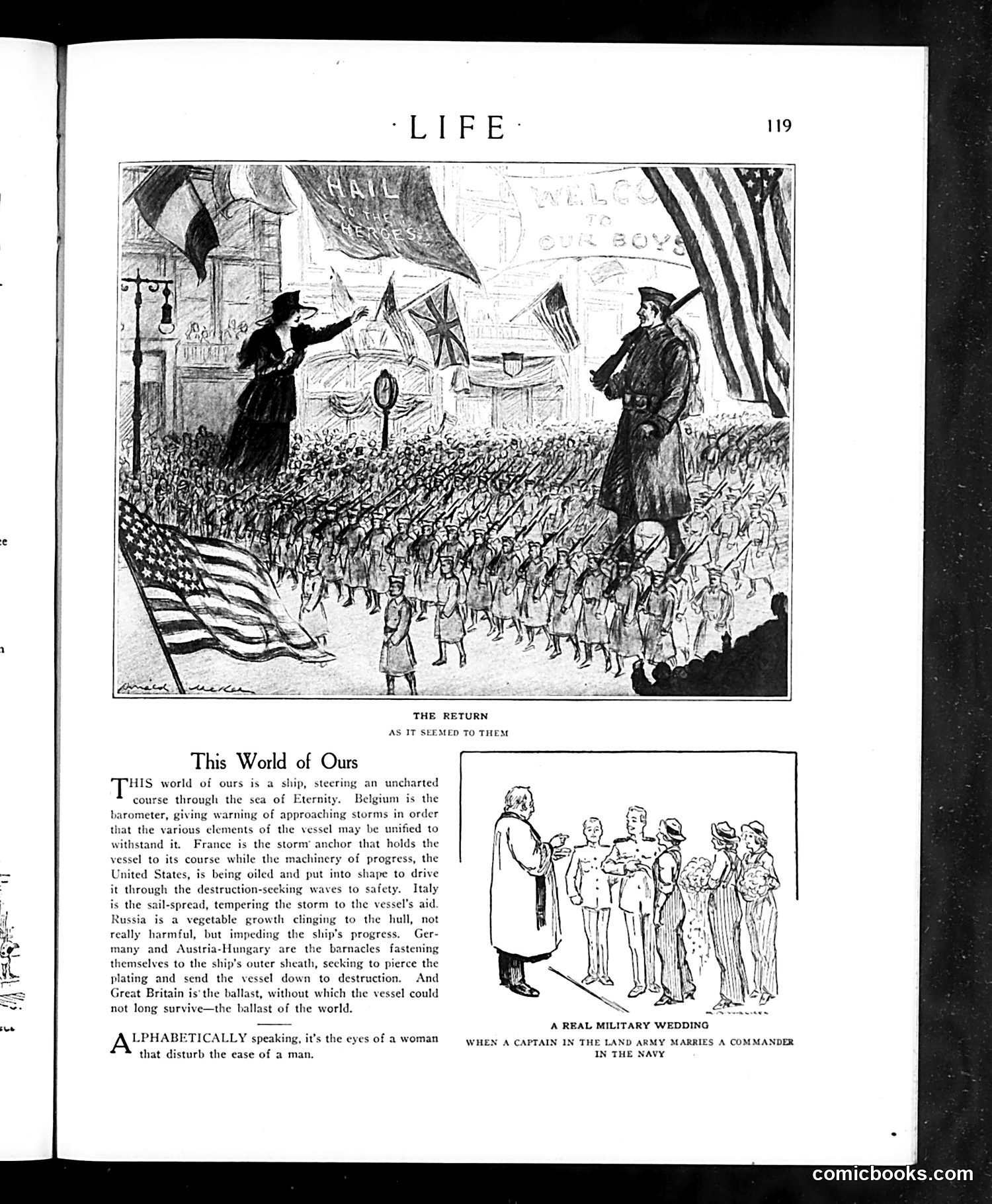
The main cartoon depicts **"The Return"** as a allegorical ship voyage through world history. The text explicitly identifies the vessel's passengers as European nations: Belgium as "barometer" warning of storms, France as "storm anchor," the United States as engine driving progress, Italy as "oil," Russia as "vegetable growth," Germany as "barnacles" seeking to destroy the ship, and Great Britain as "ballast" essential for survival. This is **post-WWI political commentary** (likely 1920s), using maritime metaphor to describe Europe's recovery and international cooperation, with Germany portrayed as a destructive force and Britain's stabilizing role emphasized. The lower cartoon, "A Real Military Wedding," humorously depicts military protocol between army and navy branches—contemporary social satire about institutional hierarchies rather than political allegory.
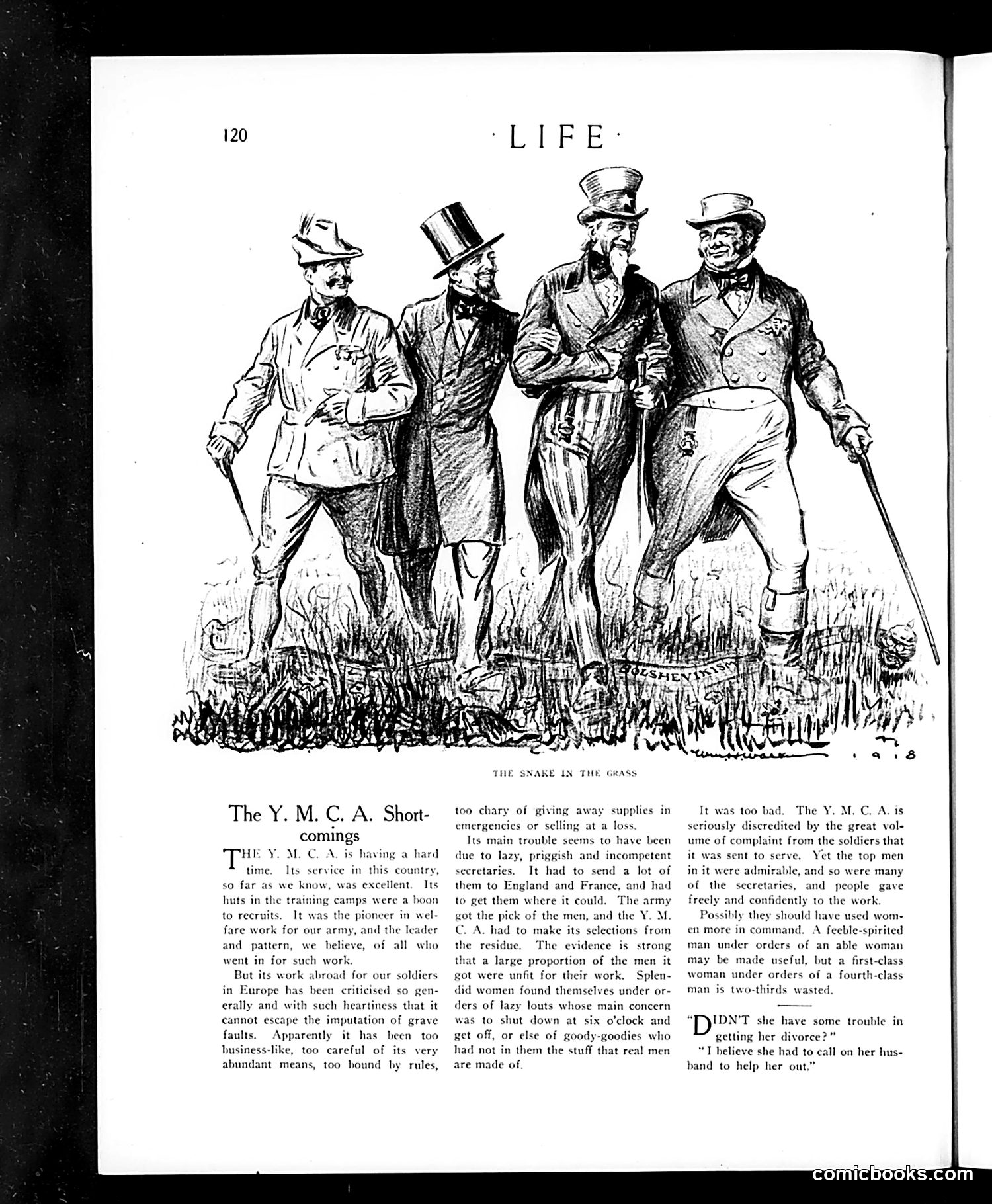
This satirical cartoon criticizes the Young Men's Christian Association (YMCA) during World War I. The illustration shows four military officers discovering a snake in grass, captioning it "THE SNAKE IN THE GRASS." The accompanying article attacks the YMCA's wartime operations, alleging incompetence and poor judgment in managing supplies and selecting personnel. The text charges the organization with sending unsuitable secretaries to support troops, being "too businesslike" and wasteful, and failing soldiers' trust. The "snake" metaphor suggests the YMCA's leadership was treacherous or deceptive—presenting itself as helpful to the military effort while actually undermining it through bungling administration and corrupt practices. This reflects broader Progressive Era skepticism of large institutional failures during the war.
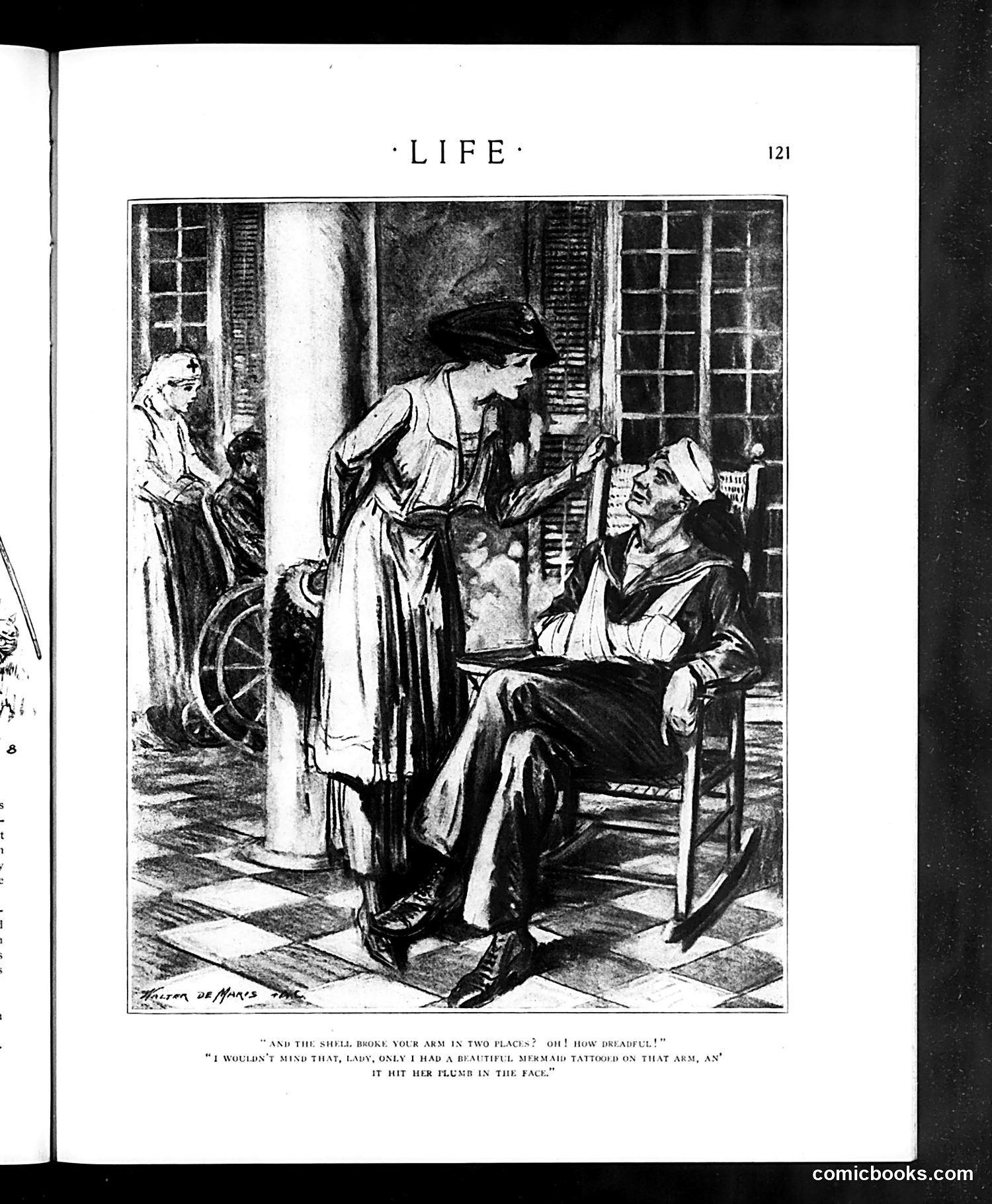
This illustration depicts a naval or maritime scene, likely satirizing early 20th-century attitudes toward working-class romance and social pretension. A sailor sits while a woman in elegant dress stands before him. The caption reveals the joke: the woman laments that a shell broke the sailor's arm in two places. She claims she wouldn't mind that loss—only that he lost a beautiful mermaid tattoo on that arm, which "hit her flume in the face." The satire mocks the woman's superficiality: she prioritizes the aesthetic appeal of a tattoo over the man's actual injury. It also plays on period stereotypes about sailors' tattoos and working-class romanticism, while her refined speech contrasts comically with her shallow concern.
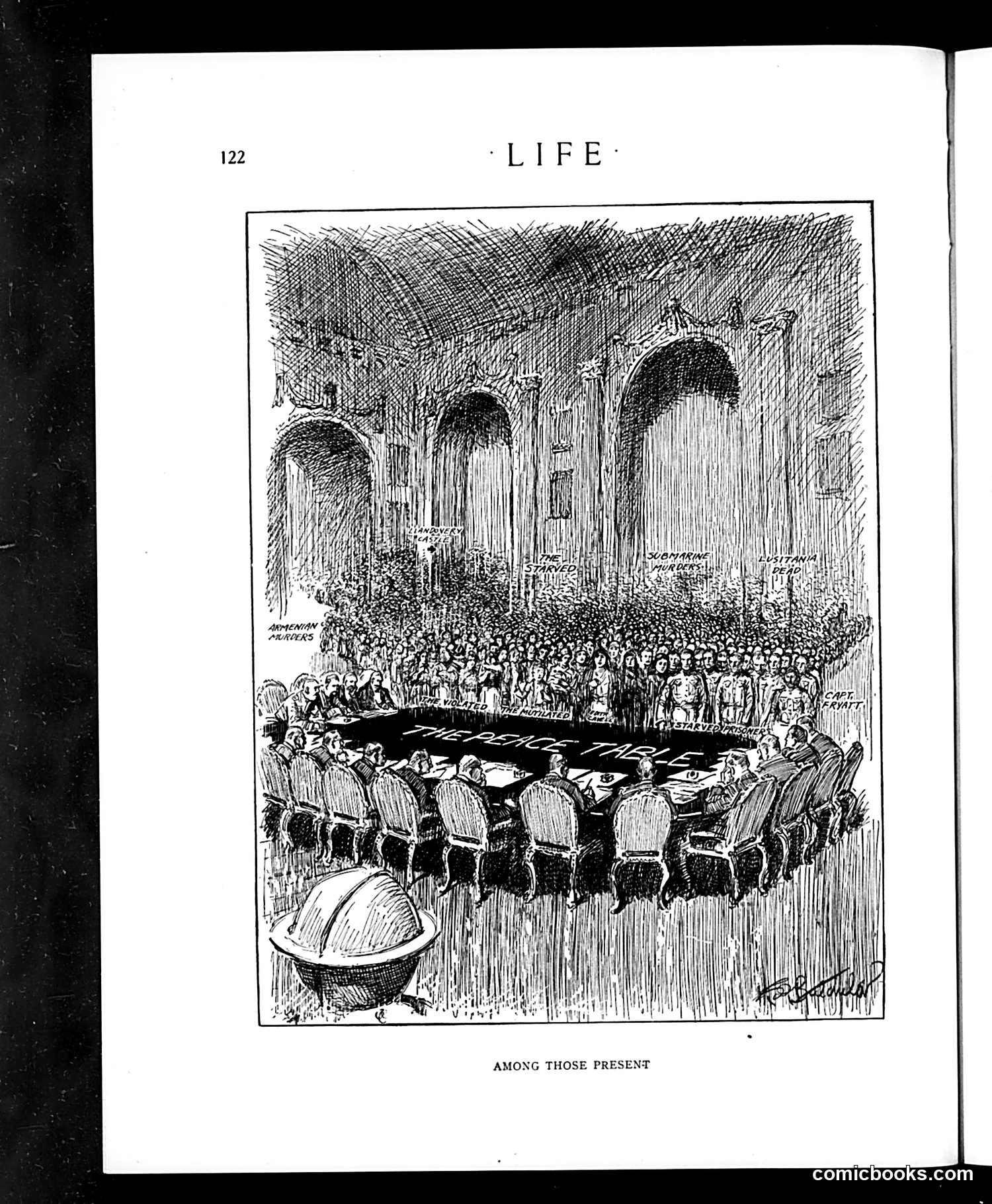
This is a satirical illustration titled "Among Those Present" from Life magazine (page 122). The cartoon depicts a formal gathering in what appears to be a grand cathedral or church with vaulted ceilings. A large round table dominates the foreground where dignitaries are seated, while crowds of onlookers fill the cathedral behind them. The labels visible include "Armenian Murders" and "German Atrocities," suggesting this addresses international diplomatic responses to wartime atrocities. The satire appears to criticize officials gathered in apparent grandeur while serious humanitarian crises go unaddressed—the disconnect between formal proceedings and actual suffering. The cartoon likely comments on diplomatic inaction regarding documented war crimes, a common Life magazine critique of political indifference to human rights violations.
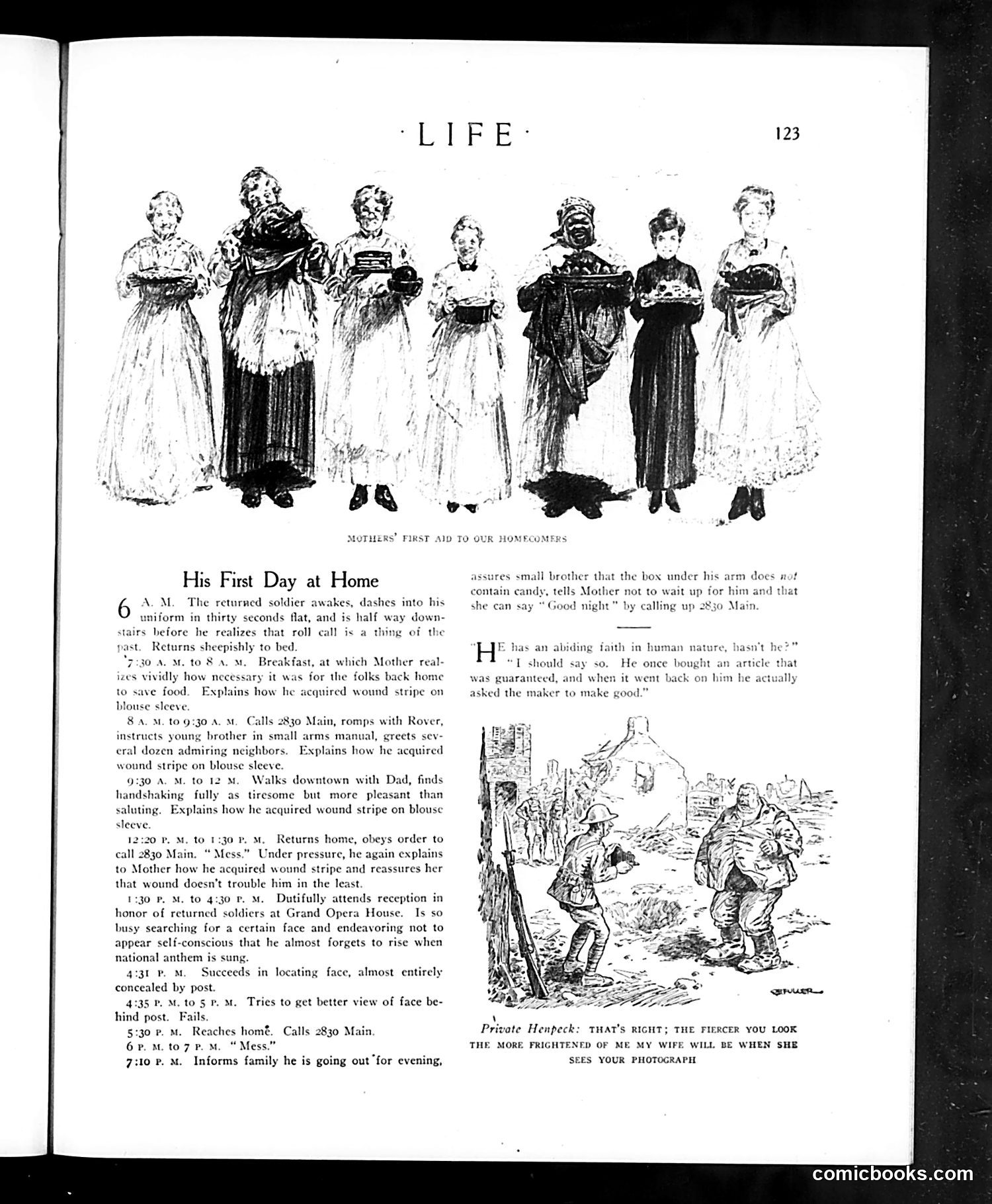
This satirical piece depicts a returning soldier's first day after WWI (based on the uniform references). The page presents a humorous timeline showing the soldier's activities from 6 A.M. through 7 P.M., highlighting the domestic challenges of reintegration. The illustration at bottom shows soldiers in a trench with the caption about a "Private Henpeck" joke—a pun on soldiers under military command becoming "henpecked" (dominated by wives) once home. The satire suggests that while soldiers faced combat dangers abroad, they now face domestic pressure from their families, particularly wives anxious about their appearance and behavior. The "Mothers' First Aid to Our Homecomers" header indicates the piece mocks overly protective family members and the awkwardness of readjustment to civilian life after military service.
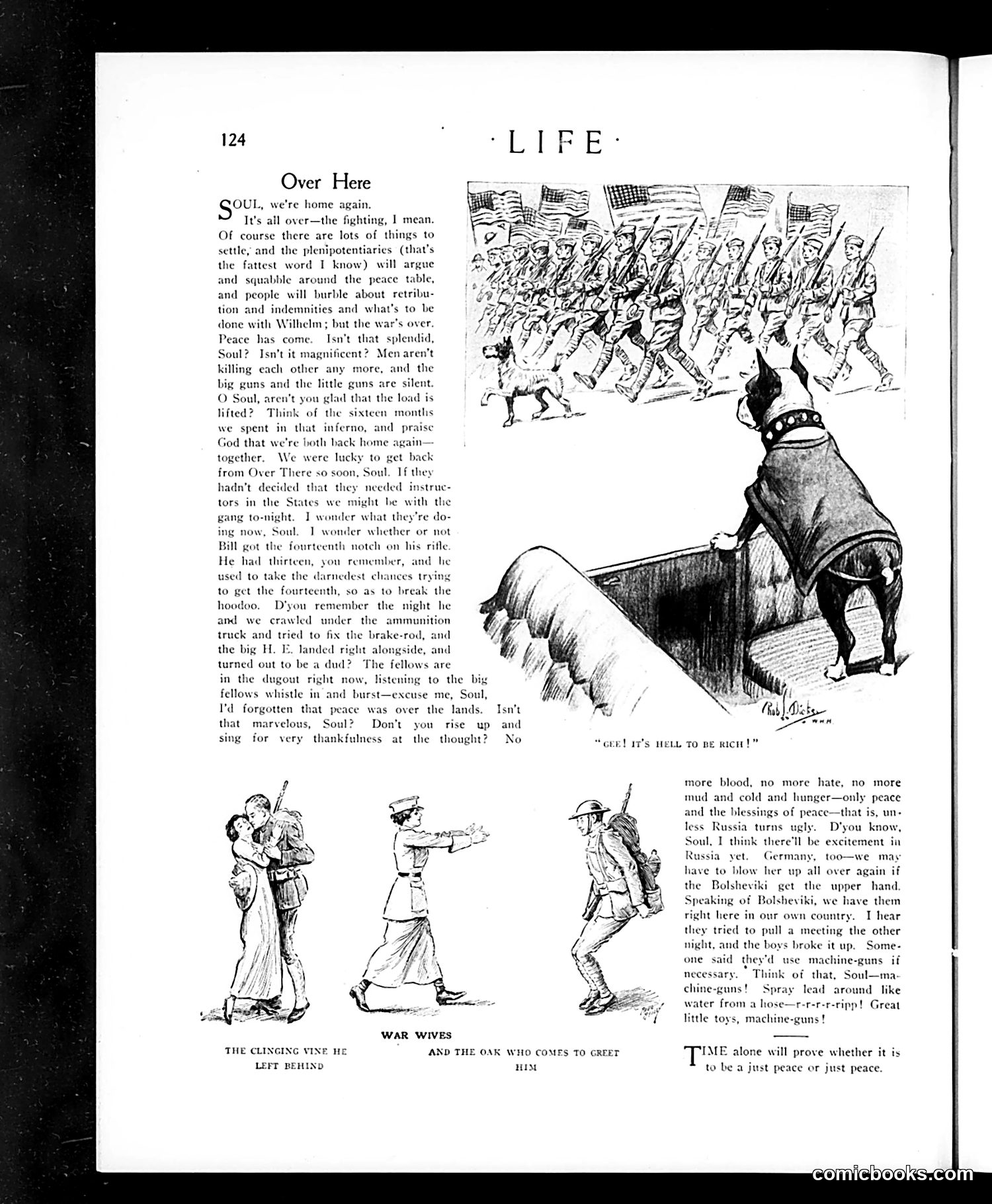
This page reflects American attitudes immediately after World War I's armistice (November 1918). The main text is a conversational meditation on returning home from combat, celebrating peace while hinting at anxieties about the future. The three illustrations labeled "War Wives" contrast soldiers' romanticized expectations with reality: "The Clinging Vine He Left Behind" (dependent woman awaiting return) versus "The Oak Who Comes to Greet Him" (a woman who has become self-reliant during his absence). This satirizes the domestic adjustment challenges veterans faced. The large illustration shows soldiers celebrating, while the caption "It'll Hell to Be Rich!" suggests ironic commentary on wealth disparities. The text references contemporary concerns: Russian Bolshevism ("unless Russia turns ugly"), German instability, domestic radical agitation ("Bolsheviki right here"), and military suppression of political meetings—reflecting post-war American anxiety about communism and social unrest that would intensify in 1919-1920.
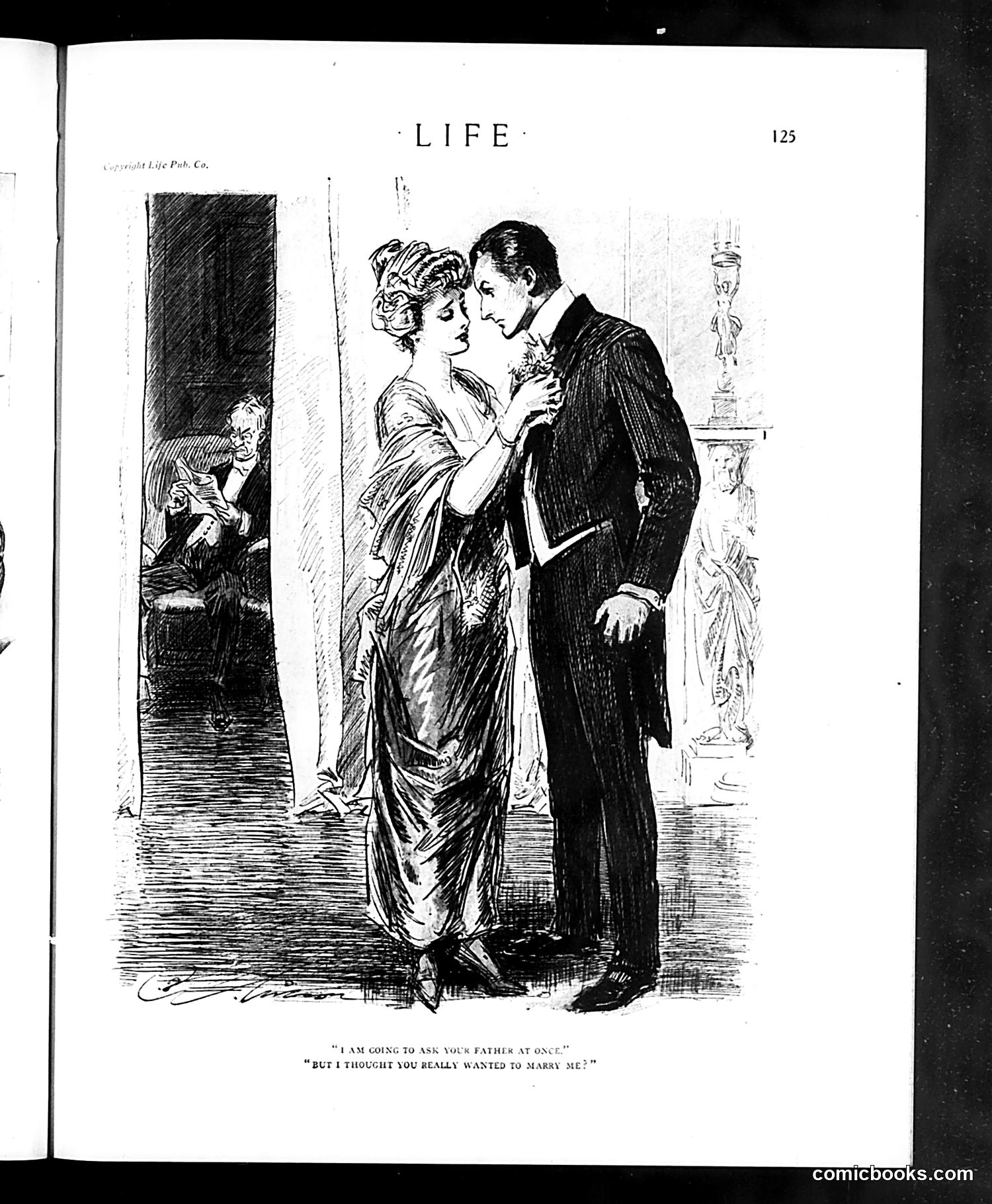
This is a romantic comedy sketch satirizing marriage proposals and courtship conventions of the early 20th century. A well-dressed man declares his intention to ask the woman's father for permission to marry her—a formal social requirement of the era. Her response exposes the contradiction: she questions whether he *actually* wants to marry *her*, or merely wants to satisfy social protocol by obtaining her father's consent. The joke critiques how marriage was treated as a transaction between men, with the woman's own desires secondary. Her sharp retort highlights the absurdity of seeking paternal approval as a substitute for genuine romantic commitment. The elegant interior setting and formal attire emphasize the upper-class social rituals being mocked.
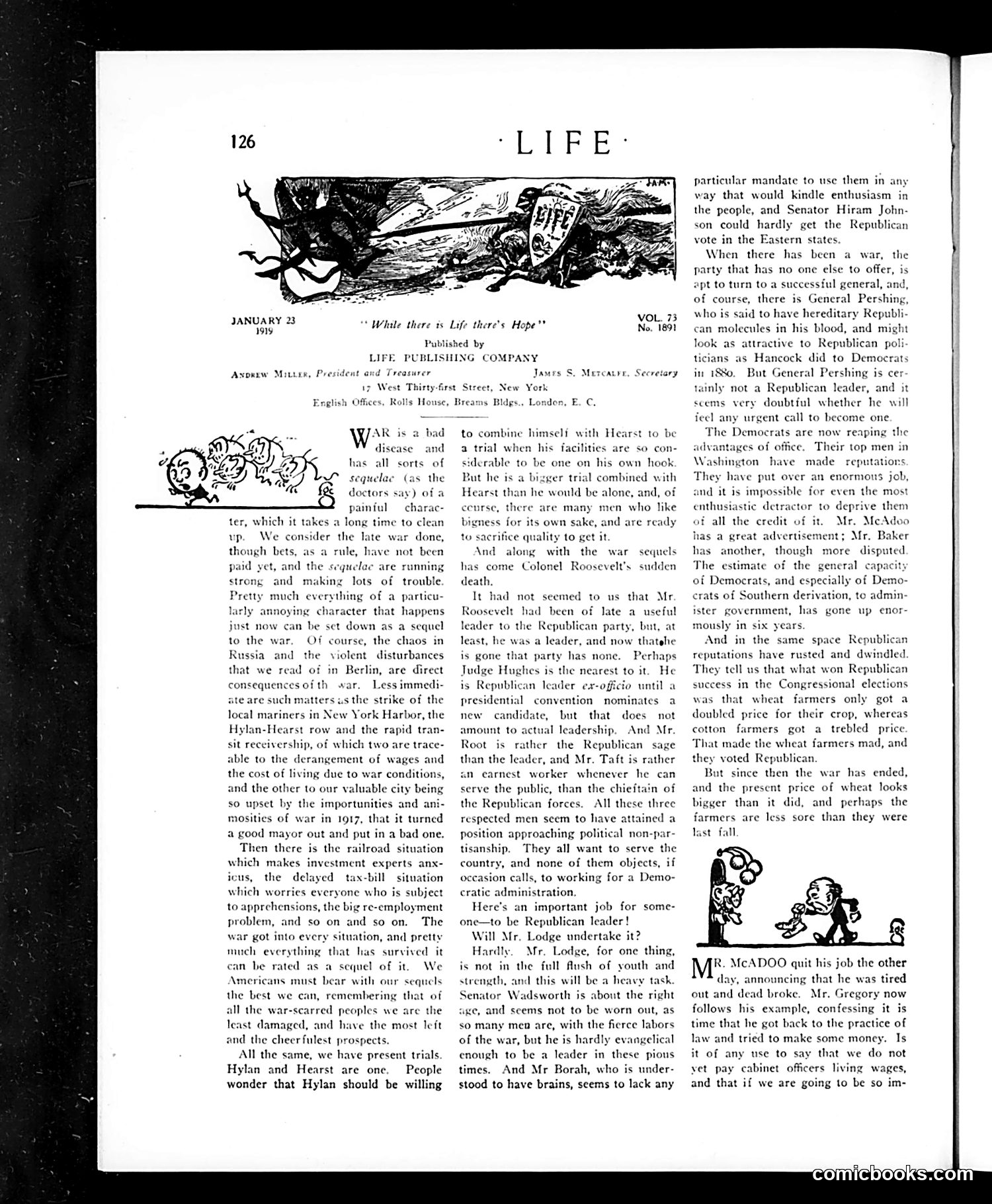
This page critiques post-WWI American politics and the Republican Party's leadership vacuum following Theodore Roosevelt's death. **The Main Cartoon** (top) depicts a skeletal, dead figure labeled "War" lying prone—illustrating the article's argument that while the war ended, its destructive "sequelae" (consequences) persist throughout American society: labor strikes, transit crises, employment problems, and political chaos. **Key Political References:** - **Hylan-Hearst row**: Mayor John Hylan and newspaper magnate William Randolph Hearst's contentious relationship, blamed on post-war instability - **Roosevelt's death**: The recent loss of Theodore Roosevelt, whom Life credits as the Republican Party's only effective leader - **Leadership vacuum**: The article questions whether Republicans like Lodge, Wadsworth, or Borah can replace Roosevelt's authority **The Satire's Point**: Life argues America's greatest post-war problem isn't foreign chaos but finding competent Republican leadership. The magazine ironically portrays this as more urgent than economic recovery or labor unrest.
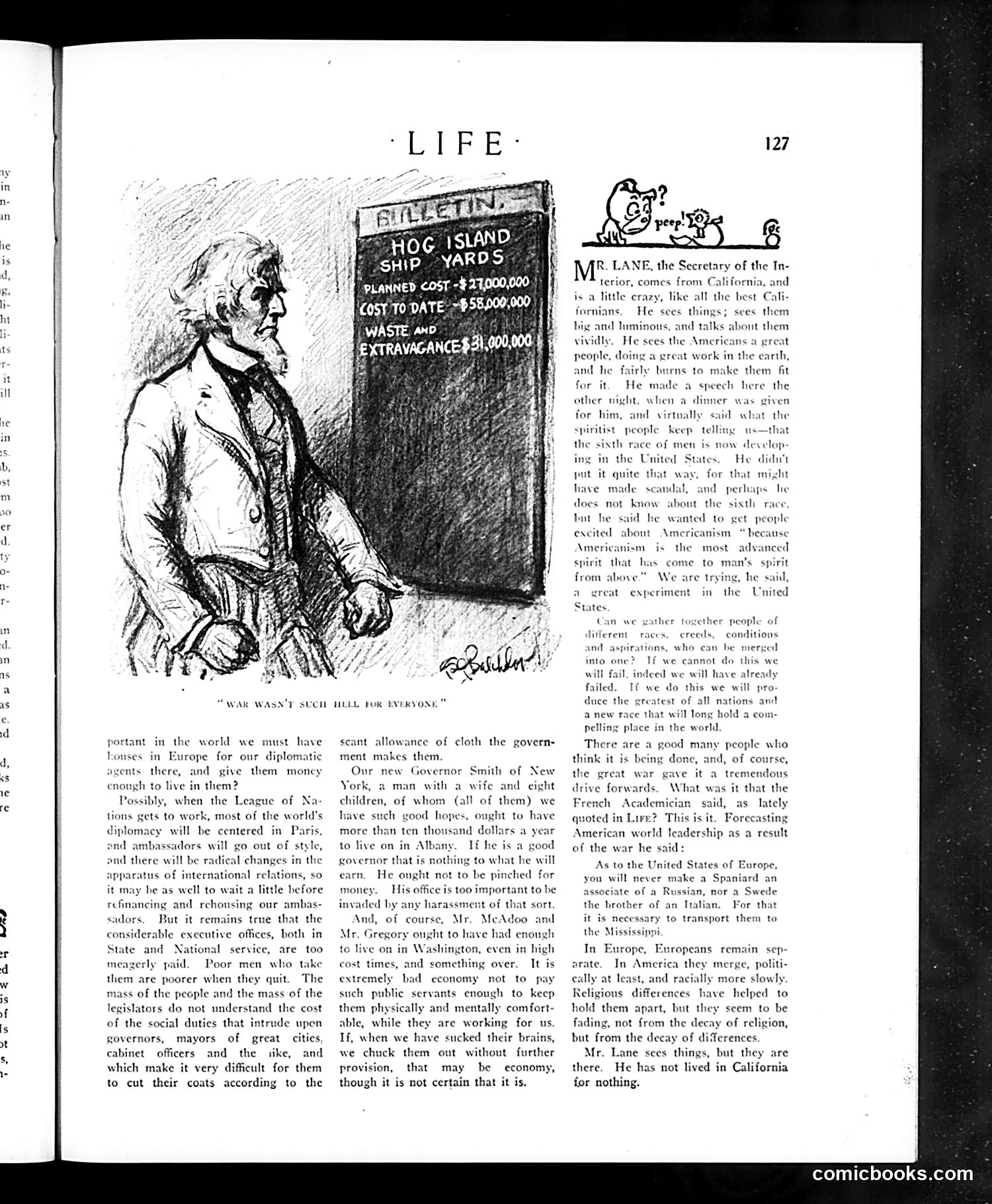
This page satirizes government waste and inadequate public servant compensation. The **cartoon** depicts a man viewing a sign for "Hog Island Ship Yards" with wildly inflated costs: $27 million planned, ballooning to $35 million actual cost, with $31 million in "waste and extravagance." The caption reads "War Wasn't Such Hell for Everyone"—mocking profiteers who enriched themselves during WWI while soldiers suffered. The **text discussion of Mr. Lane**, Secretary of the Interior, portrays him as an idealistic Californian visionary obsessed with creating an advanced "sixth race" of Americans through merging different peoples. The author gently mocks his grandiose rhetoric while noting the French skepticism that Europeans (Spaniards, Russians, Swedes, Italians) can be culturally merged like Americans can, especially away from geographic concentrations like the Mississippi region. The broader **editorial argument** advocates higher salaries for diplomats and public officials (mentioning Governor Smith, McAdoo, and Gregory) to prevent corruption and ensure quality leadership—contrasting with wartime profiteering like Hog Island exemplifies.
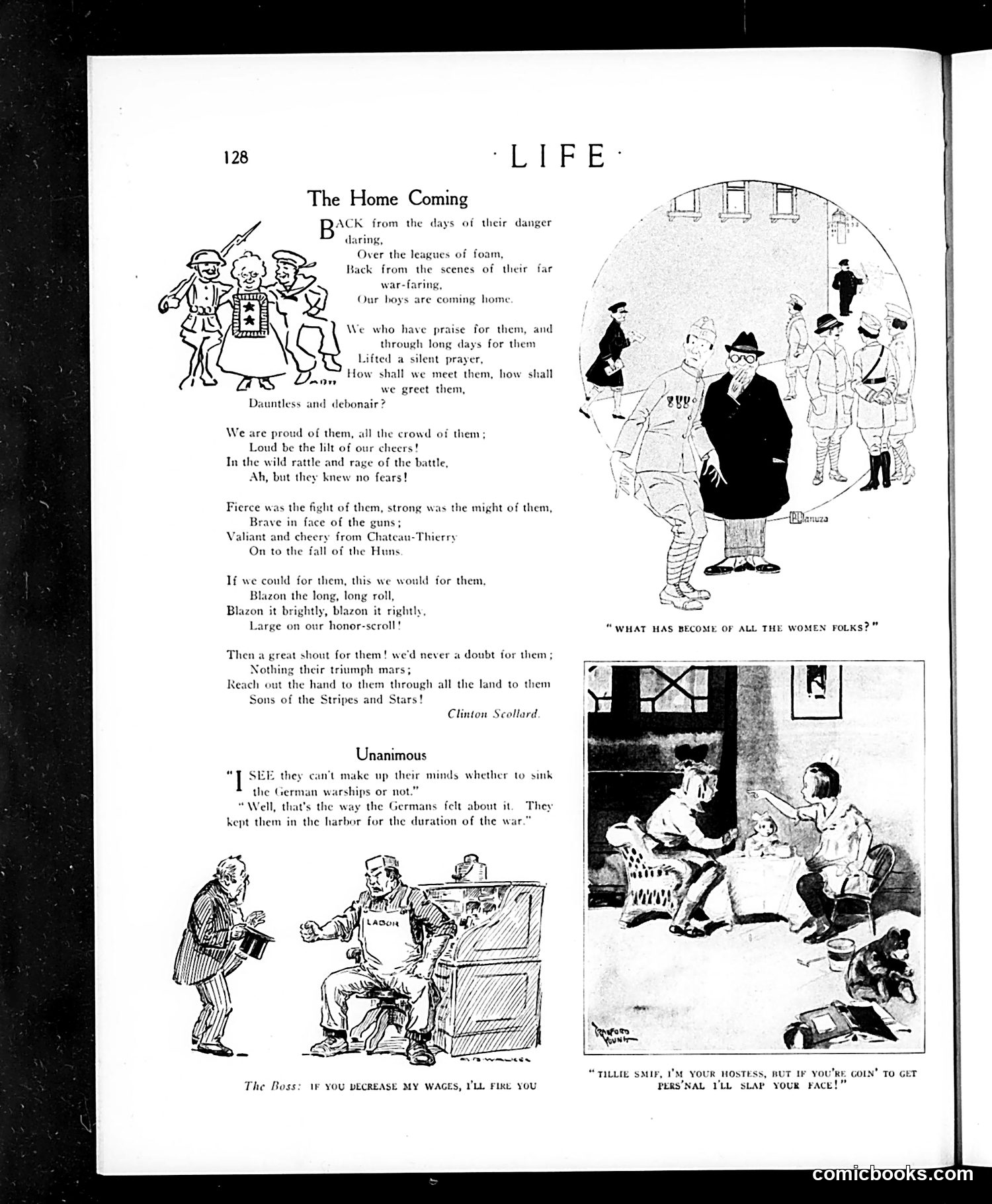
**"The Home Coming"** is a patriotic poem celebrating American soldiers returning from World War I, emphasizing their bravery and the nation's pride in them. **"Unanimous"** satirizes political indecision about German naval strategy. The joke: Germans couldn't decide whether to sink their own warships, so they kept them harbored throughout the war—a pointed critique of German military incompetence or hesitation. **"The Boss"** depicts labor conflict: a working-class man threatens his employer that if wages are cut, he'll be fired and will slap the boss's face. This reflects post-WWI tensions between labor and management, as workers returning from war sought better conditions and faced employer resistance. The cartoon mocks both the boss's threat and the worker's defiant (if improbable) response, capturing the era's class antagonism and workers' assertiveness.
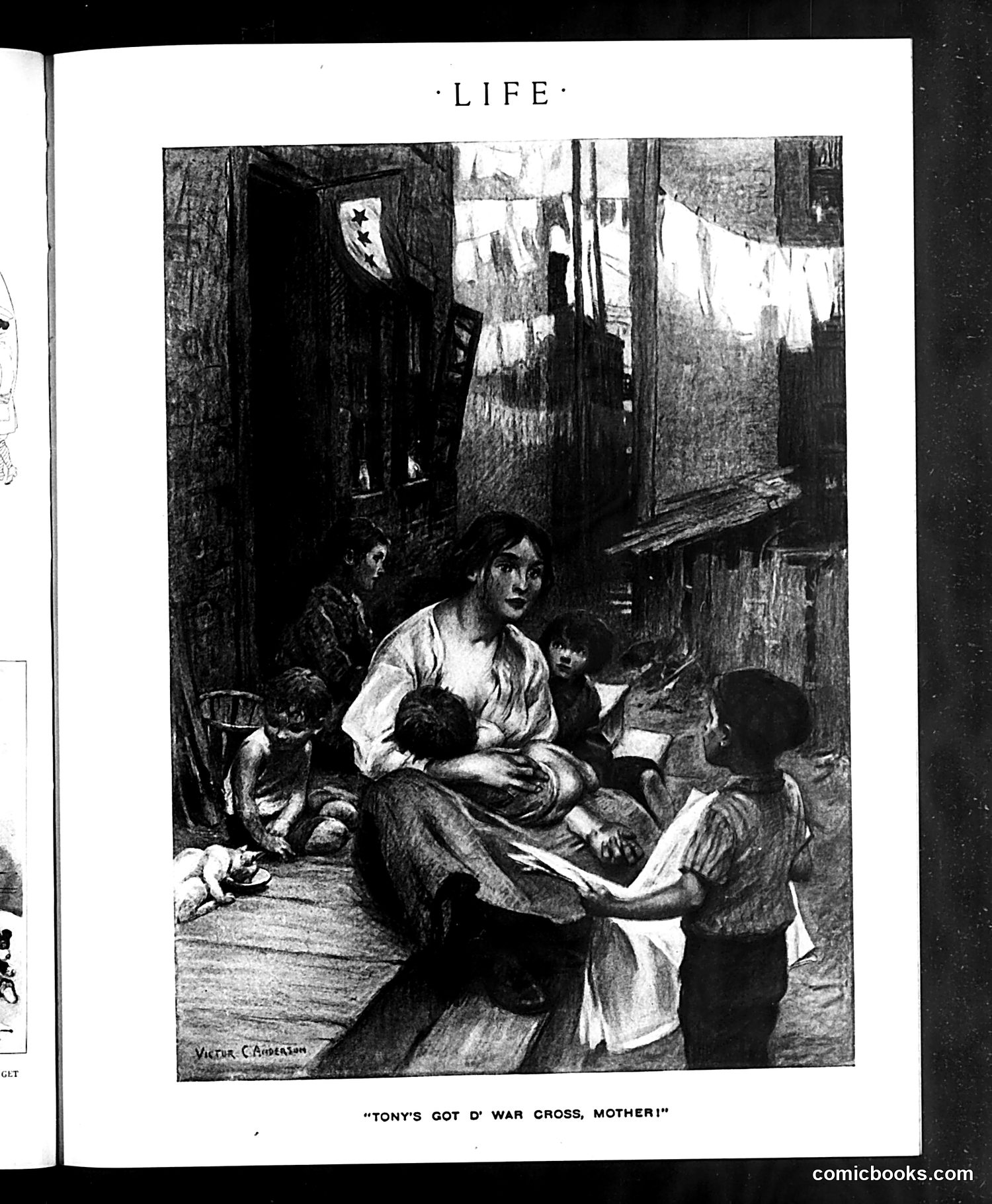
This appears to be a WWI-era satirical illustration from *Life* magazine. The caption "'Tony's Got D' War Cross, Mother!" depicts a tenement scene where a woman (presumably a mother) learns her son "Tony" has received a military decoration—likely the Distinguished Service Cross. The satire targets working-class immigrant communities (suggested by the dialect spelling "d'" and the character name "Tony," common period stereotypes for Italian immigrants). The cramped, impoverished living conditions visible in the background contrast sharply with any honor or prestige a war medal might suggest. The artwork critiques how poor immigrant families sacrificed sons to the war effort while remaining trapped in poverty, presenting a dark commentary on class inequality and the human cost of warfare among vulnerable populations.
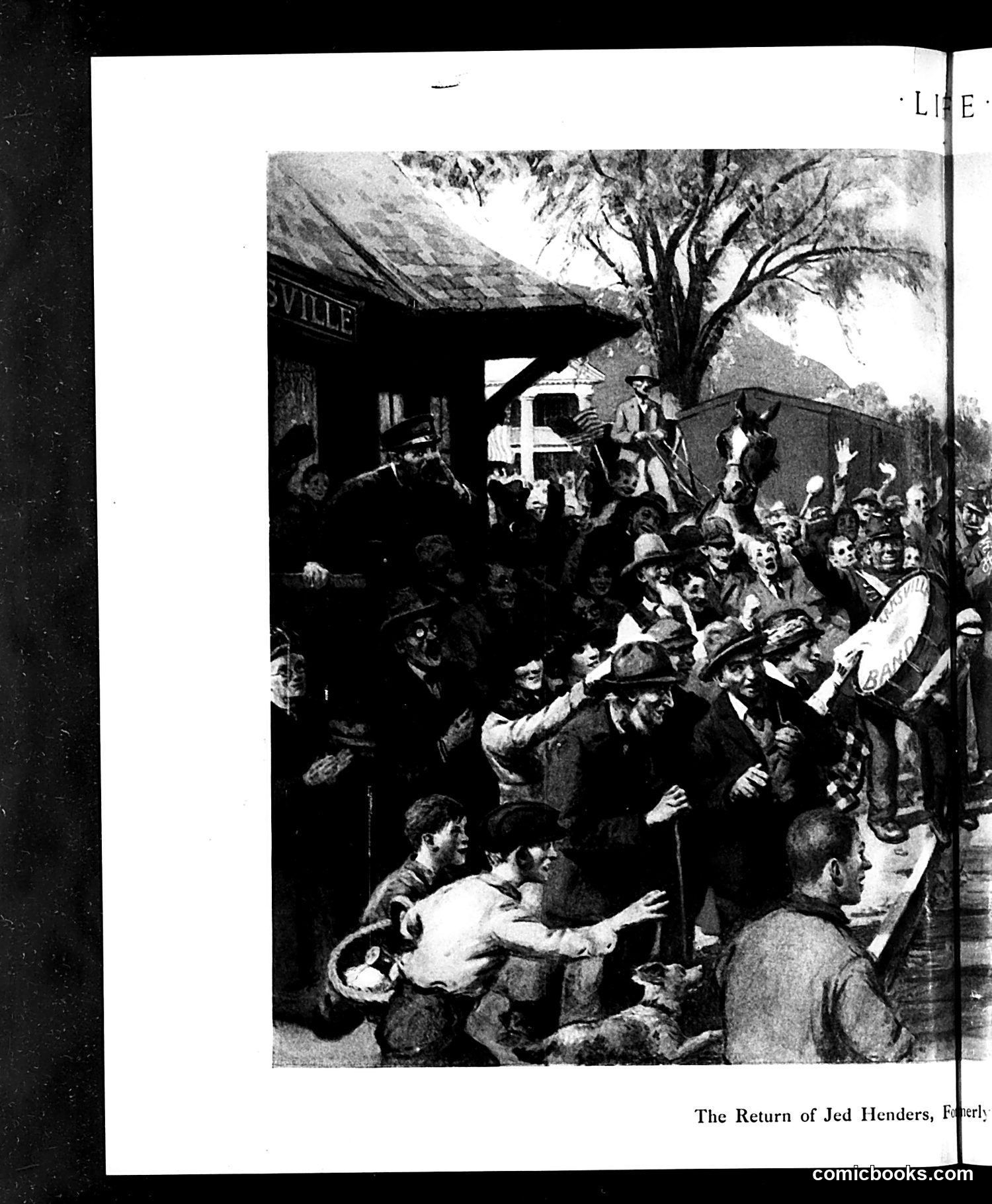
This appears to be a satirical illustration depicting a crowded, chaotic scene centered around a building. A large crowd of people gestures excitedly toward a figure on horseback in the background, suggesting a homecoming or return of some significance. The caption reads "The Return of Jed Henders, Fd" (the abbreviation "Fd" is unclear—possibly "Federal" or truncated text). Without additional context from Life magazine's publication date, I cannot identify who Jed Henders was or what specific political or social event this references. The scene's theatrical, exaggerated style suggests satire of either a public figure's return or commentary on crowd behavior and celebration. The specifics of the joke remain unclear without broader historical context.
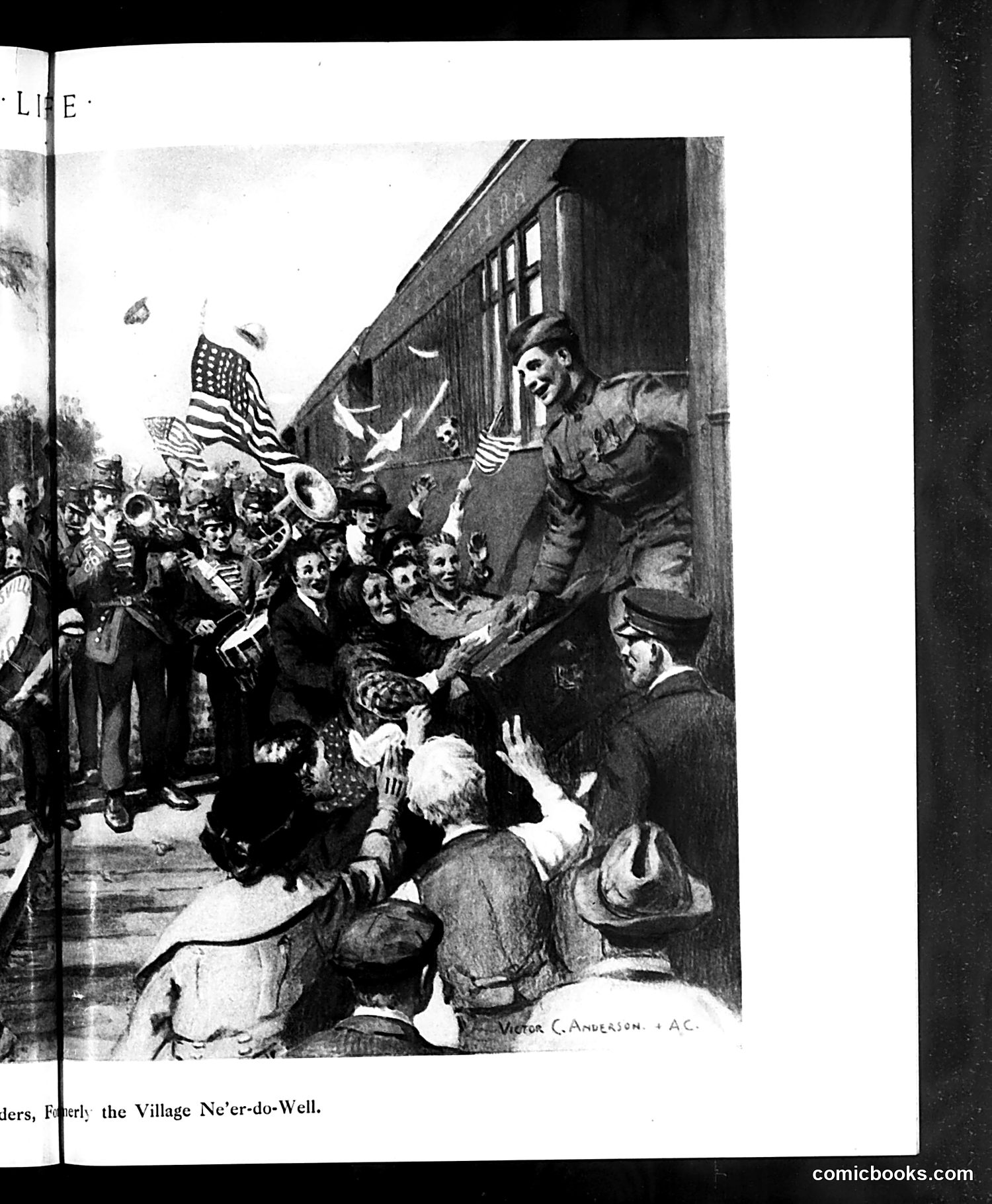
This illustration by Victor C. Anderson depicts a crowd of immigrants or working-class people gathered outside what appears to be a building or ship. American flags are visible, suggesting a patriotic or arrival context. The caption references "the Village Ne'er-do-Well," indicating this is satirizing a particular social type or character. The scene likely comments on immigration, urban poverty, or social welfare during the early 20th century. The crowd's composition and the building setting suggest this may depict arrival at Ellis Island, a tenement, or a charitable institution. The "Ne'er-do-Well" reference suggests satire directed at perceived laziness or social parasitism—a common theme in *Life* magazine's commentary on urban populations and immigration policy of the era. Without clearer text or more context, the specific political target remains somewhat unclear.
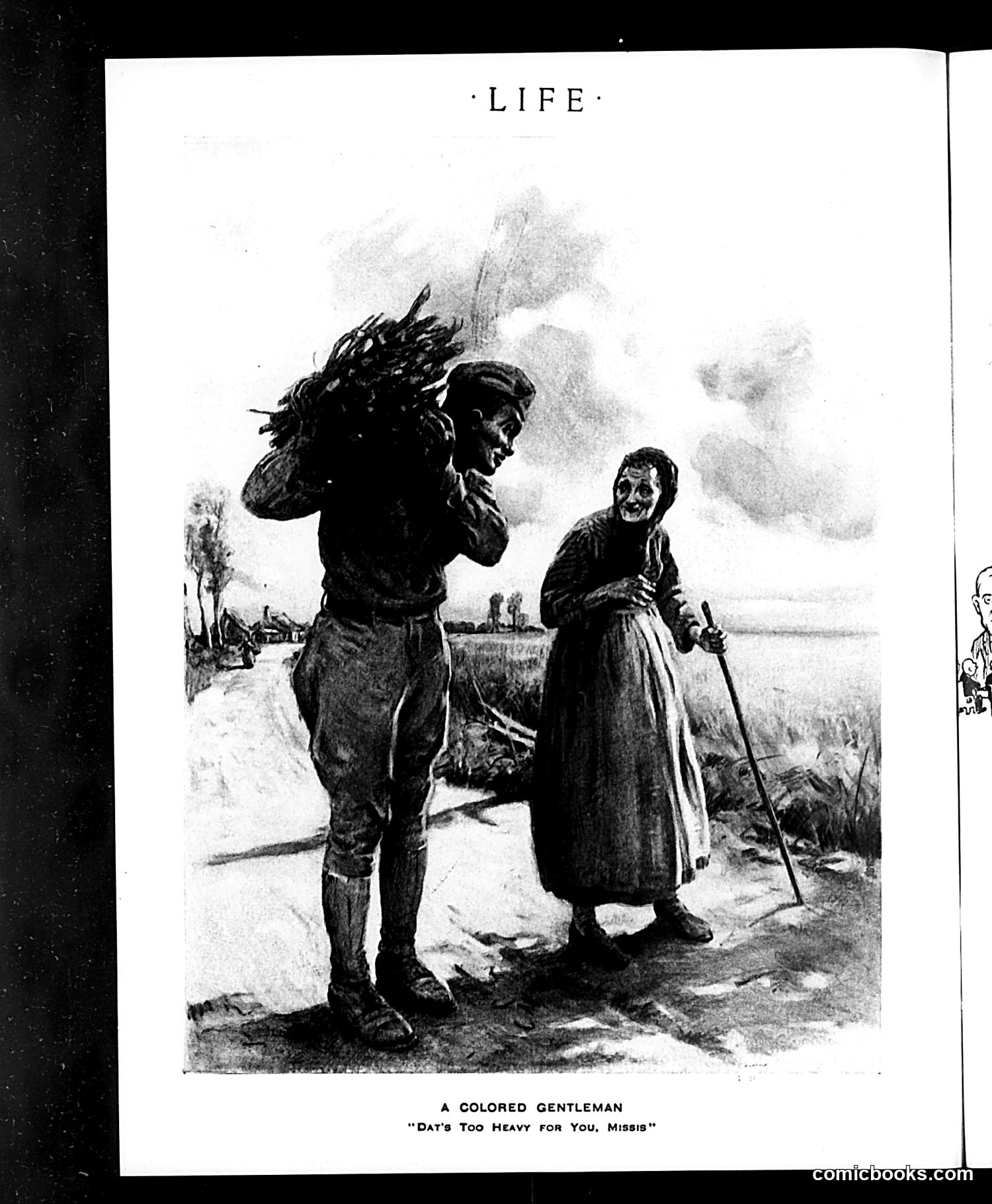
This is a racist caricature from Life magazine's "LIFE" section. The image depicts a Black man carrying an enormous bundle of sticks or branches on his back, speaking to a white woman. The caption "'Dat's Too Heavy for You, Missus'" uses exaggerated dialect spelling to mock African American speech patterns. The satire appears to mock both the Black man (through caricature and dialect) and potentially critique white women's expectations or entitlement—suggesting the woman expects the man to carry something burdensome for her. However, the primary focus is dehumanizing racial caricature typical of early 20th-century American satirical publications. The image reinforces harmful stereotypes about Black Americans while presenting this mockery as humor.
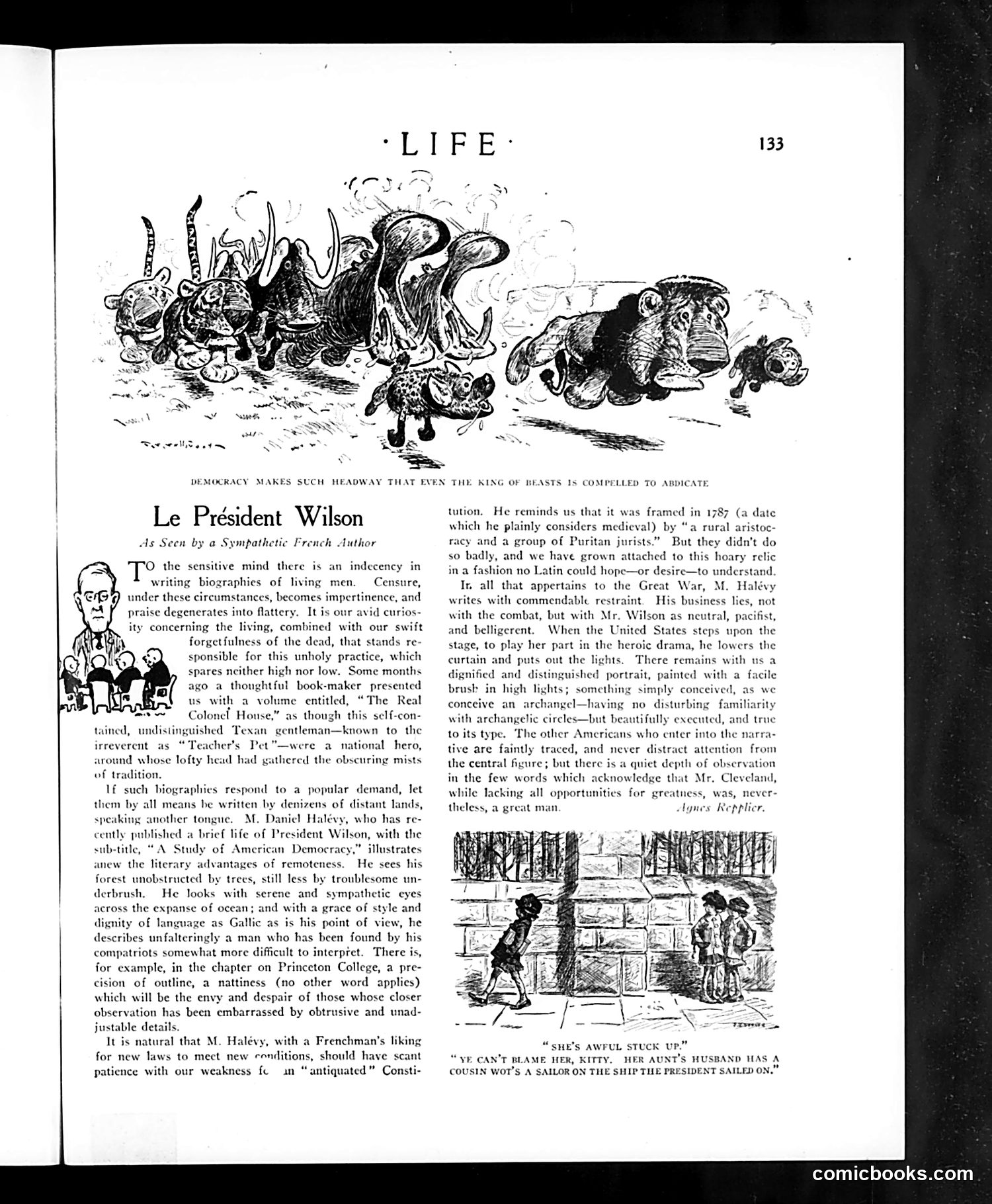
**Main Content:** This page reviews M. Daniel Halévy's French biography of President Wilson, praising the outsider's perspective while gently critiquing Wilson himself. The author argues that distant observers see clearly what Americans miss due to familiarity. **Top Cartoon:** The caption "Democracy makes such headway that even the King of Beasts is compelled to abdicate" depicts animals (appearing to include a lion losing its crown) fleeing in chaos. This satirizes democracy's destabilizing force—suggesting democratic ideals are so powerful they're overthrowing even traditional authority figures, portrayed here as animals abandoning their natural hierarchy. **Bottom Cartoon:** Two working-class women discuss a girl who's "stuck up." The joke: the girl's aunt married a sailor on a ship Wilson sailed on—a trivial connection to the President that inflates the family's social status. This mocks how ordinary Americans seek prestige through the thinnest possible association with powerful figures. **Overall Point:** The page contrasts French analytical distance with American social pretension regarding Wilson and democracy itself.
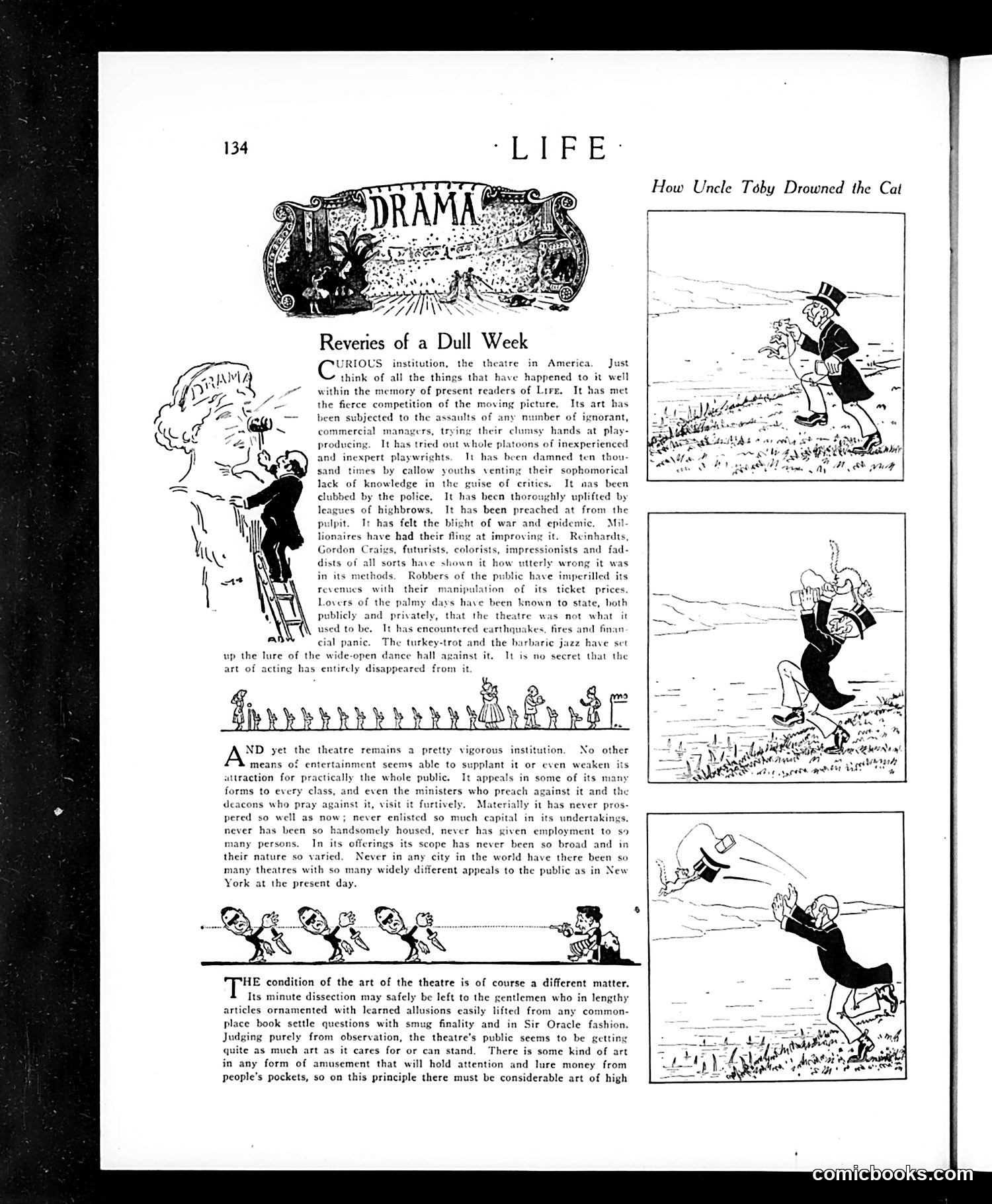
This page contains a lengthy essay defending American theatre against its many critics and detractors. The text sarcastically catalogs the theatre's supposed "failures": competition from movies, bad playwrights, police censorship, highbrow meddling, and jazz clubs luring audiences away. The right-side cartoon titled "How Uncle Toby Drowned the Cat" appears to be a humorous visual sequence (likely referencing Laurence Sterne's *Tristram Shandy*) showing a character's misadventure near water—unrelated to the main essay. **The satire's point**: Despite constant attacks from critics, moralists, censors, and entertainment competitors, theatre thrives financially and remains popular across all social classes. The essay argues that actual "art" in theatre is secondary to entertainment value—if it makes money and holds attention, it has merit. Modern readers would miss the specific reference to "turkey-trot" (1910s dance craze) as moral panic and the general anxiety about theatre's decline that was common in this era.
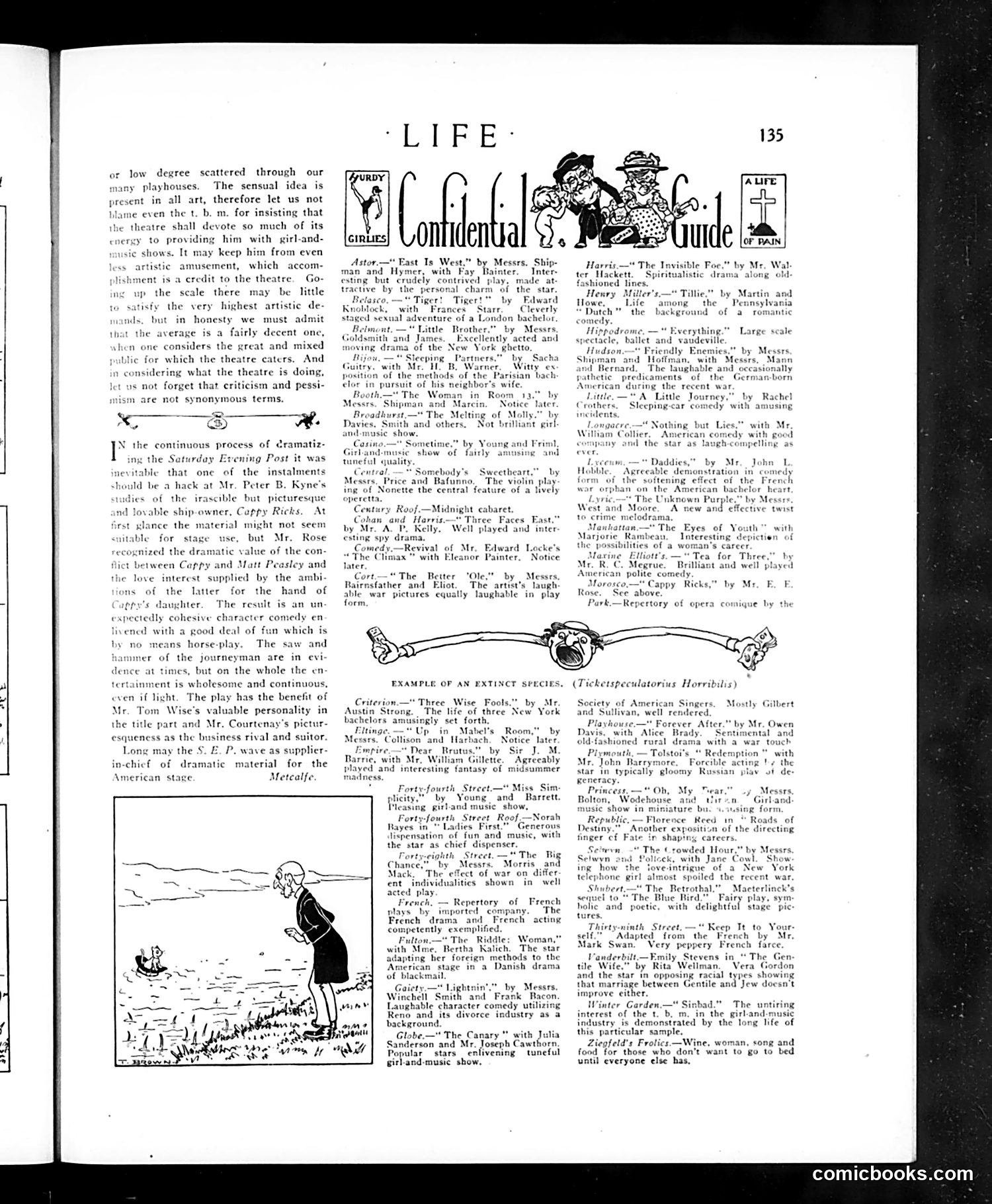
This is a theater review section from Life magazine (page 135), featuring brief critiques of Broadway productions. The page includes two cartoons illustrating theatrical themes. **The cartoons show**: 1. A figure in formal dress observing what appears to be an extinct species—likely satirizing outdated theatrical conventions or old-fashioned dramatic styles 2. A woman in a field or natural setting, possibly commenting on theatrical realism versus artifice **The text's satire**: The opening editorial argues against theater overly catering to lowbrow audiences with "girl-and-music shows" rather than serious art. The author criticizes sensationalism in playhouses while defending legitimate criticism as distinct from pessimism. **Key point**: This reflects early 20th-century debates about theater's artistic standards—whether it should pursue popular entertainment or maintain elevated dramatic quality. The "extinct species" cartoon likely mocks outdated theatrical formulas being replaced by more modern productions listed in the reviews below.
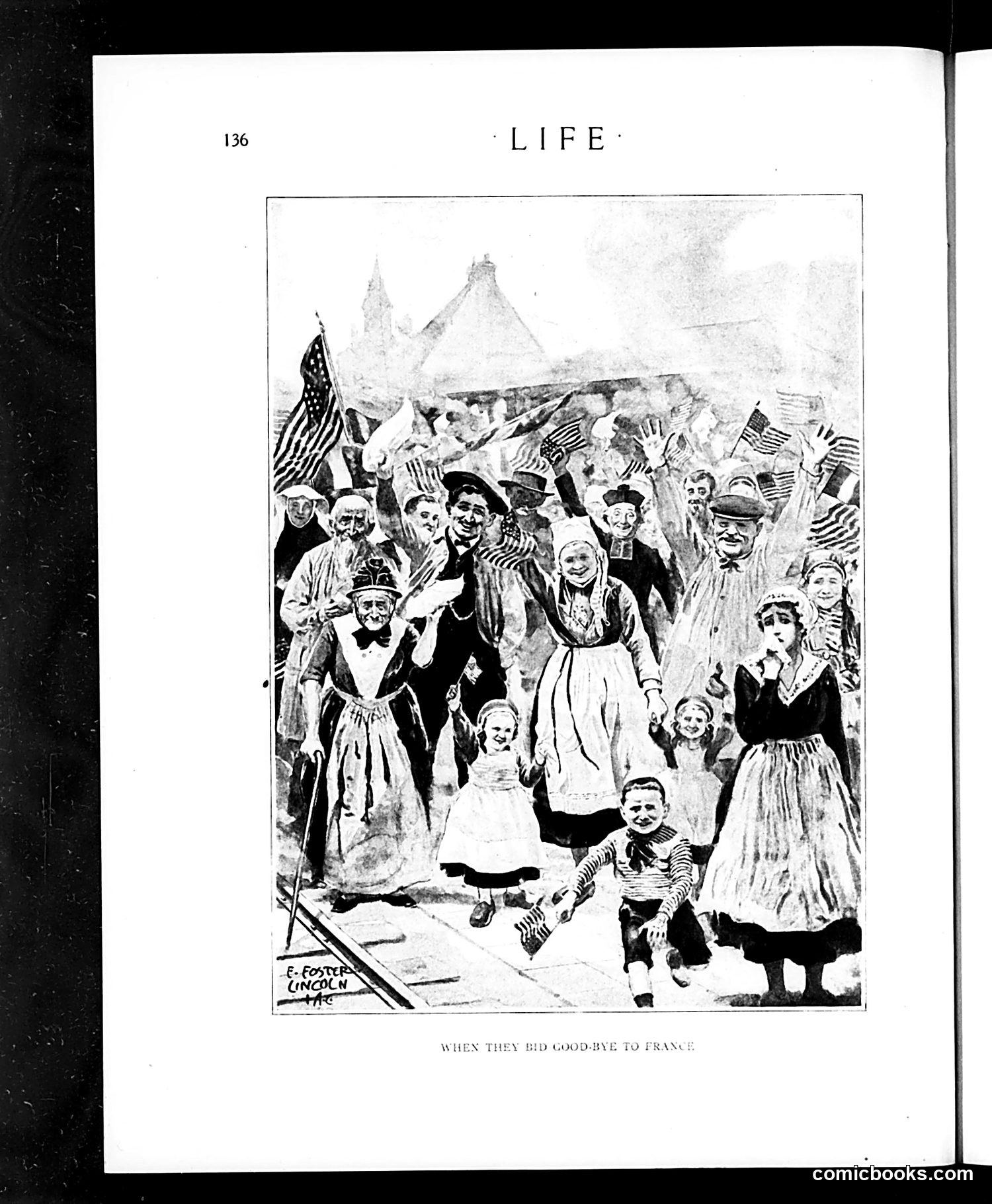
This political cartoon depicts a crowd of people—appearing to represent immigrants or emigrants—waving American flags as they depart France. The scene shows families with children, elderly people, and various figures in period dress gathered before what appears to be a church or prominent building in the background. The title's reference to "bidding good-bye to France" suggests this comments on emigration from France to America, likely during a period of French instability or hardship. The prominent American flags and the diverse cross-section of French society depicted indicate the cartoon satirizes or comments on immigration patterns, possibly suggesting Americans' attraction to the United States as a refuge or opportunity. The artist is credited as "E. Foster Lincoln" in the lower left corner.
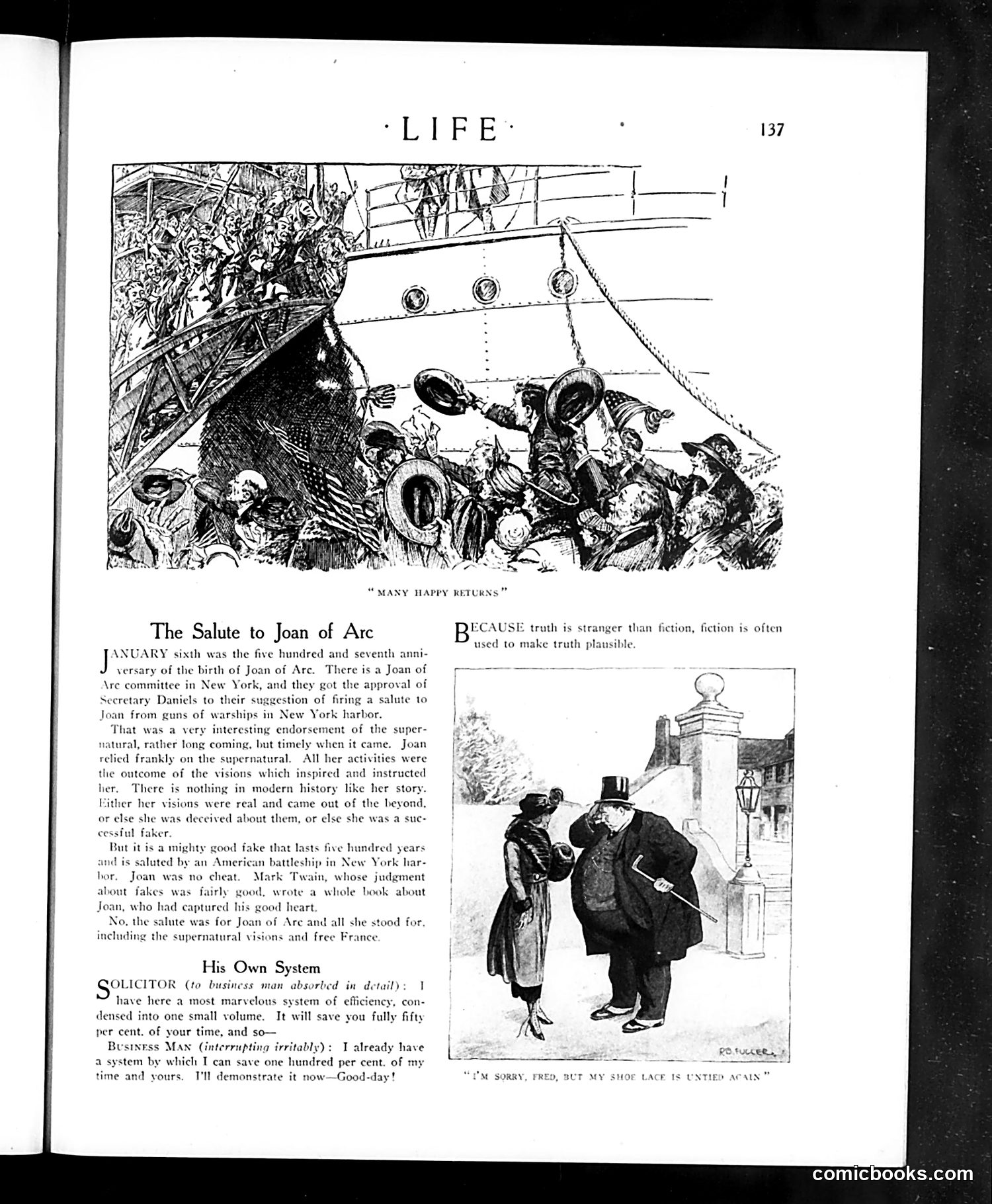
**Top Section - "The Salute to Joan of Arc":** This celebrates January 6th's 500th anniversary of Joan of Arc's birth. A New York Joan of Arc committee secured Secretary of the Navy Daniels's approval to fire a ceremonial gun salute from warships in New York Harbor. The text notes the irony: America's modern military officially honored someone whose authority came from supernatural visions—a remarkable endorsement of the supernatural. The author cites Mark Twain's positive biography, arguing Joan was either genuinely inspired, self-deceived, or a "successful faker" whose legacy lasted five centuries. **Bottom Section - "His Own System":** A satirical business dialogue. A solicitor pitches an efficiency system promising to save 50% of the businessman's time. The businessman interrupts irritably, claiming he already has a system saving 100% of both their time—then dismisses the solicitor ("Good-day!"). The joke: by refusing to listen and ending the conversation, he's "saved" maximum time, rendering the solicitor's pitch pointless through sheer rudeness.
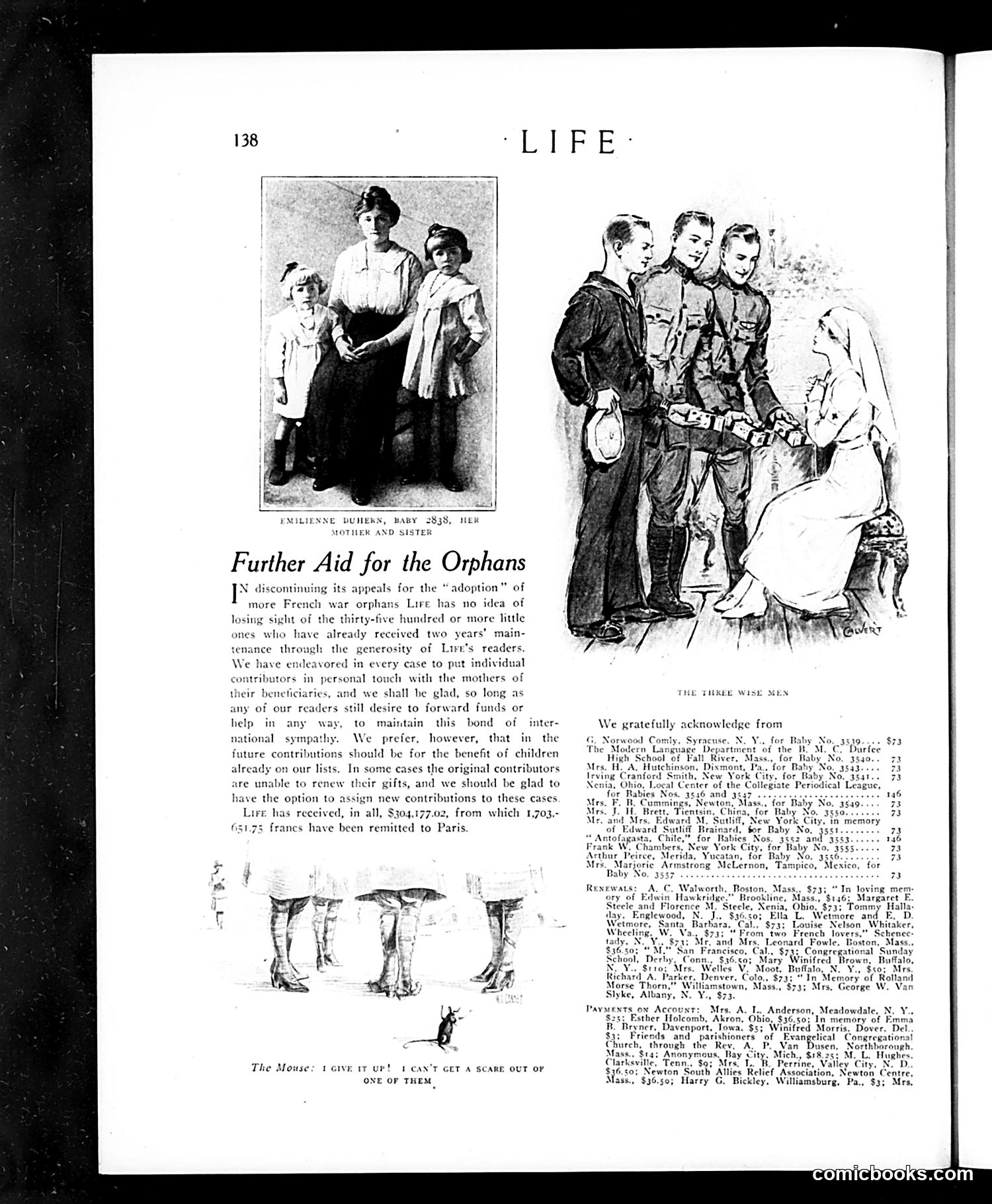
This page documents Life magazine's charitable campaign to support French war orphans following World War I. The top images show Émilienne Duhern (a beneficiary child) with her mother and sister, and "The Three Wise Men"—likely a biblical reference to generosity. The main article explains that Life is discontinuing new orphan "adoptions" but will continue supporting the 3,500+ children already receiving aid for two years. The magazine has collected $304,177.02 and remitted over 1.7 million francs to Paris. The mouse cartoon below—captioned "I CAN'T GET A SCARE OUT OF ONE OF THEM"—appears to use mice as a metaphor, though its specific satirical point is unclear without additional context. The bulk of the page lists donor names and contribution amounts ($36.50–$146), including individuals, churches, and organizations from across America and abroad, demonstrating the broad philanthropic support for this international relief effort.
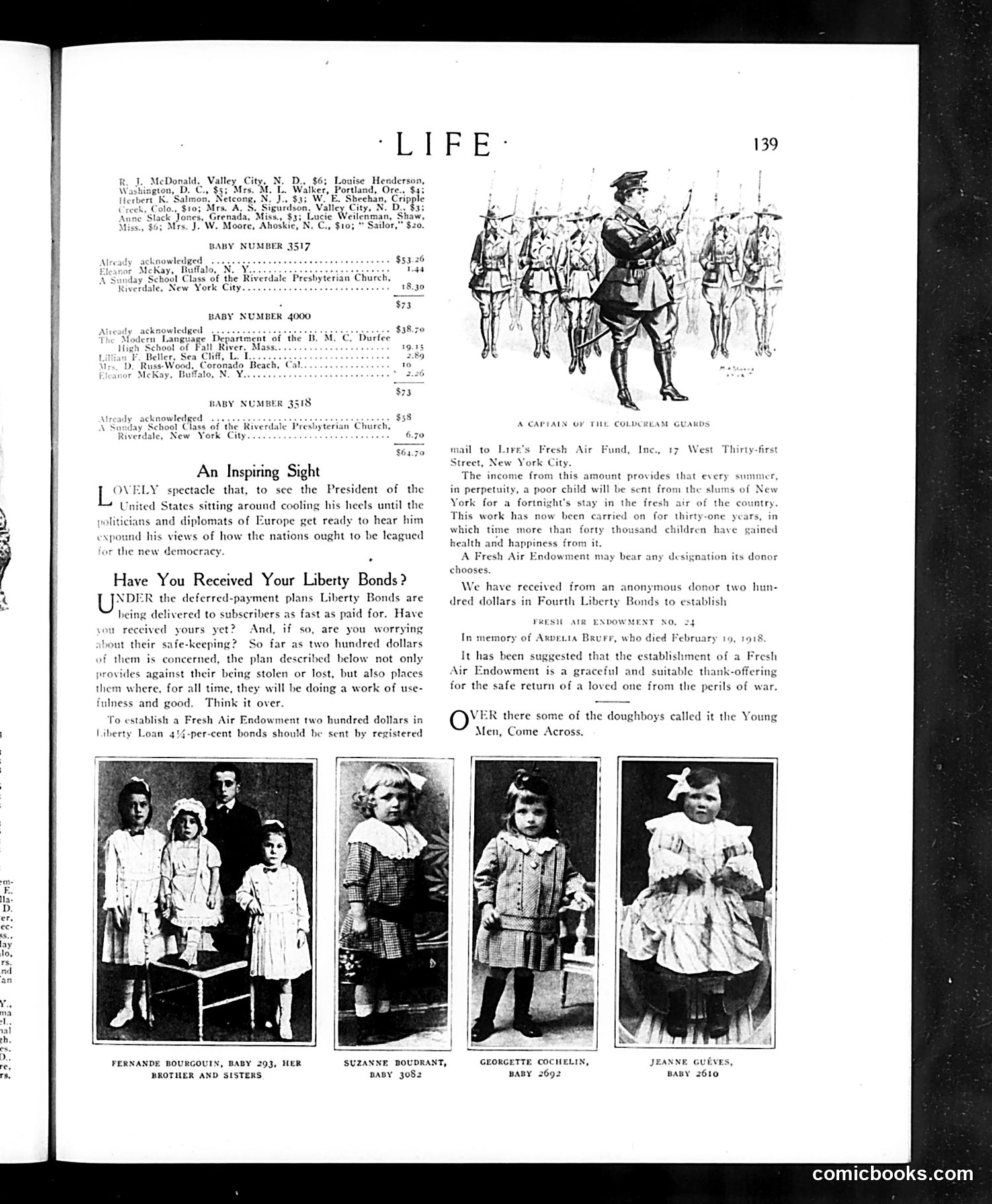
This page combines fundraising appeals with subtle political commentary. The main cartoon, titled "A Captain of the Coldstream Guards," depicts a British military officer addressing soldiers—likely satirizing American expectations of European diplomacy. The accompanying text "An Inspiring Sight" mocks President Wilson's situation: he must wait for European politicians and diplomats to be ready to hear his views on post-war democracy and a league of nations. The satire suggests America's president is cooling his heels while Europe dawdles—a jab at European inefficiency and American impatience during post-WWI negotiations (circa 1918). The rest of the page promotes Liberty Bonds and a Fresh Air Endowment charity, featuring photographs of children. These represent typical Life magazine content mixing advocacy with advertising.
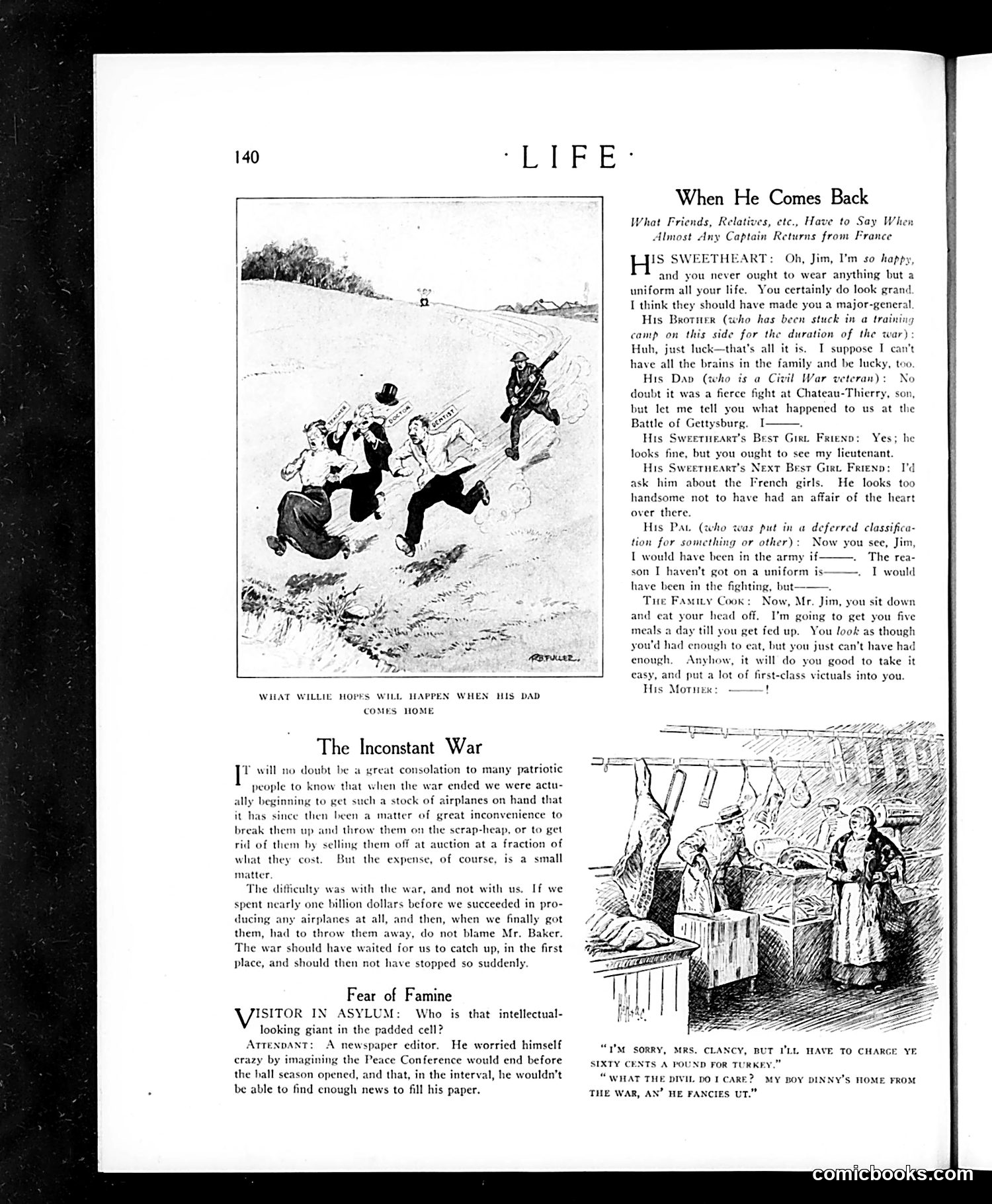
This page contains three separate satirical pieces about post-WWI American life: **"When He Comes Back"** (top): A cartoon showing various people overwhelming a returning soldier with unsolicited commentary. The satire mocks how civilians—his sweetheart, brother, father, family cook—all presume to advise or judge the veteran despite having no combat experience. The father interrupts with irrelevant stories about the Civil War; the brother resents not serving; others make inappropriate comments about his appearance or the French. The humor lies in the obliviousness of non-combatants. **"The Inconsistent War"** (middle): Satirizes military procurement failures—the government spent a billion dollars before producing any airplanes, then had too many once the war ended, forcing them to scrap or sell them cheaply. The complaint that "the war should have waited" is intentionally absurd, blaming the war's inconvenient timing rather than military mismanagement. **"Fear of Famine"** (bottom): A newspaper editor in an asylum went mad worrying the Peace Conference would end before the off-season, leaving him without news to publish—satirizing journalists' self-interested anxiety about losing coverage opportunities.
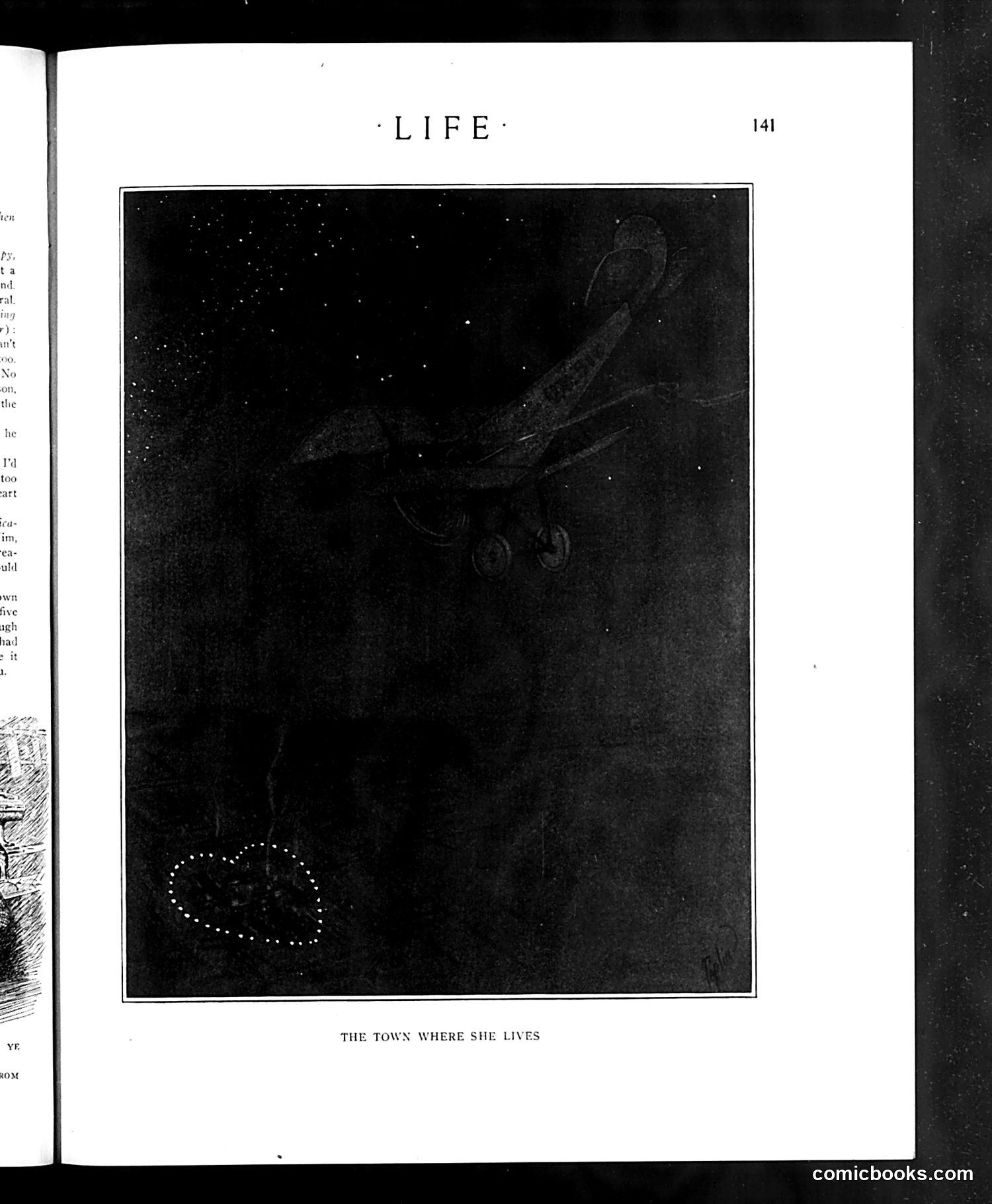
This appears to be an illustration from Life magazine (page 141) showing a nighttime aerial or elevated view of a town with stars visible in the dark sky. A dotted oval outline marks a specific area at the bottom of the image, possibly highlighting a particular location or building. Without additional context or clearer visibility of details in this dark photograph/illustration, I cannot confidently identify the specific figures, characters, or satirical reference intended. The caption "The Town Where She Lives" suggests this relates to a narrative about a female character, but the image quality and lack of surrounding text make it difficult to determine the exact political, social, or humorous point the cartoonist was making.
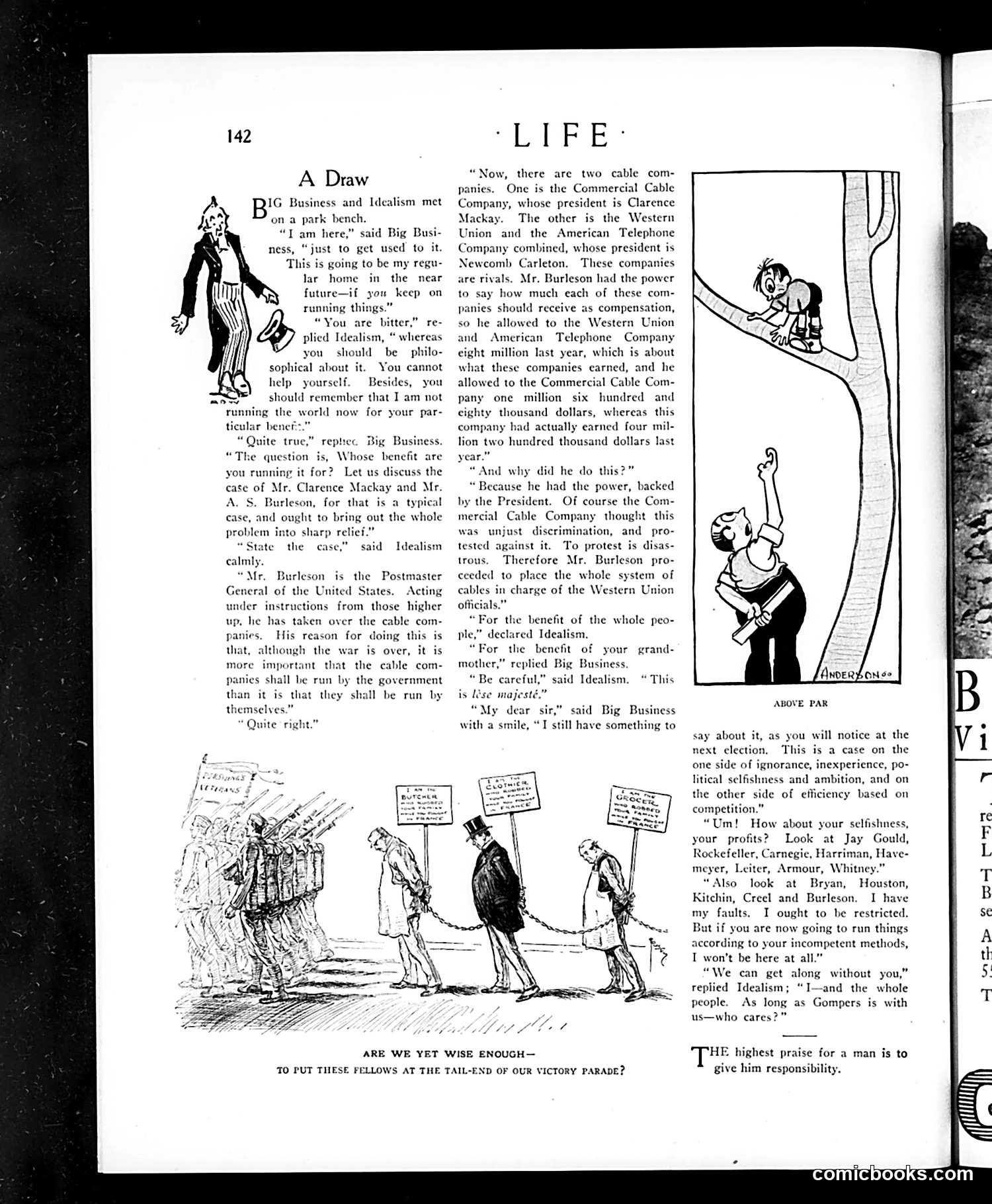
This satirical dialogue personifies **Big Business** and **Idealism** debating government control of industries after World War I. The specific case concerns **Postmaster General A.S. Burleson's** management of cable companies during the war. The satire criticizes Burleson for allegedly favoring the **Western Union and American Telephone Company** (which received $8 million) over the **Commercial Cable Company** (whose president **Clarence Mackay** received only $1.6 million despite earning $4.2 million). Big Business argues this represents incompetent, politically-motivated government management. Idealism counters that business itself is corrupt (citing robber barons like Rockefeller and Carnegie) and that workers and reformers (including labor leader **Gompers**, and politicians like Bryan and Houston) support government control. The bottom cartoon depicts executives as puppets on strings, questioning whether they deserve a place in victory celebrations. The piece attacks both sides: government overreach through favoritism, and business's historical exploitation.
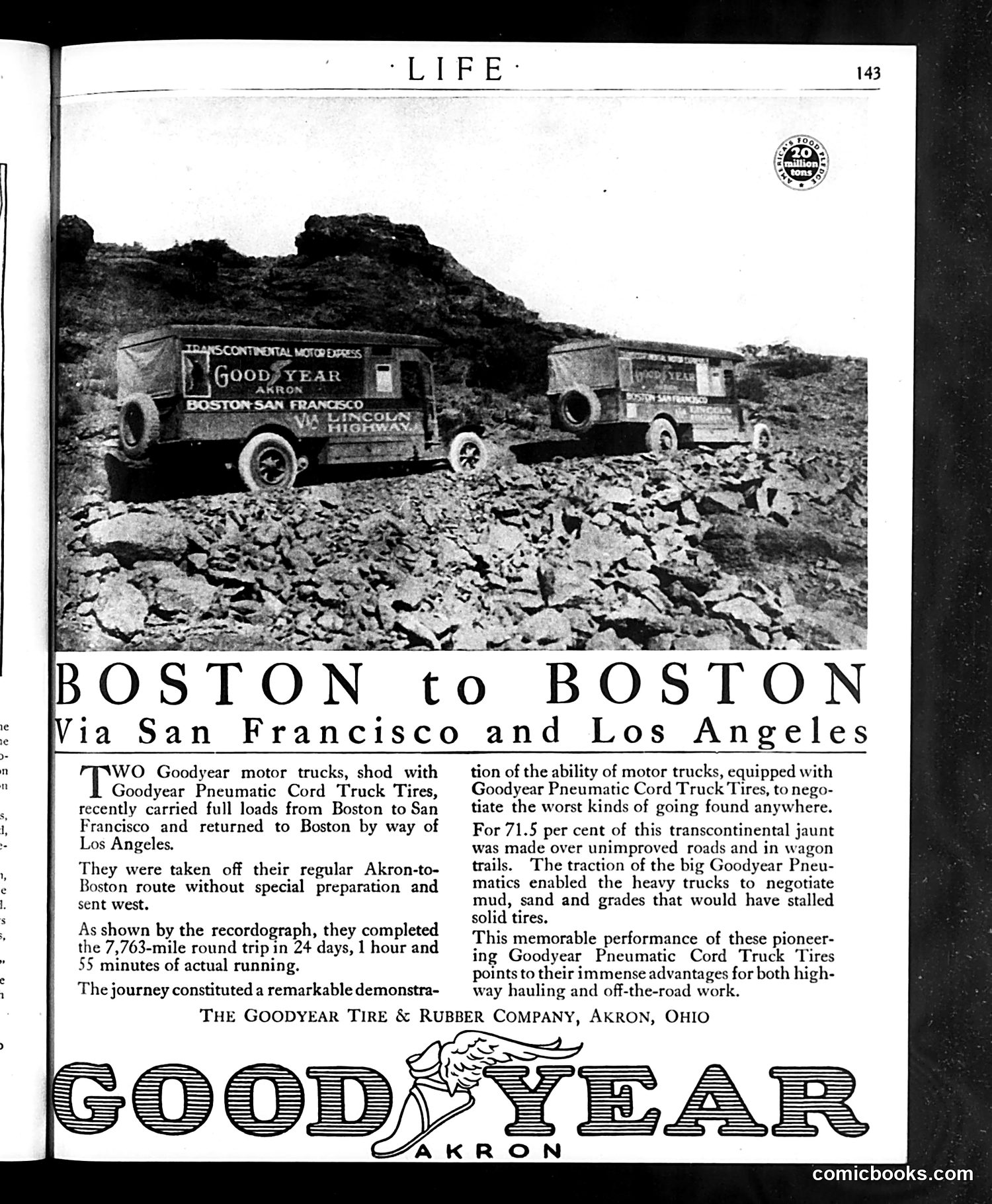
This is **not a political cartoon or satire**—it's a **full-page advertisement** for Goodyear tires in *Life* magazine (page 143). The image shows two Goodyear motor trucks photographed on rough, rocky terrain, demonstrating their capability on poor road conditions. The advertisement describes a cross-country promotional journey: two trucks carried full loads from Boston to San Francisco and back to Boston via Los Angeles, completing 7,763 miles in 24 days. The "point" is commercial, not satirical: the ad argues that Goodyear Pneumatic Cord Truck Tires proved superior because they successfully negotiated harsh conditions (71.5% unimproved roads and wagon trails) that would have disabled solid tires. This was early automotive advertising, using a real-world endurance test to demonstrate product reliability. There are no political figures, caricatures, or satirical commentary—just a straightforward marketing message aimed at commercial truck buyers.
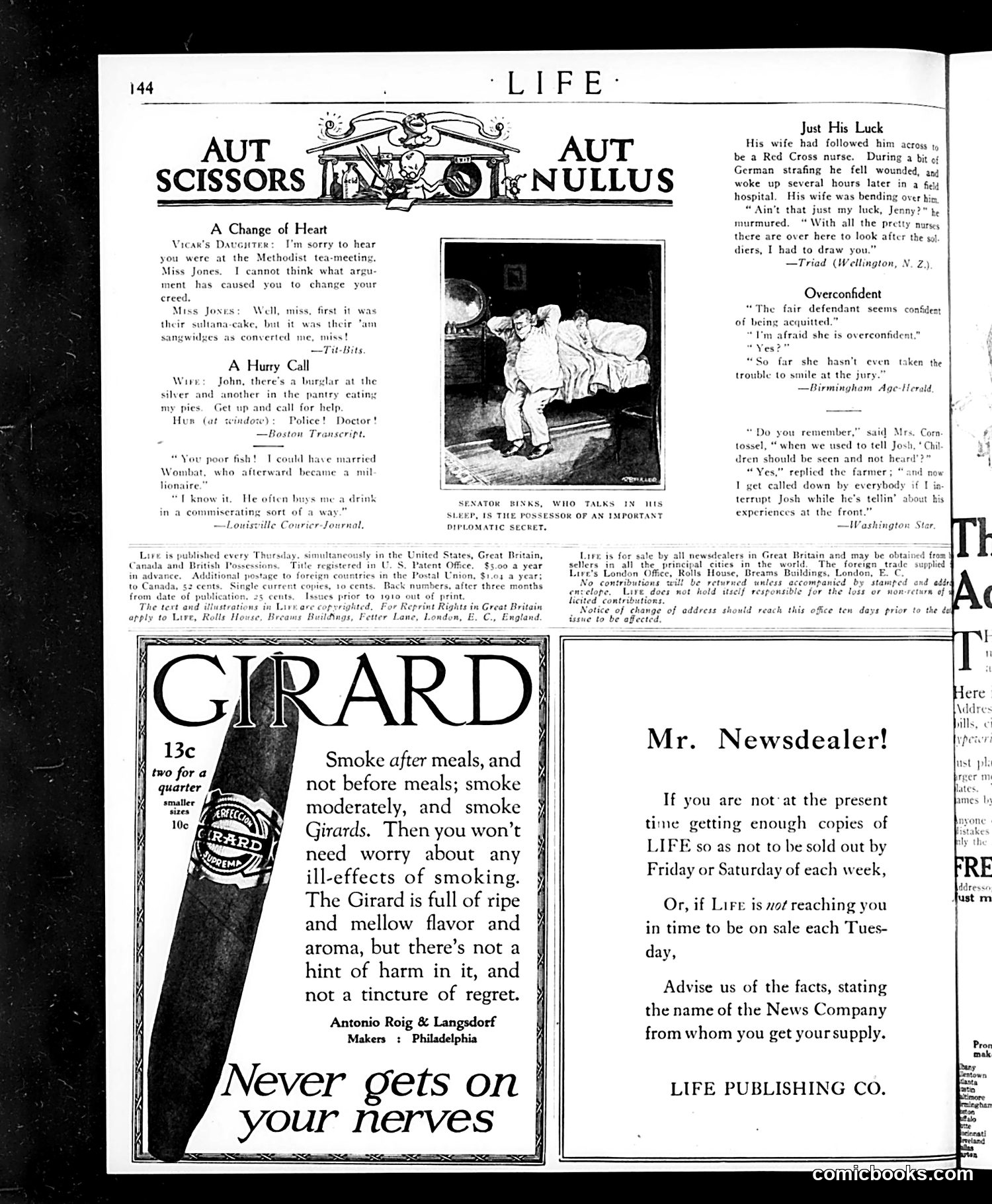
This page from *Life* magazine contains several brief satirical sketches typical of early 20th-century humor, along with advertisements and a notice to newsdealer. **The Sketches:** The cartoons mock everyday situations: a vicar's daughter changing her religious affiliation over cake; a woman whose bad luck persists even when her wife (a Red Cross nurse) finds her in a hospital; marital banter about a husband's financial mistakes; and a senator who talks in his sleep while possessing diplomatic secrets. **The Humor:** These are gentle, domestic comedies relying on wordplay and ironic situations rather than political commentary. The "Overconfident" piece jokes that a female defendant hasn't bothered smiling at jurors—reflecting period attitudes about women and courtroom tactics. **The Advertisements:** Girard ciggar ad claims smoking causes no "ill-effects"—a claim utterly debunked by modern medicine. **Publisher's Note:** *Life* warns newsdealer to order sufficient copies to avoid Friday-Saturday sellouts, indicating the magazine's popularity as weekly entertainment.
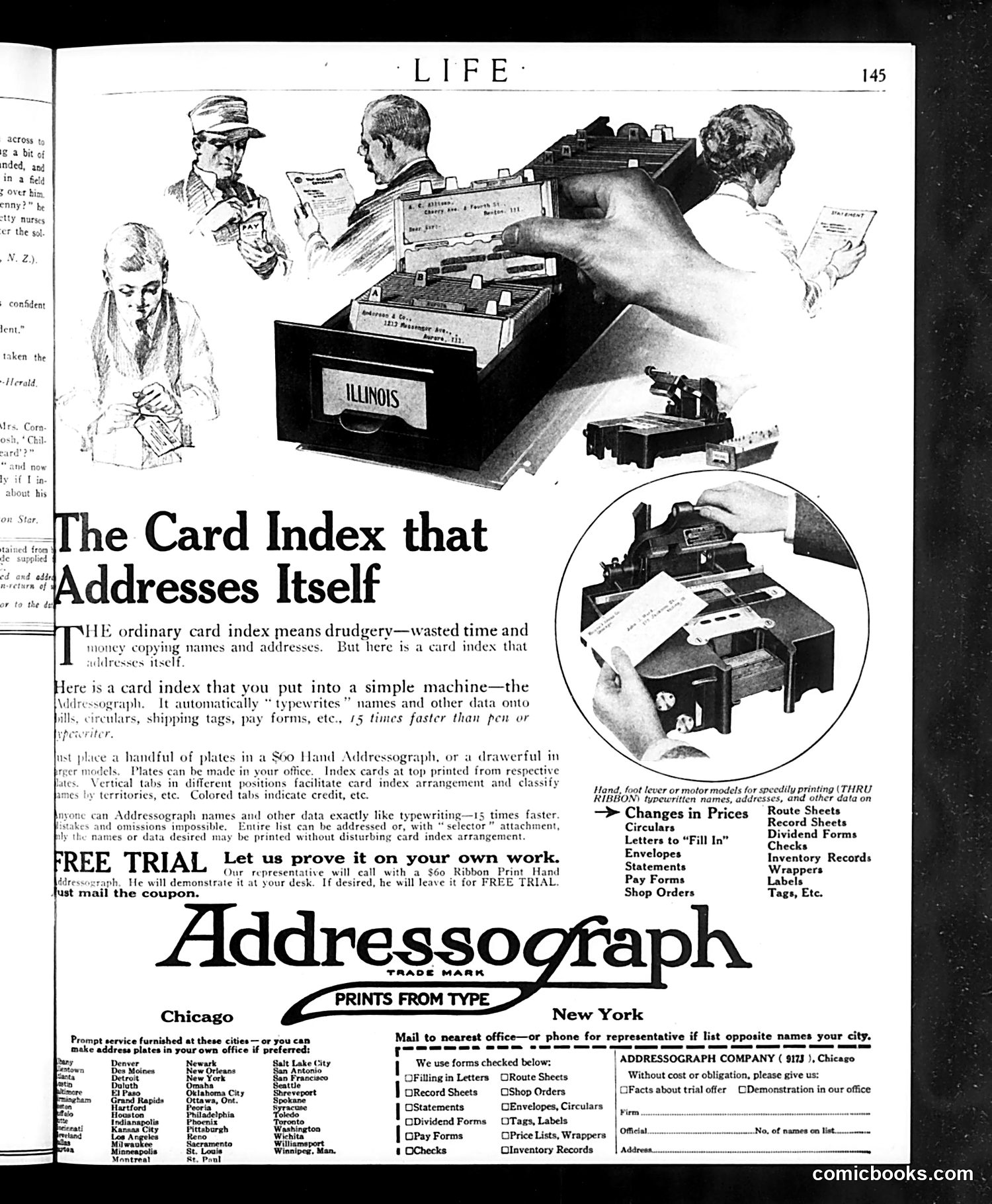
This page is **primarily an advertisement**, not political satire. It promotes the Addressograph, a mechanical device that automated address printing for businesses in the early 20th century. The cartoon illustrations show the machine's practical use: businesspeople and office workers using the device to print addresses onto forms, circulars, and mailing materials—tasks previously done by hand. The "satire" is gentle and self-promotional: the machine supposedly "addresses itself" by automating tedious clerical work, saving time and reducing errors. The humor lies in personification and the relief from administrative drudgery. For modern readers, the most striking aspect is how this represents an early stage of office automation—the Addressograph was to its era what computer databases are today. The advertisement emphasizes speed (15 times faster than pen or typewriter) and efficiency, core selling points to businesses managing growing mailing lists. There is no political commentary or caricature of public figures visible here.
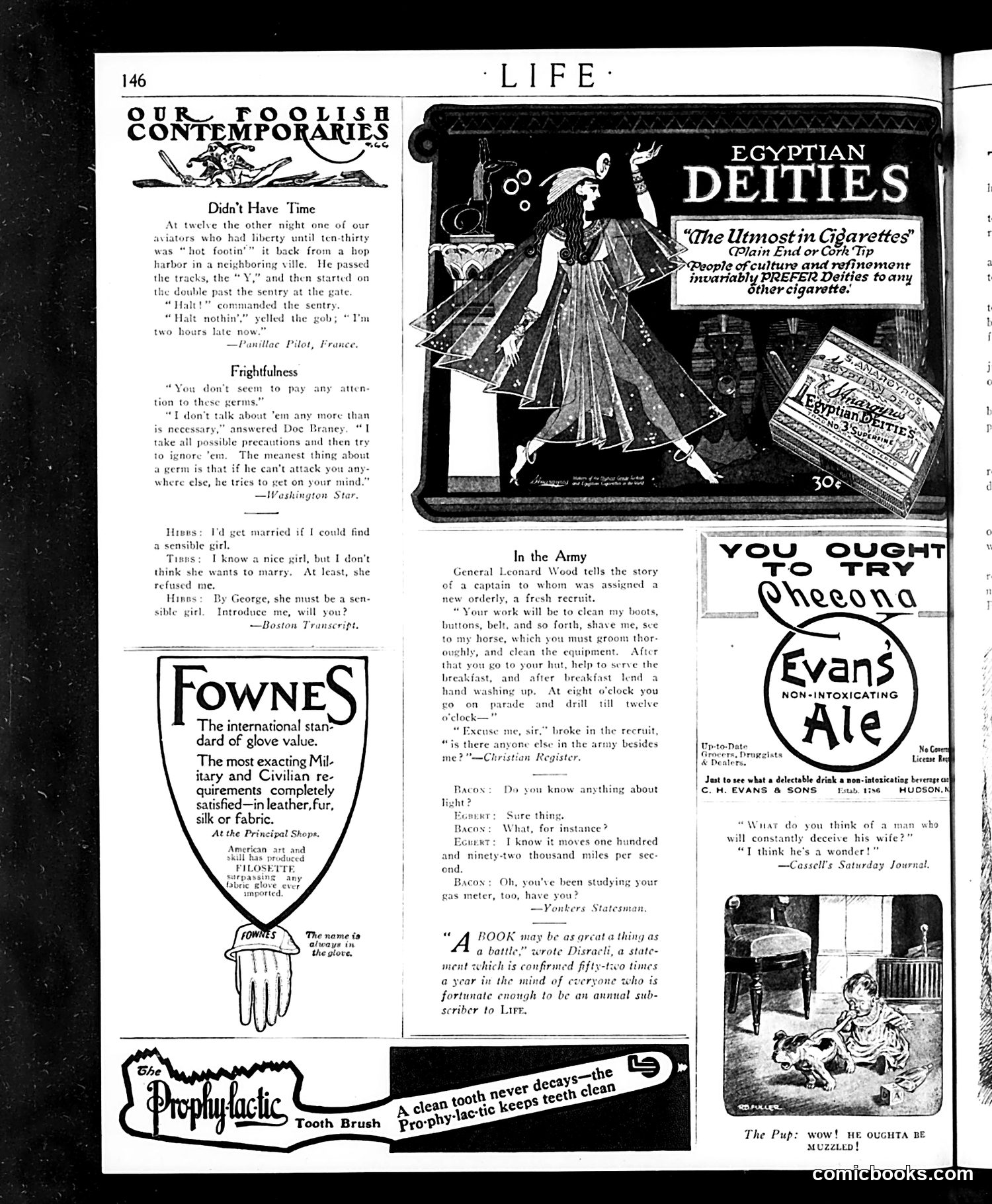
This page from *Life* magazine contains satirical short jokes and period advertisements, typical of early 20th-century humor. **The Jokes:** Brief anecdotes mock everyday absurdities—a pilot arriving late from a romantic escapade, a recruits' misunderstanding about army duties ("is there anyone else in the army besides me?"), and wordplay about light and a gas meter. The humor relies on literal interpretations and domestic situations familiar to contemporary readers. **The Advertisements:** Include glove manufacturers (Fownes), cigarettes (Egyptian Deities), ale (Cheona Evans), and a toothbrush. The cigarette ad's claim that "people of culture and refinement invariably PREFER Deities" reflects pre-1920s advertising that made unsubstantiated health/class claims—tobacco companies hadn't yet faced serious regulation. **The cartoon** at bottom shows a puppy needing a muzzle, captioned as a pun about dogs being unruly. The overall tone is light domestic satire with no political content—typical entertainment for *Life*'s affluent readers of that era.
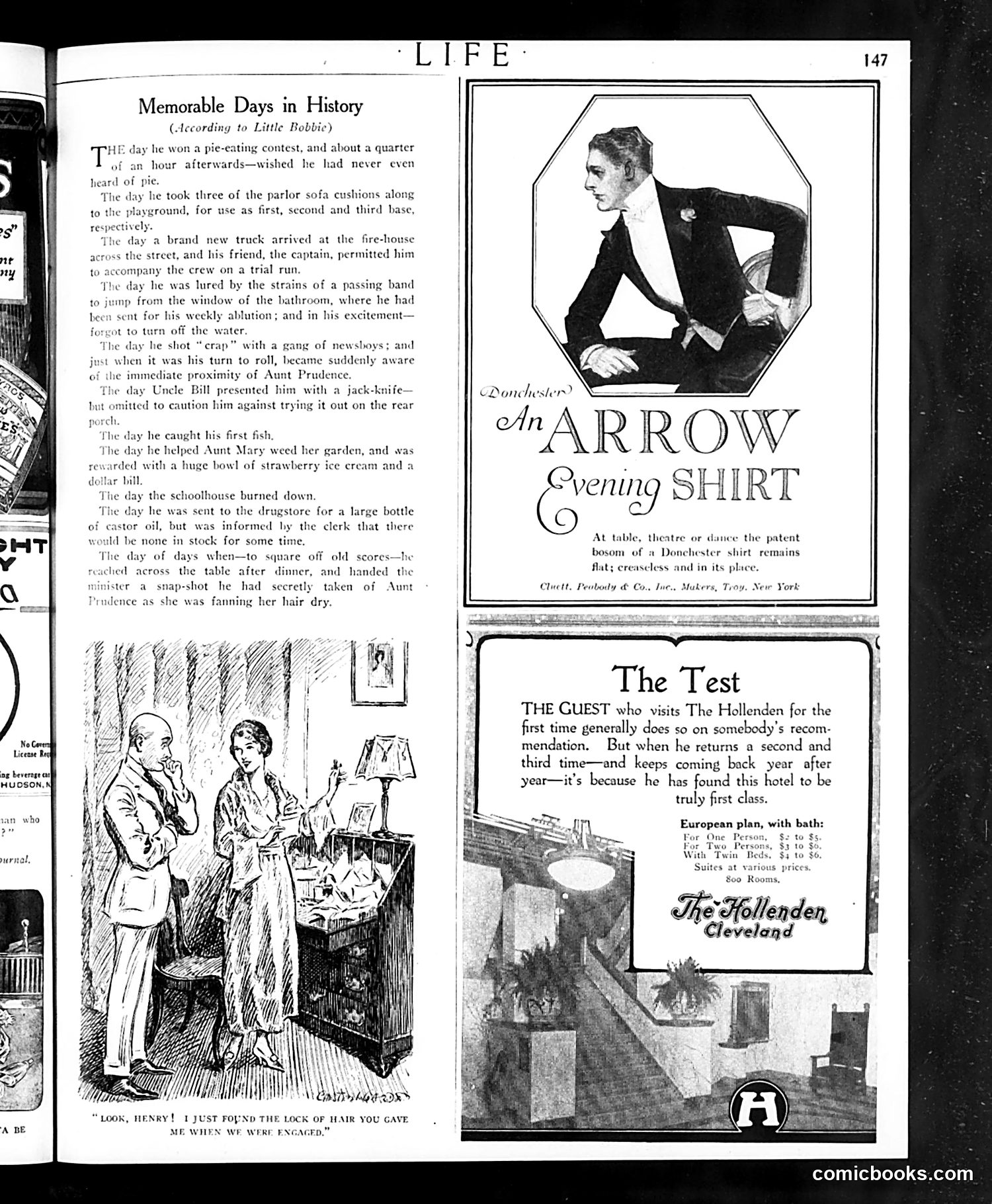
**Main Content: "Memorable Days in History (According to Little Bobbie)"** This is a humorous list describing childhood misadventures from a boy's perspective. The satire lies in treating trivial, embarrassing childhood incidents—pie-eating contests, forgotten bathwater, accidental photography of an aunt—as if they were historically significant "memorable days." The accompanying sketch shows a man presenting a lock of hair to a woman, captioned as an engagement memento, adding nostalgic sentimentality to the juvenile humor. **Advertisements:** The page includes two period advertisements: an Arrow Evening Shirt (emphasizing a wrinkle-free patent bosom), and The Hollenden hotel in Cleveland. These are typical early 20th-century luxury goods ads targeting the magazine's affluent readership. **Historical Context:** The humor relies on contrasting grand historical language with mundane childhood experiences—a common satirical device in Life magazine's gentle, family-friendly social commentary.
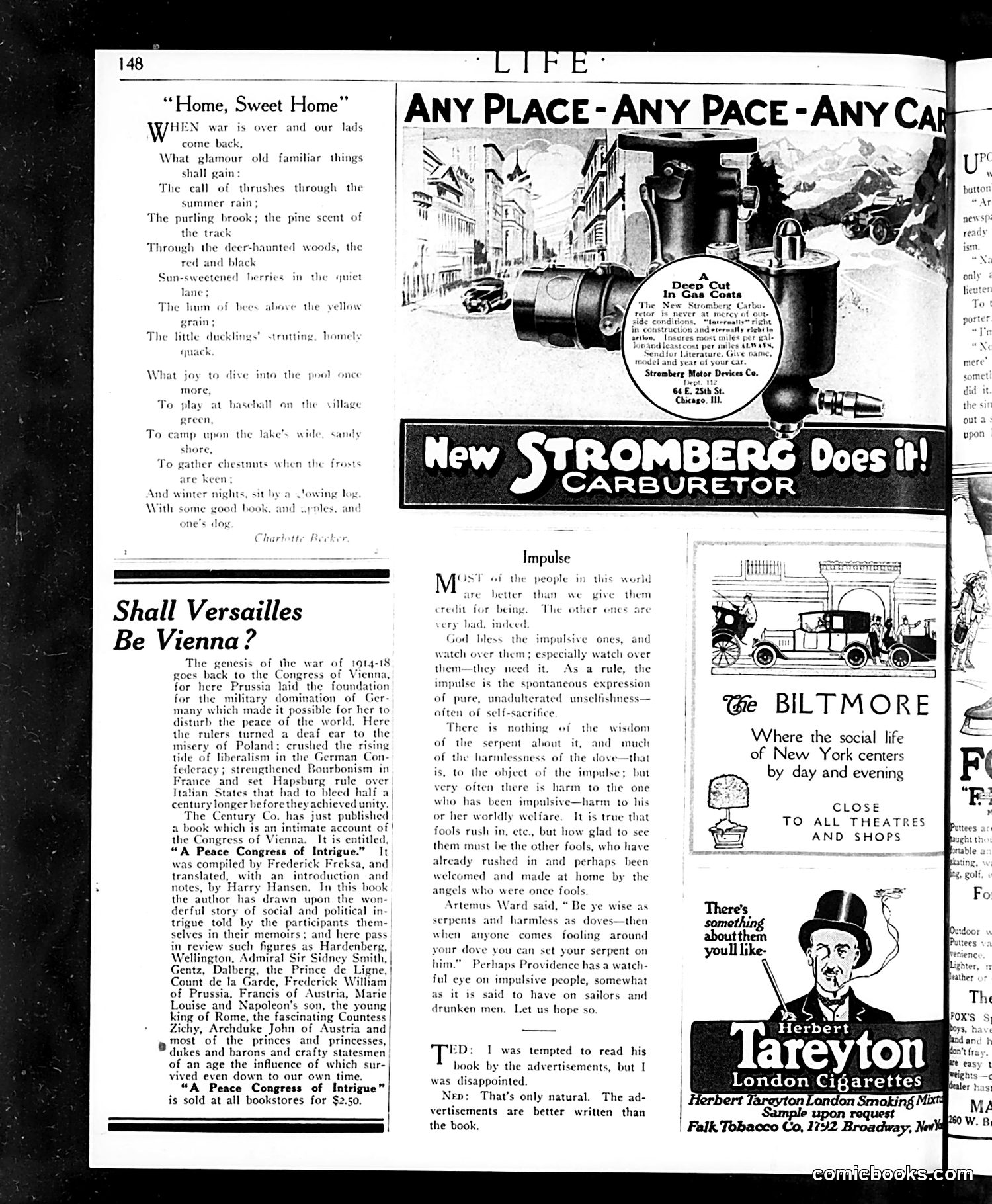
This page mixes poetry, book review, and advertisements typical of Life's satirical format circa 1920s. **The Poetry ("Home, Sweet Home")**: A sentimental verse by Charlotte Perkins (bylined) about soldiers returning from WWI and rediscovering domestic pleasures—pastoral imagery meant to contrast with wartime destruction. **"Shall Versailles Be Vienna?" Article**: Reviews a book about the Congress of Vienna (1815), drawing historical parallels to post-WWI peace negotiations. It warns that the 1815 Congress's failure to address legitimate grievances (Polish independence, liberal movements) fueled decades of conflict—an implicit critique that the 1919 Treaty of Versailles risks similar long-term consequences by being punitive rather than just. **Advertisements**: The Stromberg carburetor, Biltmore Hotel, and Tareyton cigarettes are period product endorsements with no satirical content. The page juxtaposes optimistic homecoming sentiment against serious warnings about peace-treaty failures—typical Life editorial strategy mixing sentiment with political commentary.
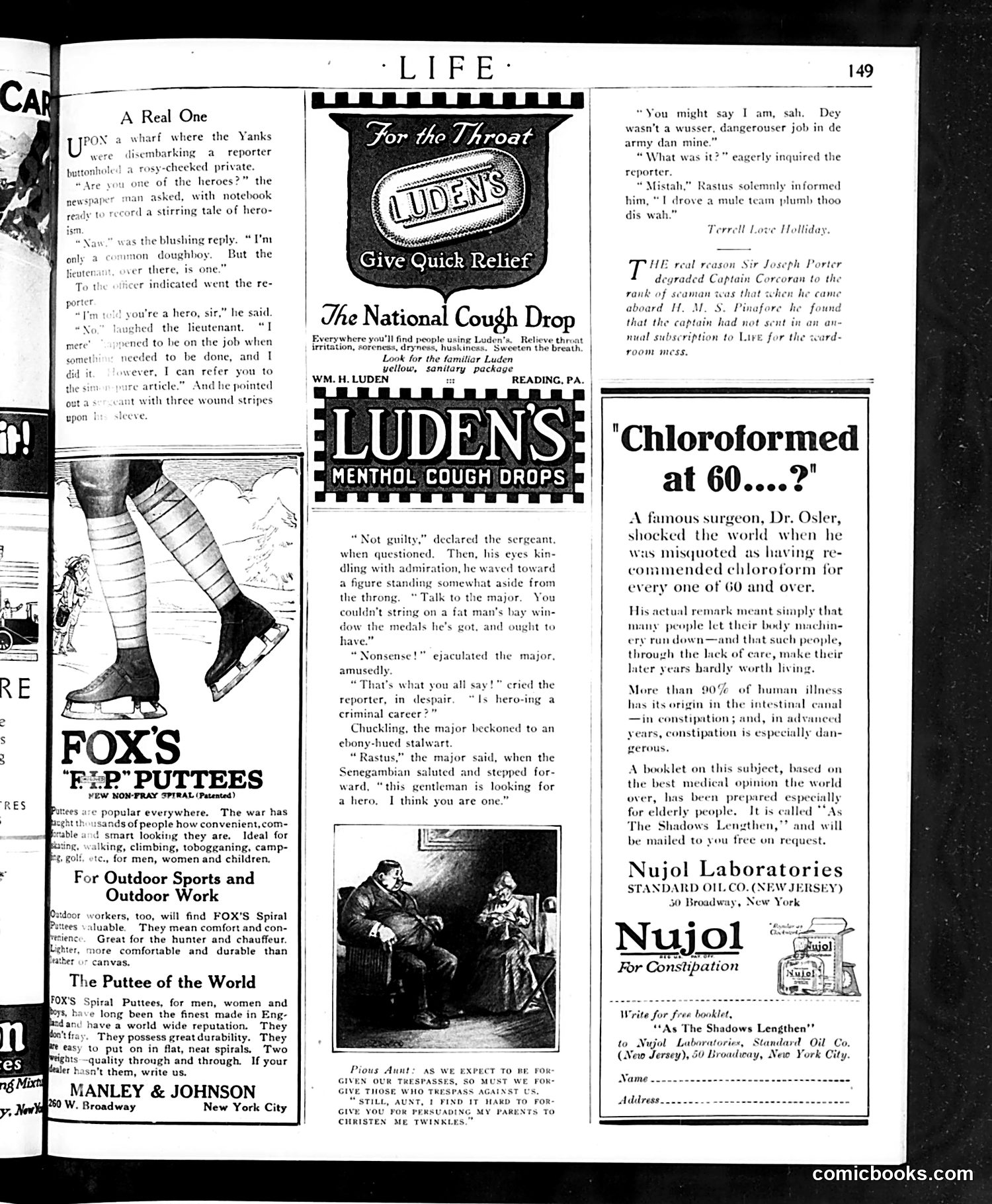
This brief comic story satirizes how soldiers are treated as heroes upon returning from World War I. A reporter seeks out a dramatic war story from a disembarking Yank, but a modest lieutenant deflects, directing him instead to a decorated major. The major then points to "Rastus," a Black soldier, claiming *he's* the real hero. The punchline reveals the satire's sting: when asked what heroic deed he performed, Rastus replies he "drove a mule team plumb thoo dis wah"—ordinary, unglamorous work. The joke operates on multiple levels: it mocks the public's hunger for heroic narratives, the arbitrary nature of military recognition, and implicitly critiques how Black soldiers were relegated to non-combat roles (supply and transport) despite equal danger and sacrifice. The dialect representation reflects period conventions but underscores the racial hierarchy of WWI service.
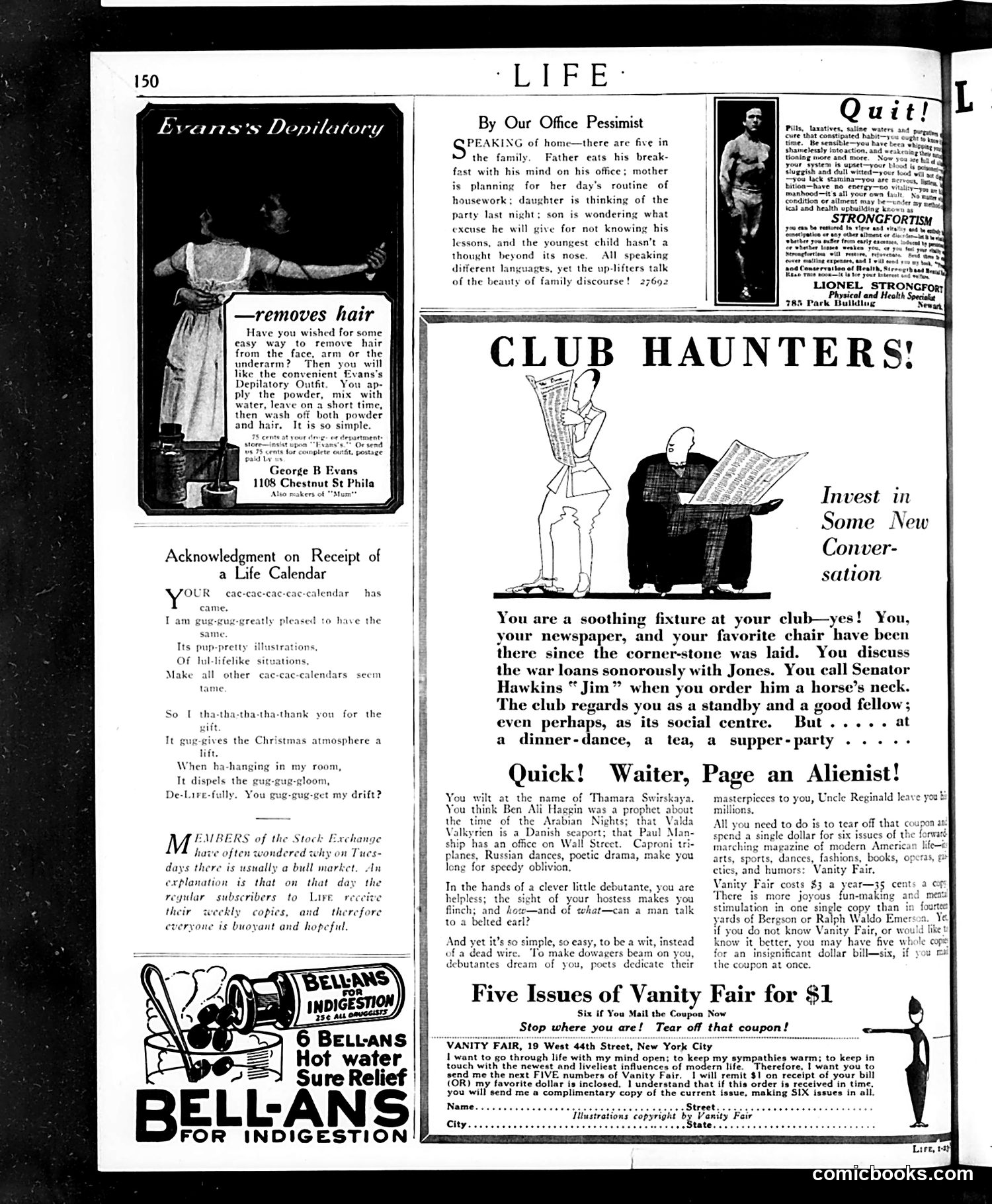
This page satirizes socially awkward men who dominate at their clubs but fail in wider social situations. The central cartoon shows a man reading a newspaper in a comfortable club chair—he's confident there, discussing politics and calling senators by nicknames. However, the accompanying text mocks his complete social collapse at dinner parties and teas. When faced with sophisticated conversation topics (references to obscure artists, literary figures, or current events), he wilts into silence. The solution offered half-mockingly: hire an "alienist" (psychiatrist) to train him in conversation. The satire targets upper-class male insularity—men so dependent on their club's familiar environment that they've atrophied socially beyond it. It's a jab at masculine rigidity and the limitations of clubhouse comfort, suggesting even well-placed men lack genuine social adaptability or intellectual range. The Vanity Fair advertisement below reinforces the theme: readers should stay mentally "open" and engaged with "the newest and liveliest influences"—the opposite of the stagnant club man.