
Life, 1919-01-23 · page 26 of 42
Life — January 23, 1919 — page 26: what you’re looking at
What you’re looking at
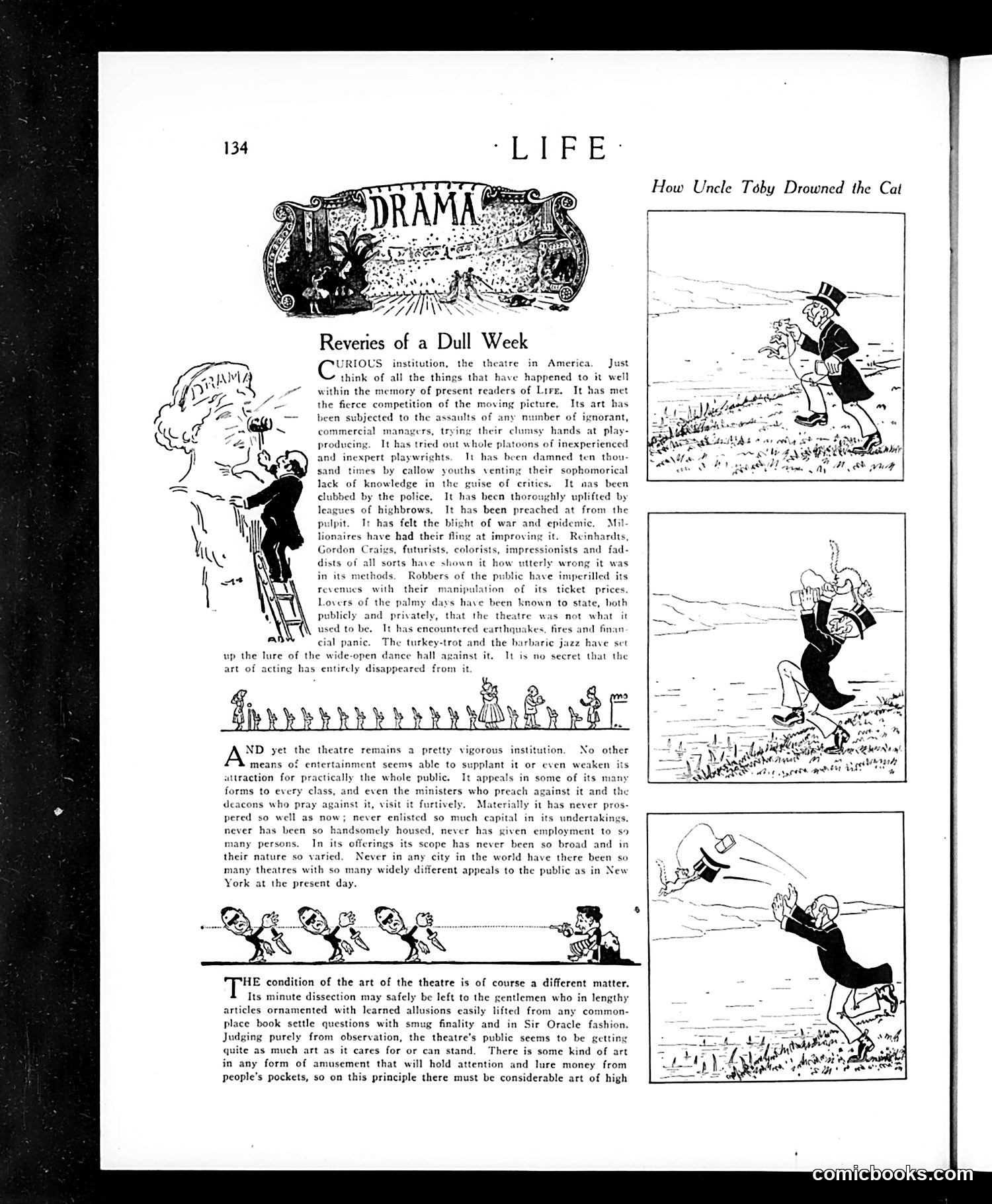
This page contains a lengthy essay defending American theatre against its many critics and detractors. The text sarcastically catalogs the theatre's supposed "failures": competition from movies, bad playwrights, police censorship, highbrow meddling, and jazz clubs luring audiences away. The right-side cartoon titled "How Uncle Toby Drowned the Cat" appears to be a humorous visual sequence (likely referencing Laurence Sterne's *Tristram Shandy*) showing a character's misadventure near water—unrelated to the main essay. **The satire's point**: Despite constant attacks from critics, moralists, censors, and entertainment competitors, theatre thrives financially and remains popular across all social classes. The essay argues that actual "art" in theatre is secondary to entertainment value—if it makes money and holds attention, it has merit. Modern readers would miss the specific reference to "turkey-trot" (1910s dance craze) as moral panic and the general anxiety about theatre's decline that was common in this era.
📄 Transcribed text from this page (OCR, searchable)
Machine-transcribed from the original scan — historical spelling and the odd misread are preserved.
URIOUS institution, the theatre in America. Just think of all the things that have happened to it well within the memory of present readers of Lire. It has met the fierce competition of the moving picture, Its art has been subjected to the assaults of any nt norant, y hands at pl has tried out whole platoons of inexperienced and inexpert playwrights. It has been damned ten thi sand times by callow youths venting their sophomor lack of knowledge in the guise of critics, It nas bee clubbed by the police, It has been thoroughly uplifted by leagues of highbrows, It has been preached at from the pulpit. It has felt the of war and epidemic, Mil lionaires have had their fling at improving it. Reinhardts Gordon Craigs, futurists, colorists, impressionists and fad- dists of all sorts have shown it how utterly wrong it was in its methods. Robbers of the public have imperilled its revenues with their manipulation of ticket prices. Lovers of the palmy days have been known to state, both publicly and privately, that the theatre was not what it used to be, It has encountered earthquakes, fires and finan cial panic. The turkey-trot and the barbaric jazz have set p the lure of the wide-open dance hall against it. It is no secret th art of acting has entircly disappeared from it ND yet the theatre remains a pretty vigorous institution. No other means of entertainment seems able to supplant it or even weaken its traction for practically the whole public. It appeals in some of its many forms to every class, even the ministers who preach against it and the deacons who pray against it, visit it furtively, Materially it has never pered so well as now; never enlisted so much capital in its never has been so handsomely housed, never has given employment to so many persons. In its offerings its scope has never been so broad and in their nature so varied. Never in any city in the world have there been so many theatres with so many widely different appeals to the public as in New York at the present day. HE condition of the art of the theatre is of course a different matter. Its minute dissection may safely be left to the gentlemen who in lengthy articles ornamented with learned allusions easily lifted from any common- place book settle questions with smug finality and in Sir Oracle fashion. Judging purely from observation, the theatre's public seems to be getting quite as much art as it cares for or can stand. There is some kind of art in any form of amusement that will hold attention and lure money from people's pockets, so on this principle there must be considerable art of high How Uncle Toby Drowned the Cat