
Life, 1919-01-23 · page 25 of 42
Life — January 23, 1919 — page 25: what you’re looking at
What you’re looking at
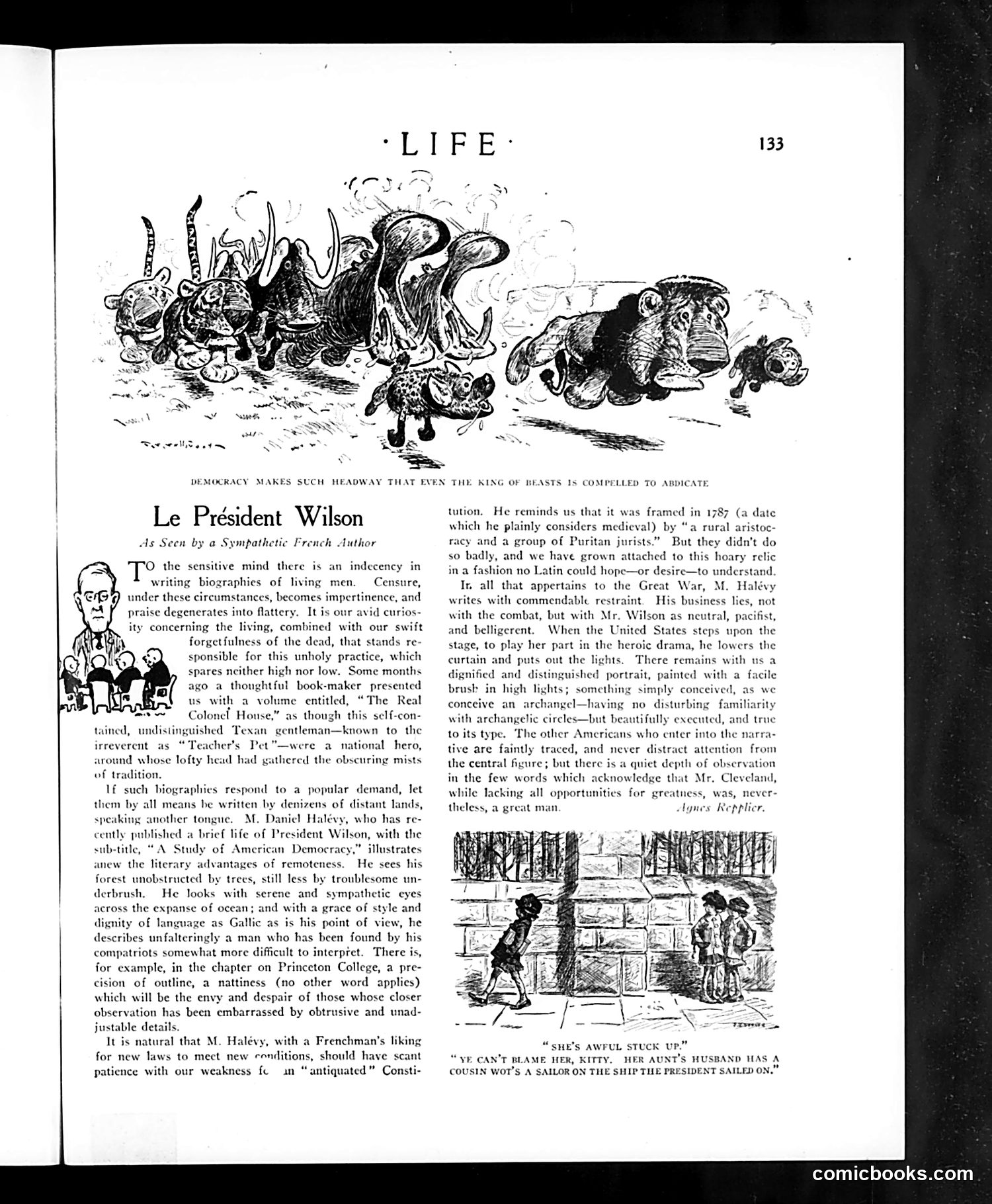
**Main Content:** This page reviews M. Daniel Halévy's French biography of President Wilson, praising the outsider's perspective while gently critiquing Wilson himself. The author argues that distant observers see clearly what Americans miss due to familiarity. **Top Cartoon:** The caption "Democracy makes such headway that even the King of Beasts is compelled to abdicate" depicts animals (appearing to include a lion losing its crown) fleeing in chaos. This satirizes democracy's destabilizing force—suggesting democratic ideals are so powerful they're overthrowing even traditional authority figures, portrayed here as animals abandoning their natural hierarchy. **Bottom Cartoon:** Two working-class women discuss a girl who's "stuck up." The joke: the girl's aunt married a sailor on a ship Wilson sailed on—a trivial connection to the President that inflates the family's social status. This mocks how ordinary Americans seek prestige through the thinnest possible association with powerful figures. **Overall Point:** The page contrasts French analytical distance with American social pretension regarding Wilson and democracy itself.
📄 Transcribed text from this page (OCR, searchable)
Machine-transcribed from the original scan — historical spelling and the odd misread are preserved.
Ce on ae Le Président Wilson As Seen by a Sympathetic French Author 'O the sensitive mind there is an indecency in writing biographies of living men. under these circumstances, becomes impertinence, and aise degenerates into flattery. It is our avid curios- ity concerning the living, combined with our swift forgetfulness of the dead, that stands re- sponsible for this unholy practice, which spares neither high nor low. Some months ago a thoughtful book-maker presented us with a volume entitled, “The Real Colonel House,” as though this self-con- tained, undistinguished Texan gentleman—known to the irreverent as “Teacher's Pet"—were a national hero, around whose lofty head had gathered the obscuring mists of tradition. If such biographies respond to a popular demand, let them by all means be written by denizens of distant lands, speaking another tongue. M. Daniel Halévy, who has re cently published a brief life of President Wilson, with the sub-title, “A Study of American Democracy,” illustrates anew the literary advantages of remoteness. He sees his forest unobstructed by trees, still less by troublesome un- He looks with serene and sympathetic eyes across the expanse of ocean; and with a grace of style and dignity of language as Gallic as is his point of view, he describes unfalteringly a man who has been found by his compatriots somewhat more difficult to interpret. There is, for example, in the chapter on Princeton College, a pre- sion of outline, a nattiness (no other word applies) which will be the envy and despair of those whose closer observation has been embarrassed by obtrusive and unad- justable details. It is natural that M. Halévy, with a Frenchman's liking for new laws to mect new conditions, should have scant patience with our weakness fe an “antiquated” Consti- Censure, derbrush, DEMOCRACY MAKES SUCH HEADWAY THAT EVEN THE KING HEASTS 18 COMPELLED TO ANDICATE tution, He reminds us that it was framed in 1787 (a date which he plainly considers medieval) by “a rural aristoc- racy and a group of Puritan jurists.” But they didn’t do so badly, and we have grown attached to this hoary re in a fashion no Latin could hope—or desire—to understand In all that appertains to the Great War, M. Halévy writes with commendable restraint. His business lies, not with the combat, but with Mr. Wilson as neutral, pacifist, and belligerent. When the United States st stage, to play her part in the heroic drama, he lowers the curtain and puts out the lights. There remains with us a dignified and distinguished portrait, painted with a facile brush in high lights; something simply conceived, as we conceive an_archangel—t »s upon the ving no disturbing familiarity with archangelic circles—but beautifully executed, and true to its type. The other Americans who enter into the narra- tive are faintly traced, and never distract attention from the central figure; but there is a quiet depth of observation in the few words which acknowledge that Mr, Cleveland, while lacking all opportunities for greatness, theless, a great man elqnes Repplicr. was, never- “SHE'S AWFUL STUCK UP.” “YE CAN'T BLAME HER, KITTY, HER AUNT’ WOT’S A SAILOR ON THE SHIP THE PRI HUSBAND HAS IDENT SAILED ON, comicbooks.com