
Life, 1919-01-23 · page 34 of 42
Life — January 23, 1919 — page 34: what you’re looking at
What you’re looking at
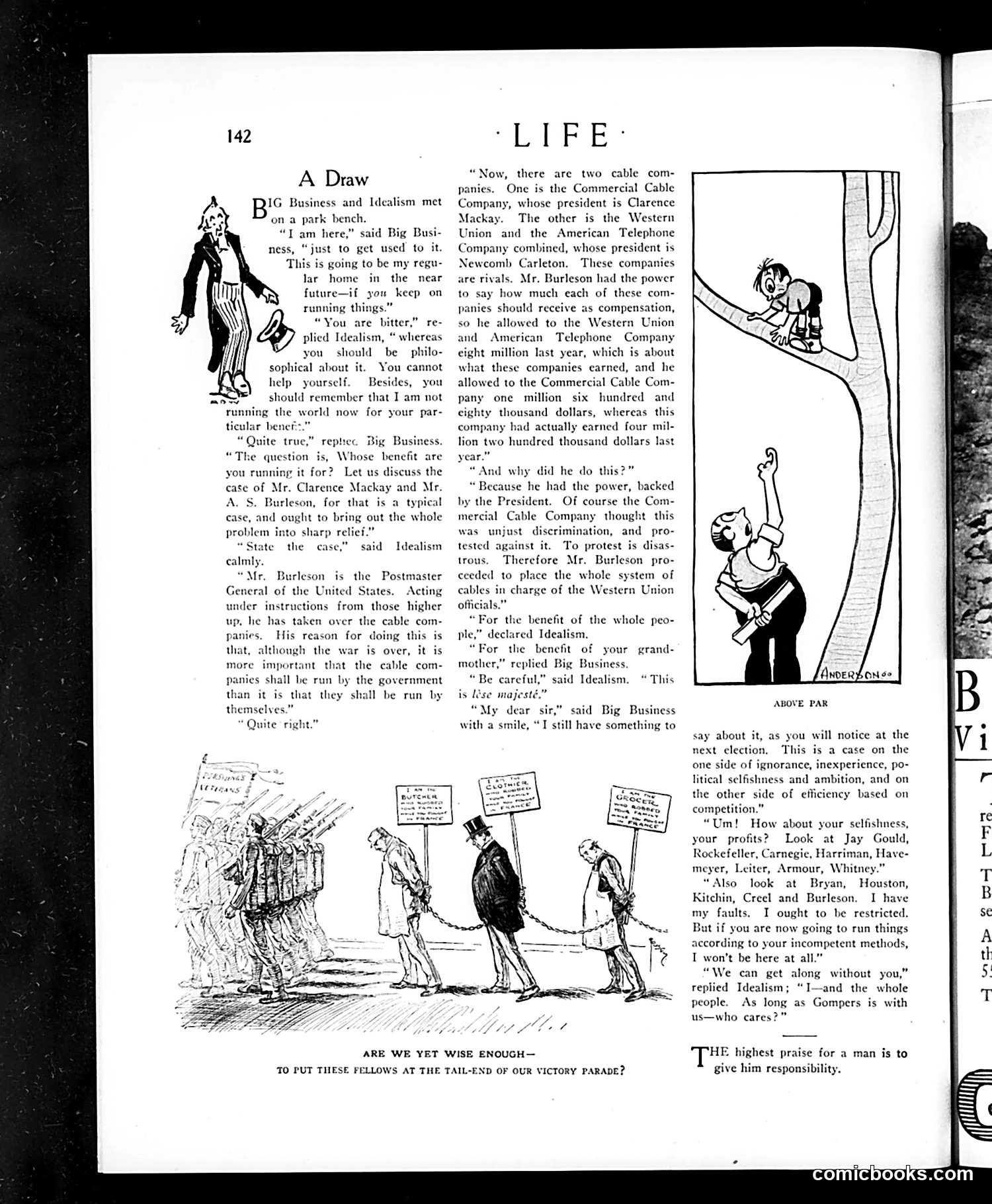
This satirical dialogue personifies **Big Business** and **Idealism** debating government control of industries after World War I. The specific case concerns **Postmaster General A.S. Burleson's** management of cable companies during the war. The satire criticizes Burleson for allegedly favoring the **Western Union and American Telephone Company** (which received $8 million) over the **Commercial Cable Company** (whose president **Clarence Mackay** received only $1.6 million despite earning $4.2 million). Big Business argues this represents incompetent, politically-motivated government management. Idealism counters that business itself is corrupt (citing robber barons like Rockefeller and Carnegie) and that workers and reformers (including labor leader **Gompers**, and politicians like Bryan and Houston) support government control. The bottom cartoon depicts executives as puppets on strings, questioning whether they deserve a place in victory celebrations. The piece attacks both sides: government overreach through favoritism, and business's historical exploitation.
📄 Transcribed text from this page (OCR, searchable)
Machine-transcribed from the original scan — historical spelling and the odd misread are preserved.
A Draw 1G Business and Idealism met ona park bench. “Tam here,” said Big Busi- ness, “just to get used to it. This is going to be my regu- lar home in the near future—if you keep on running things.” “You are bitter,” re- plied Idealism, “ whereas should be philo- sophical about it. You cannot help yourself. Besides, you should remember that I am not running the world now for your par- ticular benef.” “Quite true,” reptrec “The question is, Whose benefit are you running it for? Let us discuss the case of Mr. Clarence Mackay and Mr. A. S. Burleson, for that is atypical case, and ought to bring out the whole problem into sharp reli “State the calmly. “Mr. Burleson is the Postmaster General of the United States. Acting under instructions from those higher has taken over the cable com- His reason for doing this is though the war is over, it is important that the cable com- panies shall be run by the government than it is that they shall be run by themselves.” “Quite right.” you Big Business. case,” said Idealism up, he ‘LIFE * ow, there are two cable com- panies. One is the Commercial Cable Company, whose president is Clarence Mackay. The other is the Western Union and the American Telephone Company combined, whose president is Newcomb Carleton. These companies are rivals. Mr. Burleson had the power to say how much each of these com- panies should receive as compensation, so he allowed to the Western Union and American Telephone Company eight million last year, which is about what these companies earned, and he allowed to the Commercial Cable Com- pany one million six hundred and hty thousand dollars, whereas this company had actually earned four mil- lion two hundred thousand dollars last year.” “And why did he do this?” “Because he had the power, backed the President. Of course the Com- mercial Cable Company thought this was unjust discrimination, and pro- tested against it. To protest is disas- trous. Therefore Mr. Burleson pro- ceeded to place the whole system of cables in charge of the Western Union officials, “For the benefit of the whole peo- declared Idealism. or the benefit of your mother,” replied Big Business. “Be careful,” said Idealism. is lese maj My dear sir,” said Big Business with a smile, “I still have something to grand- “This ARE WE YET WISE ENOUGH— TO PUT THESE FELLOWS AT THE TAIL-END OF OUR VICTORY PARADE? ABOVE PAR say about it, as you will notice at the next electio: his is a case on the one side of ignorance, inexperience, po- litical selfishness and ambition, and on the other side of efficiency based on competition.” “Um! How about your selfishness, your profits? Look at Jay Gould, Rockefeller, Carnegie, Harriman, Have- meyer, Leiter, Armour, Whitney.” Also look at Bryan, Houston, Kitchin, Creel and Burleson. I have my faults. I ought to be restricted. But if you are now going to run things according to your incompetent methods, I won't be here at all.” “We can get along without you,” replied Idealism; “I—and the whole people. As long as Gompers is with us—who cares?” HE highest praise for a man is to give him responsibility.