
A complete issue · 35 pages · 1918
Life — December 26, 1918
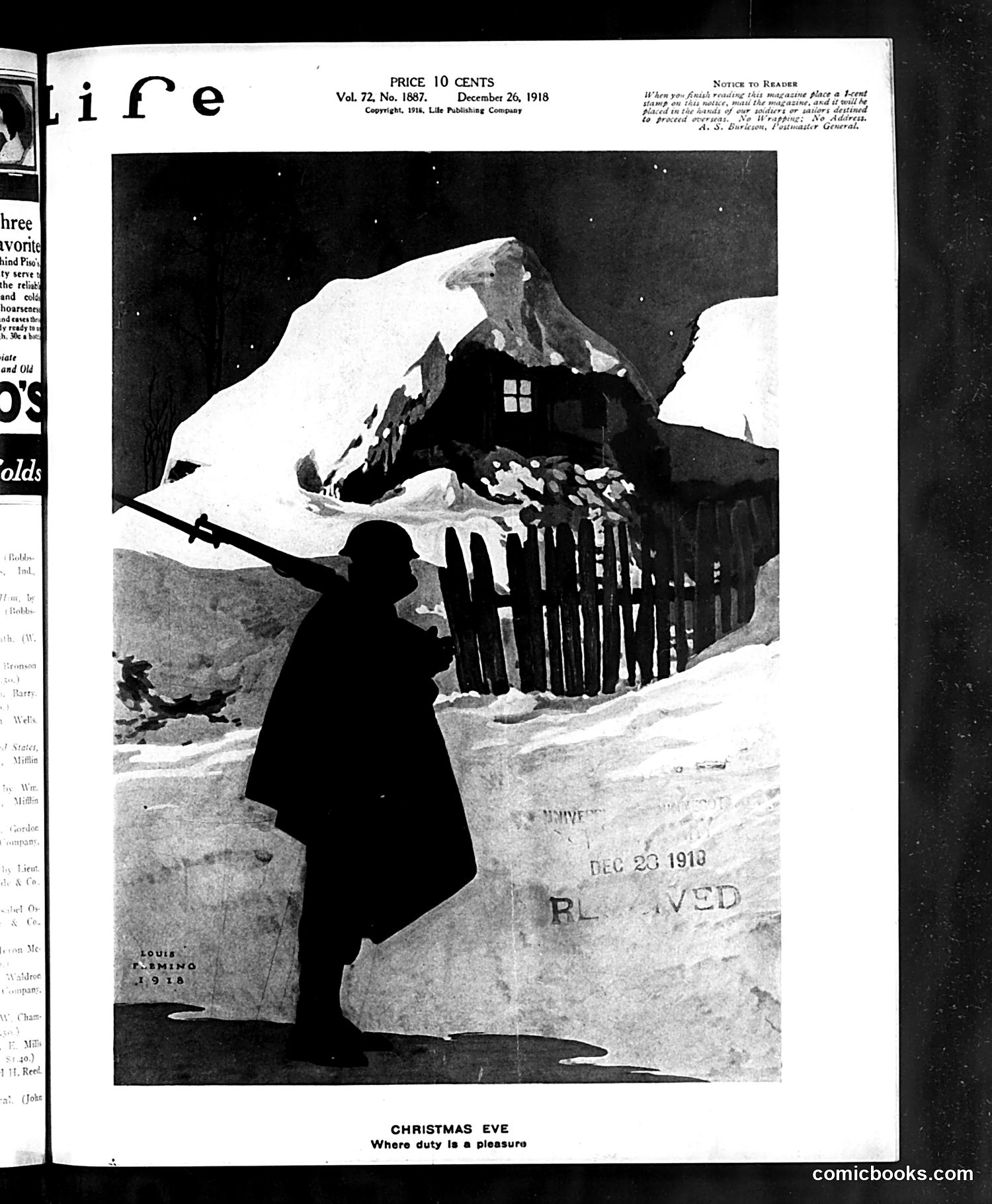
This cover depicts a soldier silhouetted against a snowy landscape, standing before a cottage with snow-laden roof and a wooden fence. The image is titled "CHRISTMAS EVE: Where duty is a pleasure." The context is post-WWI (the magazine is dated just weeks after the November 1918 Armistice). The soldier appears to represent American troops stationed abroad or garrisoned during the occupation phase following the war's end. The caption's irony—"duty is a pleasure"—likely comments on soldiers spending Christmas away from home, stationed in harsh winter conditions, far from families. This reflects the bittersweet reality facing demobilizing troops: many remained overseas for months after fighting ceased, unable to return immediately to civilian life, spending holidays in foreign, snowy quarters rather than with loved ones.
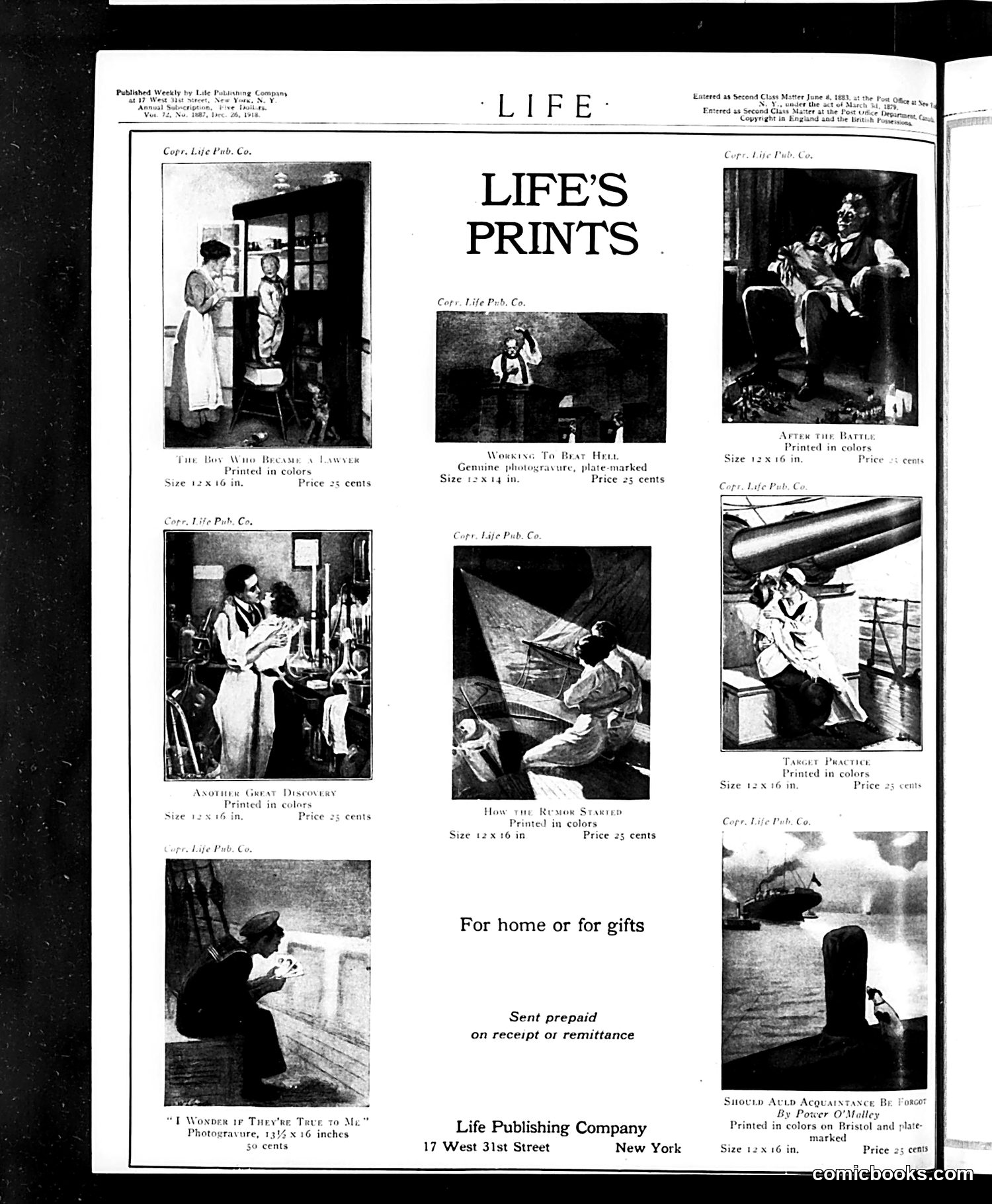
This is primarily an **advertising page**, not satirical content. Life Publishing Company is marketing a series of prints for sale—affordable art reproductions priced at 25 cents each, sized 12x16 inches or 12x14 inches. The prints depicted include narrative scenes with titles like "The Boy Who Became a Lawyer," "Another Great Discovery," "Working to Beat Hell," and "Target Practice." These appear to be sentimental or dramatic illustrations typical of early 20th-century popular art—dealing with themes of ambition, romance, science, labor, and military subjects. The advertisement emphasizes these prints are "For home or for gifts" and could be "Sent prepaid on receipt of remittance" to their New York address. This reflects how affordable reproductions democratized art access for middle-class households during this era.
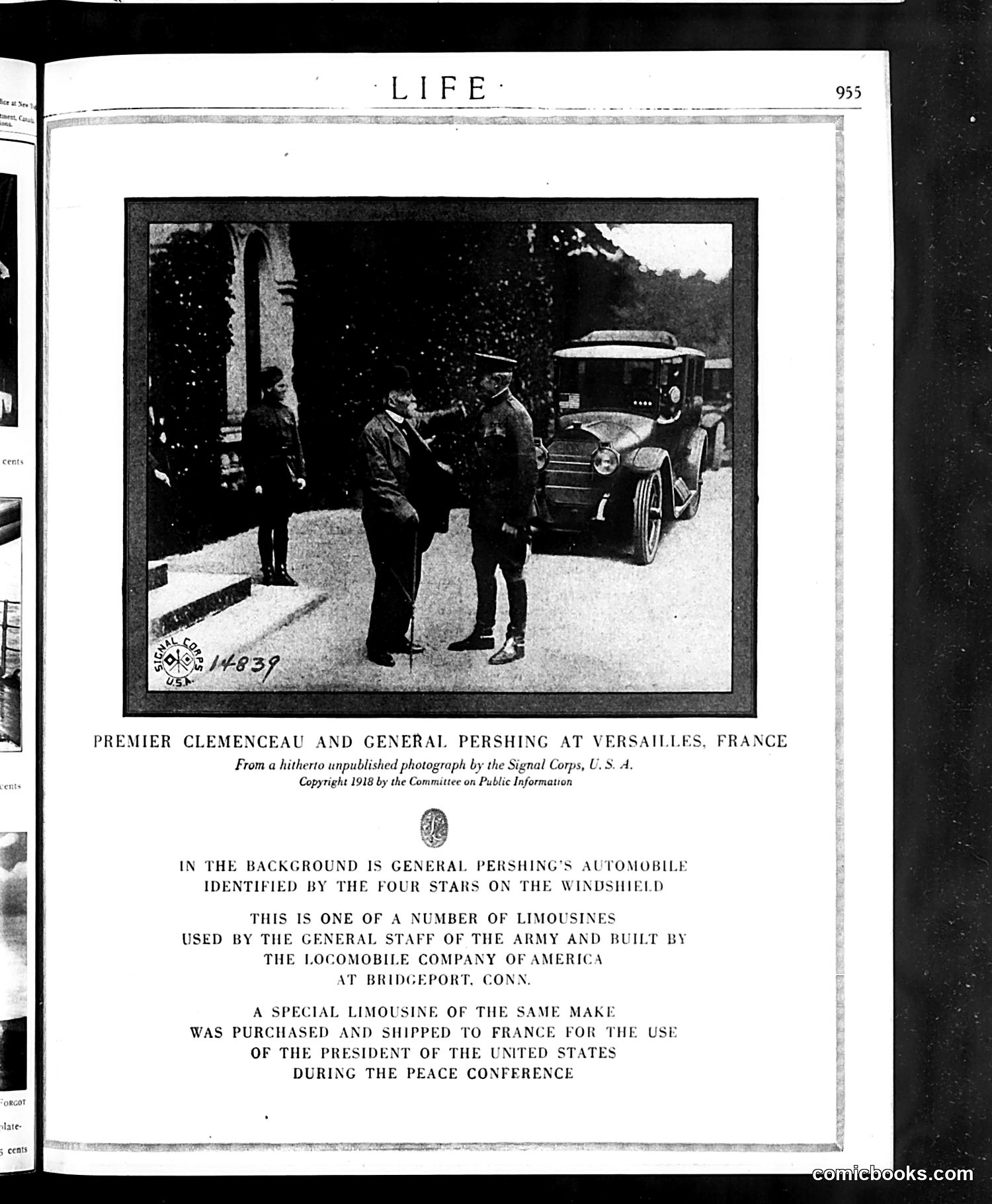
This is **not a cartoon or satire**, but a historical photograph from *Life* magazine (page 955) documenting the 1918 Paris Peace Conference. The image shows Premier Georges Clemenceau (French leader) and General John J. Pershing (American military commander) at Versailles, France. The caption identifies Pershing's automobile in the background—a Locomobile limousine built in Bridgeport, Connecticut, by the Locomotile Company of America. The text emphasizes that a matching limousine was shipped to France for President Woodrow Wilson's use during peace negotiations. This is straightforward documentation of Allied leadership and American industrial contribution to the post-WWI diplomatic effort, not satire.
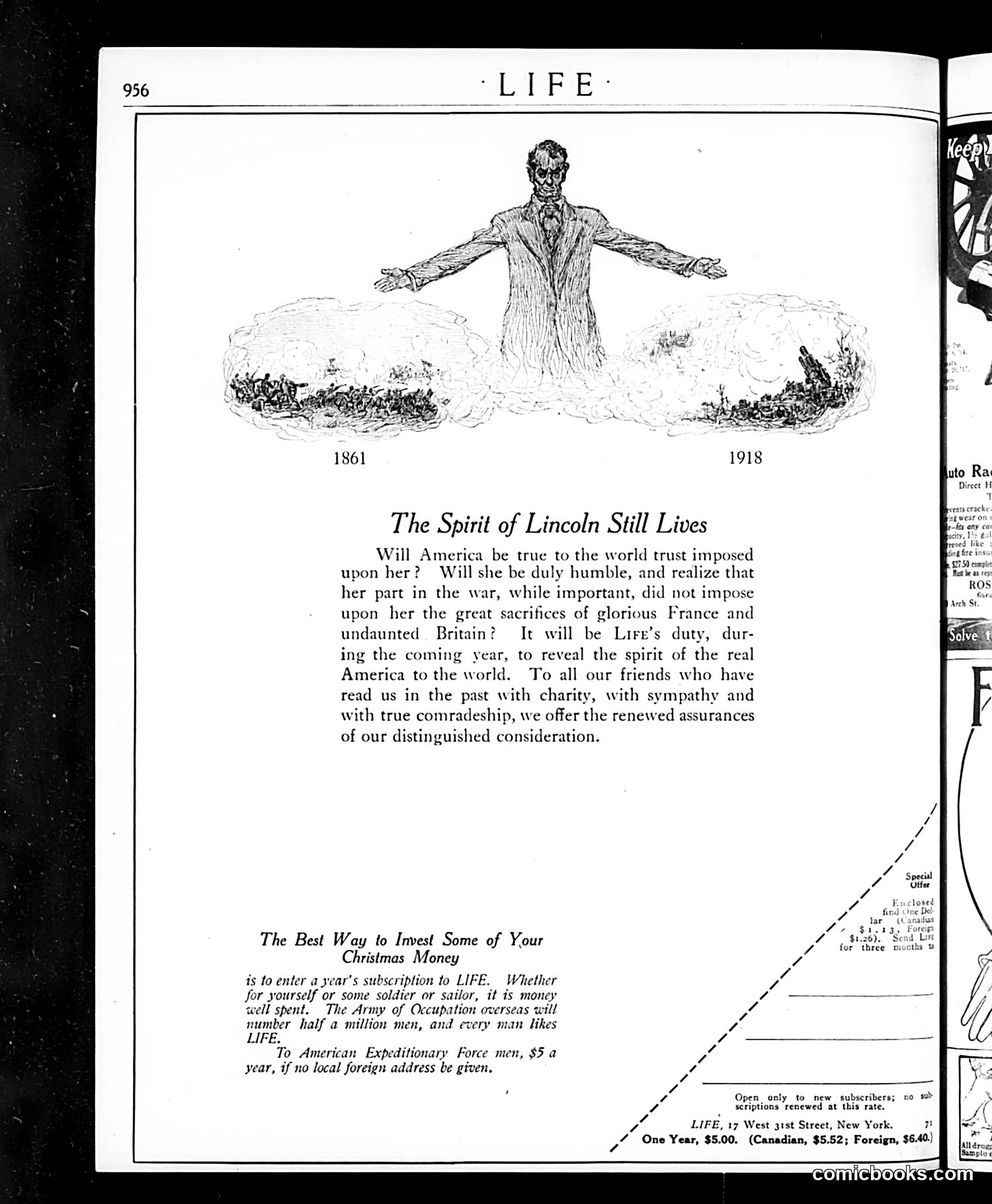
This page from *Life* magazine features a patriotic illustration titled "The Spirit of Lincoln Still Lives," showing a figure with outstretched arms flanked by two historical scenes labeled 1861 and 1918. The illustration invokes Abraham Lincoln's legacy to contextualize America's involvement in World War I (which the U.S. entered in 1917). The paired dates reference the Civil War era and the recent Great War, suggesting America's continued moral mission—from preserving the Union to supporting the Allied cause. The accompanying text poses rhetorical questions about America's duty and humility in the war effort, acknowledging the greater sacrifices of France and Britain while asserting America's role in revealing "the spirit of the real America to the world." The lower section advertises *Life* subscriptions as a patriotic Christmas gift for soldiers and sailors, directly monetizing wartime sentiment.
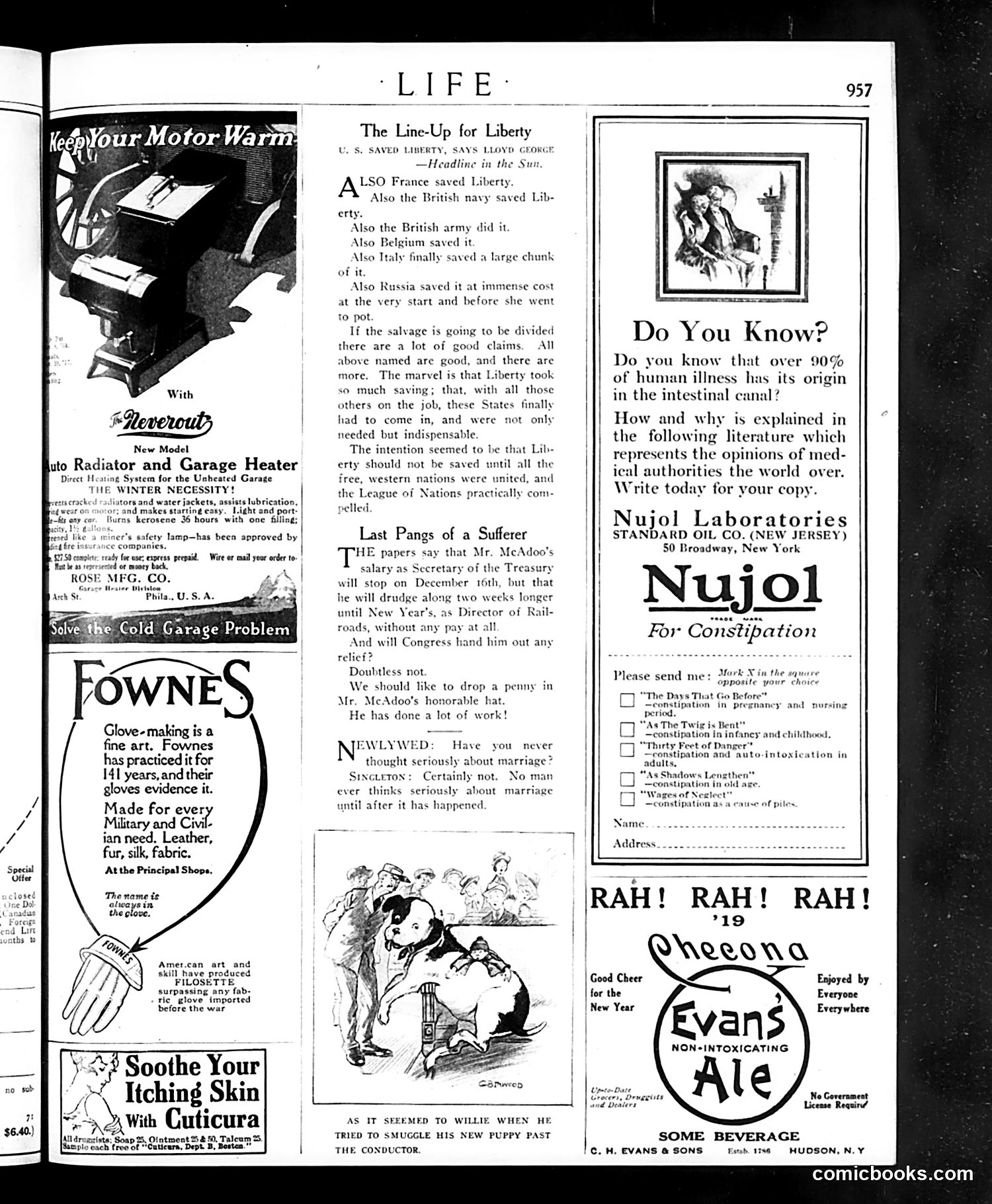
This page is primarily **advertising** with one small political cartoon. The main content includes ads for automobile heaters, gloves, medical literature, and ale. The cartoon titled "As It Seemed to Willie When He Tried to Smuggle His New Puppy Past the Conductor" shows a humorous scene of a man attempting to hide a dog from a train conductor. The joke is straightforward slapstick: the puppy's tail visibly protrudes, making the smuggling attempt obvious and comical. The adjacent article "The Line-Up for Liberty" discusses nations credited with saving the Statue of Liberty, including France, Britain, Belgium, Italy, and Russia—likely referencing WWI allied cooperation, though context is unclear from this excerpt alone.
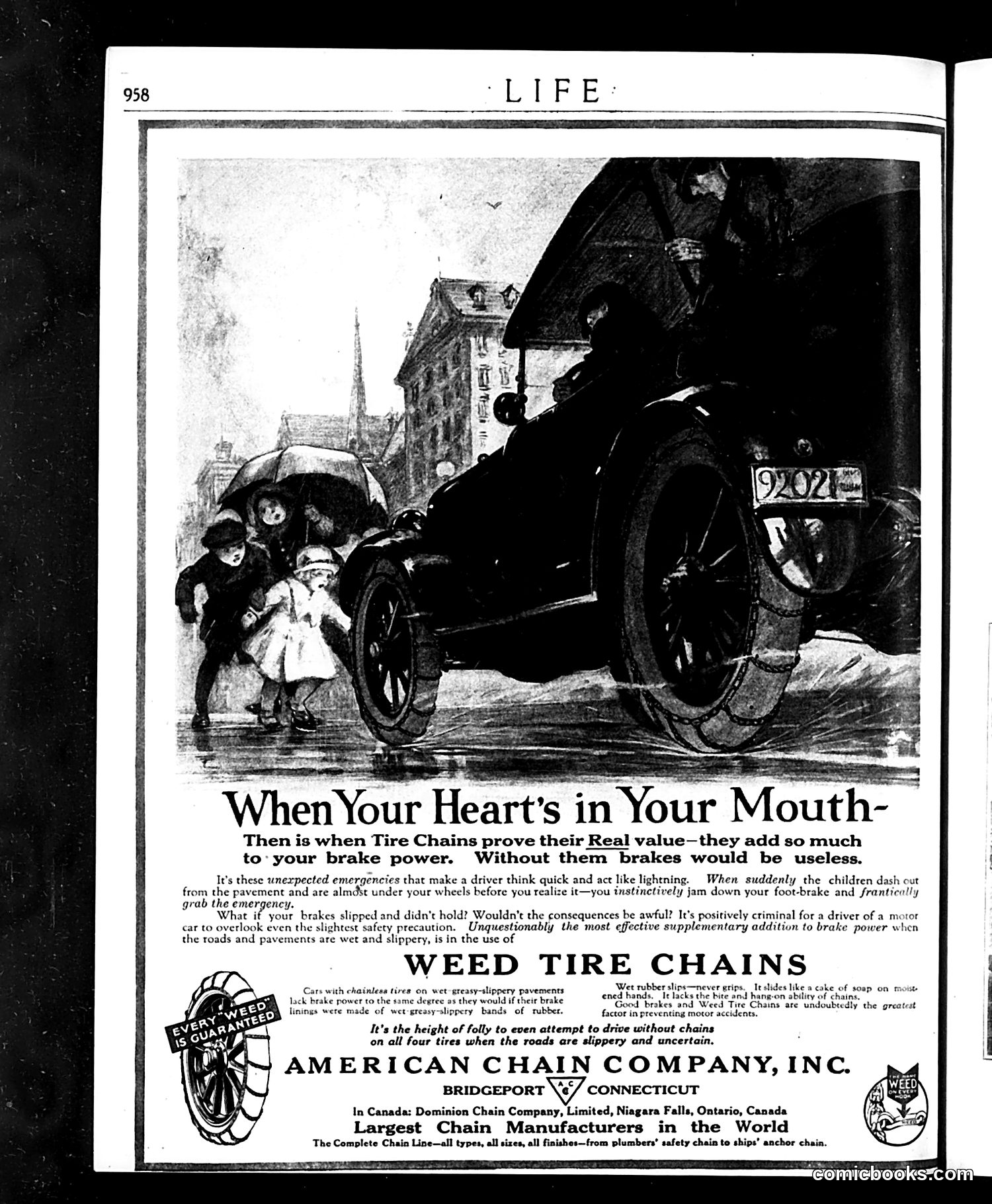
This page is primarily **an advertisement, not satire or political commentary**. It's a 1920s safety ad for Weed Tire Chains by American Chain Company, Inc. The dramatic illustration shows an automobile nearly striking children in the rain—a scenario designed to shock viewers into recognizing tire chains' safety value. The ad's rhetoric exploits parental fear: "When Your Heart's in Your Mouth" appeals to emotion, arguing that tire chains provide essential braking power on wet, slippery roads. The text emphasizes that chains are "unquestionably the most effective supplementary addition to brake power when roads and pavements are wet and slippery." This represents early automobile safety advertising, using fear-based messaging to promote a practical product before modern tire technology made chains obsolete.
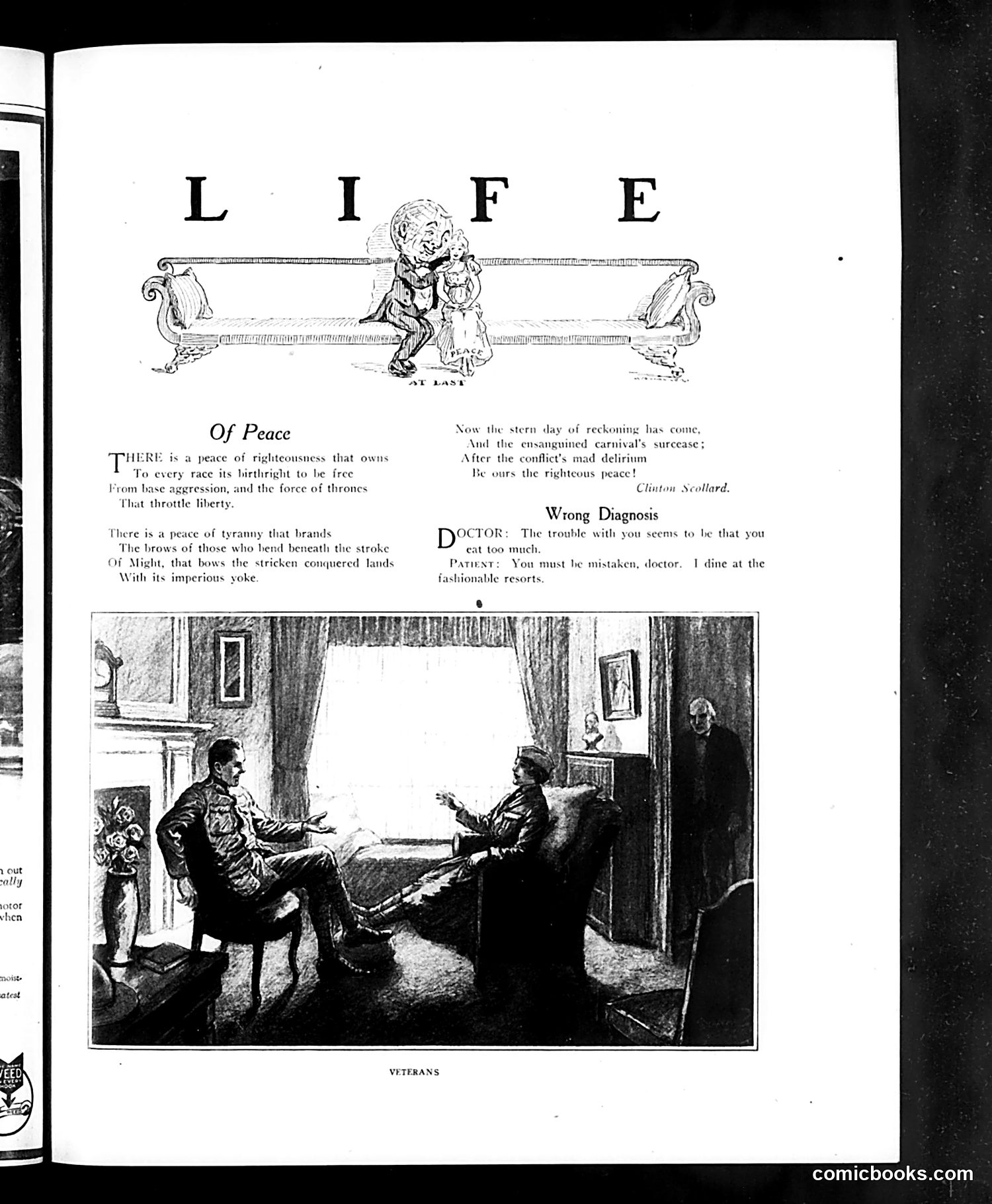
This page contains two sections: **"Of Peace"** is a poem about different types of peace—righteousness, tyranny, and others—attributed to Clinton Scollard. **"Wrong Diagnosis"** is a brief comic dialogue where a doctor tells a patient his trouble is eating too much, and the patient responds he must be mistaken because he dines at fashionable resorts. The humor relies on class satire: the patient insists he eats at expensive, prestigious restaurants, implying that wealthy people at fancy establishments couldn't possibly overeat or have common health problems. It mocks the assumption that fashionable dining automatically equals proper nutrition or restraint. The illustration labeled "VETERANS" shows a doctor's office scene, likely depicting this exchange.
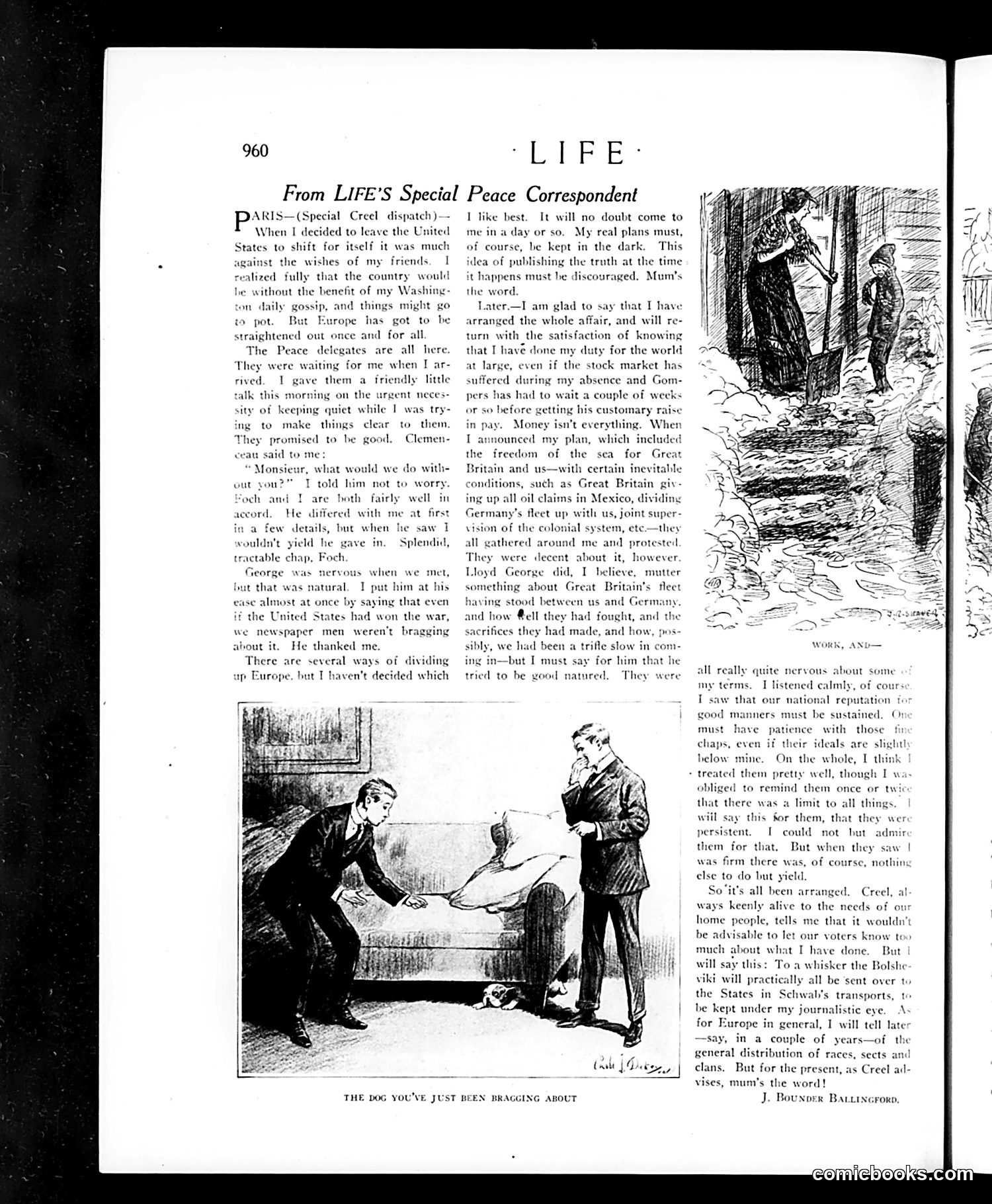
This page features a satirical article titled "From LIFE'S Special Peace Correspondent" by J. Bounder Ballingford, describing diplomatic negotiations in Paris following World War I. The accompanying cartoon depicts three men in suits examining what appears to be a dog or similar creature, captioned "THE DOG YOU'VE JUST BEEN BRAGGING ABOUT." The image suggests mockery of inflated claims—likely referencing how negotiators or political figures exaggerate their accomplishments or leverage in peace talks. The article discusses European division, the Bolshevik question, and maintaining national reputation during delicate negotiations. The satirical tone criticizes how diplomats handle sensitive matters while managing competing interests, suggesting they overstate their achievements to domestic audiences while making uncomfortable compromises behind closed doors.
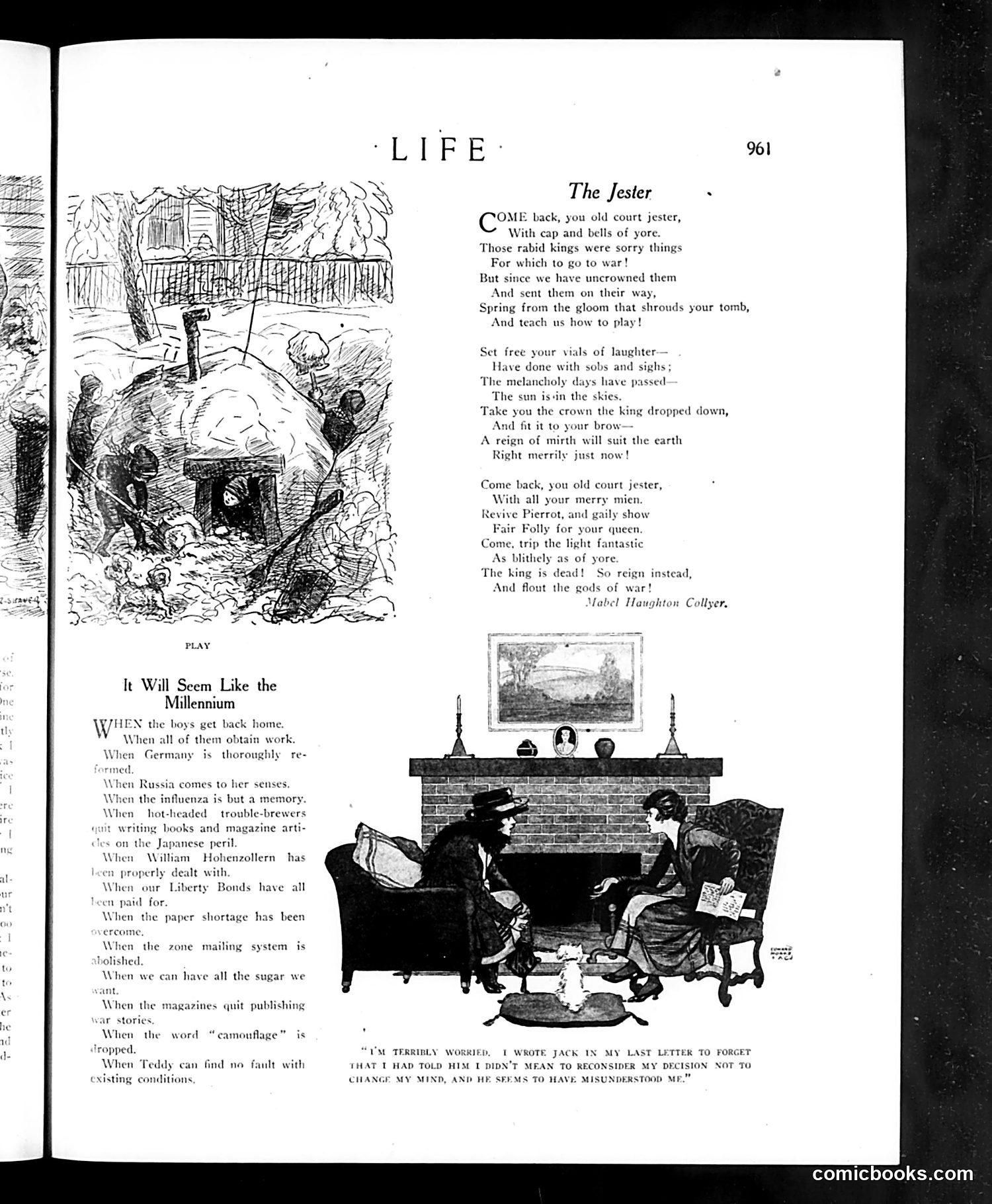
This page contains two satirical pieces from WWI-era Life magazine: **"The Jester"** (top): A poem by Mabel Houghton Collyer urging a court jester to return and use humor to lift wartime gloom. It references the king being "dead" and suggests laughter as relief from war's melancholy—likely satirizing how Americans need entertainment distraction during the conflict. **"It Will Seem Like the Millennium"** (bottom): A humorous list of post-war peace conditions (sugar availability, magazine stories resuming, etc.). The accompanying illustration shows two figures by a fireplace, with a caption about miscommunication regarding a decision change—appears to be domestic comedy contrasting trivial home concerns with grand war-ending aspirations. Both pieces use humor to process WWI anxiety through satire of American daily life and desires for normalcy.
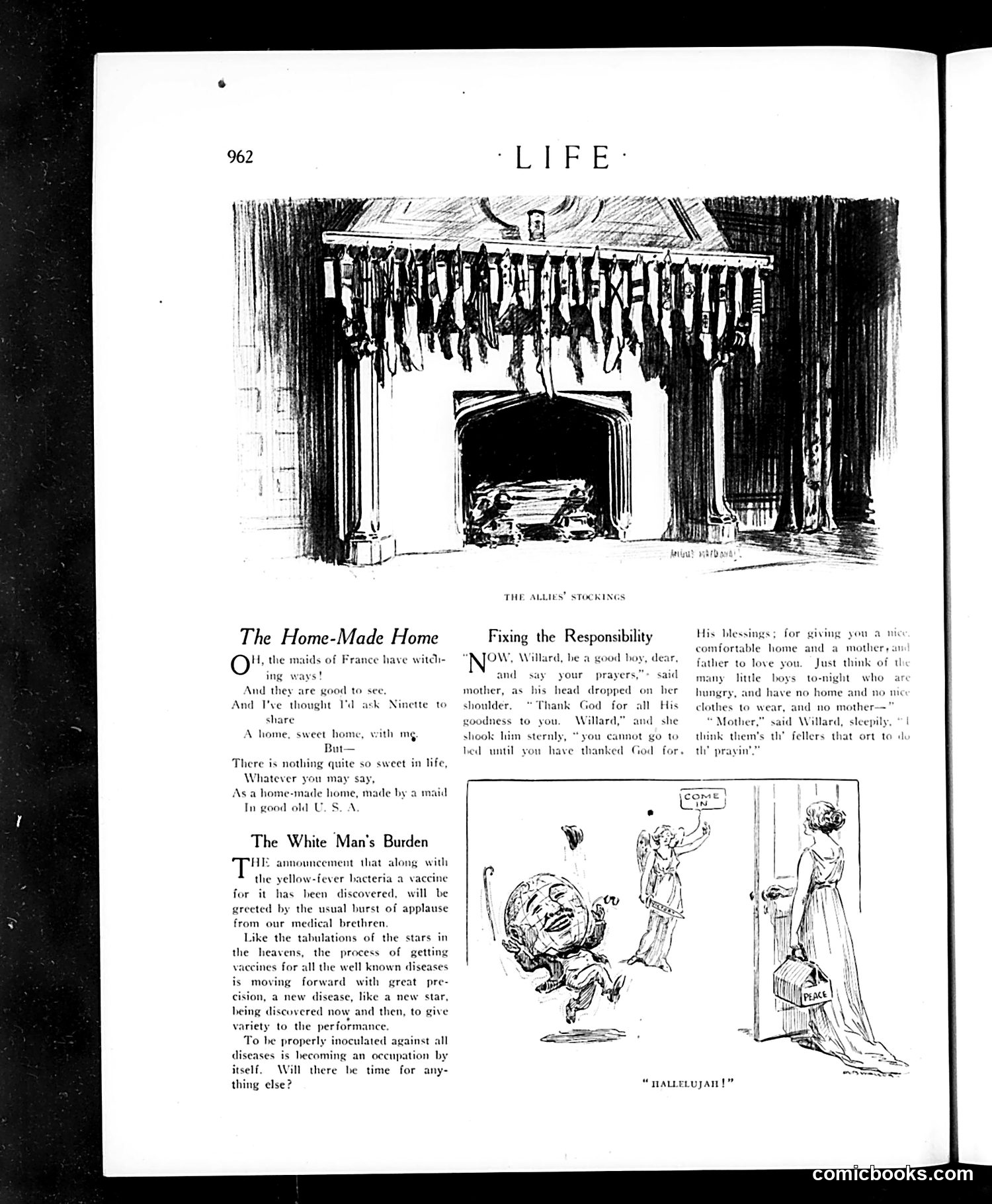
This page contains three distinct pieces: 1. **"The Allies' Stockings"** — An illustration showing stockings hung above a fireplace, likely a WWI-era reference to Allied nations' supplies or resources. 2. **"The Home-Made Home"** — A sentimental poem about French maids and domestic comfort, praising homemade homes made by servants ("a maid / In good old U.S.A."). 3. **"The White Man's Burden"** — An article discussing vaccine development for yellow fever, presented as medical progress. The title references Kipling's famous imperialist poem, sarcastically framing disease prevention as a civilizing mission. 4. **"Hallelujah!"** — Comic cartoons showing what appears to be a child's exuberant reaction, likely illustrating domestic happiness or relief. The page blends sentimentality about home life with imperialist undertones typical of early 20th-century American periodicals.
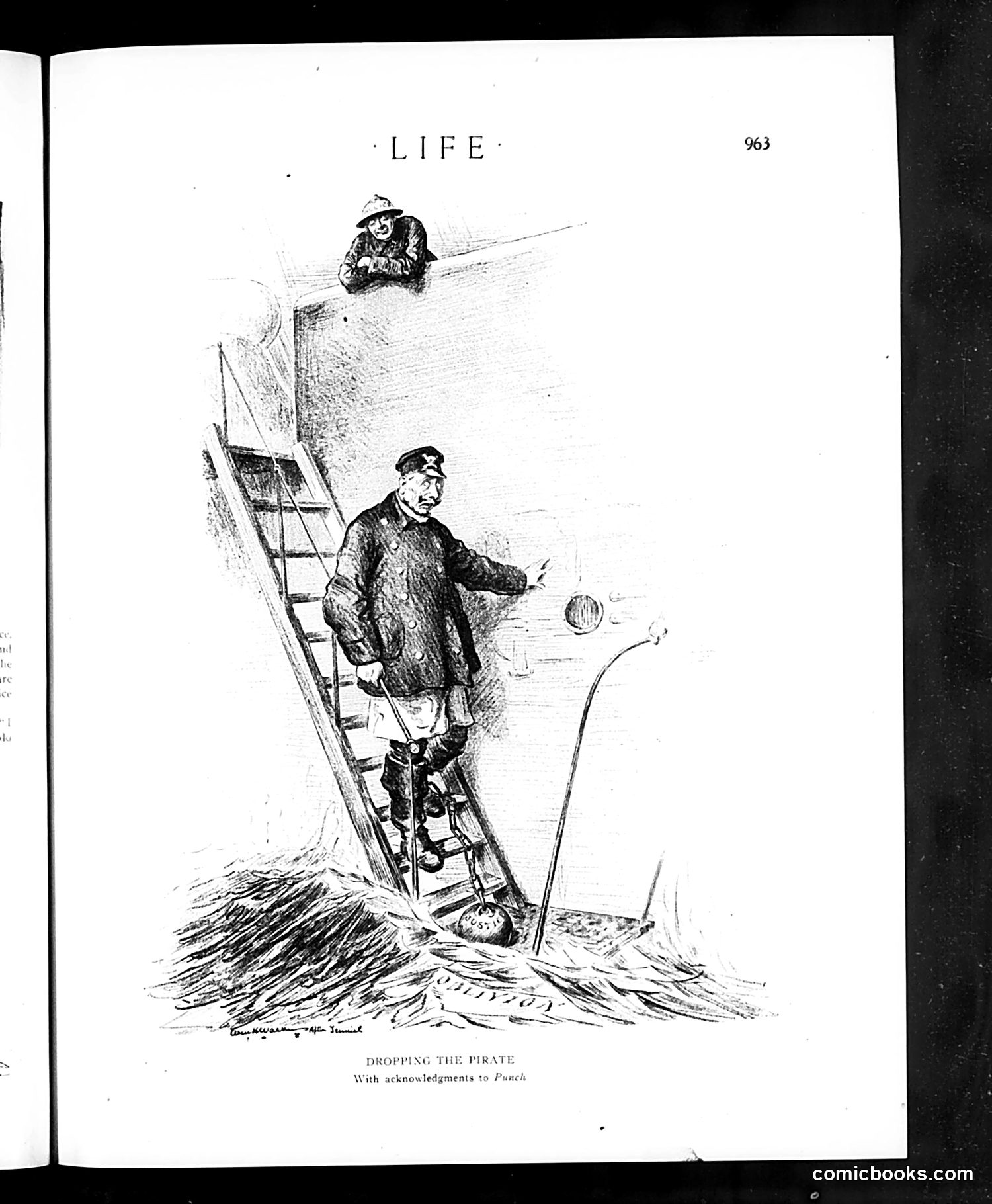
This political cartoon depicts a man on a ladder dropping a spherical object (labeled a "pirate") while another figure watches from above. The title indicates this is a satirical commentary acknowledging *Punch*, a British satirical magazine. The cartoon appears to be criticizing a political figure or policy associated with piracy—likely referencing a leader or government being abandoned or discarded. The ladder suggests climbing toward power or legitimacy. Without clearer historical context or visible dates, the specific political situation remains unclear, but the satire suggests someone in authority is distancing themselves from an unpopular association or ally, much like dropping unwanted cargo.
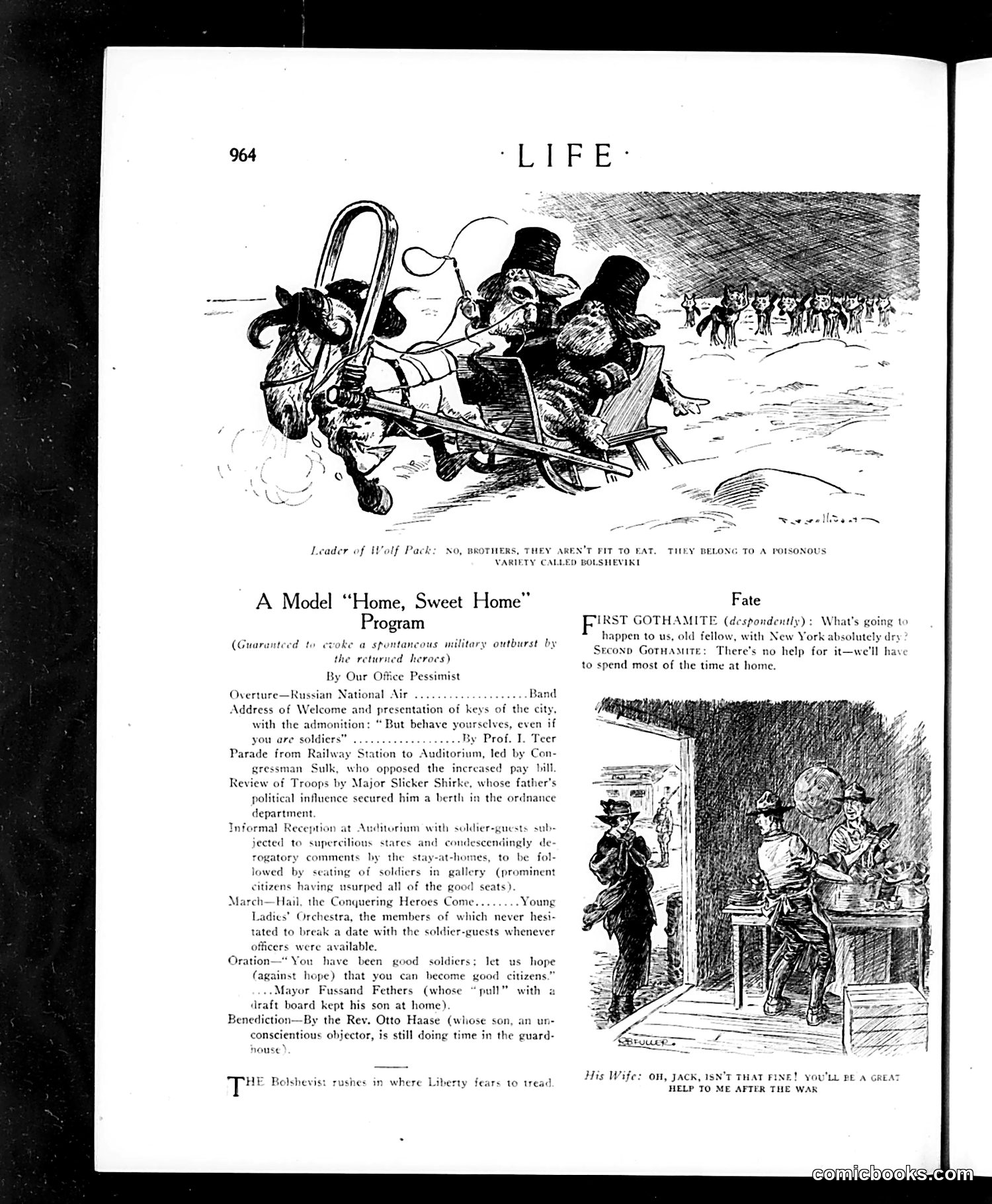
This Life magazine page satirizes the post-WWI "homecoming" experience. The top cartoon mocks Russian Bolsheviks by depicting them as wolves in a sleigh—the caption dismisses them as unfit to eat, belonging to "a poisonous variety called Bolsheviki," reflecting American anti-communist sentiment of the era. The "Model Home, Sweet Home Program" section parodies official receptions for returning soldiers. It lists absurdly contradictory gestures: parades, speeches promising citizenship, informal receptions with "condescendingly derogatory comments," and benedictions—all while soldiers face uncertain futures. The lower cartoon shows a soldier returning home to find his wife optimistic about his prospects. The satire highlights the disconnect between ceremonial patriotic welcomes and soldiers' actual post-war difficulties and employment concerns.
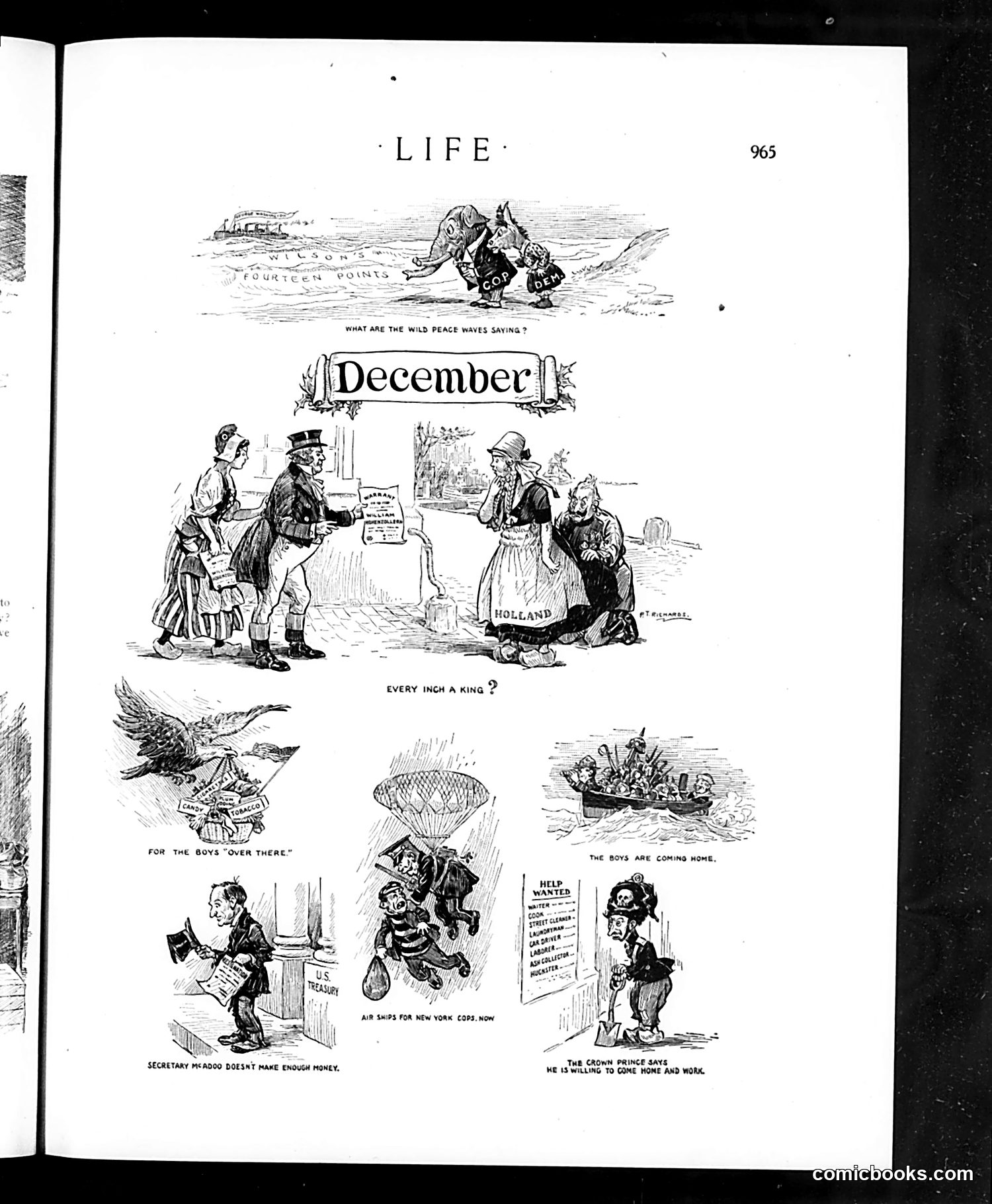
This page presents December 1915 wartime commentary during World War I. The central cartoon shows figures labeled "Holland" discussing neutrality ("Every Inch a King?"), referencing the Netherlands' precarious position maintaining neutrality while surrounded by warring powers. Other cartoons address American homefront concerns: "Secretary McAdoo Doesn't Make Enough Money" critiques government finances; "Air Ships for New York Cops Now" references militarization; "The Boys Are Coming Home" and "For the Boys Over There" reference American soldiers in the European conflict; "The Boys' Wages" likely addresses soldier compensation. The top cartoon caption asks "What Are the Wild Peace Waves Saying?"—suggesting satirical commentary on peace negotiations or war-weary public sentiment during the ongoing conflict.
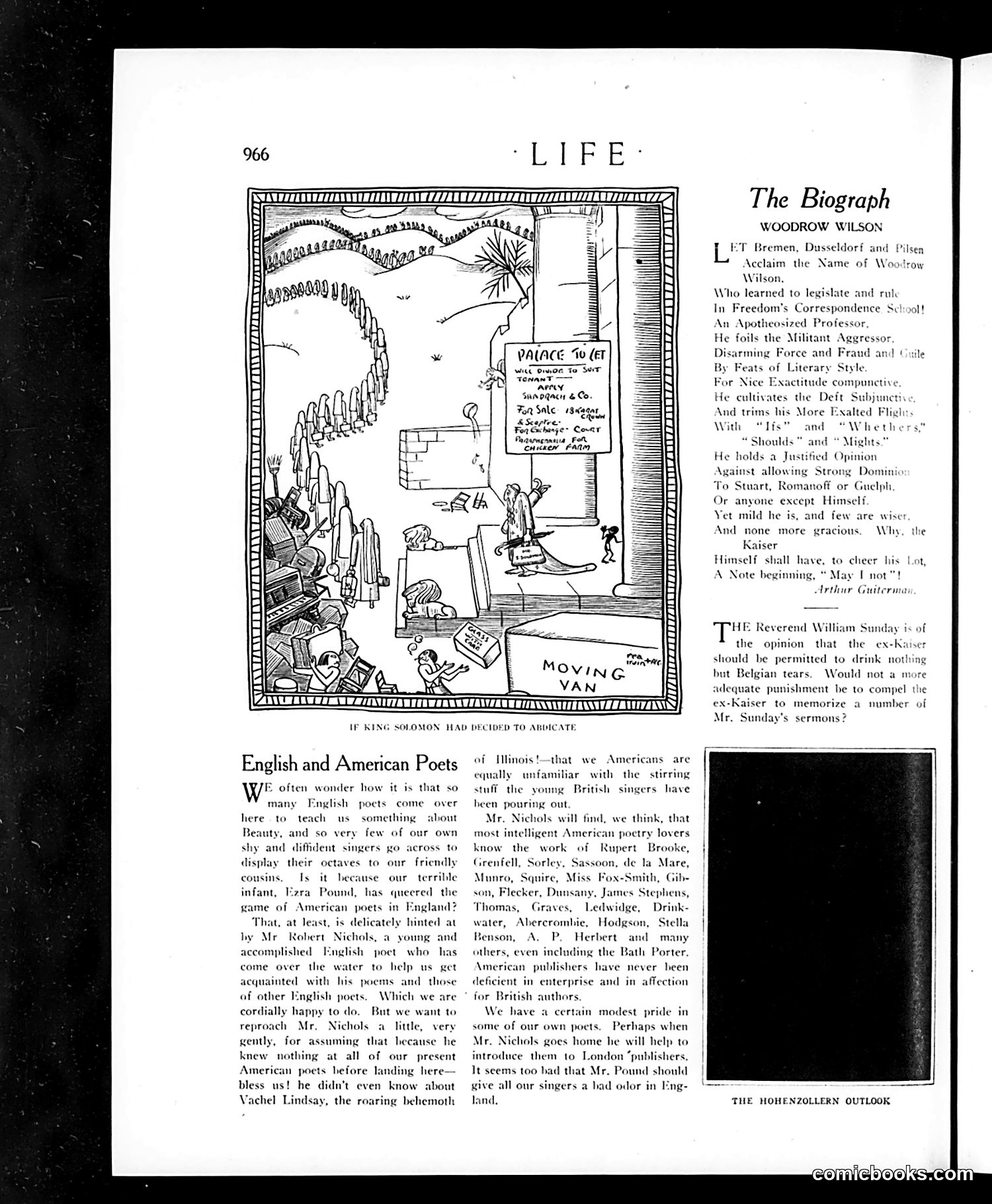
The main cartoon, titled "If King Solomon Had Decided to Abrogate," depicts a chaotic palace scene with a "Moving Van" and "Palace To Let" sign, satirizing the abdication crisis. The sketch shows Solomon (likely representing a historical/biblical authority figure) abandoning his throne amid disorder and property removal. The accompanying text criticizes American poet Robert Nichols for claiming ignorance of major American poets before visiting England. The article sarcastically suggests Nichols should help introduce American poets to London publishers, implying his dismissal of figures like Vachel Lindsay was embarrassing. The piece defends American literary accomplishment against perceived British condescension. "The Biograph" section right offers satirical commentary on Woodrow Wilson's character and political legacy.
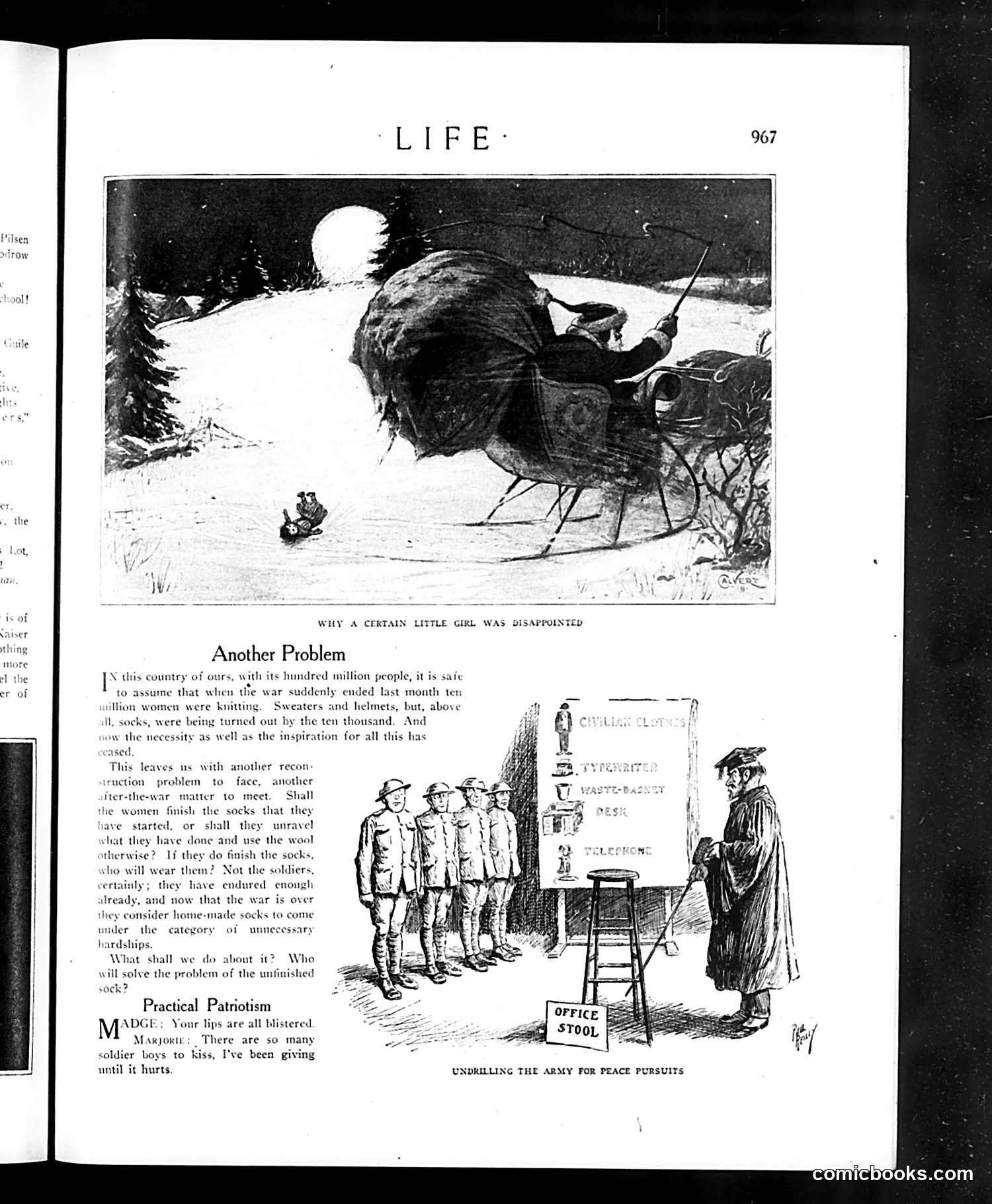
**Top Cartoon:** "Why a Certain Little Girl Was Disappointed" depicts a surreal scene where a large insect or mechanical creature appears to have replaced Santa Claus—suggesting post-war disillusionment with Christmas expectations. **Main Article:** "Another Problem" discusses post-WWI reconstruction challenges, specifically the fate of millions of knitted items (sweaters, helmets, socks) produced during wartime. The author questions what to do with these now-unneeded supplies—a practical concern about converting wartime production back to civilian use. **Bottom Cartoon:** "Ungrilling the Army for Peace Pursuits" shows soldiers being "ungrilled" (interrogated/processed) at an office, satirizing the bureaucratic challenges of demobilizing the military and transitioning soldiers to civilian employment and peacetime life after World War I.
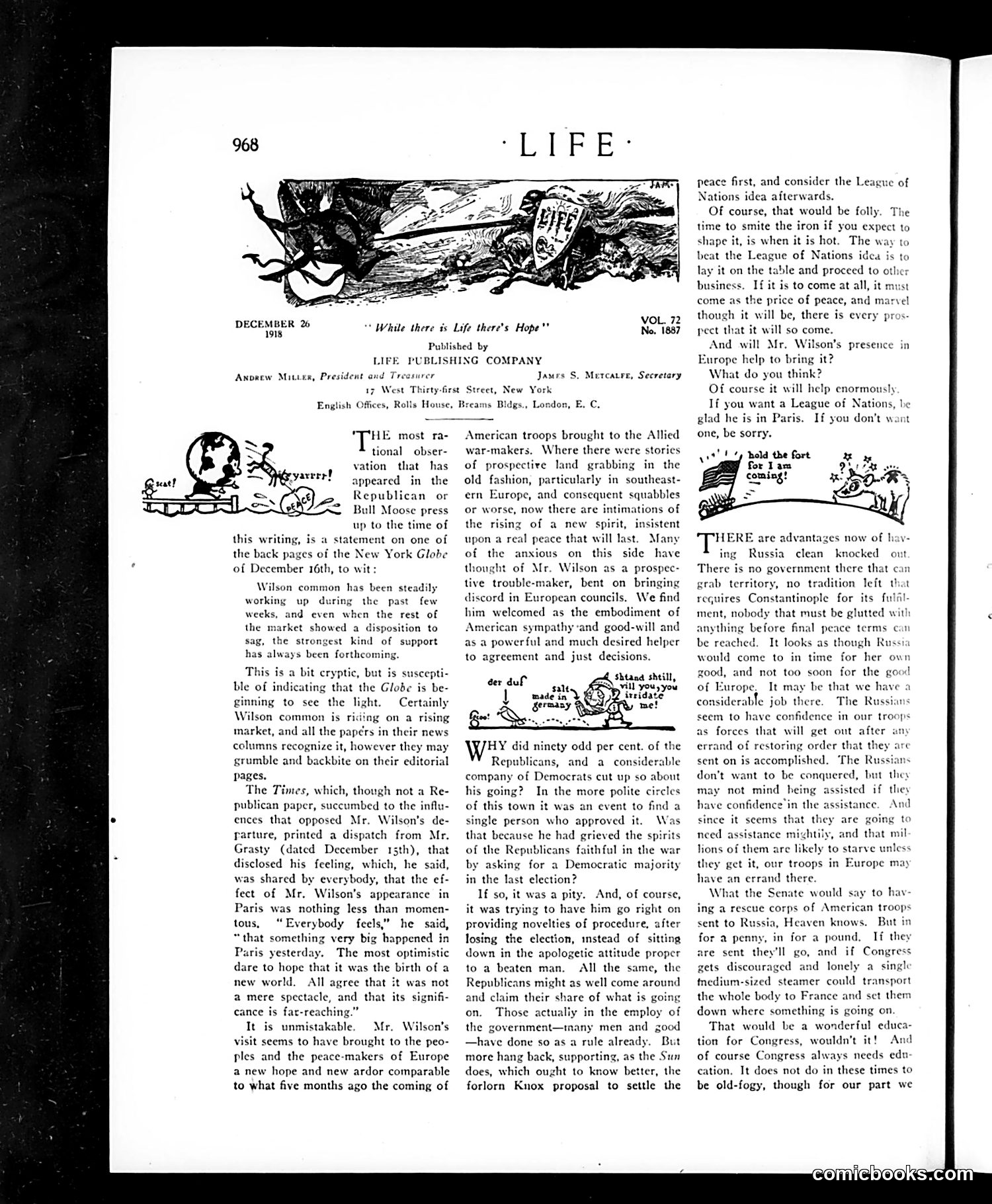
This page celebrates President Wilson's recent arrival in Paris for peace negotiations following World War I's armistice. The small cartoon at top-left appears to show Wilson as a figure of hope amid the wreckage of war. The article praises Wilson's transformative effect on European leaders and the public, noting his arrival has inspired optimism about achieving a genuine, lasting peace rather than old-fashioned territorial grabbing. The satire targets Republican opposition to Wilson's diplomatic mission. The piece mocks Republicans' hypocrisy—they opposed his trip despite most Americans supporting him—and ridicules the Republican proposal to settle peace terms *before* considering Wilson's League of Nations idea. The author argues this cart-before-horse approach is foolish; the League should be part of the peace settlement itself. The headline "While there is Life there's Hope" puns on the magazine's name, suggesting Wilson represents America's best hope for reshaping post-war Europe according to democratic ideals rather than imperial interests.
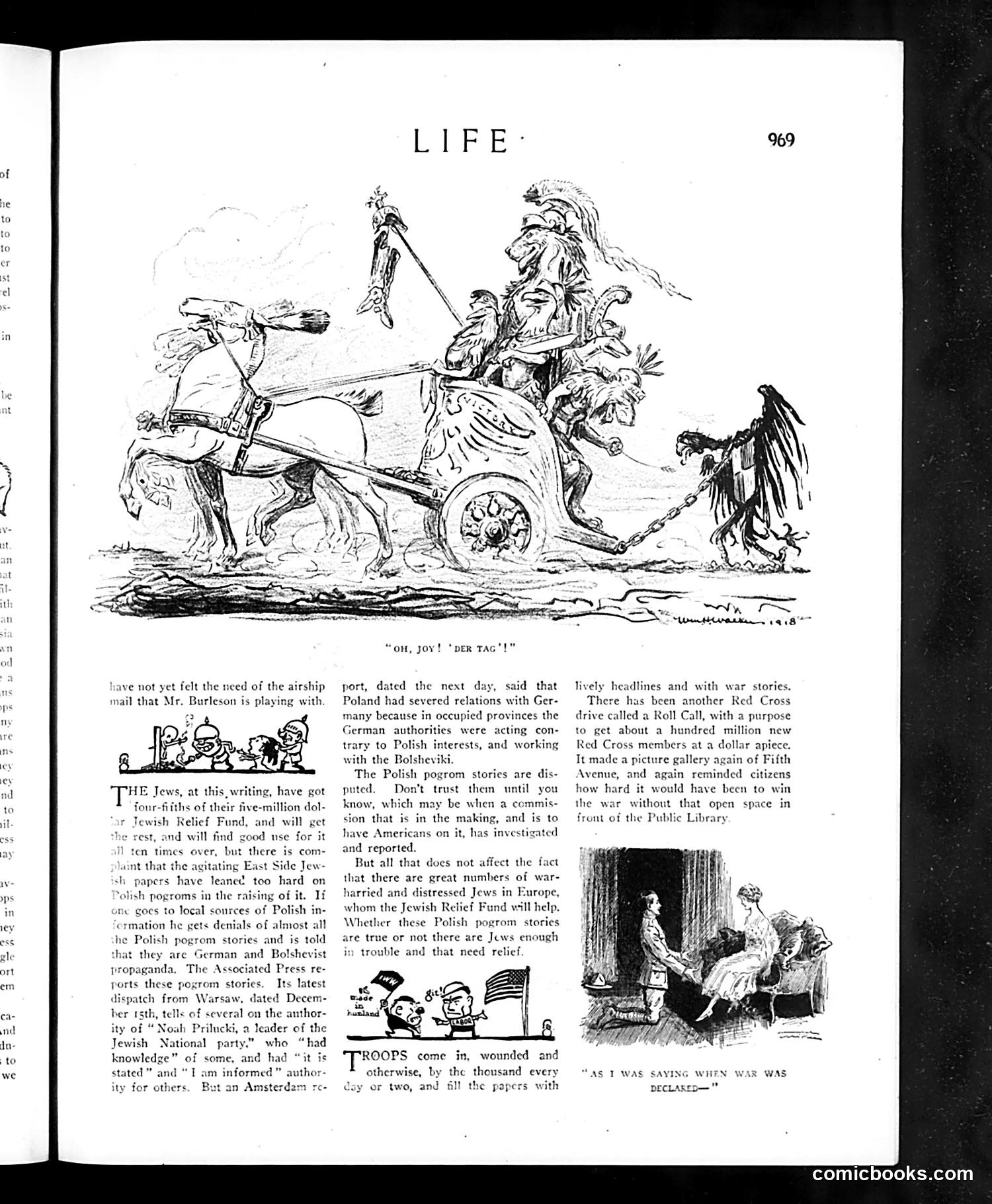
The top cartoon depicts a chaotic scene labeled "Oh, Joy! 'Der Tag'!" ("The Day!"—German for the anticipated German victory). A grotesque figure representing Germany rides in a cart pulled by dogs, accompanied by demonic figures holding weapons and a scythe, while an eagle (likely representing the Kaiser or Prussian militarism) trails behind on a chain. This is anti-German wartime propaganda satirizing German imperial ambitions. The text below discusses the Jewish Relief Fund, which had raised most of its five-million-dollar goal to aid war victims. The article notes controversy: East Side Jewish newspapers emphasized Polish pogroms (violent attacks on Jews) to solicit donations, but Polish sources denied these atrocities, attributing them to German and Bolshevik propaganda. Life urges caution about unverified reports pending an investigation. The page also mentions the Red Cross "Roll Call" campaign seeking one hundred million new members at one dollar each, using Fifth Avenue as promotional backdrop. The overall theme addresses charitable fundraising and wartime propaganda credibility during the post-WWI period.
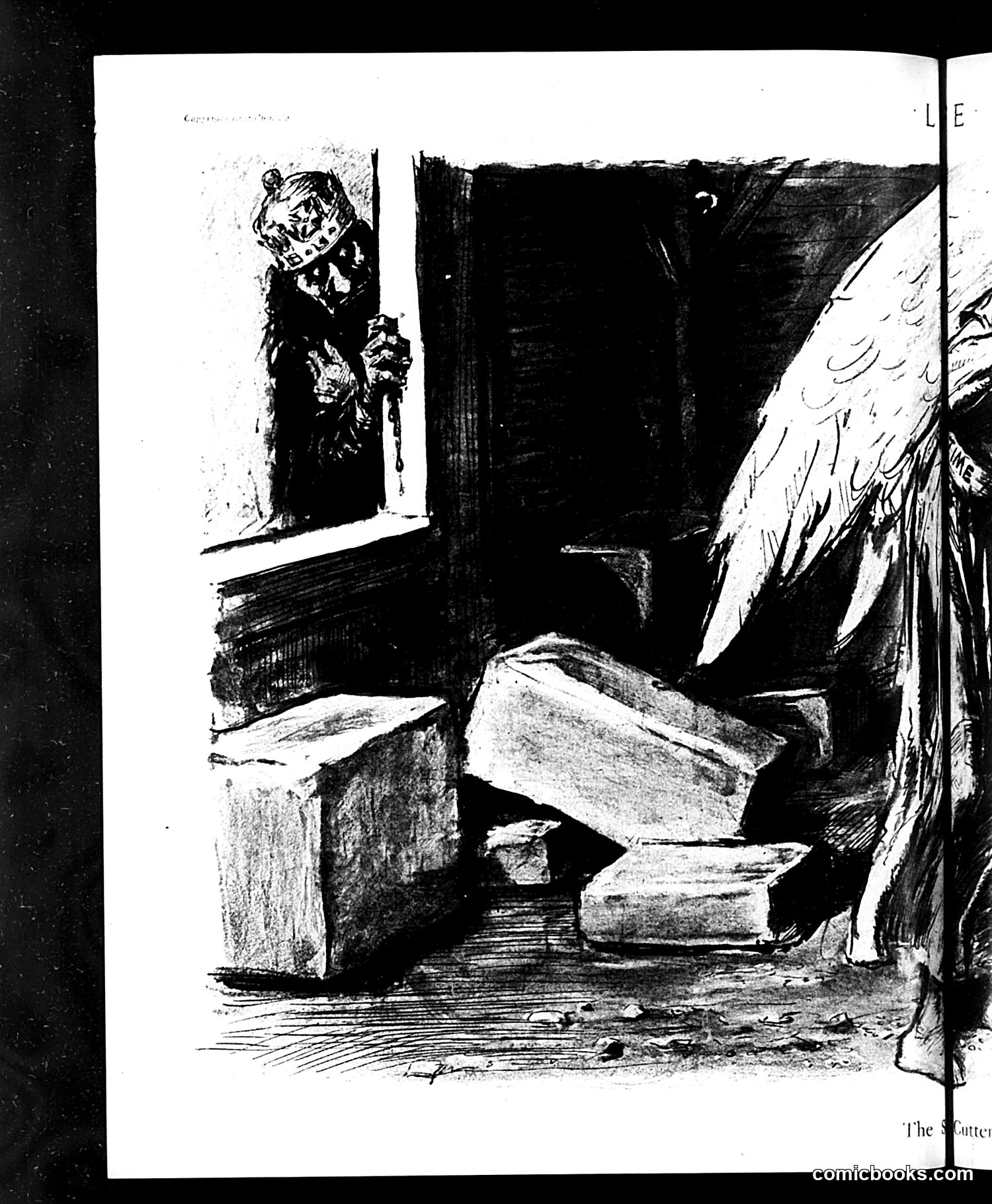
This appears to be an illustration titled "The Potter" (visible at bottom). The image depicts a dramatic scene: a figure with large wings (suggesting an angel or supernatural being) leans over a potter's wheel or workspace, observing a kneeling craftsman at work. Through a window or opening in the background, a hooded figure peers in. The symbolism suggests a spiritual or allegorical commentary—possibly about divine inspiration guiding human craft, or the relationship between creator and creation. The hooded observer adds an ominous or mysterious element, though without additional context or caption text, the specific satirical or political meaning remains unclear. The style is consistent with early 20th-century *Life* magazine's dramatic woodcut aesthetic.
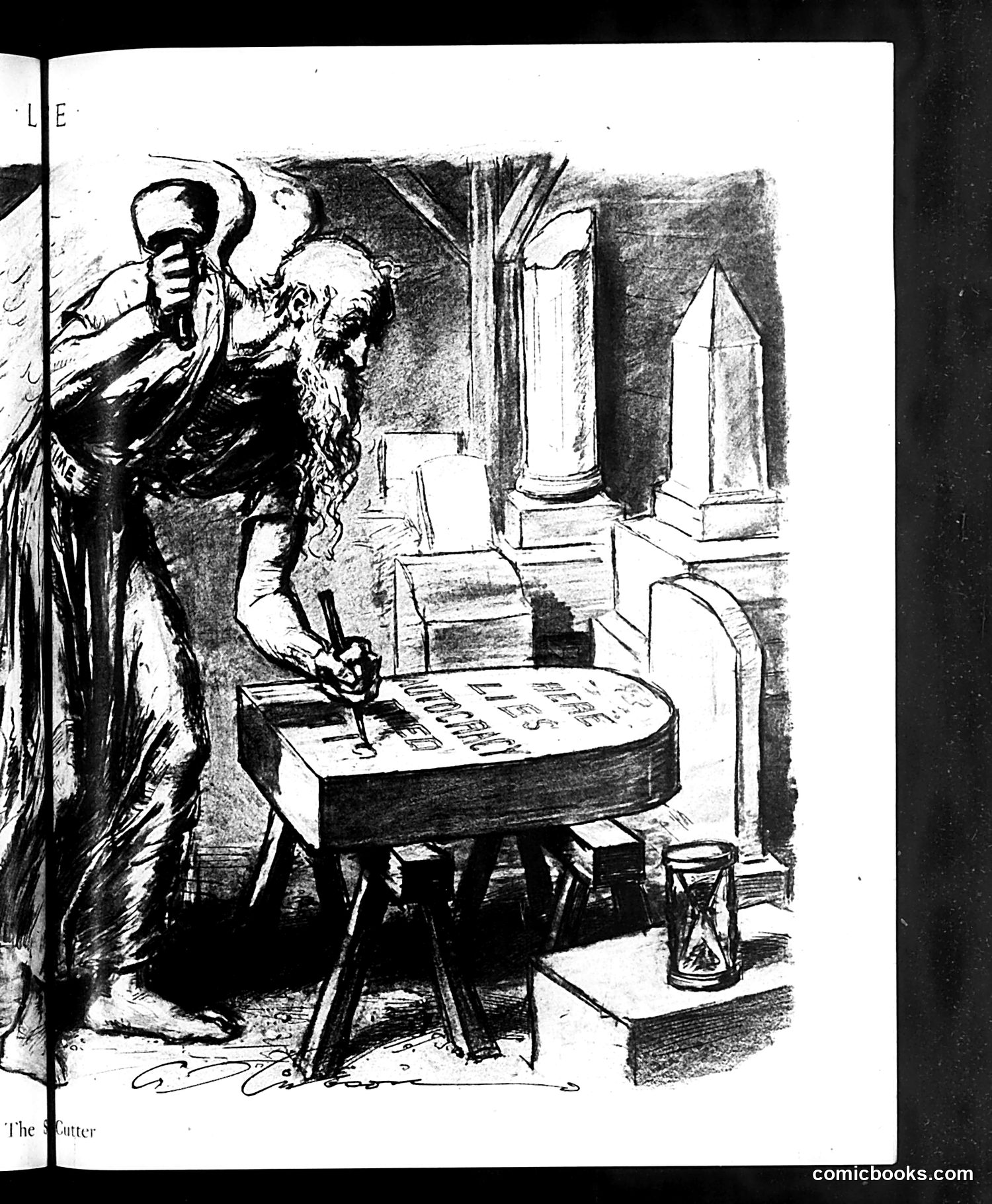
This cartoon depicts an elderly bearded man (likely a historical or allegorical figure) at a desk examining or cutting what appears to be a map or document. The setting suggests an official or governmental space, with formal architectural elements visible in the background. The title "The Cutter" suggests the figure is making divisions or alterations to territory or policy. Without clearer OCR text or publication date, the specific political reference remains unclear—it could reference territorial disputes, boundary adjustments, or administrative reorganization from the era when Life magazine was active as a satirical publication. The sketch style and formal dress suggest this critiques a political or governmental figure's actions, though the exact target requires additional context about Life's publication date.
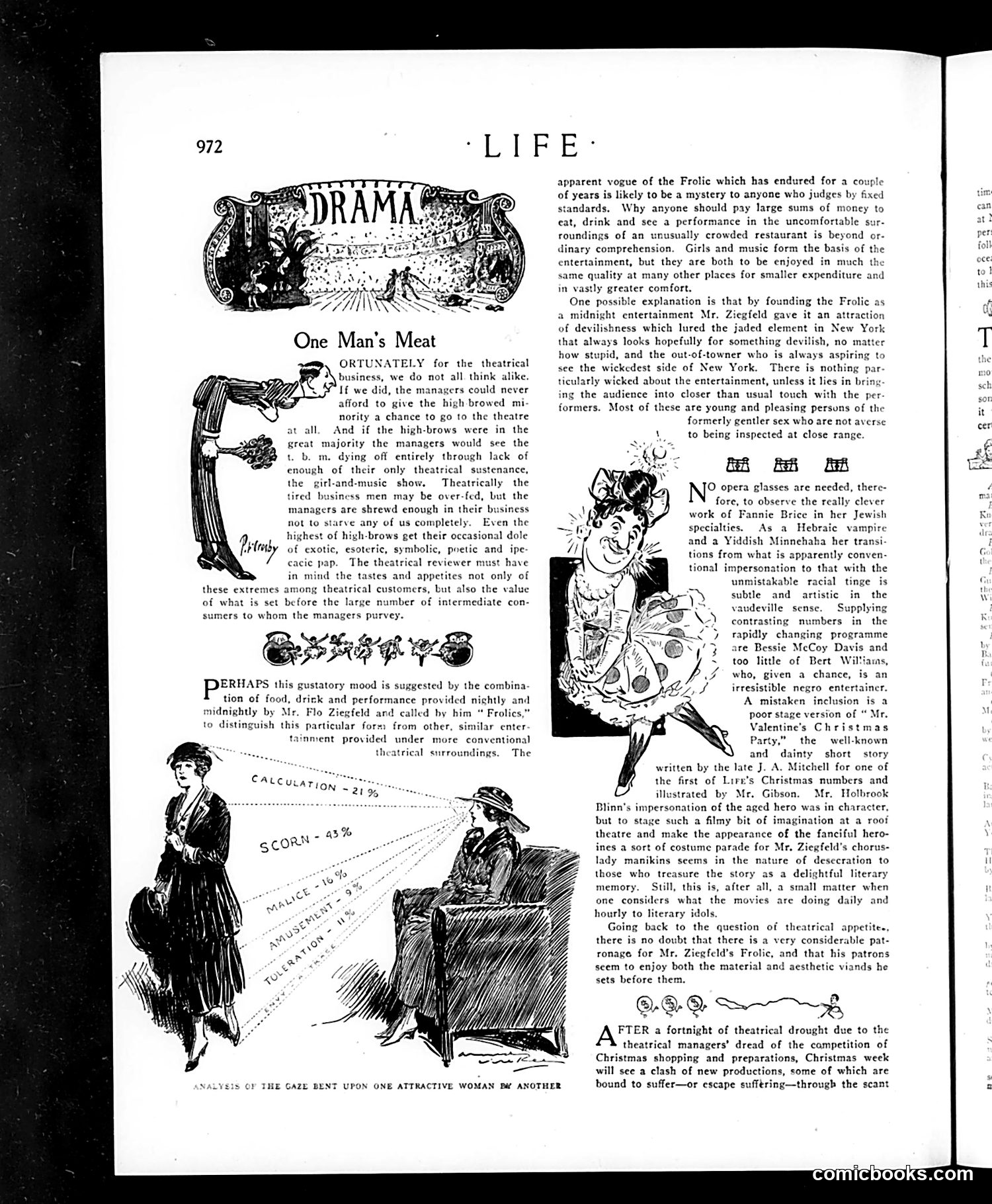
This page critiques Florenz Ziegfeld's "Frolic"—an expensive, late-night cabaret show featuring food, drink, and entertainment. The author questions why wealthy New Yorkers pay premium prices for mediocre performances in cramped restaurant settings when superior entertainment exists elsewhere in greater comfort. The cartoon "Analysis of the Gaze Bent Upon One Attractive Woman by Another" satirizes the Frolic's actual appeal: it attracts jaded socialites and tourists seeking "devilish" thrills through close proximity to performers—primarily young women. The diagram maps their gazes between figures, suggesting the entertainment's real draw is voyeuristic rather than artistic. The review acknowledges genuine talent (Fannie Brice's Jewish specialties, Bessie McCoy Davis), but criticizes a theatrical adaptation of J.A. Mitchell's literary Christmas story as sacrilege—reducing delicate fiction to a costume parade for chorus girls. The satire exposes the Frolic as theatrical exploitation dressed in sophistication.
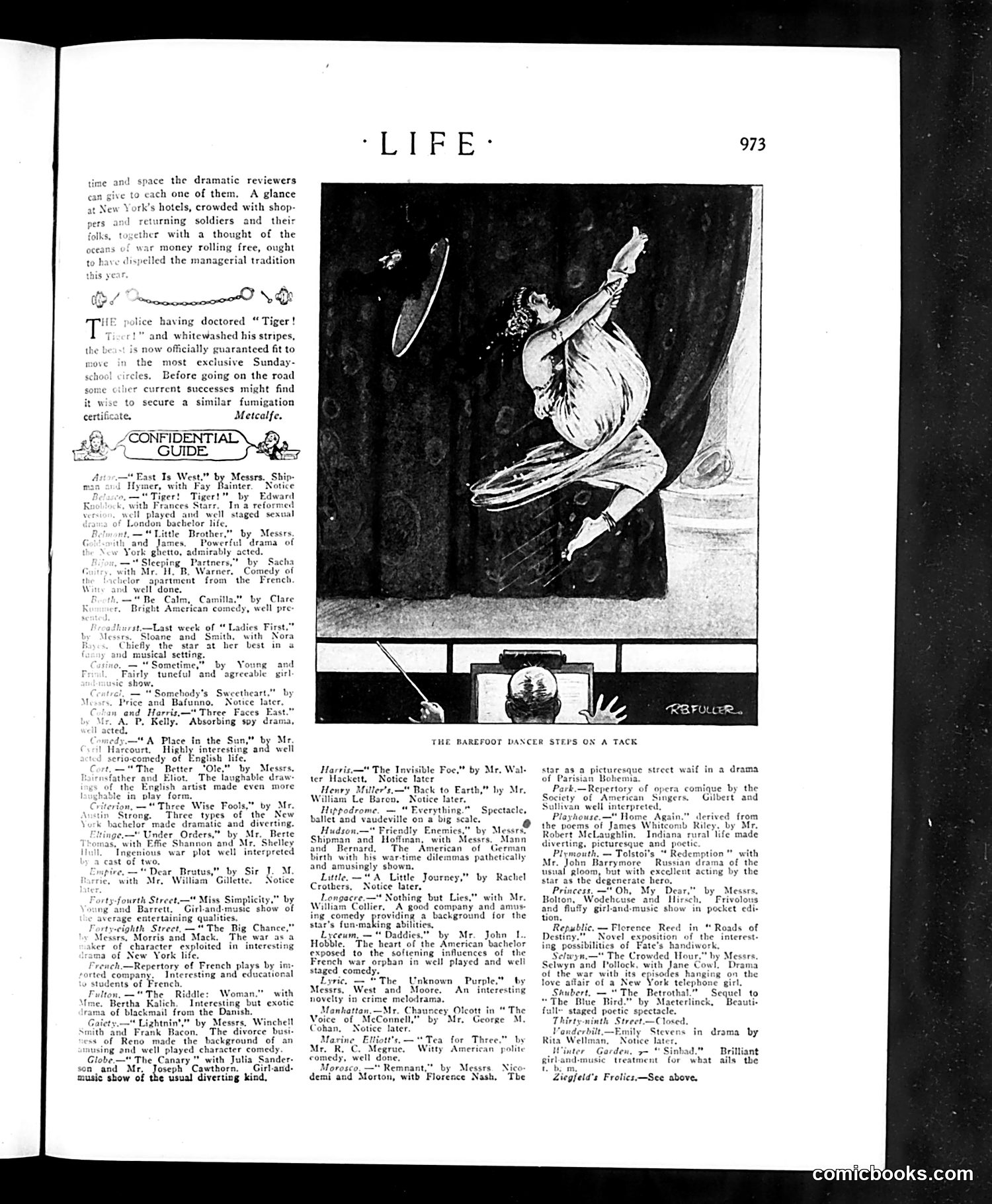
This cartoon satirizes theatrical censorship and morality campaigns of the era. The image shows a dancer in an exuberant pose, appearing to have stepped on a tack—a visual pun on constraint and pain. The accompanying text references police having "doctored 'Tiger! Tiger!'" (likely a risqué theatrical production) by "whitewashing his stripes" to make it acceptable for "exclusive Sunday-school circles." The reviewer suggests other Broadway shows seeking similar moral approval should obtain "fumigation certificates." The satire targets the contradiction between theater's natural exuberance and the rigid censorship demands of religious/moral authorities. The barefoot dancer—vulnerable and uninhibited—represents artistic freedom being literally pricked by prudish restrictions. The cartoon mocks how authorities tried to sanitize entertainment to appease conservative audiences, suggesting the process was both ridiculous and damaging to genuine artistic expression.
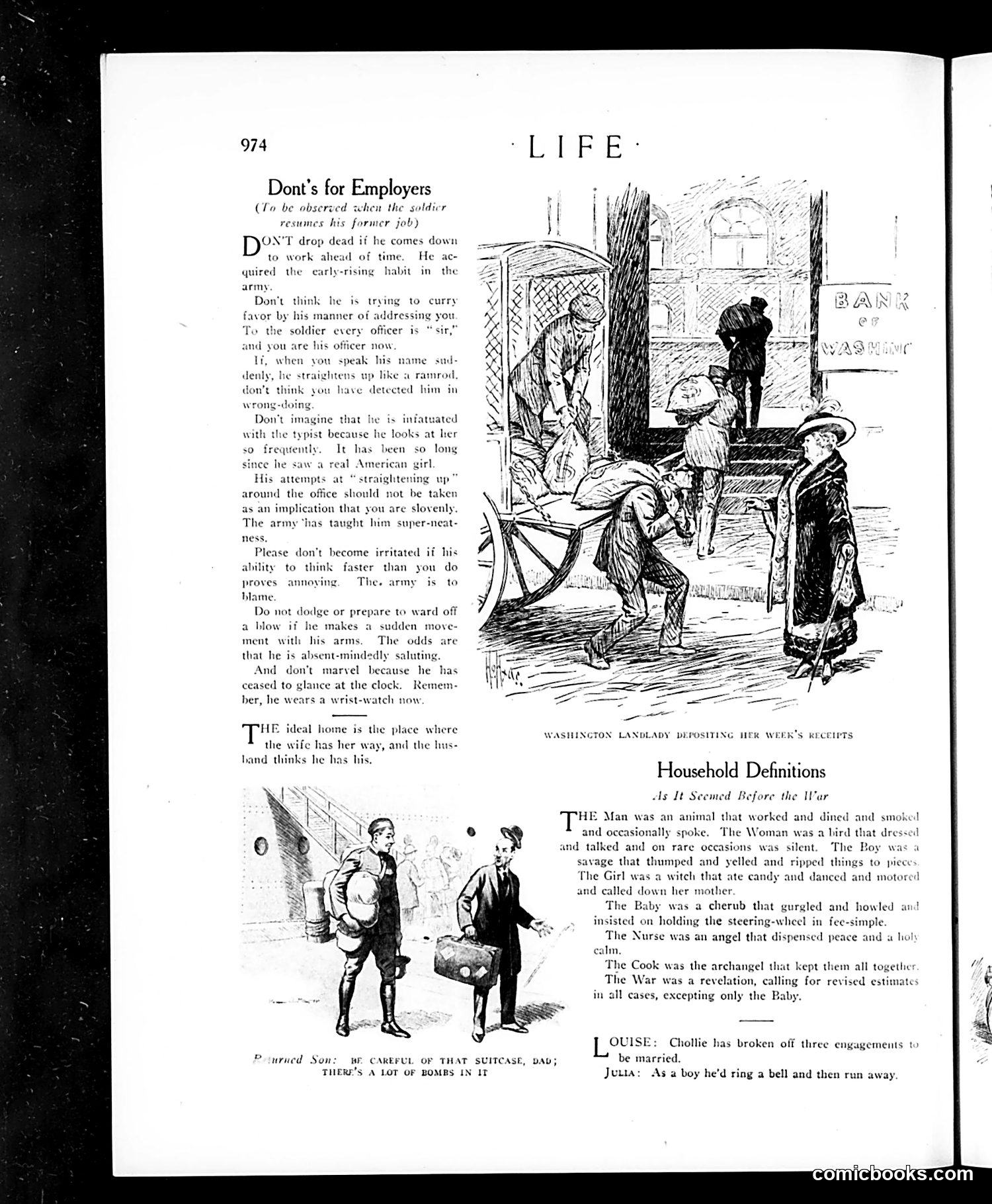
This page contains post-WWI humor addressing soldiers returning to civilian jobs. The main article, "Don'ts for Employers," advises bosses to tolerate veterans' military habits—arriving early, standing rigidly, thinking quickly, absent-mindedly saluting, and wearing wristwatches. The satire gently mocks both employers' ignorance of soldier psychology and soldiers' difficulty readjusting. The illustrations show a soldier returning home and a father with a suitcase "full of bombs" (likely trench ordnance souvenirs—common for returning doughboys). "Household Definitions: As It Seemed Before the War" humorously redefines family members as animals/mythical creatures, then notes the war has changed everything—except babies remain unchanged, suggesting war's universal impact on society and gender roles. The brief dialogue jokes about a young man's multiple broken engagements, comparing his behavior to ringing doorbells and running away—youthful pranks.
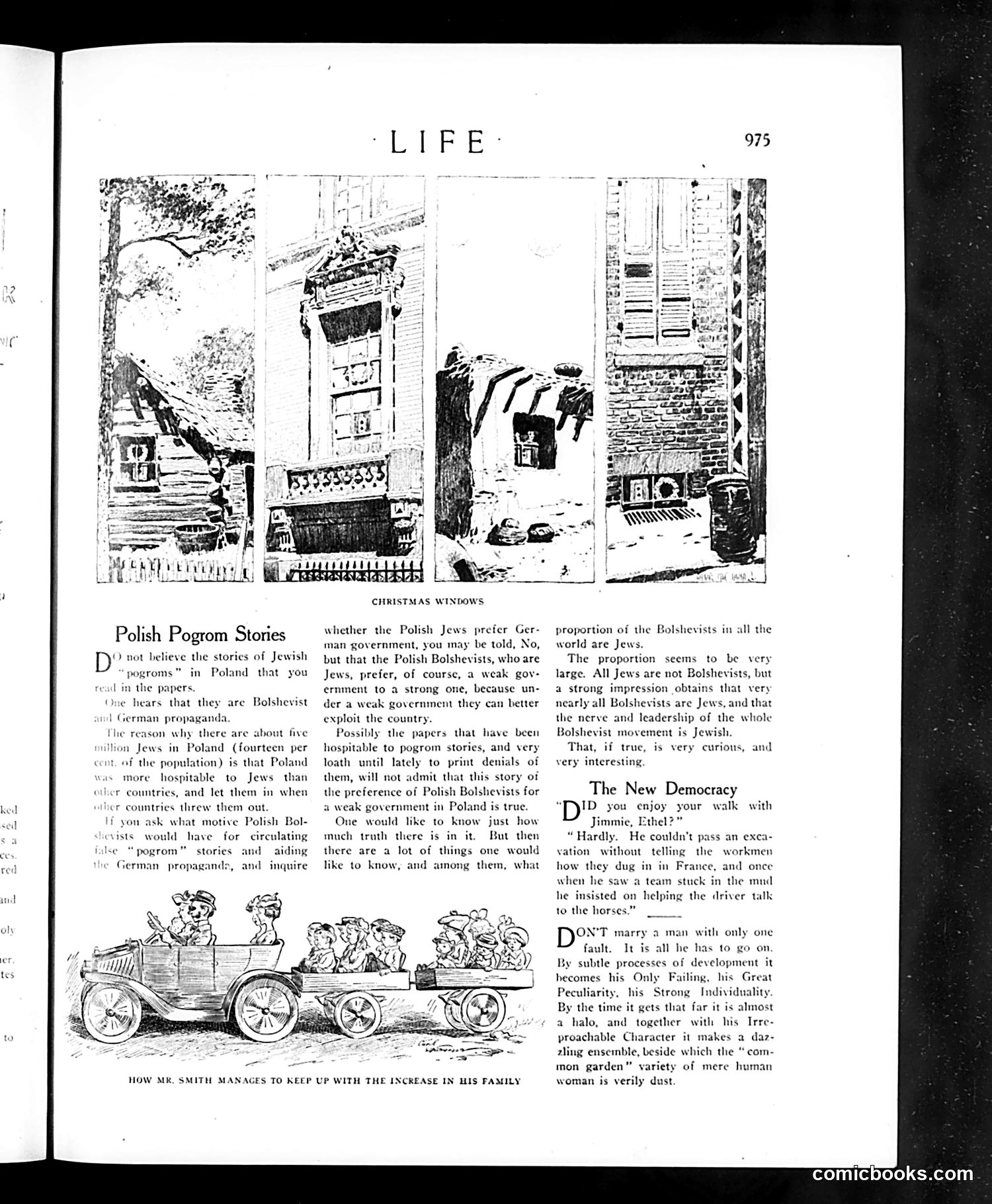
**"Polish Pogrom Stories"** presents a dismissive argument against reports of Jewish persecution in Poland. The text claims pogroms are "Bolshevist and German propaganda," arguing Poland has historically been hospitable to Jews. However, it then pivots to antisemitic conspiracy theory: suggesting Polish Bolshevists (identified as Jewish) deliberately weaken the government for exploitation, and asserting that Bolshevism's "nerve and leadership" is Jewish-controlled. **"How Mr. Smith Manages to Keep Up"** is a humorous cartoon about a man overwhelmed by his growing family (shown in an overloaded car), satirizing the challenges of supporting large households. **"The New Democracy"** is a light domestic humor piece about annoying personality quirks becoming endearing character traits over time. The page reveals *Life* magazine publishing mainstream antisemitic tropes during this period—conflating Judaism with Bolshevism and suggesting Jewish conspiracies—while simultaneously running lighter satirical content.
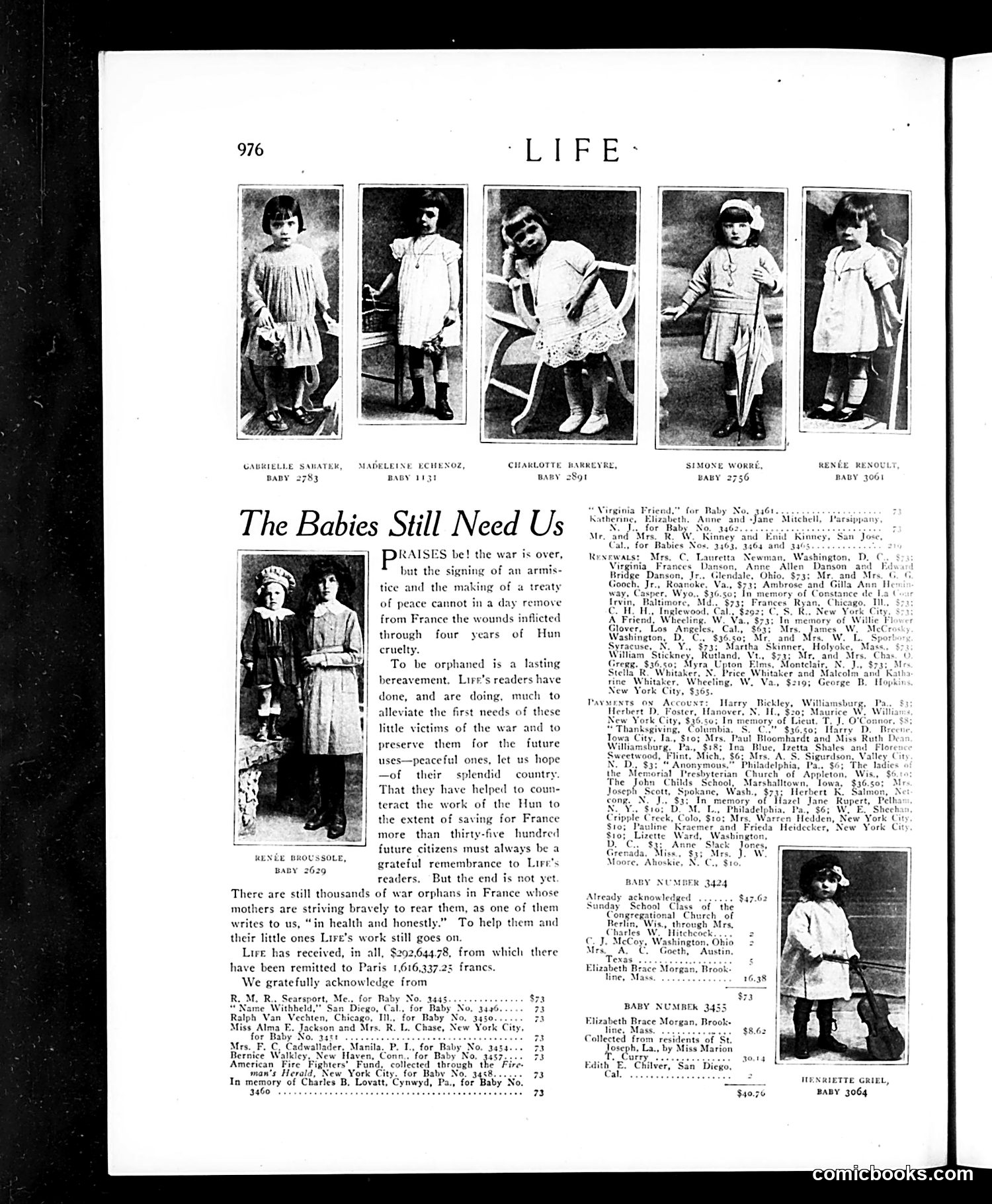
This page documents Life magazine's charitable campaign to support French war orphans following World War I's armistice. The five photographs at top show individual orphaned children sponsored through the program, each assigned a "baby number." The article "The Babies Still Need Us" argues that although the war has ended, France's orphans remain in desperate need. It appeals to readers' conscience: thousands of children have lost parents to "Hun cruelty" (German aggression), and their mothers struggle to raise them "in health and honestly." The bulk of the page lists donors and their contributions—individuals, organizations, and even fire departments collected funds. Specific donations appear itemized with recipient "baby numbers." This transparency demonstrates accountability to donors while celebrating their generosity. The implicit message: victory on the battlefield doesn't solve human suffering; wealthy Americans have a moral obligation to help rebuild Europe's future through charitable giving to innocent victims. The orphans represent both France's wounds and hope for peaceful reconstruction.
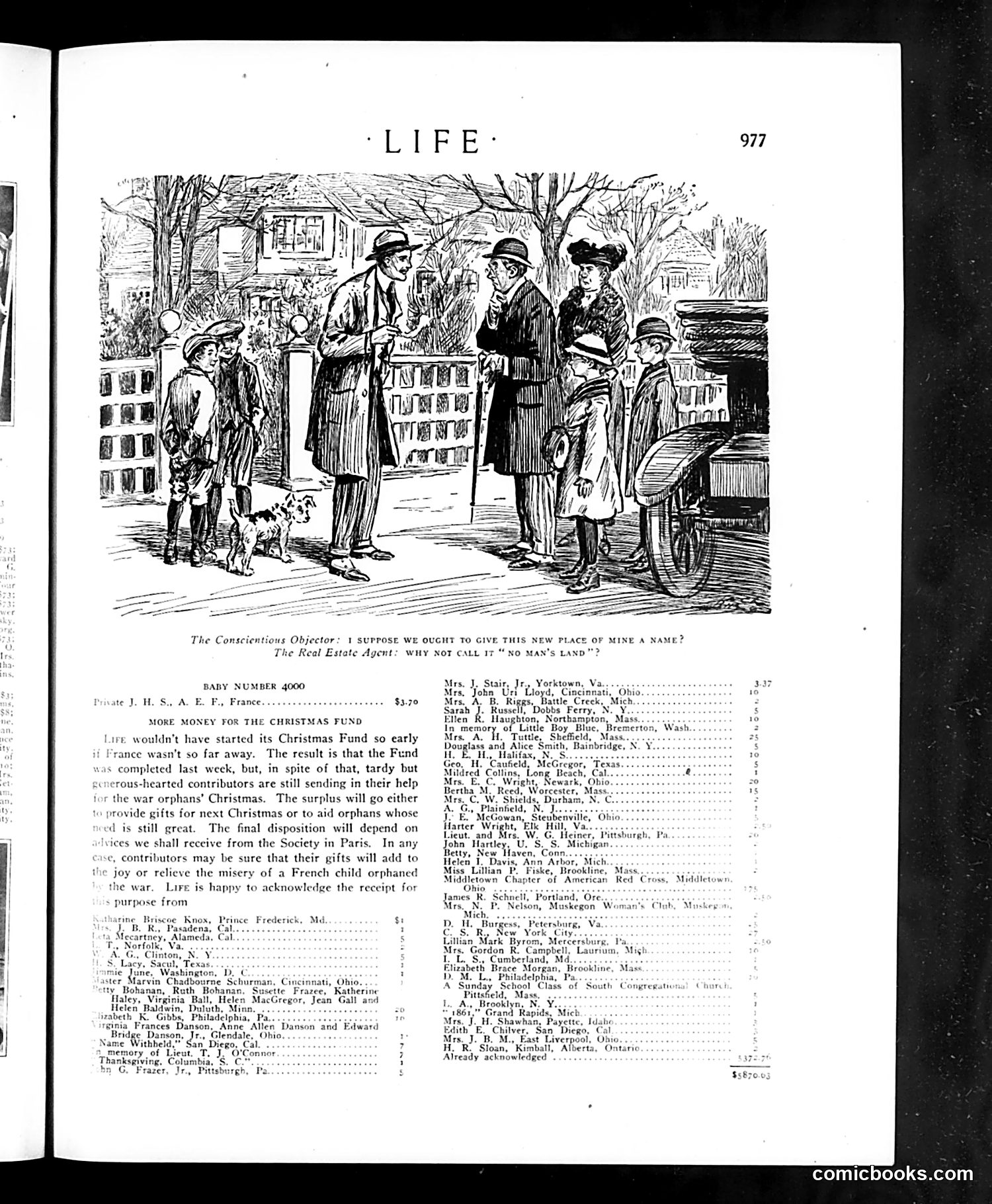
This page features a single-panel cartoon satirizing post-World War I real estate speculation. A "Conscientious Objector" (likely a wealthy businessman seeking to purchase property) asks a real estate agent for a name for his new piece of land. The agent sarcastically suggests calling it "No Man's Land"—a direct reference to the devastated, corpse-filled terrain between opposing trenches during WWI. The joke's bitter edge: the agent equates commercial real estate with the war's most horrific landscape, implying the objector's conscience about warfare doesn't extend to profiting from peace. The cartoon criticizes how quickly wartime trauma becomes forgotten in pursuit of financial gain. The page also includes Life's Christmas Fund donations list—money for French war orphans—contextualizing the cartoon's ironic contrast between charitable giving and callous commercialism.
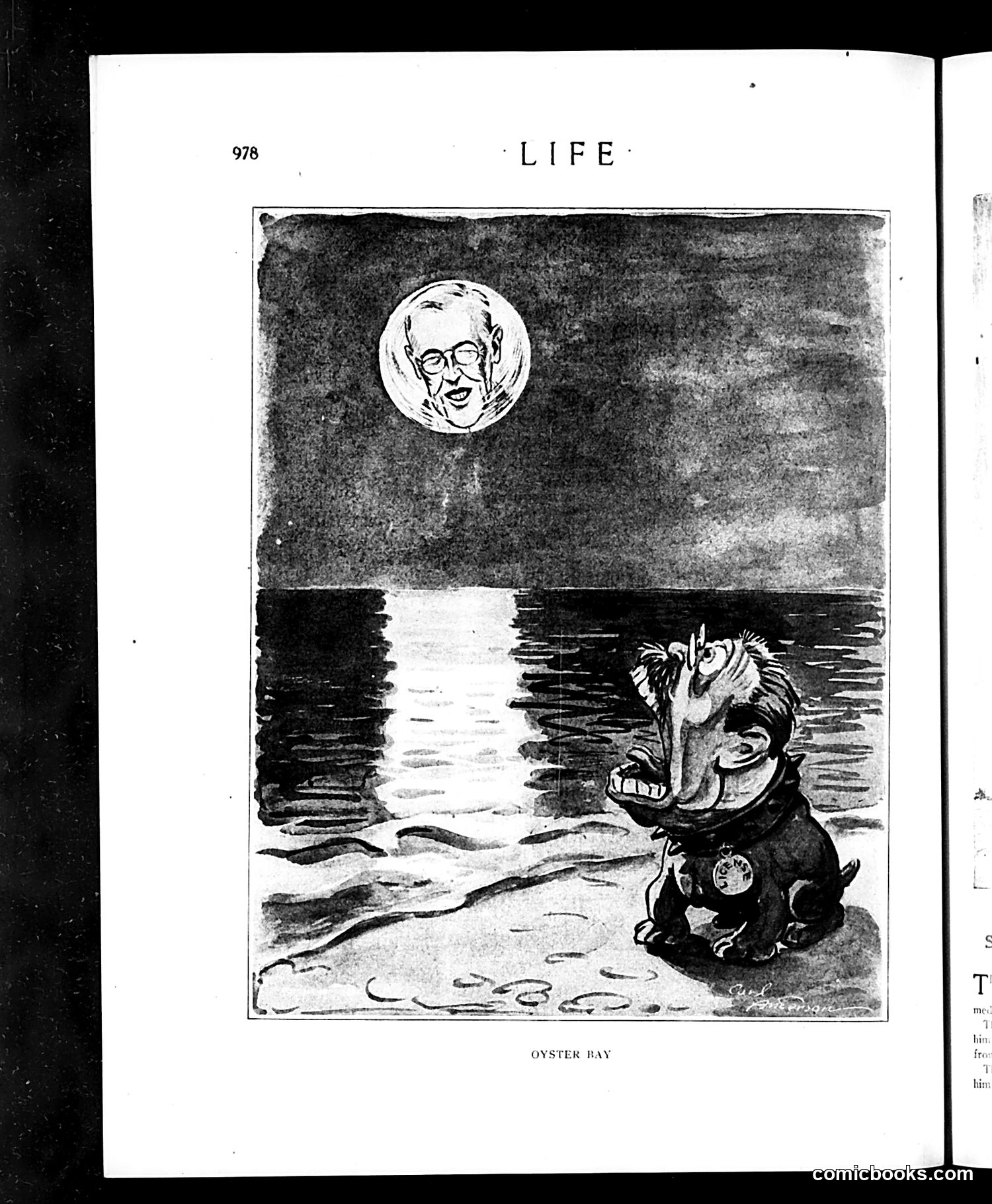
This satirical cartoon depicts a caricatured figure gazing upward at a moon-faced portrait of a bespectacled man. The title "Oyster Bay" references Theodore Roosevelt's Long Island estate, suggesting this concerns Roosevelt himself. The exaggerated caricature in the lower portion—with prominent teeth and animated expression—appears to mock a political figure's zealous devotion or ambition. The moon-lit seascape setting and the worshipful pose suggest satirizing either Roosevelt's political influence or his followers' admiration. Without additional context from the magazine's date and surrounding articles, the precise satirical point remains unclear, but the cartoon clearly mocks either Roosevelt's ego or his supporters' reverence toward him during the Progressive Era.
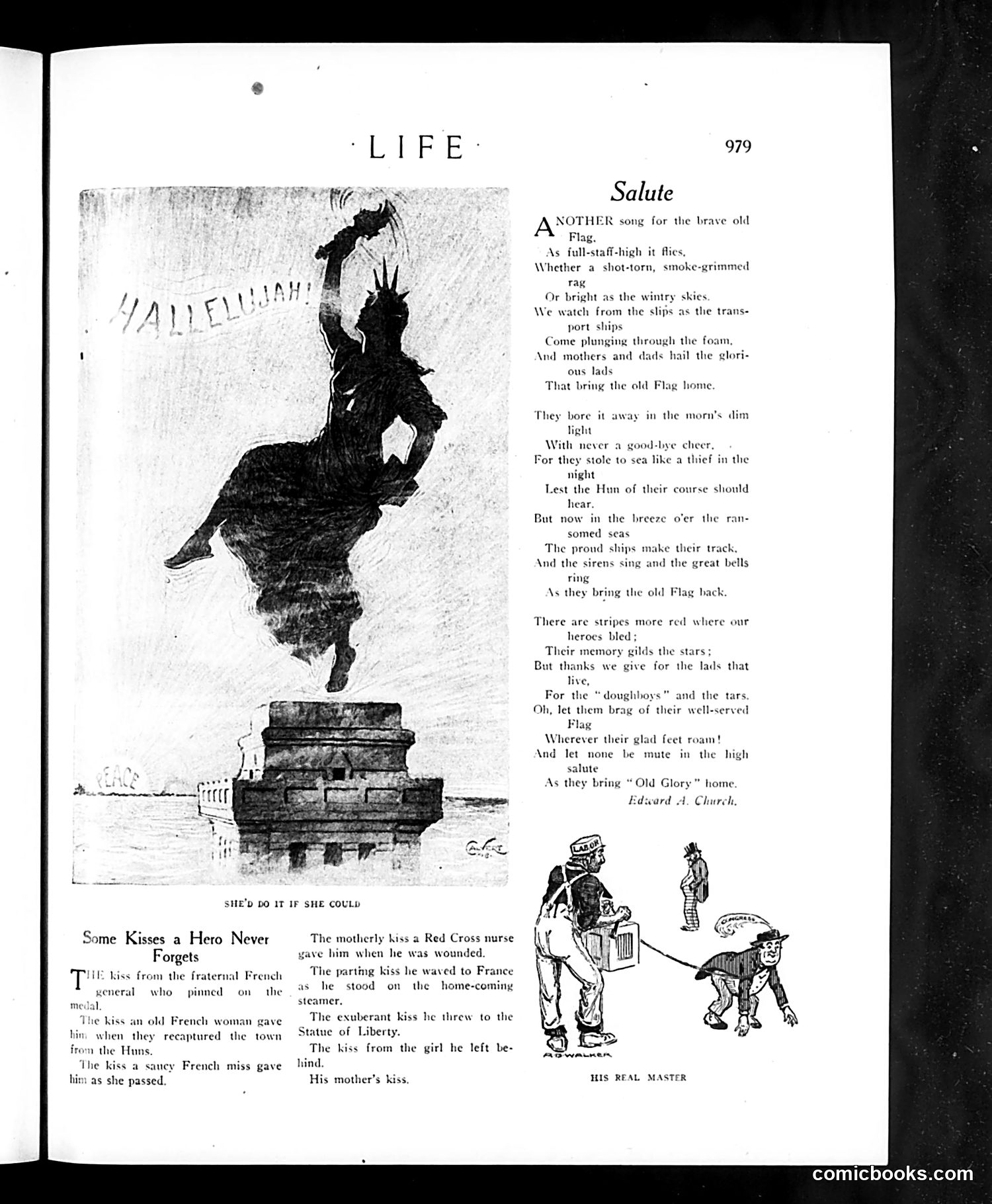
This page celebrates American soldiers returning from World War I. The large illustration "She'd Do It If She Could" depicts the Statue of Liberty reaching toward incoming transport ships—personifying America's emotional welcome of returning troops. The statue's straining posture suggests she wants to embrace the soldiers but cannot physically reach them. The accompanying text lists kisses a soldier received during his service: from French generals and civilians, a Red Cross nurse, the Statue of Liberty, and his mother. These represent the various expressions of gratitude and affection soldiers experienced abroad and anticipate upon homecoming. The poem "Salute" by Edward A. Church celebrates the American flag returning with victorious troops, emphasizing sacrifice ("stripes more red where our heroes bled") and national pride in the "doughboys" and sailors. The small cartoon "His Real Master" (bottom right) appears unrelated—likely a separate satirical commentary on something contemporary to 1918-1919, though the specific reference is unclear from this image alone.
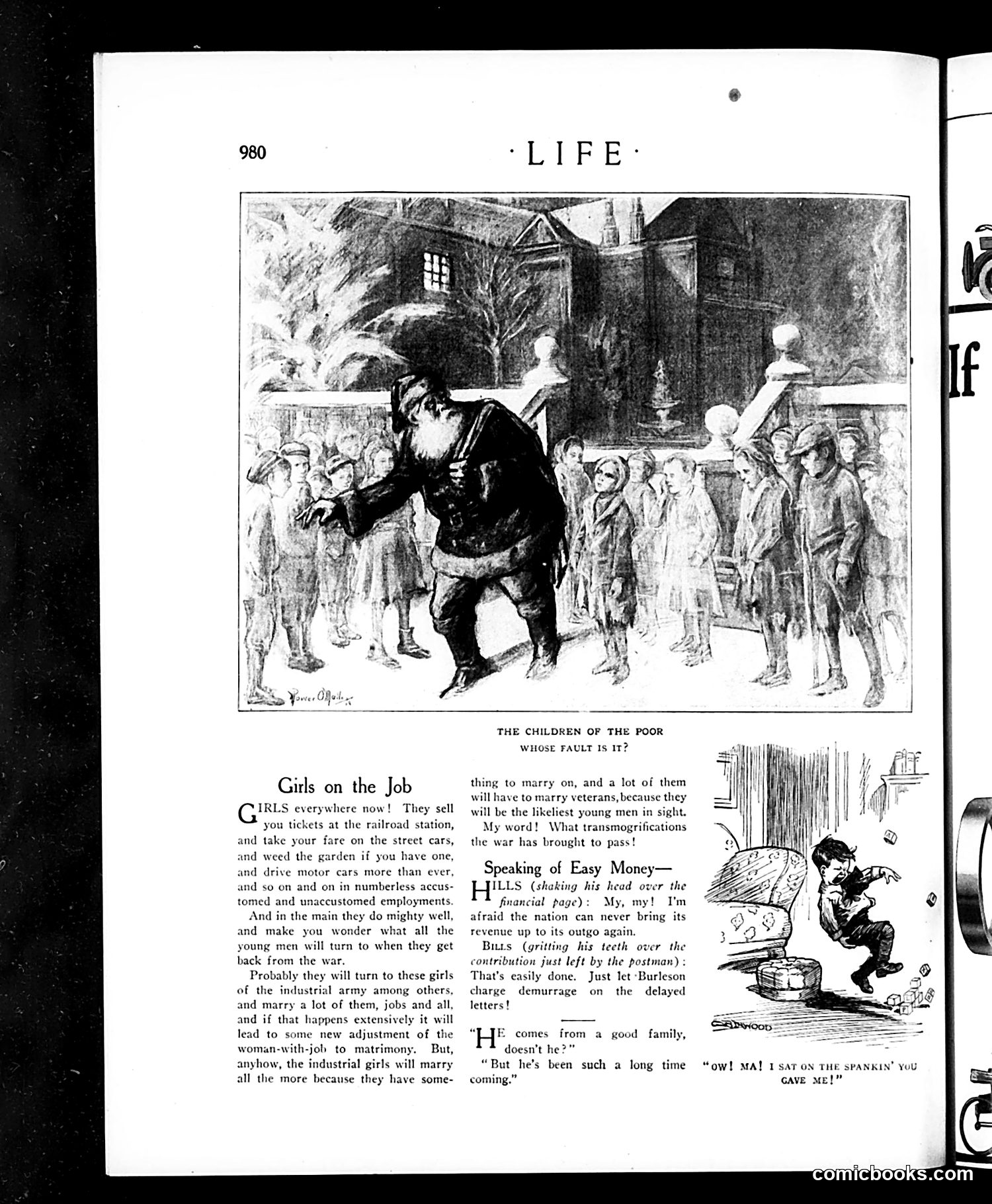
This page from Life magazine (appearing to be post-WWI, given references to "the war") satirizes social changes caused by wartime labor shortages. **"Girls on the Job"** celebrates women entering the workforce—selling railroad tickets, operating streetcars, driving cars—in unprecedented numbers during the war. The text humorously speculates that when soldiers return, they'll marry these working women, creating a new social adjustment where women combine jobs with matrimony. **"Speaking of Easy Money"** is political satire about government finances. "Hits" despairs that national revenue can't match spending. "Burs" quips darkly that Postmaster General Albert Burleson could solve this by charging demurrage (storage fees) on delayed mail—a jab at postal service incompetence. **The bottom cartoon** plays on delayed letters from soldiers, with a child saying Burleson's spanking (metaphorically, the postmaster) caused mail delays. The cartoons reflect anxieties about rapid social change and criticism of wartime government administration.
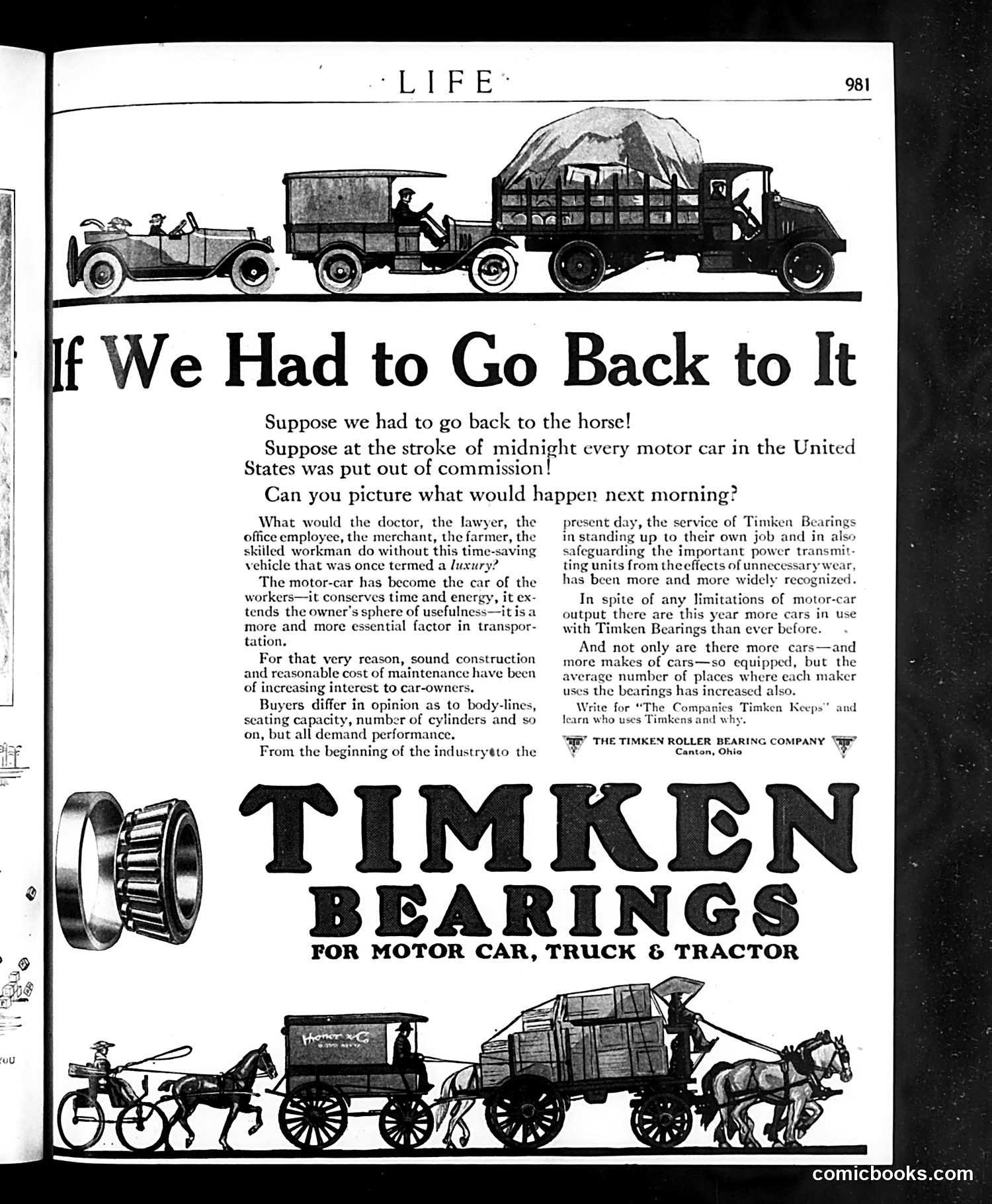
This is primarily a **Timken Bearings advertisement** disguised as social commentary. The satirical premise asks readers to imagine all motor cars suddenly disabled, forcing society back to horse-drawn transportation. The advertisement argues that automobiles have become **essential to modern life**—not luxuries—for doctors, lawyers, farmers, and workers. It emphasizes that reliable car components (specifically Timken ball bearings) matter because society now depends on motor vehicles. The visual comparison at top and bottom reinforces this: modern motorized vehicles versus horse-drawn wagons, suggesting regression would be catastrophic. **The satire's point**: By 1920s standards, this was relatively subtle advertising that flatters readers' dependence on automobiles while promoting a specific mechanical component as essential to that modern lifestyle. It transforms a product endorsement into a "what if?" thought experiment about progress and necessity. The ad assumes readers will find the prospect of returning to horses absurd—reflecting genuine automotive cultural dominance by this era.
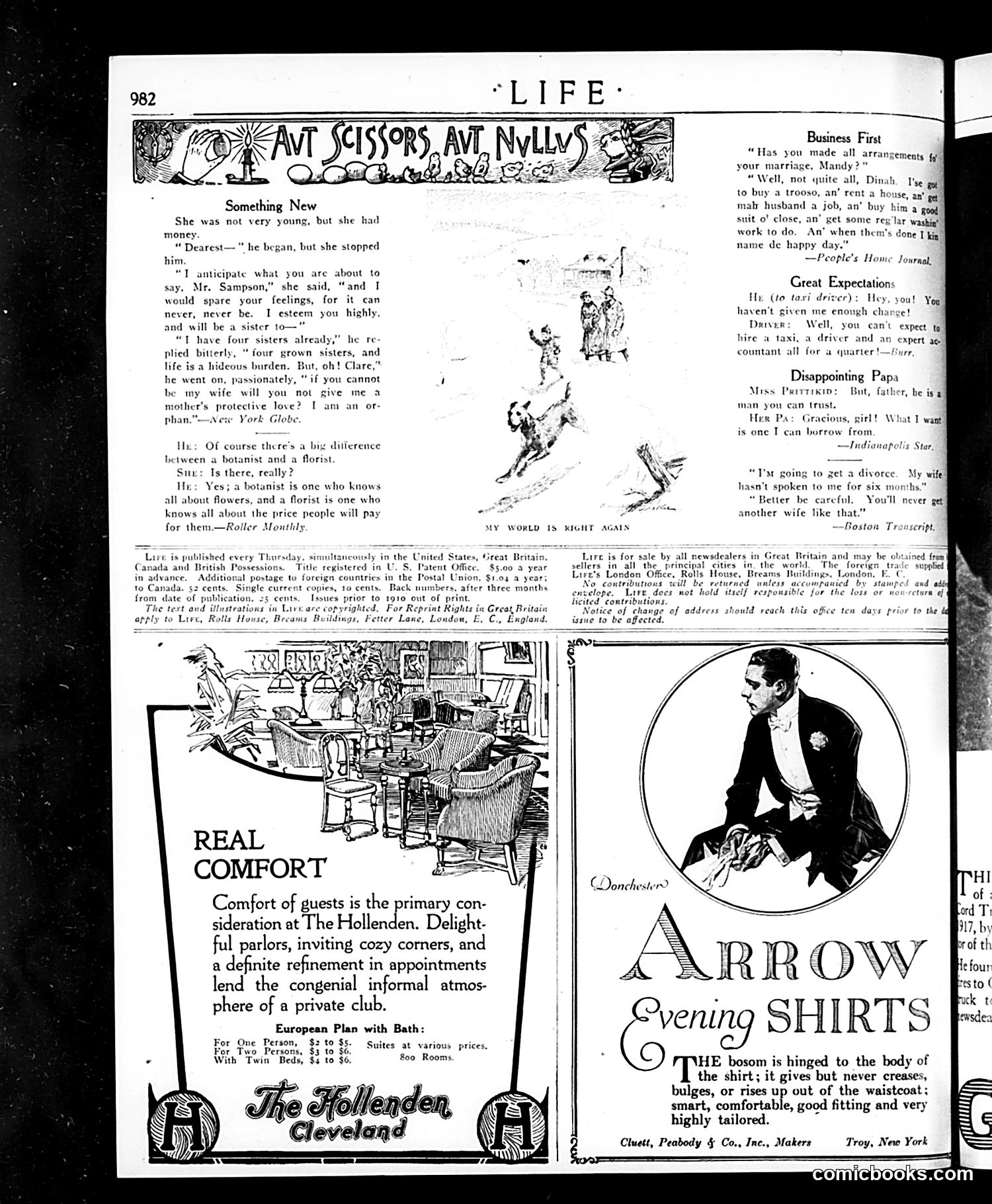
This page from *Life* magazine features several brief humorous anecdotes typical of early 20th-century American satire: **"Something New"** mocks romantic rejection—a poor man (Mr. Sampson) proposes to a wealthy woman, who deflects by offering "sisterly" affection. His bitter reply that he already has four sisters satirizes the awkwardness of class-based courtship and insincere consolation. **The botanist/florist joke** contrasts scientific knowledge with commercial greed—a florist exploits customers' willingness to overpay for flowers, suggesting mercenary motives beneath aesthetic pretense. Additional brief jokes address marital and domestic expectations common to the era. The page is primarily **advertising**—prominently featuring The Hollenden hotel (Cleveland), promoting comfort and refinement, and Arrow Evening Shirts, emphasizing the "hinged bosom" that won't wrinkle or bulge. These ads reflect aspirational middle-class values around respectability and appearance. The humor and advertising together target *Life's* educated, urban readership.
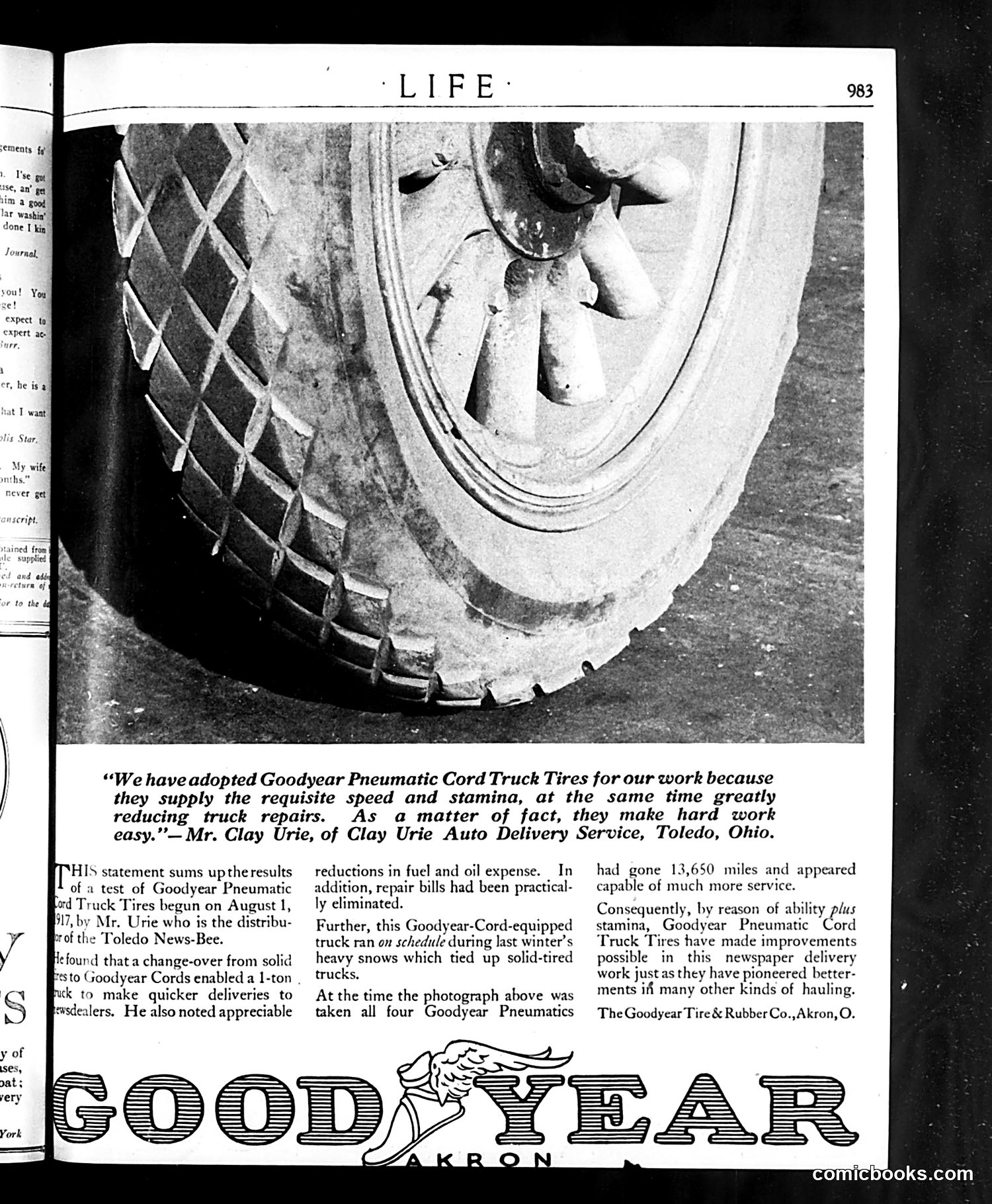
This is **not a cartoon or satire**, but a **product advertisement** disguised as editorial content—a common practice in early 20th-century magazines. The page features a testimonial from Clay Urie, owner of an auto delivery service in Toledo, Ohio, praising Goodyear Pneumatic Cord Truck Tires. The photograph shows a close-up of a truck tire with its tread pattern visible. The "news" angle is that Urie conducted a test switching from solid tires to pneumatic cords, allegedly experiencing faster deliveries, reduced fuel costs, eliminated repair bills, and reliable winter performance. By 1917 (the implied date), pneumatic tires were still relatively new technology for commercial trucks. **For modern readers:** This represents branded advertorial—marketing copy presented with quasi-journalistic authority and specific claims. The emphasis on measurable results (13,650 miles, cost savings) and a named "real customer" reflects early advertising strategy mimicking news reporting to build consumer trust.
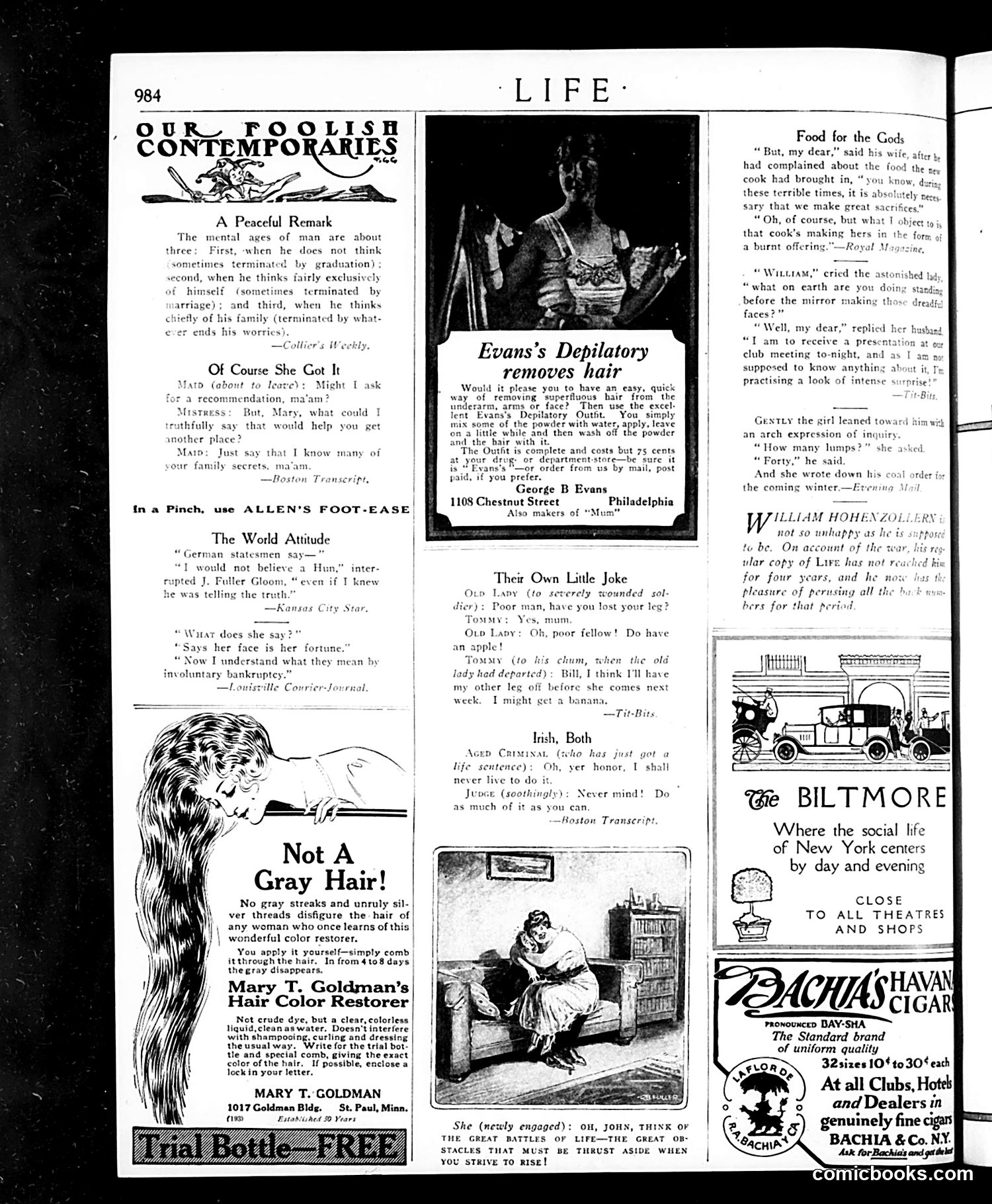
This page mixes humorous social commentary with period advertisements. The "Our Foolish Contemporaries" section collects brief jokes satirizing human behavior—particularly marital dynamics and vanity. One joke mocks a servant who threatens to reveal family secrets for a raise; another ridicules a woman whose "face is her fortune" yet faces bankruptcy. The central cartoon depicts a newly engaged couple. The woman lectures the man about life's "great obstacles," while the caption reveals she's actually thinking about overcoming obstacles to *self-improvement*—suggesting women's aspirations were reduced to personal vanity rather than genuine ambition. Surrounding advertisements for hair dye, depilatory cream, and hotel amenities reflect early 20th-century consumer culture targeting women's appearance anxieties. The satire implicitly critiques both female vanity and male condescension toward women's concerns.
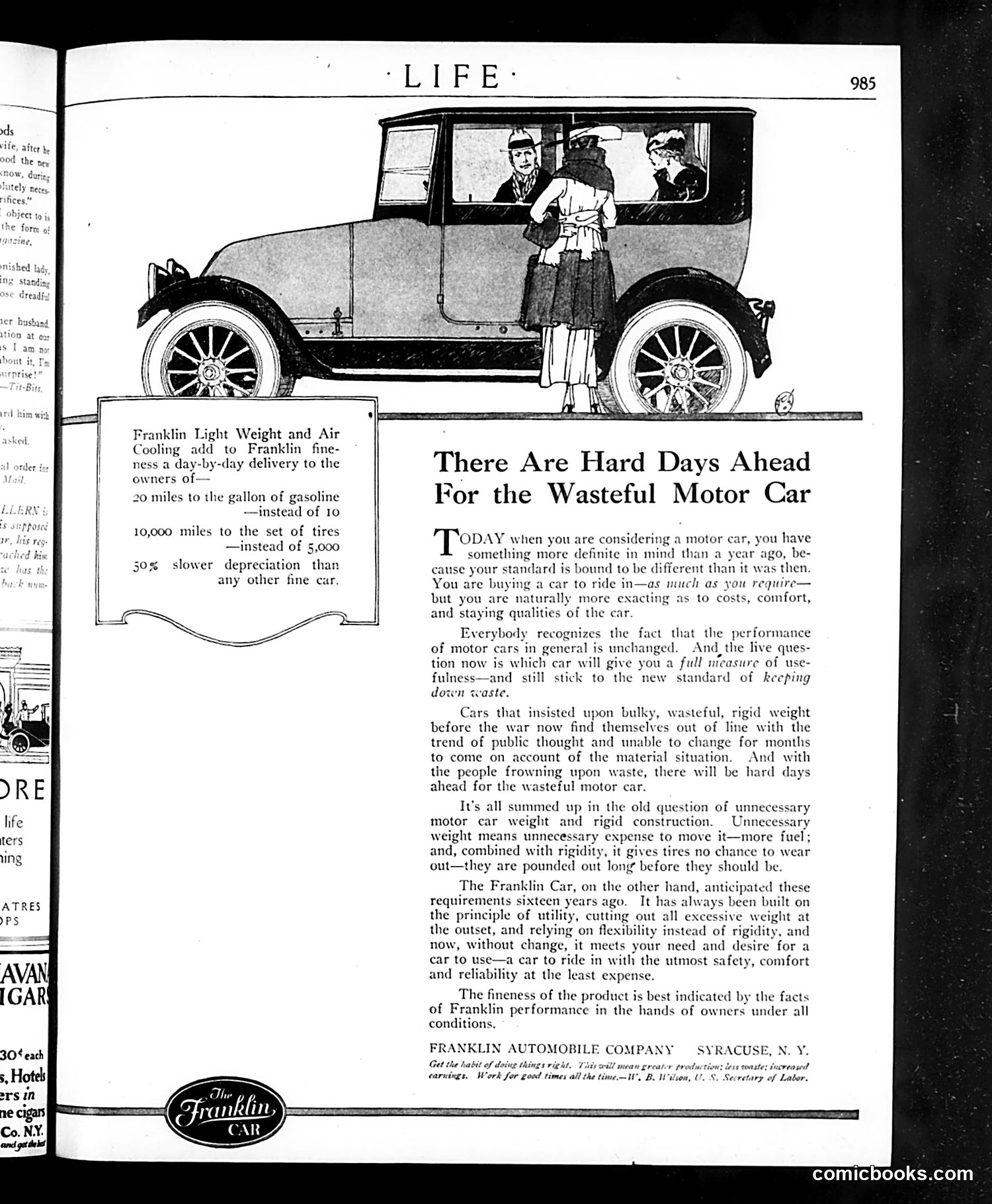
This is primarily a **Franklin automobile advertisement**, not satire. The page addresses post-World War I consumer attitudes about efficiency and waste. The headline "There Are Hard Days Ahead For the Wasteful Motor Car" references the economic shifts following WWI. The ad argues that prewar cars—designed with unnecessary weight and rigid construction—are now obsolete because the public has adopted new values around conservation and economy. Franklin positions itself as forward-thinking: it claims to have anticipated this shift "sixteen years ago" by prioritizing lightweight, flexible design over rigid bulk. The accompanying illustration shows a well-dressed woman and passengers in a Franklin automobile, suggesting reliability and refinement. The specific claims (20 miles per gallon, 10,000-mile tire life, slower depreciation) support Franklin's argument that their design philosophy aligns with emerging consumer demands for efficiency and reduced waste—positioning competitors' "wasteful" designs as outdated. This reflects genuine 1920s industrial discourse about standardization and efficiency.
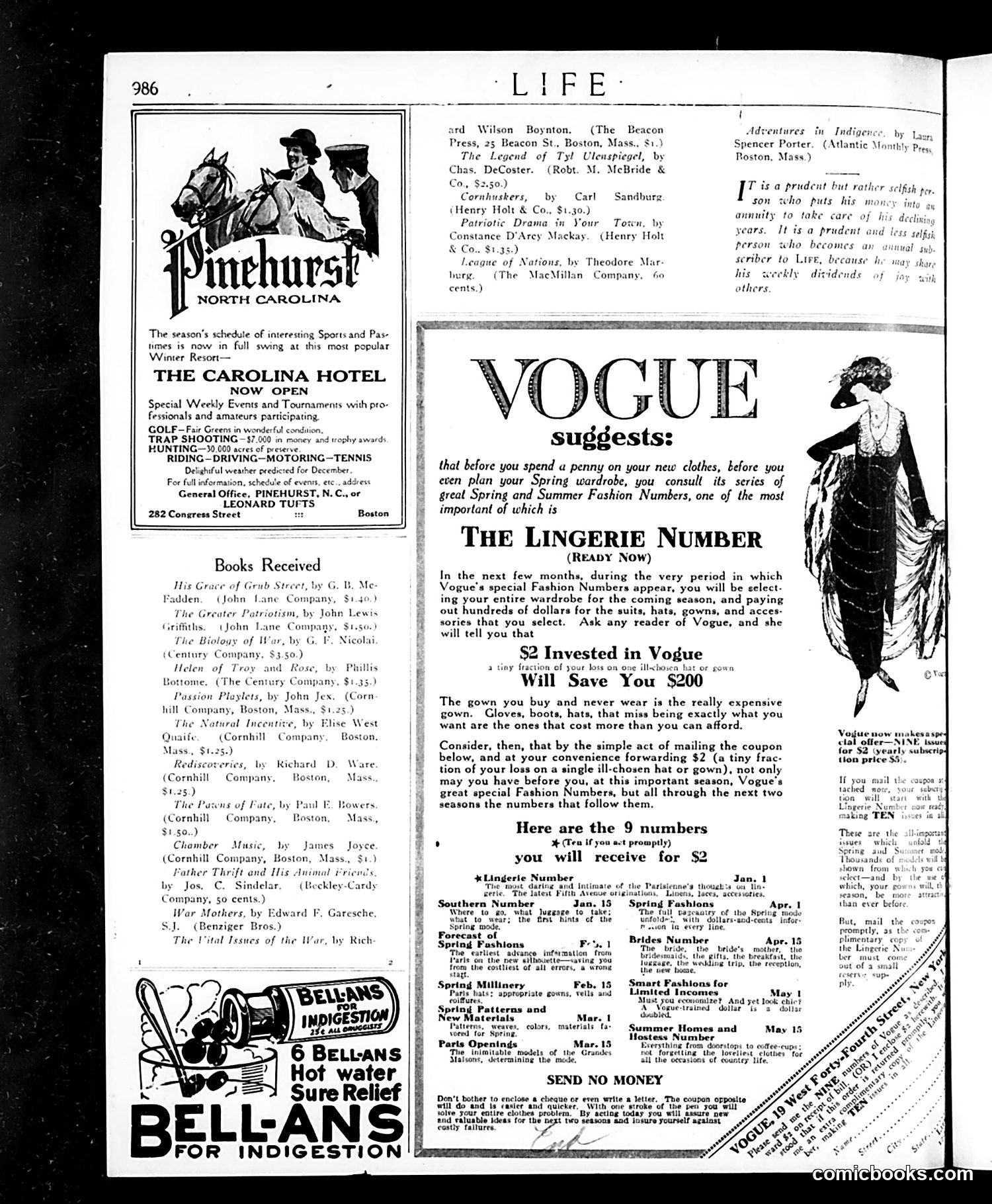
This is primarily an **advertising and book review page** rather than political satire. The main content includes: **Advertisement Section:** The dominant feature is a **Vogue magazine promotion** offering nine fashion issues (including a "Lingerie Number") for $2—claiming this investment will "save you $200" on wardrobe purchases. The pitch targets women planning spring wardrobes, emphasizing that consulting Vogue prevents costly fashion mistakes. **Supporting Advertisements:** - Pinehurst, North Carolina resort promotion (golf, hunting, horseback riding) - Bellans digestive remedy ad **Book Reviews:** A "Books Received" section lists recent publications on topics including war, patriotism, and drama—reflecting WWI-era concerns. **Notable Editorial:** A brief note advocates Life magazine subscriptions as "prudent" financial planning, using language typical of early 20th-century appeals to middle-class sensibility and civic duty. The page reflects 1910s-1920s consumer culture targeting affluent readers interested in fashion, leisure travel, and literature.
I can see this is a mostly blank page from *Life* magazine with some text fragments visible in the left margin and bottom corners, but the image quality and cropping make it difficult to read the complete content clearly. The page appears to be either mostly blank (possibly an advertisement or transition page) or the primary content has not been clearly captured in this scan. Without being able to reliably read the text or identify specific cartoon elements, I cannot accurately explain what political or social commentary this page contains. To provide a responsible historical analysis, I would need a clearer, more complete image of the page's content. If you have a clearer version, I'd be happy to analyze it properly.