
Life, 1918-12-26 · page 33 of 35
Life — December 26, 1918 — page 33: what you’re looking at
What you’re looking at
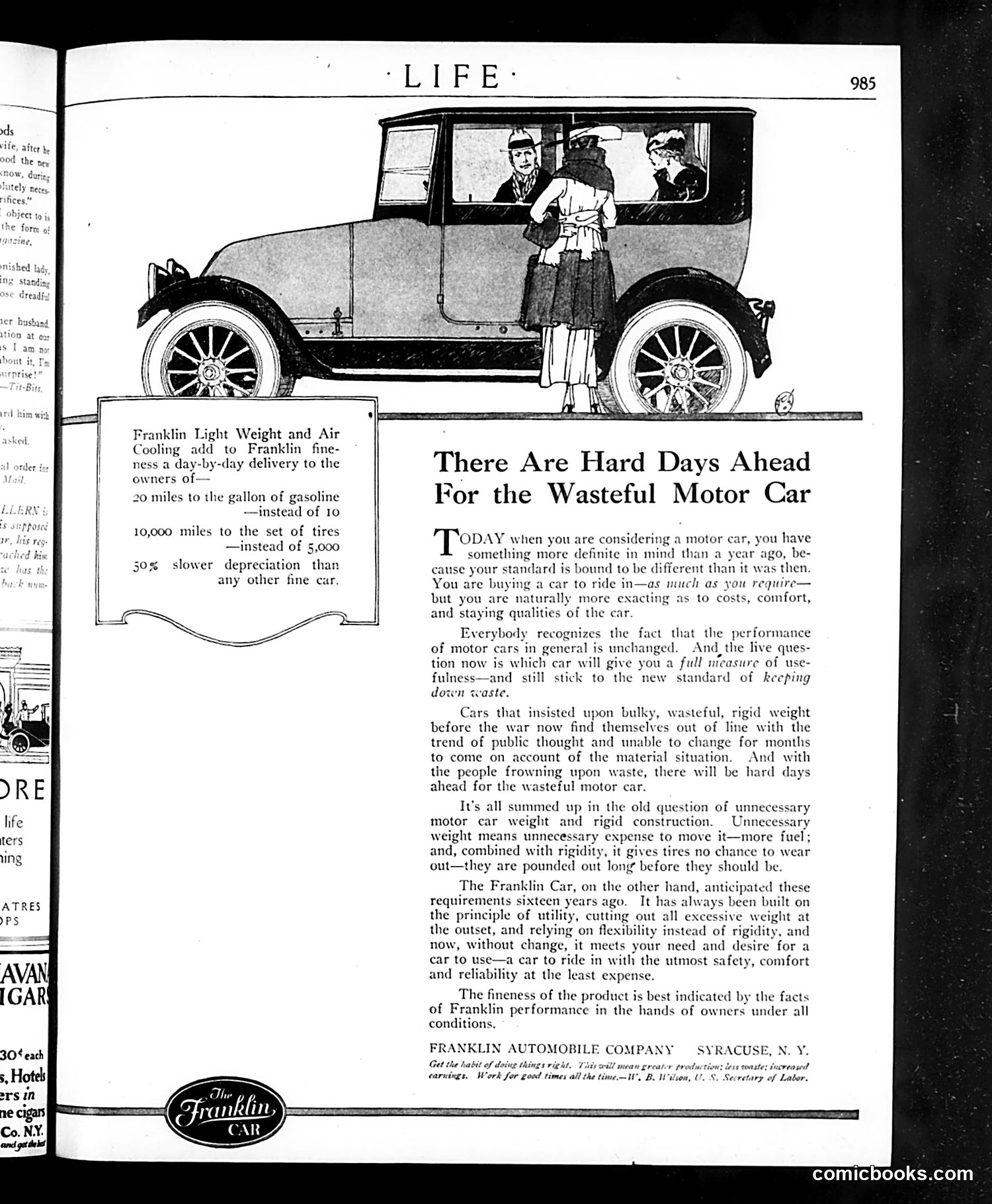
This is primarily a **Franklin automobile advertisement**, not satire. The page addresses post-World War I consumer attitudes about efficiency and waste. The headline "There Are Hard Days Ahead For the Wasteful Motor Car" references the economic shifts following WWI. The ad argues that prewar cars—designed with unnecessary weight and rigid construction—are now obsolete because the public has adopted new values around conservation and economy. Franklin positions itself as forward-thinking: it claims to have anticipated this shift "sixteen years ago" by prioritizing lightweight, flexible design over rigid bulk. The accompanying illustration shows a well-dressed woman and passengers in a Franklin automobile, suggesting reliability and refinement. The specific claims (20 miles per gallon, 10,000-mile tire life, slower depreciation) support Franklin's argument that their design philosophy aligns with emerging consumer demands for efficiency and reduced waste—positioning competitors' "wasteful" designs as outdated. This reflects genuine 1920s industrial discourse about standardization and efficiency.
📄 Transcribed text from this page (OCR, searchable)
Machine-transcribed from the original scan — historical spelling and the odd misread are preserved.
rds vife, after be Franklin Light Weight and Air Cooling add to Franklin fine- ness a day-by-day delivery to the owners of- 20 miles to the gallon of gasoline —instead of 10 10,000 miles to the set of tires —instead of 5,000 50% slower depreciation than any other fine car. There Are Hard Days Ahead For the Wasteful Motor Car ODAY when you are considering a motor car, y something more definite in mind than a ye: cause your standard is bound to be different than it was then You are buying a car to ride in—as much as you require— but you are naturally more exacting as to costs, comfort, ng qualities of the car. ybody recognizes the fact that the performance of motor c in general is unchanged. And the live ques- tion now is which car will give you a full measure of use- fulness—and still stick to the new standard of keeping down waste. Cars that insisted upon bulky, wasteful, rigid weight before the war now find themselves out of line with the trend of public thought and unable to change for months. to come on account of the material situation. And with the people frowning upon waste, there will be hard days ahead for the wasteful motor car. It’s all summed up in the old question of unnecessary motor car weight and rigid construction. Unnecessary weight means unnecessary expense to move it—more fuel; and, combined with rigidity, it gives tires no chance to wear out—they are pounded out long before they should be. The Franklin Car, on the other hand, anticipated these requirements sixteen years ago. It has alv been built on the principle of utility, cutting out all excessive weight at the outset, and relying on flexibility instead of rigidity, and now, without change, it m your need and desire for a car to use—a car to ride in with the utmost safety, comfort and reliability at the least expense. The fineness of the product is best indicated by the facts of Franklin performance in the hands of owners under all conditions, FRANKLIN AUTOMOBILE COMPANY SYRACUSE, N. Y. Get the habit of doing things right. Tits will mean greater prods te: increased earnings. Work for good times all the time—W', B. Wilson, U.S, Secretary of Later. comicbooks.com