
Life, 1918-12-26 · page 20 of 35
Life — December 26, 1918 — page 20: what you’re looking at
What you’re looking at
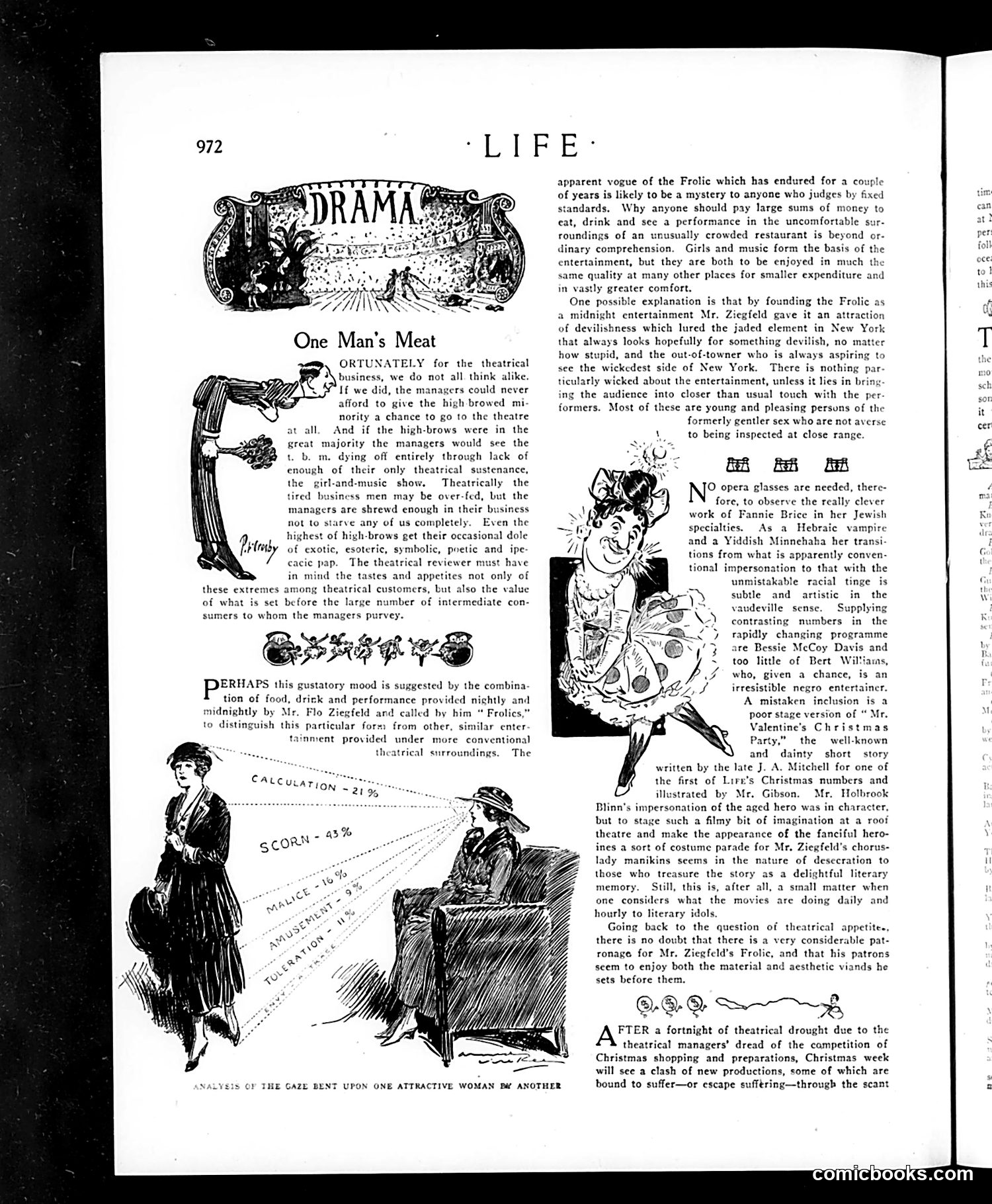
This page critiques Florenz Ziegfeld's "Frolic"—an expensive, late-night cabaret show featuring food, drink, and entertainment. The author questions why wealthy New Yorkers pay premium prices for mediocre performances in cramped restaurant settings when superior entertainment exists elsewhere in greater comfort. The cartoon "Analysis of the Gaze Bent Upon One Attractive Woman by Another" satirizes the Frolic's actual appeal: it attracts jaded socialites and tourists seeking "devilish" thrills through close proximity to performers—primarily young women. The diagram maps their gazes between figures, suggesting the entertainment's real draw is voyeuristic rather than artistic. The review acknowledges genuine talent (Fannie Brice's Jewish specialties, Bessie McCoy Davis), but criticizes a theatrical adaptation of J.A. Mitchell's literary Christmas story as sacrilege—reducing delicate fiction to a costume parade for chorus girls. The satire exposes the Frolic as theatrical exploitation dressed in sophistication.
📄 Transcribed text from this page (OCR, searchable)
Machine-transcribed from the original scan — historical spelling and the odd misread are preserved.
‘ LIFE" Spt tee rT ZZ HINES 7M A theatrical we do not all think alike. , the managers could never afford to give the high browed mi nority a chance to go to the theatre And if the high-brows were in the great majority the managers would see the t. b. m. dying off entirely through lack of enough of their only theatrical sustenance, rl-and-music show. Theatrically the tired business men may be over-fed, but the managers are shrewd enough in their business not to starve any of us completely. Even the highest of high-brows get their occasional dole of exotic, esoteric, symbolic, poetic and ipe- cacie pap. The theatrical reviewer must have in mind the tastes and appetites not only of these extremes among theatrical customers, but also the value of what is set before the large number of intermediate con- ers to whom the managers purvey. EPFSE EG ERHAPS this gustatory mood is suggested by the combina tion of food, drink and performance provided nightly and midnightly by Mr. Flo Ziegfeld and called by him “ Frolics,” to distinguish this particular form: from other, similar enter nment provided under more conventional theatrical surroundings. The THE GAZE BENT UPON ONE ATTRACTIVE WOMAN B& ANOTHER apparent vogue of the Frolic which has endured for a couple of years is likely to be a mystery to anyone who judges by fixed standards, Why anyone should pay large sums of money to cat, drink and see a performance in the uncomfortable sur- roundings of an unusually crowded restaurant is beyond or- dinary comprehension. Girls and music form the basis of the entertainment, but they are both to be enjoyed in much many other places for smaller expenditure an in vastly greater comfort. One possible explanation is that by founding the Frolic as a midnight entertainment Mr. Ziegfeld gave it an attraction of devilishness which lured the jaded element in New York that always looks hopefully for something devilish, no matter how stupid, and the out-of-towner who is always aspiring to see the wickcdest side of New York. There is nothing par- ticularly wicked about the entertainment, unless it lies in bi ing the audience into closer than usual touch with the p formers. Most of these are young and pleasing persons of the formerly gentler sex who are not averse to being inspected at close range. & A A 'O opera glasses are needed, there- fore, to observe the really clever work of Fannie Brice in her Jewish specialties. As a Hebraic vampire and a Yiddish Minnehaha her transi- ns from what is apparently conven- tional impersonation to that with the unmistakable racial tinge is subtle and artistic in the vaudeville sense. Supplying contrasting numbers in the rapidly changing programme are Bessie McCoy Davis and too little of Bert Wiltias, who, given a chance, is an irresistible negro entertainer. A mistaken inclusion is a poor stage version of “ Mr. Valentine's Christmas Party,” the well-known and dainty short story written by the late J. A. Mitchell for one of the first of Lire’s Christmas numbers and illustrated by Mr. Gibson. Mr, Holbrook Blinn’s impersonation of the aged hero was in character, but to stage such a filmy bit of imagination at a roof theatre and make the appearance of the fanciful hero- ines a sort of costume parade for Mr. Ziegfeld’s chorus- lady manikins seems in the nature of desecration to those who treasure the story as a delightful literary memory. Still, this is, after all, a small matter when one considers what the movies are doing daily and hourly to literary idols. Going back to the question of theatrical appetite: there is no doubt that there is a very considerable pat- ronage for Mr. Ziegfeld’s Frolic, and that his patrons seem to enjoy both the material and aesthetic viands he sets before them. @, e&@ See FTER a fortnight of theatrical drought due to the theatrical managers’ dread of the competition of Christmas shopping and preparations, Christmas week will see a clash of new productions, some of which are bound to suffer—or escape sufftring—through the scant