
Life, 1918-12-26 · page 16 of 35
Life — December 26, 1918 — page 16: what you’re looking at
What you’re looking at
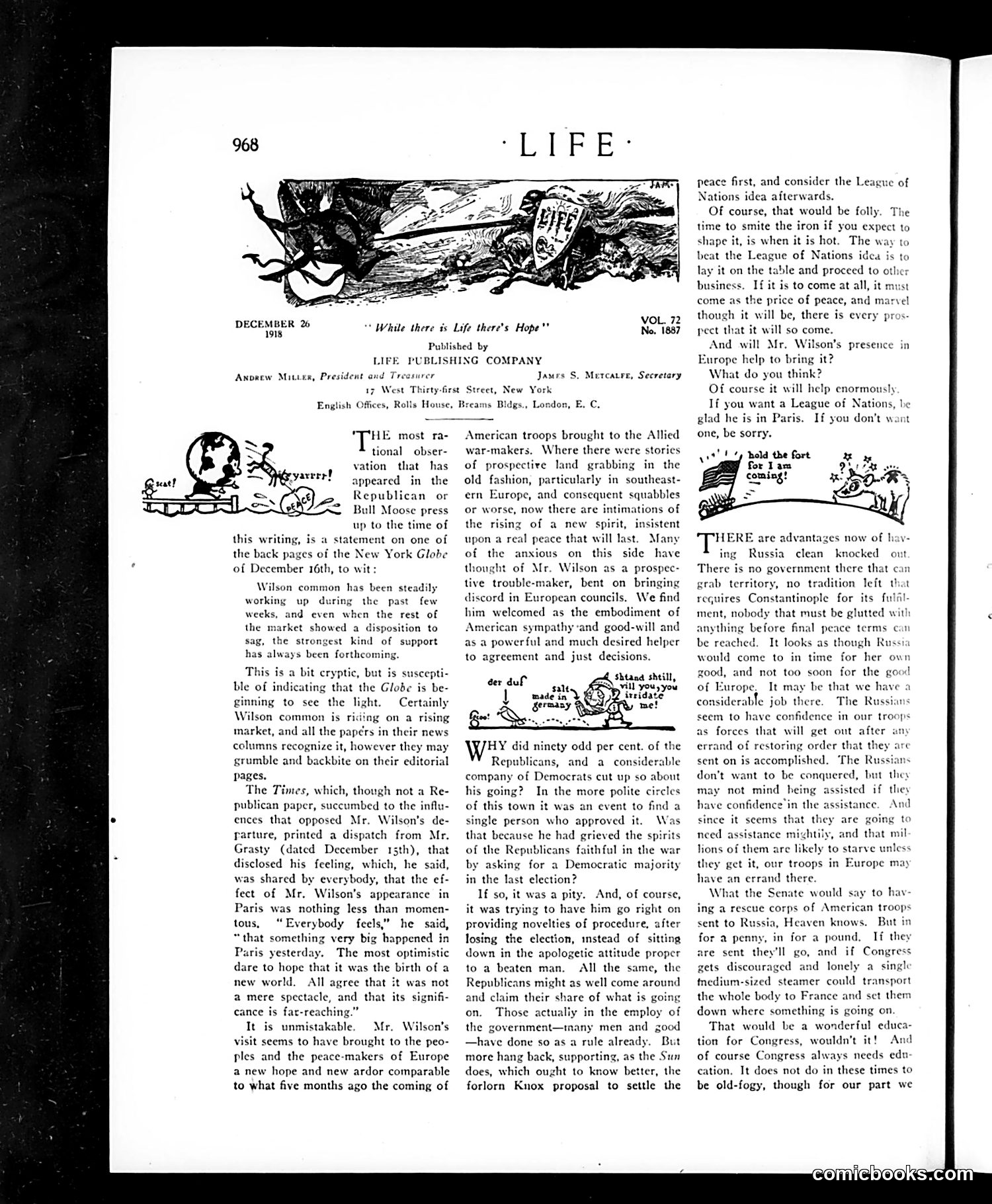
This page celebrates President Wilson's recent arrival in Paris for peace negotiations following World War I's armistice. The small cartoon at top-left appears to show Wilson as a figure of hope amid the wreckage of war. The article praises Wilson's transformative effect on European leaders and the public, noting his arrival has inspired optimism about achieving a genuine, lasting peace rather than old-fashioned territorial grabbing. The satire targets Republican opposition to Wilson's diplomatic mission. The piece mocks Republicans' hypocrisy—they opposed his trip despite most Americans supporting him—and ridicules the Republican proposal to settle peace terms *before* considering Wilson's League of Nations idea. The author argues this cart-before-horse approach is foolish; the League should be part of the peace settlement itself. The headline "While there is Life there's Hope" puns on the magazine's name, suggesting Wilson represents America's best hope for reshaping post-war Europe according to democratic ideals rather than imperial interests.
📄 Transcribed text from this page (OCR, searchable)
Machine-transcribed from the original scan — historical spelling and the odd misread are preserved.
DECEMBER 26 1918 “While there is Life there's Hope"® Published by LIFE Axpaew Mittex, President and Treasurer 17 West Thirty-first English Offices, Rolls House, Br HE most ra- onal obser- vation that has appeared in the Republican or Bull Moose press up to the time of statement on one of y York Globe this writing, is the back pages of the N of December 16th, to wit: Wilson common has been steadily working up during the past few weeks, and even when the rest of market showed a disposition to the strongest kind of support has always been forthcomin This is a bit cryptic, but is suscepti- ble of indicating that the Globe is be- ginning to see the light. Certainly Wilson common is riding on a rising market, and all the papers in their news columns recognize it, however they may grumble and backbite on their editorial pages. The Times, which, though not a Re- publican paper, succumbed to the influ- ences that opposed Mr. Wilson's de- rarture, printed a dispatch from Mr. Grasty (dated December 15th), that disclosed his feeling, which, he said, was shared by everybody, that the ef- fect of Mr. Wilson’s appearance in Paris was nothing less than momen- tous, “Everybody feels,” he said, “that something very big happened in Paris yesterday, The most optimistic dare to hope that it was the birth of a new world. All agree that it was not a mere spectacle, and that its signifi- cance is far-reaching.’ It is unmistakable. Mr. Wilson's visit seems to have brought to the peo- ples and the peace-makers of Europe a new hope and new ardor comparable to what five months ago the coming of PUBLISHING COMPANY Jaurs S. Metcatre, Secretary ect, New York ams Bldgs., London, E, C. American troops brought to the Allied war-makers. Where there were stories of prospective land grabbing in the old fashion, particularly in southeast- ern Europe, and consequent squabbles or worse, now there are intimations of the rising of a new spirit, insistent upon a real peace that will last. Many of the anxious on this side have thought of Mr. Wilson as a prospec- tive trouble-maker, bent on bringing discord in European councils, We find him welcomed as the embodiment of American sympathy ‘and good-will and as a powerful and much desired helper to agreement and just decisions. HY did ninety odd per cent. of the Republicans, and a_ considerable company of Democrats cut up so about his going? In the more polite circles of this town it was an event to find a single person who approved it. Was that because he had grieved the spirits of the Republicans faithful in the war by asking for a Democratic majority in the last election? If so, it was a pity. And, of course, it was trying to have him go right on providing novelties of procedure, after losing the election, instead of sitting down in the apologetic attitude proper to a beaten man. All the same, the Republicans might as well come around and claim their share of what is going on. Those actualiy in the employ of the government—tnany men and good shave done so as a rule already. But more hang back, supporting, as the Sun does, which ought to know better, the forlorn Knox proposal to settle the peace first, and consider the I Nations idea afterwards. Of course, that would be folly. time to smite the iron if you expe shape it, is when it is hot. The wa beat the League of Nations idca i lay it on the table and proceed to other business. If it is to come at all, it must come as the price of peace, and marvel though it will be, there is every pros- pect that it will so come. And will Mr. Wilson’s presence i: Europe help to bring it? What do you think? Of course it will help enormously If you want a League of Nations, be glad he is in Paris. If you don't want one, be sorry. gue of The hold the fort for lam coming! THER E are advantages now of hav- ing Russia clean knocked out There is no government there that ca grab territory, no tradition leit that requires Constantinople for its f ment, nobody that must be glutted with anything before final peace terms car be reached. It looks as though Russi would come to in time for her own good, and not too soon for the good of Europe, It may be that we considerable job there. The Russians seem to have confidence in our troops as forces that will get out after any errand of restoring order that they sent on is accomplished. The Russi don't want to be conquered, but they may not mind heing assisted if they sistance. And are going to ave a have confidence’in the since it seems that the need assistance mightily, and that mil lions of them are likely to starve they get it, our troops in Europe may 1 ness have an errand there. What the Senate would say to ing a rescue corps of American troops sent to Russia, Heaven knows. But in for a penny, in for a pound, If they are sent they'll go, and if Congress gets discouraged and lonely a singk tnedium-sized steamer could transport the whole body to France and set them down where something is going on. That would be a wonderful educa- tion for Congress, wouldn't it! And of course Congress always needs edu cation, It does not do in these times to be old-fogy, though for our part we