
A complete issue · 34 pages · 1918
Life — December 12, 1918
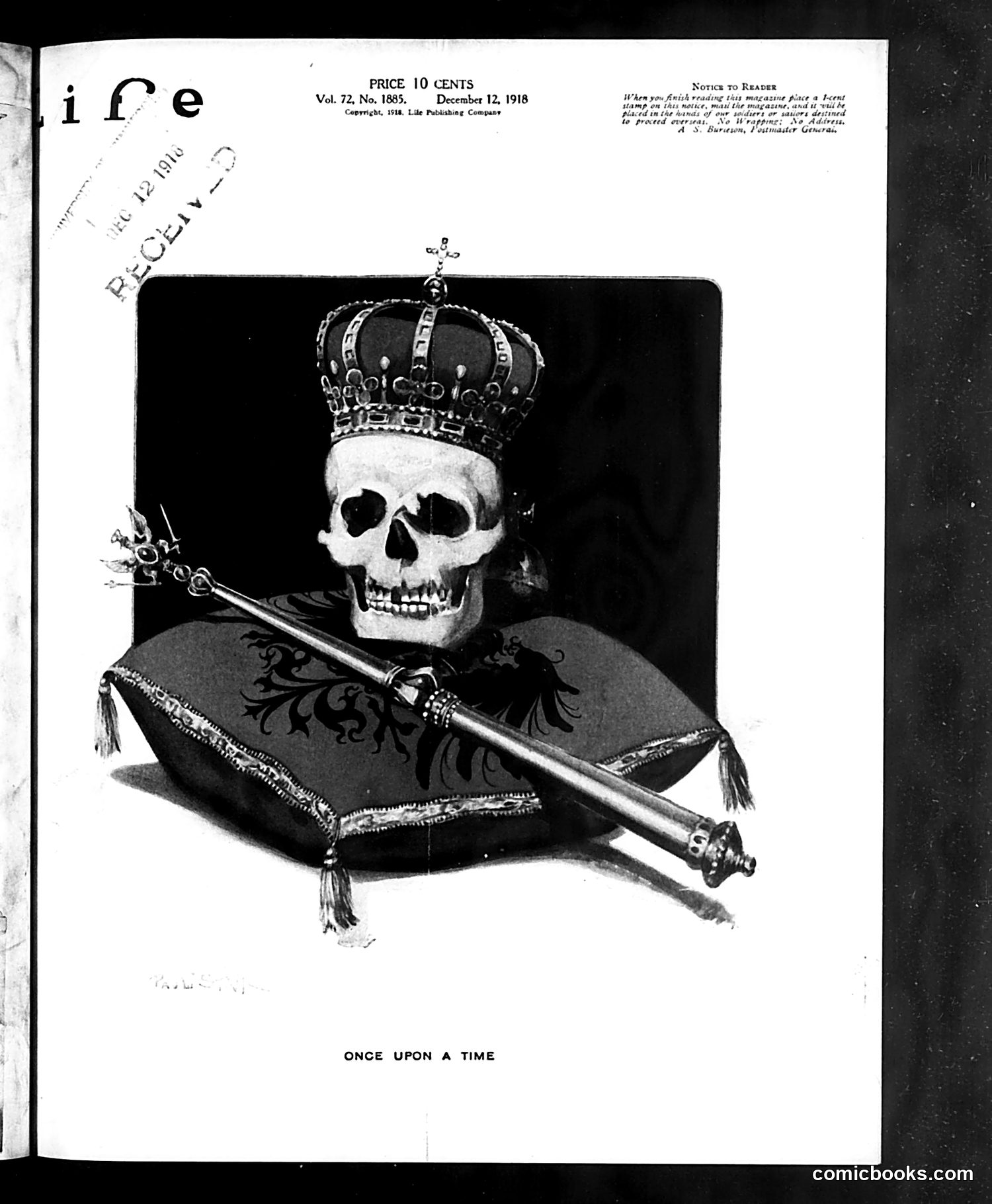
This political cartoon depicts a skull wearing a royal crown, draped in ornate robes and holding a scepter—a classic memento mori (death's-head) symbolizing mortality and the end of power. Published just after World War I's armistice (November 1918), this likely satirizes the collapse of European monarchies. The German, Austro-Hungarian, and Russian imperial systems had recently fallen or were collapsing. The crowned skull represents the "death" of autocratic rule and imperial authority. The title "Once Upon a Time" suggests these once-mighty kingdoms are now merely historical tales—a commentary on how quickly absolute power vanishes. The ornate regalia ironically emphasizes what these regimes have lost.
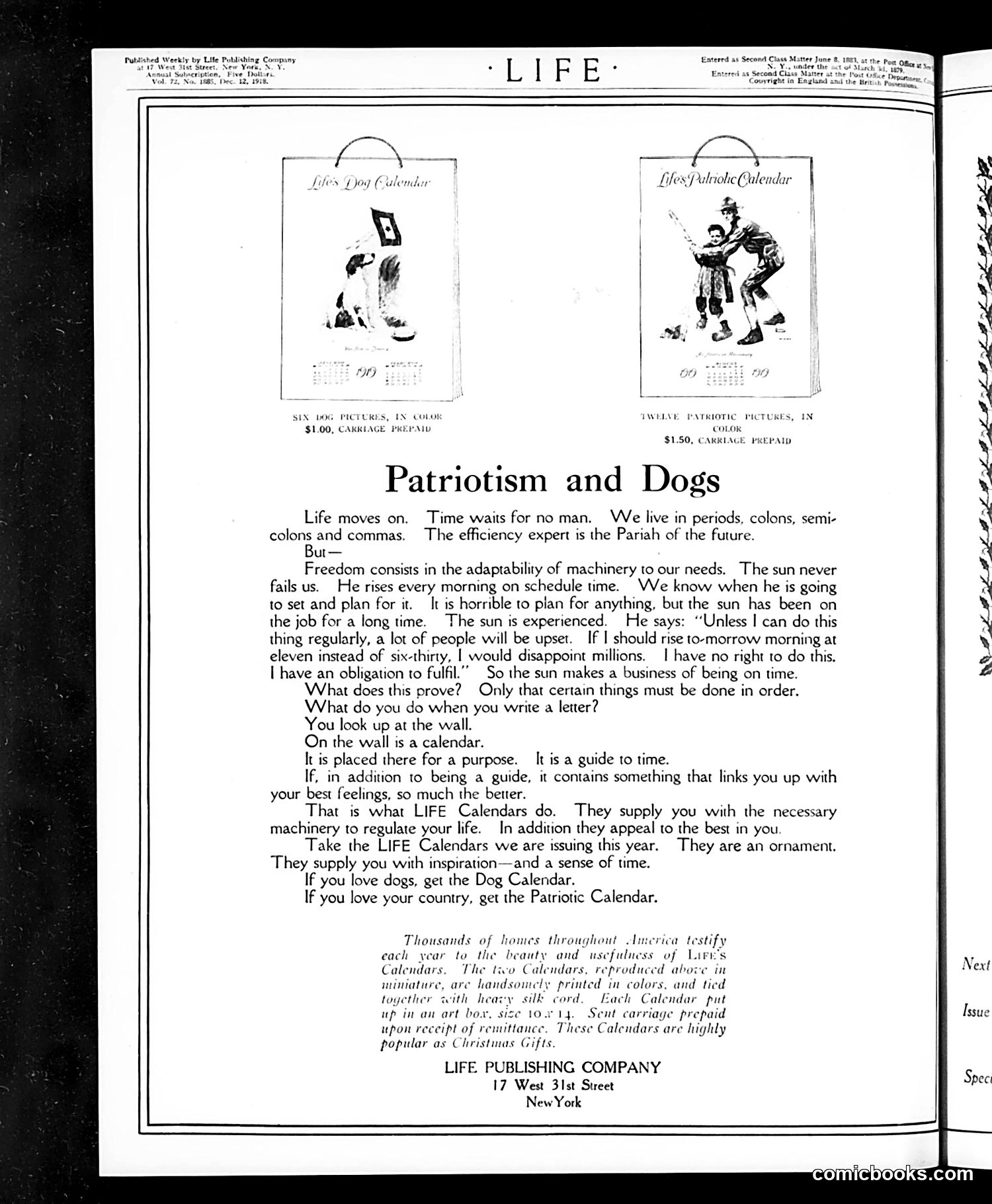
This page is primarily **advertising** for two LIFE-brand calendars rather than satirical content. The ads promote: 1. **"Life's Dog Calendar"** ($1.00) - featuring six color pictures of dogs 2. **"Life's Patriotic Calendar"** ($1.50) - featuring twelve patriotic illustrations The accompanying essay, "Patriotism and Dogs," uses philosophical language about time, order, and freedom to justify why calendars are necessary organizational tools. It then makes a lighthearted appeal: "If you love dogs, get the Dog Calendar. If you love your country, get the Patriotic Calendar." The juxtaposition appears mildly humorous—equating patriotic devotion with dog-loving as equally valid reasons for calendar purchase. However, this is fundamentally a **commercial product advertisement** rather than political satire or editorial cartooning.
This page is primarily a **subscription advertisement** for *Life* magazine, not political satire. The left side features a decorative bordered illustration with a cherub/cupid figure and the quote "TAKE ME WITH YOU IF YOU WANT TO BE POPULAR," promoting a year-long subscription with "Christmas Greetings." The right side lists reasons to subscribe: it's suitable for American soldiers overseas (weekly delivery, compact) and friends/relatives anywhere (52 issues yearly with entertainment content). The bottom section announces upcoming special issues, including covers featuring "My Mother" and "Christmas Eve—Where Duty Is Pleasure," plus special numbered editions (Hero's Number, Soldierettes Number, Back-Home Number). The text mentions removing "paper restrictions," suggesting this dates to **World War II era** when materials were rationed. This is fundamentally **marketing copy**, not editorial content.
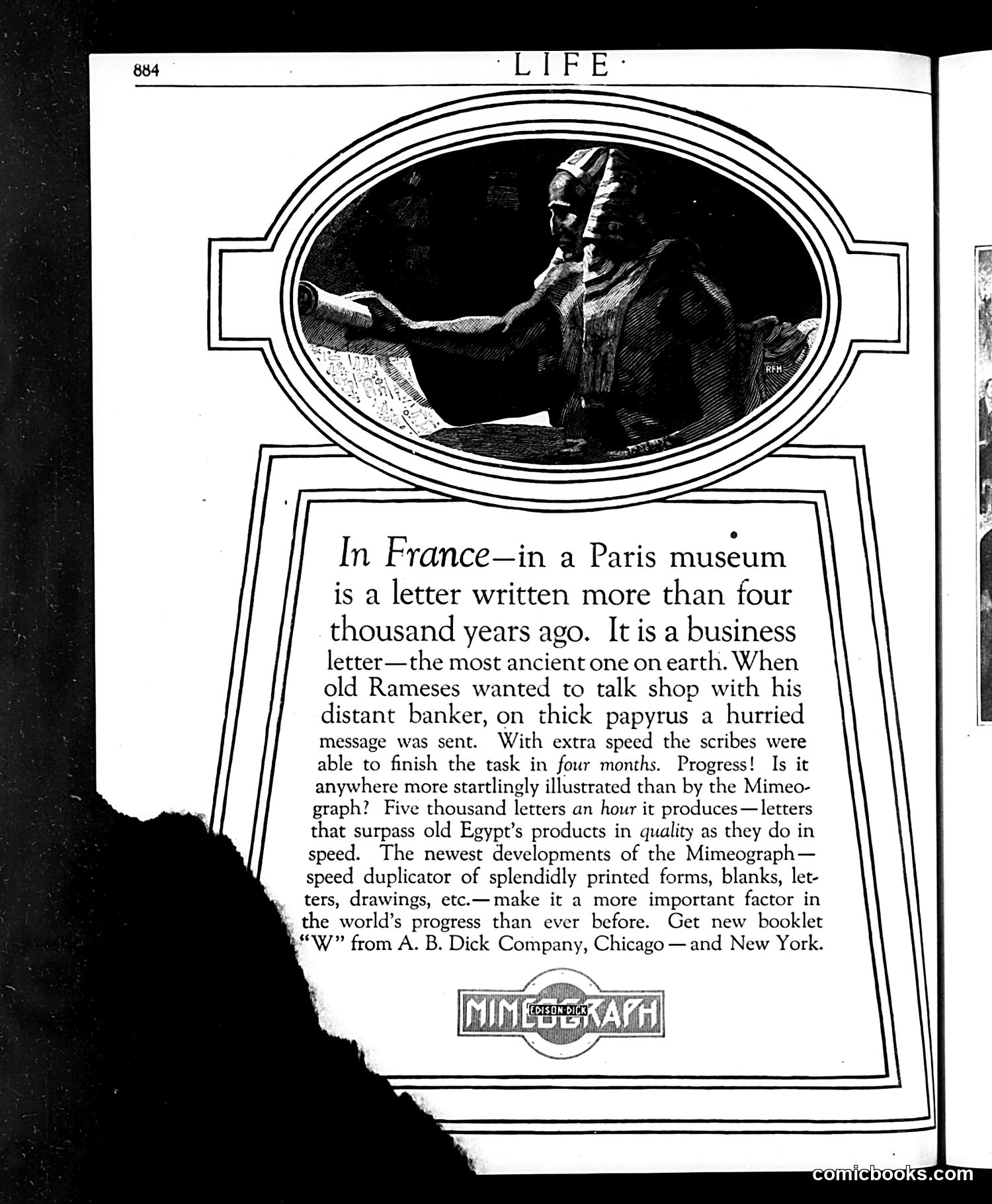
This is primarily a **product advertisement** for the Mimeograph duplicating machine, made by A.B. Dick Company. The ad uses historical comparison as its selling point. The text contrasts ancient Egyptian efficiency with modern technology: Ramses II's scribes took four months to hand-copy a business letter on papyrus, while the Mimeograph produces "five thousand letters an hour." The illustrated figure appears to represent an ancient Egyptian scribe. The advertisement's satire is implicit—it mocks the slowness of pre-industrial communication by exaggerating the time ancient methods required. The "progress" theme celebrates how the Mimeograph represents modern advancement, positioning the machine as essential to contemporary business efficiency. This reflects early 20th-century optimism about technology's transformative power in commerce.
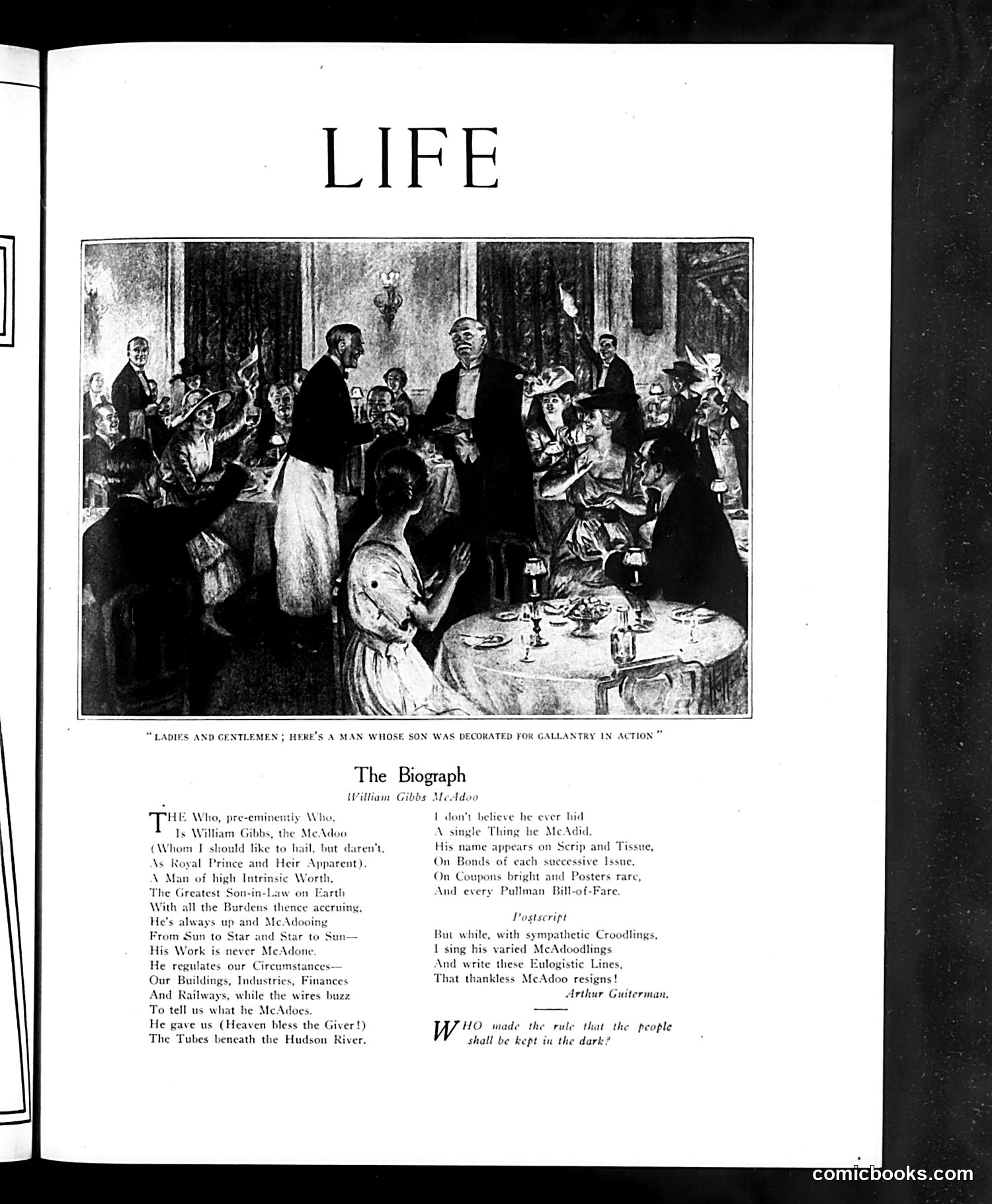
This page satirizes **William Gibbs McAdoo**, Secretary of the Treasury under President Wilson. The poem's title references the Biograph Company, a major film studio, suggesting McAdoo is as prominent and visible as a movie star. The satirical verse mocks McAdoo's omnipresence in American public life—his name appearing constantly in financial documents ("Scrip and Tissue," "Bonds," "Coupons," "Posters"), government railways, and industrial regulations. The final quoted line by Arthur Guiterman pointedly asks "Who made the rule that the people shall be kept in the dark?"—suggesting McAdoo's secretive or opaque financial management during WWI affected public understanding of Treasury operations. The formal dinner scene illustration shows McAdoo as a celebrated, toasted figure, emphasizing his considerable power and visibility.
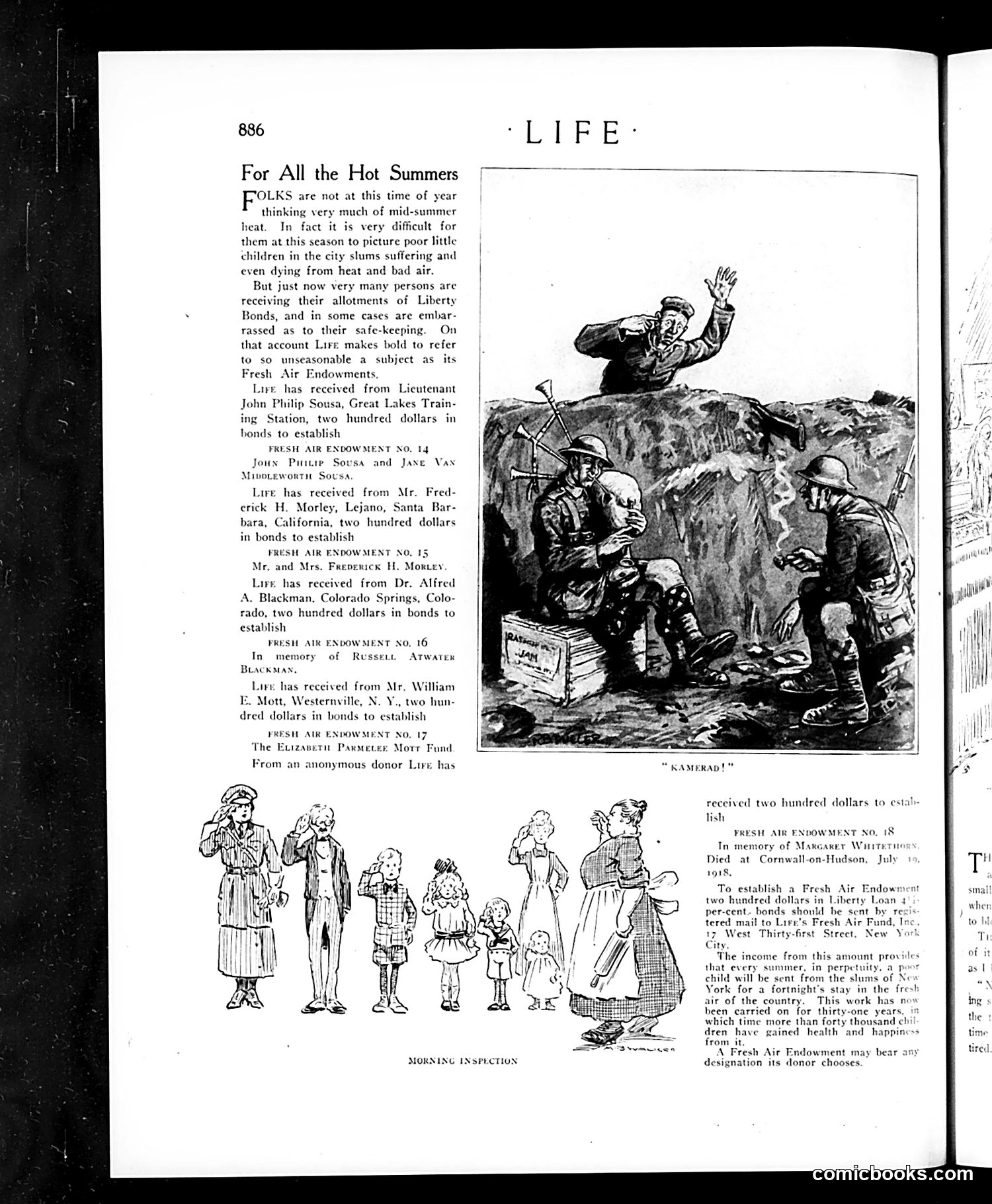
This page discusses Fresh Air Endowments—charitable funds providing poor urban children relief from summer heat and city pollution. The text lists recent donations (Liberty Bonds) to establish these programs. The main cartoon titled **"KAMERAD!"** depicts what appears to be soldiers or military figures in a satirical scene. Given the 1918 reference to Margaret Whitehouse's death and Liberty Loan context, this likely references WWI. The "Kamerad!" caption (German surrender cry) suggests ironic commentary on wartime conditions. The lower illustration labeled **"Morning Inspection"** shows a family group, possibly contrasting civilian life with the military theme above. The satire appears to connect wartime sacrifice with domestic charity needs—suggesting Americans should extend patriotic concern toward suffering children at home, not just war efforts abroad.
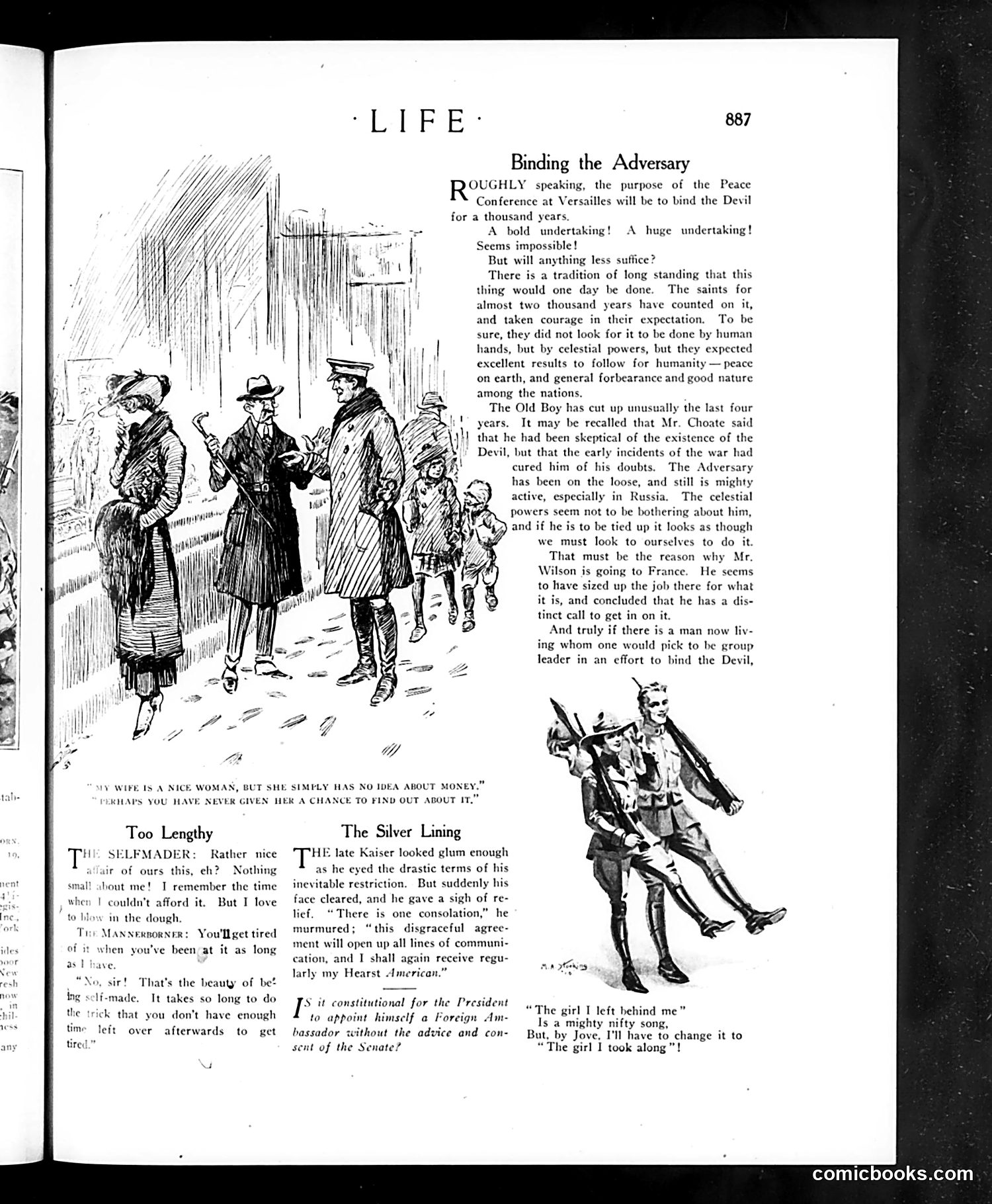
This page satirizes the Paris Peace Conference at Versailles (post-WWI). The main article jokes that binding "the Devil" for a thousand years through the peace treaty is an impossible task, while referencing Mr. Choate's past skepticism about the Devil's existence. The central cartoon depicts men in formal dress (diplomats) discussing the effort to restrain their adversary through treaty negotiations—likely referencing widespread doubts about whether harsh peace terms could actually constrain Germany long-term. The smaller cartoons mock various diplomatic concerns: one about a wife's ignorance of finances, another about Constitutional limits on the President's Foreign Ambassador appointment powers, and a soldier's romantic lament. The overall tone is skeptical that Versailles could truly create lasting peace.
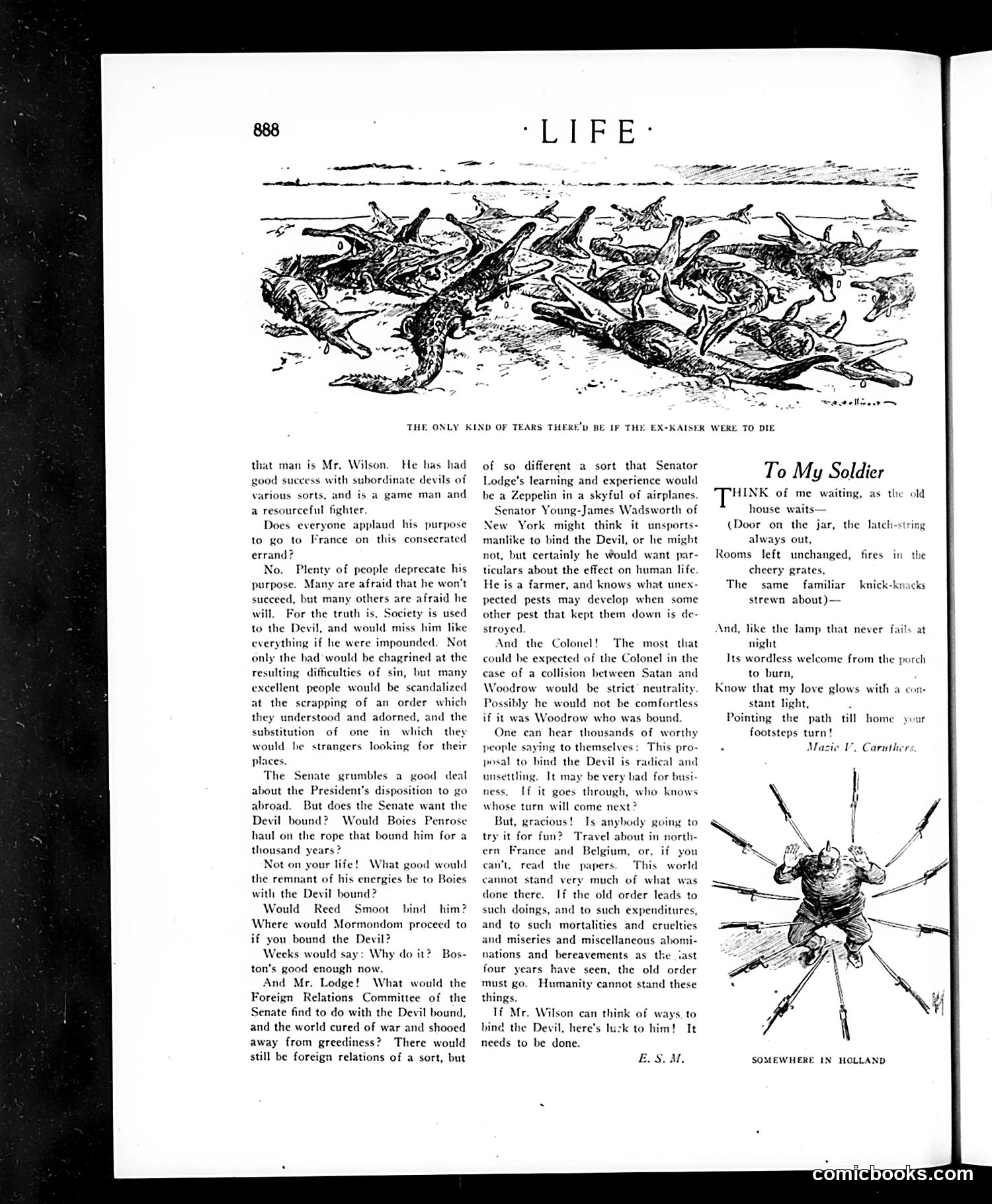
The top illustration shows dead soldiers/casualties on a battlefield, captioned "THE ONLY KIND OF TEARS THERE'D BE IF THE EX-KAISER WERE TO DIE" — a dark joke suggesting no one would mourn the former German Kaiser's death. The text discusses President Wilson's proposed trip to France, debating whether binding the Devil (apparently a metaphor for Germany/the Kaiser) is wise. References to "Senator Lodge" and "Foreign Relations Committee" indicate this addresses real 1919 post-WWI peace negotiations. The satirists question whether harsh peace terms or leniency toward defeated Germany serves humanity better. The illustration on the right titled "SOMEWHERE IN HOLLAND" appears to depict the exiled Kaiser, shown as a grotesque figure — reflecting contemporary anti-German sentiment following World War I.
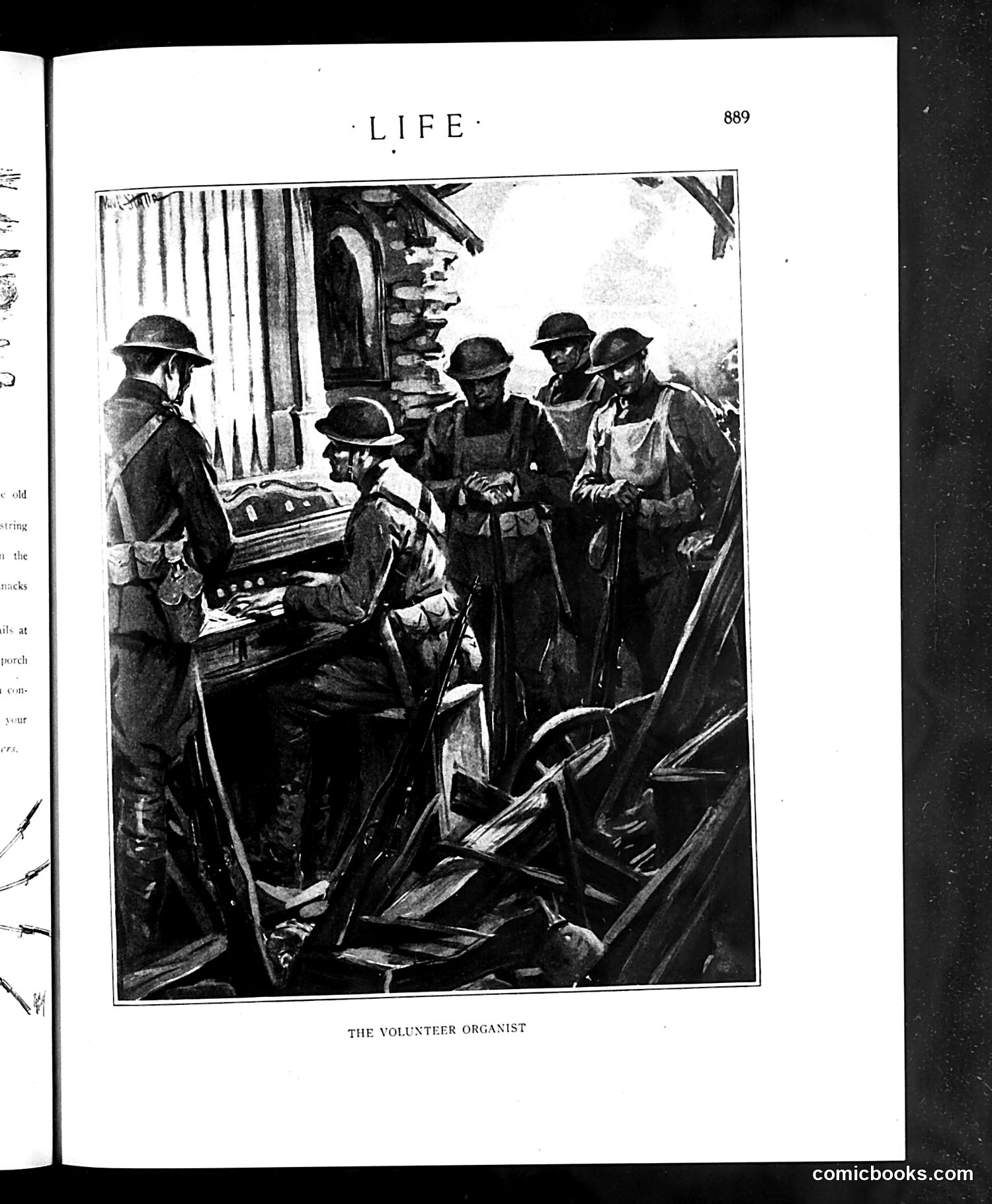
This illustration depicts soldiers in World War I military uniforms and helmets gathered around what appears to be a piano or organ inside a military structure. The caption "The Volunteer Organist" suggests satire about entertainment or morale-boosting efforts during wartime. The joke likely plays on the incongruity of finding a musical instrument in a military setting, and the "volunteer" aspect may mock either the reluctance of soldiers pressed into non-combat duties or the absurdity of maintaining civilian cultural activities amid warfare. Without additional context from the magazine's text, the precise satirical target remains unclear—whether it critiques military inefficiency, the attempt to maintain normalcy during war, or something else entirely.
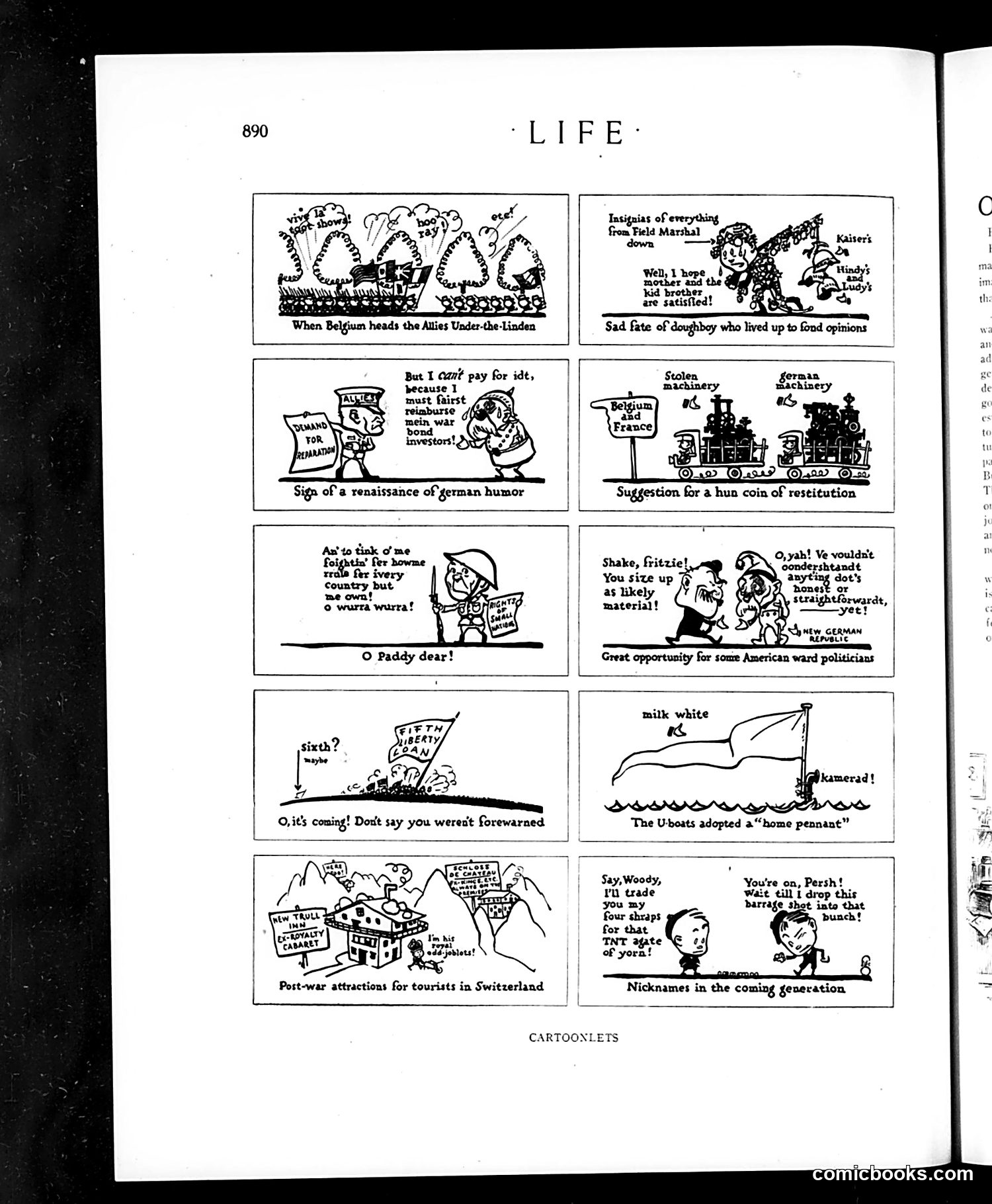
This page collects WWI-era satirical cartoons mocking various aspects of the conflict and post-war period: 1. **Belgian resistance**: Shows Belgium leading Allied forces under the Linden trees—celebrating Belgian defiance against German invasion. 2. **German reparations**: Depicts stolen Belgian machinery being transported, satirizing war indemnity demands. 3. **Irish independence**: References Irish home rule conflicts during wartime chaos. 4. **U-boats**: Mocks German submarines adopting a "home pennant" flag—satirizing militaristic posturing. 5. **Swiss tourism**: Shows post-war attractions built around war remnants—dark humor about profiting from destruction. 6. **Nicknames**: Final panel jokes about derogatory names for enemy combatants becoming common currency. The cartoons collectively mock German militarism, war profiteering, and the absurdities of wartime propaganda.
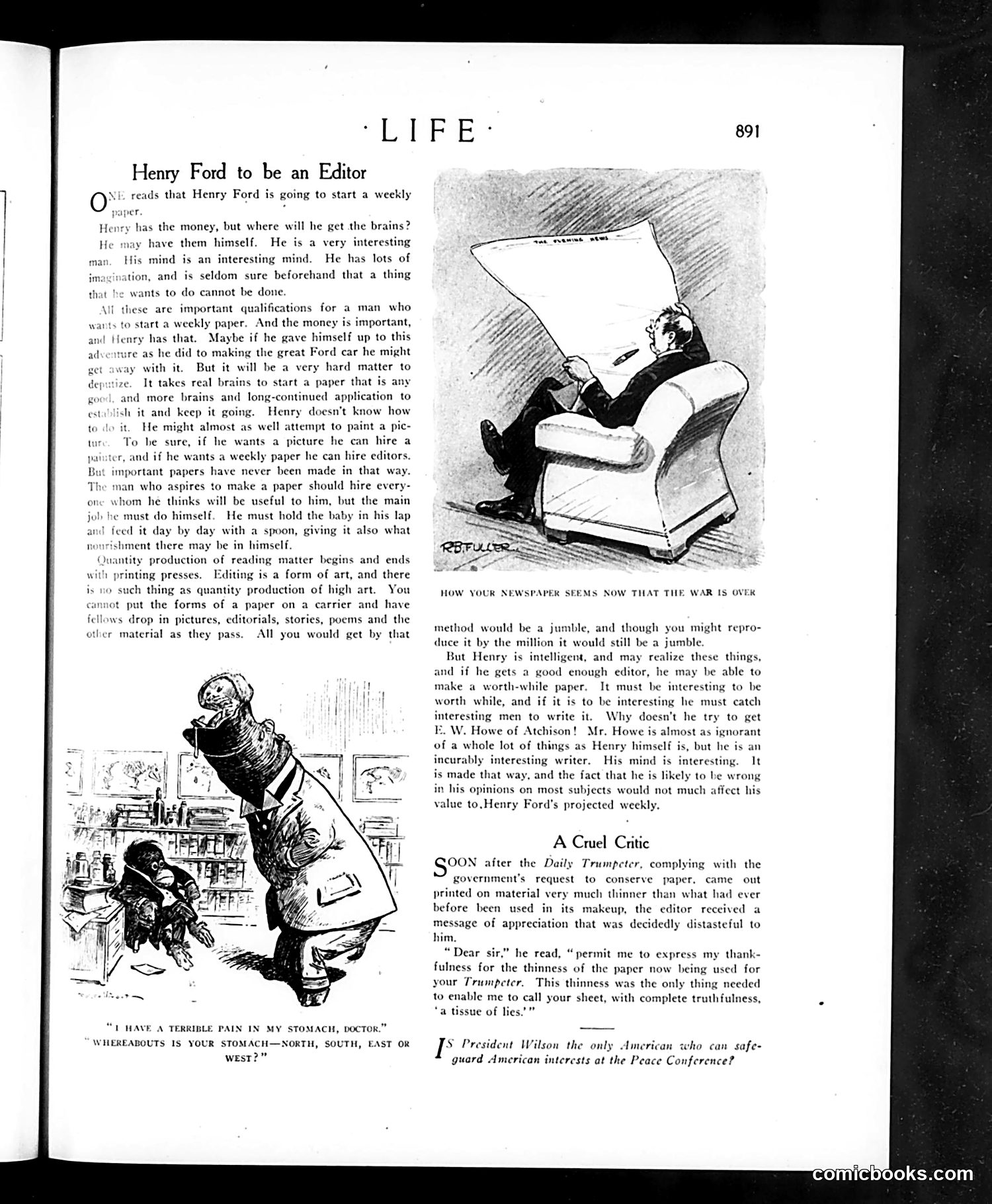
This page contains two satirical pieces from the post-WWI era (based on "now that the war is over" reference). **"Henry Ford to be an Editor"** critiques Henry Ford's reported plan to start a weekly newspaper. The text argues Ford has money and imagination but lacks the editorial expertise needed—he might as well attempt to paint as easily as hire painters. The satire suggests Ford's industrial success doesn't translate to media competence. **"A Cruel Critic"** mocks the *Daily Trumpet*'s response to government paper-conservation requests. An editor sarcastically thanks the government for requiring thinner paper, calling it a "tissue of lies"—a pun on the literal thinness of the new material. The political cartoons (by what appears to be Cesare) visually reinforce these critiques of powerful figures overstepping their expertise.
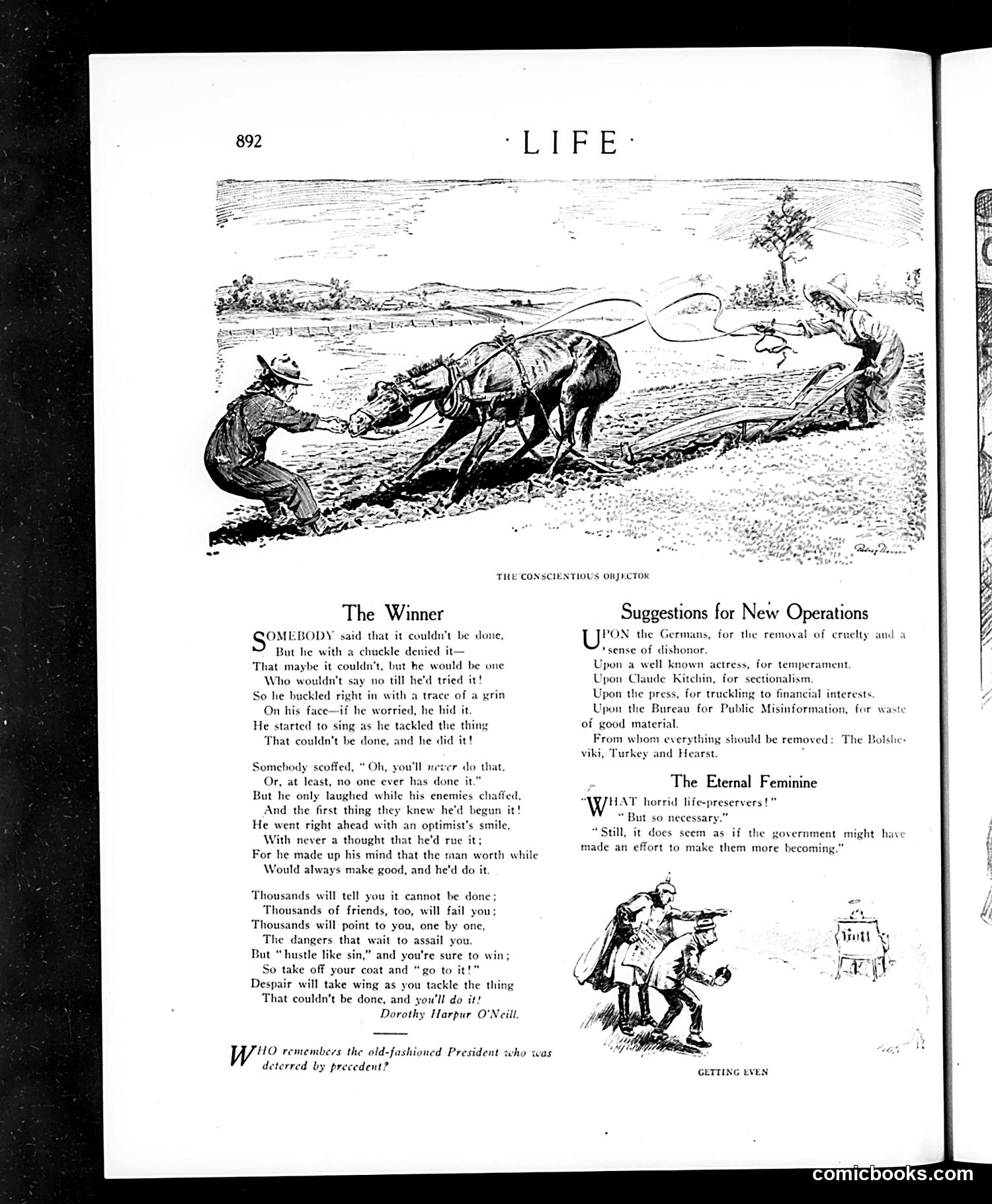
**Top Cartoon: "The Conscientious Objector"** Shows a man operating a plow pulled by a horse, with another figure working in the background. This illustrates the concept of conscientious objection—refusing military service on moral grounds. During WWI, conscientious objectors were sometimes assigned agricultural labor instead of combat. The cartoon's title suggests commentary on this alternative service. **"The Winner" Poem** By Dorothy Harpur O'Neill, celebrates someone who persevered despite obstacles and naysayers. The narrative voice contrasts self-doubt with ultimate success, suggesting triumph through determination. **"Suggestions for New Operations"** A satirical list proposing removal of various German figures and institutions post-WWI, and the section "The Eternal Feminine" makes a quip about government efforts to make "life-preservers" more appealing to women.
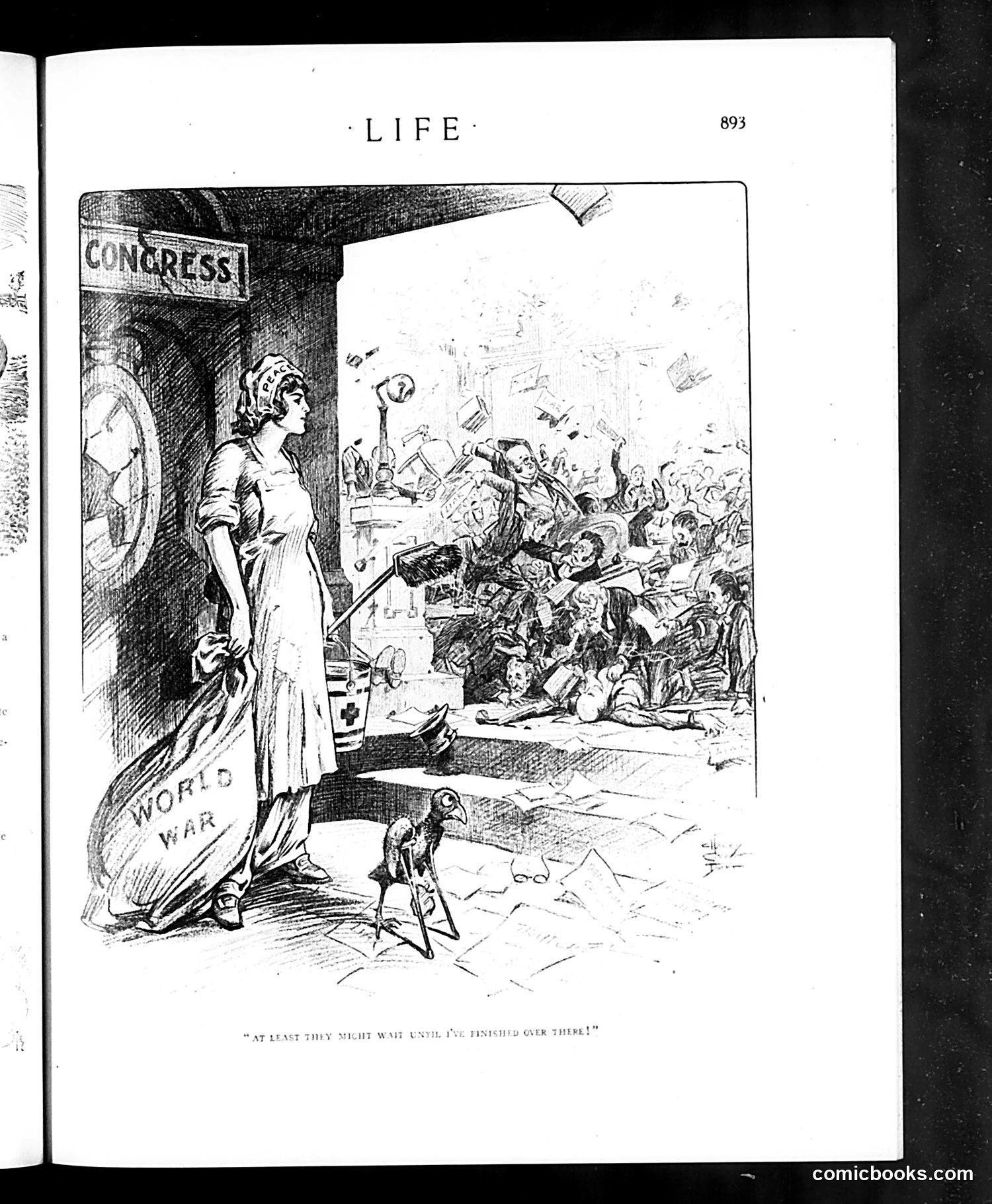
This satirical cartoon depicts a female allegorical figure (representing America or Liberty, suggested by her classical drapery and the "World War" label on her robe) standing outside the U.S. Congress building. She observes a chaotic scene of squabbling politicians inside, with papers and documents flying about. The caption reads: "At least they might wait until I've finished over there!" The satire criticizes Congressional dysfunction and infighting during World War I. While America is engaged in serious warfare abroad, Congress remains consumed by internal political disputes and partisan bickering rather than unified focus on the war effort. The cartoon suggests Congress is failing its patriotic duty by prioritizing political quarrels over national wartime needs.
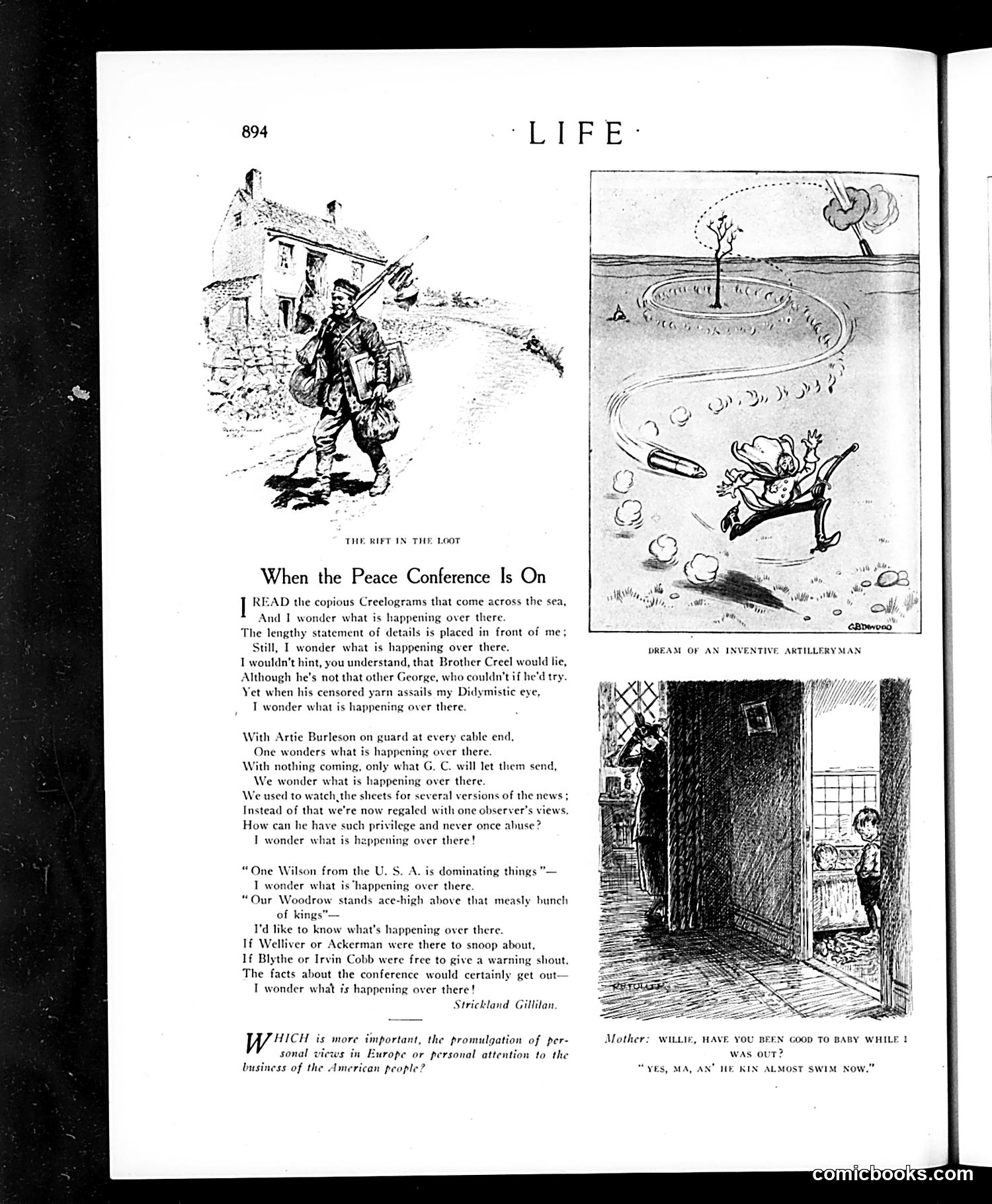
This page satirizes American ignorance about peace negotiations following World War I. The poem "When the Peace Conference Is On" by Strickland Gillinan mocks how ordinary Americans receive only censored or filtered information about the Paris Peace Conference proceedings. References include: - **Artie Burleson** (Postmaster General) controlling cable communications - **G.C.** (likely George Creel, head of wartime propaganda) - **Wilson, Woodrow, Welliver, Blythie, Irvin Cobb** — figures expected to provide truthful conference reports The satire's point: Americans wonder what's *actually* happening abroad while authorities tightly control the information flow. The bottom cartoon shows a child's innocent question about baby Willie swimming—a lighter domestic contrast to the serious geopolitical frustration above.
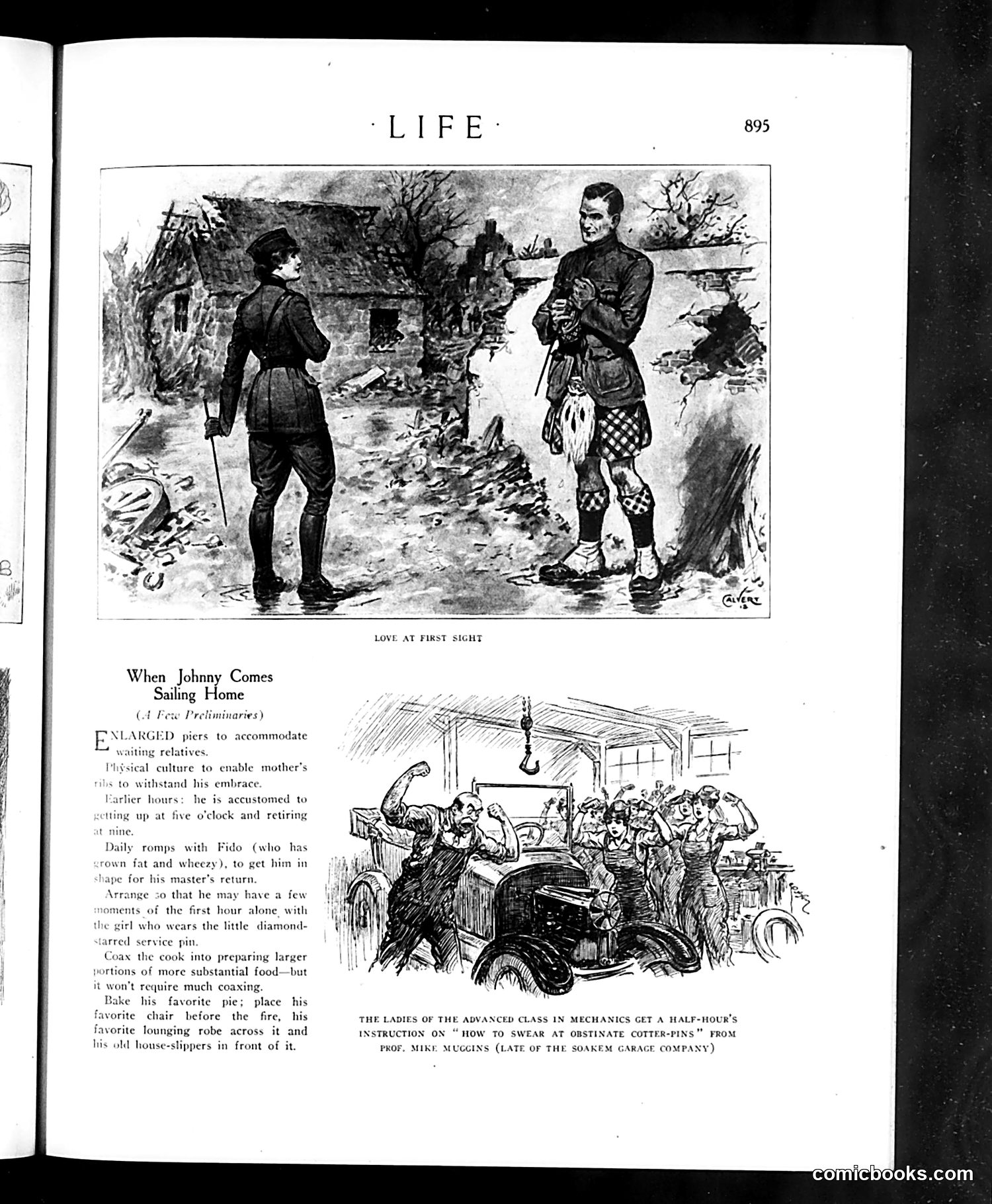
This page contains two separate satirical pieces from *Life* magazine: **Top cartoon ("Love at First Sight"):** Shows a soldier in Scottish military dress encountering a woman in what appears to be a war-torn village. The satire likely comments on romantic encounters during wartime, though the specific conflict is unclear from the image alone. **Bottom section ("When Johnny Comes Sailing Home"):** The text humorously describes preparations for a soldier's homecoming, with practical domestic advice (enlarging piers, physical culture, preparing food). The accompanying illustration shows women receiving instruction on "how to swear at obstinate cotter-pins" from a garage mechanic—satirizing women's unfamiliar involvement in mechanical tasks, presumably during wartime when men were absent. The joke targets gender role disruption during military service periods.
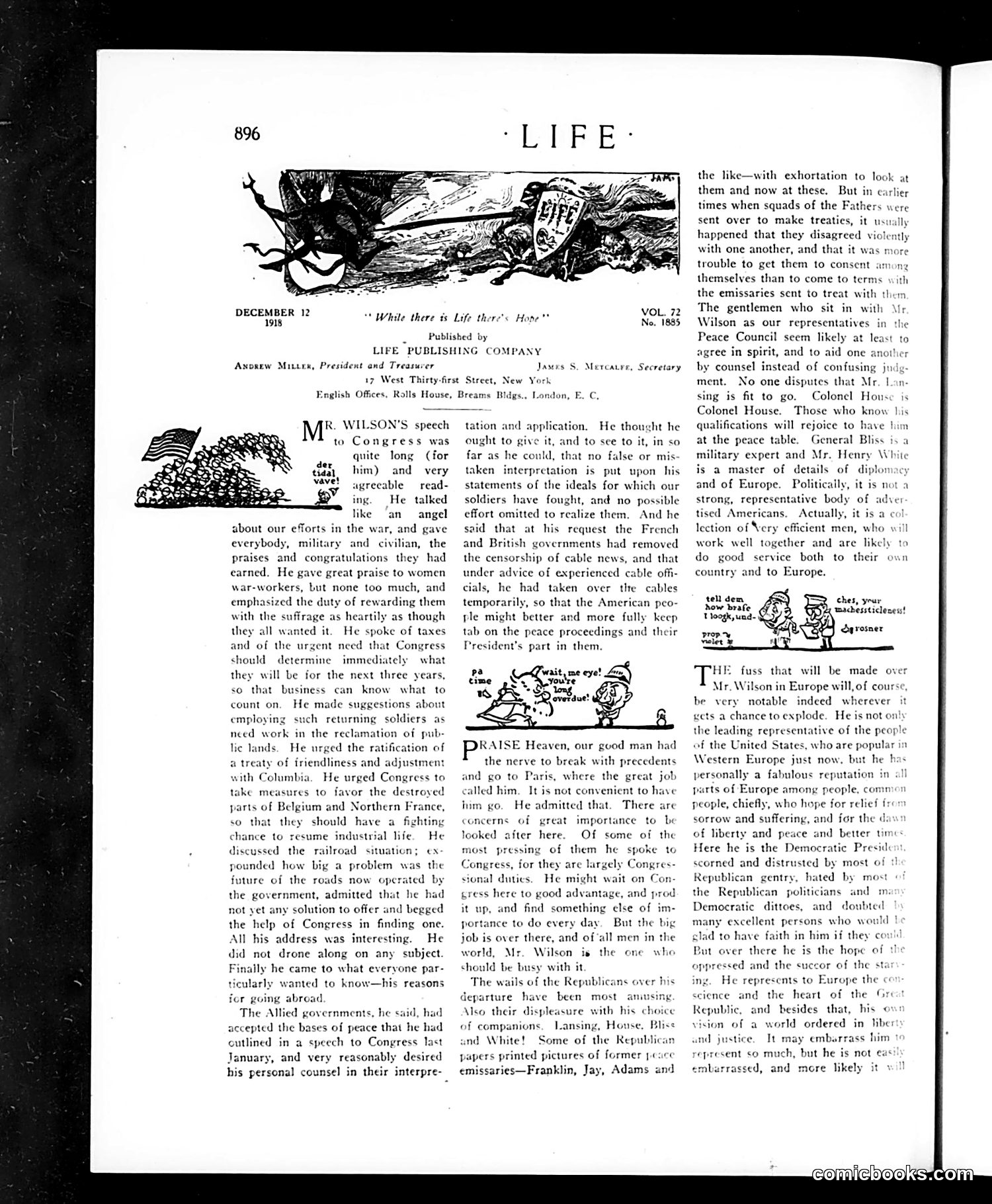
This page discusses President Wilson's speech to Congress regarding his decision to personally attend the Paris Peace Conference following World War I's armistice. **The Key Points:** Wilson justified going to Paris to ensure his stated peace ideals were properly interpreted and implemented. He claimed the Allied governments requested his personal counsel and that he'd temporarily taken control of cable censorship to give Americans fuller information about peace proceedings. **The Satire:** The magazine gently mocks Republican opposition to Wilson's departure and their complaints about his chosen advisors (Lansing, House, Bliss, White). Republicans circulated images of Founding Fathers as if to suggest better representatives should have been chosen. Life's response: historical peace delegations also disagreed internally—the Founding Fathers themselves frequently quarreled, making the current controversy unremarkable. The article's title, "While there is Life there's Hope," suggests cautious optimism about the peace process, though the tone implies some skepticism about Wilson's justifications and Republican carping alike.
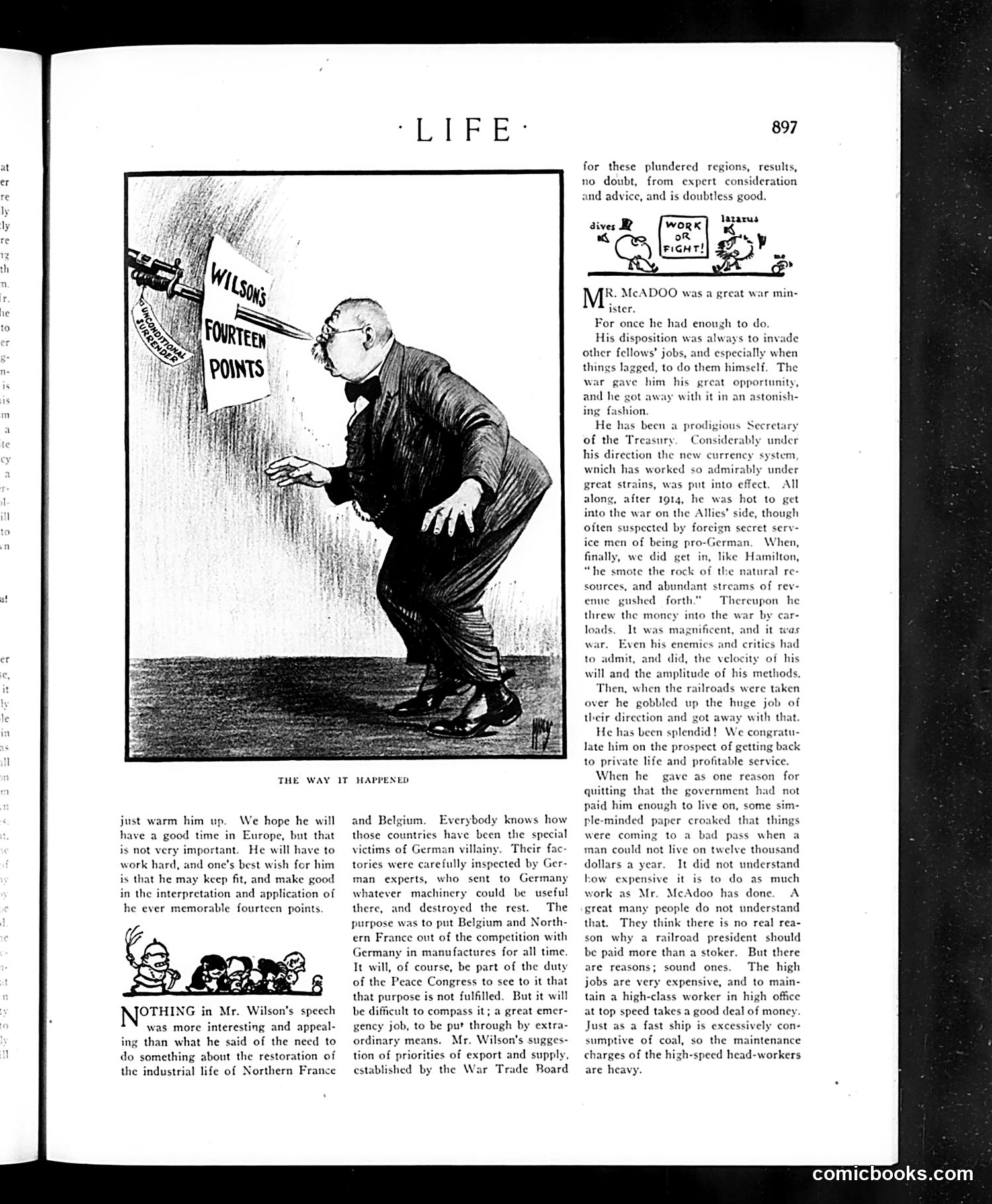
This Life magazine page contains political satire about President Wilson's Fourteen Points peace proposal following World War I. **The Main Cartoon:** Shows a figure (labeled "WILSONS' FOURTEEN POINTS") pinning a document to a wall, depicted as a tailor or craftsman carefully hanging up work. The satire suggests Wilson is methodically presenting his peace plan—treating abstract diplomatic principles like a tangible, physical item to be inspected and applied. **The Text Commentary:** Praises Secretary of the Treasury William McAdoo as an exceptional wartime administrator who mobilized American financial resources for the Allied war effort. The piece defends high executive salaries, arguing that maintaining "high-speed head-workers" is expensive, like operating a fast ship that consumes excessive coal. **Historical Context:** This appears post-WWI (references 1914 entry into war), addressing Wilson's peace negotiations and reconstruction of war-damaged France and Belgium—concerns central to the 1919 Treaty of Versailles negotiations. The satire's tone is generally supportive of both Wilson and McAdoo's wartime leadership.
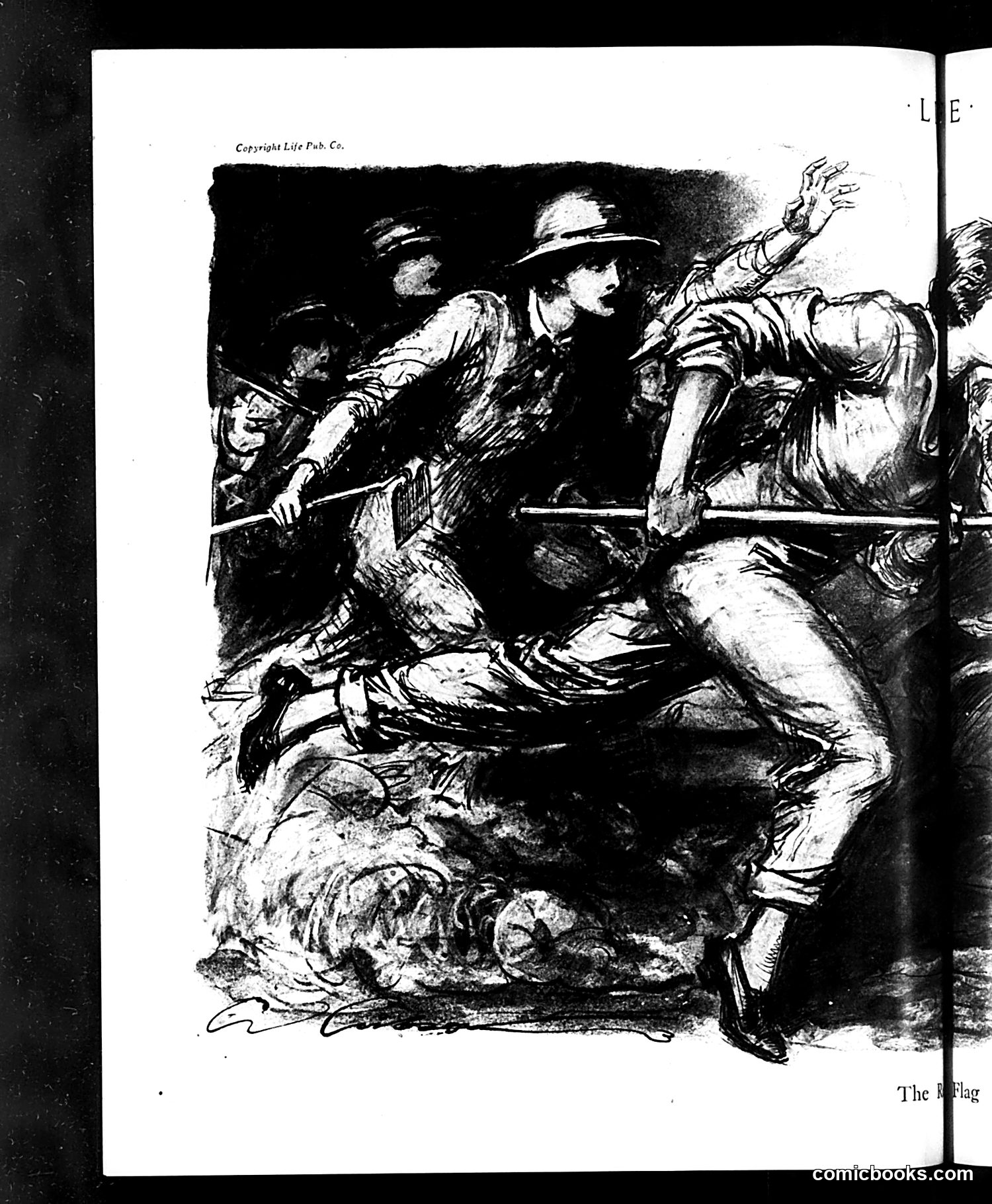
This illustration, titled "The Flag," appears to be a WWI-era satirical cartoon from *Life* magazine. It depicts soldiers in combat, bayonets fixed, engaged in fierce fighting over or around a flag. The style suggests propaganda or patriotic commentary on warfare. The satire likely critiques either: the brutal reality of war despite patriotic rhetoric, the pointless sacrifice of soldiers fighting over nationalist symbols, or (conversely) celebrates military valor. The dramatic, violent composition emphasizes the human cost of conflict and flag-waving nationalism. Without more text context or a visible date, the exact political stance remains unclear—whether this celebrates sacrifice or questions its necessity. The artistic treatment suggests ironic commentary on romanticized patriotism versus battlefield reality.
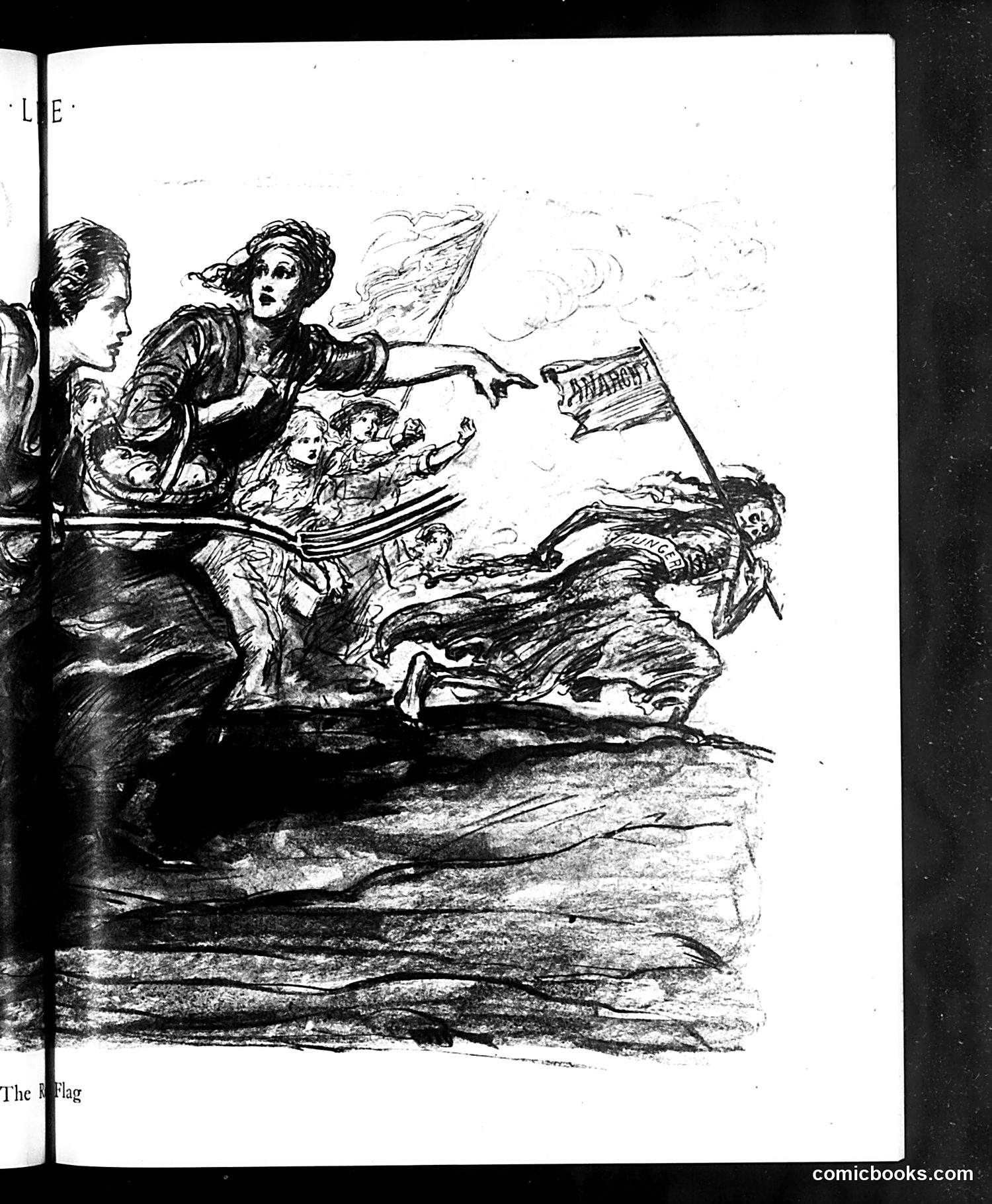
This political cartoon depicts figures on the left (appearing to represent authority or establishment forces) confronting anarchists or revolutionaries on the right who are displaying a red flag marked "ANARCHIST." The composition shows a dramatic struggle, with the left side figures seemingly attempting to suppress or combat the red flag and its bearers. The satire likely comments on late 19th or early 20th-century anxieties about anarchist movements in America. The red flag was a symbol associated with anarchism and radical socialism during this period. *Life* magazine, known for satirical commentary on contemporary politics and social issues, appears to be depicting the conflict between establishment order and radical revolutionary ideology as a central social tension of its era.
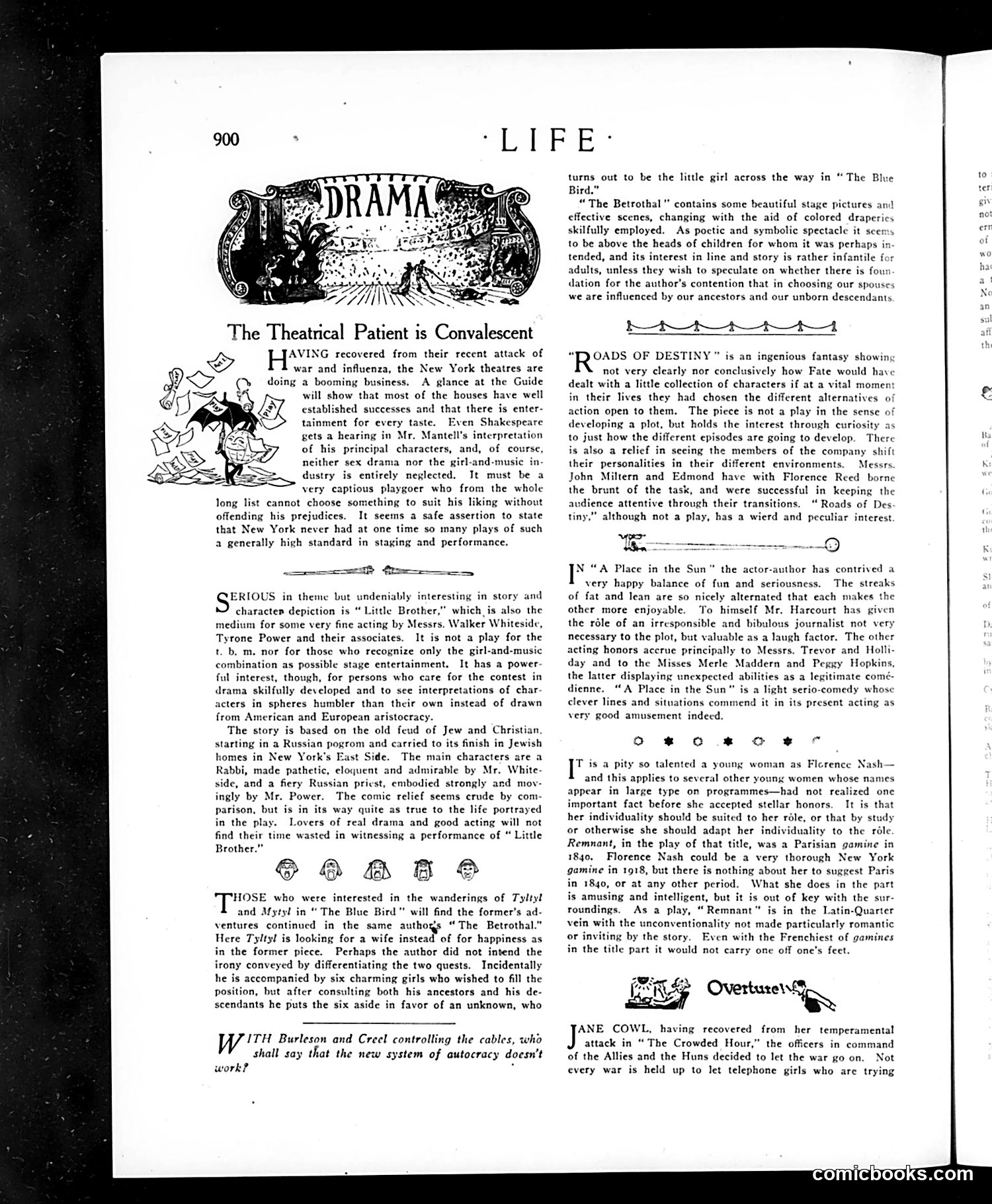
This page reviews New York theatrical productions during the post-WWI recovery period ("recovered from their recent attack of war and influenza"). The reviews praise Broadway's diverse offerings—Shakespeare, serious drama like "Little Brother" (featuring anti-Semitic/Christian conflict themes), and fantasy plays like "The Betrothal" and "Roads of Destiny." The notable satirical element appears in the brief quip at bottom: "WITH Burleson and Creel controlling the cables, who shall say that the new system of autocracy doesn't work?" This references **Albert Burleson** (Postmaster General) and **George Creel** (propaganda chief), who together controlled wartime communications censorship. The joke sarcastically suggests their control resembles autocracy—critiquing government overreach during and after WWI. The page presents theater as cultural recovery, with satire targeting government censorship rather than theatrical content.
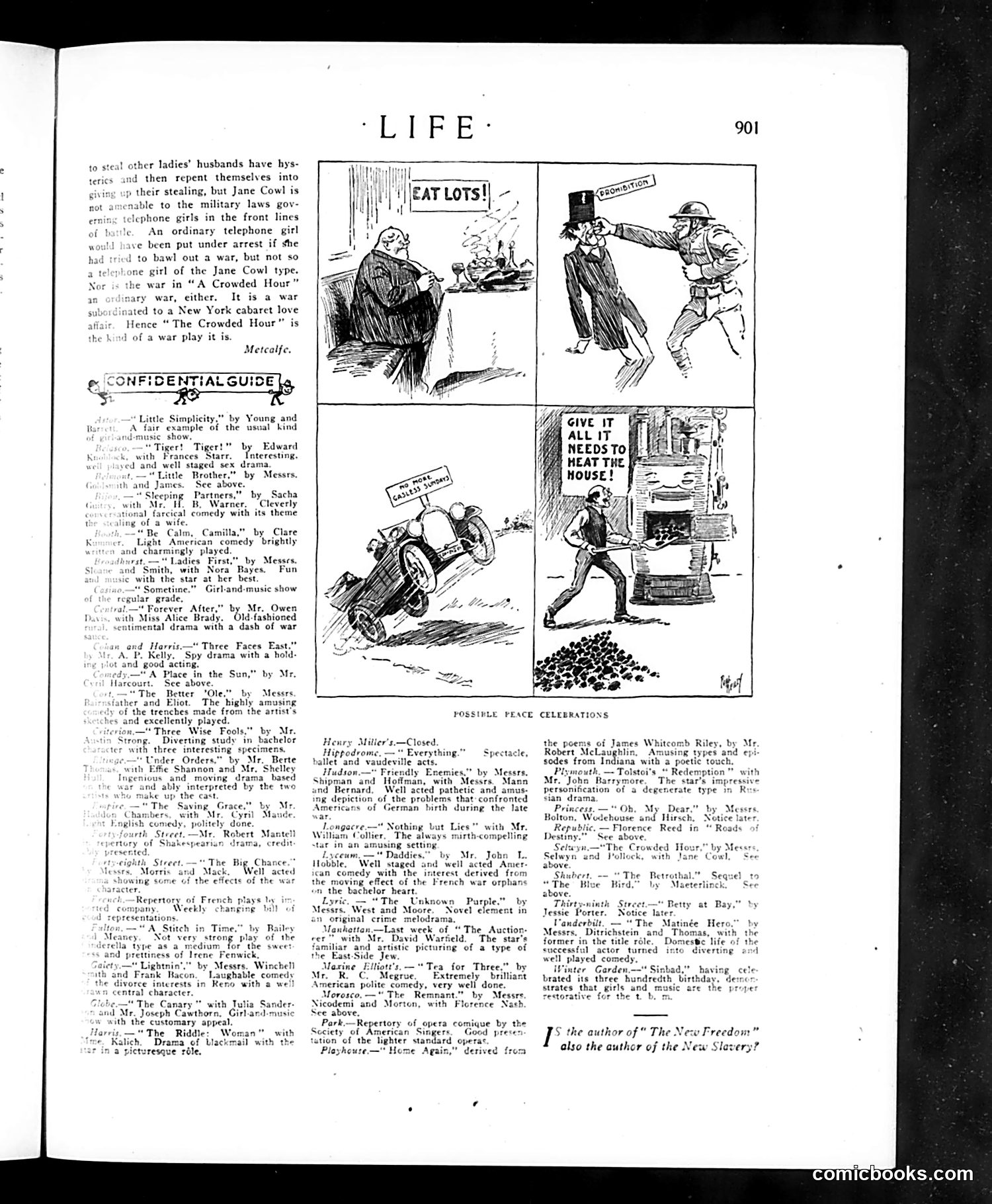
This page from Life magazine features **theatrical reviews and cartoon commentary** on WWI-era social attitudes. The cartoons mock **wartime rationing and civilian sacrifice**. The top-left panel shows "Eat Lots!" directed at those hoarding food. The right panels depict exaggerated civilian efforts: a man frantically shoveling coal with the caption "Give It All It Needs to Heat the House!" and piles of fuel below. The center cartoon shows a vehicle (likely a car or wagon) in distress, possibly satirizing transportation or resource scarcity during wartime. **The satire targets home-front hypocrisy**: while soldiers fought abroad, civilians were urged to conserve resources, yet the exaggerated depictions suggest people were either inadequately complying or performing performative sacrifice for appearances. The dramatic body language and crowded compositions emphasize the absurdity of civilian "wartime duty." The reviews below discuss contemporary Broadway productions, many with war themes ("The Better 'Ole," "Three Faces East"), reflecting how thoroughly WWI dominated American popular culture circa 1918-1919.
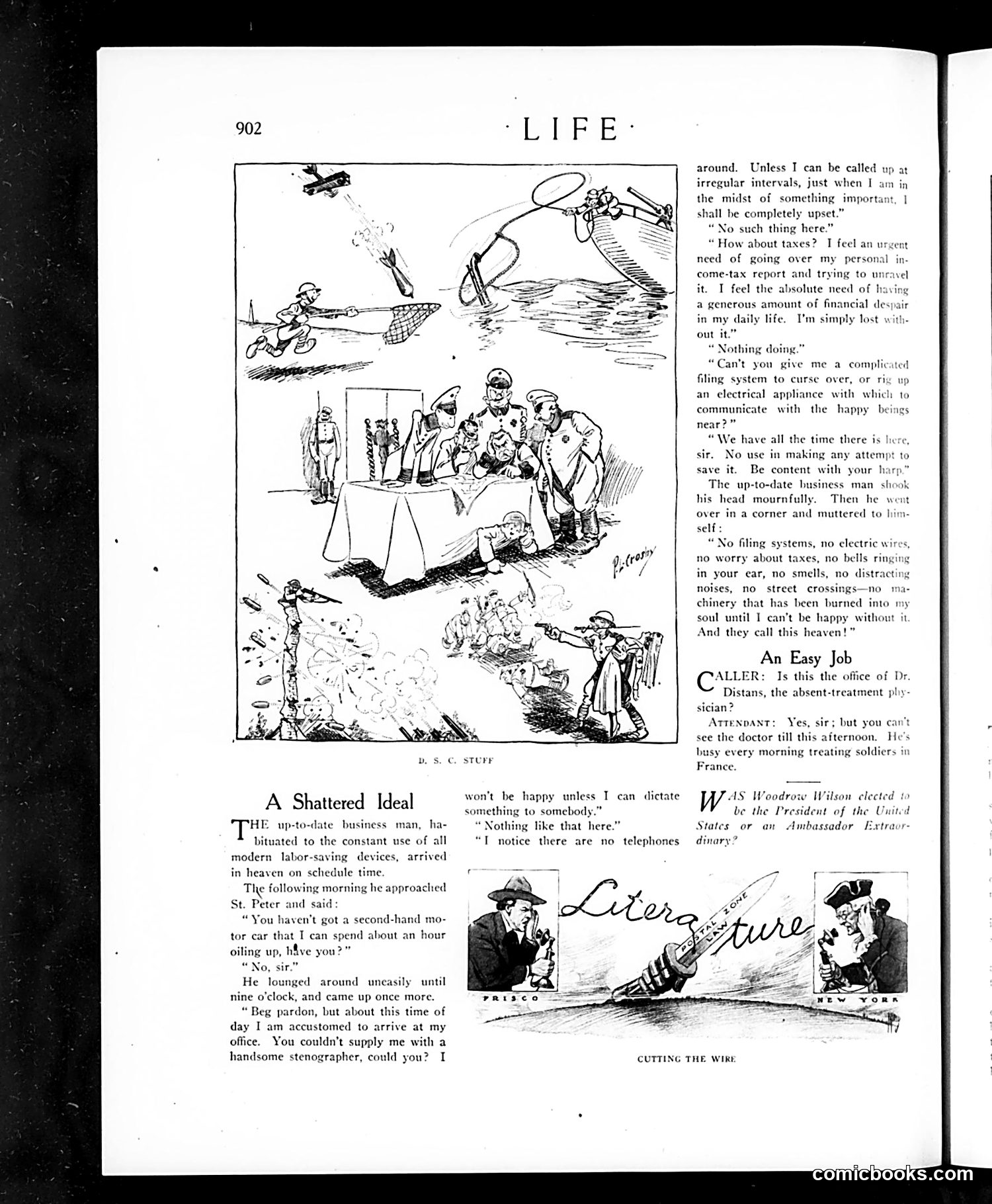
This page contains two satirical pieces critiquing modern American life during World War I era: **"A Shattered Ideal"** mocks the "up-to-date business man" obsessed with labor-saving devices and constant activity. In heaven, he cannot find stenographers, telephones, tax forms, or filing systems—the very apparatus of modern business that define his existence. The joke: he's miserable in paradise because he lacks the irritations and busy-work he needs to feel alive. It's satire on American workaholism and technological dependence. **"An Easy Job"** presents a brief joke about a doctor treating soldiers in France during WWI, making him unavailable for civilian patients. The humor stems from the irony that treating wounded soldiers is now considered his "easy job" compared to normal practice. The bottom section references Woodrow Wilson's potential election or diplomatic role, likely topical to the magazine's publication date during Wilson's presidency. The cartoon illustrations support these themes of modern absurdity and wartime disruption.
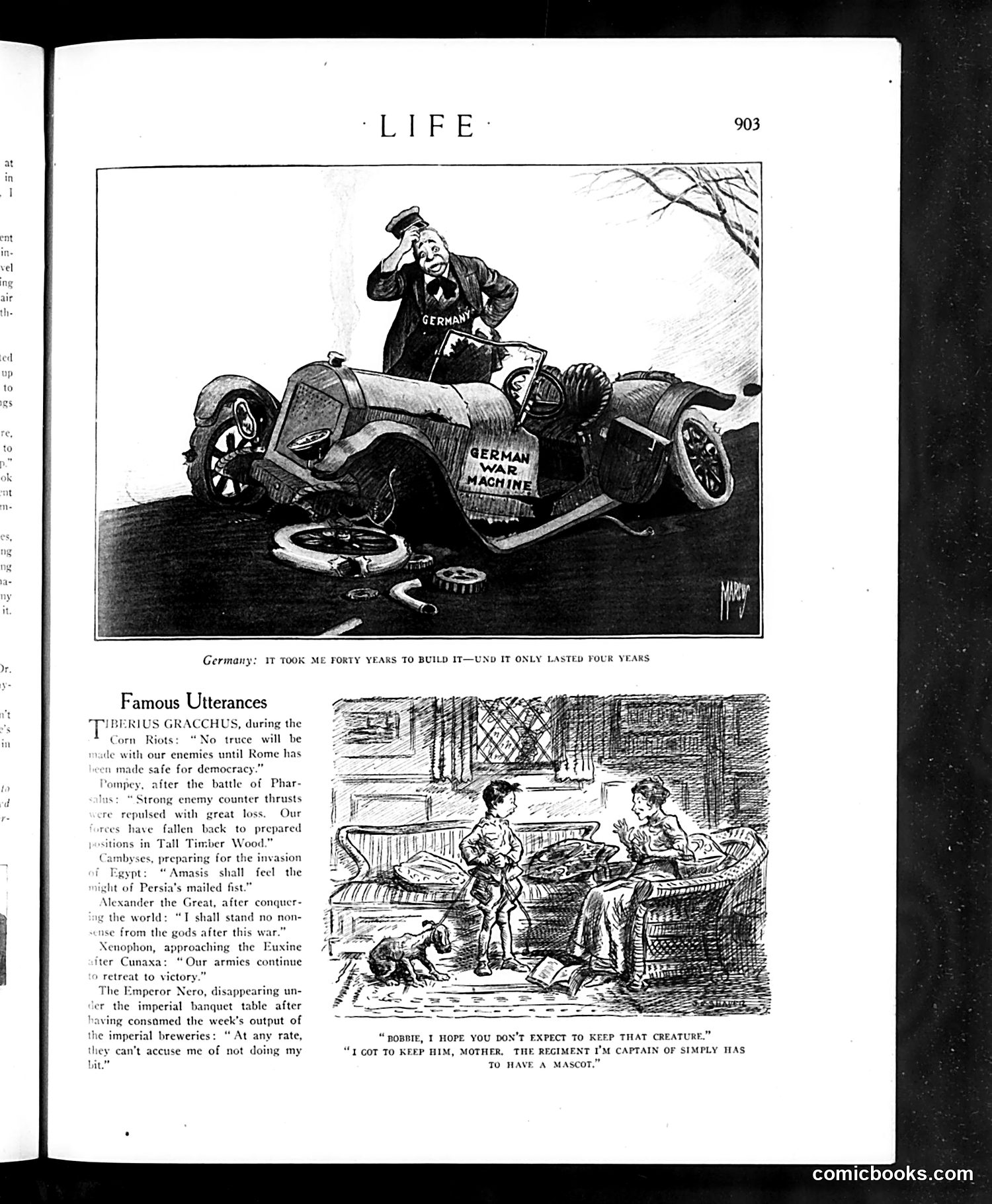
**Top Cartoon:** A caricatured German figure stands on a wrecked "German War Machine," lamenting that it took forty years to build but lasted only four years. This satirizes Germany's military defeat in World War I (1914-1918), mocking the collapse of German military power after years of buildup. **"Famous Utterances" Section:** This presents humorous fake quotes from historical figures—Tiberius Gracchus, Pompey, Cambyses, Alexander the Great, Xenophon, and Nero—applying modern WWI-era language and concerns (democracy, retreat, doing one's bit) anachronistically to ancient times. The humor lies in this absurd historical mashup. **Bottom Cartoon:** A domestic scene where a boy wants to keep a small creature as a military mascot. The joke appears to mock wartime sentimentality or the militarization of everyday life during WWI. The page satirizes German defeat and contemporary wartime attitudes through both direct mockery and historical parody.
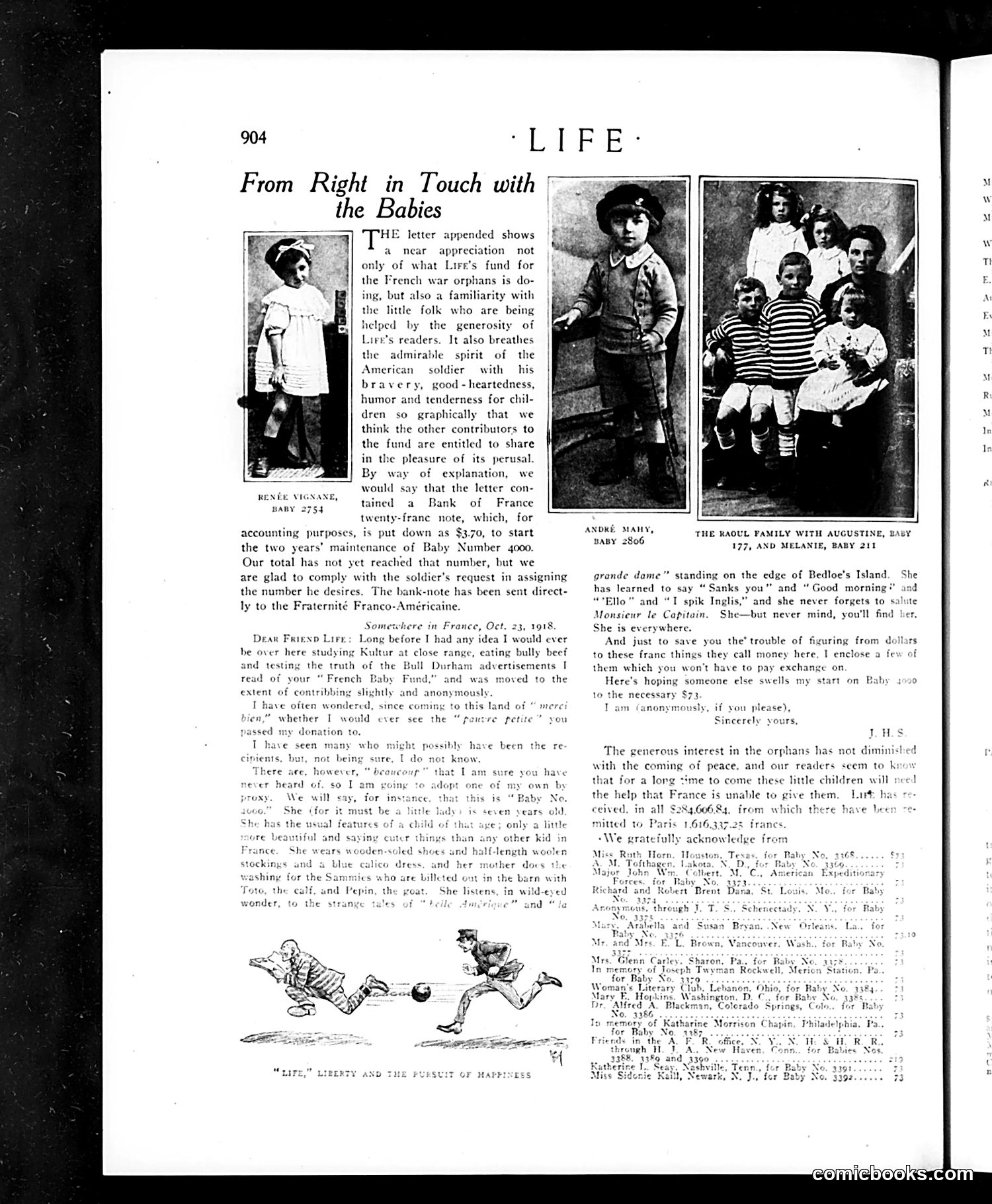
This page documents **Life magazine's fundraising campaign for French war orphans** during World War I. The central content is a letter from an anonymous American soldier in France (dated October 23, 1918, near war's end) donating a 20-franc note to support "Baby Number 4000." The soldier's letter conveys admiration for French children's resilience and charm—describing a young girl learning English phrases and wearing wooden-soled shoes. He's moved by their poverty and circumstances, enclosing money specifically to maintain a child's support for two years. The accompanying photographs show actual orphans being helped by the fund. The small cartoon at bottom depicts soldiers in playful pursuit, illustrating the "good-heartedness" and humor the soldier praised in American troops. **The satire's point**: Life presents this as evidence that American soldiers—despite being in a foreign war zone—retained compassionate humanity toward civilian victims, particularly children. It's simultaneously a fundraising appeal and patriotic reassurance about American soldiers' character.
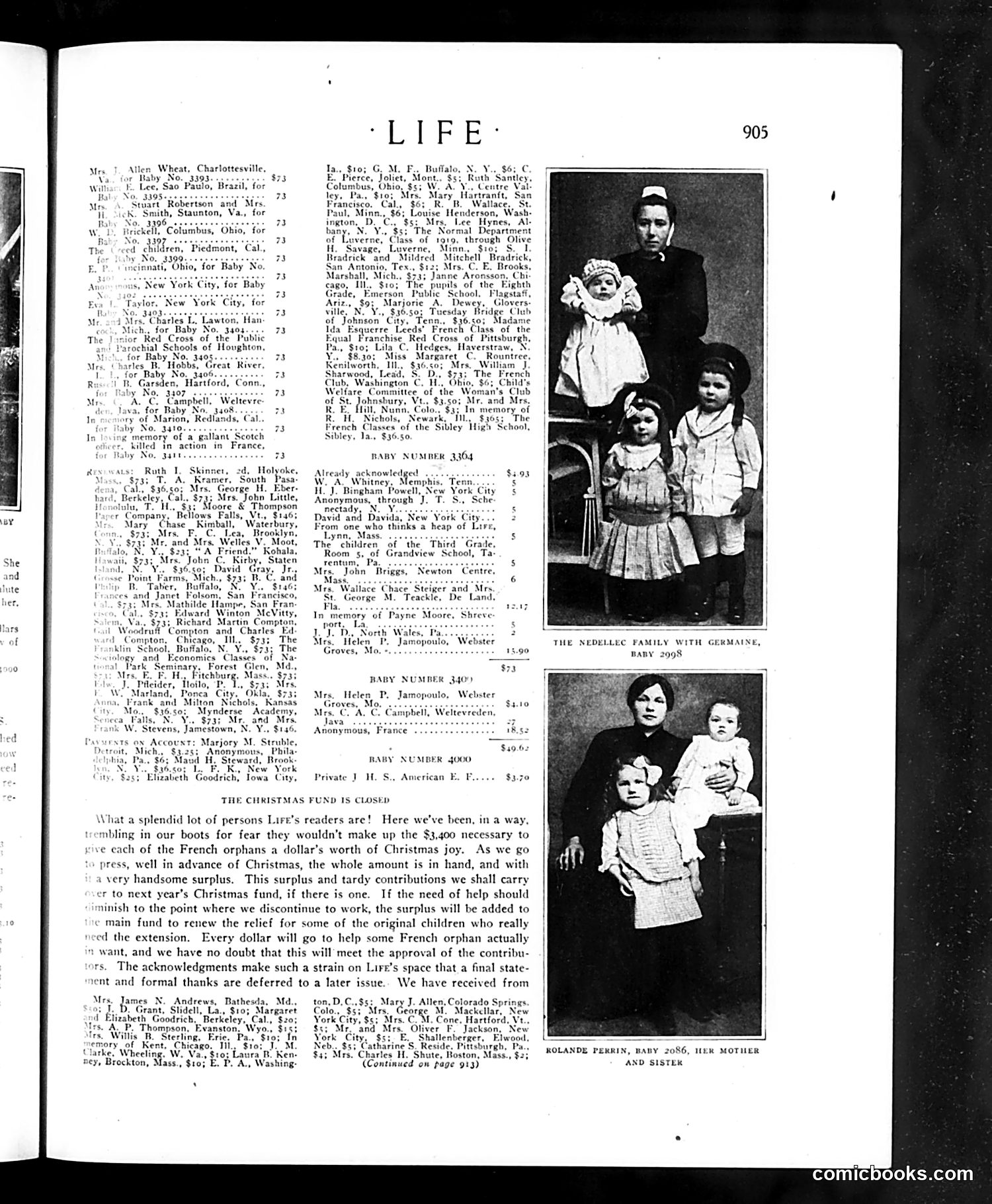
This page documents **Life magazine's Christmas charity fund for French war orphans**—a fundraising campaign that exceeded its $3,400 goal. The bulk of the text lists donors and donation amounts, ranging from individuals to organizations like the "French Classes of the Sibley High School." The accompanying photographs show actual beneficiary children: the Nedelec family with Germaine (baby 2998) and Rolande Perrin (baby 2086) with her mother and sister. The editorial note celebrating the fund's closure explains the magazine's satisfaction: readers contributed generously to provide "a dollar's worth of Christmas joy" to French orphans. The tone is self-congratulatory about Life's readers' charity and suggests surplus funds will support the magazine's relief efforts into the following year. **Context:** This reflects post-WWI American philanthropic efforts toward war-devastated Europe, particularly France—a common charitable focus in the 1920s before American isolationism deepened.
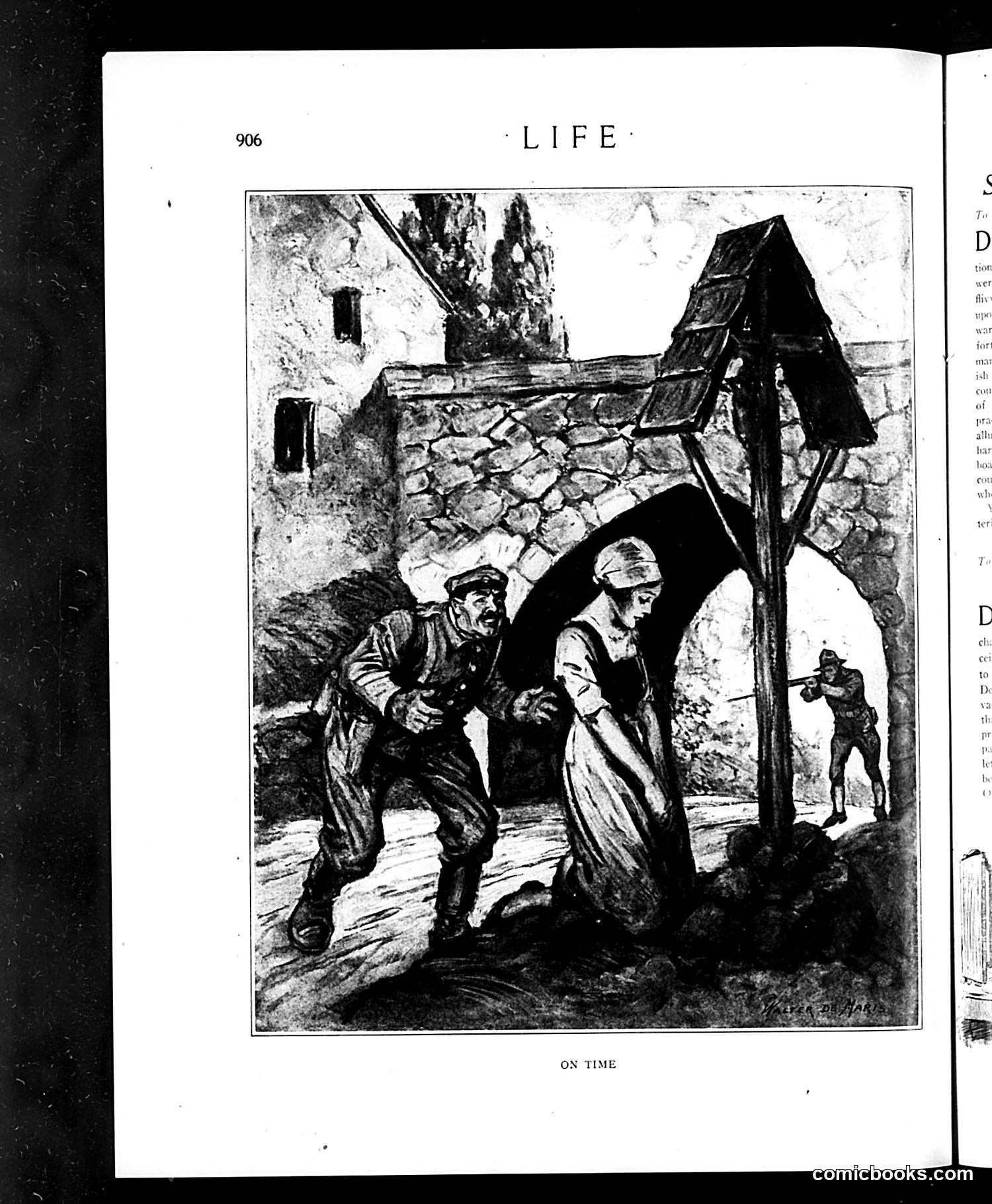
This illustration depicts two figures emerging from what appears to be a tunnel or archway in a stone fortification. The caption "ON TIME" suggests the cartoon comments on punctuality or reliability in meeting an obligation or deadline. The setting—medieval or fortress-like architecture with armed sentries visible—suggests a military or wartime context. The figures' clothing and the overall composition indicate this is likely satirizing some contemporary political or social situation where timeliness was at issue, possibly related to military commitments, treaty obligations, or political promises. Without additional context or a visible date on this page, I cannot definitively identify which specific event or figures are being referenced. The artwork style and setting suggest early-to-mid 20th century publication.
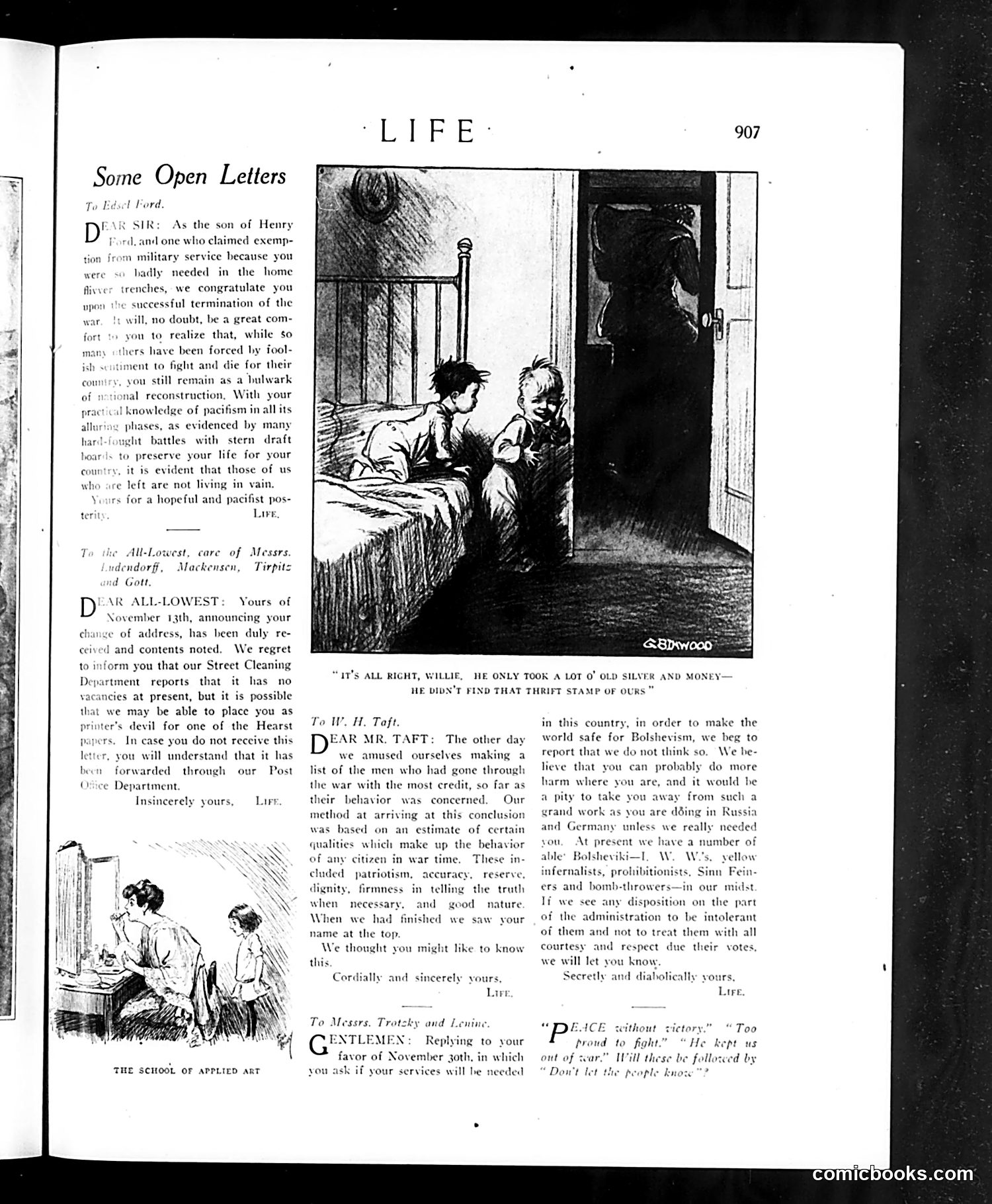
This page contains **satirical open letters** mocking prominent figures who avoided or were exempted from WWI service. **The Edsel Ford letter** attacks Henry Ford's son for claiming exemption from military service as "badly needed in the home," then sarcastically congratulates him while implying his pacifism is cowardly. The joke: while others died, Ford remained safe. **The "All-Lowest" letter** appears to ridicule German military leaders (Ludendorff, Mackensen, Tirpitz) by mockingly offering them menial jobs, suggesting they deserve demotion. **The Taft letter** praises William Howard Taft for his wartime conduct—likely sincere flattery. **The Trotsky/Lenin letter** sarcastically "declines" their offer to spread Bolshevism in America, arguing they're more useful destabilizing Russia and Germany. It complains America already has enough radicals ("Bolsheviki," "prohibitionists," "bomb-throwers"). The **cartoon** shows children finding money/silver without finding a thrift stamp—suggesting waste or moral failure. Overall, the page reflects **post-WWI American anxiety**: resentment toward draft-dodgers, anti-communist sentiment, and social upheaval.
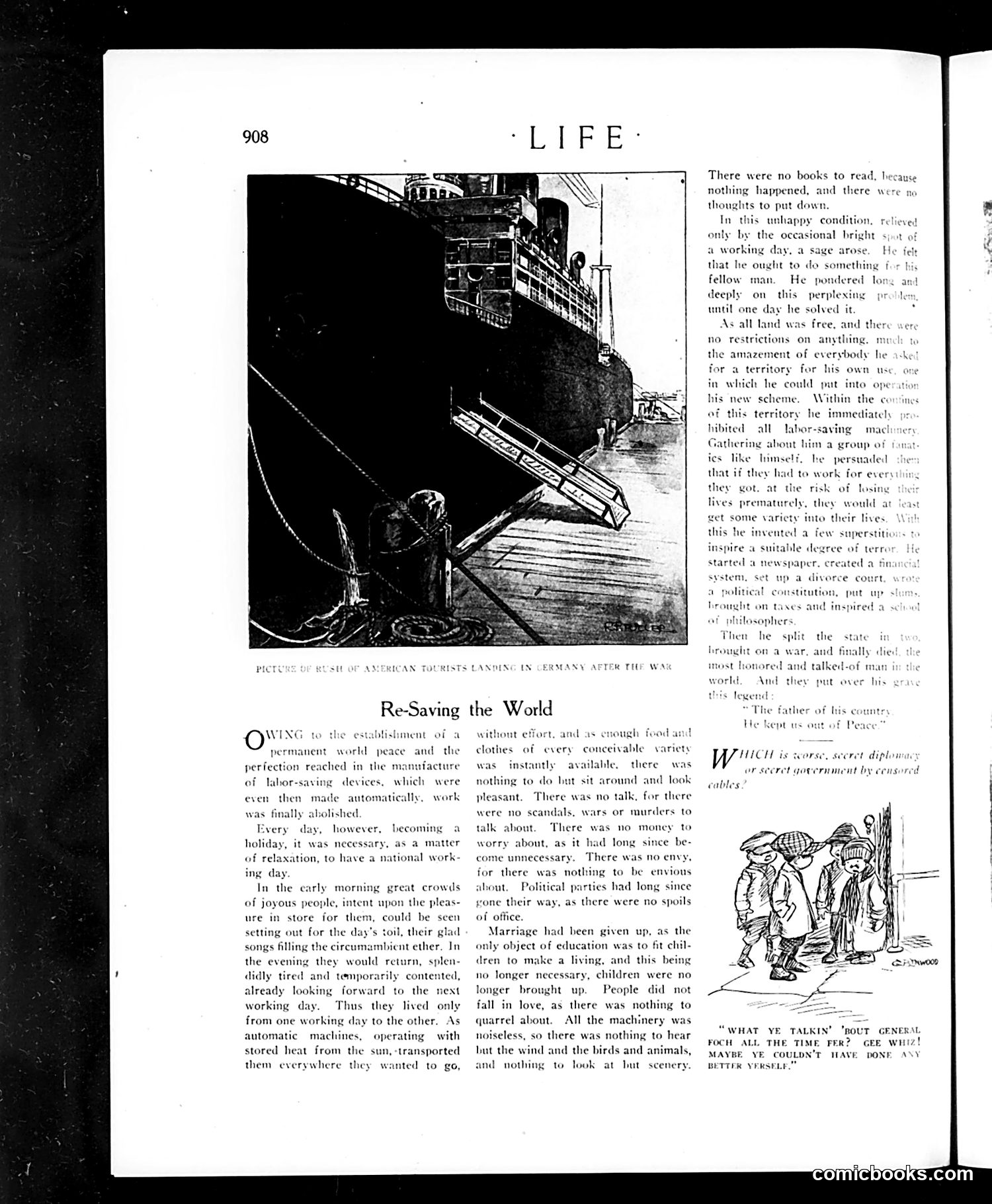
This page satirizes utopian visions of a perfectly mechanized future. The main article "Re-Saving the World" depicts a dystopian society where labor-saving machines have eliminated all work, making life meaningless and tedious. With no conflict, crime, or hardship, people have nothing to do but "sit around and look pleasant." A sage solves this crisis by reintroducing artificial struggle: he creates a territory requiring manual labor, invents superstitions to inspire fear, starts newspapers and courts, and establishes taxation and political systems—essentially recreating civilization's complications deliberately. The satire criticizes both extreme technological utopianism and the unnecessary bureaucratic/political systems that modern society accepts. It suggests that without conflict and labor, human life becomes empty, yet society deliberately perpetuates complications. The bottom cartoon (unclear in context here) appears to reference a military figure discussing General Foch, likely relating to WWI-era diplomacy.
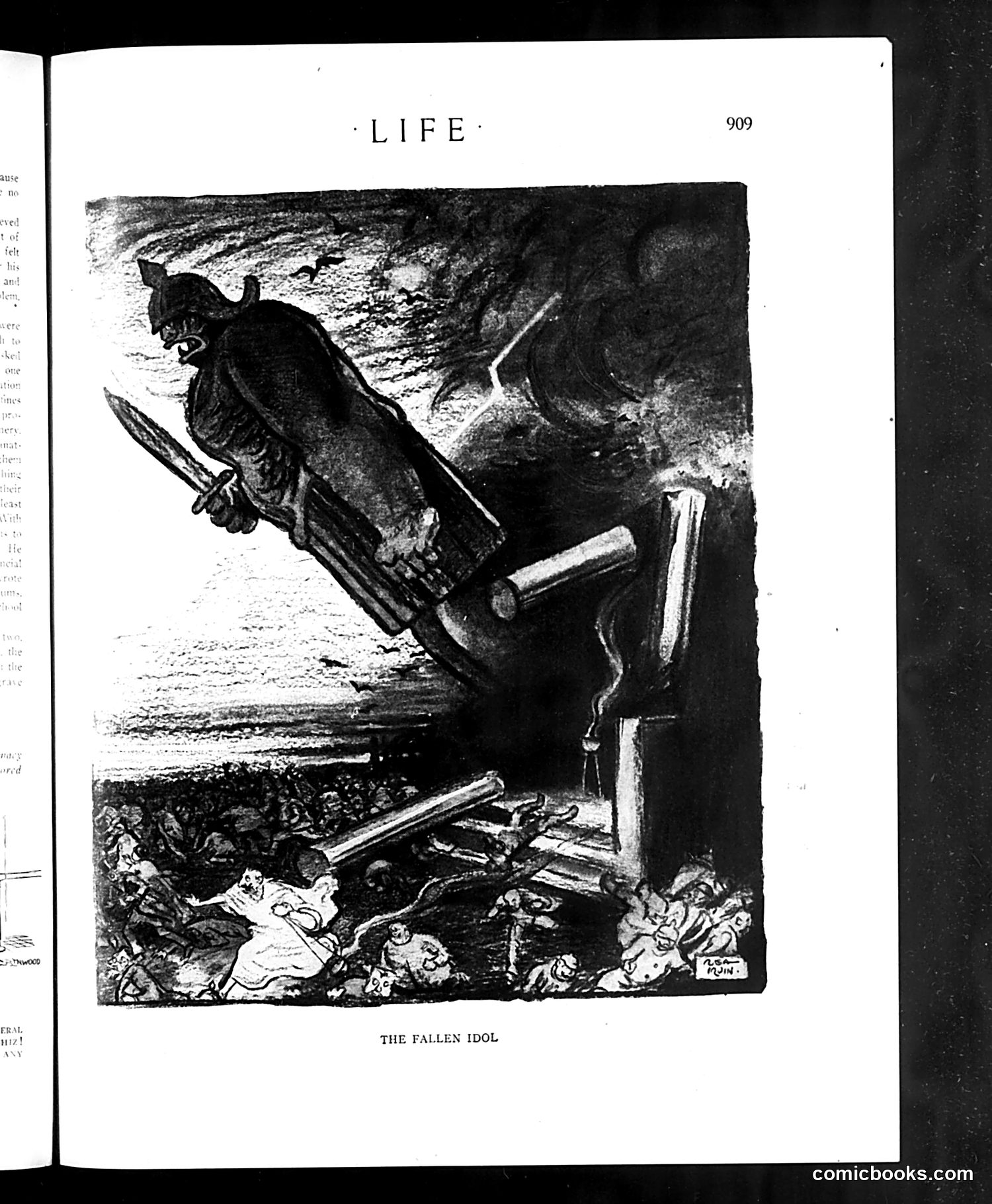
This satirical cartoon depicts a toppled statue or monument of a military figure, shown crashing downward with a sword. The figure appears to be a general or military leader whose image has literally collapsed. Below the fallen idol, civilians—possibly representing the public or common people—scatter in the chaos, some appearing distressed or fleeing. The satire critiques the sudden loss of faith in a previously revered military or political leader. The dramatic composition suggests a dramatic fall from grace or public favor. Without the magazine's date visible, the specific historical figure remains unclear, but the cartoon addresses how public idols can be quickly discredited, leaving their former admirers in confusion and upheaval. The title underscores the theme of disillusionment with authority.
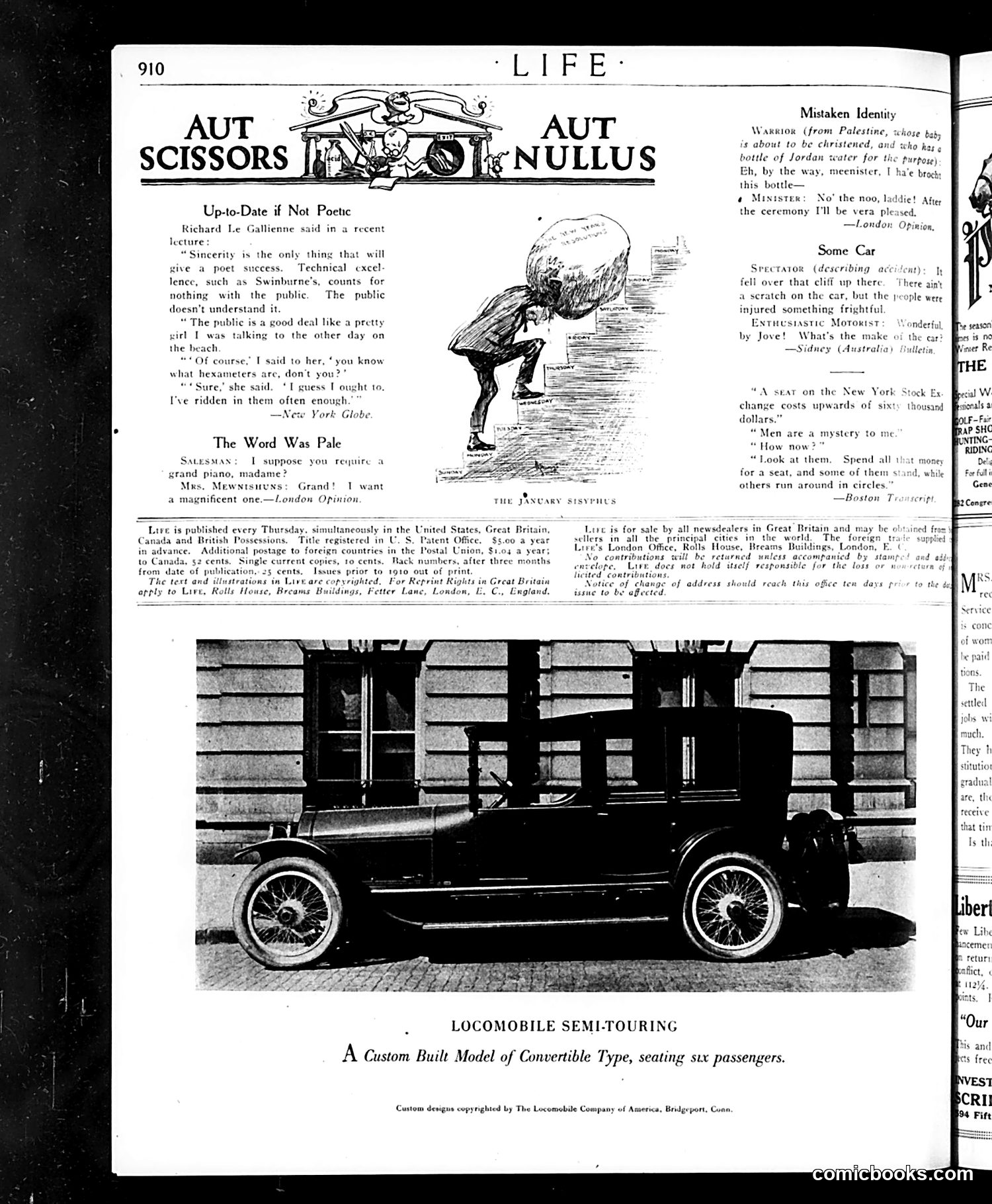
This page contains three brief satirical jokes and an automobile advertisement: **"Up-to-Date if Not Poetic"** mocks literary pretension by quoting Richard Le Gallienne on sincerity in poetry, then undercutting it with a beach anecdote where a woman admits she doesn't understand "poetic excellence" but rides in them anyway—satirizing public indifference to high culture. **"The Word Was Pale"** is a short joke about a salesman pitching a grand piano to a customer, with the punchline relying on wordplay (unclear from OCR but likely about "pale" or "sale"). **The cartoon** (center) shows a figure carrying an enormous head, captioned "The Heavy Syphilis"—a visual pun making fun of venereal disease as a metaphorical burden. **"Some Car"** and other brief jokes mock automobiles and stock market speculation. The page primarily advertises the **Locomobile Semi-Touring automobile**, a luxury convertible for six passengers, manufactured by the Locomobile Company of America. This reflects the era's fascination with early automobiles as status symbols.
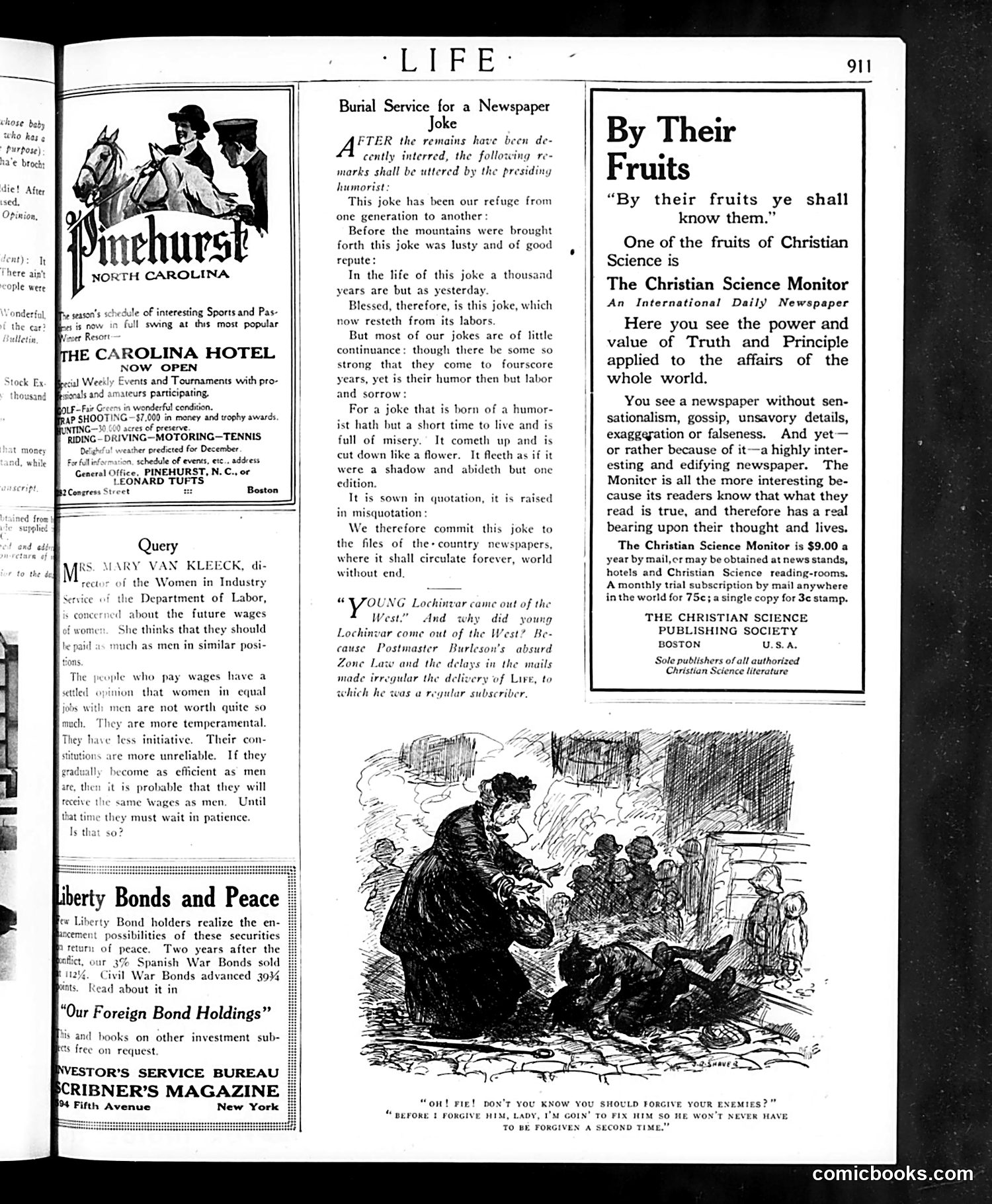
This page contains satirical commentary on early 20th-century American issues: **"Burial Service for a Newspaper Joke"** mocks the exhaustion of old, repeatedly recycled humor—suggesting that even well-worn jokes eventually die from overuse in newspapers. **The "Young Lochinvar" joke** criticizes Postmaster General Albert Burleson's "Zone Law" and mail delays, which allegedly disrupted regular magazine delivery. This references real frustration with postal service inefficiency during that era. **The bottom cartoon** depicts a woman refusing to forgive an enemy, contradicting Christian teaching. The caption's incomplete text suggests ironic commentary on hypocrisy regarding forgiveness. **Additional content** includes a query about women's wages (noting employers paid women less, citing temperament and reliability as justifications—reflecting period sexism) and advertisements for bonds and The Christian Science Monitor. The page exemplifies Life's role: satirizing contemporary politics, social attitudes, and institutional failures through humor and visual commentary.
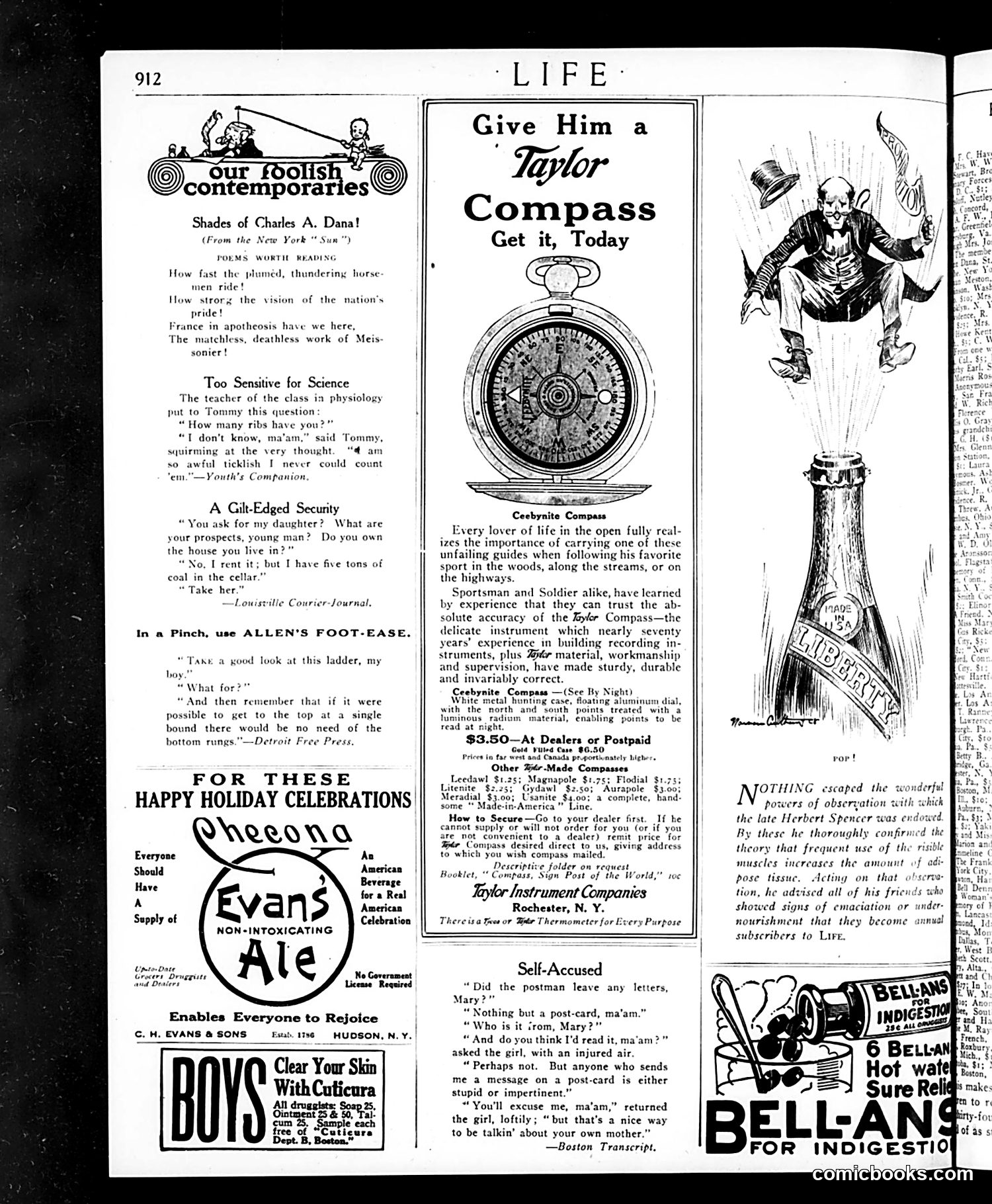
This page from *Life* magazine consists primarily of **advertisements and humorous short pieces**, rather than political cartoons. The main content includes: **Satirical Poems/Jokes:** - "Shades of Charles A. Dana" references the famous newspaper editor, using his name to evoke serious journalism while presenting silly observations about French cavalry and national pride. - Several brief comedic exchanges (on ribs, prospects, ladders) are gentle humor targeting embarrassment and social awkwardness. **Advertisements:** The page is dominated by ads for consumer goods (Allen's Foot-Ease, Cheona Ale, Taylor Compass, Boys Cuticura soap, Bellans antacid), typical of early 20th-century *Life* magazine monetization. **The "Self-Accused" Joke:** A maid chides her employer for calling post-card senders "stupid or impertinent"—revealing the employer was the one who sent it. This plays on class dynamics and social pretension. The page reflects *Life's* dual purpose as satirical publication and commercial vehicle, with light social commentary rather than sharp political critique.
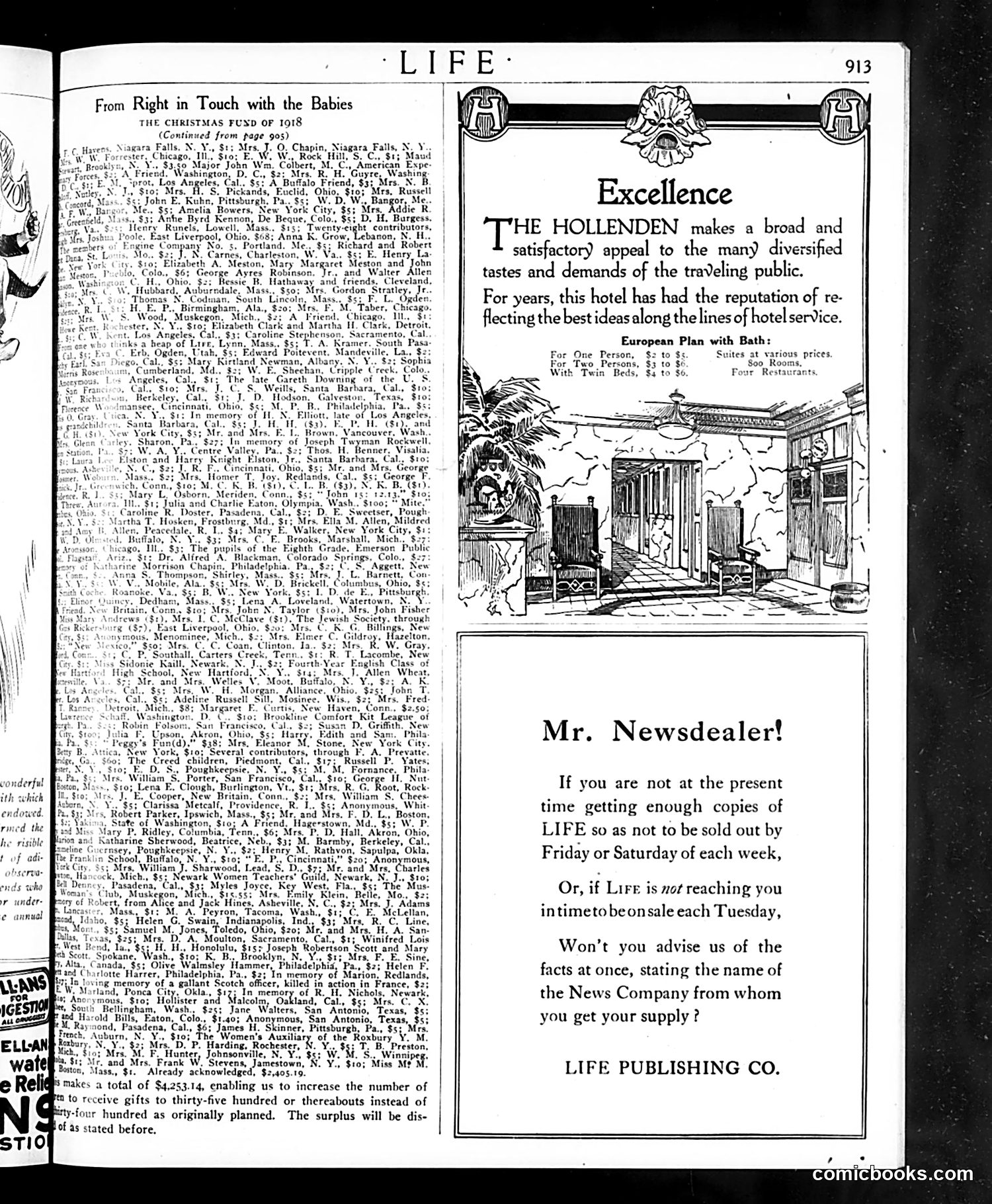
This page is primarily **administrative documentation** rather than political satire. The left column lists hundreds of donors to *Life* magazine's 1918 Christmas Fund, a charitable campaign to provide gifts to soldiers and their families during World War I. Donors range from individuals contributing $1 to organizations giving larger sums, drawn from across the United States. The right side contains two advertisements: one for "The Hollenden" hotel promoting European-plan accommodations, and another from *Life Publishing Co.* addressing newsstand distributors about circulation and subscription issues—noting that *Life* should not be sold only on weekends but should reach newsstands each Tuesday. **There is no political cartoon on this page.** It serves as a record of wartime charitable giving and contains period advertising, typical of magazine layouts from this era.
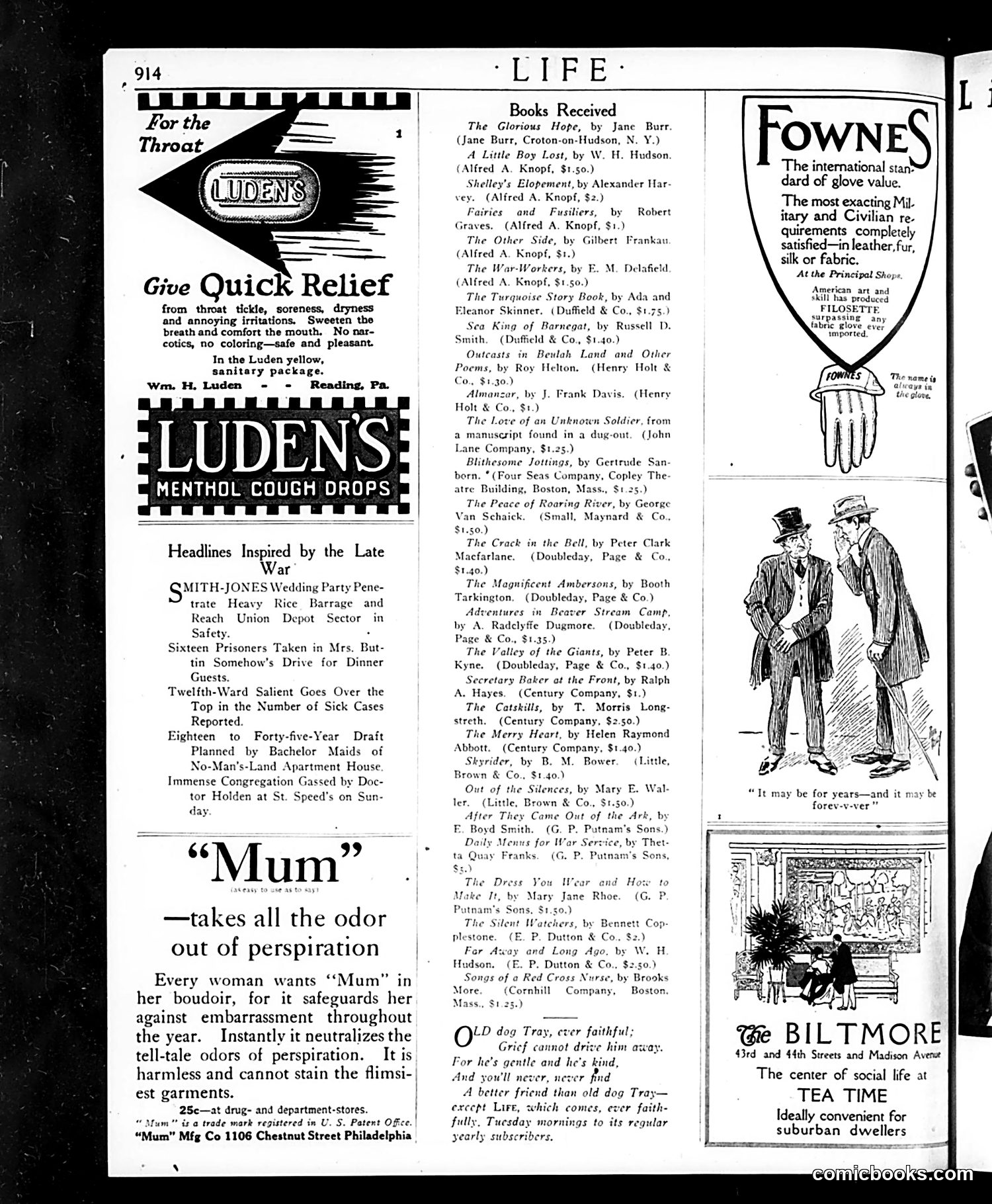
This page is primarily **advertising and book listings** rather than political satire. The dominant content includes: **Advertisements:** Luden's cough drops, "Mum" deodorant, and Fownes gloves occupy substantial space with typical early-20th-century product claims. **The only satirical content** is a brief section titled "Headlines Inspired by the Late War"—military terminology applied absurdly to domestic events. Examples mock WWI's battlefield language by describing a wedding party "penetrating a rice barrage," bachelor maids planning a "draft," and a church congregation being "gassed." This satirizes how thoroughly war language had saturated American speech during/after World War I. **Book reviews** list recently published titles, many war-related ("Secretary Baker at the Front," "Songs of a Red Cross Nurse"), reflecting the era's preoccupation. The page reflects post-WWI American culture: commercialism, lingering war consciousness, and gentle humor about how thoroughly military vocabulary had infiltrated everyday conversation.