
Life, 1918-12-12 · page 17 of 34
Life — December 12, 1918 — page 17: what you’re looking at
What you’re looking at
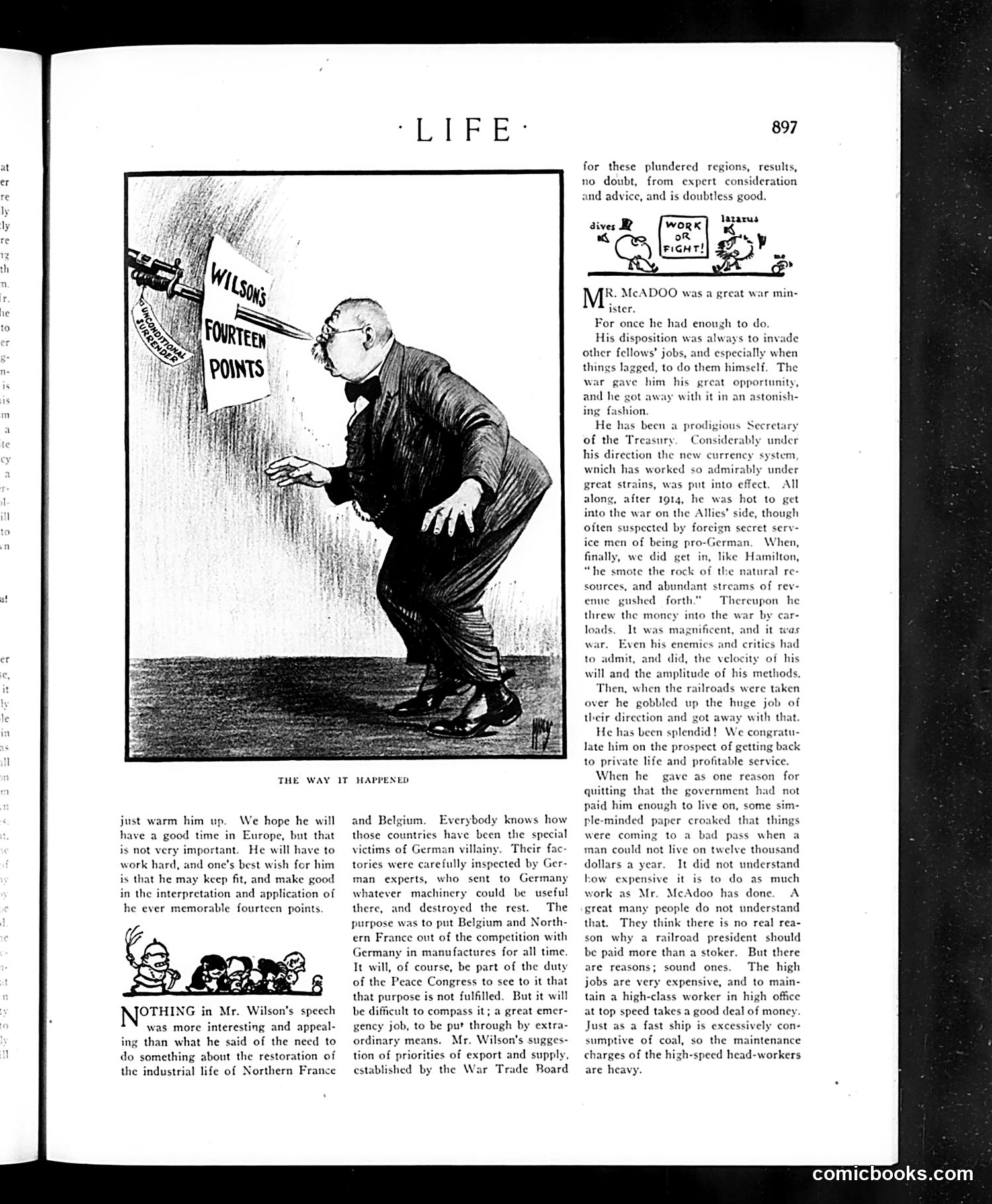
This Life magazine page contains political satire about President Wilson's Fourteen Points peace proposal following World War I. **The Main Cartoon:** Shows a figure (labeled "WILSONS' FOURTEEN POINTS") pinning a document to a wall, depicted as a tailor or craftsman carefully hanging up work. The satire suggests Wilson is methodically presenting his peace plan—treating abstract diplomatic principles like a tangible, physical item to be inspected and applied. **The Text Commentary:** Praises Secretary of the Treasury William McAdoo as an exceptional wartime administrator who mobilized American financial resources for the Allied war effort. The piece defends high executive salaries, arguing that maintaining "high-speed head-workers" is expensive, like operating a fast ship that consumes excessive coal. **Historical Context:** This appears post-WWI (references 1914 entry into war), addressing Wilson's peace negotiations and reconstruction of war-damaged France and Belgium—concerns central to the 1919 Treaty of Versailles negotiations. The satire's tone is generally supportive of both Wilson and McAdoo's wartime leadership.
📄 Transcribed text from this page (OCR, searchable)
Machine-transcribed from the original scan — historical spelling and the odd misread are preserved.
THE WAY We hope he will just warm him up. ave a good time in Europe, but that not very important. He will have to work hard, and one’s best wish for him is that he may keep fit, and make good in the interpretation and application of he ever memorable fourtcen points. OTHING in Mr. Wilson's speech was more interesting and appeal- ing than what he said of the need to do something about the restoration of the industrial life of Northern France Tv HAPPENED Zverybody knows how those countries have been the special victims of German villainy, Their fac- tories were carefully inspected by Ger- man experts, who sent to Germany whatever machinery could be useful there, and destroyed the rest. The purpose was to put Belgium and North- ern France out of the competition with Germany in manufactures for all time It will, of course, be part of the duty of the Peace Congress to see to it that that purpose is not fulfilled. But it will be difficult to compass it; a great emer- gency job, to be put through by extr: ordinary means. Mr. Wilson's sugges- tion of priorities of export and supply, established by the War Trade Board and Belgium. 897 for these plundered regions, results, no doubt, from expert consideration and advice, and is doubtless good. lazarus R. McADOO was a great war min- ister. ‘or once he had enough to do. His disposition was always to invade other fellows’ jobs, and especially when things lagged, to do them himself. The war gave him his great opportunity, and he got away with it in an astonish- ing fashion. He has been a prodigious Secretary of the Treasury. Considerably under his direction the new currency system. wnich has worked so admirably under great strains, was put into effect. All along, after 1914, he was hot to get into the war on the Allies’ side, though often suspected by forcign secret serv- ice men of being pro-German. When, final, did get in, like Hamilton, “he smote the rock of the natural re- sources, and abundant streams of rev- enue gushed forth.” Thereupon he threw the moncy into the war by car- loads. It was magnificent, and it was Even his enemics and critics had «l did, the velocity of his will and the amplitude of his methods. Then, when the railroads were taken over he gobbled up the huge job of their direction and got away with that. He has been splendid! We congratu- late him on the prospect of getting back to private life and profitable service. When he gave as one for quitting that the government had not paid him enough to live on, some sim- ple-minded paper croaked that things were coming to a bad pass when a man could not live on twelve thousand dollars a year. It did not understand how to do as much work as Mr. McAdoo has done. A great many people do not understand that. They think there is no real rea- son why a railroad president should be paid more than a stoker. But there are reasons; sound ones. The high jobs are very expensive, and to main- tain a high-class worker in high office at top speed takes a good deal of money. Just as a fast ship is excessively con- sumptive of coal, so the maintenance charges of the high-speed head-workers are heavy. war, to admit, reason expensive it is comicbooks.com