
Life, 1918-12-12 · page 16 of 34
Life — December 12, 1918 — page 16: what you’re looking at
What you’re looking at
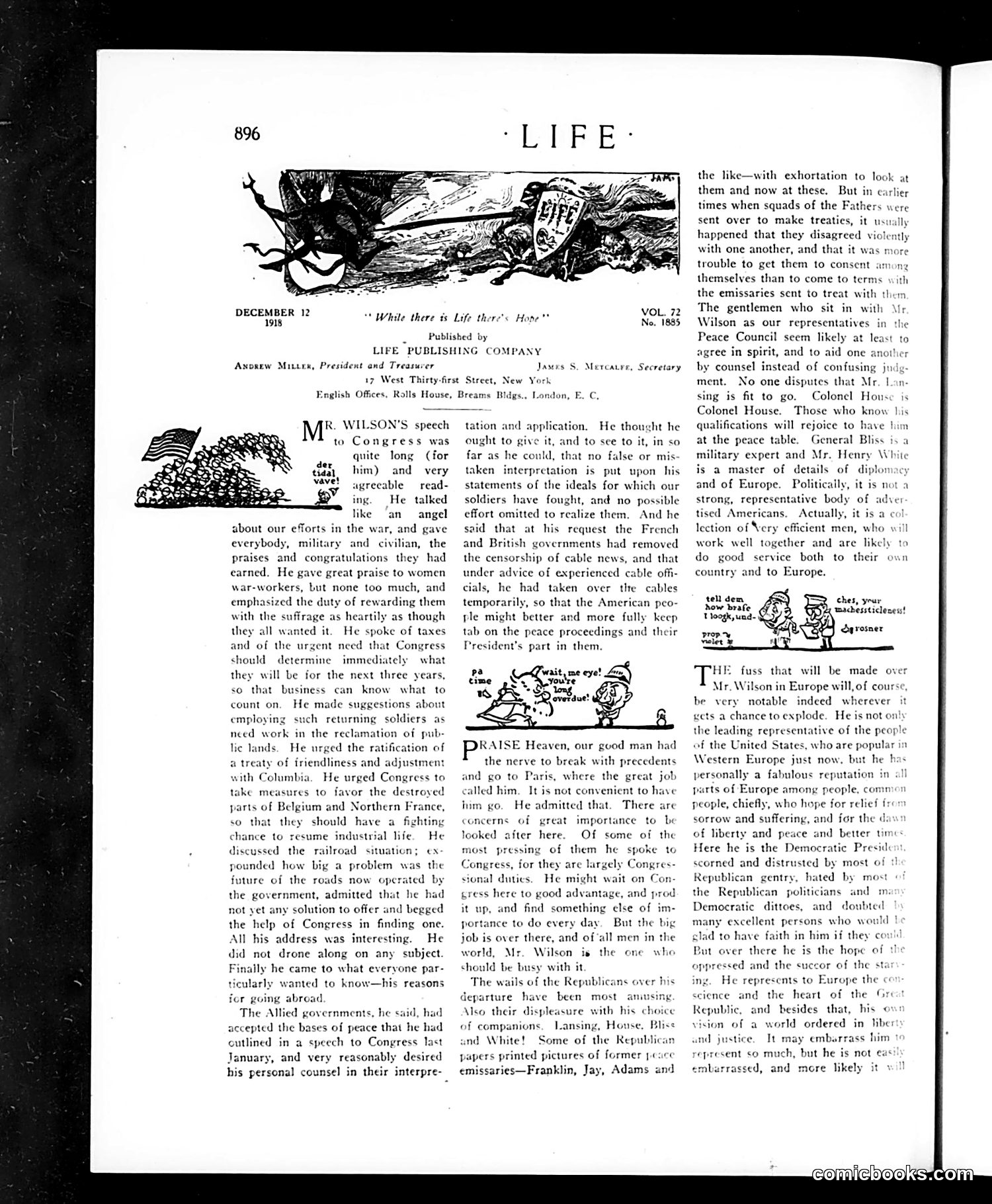
This page discusses President Wilson's speech to Congress regarding his decision to personally attend the Paris Peace Conference following World War I's armistice. **The Key Points:** Wilson justified going to Paris to ensure his stated peace ideals were properly interpreted and implemented. He claimed the Allied governments requested his personal counsel and that he'd temporarily taken control of cable censorship to give Americans fuller information about peace proceedings. **The Satire:** The magazine gently mocks Republican opposition to Wilson's departure and their complaints about his chosen advisors (Lansing, House, Bliss, White). Republicans circulated images of Founding Fathers as if to suggest better representatives should have been chosen. Life's response: historical peace delegations also disagreed internally—the Founding Fathers themselves frequently quarreled, making the current controversy unremarkable. The article's title, "While there is Life there's Hope," suggests cautious optimism about the peace process, though the tone implies some skepticism about Wilson's justifications and Republican carping alike.
📄 Transcribed text from this page (OCR, searchable)
Machine-transcribed from the original scan — historical spelling and the odd misread are preserved.
DECEMBER 12 1918 “* While there is Life there's Hi _ Published by LIFE PUBLISHING COMPANY Axorew Muttrx, President and Treasurer Jastes S. Mereaure, Secretary 17 West Thirty-first Street, New York English Offices, R. WILSON’S speech to Congress was quite long (for him) and very agreeable read- ing. He talked like ‘an angel about our efforts in the war, and gave everybody, military and civilian, the praises and congratulations they had earned. He gave great praise to women war-workers, but none too much, and emphasized the duty of rewarding them with the suffrage as heartily as though they all wanted it. He spoke of taxes and of the urgent need that Congress nmediately what tidal vave! should determine they will be for the next three years, business can know what to He made suggestions about employing such returning soldiers as need work in the reclamation of pub- lic lands, He urged the ratification of a treaty of friendliness and adjustment with Columbia. He urged Congress to take favor the destroyed parts of Belgium and Northern France, should have a fighting chance to resume industrial life. He the railroad how big a problem was the ed by so that count on measures 10 so that they discussed situation; ex nded future of the roads now ope the government, admitted that he had not yet any solution to offer and begged the help of Congress in finding one. All his address was interesting. He did not drone along on any subject. Finally he came to what everyone par- ticularly wanted to know—his reasons ior going abroad The Allied governments, he said, had accepted the bases of peace that he had outlined in a speech to Congress last January, and very reasonably desired his personal counsel in their interpre- Rolls House, Breams Bldgs. London, E. C, tation and application. He thought he ought to give it, and to see to it, in so far as he could, that no false or mis. taken interpretation is put upon his statements of the ideals for which our soldiers have fought, and no possible effort omitted to realize them. And he said that at his request the French and British governments had removed the censorship of cable news, and that under advice of experienced cable offi- cials, he had taken over the cables temporarily, so that the American pco- ple might better and more fully keep tab on the peace proceedings and their President's part in them RAISE Heaven, our good man had the nerve to break with precede: and go to Paris, where the great jol called him. It is not convenient to have i He admitted that. There are concerns of great importance to be looked after here. Of some of the most pressing of them he spoke to ly Congres- it on Co him go. Congress, for they are larg sional duties. He might w gress here to good advantage, and prod it up, and find something else of im- portance to do every day. But the big job is over there, and of/all men in the world, Mr. Wilson is the whe should be busy with it The wails of the Republicans over } departure have been most amiusin; Also their displeasure with his choice of companions, Lansing, House, Bl und White! Some of the Republican papers printed pictures of former psec emissaries—Franklin, Jay, Adams and the like—with exhortation to look them and now at these. But in ¢ times when squads of the Fathers were sent over to make treaties, it usually happened that they disagreed violently with one another, and that it was more trouble to get them to consent among themselves than to come to terms \.ith the emissaries sent to treat with them, The gentlemen who sit in with Mr Wilson as our representatives in Peace Council seem likely at le agree in spirit, and to aid one ai by counsel instead of confusing ment. No one disputes that Mr sing is fit to go. Colonel Hous Colonel House. Those who know his qualifications will rejoice to have him at the peace table. General Bliss is a military expert and Mr. Henry White is a master of details of diplor and of Europe. Politicaily, it is not a strong, representative body of : tised Americans. Actually, it isa lection of Very efficient men, who will work well together and are likely to do good both to their own country and to Europe. servic ches, yrur wachessticleness! Syrosner HE fuss that will be made over Mr. Wilson in Europe will,of course, be very notable indeed wherever it gets a chance to explode. He is not only the leading representative of the people of the United States, who are popular in Western Europe just now, but he has personally a fabulous reputation in all parts of Europe among people, comr people, chiefly, who hope for relief i: sorrow and suffering, and for the d. of liberty and peace and better times Here he is the Democratic Presid: scorned and distrusted by most of #] Republican gentry, hated by most the Republican politicians and ms Democratic dittoes, and doubted many excellent persons who would glad to have faith in him if they cc But over there he is the hope of r of the sta Zurope the oppressed and the sui s. He represents to science and the heart of the Gr Republic, and besides that, his « orld ordered in Tibe It may embarrass him vision of a nd justice represent so much, but he is not ¢ ed, and emburr ore likely it