
Life, 1918-12-12 · page 28 of 34
Life — December 12, 1918 — page 28: what you’re looking at
What you’re looking at
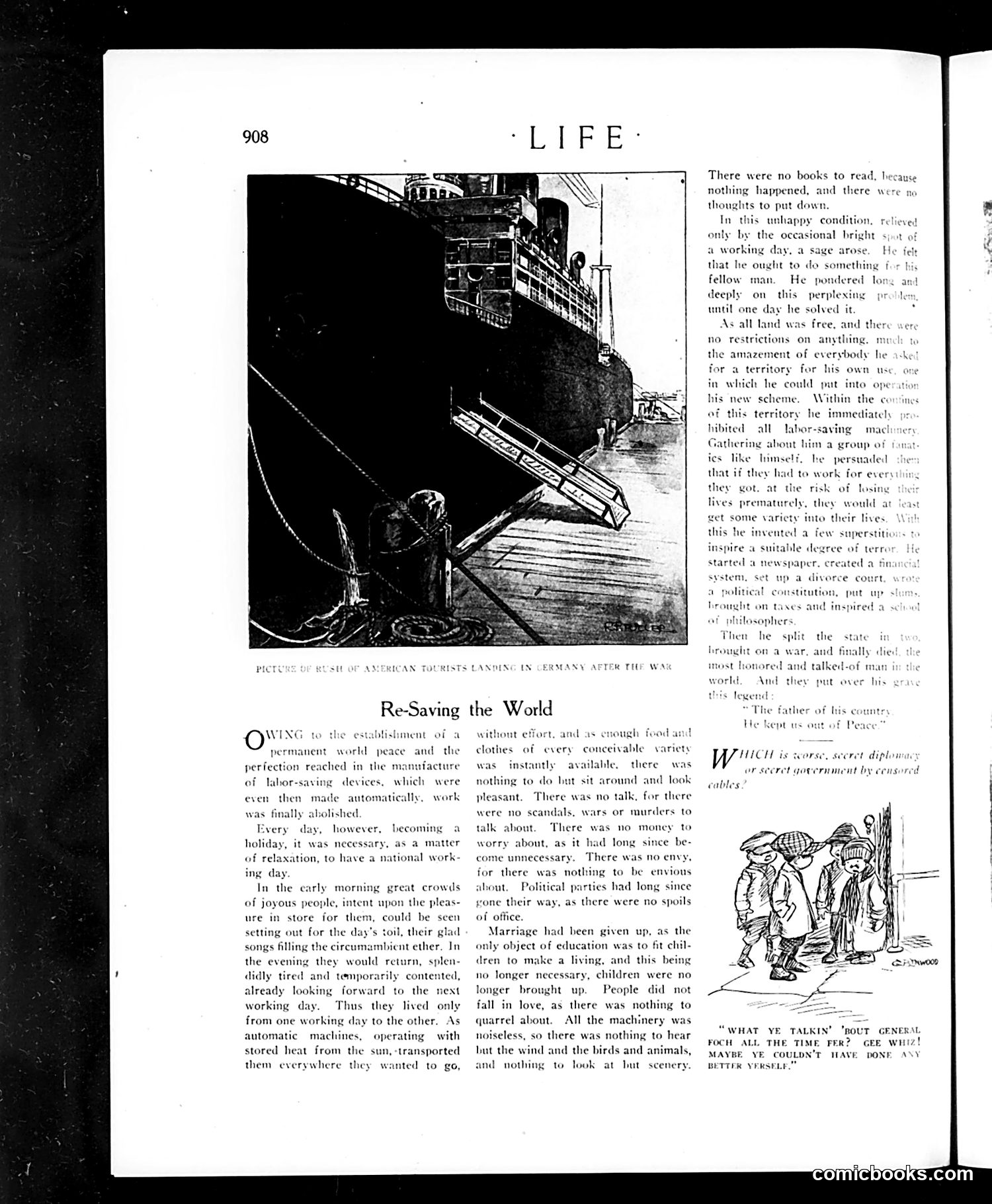
This page satirizes utopian visions of a perfectly mechanized future. The main article "Re-Saving the World" depicts a dystopian society where labor-saving machines have eliminated all work, making life meaningless and tedious. With no conflict, crime, or hardship, people have nothing to do but "sit around and look pleasant." A sage solves this crisis by reintroducing artificial struggle: he creates a territory requiring manual labor, invents superstitions to inspire fear, starts newspapers and courts, and establishes taxation and political systems—essentially recreating civilization's complications deliberately. The satire criticizes both extreme technological utopianism and the unnecessary bureaucratic/political systems that modern society accepts. It suggests that without conflict and labor, human life becomes empty, yet society deliberately perpetuates complications. The bottom cartoon (unclear in context here) appears to reference a military figure discussing General Foch, likely relating to WWI-era diplomacy.
📄 Transcribed text from this page (OCR, searchable)
Machine-transcribed from the original scan — historical spelling and the odd misread are preserved.
Re-Saving lishment of a (ISG t permanent world peace and the perfection reached in the manufacture of labor-saving devices, which were then made automatically, work was finally abolished even day, however, becoming a holiday, it was necessary, as a matter Every of relaxation, to have a national work- ing day In the carly morning of joyous people, intent upon the pleas- reat crowds ure in store for them, could be seen setting out for the day’s toil, their glad songs filling the circumambient ether. In the evening they would return, splen- didly tired and temporarily cont already looking forward to the next working day. Thus they lived only y to the other. As operating — with stored heat from the sun, -transported them everywhere they wanted to go, from one working d utomatic machines, the World without effort, and as cnou { od ar clothes of every conceivable variety was instantly available, there was nothing to do but sit around and look pleasant, There was no talk, for there were no scandals, wars or murders to talk worry about, as it had long since be- There was no envy, about. There was no money to come unnecessary. there nothing to be Political parties had long since ior envious ahout sone their way, as there were no spoils of office. Marriage had been given up, as the only object of education was to fit chil- dren to make a living, and this being children were no People did not fall in love, as there was nothing to All the machinery was noiseless, so there was nothing to hear but the wind and the birds and animals, look at but se no longer necessary, longer brought up quarrel about and nothing to ery. There were no books to read, hecause nothing happened, and there were no thoughts to put down. In this unhappy condition, re! only by the occasional bright < a working day, a sage arose. Hi that he ought to do something f fellow man deeply on He pondered lo this until one day he solved it As all land was free, and ther perplex no restrictions on anything, 1 the amazement of everybody he for a territory for his own usc in which he could put into his new scheme. Within the of this territory he immediatel hibited all labor-saving Gathering about him a group of ics like persuaded that if they had to work for e they got, at lives prematurely, they would at mac limss the k of losing get some variety into their lives this he invented a few superstit inspire a suitable degree of terrs started a newspaper. created system, set up a diverce c political constitution, put ups ght on taxes and inspired Then he the and fi Hy dies A talked-of man his put over ather of his countr ep us HICH is worse, secret diplor or secret government by censorc cables "ROUT GENERAL FER? GEE wuz! WAVE DONE ANY “WHAT YE FOCH ALL THE TIME MAYBE YE COULDN'T BETTER VERSELE.” TALKIN