
Life, 1918-12-12 · page 20 of 34
Life — December 12, 1918 — page 20: what you’re looking at
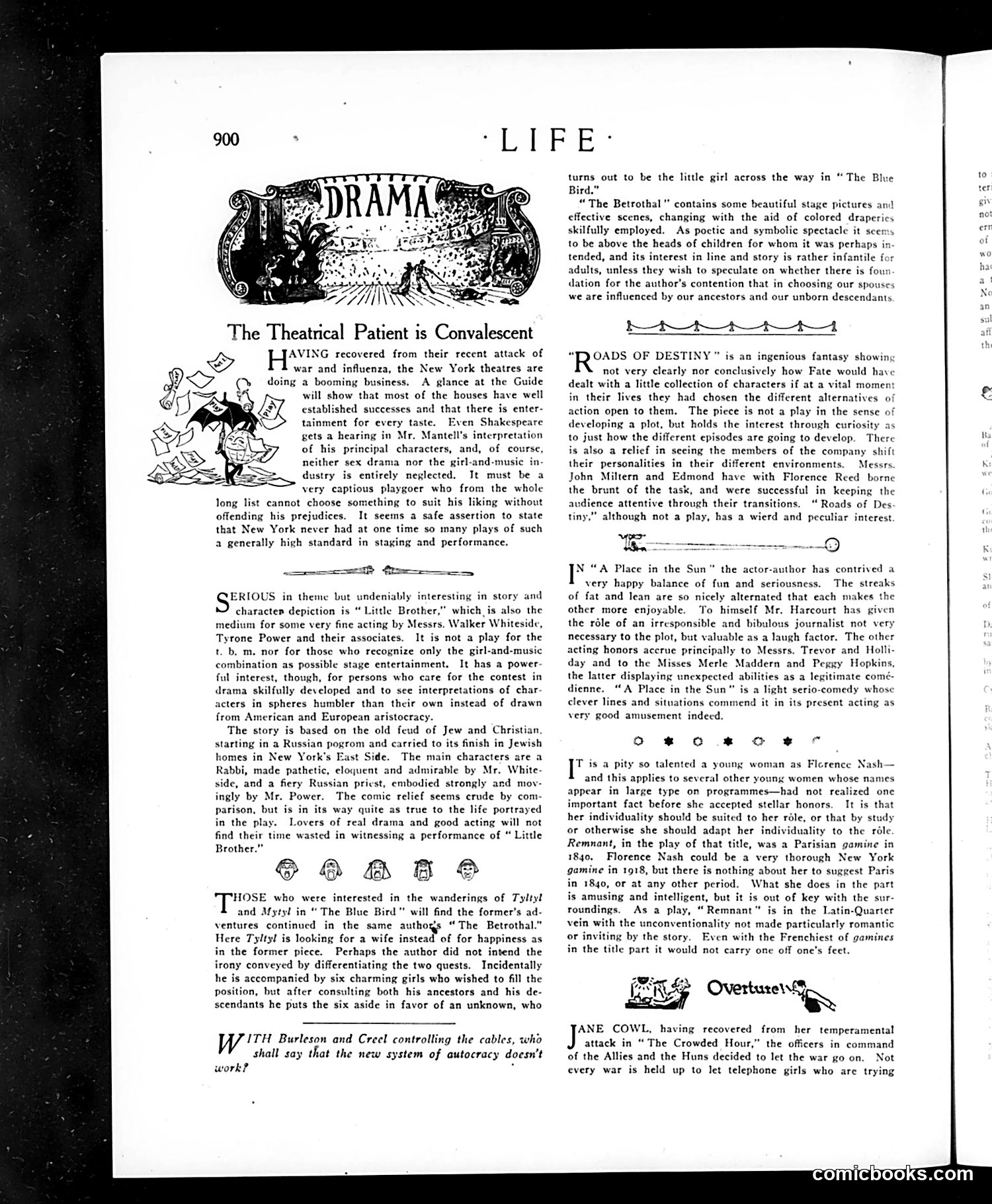
What you’re looking at
This page reviews New York theatrical productions during the post-WWI recovery period ("recovered from their recent attack of war and influenza"). The reviews praise Broadway's diverse offerings—Shakespeare, serious drama like "Little Brother" (featuring anti-Semitic/Christian conflict themes), and fantasy plays like "The Betrothal" and "Roads of Destiny." The notable satirical element appears in the brief quip at bottom: "WITH Burleson and Creel controlling the cables, who shall say that the new system of autocracy doesn't work?" This references **Albert Burleson** (Postmaster General) and **George Creel** (propaganda chief), who together controlled wartime communications censorship. The joke sarcastically suggests their control resembles autocracy—critiquing government overreach during and after WWI. The page presents theater as cultural recovery, with satire targeting government censorship rather than theatrical content.
📄 Transcribed text from this page (OCR, searchable)
Machine-transcribed from the original scan — historical spelling and the odd misread are preserved.
cal Oe a The Theatrical Patient is Convalescent AVING recovered from their recent attack of war and influenza, the New York theatres are doing a booming business, A glance at the Guide will show that most of the houses have well established successes and that there is enter- tainment for every taste. Even Shakespeare gets a hearing in Mr. Mantell’s interpretation of his principal characters, and, of course, neither sex drama nor the girl-and-music in dustry is entirely neglected. It must be a very captious playgoer who from the whole cannot choose something to suit his liking without offending his prejudices. It seems a safe assertion to state that New York never had at one time so many plays of such a generally high standard in staging and performance. a ERIOUS in theme but undeniably interesting in story and character depiction is “Little Brother,” which is also the medium for some very fine acting by Messrs. Walker Whiteside, Tyrone Power and their associates. It is not a play for the t. b. m. nor for those who recognize only the girl-and-music combination as possible stage entertainment. It has a power ful interest, though, for persons who care for the contest in drama skilfully developed and to see interpretations of char acters in spheres humbler than their own instead of drawn from American and European aristocracy. The story is based on the old feud of Jew and Christian starting in a Russian pogrom and carried to its finish in Jewish homes in New York's East Side. The main characters are a Rabbi, made pathetic, eloquent and admirable by Mr. White side, and a fiery Russian priest, embodied strongly and mov- ingly by Mr. Power. The comic relief seems crude by com- parison, but is in its way quite as true to the life portrayed in the play. Lovers of real drama and good acting will not find their time wasted in witnessing a performance of “ Little Brother.” oo & B ® 'HOSE who were interested in the wanderings of Tyltyl and Mytyl in “ The Blue Bird” will find the former's ad- ventures continued in the same authogs “The Betrothal.” Here Tyltyl is looking for a wife instead of for happiness as in the former piece. Perhaps the author did not intend the irony conveyed by differentiating the two quests. Incidentally he is accompanied by six charming girls who wished to fill the position, but after consulting both his ancestors and his de- scendants he puts the six aside in favor of an unknown, who ITH Burleson and Creel controlling the cables, who shall say that the new system of autocracy doesn’t work? . turns out to be the little girl across the way in “ The Blue Bird.” “The Betrothal ” contains some beautiful stage pictures and effective scenes, changing with the aid of colored draperies skilfully employed. As poctic and symbolic spectacle it seems to be above the heads of children for whom it was perhaps i tended, and its interest in line and story is rather infantile for adults, unless they wish to speculate on whether there is four dation for the author's contention that in choosing our spouses we are influenced by our ancestors and our unborn descendants. RHR _- 1 OADS OF DESTINY” is an ingenious fantasy showing not very clearly nor conclusively how Fate would have dealt with a little collection of characters if at a vital moment in their lives they had chosen the different alternatives o action open to them. The piece is not a play in the sense of developing a plot, but holds the interest through curiosity to just how the different episodes are going to develop. There is also a relief in secing the members of the company shift their personalities in their different environments. Messrs John Miltern and Edmond have with Florence Reed borne the brunt of the task, and were successful in keeping the audience attentive through their transitions. “Roads of Des although not a play, has a wierd and peculiar interest ] “A Place in the Sun” the actor-author has contrived a very happy balance of fun and seriousness. The streaks of fat and lean are so nicely alternated that each makes the other more enjoyable. To himself Mr. Harcourt has given the réle of an irresponsible and bibulous journalist not very necessary to the plot, but valuable as a laugh factor. The other acting honors accrue principally to Messrs. Trevor and Holli- day and to the Misses Merle Maddern and Peggy Hopkins, the latter displaying unexpected abilities as a legitimate comé- dienne, “A Place in the Sun” is a light serio-comedy whose clever lines and situations commend it in its present acting as very good amusement indeed. oo * © * GO 8 T is a pity so talented a young woman as Florence Nash— and this applies to several other young women whose names appear in large type on programmes—had not realized one important fact before she accepted stellar honors. It is that her individuality should be suited to her réle, or that by study or otherwise she should adapt her individuality to the réle Remnant, in the play of that title, was a Parisian gamine in 1840, Florence Nash could be a very thorough New York gamine in 1918, but there is nothing about her to suggest Paris in 1840, or at any other period. What she does in the part is amusing and intelligent, but it is out of key with the sur- roundings. As a play, “Remnant” is in the Latin-Quarter vein with the unconventionality not made particularly romantic or inviting by the story. Even with the Frenchiest of gamines in the title part it would not carry one off one’s feet. io Re Oneal. ANE COWL, having recovered from her temperamental J attack in “ The Crowded Hour,” the officers in command of the Allies and the Huns decided to let the war go on. Not every war is held up to let telephone girls who are trying