
A complete issue · 28 pages · 1909
Life — December 23, 1909
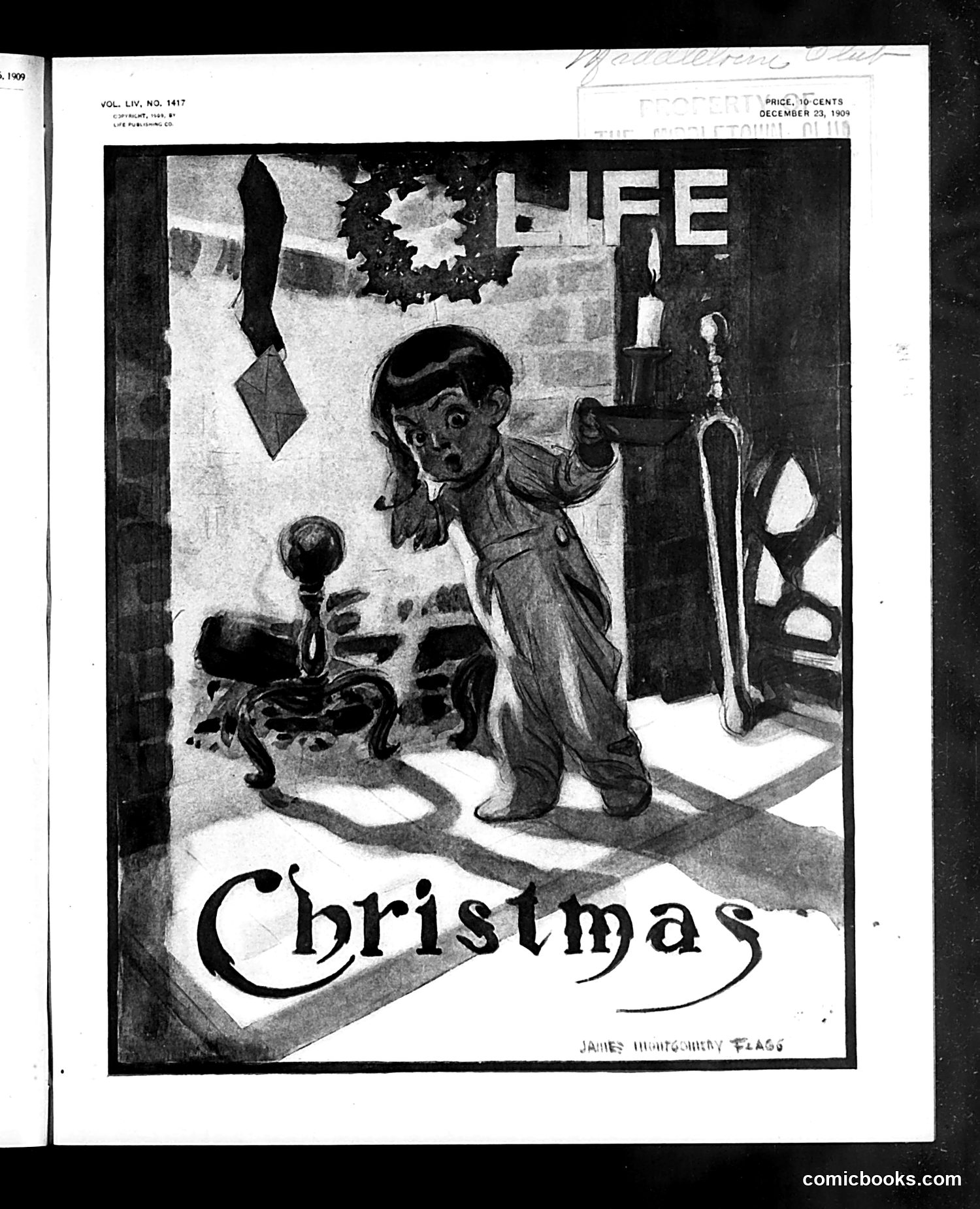
This is a Christmas-themed cover illustration by James Montgomery Flagg showing a young boy in an interior hallway decorated with holly and a wreath. The child appears startled or surprised, reaching upward with an expression of wonder or alarm. The setting suggests a domestic Christmas scene, likely depicting the magical moment of encountering Christmas decorations or perhaps Santa-related activity. The "LIFE" masthead and festive wreath visible in the composition confirm this is holiday-themed content. Without additional text identifying specific figures or satirical references, this appears to be primarily seasonal illustration rather than political commentary—typical of Life magazine's mix of humor, illustration, and holiday spirit for its December issue.
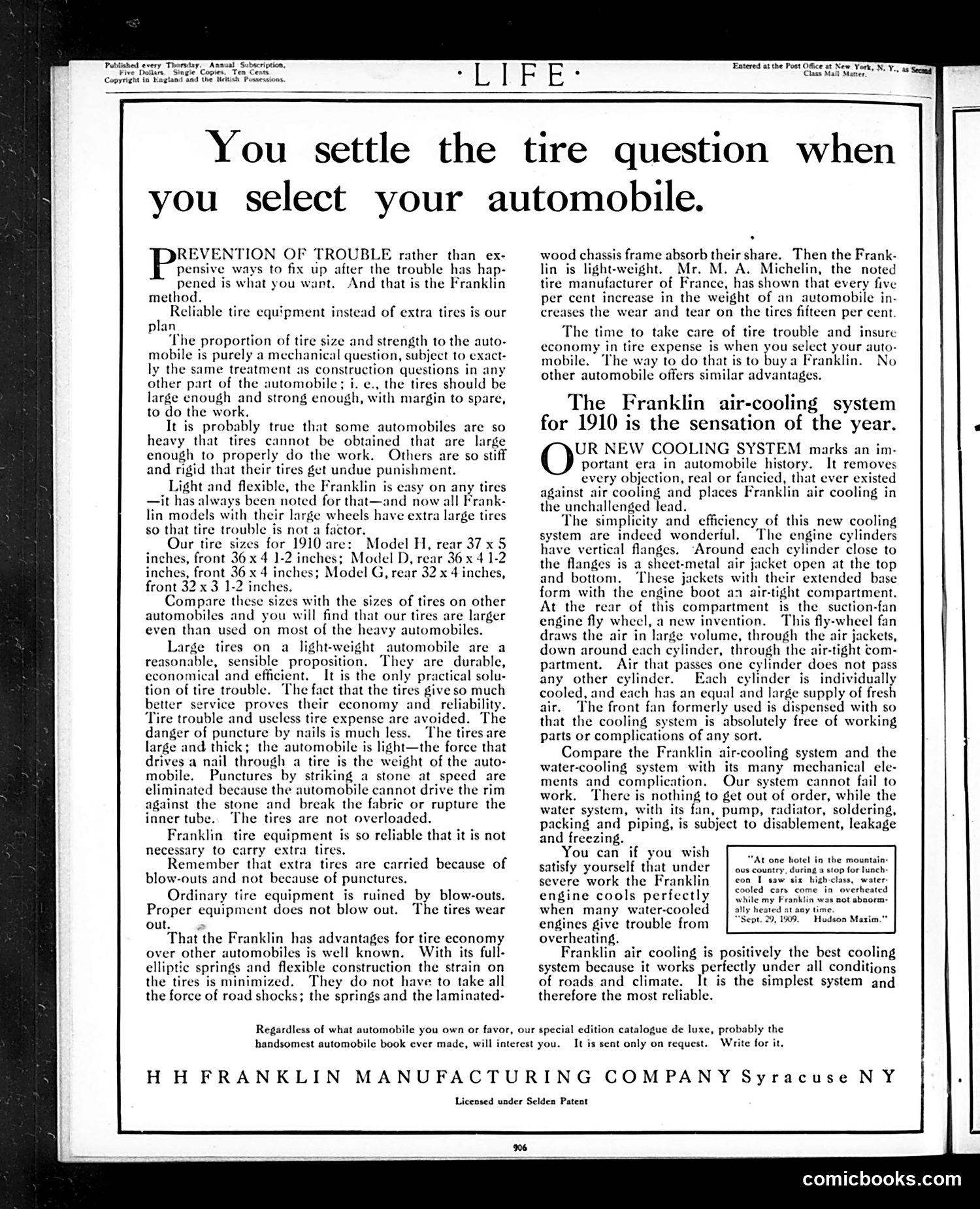
This page is **entirely an advertisement**, not satire or editorial content. It's a Franklin Manufacturing Company ad for their automobiles, specifically promoting tire quality and their innovative air-cooling system for 1910 models. The ad argues that tire selection is crucial when buying a car, claiming Franklin tires are larger and more durable than competitors'. It emphasizes that Franklin's air-cooling engine system (using flanges and fan circulation rather than water) is superior—simpler, more reliable, and effective in all climates. The small inset quote about mountain travel appears to be customer testimony. The ad concludes with an invitation to request their "special edition catalogue." This represents early automotive marketing focusing on technical specifications as selling points.
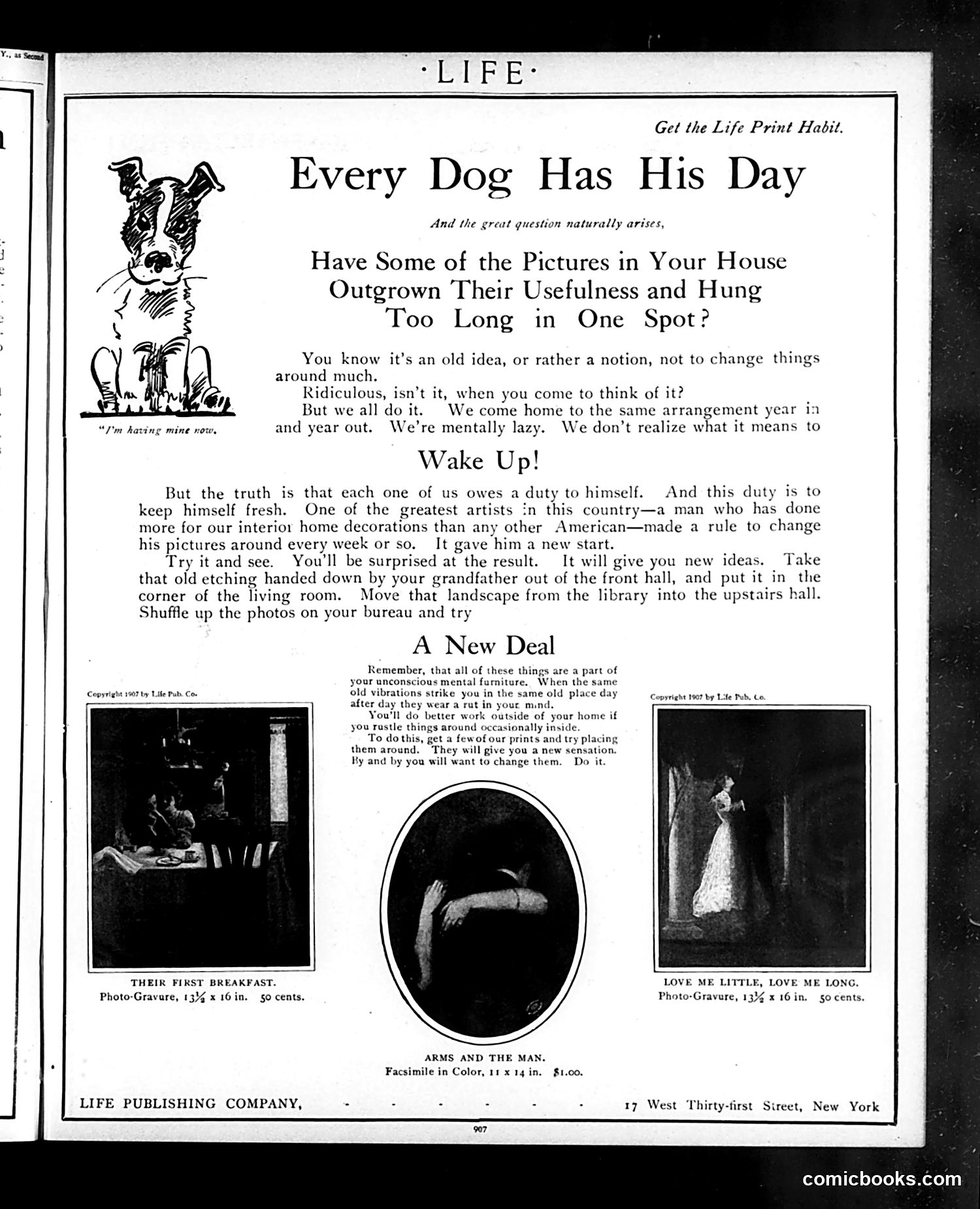
This page is primarily **advertising content**, not political satire. It promotes Life Publishing Company's art prints and home décor products. The dog illustration at top left (captioned "I'm loving mine now") serves as a charming mascot for the ad campaign. The three photographs advertised are domestic scenes: "Their First Breakfast," "Love Me Little, Love Me Long," and "Arms and the Man." These appear to be sentimental home decoration prints depicting romantic or family moments. The accompanying text argues that homeowners should regularly rotate their wall art and decorations to mentally refresh their living spaces—a practical interior design suggestion framed as a duty to oneself. The entire page functions as a marketing pitch encouraging readers to purchase Life's prints for their homes.
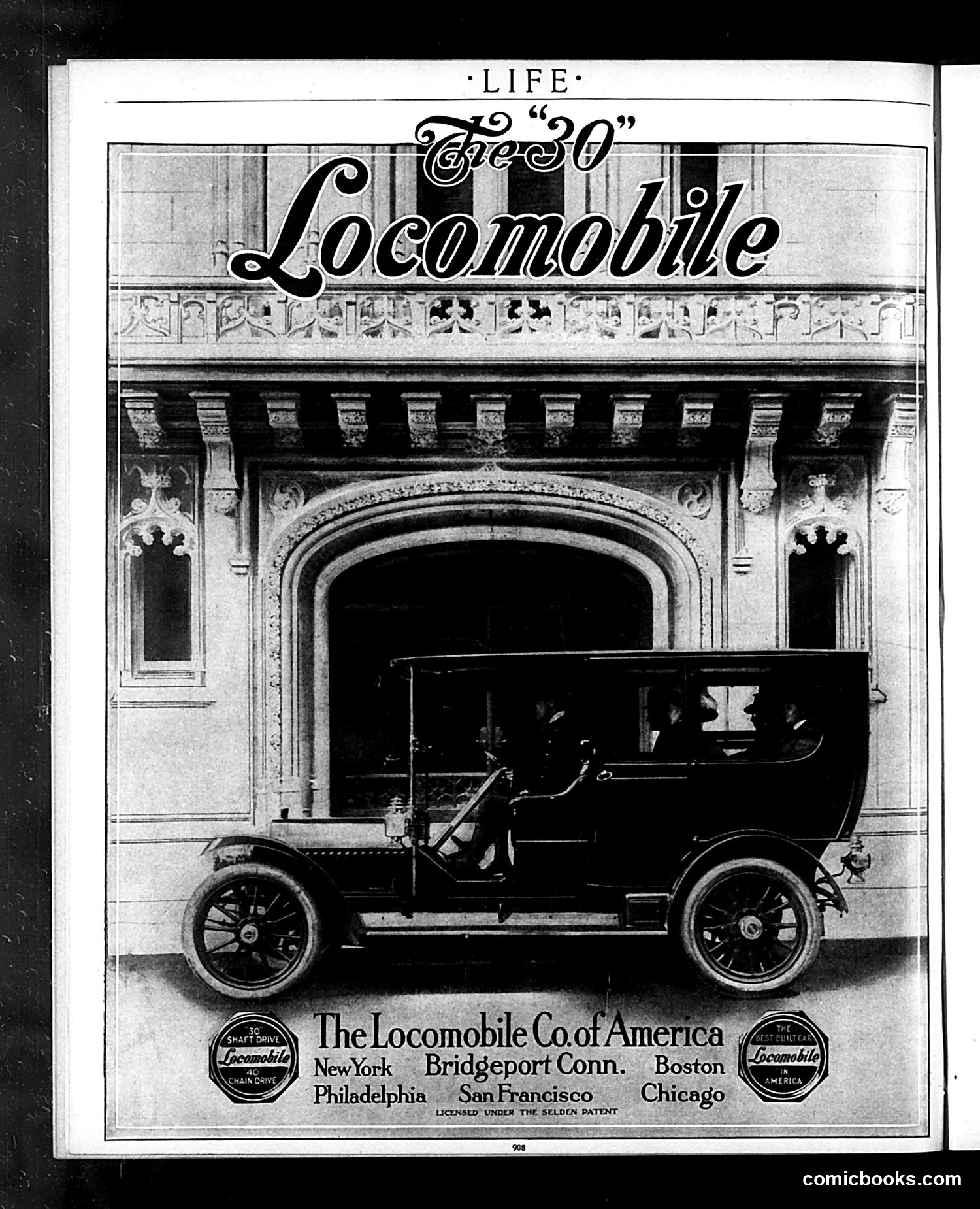
This is a **product advertisement**, not political satire. It promotes the Locomobile automobile, manufactured by The Locomobile Co. of America with offices in New York, Bridgeport, Connecticut, Boston, Philadelphia, San Francisco, and Chicago. The ad emphasizes the car's elegance by photographing it against an ornate architectural backdrop—a classical building facade with decorative columns and arched windows. This juxtaposition suggests the vehicle's sophistication and appeal to wealthy buyers. The "20" likely refers to the model designation. The circular emblems at bottom reference "shaft drive" technology, a selling point in early automotive marketing. This is straightforward commercial advertising rather than editorial commentary.
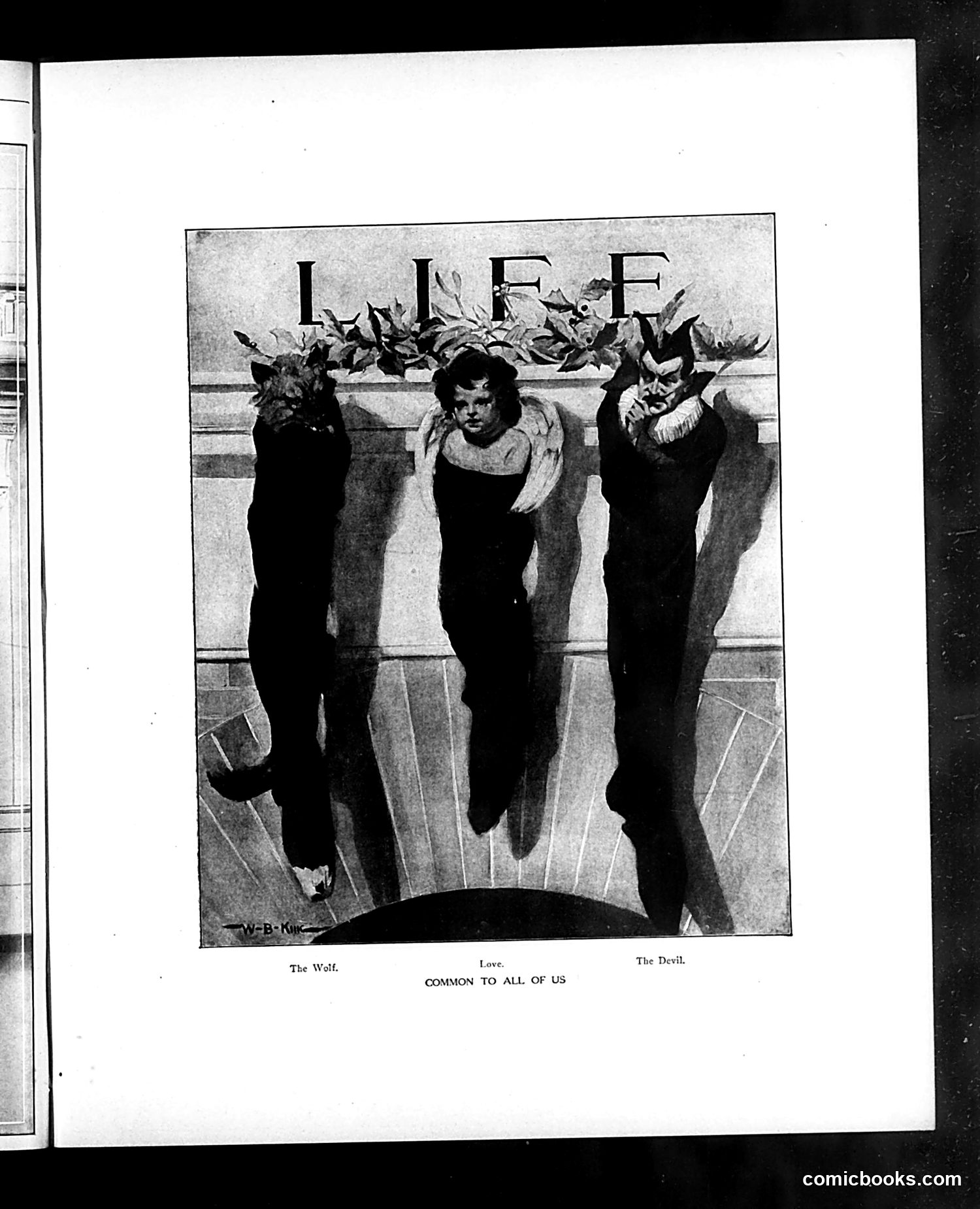
This satirical illustration from *Life* magazine depicts three figures labeled "The Wolf," "Love," and "The Devil," positioned beneath the letters "LIFE" and captioned "COMMON TO ALL OF US." The cartoon uses archetypal human impulses or character types—animal instinct (wolf), romantic/emotional desire (love), and moral corruption (devil)—as universal human traits. The three figures, rendered in silhouette wearing period dress with animal heads, suggest that regardless of social station or individual identity, all humans share these fundamental drives. This appears to be early 20th-century social commentary using allegorical figures to reflect on human nature—a common *Life* magazine approach. The satire suggests that civilization cannot fully suppress these base instincts; they remain inherent to humanity.
This page contains political commentary rather than cartoons. The main text discusses Mr. Watson and his accusations against the Asquith family regarding British politics and the head of government. The article references Mr. Watson's charges against women in politics, suggesting British suffragettes are "much more interpolative in politics than American women." The satire implies Watson uses political scandals and "drawing room" gossip to discredit women's political involvement. The piece also covers General Díaz (Mexico's president), Dr. Cook (explorer/fraud claims), and Collier's Weekly secretary Ballinger's defense of coal and water site policies. The small illustrated vignettes show cartoon figures but the text provides the satirical commentary targeting early 20th-century political figures and movements, particularly British suffrage debates and American political controversies.
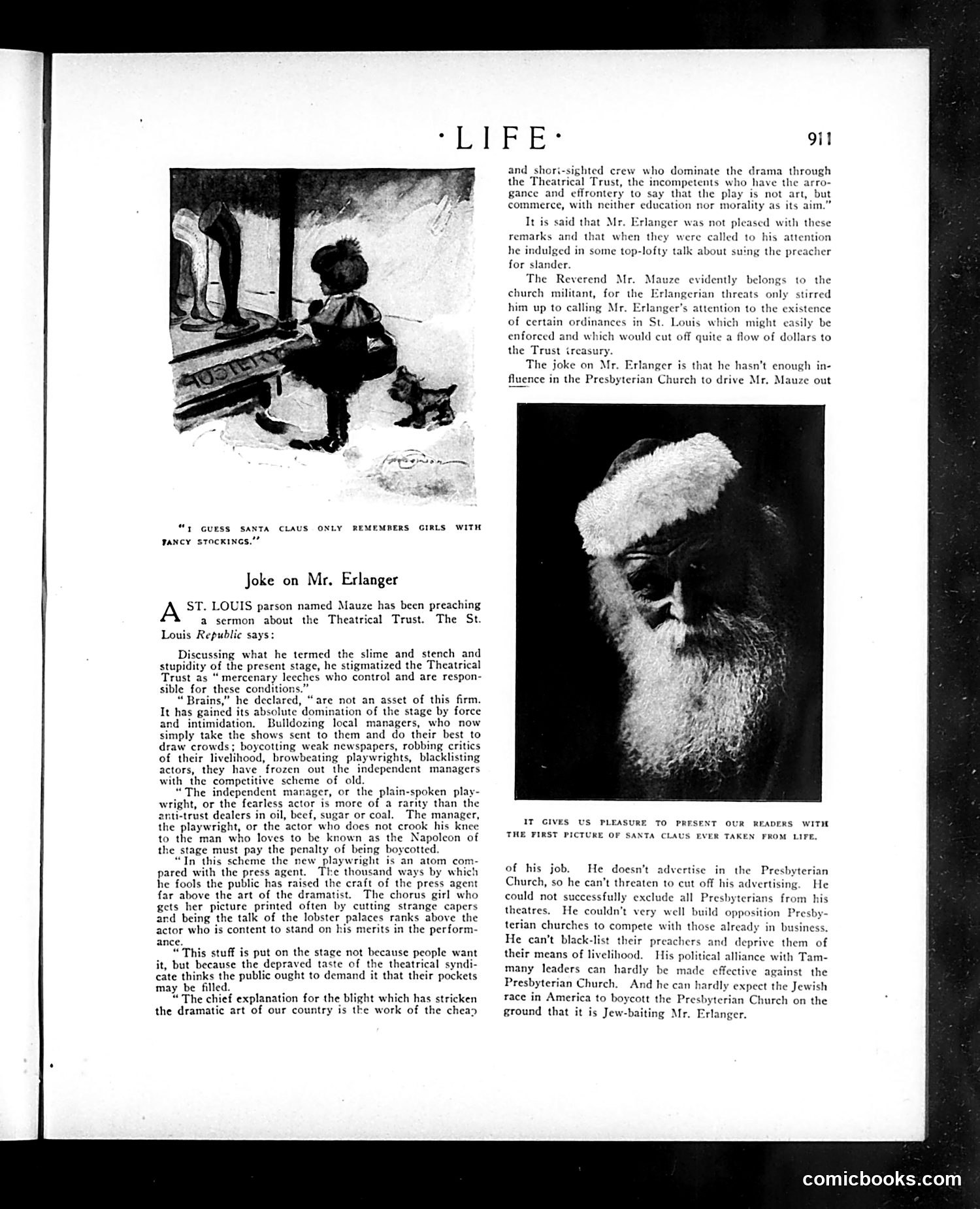
This page satirizes **Mr. Erlanger**, a powerful theatrical producer who controlled the Theatrical Trust—a monopolistic syndicate dominating American theater. The text criticizes the Trust's control over independent theaters and playwrights. **The upper cartoon** shows Santa Claus with a child, captioned "I guess Santa Claus only remembers girls with fancy stockings"—likely mocking selective favoritism. **The lower image** appears to be the first published photograph of Santa Claus from Life magazine, as noted in the caption. The main article attacks Erlanger for using the Trust's power to boycott theaters, blacklist actors, and control which plays get produced. A Reverend Mauze from St. Louis had criticized the Trust's "mercenary" control. The satire suggests Erlanger lacks sufficient influence over the Presbyterian Church to silence the criticism—a dig at his limited power in certain domains.
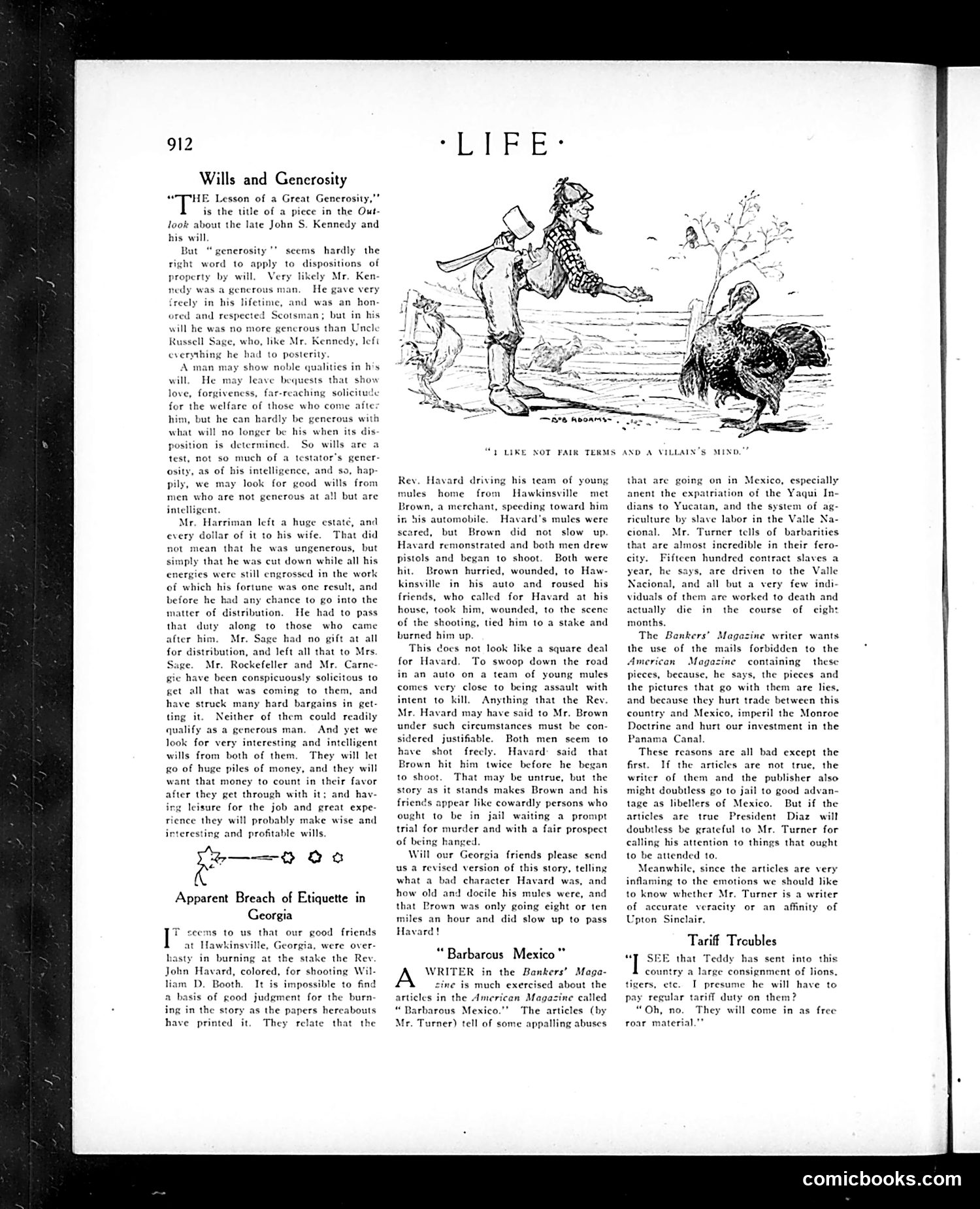
The cartoon depicts a confrontation between two figures: a man in formal attire wielding what appears to be a riding crop or whip, and another man on the ground being beaten or attacked. The caption quotes Shakespeare, suggesting the aggressor represents villainy or unfair dealing. Based on the surrounding text discussing Rev. Havard and Mr. Brown's conflict over mules and shooting in Mexico, this appears to satirize their dispute—portraying one party as acting with "villain's mind" through violence rather than justice. The cartoon criticizes brutish behavior and mob violence, using literary reference to elevate the satire and suggest moral judgment on the perpetrator's conduct.
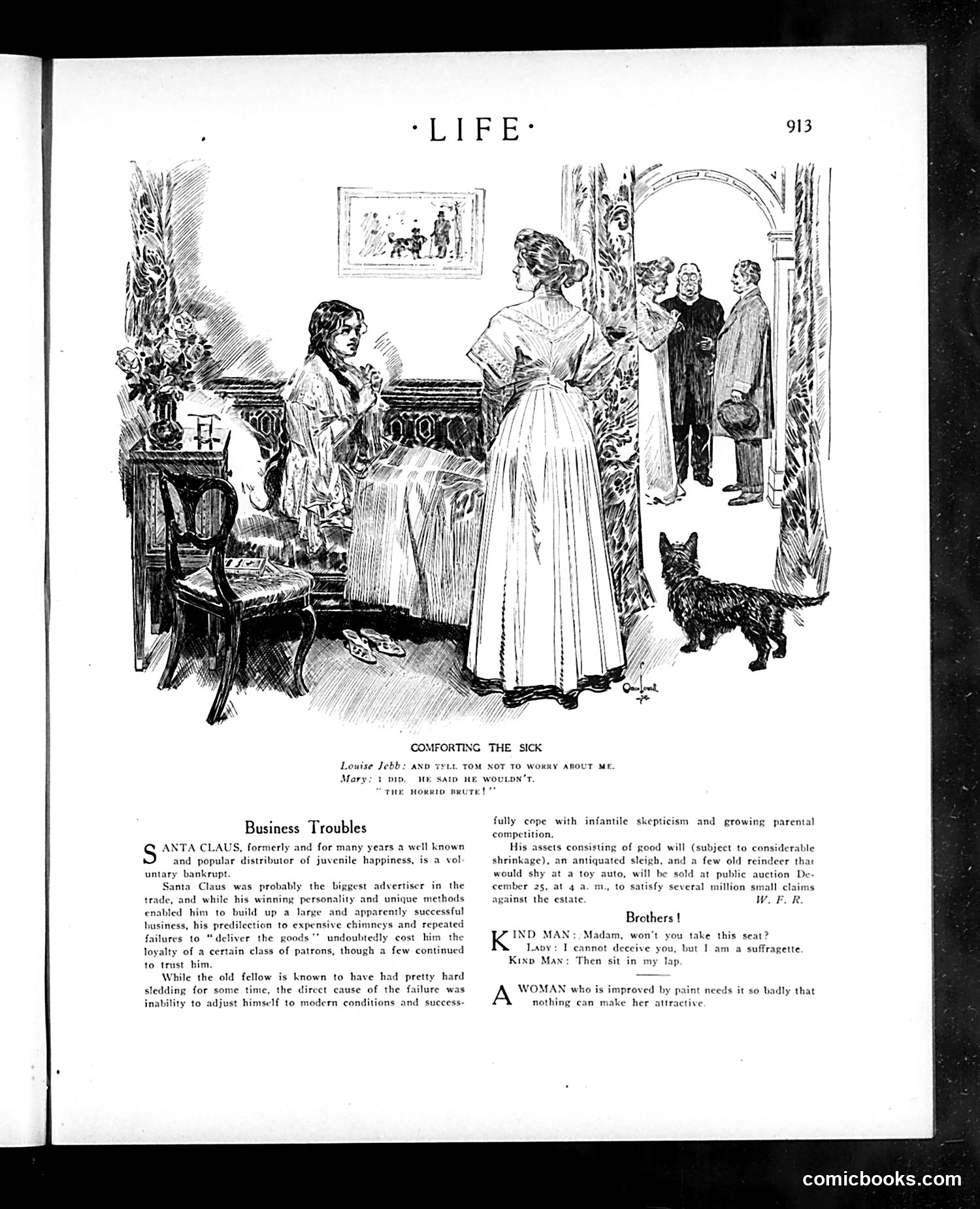
The top illustration depicts a domestic scene where a woman tends to a bedridden man while guests arrive. The caption references "Louise Jebb" and "Tom," with dialogue about worrying—suggesting a satirical commentary on a specific social situation or relationship, though the exact reference is unclear without additional context. Below, "Business Troubles" mocks **Santa Claus** as a failed businessman and "voluntary bankrupt." The text satirizes his inability to modernize his operations, attributing his financial collapse to outdated methods and resistance to contemporary business practices. This appears to be a humorous commentary on old-fashioned commercial enterprises struggling against modern competition and efficiency standards—using the beloved Christmas figure as an ironic vehicle for the critique.
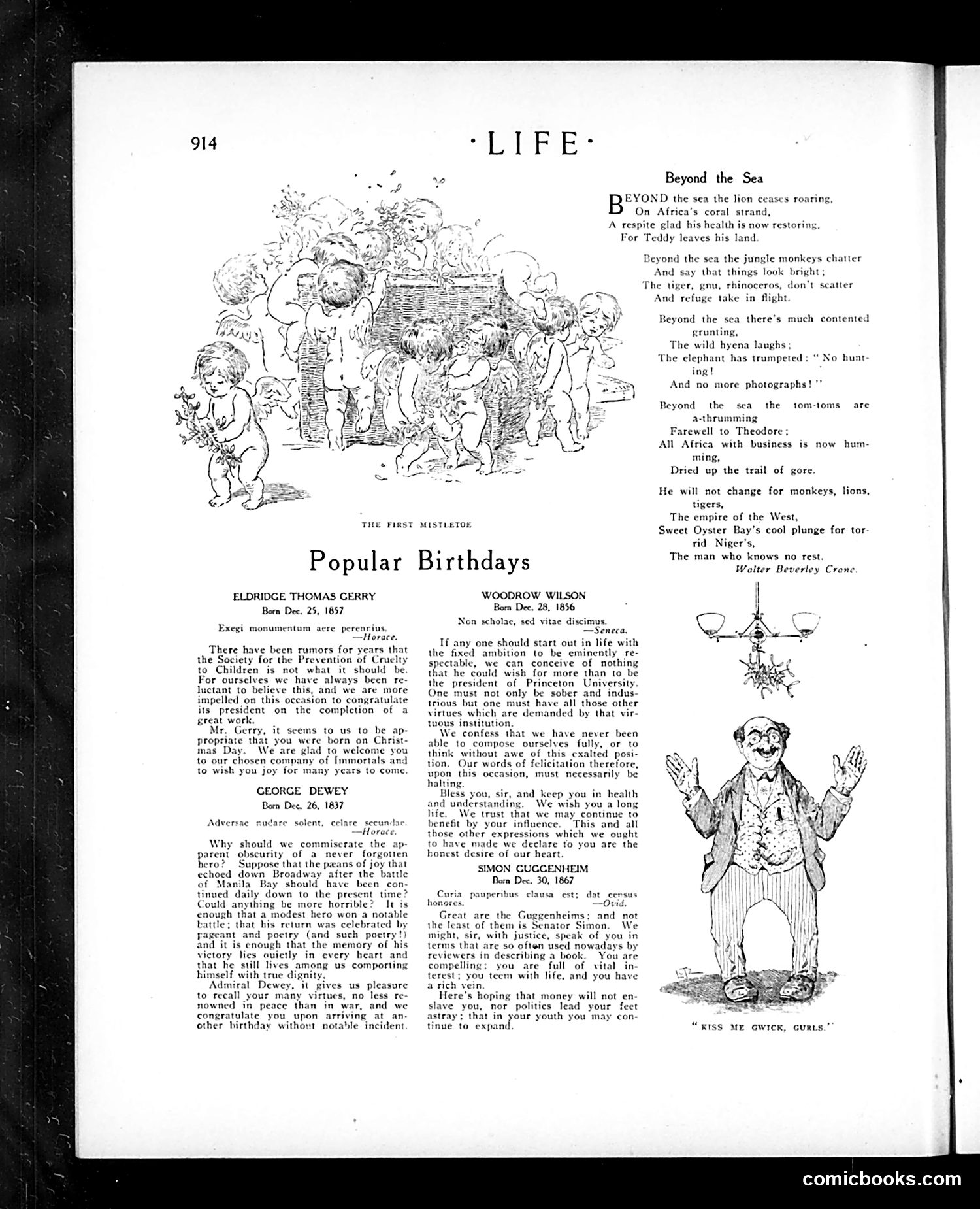
This page features a section titled "Popular Birthdays" celebrating notable figures born on specific dates: Eldridge Thomas Gerry (Dec. 29), George Dewey (Dec. 31), Woodrow Wilson (Dec. 28), and Simon Guggenheim (Dec. 30). The top illustration shows cherubs or putti gathered around a mistletoe, labeled "The First Mistletoe"—a seasonal Christmas reference appropriate for December birthdays. The congratulatory text for each figure includes brief biographical notes and witty commentary. The magazine celebrates these prominent men (a reformer, admiral, president, and businessman) with characteristic satirical affection rather than criticism. The right-side illustration appears to be decorative, showing a figure in period dress with the caption "Kiss Me Gwick, Girls," though its specific reference is unclear from context alone.
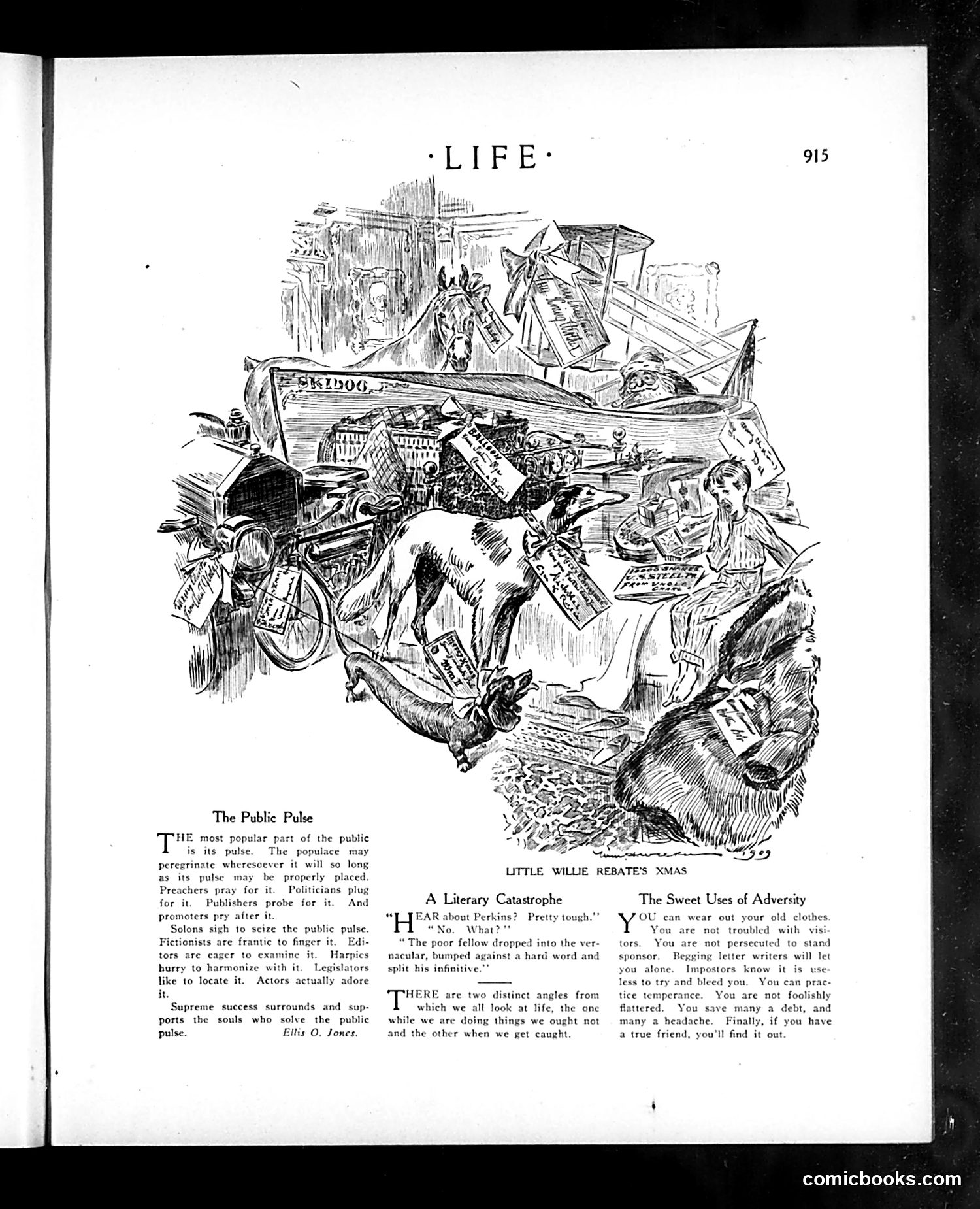
The central illustration titled "Little Willie Rebate's Xmas" depicts a chaotic scene of commercial excess and corruption. A large figure (presumably representing corporate interests or monopolies) sits surrounded by scattered goods, money, and various symbols of commerce and transportation—ships, trains, bicycles, and buildings. The figure appears bloated or overstuffed, suggesting greed. The surrounding text articles—"The Public Pulse," "A Literary Catastrophe," and "The Sweet Uses of Adversity"—appear to be satirical commentary on contemporary social issues. "The Public Pulse" discusses public opinion and manipulation, while the other pieces mock literary pretension and the corrupting influence of advertising/commerce on ethics. The overall message critiques Gilded Age capitalism and corporate excess.
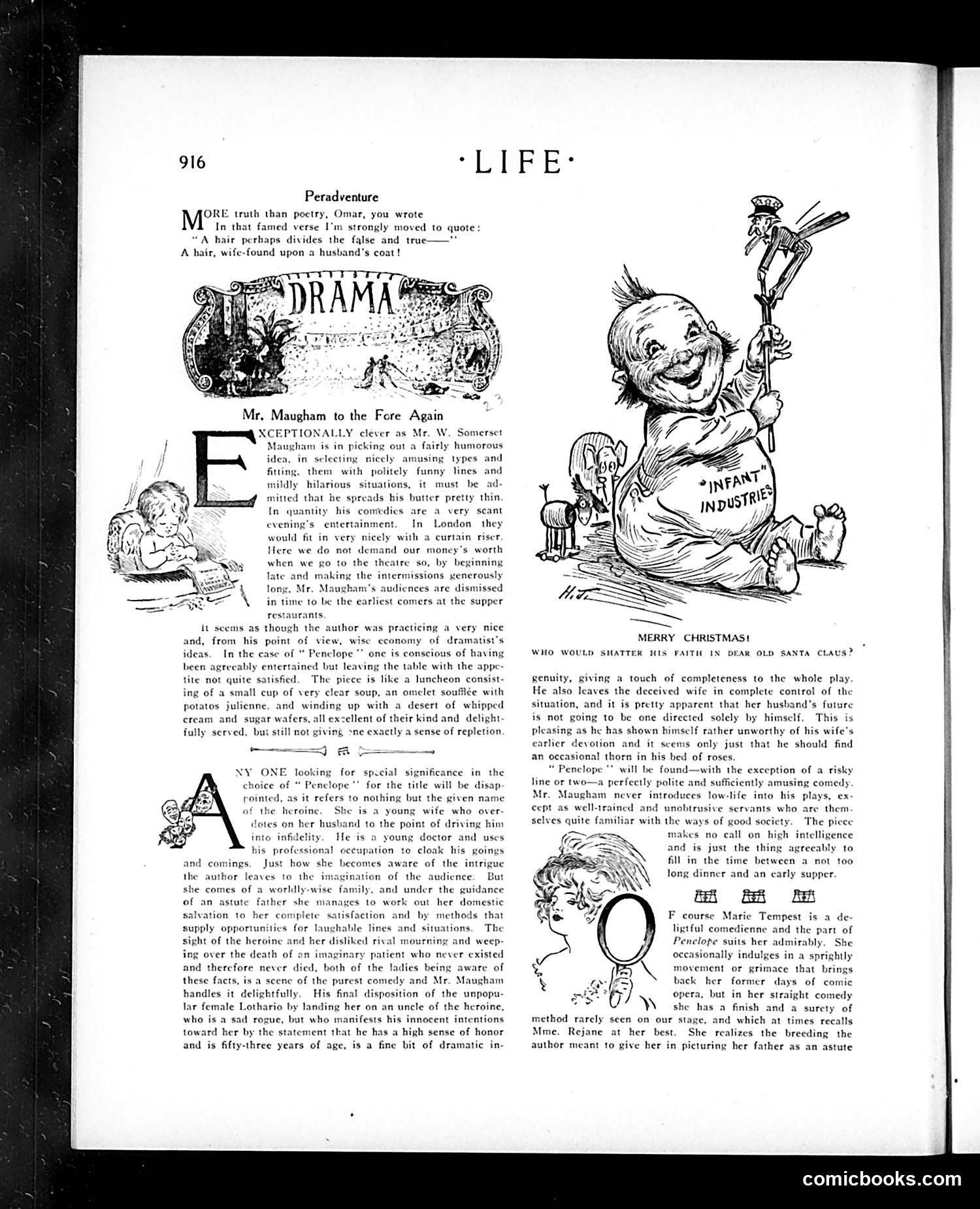
This page contains drama criticism and illustrations. The main article discusses **Mr. Maugham's theatrical work**, praising his skill at selecting "amusing types" and creating "politely funny" comedic situations. The piece notes his plays work well for London audiences seeking lighter entertainment. The article reviews **"Penelope,"** focusing on the lead actress Marie Tempest's performance. It describes her character as an overconfident wife who mismanages domestic life while believing herself superior—a comedic premise typical of early 20th-century theater. The cartoon at top right shows a cheerful figure labeled **"Infant Industries,"** appearing to reference economic protectionism concerns of the era. The satirical "Merry Christmas" caption questions Santa's credibility—likely social commentary about commercialism or childhood disillusionment.
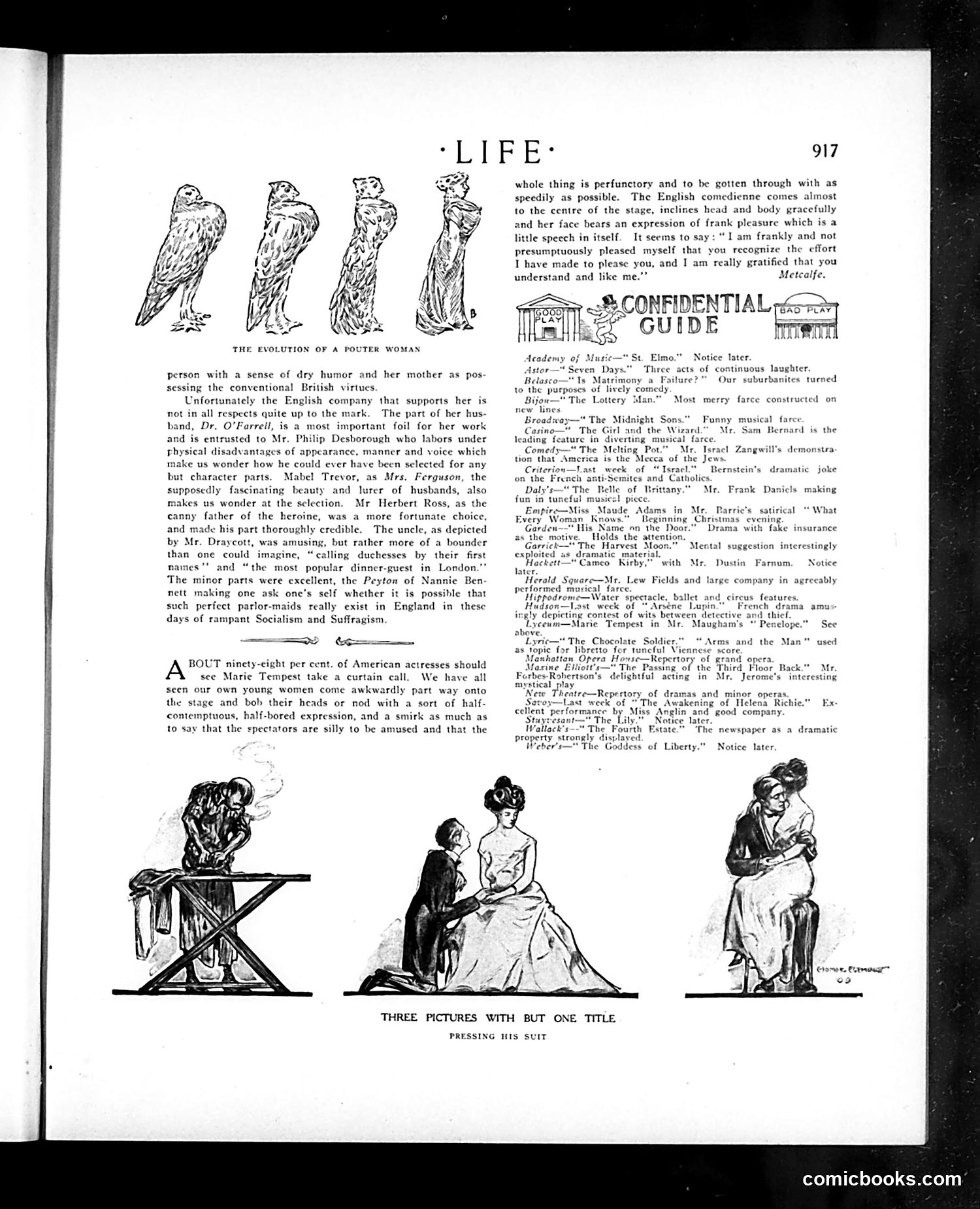
This page critiques English actresses and theatrical conventions of the early 20th century. The top section discusses how English comedians prioritize speed over substance, using dry humor. It specifically names **Mabel Trevor** and **Mr. Herbert Ross**, praising their work despite the "physical disadvantages of appearance, manner and voice." The bottom illustration, titled "THREE PICTURES WITH BUT ONE TITLE: PRESSING HIS SUIT," uses visual satire to mock courtship rituals. The three drawings—showing a man in various poses with a woman—play on the double meaning of "pressing his suit" (pursuing romance versus literally ironing clothing). This wordplay satire was typical of Life's humor, gently mocking Victorian social conventions and romantic pursuits.
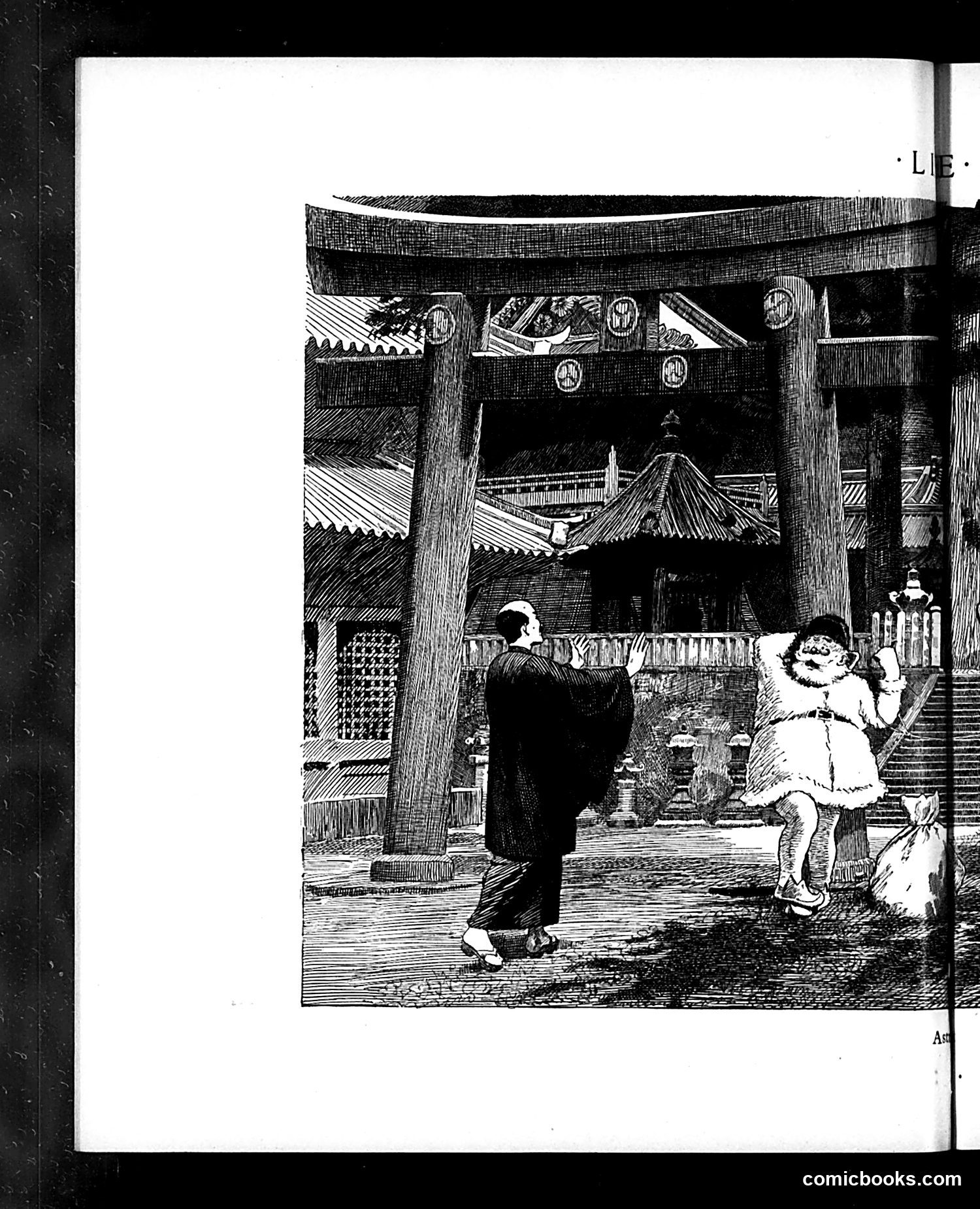
This appears to be a satirical illustration from Life magazine depicting a scene in what looks like an Asian (likely Chinese or Japanese) temple or palace interior, based on the architectural elements: ornate wooden pillars, curved roofs with distinctive peaked designs, decorative circular medallions, and traditional railings. The scene shows a Western man in formal dark clothing viewing the temple interior, while a rotund figure (possibly representing a Western tourist or businessman) gestures animatedly nearby. The satire likely comments on Western attitudes toward Asian cultures—possibly mocking either orientalism, cultural tourism, or Western business interests in Asia during the early 20th century. Without additional context or visible captions, the specific political target remains unclear, though the juxtaposition of Western and Asian elements suggests commentary on cross-cultural encounters.

This appears to be a woodcut or engraving depicting an elaborate Asian (likely Chinese or Japanese) architectural complex with upturned eaves and decorative elements. Two large deer or elk with impressive antlers stand prominently in the foreground, facing the ornate building. The style suggests this is satirical commentary, possibly from the late 19th or early 20th century. Without clearer OCR text or visible captions identifying the specific figures and political references, I cannot definitively explain the satire's meaning. The juxtaposition of Western animals with Asian architecture might reference colonial attitudes, trade relations, or foreign policy. However, I cannot confidently identify which political figures or events this targets. The comicbooks.com watermark indicates this is a digitized archival image, but the page's original context and publication date remain unclear from what's visible.
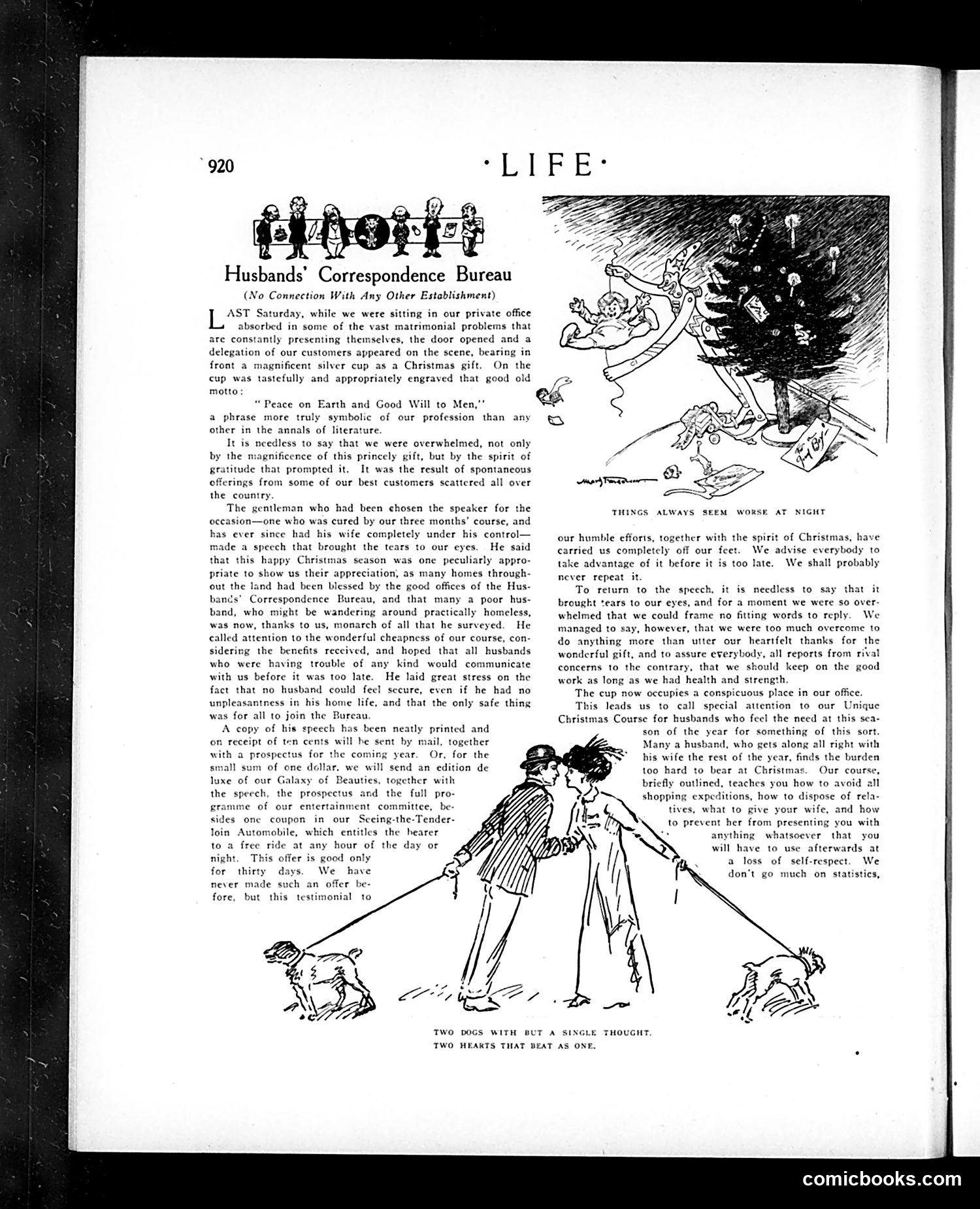
This is satirical advertising for a fictional "Husbands' Correspondence Bureau"—a fake service claiming to teach men how to control their wives. The joke targets early 1900s gender dynamics and marital discord. The cartoon depicts a husband literally pulling two women (his wife and mother-in-law, apparently) in opposite directions, illustrating domestic conflict. The caption reads "Two dogs with but a single thought, two hearts that beat as one"—ironic commentary on marriage. The text mocks both husbands seeking male dominance and the commercialization of relationship advice. The gift presentation and testimonial parody self-help marketing while satirizing the era's assumption that husbands should be "monarch of all that he surveyed." The humor relies on: exaggerated masculine control fantasies, marriage stereotypes of that period, and absurdist business-speak. Modern readers should note this reflects genuine historical attitudes about male authority in marriage, presented mockingly through Life magazine's satirical lens.
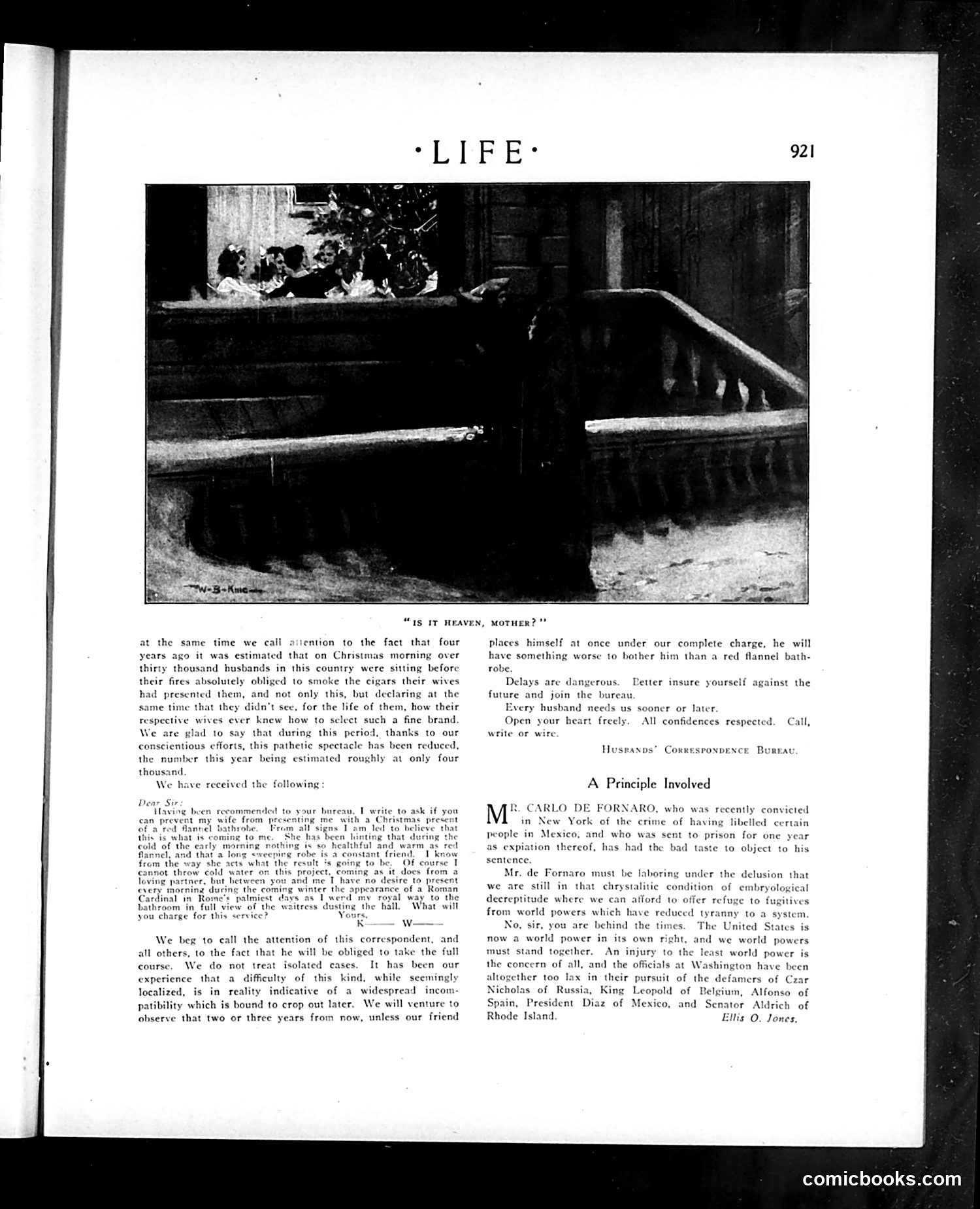
This page contains two satirical pieces targeting early 1900s American society. The main cartoon (top) and accompanying text mock husbands forced to smoke inferior cigars as Christmas gifts from wives. Life magazine claims to operate a "Husbands' Correspondence Bureau" offering marital counseling. The satire targets both the absurdity of unwanted gifts and gender dynamics—wives selecting presents their husbands pretend to appreciate out of politeness. The lower article, "A Principle Involved," critiques U.S. foreign policy hypocrisy. Carlo de Fornaro, an Italian convicted of libeling Mexican officials, appealed his sentence. The author sarcastically argues America, now a "world power," must side with autocratic regimes (Russia, Belgium, Mexico, etc.) over individuals. The piece mocks America's abandonment of democratic principles in favor of diplomatic expedience—protecting dictators rather than defending free speech for political critics.
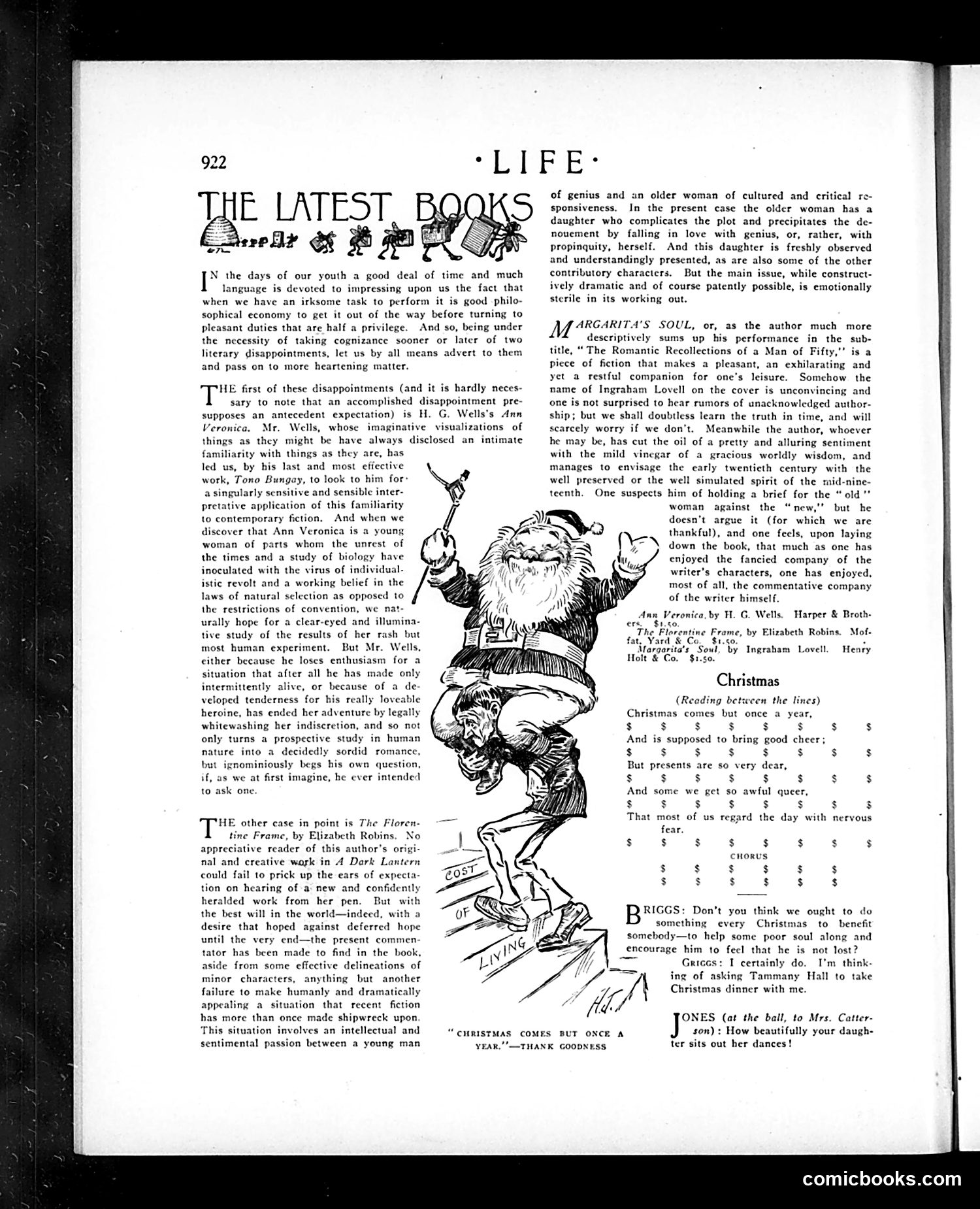
This page from Life magazine contains **book reviews** rather than political cartoons. The central illustration—a caricatured figure juggling while balancing on one leg—is a decorative **generic emblem** for "The Latest Books" section, not satire of a specific person. The reviews discuss three novels critically: H.G. Wells's *Ann Veronica* (criticized for abandoning serious social commentary through an unsatisfying romantic resolution), Elizabeth Robins's *The Florentine Frame* (faulted as emotionally sterile despite capable characterization), and Ingraham Lovell's *Margarita's Soul* (praised as a pleasant leisure read). The page also includes a humorous Christmas poem and dialogue about holiday gift-giving anxieties. No specific political figures or events are referenced—this is literary criticism dressed in the magazine's characteristic witty, gossipy tone aimed at educated readers.
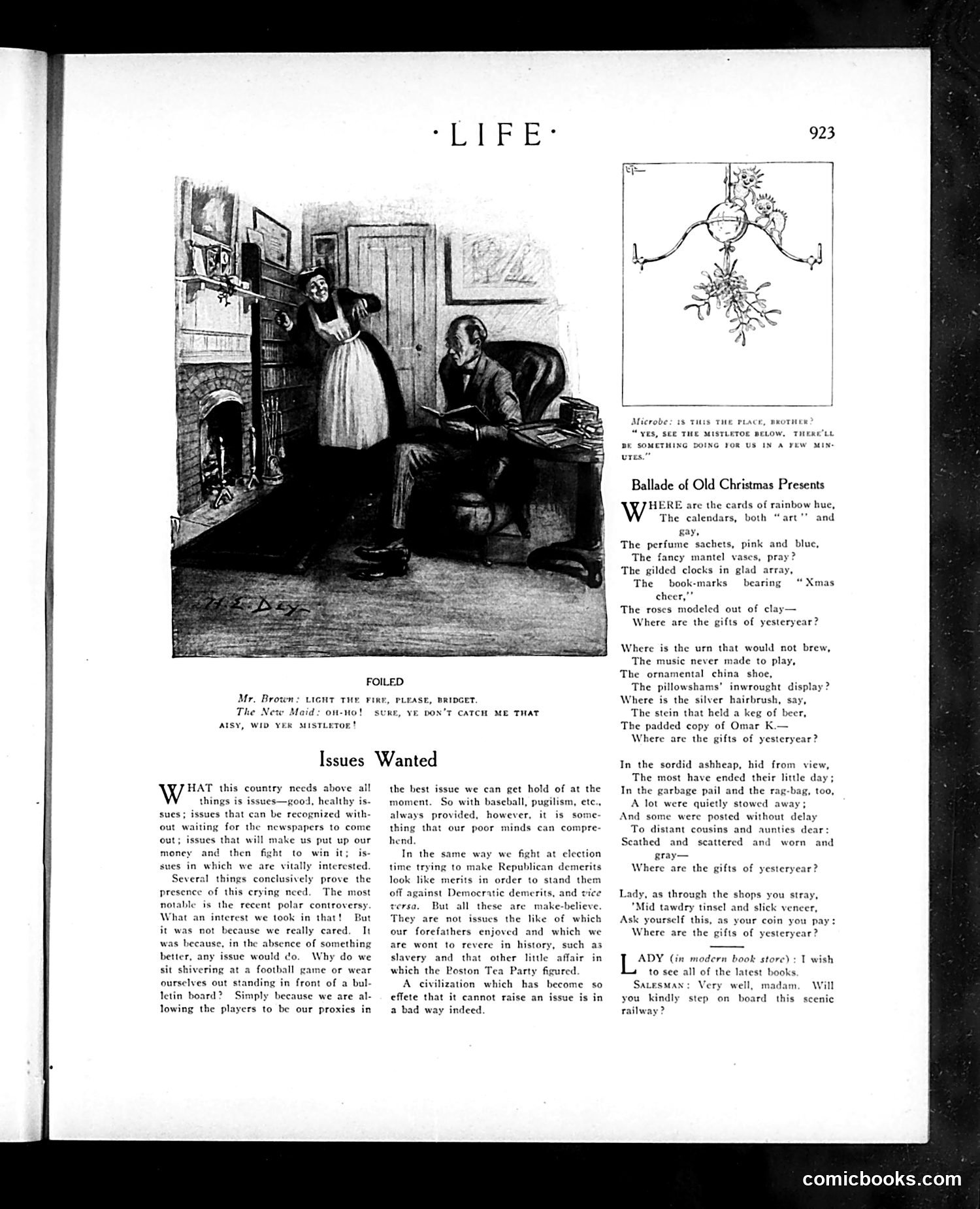
This *Life* magazine page contains three distinct pieces of satirical content: **"Foiled" cartoon (top left):** A man and woman stand under mistletoe during Christmas. The woman rejects his advance with "Sure, ye don't catch me that"—a period joke about unwanted kissing under mistletoe, rendered in working-class Irish dialect for comedic effect. **"Issues Wanted" editorial:** The author satirizes Americans' need for engaging social causes. He observes people obsess over sports and polar exploration controversies because they lack substantive political issues to debate. He argues modern America has become so "effete" (weakened) that it can't generate real issues like slavery or the Boston Tea Party once did—a critique of contemporary political complacency. **"Ballad of Old Christmas Presents":** A poem mocking the disposability of Christmas gifts. It catalogs unwanted presents (perfume sachets, ornamental shoes, bad music boxes) that inevitably end up in garbage pails or are regifted to distant relatives—satirizing both consumer culture and holiday gift-giving obligations.
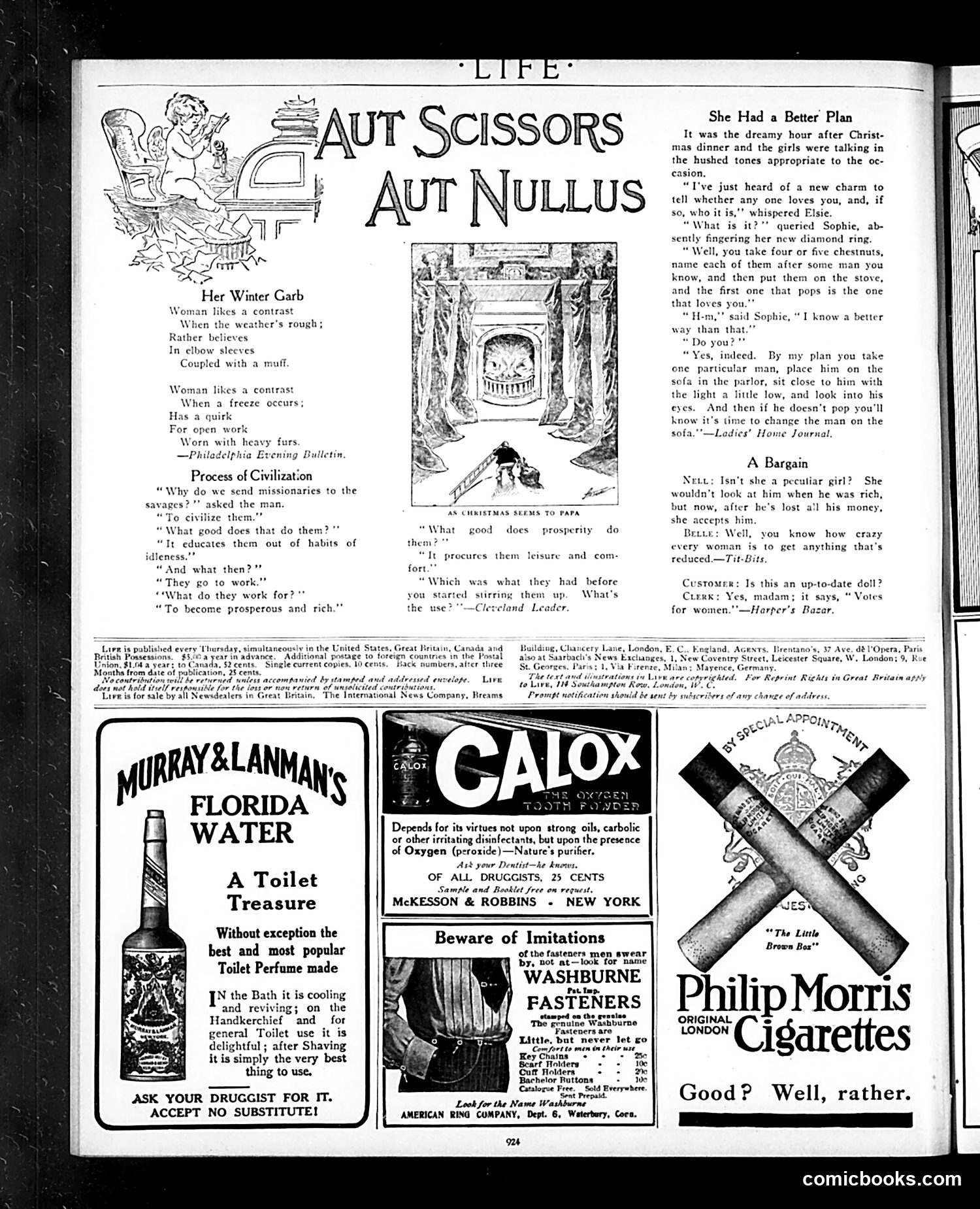
This page contains **three humorous short pieces** typical of Life's satirical format, plus period advertisements. **"Process of Civilization"** satirizes missionary work and Western imperialism. A man questions why missionaries "civilize" indigenous peoples, noting the ironic cycle: missionaries teach them to abandon traditional ways, which leads them to work for money to become "prosperous and rich"—the very leisure and comfort they already possessed. The joke critiques how Western "civilization" actually disrupts indigenous life while claiming to improve it. **"She Had a Better Plan"** is a romantic joke about testing love. While one girl suggests a folk charm (burning chestnuts to reveal a suitor), another proposes a more direct method: placing a man on a sofa in dim light and observing his behavior—implying seduction as a "test" of his affection. **"A Bargain"** jokes about a woman's illogical economics: she rejected a wealthy suitor but now pursues him after he's broke, because she enjoys getting discounted goods. The page is primarily **advertising** (Florida Water, Galox tooth powder, Philip Morris cigarettes), reflecting Life's revenue model.
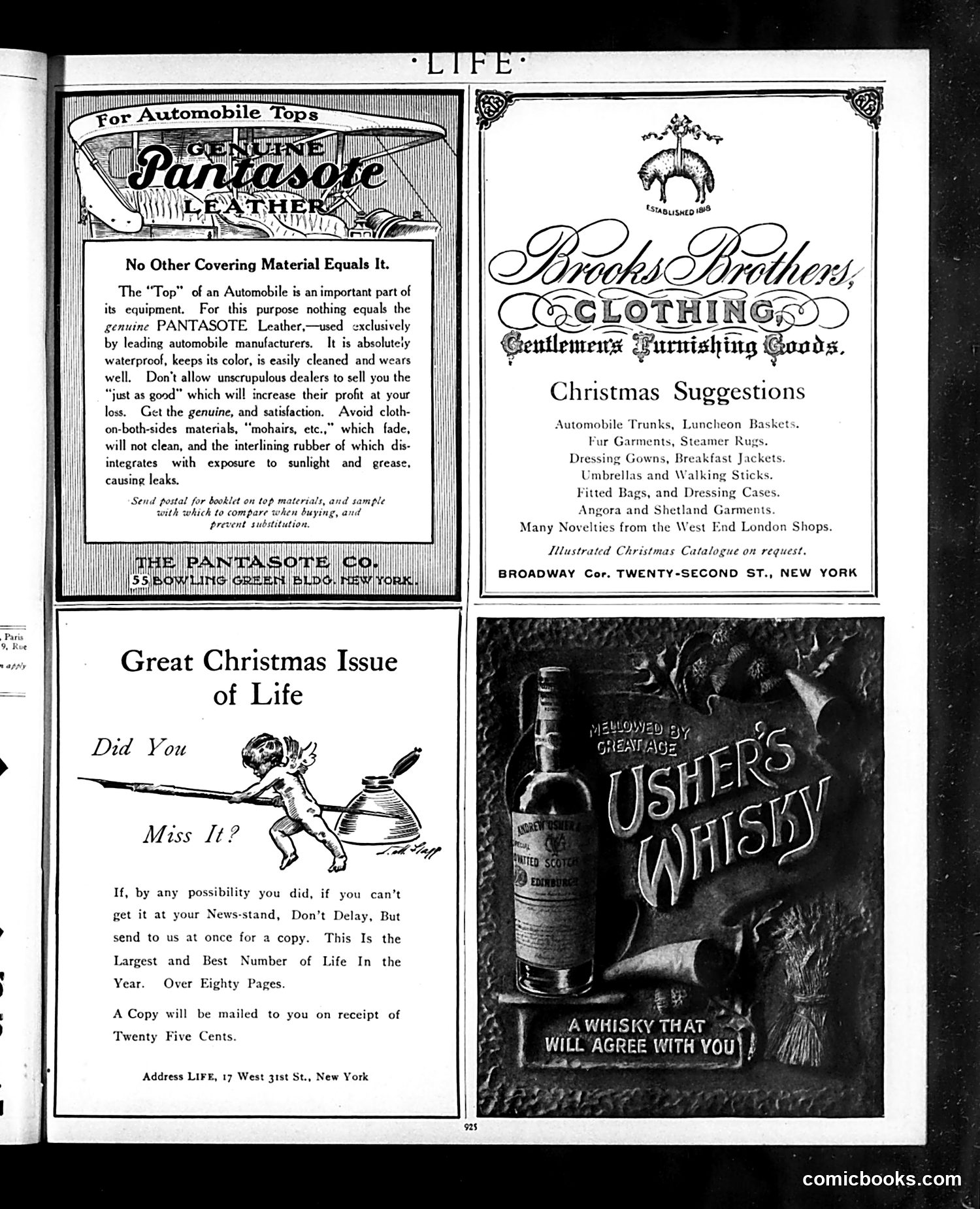
This is primarily an **advertising page** from Life's Christmas issue, not political satire. The page contains four distinct ads: 1. **Pantasote Leather** (top left): An automobile accessory advertisement warning consumers against counterfeit "just as good" substitutes—a common early 1900s consumer protection message. 2. **Brooks Brothers** (top right): A gentlemen's clothing store promoting holiday gift suggestions (trunks, garments, accessories). 3. **Life Magazine itself** (bottom left): A self-promotional ad for the Christmas issue, featuring a cupid-like cherub with a paintbrush, encouraging readers to purchase the 80+ page special edition for 25 cents. 4. **Usher's Whisky** (bottom right): A spirits advertisement claiming the product "will agree with you." There is **no political cartoon or satire** visible on this page. It represents typical early 20th-century magazine advertising focused on luxury goods and holiday shopping—reflecting the consumer culture of the era.
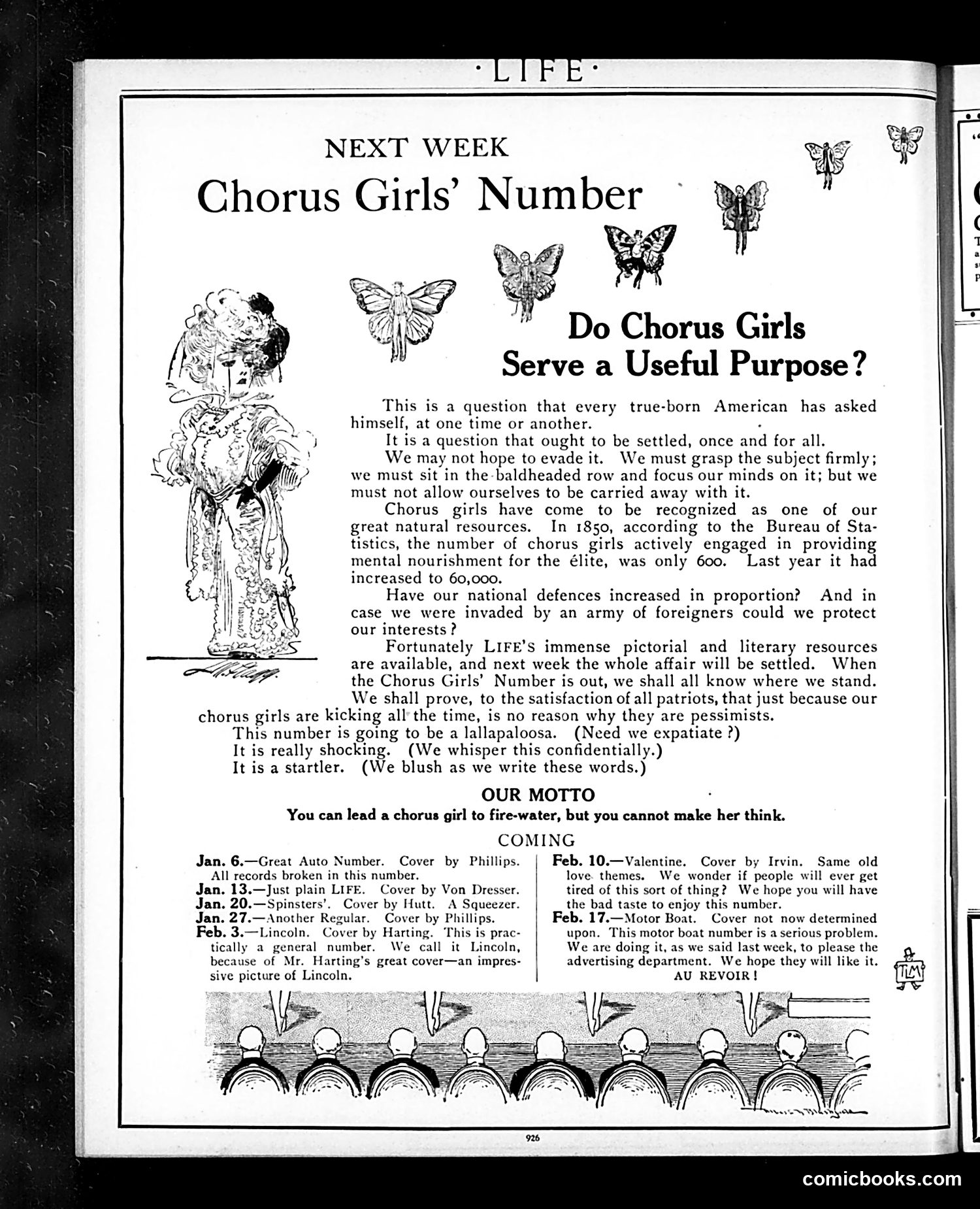
This is a self-promotional page for *Life* magazine's upcoming "Chorus Girls' Number." The satire mocks contemporary anxieties about chorus girls—young women performers in theatrical productions—by presenting them as a matter of national importance. The joke operates on multiple levels: Life ironically treats chorus girls as "natural resources" worthy of government statistics, inflating their cultural significance. The statistics claiming growth from 600 (1850) to 60,000 dancers connects them absurdly to national defense concerns. The motto—"You can lead a chorus girl to fire-water, but you cannot make her think"—delivers a sexist punchline typical of the era, while the phrase "kicking all the time" references both the high-kick choreography of chorus lines and stereotypes about dancers' behavior. The illustration shows an elaborately dressed woman, likely caricaturing a chorus girl's glamorous stage appearance. The overall tone is tongue-in-cheek; Life uses mock-serious language to advertise an issue devoted to titillating entertainment rather than serious journalism—acknowledging this honestly with phrases like "we blush as we write these words."
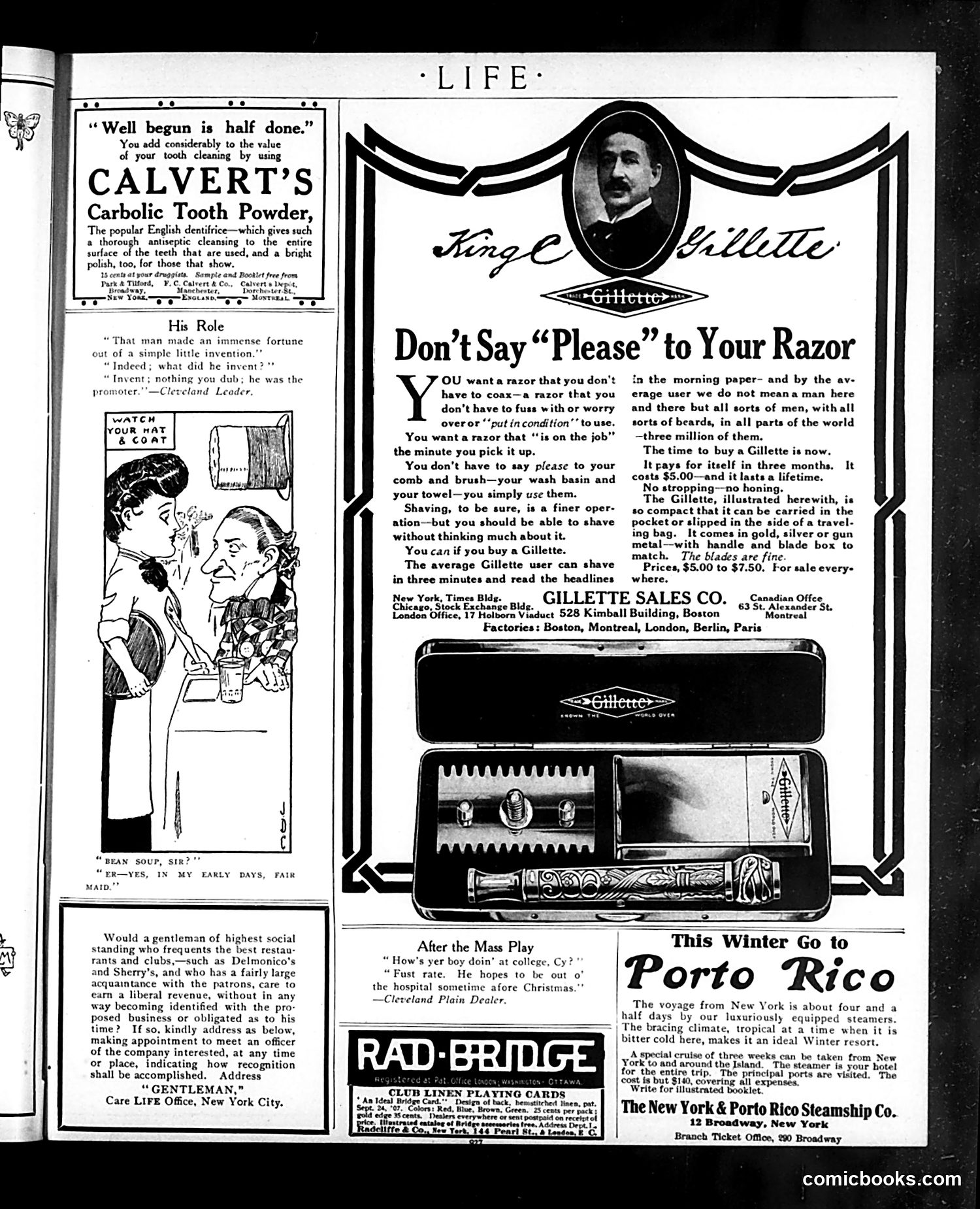
This page contains mostly **advertisements** rather than political cartoons, though it includes some satirical humor typical of Life magazine's style. **The cartoons/jokes:** - "His Role" mocks a promoter who made a fortune not by inventing, but by promoting others' inventions—satirizing empty self-promotion. - "Bean Soup, Sir?" shows a waiter serving soup, with text referencing "early days, fair maid"—likely a period-piece joke about class or service roles. - A small classified ad humorously solicits a wealthy gentleman to earn money through unspecified means while maintaining his social standing—satirizing wealthy men seeking easy income without soiling their reputations. **The advertisements** promote Calvert's tooth powder, Gillette razors (emphasizing convenience and reliability), Rad-Bridge playing cards, and Porto Rico steamship cruises. These reflect early 20th-century consumer culture and leisure travel for the affluent. The page's satire targets self-promotion, class pretension, and the emerging consumer culture of the era.
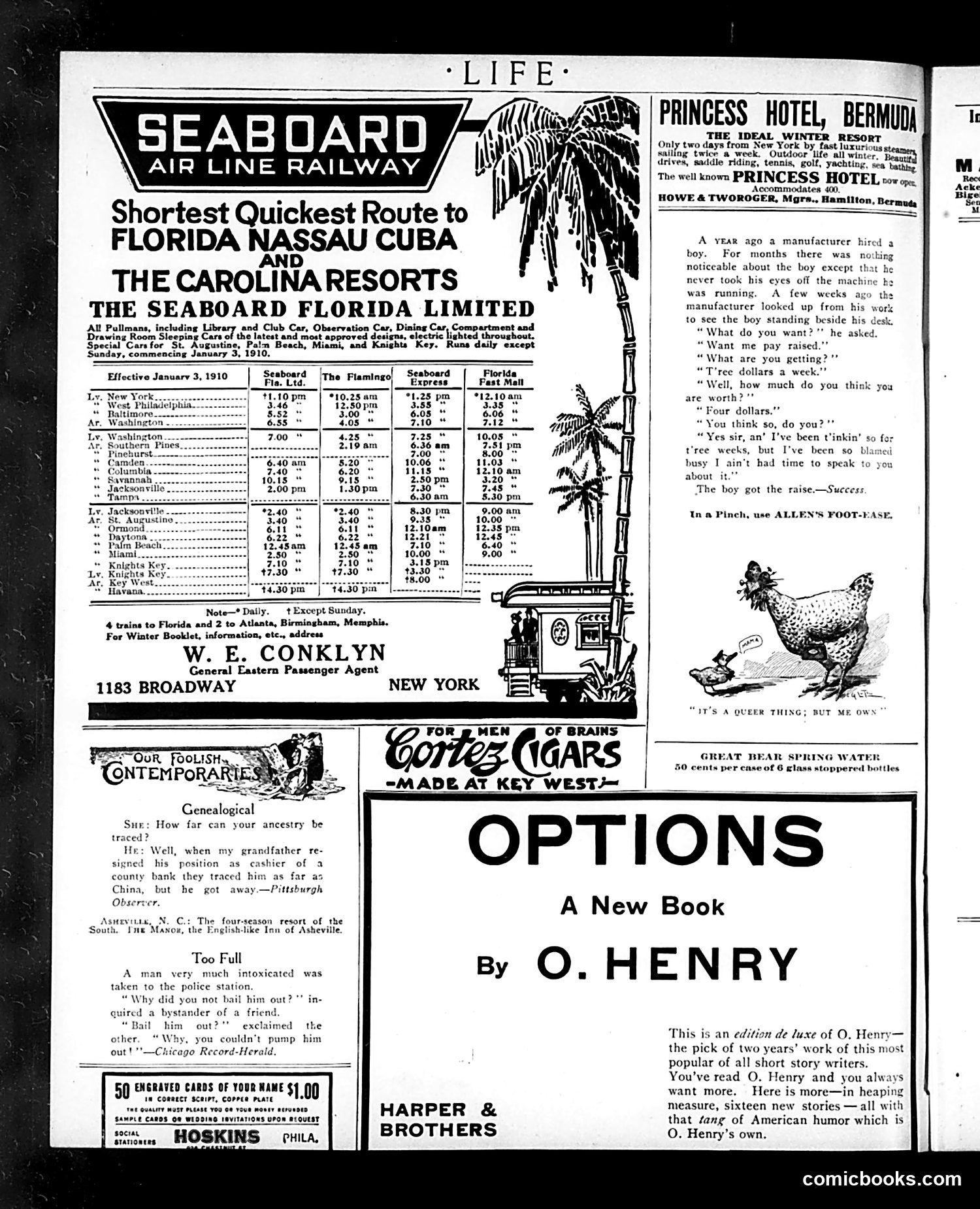
This page is primarily **advertising and filler content** rather than political satire. The dominant feature is a large railroad advertisement for the Seaboard Air Line Railway promoting fast travel to Florida, Nassau, and Cuba—destinations popular with wealthy winter travelers during this era. The page includes several unrelated comic anecdotes and advertisements: 1. **"Genealogical"** joke: A man traces his ancestry back to China, where his grandfather (a bank cashier who embezzled) fled. 2. **"Too Full"** joke: A drunk man is arrested; his friend won't bail him out because "you couldn't pump him out." 3. **O. Henry book advertisement**: Promoting a new collection of short stories by the popular humorist. 4. Various other ads (cigars, engraved cards, foot powder, spring water). The page reflects early 1900s leisure culture and commercial advertising typical of Life magazine's format.
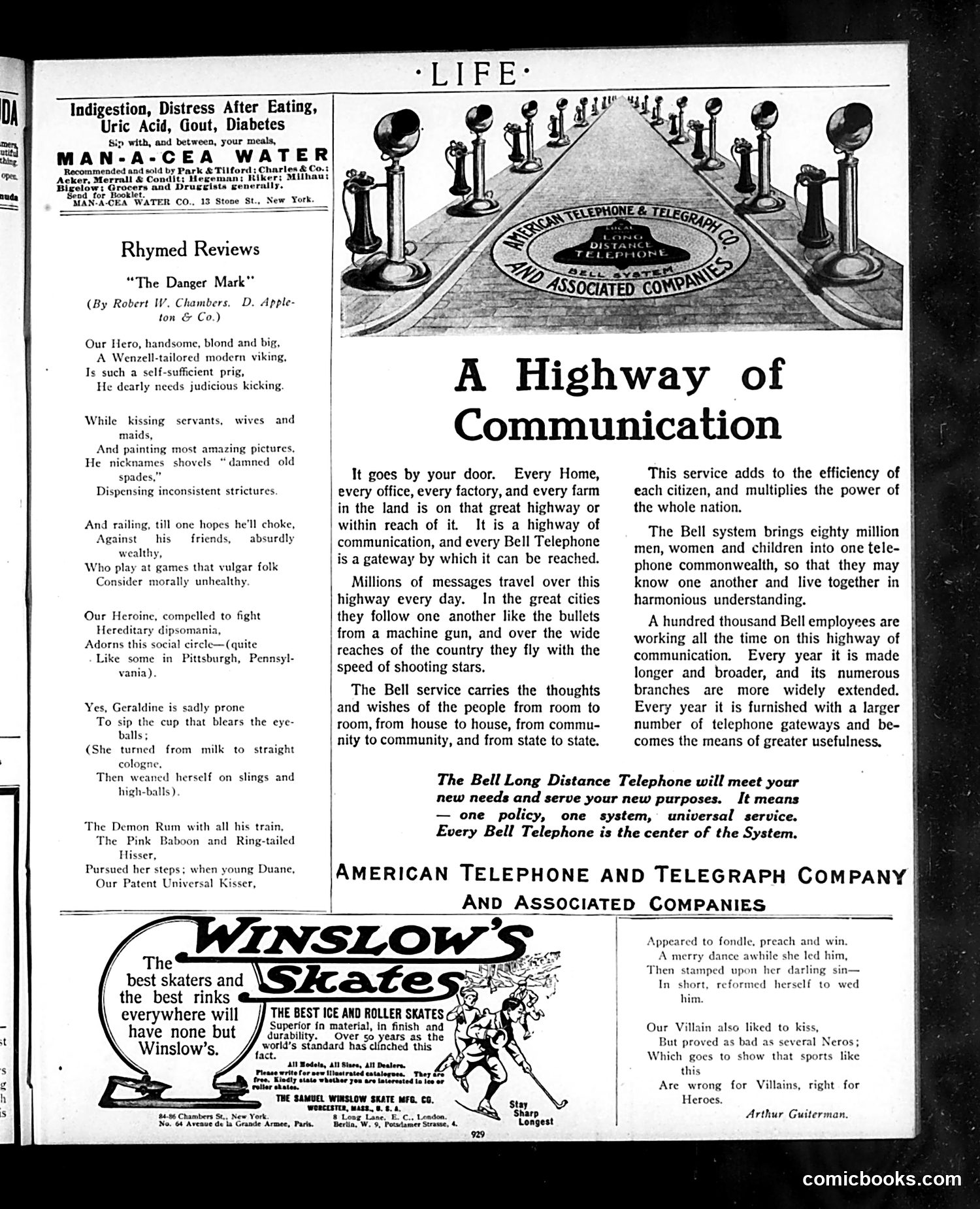
This Life magazine page combines literary criticism, corporate advertising, and social commentary typical of early 20th-century American publishing. **Literary Review ("The Danger Mark"):** Arthur Guiterman's verse review satirizes Robert W. Chambers' novel about a morally hypocritical "modern viking"—a handsome, self-righteous man who seduces women while judging others. The heroine Geraldine struggles with alcoholism (referenced through drinks like "slings and high-balls") but ultimately reforms through love. Guiterman's moral: villains and heroes are distinguished by their actions, not appearances. **Bell Telephone Advertisement:** The large central advertisement portrays the telephone system as a democratic "highway of communication" connecting all Americans. This reflects Progressive Era rhetoric about technology uniting the nation. **Minor Advertisements:** Winslow's ice skates and Man-a-Cea Water (a patent medicine for digestive complaints) fill remaining space—typical period advertising. The page juxtaposes literary morality lessons with corporate messaging about modern progress and national unity.
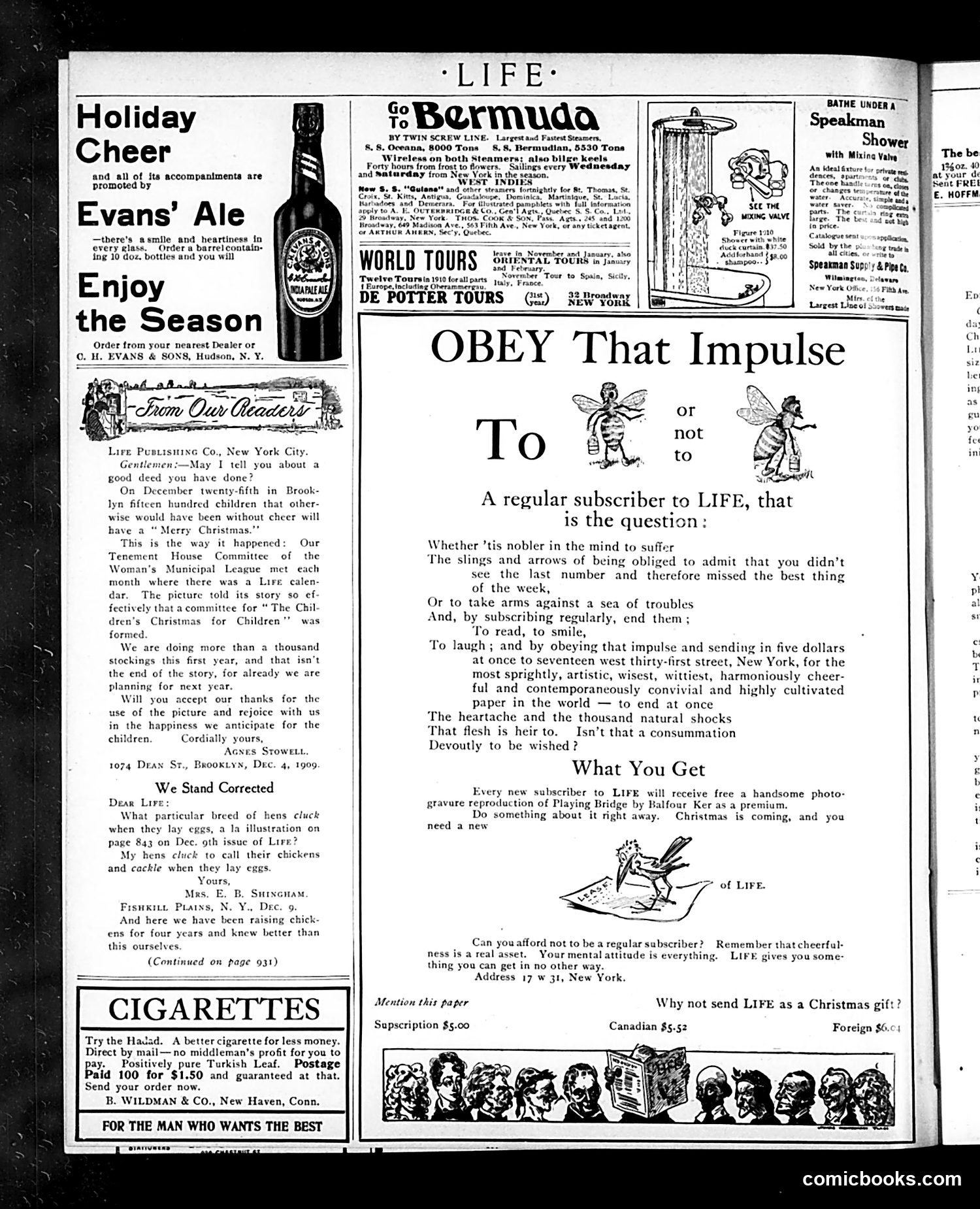
This page is primarily **advertising and subscription promotion** rather than political satire. The main content is a large advertisement for Life magazine subscriptions, cleverly written as a parody of Shakespeare's "To Be or Not to Be" soliloquy. The **central pitch** asks whether readers can afford to *not* subscribe to Life regularly—presenting subscription as a solution to missing the magazine's content and the mental distress this causes. It's a humorous guilt-based sales tactic, suggesting that regular readership ensures cheerfulness and mental well-being. The page also includes: - Travel advertisements (Bermuda cruises, world tours) - Evans' Ale holiday promotion - Reader letters ("We Stand Corrected") about hens and eggs - A promise of a free photogravure print for new subscribers The satire is gentle and self-aware—Life mocks its own sales desperation by invoking Shakespeare while simultaneously making an earnest subscription pitch.
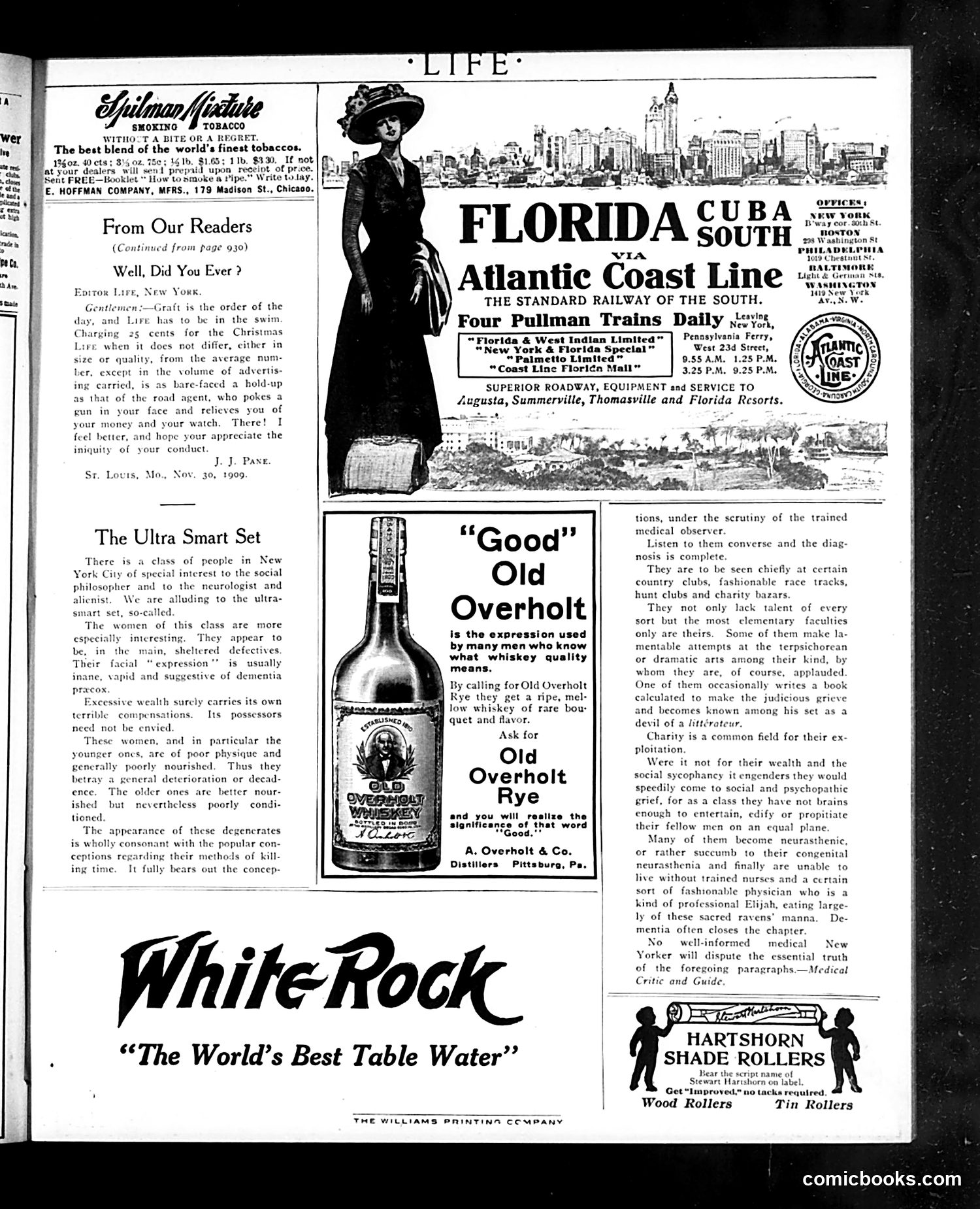
This page contains **primarily advertisements** interspersed with reader letters and a social commentary article. The main satirical content is "The Ultra Smart Set," which critiques wealthy New York socialites—particularly women. The author argues they are "sheltered defectives" with "dementia praecox" (an older psychiatric term), poor physique, and no genuine talents. They're observed at country clubs, racetracks, and charity events, where they dabble unsuccessfully in arts or writing. The piece suggests their wealth enables mediocrity and social parasitism, and that many become neurotic, requiring physicians and nurses. The satire targets the leisure class's emptiness and dependence on inherited money rather than merit or ability. The page also features advertisements for Sulmona tobacco, Atlantic Coast Line railway service to Florida, Old Overholt Rye whiskey, White Rock water, and Hartshorn shade rollers—typical early-1900s consumer products.
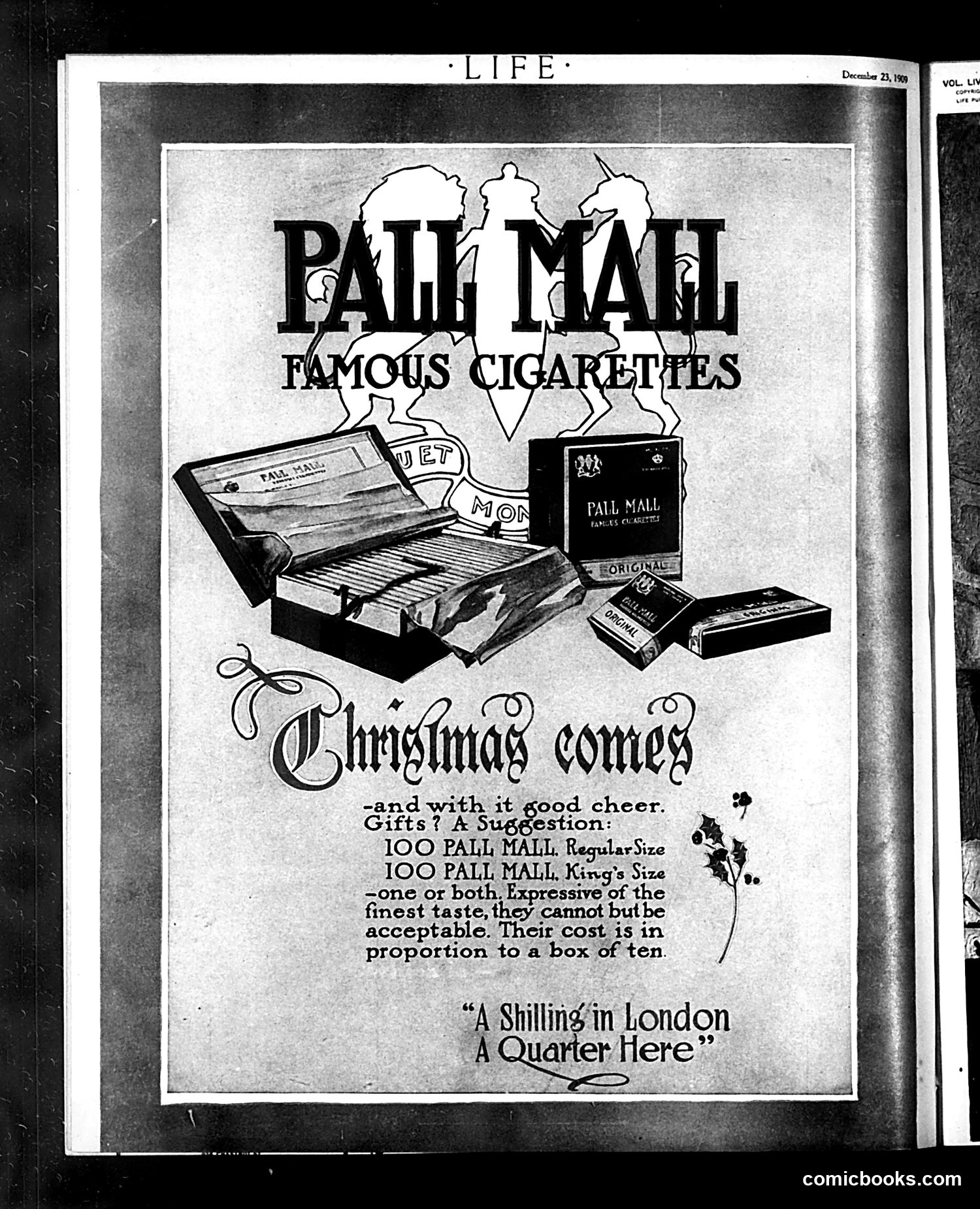
This is a cigarette advertisement for Pall Mall, not political satire. The page appears from Life magazine (dated December 23, 1908 based on the header) and promotes Pall Mall cigarettes as Christmas gifts. The three figures at the top are decorative illustrations, not political caricatures. The ad suggests gifting either regular or "King's Size" boxes of 100 cigarettes, emphasizing they represent "finest taste" and are appropriately priced. The tagline "A Shilling in London / A Quarter Here" indicates pricing differences between British and American markets. This reflects the era when cigarettes were commonly marketed as acceptable luxury gifts, before modern health concerns became public knowledge.