
Life, 1909-12-23 · page 12 of 28
Life — December 23, 1909 — page 12: what you’re looking at
What you’re looking at
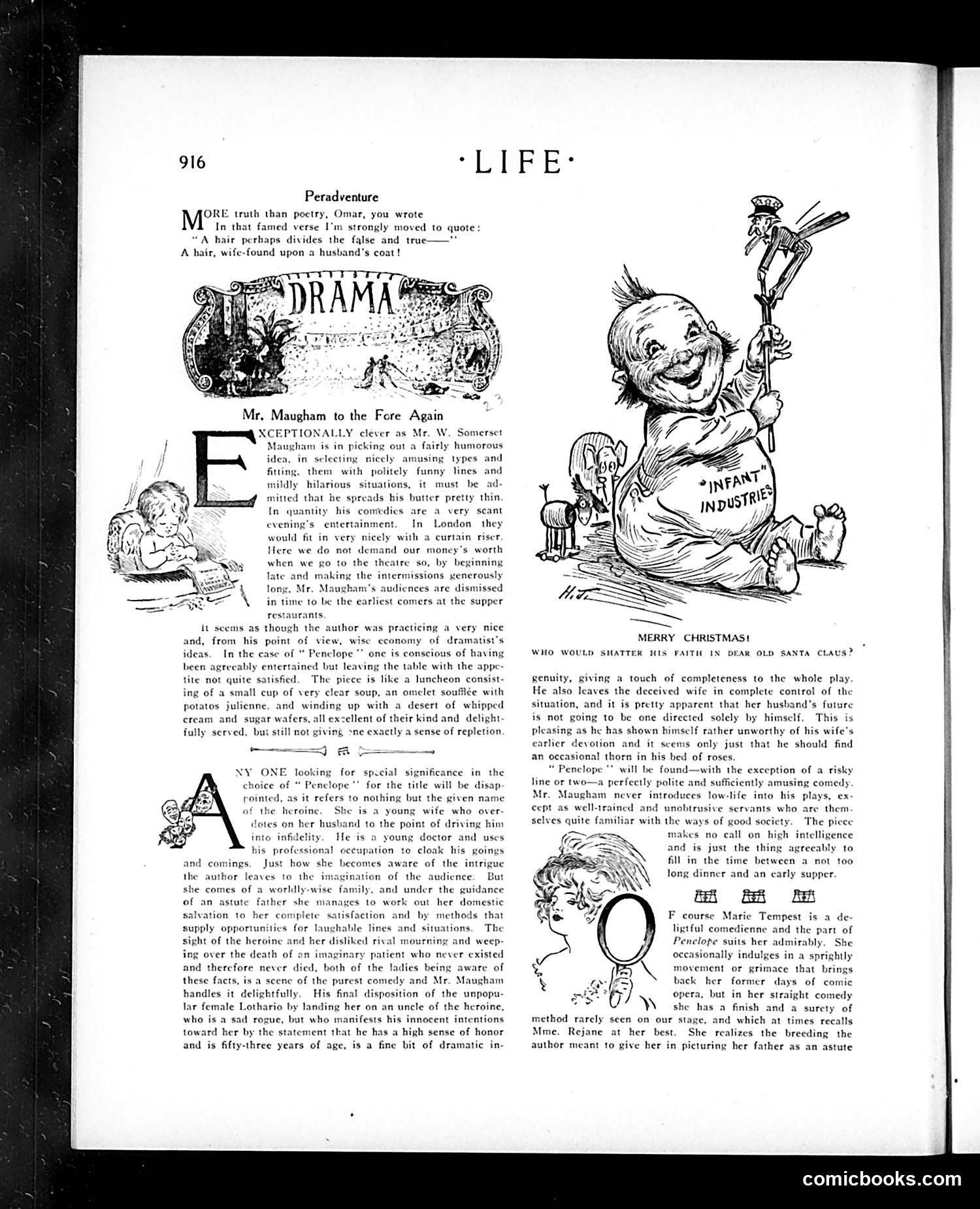
This page contains drama criticism and illustrations. The main article discusses **Mr. Maugham's theatrical work**, praising his skill at selecting "amusing types" and creating "politely funny" comedic situations. The piece notes his plays work well for London audiences seeking lighter entertainment. The article reviews **"Penelope,"** focusing on the lead actress Marie Tempest's performance. It describes her character as an overconfident wife who mismanages domestic life while believing herself superior—a comedic premise typical of early 20th-century theater. The cartoon at top right shows a cheerful figure labeled **"Infant Industries,"** appearing to reference economic protectionism concerns of the era. The satirical "Merry Christmas" caption questions Santa's credibility—likely social commentary about commercialism or childhood disillusionment.
📄 Transcribed text from this page (OCR, searchable)
Machine-transcribed from the original scan — historical spelling and the odd misread are preserved.
916 “LIFE: Peradventure ORE truth than poetry, Omar, you wrote In that famed verse I'm strongly moved to quote: “A hair perhaps divides the false and truae——" A hair, wife-found upon a husband's coal ss ae SZ Mr. Maugham to the Fore Again TIONALLY clever as Mr. W. Somerset Maugham is in picking out a fairly humorous dea, in selecting nicely amusing types and fitting, them with politely funny lines and mildly hilarious situations, it must be ad- mitted that he spreads his butter pretty thin In quantity his comedies are a very scant evening's entertainment. In London they would fit in very nicely with a curtain riser: Here we do not demand our money's worth when we go to the theatre so, by beginning late and making the intermissions xenerous! long, Mr. Maugham’s audiences are dismissed in time to be the earliest comers at the supper restaurants 1t scems as though the author was practicing a very nice and, from his point of view, wise economy of dramatist’s ideas. In the case of “ Penelope" one is conscious of having been agreeably entertained but leaving the table with the appe- tite not quite satisfied. The piece is like a luncheon consist- ing of a small cup of very clear soup, an omelet souflée with potatos julienne, and winding up with a desert of whipped cream and sugar wafers, all exzellent of their kind and delight fully served, but still not giving >ne exactly a sense of repletion ey AD oe NY ONE looking for spccial significance in the choice of “ Penelope "’ for the title will be disap pointed, as it refers to nothing but the given name heroine. She is a young wife who over tes on her husband to the point of driving him into infidelity. He is a young doctor and uses his professional occupation to cloak his goings Just how she becomes aware of the intrigue of the audience. But she comes of a worldly-wise family, and under the guidance of an astute father she manages to work out her domestic salvation to her complete satisfaction and by methods that and comings. the author leaves to the imaginatio supply opportunitics for laughable lines and situations. The sight of the heroine and her disliked rival mourning and weep- ing over the death of an imaginary patient who never existed and therefore never died, both of the ladies being aware of these facts, is a scene of the purest comedy and Mr. Maugham handles it delightfully. His final disposition of the unpopu- lar female Lothario by landing her on an uncle of the heroine, who is a sad rogue, but who manifests his innocent intentions toward her by the statement that he has a high sense of honor and is fifty-three years of age, is a fine bit of dramatic in- MERRY CHRISTMAS! WHO WOULD SHATTER HIS FAITIC IN DEAR OLD SANTA CLAUS? genuity, giving a touch of completeness to the whole play. He also leaves the deceived wife in complete control of the situation, and it is pretty apparent that her husband's future is not going to be one directed solely by himself. This is pleasing as he has shown himself rather unworthy of his wife's evotion and it seems only just that he should find an occasional thorn in his bed of roses. “ Penelope "’ will be found—with the exception of a risky line or two—a perfectly polite and sufficiently amusing comedy Mr. Maugham never introduces low-life into his plays, ex- earlier cept as well-trained and unobtrusive servants who are them selves quite familiar with th The piece Ga< makes no call on high intelligence OS and is just the thing agreeably to > fill in the time between a not too ways of good society long dinner and an carly supper. a RR MA F course Marie Tempest is a de ligtful comedienne and the part of Penelope suits her admirably. She occasionally indulges in a sprightly movement or grimace that brings back her former days of comic opera, but in her straight comedy she has a finish and a surety of method rarely seen on our s Mme. Rejane at her best ze, and which at times recalls She realizes the breeding the author meant to give her in picturing her father as an astute comicbooks.com