
Life, 1909-12-23 · page 18 of 28
Life — December 23, 1909 — page 18: what you’re looking at
What you’re looking at
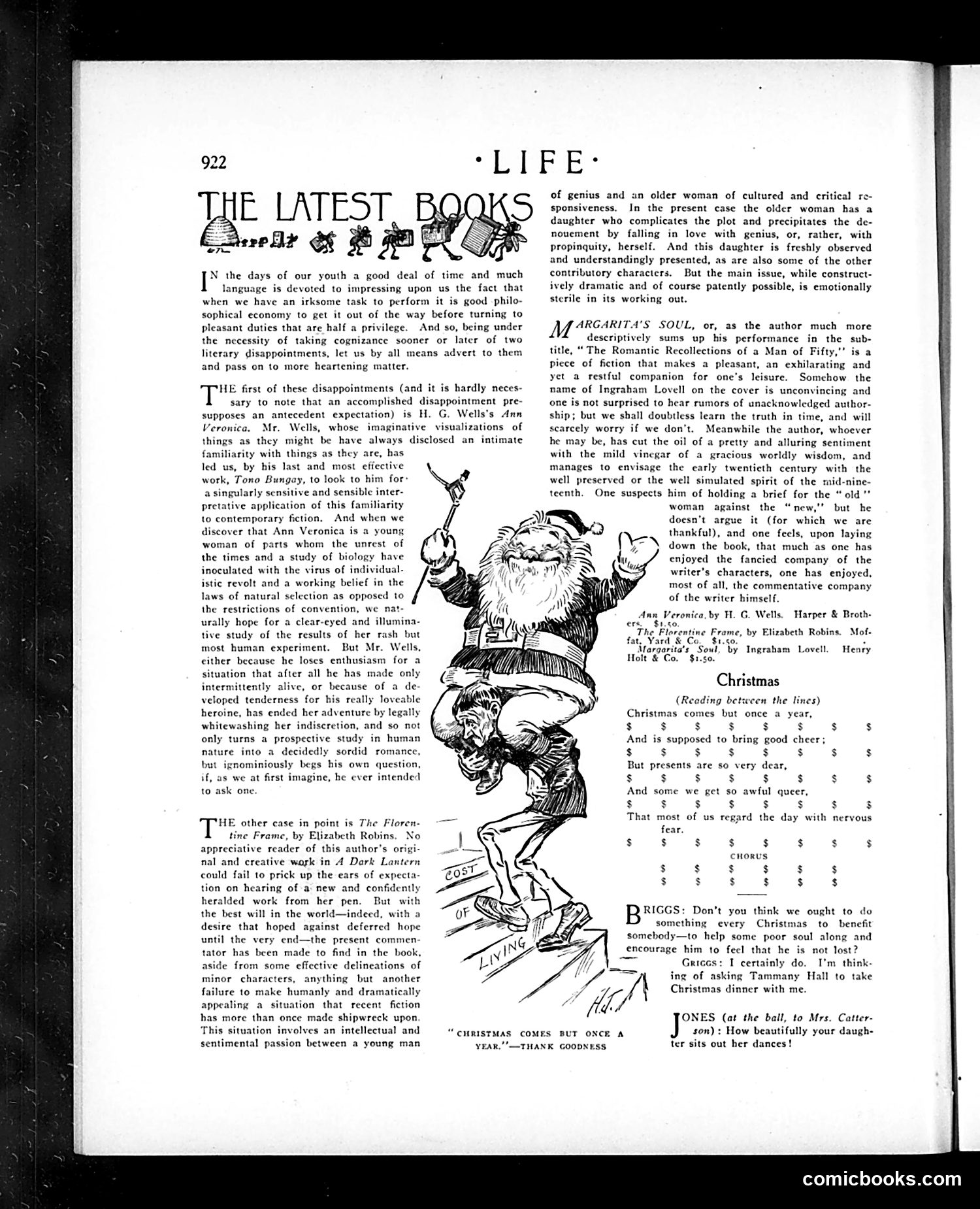
This page from Life magazine contains **book reviews** rather than political cartoons. The central illustration—a caricatured figure juggling while balancing on one leg—is a decorative **generic emblem** for "The Latest Books" section, not satire of a specific person. The reviews discuss three novels critically: H.G. Wells's *Ann Veronica* (criticized for abandoning serious social commentary through an unsatisfying romantic resolution), Elizabeth Robins's *The Florentine Frame* (faulted as emotionally sterile despite capable characterization), and Ingraham Lovell's *Margarita's Soul* (praised as a pleasant leisure read). The page also includes a humorous Christmas poem and dialogue about holiday gift-giving anxieties. No specific political figures or events are referenced—this is literary criticism dressed in the magazine's characteristic witty, gossipy tone aimed at educated readers.
📄 Transcribed text from this page (OCR, searchable)
Machine-transcribed from the original scan — historical spelling and the odd misread are preserved.
922 THE LATEST (AeA? & x N the days of our youth a good deal of time and much language is devoted to impressing upon us the fact that when we have an irksome task to perform it is good philo- sophical economy to get it out of the way before turning to pleasant duties that are half a privilege. And so, being under the necessity of taking cognizance sooner or later of two literary disappointments, let us by all means advert to the and pass on to more heartening matter. HE first of these disappointments (and it is hardly neces- sary to note that an accomplished disappointment pre- supposes an antecedent expectation) is H. G. Wells's Ann Veronica. Mr. Wells, whose imaginative visualizations of things as they might be have always disclosed an intimate familiarity with things as they are, has led us, by his last and most efiective work, Tono Bungay, to look to him for* a singularly sensitive and sensible inter- pretative application of this familiarity to contemporary fiction. And when we discover that Ann Veronica is a young woman of parts whom the unrest of the times and a study of biology have inoculated with the virus of individual- istic revolt and a working belief in the laws of natural selection as opposed to the restrictions of convention, we nat- urally hope for a clear-eyed and illumina- tive study of the results of her rash but most human experiment. But Mr. Wells, either because he loses enthusiasm for a situation that after all he has made only intermittently alive, or because of a de veloped tenderness for his really loveable heroine, has ended her adventure by legally whitewashing her indiscretion, and so not only turns a prospective study in human nature into a decidedly sordid romance, but ignominiously begs his own question, if, as we at first imagine, he ever intended to ask one. HE other case in point is The Floren- tine Frame, by Elizabeth Robins, No appreciative reader of this author's origi- nal and creative wask in A Dork Lantern could fail to prick up the ears of expecta- tion on hearing of a new and confidently heralded work from her pen. But with the best will in the world—indeed, with a desire that hoped against deferred hope until the very end—the present commen tator has been made to find in the book. aside from some effective delineations of minor characters, anything but another failure to make humanly and dramatically appealing a situation that recent fiction has more than once made shipwreck upon. This situation involves an intellectual and“ cugistatas COMES BUT ONCE A sentimental passion between a young man YEAR,”’—THANK GOODNESS “ETE E* of genius and an older woman of cultured and critical re- sponsiveness. In the present case the older woman has a daughter who complicates the plot and precipitates the de- nouement by falling in love with genius, or, rather, with Propinquity, herself. And this daughter is freshly observed and understandingly presented, as are also some of the other contributory characters. But the main issue, while construct- ively dramatic and of course patently possible, is emotionally sterile in its working out. ARGARITA'S SOUL, of, as the author much more descriptively sums up his performance in the sub- title, “The Romantic Recollections of a Man of Fifty,” is a piece of fiction that makes a pleasant, an exhilarating and yet a restful companion for one’s leisure. Somehow the name of Ingraham Lovell on the cover is unconvincing and one is not surprised to hear rumors of unacknowledged author- ship; but we shall doubtless learn the truth in time, and will scarcely worry if we don't. Meanwhile the author, whoever he may be, has cut the oil of a pretty and alluring sentiment with the mild vinegar of a gracious worldly wisdom, and manages to envisage the early twentieth century with the well preserved or the well simulated spirit of the mid-nine- teenth. One suspects him of holding a brief for the “ old" woman against the “new," but he doesn't argue it (for which we are thankful), and one feels, upon laying down the book, that much as one has enjoyed the fancied company of the writer's characters, one has enjoyed, most of all, the commentative company of the writer himself. Inn Veronica, by H. G. Wells. $1.50, Harper & Broth- Florentine Frame, by Elizabeth Robins. Mof- & Co. $1.50. Margarita's Soul, by Ingraham Lovell Holt & Co. $1.50. Christmas (Reading between the lines) Christmas comes but once a year, $$ $ $ $ $8 And is supposed to bring good cheer; $ $s $ $ $ $ But presents are so very dear, $s $ $ $ $ § I) iy) And some we get so awful queer, 1} $ $ $ $ $ $ $ 8 ‘ That most of us regard the day with nervous fear. Henry L(A $ $ $ RIGGS: Don't you think we ought to do something every Christmas to benefit somebody—to help some poor soul along and encourage him to fecl that he is not lost? Griccs: T certainly do. I’m think- ing of asking Tammany Hall to take Christmas dinner with me. ONES (at the ball, to Mrs. Catter- son): How beautifully your daugh- ter sits out her dances! comicbooks.com