
Life, 1909-12-23 · page 6 of 28
Life — December 23, 1909 — page 6: what you’re looking at
What you’re looking at
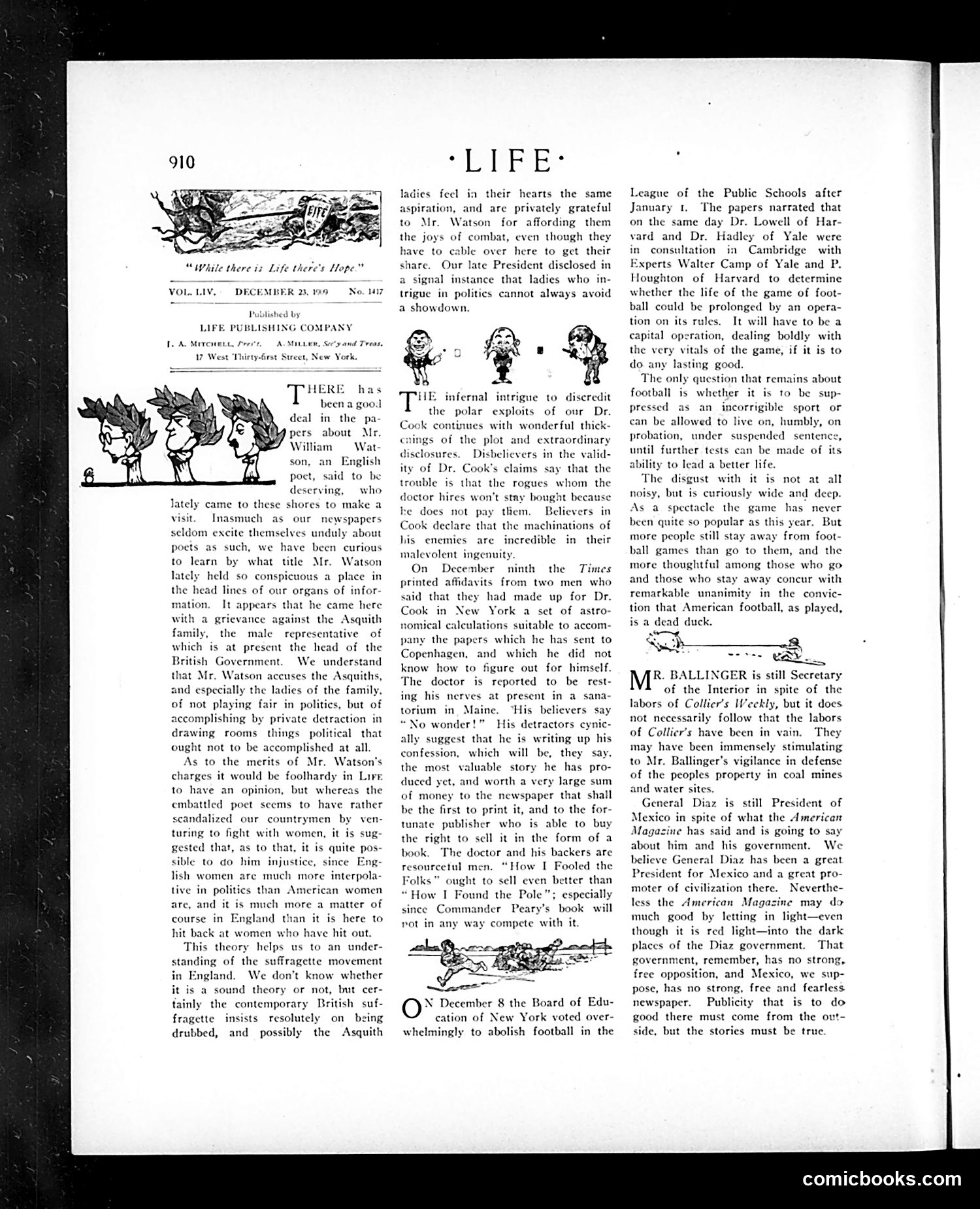
This page contains political commentary rather than cartoons. The main text discusses Mr. Watson and his accusations against the Asquith family regarding British politics and the head of government. The article references Mr. Watson's charges against women in politics, suggesting British suffragettes are "much more interpolative in politics than American women." The satire implies Watson uses political scandals and "drawing room" gossip to discredit women's political involvement. The piece also covers General Díaz (Mexico's president), Dr. Cook (explorer/fraud claims), and Collier's Weekly secretary Ballinger's defense of coal and water site policies. The small illustrated vignettes show cartoon figures but the text provides the satirical commentary targeting early 20th-century political figures and movements, particularly British suffrage debates and American political controversies.
📄 Transcribed text from this page (OCR, searchable)
Machine-transcribed from the original scan — historical spelling and the odd misread are preserved.
“While there iz Life there's Hope” VOL. LIV, DECEMBER 23,199 No. 1417 Published by LIFE PUBLISHING COMPANY 1. A. Meron A. MILLER, Si’y and Treas, st Street, New York. HERE been a goo.l deal in the pa pers about Mr. William Wat son, an English poet, said to be deserving, who lately came to these shores to make a visit. Inasmuch as has our newspapers seldom excite themselves unduly about poets as such, we have been curious to learn by what title Mr. Watson held so conspicuous a place in head lines of our organs of infor- mation. It appears that he came here with a grievance against the Asquith family, the which is male representative of ut present the head of the vernment. We understand that Mr. Watson accuses the Asquiths, and especially the ladies of the family, of not playing fair in politics, but of accomplishing by private detraction in drawing rooms things political that ought not to be accomplished at all As to the merits of Mr. Watson's charges it would be foolhardy in Lirr to have an opinion, but whereas the embattled poet seems to have rather scandalized our countrymen by ven- turing to fight with women, it is sug- gested that, as to that, it is quite pos- sible to do him injustice, since E lish women are much more interpola tive in politics than American women are, and it is much more a matter of course in England than it is here to hit back at women who have hit out, This theory helps us to an under- standing of the suffragette movement in gland. We don’t know whether it is a sound theory or not, but cer- tainly the contemporary British suf- fragette resolutely on being drubbed, and possibly the Asquith insists Se) Ey Lali ladies feel in their hearts the same aspiration, and are privately grateful to Mr. Watson for affording them the joys of combat, even though they have le over here to get their share. Our late President disclosed in a signal instance that ladies who in- trigue in politics cannot always avoid a showdown, to ca’ HE infernal intrigue to discredit the polar exploits of our Dr. ‘ook continues with wonderful thick- ings of the plot and extraordinary disclosures. Disbelievers in the valid- ity of Dr. Cook's claims say that the trouble is that the rogues whom the doctor hires won't stay bought because ke does not pay them. Believers in Cook declare that the machinations of incredible in their malevolent ingenuity. On December ninth the Times printed affidavits from two men who said that they had made up for Dr. Cook in New York a set of astro- nomical calculations suitable to accom- pany the papers which he has sent to Copenhagen, and which he did not know how to figure out for himself. The doctor is reported to be rest- ing his nerves at present in a sana- torium in Maine. “His believers say “No wonder!” His detractors cynic- ally suggest that he is writing up his which will be, they say. the most valuable story he has pro- duced yet, and worth a very large sum of money to the newspaper that shall be the first to print it, and to the for- tunate publisher who is able to buy the right to sell it in the form of a book. The doctor and his backers are resourcetul men. “How I Fooled the Folks” ought to sell even better than “How I Found the Pole”; especially Commander Peary’s book will rot in any way compete with it. Roe N December 8 the Board of Edu- cation of New York voted over- whelmingly to abolish football in the his enemies are confessiot since League of the Public Schools after January 1. The papers narrated that on the same day Dr. Lowell of Har- vard and Dr. Hadley of Yale were in consultation in Cambridge with ixperts Walter Camp of Yale and P. Houghton of Harvard to determine whether the life of the game of foot- ball could be prolonged by an ope tion on its rules. It will have to be a capital operation, dealing boldly with the very vitals of the game, if it is to do any lasting good. The only question that remains about football is whether it is 10 be pressed as an incorrigible sport or can be allowed to live on, humbly, on probation, under suspended sentence, until further tests can be made of its bility to lead a better life. The disgust with it is not at all noisy, but is curiously wide and deep. As as le the game has never been quite so popular as this year. But more people still stay away from foot- ball games than go to them, and the more thoughtful among those who go and those who stay away concur with remarkable unanimity in the convic- tion that American football, as played, is a dead duck. a R. BALLINGER is still Secretary of the Interior in spite of the labors of Collier's Weekly, but it does not necessarily follow that the labors of Collier's have been in vain. They may have been immensely stimulating to Mr. Ballinger’s vigilance in defense of the peoples property in coal mines and water sites. General Diaz is still President of Mexico in spite of what the American Magazine has said and is going to say about him and his government. We believe General Diaz has been a great President for Mexico and a great pro- moter of civilization there. Neverthe- less the American Magazine may do much good by letting in light—even though it is red light—into the dark places of the Diaz government. That government, remember, has no strong, free opposition, and Mexico, we sup- pose, has no strong, free and fearless. newspaper. Publicity that is to do good there must come from the ovt- side, but the stories must be true. sup- comicbooks.com