
A complete issue · 36 pages · 1909
Life — April 15, 1909
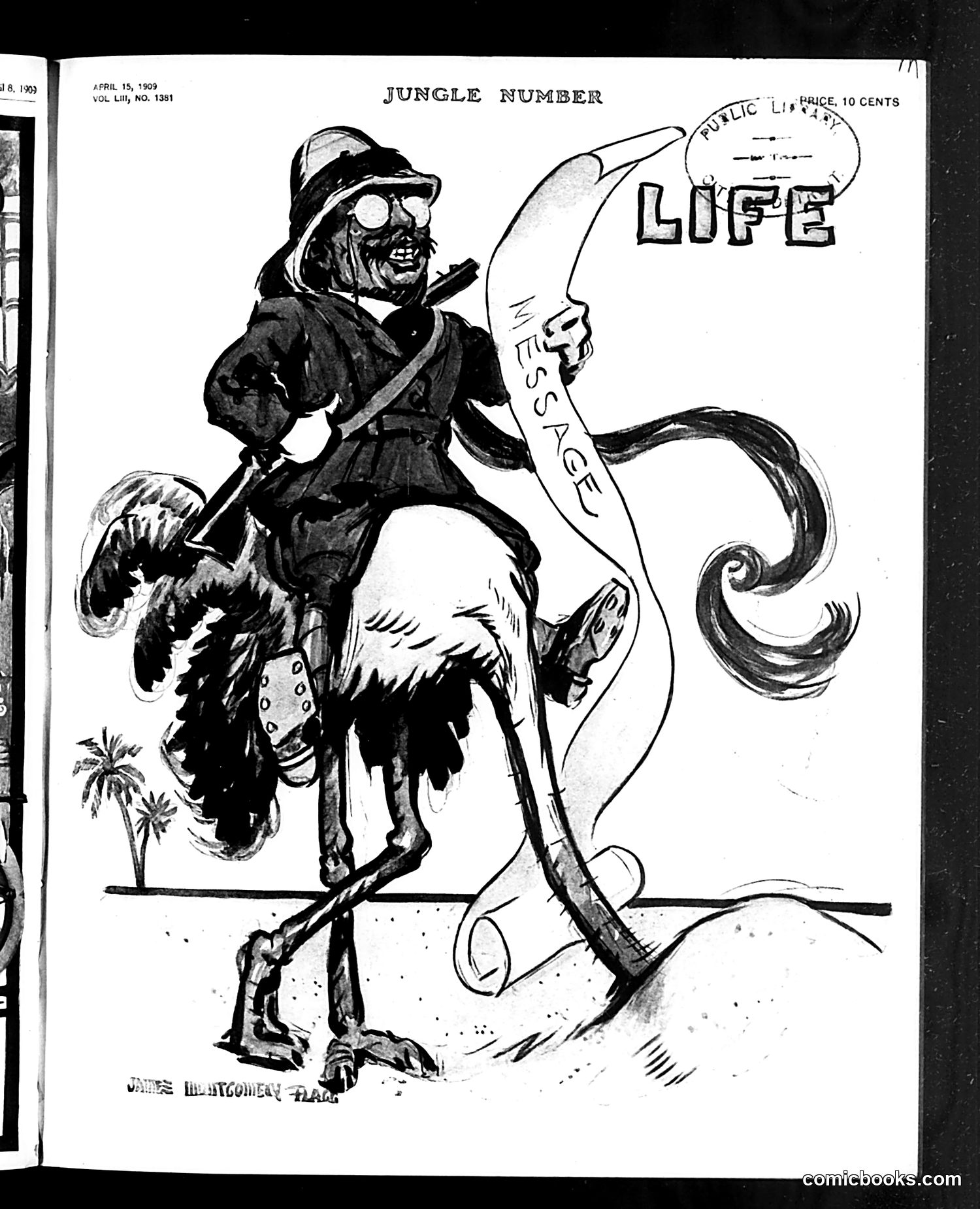
**Publication:** April 15, 1909 **Image:** This "Jungle Number" cover features a caricatured figure in colonial/safari attire riding an anthropomorphized animal (possibly representing a large ape or beast). The rider wields a curved blade marked "PASSAGE" while a banner reading "LIFE" flies overhead. **Context:** The cover likely references Upton Sinclair's *The Jungle* (1906), a muckraking novel exposing abuses in the American meatpacking industry. The satirical imagery—combining jungle/safari themes with the book's title—appears to mock either the novel's popularity or its sensationalism. The "passage" reference remains unclear without additional context, though it may relate to colonial or industrial themes contemporary to the period.
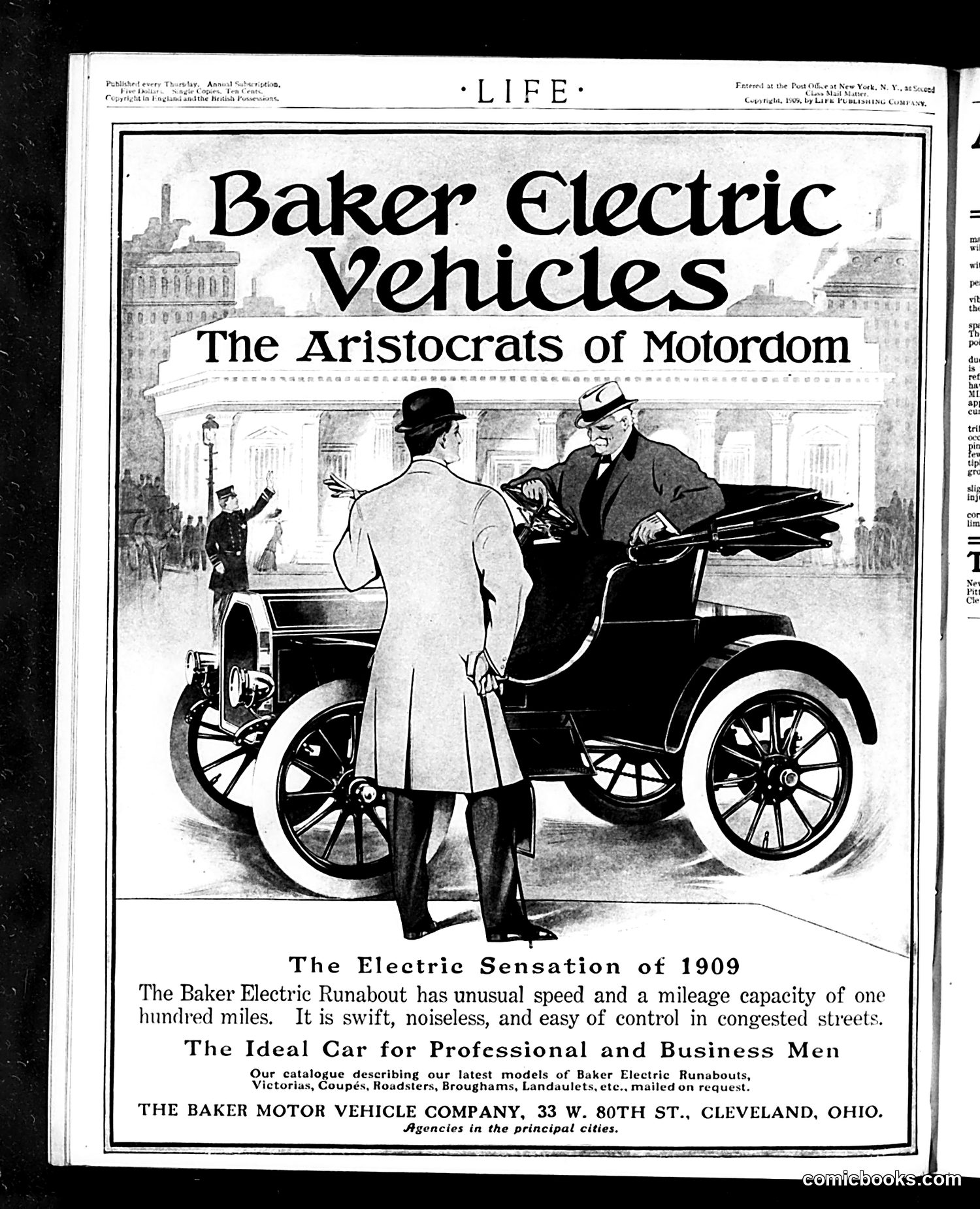
This is primarily a **product advertisement**, not satire. It promotes the Baker Electric Runabout, an early electric automobile, positioned as "The Aristocrats of Motordom." The illustration depicts two well-dressed gentlemen in formal attire (bowler hats, overcoats) examining Baker electric vehicles against a grand civic building backdrop. The messaging targets "Professional and Business Men" by emphasizing luxury, reliability, and practical advantages: "unusual speed," "one hundred miles" range, and being "swift, noiseless, and easy of control in congested streets." This reflects the 1909 moment when electric vehicles competed seriously with gasoline cars before internal combustion engines eventually dominated. The ad's claim that electrics represented elite "aristocrats" of motoring illustrates how novel and prestigious automobiles—especially quiet, clean electric models—were positioned as status symbols for wealthy urban professionals.
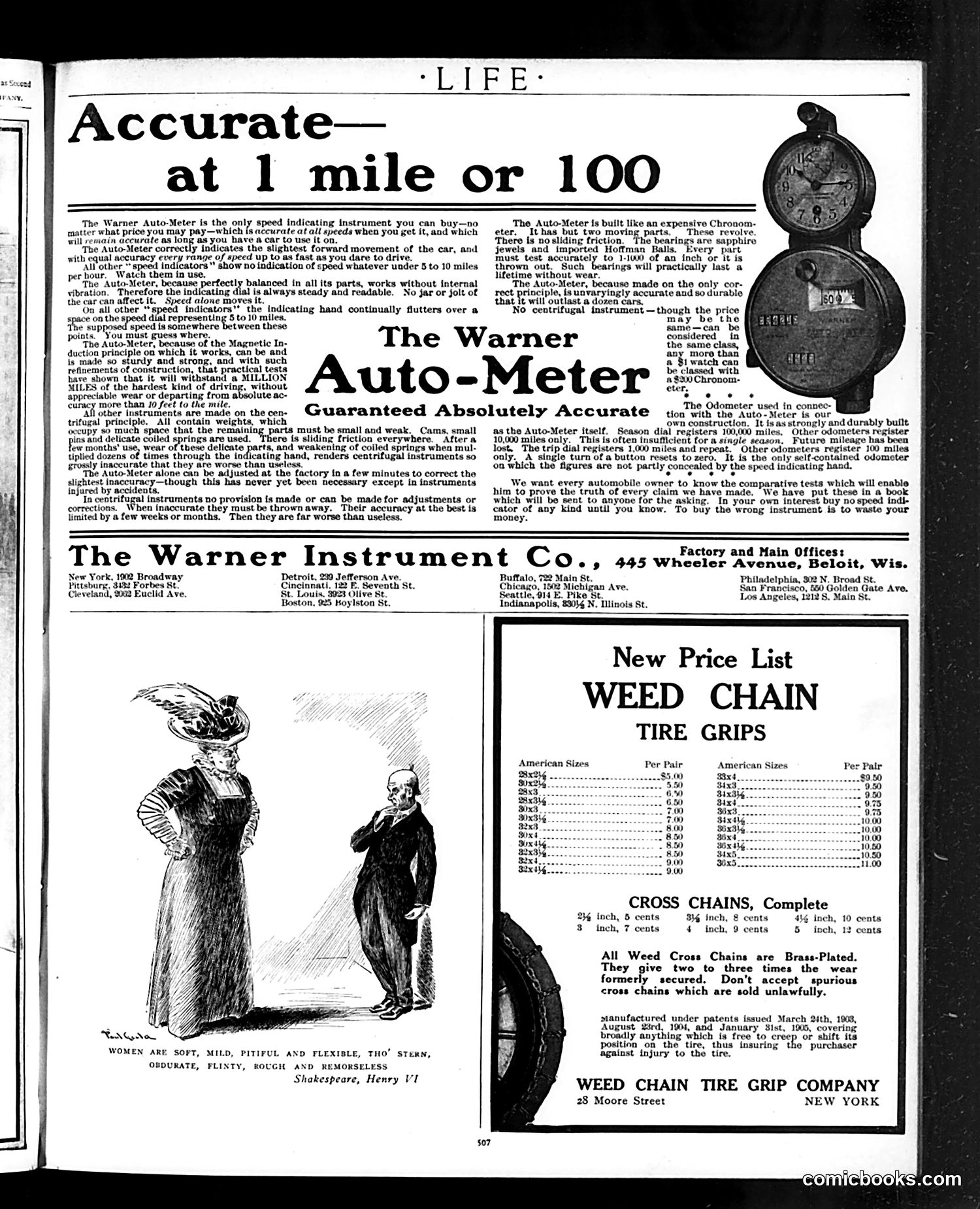
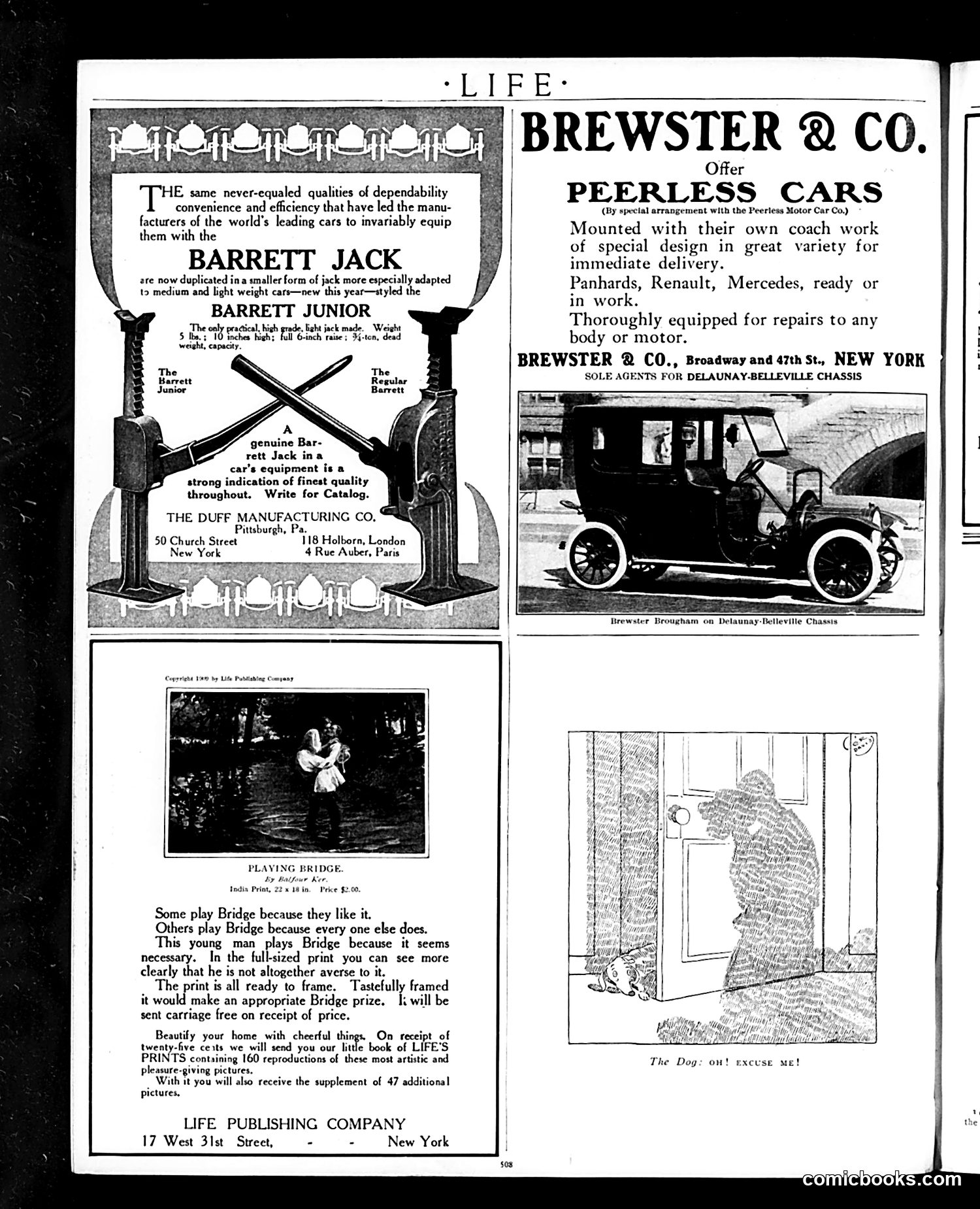
This page is **primarily advertising**, not political satire. The left side advertises the **Barrett Jack**, a mechanical car jack manufactured by Duff Manufacturing Co. (Pittsburgh and London locations listed). Text emphasizes its "dependability" and "efficiency." The right side features **Brewster & Co.**, a New York automobile coachbuilder advertising "peerless cars" with custom coach work on Panhard, Renault, and Mercedes chassis. They offer repair services and show a photograph of a Brewster Brougham. Below is a **Life Publishing Company advertisement** promoting their "Playing Bridge" print and offering a books-of-prints collection. The small cartoon at bottom right—"The Dog: oh! excuse me!"—is the only satirical content, depicting a dog encountering something indoors, likely a mild domestic humor gag typical of early-20th-century magazine filler.
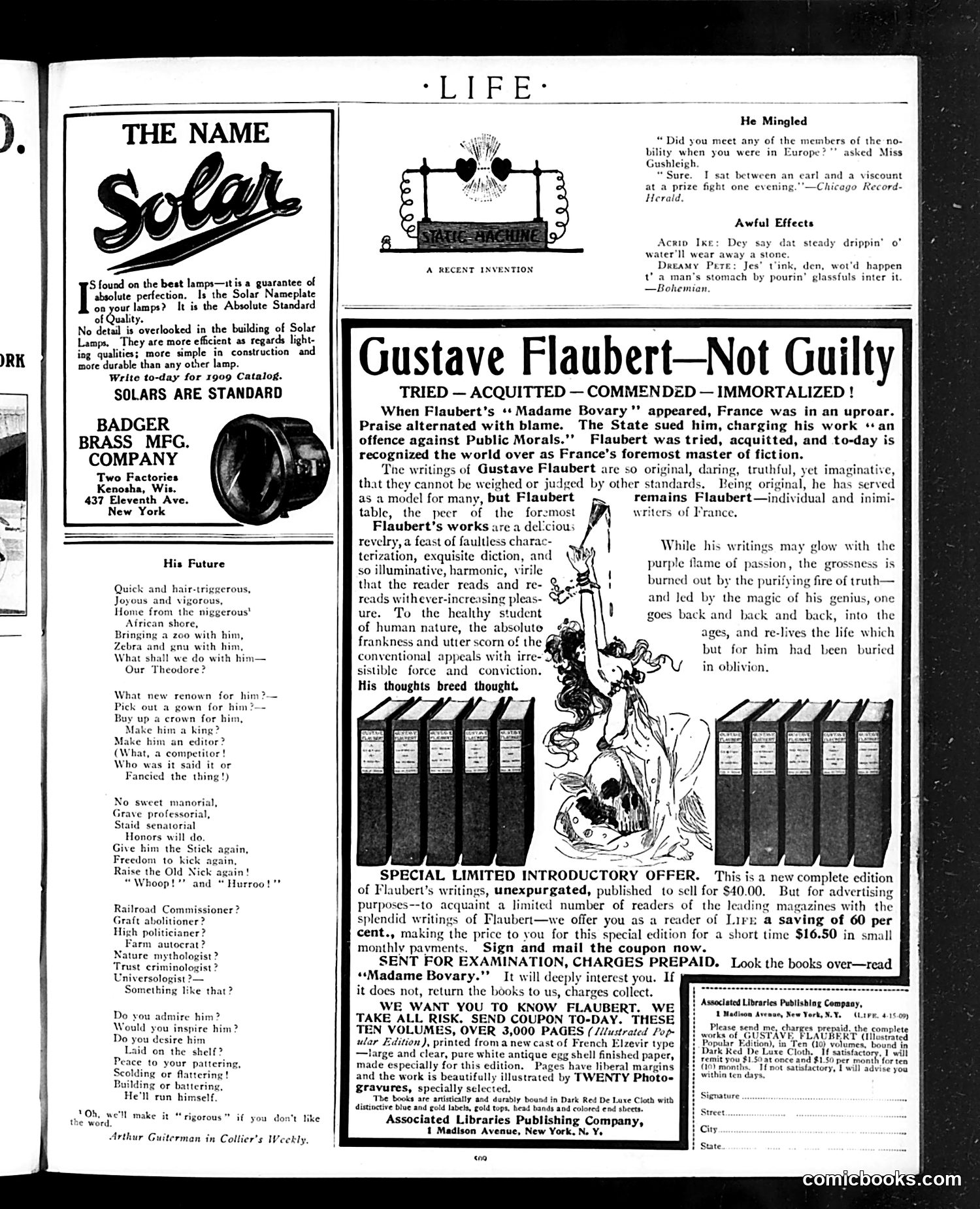
This page is primarily **advertising and promotional content**, not political satire. The main feature is a large advertisement for a special edition of Gustave Flaubert's complete works, published by Associated Libraries Publishing Company. The Flaubert section uses elevated language praising the French author as France's "foremost master of fiction" and emphasizing his literary immortality. This is straightforward book marketing rather than satire. The left column contains a Solar lamp advertisement and an unrelated poem titled "His Future" by Arthur Guiterman in Collier's Weekly—conventional magazine filler. The page includes sketches accompanying the Flaubert promotion, showing classical imagery appropriate to marketing a canonical literary work. There is **no identifiable political cartoon or satirical content** on this page.
This page is **not a cartoon or satire** — it's a straightforward advertisement for the Herreshoff automobile, placed in Life magazine. The ad promotes a lightweight car (1,600 pounds) manufactured by Herreshoff Motor Co. of Detroit and sold through Harvey S. Haupt Co. in New York. The pitch emphasizes practical advantages: lower purchase price, reduced maintenance costs (one-third of larger cars), better fuel efficiency (18+ miles per gallon), and superior handling on poor roads. The ad positions the Herreshoff as filling a market niche between light cars and luxury vehicles, claiming quality comparable to major American and foreign manufacturers despite its $1,500 price point. It mentions planned production in Bristol, Connecticut, with models featuring 4-cylinder and 6-cylinder engines. This represents early 20th-century automobile marketing, targeting budget-conscious consumers.
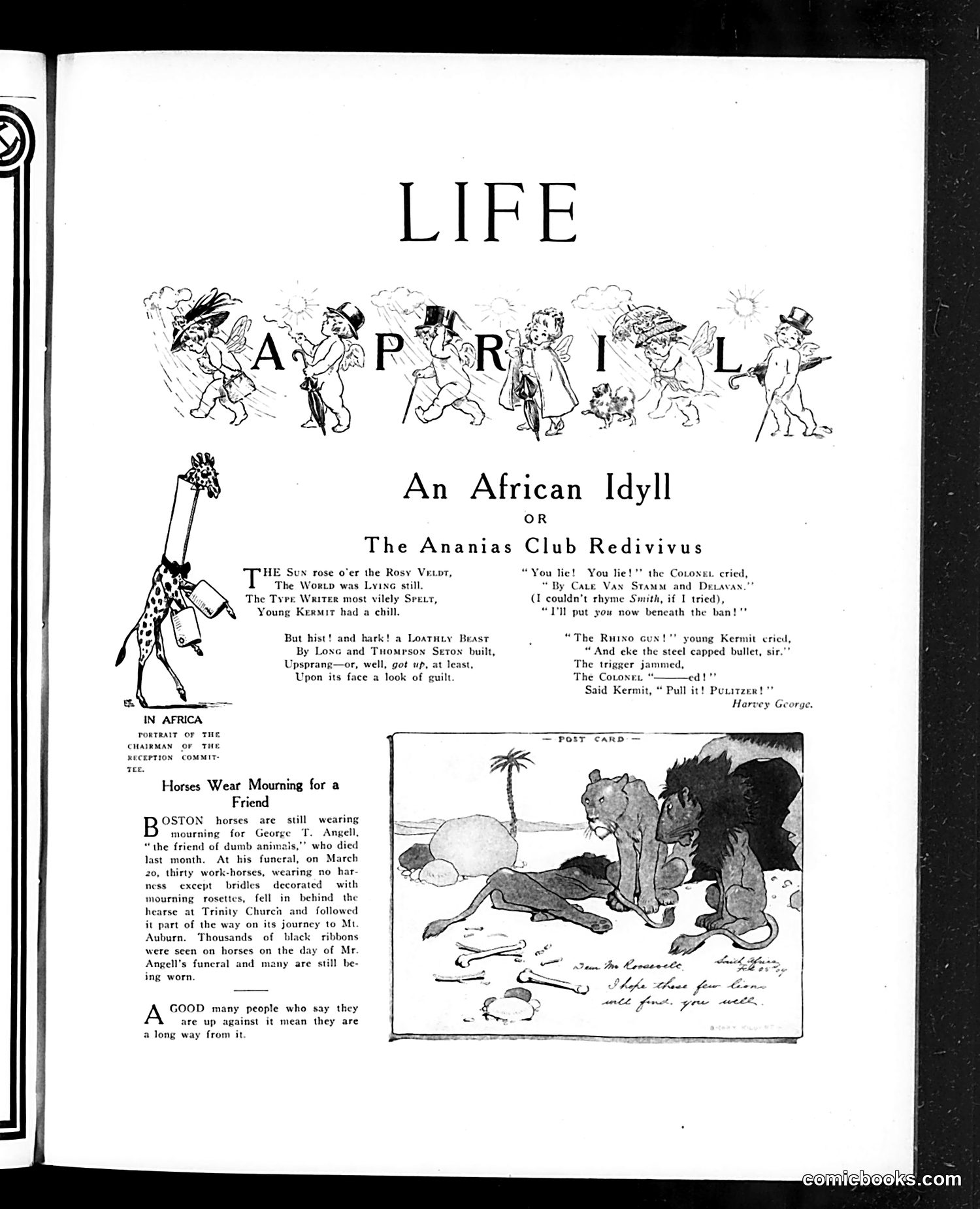
This page is titled "Life April: An African Idyll or The Ananias Club Redivivus." The content satirizes colonial attitudes toward Africa and those who romanticize it. The top features decorative lettering with cherubic figures and a giraffe illustration labeled "Portrait of the Character of the Reception Committee." The main article, "Horses Wear Mourning for a Friend," appears to mock absurd colonial anecdotes—specifically referencing Boston horses mourning George T. Angell, described as "the friend of dumb animals," with exaggerated details about funeral processions with black ribbons. The postcard illustration shows lions in African landscape with handwritten-style captions, likely mocking overwrought colonial travel narratives and romanticized accounts of Africa circulating among American readers. The satire targets both colonial pretension and credulous audiences who accepted such exaggerated stories.
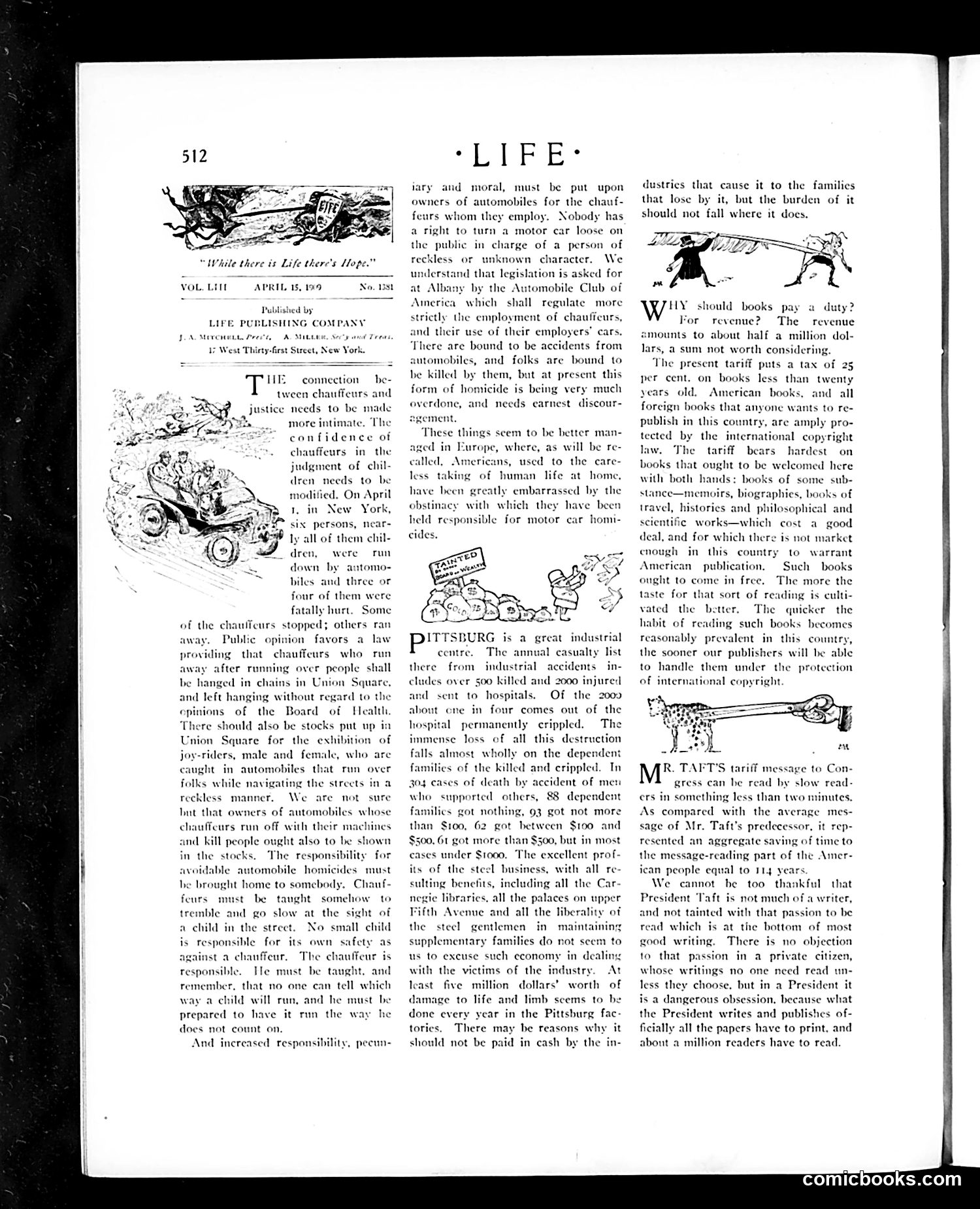
This page discusses automobile-related deaths and injuries, particularly focusing on chauffeurs' safety and accountability. The cartoons illustrate the hazards of early motoring—showing vehicles in crashes and collisions. The text advocates for stricter regulation of chauffeur employment and argues that automobile owners bear responsibility for accidents caused by their drivers. It references a Pittsburgh industrial center with 500+ killed and 2,000 injured in accidents annually. The page also critiques President Taft's tariff message to Congress, suggesting his prolific writing (million readers) reflects dangerous obsession rather than practical leadership. The satirical thrust targets both automobile industry negligence and political excess, using visual humor to underscore early 20th-century industrial safety concerns.
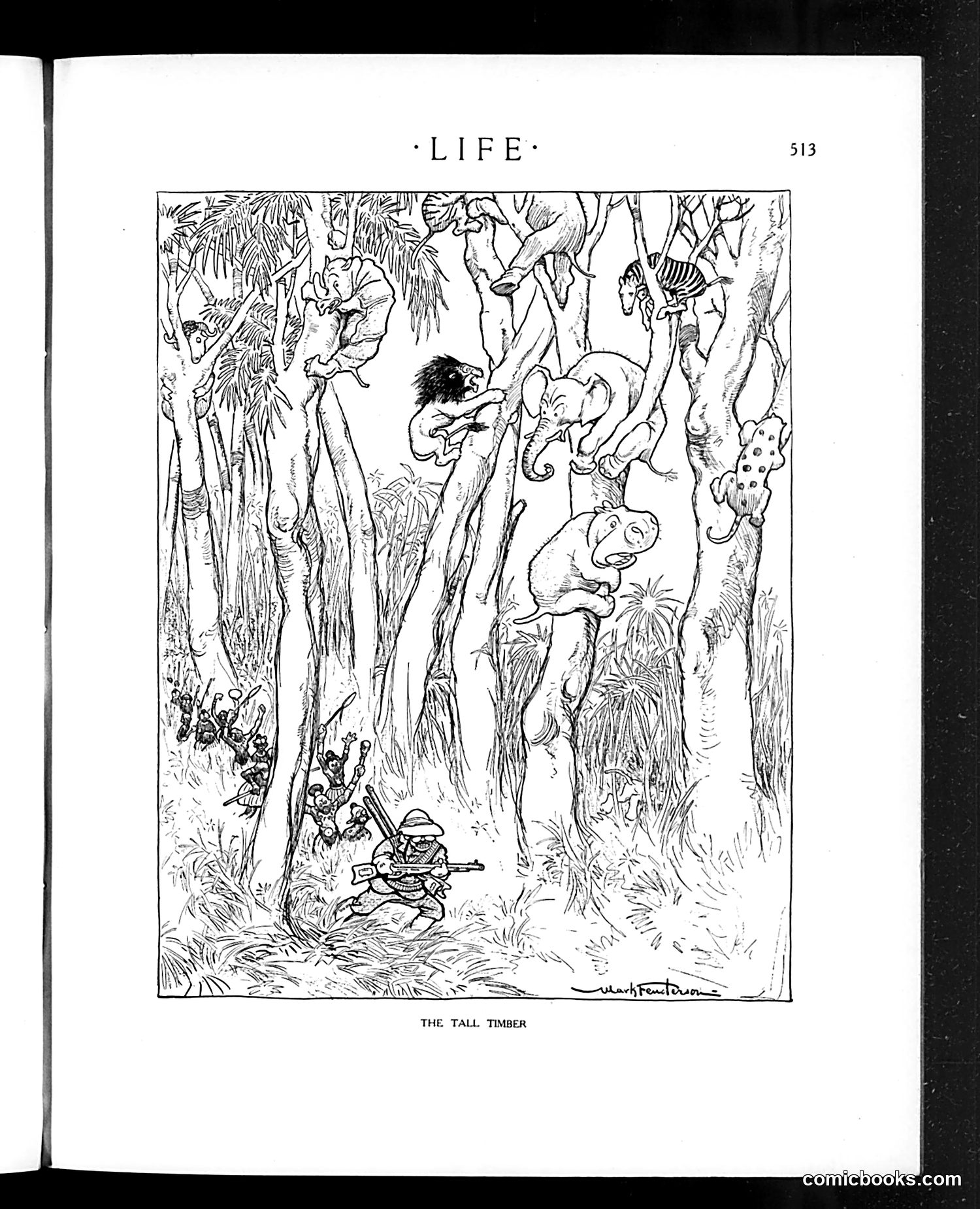
This cartoon depicts a hunter armed with a rifle at the base of tall trees in what appears to be a jungle or forest setting. Multiple monkeys or apes swing and climb throughout the canopy above him. The title "The Tall Timber" is a period phrase meaning remote, wild country. The cartoon appears to be satirizing big-game hunting or colonial exploration in exotic locales—popular leisure activities for wealthy Americans and Europeans in the early 20th century. The hunter's vulnerable position beneath the agile creatures suggests the satirist's commentary on human presumption: that despite weaponry and civilization, man remains at a disadvantage in nature's domain, outnumbered and outmaneuvered by the indigenous inhabitants.
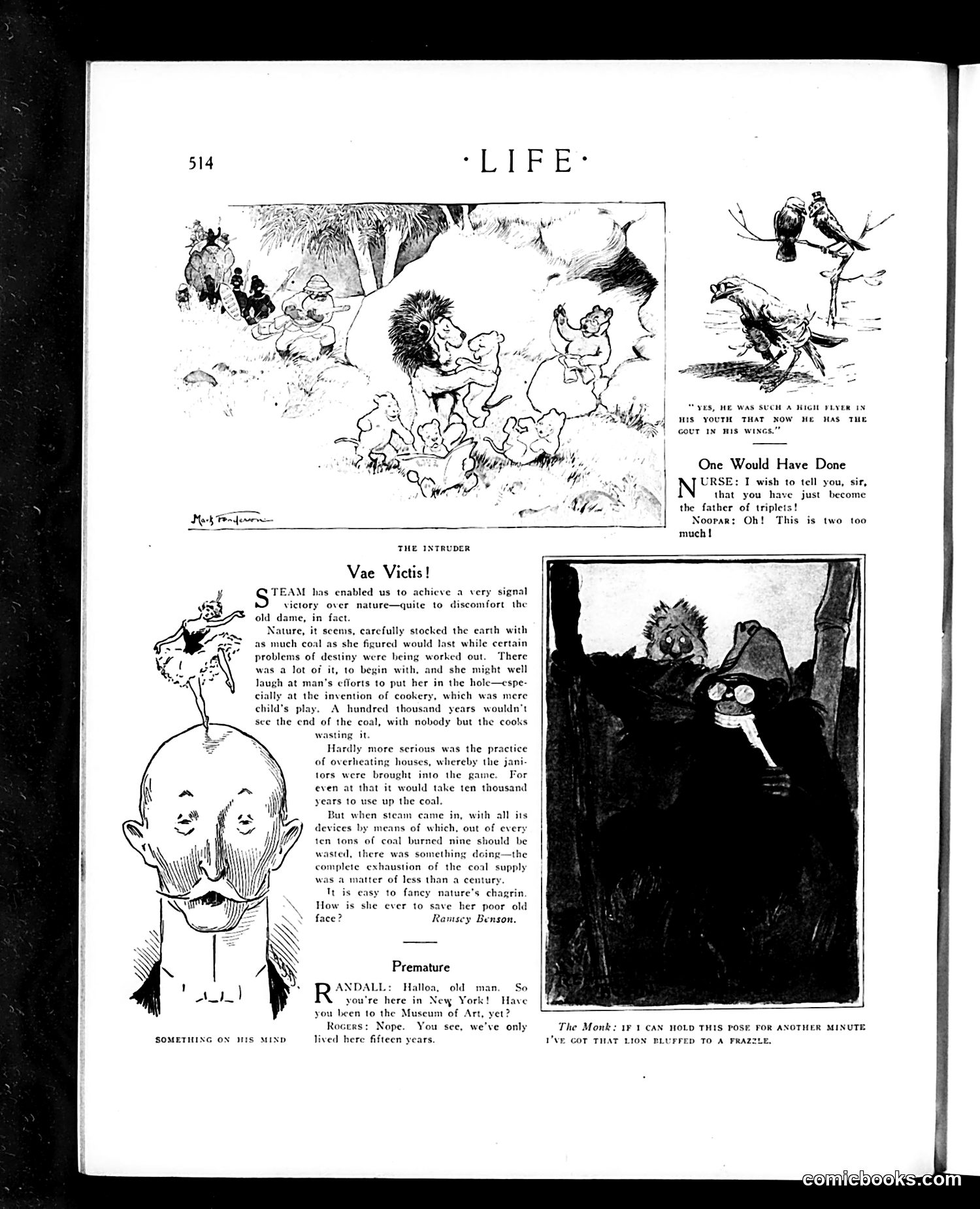
This page contains three separate satirical pieces about modern industrial life: **"The Intruder" ("Vae Victis!")** mocks steam power's displacement of natural resources. A skeletal figure representing coal depletion stands atop a skull labeled "SOMETHING ON HIS MIND." The text critiques how steam engines waste coal—nine of every ten tons burned is wasted—and warns that the coal supply will be exhausted within a century. **"One Would Have Done"** presents a nurse announcing triplets to a man, who protests about overpopulation. **"Premature"** shows dialogue between an old man (Randall) and Rogers in New York, joking about the Museum of Art. The dominant theme is anxiety about industrial progress consuming natural resources unsustainably—a pre-1920s concern about energy depletion and technological excess.
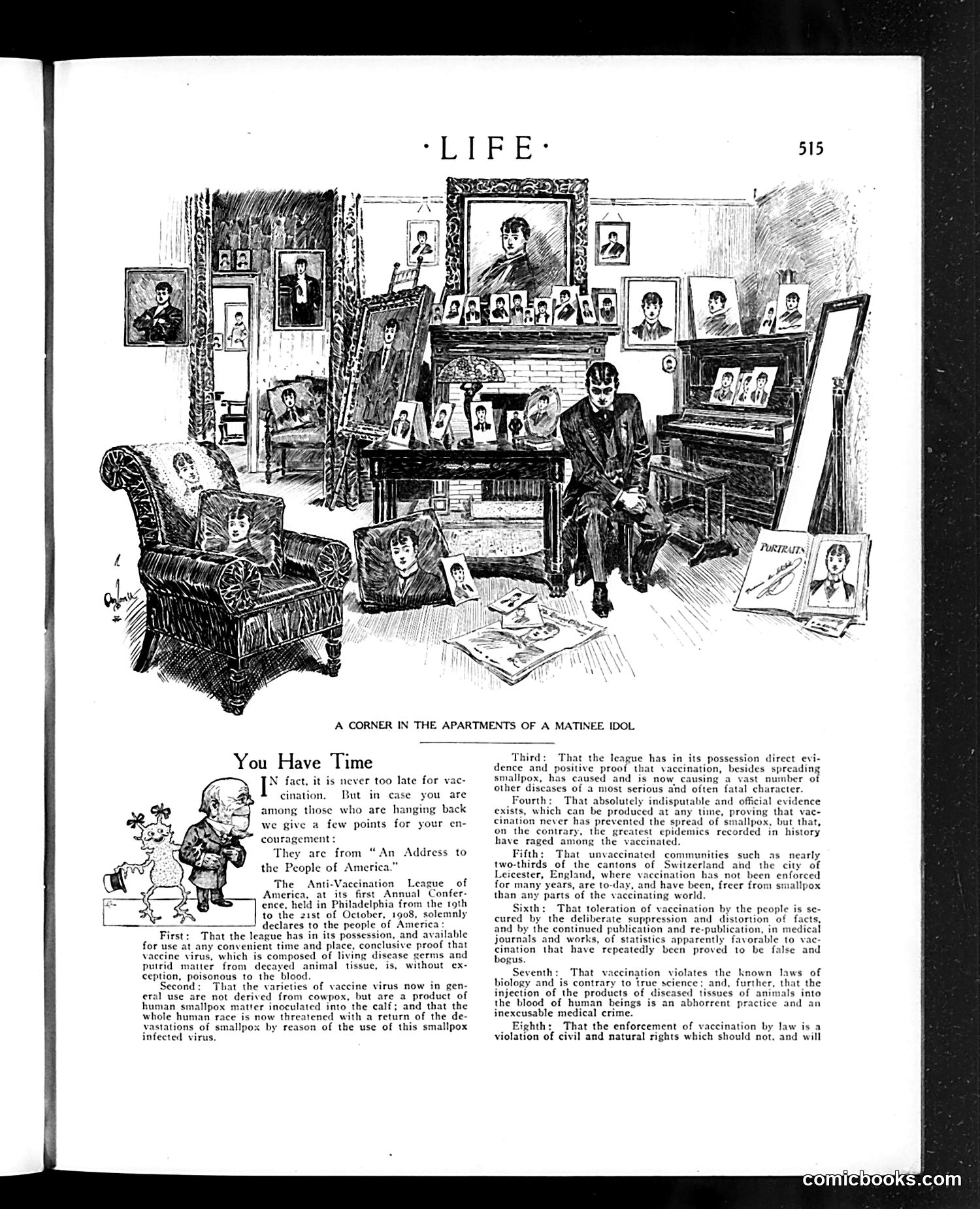
This illustration satirizes celebrity culture and anti-vaccination sentiment. The sketch depicts a wealthy performer's apartment filled with his own portrait photographs—a visual joke about vanity and self-absorption. The accompanying text, "You Have Time," presents eight numbered arguments *against* vaccination, claiming vaccines cause disease, violate civil rights, and contradict scientific principles. The satire works by associating anti-vaccination ideology with the shallow narcissism of a "matinee idol"—suggesting that vaccine skepticism is as frivolous and self-centered as celebrity obsession. The piece mocks both anti-vaxxers and celebrity culture simultaneously, implying that rejecting public health measures reflects the same disconnected vanity as surrounding oneself with personal portraits.
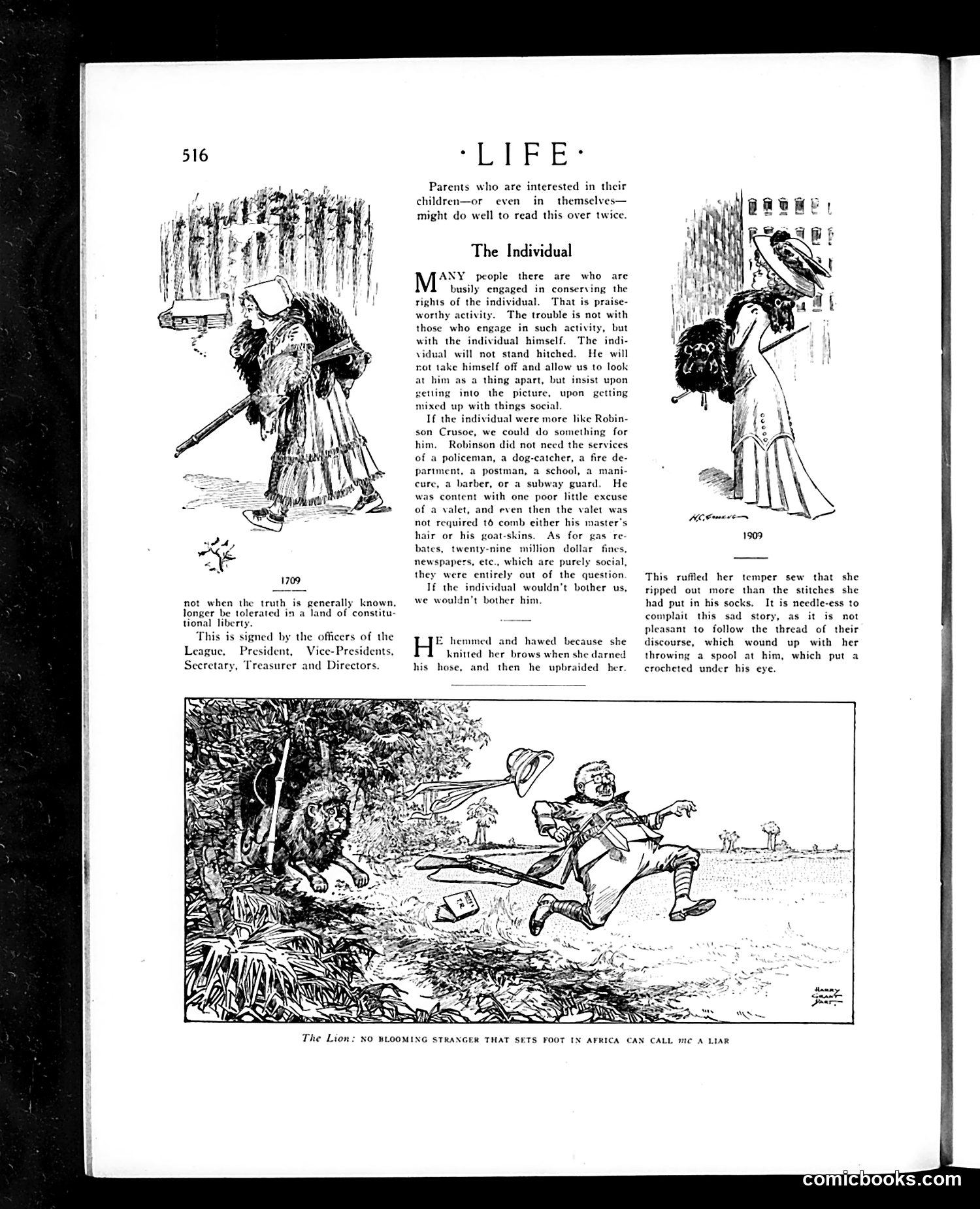
This page contains satirical commentary on individualism titled "The Individual." The text criticizes people who demand special treatment and resist social conformity, comparing such a person unfavorably to Robinson Crusoe—suggesting they're impractical and self-centered. The illustrations support this theme: a bearded man carries bundles of possessions, representing the obstinate individual burdened by their own demands. A second sketch shows a woman in ruffled dress, relating an anecdote about her temper and conflict with servants. The large cartoon at bottom depicts "The Lion," satirizing African colonial narratives. It shows a man fleeing from a lion while holding a kite, captioned "NO BLOOMING STRANGER THAT SETS FOOT IN AFRICA CAN CALL ME A LIAR"—likely mocking tall tales and exaggeration common in imperial adventure stories.
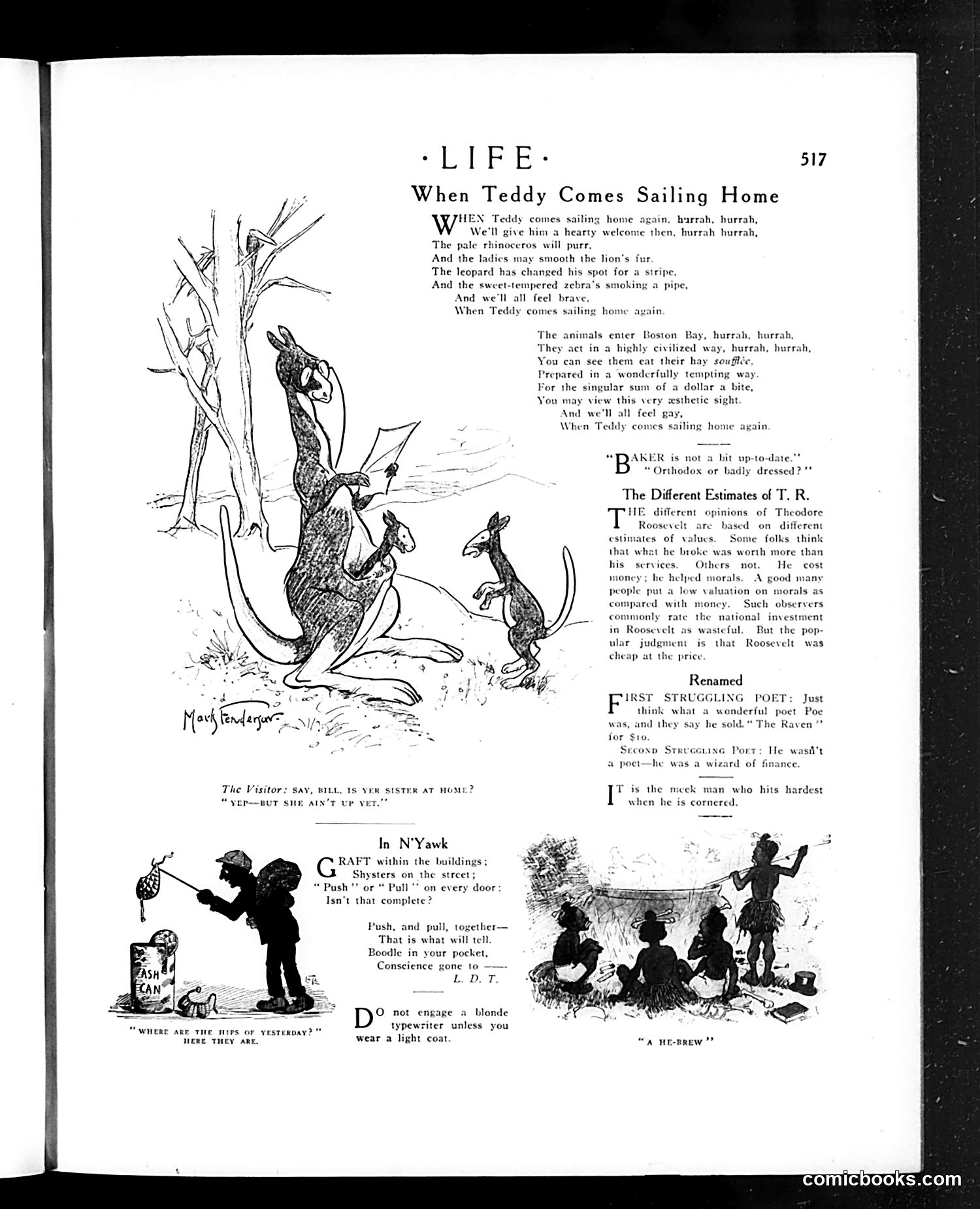
This page contains satirical poetry and sketches mocking Theodore Roosevelt's return from safari. "When Teddy Comes Sailing Home" celebrates Roosevelt's supposed achievements, while the accompanying cartoon by Maud Toudriafare shows animals (appearing to be kangaroos) reacting to his arrival—likely satirizing his big-game hunting expedition. The section "The Different Estimates of T.R." critiques Roosevelt's inflated self-worth, noting people disagreed on his actual value versus his self-assessment. A subtitle "Renamed" includes brief jabs at famous figures, including a poet (likely Poe) and a financial wizard. The remaining sketches depict New York street life and social commentary with minimal political reference. The overall page mocks Roosevelt's ego and public persona through humorous verse and illustration.
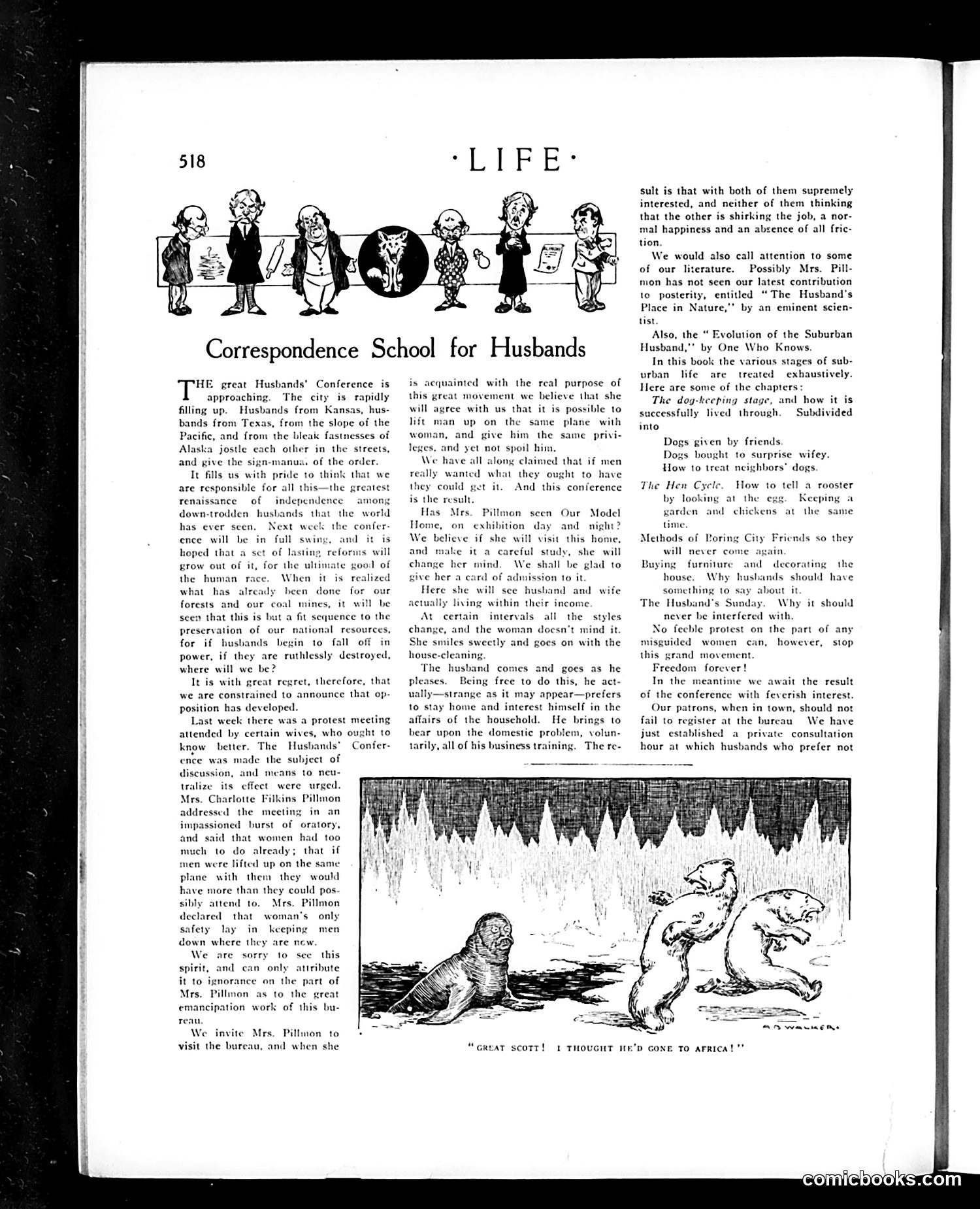
This page satirizes the "Husbands' Conference"—an apparent movement to elevate men's status and independence. The cartoon mocks a backlash led by Mrs. Charlotte Filkins Pillmon, who protests that empowering husbands will make them neglect household duties and burden women further. The satire ridicules both sides: the husbands' conference claims men deserve equality with women, while Pillmon argues women's safety depends on keeping men subordinate and busy with work outside the home. The bottom illustration shows a man lounging while dogs chase—a visual joke supporting Pillmon's worry: if freed from labor, men become useless. The piece reflects early 20th-century gender debates about domestic roles and women's evolving power, using absurdist humor to mock rigid arguments from both traditionalists and proto-feminist advocates.
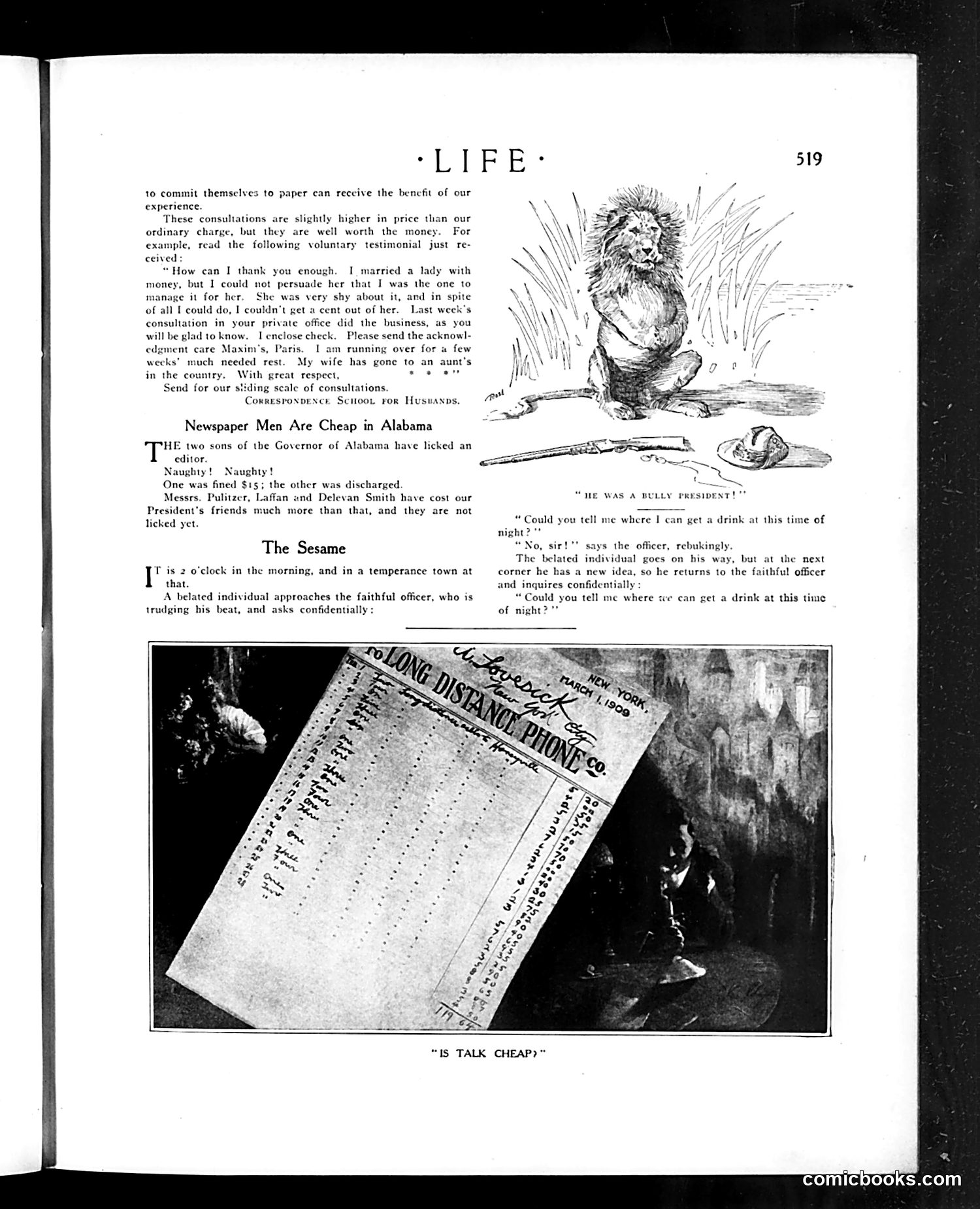
This page contains two distinct satirical pieces targeting early 1900s American politics and social hypocrisy. **"Newspaper Men Are Cheap in Alabama"** mocks the favoritism shown to the Alabama Governor's sons, who received minimal punishment (one fined $15, one discharged) after assaulting a newspaper editor. The piece sarcastically contrasts this with more powerful newspaper publishers—Pulitzer, Laffan, and Delevan Smith—whose influence has cost the President's political allies far more through their reporting, yet they remain unpunished. The satire highlights class-based justice and political corruption. **"The Sesame"** depicts a drunk man repeatedly approaching a night officer asking where to find alcohol in a temperance town. The caption "IS TALK CHEAP?" suggests the joke: the man keeps talking/asking rather than directly offering a bribe—implying that in corrupt systems, a monetary offer ("talk") gets results. Both pieces critique government corruption, selective law enforcement, and moral hypocrisy of the era.
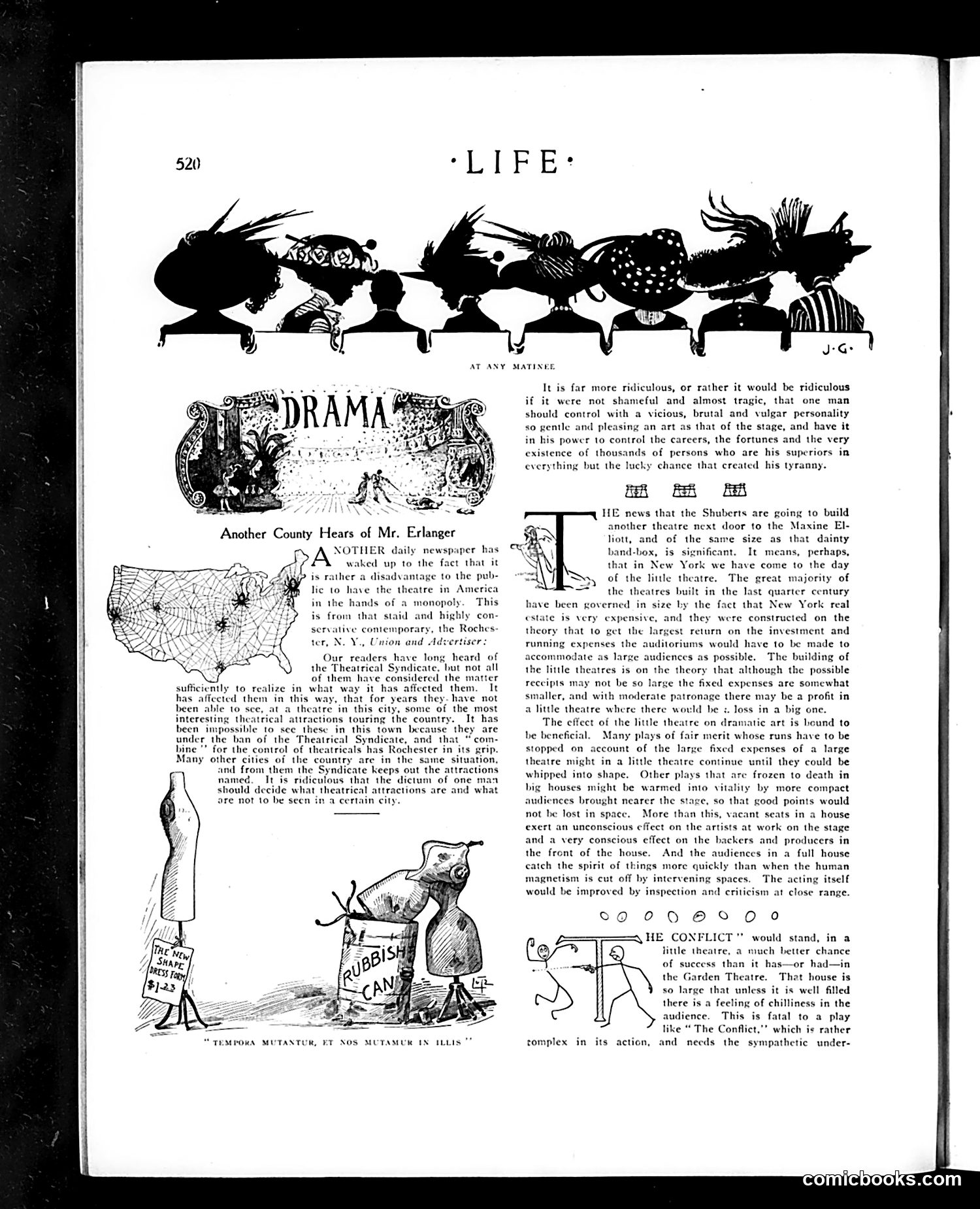
This page satirizes **the Theatrical Syndicate monopoly** controlling American theater in the early 20th century, led by **Mr. Erlanger** (the "one man" repeatedly mentioned). The cartoon shows various theatrical characters/caricatures sitting in a row at a matinee, representing diverse theater types now controlled by this monopoly. The text attacks Erlanger's tyrannical control over which plays tour which cities—Rochester and many other towns are shut out from quality productions. The satire emphasizes the moral injustice: one man with "vicious, brutal" personality controls the careers and livelihoods of thousands of superior artists. The secondary discussion advocates for smaller, intimate theaters (the Shuberts' new competition against the Maxine Elliott Theatre) as antidotes to the Syndicate's grip. Smaller venues offer better acoustics, lower fixed costs, and improved acting conditions. **The Latin motto translates: "Times change, and we change with them"**—suggesting theatrical monopoly control won't last forever.
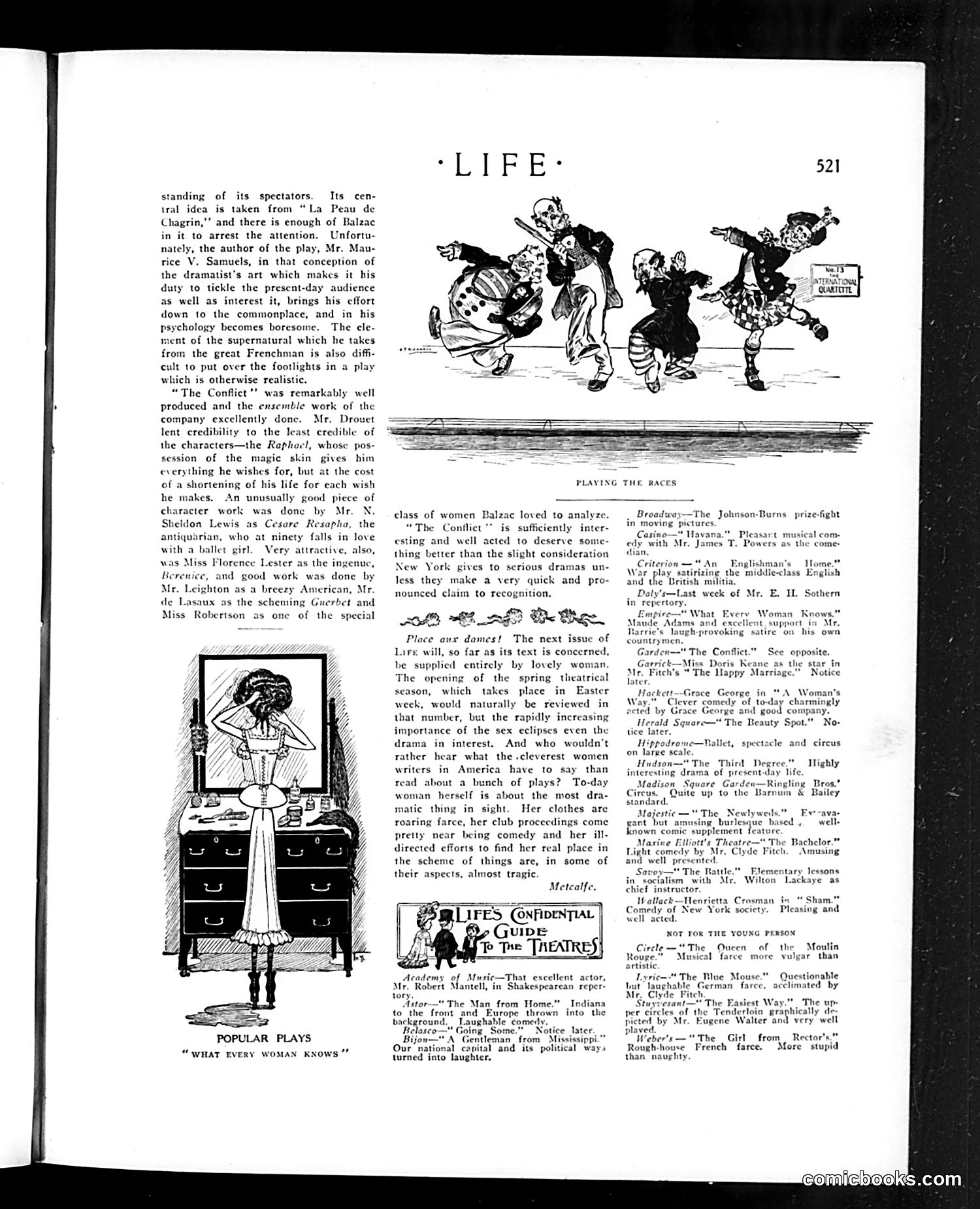
This page contains theater reviews and advertisements rather than political cartoons. The main content discusses Broadway productions, including "The Conflict" (adapted from Balzac's *La Peau de Chagrin*), which critics found well-acted but ultimately derivative and unconvincing in its supernatural elements. The section "Place aux dames!" (Make way for ladies!) expresses the social commentary: the author notes that women's increasing prominence in society—their fashions, club activities, and social roles—has become more dramatically interesting than theatrical productions themselves. This reflects early 20th-century anxiety about women's expanding public presence and changing social status. The illustrations show period theatrical scenes and a woman at a vanity, typical of Life's satirical visual style addressing gender and social topics of the era.
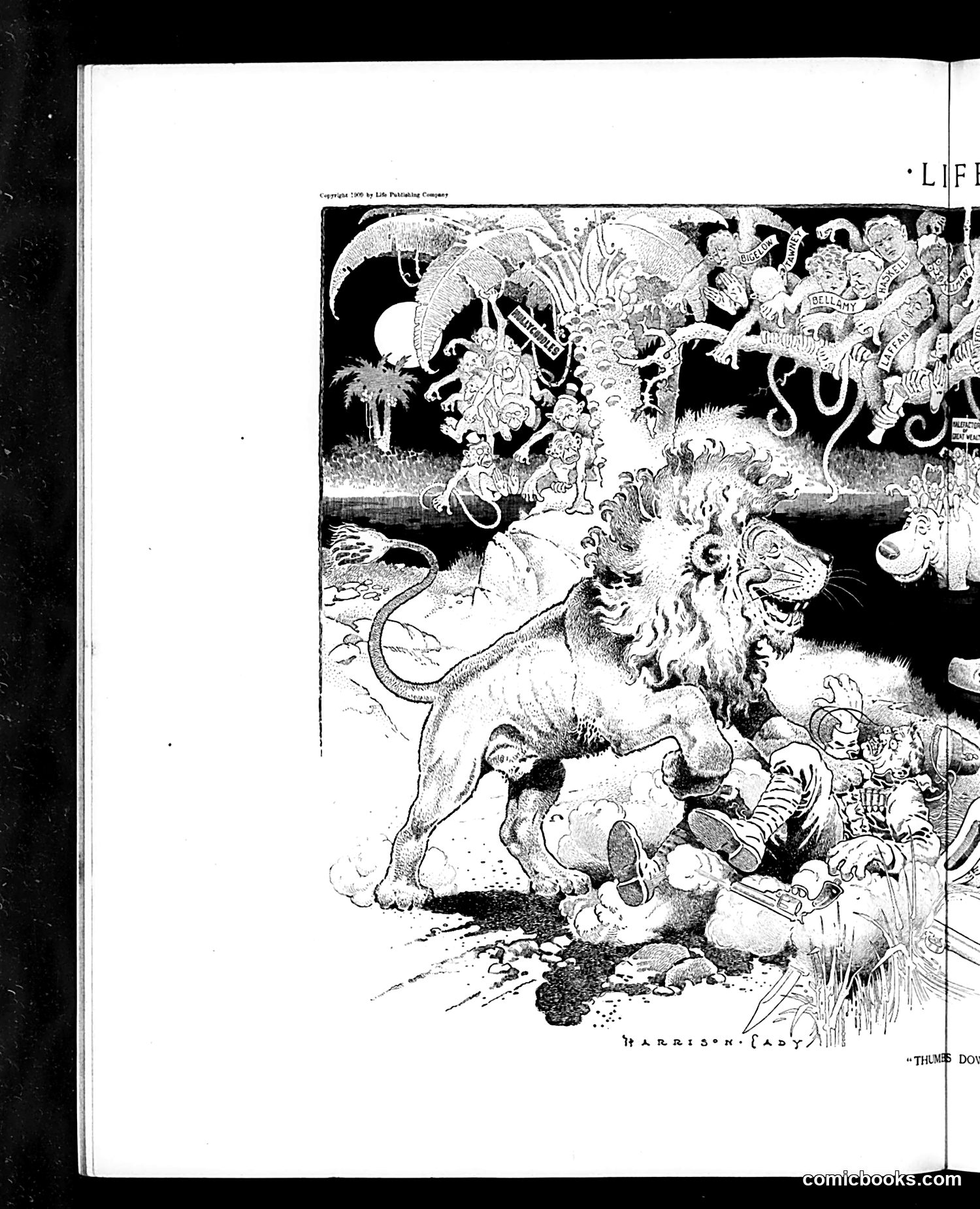
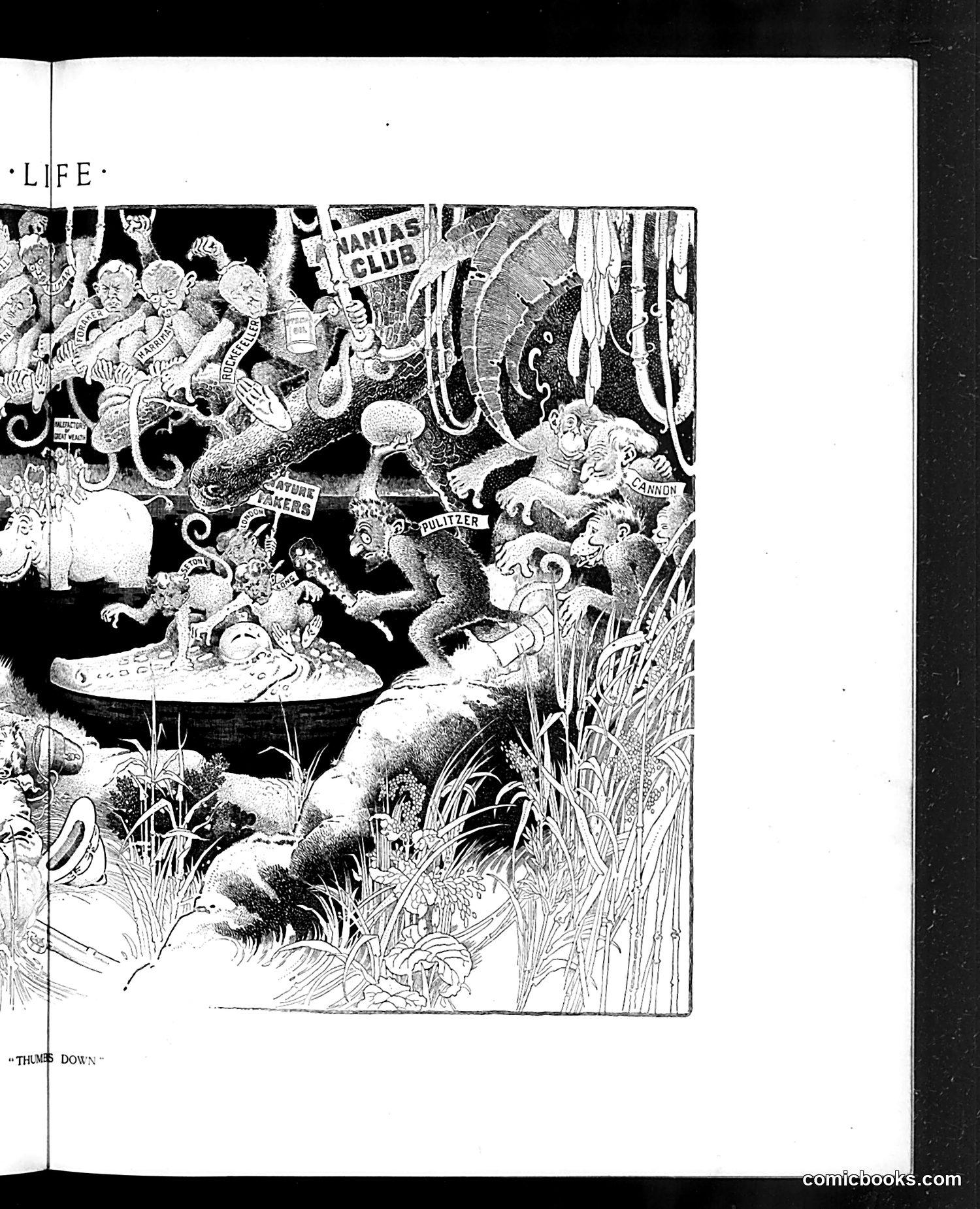
This satirical cartoon depicts a chaotic underwater scene with various figures and animals gathered around what appears to be a gladiatorial judgment. The visible text references include "Maniacs Club," "Pulitzer," and "Cannon," suggesting commentary on prominent institutions or individuals of the era. The composition mimics ancient Roman amphitheater scenes, with the "thumbs down" gesture implying condemnation or rejection. The grotesque caricatures and mixed animal-human figures suggest satirical mockery of specific public figures or social groups, likely related to early 20th-century American politics or society. However, without clearer identification of specific individuals or dated context, the precise targets and political meaning remain unclear from the image alone.
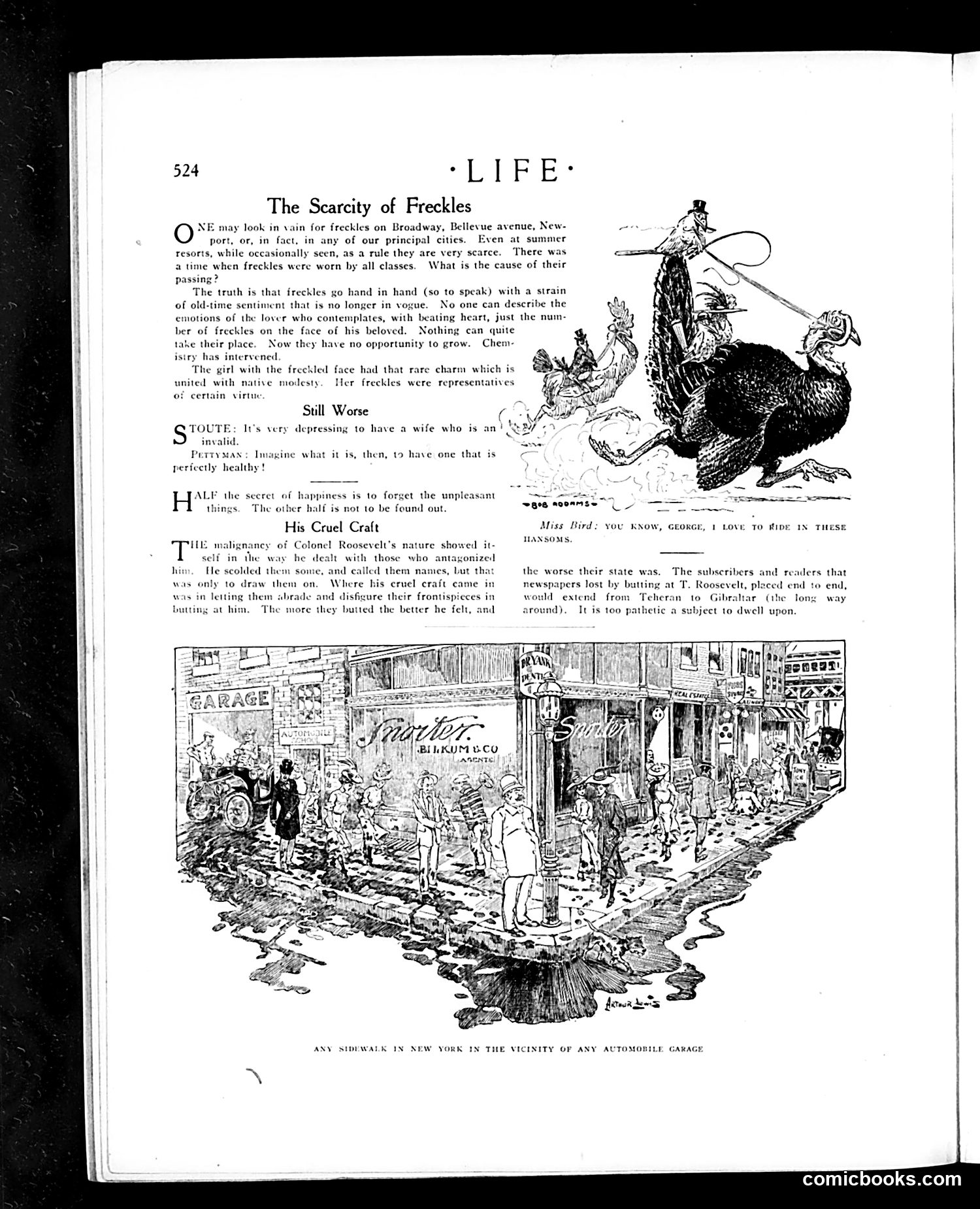
This page contains three satirical pieces typical of early 20th-century *Life* magazine humor: **"The Scarcity of Freckles"**: A tongue-in-cheek lament that freckles have disappeared from fashionable society (Broadway, Bellevue Avenue). The author claims chemistry/cosmetics have eliminated them, and nostalgically mourns the loss of the romantic charm freckled girls supposedly possessed. It's social satire about beauty standards and modernization erasing "old-fashioned" feminine traits. **"Still Worse"**: A brief joke contrasting two marital complaints—having an invalid wife versus a perfectly healthy one (the implication being both present problems). **"His Cruel Craft"**: This references Colonel Theodore Roosevelt, criticizing his aggressive personality and how he provoked newspaper editors into defensive responses, which he enjoyed. It's political satire about Roosevelt's combative nature. The bottom illustration depicts a chaotic New York street scene near an automobile garage—likely satirizing early automotive culture's messiness and danger to urban pedestrians.
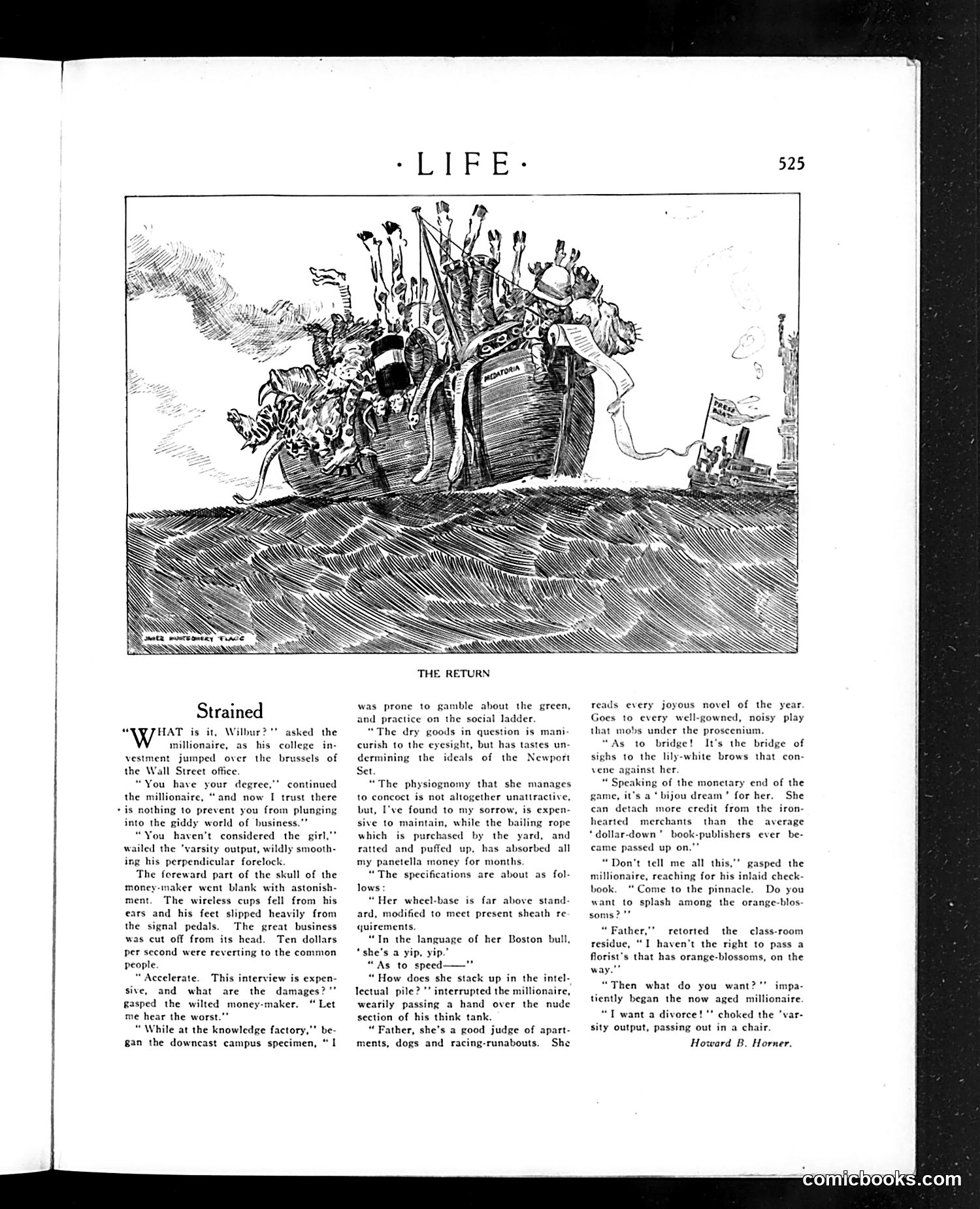
This cartoon mocks the clash between old-money values and modern youth culture in the early 20th century. A wealthy father (the "money-maker") expects his college-educated son to enter business, but the son confesses he's entangled with an unsuitable woman. The satire targets several things: the son's flowery, evasive language when describing his girlfriend (using automobile and mechanical metaphors—"wheel-base," "speed"); her expensive tastes and shallow interests (novels, plays, bridge, shopping); and her cost to his finances. The joke escalates when the millionaire assumes marriage is inevitable and reaches for his checkbook—only for the son to shock him by asking for a **divorce**, implying he's already married this woman and regrets it. The cartoon critiques both generations: the father's assumption that money solves everything, and the son's poor judgment in marrying above his means for superficial reasons. The title "The Return" likely refers to the son returning home from college with unexpected complications.
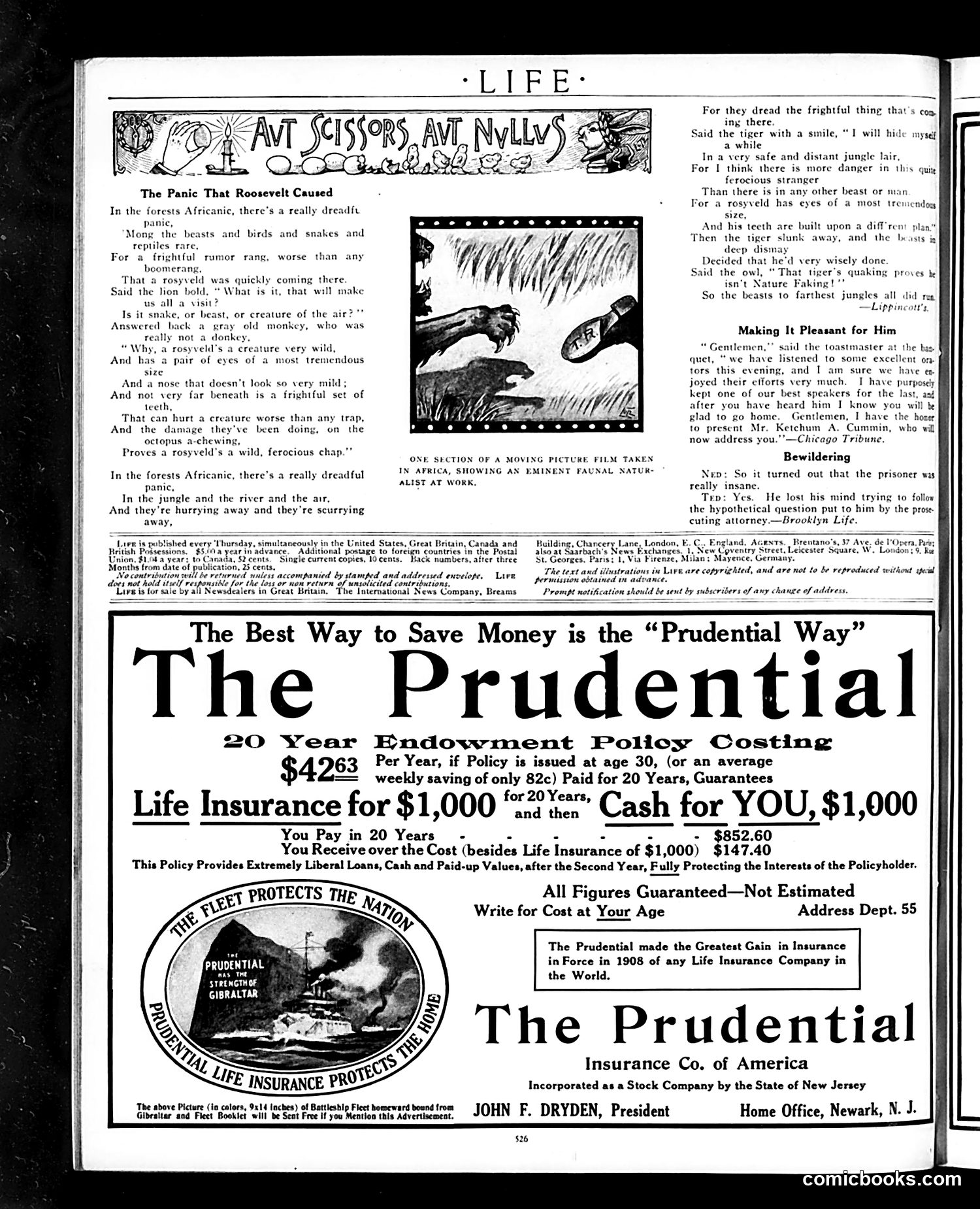
This poem-illustrated cartoon satirizes Theodore Roosevelt's famous 1909 African safari. The "rosyveld" (a real antelope) represents Roosevelt himself—depicted as so fearsome that African wildlife panics and flees at the mere rumor of his arrival. The joke relies on Roosevelt's reputation as a big-game hunter and outdoorsman. Animals legendary for ferocity (lions, tigers) are terrified of this human visitor, whose "eyes of most tremendous size" and teeth "built upon a different plan" mark him as uniquely dangerous. The accompanying photograph shows actual wildlife footage, reinforcing that this is about Roosevelt's real safari adventure—a major news event at the time. The satire mocks both Roosevelt's hunting prowess and the contemporary media frenzy surrounding his expedition. The page also includes unrelated humor pieces ("Making It Pleasant for Him," "Bewildering") and a Prudential insurance advertisement typical of Life magazine's commercial content.
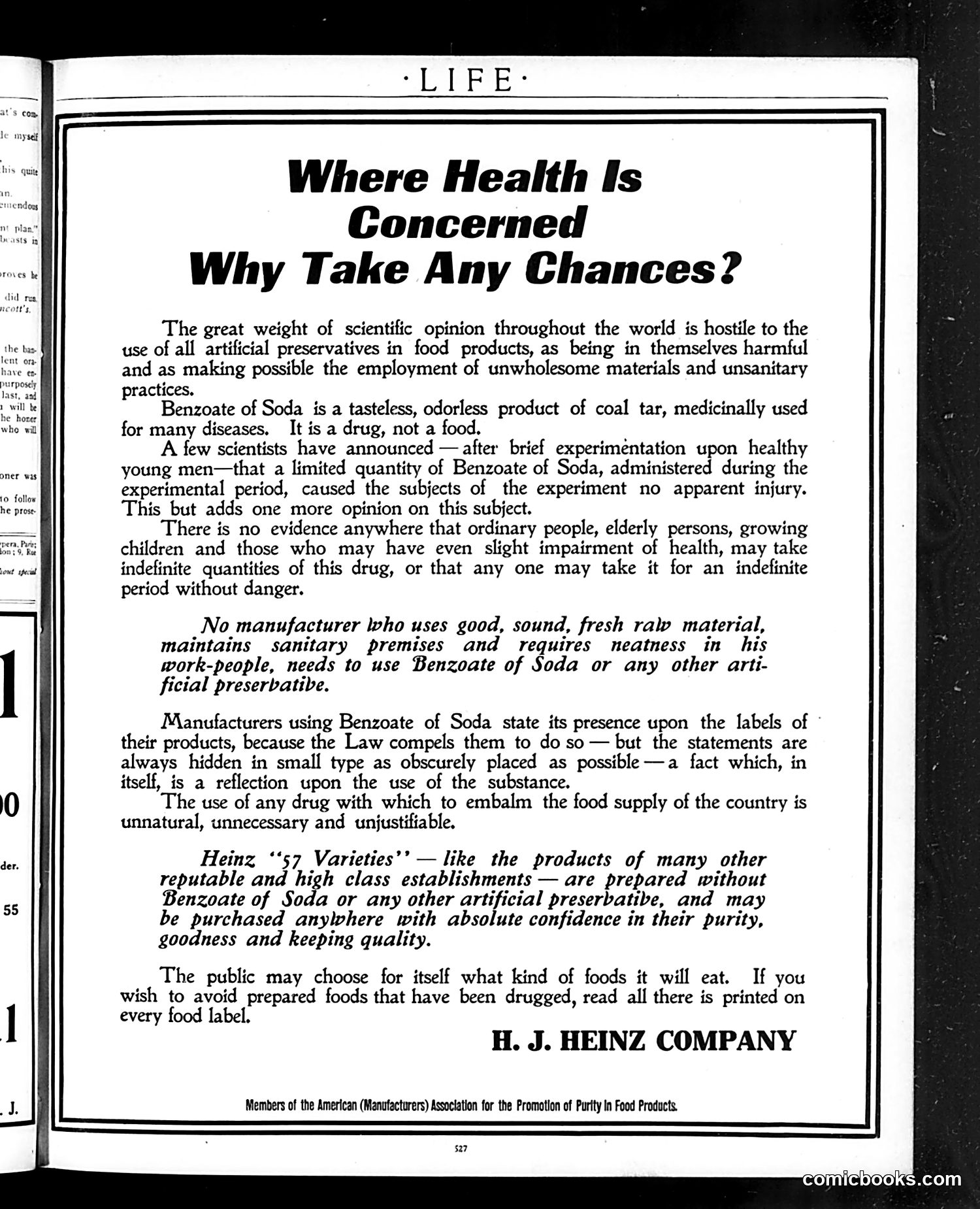
This is a **food industry advertisement**, not a political cartoon. The H.J. Heinz Company uses it to attack a competitor's preservation practice. **The Issue:** Benzoate of Soda, a coal-tar-derived chemical preservative used by some food manufacturers, was scientifically controversial in the early 20th century. **The Argument:** Heinz claims that: - Scientific opinion opposes artificial preservatives as inherently harmful - Limited safety testing on healthy young men doesn't prove safety for children, elderly people, or long-term use - Manufacturers hide benzoate warnings in tiny print, suggesting guilt - Quality manufacturers (like Heinz) don't *need* artificial preservatives **The Pitch:** Heinz products are made without benzoate and can be purchased "with absolute confidence." This reflects the **Pure Food and Drug Act era** (early 1900s) when food safety and ingredient disclosure became public concerns. Heinz positions itself as the ethical choice for health-conscious consumers suspicious of industrial additives.
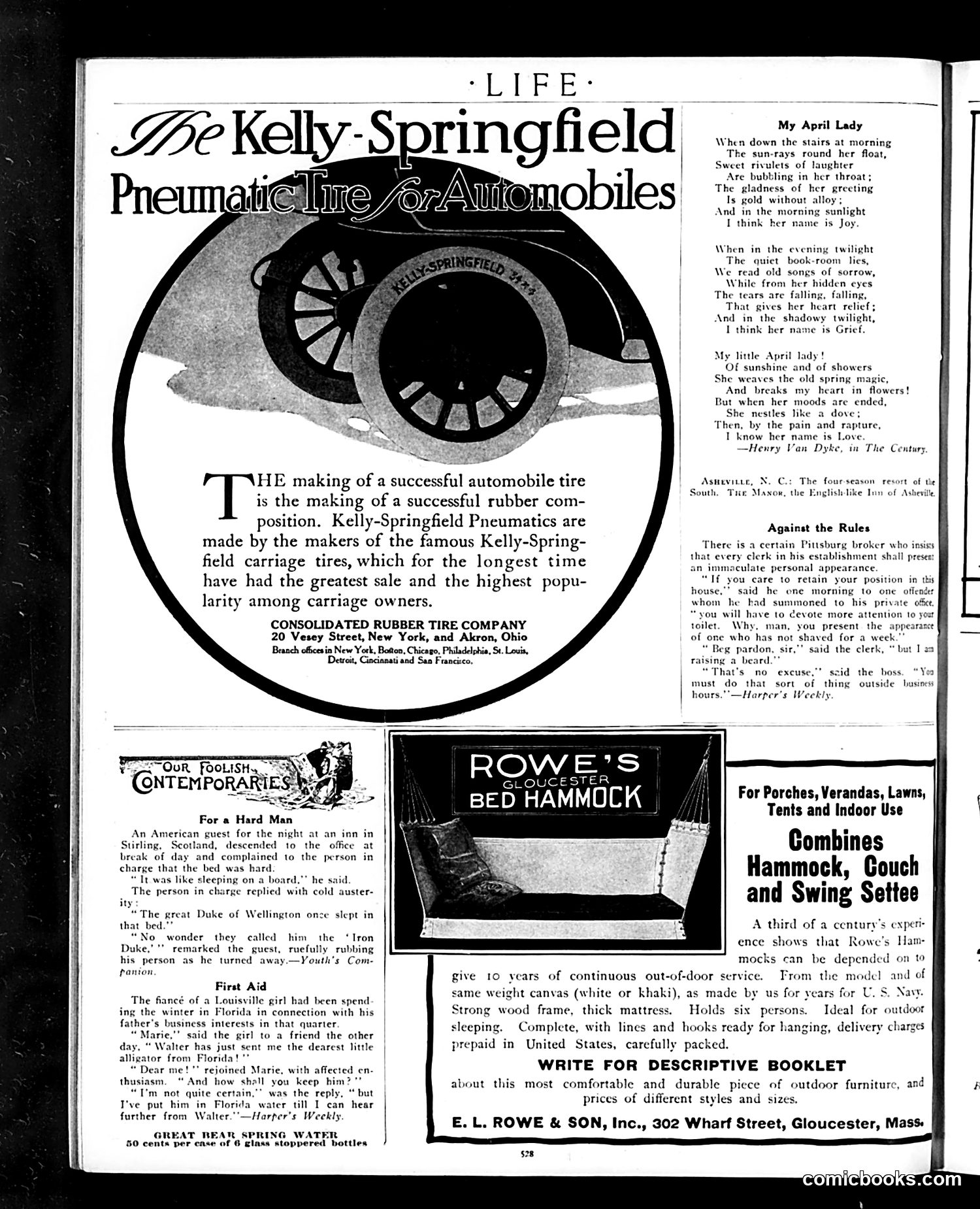
This page combines **poetry, humorous anecdotes, and advertisements** typical of early-20th-century Life magazine. **Literary Content:** A sentimental poem titled "My April Lady" (attributed to Henry Van Dyke) portrays an idealized woman whose moods shift between joy, grief, and love—reflecting the sentimental Victorian aesthetic popular in this era. **Humorous Anecdotes:** Three brief comedic stories appear under "Our Foolish Contemporaries": - A hard-sleeping American guest complains about a bed allegedly used by the Duke of Wellington - A Pittsburgh broker obsessively demands his clerks maintain impeccable grooming, even outside work hours - A girl keeps an alligator gift from her fiancé in "Florida water" These jokes mock social pretension, excessive workplace control, and romantic naïveté. **Advertisements:** The page features prominent ads for Kelly-Springfield automobile tires, Rowe's bed hammocks, and other consumer goods—standard for Life's revenue model. The overall tone reflects genteel, urbane humor aimed at educated middle-class readers.
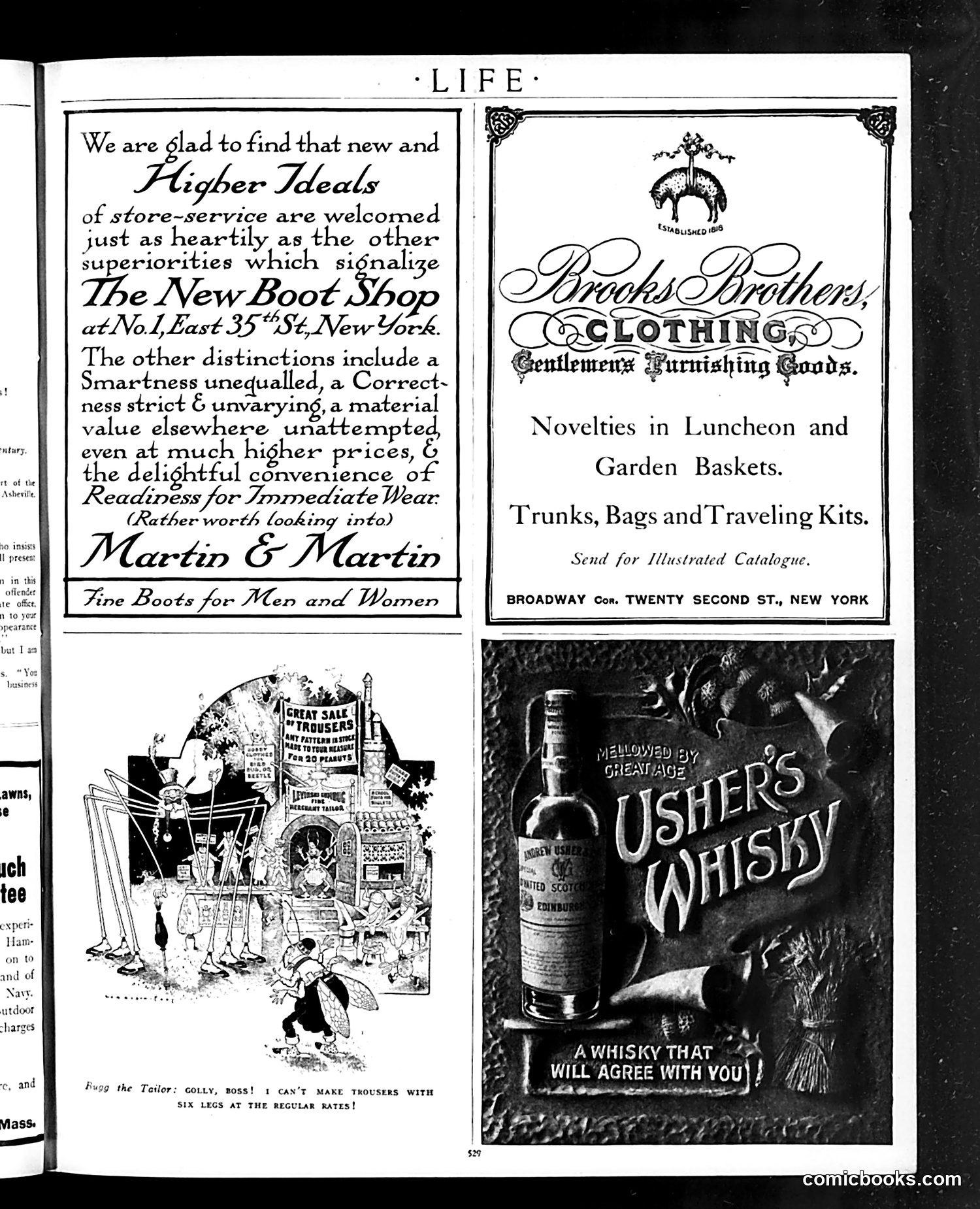
This page mixes advertisements with one cartoon. The cartoon at bottom left depicts "Bugg the Tailor" confronting an absurdly multi-legged creature, with the tailor complaining he cannot make trousers at standard rates for a six-legged being. The joke satirizes labor disputes and tailoring costs: the cartoon plays on the impossibility of the task (six legs instead of two) as metaphor for unreasonable customer demands or labor negotiations. The punchline—"at the regular rates"—suggests tailors' complaints about wage pressures or customers expecting work beyond reasonable scope for standard payment. The surrounding advertisements (Martin & Martin boots, Brooks Brothers clothing, Usher's whisky) occupy the bulk of the page and appear to be standard commercial placements rather than satirical content. The page primarily functions as advertising space with light comedic filler.
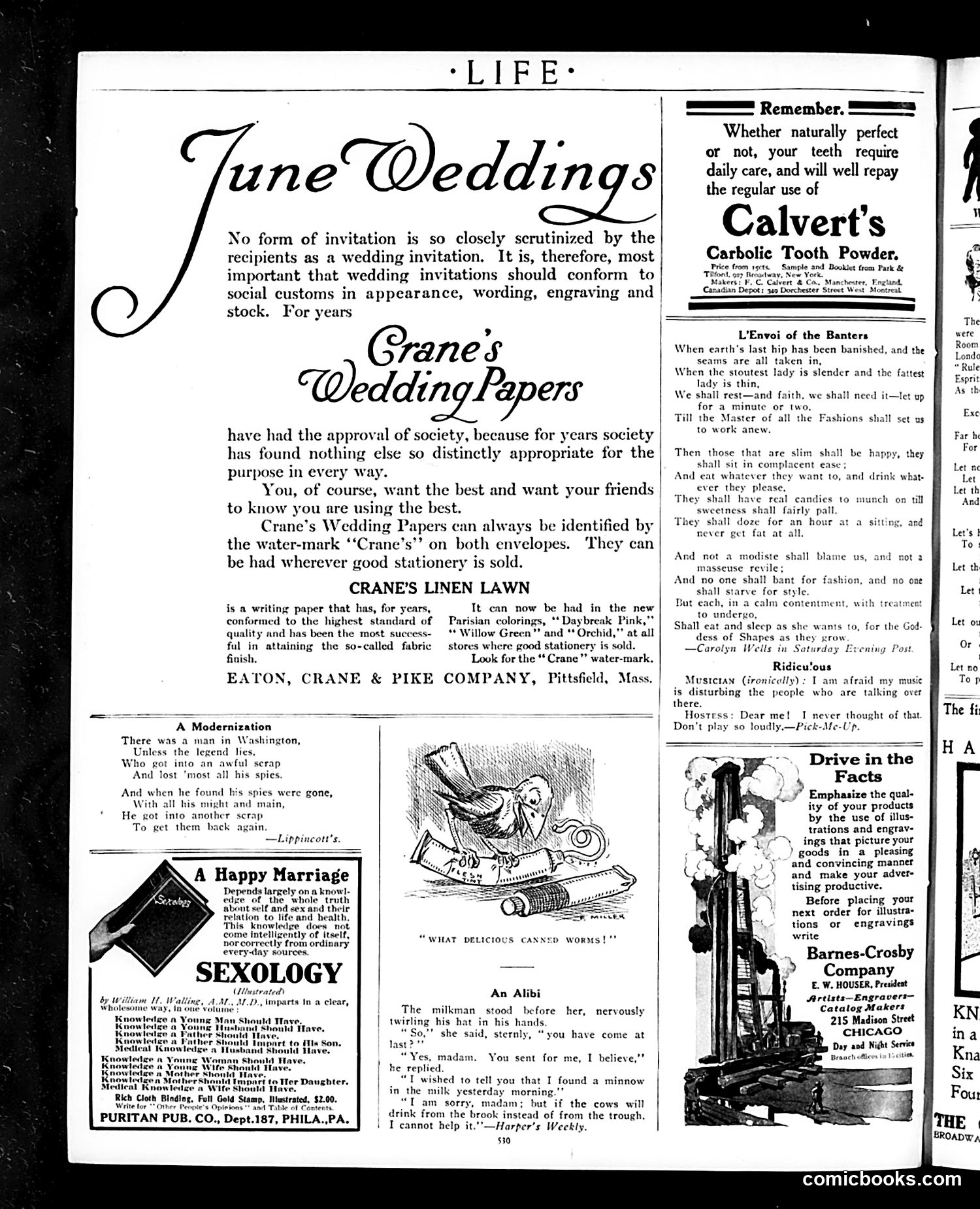
This page is primarily **advertising and light humor** rather than political commentary. The main content includes: **"June Weddings"** — A large advertisement for Crane's wedding stationery, emphasizing that proper invitation etiquette requires using socially-approved, high-quality papers. The copy stresses conformity to social customs. **Small humorous pieces** include: - "A Modernization" — A poem satirizing a Washington official (likely Theodore Roosevelt) who lost his "spies" (secret service agents) and had to "scrap" to recover them - "An Alibi" — A joke about a milkman explaining a minnow in milk by blaming cows drinking from brooks - "L'Envoi of the Banters" — A satirical poem about women's fashion obsessions and dieting, imagining future freedom from beauty standards The cartoon shows a woman discovering a minnow in a milk bottle, illustrating the alibi joke. **Overall**: This is a society/etiquette-focused issue mixing advertising with genteel satire about fashion, manners, and mild political humor — typical of Life's early 20th-century content.
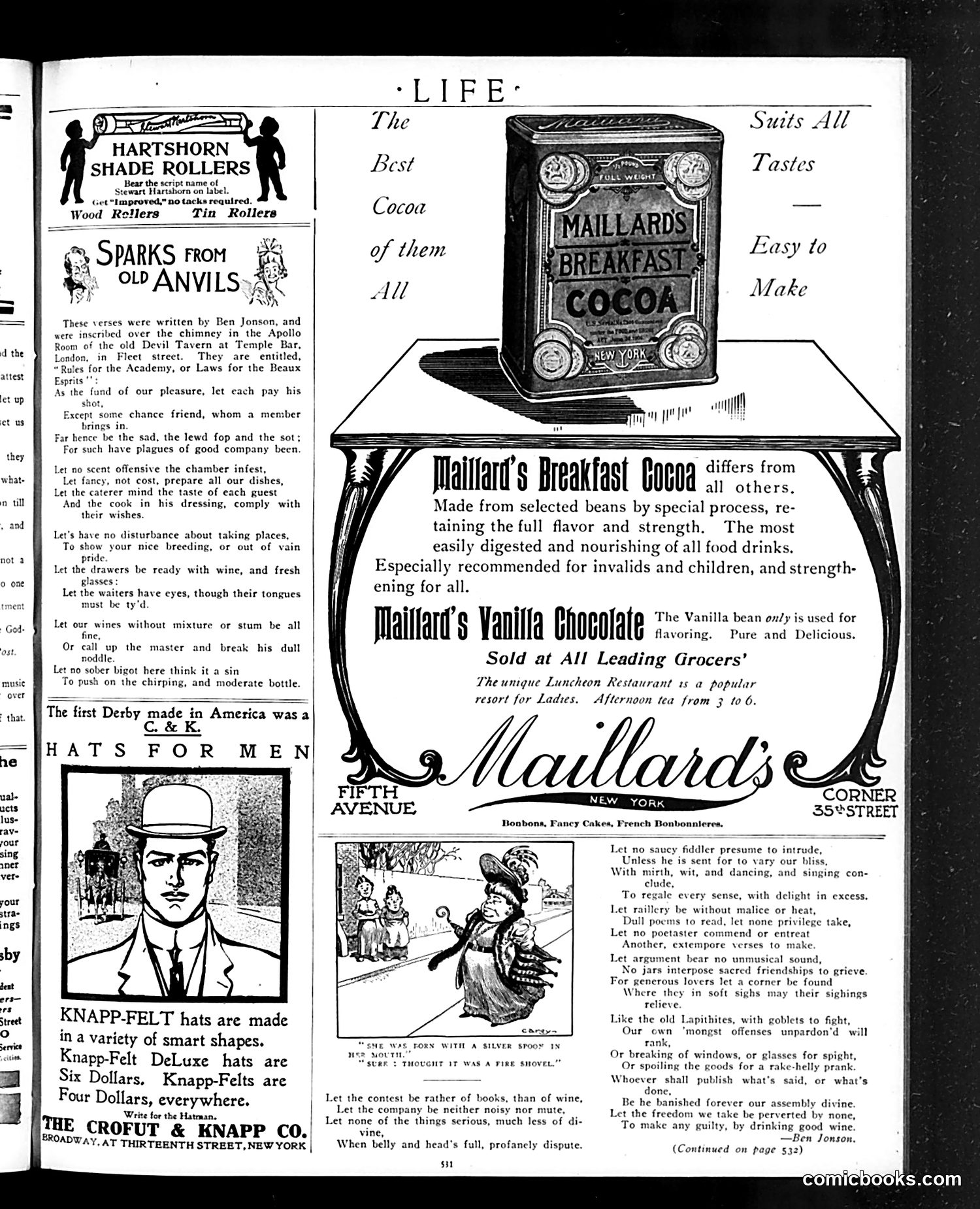
This page is primarily **advertising with one satirical cartoon**. The main content includes ads for Hartshorn shade rollers, Knapp-Felt hats, and prominently, **Maillard's cocoa and chocolate products**. The cartoon depicts a wealthy woman with a servant, captioned: "She was born with a silver spoon in her mouth. I thought it was a fire shovel." This is a **class satire**—the joke mocks the servant's bewilderment at upper-class affectation. The "silver spoon" idiom (meaning born privileged) confuses the working-class servant, who mistakes the ornamental utensil for a household tool. It satirizes both class pretension and the gap between wealthy and working people. The page also reprints Ben Jonson's **17th-century "Rules for the Academy"**—tavern etiquette rules—likely included for historical humor or genteel cultural reference. Otherwise, this is typical period advertising targeting affluent readers through product endorsements and lifestyle imagery.
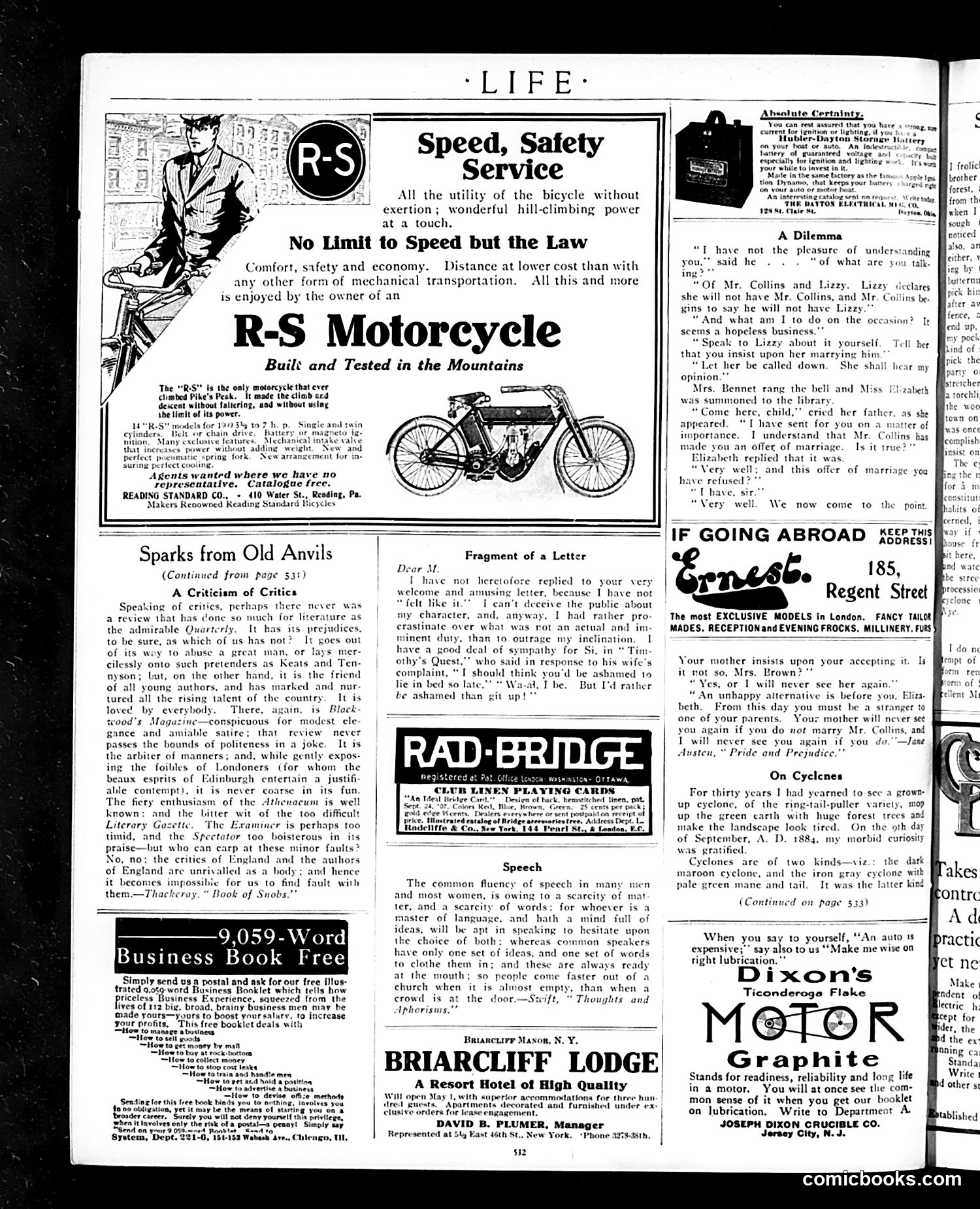
This page is primarily **advertising and filler content** rather than political satire. The main features are: **R-S Motorcycle Advertisement**: A major ad highlighting the motorcycle's hill-climbing ability, safety, and economy. It claims the R-S "made the climb" of Pike's Peak without using power—a performance boast typical of early 1900s motorcycle marketing. The illustration shows a well-dressed man on the vehicle. **"Sparks from Old Anvils"**: A literary commentary praising English critics and publications (the Quarterly, Blackwood's Magazine, the Examiner, the Spectator). This appears to be excerpted from Thackeray's "Book of Snobs"—satirizing the tendency to idealize English institutions uncritically. **Minor content** includes a fragment of a humorous letter joking about staying in bed, a business book advertisement, and notices about playing cards and hotels. The page reflects early 1900s consumer culture with minimal social or political satire—mostly lifestyle advertising and literary discussion aimed at educated readers.
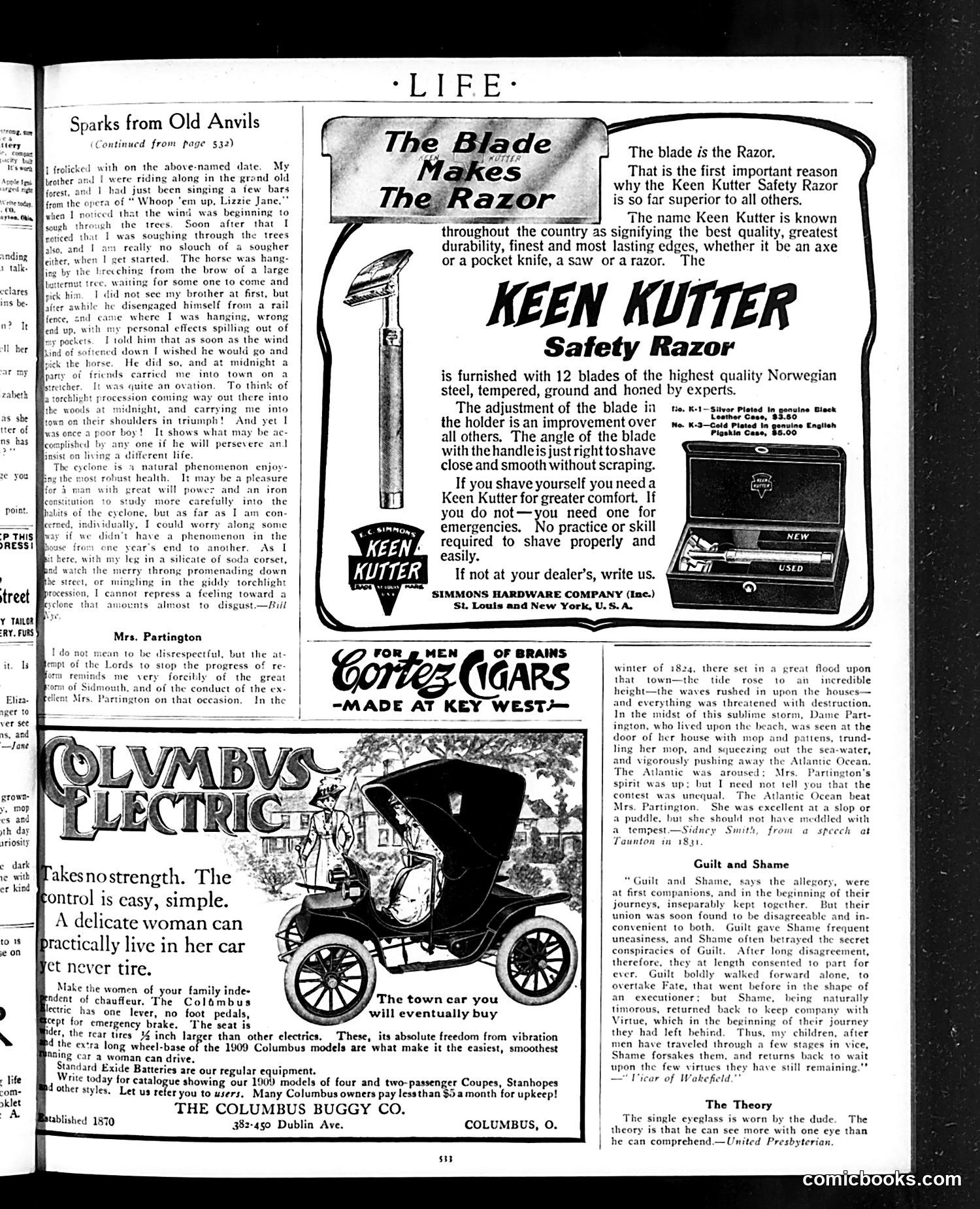
This page is primarily **advertising**, not political satire. The dominant content includes: 1. **Keen Kutter Safety Razor ad** (center): Emphasizes the blade quality and holder design as superior to competitors. The ad targets men concerned with shaving comfort and efficiency. 2. **Olmybus Electric (automobile ad)**: Markets an electric car as easy to operate—specifically appealing to women by emphasizing it requires "no strength" and "the control is easy, simple." This reflects early 1900s gender assumptions about women drivers preferring gentler vehicles. 3. **Cortes Cigars ad**: Simple branded messaging. 4. **Columbus Buggy Company ad** (lower section): Advertises horse-drawn buggies. 5. **"Sparks from Old Anvils"** (left column): A humorous anecdote about a man caught in wind while riding, rescued by friends. The page reflects **early 1900s consumer culture and gender norms**—particularly how manufacturers marketed technology differently to women versus men. No significant political satire is evident.
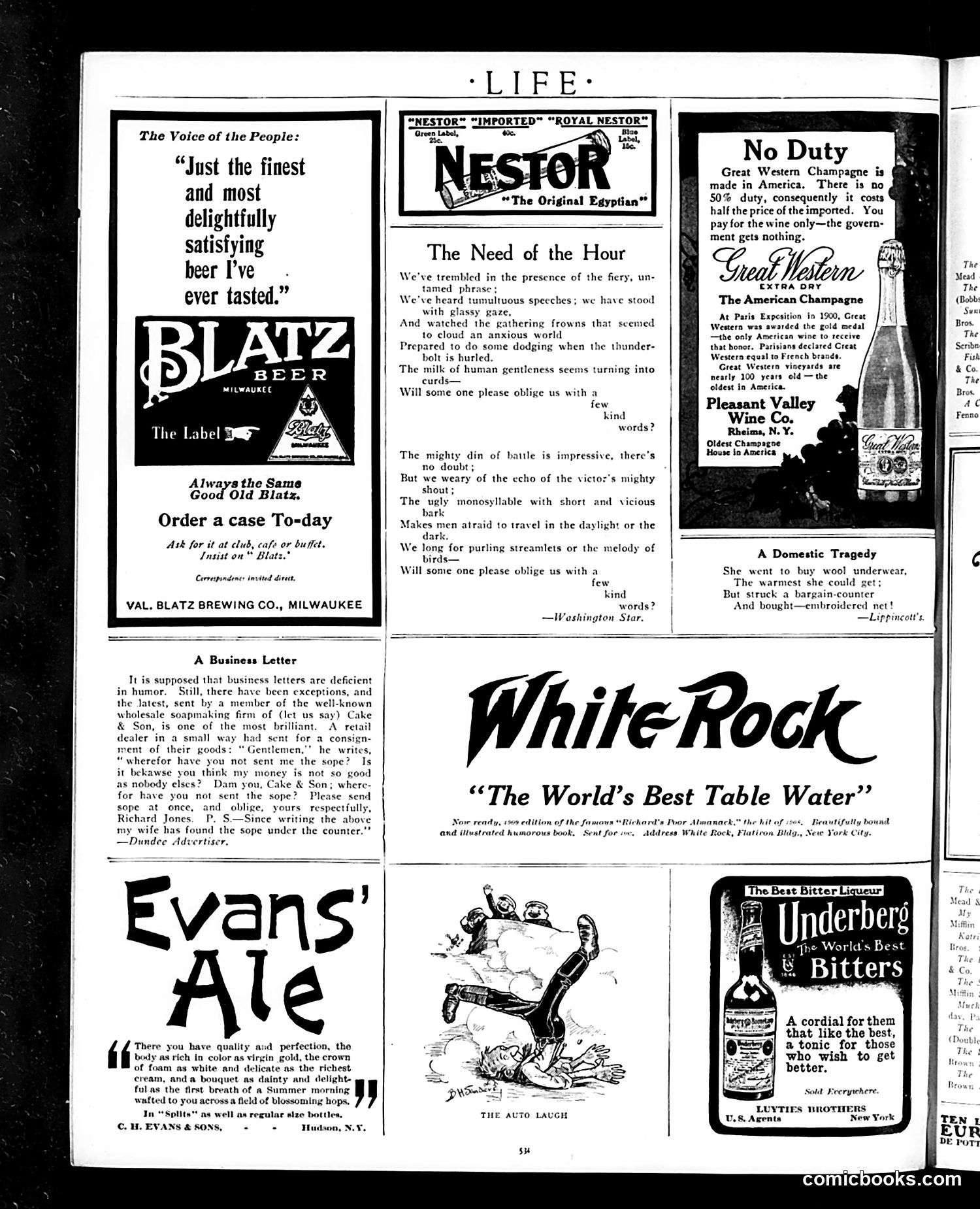
This page is primarily **advertising**, typical of early 20th-century Life magazine. The content consists of product advertisements interspersed with brief humorous pieces: ## Key Content: **Advertisements:** Blatz Beer, Nestor (Egyptian wine), Great Western Champagne, Pleasant Valley Wine, White Rock table water, Evans' Ale, and Underberg Bitters dominate the page. **Humor Pieces:** - "A Business Letter": A satirical anecdote mocking crude business correspondence—a soap dealer's misspelled, angry letter demanding his order, resolved when his wife finds it under the counter. - "A Domestic Tragedy": A short joke about a woman buying cheap embroidered net underwear instead of wool. - "The Need of the Hour": A Washington Star poem lamenting post-war weariness and longing for peace and gentle things. **Context:** The page reflects Prohibition-era anxieties (note the champagne ad's "No Duty" claim) and post-WWI malaise. The humor is gentle, domestic, and focused on everyday frustrations rather than political satire.
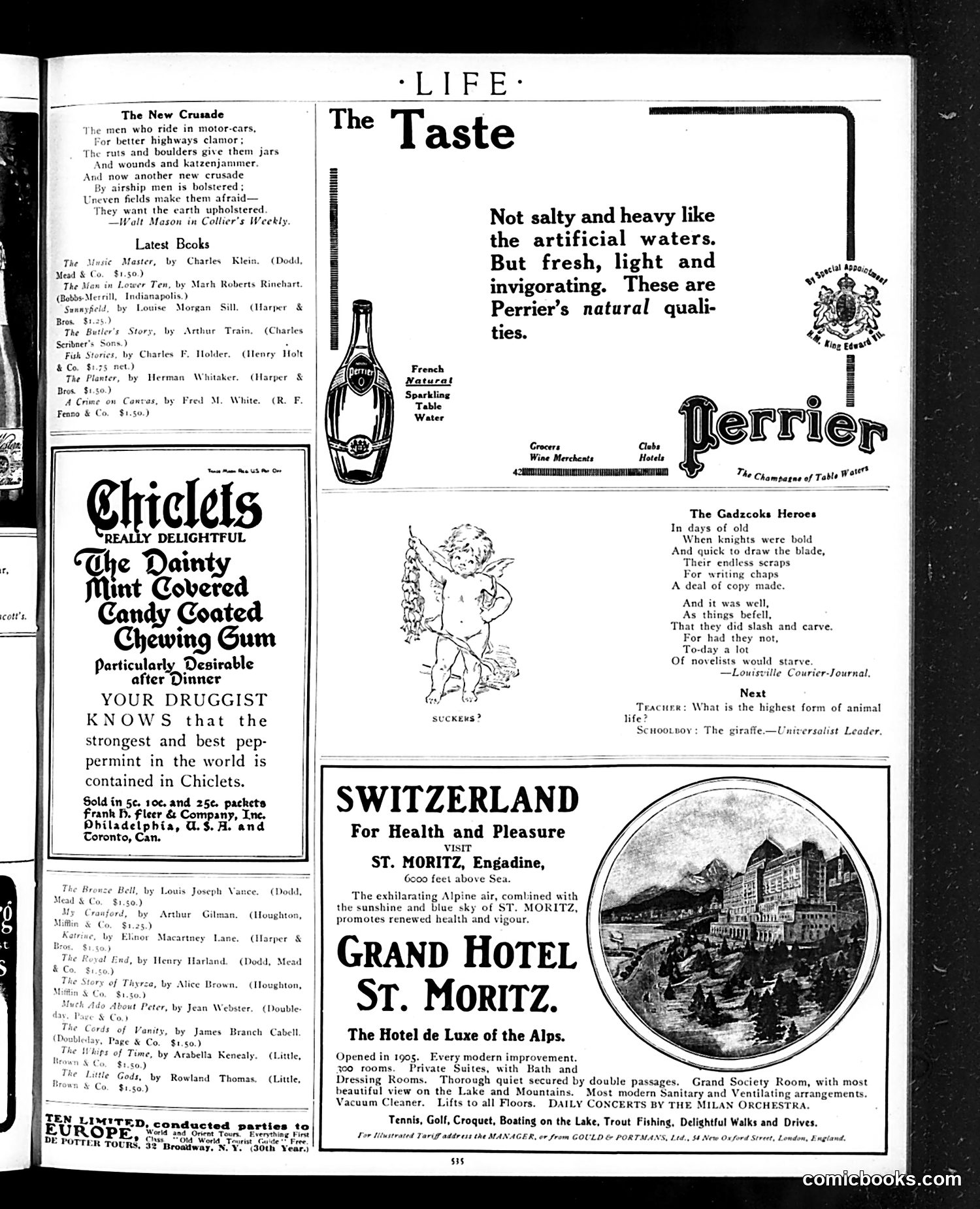
This page is primarily **advertisements and book reviews** rather than political satire. The notable content includes: **"The New Crusade" poem** (top left): A brief satirical verse mocking early aviators and airship pilots. The joke is that these "crusaders" want smooth, upholstered earth because uneven terrain causes their vehicles to jar and bump—a gentle jab at the newfangled aviation craze and its practitioners' complaints. **"The Gadzcocks Heroes" poem** (center-right): Light satirical verse about medieval knights, suggesting their constant warfare actually provided good material for writers. The humor lies in the cynical observation that novelists would "starve" without such violent drama to chronicle. The rest of the page consists of **book advertisements, Chiclets gum ads, Perrier water promotion, and a Grand Hotel Switzerland advertisement**—typical commercial content for a 1910s magazine. There is no significant political cartoon or complex satire beyond these mild, whimsical verses poking fun at contemporary crazes (aviation) and historical romanticism (knights).
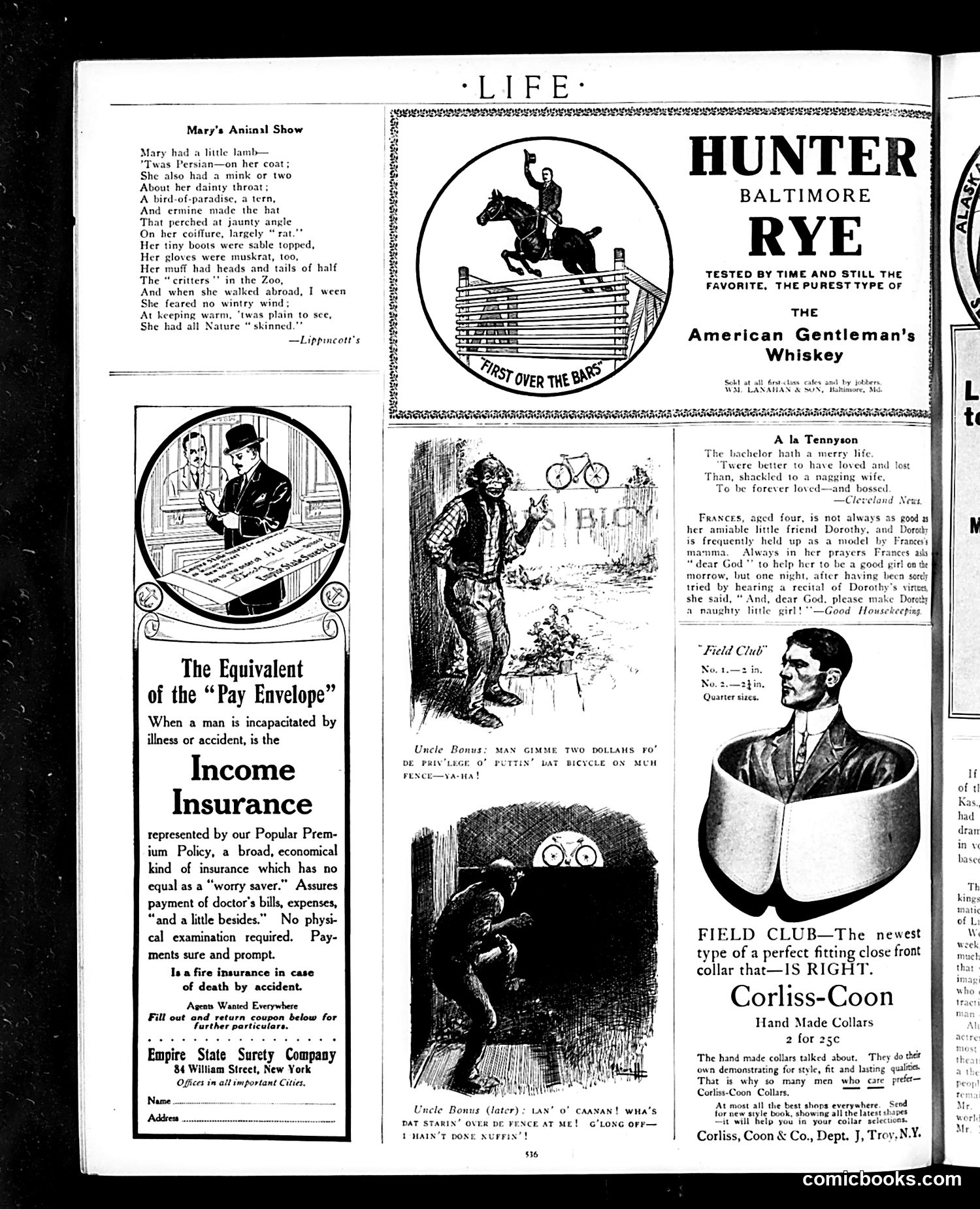
This page combines satirical poetry, advertisements, and comic illustrations typical of early 20th-century Life magazine. **"Mary's Animal Show"** (Lippincott's poem): Satirizes wealthy women's extravagant fashion, specifically the widespread practice of wearing furs and exotic animal parts as status symbols. The poem mocks a woman ("Mary") who wears Persian lamb, mink, ermine, bird-of-paradise feathers, and other animal products so extensively she has "all Nature 'skinned.'" The satire criticizes both the conspicuous consumption and the animal cruelty involved in haute couture. **Comic illustrations** feature "Uncle Bonus," an African American character in dialect-heavy captions asking for money for a bicycle—appearing to satirize both racial stereotypes and class differences. **Advertisements** promote income insurance, Baltimore Rye whiskey, and Corliss-Coon collars, typical period commercial content. The page reflects early 1900s attitudes: mocking wealthy fashion excess while simultaneously depicting African Americans through offensive stereotypes.
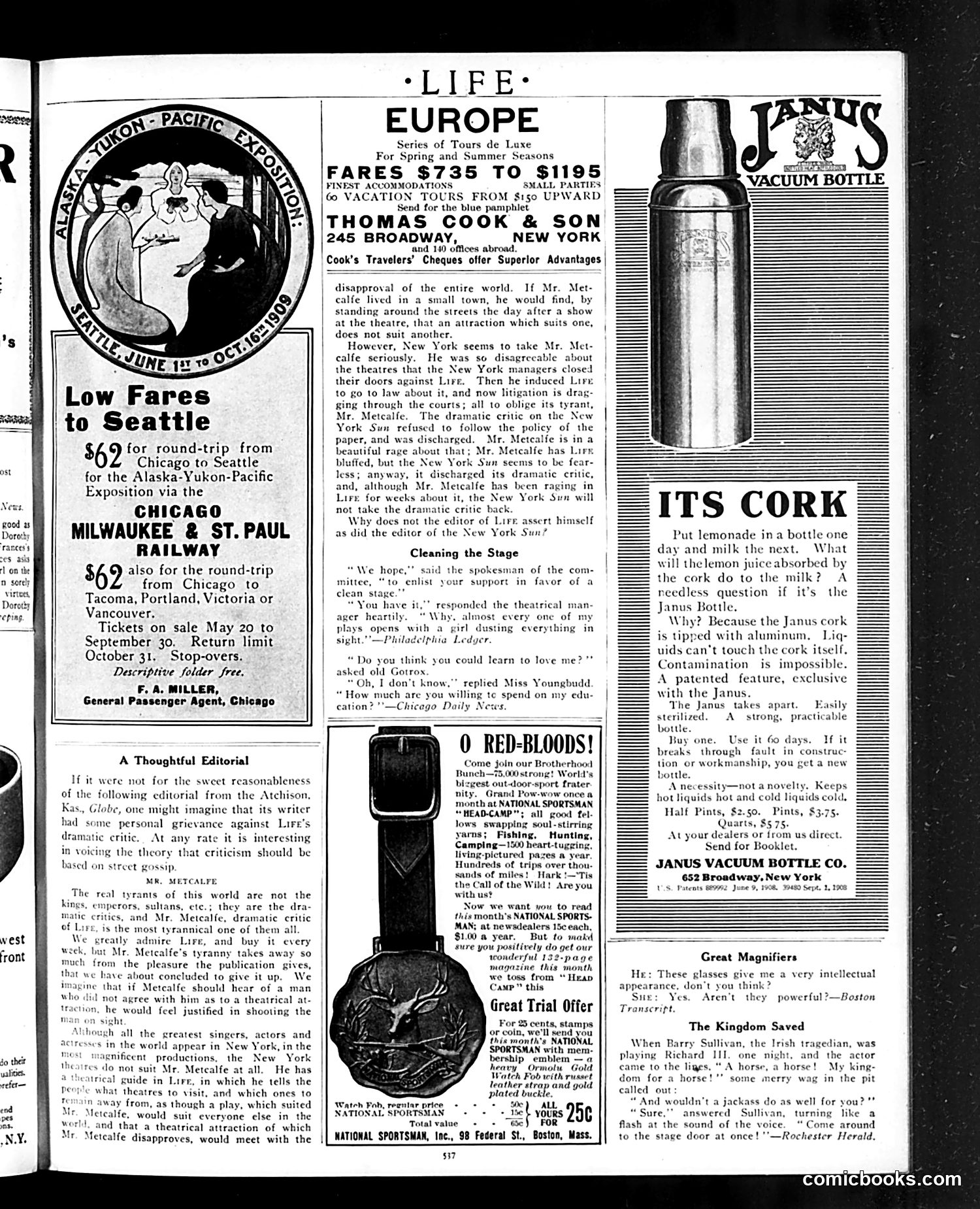
This page is primarily **advertising and editorial content** rather than political satire. The main elements include: **Left side**: An editorial criticizing **Life's drama critic Mr. Metcalfe** for his tyrannical reviews that upset New York theater managers so much they banned Life from theaters. The Atchison, Kansas Globe's editorial sarcastically argues Metcalfe wields excessive power over theatrical productions, suggesting his personal taste shouldn't dictate what audiences see. **Center**: Travel advertisements for European tours and Alaska-Yukon-Pacific Exposition trips. **Right side**: Product advertisements (Janus vacuum bottle, National Sportsman magazine). The satire targets **critical overreach**—the idea that one theater critic's harsh opinions influenced actual business decisions and legal disputes. The page suggests tension between Life magazine's editorial voice and New York's theater industry during this period.
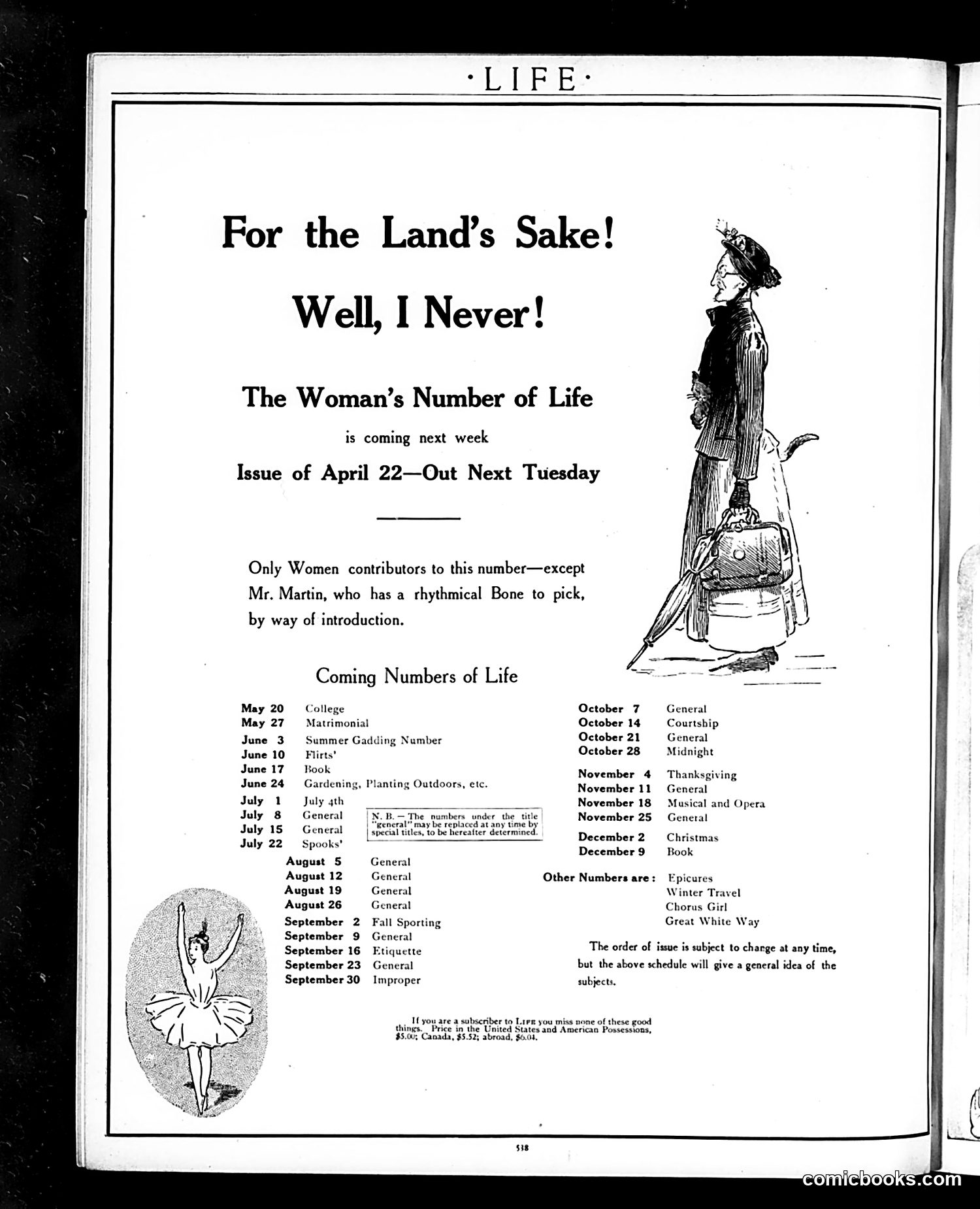
This is a **promotional advertisement** for an upcoming special issue of *Life* magazine (April 22), dedicated entirely to women contributors—with one exception: "Mr. Martin, who has a rhythmical Bone to pick, by way of introduction." The phrase "For the Land's Sake! Well, I Never!" expresses mock surprise at this female-focused edition. The accompanying illustrations—a fashionable woman with a basket and a stylized female dancer—reinforce the feminine theme. The satire is subtle: by allowing only one male contributor to "pick a bone" (complain/argue), *Life* gently mocks both women's emerging cultural prominence in the 1910s-20s and any potential male resistance to it. The tone is lighthearted rather than serious commentary. The page also lists upcoming themed issues (Matrimonial, Flirts, Spooks, Fall Sporting, etc.), demonstrating *Life*'s editorial strategy of specialized content targeting different interests and audiences.
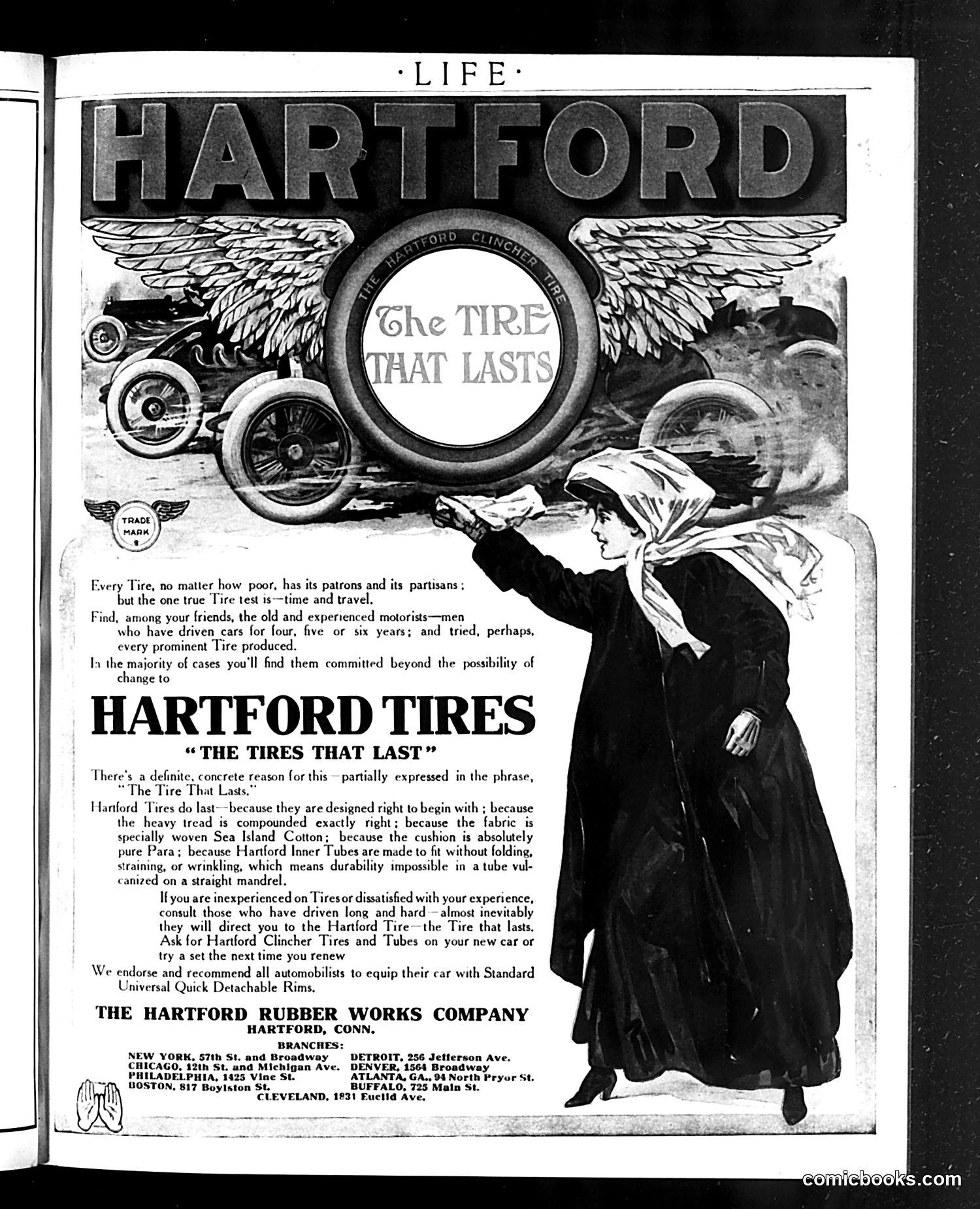
This is a **tire company advertisement**, not political satire. The page promotes Hartford Rubber Works Company tires using early 1900s marketing appeals. The imagery features winged tires (suggesting speed/reliability) flanking a large central tire, with a woman in period dress pointing toward it. The woman represents an endorser or satisfied customer—a common advertising device of the era. The advertisement's strategy is testimonial-based: it urges inexperienced buyers to ask experienced motorists (who've driven 4-6 years) about tire brands, claiming they'll overwhelmingly recommend Hartford. The text emphasizes durability through technical specifications: Sea Island Cotton fabric, pure Para rubber, and precision construction. This reflects early automotive culture when tire reliability was a genuine concern and word-of-mouth recommendations carried significant weight. The "tire that lasts" slogan directly addresses consumers' primary worry—tire longevity on poor roads.
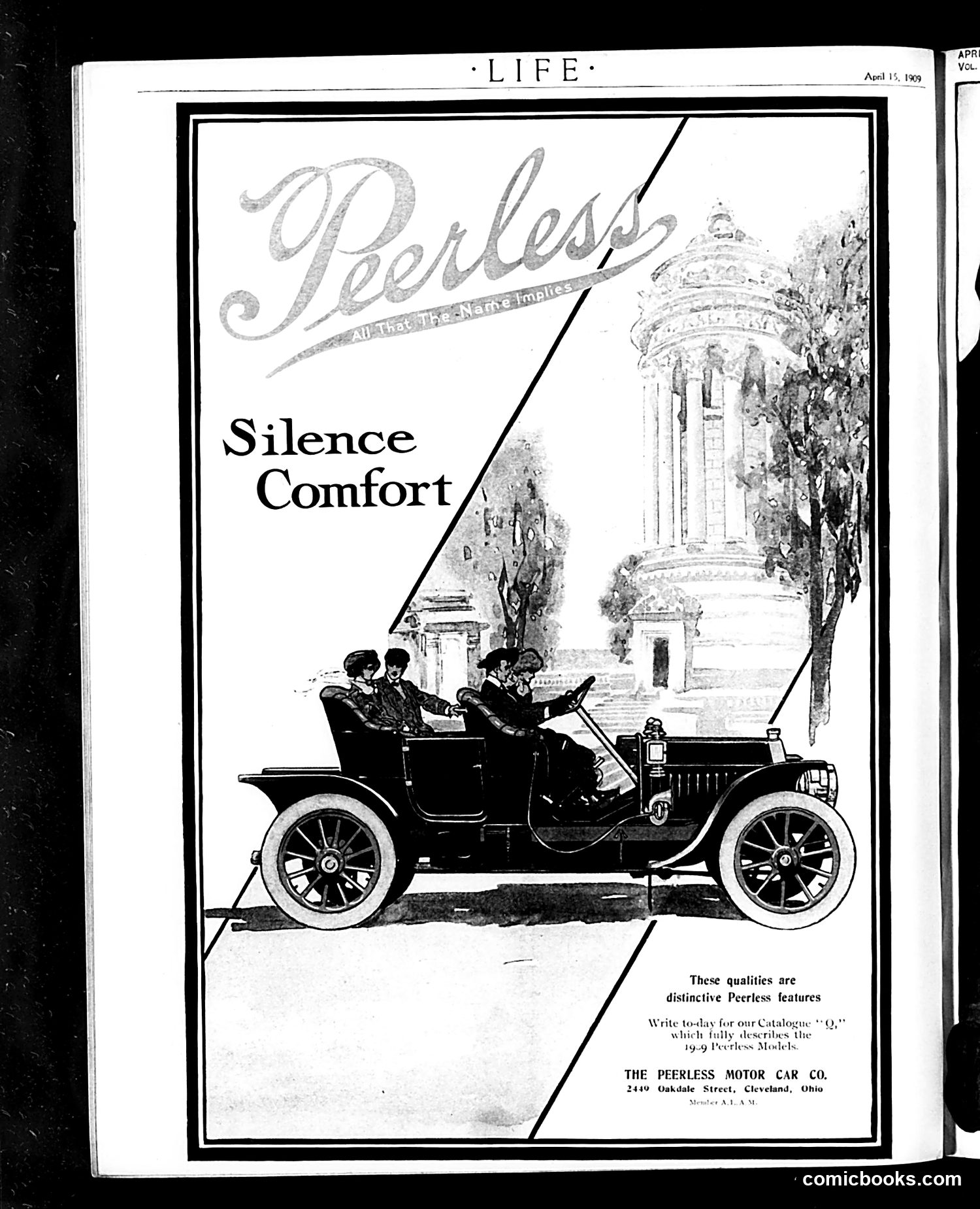
This is a **Peerless automobile advertisement** from *Life* magazine (April 15, 1909), not political satire. The page advertises the 1909 Peerless motor car model. The image depicts an elegant early-automobile touring scene: well-dressed passengers ride in a Peerless car past classical architecture (a domed building with columns), emphasizing luxury and refinement. The tagline "Silence Comfort" highlights the car's desirable mechanical qualities—smooth, quiet operation was a premium feature of high-end automobiles in this era. The ad copy explicitly states these qualities are "distinctive Peerless features" and invites readers to request a catalog. The company address is in Cleveland, Ohio. This represents early automotive marketing targeting affluent consumers through aspirational imagery and appeals to comfort and status rather than speed or performance.