
Life, 1909-04-15 · page 16 of 36
Life — April 15, 1909 — page 16: what you’re looking at
What you’re looking at
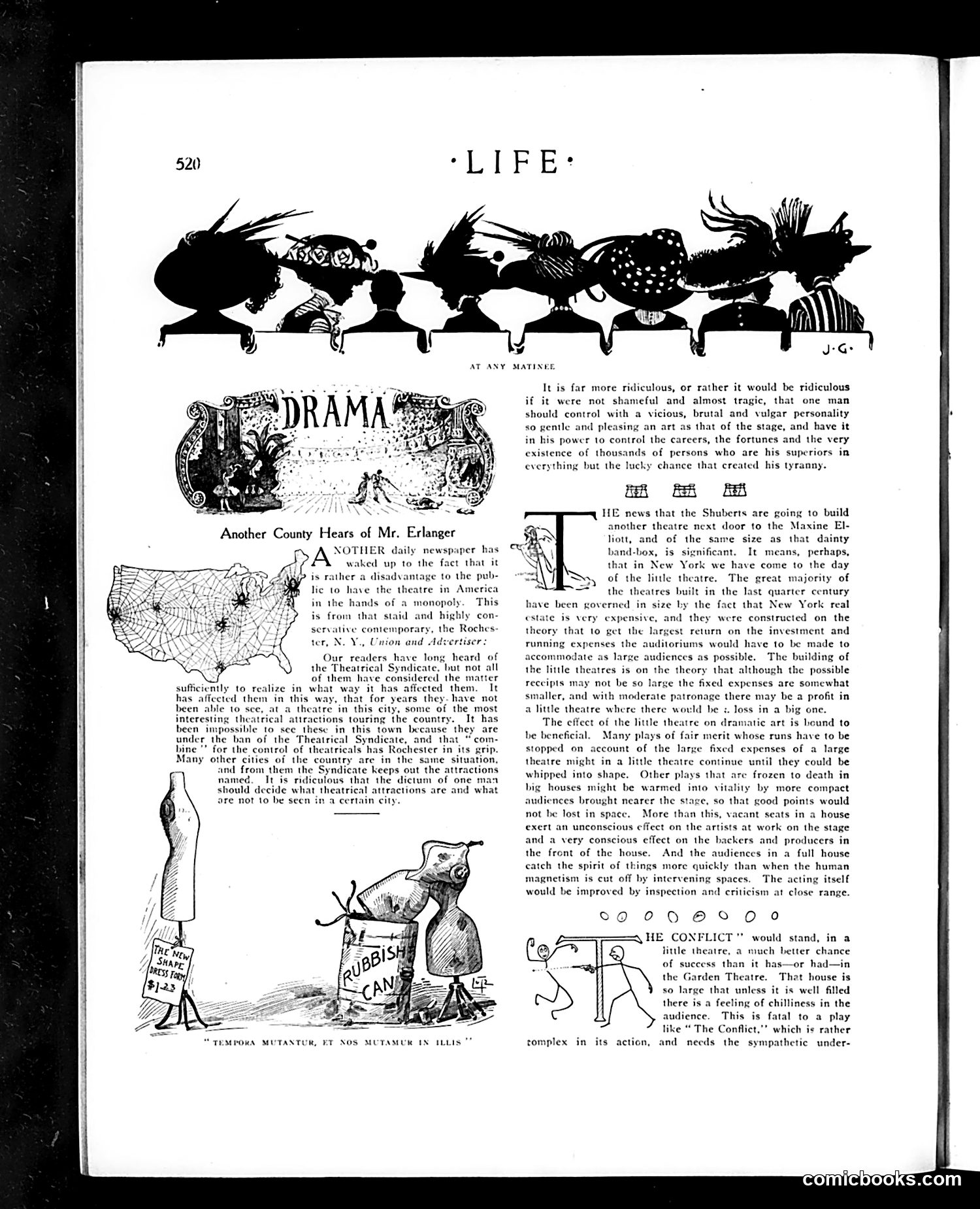
This page satirizes **the Theatrical Syndicate monopoly** controlling American theater in the early 20th century, led by **Mr. Erlanger** (the "one man" repeatedly mentioned). The cartoon shows various theatrical characters/caricatures sitting in a row at a matinee, representing diverse theater types now controlled by this monopoly. The text attacks Erlanger's tyrannical control over which plays tour which cities—Rochester and many other towns are shut out from quality productions. The satire emphasizes the moral injustice: one man with "vicious, brutal" personality controls the careers and livelihoods of thousands of superior artists. The secondary discussion advocates for smaller, intimate theaters (the Shuberts' new competition against the Maxine Elliott Theatre) as antidotes to the Syndicate's grip. Smaller venues offer better acoustics, lower fixed costs, and improved acting conditions. **The Latin motto translates: "Times change, and we change with them"**—suggesting theatrical monopoly control won't last forever.
📄 Transcribed text from this page (OCR, searchable)
Machine-transcribed from the original scan — historical spelling and the odd misread are preserved.
AT ANY MATINEE Another County Hears of Mr. Erlanger NOTHER daily waked up to the fact that it is rather a disadvantage to the pub- lic to have the theatre in America in the hands of a monopoly. This is from that staid and highly con- servative contemporary, the Roches: ter, N.Y, Union and Advertiser Our readers have long heard of the Theatrical Syndicate, but not all of them have considered the matter way it has affected them. It that for years they. have not some of the most y. It has y newspaper has sufficiently tor has aficcted th 3 been able to sce, at_a theatre in this city interesting theatrical attractions touring the count been impossible to sce these in this town because under, the ban of the Theatrical Syndicat bine’ for the control of theatricals has Rochester in its grip. Many other cities of the country are in the same situation, and from them the Syndicate keeps out the attractions named. It is ridiculous that the dictum of one man should decide what theatrical attractions are and what are not to be sec in city. “TEMPORA MUTANTUR, ET NOS MUTAMUK EN ELLIS’ It is far more ridiculous, or rather it would be ridiculous if it were not shameful and almost tragic, that one man should control with a vicious, brutal and vulgar personality so gentle and pleasing an art as that of the stage, and bave it in his powcr to control the careers, the fortunes and the very existence of thousands of persons who are his superiors in everything but the lucky chance that created his tyranny. mm BA RA HE news that the Shuberts are going to build another theatre next door to the Maxine El- liott, and of the same size as that dainty band-box, is significant. It means, perhaps, that in New York we have come to the day of the little theatre, The great majority of the theatres built in the last quarter century have been governed in size by the fact that New York real estate is very expensive, and they were constructed on the theory that to get the largest return on the investment and ing expenses the auditoriums would have to be made to nmodate as large audiences as possible, The building of the little theatres is on the theory that although the possible reccipts may not be so large the fixed expenses are somewhat Her, and with moderate patronage there may be a profit in a little theatre where there would he :. loss in a big one. The effect of the little theatre on dramatic art is bound to be beneficial. Many plays of fair merit whose runs have to be stopped on account of the large fixed expenses of a large theatre might in a little theatre continue until they could be frozen to death in by more compact audiences brought nearer the stage, so that good points would not be lost in space. More than this, vacant seats in a house exert an unconscious effect on the artists at work on the stage and a very conscious effect on the backers and producers in the front of the house. And the audiences in a full house catch the spirit of things more quickly than when the human The acting itself whipped into shape. Other plays that big houses might be warmed into vitality magnetism is cut off by intervening spaces. would be improved by inspection and criticism at close range. caq00 08200 HE CONFLICT would stand, in a little theatre, a much better chance of success than it has—or had—in the Garden Theatre. That house is so large that unless it is well filled there is a feeling of chilliness in the audience. This is fatal to a play like “ The Confiict,"” which is rather tomplex in its action, and needs the sympathetic under-