
Life, 1909-04-15 · page 8 of 36
Life — April 15, 1909 — page 8: what you’re looking at
What you’re looking at
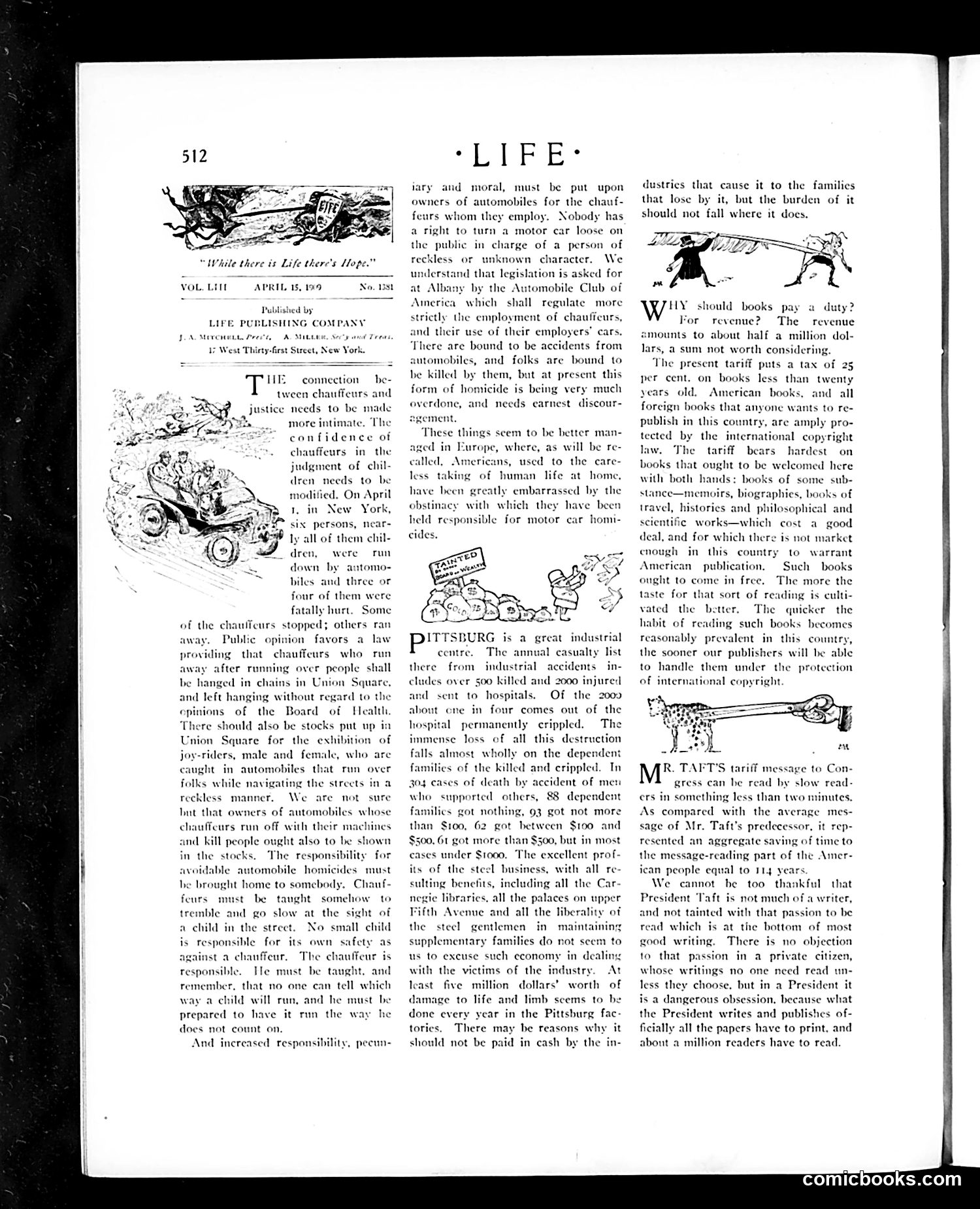
This page discusses automobile-related deaths and injuries, particularly focusing on chauffeurs' safety and accountability. The cartoons illustrate the hazards of early motoring—showing vehicles in crashes and collisions. The text advocates for stricter regulation of chauffeur employment and argues that automobile owners bear responsibility for accidents caused by their drivers. It references a Pittsburgh industrial center with 500+ killed and 2,000 injured in accidents annually. The page also critiques President Taft's tariff message to Congress, suggesting his prolific writing (million readers) reflects dangerous obsession rather than practical leadership. The satirical thrust targets both automobile industry negligence and political excess, using visual humor to underscore early 20th-century industrial safety concerns.
📄 Transcribed text from this page (OCR, searchable)
Machine-transcribed from the original scan — historical spelling and the odd misread are preserved.
“While there is Life there's Hope.” VOL. Lt APRIL 15, Published by LIFE PUBLISHING COMPAD 17 West Thirty-first Street, New York, IIE connection — be- tween chauffeurs and justice needs to be made more intimate. The confidence of chauffeurs in the judgment of chil- dren needs to be modified. On April 1, in New York, six persons, near- L of them chil- _ dren, run down by antomo- biles and three or four of them were fatally hurt. Some others ran law were of the chauifeurs stopped away, Public opinion favors a providing that chauffeurs who run away after running over people shall be hanged in chains in Union Square, and left hanging without regard to the opinions of the Board of Health. There should also be stocks put up in Union Square for the exhibition of joy-riders, male and fema who are aught in automobiles that run over folks while navigating the streets in a reckless manner. We are not but that owners of automobiles whose chauffeurs run off with their machines and kill people ought also to be shown in the stocks. The responsibility for avoidable automobile homicides he brought home to somebody, Chauf- feurs must be taught tremble and go slow at the sight of a child in the street. No small child is responsihle for its own safety as against a chauffeur, The chauffeur is responsible. He must be taught. and remember, that no one can tell which way achild will run, and he must be prepared to have it run the way he does not count on. And increased responsibility, peeun- sure must somehow to “LIFE: iary and moral, must be put upon owners of automobiles for the chauf- feurs whom they employ, Nobody has a right to turn a motor car loose on the public in charge of a person of reckless or unknown character. We understand that legislation is asked for at Albany by the Automobile Club of America which shall regulate more strictly the employment of chauficurs, and their use of their employers’ cars. There are bound to be accidents from automobiles, and folks are bound to he killed by them, but at present this form of homicide is being very much overdone, 1 needs earnest discour- zgement, These things scem to be better man- aged in Europe, where, as will be re- called, Americans, used to the care- less taking of human life at home, have been greatly embarrassed by the obstinacy with which they 1 held responsible for motor car homi- ve been cid 3URG is a great industrial centre. The annual casualty list there from industrial accidents in- cludes over 500 killed and 2000 injured and sent to hospit Of the 2009 ahout ene in four comes out of the hospital permanently crippled. The immense loss of all this destruction falls almost wholly on the dependent families of the killed and crippled. In 3 ses of death by accident of men who supported others, 88 depende milies got nothing, 93 got not more than $100, 62 got between $100 and $500, 61 got more than $300, but in most ases under $1000. The excellent prof- its of the steel business, with all re- sulting benefits, including all the Car- negie libraries, all the palaces on up; Fifth Avenue and all the liberality of the steel gentlemen in maintaining supplementary families do not seem to us to excuse such economy in dealing with the victims of the industry. At least’ five million dollars’ worth of damage to life and limb seems to be done every year in the Pittsburg fac- tories. There may be reasons why it should not be paid in cash by the in- dustrics that cause it to the families that lose by it, but the burden of it should not fall where it does, ™ wi should books pay a duty? For revenue? The revenue gmounts to about half a million dol- lars, a sum not worth considering. The present tariff puts a tax of 25 per cent. on books less than twenty years old. American books, and all forcign books that anyone wants to re- publish in this country, are amply pro- tected by the international copyright law. The tariff bears hardest’ on books that ought to be welcomed here with both hands: books of some sub- stance—memoirs, biographies, books of travel, histories and philosophical and scientific works—which a good deal, and for which there is not market cnough in this country to warrant American publication. Such books ought to come in free, The more the taste for that sort of reading is culti- vated the better, The quicker the habit of reading such books becomes reasonably prevalent in this country, the sooner our publishers will be able to handle them under the protection of inte cost ational copyright ay R. TAFT’S tariff message to Con- gress can be read by slow read- ers in something less than two minutes. As compared with the average mes- sage of Mr. Taft’s predecessor, it rep- resented an aggregate saving of time to the message-reading part of the Amer- ican people equal to 114 y We cannot be too thankful that President Taft is not much of a writer, and not tainted with that passion to be read which is at the bottom of most good writing. There is no objection to that sion in a private citizen, whose writings no one need read un- less they choose, but in a President it is a dangerous obsession, because what the President writes and publishes of- ficially all the papers have to print, and about a million readers have to read. comicbooks.com