
A complete issue · 32 pages · 1909
Life — March 18, 1909
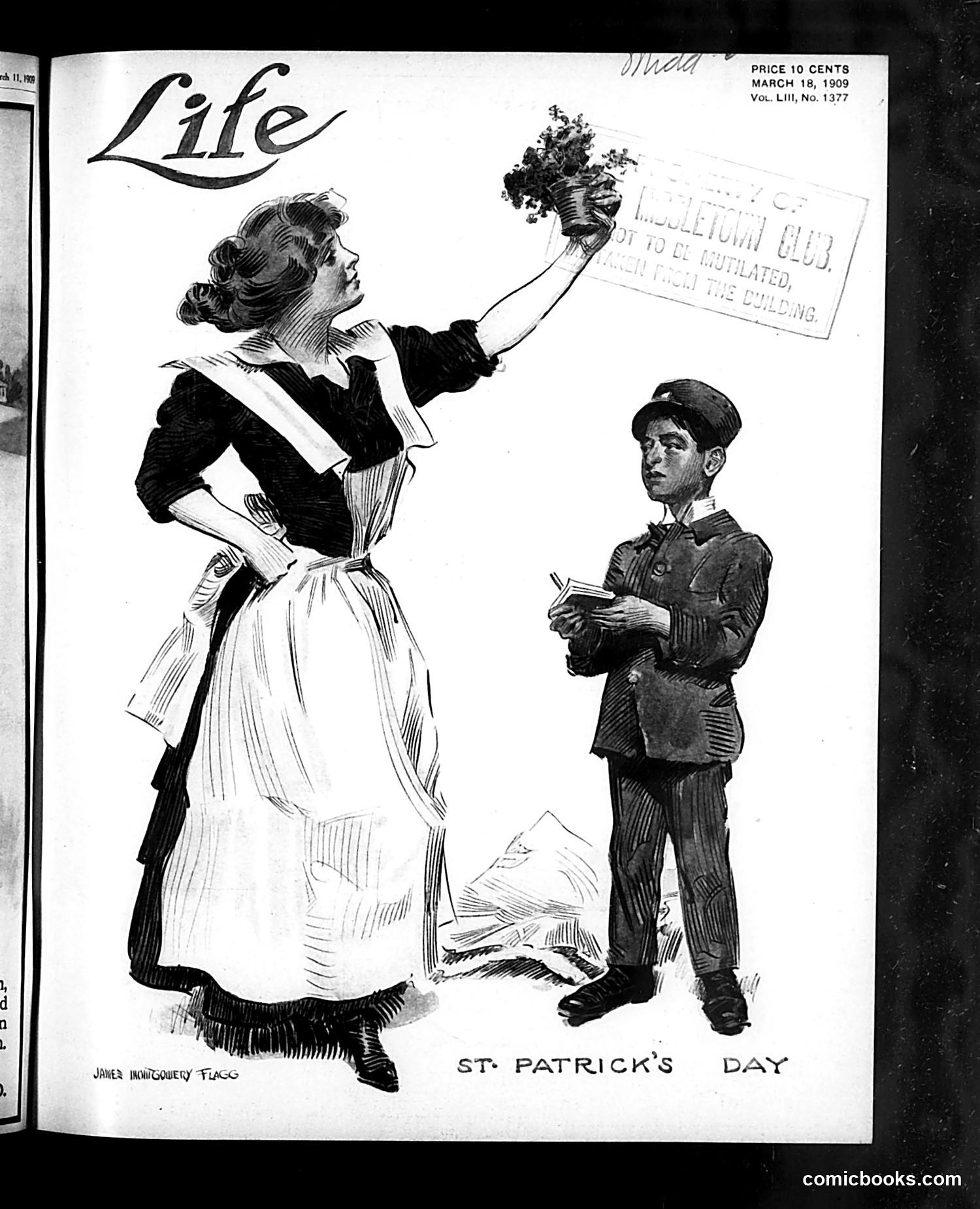
This Life magazine cover from March 18, 1909, depicts a St. Patrick's Day satire by James Montgomery Flagg. A well-dressed woman holds up a shamrock plant triumphantly while gazing at a young boy holding what appears to be a book or document. The woman's elaborate clothing and confident pose suggest she represents an idealized or stereotypical figure, while the boy—depicted with exaggerated features in a manner typical of early-1900s caricature—appears uncertain or subordinate. The satire likely comments on St. Patrick's Day celebrations in America, possibly mocking either the commercialization of the holiday, gender dynamics, or Irish-American immigrant experiences. Without additional context from the magazine's text, the precise political or social target remains unclear, though the dynamic between the two figures suggests commentary on social hierarchy or cultural assimilation.
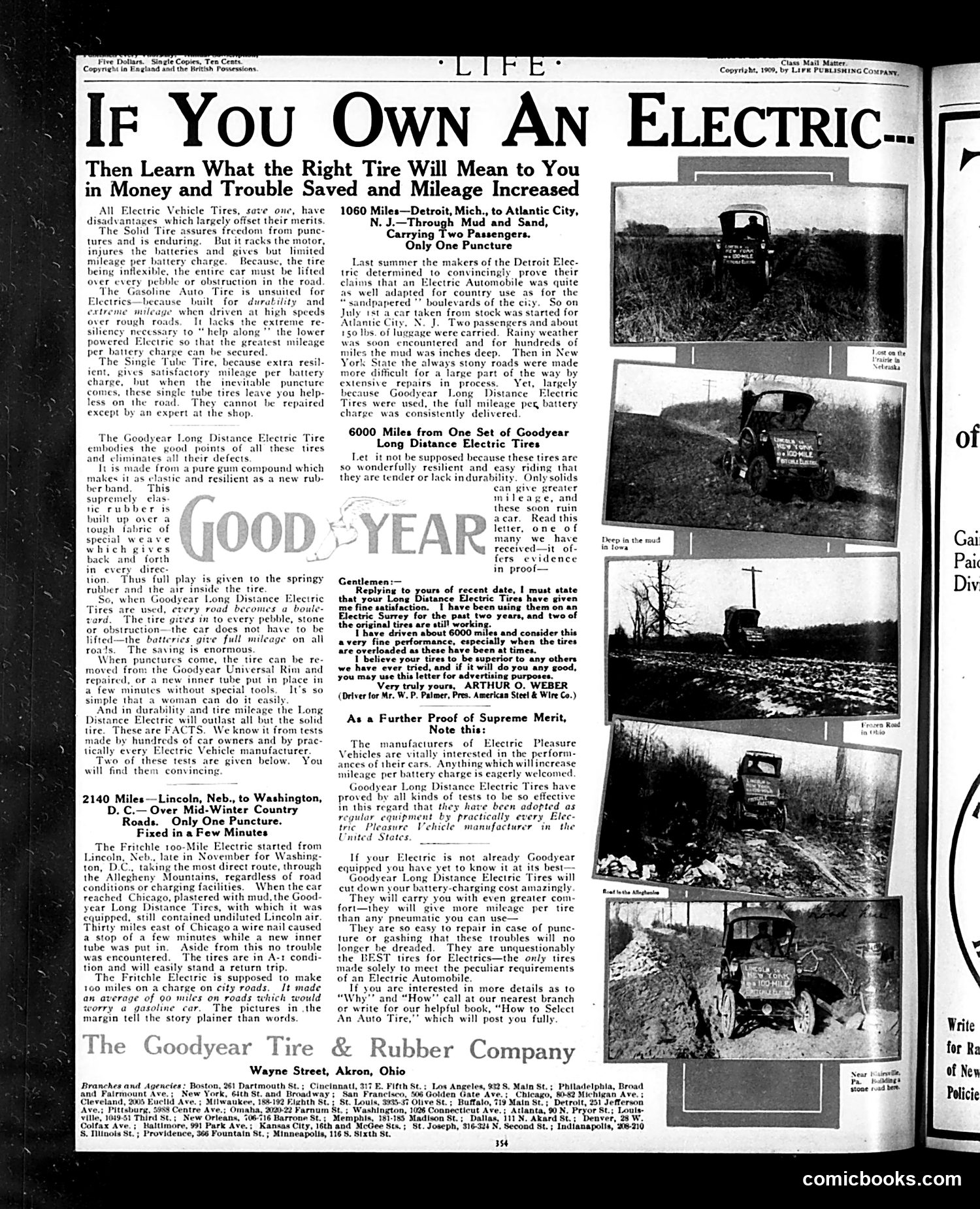
This page is **primarily advertising**, not editorial content or satire. It's a Goodyear Tire & Rubber Company advertisement promoting their "Long Distance Electric Tires" for electric automobiles. The ad features testimonial letters from customers describing real-world long-distance trips in electric vehicles (1060 miles Detroit to Atlantic City; 2140 miles Lincoln to Washington D.C.). Period photographs show early electric cars on roads. The appeal targets early electric vehicle owners, emphasizing tire durability, reliability, and mileage per battery charge. The ad positions Goodyear tires as superior to solid tires then common on electrics. This reflects genuine 1910s-era competition between electric and gasoline automobiles, before gasoline vehicles ultimately dominated the market. The advertisement is straightforward promotion, not satirical commentary.
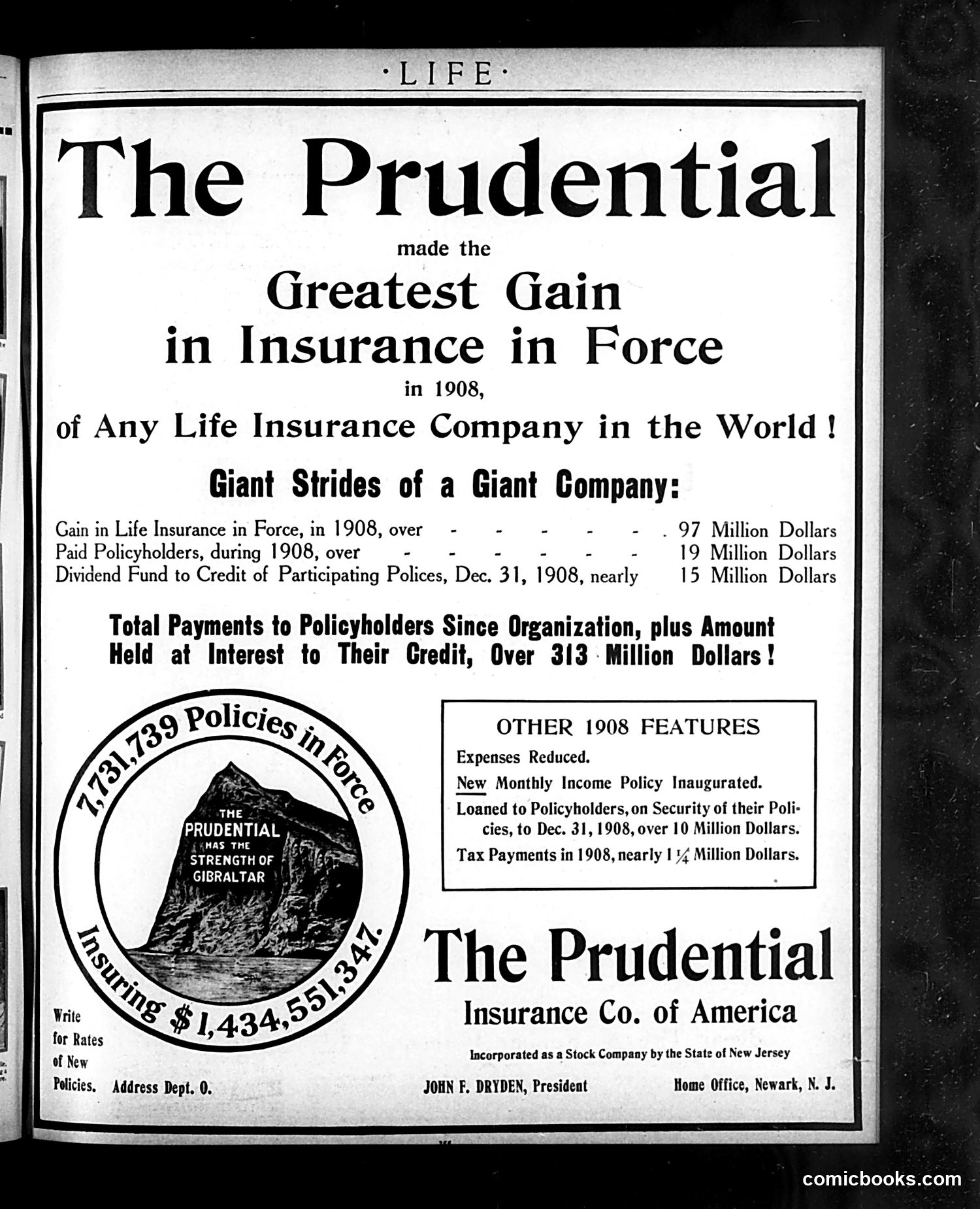
This page is primarily **advertising, not satire or editorial content**. It's a full-page advertisement for The Prudential Insurance Company of America, published in Life magazine. The ad boasts the company's 1908 achievements: $97 million in new insurance in force, $19 million in dividend payments, and $15 million added to a police dividend fund. The circular emblem features the Rock of Gibraltar with the company's slogan "The Prudential Has the Strength of Gibraltar," along with their insurance in force amount ($1,434,551,342). The page highlights 1908 "features" including reduced expenses, new monthly income policies, and tax payments. President John F. Dryden is named; the home office is listed as Newark, New Jersey. This represents early-1900s corporate advertising promoting financial stability and growth.
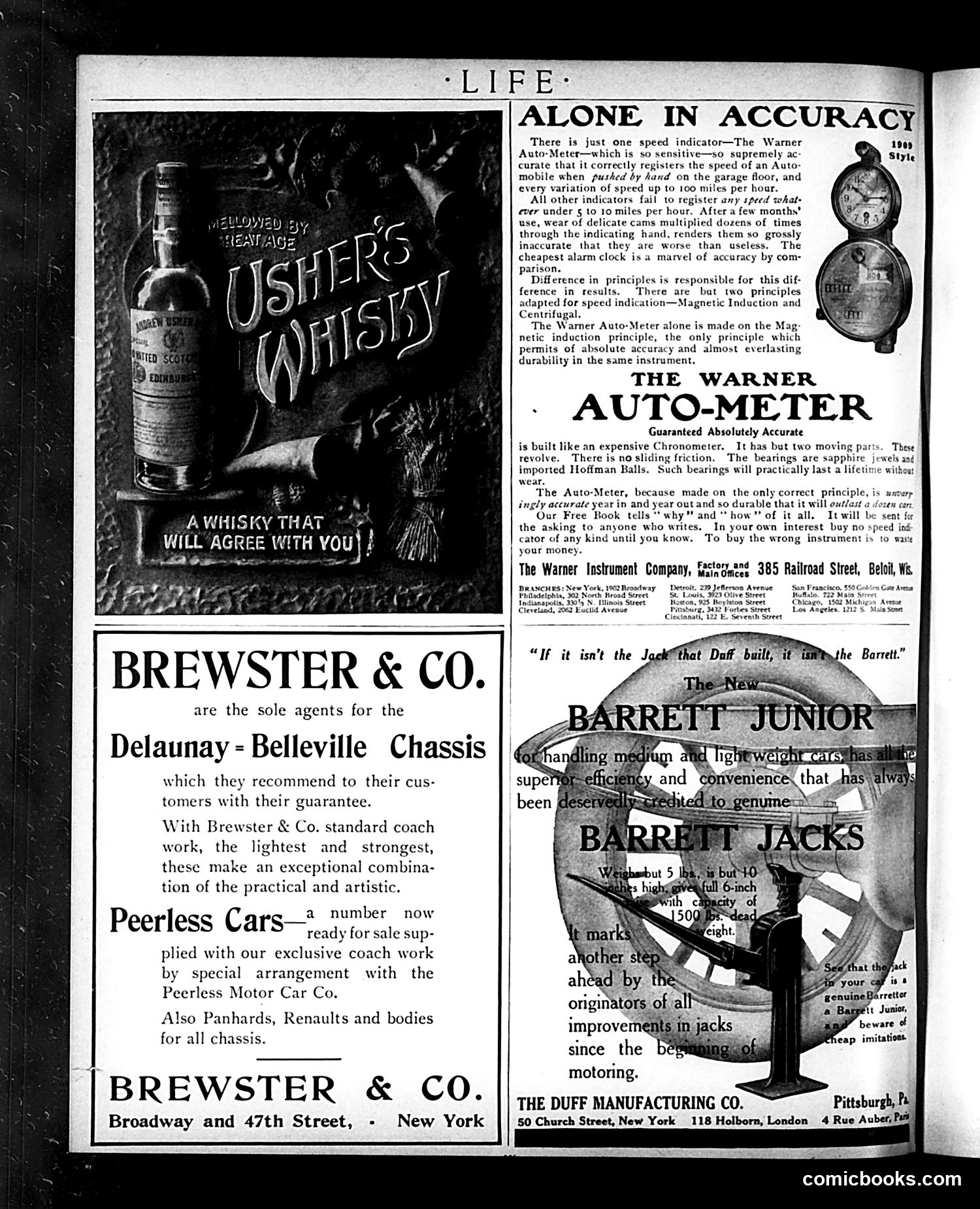
This page is primarily **advertising**, not editorial content or satire. It contains four advertisements from the early 20th century: 1. **Usher's Whisky** - promotes a Scottish whisky brand with the tagline "A Whisky That Will Agree With You" 2. **Warner Auto-Meter** - advertises a speed indicator claiming superior accuracy compared to competing automotive gauges 3. **Brewster & Co.** - announces they're the exclusive agents for Delaunay-Belleville chassis and offers coach work and Peerless Cars 4. **Barrett Junior Jacks** - promotes lifting equipment for automobiles There is **no political cartoon or satire** on this page. It represents typical early-1900s Life magazine advertising—a mix of luxury goods (whisky, custom automobiles) and automotive equipment targeting wealthy readers.
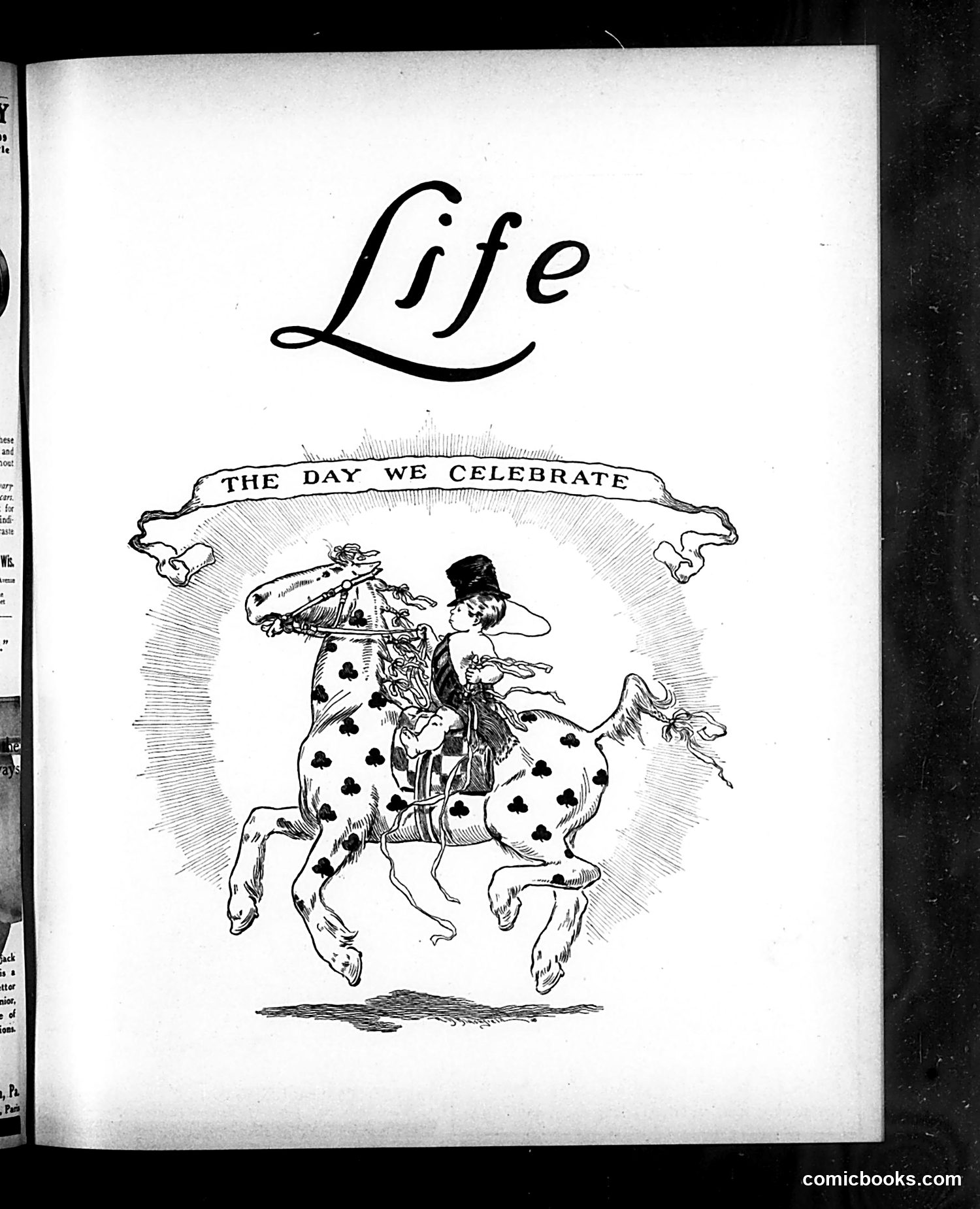
This appears to be a cover or title page from *Life* magazine featuring a satirical illustration of a figure on a spotted horse, wearing a top hat and formal attire. The banner reads "THE DAY WE CELEBRATE," suggesting commentary on a specific commemorative occasion. The spotted horse and jester-like costume suggest mockery of pretense or folly. Without additional context about the publication date, the specific holiday or event referenced remains unclear. The style and engraving technique indicate this is from an earlier era of American satire, likely late 19th or early 20th century. The overall composition appears to lampoon celebrated figures or occasions through exaggerated, comedic imagery—characteristic of *Life* magazine's satirical approach.
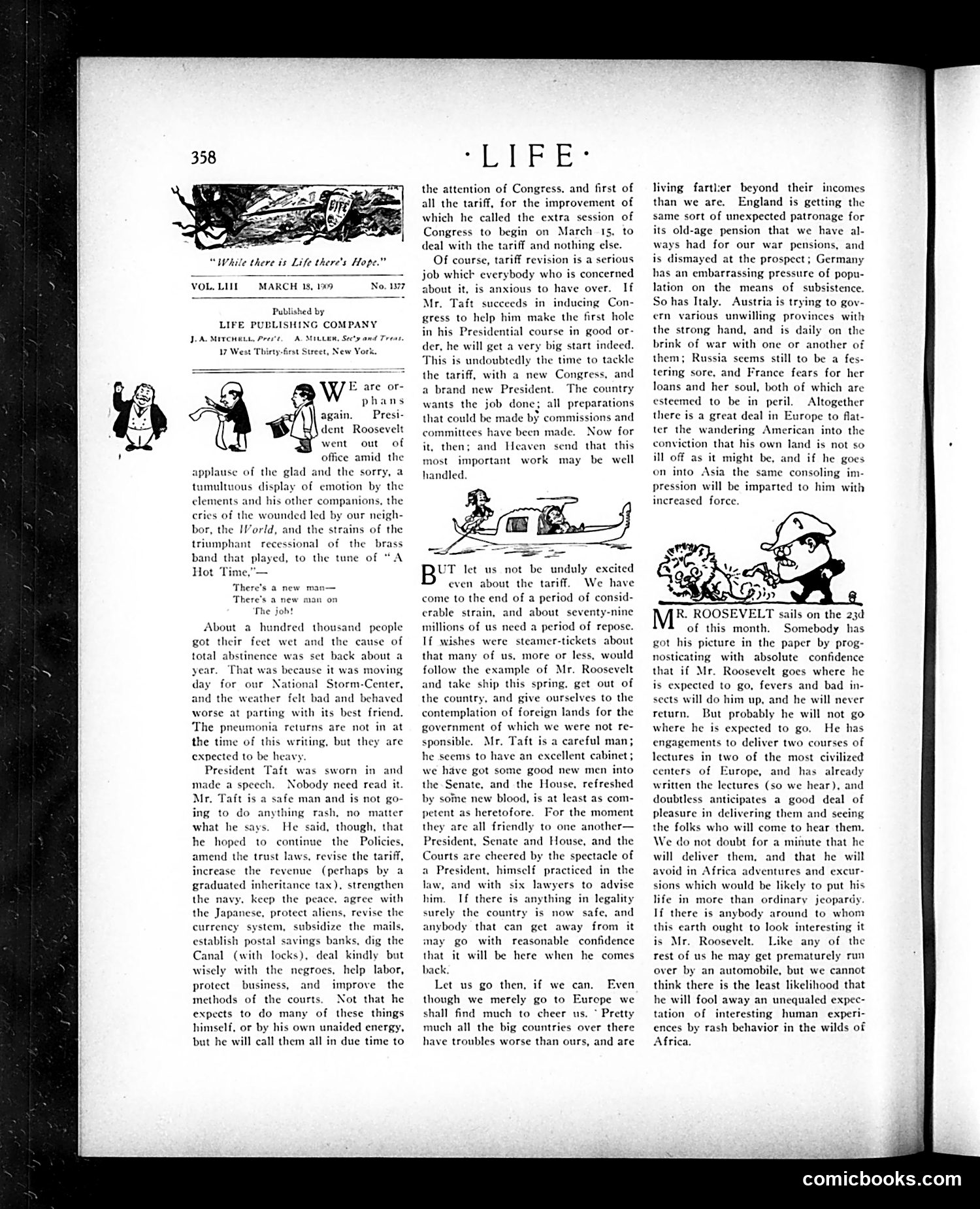
The page contains editorial commentary on President Theodore Roosevelt's impending departure from office (he left in March 1909). The main cartoon depicts Roosevelt as a sailor departing on a ship, satirizing his planned African safari after leaving the presidency. The accompanying text expresses relief that Roosevelt is leaving—describing the tumultuous emotional display of his presidency and the "wounded" caused by his neighbor, the *World* newspaper (likely the New York World). The editorial celebrates that a new president will take office amid "applause" and calmer circumstances. It praises Roosevelt's accomplishments while suggesting the country needs "a period of repose" after his energetic tenure. The tone is tongue-in-cheek rather than hostile, treating his departure as both notable and somewhat comedic.
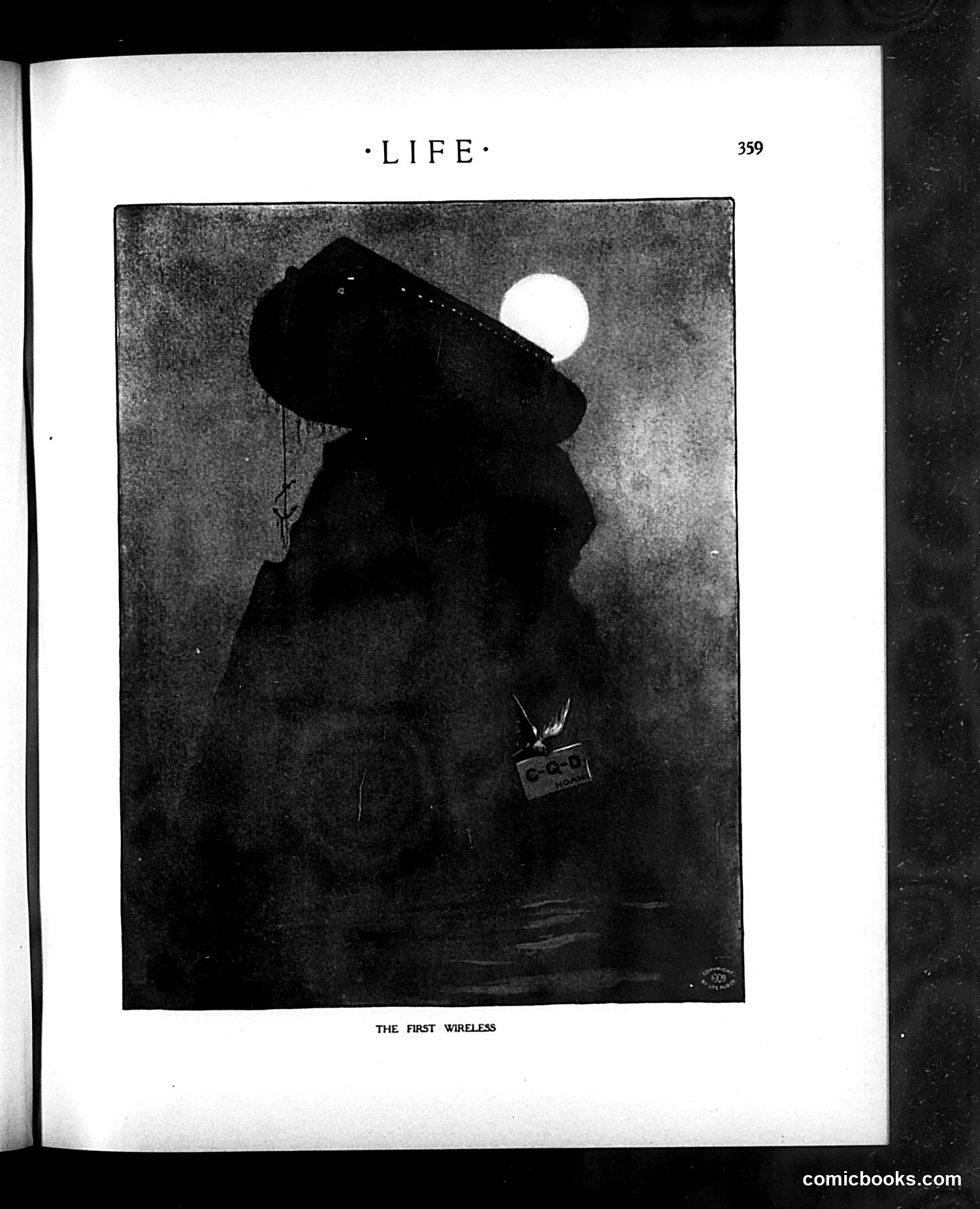
This satirical illustration from *Life* magazine (page 359) depicts a silhouetted figure holding what appears to be early wireless/radio equipment, with a full moon visible behind. The title "The First Wireless" is the joke's pivot point. The satire likely plays on the era's fascination with newly-invented wireless technology (radio), while the silhouetted figure and moon suggest a werewolf or supernatural creature. The humor appears to be a pun: presenting a literal "wireless" — a creature of folklore — as "the first wireless," mocking either the new technology's mystique or perhaps its seemingly magical properties to contemporary viewers unfamiliar with radio. The cartoon reflects early-20th-century anxieties about rapid technological change presented through horror-tinged humor.
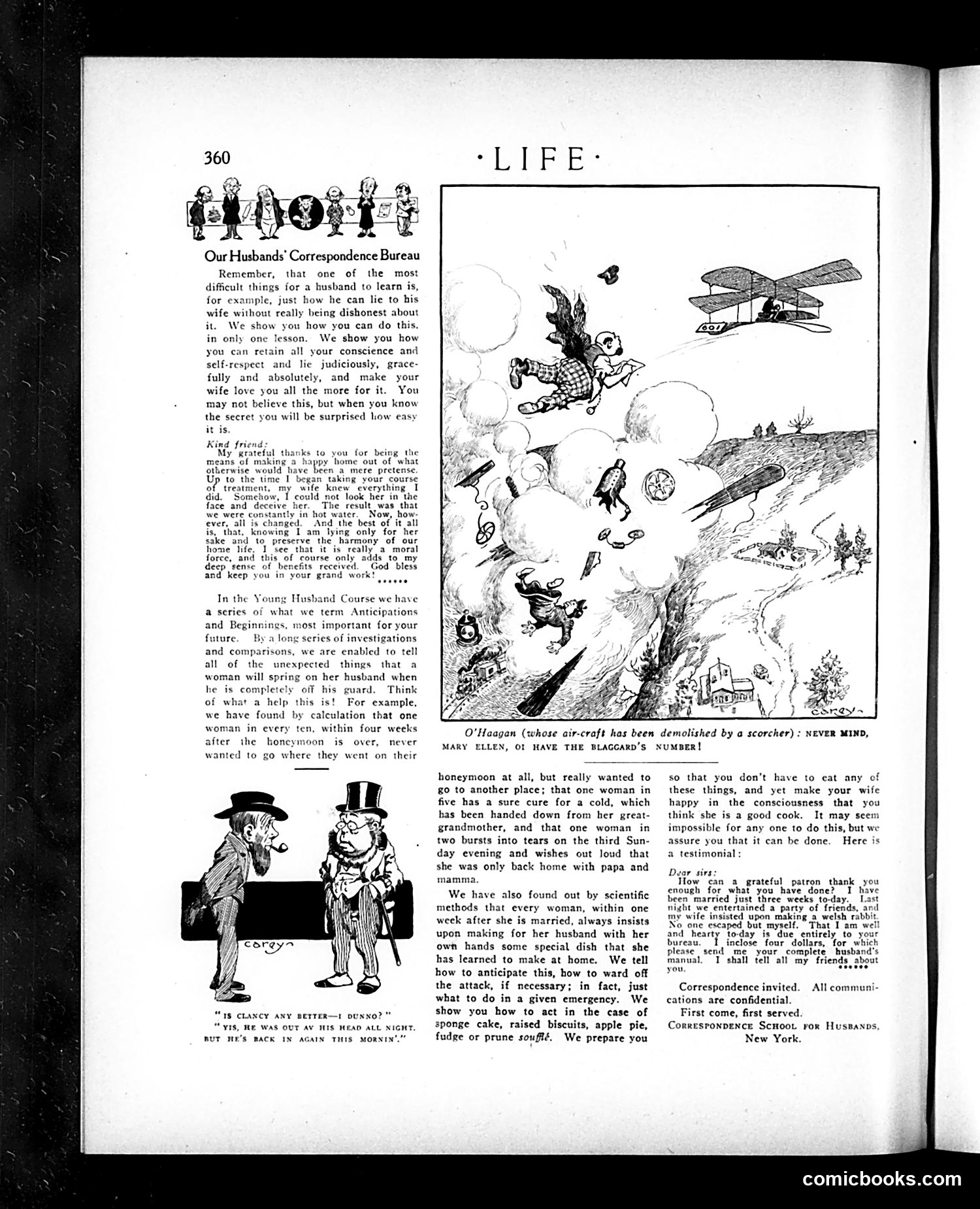
This page satirizes early 20th-century marital advice and domestic instruction. The main illustration shows a whimsical aerial view of couples engaged in various activities—picnicking, flying, cycling—suggesting the "Young Husband Course" offered by the bureau. The text humorously instructs wives on deceiving their husbands about household incompetence. It advises women to hide cooking failures and financial ignorance while maintaining their husbands' confidence through calculated domesticity. The cartoon below features two gentlemen in top hats discussing a night out, with the caption suggesting one was unaware his wife went out—mocking the bureau's premise that wives should manage appearances. The satire targets both naive husbands and the commercialized "self-improvement" industry promising marital harmony through manufactured deception rather than honest communication.
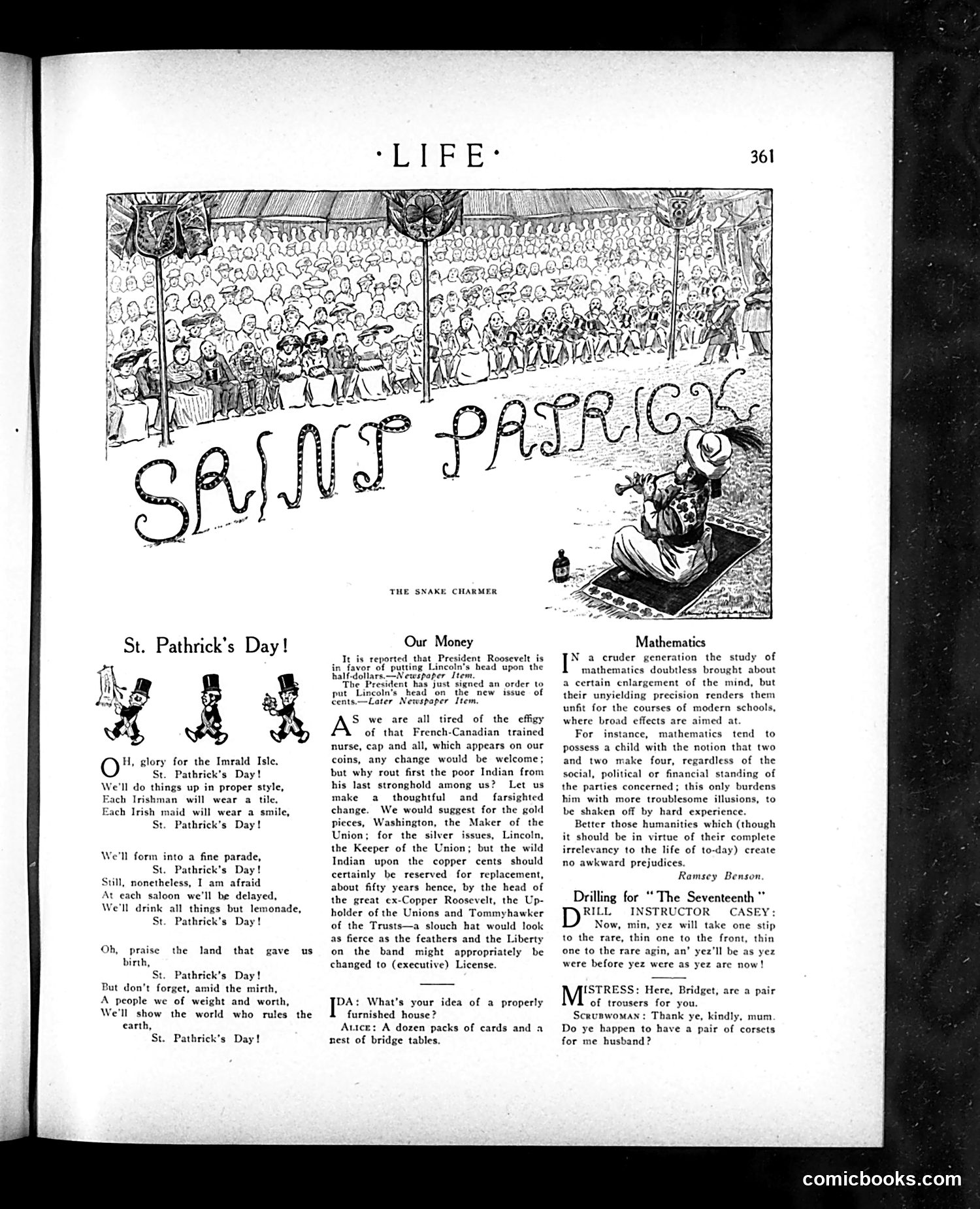
The large cartoon depicts a fairground or carnival scene labeled "SAINT PASTIME," showing crowds watching entertainers. Below are several short pieces, including a St. Patrick's Day poem and articles on currency and mathematics. The "Our Money" section satirizes President Roosevelt's reported favor for debasing U.S. coinage by reducing precious metal content. It mocks this proposal by suggesting replacing various coins with Indian heads and other figures—a jab at what the author considers foolish monetary policy. The "Mathematics" piece critiques how modern education emphasizes abstract theory over practical skills, rendering students "unfit for the courses of modern schools, where broad orders are aimed at." These pieces reflect early 20th-century anxieties about government spending, educational reform, and changing American values.
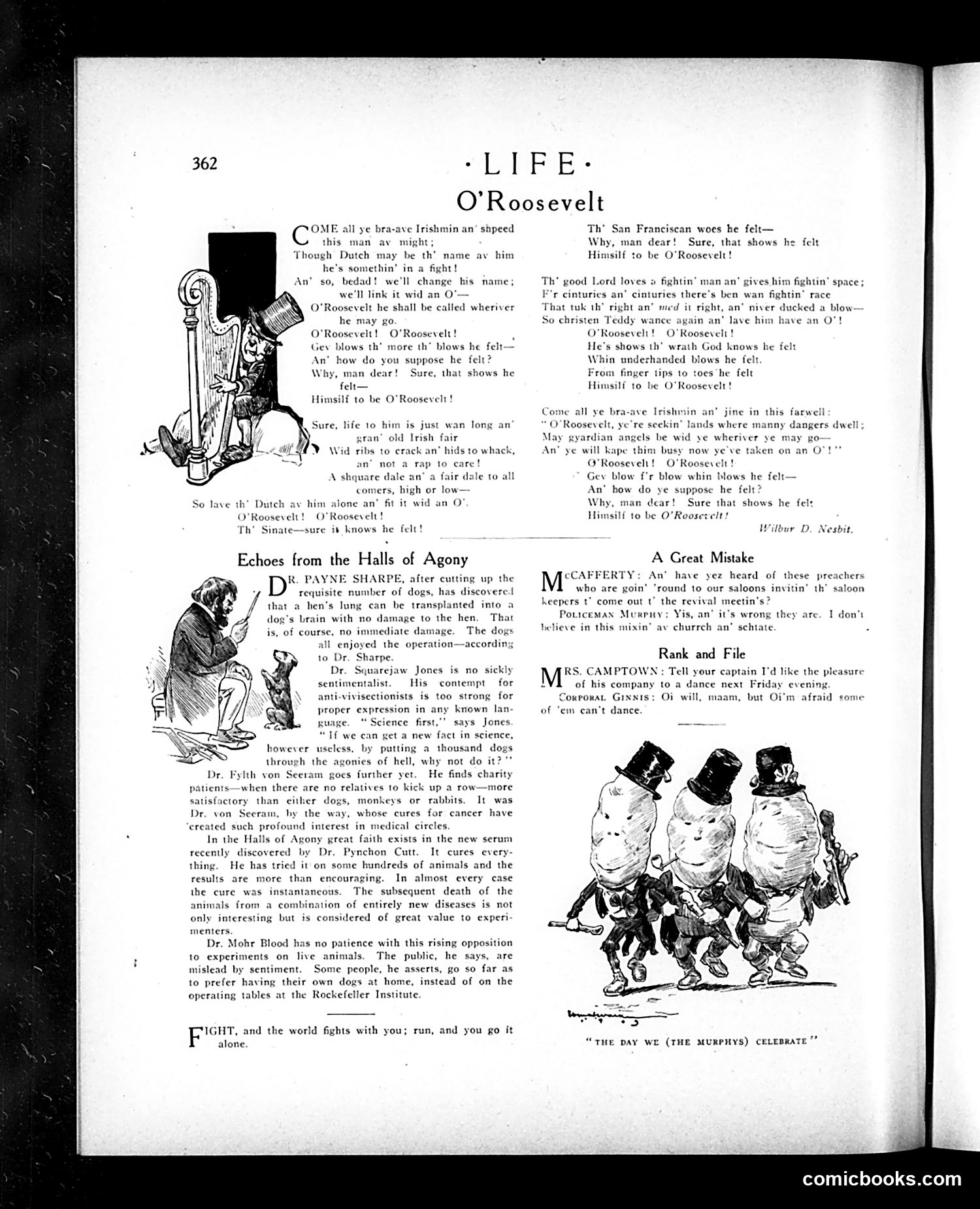
This page contains satirical poetry and prose about Theodore Roosevelt ("O'Roosevelt"), presented as Irish dialect verse celebrating him as a "brave Irishman." The accompanying illustration shows an Irish figure with a harp and shillelagh, linking Roosevelt to Irish-American identity. Below that, "Echoes from the Halls of Agony" discusses medical experiments on animals—specifically Dr. Sharpe's transplantation of a dog's brain into a hen. The text criticizes both the experiment and Dr. Sloik Blood's opposition to vivisection research, mocking sentiment-driven animal activists who prefer dogs "at home, instead of on the operating tables at the Rockefeller Institute." The final cartoon "Rank and File" shows three men in top hats dancing, captioned "The Day We (The Murphys) Celebrate"—likely satirizing Irish-American social pretension.
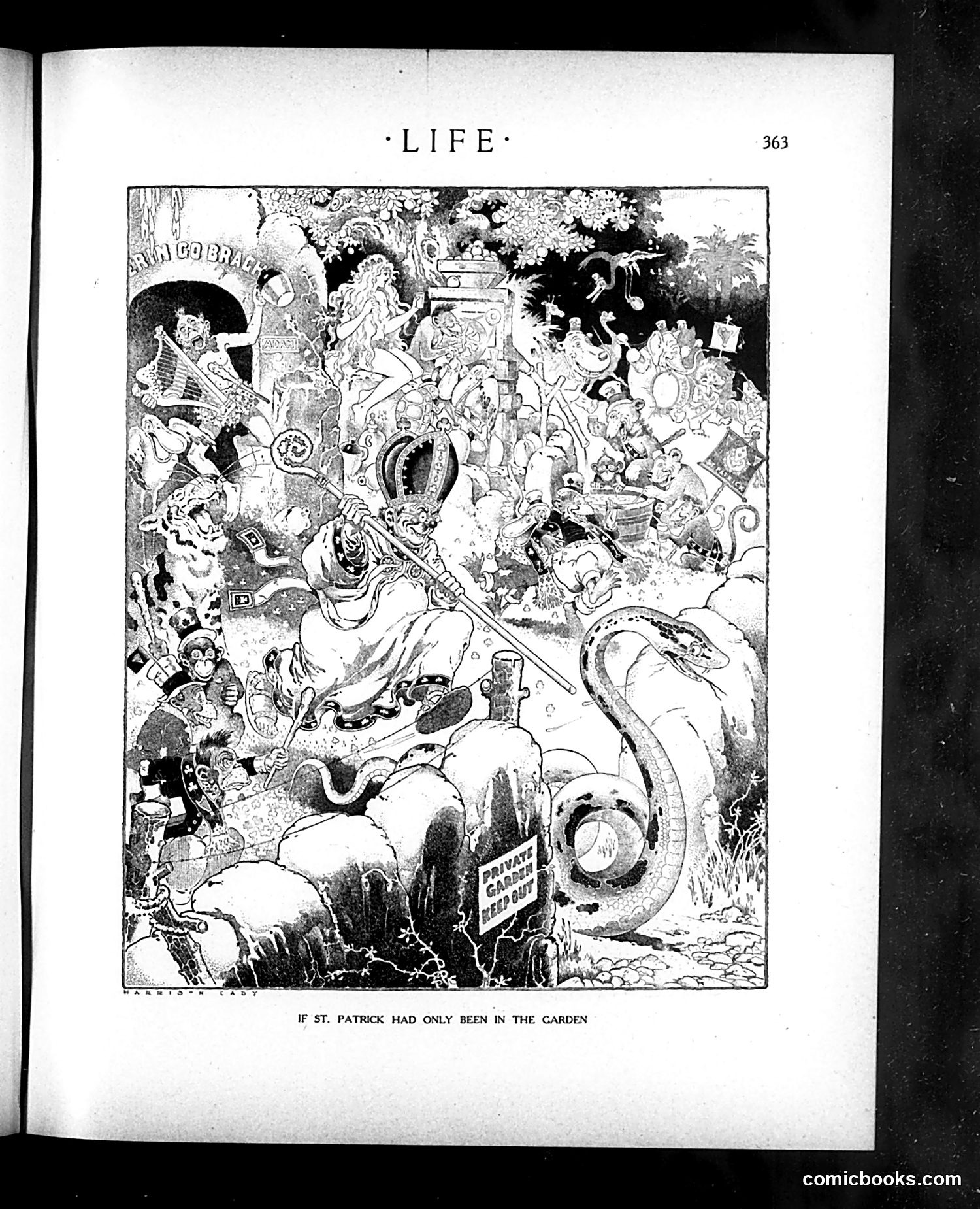
This is a satirical cartoon imagining an alternate history where Saint Patrick remained in a garden rather than going to Ireland to convert people and drive out snakes. The elaborate scene depicts a chaotic, densely-packed garden overrun with snakes, demons, and fantastical creatures - suggesting what Ireland might have become without Patrick's legendary missionary work. The joke plays on the Irish cultural icon of St. Patrick, particularly relevant around St. Patrick's Day. The satire mocks both the historical mythology surrounding Patrick and perhaps contemporary Irish-American celebration culture. The intricate, crowded composition humorously exaggerates the consequences of Patrick's absence, treating legendary religious history as comedic counterfactual.
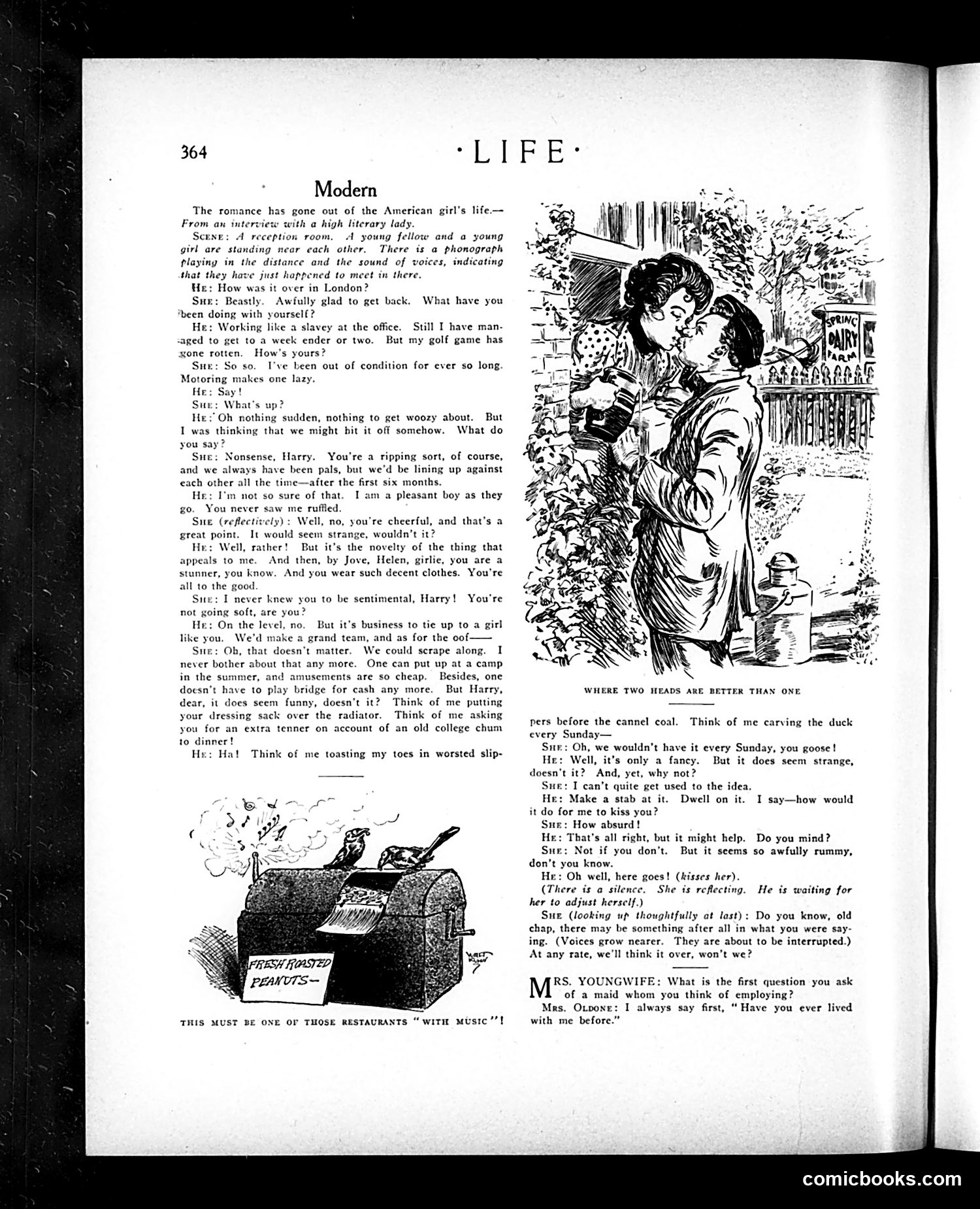
This page presents a satirical dialogue between a husband and wife discussing their mundane married life. The humor targets the gap between romantic expectations and reality: she mentions London trips and golf games; he admits to working "like a slave" at the office. The satire mocks their attempts to maintain novelty—she suggests carving a duck every Sunday, he proposes kissing—yet both recognize these gestures feel forced and artificial. The conversation culminates with him kissing her, but the stage direction notes she's "reflecting" rather than engaged, suggesting emotional distance beneath surface affection. The accompanying illustrations—a couple on a porch and a roasted peanuts vendor—humorously underscore the mundane, disconnected nature of modern marriage and courtship.
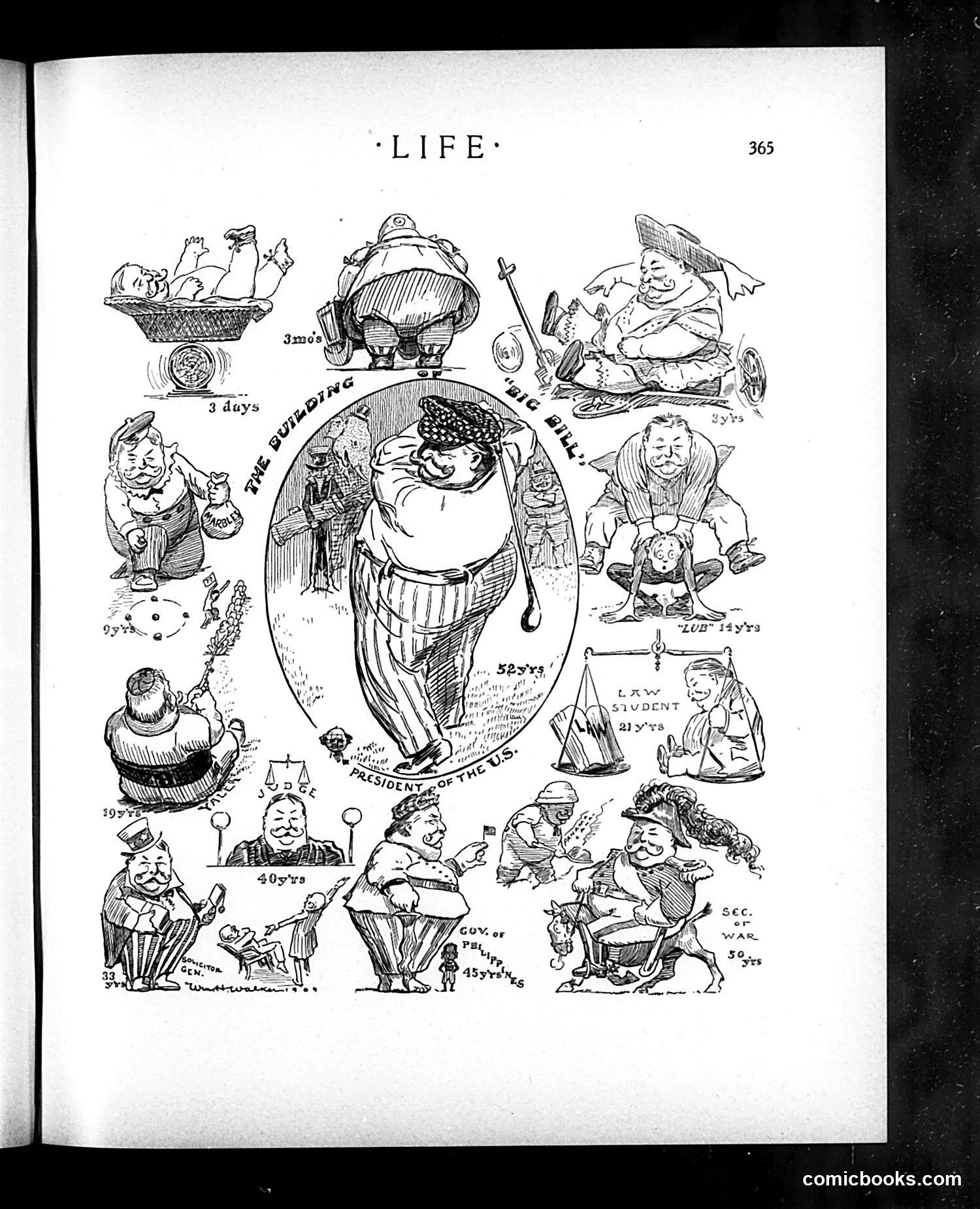
This is a life-cycle satire titled "The Budding Bill," showing the progression of a central character from infancy through old age. The figure appears to represent a political or public figure—likely a U.S. President based on text reading "PRESIDENT OF THE U.S." in the center. Surrounding the main character are vignettes labeled with ages (3 days, 3 yrs, 10 yrs, etc.) depicting typical life stages. The satire satirizes political ambition and career progression, showing how a person develops from childhood through various roles (Judge, Law Student, Governor, Secretary of War) toward ultimate power. The cartoon mocks the trajectory of political advancement and the compromises or character changes that accompany such ambition.
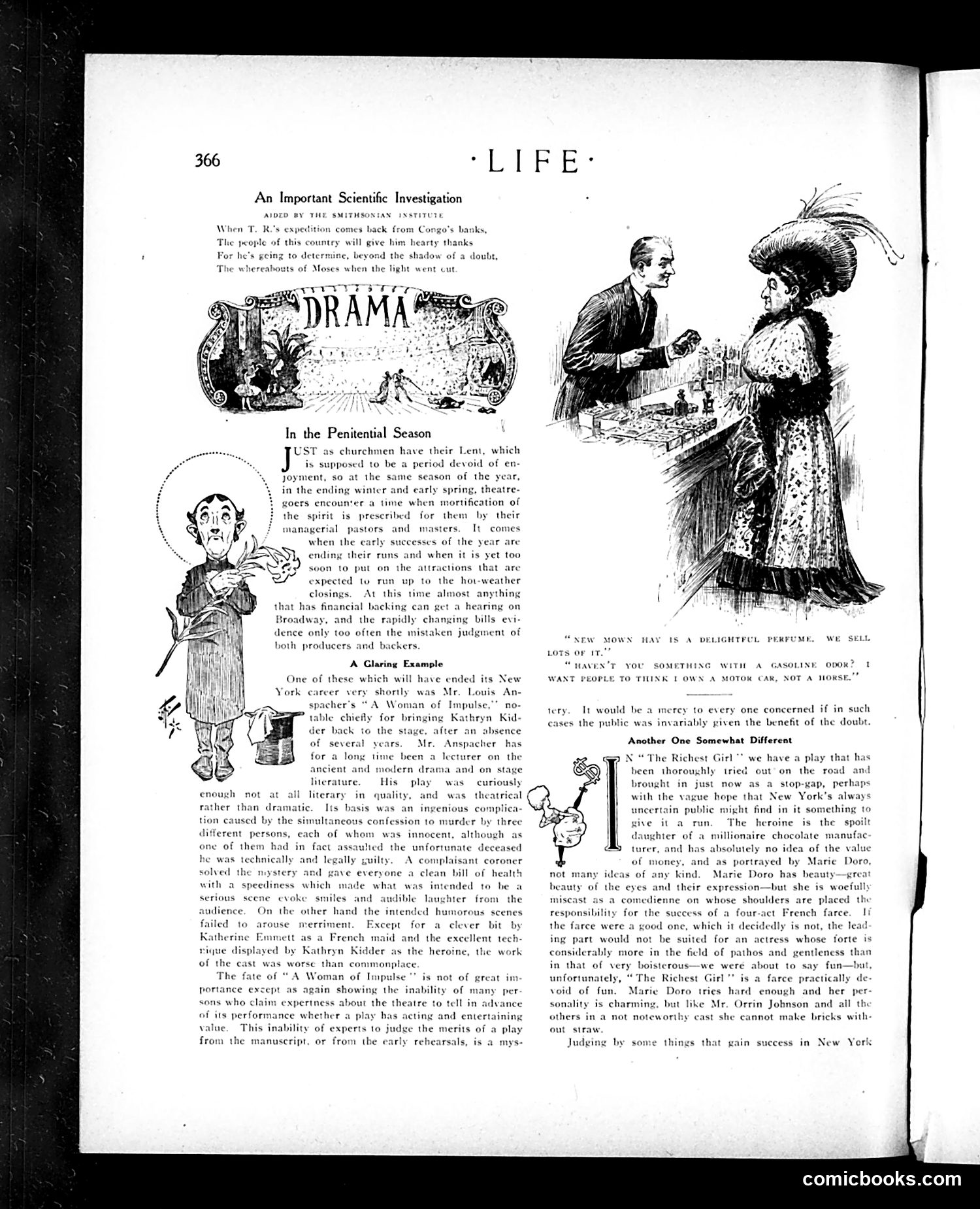
This page contains two theatrical reviews with satirical commentary on Broadway productions during the "Penitential Season" (early spring, when quality shows have closed and producers fill time with weaker offerings). **The top cartoon** references Theodore Roosevelt's African expedition, joking that upon his return, he'll definitively answer where Moses was "when the light went out"—mocking both T.R.'s presumed expertise and contemporary debates about religious/scientific authority. **The reviews critique two plays:** Louis Anspacher's "A Woman of Impulse" (poorly written despite literary pretensions) and "The Richest Girl" (a French farce miscast with actress Marie Doro, beautiful but unsuited to comedy). **The satire's point:** The page mocks both theatrical producers who misjudge plays' merit and critics/experts who cannot predict which manuscripts will succeed. The "Penitential Season" framing suggests theatergoers endure mediocre productions as spiritual mortification. **The gasoline/perfume joke** (right margin) satirizes nouveau-riche affectation—wanting to appear wealthy by owning a motor car rather than a horse.
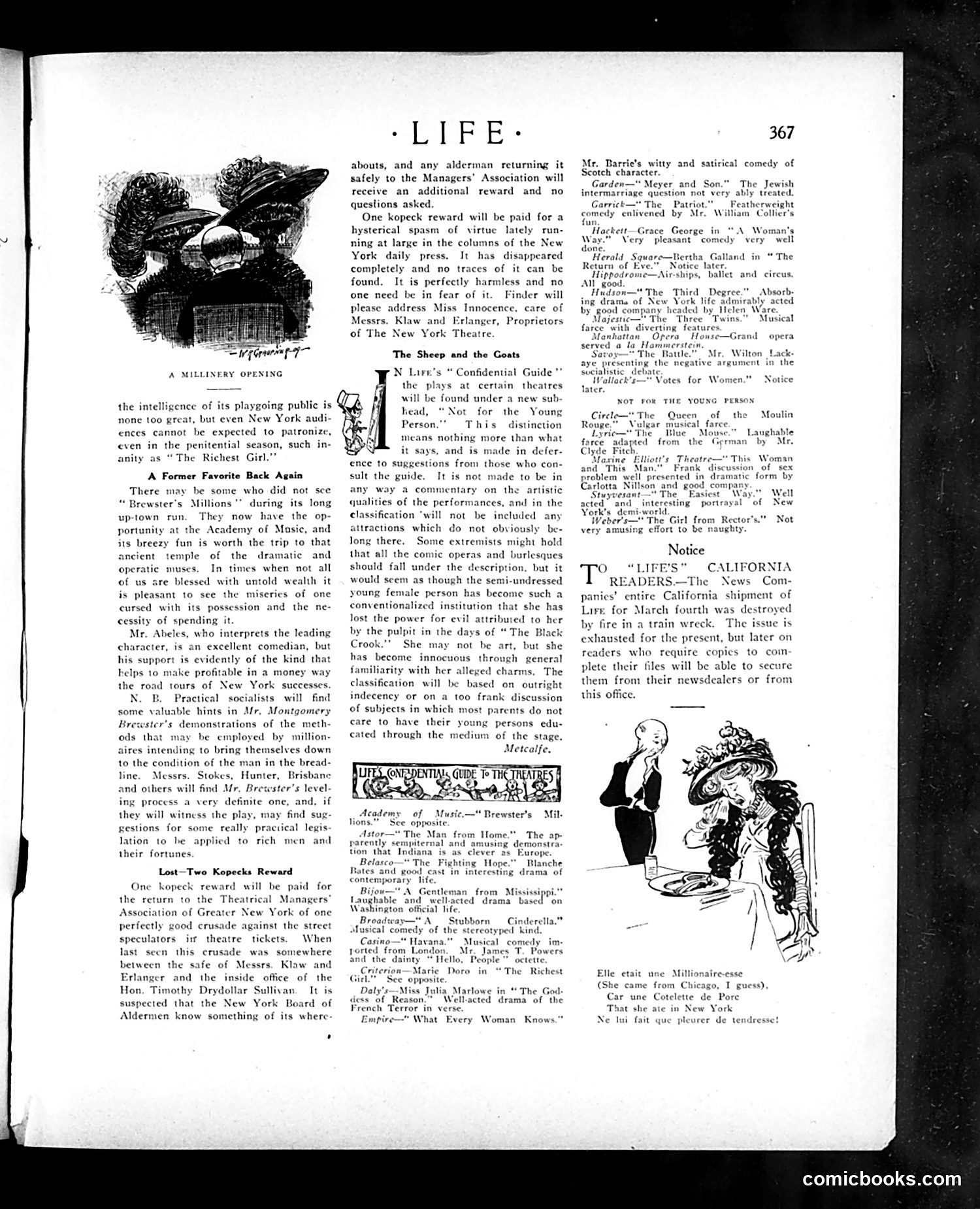
This page of *Life* magazine (undated, early 20th century) contains theatrical reviews and satirical commentary on New York theater: **"A Millinery Opening"** (left): A sketch mocking frivolous theater-goers, depicting a woman in an oversized hat—satirizing both pretentious audiences and the fashion excesses of the era. **"Lost—Two Kopecks Reward"**: A biting satirical "notice" mocking corrupt theater moguls and aldermen. References to "kopecks" (Russian currency) invoke contemporary Progressive-era concerns about graft. The piece sarcastically offers rewards for a missing "crook" (theft mechanism) and vanished "virtue" in the press—implying collusion between theater owners Klaw & Erlanger, corrupt politicians like "Timothy Drydollar Sullivan" (likely Tammany Hall-connected), and a complicit media that ignores theater-ticket scalping. **"The Sheep and the Goats"**: Commentary on *Life*'s theatrical guide censoring "indecent" plays, dismissing moral panic about semi-nude performers as outdated prudishness. The overall tone critiques theatrical corruption, political graft, and hypocritical moralizing.
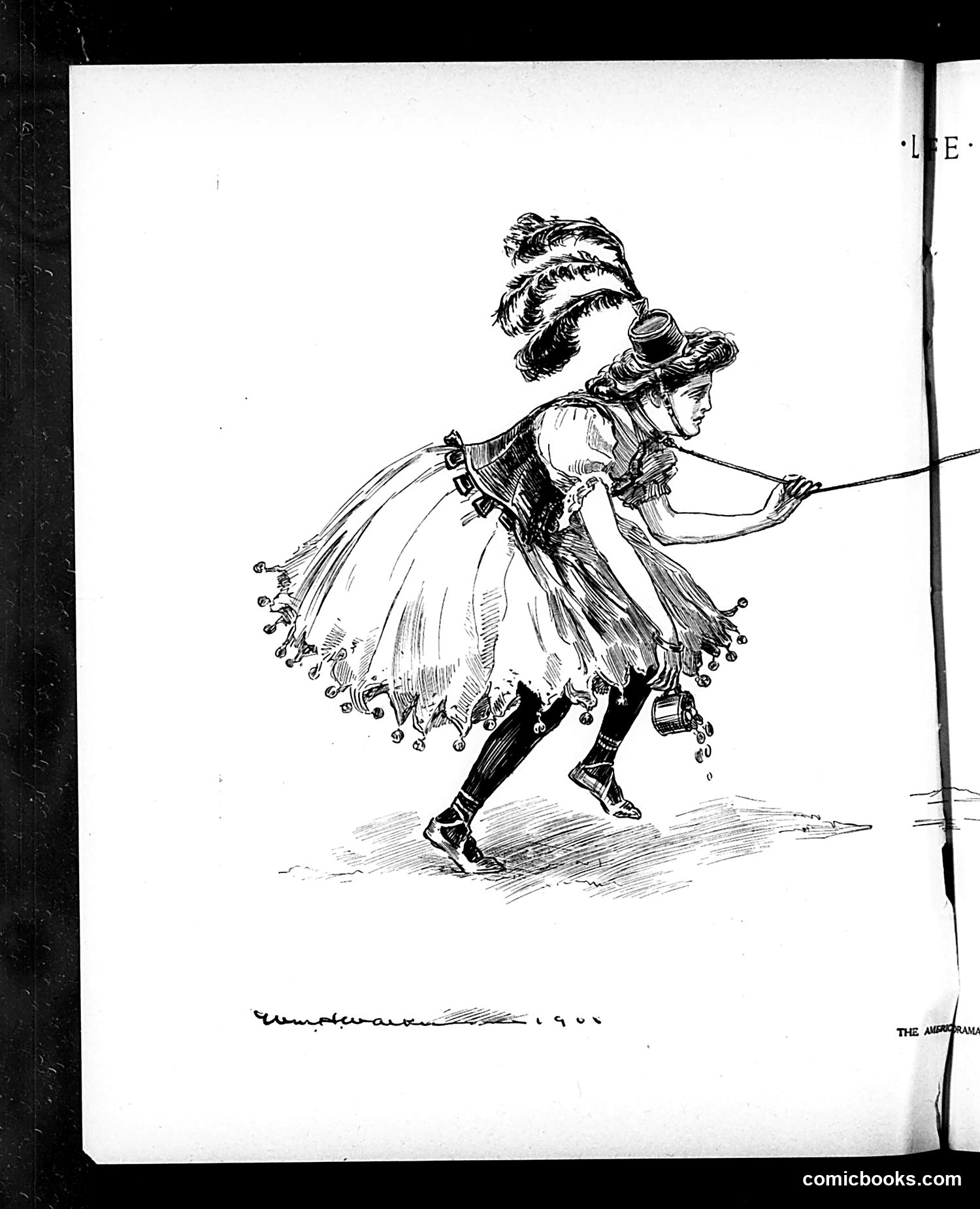
This is a satirical illustration from Life magazine (appears to be early 1900s based on style). The figure depicts a woman in elaborate theatrical costume—a voluminous, ornate dress with decorative bells or spheres at the hem, feathered hat, and dramatic pose holding a conductor's baton or similar prop. The satire likely mocks either: - A specific theatrical performer or production popular at the time - Women's fashion excess of the era - The artificiality or pretension of high society or performance culture The exaggerated costume details—particularly the ridiculous hem decoration and towering headdress—suggest ridicule of contemporary fashion excess or theatrical absurdity. The artist's signature appears at bottom, though it's not clearly legible in this reproduction. Without additional context from the magazine's text, the specific target remains unclear.
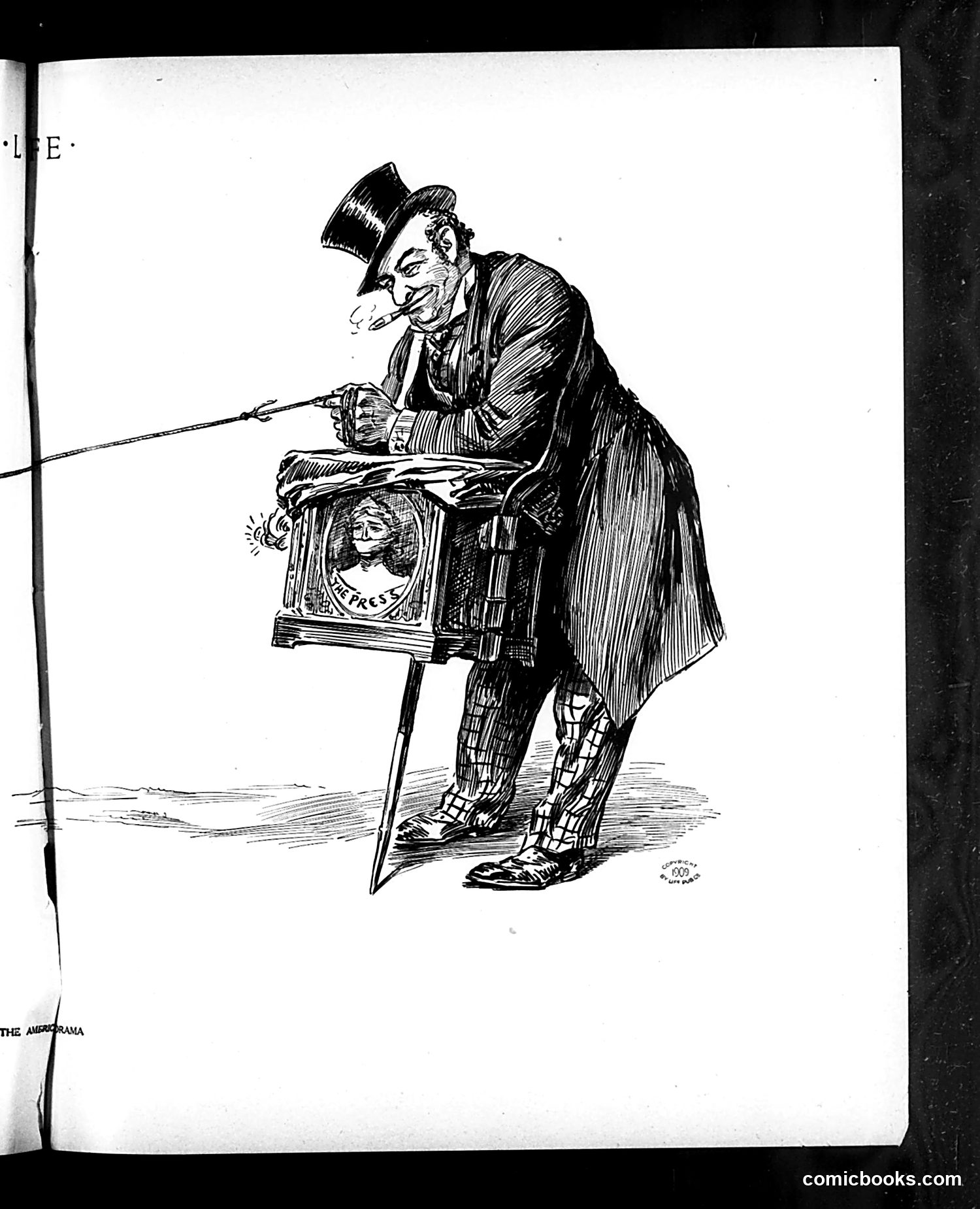
This is a political cartoon from *Life* magazine depicting a caricatured figure operating what appears to be a "Press" machine—a printing press or media apparatus. The figure wears a top hat and formal attire, with exaggerated facial features typical of period caricature. He's wielding a rod or stick to manipulate the press, which shows a face inside its mechanism, suggesting control of media output or public opinion. The satire likely critiques media manipulation or propagandistic control of the press by a specific political figure or entity, though without additional context or visible dates, the specific target remains unclear. The cartoon's message appears to be about the power to shape public discourse through media control.
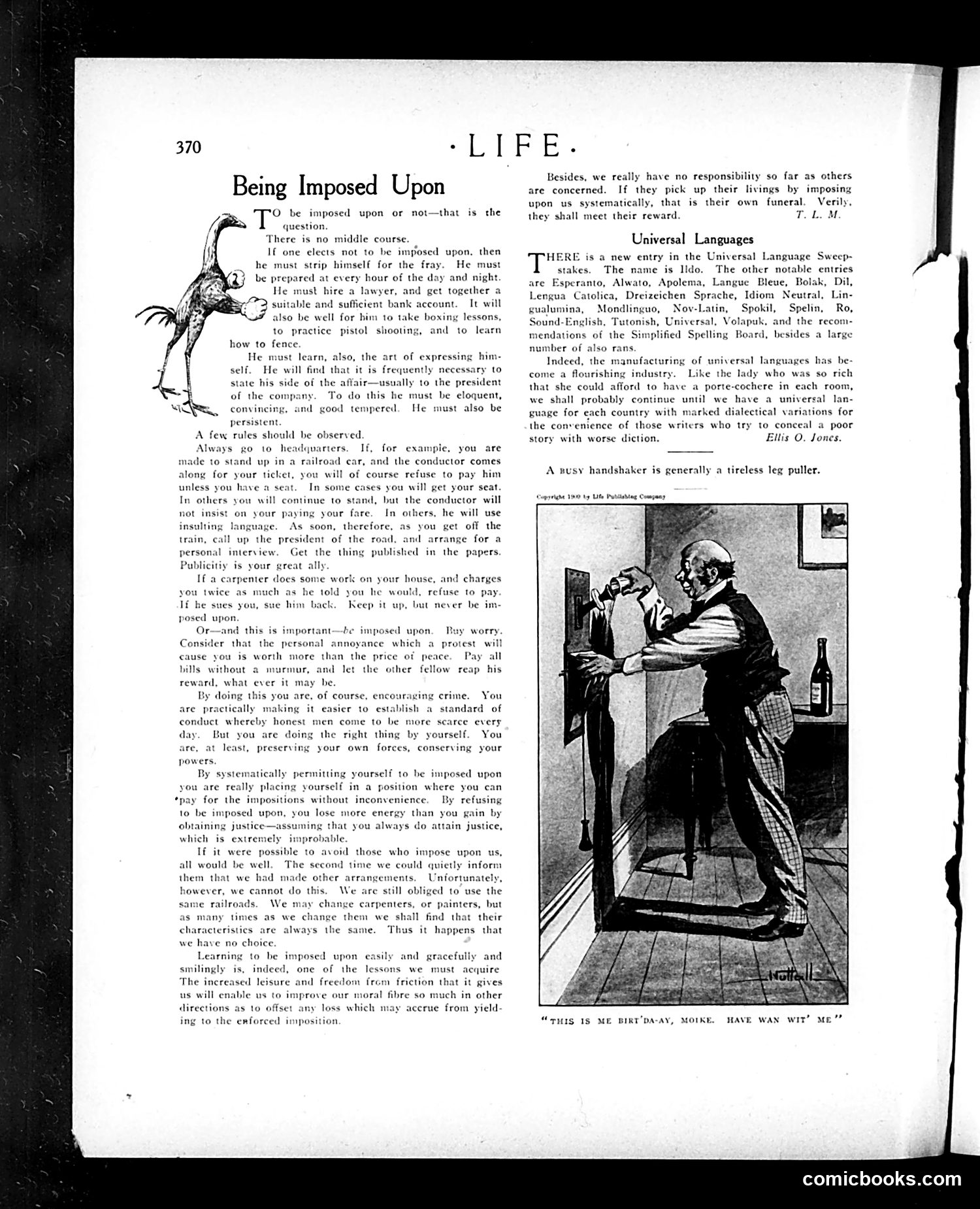
This satirical essay mocks the futility of fighting everyday exploitation. The author presents two opposing philosophies: aggressively resisting every imposition (requiring lawyers, boxing lessons, pistol practice) versus passively accepting it. The joke is that *both* approaches are exhausting and ultimately pointless. The advice parodies advice-column earnestness—suggesting readers call railroad presidents over seat disputes or sue carpenters back. These absurd escalations mock how Americans obsess over minor slights. The real satire: accepting impositions gracefully actually makes life easier, even though it encourages further abuse. The accompanying cartoon (caption: "THIS IS ME BRO'DAY, MOIKE. HAVE WAN WIT' ME") appears to show working-class figures, likely reinforcing that common people routinely get cheated by conductors, carpenters, and service providers—situations too trivial to fight but too frequent to ignore. The piece argues resignation, not justice, is practical wisdom.
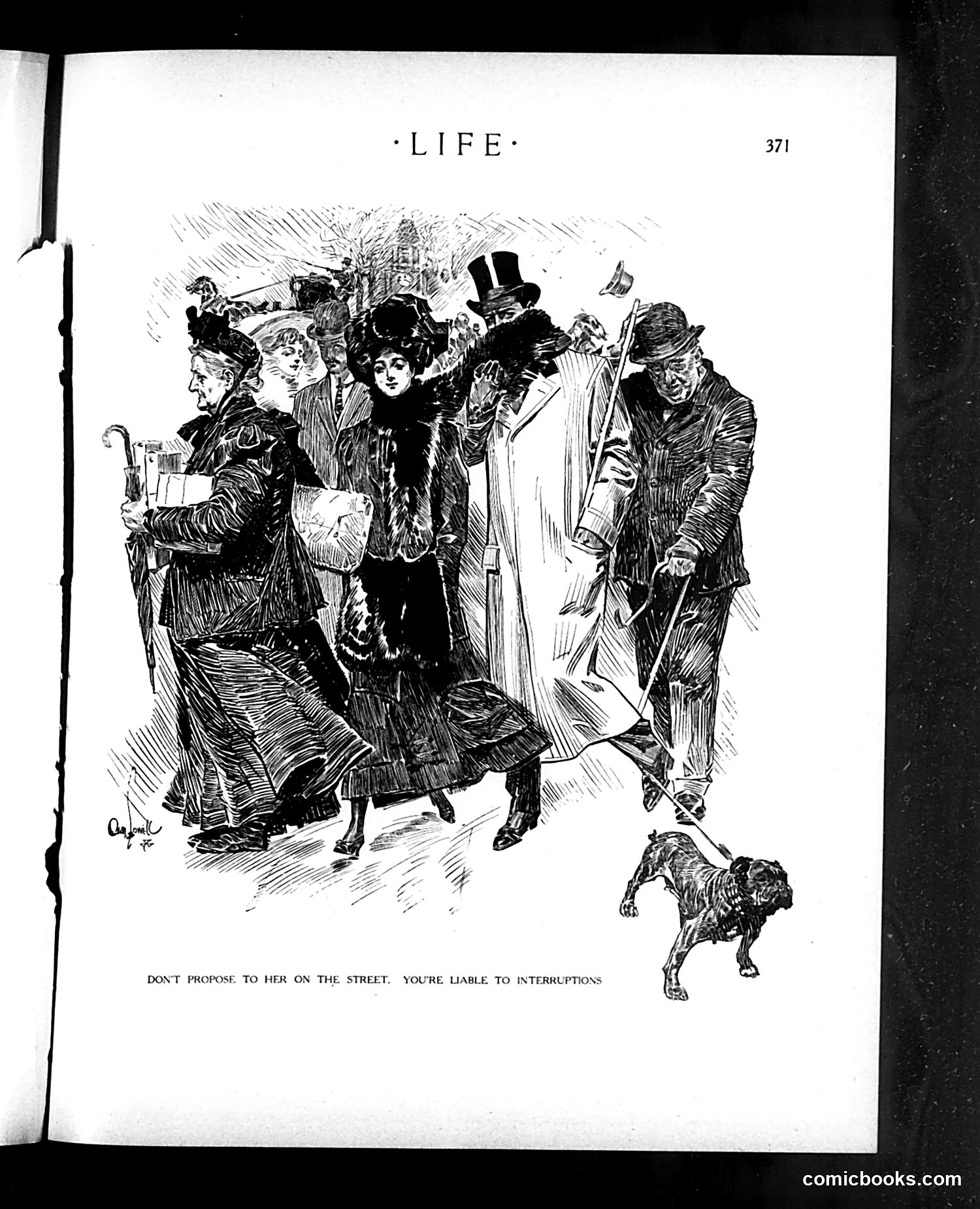
This is a satirical cartoon about romantic proposals in public spaces. The image shows a well-dressed man attempting to propose to a woman on the street, but they're surrounded by various interruptions: well-dressed pedestrians, a dog tugging at the scene, and what appears to be a street setting with buildings in the background. The joke is literal and practical rather than political: the caption warns men against proposing marriage on public streets because they'll face constant interruptions from passersby, dogs, and general street chaos. It's social satire about courtship etiquette and the impracticality of intimate romantic moments in crowded urban spaces. This reflects early 20th-century concerns about proper behavior and the challenges of city life.
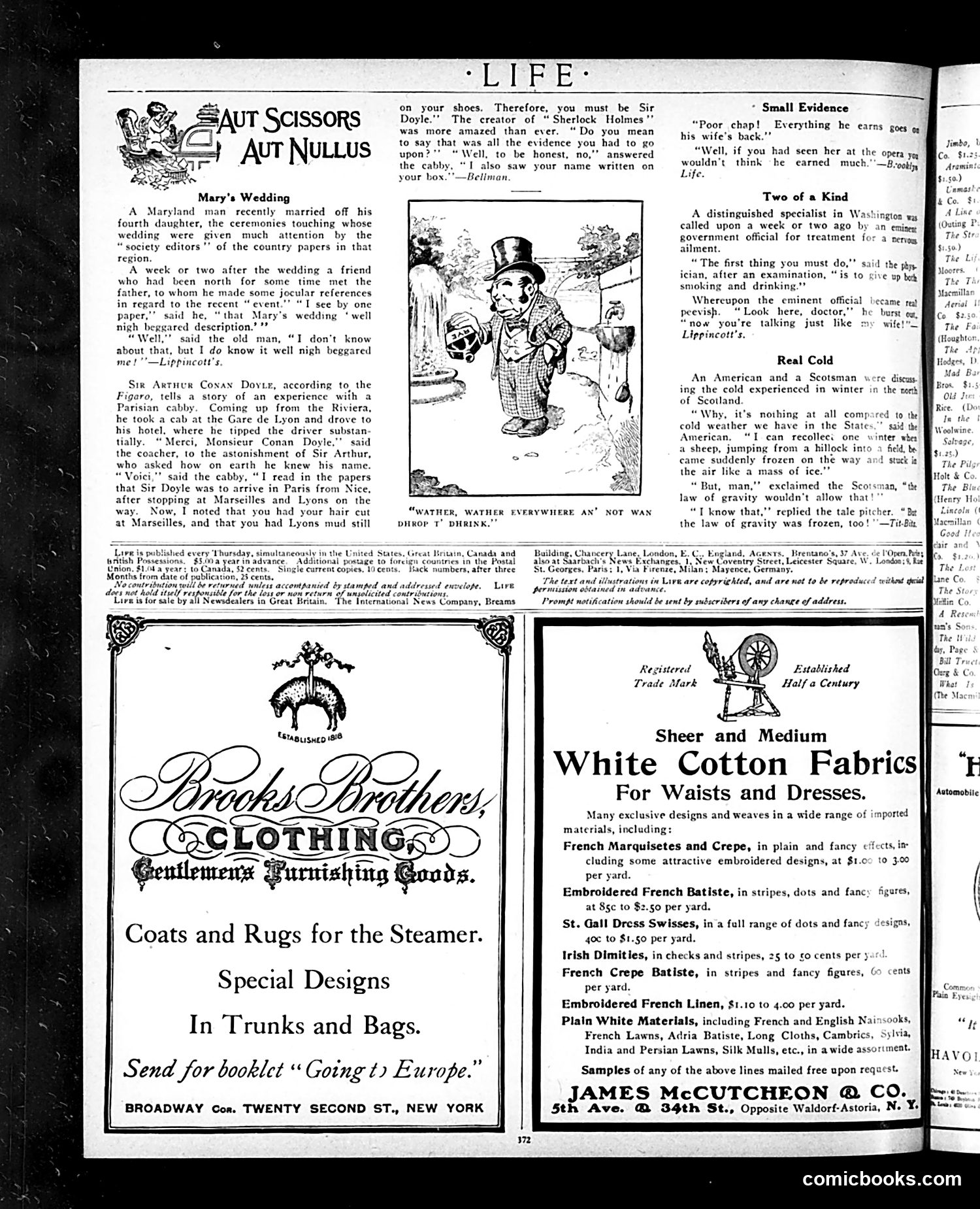
This page contains several brief humorous anecdotes and advertisements, typical of Life magazine's satirical format. **Main Cartoons/Stories:** 1. **"Mary's Wedding"** — A joke about a Maryland father whose fourth daughter's wedding costs him so much money it nearly bankrupts him. The humor lies in the contrast between the society press's flowery coverage ("well nigh beggared description") and the father's grim financial reality. 2. **"Sir Arthur Conan Doyle"** — A Parisian cab driver recognizes the famous author by deducing details from newspaper reports about his travels. The satire pokes fun at both Doyle's celebrity and cabby's supposed deductive abilities. 3. **"Two of a Kind"** — A Washington official visits a doctor who advises quitting smoking and drinking; the official resents receiving moral lectures from a medical professional. 4. **"Real Cold"** — An American and Scotsman compete over who experienced harsher winters, with absurd exaggeration. The American's tall tale about a frozen sheep is undercut by the Scot's logical retort about gravity. The page is primarily **advertising** (Brooks Brothers clothing, James McCutcheon fabrics).
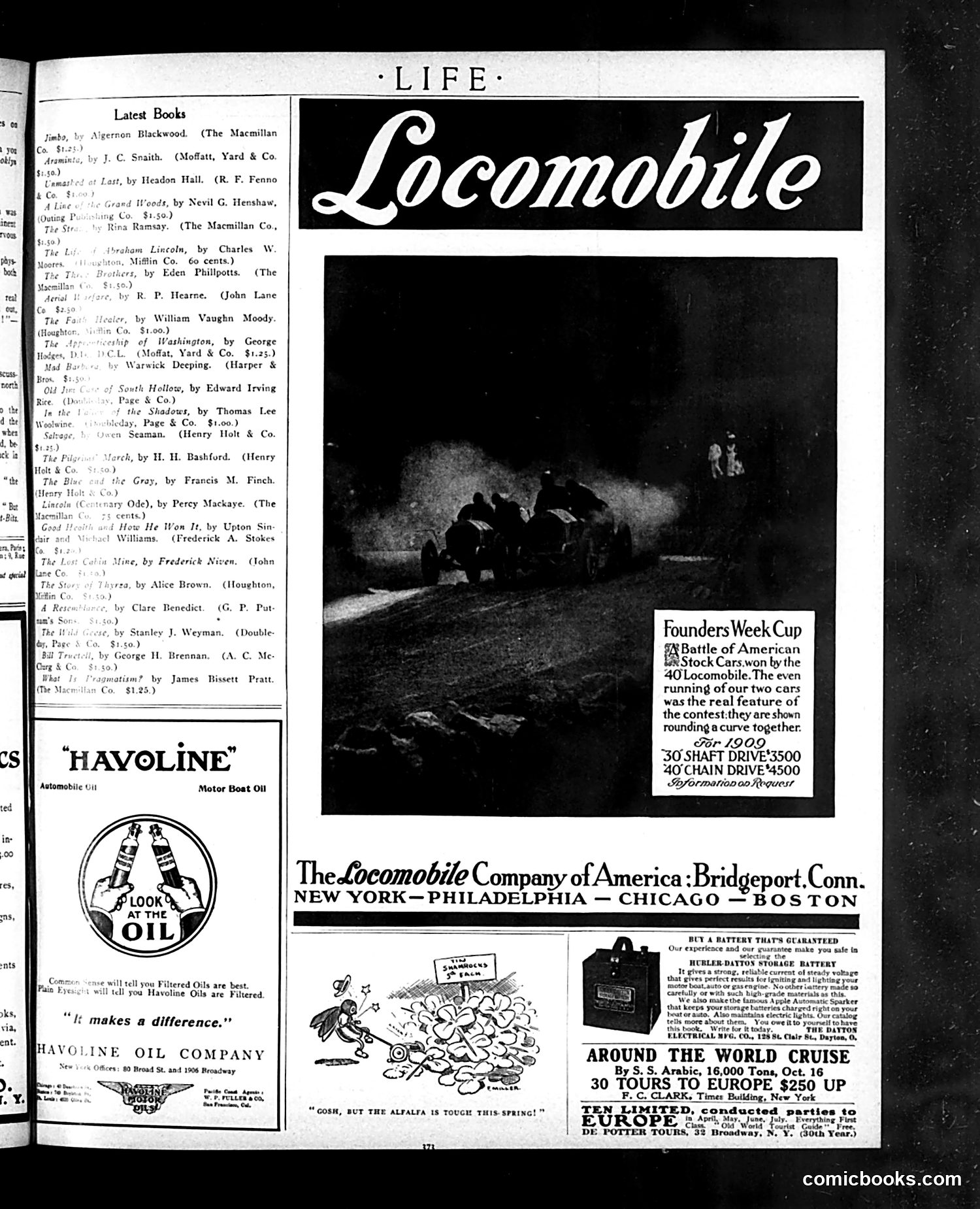
This page is primarily **advertising**, not satire or political commentary. The dominant content features: **Main Advertisement: Locomobile automobiles** — The large central image shows a racing scene from the "Founders Week Cup," a competition between American stock cars won by a Locomobile. The caption notes that two Locomobiles rounding a curve together was "the real feature of the contest," suggesting this was a notable automotive achievement worth marketing. **Supporting Ads:** - Havoline Motor Oil (emphasizing filtered oils) - Hubler-Datton Storage Battery - Various travel/cruise advertisements (S.S. Arabic world cruise, European tours) - A humorous small cartoon about tough alfalfa (captioned "Gosh, but the alfalfa is tough this spring!") The left column lists **newly published books** from various publishers. There is **no political cartoon or satire** on this page—it's a straightforward commercial publication page typical of early 20th-century Life magazine's business model.
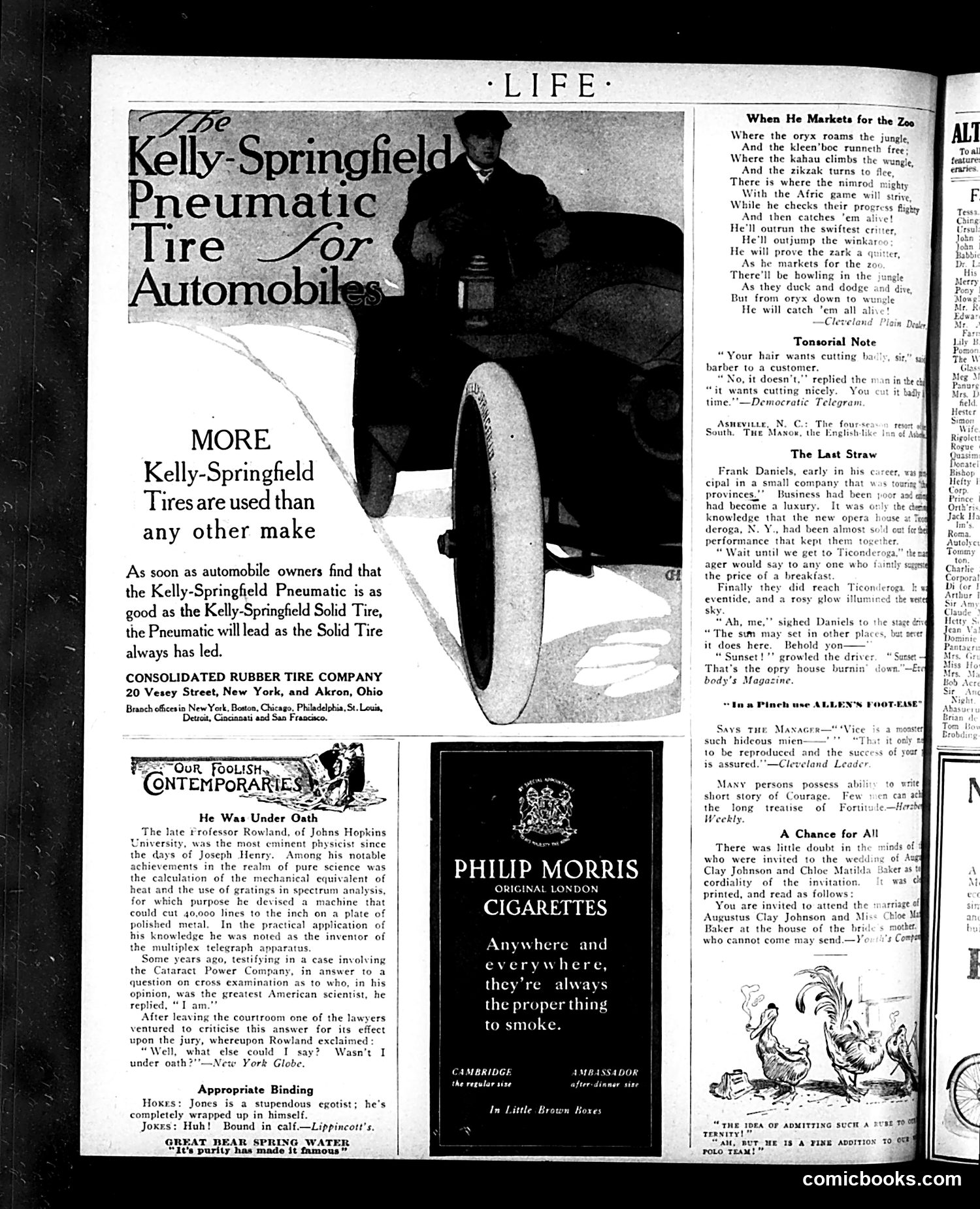
This page is primarily **advertising and miscellaneous content** rather than political satire. The dominant features are: **Advertisements:** Kelly-Springfield pneumatic tires (claiming superiority over competitors), Philip Morris cigarettes, and Great Bear Spring Water occupy significant space with standard commercial messaging. **Humor columns** appear under "Our Foolish Contemporaries," including anecdotes about Professor Rowland (a Johns Hopkins physicist) who, when asked under oath who was America's greatest scientist, answered "I am"—the joke being his honest egotism versus expected modesty. A second brief joke plays on the word "binding" (in book terms vs. egotistical). **Literary/verse content** includes poems like "When He Markets for the Zoo" (whimsical animal verse) and short satirical pieces about barbershop dialogue and romantic situations. The page reflects early 20th-century *Life* magazine's mix of commercial sponsorship and light social humor—not political commentary but rather gentle mockery of contemporary manners and vanity.
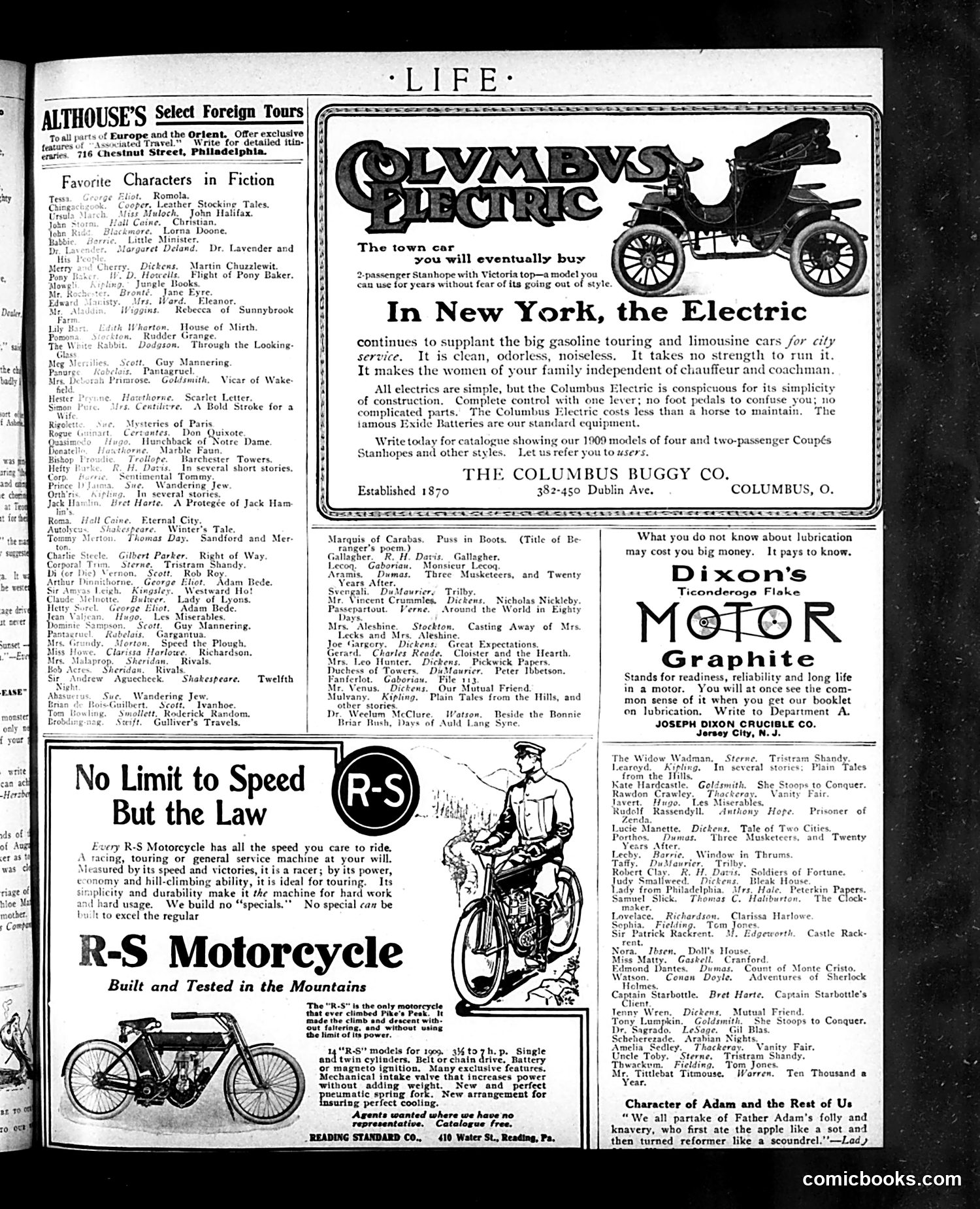
This page is primarily **advertising**, not political satire or editorial cartooning. The main content includes: 1. **"Favorite Characters in Fiction"** — a literary reference list naming protagonists from classic novels (Jane Eyre, Don Quixote, etc.), likely for cultural education or entertainment. 2. **Three product advertisements** for early automobiles and motorcycles: - **Olympus Electric** cars (marketed to women as independent from chauffeurs) - **Dixon's Motor Graphite** lubricant - **R-S Motorcycle** (emphasizing speed and mountain-testing) These ads reflect early 1900s technology and social attitudes—particularly the Columbus Buggy Company's pitch that electric cars liberate women from relying on drivers, a notable claim for the era. There is **no political cartoon or satire** visible here. The page represents typical Life magazine content: cultural reference material and advertisements targeting affluent readers interested in new automotive technology.
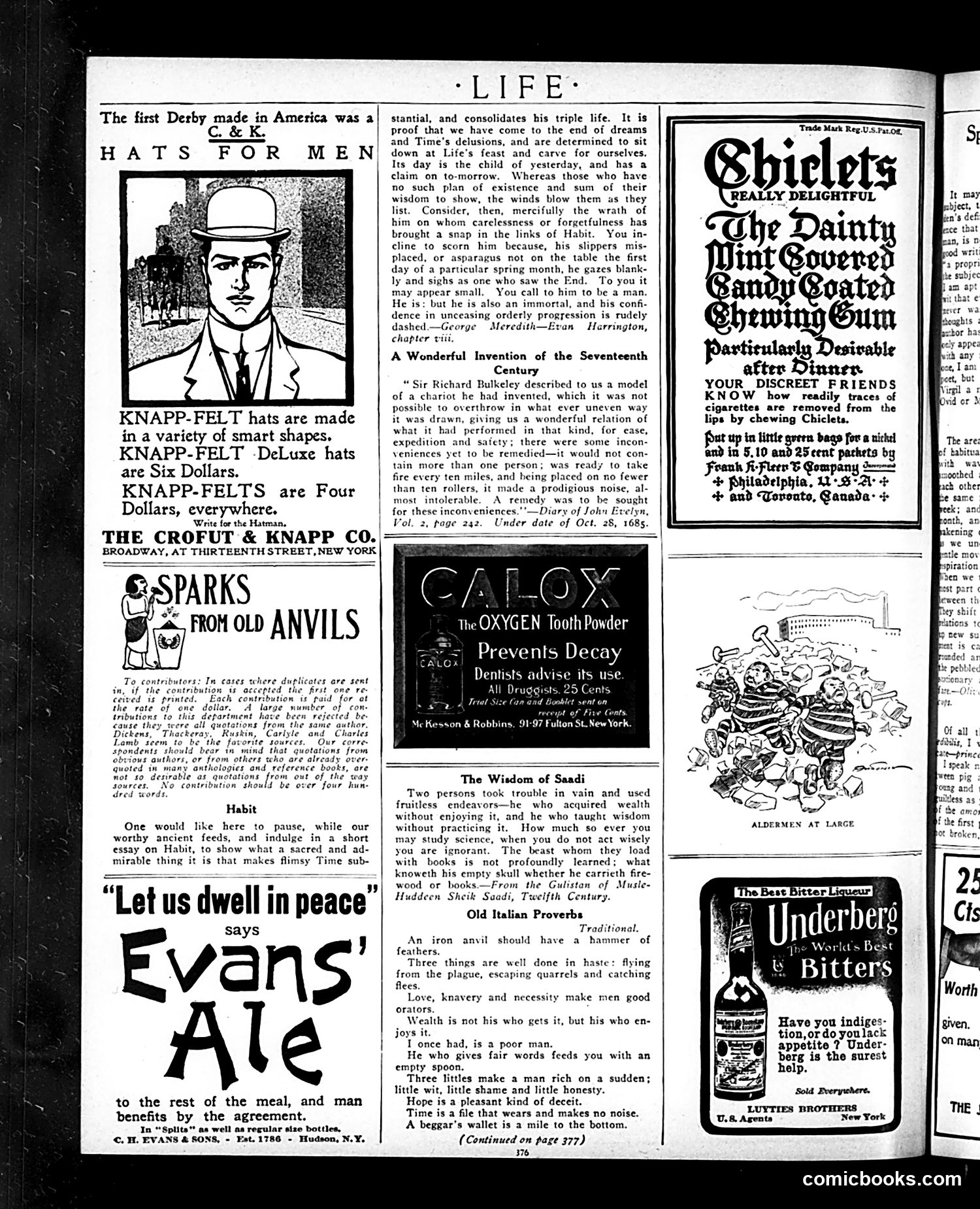
This page is primarily **advertising and filler content** rather than political satire. The main elements include: **Advertisements:** - Knapp-Felt hats for men (prominently featured with illustrated derby hat) - Evans' Ale ("Let us dwell in peace") - Calox Oxygen Tooth Powder - Underberg Bitters **Editorial Content:** The page includes philosophical and literary excerpts on habit (George Meredith), a 17th-century chariot invention (John Evelyn's diary), wisdom sayings from Saadi, and traditional Italian proverbs—typical of *Life* magazine's mix of humor, culture, and morality. **The Cartoon:** "Aldermen at Large" (bottom right) appears to be a satirical illustration, though details are unclear in this reproduction. It likely mocks local politicians or civic corruption, a common *Life* target. The page reflects early 20th-century magazine style: mixing advertising, classical quotations, and light social commentary—not focused political cartooning.
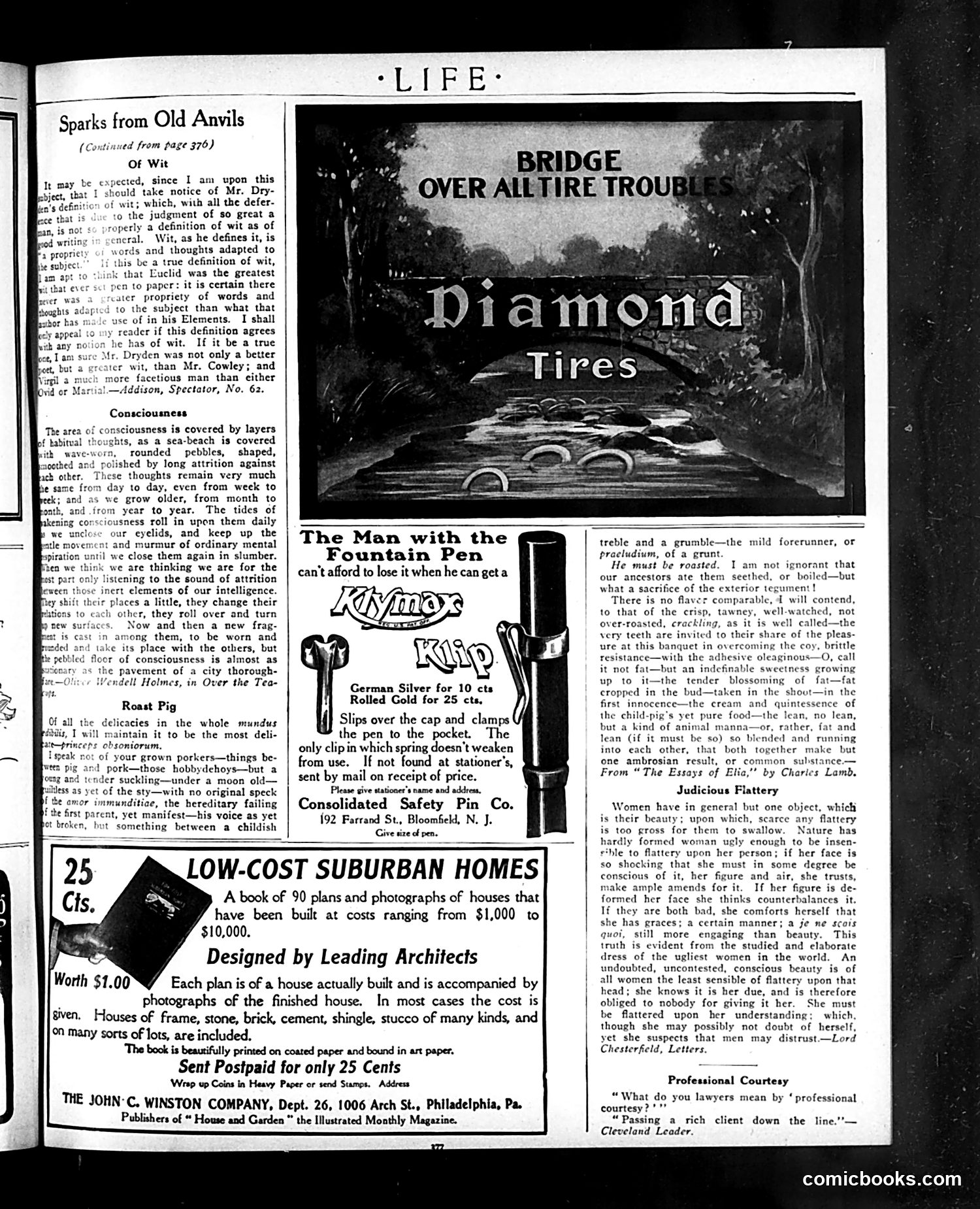
This page is primarily **advertising with literary excerpts**, not political satire. The main content includes: **Literary Pieces**: "Sparks from Old Anvils" excerpts classical writers (Addison, Holmes) debating wit and praising roast pig. "Judicious Flattery" discusses women's vanity—typical early 20th-century social commentary reflecting period attitudes toward women. **Advertisements**: Diamond Tires, Kinmax fountain pens, low-cost suburban home plans, and safety pins dominate the page visually. **The Cartoon**: "Bridge Over All Tire Trouble" (top) appears to be straightforward product advertising—no discernible political message, just a branded landscape image promoting Diamond Tires. **Historical Context**: This reflects *Life* magazine's mix of satirical writing and commercial advertising. The social commentary on women's susceptibility to flattery represents era-specific gender attitudes that modern readers would recognize as patronizing. No identifiable political figures or events are present on this page.
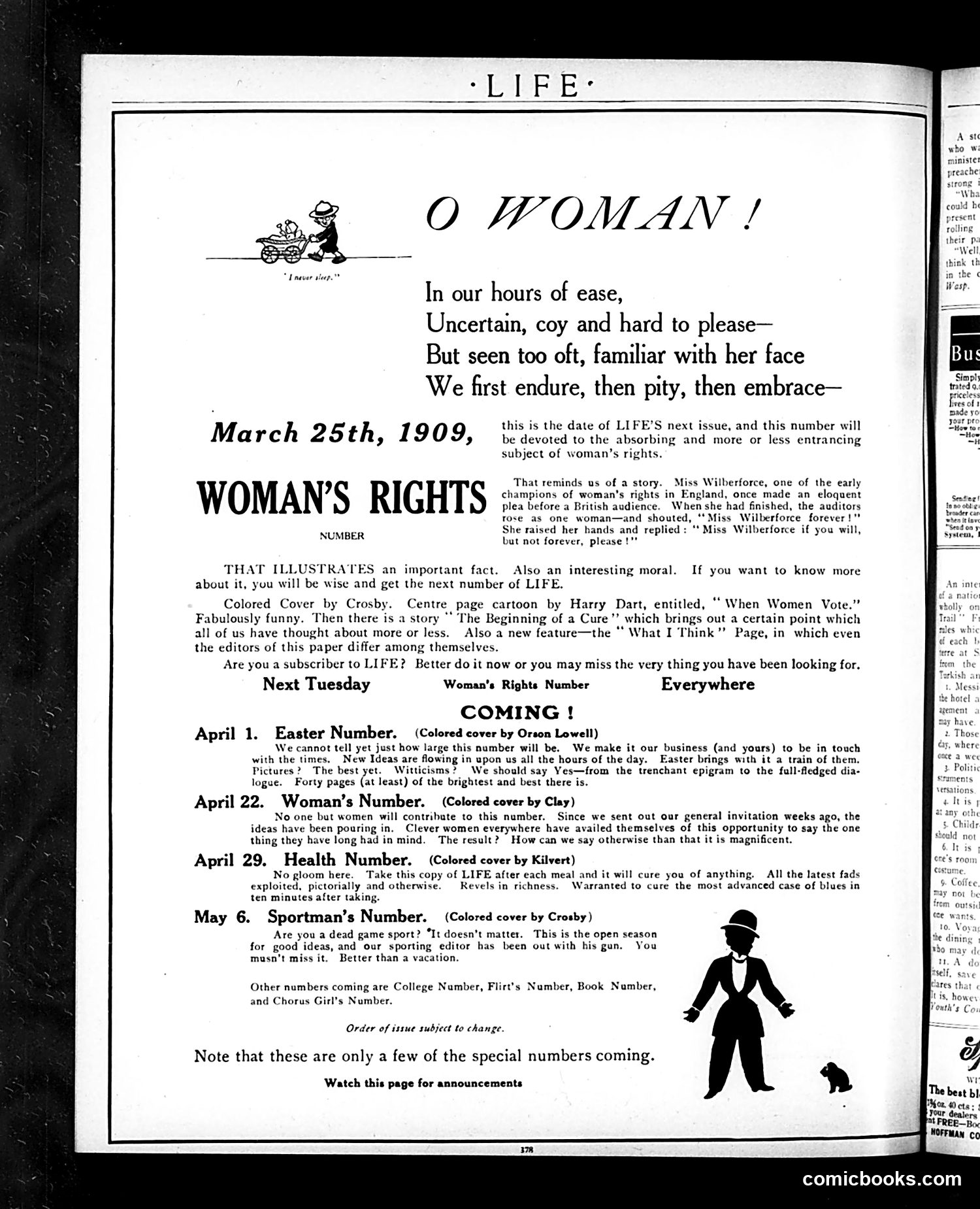
This page announces Life's upcoming "Woman's Rights Number" (March 25, 1909). The opening poem sarcastically characterizes women as "uncertain, coy and hard to please," expressing a dismissive male perspective on the opposite sex. The included anecdote about Miss Wilberforce—a real early women's rights advocate—illustrates the magazine's satirical approach: when audiences cheered "Miss Wilberforce forever!" after her speech, she corrected them to "Miss Wilberforce if you will, but not forever, please!" The joke relies on mocking women's presumed vanity or inconsistency. The page promotes upcoming special issues with tongue-in-cheek descriptions. A cartoon by Harry Dart titled "When Women Vote" is mentioned, suggesting the upcoming number will satirize women's suffrage—a hotly debated issue in 1909. This reflects Life's position as a satirical magazine that treated women's rights movements with mockery rather than support, typical of mainstream American periodicals during the suffrage era.
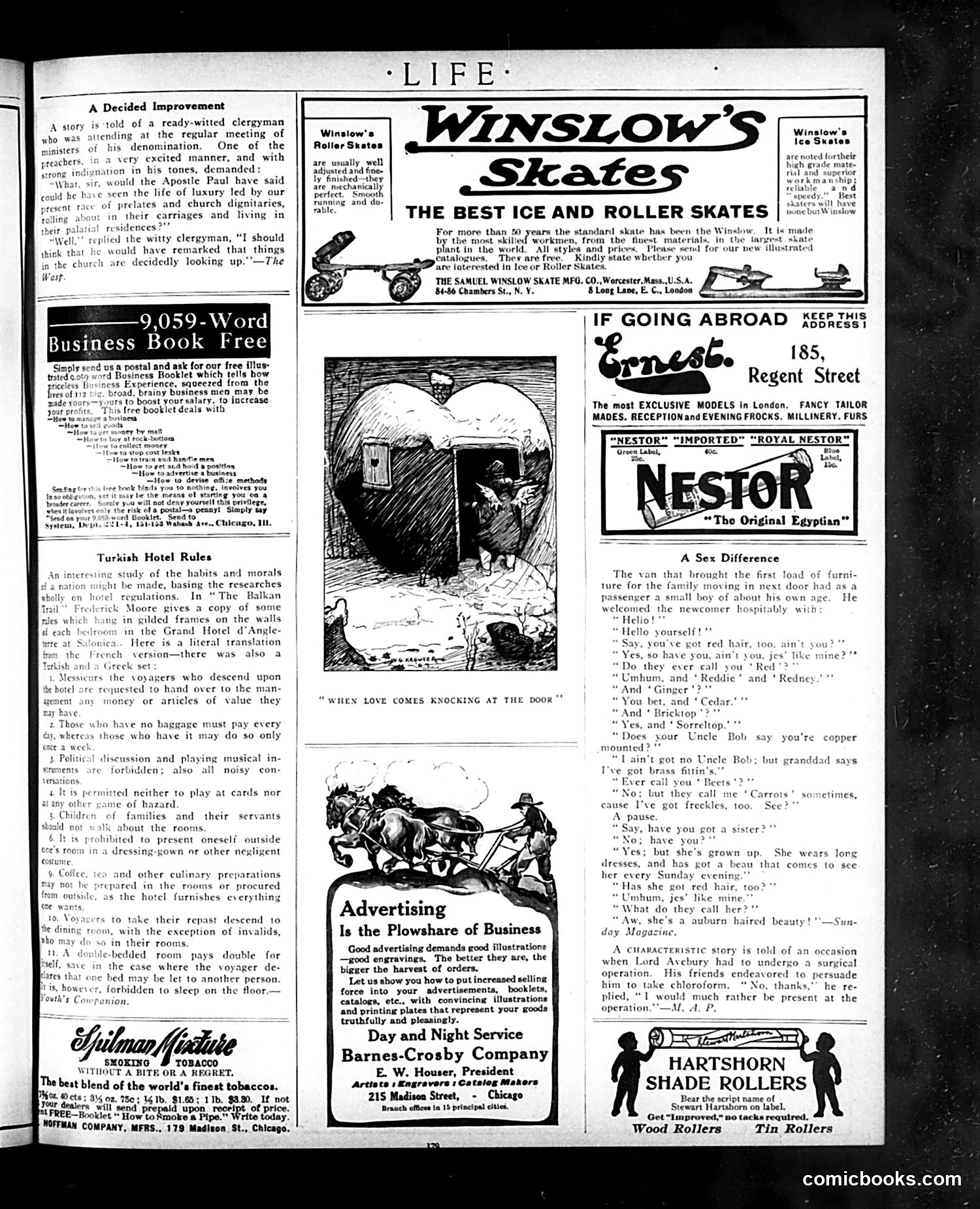
This page contains primarily **advertising and humor columns** rather than political cartoons. The main satirical content is "A Sex Difference," a dialogue between two red-haired boys who have just met. The joke hinges on period-appropriate **gender expectations**: when one boy mentions his sister, the other asks if she's pretty—reflecting early 20th-century assumptions that a girl's primary value lay in her appearance and marriageability, while boys bonded over practical details like hair color and family characteristics. The cartoon illustration "When Love Comes Knocking at the Door" depicts a couple embracing in a snowy doorway—sentimental Victorian romance imagery typical of Life's humor. The remainder consists of straightforward advertisements (Winslow's Skates, Nestor Egyptian cigarettes, Barnes-Crosby advertising services) and advice columns on Turkish hotel etiquette and business practices. No identifiable political figures or events appear on this page.
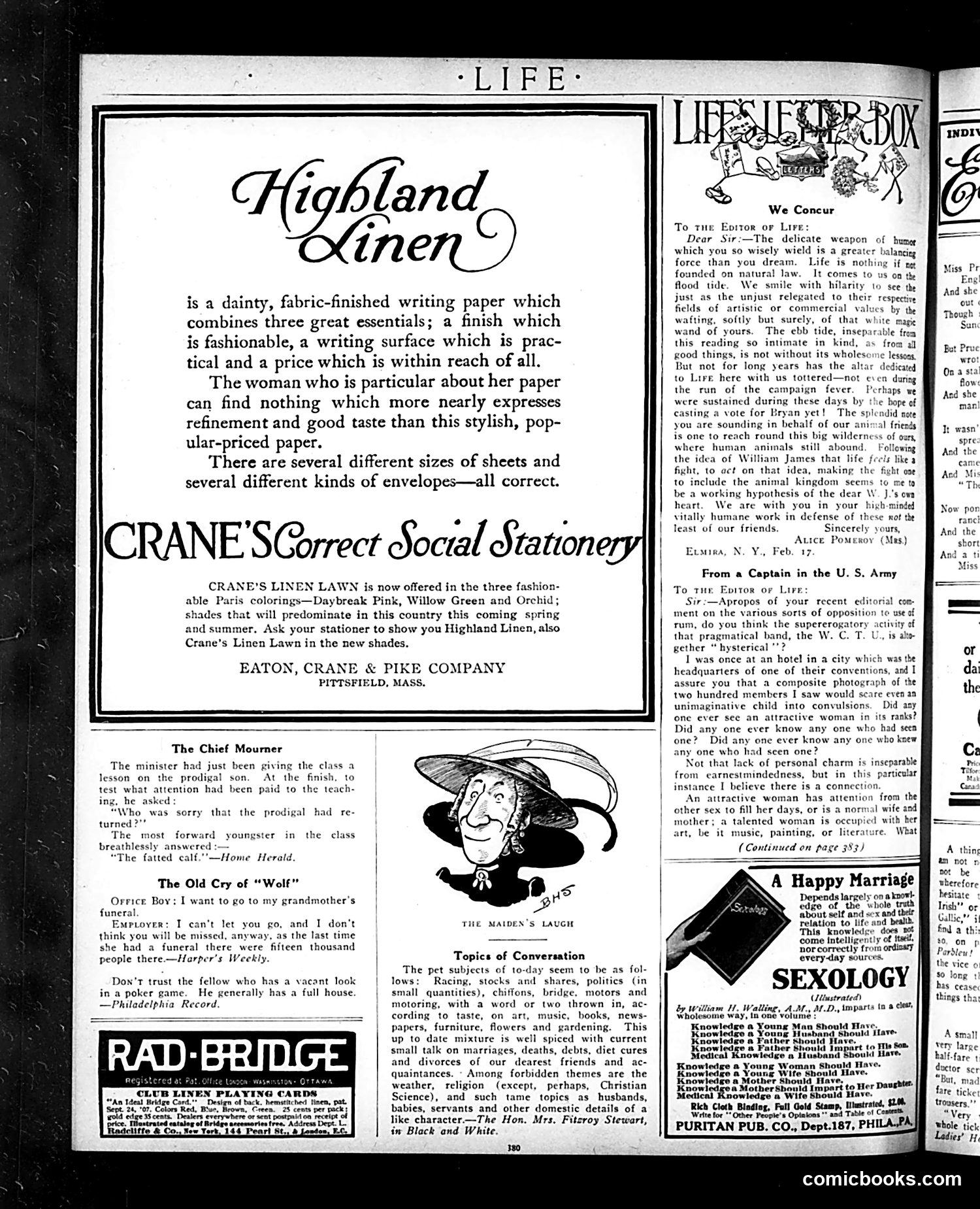
This page is primarily **advertising and humor content** rather than political commentary. The main elements are: **Highland Linen Advertisement**: A prominent stationery ad emphasizing that quality writing paper expresses "refinement and good taste" while remaining affordable—appealing to women concerned with proper social correspondence. **Three Short Humorous Anecdotes**: - "The Chief Mourner": A child misunderstands the parable of the Prodigal Son, thinking the fatted calf was sorry—innocent wordplay humor. - "The Old Cry of Wolf": Office humor about an employee using grandmother's funeral as a false excuse. - A poker joke about vacant-looking players. **"The Maiden's Laugh" Illustration**: A caricatured woman's face, likely mocking fashionable gossip topics. **"Topics of Conversation" Essay**: Lists acceptable parlor discussion (racing, bridge, motors) while condemning "tame" topics like weather, husbands, and babies as forbidden conversation subjects—reflecting early 1900s social class attitudes about what refined people discussed. The page reflects *Life*'s focus on upper-middle-class social etiquette and gentle satire of contemporary manners.
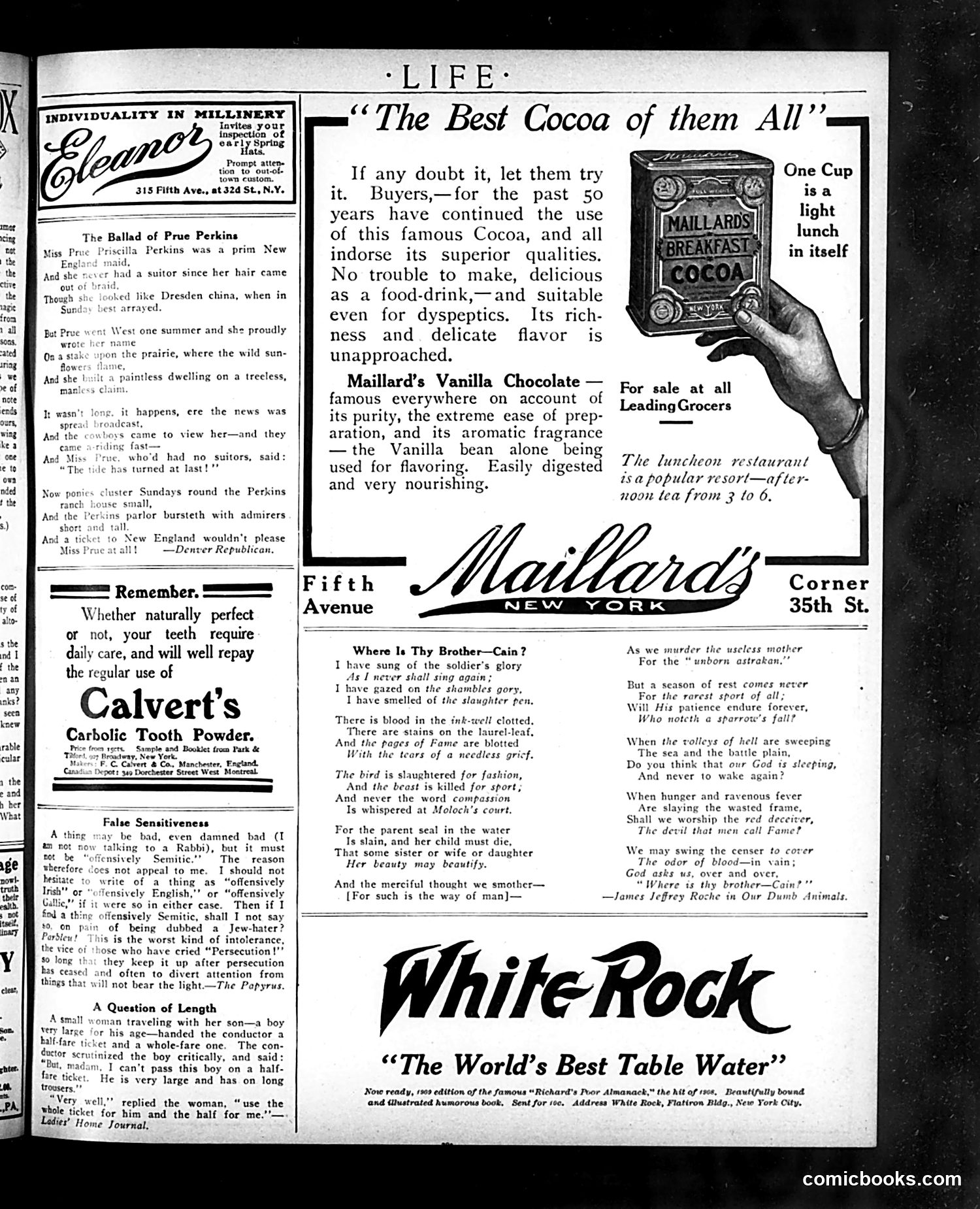
This page is primarily **advertisements and filler content** rather than political satire. The main elements are: **Advertisements:** Maillard's cocoa and chocolate, Calvert's tooth powder, and White Rock water dominate the page with product claims and testimonials. **Literary/Editorial Content:** - "The Ballad of Prue Perkins" appears to be a light verse piece about a prim New England woman who goes West and returns more socially successful - A poem titled "Where Is Thy Brother—Cain?" criticizes animal cruelty and fashion (seal fur, astrakhan coats) and questions divine patience with human violence - Several brief humorous anecdotes about "False Sensitiveness" and ticket-length disputes **Context:** Without identifying specific cartoons (none are clearly visible), this appears to be a typical early 20th-century Life issue mixing commercial advertisements with satirical or moralistic poetry and humor pieces. The animal cruelty poem suggests contemporary concern about fashion's environmental cost.
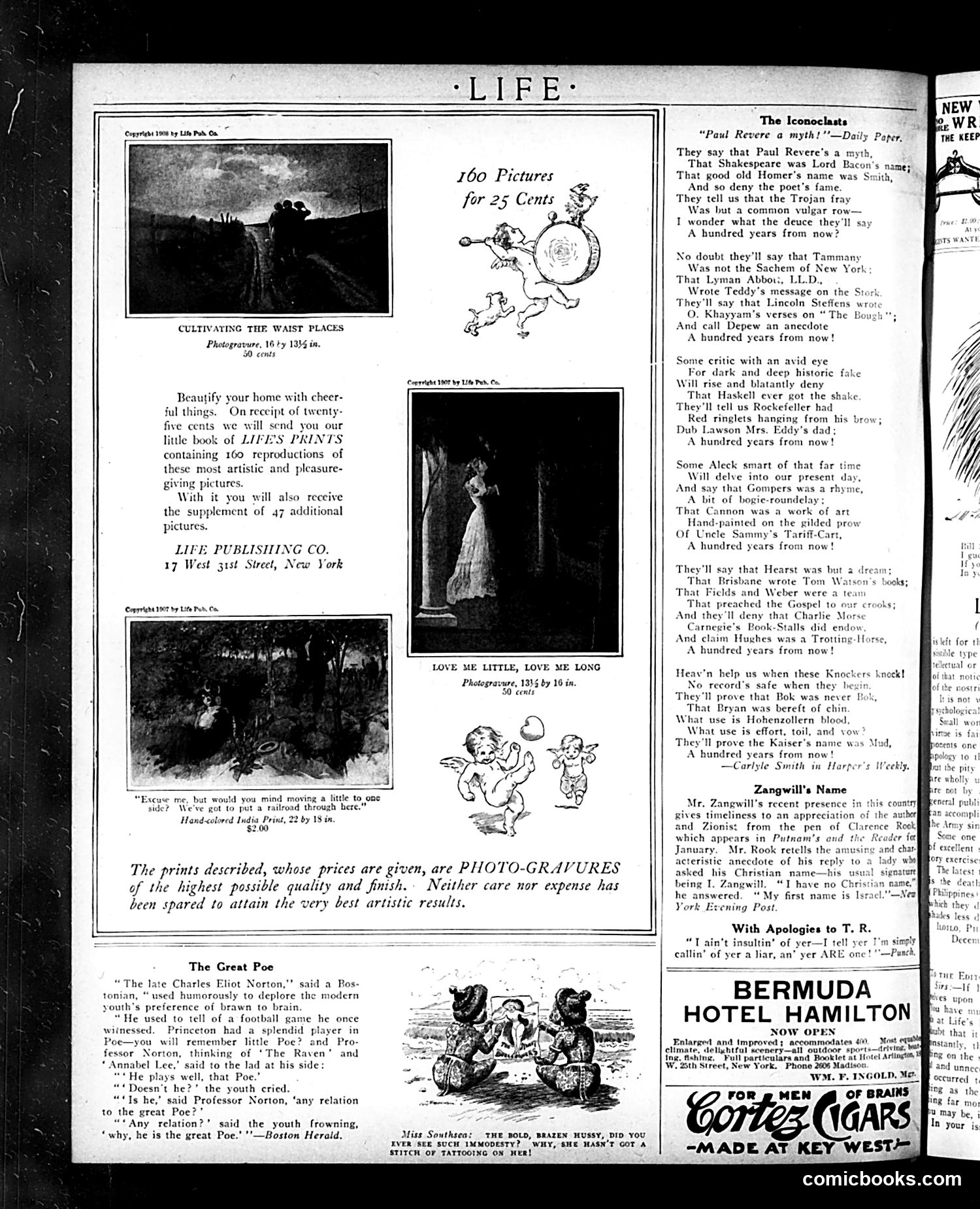
This satirical poem mocks historical debunkers and skeptics who questioned the authenticity of famous figures and events. The poet anticipates future critics will deny the existence or accomplishments of contemporary early-1900s personalities—including President Theodore Roosevelt (implied by "Teddy's message"), William Randolph Hearst, Andrew Carnegie, James J. Corbett (the boxer), and others. The humor lies in equating plausible historical myths (Paul Revere, Homer, the Trojan War) with absurd future denials of recently-lived public figures. The refrain "A hundred years from now!" emphasizes how ridiculous it would be to doubt the existence of people the magazine's readers knew personally. This reflects early-1900s anxiety about historical truth-seeking and academic skepticism—the concern that overzealous scholars might dismiss documented reality. It's essentially a defense of contemporary figures against future historical revisionism.
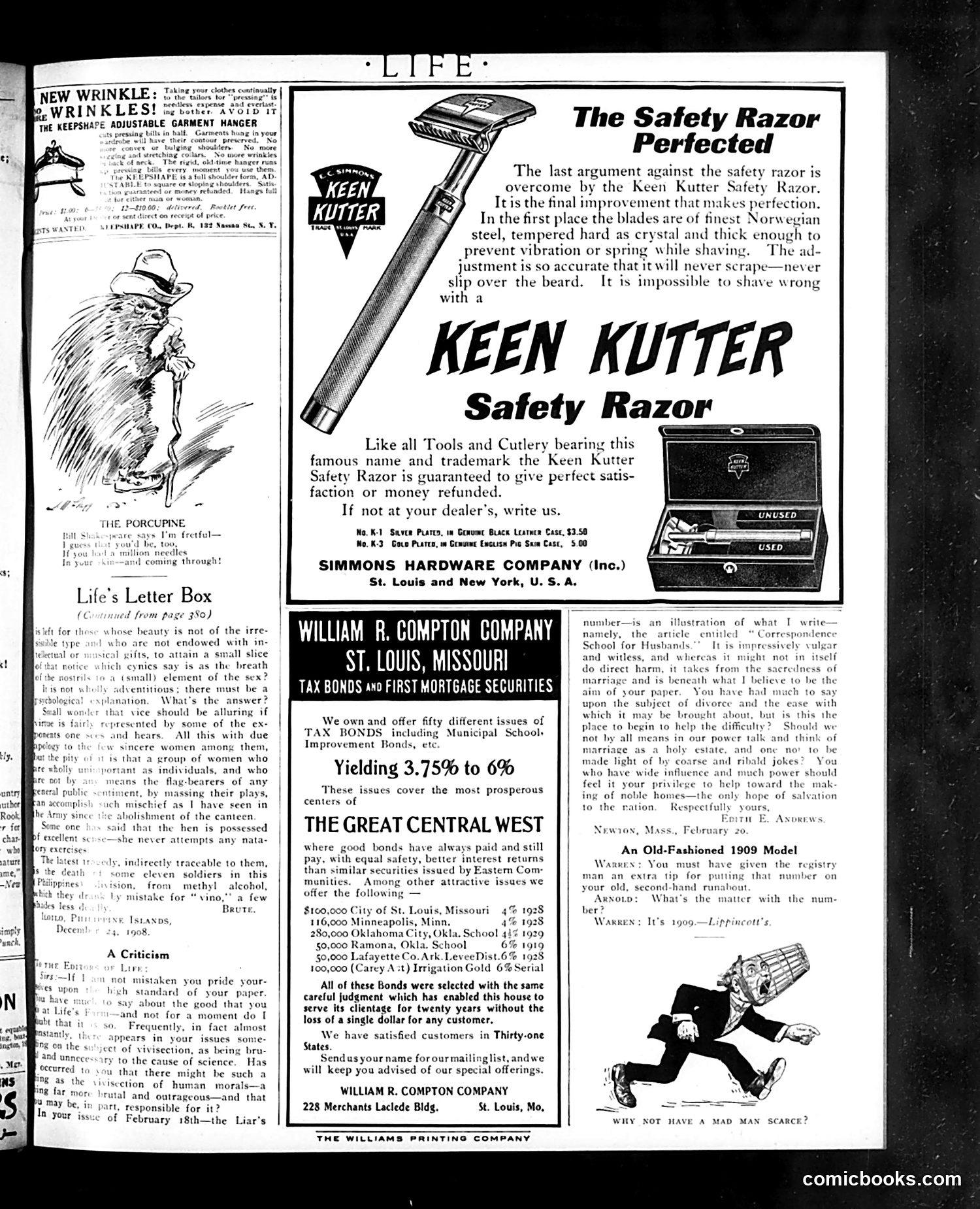
This page is primarily **advertising and advice columns** with minimal political satire. The notable cartoon appears at bottom right: a man tumbling backward labeled "WHY NOT HAVE A MAD MAN SCARE?" This illustrates a letter discussing an "Old-Fashioned 1909 Model"—apparently a joke about outdated ideas or practices causing comic mishaps. The left side features "Life's Letter Box," a reader advice column addressing social concerns: one letter criticizes *Life* for coverage of vivisection while ignoring moral outrages in human society. **The bulk of the page is advertising**: the Keen Kutter Safety Razor (emphasizing precision and Norwegian steel), a garment hanger, and the William R. Compton Company promoting tax bonds yielding 3.75-6% across the American midwest. One cartoon shows a porcupine complaining about being "fretful"—a visual pun on irritability. The page reflects early-1900s concerns (vivisection ethics, investment opportunities) and consumer product marketing rather than political commentary.
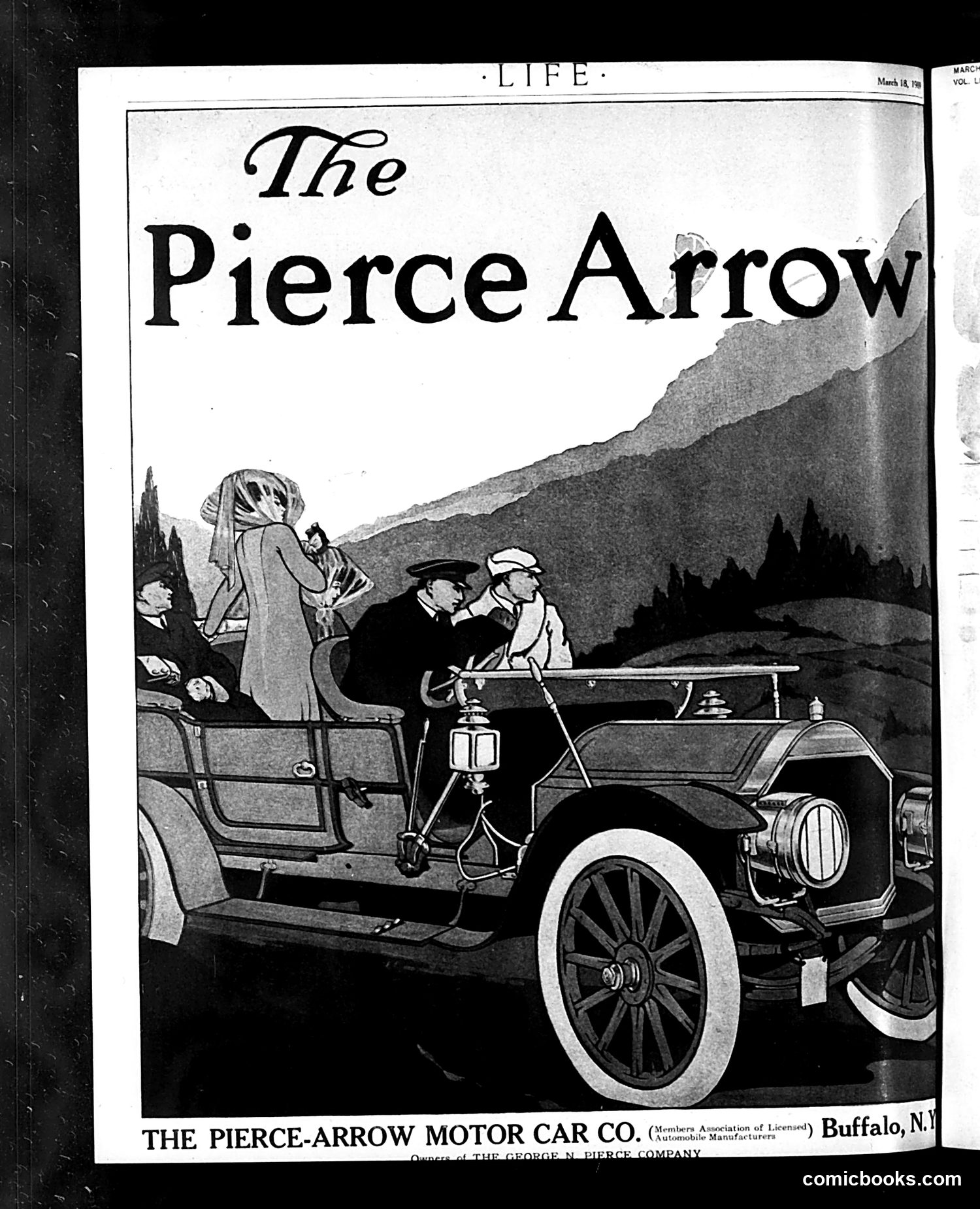
This is a full-page advertisement for the Pierce-Arrow Motor Car Company of Buffalo, New York, appearing in *Life* magazine. Rather than a political cartoon, it's a luxury automobile advertisement from the early automotive era (appears to be 1910s-1920s based on styling). The image depicts well-dressed figures in and around an elegant Pierce-Arrow automobile set against a mountainous landscape. The advertisement emphasizes the car's appeal to affluent, sophisticated consumers through its artistic presentation and refined imagery. The "satire" in *Life* magazine during this period often came from juxtaposing luxury advertisements with social commentary elsewhere in the publication, though this particular page functions primarily as straightforward commercial promotion for what was then a prestigious American automobile manufacturer.