
Life, 1909-03-18 · page 14 of 32
Life — March 18, 1909 — page 14: what you’re looking at
What you’re looking at
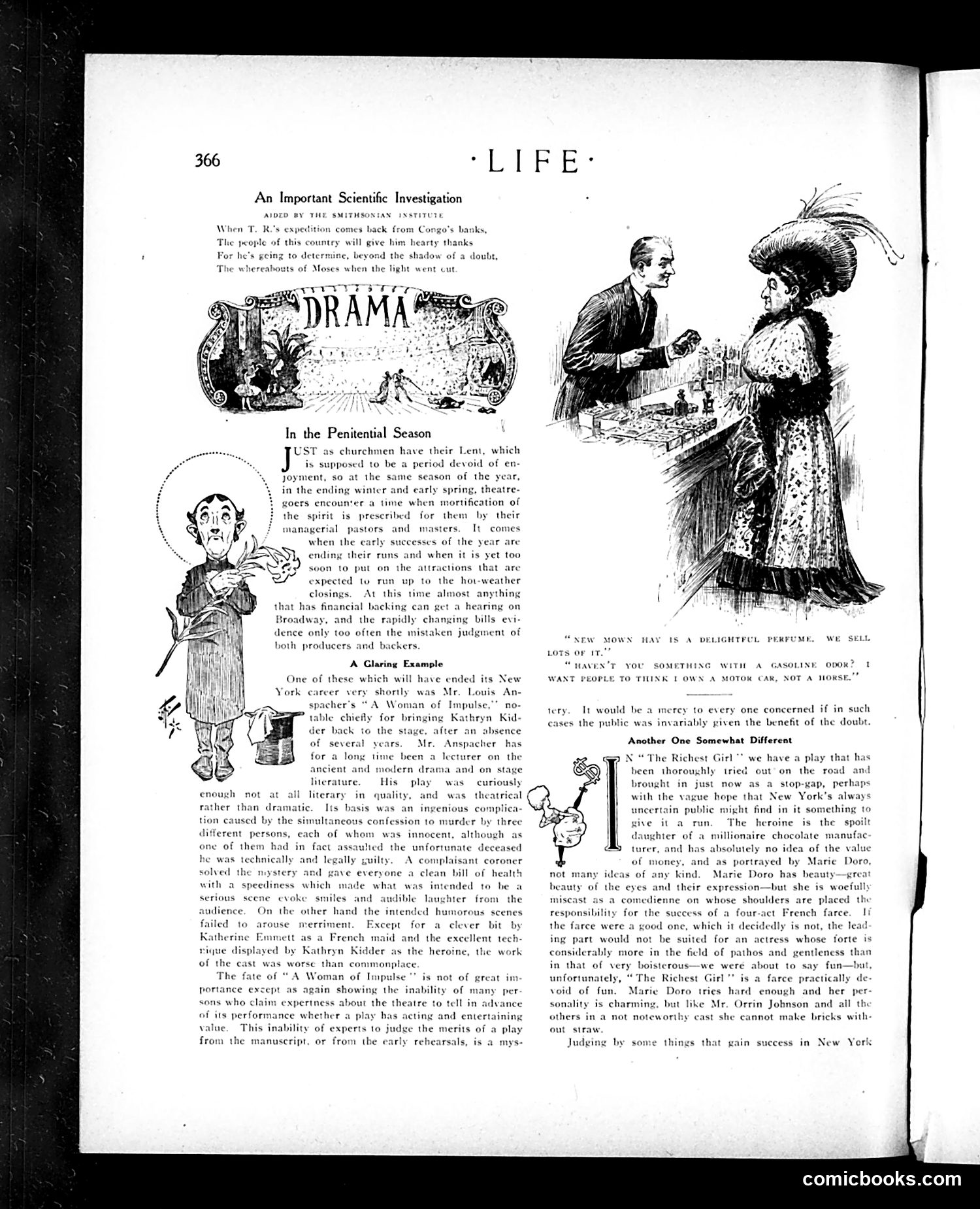
This page contains two theatrical reviews with satirical commentary on Broadway productions during the "Penitential Season" (early spring, when quality shows have closed and producers fill time with weaker offerings). **The top cartoon** references Theodore Roosevelt's African expedition, joking that upon his return, he'll definitively answer where Moses was "when the light went out"—mocking both T.R.'s presumed expertise and contemporary debates about religious/scientific authority. **The reviews critique two plays:** Louis Anspacher's "A Woman of Impulse" (poorly written despite literary pretensions) and "The Richest Girl" (a French farce miscast with actress Marie Doro, beautiful but unsuited to comedy). **The satire's point:** The page mocks both theatrical producers who misjudge plays' merit and critics/experts who cannot predict which manuscripts will succeed. The "Penitential Season" framing suggests theatergoers endure mediocre productions as spiritual mortification. **The gasoline/perfume joke** (right margin) satirizes nouveau-riche affectation—wanting to appear wealthy by owning a motor car rather than a horse.
📄 Transcribed text from this page (OCR, searchable)
Machine-transcribed from the original scan — historical spelling and the odd misread are preserved.
AIDED BY THE SMITHSONIAN INSTITL When T. R's expedition comes back from Cong ks, The people of this country will give him hearty thanks For he’s geing to determine, beyond the shadow of a doubt, The whereabouts of Moses when the light we In the Penitential Season UST as churchmen have their Lent, which is supposed to be a period devoid of en- Joyment, so at the same season of the year, in the ending winter and early spring, theatre- goers encounter a time when mortification of he spirit is prescribed for them by their managerial pastors and masters. It comes 1 the carly successes of the year are ending their runs and when it is yet too soon to put on the attractions that are expected ty run up to the hot-weather closings. At that has financial backin Broadway, and the rapidly changing bills evi- dence only too often the mistaken judgment of both producers and backers A Glaring Example One of these which will have ended its New York carcer very shortly was Mr. Louis An- spacher's “A Woman ¢ table chief Impulse.”" no- for bringing Kathryn Kid- back to the stage, after of several years. Mr. psence Anspacher has for a long time been a lecturer on t ancient and modern drama and on stage literature. His play was curiously enough literary in quality, and was theatrical rather than dramatic. Its basis was an ingenious complica tion ¢ i by the simultaneous confession to murder by three different persons, each of whom was innocent, although one of them had in fact assaulted the unfortunate dec he was technically and legally guilty solved th A complaisant co ystery and gave everyone a clean bill of with a speediness which made what was intended to be serious scene evoke smiles and audible laughter from. the udience. On the other hand the intended humorous scenes led to arouse merriment. Except for Katherine Emmett as clever bit by French maid and the excellent tech nique displayed by Kathryn Kidder as the heroine, the work of the cast was worse than common] The fate of “A Woman of is not of great im portance except as again showing the inability of many per sons who claim expertness about the theatre to tell in advance of its performance whether a play has acting and entertaining value. This inability of experts to judge the merits pulse from the manuscript, or from the early rehearsals, NEW MOWN HAY IS A DELIGHTFUL PERFUME. WE SE or ir. “MAVEN'T YOU SOMETHING WITH A GASOLINE ODOR? 1 WANT FEOPLE TO THINK 1 OWN A MOTOR CAR, NOT A HORSE.” tery. It would be a mercy to every one concerned if in such cases the public was invariably given the benefit of the doubt Another One Somewhat Different gg X “The Richest Girl been thoroughly tried out on the ro: * we have a play that has brought in just now as a stop-gap, perhaps with the vague hope that New York's always uncertain public might find in it something to give ita run. The heroine is the spc daughter of a millionaire chocolate manufac turer, and has absolutely no idea of the value of money, and as portrayed by Marie Doro, not many ideas of any kind. Marie Doro has heauty—great beauty of the eyes and their expression—but she is woefully miscast as a comedienne on whose shoulders are placed th: responsibility for the success of a four-act French farce. li the farce were a good one, which it decidedly is not, the ing part would not be suited for an actress whose forte is considerably more in the ficld of pathos and gentleness than in that of very boisterous—we were about to say fun—t unfortunately, “1 void of fun. he Richest Girl * is a farce practically de Marie Doro tries hard enough and her sonality is charming, but like Mr. Orrin Jobnson and all the others in a not noteworthy cast she cannot make bricks with- out straw Judging by some things that gain success in New York comicbooks.com