
A complete issue · 20 pages · 1908
Life — October 29, 1908
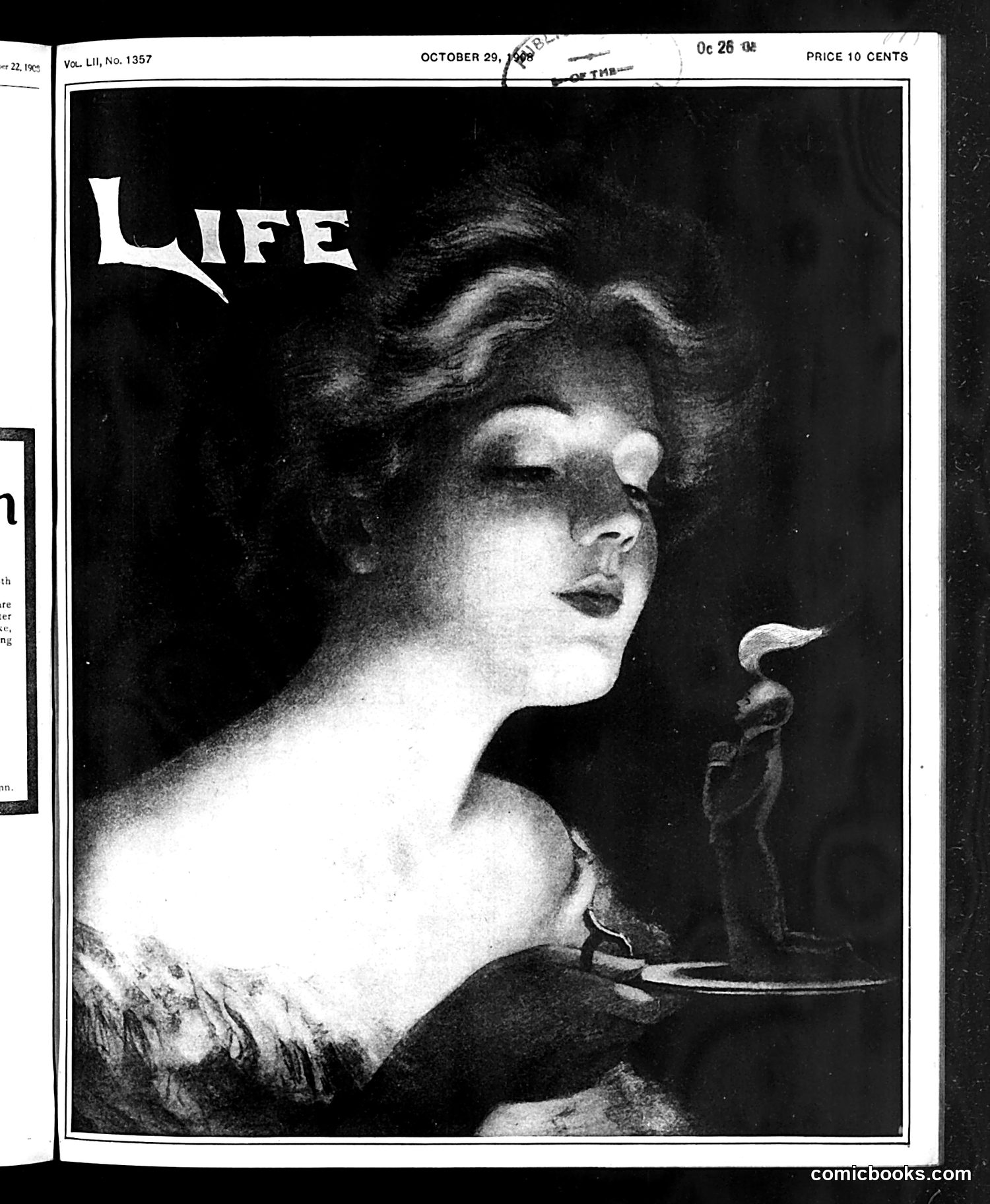
This is the cover of *Life* magazine from October 29, 1908. The image shows a woman in profile, elegantly posed with her head tilted back, holding what appears to be a cigarette or similar object. She has fashionably styled hair typical of the Gibson Girl era. Without additional OCR text from the article visible, the specific satirical point is unclear. However, given the date and *Life*'s editorial focus, this likely comments on women's changing social roles—possibly regarding smoking, modern fashion, or shifting gender norms of the Progressive Era. The refined, somewhat provocative presentation suggests commentary on evolving notions of female respectability and independence during this period of social change.
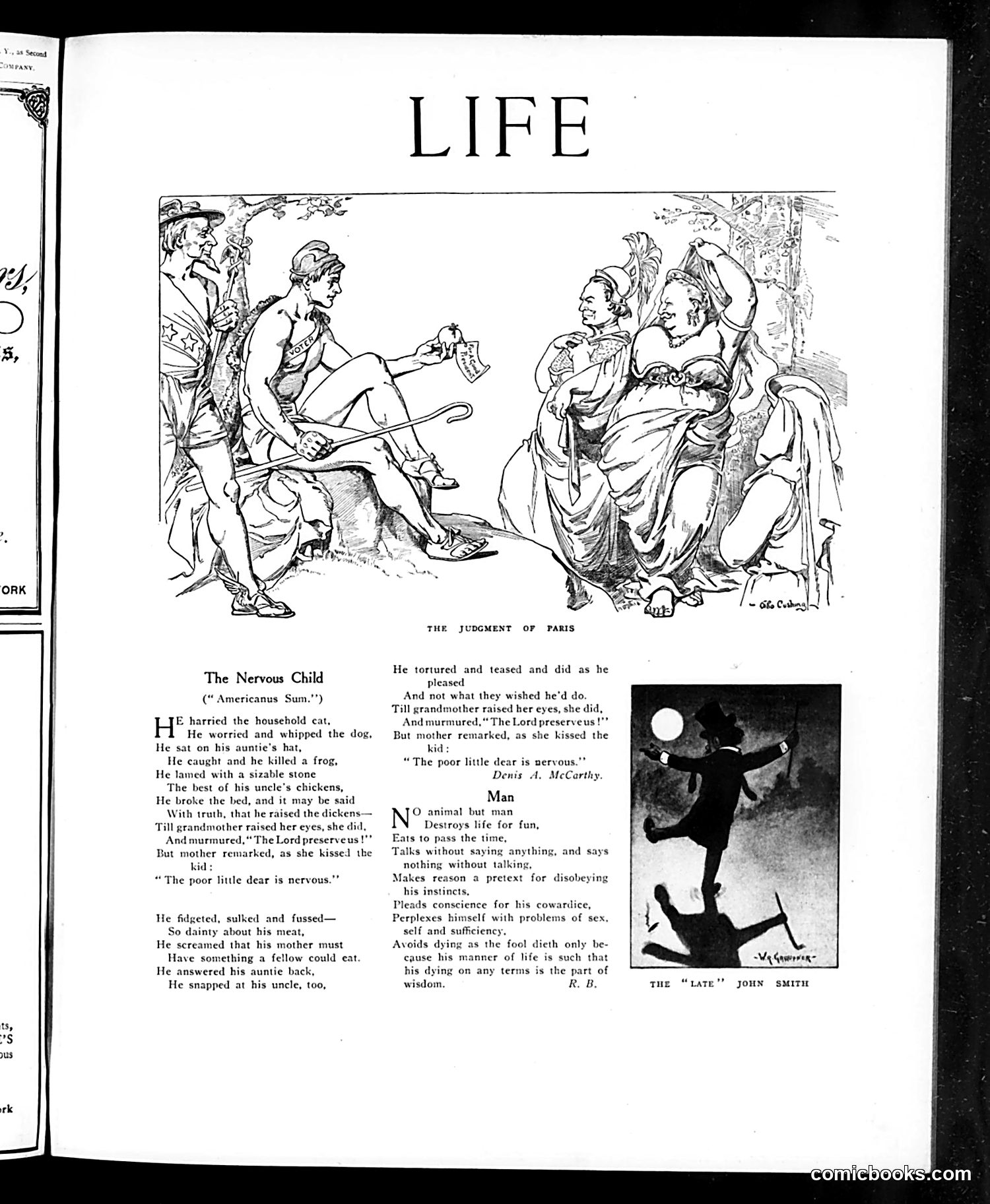
**"The Judgment of Paris"** illustration depicts a classical mythological scene: a man offering a gift or decision to three women. This references the Greek myth where Paris must judge which goddess deserves a golden apple—a famous beauty contest with fateful consequences. **"The Nervous Child"** poem satirizes an anxious, destructive boy who torments animals and household items, embodying nervous energy and lack of discipline. The grandmother's repeated refrain—"The poor little dear is nervous"—mocks how parents excuse misbehavior through psychological terminology, a likely jab at emerging child psychology concepts. **"Man"** is a cynical verse attacking male behavior: destroying life for amusement, talking without substance, making excuses for moral failings through pseudo-philosophical reasoning. The page critiques pretense and rationalization across mythology, parenting, and masculine behavior.
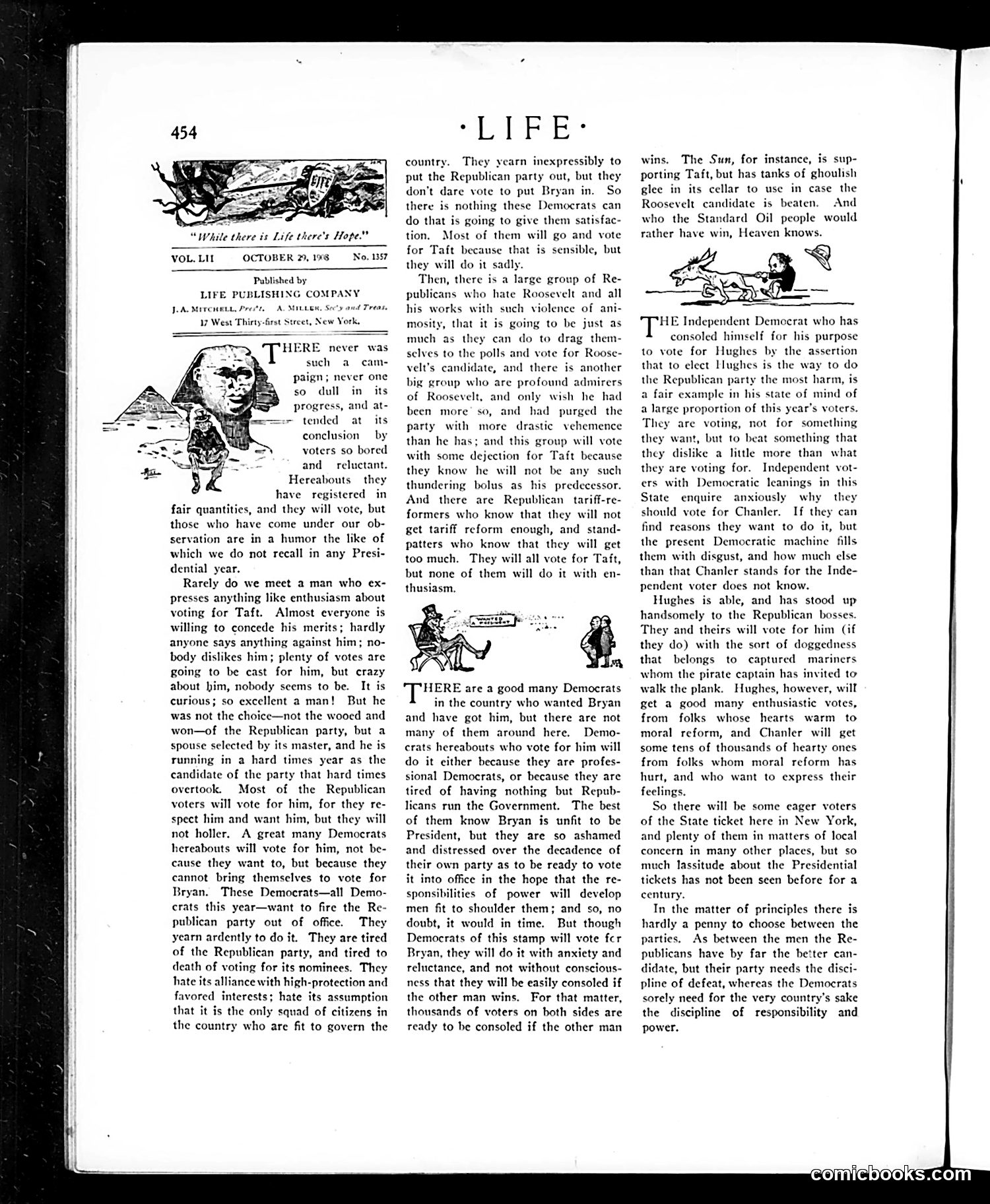
This page discusses the 1908 U.S. presidential election between Republican William Howard Taft and Democrat William Jennings Bryan. The text analyzes various voter groups—Republicans torn between supporting Taft or Roosevelt's legacy, Democrats frustrated with Bryan's repeated candidacies, and independent voters facing difficult choices. The cartoons (though small) appear to illustrate voter confusion and apathy during this campaign. The editorial argues that Republicans have superior candidates but acknowledge some voter dissatisfaction, while Democrats struggle with enthusiasm for Bryan. The piece suggests independent voters, though principled, face no clear moral choice between the parties. The overall tone is satirical toward the uninspiring nature of the election itself.
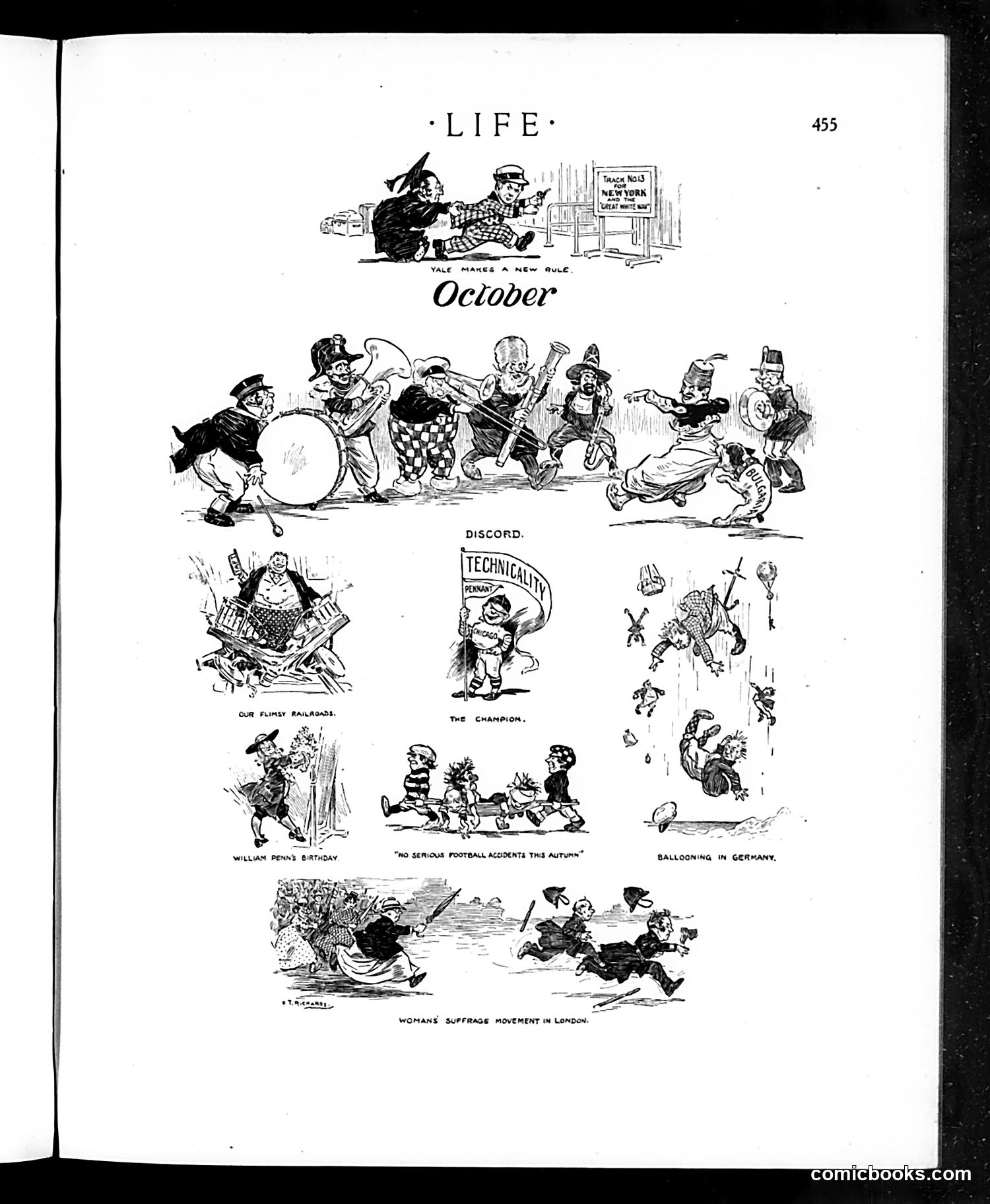
This October 1912 Life page satirizes contemporary events through multiple cartoons: **"Yale Makes a New Rule"** (top): References Yale University implementing new regulations, likely disciplinary. **"Discord"** (center): Multiple vignettes mock social upheaval—"Our Flimsy Railroads" criticizes railroad safety; "The Champion" appears to lampoon a boxing figure; "William Penn's Birthday" references the Pennsylvania founder; "No Serious Football Accidents This Autumn" sarcastically comments on college football dangers. **"Ballooning in Germany"** and **"Woman's Suffrage Movement in London"** (bottom) address contemporary international issues: aviation developments and the active British women's suffrage campaign, which was prominent in 1912. The page's title "Discord" unifies these vignettes—all depicting social, political, and institutional conflicts of the era.
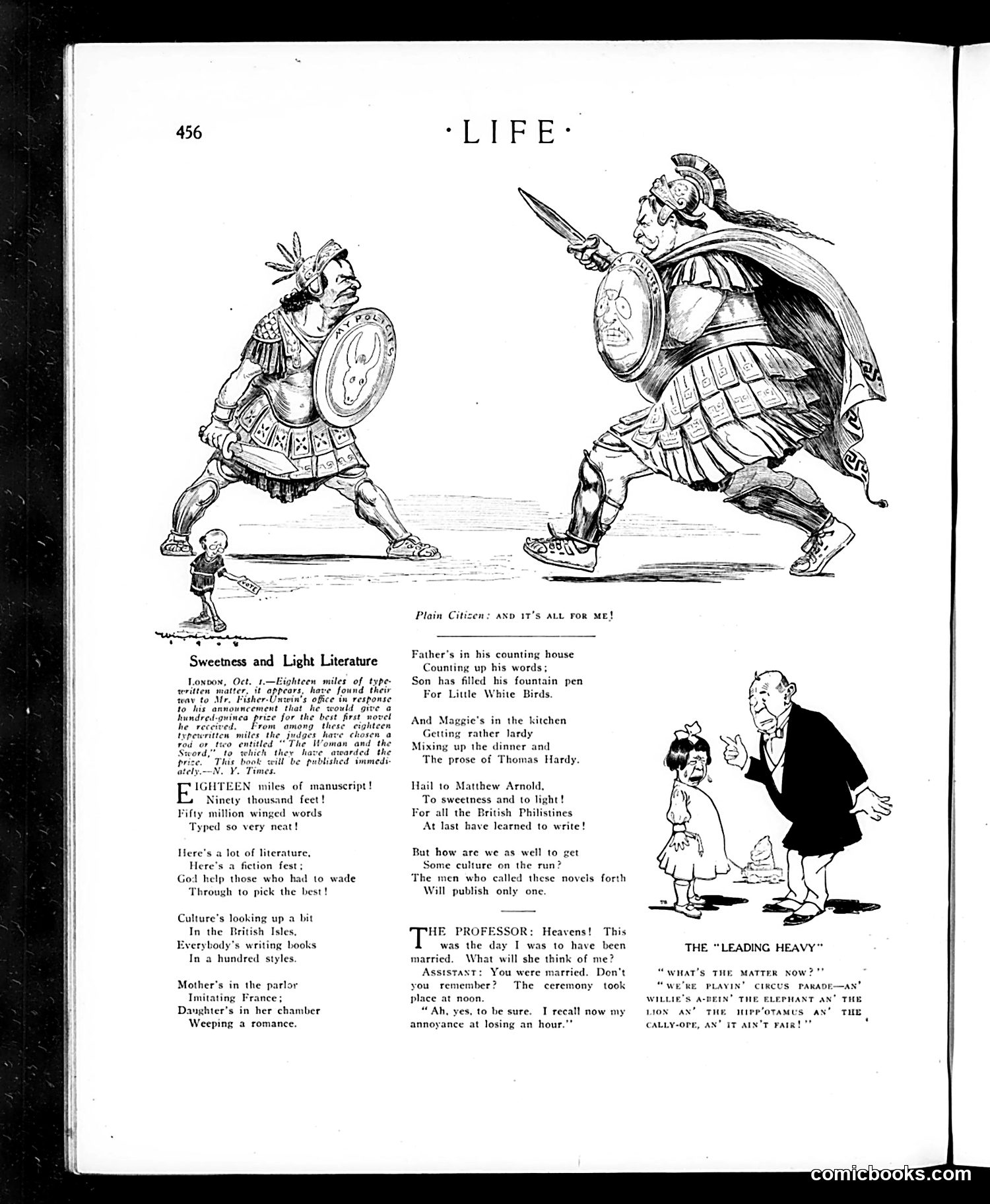
The top illustration depicts a gladiatorial combat between two armored warriors, captioned "Plain Citizen: and it's all for me!" This appears to satirize ordinary citizens caught between competing powerful interests—the two warriors likely represent rival factions or powers fighting while the common person bears the consequences. The bottom right cartoon, titled "The 'Leading Heavy,'" shows an adult explaining theatrical terminology to a child, who excitedly lists circus acts. This is likely satirizing either overwrought dramatic literature of the era or theatrical pretension being confused with actual entertainment. The left column discusses "Sweetness and Light Literature," critiquing contemporary literary output as voluminous but shallow—eighteen miles of manuscript producing minimal meaningful content. The satire targets publishing industry excess and literary mediocrity.
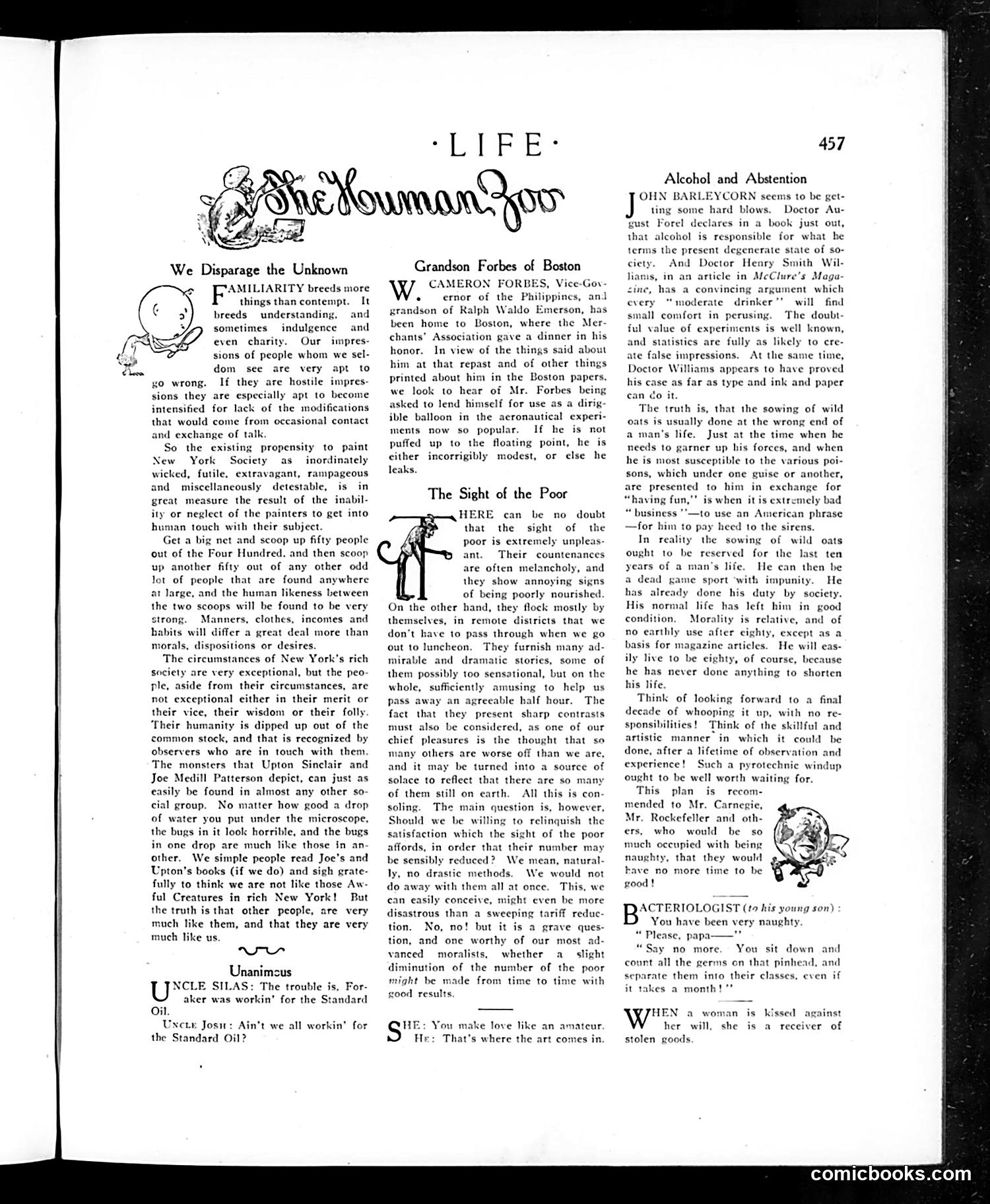
This page contains several satirical columns and brief jokes typical of Life's humor section. The main pieces include: **"We Disparage the Unknown"** - Critiques New York's snobbish attitude toward unfamiliar things, using the analogy of bugs under a microscope appearing equally strange to each other. **"The Sight of the Poor"** - Discusses whether society should reduce poverty through "drastic methods" or maintain the satisfaction of charitable giving. It's social commentary questioning whether the poor exist partly to make the wealthy feel virtuous. **Brief jokes** at bottom include wordplay about oil companies and a quip about kissing women against their will as "receiving stolen goods." The small cartoon illustrations are generic vignettes rather than specific political caricatures. This appears to be general social satire rather than commentary on particular events or figures.
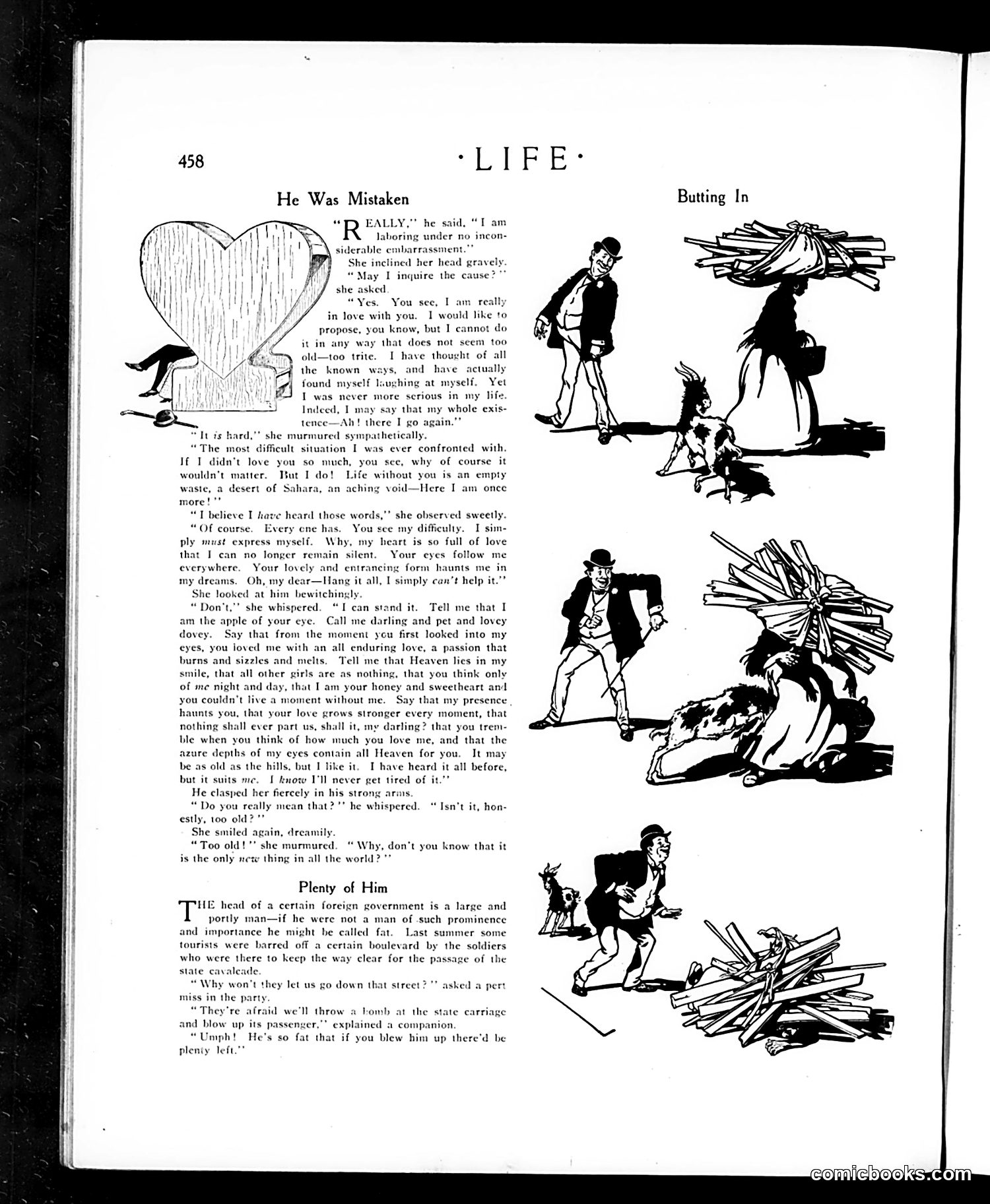
The page contains two distinct sections: **"He Was Mistaken"** (left): A romantic story excerpt featuring dialogue between a man and woman about love and commitment. A heart illustration accompanies the text. This appears to be satirical fiction mocking overwrought romantic declarations. **"Butting In"** (right): A series of cartoon illustrations showing a man repeatedly colliding with or being knocked over by a goat. The humor derives from slapstick physical comedy—the man's escalating misfortunes as he encounters the animal in various situations. **"Plenty of Him"** (bottom): A joke about a foreign government official described as extremely large ("fat"), with a punchline suggesting he's so substantial that bombing him would leave "plenty left." The page primarily offers light entertainment through romantic satire, physical comedy, and crude humor typical of early-to-mid 20th-century American magazines.
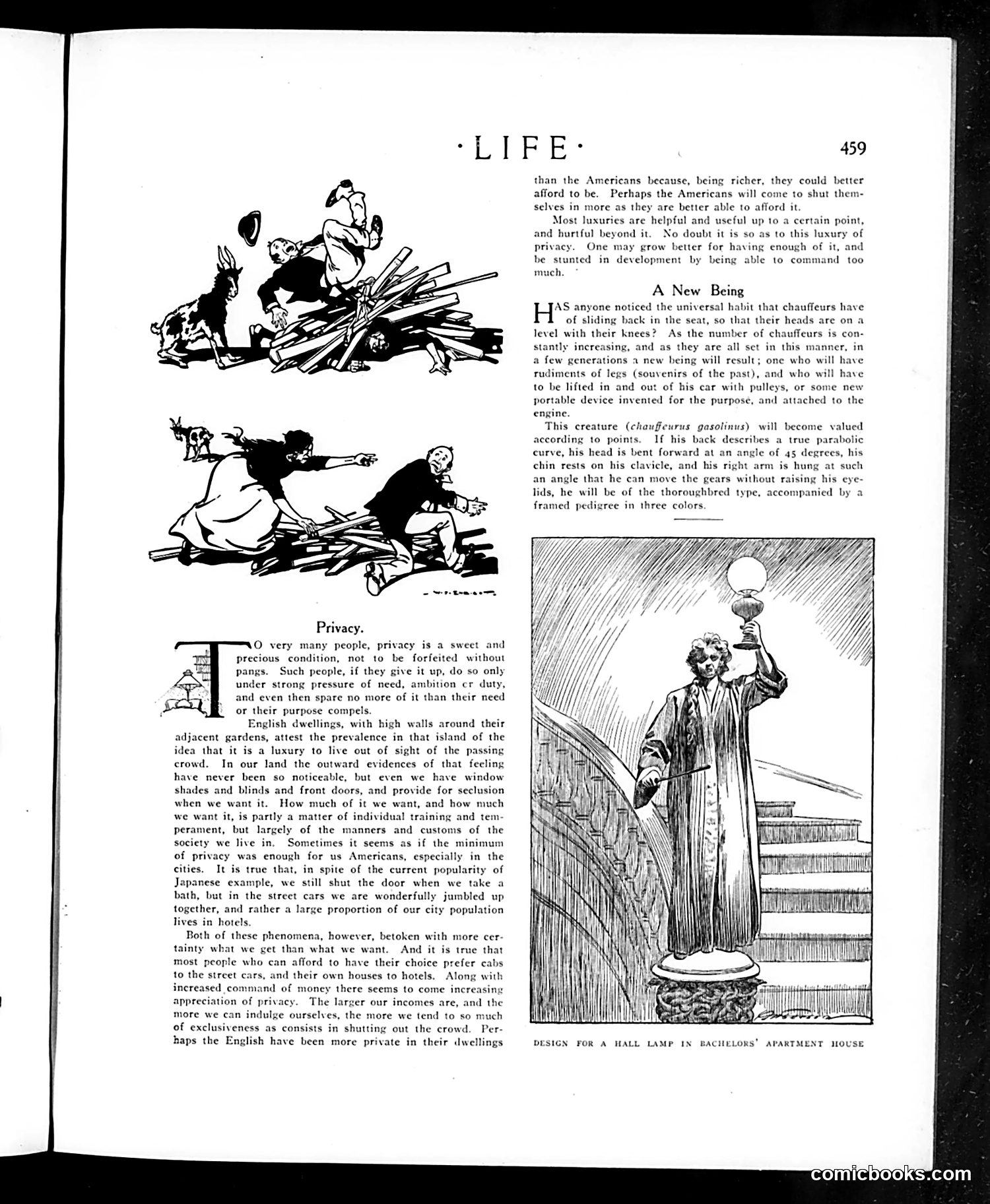
This page contains two distinct sections: humorous illustrations on the left and a serious essay on the right. The **left cartoons** depict people in various comedic situations involving firewood and household chaos—likely satirizing domestic mishaps or the challenges of maintaining a home, though specific contemporary references are unclear from the image alone. The **"Privacy" essay** discusses the English cultural value of privacy in dwellings, contrasting it with American and Japanese practices. It argues that wealthier societies increasingly appreciate exclusivity and seclusion from crowds, noting the prevalence of window shades and door blinds in English homes. The **right illustration** shows a decorative hall lamp design for bachelor apartments, representing the aesthetic refinement discussed in the accompanying article "A New Being."
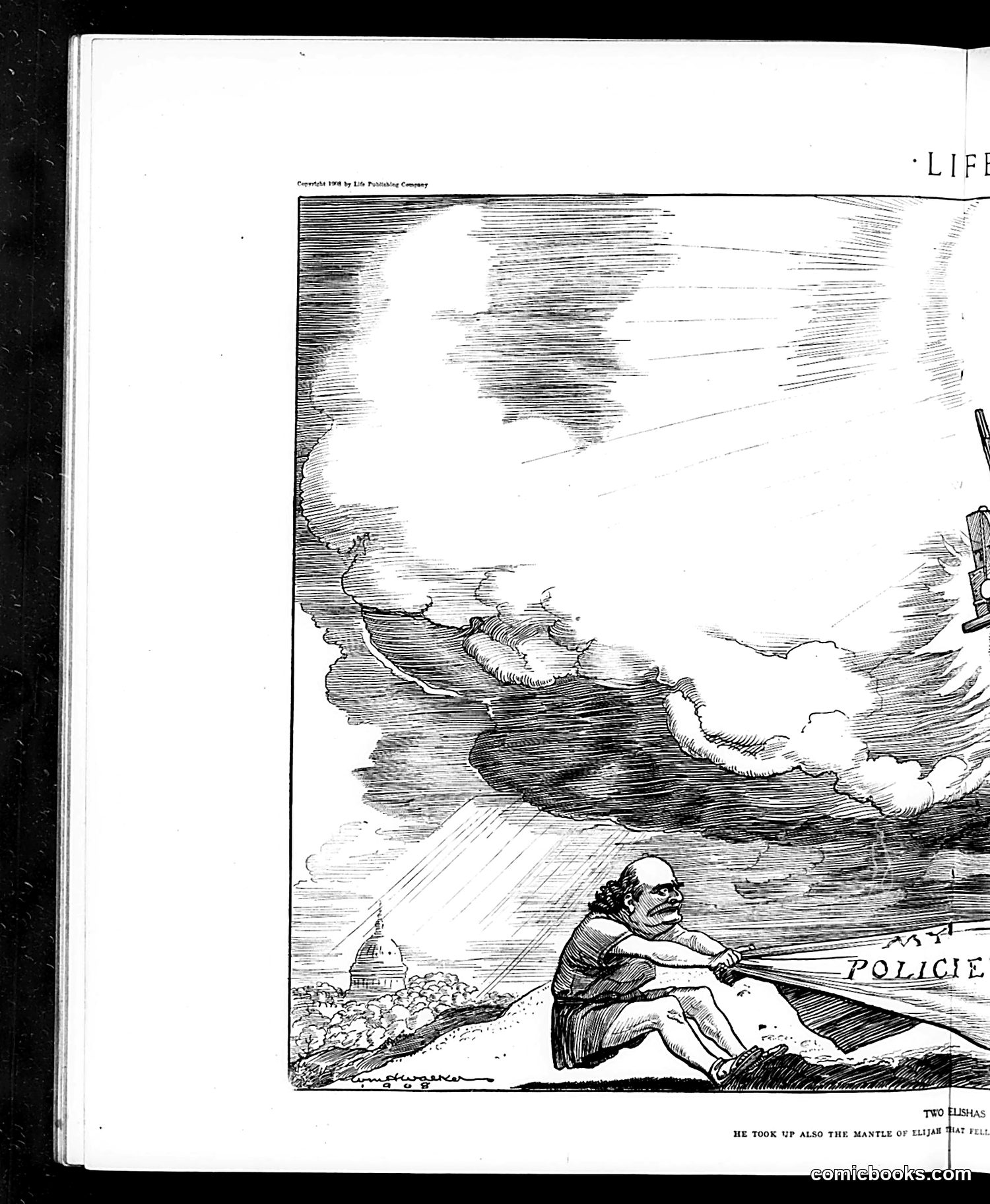
This is a political cartoon depicting a figure rowing a boat labeled "POLICIE" (Policy) while storm clouds gather overhead. The figure appears to be a caricatured political leader struggling to navigate turbulent conditions. In the background, a Capitol building is visible on the distant shore. The satire suggests that whoever this leader represents is attempting to steer the nation's policies through difficult, chaotic circumstances—the storm clouds indicating crisis or turmoil. The text fragment "HE TOOK UP ALSO THE MANTLE OF ELIJAH THAT FELL" suggests a biblical reference to succession of authority, implying the cartoon comments on a transfer of political power during troubled times. Without clearer dating or caption text, the specific political crisis remains unclear, though the imagery universally conveys struggle with governance during adversity.
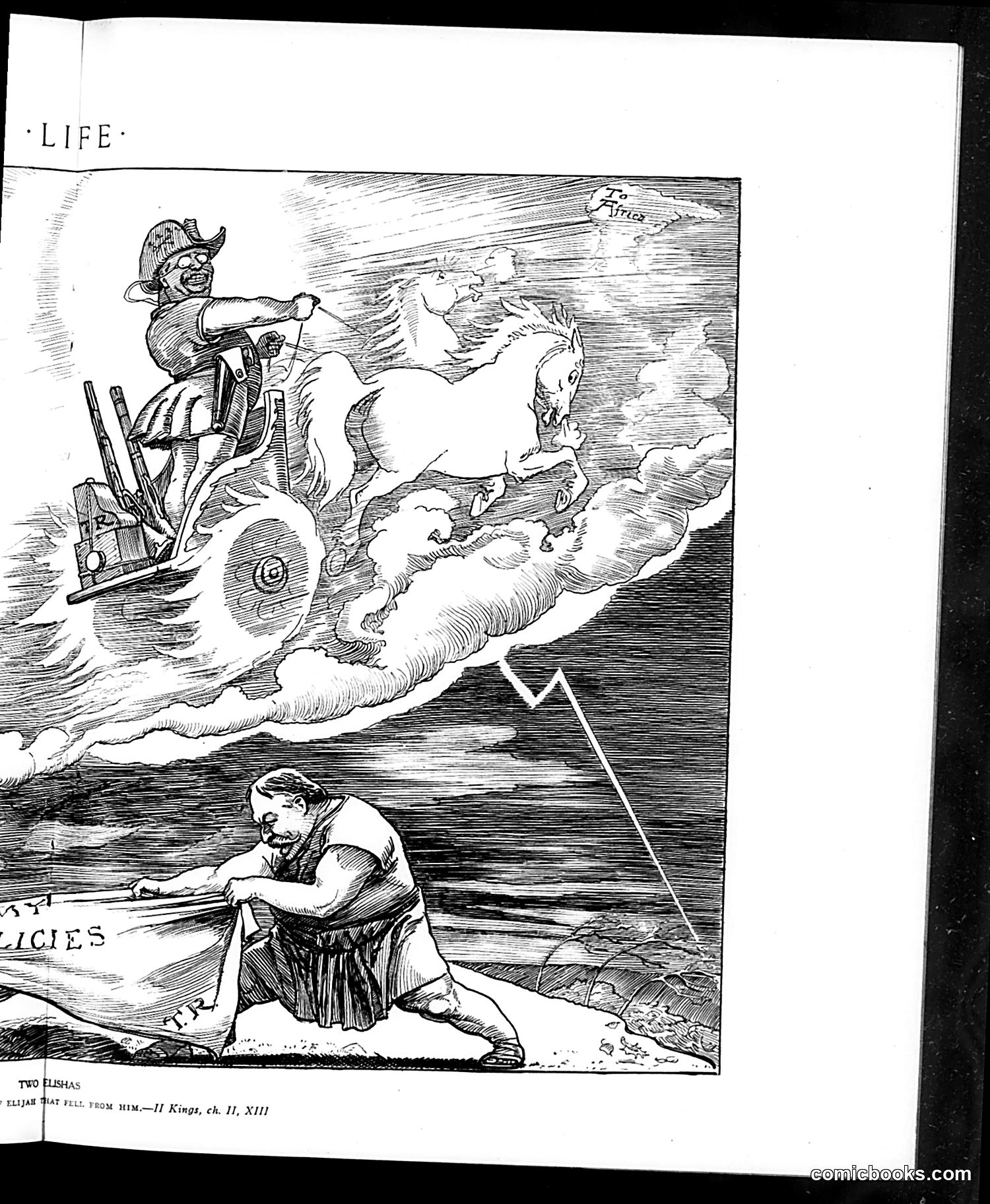
This engraving illustrates **II Kings, ch. 11, XIII** — a biblical reference to two kings who "fell from him." The cartoon depicts a figure in period military dress riding horses across clouds, whipping them forward with dynamic energy, while below a kneeling figure appears distressed or supplicant. The satire likely uses this biblical allegory to comment on political leaders or rulers who have lost power or favor. The dramatic cloud-chariot imagery suggests divine judgment or heavenly retribution. The contrast between the mounted authority figure and the kneeling subject below emphasizes themes of power dynamics, downfall, or divine intervention in political affairs. Without a publication date visible, the specific political figures referenced remain unclear.
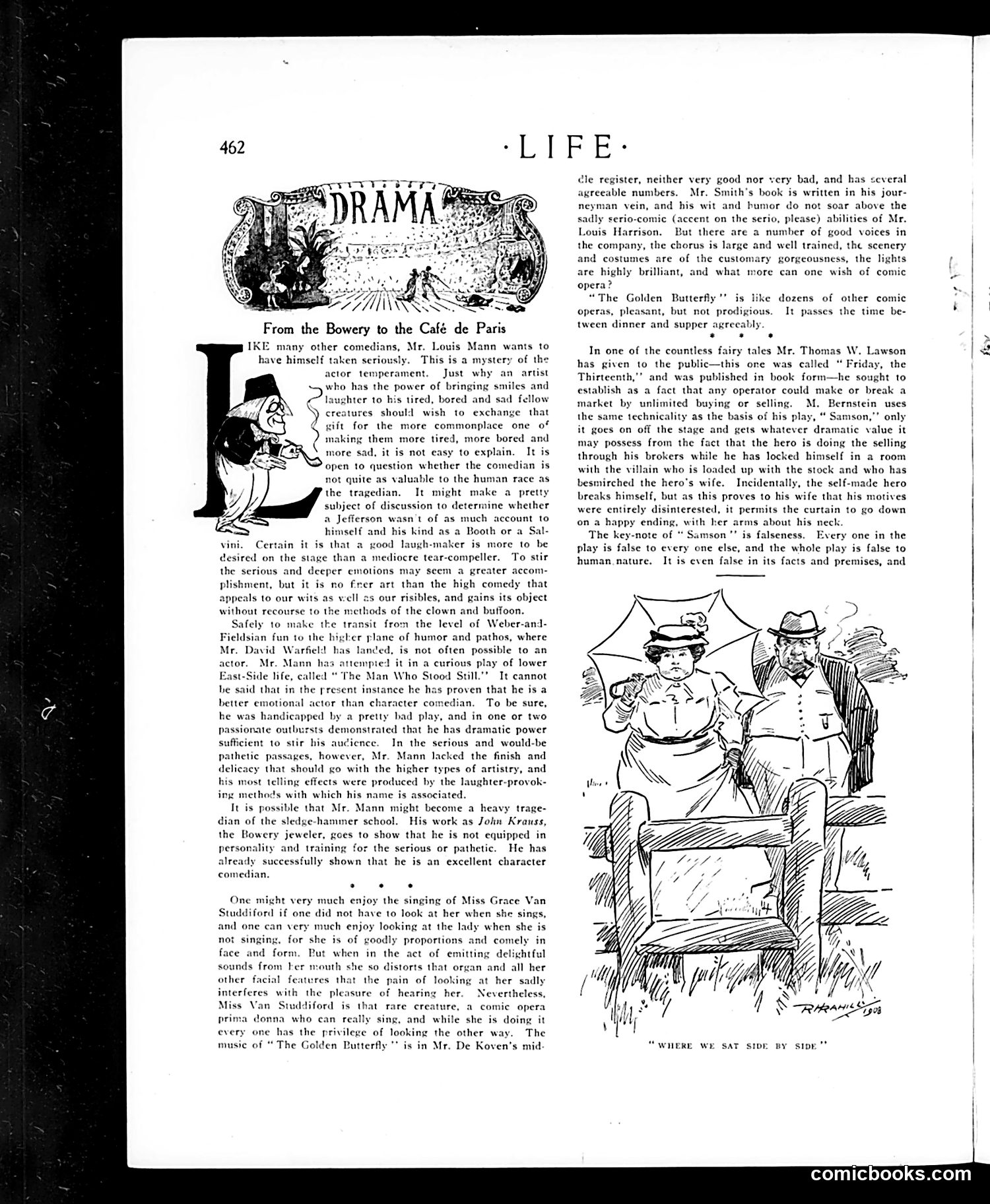
This page reviews theatrical productions, focusing on comic opera and comedians. The left illustration shows a caricatured figure in formal dress—likely representing a specific actor or theatrical personality, though the identity isn't explicitly stated in the visible text. The main article discusses "The Golden Butterfly" opera and critiques various performers including Louis Mann, David Warfield, and mentions Miss Grace Van Studdiford. The text praises some actors' emotional range while criticizing others for lacking dramatic depth or finish. The right cartoon ("Where We Sat Side by Side") depicts two figures in casual dress sitting together outdoors—likely satirizing a theatrical romance or relationship. The overall tone is critical yet affectionate commentary on Broadway's entertainment scene.
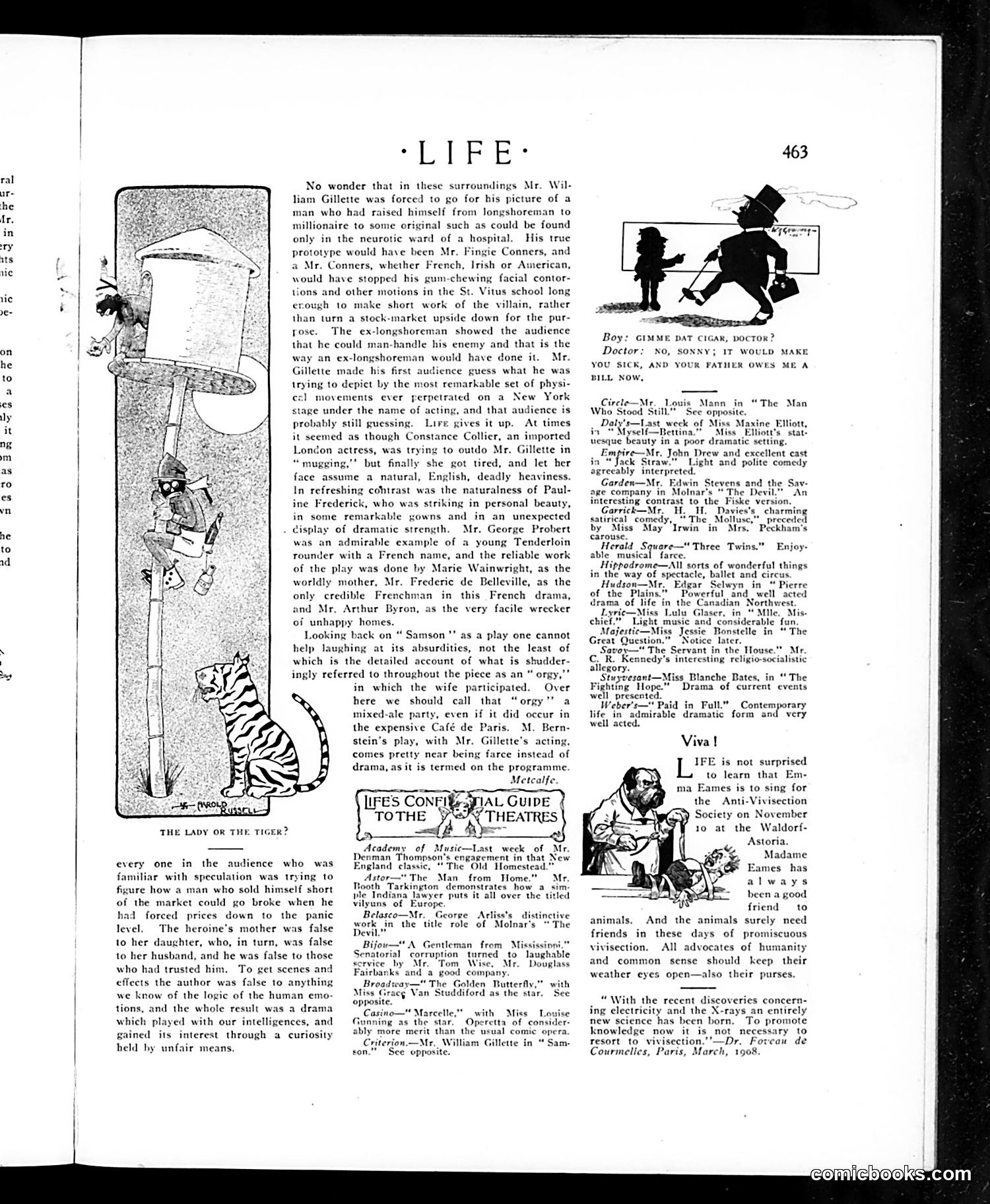
This page contains theater reviews and a cartoon titled "The Lady or the Tiger?" The cartoon depicts a man confronting a tiger, illustrating the famous ambiguous story by Frank R. Stockton where a character must choose between two doors—one hiding a lady, one a tiger. The drawing shows the moment of suspenseful choice. The surrounding text reviews contemporary theatrical productions (1908), including performances by William Gillette and other actors. The reviews critique acting quality and plot coherence. One section humorously discusses how audiences couldn't guess the ending of one production, reflecting the magazine's satirical commentary on theatrical entertainment and audience expectations of the era.
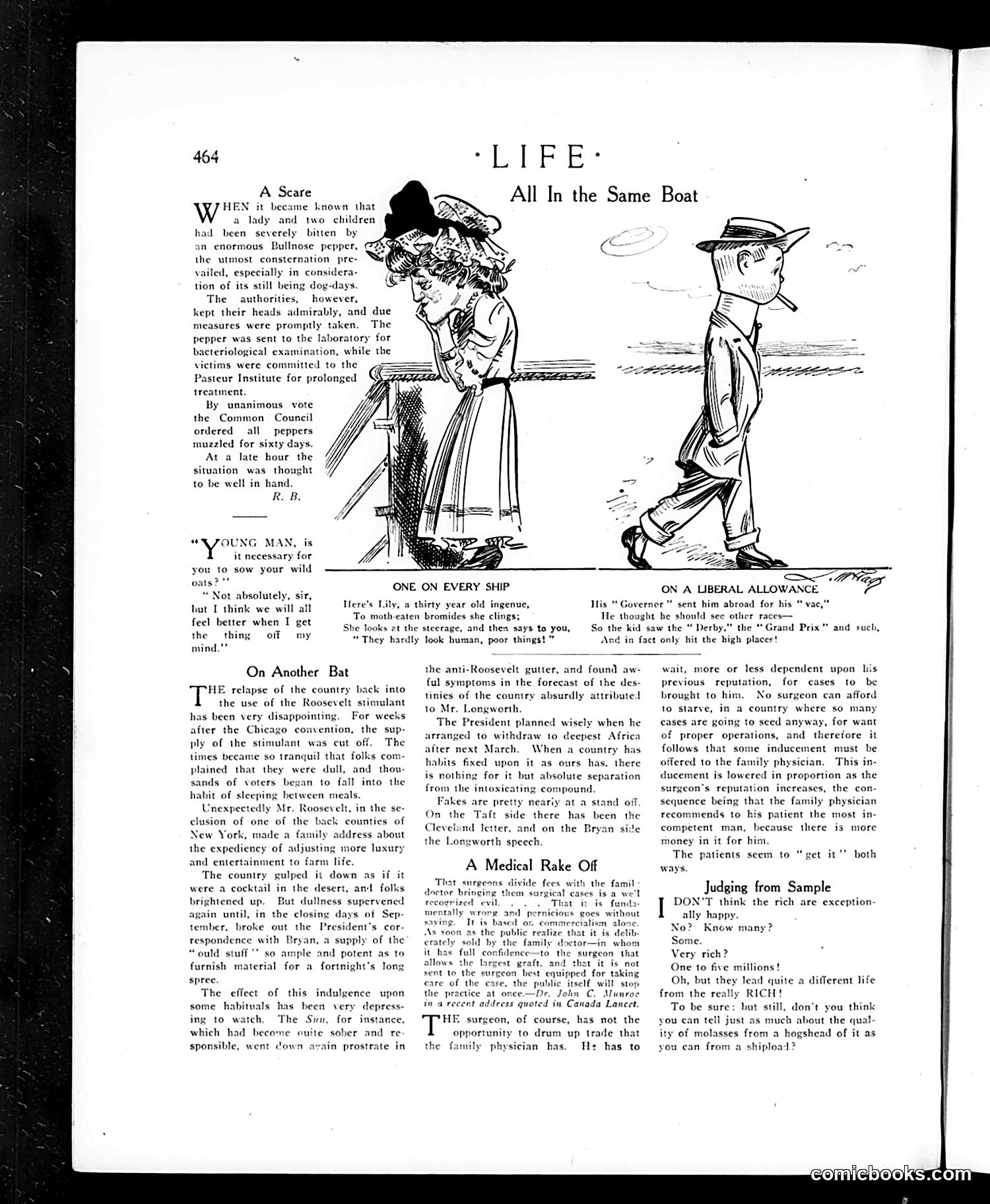
This page contains three separate satirical pieces: **"A Scare"**: A humorous short piece mocking public panic and government overreaction. A woman and children are bitten by a "Bullnose pepper," triggering absurd official response—laboratory examination, Pasteur Institute treatment, and a city council vote to muzzle all peppers for 60 days. The satire targets both sensationalism and bureaucratic excess. **"On Another Bat"**: Political commentary on Theodore Roosevelt's influence on American politics. The "stimulant" metaphor compares Roosevelt's dramatic actions and statements to an intoxicating drug that keeps the nation stimulated and engaged. The text suggests newspapers became "sober" without his activity, then relapsed into excitement during controversies involving Taft and Bryan. **"All In the Same Boat"** and other illustrated cartoons on the right mock social hypocrisy and privilege—wealthy people treating others dismissively while themselves behaving poorly, and a governor's son receiving an allowance to travel abroad under the guise of education. The page satirizes public behavior, political addiction, and class pretense typical of early 20th-century American society.
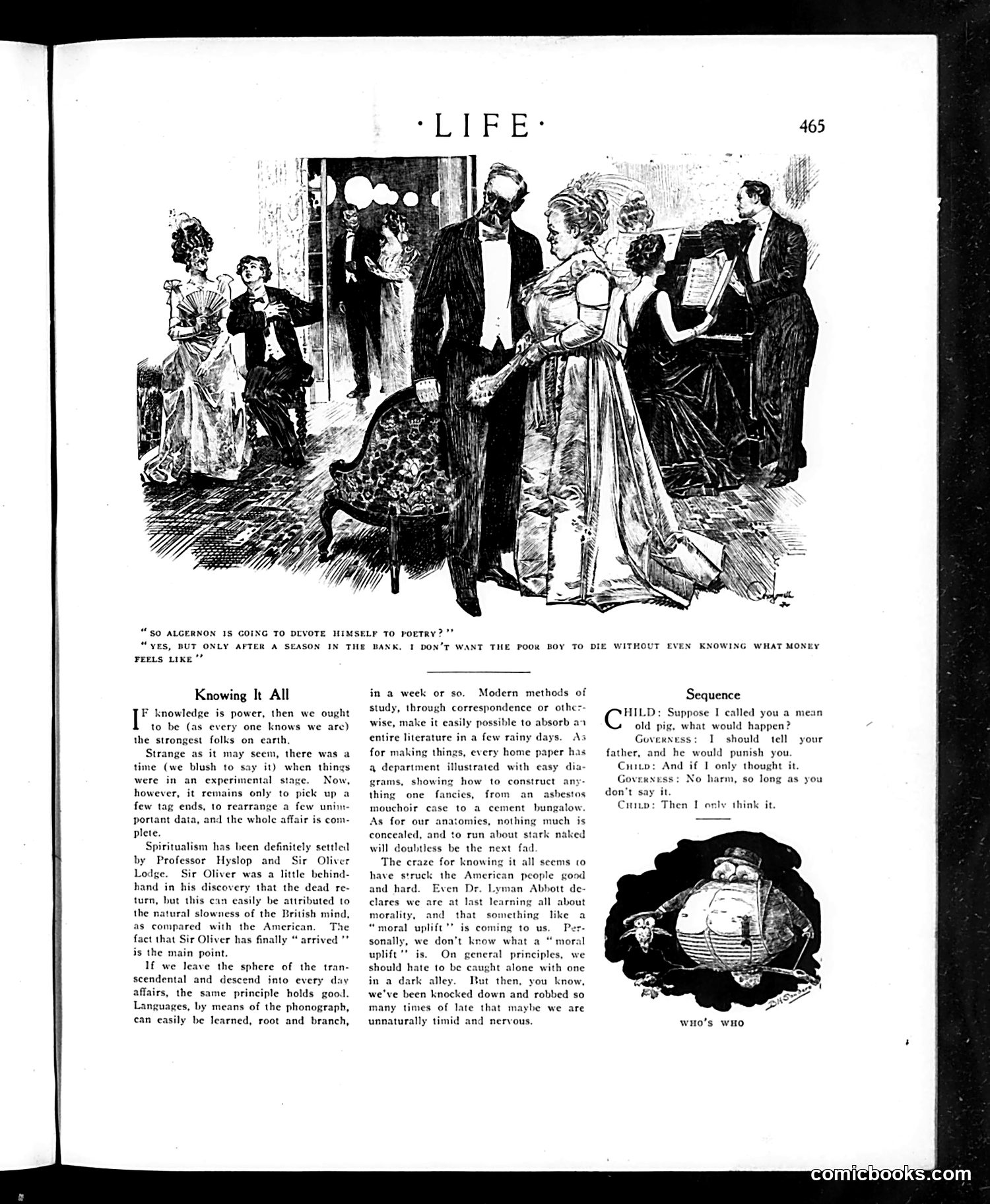
This page from *Life* magazine satirizes the early 20th-century American obsession with self-improvement and rapid knowledge acquisition. The **top cartoon** mocks social climbing: a wealthy mother explains her son Algernon will work in a bank before pursuing poetry—not for financial need, but so the "poor boy" experiences what money feels like. The joke ridicules the artificial aspiration of the upper class trying to appear worldly. The **"Knowing It All" article** critiques American overconfidence in quick-fix education: spiritualism "settled" by Professor Hyslop, languages learned via phonograph in a week, entire literatures absorbed during rainy days, home-improvement projects from pamphlets. The author sarcastically suggests Americans believe everything—morality, science, crafts—can now be instantly mastered. The **"Sequence" dialogue** humorously illustrates this shallow thinking: a governess tells a child that thinking mean things is acceptable since only *saying* them brings punishment—capturing the era's superficial moral reasoning. The satire targets American impatience, materialism, and the false promise that knowledge can be effortlessly consumed rather than genuinely understood.
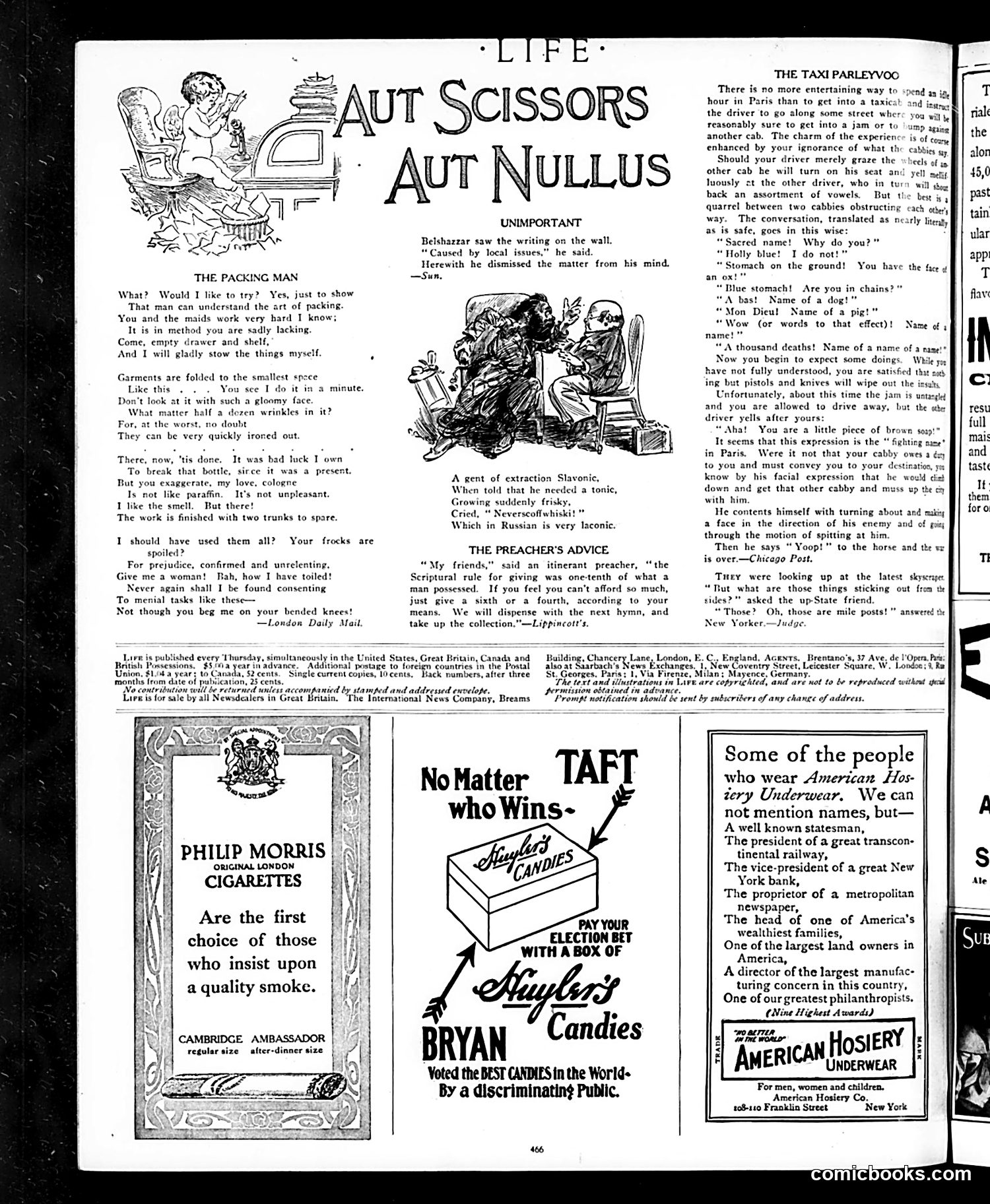
This page from *Life* magazine contains several satirical pieces: **"The Packing Man"** is a humorous poem about a husband who confidently offers to pack for a trip, dismisses his wife's concerns about wrinkles and cologne smell, and successfully packs everything—only to discover he's ruined her clothes. The satire mocks male overconfidence and condescension toward domestic tasks they don't actually understand. **"Aut Scissors / Aut Nullus"** presents two brief anecdotes: one about King Belshazzar ignoring warning signs (a biblical reference), and another about a Slavic man's odd response to being told he needs a tonic. These appear to be simple jokes about dismissing problems or absurd logic. **"The Taxi Parleyvoo"** satirizes the entertaining chaos of Parisian taxi culture—two drivers having an escalating, profanity-laden argument in French while passengers are stuck in traffic. The piece pokes fun at both French expressiveness and the language barrier for English speakers. The advertisements (Philip Morris, Suyler's Candies, American Hosiery) are period typical.
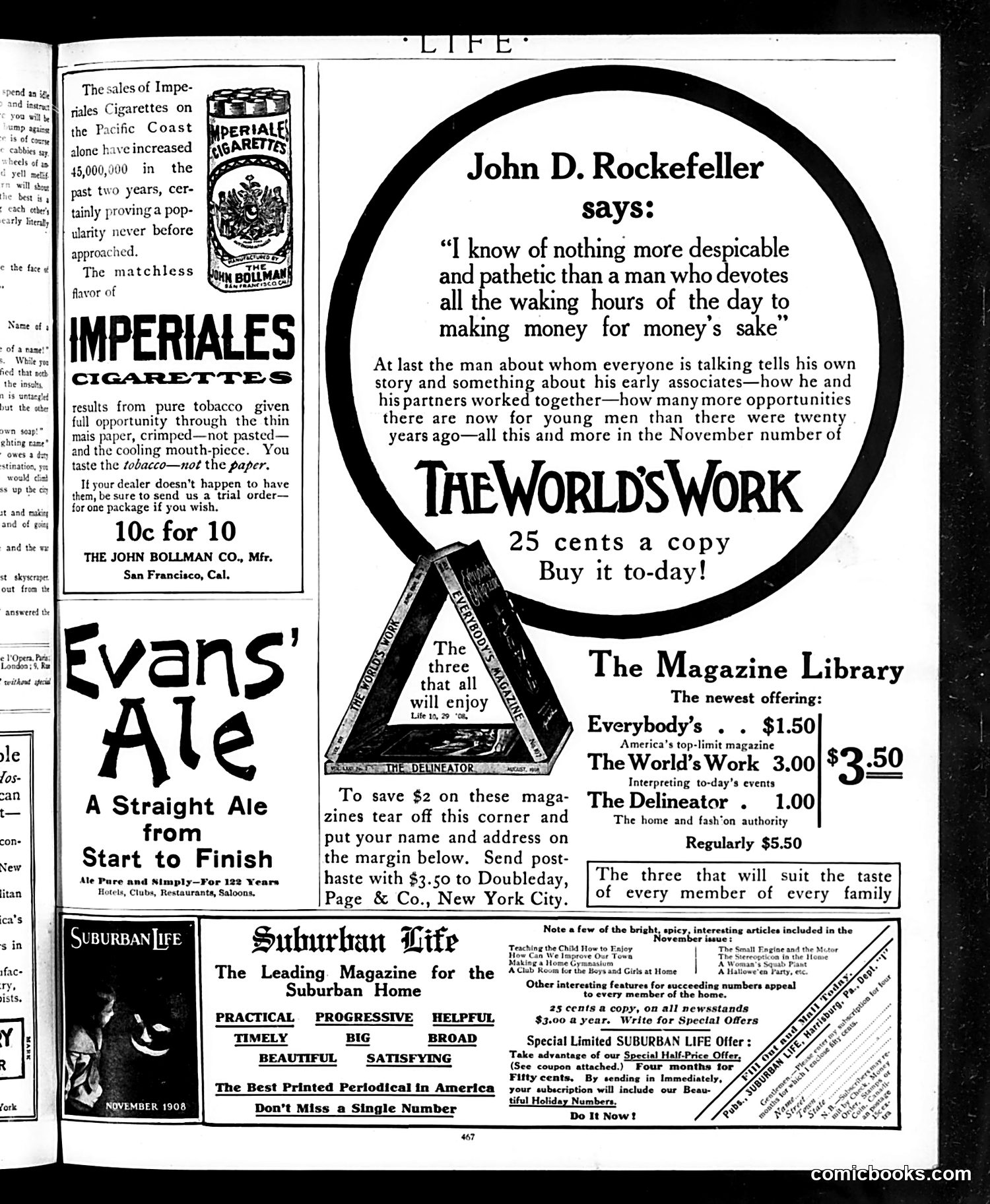
This page is primarily **advertising for *The World's Work* magazine**, not political satire. The central feature is a large circular advertisement quoting John D. Rockefeller denouncing men who pursue wealth obsessively—calling such behavior "despicable and pathetic." The irony is unmistakable: Rockefeller, America's wealthiest industrialist and symbol of ruthless capitalism, is being used to promote a magazine that will publish his "own story" about his early business partnerships and opportunities. This is **self-serving contradiction**—the world's most famous money-maker lecturing against money-making, while simultaneously using that moral stance to sell magazines. For modern readers: this represents how wealthy industrialists in the early 1900s used public relations to rehabilitate their image. Rockefeller's quote attempts to reframe his fortune as somehow morally elevated, justifying his life story as instructive rather than cautionary. The surrounding ads (cigarettes, ale, other magazines) are incidental.
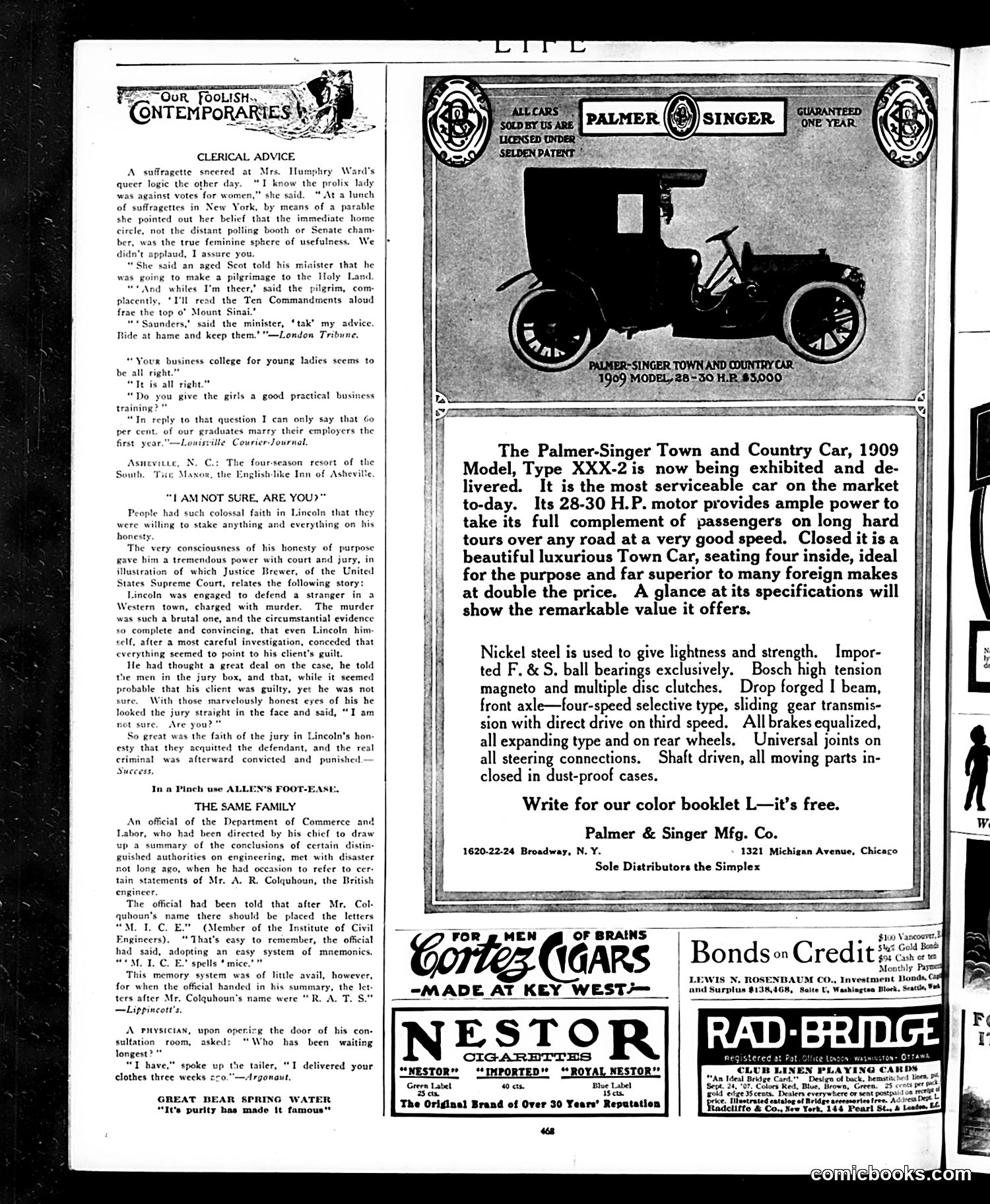
This page is primarily **advertising and humorous anecdotes**, not political satire. The main content consists of: **"Our Foolish Contemporaries"** — A humor column featuring brief jokes about: - A suffragette's argument for voting rights (topical to the women's suffrage movement) - A Scottish pilgrim's religious hypocrisy - A business college that trains girls to marry their employers **The Lincoln Anecdote** — A longer story praising Abraham Lincoln's honesty, illustrating how his genuine uncertainty ("I am not sure") paradoxically convinced a jury of his client's innocence, contrasting his integrity with typical legal tactics. **Smaller jokes** about clerical mishaps and tailors. **The bulk of the page** advertises the **Palmer-Singer Town and Country Car** (1909 model), highlighting its 28-30 H.P. motor, luxury seating, and value—positioned as superior to foreign competitors at half their price. Additional advertisements include cigars, financial services, and spring water. This is essentially a **satirical humor column with substantial advertising**—typical of Life magazine's format in this era.
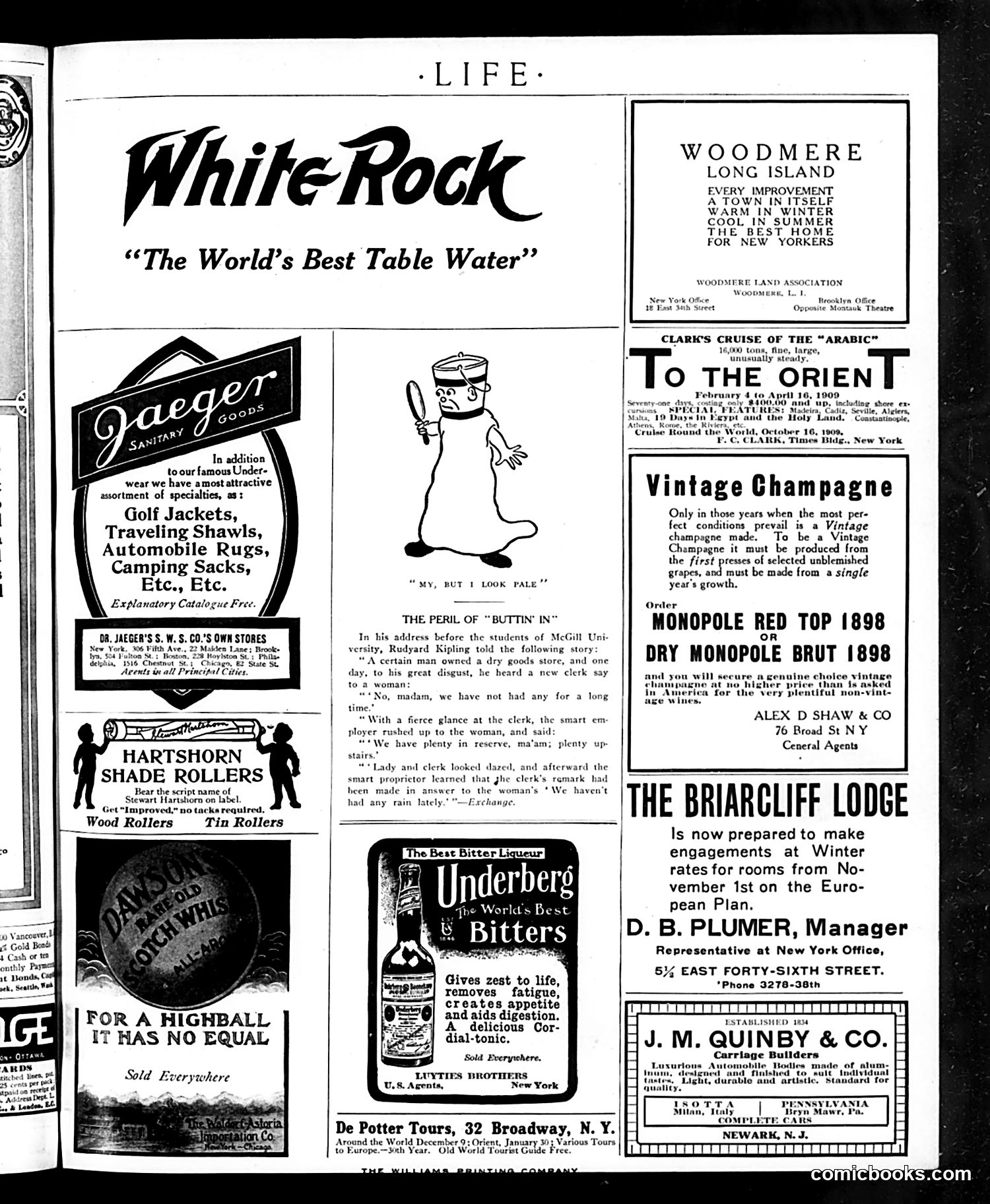
This Life magazine page is primarily **advertising**, with one embedded satirical anecdote. The main content is product advertisements (White Rock water, Dr. Jaeger clothing, Hartshorn shade rollers, Underberg bitters, champagne, etc.). The cartoon labeled "THE PERIL OF 'BUTTIN' IN'" is a brief Rudyard Kipling anecdote attributed to an address at McGill University. It mocks over-eager customer service: a new clerk tells a customer they lack an item, but the proprietor interrupts to contradict him, saying stock exists. The satire criticizes well-meaning but inappropriate interference—the employer's correction worsens the situation by publicly contradicting his employee, undermining his authority. The accompanying illustration shows a thin, pale figure saying "MY, BUT I LOOK PALE," likely representing the embarrassed or diminished clerk after being contradicted. The joke's point: sometimes minding your own business is wiser than "buttin' in," however good your intentions.
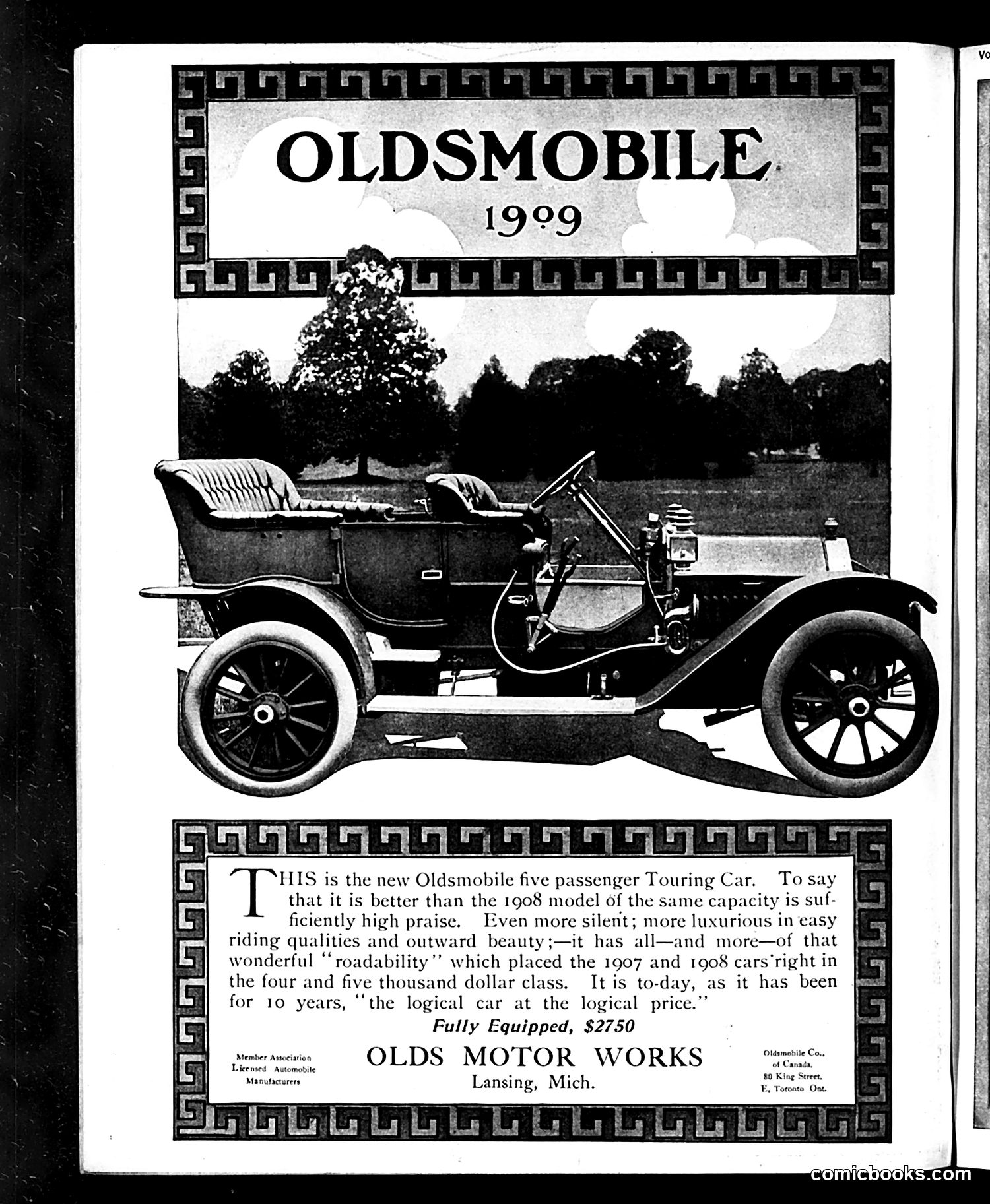
This is a 1909 **automobile advertisement**, not a political cartoon. It promotes Oldsmobile's new five-passenger touring car. The ad's key selling points address what modern readers should understand: 1. **"Roadability"** was a crucial term—early cars were notoriously unreliable and uncomfortable on poor roads. 2. The comparison to 1907-1908 models suggests **rapid automotive improvement** during this period of innovation. 3. Pricing ($2,750 fully equipped) positioned it as middle-class aspirational—expensive but positioned as "logical" value versus luxury cars costing $4,000-5,000. 4. The emphasis on being **"silent" and "luxurious"** indicates early cars were loud, rough, and spartan. 5. Ten years of market presence suggests Oldsmobile's established reliability—important when automobile manufacturing was chaotic and many brands disappeared. The decorative Greek key border reflects the era's design aesthetic.