
Life, 1908-10-29 · page 13 of 20
Life — October 29, 1908 — page 13: what you’re looking at
What you’re looking at
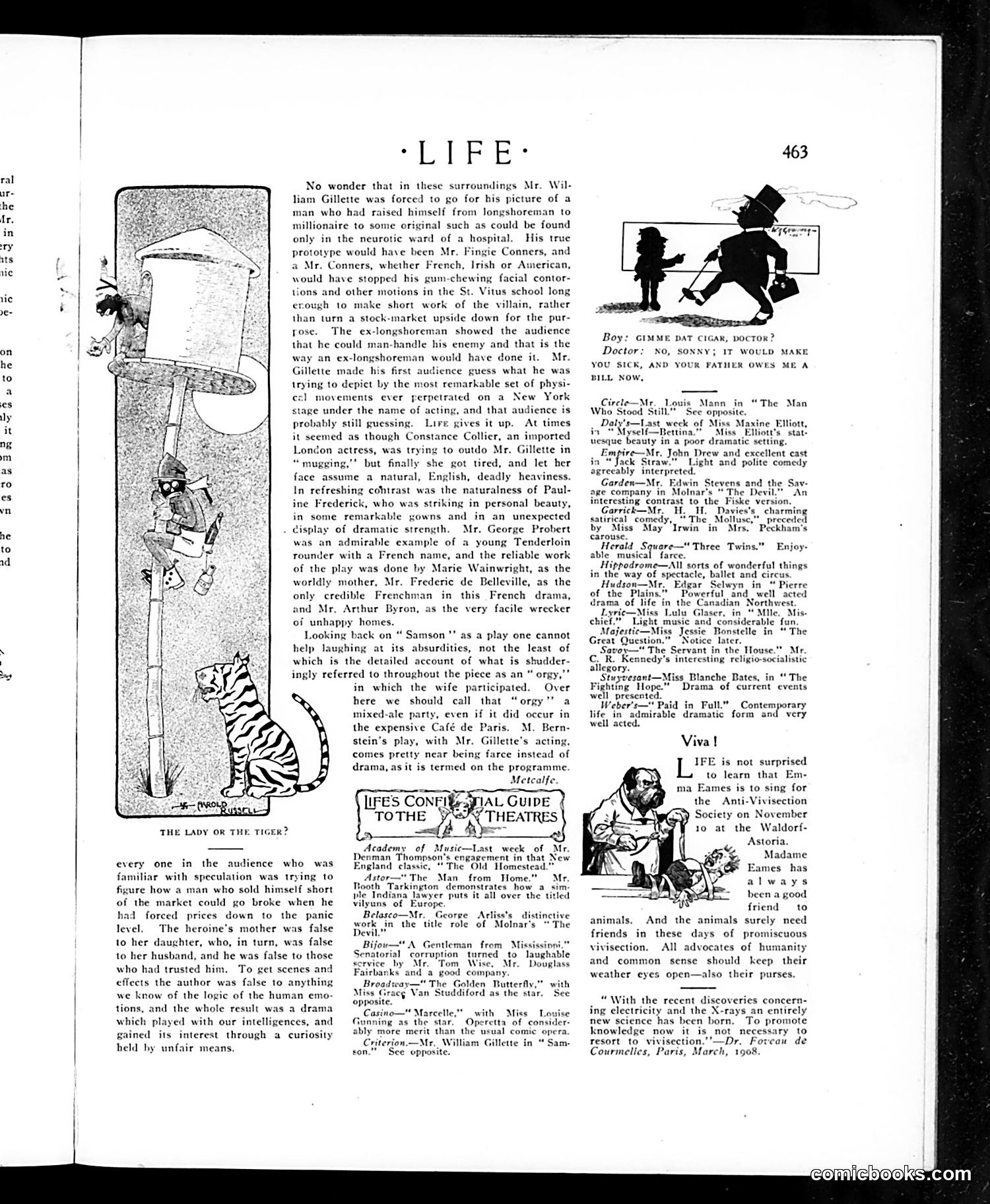
This page contains theater reviews and a cartoon titled "The Lady or the Tiger?" The cartoon depicts a man confronting a tiger, illustrating the famous ambiguous story by Frank R. Stockton where a character must choose between two doors—one hiding a lady, one a tiger. The drawing shows the moment of suspenseful choice. The surrounding text reviews contemporary theatrical productions (1908), including performances by William Gillette and other actors. The reviews critique acting quality and plot coherence. One section humorously discusses how audiences couldn't guess the ending of one production, reflecting the magazine's satirical commentary on theatrical entertainment and audience expectations of the era.
📄 Transcribed text from this page (OCR, searchable)
Machine-transcribed from the original scan — historical spelling and the odd misread are preserved.
on he a es ly it m, ad ¢ LFE No wonder that in these surroundings Mr. Wi liam Gillette was forced to go for his picture of a man who had raised himself from longshoreman to millionaire to some original such as could be found only in the neurotic ward of a hospital. His true prototype would have been Mr. Fingie Conners, and a Mr. Conners, whether French, Irish or American, would have stopped his gum-chewing facial contor- tions and other motions in the St. Vitus school long enough to make short work of the villain, rather than turn a stock-market upside down for the pur- rose. The ex-longshoreman showed the audience that he could m way an ex-longshoreman would have done it. Mr. Gillette made his first audience guess what he was trying to depict by the most remarkable set of physi- 2] movements ever perpetrated on a New York stage under the name of acting, and that audience is probably still guessing. Lire gives it up. At times it seemed as though Constance Collier, an imported London actress, was trying to outdo Mr. Gillette in “mugging,"? but finally she got tired, and let her face assume a natural, English, deadly heaviness. In refreshing cohtrast was the naturalness of Paul- ine Frederick, who was striking in personal beaut in some remarkable yowns and in an unexpected Cisplay of dramatic strength. Mr. George Probert was an admirable example of a young Tenderloin rounder with a French name, and the reliable work of the play was done by Marie Wainwright, as the worldly mother, Mr. Frederic de Belleville, as the only credible Frenchman in this French drama, and Mr, Arthur Byron, as the very facile wrecker of unhappy homes. Looking back on “ Samson "’ as a play one cannot help laughing at its absurdities, not the least of which is the detailed account of what is shudder- ingly referred to throughout the piece as an “ orgy,”” in which the wife participated. Over here we should call that “orgy? a mixed-ale party, even if it did occur in the expensive Café de Paris. M. Bern- stein’s play, with Mr. Gillette’s acting, comes pretty near being farce instead of drama, as it is termed on the programme Metcalfe. ( LIFES CONFI TOTHE is AL GUIDE THE LaDy OR THE TIGER? ts. fh n-handle his enemy and that is the Academy of Music—Last week of Mr. i , Denman Thompson's engagement in that every one in the audience who was — England classic, “The Old Homestead. familiar with speculation was trying to | Astor—"The Man from Home.” Mr. Rosie: ¥ w id hi Rooth Tarkington demonstrates how a sim: figure how a man who sold himself short ie°Yndiana lawyer puts It all over the titled of the market could go broke when he — vilyuns of Europe. had forced prices down to the panic Belasco—Mr. George Arliss's distinctive level, The heroine's mother was false york jn the title role of Molnar's “The to her daughter, who, in turn, was false Bijou— A Gentleman from Mississinni.” to her husband, and he was false to those Senatorial corruption turned to laughable bo ad trusted To eet scenes and Set¥ice by Mr. ‘Tom Wise, Mr. Douglass who had trusted him. To get scenes an thanks and a good company. effects the author was false to anything Broadway—" The Golden Butterfly," with we know of the logic of the human emo- Miss (iracg Van Studdiford as the star. See tions, and the whole res "Conino—" Marcelle,” with Mice Louise which played with our i gf as the star. Operetta of consider- gained its interest through a curiosity more merit than the usual comic opera held by unfair means. : Criterion.—Mr. William Gillette in “ Sam- son." See opposite. t was a drama ¢ telligences, and 463 Boy: GIMME DAT CIGAR, DOCTOR? Doctor: No, SONNY; IT WOULD MAK: YOU SICK, AND YOUR FATHER OWES ME A BILL Now, Circle—Mr. Louis Mann in “The Man Who Stood Still.” See opposite. Daly’s—Last week of Miss Maxine Elliott, in * Myself—Bettina.” Miss Elliott's stat: uesque beauty in a poor dramatic setting. Empire—Mr. John Drew and excellent cast in “Jack Straw.” Light and polite comedy agreeably interpreted. Garden—Mr. Edwin Stevens and the Sav- age company in Molnar’s “The Devil." An interesting contrast to the Fiske version, Garrick—Mr. H, IH. Davies's, charming satirical comedy, “ The Mollus« preceded by Miss May ‘Irwin in Mrs,” Peckham’s carouse. Herald Square— Three Twins.” Enjoy- able. musical farce. Hippodrome—All sorts of wonderful things in the way of spectacle, ballet and circus. Edgar’ Selwyn in“ Pierre Powerful and well acted drama of life in the Canadian Northwest yri¢—Miss Lulu Glaser, in “ Mlle, Mis- Light music and considerable fun. Majestic—Miss Jessie Ronstelle in “ The Great Ques Notice later. Savor—" Servant in the House." Mr. C. R. Kennedy's interesting religio-socialistic ailegory. Stuyvesant—Miss Blanche Bates, in “ The Fighting Hope.” Drama of current’ events well presented. Weber’s—"* Paid in Full.” | Contemporary life in admirable dramatic form and very well acted. Viva ! IFE is not surprised to learn that ma Eames is to sing for the Anti-Vivisection Society on November 10 at the Waldorf- Astori Madame mes has always ie - been a good vi friend to animals. And the animals surely need friends in these days of promiscuous vivisection, All advocates of humanity and common sense should keep their weather eyes open—also their purses. Em- “With the recent discoveries concern- ing electricity and the X-rays an entirely new science has been born. To promote knowledge now it is not necessary to resort to vivisection."’—Dr. Foveau de Courmelies, Paris, March, 1908